Nirajkumar R.Sindhi. et.al. Int. Journal of Engineering Research and Applications www.ijera.com
ISSN: 2248-9622, Vol. 6, Issue 5, (Part - 1) May 2016, pp.43-47
www.ijera.com 43|P a g e
Study of Steel Moment Resisting Frame with Reduced Beam
Section
Nirajkumar R.Sindhi1
, Jasmin A.Gadhiya2
, Hitesh K.Dhameliya3
1, 2, 3
(Department of Civil Engineering, CGPIT, UTU University, Tarsadi, Surat)
ABSTRACT
A research became necessary after the collapse of steel structure during the 1994 Northridge and 1995 Kobe
earthquakes. Reduced beam section emerged as one of the best solution. Guidelines about the cut, that is to be
introduced in the flange of the beam section, are obtained from FEMA 350. Here, a G+15 storey steel building is
modeled using RBS as a component in one building and regular beam section as a component of the other in
STAAD PRO V8i. Time history analysis is carried out in this paper. Displacement, storey drift, time period and
base shear of both the buildings are compared as the result. Base shear shows no change but considerable change
in displacement and storey drift is observed.
Keywords: FEMA 350, MR frames, Reduced beam section, STAAD pro v8i, Time history analysis
I. INTRODUCTION
During the 1994 Northridge earthquake, the
bolted web-welded flange moment connections in
steel moment-resisting frames suffered unexpected
brittle failures in and near the heat-affected zones
[1]. A lot of damage of lives and property was
observed during this earthquake. Many industrial
steel buildings were severely damaged during this
havoc. Many modifications have been proposed for
post Northridge earthquake new construction and
retrofit of steel moment frames [1].
Many of the recommendations in FEMA
350 have since found their way into the Seismic
Provisions for Structural Steel Buildings published
by the American Institute of Steel Construction
(AISC) [2]. The most commonly observed damage
occurred in or near the welded joint of the bottom
flange of a girder to the supporting flange of column.
All of the connections approved in for Steel Moment
Resisting Frames combined improvements in
welding along with detailing that induce the beam
plastic hinge to form a short distance away from the
beam-to-column interface. The type of detailing that
shifts the plastic hinges away from the connection
region generally falls into two main categories,
reinforcement detailing and reduced beam section
detailing.
The Reduced Beam Section (RBS) is one of
the ways to weaken the beam framing to the column.
However the typology and technology of the RBS
beam to column connection, as well as its behavior
under cyclic loading conditions were investigated in
USA after the Northridge earthquake. Reduced beam
section connections provide similar benefits to
reinforced connections, but are more efficient and
economical because they do not require the extra
field welding and material associated with reinforced
connections. RBS connections also have a number of
advantages in design practice. Compared to
reinforced connections, their use leads to reduced
demands for continuity plates, panel zone
reinforcement, and strong column–weak-beam
requirements [2].
Here, a G+15 storey steel building is
analyzed with and without RBS. Time history
dynamic analysis is carried out and thus base shear,
displacement, storey drift and time period are
compared of both the buildings, thus giving the
advantages of building with RBS over building
without rbs.
II. GUIDELINES FOR DESIGN OF
REDUCED BEAM SECTION
The guidelines for deciding the dimensions
and design of RBS based on the shear and flexure
parameters have been given in FEMA-350. The
guideline provided in this document is for design of
fully restrained Reduced Beam Section (RBS)
connection. Figure 3.1 provides typical details for
such connections. When connection with RBS is
used, the elastic drift calculations should be
considered the effect of the flange reduction. In lieu
of specific calculations, a drift increase of 9% may
be applied for flange reductions ranging to 50% of
the beam flange width, with linear interpolation for
lesser values of beam flange reduction.
RESEARCH ARTICLE OPEN ACCESS
Nirajkumar R.Sindhi. et.al. Int. Journal of Engineering Research and Applications www.ijera.com
ISSN: 2248-9622, Vol. 6, Issue 5, (Part - 1) May 2016, pp.43-47
www.ijera.com 44|P a g e
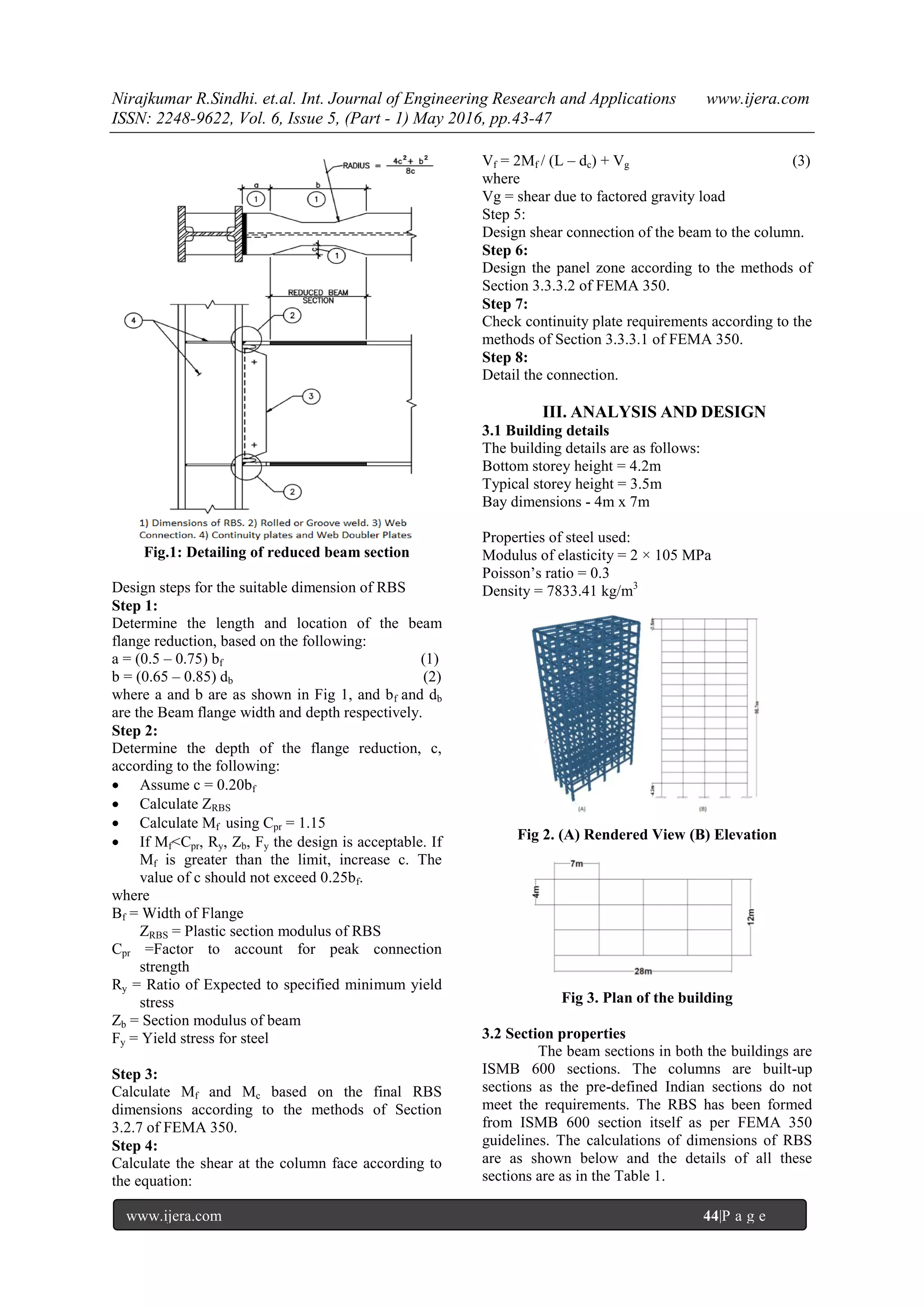
Fig.1: Detailing of reduced beam section
Design steps for the suitable dimension of RBS
Step 1:
Determine the length and location of the beam
flange reduction, based on the following:
a = (0.5 – 0.75) bf (1)
b = (0.65 – 0.85) db (2)
where a and b are as shown in Fig 1, and bf and db
are the Beam flange width and depth respectively.
Step 2:
Determine the depth of the flange reduction, c,
according to the following:
 Assume c = 0.20bf
 Calculate ZRBS
 Calculate Mf using Cpr = 1.15
 If Mf<Cpr, Ry, Zb, Fy the design is acceptable. If
Mf is greater than the limit, increase c. The
value of c should not exceed 0.25bf.
where
Bf = Width of Flange
ZRBS = Plastic section modulus of RBS
Cpr =Factor to account for peak connection
strength
Ry = Ratio of Expected to specified minimum yield
stress
Zb = Section modulus of beam
Fy = Yield stress for steel
Step 3:
Calculate Mf and Mc based on the final RBS
dimensions according to the methods of Section
3.2.7 of FEMA 350.
Step 4:
Calculate the shear at the column face according to
the equation:
Vf = 2Mf / (L – dc) + Vg (3)
where
Vg = shear due to factored gravity load
Step 5:
Design shear connection of the beam to the column.
Step 6:
Design the panel zone according to the methods of
Section 3.3.3.2 of FEMA 350.
Step 7:
Check continuity plate requirements according to the
methods of Section 3.3.3.1 of FEMA 350.
Step 8:
Detail the connection.
III. ANALYSIS AND DESIGN
3.1 Building details
The building details are as follows:
Bottom storey height = 4.2m
Typical storey height = 3.5m
Bay dimensions - 4m x 7m
Properties of steel used:
Modulus of elasticity = 2 × 10⁵ MPa
Poisson’s ratio = 0.3
Density = 7833.41 kg/m3
Fig 2. (A) Rendered View (B) Elevation
Fig 3. Plan of the building
3.2 Section properties
The beam sections in both the buildings are
ISMB 600 sections. The columns are built-up
sections as the pre-defined Indian sections do not
meet the requirements. The RBS has been formed
from ISMB 600 section itself as per FEMA 350
guidelines. The calculations of dimensions of RBS
are as shown below and the details of all these
sections are as in the Table 1.
Nirajkumar R.Sindhi. et.al. Int. Journal of Engineering Research and Applications www.ijera.com
ISSN: 2248-9622, Vol. 6, Issue 5, (Part - 1) May 2016, pp.43-47
www.ijera.com 45|P a g e
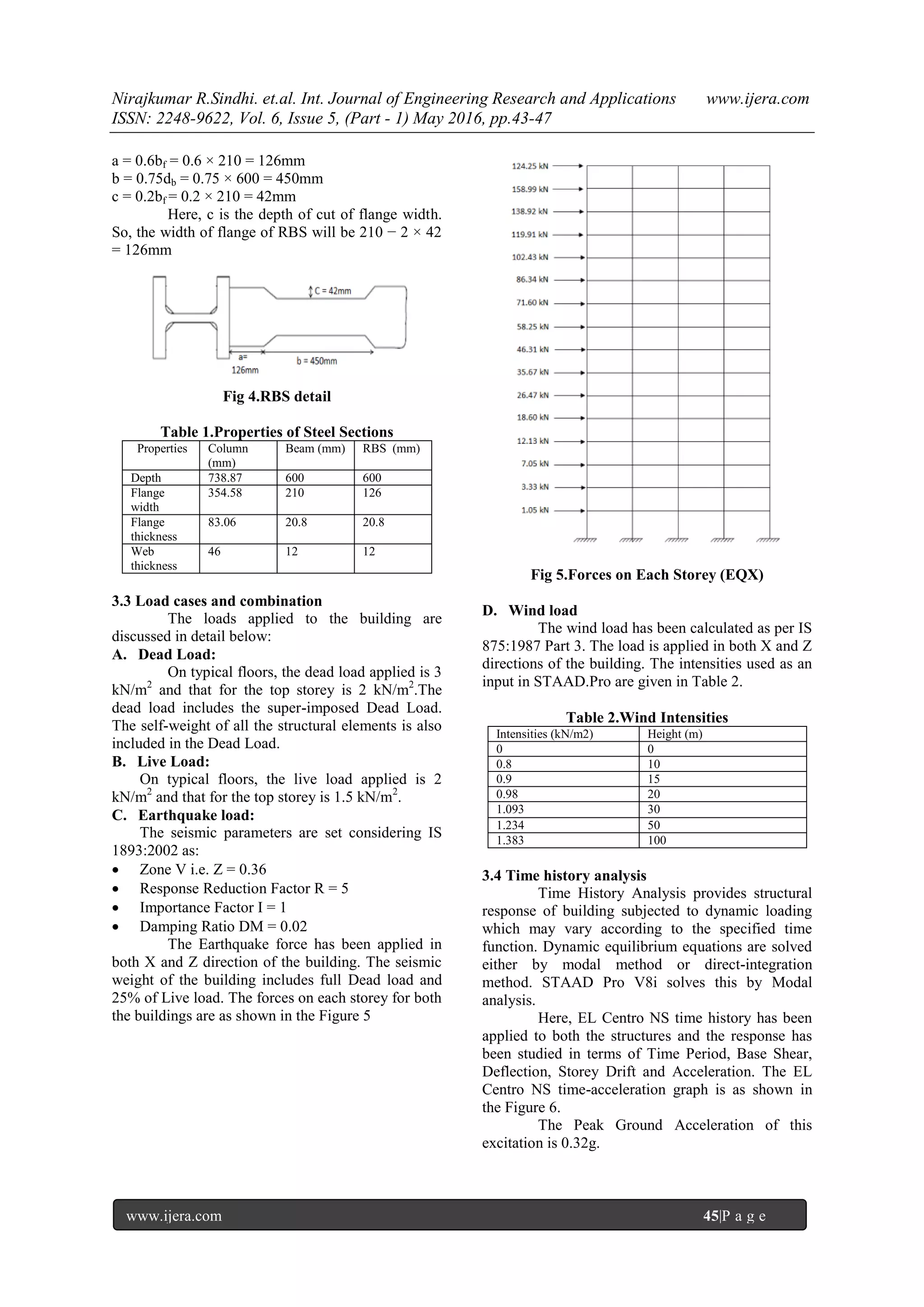
a = 0.6bf = 0.6 × 210 = 126mm
b = 0.75db = 0.75 × 600 = 450mm
c = 0.2bf = 0.2 × 210 = 42mm
Here, c is the depth of cut of flange width.
So, the width of flange of RBS will be 210 − 2 × 42
= 126mm
Fig 4.RBS detail
Table 1.Properties of Steel Sections
Properties Column
(mm)
Beam (mm) RBS (mm)
Depth 738.87 600 600
Flange
width
354.58 210 126
Flange
thickness
83.06 20.8 20.8
Web
thickness
46 12 12
3.3 Load cases and combination
The loads applied to the building are
discussed in detail below:
A. Dead Load:
On typical floors, the dead load applied is 3
kN/m2
and that for the top storey is 2 kN/m2
.The
dead load includes the super-imposed Dead Load.
The self-weight of all the structural elements is also
included in the Dead Load.
B. Live Load:
On typical floors, the live load applied is 2
kN/m2
and that for the top storey is 1.5 kN/m2
.
C. Earthquake load:
The seismic parameters are set considering IS
1893:2002 as:
 Zone V i.e. Z = 0.36
 Response Reduction Factor R = 5
 Importance Factor I = 1
 Damping Ratio DM = 0.02
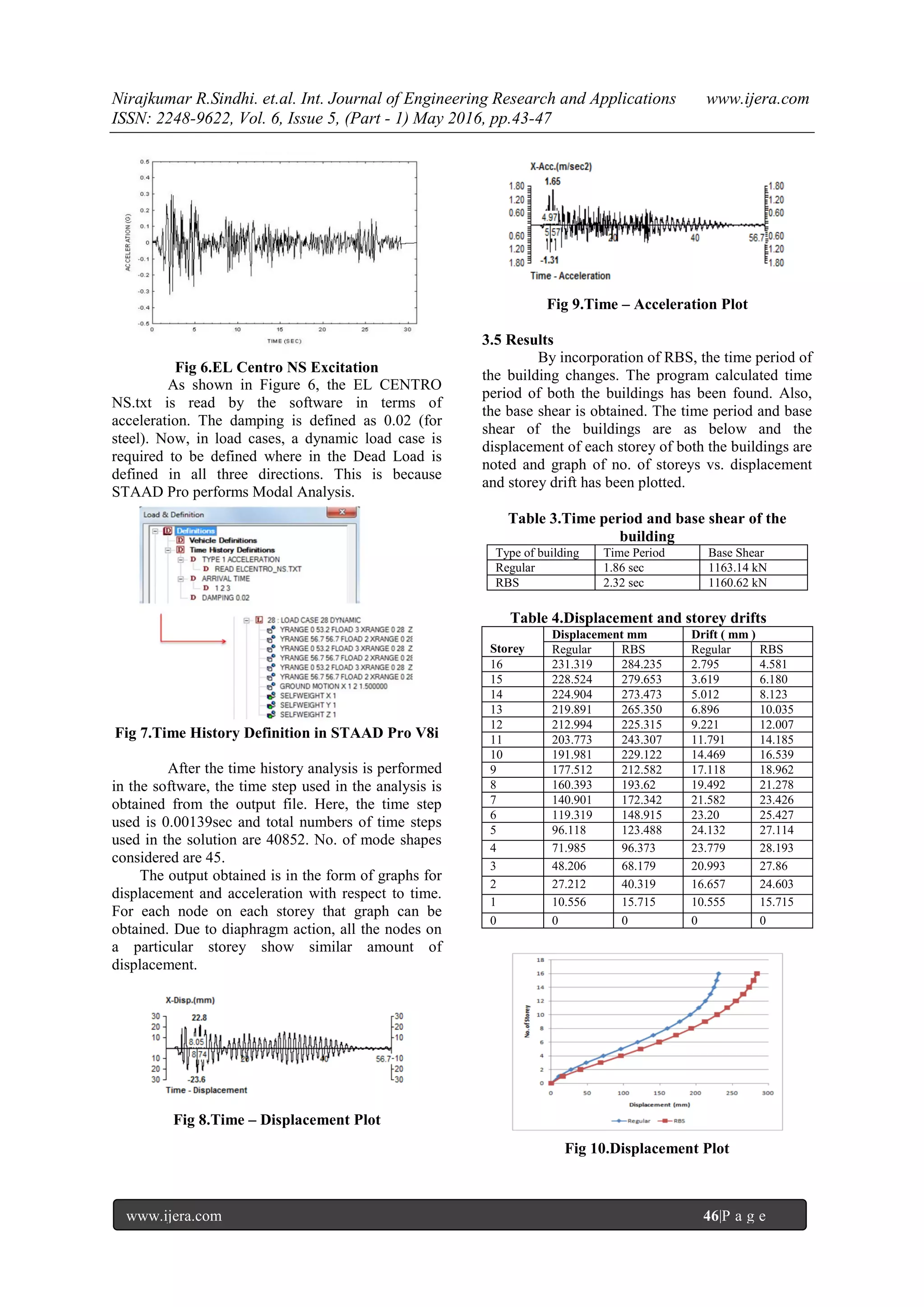
The Earthquake force has been applied in
both X and Z direction of the building. The seismic
weight of the building includes full Dead load and
25% of Live load. The forces on each storey for both
the buildings are as shown in the Figure 5
Fig 5.Forces on Each Storey (EQX)
D. Wind load
The wind load has been calculated as per IS
875:1987 Part 3. The load is applied in both X and Z
directions of the building. The intensities used as an
input in STAAD.Pro are given in Table 2.
Table 2.Wind Intensities
Intensities (kN/m2) Height (m)
0 0
0.8 10
0.9 15
0.98 20
1.093 30
1.234 50
1.383 100
3.4 Time history analysis
Time History Analysis provides structural
response of building subjected to dynamic loading
which may vary according to the specified time
function. Dynamic equilibrium equations are solved
either by modal method or direct-integration
method. STAAD Pro V8i solves this by Modal
analysis.
Here, EL Centro NS time history has been
applied to both the structures and the response has
been studied in terms of Time Period, Base Shear,
Deflection, Storey Drift and Acceleration. The EL
Centro NS time-acceleration graph is as shown in
the Figure 6.
The Peak Ground Acceleration of this
excitation is 0.32g.
Nirajkumar R.Sindhi. et.al. Int. Journal of Engineering Research and Applications www.ijera.com
ISSN: 2248-9622, Vol. 6, Issue 5, (Part - 1) May 2016, pp.43-47
www.ijera.com 46|P a g e
Fig 6.EL Centro NS Excitation
As shown in Figure 6, the EL CENTRO
NS.txt is read by the software in terms of
acceleration. The damping is defined as 0.02 (for
steel). Now, in load cases, a dynamic load case is
required to be defined where in the Dead Load is
defined in all three directions. This is because
STAAD Pro performs Modal Analysis.
Fig 7.Time History Definition in STAAD Pro V8i
After the time history analysis is performed
in the software, the time step used in the analysis is
obtained from the output file. Here, the time step
used is 0.00139sec and total numbers of time steps
used in the solution are 40852. No. of mode shapes
considered are 45.
The output obtained is in the form of graphs for
displacement and acceleration with respect to time.
For each node on each storey that graph can be
obtained. Due to diaphragm action, all the nodes on
a particular storey show similar amount of
displacement.
Fig 8.Time – Displacement Plot
Fig 9.Time – Acceleration Plot
3.5 Results
By incorporation of RBS, the time period of
the building changes. The program calculated time
period of both the buildings has been found. Also,
the base shear is obtained. The time period and base
shear of the buildings are as below and the
displacement of each storey of both the buildings are
noted and graph of no. of storeys vs. displacement
and storey drift has been plotted.
Table 3.Time period and base shear of the
building
Type of building Time Period Base Shear
Regular 1.86 sec 1163.14 kN
RBS 2.32 sec 1160.62 kN
Table 4.Displacement and storey drifts
Storey
Displacement mm Drift ( mm )
Regular RBS Regular RBS
16 231.319 284.235 2.795 4.581
15 228.524 279.653 3.619 6.180
14 224.904 273.473 5.012 8.123
13 219.891 265.350 6.896 10.035
12 212.994 225.315 9.221 12.007
11 203.773 243.307 11.791 14.185
10 191.981 229.122 14.469 16.539
9 177.512 212.582 17.118 18.962
8 160.393 193.62 19.492 21.278
7 140.901 172.342 21.582 23.426
6 119.319 148.915 23.20 25.427
5 96.118 123.488 24.132 27.114
4 71.985 96.373 23.779 28.193
3 48.206 68.179 20.993 27.86
2 27.212 40.319 16.657 24.603
1 10.556 15.715 10.555 15.715
0 0 0 0 0
Fig 10.Displacement Plot
Nirajkumar R.Sindhi. et.al. Int. Journal of Engineering Research and Applications www.ijera.com
ISSN: 2248-9622, Vol. 6, Issue 5, (Part - 1) May 2016, pp.43-47
www.ijera.com 47|P a g e
Fig 11.Storey Drift Plot
RBS being a cut in the regular beam
element reduces the weight of the building. The total
reduction of weight is calculated here to see the cost
benefit of using RBS. Table 5 summarizes the
weights of elements in both the buildings.
Table 5.Material Weight
Element Regular building Building with RBS
Length Weight Length Weight
Column 1134 m 7418.67
kN
1134 m 7418.67
kN
Beam 2752 m 3302.18
kN
2352.3
m
2822.56
kN
RBS - - 399.71
m
366.7 kN
Total 10720.85
kN
10607.93
kN
The difference in weight = 112.92 kN = 11.51 ton.
Considering cost of steel as Rs.65/kg
Cost Benefit = Rs.65000 × 11.51 ton = Rs.7.48 lakhs
IV. CONCLUSION
Following are the important conclusions made
from the present study:
 The results show that there has been an increase
in the Time Period of building with RBS by
25% over the building with conventional beams.
 The deflection of the top storey of the building
with RBS increases by 23% over the regular
building. The storey drifts also shows an
increase with incorporation of RBS.
 There is also a considerable amount of increase
in the storey drift by incorporating RBS.
 The difference between base shear of the
building with RBS and without RBS is almost
negligible.
 Due to the reduction of beam cross section at
some locations, there is a decrease in structural
steel material. So, there will be a benefit in total
cost of material.
REFERENCES
Journal Papers:
[1] J.shen, T. Kitjasateanphun, W. Srivanich,
“Seismic performance of steel moment
frames with reduced beam sections”,
Engineering Structures 22, pp 968-983,
2000
[2] Jun Jin, Sherif El-Tawil, “Seismic
Performance of Steel Frames with reduced
beam section connections”, Journal of
Constructional Steel Research 61, pp 452-
471, 2005
[3] Swati Ajay Kulkarni, Gaurang Vesmala,“
Study of Steel Moment connection with and
without reduced beam section”, Case
Studies in Structural Engineering 1, pp 26-
31, 2014
[4] Scott M. Adan, Lawrence D.
Reaveley,“The Reduced Beam Section
Moment Connection without Continuity
Plates”,13th World Conference on
Earthquake, 2000
[5] Brandon Chi, Chia-Ming Uang, “Cyclic
response and design recommendations of
reduced beam section moment connections
with deep columns”, Journal of Structural
Engineering, 0733-9445 ,pp 464-472,2002
[6] Scott L jones, Gary T fry, “Reduced beam
section welded steel moment frames”, 13th
World Conference on Earthquake, pp 1671,
2000
[7] K.Kildashti, R.Mirghaderi, I.M.Kani ,“The
efficiency of reduced beam section
connections for reducing residual drifts in
MR Frames”, Open Journal of Civil
Engineering, 2, pp 68-72, 2012
[8] C.E.Sofias, C.N.Kalfas, D.T.Pachoumis,
“Experimental and FEM analysis of
reduced beam section moment endplate
connections under cyclic loading”,
Engineering Structures, 59,pp 320-
329,2014
[9] IS 800-2007, General construction in steel-
code of practice
[10] FEMA 350, Recommenced seismic design
criteria for new steel moment frame
buildings

Study of Steel Moment Resisting Frame with Reduced Beam Section

  • 1.
    Nirajkumar R.Sindhi. et.al.Int. Journal of Engineering Research and Applications www.ijera.com ISSN: 2248-9622, Vol. 6, Issue 5, (Part - 1) May 2016, pp.43-47 www.ijera.com 43|P a g e Study of Steel Moment Resisting Frame with Reduced Beam Section Nirajkumar R.Sindhi1 , Jasmin A.Gadhiya2 , Hitesh K.Dhameliya3 1, 2, 3 (Department of Civil Engineering, CGPIT, UTU University, Tarsadi, Surat) ABSTRACT A research became necessary after the collapse of steel structure during the 1994 Northridge and 1995 Kobe earthquakes. Reduced beam section emerged as one of the best solution. Guidelines about the cut, that is to be introduced in the flange of the beam section, are obtained from FEMA 350. Here, a G+15 storey steel building is modeled using RBS as a component in one building and regular beam section as a component of the other in STAAD PRO V8i. Time history analysis is carried out in this paper. Displacement, storey drift, time period and base shear of both the buildings are compared as the result. Base shear shows no change but considerable change in displacement and storey drift is observed. Keywords: FEMA 350, MR frames, Reduced beam section, STAAD pro v8i, Time history analysis I. INTRODUCTION During the 1994 Northridge earthquake, the bolted web-welded flange moment connections in steel moment-resisting frames suffered unexpected brittle failures in and near the heat-affected zones [1]. A lot of damage of lives and property was observed during this earthquake. Many industrial steel buildings were severely damaged during this havoc. Many modifications have been proposed for post Northridge earthquake new construction and retrofit of steel moment frames [1]. Many of the recommendations in FEMA 350 have since found their way into the Seismic Provisions for Structural Steel Buildings published by the American Institute of Steel Construction (AISC) [2]. The most commonly observed damage occurred in or near the welded joint of the bottom flange of a girder to the supporting flange of column. All of the connections approved in for Steel Moment Resisting Frames combined improvements in welding along with detailing that induce the beam plastic hinge to form a short distance away from the beam-to-column interface. The type of detailing that shifts the plastic hinges away from the connection region generally falls into two main categories, reinforcement detailing and reduced beam section detailing. The Reduced Beam Section (RBS) is one of the ways to weaken the beam framing to the column. However the typology and technology of the RBS beam to column connection, as well as its behavior under cyclic loading conditions were investigated in USA after the Northridge earthquake. Reduced beam section connections provide similar benefits to reinforced connections, but are more efficient and economical because they do not require the extra field welding and material associated with reinforced connections. RBS connections also have a number of advantages in design practice. Compared to reinforced connections, their use leads to reduced demands for continuity plates, panel zone reinforcement, and strong column–weak-beam requirements [2]. Here, a G+15 storey steel building is analyzed with and without RBS. Time history dynamic analysis is carried out and thus base shear, displacement, storey drift and time period are compared of both the buildings, thus giving the advantages of building with RBS over building without rbs. II. GUIDELINES FOR DESIGN OF REDUCED BEAM SECTION The guidelines for deciding the dimensions and design of RBS based on the shear and flexure parameters have been given in FEMA-350. The guideline provided in this document is for design of fully restrained Reduced Beam Section (RBS) connection. Figure 3.1 provides typical details for such connections. When connection with RBS is used, the elastic drift calculations should be considered the effect of the flange reduction. In lieu of specific calculations, a drift increase of 9% may be applied for flange reductions ranging to 50% of the beam flange width, with linear interpolation for lesser values of beam flange reduction. RESEARCH ARTICLE OPEN ACCESS
  • 2.
    Nirajkumar R.Sindhi. et.al.Int. Journal of Engineering Research and Applications www.ijera.com ISSN: 2248-9622, Vol. 6, Issue 5, (Part - 1) May 2016, pp.43-47 www.ijera.com 44|P a g e Fig.1: Detailing of reduced beam section Design steps for the suitable dimension of RBS Step 1: Determine the length and location of the beam flange reduction, based on the following: a = (0.5 – 0.75) bf (1) b = (0.65 – 0.85) db (2) where a and b are as shown in Fig 1, and bf and db are the Beam flange width and depth respectively. Step 2: Determine the depth of the flange reduction, c, according to the following:  Assume c = 0.20bf  Calculate ZRBS  Calculate Mf using Cpr = 1.15  If Mf<Cpr, Ry, Zb, Fy the design is acceptable. If Mf is greater than the limit, increase c. The value of c should not exceed 0.25bf. where Bf = Width of Flange ZRBS = Plastic section modulus of RBS Cpr =Factor to account for peak connection strength Ry = Ratio of Expected to specified minimum yield stress Zb = Section modulus of beam Fy = Yield stress for steel Step 3: Calculate Mf and Mc based on the final RBS dimensions according to the methods of Section 3.2.7 of FEMA 350. Step 4: Calculate the shear at the column face according to the equation: Vf = 2Mf / (L – dc) + Vg (3) where Vg = shear due to factored gravity load Step 5: Design shear connection of the beam to the column. Step 6: Design the panel zone according to the methods of Section 3.3.3.2 of FEMA 350. Step 7: Check continuity plate requirements according to the methods of Section 3.3.3.1 of FEMA 350. Step 8: Detail the connection. III. ANALYSIS AND DESIGN 3.1 Building details The building details are as follows: Bottom storey height = 4.2m Typical storey height = 3.5m Bay dimensions - 4m x 7m Properties of steel used: Modulus of elasticity = 2 × 10⁵ MPa Poisson’s ratio = 0.3 Density = 7833.41 kg/m3 Fig 2. (A) Rendered View (B) Elevation Fig 3. Plan of the building 3.2 Section properties The beam sections in both the buildings are ISMB 600 sections. The columns are built-up sections as the pre-defined Indian sections do not meet the requirements. The RBS has been formed from ISMB 600 section itself as per FEMA 350 guidelines. The calculations of dimensions of RBS are as shown below and the details of all these sections are as in the Table 1.
  • 3.
    Nirajkumar R.Sindhi. et.al.Int. Journal of Engineering Research and Applications www.ijera.com ISSN: 2248-9622, Vol. 6, Issue 5, (Part - 1) May 2016, pp.43-47 www.ijera.com 45|P a g e a = 0.6bf = 0.6 × 210 = 126mm b = 0.75db = 0.75 × 600 = 450mm c = 0.2bf = 0.2 × 210 = 42mm Here, c is the depth of cut of flange width. So, the width of flange of RBS will be 210 − 2 × 42 = 126mm Fig 4.RBS detail Table 1.Properties of Steel Sections Properties Column (mm) Beam (mm) RBS (mm) Depth 738.87 600 600 Flange width 354.58 210 126 Flange thickness 83.06 20.8 20.8 Web thickness 46 12 12 3.3 Load cases and combination The loads applied to the building are discussed in detail below: A. Dead Load: On typical floors, the dead load applied is 3 kN/m2 and that for the top storey is 2 kN/m2 .The dead load includes the super-imposed Dead Load. The self-weight of all the structural elements is also included in the Dead Load. B. Live Load: On typical floors, the live load applied is 2 kN/m2 and that for the top storey is 1.5 kN/m2 . C. Earthquake load: The seismic parameters are set considering IS 1893:2002 as:  Zone V i.e. Z = 0.36  Response Reduction Factor R = 5  Importance Factor I = 1  Damping Ratio DM = 0.02 The Earthquake force has been applied in both X and Z direction of the building. The seismic weight of the building includes full Dead load and 25% of Live load. The forces on each storey for both the buildings are as shown in the Figure 5 Fig 5.Forces on Each Storey (EQX) D. Wind load The wind load has been calculated as per IS 875:1987 Part 3. The load is applied in both X and Z directions of the building. The intensities used as an input in STAAD.Pro are given in Table 2. Table 2.Wind Intensities Intensities (kN/m2) Height (m) 0 0 0.8 10 0.9 15 0.98 20 1.093 30 1.234 50 1.383 100 3.4 Time history analysis Time History Analysis provides structural response of building subjected to dynamic loading which may vary according to the specified time function. Dynamic equilibrium equations are solved either by modal method or direct-integration method. STAAD Pro V8i solves this by Modal analysis. Here, EL Centro NS time history has been applied to both the structures and the response has been studied in terms of Time Period, Base Shear, Deflection, Storey Drift and Acceleration. The EL Centro NS time-acceleration graph is as shown in the Figure 6. The Peak Ground Acceleration of this excitation is 0.32g.
  • 4.
    Nirajkumar R.Sindhi. et.al.Int. Journal of Engineering Research and Applications www.ijera.com ISSN: 2248-9622, Vol. 6, Issue 5, (Part - 1) May 2016, pp.43-47 www.ijera.com 46|P a g e Fig 6.EL Centro NS Excitation As shown in Figure 6, the EL CENTRO NS.txt is read by the software in terms of acceleration. The damping is defined as 0.02 (for steel). Now, in load cases, a dynamic load case is required to be defined where in the Dead Load is defined in all three directions. This is because STAAD Pro performs Modal Analysis. Fig 7.Time History Definition in STAAD Pro V8i After the time history analysis is performed in the software, the time step used in the analysis is obtained from the output file. Here, the time step used is 0.00139sec and total numbers of time steps used in the solution are 40852. No. of mode shapes considered are 45. The output obtained is in the form of graphs for displacement and acceleration with respect to time. For each node on each storey that graph can be obtained. Due to diaphragm action, all the nodes on a particular storey show similar amount of displacement. Fig 8.Time – Displacement Plot Fig 9.Time – Acceleration Plot 3.5 Results By incorporation of RBS, the time period of the building changes. The program calculated time period of both the buildings has been found. Also, the base shear is obtained. The time period and base shear of the buildings are as below and the displacement of each storey of both the buildings are noted and graph of no. of storeys vs. displacement and storey drift has been plotted. Table 3.Time period and base shear of the building Type of building Time Period Base Shear Regular 1.86 sec 1163.14 kN RBS 2.32 sec 1160.62 kN Table 4.Displacement and storey drifts Storey Displacement mm Drift ( mm ) Regular RBS Regular RBS 16 231.319 284.235 2.795 4.581 15 228.524 279.653 3.619 6.180 14 224.904 273.473 5.012 8.123 13 219.891 265.350 6.896 10.035 12 212.994 225.315 9.221 12.007 11 203.773 243.307 11.791 14.185 10 191.981 229.122 14.469 16.539 9 177.512 212.582 17.118 18.962 8 160.393 193.62 19.492 21.278 7 140.901 172.342 21.582 23.426 6 119.319 148.915 23.20 25.427 5 96.118 123.488 24.132 27.114 4 71.985 96.373 23.779 28.193 3 48.206 68.179 20.993 27.86 2 27.212 40.319 16.657 24.603 1 10.556 15.715 10.555 15.715 0 0 0 0 0 Fig 10.Displacement Plot
  • 5.
    Nirajkumar R.Sindhi. et.al.Int. Journal of Engineering Research and Applications www.ijera.com ISSN: 2248-9622, Vol. 6, Issue 5, (Part - 1) May 2016, pp.43-47 www.ijera.com 47|P a g e Fig 11.Storey Drift Plot RBS being a cut in the regular beam element reduces the weight of the building. The total reduction of weight is calculated here to see the cost benefit of using RBS. Table 5 summarizes the weights of elements in both the buildings. Table 5.Material Weight Element Regular building Building with RBS Length Weight Length Weight Column 1134 m 7418.67 kN 1134 m 7418.67 kN Beam 2752 m 3302.18 kN 2352.3 m 2822.56 kN RBS - - 399.71 m 366.7 kN Total 10720.85 kN 10607.93 kN The difference in weight = 112.92 kN = 11.51 ton. Considering cost of steel as Rs.65/kg Cost Benefit = Rs.65000 × 11.51 ton = Rs.7.48 lakhs IV. CONCLUSION Following are the important conclusions made from the present study:  The results show that there has been an increase in the Time Period of building with RBS by 25% over the building with conventional beams.  The deflection of the top storey of the building with RBS increases by 23% over the regular building. The storey drifts also shows an increase with incorporation of RBS.  There is also a considerable amount of increase in the storey drift by incorporating RBS.  The difference between base shear of the building with RBS and without RBS is almost negligible.  Due to the reduction of beam cross section at some locations, there is a decrease in structural steel material. So, there will be a benefit in total cost of material. REFERENCES Journal Papers: [1] J.shen, T. Kitjasateanphun, W. Srivanich, “Seismic performance of steel moment frames with reduced beam sections”, Engineering Structures 22, pp 968-983, 2000 [2] Jun Jin, Sherif El-Tawil, “Seismic Performance of Steel Frames with reduced beam section connections”, Journal of Constructional Steel Research 61, pp 452- 471, 2005 [3] Swati Ajay Kulkarni, Gaurang Vesmala,“ Study of Steel Moment connection with and without reduced beam section”, Case Studies in Structural Engineering 1, pp 26- 31, 2014 [4] Scott M. Adan, Lawrence D. Reaveley,“The Reduced Beam Section Moment Connection without Continuity Plates”,13th World Conference on Earthquake, 2000 [5] Brandon Chi, Chia-Ming Uang, “Cyclic response and design recommendations of reduced beam section moment connections with deep columns”, Journal of Structural Engineering, 0733-9445 ,pp 464-472,2002 [6] Scott L jones, Gary T fry, “Reduced beam section welded steel moment frames”, 13th World Conference on Earthquake, pp 1671, 2000 [7] K.Kildashti, R.Mirghaderi, I.M.Kani ,“The efficiency of reduced beam section connections for reducing residual drifts in MR Frames”, Open Journal of Civil Engineering, 2, pp 68-72, 2012 [8] C.E.Sofias, C.N.Kalfas, D.T.Pachoumis, “Experimental and FEM analysis of reduced beam section moment endplate connections under cyclic loading”, Engineering Structures, 59,pp 320- 329,2014 [9] IS 800-2007, General construction in steel- code of practice [10] FEMA 350, Recommenced seismic design criteria for new steel moment frame buildings