








Study Habits
Study habits
• Study habits are behaviors used when preparing for tests or learning academic
material.
• ‘Study habits’ are generic rather than specific in terms of its importance.
• Good study habits include, class participation, study time, use of test book and
recitation (सस्वर पाठ).
Check your Study habits Honestly
Do not start unless asked to do so
Concentration
Concentration is a very important predictor of effective study habits. Some students are
capable of concentrating easily and for long whereas, some others take time to concentrate,
but once they concentrate, they can continue for long, while still some others find it
difficult to concentrate at all. Some may read only when they are in mood to do so. Others
may require stimulations through tea, coffee, etc. for concentration.
COMPREHENSION समझ
There are certain specific behaviours with respect to a student’s study behaviour which
are geared to better comprehension. For example, before reading a lesson intensively the
student may try to catch on what the lesson is about. By so doing, he may actually try to
establish a mental set for studying a particular content. Similarly, he may try to relate the
materials learned in one subject with those learned in another, so that he may subsume
the new learning with the previous knowledge.
TASK ORIENTATION
If a student who has to study a series of subjects and has to develop different
levels of cognition, the task orientation is an important component of the study
habits. For example, some students study different subject according to the fixed
routine – daily, weekly or monthly. Certain students fix the time target for
completing certain academic tasks. Students’ orientations and behaviours
towards accomplishment of the tasks in a pre-decided time frame is task
orientation.
Study Sets
By study sets we mean the physical and situational
characteristics which a student adopts for study. For example,
some students read only in the night; some students learn more
when they read lying on the bed, whereas some others may as
well sleep if they read lying on the bed.
Interaction
Although both teaching and learning in our colleges have
remained convocation and almost the private affair of the
particular teachers or students respectively, there is enough
evidence to conclude that interaction of a student with his
teachers or parents or his friends contributes positively towards
better learning. Thus, interaction is a significant component of
study habit. For example, when a student does not understand
while studying, he may go to some of his friends for a
discussion. Amongst the postgraduate students in certain
universities, a common practice is to form small groups of three
or four students who study together.
Drilling
Drilling means practicing a particular learning again and again.
While drilling is a common practice at school level, it is a very
important component of good study habits amongst students of
science and technology. Since drilling is almost essential in case
of learning of Mathematics, Chemistry, Engineering, Drawing
etc. These students may revise the topics and tasks already
learned more than once.
Supports
Study in any particular discipline gets a sound back-up from a
broader study base. A student’s habit of studying different types
of books, other than textbooks, or newspapers and magazines
may be helpful in the learning of his subjects.
Recording
At higher level any good teacher hardly teaches on the basis of a
single book. For good performance of the students, it is also
necessary to read a number of books; recording in the form of
text, class notes or preparing one’s own study notes are, hence,
very important factors. Some students prepare their independent
study notes. Many students depends only on the class notes
dictated by the teacher.
Study Habits Inventory
By Dr. B. V. Patel, Principal & Professor, M. B. Patel College of Education, Sardar Patel University, Anand (Gujarat)
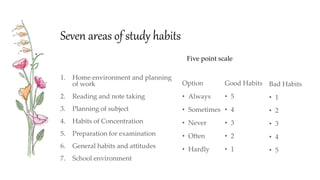
Seven areas of study habits
1. Home environment and planning
of work
2. Reading and note taking
3. Planning of subject
4. Habits of Concentration
5. Preparation for examination
6. General habits and attitudes
7. School environment
Five point scale
Option
• Always
• Sometimes
• Never
• Often
• Hardly
Good Habits
• 5
• 4
• 3
• 2
• 1
Bad Habits
• 1
• 2
• 3
• 4
• 5
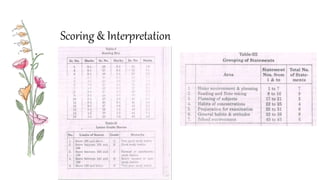
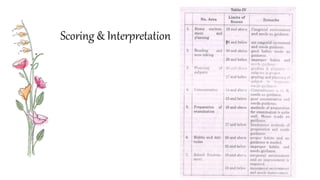
Scoring & Interpretation
For whom this
inventory is
prepared?
Secondary School Students:
In India, high school is a grade of education
from Standards IX to X. Standards IX and X are
also called Secondary School. Usually, students
from ages 14 to 17 study in this section. These
schools may be affiliated to national boards (like
CBSE, ISC, and NIOS) or various state boards.
A school where there are standards 11 and 12
(XI and XII) is called Higher Secondary School.
Questions about
• How they study at home
• Whether they plan their work
• What time they devote to different subjects
• Why they devote different time to different subjects
Two types of
study habits
1. Good study habits
2. Bad study habits
Some of Research findings on Study habits
• study habits and academic
achievement of boys are
significantly related. It can be
interpreted that change in one
variable affects significantly the
other variable.
• There is no correlation between
study habits and academic
achievement of girls.
• girls have significant higher study
habits than boys.
• Low achievement girls had better
study habits than low achieving
boys.

Study habits inventory

  • 1.
  • 2.
    Study habits • Studyhabits are behaviors used when preparing for tests or learning academic material. • ‘Study habits’ are generic rather than specific in terms of its importance. • Good study habits include, class participation, study time, use of test book and recitation (सस्वर पाठ).
  • 3.
    Check your Studyhabits Honestly Do not start unless asked to do so
  • 4.
    Concentration Concentration is avery important predictor of effective study habits. Some students are capable of concentrating easily and for long whereas, some others take time to concentrate, but once they concentrate, they can continue for long, while still some others find it difficult to concentrate at all. Some may read only when they are in mood to do so. Others may require stimulations through tea, coffee, etc. for concentration.
  • 5.
    COMPREHENSION समझ There arecertain specific behaviours with respect to a student’s study behaviour which are geared to better comprehension. For example, before reading a lesson intensively the student may try to catch on what the lesson is about. By so doing, he may actually try to establish a mental set for studying a particular content. Similarly, he may try to relate the materials learned in one subject with those learned in another, so that he may subsume the new learning with the previous knowledge.
  • 6.
    TASK ORIENTATION If astudent who has to study a series of subjects and has to develop different levels of cognition, the task orientation is an important component of the study habits. For example, some students study different subject according to the fixed routine – daily, weekly or monthly. Certain students fix the time target for completing certain academic tasks. Students’ orientations and behaviours towards accomplishment of the tasks in a pre-decided time frame is task orientation.
  • 7.
    Study Sets By studysets we mean the physical and situational characteristics which a student adopts for study. For example, some students read only in the night; some students learn more when they read lying on the bed, whereas some others may as well sleep if they read lying on the bed.
  • 8.
    Interaction Although both teachingand learning in our colleges have remained convocation and almost the private affair of the particular teachers or students respectively, there is enough evidence to conclude that interaction of a student with his teachers or parents or his friends contributes positively towards better learning. Thus, interaction is a significant component of study habit. For example, when a student does not understand while studying, he may go to some of his friends for a discussion. Amongst the postgraduate students in certain universities, a common practice is to form small groups of three or four students who study together.
  • 9.
    Drilling Drilling means practicinga particular learning again and again. While drilling is a common practice at school level, it is a very important component of good study habits amongst students of science and technology. Since drilling is almost essential in case of learning of Mathematics, Chemistry, Engineering, Drawing etc. These students may revise the topics and tasks already learned more than once.
  • 10.
    Supports Study in anyparticular discipline gets a sound back-up from a broader study base. A student’s habit of studying different types of books, other than textbooks, or newspapers and magazines may be helpful in the learning of his subjects.
  • 11.
    Recording At higher levelany good teacher hardly teaches on the basis of a single book. For good performance of the students, it is also necessary to read a number of books; recording in the form of text, class notes or preparing one’s own study notes are, hence, very important factors. Some students prepare their independent study notes. Many students depends only on the class notes dictated by the teacher.
  • 12.
    Study Habits Inventory ByDr. B. V. Patel, Principal & Professor, M. B. Patel College of Education, Sardar Patel University, Anand (Gujarat)
  • 15.
    Seven areas ofstudy habits 1. Home environment and planning of work 2. Reading and note taking 3. Planning of subject 4. Habits of Concentration 5. Preparation for examination 6. General habits and attitudes 7. School environment Five point scale Option • Always • Sometimes • Never • Often • Hardly Good Habits • 5 • 4 • 3 • 2 • 1 Bad Habits • 1 • 2 • 3 • 4 • 5
  • 16.
  • 17.
  • 18.
    For whom this inventoryis prepared? Secondary School Students: In India, high school is a grade of education from Standards IX to X. Standards IX and X are also called Secondary School. Usually, students from ages 14 to 17 study in this section. These schools may be affiliated to national boards (like CBSE, ISC, and NIOS) or various state boards. A school where there are standards 11 and 12 (XI and XII) is called Higher Secondary School.
  • 19.
    Questions about • Howthey study at home • Whether they plan their work • What time they devote to different subjects • Why they devote different time to different subjects
  • 20.
    Two types of studyhabits 1. Good study habits 2. Bad study habits
  • 21.
    Some of Researchfindings on Study habits • study habits and academic achievement of boys are significantly related. It can be interpreted that change in one variable affects significantly the other variable. • There is no correlation between study habits and academic achievement of girls. • girls have significant higher study habits than boys. • Low achievement girls had better study habits than low achieving boys.