International Journal of Trend in Scientific Research and Development (IJTSRD)
Volume 4 Issue 1, December 2019 Available Online: www.ijtsrd.com e-ISSN: 2456 – 6470
@ IJTSRD | Unique Paper ID – IJTSRD29709 | Volume – 4 | Issue – 1 | November-December 2019 Page 763
Study and Analysis of Big Data Security Analytics for
Protecting Cloud Based Virtualized Infrastructures
Hilal Ahmad Khan1, Gurinder Pal2
1M.Tech Scholar, 2Assistant Professor
1,2Department of Computer Science Engineering, IET, Bhaddal, Technical Campus, Ropar, Punjab, India
ABSTRACT
In cloud computingvirtualizedinfrastructureshasbecomea stimulatingtarget
for cyber attackers to initiate advance attacks. The motive ofthiswork maybe
a narrative huge knowledge primarilybasedsecurityanalyticsapproachtoget
advanced attacks in virtualized infrastructures. User application logs and
network logs collected consistently from the tenant virtual machines (VMs)
are saved within the Hadoop Distributed File system (HDFS). Extraction of
attack features is performed through graph-based event correlation and Map
Reduce parser based identification of potential attack paths. Two-step
machine learning approaches logistic regression and belief propagation are
used to perform the determination of attack presence.
KEYWORDS: HDFS, VM, SIEM, IDS
How to cite this paper: Hilal AhmadKhan
| Gurinder Pal "Study and Analysis of Big
Data Security Analytics for Protecting
Cloud Based Virtualized Infrastructures"
Published in
International
Journal of Trend in
Scientific Research
and Development
(ijtsrd), ISSN: 2456-
6470, Volume-4 |
Issue-1, December
2019, pp.763-767, URL:
www.ijtsrd.com/papers/ijtsrd29709.pdf
Copyright © 2019 by author(s) and
International Journal ofTrendinScientific
Research and Development Journal. This
is an Open Access article distributed
under the terms of
the Creative
CommonsAttribution
License (CC BY 4.0)
(http://creativecommons.org/licenses/by
/4.0)
I. INRODUCTION
Virtualized framework has become a noteworthy target for
cyber attackers to initiateadvanceattacks.Themotiveof this
work may be narrative massive information based mostly
security analytics approach to find advanced attacks in
virtualized infrastructures. This approach relies on HDFS
(Hadoop Distributed File System) that saves Network and
application records consistently from the resident virtual
machines. A virtualized framework contains virtual
machines (VMs) that rely upon the software defined multi-
instance theme of the currenthardware.Thevirtualmachine
monitor conjointly referred to as hypervisor, assist, and
monitor and manages the software defined multi-instance
theme. The capabilitytopool completelydifferentcomputing
measures further as permit on-demand resourcescalinghas
semiconductor diode to the overall distribution of
virtualized framework as a crucial equipment to cloud
computing services. Security analytics applies analytics on
the {various} records that are acquire at various points
within the network to find attack existence. By grasping the
huge variety of records created by totally different security
systems (e.g., intrusion detection systems (IDS), security
data and event management (SIEM), etc.), pertain huge
information analytics are going to be apt to note attacks that
aren't set via signature or rule-based recognition ways.
whereas security analytics eliminate necessitate for
signature info by applying event association to find already
undiscovered attacks, this is often typicallynotperformedin
period of time and current execution are just about not
adjustable. This digitalization of the marketing world is
swing corporations at hazards of cyber-attacks on top of
ever antecedent. Huge informationanalysishasthepotential
to supply security verses theseattacks.Sincetheconstructof
a company security circumference has nearly depart in
recent years due to the increasing promotion of cloud and
mobile services, data security has tailored a smart pattern
switch from regular perimeter security tools relating to
detective work and observation distractive activities within
company networks. Growing advanced attack technique
employed by cyber criminals and thereforethegrowingtask
of distractive insiders in varied current large-scale security
rupture clearly specify that ancient perspective to data
security will now not sustain. Analytics is that the essential
part in resistance cyber sturdiness. With growing advanced
associated constant attacks and therefore the
straightforward incontrovertible fact that each
administration should secure itself against all classes of
attacks whereas an assailant solely wants one victorioustry,
company should revise their cyber security plan. They need
to plan on the far side pure interruptions towards the PDR
pattern: stop – find – Respond. At the key of this proposal
stands improved observation which is wherever huge
information analytics comesintoplay.Recognitionshouldbe
able to distinguish dynamic use influence to implement
compound review quickly, near real time; to execute
IJTSRD29709
International Journal of Trend in Scientific Research and Development (IJTSRD) @ www.ijtsrd.com eISSN: 2456-6470
@ IJTSRD | Unique Paper ID – IJTSRD29709 | Volume – 4 | Issue – 1 | November-December 2019 Page 764
complicated correlations over a range of information origin
vary from application logs and server to network eventsand
user activities. This would like each leading analytics on the
far side straightforward rule-based perspective and
therefore the capability to run analysis on huge quota of gift
and historical information – big data security analytics.
Mingle the current condition of analytics with securityhelps
administration upgrade their cyber flexibility. Because the
security industry’s feedback to those disputes, a brand new
origination of security analytics solutions has appeared in
current years, that are able to gather, save and examine
monumental amounts of security information over the full
venture in real time. Upgraded by further subject
information and external warning intelligence, this
information is then examining victimization totallydifferent
correlation algorithms to note deviation and thus
acknowledge doable vicious activities. In contrast to classic
SIEM solutions, aforementioned tools utilize in close to real
time and make a tiny low quantity of security attentive align
by intensity consistent with a threat model. These alerts are
improved with further argumentative details andareableto
deeply clarify a security analyst’s job and authorize fast
awareness and reduction of cyber-attacks.
II. PROBLEM DEFINITION
Virtualized infrastructurein cloudcomputinghasbecome an
attractive target for cyber attackers to launch advanced
attacks. The existing techniques for protecting cloud based
virtualized infrastructure include malware detection and
security analytics. Malware detection usually involves two
steps, first, monitoring hooks are placed at different points
within the virtualized infrastructure then a regularly-
updated attack signature database is used to determine
attack presence. While thisallowsfora real-timedetectionof
attacks, the use of a dedicated signature database makes it
vulnerable to zero-day attacks for which it has no attack
signatures. Securityanalyticsappliesanalyticsonthevarious
logs which are obtained at different points within the
network to determine attack presence. By leveraging the
huge amounts of logs generated by various security systems
like (intrusion detection systems (IDS), securityinformation
and event management (SIEM), applying big data analytics
will be able to detect attacks which are not discovered
through signature or rule-based detection methods. While
security analytics removes the need for signature database
by using event correlation to detectpreviouslyundiscovered
attacks, this is often not carried out in real-time and current
implementations areintrinsicallynon-scalable.Hence needa
novel big data security analytics approach to protect
virtualized infrastructures against advanced attacks.
OBJECTIVES
To study and analyze different security techniques.
To propose a novel Big Data SecurityAnalyticsapproach
for protecting virtualized cloud infrastructures from
advanced cyber-attacks.
To make use of HDFS (Hadoop Distributed File System)
for implementing high end security.
III. METHODOLOGY
The proposed work includes a novel big data based security
analytics (BDSA) approach to protecting virtualized
infrastructures against advanced attacks. With the usage of
network logs and user application logs obtained from the
guest virtual machines stored in HDFS (Hadoop Distributed
File System), our proposed BDSA approach first extracts
attack features through graph-based event correlation, a
Map Reduce parser based identification of potential attack
paths and then ascertains attack presence through two-step
machine learning, namely logistic regression and belief
propagation.
IV. RESULTS
The results obtained are as under:
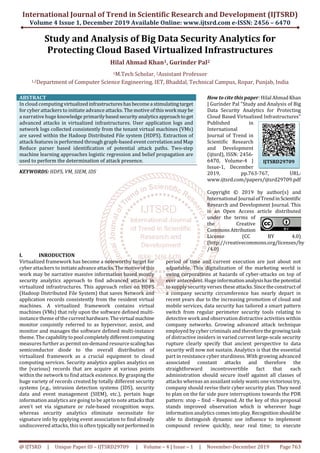
Fig.1: Different commands used in work
International Journal of Trend in Scientific Research and Development (IJTSRD) @ www.ijtsrd.com eISSN: 2456-6470
@ IJTSRD | Unique Paper ID – IJTSRD29709 | Volume – 4 | Issue – 1 | November-December 2019 Page 765
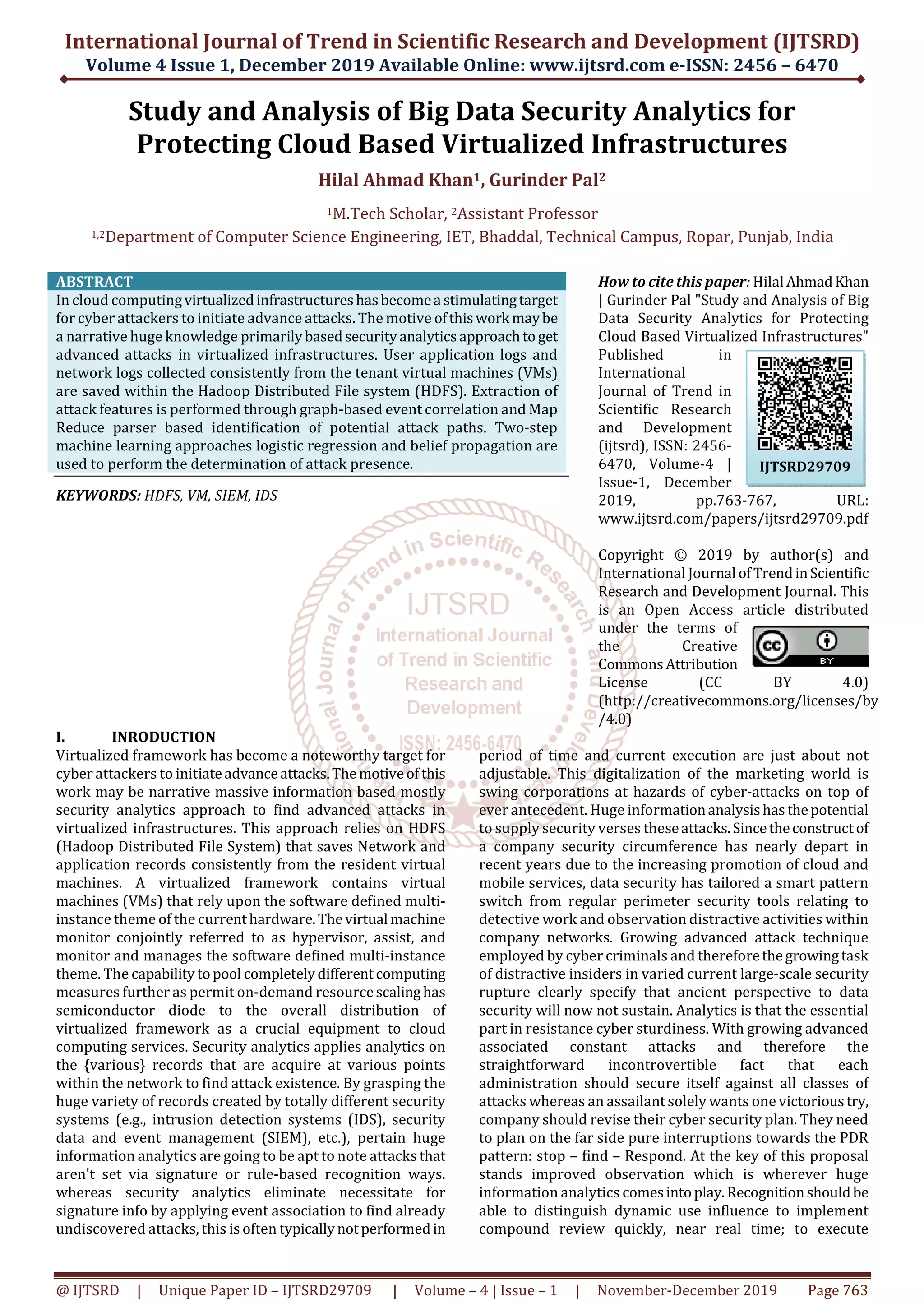
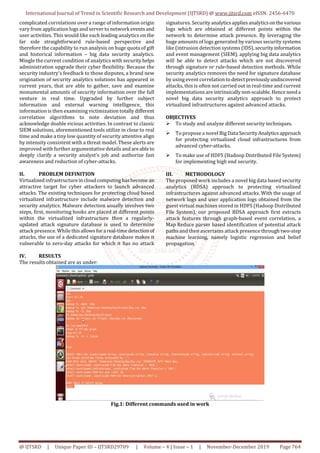
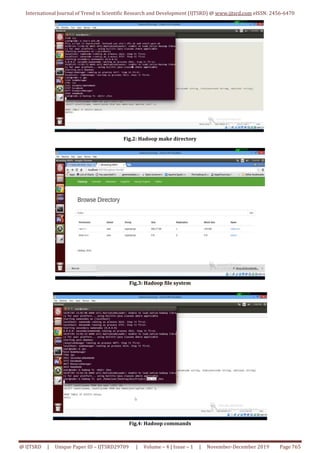
Fig.2: Hadoop make directory
Fig.3: Hadoop file system
Fig.4: Hadoop commands
International Journal of Trend in Scientific Research and Development (IJTSRD) @ www.ijtsrd.com eISSN: 2456-6470
@ IJTSRD | Unique Paper ID – IJTSRD29709 | Volume – 4 | Issue – 1 | November-December 2019 Page 766
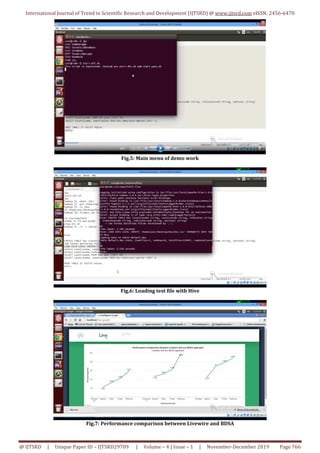
Fig.5: Main menu of demo work
Fig.6: Loading test file with Hive
Fig.7: Performance comparison between Livewire and BDSA
International Journal of Trend in Scientific Research and Development (IJTSRD) @ www.ijtsrd.com eISSN: 2456-6470
@ IJTSRD | Unique Paper ID – IJTSRD29709 | Volume – 4 | Issue – 1 | November-December 2019 Page 767
V. CONCLUSION
The research paper presents a novel approach to protect
virtualized infrastructures against advanced attacks. The
BDSA approach first extracts attack features through graph-
based event correlation, a MapReduce parser based
identification of potential attack paths and then ascertains
attack presence through two-step machine learning,namely
logistic regression and belief propagation.
REFERENCES
[1] B. Niloufer, S. Jessica Saritha, “Implementation of Big
Data Protection Analytics in Virtualized
Infrastructures”, International Journal of Technical
InnovationinModernEngineering&Science(IJTIMES),
Volume-4, Issue-9, 2018.
[2] Dr. M. Bhanu Sridhar, A. Koushik, “A Study of Big Data
Analytics in Clouds with a Security Perspective”,
International Journal of Engineering Research &
Technology (IJERT), Volume-6 Issue-1, 2017.
[3] Mr J L Aldo Stalin, M Badhri Narayanan, Mr. M Deepak,
“Security Analytics for Protecting Virtualized
Infrastructures”, Information Systems & eBusiness
Network. 2017.
[4] [4] Thu Yein Win, Huaglory Tianfield, Quentin Mair,
“Big Data Based Security Analytics for Protecting
Virtualized Infrastructures in Cloud Computing”,IEEE,
2017.
[5] Chaowei Yang, Qunying Huang,ZhenlongLi,KaiLiu,Fei
Hu “Big Data and cloud computing: innovation
opportunities and challenges”, International Journal of
Digital Earth, Volume-10, issue-1, 2017
[6] Motukuri Prashanthi, “Analysis of Security Issues in
Virtualization Cloud Computing”, International Journal
of Computer Science and Mobile ComputingIJCSMC,
Volume-5, Issue-8, 2016.
[7] Ali Gholami, Erwin Laure, “BIG DATA SECURITY AND
PRIVACY ISSUES IN THECLOUD”,International Journal
of Network Security& Its Applications(IJNSA)Volume-
8, Issue-1, 2016.
[8] Varsha, Amit Wadhwa, Swati Gupta, “Study of Security
Issues in Cloud Computing”, International Journal of
Computer Science and Mobile Computing IJCSMC,
Volume-4, Issue-6, 2015.
[9] Lidong Wang, Cheryl Ann Alexander, “Big Data in
Distributed Analytics, Cybersecurity, Cyber Warfare
and Digital Forensics”, Science and Education
Publishing, Volume-1, Issue-1, 2015.
[10] Monjur Ahmed, Mohammad Ashraf Hossain, “Cloud
Computing and Security Issues In the Cloud”,
International Journal of Network Security & Its
Applications (IJNSA), Volume-6, Issue-1, 2014.
[11] Venkata Narasimha Inukollu,Sailaja Arsi,Srinivasa Rao
Ravuri, “Security Issues Associated With Big Data in
Cloud Computing”, International Journal of Network
Security & Its Applications (IJNSA), Volume-6, Issue-3,
2014.
[12] T. Swathi, K.Srikanth, S.Raghunath Reddy,
“Virtualization in Cloud Computing”, International
Journal of Computer Science and Mobile Computing
IJCSMC, Volume-3, Issue-5, 2014.
[13] Muhammad Kazim, Rahat Masood, Muhammad Awais
Shibli, Abdul Ghafoor Abbasi, “Security Aspects of
Virtualization in Cloud Computing”, 2013.
[14] Farzad Sabahi,“Secure Virtualization for Cloud
Environment Using Hypervisor-based Technology”,
International Journal of Machine Learning and
Computing, Volume-2, Issue-1, 2012.
[15] Wentao Liu, “Research on Cloud Computing Security
Problem and Strategy”, IEEE, 2012.
[16] Shubhashis Sengupta,VikrantKaulgud,VibhuSaujanya
Sharma, “Cloud Computing Security - Trends and
Research Directions”, IEEE, 2011.
[17] Pedro Caldeira Neves, Bradley Schmerl, Jorge
Bernardino, Javier Cámara, “Big Data in Cloud
Computing: features and issues”.

Study and Analysis of Big Data Security Analytics for Protecting Cloud Based Virtualized Infrastructures

  • 1.
    International Journal ofTrend in Scientific Research and Development (IJTSRD) Volume 4 Issue 1, December 2019 Available Online: www.ijtsrd.com e-ISSN: 2456 – 6470 @ IJTSRD | Unique Paper ID – IJTSRD29709 | Volume – 4 | Issue – 1 | November-December 2019 Page 763 Study and Analysis of Big Data Security Analytics for Protecting Cloud Based Virtualized Infrastructures Hilal Ahmad Khan1, Gurinder Pal2 1M.Tech Scholar, 2Assistant Professor 1,2Department of Computer Science Engineering, IET, Bhaddal, Technical Campus, Ropar, Punjab, India ABSTRACT In cloud computingvirtualizedinfrastructureshasbecomea stimulatingtarget for cyber attackers to initiate advance attacks. The motive ofthiswork maybe a narrative huge knowledge primarilybasedsecurityanalyticsapproachtoget advanced attacks in virtualized infrastructures. User application logs and network logs collected consistently from the tenant virtual machines (VMs) are saved within the Hadoop Distributed File system (HDFS). Extraction of attack features is performed through graph-based event correlation and Map Reduce parser based identification of potential attack paths. Two-step machine learning approaches logistic regression and belief propagation are used to perform the determination of attack presence. KEYWORDS: HDFS, VM, SIEM, IDS How to cite this paper: Hilal AhmadKhan | Gurinder Pal "Study and Analysis of Big Data Security Analytics for Protecting Cloud Based Virtualized Infrastructures" Published in International Journal of Trend in Scientific Research and Development (ijtsrd), ISSN: 2456- 6470, Volume-4 | Issue-1, December 2019, pp.763-767, URL: www.ijtsrd.com/papers/ijtsrd29709.pdf Copyright © 2019 by author(s) and International Journal ofTrendinScientific Research and Development Journal. This is an Open Access article distributed under the terms of the Creative CommonsAttribution License (CC BY 4.0) (http://creativecommons.org/licenses/by /4.0) I. INRODUCTION Virtualized framework has become a noteworthy target for cyber attackers to initiateadvanceattacks.Themotiveof this work may be narrative massive information based mostly security analytics approach to find advanced attacks in virtualized infrastructures. This approach relies on HDFS (Hadoop Distributed File System) that saves Network and application records consistently from the resident virtual machines. A virtualized framework contains virtual machines (VMs) that rely upon the software defined multi- instance theme of the currenthardware.Thevirtualmachine monitor conjointly referred to as hypervisor, assist, and monitor and manages the software defined multi-instance theme. The capabilitytopool completelydifferentcomputing measures further as permit on-demand resourcescalinghas semiconductor diode to the overall distribution of virtualized framework as a crucial equipment to cloud computing services. Security analytics applies analytics on the {various} records that are acquire at various points within the network to find attack existence. By grasping the huge variety of records created by totally different security systems (e.g., intrusion detection systems (IDS), security data and event management (SIEM), etc.), pertain huge information analytics are going to be apt to note attacks that aren't set via signature or rule-based recognition ways. whereas security analytics eliminate necessitate for signature info by applying event association to find already undiscovered attacks, this is often typicallynotperformedin period of time and current execution are just about not adjustable. This digitalization of the marketing world is swing corporations at hazards of cyber-attacks on top of ever antecedent. Huge informationanalysishasthepotential to supply security verses theseattacks.Sincetheconstructof a company security circumference has nearly depart in recent years due to the increasing promotion of cloud and mobile services, data security has tailored a smart pattern switch from regular perimeter security tools relating to detective work and observation distractive activities within company networks. Growing advanced attack technique employed by cyber criminals and thereforethegrowingtask of distractive insiders in varied current large-scale security rupture clearly specify that ancient perspective to data security will now not sustain. Analytics is that the essential part in resistance cyber sturdiness. With growing advanced associated constant attacks and therefore the straightforward incontrovertible fact that each administration should secure itself against all classes of attacks whereas an assailant solely wants one victorioustry, company should revise their cyber security plan. They need to plan on the far side pure interruptions towards the PDR pattern: stop – find – Respond. At the key of this proposal stands improved observation which is wherever huge information analytics comesintoplay.Recognitionshouldbe able to distinguish dynamic use influence to implement compound review quickly, near real time; to execute IJTSRD29709
  • 2.
    International Journal ofTrend in Scientific Research and Development (IJTSRD) @ www.ijtsrd.com eISSN: 2456-6470 @ IJTSRD | Unique Paper ID – IJTSRD29709 | Volume – 4 | Issue – 1 | November-December 2019 Page 764 complicated correlations over a range of information origin vary from application logs and server to network eventsand user activities. This would like each leading analytics on the far side straightforward rule-based perspective and therefore the capability to run analysis on huge quota of gift and historical information – big data security analytics. Mingle the current condition of analytics with securityhelps administration upgrade their cyber flexibility. Because the security industry’s feedback to those disputes, a brand new origination of security analytics solutions has appeared in current years, that are able to gather, save and examine monumental amounts of security information over the full venture in real time. Upgraded by further subject information and external warning intelligence, this information is then examining victimization totallydifferent correlation algorithms to note deviation and thus acknowledge doable vicious activities. In contrast to classic SIEM solutions, aforementioned tools utilize in close to real time and make a tiny low quantity of security attentive align by intensity consistent with a threat model. These alerts are improved with further argumentative details andareableto deeply clarify a security analyst’s job and authorize fast awareness and reduction of cyber-attacks. II. PROBLEM DEFINITION Virtualized infrastructurein cloudcomputinghasbecome an attractive target for cyber attackers to launch advanced attacks. The existing techniques for protecting cloud based virtualized infrastructure include malware detection and security analytics. Malware detection usually involves two steps, first, monitoring hooks are placed at different points within the virtualized infrastructure then a regularly- updated attack signature database is used to determine attack presence. While thisallowsfora real-timedetectionof attacks, the use of a dedicated signature database makes it vulnerable to zero-day attacks for which it has no attack signatures. Securityanalyticsappliesanalyticsonthevarious logs which are obtained at different points within the network to determine attack presence. By leveraging the huge amounts of logs generated by various security systems like (intrusion detection systems (IDS), securityinformation and event management (SIEM), applying big data analytics will be able to detect attacks which are not discovered through signature or rule-based detection methods. While security analytics removes the need for signature database by using event correlation to detectpreviouslyundiscovered attacks, this is often not carried out in real-time and current implementations areintrinsicallynon-scalable.Hence needa novel big data security analytics approach to protect virtualized infrastructures against advanced attacks. OBJECTIVES To study and analyze different security techniques. To propose a novel Big Data SecurityAnalyticsapproach for protecting virtualized cloud infrastructures from advanced cyber-attacks. To make use of HDFS (Hadoop Distributed File System) for implementing high end security. III. METHODOLOGY The proposed work includes a novel big data based security analytics (BDSA) approach to protecting virtualized infrastructures against advanced attacks. With the usage of network logs and user application logs obtained from the guest virtual machines stored in HDFS (Hadoop Distributed File System), our proposed BDSA approach first extracts attack features through graph-based event correlation, a Map Reduce parser based identification of potential attack paths and then ascertains attack presence through two-step machine learning, namely logistic regression and belief propagation. IV. RESULTS The results obtained are as under: Fig.1: Different commands used in work
  • 3.
    International Journal ofTrend in Scientific Research and Development (IJTSRD) @ www.ijtsrd.com eISSN: 2456-6470 @ IJTSRD | Unique Paper ID – IJTSRD29709 | Volume – 4 | Issue – 1 | November-December 2019 Page 765 Fig.2: Hadoop make directory Fig.3: Hadoop file system Fig.4: Hadoop commands
  • 4.
    International Journal ofTrend in Scientific Research and Development (IJTSRD) @ www.ijtsrd.com eISSN: 2456-6470 @ IJTSRD | Unique Paper ID – IJTSRD29709 | Volume – 4 | Issue – 1 | November-December 2019 Page 766 Fig.5: Main menu of demo work Fig.6: Loading test file with Hive Fig.7: Performance comparison between Livewire and BDSA
  • 5.
    International Journal ofTrend in Scientific Research and Development (IJTSRD) @ www.ijtsrd.com eISSN: 2456-6470 @ IJTSRD | Unique Paper ID – IJTSRD29709 | Volume – 4 | Issue – 1 | November-December 2019 Page 767 V. CONCLUSION The research paper presents a novel approach to protect virtualized infrastructures against advanced attacks. The BDSA approach first extracts attack features through graph- based event correlation, a MapReduce parser based identification of potential attack paths and then ascertains attack presence through two-step machine learning,namely logistic regression and belief propagation. REFERENCES [1] B. Niloufer, S. Jessica Saritha, “Implementation of Big Data Protection Analytics in Virtualized Infrastructures”, International Journal of Technical InnovationinModernEngineering&Science(IJTIMES), Volume-4, Issue-9, 2018. [2] Dr. M. Bhanu Sridhar, A. Koushik, “A Study of Big Data Analytics in Clouds with a Security Perspective”, International Journal of Engineering Research & Technology (IJERT), Volume-6 Issue-1, 2017. [3] Mr J L Aldo Stalin, M Badhri Narayanan, Mr. M Deepak, “Security Analytics for Protecting Virtualized Infrastructures”, Information Systems & eBusiness Network. 2017. [4] [4] Thu Yein Win, Huaglory Tianfield, Quentin Mair, “Big Data Based Security Analytics for Protecting Virtualized Infrastructures in Cloud Computing”,IEEE, 2017. [5] Chaowei Yang, Qunying Huang,ZhenlongLi,KaiLiu,Fei Hu “Big Data and cloud computing: innovation opportunities and challenges”, International Journal of Digital Earth, Volume-10, issue-1, 2017 [6] Motukuri Prashanthi, “Analysis of Security Issues in Virtualization Cloud Computing”, International Journal of Computer Science and Mobile ComputingIJCSMC, Volume-5, Issue-8, 2016. [7] Ali Gholami, Erwin Laure, “BIG DATA SECURITY AND PRIVACY ISSUES IN THECLOUD”,International Journal of Network Security& Its Applications(IJNSA)Volume- 8, Issue-1, 2016. [8] Varsha, Amit Wadhwa, Swati Gupta, “Study of Security Issues in Cloud Computing”, International Journal of Computer Science and Mobile Computing IJCSMC, Volume-4, Issue-6, 2015. [9] Lidong Wang, Cheryl Ann Alexander, “Big Data in Distributed Analytics, Cybersecurity, Cyber Warfare and Digital Forensics”, Science and Education Publishing, Volume-1, Issue-1, 2015. [10] Monjur Ahmed, Mohammad Ashraf Hossain, “Cloud Computing and Security Issues In the Cloud”, International Journal of Network Security & Its Applications (IJNSA), Volume-6, Issue-1, 2014. [11] Venkata Narasimha Inukollu,Sailaja Arsi,Srinivasa Rao Ravuri, “Security Issues Associated With Big Data in Cloud Computing”, International Journal of Network Security & Its Applications (IJNSA), Volume-6, Issue-3, 2014. [12] T. Swathi, K.Srikanth, S.Raghunath Reddy, “Virtualization in Cloud Computing”, International Journal of Computer Science and Mobile Computing IJCSMC, Volume-3, Issue-5, 2014. [13] Muhammad Kazim, Rahat Masood, Muhammad Awais Shibli, Abdul Ghafoor Abbasi, “Security Aspects of Virtualization in Cloud Computing”, 2013. [14] Farzad Sabahi,“Secure Virtualization for Cloud Environment Using Hypervisor-based Technology”, International Journal of Machine Learning and Computing, Volume-2, Issue-1, 2012. [15] Wentao Liu, “Research on Cloud Computing Security Problem and Strategy”, IEEE, 2012. [16] Shubhashis Sengupta,VikrantKaulgud,VibhuSaujanya Sharma, “Cloud Computing Security - Trends and Research Directions”, IEEE, 2011. [17] Pedro Caldeira Neves, Bradley Schmerl, Jorge Bernardino, Javier Cámara, “Big Data in Cloud Computing: features and issues”.