International Research Journal of Engineering and Technology (IRJET) e-ISSN: 2395-0056
Volume: 05 Issue: 03 | Mar-2018 www.irjet.net p-ISSN: 2395-0072
© 2018, IRJET | Impact Factor value: 6.171 | ISO 9001:2008 Certified Journal | Page 1568
HTTP FLOODING ATTACK DETECTION USING DATA MINING
TECHNIQUES
Arockia Panimalar.S1, Monica.J2, Muthumeenal.L3, Amala.S4
1Assistant Professor, Department of BCA & M.Sc SS, Sri Krishna Arts and Science College, Tamilnadu
2,3,4III BCA ‘A’, Department of BCA & M.Sc SS, Sri Krishna Arts and Science College, Tamilnadu
---------------------------------------------------------------------***---------------------------------------------------------------------
Abstract: DoS and DDoS, the network flooding attacks has
threats on network services, rapid detection and semantic
analysis are concentrated on secured features and reliable
network services. Flooding attack detection and in-depth
analysis system are the two features which uses data mining
techniques. DoS (Denial of Services) attack threat to internet
sites and among the hardest security problem, becauseoftheir
potential impact. DDoS (Distributed Denial of Services)attack
which is easily exhausted for the computing and
communication resources of the host in very short period of
time. It is the co-operative large scale attacks which are
produced from an enormous host which isknownasZOMBIES,
considered as the major threat to internet services. The latest
development in data mining methodologies are embedded
with variety of algorithms are from the field of statics, pattern
mining, machine learning and database. For protecting the
network routers, network servers, client host becoming the
handlers, ZOMBIES and victim of DDoS attack data mining
methods can be used as an ultimate weapon.
Key Words: DDoS, DoS and ZOMBIES.
1. INTRODUCTION
DDoS - A distributed denial of serviceattack ismostcommon
and damaging forms of attack on the cloud. The Denial of
service (DoS) attacks is for the unavailable functioning of
resources to the customers, hackers can send the unwanted
messages continuously and make the traffic on the network
from multiple resources, hackers will send packets to the
receiver which make harmful to the system and temporarily
stop the services between client and server communication.
HTTP (Hyper Text Transfer Protocol) flood is a type of
Distributed Denial of Service (DDoS) attack. HTTP flood
consists of “ZOMBIE ARMY” a group of large number of
compromised hosts.
2. DDOS ATTACKS
In a Denial-of-Service (DoS) attacks such as flooding,
software exploit, protocol based etc. DDoS - A distributed
denial of service attack is uses different machinestoprevent
the permissible use of services.
DDOS attacks are of different phases, they are as follows:
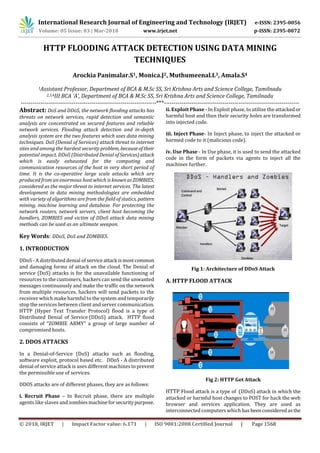
i. Recruit Phase – In Recruit phase, there are multiple
agents like slaves and zombiesmachineforsecuritypurpose.
ii. Exploit Phase - In Exploit phase, to utilize the attackedor
harmful host and then their security holes are transformed
into injected code.
iii. Inject Phase- In Inject phase, to inject the attacked or
harmed code to it (malicious code).
iv. Use Phase - In Use phase, it is used to send the attacked
code in the form of packets via agents to inject all the
machines further.
Fig 1: Architecture of DDoS Attack
A. HTTP FLOOD ATTACK
Fig 2: HTTP Get Attack
HTTP Flood attack is a type of (DDoS) attack in which the
attacked or harmful host changes to POST for hack the web
browser and services application. They are used as
interconnected computers which hasbeenconsideredasthe
International Research Journal of Engineering and Technology (IRJET) e-ISSN: 2395-0056
Volume: 05 Issue: 03 | Mar-2018 www.irjet.net p-ISSN: 2395-0072
© 2018, IRJET | Impact Factor value: 6.171 | ISO 9001:2008 Certified Journal | Page 1569
aid of malware, which is considered as the disturbing
resources such as Trojan Horses, computer viruses, worms
etc. HTTP floods possess less bandwidth.
Fig 3: HTTP Post Attack
3. DATA MINING TECHNIQUES
Data mining is important for DDoS attack detection. It is
used to transfer the raw data into structured information.
Data mining follows six various types of classes namely
statistical classification, association rule learning,clustering
analysis, regression analysis and automatic summarization,
deviation detection.
Various techniques of data mining are used for detecting
DDoS attacks. They are:
A. Intrusion Detection System (IDS)
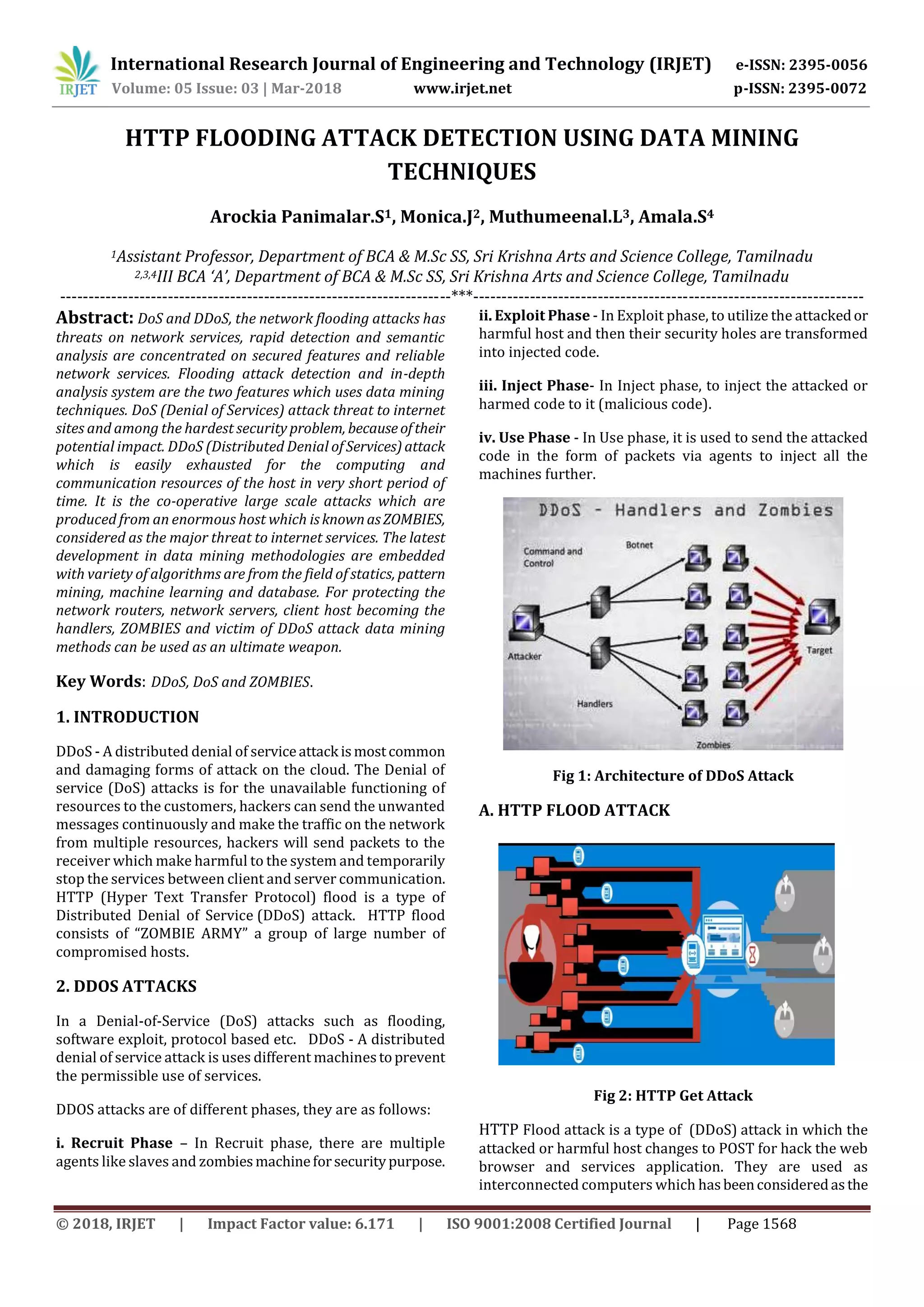
An Intrusion Detection System (IDS) is an application used
for controlling the network trafficandprotectsthesystemor
network administrator. It is a software application which is
used to monitor the network and system activities and finds
the different operations occurred. In field of business,
industry, security and health sectors LAN and WAN
networks are used.
Types of IDS
 Host based IDS
 Network based IDS
 Signature Based IDS
 Anomaly Based IDS
 Passive IDS
 Reactive IDS
 Application based IDS
Advantages of IDS
 Boost up Efficiency
 Easier to maintain and regulate security
 Can qualify and analyze the attacks/bugs
 Functioning of good context of protocol
 Tuned to specific information of networking
Intrusion detection system in data mining is the process
which is used to get the hidden information from the
databases. They are of two divisions, they are
i. Misuse Detection - Misuse detection is used as the
labeled/signature based detection.Itcanbedetectedonlyby
the recognized available signature.
ii. Anomaly Detection - Anomaly detection defines the
deviations between the models.
Technical Challenges
 Problem to false alarm, in which the different
application is being triggered in stopping the event
 Scalability conditions, in which the size of the
network fluctuates
 Data collection and logging
 Vulnerability to attacks
 Understanding and interpreting IDS data
 Keep track the IDS rule set regularly
 Alert correlation
Fig 4: Intrusion Detection System (IDS)
B. IP Traceback
IP Traceback is used for determining the reliability of
packets present on Internet. It is used to defend against the
DDOS attacks. LOGGING is the methodology which is usedto
log packets at key routers. It locates the originofthepackets.
It is complicated because IP address can be forged or
spoofed.
International Research Journal of Engineering and Technology (IRJET) e-ISSN: 2395-0056
Volume: 05 Issue: 03 | Mar-2018 www.irjet.net p-ISSN: 2395-0072
© 2018, IRJET | Impact Factor value: 6.171 | ISO 9001:2008 Certified Journal | Page 1570
Fig 5: IP Traceback
i. Link Testing
It starts from the victim of the source and assumes that the
attack is active till the end of the trace. Two variants of link
testing are:
1) Input Debugging and
2) Controlled Flooding
ii. Packet Marketing
It is one of the significant methods used. This marketing
utility the rarely used IP header to store the trailer, where it
is used for marking varies from scheme to scheme. It is
categorized into two types, they are
 Probabilistic Packet Marking
 Deterministic Packet Marking
4. CONCLUSION
In this paper, the study on HTTP flooding attack detection
using data mining techniques is carried out. DDoS attack is a
complex technique for attacking the computer networks.
Various techniques of data mining are used to detect DDoS
attack. The paper has discussed about IDS and IP Traceback.
The improvement in technology for handling DDoS attacks
and DoS attacks using data mining techniquescanbeutilized
more in future.
5. REFERENCES
[1]https://www.verisign.com/en_In/security-services/
ddos/ddos-attack/index.xhtml
[2] http://news.cnet.com/8301-1009_3-2001.htm.
[3]http://www.darkreading.com/security-services/
security/perimeter-security/222301511/index.html
[4] PeymanKabiriandAliA.Ghorbani-“ResearchonIntrusion
Detection and Response Survey”- International Journal of
Network Security, Vol.1, No.2, PP.84–102, Sep. 2005
[5] Intrusion Detection System Buyer’s Guide, Paul Dokas,
Levent Ertoz.
[6] Aleksandar Lazarevic, Jaideep Srivastava, PangNing
“Data Mining for Network Intrusion Detection”.
[7] Aleksandar Lazarević,Jaideep Srivastava, Vipin Kumar-
“Data Mining for intrusion detection”-Knowledge Discovery
in Databases 2003.

IRJET- HTTP Flooding Attack Detection using Data Mining Techniques

  • 1.
    International Research Journalof Engineering and Technology (IRJET) e-ISSN: 2395-0056 Volume: 05 Issue: 03 | Mar-2018 www.irjet.net p-ISSN: 2395-0072 © 2018, IRJET | Impact Factor value: 6.171 | ISO 9001:2008 Certified Journal | Page 1568 HTTP FLOODING ATTACK DETECTION USING DATA MINING TECHNIQUES Arockia Panimalar.S1, Monica.J2, Muthumeenal.L3, Amala.S4 1Assistant Professor, Department of BCA & M.Sc SS, Sri Krishna Arts and Science College, Tamilnadu 2,3,4III BCA ‘A’, Department of BCA & M.Sc SS, Sri Krishna Arts and Science College, Tamilnadu ---------------------------------------------------------------------***--------------------------------------------------------------------- Abstract: DoS and DDoS, the network flooding attacks has threats on network services, rapid detection and semantic analysis are concentrated on secured features and reliable network services. Flooding attack detection and in-depth analysis system are the two features which uses data mining techniques. DoS (Denial of Services) attack threat to internet sites and among the hardest security problem, becauseoftheir potential impact. DDoS (Distributed Denial of Services)attack which is easily exhausted for the computing and communication resources of the host in very short period of time. It is the co-operative large scale attacks which are produced from an enormous host which isknownasZOMBIES, considered as the major threat to internet services. The latest development in data mining methodologies are embedded with variety of algorithms are from the field of statics, pattern mining, machine learning and database. For protecting the network routers, network servers, client host becoming the handlers, ZOMBIES and victim of DDoS attack data mining methods can be used as an ultimate weapon. Key Words: DDoS, DoS and ZOMBIES. 1. INTRODUCTION DDoS - A distributed denial of serviceattack ismostcommon and damaging forms of attack on the cloud. The Denial of service (DoS) attacks is for the unavailable functioning of resources to the customers, hackers can send the unwanted messages continuously and make the traffic on the network from multiple resources, hackers will send packets to the receiver which make harmful to the system and temporarily stop the services between client and server communication. HTTP (Hyper Text Transfer Protocol) flood is a type of Distributed Denial of Service (DDoS) attack. HTTP flood consists of “ZOMBIE ARMY” a group of large number of compromised hosts. 2. DDOS ATTACKS In a Denial-of-Service (DoS) attacks such as flooding, software exploit, protocol based etc. DDoS - A distributed denial of service attack is uses different machinestoprevent the permissible use of services. DDOS attacks are of different phases, they are as follows: i. Recruit Phase – In Recruit phase, there are multiple agents like slaves and zombiesmachineforsecuritypurpose. ii. Exploit Phase - In Exploit phase, to utilize the attackedor harmful host and then their security holes are transformed into injected code. iii. Inject Phase- In Inject phase, to inject the attacked or harmed code to it (malicious code). iv. Use Phase - In Use phase, it is used to send the attacked code in the form of packets via agents to inject all the machines further. Fig 1: Architecture of DDoS Attack A. HTTP FLOOD ATTACK Fig 2: HTTP Get Attack HTTP Flood attack is a type of (DDoS) attack in which the attacked or harmful host changes to POST for hack the web browser and services application. They are used as interconnected computers which hasbeenconsideredasthe
  • 2.
    International Research Journalof Engineering and Technology (IRJET) e-ISSN: 2395-0056 Volume: 05 Issue: 03 | Mar-2018 www.irjet.net p-ISSN: 2395-0072 © 2018, IRJET | Impact Factor value: 6.171 | ISO 9001:2008 Certified Journal | Page 1569 aid of malware, which is considered as the disturbing resources such as Trojan Horses, computer viruses, worms etc. HTTP floods possess less bandwidth. Fig 3: HTTP Post Attack 3. DATA MINING TECHNIQUES Data mining is important for DDoS attack detection. It is used to transfer the raw data into structured information. Data mining follows six various types of classes namely statistical classification, association rule learning,clustering analysis, regression analysis and automatic summarization, deviation detection. Various techniques of data mining are used for detecting DDoS attacks. They are: A. Intrusion Detection System (IDS) An Intrusion Detection System (IDS) is an application used for controlling the network trafficandprotectsthesystemor network administrator. It is a software application which is used to monitor the network and system activities and finds the different operations occurred. In field of business, industry, security and health sectors LAN and WAN networks are used. Types of IDS  Host based IDS  Network based IDS  Signature Based IDS  Anomaly Based IDS  Passive IDS  Reactive IDS  Application based IDS Advantages of IDS  Boost up Efficiency  Easier to maintain and regulate security  Can qualify and analyze the attacks/bugs  Functioning of good context of protocol  Tuned to specific information of networking Intrusion detection system in data mining is the process which is used to get the hidden information from the databases. They are of two divisions, they are i. Misuse Detection - Misuse detection is used as the labeled/signature based detection.Itcanbedetectedonlyby the recognized available signature. ii. Anomaly Detection - Anomaly detection defines the deviations between the models. Technical Challenges  Problem to false alarm, in which the different application is being triggered in stopping the event  Scalability conditions, in which the size of the network fluctuates  Data collection and logging  Vulnerability to attacks  Understanding and interpreting IDS data  Keep track the IDS rule set regularly  Alert correlation Fig 4: Intrusion Detection System (IDS) B. IP Traceback IP Traceback is used for determining the reliability of packets present on Internet. It is used to defend against the DDOS attacks. LOGGING is the methodology which is usedto log packets at key routers. It locates the originofthepackets. It is complicated because IP address can be forged or spoofed.
  • 3.
    International Research Journalof Engineering and Technology (IRJET) e-ISSN: 2395-0056 Volume: 05 Issue: 03 | Mar-2018 www.irjet.net p-ISSN: 2395-0072 © 2018, IRJET | Impact Factor value: 6.171 | ISO 9001:2008 Certified Journal | Page 1570 Fig 5: IP Traceback i. Link Testing It starts from the victim of the source and assumes that the attack is active till the end of the trace. Two variants of link testing are: 1) Input Debugging and 2) Controlled Flooding ii. Packet Marketing It is one of the significant methods used. This marketing utility the rarely used IP header to store the trailer, where it is used for marking varies from scheme to scheme. It is categorized into two types, they are  Probabilistic Packet Marking  Deterministic Packet Marking 4. CONCLUSION In this paper, the study on HTTP flooding attack detection using data mining techniques is carried out. DDoS attack is a complex technique for attacking the computer networks. Various techniques of data mining are used to detect DDoS attack. The paper has discussed about IDS and IP Traceback. The improvement in technology for handling DDoS attacks and DoS attacks using data mining techniquescanbeutilized more in future. 5. REFERENCES [1]https://www.verisign.com/en_In/security-services/ ddos/ddos-attack/index.xhtml [2] http://news.cnet.com/8301-1009_3-2001.htm. [3]http://www.darkreading.com/security-services/ security/perimeter-security/222301511/index.html [4] PeymanKabiriandAliA.Ghorbani-“ResearchonIntrusion Detection and Response Survey”- International Journal of Network Security, Vol.1, No.2, PP.84–102, Sep. 2005 [5] Intrusion Detection System Buyer’s Guide, Paul Dokas, Levent Ertoz. [6] Aleksandar Lazarevic, Jaideep Srivastava, PangNing “Data Mining for Network Intrusion Detection”. [7] Aleksandar Lazarević,Jaideep Srivastava, Vipin Kumar- “Data Mining for intrusion detection”-Knowledge Discovery in Databases 2003.