Inspiring the Next Generation  of Innovators:    Students, Parents and Educators Speak Up about Science Education National Report Release NECC – July 1, 2008 Project Tomorrow & PASCO scientific
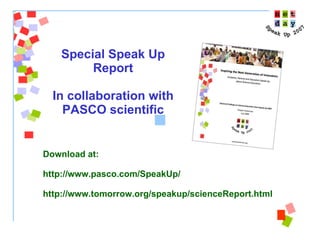
Download at:  http://www.pasco.com/SpeakUp/ http://www.tomorrow.org/speakup/scienceReport.html Special Speak Up Report In collaboration with  PASCO scientific
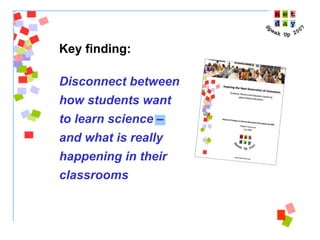
Key finding: Disconnect between how students want to learn science – and what is really happening in their classrooms
Annual national research project Online surveys Open for all K-12 schools Schools/districts get their own data for planning and budgeting Collect data  ↔ Stimulate conversations Students, Teachers, Parents and School Leaders Inform policies & programs Analysis and reporting – national reports  Services: custom reports, consulting with schools, Speak Up Your Way! 5 years of empowering authentic voices – since 2003:   1.1 million K-12 students 74,000 teachers 34,000 parents 3,200 school leaders 14,000 schools – from all 50 states, DC, American military base schools, Canada, Mexico, Australia What is Speak Up? 1.2 million respondents
Speak Up is facilitated annually by  Project Tomorrow   (formerly known as NetDay) About Project Tomorrow:  A national education nonprofit organization providing leadership, research and programming to support STEM education in America’s schools
Learning & Teaching with Technology Web 2.0 / Web 3.0 in Education 21st Century Skills Science Instruction & Global Competitiveness Emerging Technologies in the Classroom Designing the 21st Century School 2007 survey question themes:
We would like to recognize our Speak Up 2007 Sponsors:
We would like to also acknowledge the support of our Speak Up 2007  National Champion Outreach Partners:
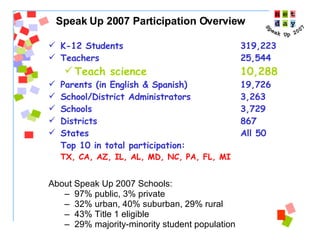
K-12 Students 319,223 Teachers 25,544 Teach science 10,288 Parents (in English & Spanish) 19,726 School/District Administrators 3,263 Schools 3,729 Districts 867 States  All 50 Top 10 in total participation:  TX, CA, AZ, IL, AL, MD, NC, PA, FL, MI About Speak Up 2007 Schools: 97% public, 3% private 32% urban, 40% suburban, 29% rural 43% Title 1 eligible 29% majority-minority student population  Speak Up 2007 Participation Overview
21 st  Century Science Education & Technology Students & technology National policy  Science instruction STEM careers Speak Up 2007 Data Findings
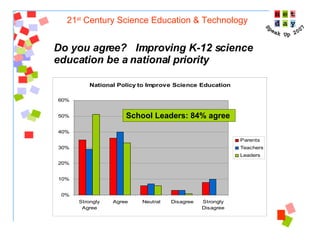
21 st  Century Science Education & Technology Do you agree?  Improving K-12 science education be a national priority School Leaders: 84% agree
21 st  Century Science Education & Technology Science instruction today Teachers:  What instructional strategies do you use to teach science? What are the barriers to teaching inquiry-based science?
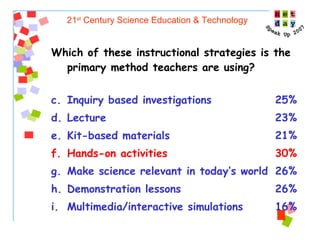
21 st  Century Science Education & Technology Which of these instructional strategies is the primary method teachers are using?   Inquiry based investigations 25% Lecture 23% Kit-based materials 21% Hands-on activities 30% Make science relevant in today’s world 26% Demonstration lessons  26% Multimedia/interactive simulations 16%
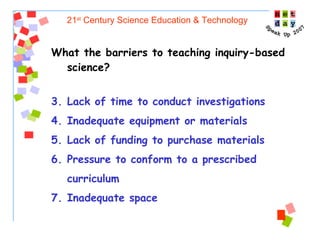
21 st  Century Science Education & Technology What the barriers to teaching inquiry-based science?  Lack of time to conduct investigations Inadequate equipment or materials Lack of funding to purchase materials Pressure to conform to a prescribed curriculum Inadequate space
21 st  Century Science Education & Technology Improving science instruction Parents:  What would improve your child’s science education? Students: Imagine your ultimate science classroom
21 st  Century Science Education & Technology Parents: What would improve your child’s science education? Top voter getters:
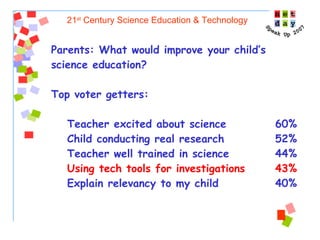
21 st  Century Science Education & Technology Parents: What would improve your child’s science education? Top voter getters: Teacher excited about science  60% Child conducting real research 52% Teacher well trained in science 44% Using tech tools for investigations 43% Explain relevancy to my child 40%
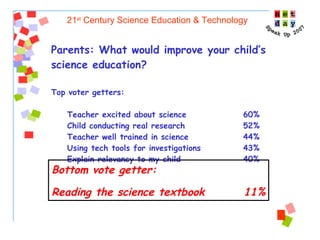
21 st  Century Science Education & Technology Parents: What would improve your child’s science education? Top voter getters: Teacher excited about science  60% Child conducting real research 52% Teacher well trained in science 44% Using tech tools for investigations 43% Explain relevancy to my child 40% Bottom vote getter: Reading the science textbook  11%
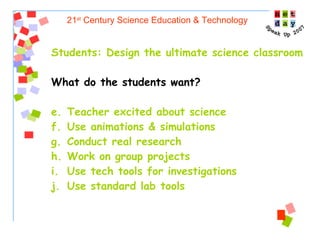
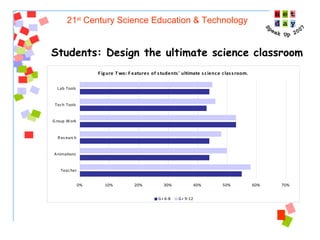
21 st  Century Science Education & Technology Students: Design the ultimate science classroom What do the students want? Teacher excited about science Use animations & simulations Conduct real research Work on group projects Use tech tools for investigations Use standard lab tools
21 st  Century Science Education & Technology Students: Design the ultimate science classroom
21 st  Century Science Education & Technology 21 st  Century Tools Teachers:  Which tools have the greatest potential for increasing student achievement? Administrators:  What factors influence you and your decisions for improving science education?
21 st  Century Science Education & Technology Teachers:   Which tools have the greatest potential for increasing student achievement?
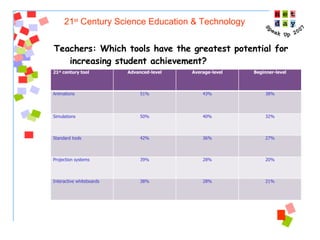
21 st  Century Science Education & Technology Teachers: Which tools have the greatest potential for increasing student achievement? 21 st  century tool Advanced-level Average-level Beginner-level Animations 51% 43% 38% Simulations 50% 40% 32% Standard tools 42% 36% 27% Projection systems 39% 28% 20% Interactive whiteboards 38% 28% 21%
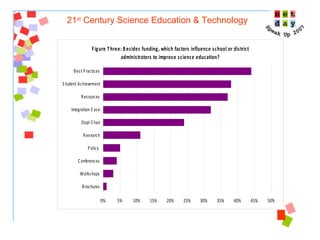
21 st  Century Science Education & Technology Administrators:   What factors influence you and your decisions for improving science education?
21 st  Century Science Education & Technology
21 st  Century Science Education & Technology Preparing today’s students for STEM careers Parents & Students:  Importance of science and impact on STEM careers
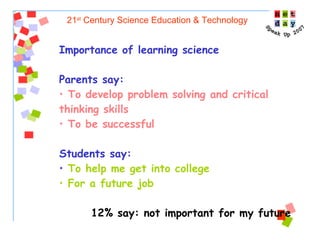
21 st  Century Science Education & Technology Importance of learning science Parents say:   To develop problem solving and critical thinking skills To be successful Students say: To help me get into college For a future job
21 st  Century Science Education & Technology Importance of learning science Parents say:   To develop problem solving and critical thinking skills To be successful Students say: To help me get into college For a future job  12% say: not important for my future
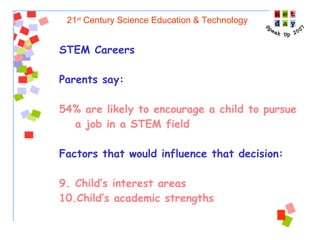
21 st  Century Science Education & Technology STEM Careers Parents say:   54% are likely to encourage a child to pursue a job in a STEM field Factors that would influence that decision: Child’s interest areas Child’s academic strengths
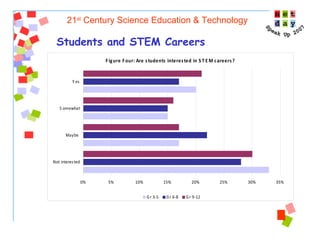
21 st  Century Science Education & Technology Students and STEM Careers
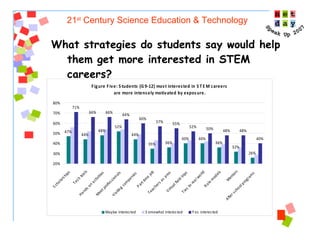
21 st  Century Science Education & Technology What strategies do students say would help them get more interested in STEM careers?
Is  your school  doing a good job preparing  you/your students/your child for future jobs?
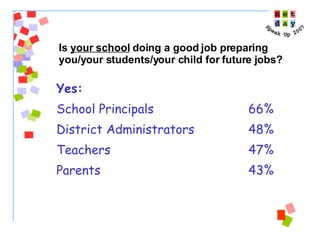
Yes: School Principals 66% District Administrators 48% Teachers 47% Parents 43% Is  your school  doing a good job preparing  you/your students/your child for future jobs?
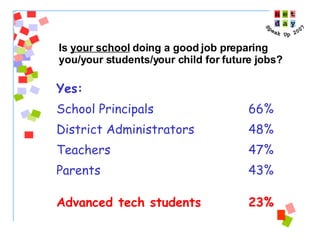
Yes: School Principals 66% District Administrators 48% Teachers 47% Parents 43% Advanced tech students 23% Is  your school  doing a good job preparing  you/your students/your child for future jobs?
Download at:  http://www.pasco.com/SpeakUp/ http://www.tomorrow.org/speakup/scienceReport.html Let’s discuss:  http:// speakupblog.tomorrow.org / More Speak Up data?  http:// www.tomorrow.org/speakup/index.html
Speak Up 2008 Fall 2008 Have a  voice   in national discussions  Learn about the  ideas   of your own stakeholders Inform  your plans, budgets and programs  Participating schools and districts get  free online access  to your  own quantitative data –  with national benchmark data
Copyright Project Tomorrow 2008.  This work is the intellectual property of the author. Permission is granted for this material to be shared for non-commercial, educational purposes, provided that this copyright statement appears on the reproduced materials and notice is given that the copying is by permission of the author. To disseminate otherwise or to republish requires written permission from the author. Thank you for your participation. Julie Evans [email_address]

Students, Parents and Educators Speak Up about Science

  • 1.
    Inspiring the NextGeneration of Innovators: Students, Parents and Educators Speak Up about Science Education National Report Release NECC – July 1, 2008 Project Tomorrow & PASCO scientific
  • 2.
    Download at: http://www.pasco.com/SpeakUp/ http://www.tomorrow.org/speakup/scienceReport.html Special Speak Up Report In collaboration with PASCO scientific
  • 3.
    Key finding: Disconnectbetween how students want to learn science – and what is really happening in their classrooms
  • 4.
    Annual national researchproject Online surveys Open for all K-12 schools Schools/districts get their own data for planning and budgeting Collect data ↔ Stimulate conversations Students, Teachers, Parents and School Leaders Inform policies & programs Analysis and reporting – national reports Services: custom reports, consulting with schools, Speak Up Your Way! 5 years of empowering authentic voices – since 2003: 1.1 million K-12 students 74,000 teachers 34,000 parents 3,200 school leaders 14,000 schools – from all 50 states, DC, American military base schools, Canada, Mexico, Australia What is Speak Up? 1.2 million respondents
  • 5.
    Speak Up isfacilitated annually by Project Tomorrow (formerly known as NetDay) About Project Tomorrow: A national education nonprofit organization providing leadership, research and programming to support STEM education in America’s schools
  • 6.
    Learning & Teachingwith Technology Web 2.0 / Web 3.0 in Education 21st Century Skills Science Instruction & Global Competitiveness Emerging Technologies in the Classroom Designing the 21st Century School 2007 survey question themes:
  • 7.
    We would liketo recognize our Speak Up 2007 Sponsors:
  • 8.
    We would liketo also acknowledge the support of our Speak Up 2007 National Champion Outreach Partners:
  • 9.
    K-12 Students 319,223Teachers 25,544 Teach science 10,288 Parents (in English & Spanish) 19,726 School/District Administrators 3,263 Schools 3,729 Districts 867 States All 50 Top 10 in total participation: TX, CA, AZ, IL, AL, MD, NC, PA, FL, MI About Speak Up 2007 Schools: 97% public, 3% private 32% urban, 40% suburban, 29% rural 43% Title 1 eligible 29% majority-minority student population Speak Up 2007 Participation Overview
  • 10.
    21 st Century Science Education & Technology Students & technology National policy Science instruction STEM careers Speak Up 2007 Data Findings
  • 11.
    21 st Century Science Education & Technology Do you agree? Improving K-12 science education be a national priority School Leaders: 84% agree
  • 12.
    21 st Century Science Education & Technology Science instruction today Teachers: What instructional strategies do you use to teach science? What are the barriers to teaching inquiry-based science?
  • 13.
    21 st Century Science Education & Technology Which of these instructional strategies is the primary method teachers are using? Inquiry based investigations 25% Lecture 23% Kit-based materials 21% Hands-on activities 30% Make science relevant in today’s world 26% Demonstration lessons 26% Multimedia/interactive simulations 16%
  • 14.
    21 st Century Science Education & Technology What the barriers to teaching inquiry-based science? Lack of time to conduct investigations Inadequate equipment or materials Lack of funding to purchase materials Pressure to conform to a prescribed curriculum Inadequate space
  • 15.
    21 st Century Science Education & Technology Improving science instruction Parents: What would improve your child’s science education? Students: Imagine your ultimate science classroom
  • 16.
    21 st Century Science Education & Technology Parents: What would improve your child’s science education? Top voter getters:
  • 17.
    21 st Century Science Education & Technology Parents: What would improve your child’s science education? Top voter getters: Teacher excited about science 60% Child conducting real research 52% Teacher well trained in science 44% Using tech tools for investigations 43% Explain relevancy to my child 40%
  • 18.
    21 st Century Science Education & Technology Parents: What would improve your child’s science education? Top voter getters: Teacher excited about science 60% Child conducting real research 52% Teacher well trained in science 44% Using tech tools for investigations 43% Explain relevancy to my child 40% Bottom vote getter: Reading the science textbook 11%
  • 19.
    21 st Century Science Education & Technology Students: Design the ultimate science classroom What do the students want? Teacher excited about science Use animations & simulations Conduct real research Work on group projects Use tech tools for investigations Use standard lab tools
  • 20.
    21 st Century Science Education & Technology Students: Design the ultimate science classroom
  • 21.
    21 st Century Science Education & Technology 21 st Century Tools Teachers: Which tools have the greatest potential for increasing student achievement? Administrators: What factors influence you and your decisions for improving science education?
  • 22.
    21 st Century Science Education & Technology Teachers: Which tools have the greatest potential for increasing student achievement?
  • 23.
    21 st Century Science Education & Technology Teachers: Which tools have the greatest potential for increasing student achievement? 21 st century tool Advanced-level Average-level Beginner-level Animations 51% 43% 38% Simulations 50% 40% 32% Standard tools 42% 36% 27% Projection systems 39% 28% 20% Interactive whiteboards 38% 28% 21%
  • 24.
    21 st Century Science Education & Technology Administrators: What factors influence you and your decisions for improving science education?
  • 25.
    21 st Century Science Education & Technology
  • 26.
    21 st Century Science Education & Technology Preparing today’s students for STEM careers Parents & Students: Importance of science and impact on STEM careers
  • 27.
    21 st Century Science Education & Technology Importance of learning science Parents say: To develop problem solving and critical thinking skills To be successful Students say: To help me get into college For a future job
  • 28.
    21 st Century Science Education & Technology Importance of learning science Parents say: To develop problem solving and critical thinking skills To be successful Students say: To help me get into college For a future job 12% say: not important for my future
  • 29.
    21 st Century Science Education & Technology STEM Careers Parents say: 54% are likely to encourage a child to pursue a job in a STEM field Factors that would influence that decision: Child’s interest areas Child’s academic strengths
  • 30.
    21 st Century Science Education & Technology Students and STEM Careers
  • 31.
    21 st Century Science Education & Technology What strategies do students say would help them get more interested in STEM careers?
  • 32.
    Is yourschool doing a good job preparing you/your students/your child for future jobs?
  • 33.
    Yes: School Principals66% District Administrators 48% Teachers 47% Parents 43% Is your school doing a good job preparing you/your students/your child for future jobs?
  • 34.
    Yes: School Principals66% District Administrators 48% Teachers 47% Parents 43% Advanced tech students 23% Is your school doing a good job preparing you/your students/your child for future jobs?
  • 35.
    Download at: http://www.pasco.com/SpeakUp/ http://www.tomorrow.org/speakup/scienceReport.html Let’s discuss: http:// speakupblog.tomorrow.org / More Speak Up data? http:// www.tomorrow.org/speakup/index.html
  • 36.
    Speak Up 2008Fall 2008 Have a voice in national discussions Learn about the ideas of your own stakeholders Inform your plans, budgets and programs Participating schools and districts get free online access to your own quantitative data – with national benchmark data
  • 37.
    Copyright Project Tomorrow2008. This work is the intellectual property of the author. Permission is granted for this material to be shared for non-commercial, educational purposes, provided that this copyright statement appears on the reproduced materials and notice is given that the copying is by permission of the author. To disseminate otherwise or to republish requires written permission from the author. Thank you for your participation. Julie Evans [email_address]