Artificial Intelligence in
The Government
By:
Karen Gillmore, Karlton Hill,
LeAndre Sampson & Lucy Tran
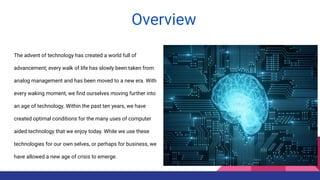
The advent of technology has created a world full of
advancement; every walk of life has slowly been taken from
analog management and has been moved to a new era. With
every waking moment, we find ourselves moving further into
an age of technology. Within the past ten years, we have
created optimal conditions for the many uses of computer
aided technology that we enjoy today. While we use these
technologies for our own selves, or perhaps for business, we
have allowed a new age of crisis to emerge.
Overview
Overview
Artificial intelligence (AI) is the use of computers and other technology that is designed to work like humans. AI is created
to be able to recognize patterns, distinguish speech, plan, and solve problems. The use of artificial intelligence
encompasses several different subjects, such as data mining, deep learning, data storage, etc. Data storage is the use of
technology to store large amounts of digital data. With most things being online, the use of AI and data storage is needed to
be able to maintain and process large amounts of information. For example, Facebook has a data storage system that is
able to store the information from its millions of users.
Technology
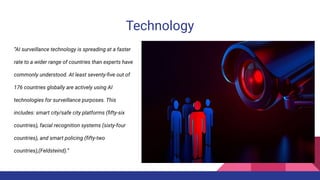
“AI surveillance technology is spreading at a faster
rate to a wider range of countries than experts have
commonly understood. At least seventy-five out of
176 countries globally are actively using AI
technologies for surveillance purposes. This
includes: smart city/safe city platforms (fifty-six
countries), facial recognition systems (sixty-four
countries), and smart policing (fifty-two
countries),(Feldsteind).”
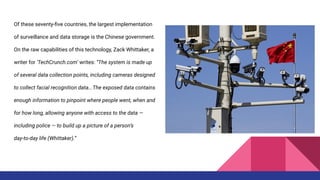
Of these seventy-five countries, the largest implementation
of surveillance and data storage is the Chinese government.
On the raw capabilities of this technology, Zack Whittaker, a
writer for ‘TechCrunch.com’ writes: “The system is made up
of several data collection points, including cameras designed
to collect facial recognition data...The exposed data contains
enough information to pinpoint where people went, when and
for how long, allowing anyone with access to the data —
including police — to build up a picture of a person’s
day-to-day life (Whittaker).”
Economy
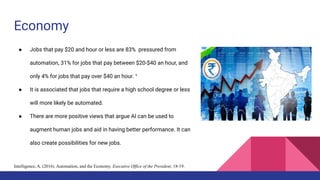
● Jobs that pay $20 and hour or less are 83% pressured from
automation, 31% for jobs that pay between $20-$40 an hour, and
only 4% for jobs that pay over $40 an hour. ¹
● It is associated that jobs that require a high school degree or less
will more likely be automated.
● There are more positive views that argue AI can be used to
augment human jobs and aid in having better performance. It can
also create possibilities for new jobs.
Intelligence, A. (2016). Automation, and the Economy. Executive Office of the President, 18-19.
● If AI were to replace many employees, that would mean there would be
less people to pay taxes.
● This has the potential to create inequalities in the wealth distribution.
● “If labour income does not benefit from the economic gains generated by
AI, consumption may stagnate and restrict growth, thereby having an
adverse effect on the economy”
● One of the arguments made for this suggests that AI systems or “robots”
should be taxed as well. Companies that have employed AIs to replace
human workers should be responsible and paythose tax incomes that are
required
Szczepański, M. (July 2019). European Parliament. Retrieved from
http://www.europarl.europa.eu/RegData/etudes/BRIE/2019/637967/EPRS_BRI(2019)637967_EN.pdf
“ Over the next five years, we are about to witness the world we live
in entirely disrupted by improvements in artificial intelligence (AI)
and machine learning. Children today are growing up with AI
assistants in their homes (Google Assistant, Siri and Alexa) -- to the
point that you might consider their mere presence an extension of
co-parenting. As voice and facial recognition continue to evolve,
machine learning algorithms are getting smarter. More and more
industries are being influenced by AI, and our society as we know it
is transforming.”
- Anthony Delgado
Social
https://www.forbes.com/sites/forbestechcouncil/2018/06/13/three-impacts-of-artificial-intelli
gence-on-society/#4fad249f6ec0
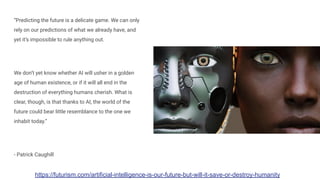
“Predicting the future is a delicate game. We can only
rely on our predictions of what we already have, and
yet it’s impossible to rule anything out.
We don’t yet know whether AI will usher in a golden
age of human existence, or if it will all end in the
destruction of everything humans cherish. What is
clear, though, is that thanks to AI, the world of the
future could bear little resemblance to the one we
inhabit today.”
- Patrick Caughill
https://futurism.com/artificial-intelligence-is-our-future-but-will-it-save-or-destroy-humanity
Political
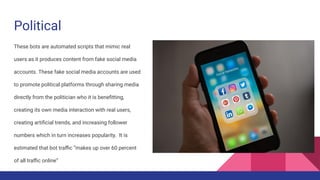
These bots are automated scripts that mimic real
users as it produces content from fake social media
accounts. These fake social media accounts are used
to promote political platforms through sharing media
directly from the politician who it is benefitting,
creating its own media interaction with real users,
creating artificial trends, and increasing follower
numbers which in turn increases popularity. It is
estimated that bot traffic “makes up over 60 percent
of all traffic online”
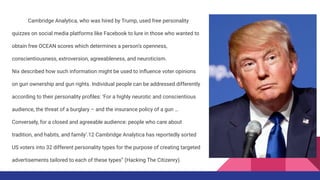
Cambridge Analytica, who was hired by Trump, used free personality
quizzes on social media platforms like Facebook to lure in those who wanted to
obtain free OCEAN scores which determines a person’s openness,
conscientiousness, extroversion, agreeableness, and neuroticism.
Nix described how such information might be used to influence voter opinions
on gun ownership and gun rights. Individual people can be addressed differently
according to their personality profiles: ‘For a highly neurotic and conscientious
audience, the threat of a burglary – and the insurance policy of a gun …
Conversely, for a closed and agreeable audience: people who care about
tradition, and habits, and family’.12 Cambridge Analytica has reportedly sorted
US voters into 32 different personality types for the purpose of creating targeted
advertisements tailored to each of these types” (Hacking The Citizenry).
Conclusion
The rising efficiency of artificial intelligence has started to affect the
way humans live their day to day lives. The use of artificial intelligence and
data storage plays a role in every facet of human life including technological,
economical, social, and political. Governments have incorporated AI
technology into the way rules are regulated, created the start of a major wealth
distribution, improved the customer service aspect of certain companies, and
repurposed personal data with the function of putting politicians in office. The
advancement of artificial intelligence has the advantages of creating efficiency
in all aspects of human life but for every advantage there is a disadvantage.

Student Presentation: AI & Government

  • 1.
    Artificial Intelligence in TheGovernment By: Karen Gillmore, Karlton Hill, LeAndre Sampson & Lucy Tran
  • 2.
    The advent oftechnology has created a world full of advancement; every walk of life has slowly been taken from analog management and has been moved to a new era. With every waking moment, we find ourselves moving further into an age of technology. Within the past ten years, we have created optimal conditions for the many uses of computer aided technology that we enjoy today. While we use these technologies for our own selves, or perhaps for business, we have allowed a new age of crisis to emerge. Overview
  • 3.
    Overview Artificial intelligence (AI)is the use of computers and other technology that is designed to work like humans. AI is created to be able to recognize patterns, distinguish speech, plan, and solve problems. The use of artificial intelligence encompasses several different subjects, such as data mining, deep learning, data storage, etc. Data storage is the use of technology to store large amounts of digital data. With most things being online, the use of AI and data storage is needed to be able to maintain and process large amounts of information. For example, Facebook has a data storage system that is able to store the information from its millions of users.
  • 4.
    Technology “AI surveillance technologyis spreading at a faster rate to a wider range of countries than experts have commonly understood. At least seventy-five out of 176 countries globally are actively using AI technologies for surveillance purposes. This includes: smart city/safe city platforms (fifty-six countries), facial recognition systems (sixty-four countries), and smart policing (fifty-two countries),(Feldsteind).”
  • 5.
    Of these seventy-fivecountries, the largest implementation of surveillance and data storage is the Chinese government. On the raw capabilities of this technology, Zack Whittaker, a writer for ‘TechCrunch.com’ writes: “The system is made up of several data collection points, including cameras designed to collect facial recognition data...The exposed data contains enough information to pinpoint where people went, when and for how long, allowing anyone with access to the data — including police — to build up a picture of a person’s day-to-day life (Whittaker).”
  • 6.
    Economy ● Jobs thatpay $20 and hour or less are 83% pressured from automation, 31% for jobs that pay between $20-$40 an hour, and only 4% for jobs that pay over $40 an hour. ¹ ● It is associated that jobs that require a high school degree or less will more likely be automated. ● There are more positive views that argue AI can be used to augment human jobs and aid in having better performance. It can also create possibilities for new jobs. Intelligence, A. (2016). Automation, and the Economy. Executive Office of the President, 18-19.
  • 7.
    ● If AIwere to replace many employees, that would mean there would be less people to pay taxes. ● This has the potential to create inequalities in the wealth distribution. ● “If labour income does not benefit from the economic gains generated by AI, consumption may stagnate and restrict growth, thereby having an adverse effect on the economy” ● One of the arguments made for this suggests that AI systems or “robots” should be taxed as well. Companies that have employed AIs to replace human workers should be responsible and paythose tax incomes that are required Szczepański, M. (July 2019). European Parliament. Retrieved from http://www.europarl.europa.eu/RegData/etudes/BRIE/2019/637967/EPRS_BRI(2019)637967_EN.pdf
  • 8.
    “ Over thenext five years, we are about to witness the world we live in entirely disrupted by improvements in artificial intelligence (AI) and machine learning. Children today are growing up with AI assistants in their homes (Google Assistant, Siri and Alexa) -- to the point that you might consider their mere presence an extension of co-parenting. As voice and facial recognition continue to evolve, machine learning algorithms are getting smarter. More and more industries are being influenced by AI, and our society as we know it is transforming.” - Anthony Delgado Social https://www.forbes.com/sites/forbestechcouncil/2018/06/13/three-impacts-of-artificial-intelli gence-on-society/#4fad249f6ec0
  • 9.
    “Predicting the futureis a delicate game. We can only rely on our predictions of what we already have, and yet it’s impossible to rule anything out. We don’t yet know whether AI will usher in a golden age of human existence, or if it will all end in the destruction of everything humans cherish. What is clear, though, is that thanks to AI, the world of the future could bear little resemblance to the one we inhabit today.” - Patrick Caughill https://futurism.com/artificial-intelligence-is-our-future-but-will-it-save-or-destroy-humanity
  • 10.
    Political These bots areautomated scripts that mimic real users as it produces content from fake social media accounts. These fake social media accounts are used to promote political platforms through sharing media directly from the politician who it is benefitting, creating its own media interaction with real users, creating artificial trends, and increasing follower numbers which in turn increases popularity. It is estimated that bot traffic “makes up over 60 percent of all traffic online”
  • 11.
    Cambridge Analytica, whowas hired by Trump, used free personality quizzes on social media platforms like Facebook to lure in those who wanted to obtain free OCEAN scores which determines a person’s openness, conscientiousness, extroversion, agreeableness, and neuroticism. Nix described how such information might be used to influence voter opinions on gun ownership and gun rights. Individual people can be addressed differently according to their personality profiles: ‘For a highly neurotic and conscientious audience, the threat of a burglary – and the insurance policy of a gun … Conversely, for a closed and agreeable audience: people who care about tradition, and habits, and family’.12 Cambridge Analytica has reportedly sorted US voters into 32 different personality types for the purpose of creating targeted advertisements tailored to each of these types” (Hacking The Citizenry).
  • 12.
    Conclusion The rising efficiencyof artificial intelligence has started to affect the way humans live their day to day lives. The use of artificial intelligence and data storage plays a role in every facet of human life including technological, economical, social, and political. Governments have incorporated AI technology into the way rules are regulated, created the start of a major wealth distribution, improved the customer service aspect of certain companies, and repurposed personal data with the function of putting politicians in office. The advancement of artificial intelligence has the advantages of creating efficiency in all aspects of human life but for every advantage there is a disadvantage.