Shayna T. Blum
Dar Al Hekma University
Xavier University of Louisiana
VISCOM 28 2014
Whispering Pines, West Greenwich, RI
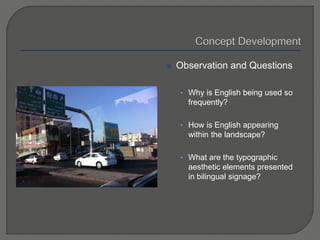
 Observation and Questions
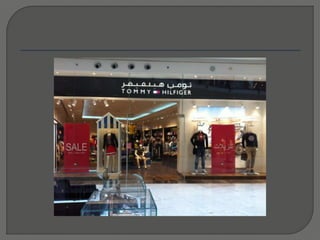
• Why is English being used so
frequently?
• How is English appearing
within the landscape?
• What are the typographic
aesthetic elements presented
in bilingual signage?
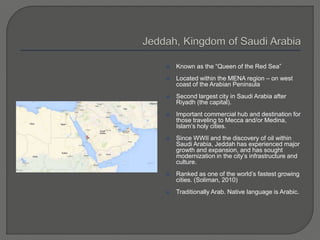
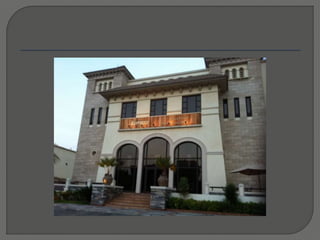
 Known as the “Queen of the Red Sea”
 Located within the MENA region – on west
coast of the Arabian Peninsula
 Second largest city in Saudi Arabia after
Riyadh (the capital).
 Important commercial hub and destination for
those traveling to Mecca and/or Medina,
Islam’s holy cities.
 Since WWII and the discovery of oil within
Saudi Arabia, Jeddah has experienced major
growth and expansion, and has sought
modernization in the city’s infrastructure and
culture.
 Ranked as one of the world’s fastest growing
cities. (Soliman, 2010)
 Traditionally Arab. Native language is Arabic.
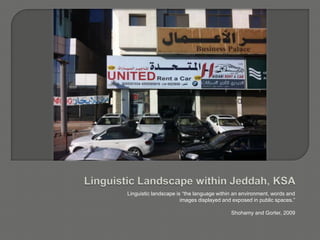
Linguistic landscape is “the language within an environment, words and
images displayed and exposed in public spaces.”
Shohamy and Gorter, 2009
 In Signs of Belonging: Culture, Identity, and
the English Language, John E. Joseph
(2013) states that language is the “ultimate
semiotic system… The very sense of who we
are, where we belong, and why and how we
relate to those around us, all have language
at the center” (p. 55).
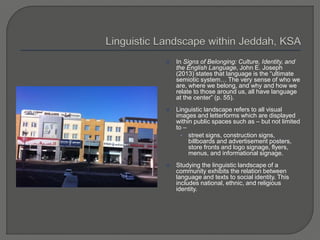
 Linguistic landscape refers to all visual
images and letterforms which are displayed
within public spaces such as – but not limited
to –
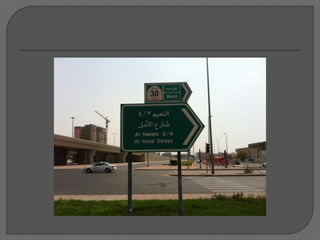
• street signs, construction signs,
billboards and advertisement posters,
store fronts and logo signage, flyers,
menus, and informational signage.
 Studying the linguistic landscape of a
community exhibits the relation between
language and texts to social identity. This
includes national, ethnic, and religious
identity.
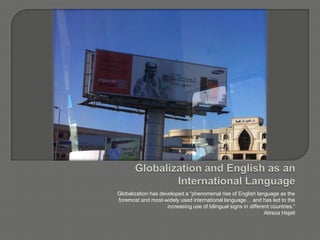
Globalization has developed a “phenomenal rise of English language as the
foremost and most-widely used international language… and has led to the
increasing use of bilingual signs in different countries.”
Alireza Hojati
Through Globalization….
 Our world has become increasingly
familiar in different locations, more
connected, more consumerist,
increasingly corporatized
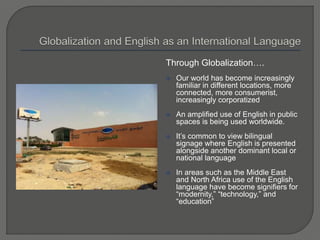
 An amplified use of English in public
spaces is being used worldwide.
 It’s common to view bilingual
signage where English is presented
alongside another dominant local or
national language
 In areas such as the Middle East
and North Africa use of the English
language have become signifiers for
“modernity,” “technology,” and
“education”
 Elements which have contributed to the rise in the use of English within the
MENA /Gulf region:
• Development of the oil industry from the early 19th century and onward. And the
participation and influence of western corporations and governments within the MENA
region.
• Investment in western education within the Middle East and gulf region including
sending students abroad to European, English, and American academic institutions.
• Employment patterns where Middle East nationals are working jobs doing business
with western companies.
• The use of mass media broadcasted in both Arabic and English
• Rise of the internet and “globalized” societies.
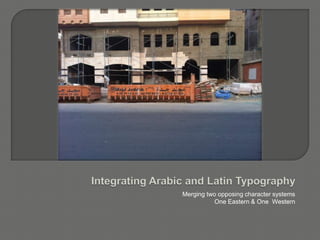
Merging two opposing character systems
One Eastern & One Western
 Signage that integrates the two writing
systems may be deconstructed by the
presentation of the work.
• How is the overall piece presented?
 How is the text laid out? Is it symmetrical or
asymmetrical?
 What is the spacing size between text?
• What is the dominant language being
presented?
 Which language type is presented above?
Below?
 Which language type is larger? Smaller? Or
are the letterforms of equal size?
• Is there color or weight change between the
language letterforms?
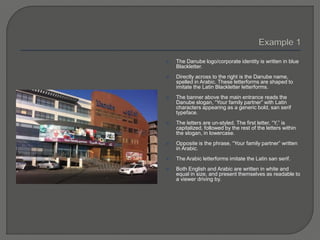
 The Danube logo/corporate identity is written in blue
Blackletter.
 Directly across to the right is the Danube name,
spelled in Arabic. These letterforms are shaped to
imitate the Latin Blackletter letterforms.
 The banner above the main entrance reads the
Danube slogan, “Your family partner” with Latin
characters appearing as a generic bold, san serif
typeface.
 The letters are un-styled. The first letter, “Y,” is
capitalized, followed by the rest of the letters within
the slogan, in lowercase.
 Opposite is the phrase, “Your family partner” written
in Arabic.
 The Arabic letterforms imitate the Latin san serif.
 Both English and Arabic are written in white and
equal in size, and present themselves as readable to
a viewer driving by.
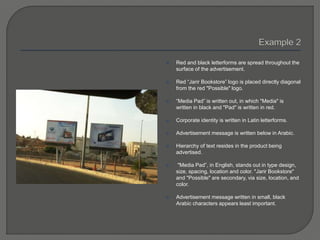
 Red and black letterforms are spread throughout the
surface of the advertisement.
 Red “Jarir Bookstore” logo is placed directly diagonal
from the red "Possible" logo.
 “Media Pad” is written out, in which "Media" is
written in black and "Pad" is written in red.
 Corporate identity is written in Latin letterforms.
 Advertisement message is written below in Arabic.
 Hierarchy of text resides in the product being
advertised.
 "Media Pad”, in English, stands out in type design,
size, spacing, location and color. "Jarir Bookstore"
and "Possible" are secondary, via size, location, and
color.
 Advertisement message written in small, black
Arabic characters appears least important.
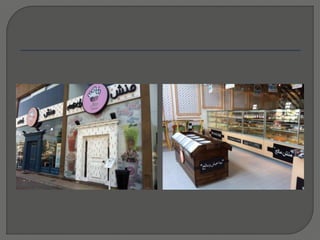
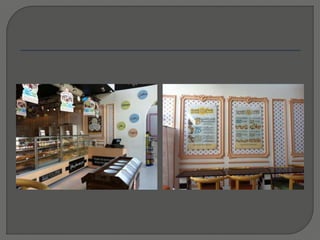
 Language mixing between English and Arabic dominates the linguistic landscape of Jeddah, Saudi
Arabia. This element is apparent from the rise of globalization and the use of English as an
“international” language. Often as in the case of marketing and advertising, English text is
presented via corporate identity and logo trademark, while the Arabic is presented either in
translation to the corporate identity, and/or the advertising message. Both cases exhibit an
imitation of typographic style, in which the Arabic and Latin letterforms will coincide with one
another via similarities in size, shape, color, width, and edge.
 Bhagwati, J. (2007). In Defense of Globalization: With a
New Afterword. New York: Oxford University Press.
 Blankenship, S. (2003). Cultural Considerations: Arabic
Calligraphy and Latin Typography. Massachusetts
Institute of Technology: Design Issues 19:2, 60-63.
 Bolton, K. (2012). World Englishes and linguistic
landscapes. World Englishes 31:1, 30-33.
 Hojati, A. (2013). A Study of Errors in Bilingual Road,
Street and Shop Signs in Iran.
 Mediterranean Journal of Social Sciences 4, 607-611.
Holes, C.D. (2011). Language and Identity in the Arabian
Gulf. Journal of Arabian Studies: Arabia, the Gulf, and the
Red Sea, 1:2, 129-145.
 Jaworski, A. and Thurlow, C. (2009). Introducing Semiotic
Landscapes: Semiotic Landscapes.
 Jorgensen, J.N. (2008a). Polylingual languaging around
and among children and adolescents. International
Journal of Multilingualism 5, 161-176.
 Jorgensen, J.N. (2008b). Urban wall languaging.
International Journal of Multilingualism 5, 237-252.
 Joseph, J. (2013). Signs of belonging: culture, identity
and the English language: Perspectives on English in the
Middle East and North Africa. (pp. 53-70). London: British
Council.
 Kasanga, L. A. (2012). English in the Democratic
Republic of the Congo. World Englishes 31:1, 48-69.
 Kasanga, L. A. (2010). Streetwise English: Symbolism,
modernity, and cosmopolitan identity. International
Journal of the Sociology of Language 206, 187-205.
 Kirillova, N.B. (2013). Phenomenon of Media Culture as a
System of Signs. Middle-East Journal of Scientific
Research 16 (3): 411-416.
 Landry, R. and Blourihis, R.Y. (1997). Linguistic
Landscape and etholinguistic vitality. Journal of
Language and Social Psychology 16:1, 23-49
 Martin, E. (2007). "Frenglish" for sale: Multilingual
discourse for addressing today’s global consumer. World
Englishes 26, 170-188.
 Milo, T. ((2011). Balancing Arabic and Latin typography.
Intellect Limited 1:2, 239-254.
 Sebba, M. (2012). Multilingualism in written discourse: An
approach to the analysis of multilingual texts.
International Journal of Bilingualism 17(1), 97-118.
 Shohamy, E. and Gorter, D. (eds.) (2009). Linguistic
Landscape. Expanding the Scenery. New York:
Routledge.
 Sonntag, S.K. (2003). The Local Politics of Global
English. Case Studies in Linguistic Globalization.
Lanham, MD: Lexington Books.
 Stroud, C. and Mpendukana, S. (2010). Multilingual
signage: a multimodal approach to discourses of
consumption in a South African township. Social
Semiotics 20:5, 469-493.
 Vaish, V. (2008). Biliteracy and globalization: English
language education in India. Great Britian: Multilingual
Matters.
 Yaghan, M.A.(2008). "Arabizi": A Contemporary Style of
Arabic Slang. Massachusetts Institute of Technology:
Design Issues 24:2, 39-52.

S blum viscom2014

  • 1.
    Shayna T. Blum DarAl Hekma University Xavier University of Louisiana VISCOM 28 2014 Whispering Pines, West Greenwich, RI
  • 2.
     Observation andQuestions • Why is English being used so frequently? • How is English appearing within the landscape? • What are the typographic aesthetic elements presented in bilingual signage?
  • 3.
     Known asthe “Queen of the Red Sea”  Located within the MENA region – on west coast of the Arabian Peninsula  Second largest city in Saudi Arabia after Riyadh (the capital).  Important commercial hub and destination for those traveling to Mecca and/or Medina, Islam’s holy cities.  Since WWII and the discovery of oil within Saudi Arabia, Jeddah has experienced major growth and expansion, and has sought modernization in the city’s infrastructure and culture.  Ranked as one of the world’s fastest growing cities. (Soliman, 2010)  Traditionally Arab. Native language is Arabic.
  • 4.
    Linguistic landscape is“the language within an environment, words and images displayed and exposed in public spaces.” Shohamy and Gorter, 2009
  • 5.
     In Signsof Belonging: Culture, Identity, and the English Language, John E. Joseph (2013) states that language is the “ultimate semiotic system… The very sense of who we are, where we belong, and why and how we relate to those around us, all have language at the center” (p. 55).  Linguistic landscape refers to all visual images and letterforms which are displayed within public spaces such as – but not limited to – • street signs, construction signs, billboards and advertisement posters, store fronts and logo signage, flyers, menus, and informational signage.  Studying the linguistic landscape of a community exhibits the relation between language and texts to social identity. This includes national, ethnic, and religious identity.
  • 6.
    Globalization has developeda “phenomenal rise of English language as the foremost and most-widely used international language… and has led to the increasing use of bilingual signs in different countries.” Alireza Hojati
  • 7.
    Through Globalization….  Ourworld has become increasingly familiar in different locations, more connected, more consumerist, increasingly corporatized  An amplified use of English in public spaces is being used worldwide.  It’s common to view bilingual signage where English is presented alongside another dominant local or national language  In areas such as the Middle East and North Africa use of the English language have become signifiers for “modernity,” “technology,” and “education”
  • 10.
     Elements whichhave contributed to the rise in the use of English within the MENA /Gulf region: • Development of the oil industry from the early 19th century and onward. And the participation and influence of western corporations and governments within the MENA region. • Investment in western education within the Middle East and gulf region including sending students abroad to European, English, and American academic institutions. • Employment patterns where Middle East nationals are working jobs doing business with western companies. • The use of mass media broadcasted in both Arabic and English • Rise of the internet and “globalized” societies.
  • 11.
    Merging two opposingcharacter systems One Eastern & One Western
  • 12.
     Signage thatintegrates the two writing systems may be deconstructed by the presentation of the work. • How is the overall piece presented?  How is the text laid out? Is it symmetrical or asymmetrical?  What is the spacing size between text? • What is the dominant language being presented?  Which language type is presented above? Below?  Which language type is larger? Smaller? Or are the letterforms of equal size? • Is there color or weight change between the language letterforms?
  • 13.
     The Danubelogo/corporate identity is written in blue Blackletter.  Directly across to the right is the Danube name, spelled in Arabic. These letterforms are shaped to imitate the Latin Blackletter letterforms.  The banner above the main entrance reads the Danube slogan, “Your family partner” with Latin characters appearing as a generic bold, san serif typeface.  The letters are un-styled. The first letter, “Y,” is capitalized, followed by the rest of the letters within the slogan, in lowercase.  Opposite is the phrase, “Your family partner” written in Arabic.  The Arabic letterforms imitate the Latin san serif.  Both English and Arabic are written in white and equal in size, and present themselves as readable to a viewer driving by.
  • 14.
     Red andblack letterforms are spread throughout the surface of the advertisement.  Red “Jarir Bookstore” logo is placed directly diagonal from the red "Possible" logo.  “Media Pad” is written out, in which "Media" is written in black and "Pad" is written in red.  Corporate identity is written in Latin letterforms.  Advertisement message is written below in Arabic.  Hierarchy of text resides in the product being advertised.  "Media Pad”, in English, stands out in type design, size, spacing, location and color. "Jarir Bookstore" and "Possible" are secondary, via size, location, and color.  Advertisement message written in small, black Arabic characters appears least important.
  • 23.
     Language mixingbetween English and Arabic dominates the linguistic landscape of Jeddah, Saudi Arabia. This element is apparent from the rise of globalization and the use of English as an “international” language. Often as in the case of marketing and advertising, English text is presented via corporate identity and logo trademark, while the Arabic is presented either in translation to the corporate identity, and/or the advertising message. Both cases exhibit an imitation of typographic style, in which the Arabic and Latin letterforms will coincide with one another via similarities in size, shape, color, width, and edge.
  • 24.
     Bhagwati, J.(2007). In Defense of Globalization: With a New Afterword. New York: Oxford University Press.  Blankenship, S. (2003). Cultural Considerations: Arabic Calligraphy and Latin Typography. Massachusetts Institute of Technology: Design Issues 19:2, 60-63.  Bolton, K. (2012). World Englishes and linguistic landscapes. World Englishes 31:1, 30-33.  Hojati, A. (2013). A Study of Errors in Bilingual Road, Street and Shop Signs in Iran.  Mediterranean Journal of Social Sciences 4, 607-611. Holes, C.D. (2011). Language and Identity in the Arabian Gulf. Journal of Arabian Studies: Arabia, the Gulf, and the Red Sea, 1:2, 129-145.  Jaworski, A. and Thurlow, C. (2009). Introducing Semiotic Landscapes: Semiotic Landscapes.  Jorgensen, J.N. (2008a). Polylingual languaging around and among children and adolescents. International Journal of Multilingualism 5, 161-176.  Jorgensen, J.N. (2008b). Urban wall languaging. International Journal of Multilingualism 5, 237-252.  Joseph, J. (2013). Signs of belonging: culture, identity and the English language: Perspectives on English in the Middle East and North Africa. (pp. 53-70). London: British Council.  Kasanga, L. A. (2012). English in the Democratic Republic of the Congo. World Englishes 31:1, 48-69.  Kasanga, L. A. (2010). Streetwise English: Symbolism, modernity, and cosmopolitan identity. International Journal of the Sociology of Language 206, 187-205.  Kirillova, N.B. (2013). Phenomenon of Media Culture as a System of Signs. Middle-East Journal of Scientific Research 16 (3): 411-416.  Landry, R. and Blourihis, R.Y. (1997). Linguistic Landscape and etholinguistic vitality. Journal of Language and Social Psychology 16:1, 23-49  Martin, E. (2007). "Frenglish" for sale: Multilingual discourse for addressing today’s global consumer. World Englishes 26, 170-188.  Milo, T. ((2011). Balancing Arabic and Latin typography. Intellect Limited 1:2, 239-254.  Sebba, M. (2012). Multilingualism in written discourse: An approach to the analysis of multilingual texts. International Journal of Bilingualism 17(1), 97-118.  Shohamy, E. and Gorter, D. (eds.) (2009). Linguistic Landscape. Expanding the Scenery. New York: Routledge.  Sonntag, S.K. (2003). The Local Politics of Global English. Case Studies in Linguistic Globalization. Lanham, MD: Lexington Books.  Stroud, C. and Mpendukana, S. (2010). Multilingual signage: a multimodal approach to discourses of consumption in a South African township. Social Semiotics 20:5, 469-493.  Vaish, V. (2008). Biliteracy and globalization: English language education in India. Great Britian: Multilingual Matters.  Yaghan, M.A.(2008). "Arabizi": A Contemporary Style of Arabic Slang. Massachusetts Institute of Technology: Design Issues 24:2, 39-52.

Editor's Notes

  • #3  For the past two years, I have been living and working in Jeddah, Kingdom of Saudi Arabia. As a designer and vis com theorist, I noticed that the majority of signage within the city was written in two languages, Arabic and English. I was curios about this bilingual/multilingual typographic communication and sought to explore the concepts and aesthetics pertaining to the visual integration of languages within Jeddah.
  • #4 Located within the MENA region - on the west coast of the Arabian Peninsula, directly across from Egypt and Sudan on the Red Sea. Known as the “Queen of the Red Sea”, Jeddah is the second largest city in Saudi Arabia after Riyadh (the capital). Since WWII and the discovery of oil within Saudi Arabia, Jeddah has experienced major growth and expansion, and has sought modernization in the city’s infrastructure and culture. Ranked as one of the world’s fastest growing cities. (Soliman, 2010) Important commercial hub and destination for those traveling to Mecca and/or Medina, Islam’s holy cities. Traditionally Arab. Native language is Arabic.
  • #12 Conflicting Forms. Merging two opposing character systems. One is Eastern and the other Western Arabic is horizontally based. Connected as a calligraphic script. Feminine and formal, it appears delicate and spiritual. Latin letterforms are vertically based. They are separate, block-like, rigid, straight, and systematic. Arabic type written at the same size as the Latin translation will appear much smaller.
  • #14 Danube grocery store (Figure 2) located on Medina Road, one of the most popular main streets in Jeddah, presents itself with a storefront of English and Arabic typography. The Danube logo and corporate identity is written in a blue black letter typeface. The word is well spelled-out with even space between letterforms, with the exception of the space between the “u” and “b.” Directly across to the right is the Danube name, spelled in Arabic. These Arabic letterforms are shaped to imitate the black letter typeface, with their sharp, angular curves and serifs, and the spacing between letterforms. The banner above the main entrance reads the Danube slogan, “Your family partner.” The phrase is written in English in Latin characters appearing as a generic san serif bold typeface in width, and contradictory to the Danube black letter logo. The letters are un-styled. The first letter, “Y,” is capitalized, followed by the rest of the letters within the slogan, in lowercase. Opposite is the phrase, “Your family partner” written in Arabic. The typeface used imitates the Latin san serif in its width and curves. Both English and Arabic are written in white and equal in size, and present themselves as readable to a viewer driving by.
  • #24 Language mixing between English and Arabic dominates the linguistic landscape of Jeddah, Saudi Arabia. This element is apparent from the rise of globalization and the use of English as an “international” language. Often as in the case of marketing and advertising, English text is presented via corporate identity and logo trademark, while the Arabic is presented either in translation to the corporate identity, and/or the advertising message. Both cases exhibit an imitation of typographic style, in which the Arabic and Latin letterforms will coincide with one another via similarities in size, shape, color, width, and edge. As research of this subject is relatively limited in Jeddah, further observations will be conducted into this integration of language and letterforms and it’s use within a developing environment.