AND LIFE IN 2030
Muazzam Ali (Tc-04)
Teacher: Dr.Tahir Malik
Content
• Section I: What is Artificial Intelligence?
• Defining AI
• AI Research Trends
• Section II: AI by Domain
• Transportation
• Home/Service Robots
• Healthcare
• Education
• Low-Resource Communities
• Public Safety and Security
• Employment and Workplace
• Entertainment
• Section III: Prospects and
Recommendations
• AI Policy, Now and in the Future
Nils Jhon. NILSSON
What is Artificial
Intelligence?
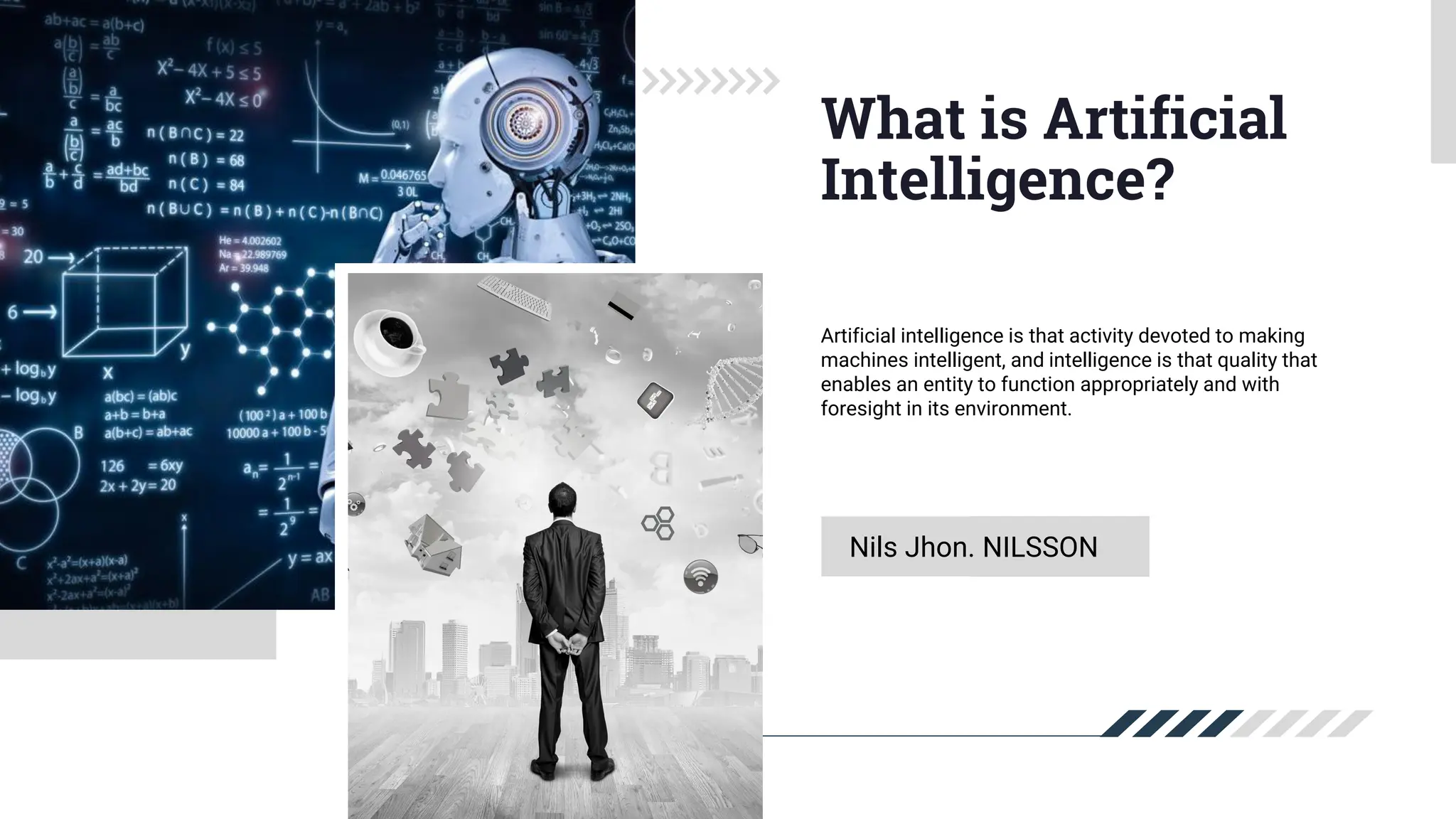
Artificial intelligence is that activity devoted to making
machines intelligent, and intelligence is that quality that
enables an entity to function appropriately and with
foresight in its environment.
The Human
Measure
• To Reason
• Achieve Goals
• Understand and generate Language
• Perceive and respond to sensory inputs
• Prove mathematical theorems
• Play challenging games
• Synthesize and Summarize Information
• Create Art and music and even write histories
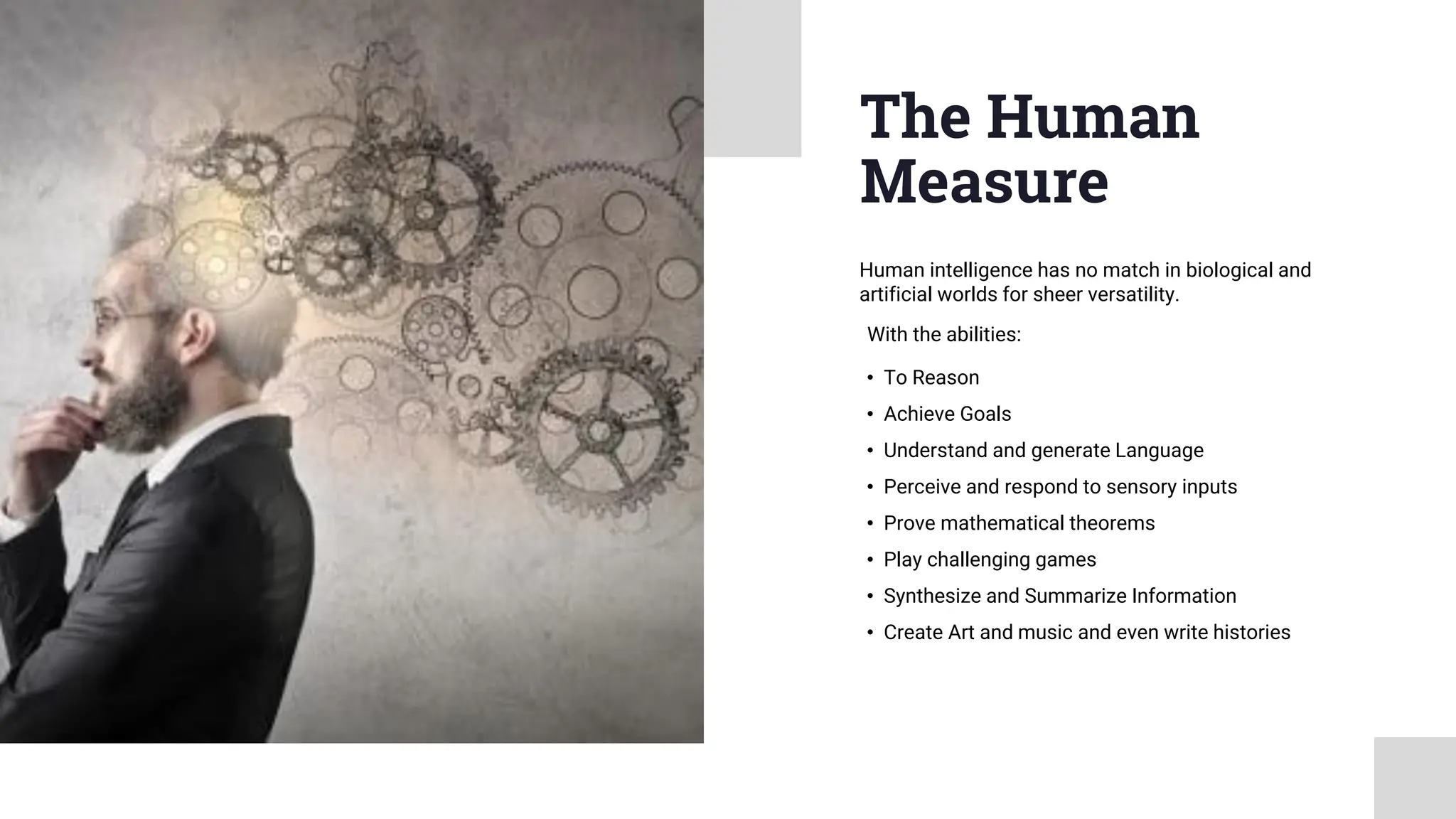
Human intelligence has no match in biological and
artificial worlds for sheer versatility.
With the abilities:
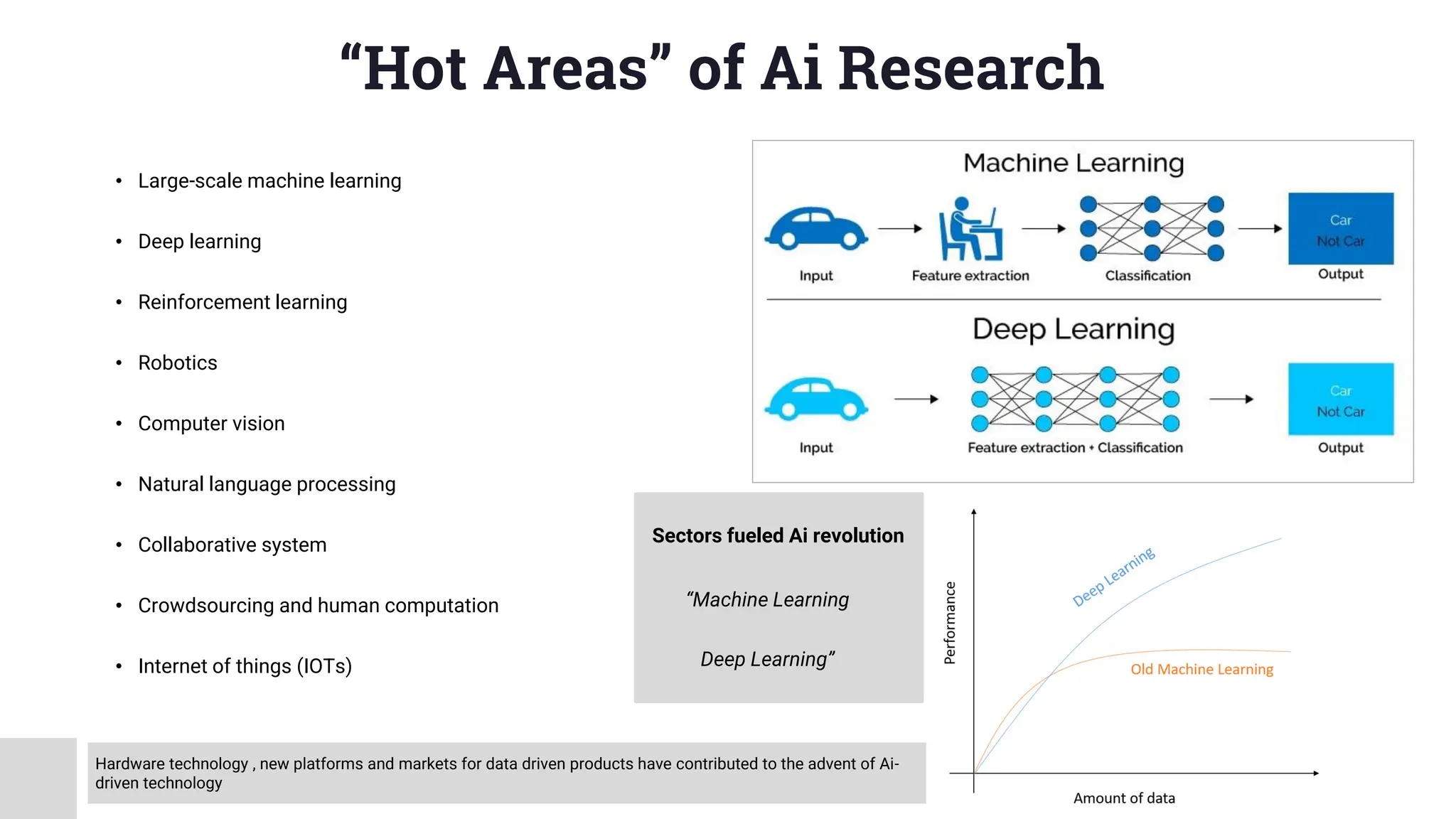
“Hot Areas” of Ai Research
• Large-scale machine learning
• Deep learning
• Reinforcement learning
• Robotics
• Computer vision
• Natural language processing
• Collaborative system
• Crowdsourcing and human computation
• Internet of things (IOTs)
Hardware technology , new platforms and markets for data driven products have contributed to the advent of Ai-
driven technology
“Machine Learning
Deep Learning”
Sectors fueled Ai revolution
False Perception
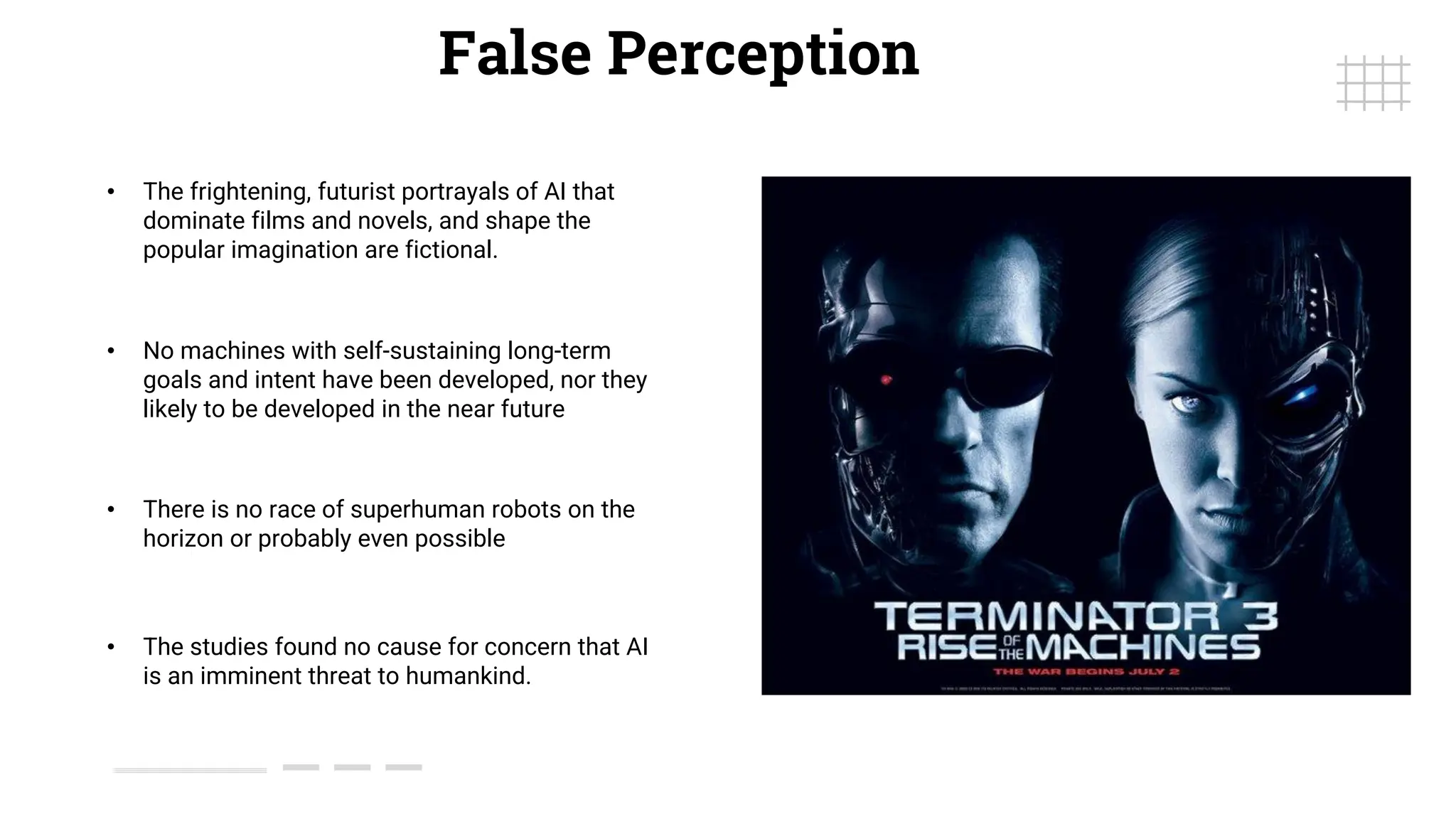
• The frightening, futurist portrayals of AI that
dominate films and novels, and shape the
popular imagination are fictional.
• The studies found no cause for concern that AI
is an imminent threat to humankind.
• There is no race of superhuman robots on the
horizon or probably even possible
• No machines with self-sustaining long-term
goals and intent have been developed, nor they
likely to be developed in the near future
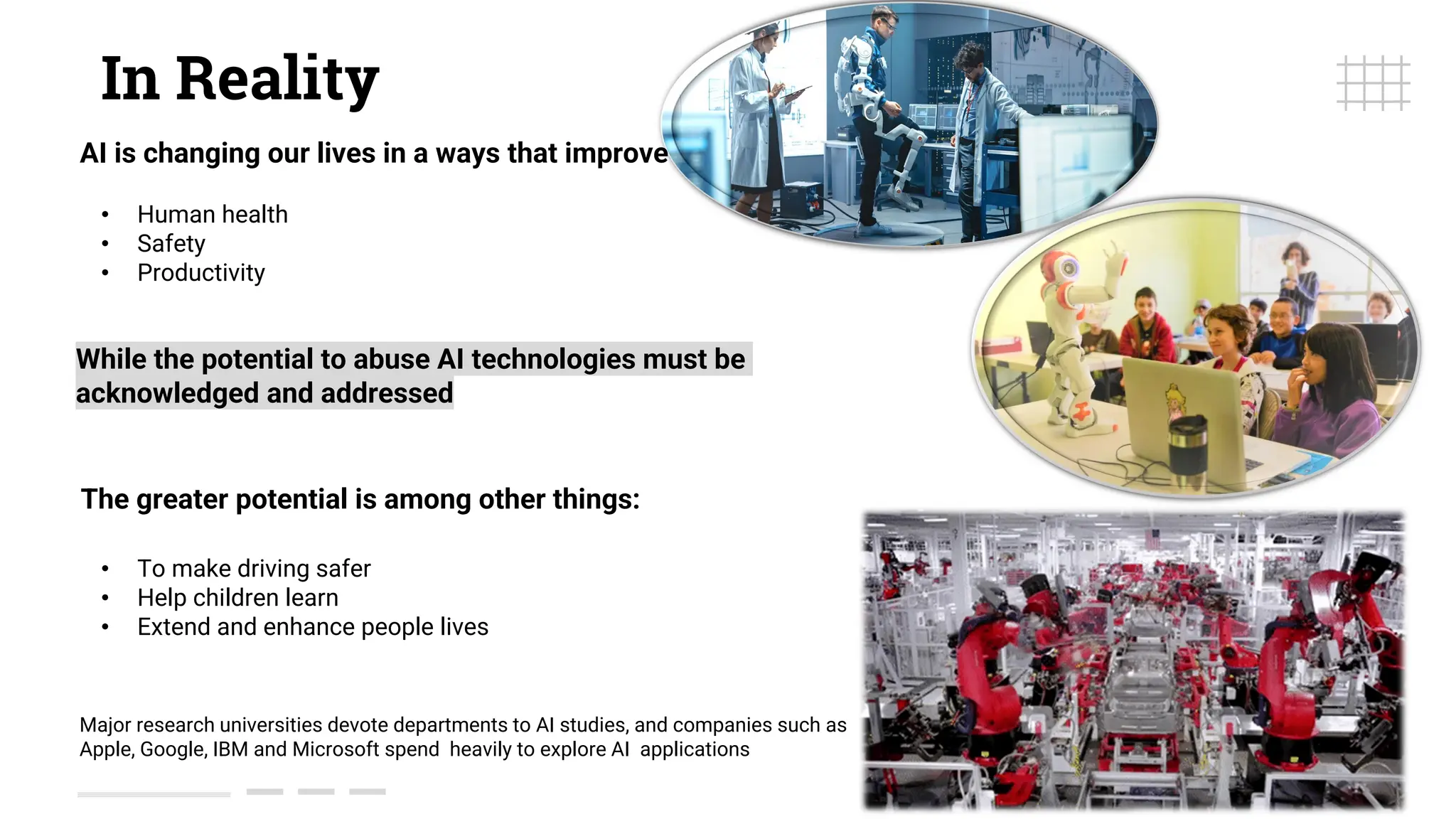
In Reality
• Human health
• Safety
• Productivity
While the potential to abuse AI technologies must be
acknowledged and addressed
AI is changing our lives in a ways that improve
The greater potential is among other things:
• To make driving safer
• Help children learn
• Extend and enhance people lives
Major research universities devote departments to AI studies, and companies such as
Apple, Google, IBM and Microsoft spend heavily to explore AI applications
As cars become better drivers than people, city-dwellers will own
fewer cars, live further from work, and spend time differently
leading to an entirely different urban organization.
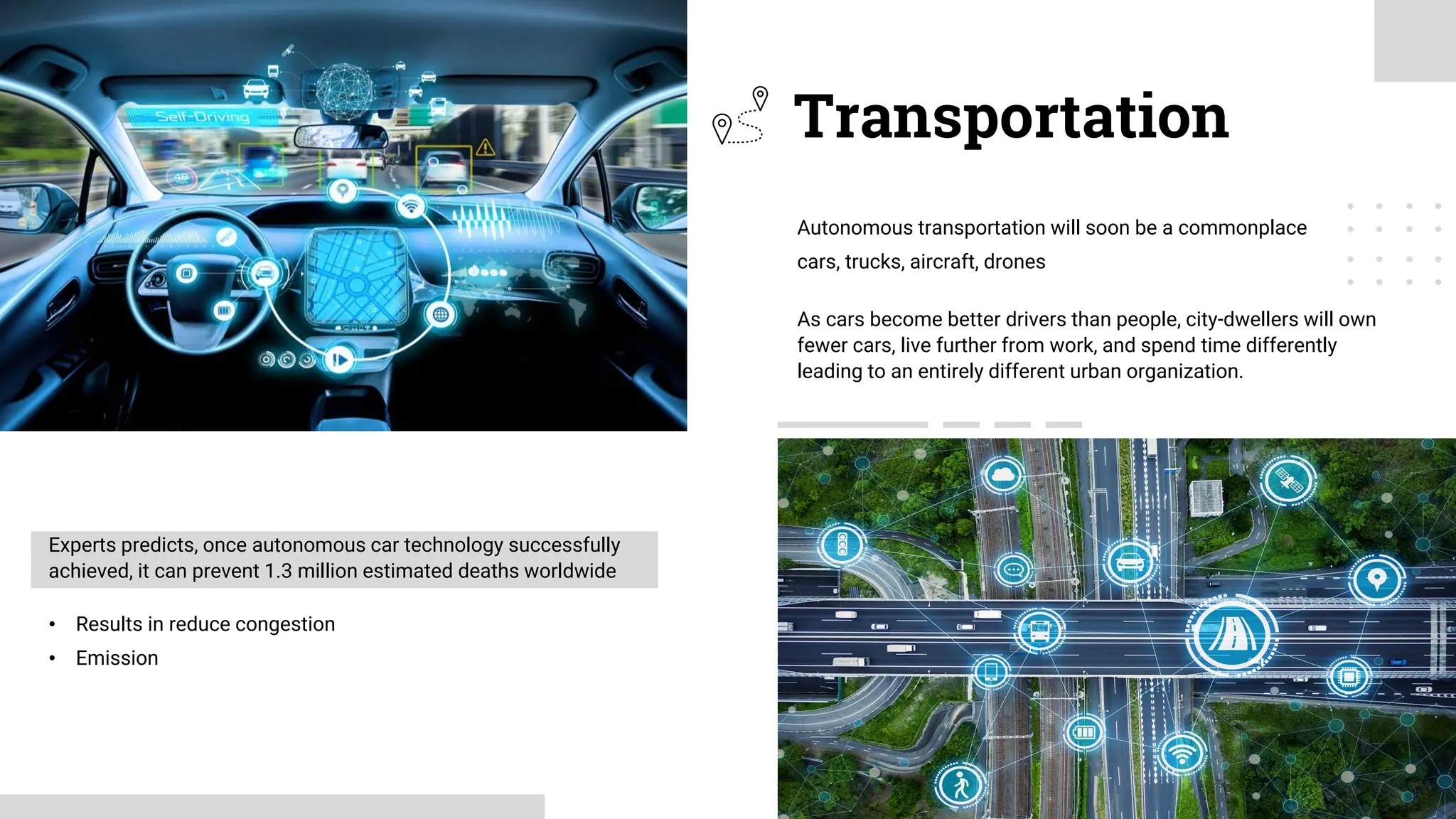
Autonomous transportation will soon be a commonplace
cars, trucks, aircraft, drones
Transportation
Experts predicts, once autonomous car technology successfully
achieved, it can prevent 1.3 million estimated deaths worldwide
• Results in reduce congestion
• Emission
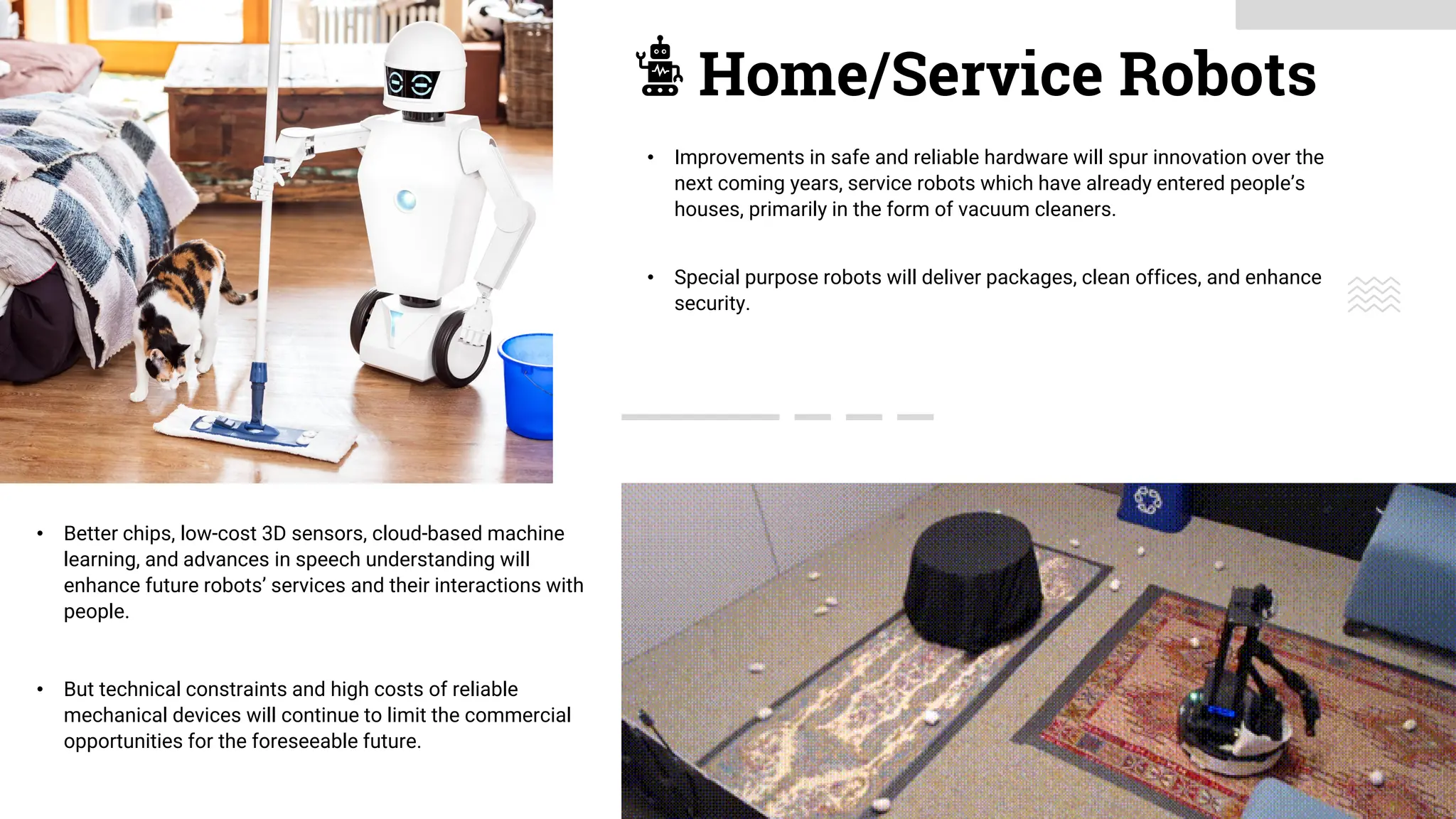
Home/Service Robots
• Better chips, low-cost 3D sensors, cloud-based machine
learning, and advances in speech understanding will
enhance future robots’ services and their interactions with
people.
• But technical constraints and high costs of reliable
mechanical devices will continue to limit the commercial
opportunities for the foreseeable future.
• Improvements in safe and reliable hardware will spur innovation over the
next coming years, service robots which have already entered people’s
houses, primarily in the form of vacuum cleaners.
• Special purpose robots will deliver packages, clean offices, and enhance
security.
• Better hearing aids and visual assistive devices will mitigate the
effects of hearing and vision loss, improving safety and social
connection.
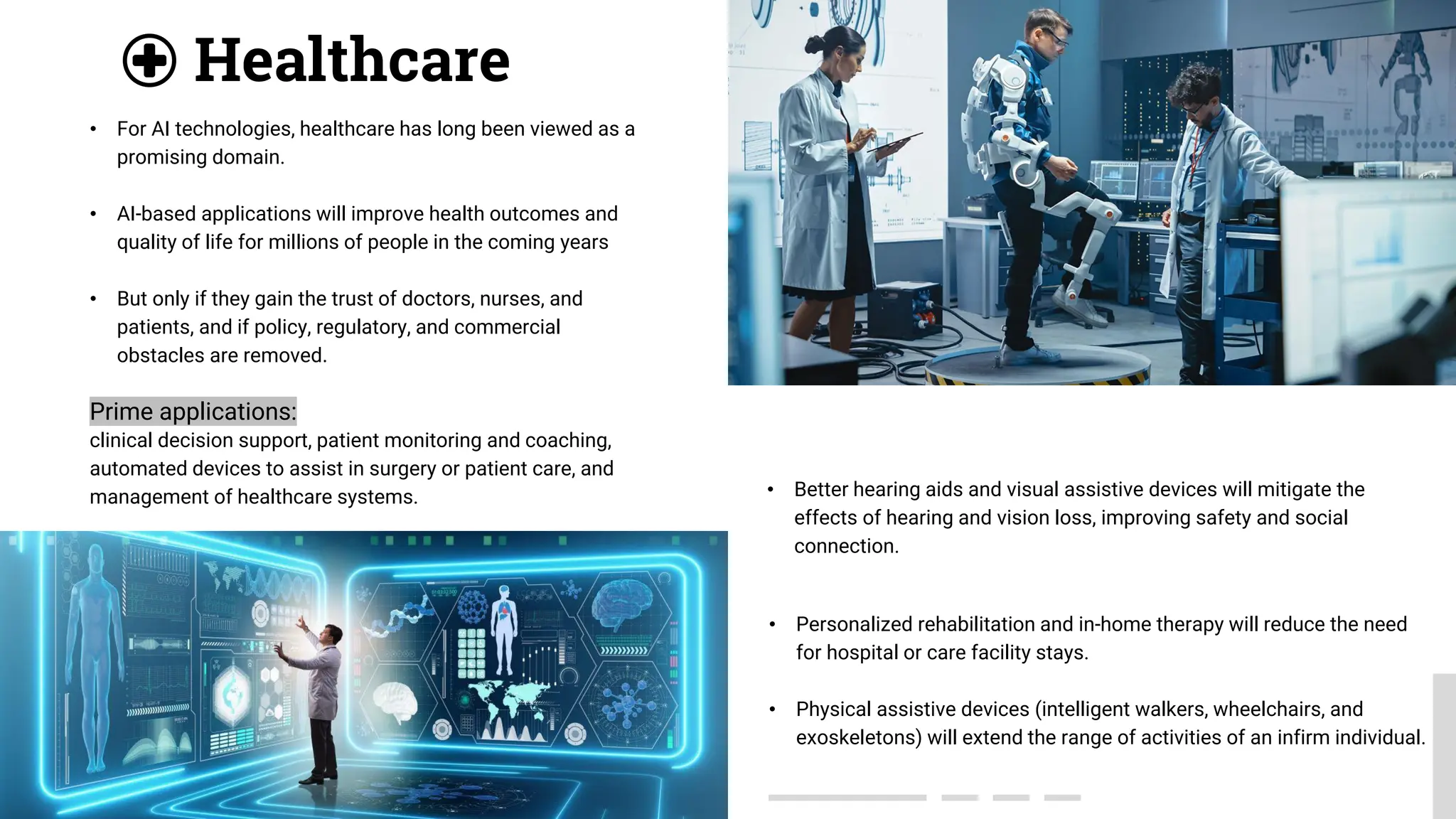
Healthcare
• Personalized rehabilitation and in-home therapy will reduce the need
for hospital or care facility stays.
• Physical assistive devices (intelligent walkers, wheelchairs, and
exoskeletons) will extend the range of activities of an infirm individual.
• For AI technologies, healthcare has long been viewed as a
promising domain.
• AI-based applications will improve health outcomes and
quality of life for millions of people in the coming years
• But only if they gain the trust of doctors, nurses, and
patients, and if policy, regulatory, and commercial
obstacles are removed.
Prime applications:
clinical decision support, patient monitoring and coaching,
automated devices to assist in surgery or patient care, and
management of healthcare systems.
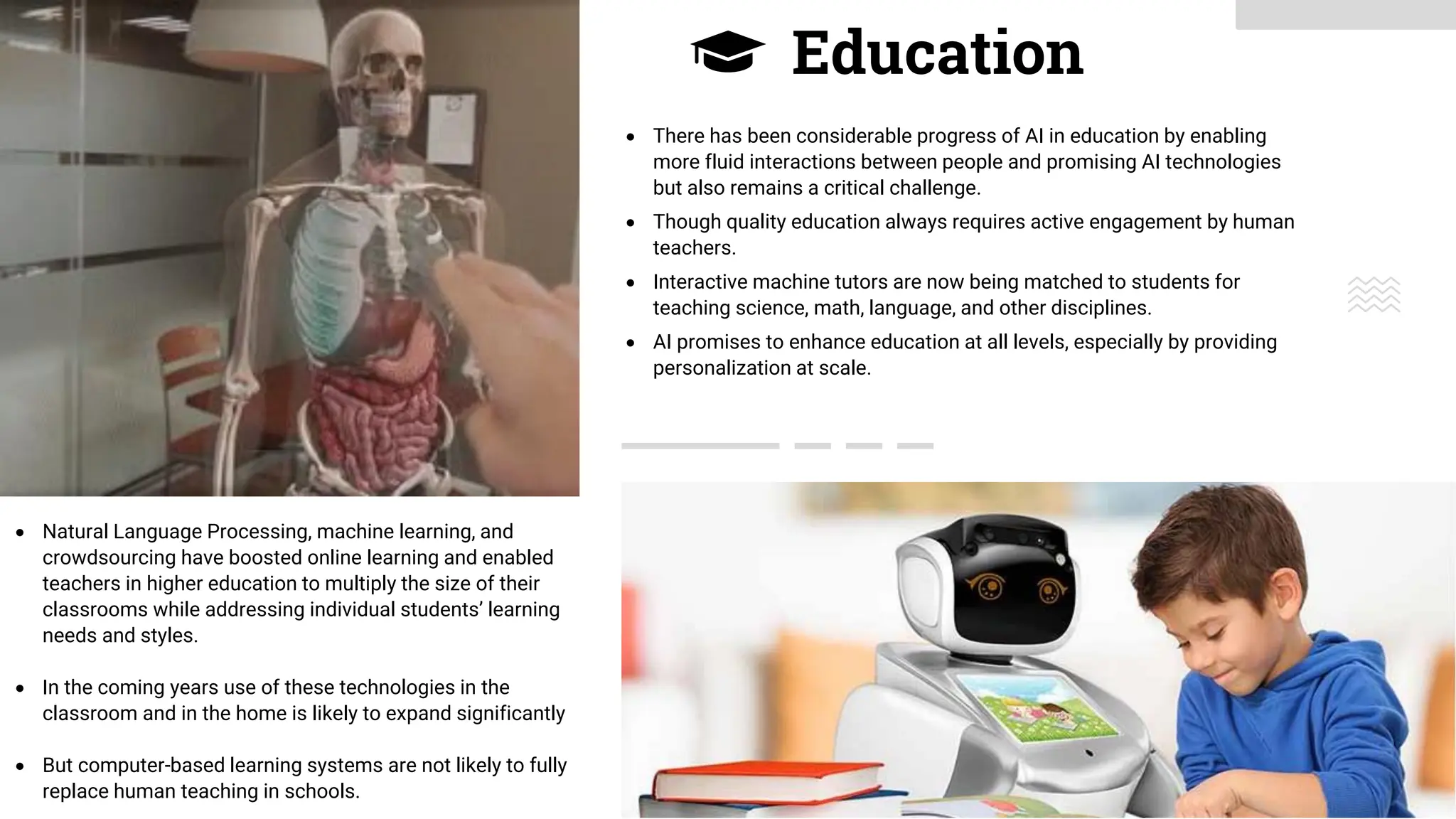
Education
• Natural Language Processing, machine learning, and
crowdsourcing have boosted online learning and enabled
teachers in higher education to multiply the size of their
classrooms while addressing individual students’ learning
needs and styles.
• In the coming years use of these technologies in the
classroom and in the home is likely to expand significantly
• But computer-based learning systems are not likely to fully
replace human teaching in schools.
• There has been considerable progress of AI in education by enabling
more fluid interactions between people and promising AI technologies
but also remains a critical challenge.
• Though quality education always requires active engagement by human
teachers.
• Interactive machine tutors are now being matched to students for
teaching science, math, language, and other disciplines.
• AI promises to enhance education at all levels, especially by providing
personalization at scale.
Public Safety and Security
• For example, AI has been used to create predictive models to help
government agencies address issues such as prevention of lead
poisoning in at-risk children and distribution of food efficiently.
• These budding efforts suggest more could be done, particularly
if agencies and organizations can engage and build trust with
these communities.
• Beyond education, many opportunities exist for AI methods to
assist Low-resource Communities by providing mitigations and
solutions to a variety of social problems.
Low-Resource Communities
• Gaining public trust is also a challenge for AI.
• Developed countries have already begun to deploy AI technologies in border
administration and law enforcement.
• By 2030, they will rely heavily upon them, including improved cameras and
drones for surveillance, algorithms to detect financial fraud, and predictive
policing.
• The latter raises the specter of innocent people being unjustifiably monitored,
and care must be taken to avoid systematizing human bias and protect
individual rights.
Employment and
Workplace
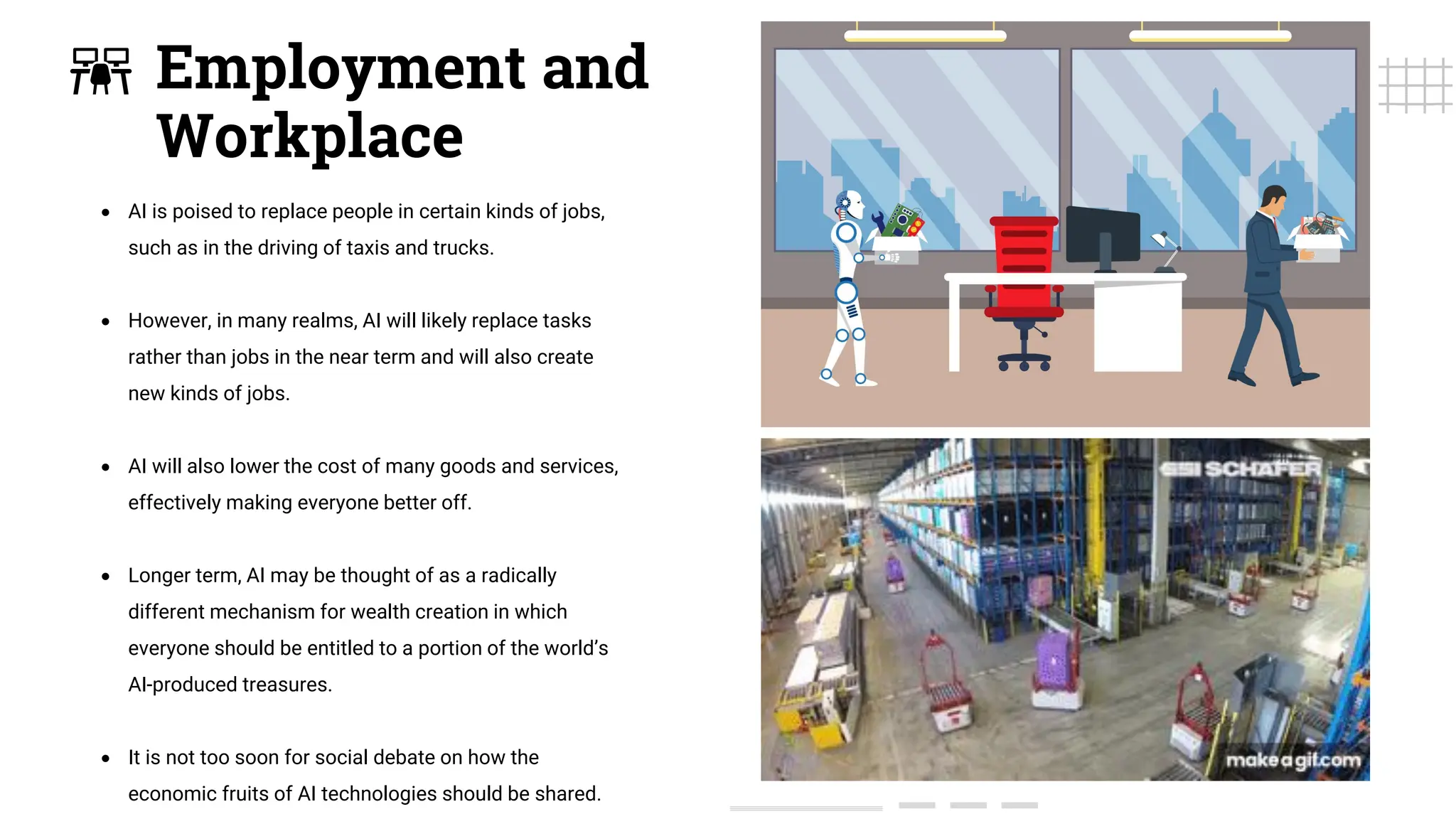
• AI is poised to replace people in certain kinds of jobs,
such as in the driving of taxis and trucks.
• However, in many realms, AI will likely replace tasks
rather than jobs in the near term and will also create
new kinds of jobs.
• AI will also lower the cost of many goods and services,
effectively making everyone better off.
• Longer term, AI may be thought of as a radically
different mechanism for wealth creation in which
everyone should be entitled to a portion of the world’s
AI-produced treasures.
• It is not too soon for social debate on how the
economic fruits of AI technologies should be shared.
Entertainment
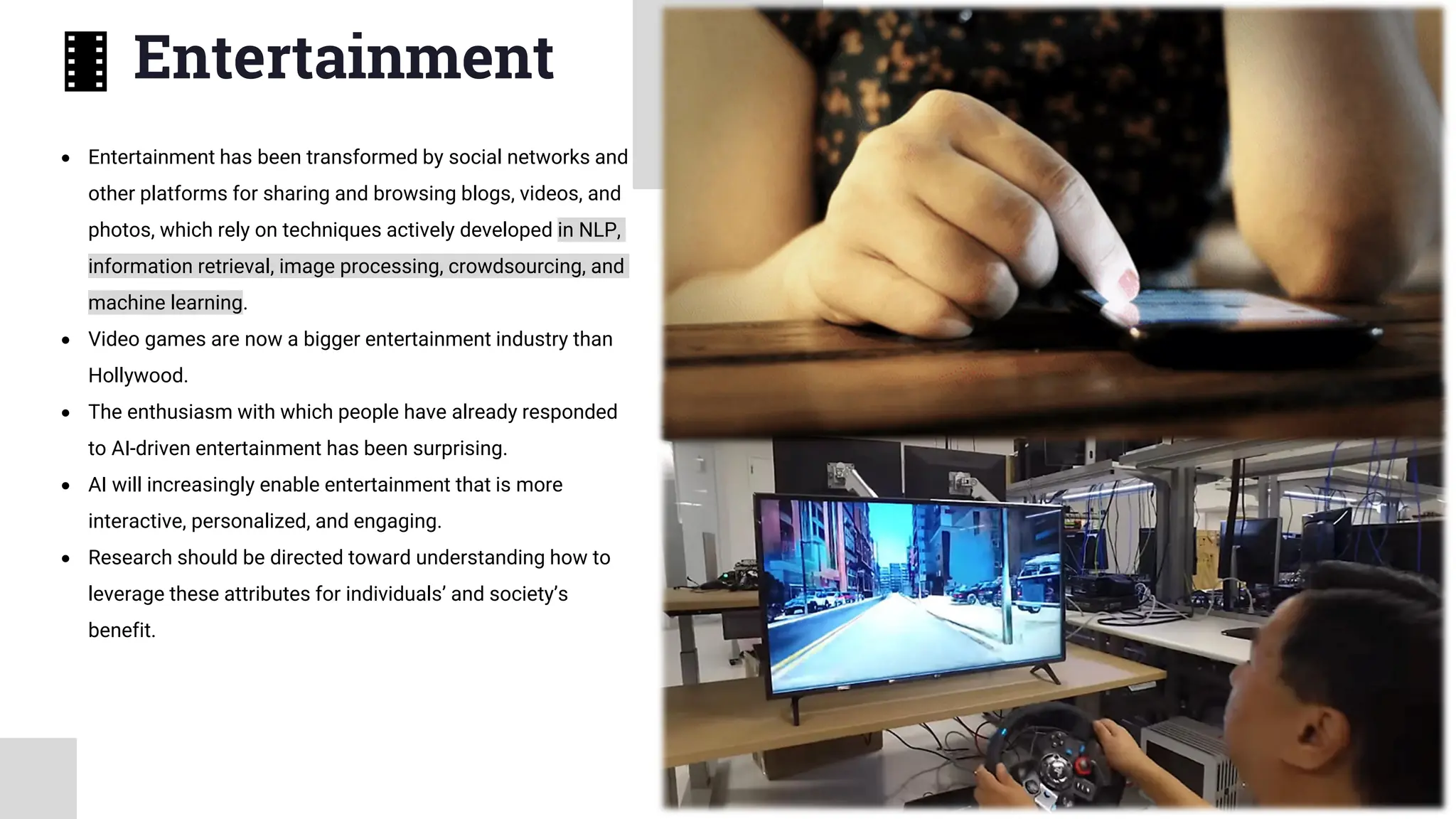
• Entertainment has been transformed by social networks and
other platforms for sharing and browsing blogs, videos, and
photos, which rely on techniques actively developed in NLP,
information retrieval, image processing, crowdsourcing, and
machine learning.
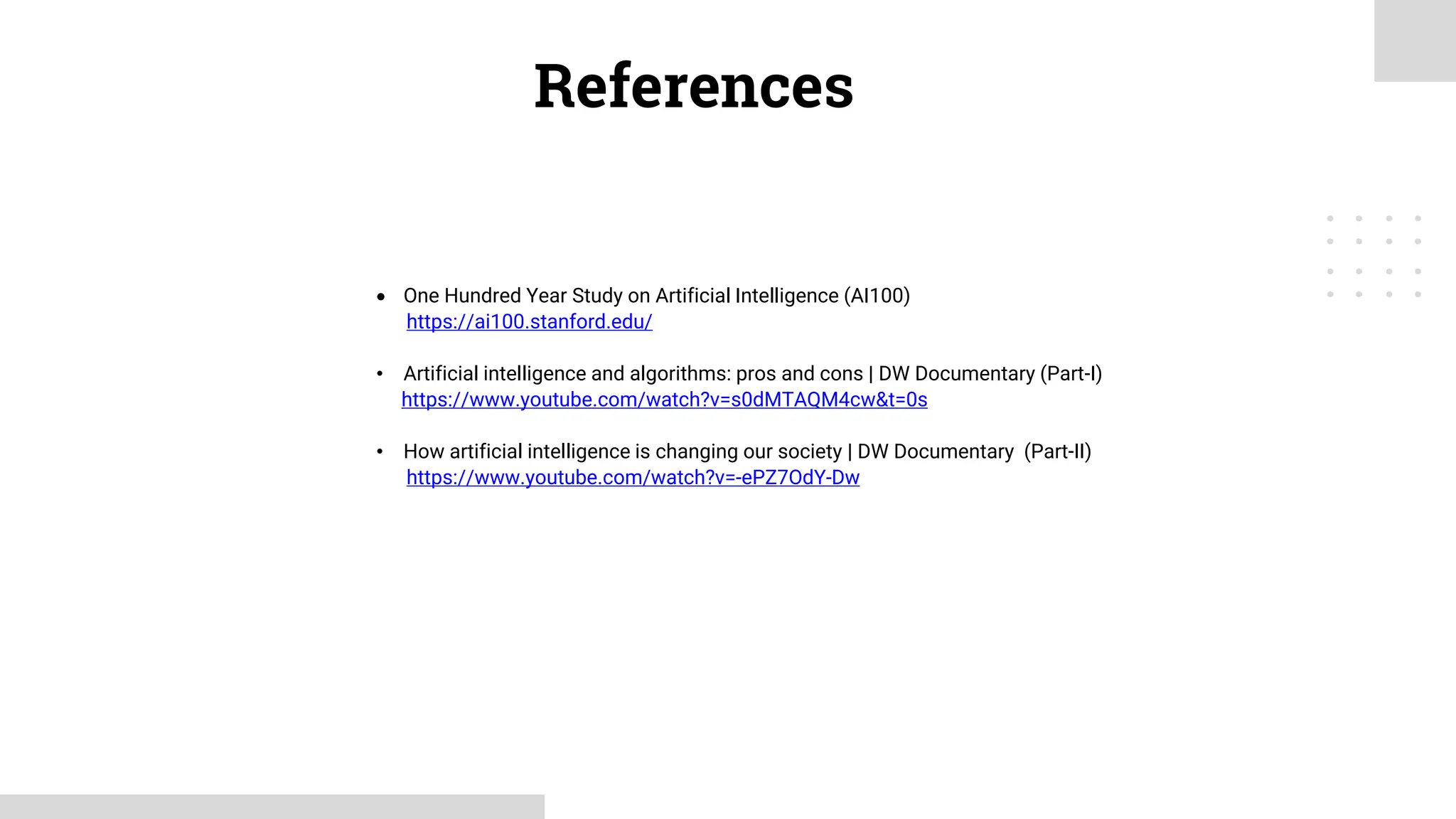
• Video games are now a bigger entertainment industry than
Hollywood.
• The enthusiasm with which people have already responded
to AI-driven entertainment has been surprising.
• AI will increasingly enable entertainment that is more
interactive, personalized, and engaging.
• Research should be directed toward understanding how to
leverage these attributes for individuals’ and society’s
benefit.
• Throughout history, humans have both shaped and adapted to new
technologies.
• Misunderstandings about what AI is and not could fuel opposition to
technologies with the potential to benefit everyone.
• Poorly informed regulation that stifles innovation would be a tragic mistake.
• The measure of success for AI applications is the value they create for human
lives.
• Privacy concerns about AI-enabled surveillance, sousveillance are also
widespread.
• Another important consideration is how AI systems that take over certain tasks
will affect people’s affordances and capabilities.
AI Policy, now and in the future
• One Hundred Year Study on Artificial Intelligence (AI100)
https://ai100.stanford.edu/
• Artificial intelligence and algorithms: pros and cons | DW Documentary (Part-I)
https://www.youtube.com/watch?v=s0dMTAQM4cw&t=0s
• How artificial intelligence is changing our society | DW Documentary (Part-II)
https://www.youtube.com/watch?v=-ePZ7OdY-Dw
References
2021 Study Panel Report
Standing Questions
Q1. What are the examples of pictures that reflect important progress in Ai?
Q2. What are the most important advances in Ai?
Q3. What are the most inspiring open grand challenge problems?
Q4. How much have we progressed in understanding the key mysteries of
human intelligence?
Q5. What are the prospects for more general artificial intelligence?
Q6. How has public sentiments toward Ai evolved, and how we should
inform/educate the public?
Q7. How should governments act to ensure Ai is developed and used responsibly?
Q8. What should the roles of academia and industry be , respectively in the development and deployment of Ai technologies and the study of the
impacts of Ai?
Q9. What are the most promising opportunities for Ai?
Q10. What are the most pressing dangers of Ai?
Q11. How has Ai impacted on socioeconomic relationships?
Q12. Does it appear “building in how we think” work as an engineering strategy in the long run?
Workshop Questions
Q1. How are Ai-driven predictions made in high stakes public contexts, and what social, organizational, and practical considerations must policy makers
consider in their implantation and governance?
Q2. What are the most pressing challenges and significant opportunities in the use of Ai to provide physical and emotional care to people in need?
Thank You

Artificial Intelligence and life in 2030

  • 1.
    AND LIFE IN2030 Muazzam Ali (Tc-04) Teacher: Dr.Tahir Malik
  • 2.
    Content • Section I:What is Artificial Intelligence? • Defining AI • AI Research Trends • Section II: AI by Domain • Transportation • Home/Service Robots • Healthcare • Education • Low-Resource Communities • Public Safety and Security • Employment and Workplace • Entertainment • Section III: Prospects and Recommendations • AI Policy, Now and in the Future
  • 3.
    Nils Jhon. NILSSON Whatis Artificial Intelligence? Artificial intelligence is that activity devoted to making machines intelligent, and intelligence is that quality that enables an entity to function appropriately and with foresight in its environment.
  • 4.
    The Human Measure • ToReason • Achieve Goals • Understand and generate Language • Perceive and respond to sensory inputs • Prove mathematical theorems • Play challenging games • Synthesize and Summarize Information • Create Art and music and even write histories Human intelligence has no match in biological and artificial worlds for sheer versatility. With the abilities:
  • 5.
    “Hot Areas” ofAi Research • Large-scale machine learning • Deep learning • Reinforcement learning • Robotics • Computer vision • Natural language processing • Collaborative system • Crowdsourcing and human computation • Internet of things (IOTs) Hardware technology , new platforms and markets for data driven products have contributed to the advent of Ai- driven technology “Machine Learning Deep Learning” Sectors fueled Ai revolution
  • 6.
    False Perception • Thefrightening, futurist portrayals of AI that dominate films and novels, and shape the popular imagination are fictional. • The studies found no cause for concern that AI is an imminent threat to humankind. • There is no race of superhuman robots on the horizon or probably even possible • No machines with self-sustaining long-term goals and intent have been developed, nor they likely to be developed in the near future
  • 7.
    In Reality • Humanhealth • Safety • Productivity While the potential to abuse AI technologies must be acknowledged and addressed AI is changing our lives in a ways that improve The greater potential is among other things: • To make driving safer • Help children learn • Extend and enhance people lives Major research universities devote departments to AI studies, and companies such as Apple, Google, IBM and Microsoft spend heavily to explore AI applications
  • 8.
    As cars becomebetter drivers than people, city-dwellers will own fewer cars, live further from work, and spend time differently leading to an entirely different urban organization. Autonomous transportation will soon be a commonplace cars, trucks, aircraft, drones Transportation Experts predicts, once autonomous car technology successfully achieved, it can prevent 1.3 million estimated deaths worldwide • Results in reduce congestion • Emission
  • 9.
    Home/Service Robots • Betterchips, low-cost 3D sensors, cloud-based machine learning, and advances in speech understanding will enhance future robots’ services and their interactions with people. • But technical constraints and high costs of reliable mechanical devices will continue to limit the commercial opportunities for the foreseeable future. • Improvements in safe and reliable hardware will spur innovation over the next coming years, service robots which have already entered people’s houses, primarily in the form of vacuum cleaners. • Special purpose robots will deliver packages, clean offices, and enhance security.
  • 10.
    • Better hearingaids and visual assistive devices will mitigate the effects of hearing and vision loss, improving safety and social connection. Healthcare • Personalized rehabilitation and in-home therapy will reduce the need for hospital or care facility stays. • Physical assistive devices (intelligent walkers, wheelchairs, and exoskeletons) will extend the range of activities of an infirm individual. • For AI technologies, healthcare has long been viewed as a promising domain. • AI-based applications will improve health outcomes and quality of life for millions of people in the coming years • But only if they gain the trust of doctors, nurses, and patients, and if policy, regulatory, and commercial obstacles are removed. Prime applications: clinical decision support, patient monitoring and coaching, automated devices to assist in surgery or patient care, and management of healthcare systems.
  • 11.
    Education • Natural LanguageProcessing, machine learning, and crowdsourcing have boosted online learning and enabled teachers in higher education to multiply the size of their classrooms while addressing individual students’ learning needs and styles. • In the coming years use of these technologies in the classroom and in the home is likely to expand significantly • But computer-based learning systems are not likely to fully replace human teaching in schools. • There has been considerable progress of AI in education by enabling more fluid interactions between people and promising AI technologies but also remains a critical challenge. • Though quality education always requires active engagement by human teachers. • Interactive machine tutors are now being matched to students for teaching science, math, language, and other disciplines. • AI promises to enhance education at all levels, especially by providing personalization at scale.
  • 12.
    Public Safety andSecurity • For example, AI has been used to create predictive models to help government agencies address issues such as prevention of lead poisoning in at-risk children and distribution of food efficiently. • These budding efforts suggest more could be done, particularly if agencies and organizations can engage and build trust with these communities. • Beyond education, many opportunities exist for AI methods to assist Low-resource Communities by providing mitigations and solutions to a variety of social problems. Low-Resource Communities • Gaining public trust is also a challenge for AI. • Developed countries have already begun to deploy AI technologies in border administration and law enforcement. • By 2030, they will rely heavily upon them, including improved cameras and drones for surveillance, algorithms to detect financial fraud, and predictive policing. • The latter raises the specter of innocent people being unjustifiably monitored, and care must be taken to avoid systematizing human bias and protect individual rights.
  • 13.
    Employment and Workplace • AIis poised to replace people in certain kinds of jobs, such as in the driving of taxis and trucks. • However, in many realms, AI will likely replace tasks rather than jobs in the near term and will also create new kinds of jobs. • AI will also lower the cost of many goods and services, effectively making everyone better off. • Longer term, AI may be thought of as a radically different mechanism for wealth creation in which everyone should be entitled to a portion of the world’s AI-produced treasures. • It is not too soon for social debate on how the economic fruits of AI technologies should be shared.
  • 14.
    Entertainment • Entertainment hasbeen transformed by social networks and other platforms for sharing and browsing blogs, videos, and photos, which rely on techniques actively developed in NLP, information retrieval, image processing, crowdsourcing, and machine learning. • Video games are now a bigger entertainment industry than Hollywood. • The enthusiasm with which people have already responded to AI-driven entertainment has been surprising. • AI will increasingly enable entertainment that is more interactive, personalized, and engaging. • Research should be directed toward understanding how to leverage these attributes for individuals’ and society’s benefit.
  • 15.
    • Throughout history,humans have both shaped and adapted to new technologies. • Misunderstandings about what AI is and not could fuel opposition to technologies with the potential to benefit everyone. • Poorly informed regulation that stifles innovation would be a tragic mistake. • The measure of success for AI applications is the value they create for human lives. • Privacy concerns about AI-enabled surveillance, sousveillance are also widespread. • Another important consideration is how AI systems that take over certain tasks will affect people’s affordances and capabilities. AI Policy, now and in the future
  • 16.
    • One HundredYear Study on Artificial Intelligence (AI100) https://ai100.stanford.edu/ • Artificial intelligence and algorithms: pros and cons | DW Documentary (Part-I) https://www.youtube.com/watch?v=s0dMTAQM4cw&t=0s • How artificial intelligence is changing our society | DW Documentary (Part-II) https://www.youtube.com/watch?v=-ePZ7OdY-Dw References
  • 17.
    2021 Study PanelReport Standing Questions Q1. What are the examples of pictures that reflect important progress in Ai? Q2. What are the most important advances in Ai? Q3. What are the most inspiring open grand challenge problems? Q4. How much have we progressed in understanding the key mysteries of human intelligence? Q5. What are the prospects for more general artificial intelligence? Q6. How has public sentiments toward Ai evolved, and how we should inform/educate the public? Q7. How should governments act to ensure Ai is developed and used responsibly? Q8. What should the roles of academia and industry be , respectively in the development and deployment of Ai technologies and the study of the impacts of Ai? Q9. What are the most promising opportunities for Ai? Q10. What are the most pressing dangers of Ai? Q11. How has Ai impacted on socioeconomic relationships? Q12. Does it appear “building in how we think” work as an engineering strategy in the long run? Workshop Questions Q1. How are Ai-driven predictions made in high stakes public contexts, and what social, organizational, and practical considerations must policy makers consider in their implantation and governance? Q2. What are the most pressing challenges and significant opportunities in the use of Ai to provide physical and emotional care to people in need?
  • 18.