David De Roure
 @dder


Social Machines:
democratization, disintermediation,
and citizens at scale
DIRECTOR, UNIVERSITY OF OXFORD E-RESEARCH CENTRE
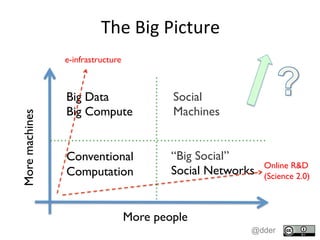
The Big Picture(s)
The	
  Big	
  Picture	
  
More people
Moremachines
Big Data
Big Compute
Conventional
Computation
“Big Social”
Social Networks
e-infrastructure
Online R&D
(Science 2.0)
Social
Machines
@dder
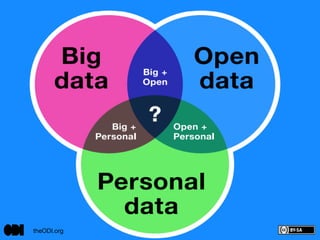
theODI.org
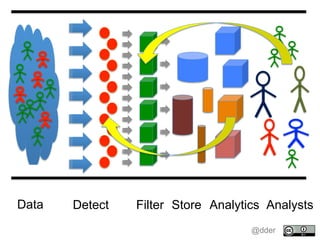
Data Detect Store AnalyticsFilter Analysts
@dder
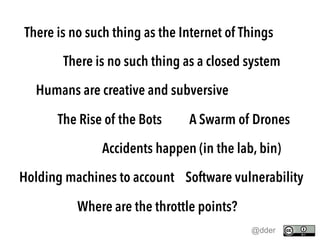
There is no such thing as the Internet of Things
There is no such thing as a closed system
Humans are creative and subversive
The Rise of the Bots A Swarm of Drones
Accidents happen (in the lab, bin)
Holding machines to account Software vulnerability
Where are the throttle points?
@dder
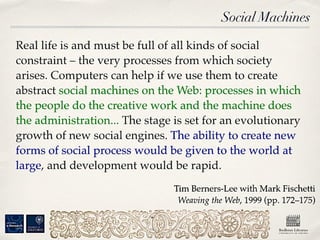
Social Machines
Empowered Citizens
Social	
  Machines	
  Defini6on	
  TBL	
  
Pip Willcox
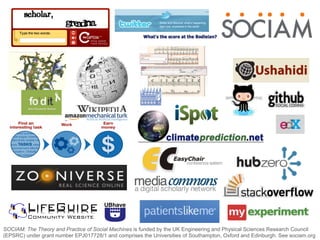
SOCIAM: The Theory and Practice of Social Machines is funded by the UK Engineering and Physical Sciences Research Council
(EPSRC) under grant number EPJ017728/1 and comprises the Universities of Southampton, Oxford and Edinburgh. See sociam.org
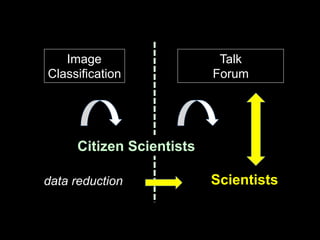
Scientists
Talk
Forum
Image
Classification
data reduction
Citizen Scientists
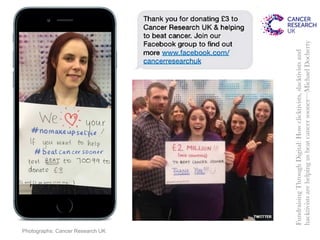
FundraisingThroughDigital:Howclicktivists,slacktivistsand
hacktivistsarehelpingusbeatcancersooner—MichaelDocherty
Photographs: Cancer Research UK
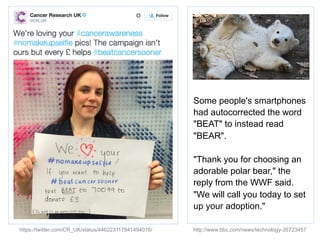
https://twitter.com/CR_UK/status/446223117841494016/
Some people's smartphones
had autocorrected the word
"BEAT" to instead read
"BEAR".
"Thank you for choosing an
adorable polar bear," the
reply from the WWF said.
"We will call you today to set
up your adoption."
http://www.bbc.com/news/technology-26723457
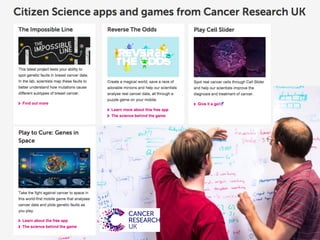
http://chordify.net/
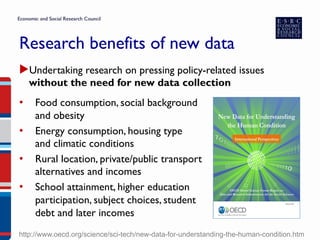
Research benefits of new data
▶ Undertaking research on pressing policy-related issues
without the need for new data collection
•  Food consumption, social background
and obesity
•  Energy consumption, housing type
and climatic conditions
•  Rural location, private/public transport
alternatives and incomes
•  School attainment, higher education
participation, subject choices, student
debt and later incomes
http://www.oecd.org/science/sci-tech/new-data-for-understanding-the-human-condition.htm
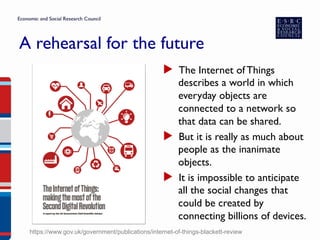
A rehearsal for the future
▶  The Internet of Things
describes a world in which
everyday objects are
connected to a network so
that data can be shared.
▶  But it is really as much about
people as the inanimate
objects.
▶  It is impossible to anticipate
all the social changes that
could be created by
connecting billions of devices.
https://www.gov.uk/government/publications/internet-of-things-blackett-review
Social Machines as
disruptive (socio-)technology
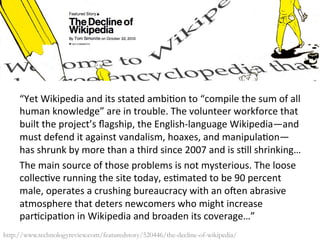
“Yet	
  Wikipedia	
  and	
  its	
  stated	
  ambi6on	
  to	
  “compile	
  the	
  sum	
  of	
  all	
  
human	
  knowledge”	
  are	
  in	
  trouble.	
  The	
  volunteer	
  workforce	
  that	
  
built	
  the	
  project’s	
  flagship,	
  the	
  English-­‐language	
  Wikipedia—and	
  
must	
  defend	
  it	
  against	
  vandalism,	
  hoaxes,	
  and	
  manipula6on—
has	
  shrunk	
  by	
  more	
  than	
  a	
  third	
  since	
  2007	
  and	
  is	
  s6ll	
  shrinking…	
  	
  
The	
  main	
  source	
  of	
  those	
  problems	
  is	
  not	
  mysterious.	
  The	
  loose	
  
collec6ve	
  running	
  the	
  site	
  today,	
  es6mated	
  to	
  be	
  90	
  percent	
  
male,	
  operates	
  a	
  crushing	
  bureaucracy	
  with	
  an	
  oSen	
  abrasive	
  
atmosphere	
  that	
  deters	
  newcomers	
  who	
  might	
  increase	
  
par6cipa6on	
  in	
  Wikipedia	
  and	
  broaden	
  its	
  coverage…”	
  
	
  http://www.technologyreview.com/featuredstory/520446/the-decline-of-wikipedia/
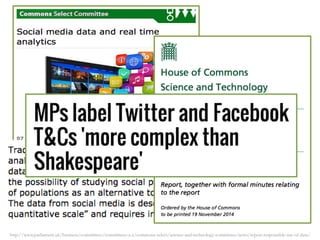
http://www.parliament.uk/business/committees/committees-a-z/commons-select/science-and-technology-committee/news/report-responsible-use-of-data/
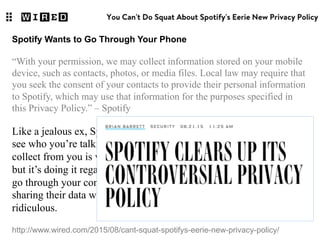
http://www.wired.com/2015/08/cant-squat-spotifys-eerie-new-privacy-policy/
Spotify Wants to Go Through Your Phone
“With your permission, we may collect information stored on your mobile
device, such as contacts, photos, or media files. Local law may require that
you seek the consent of your contacts to provide their personal information
to Spotify, which may use that information for the purposes specified in
this Privacy Policy.” – Spotify
Like a jealous ex, Spotify wants to see (and collect) your photos and
see who you’re talking to. What kind of media files Spotify will
collect from you is vague, and why the company needs it is unclear,
but it’s doing it regardless. Also, the fact that Spotify expects you to
go through your contact list and ask everyone for their consent in
sharing their data with Spotify is–what’s the word? Oh yes: it’s
ridiculous.
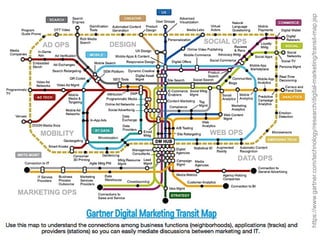
https://www.gartner.com/technology/research/digital-marketing/transit-map.jsp
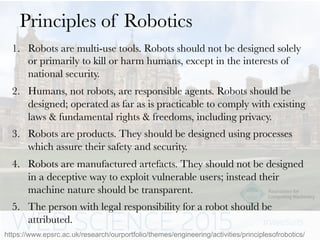
Principles of Robotics
1.  Robots are multi-use tools. Robots should not be designed solely
or primarily to kill or harm humans, except in the interests of
national security.
2.  Humans, not robots, are responsible agents. Robots should be
designed; operated as far as is practicable to comply with existing
laws & fundamental rights & freedoms, including privacy.
3.  Robots are products. They should be designed using processes
which assure their safety and security.
4.  Robots are manufactured artefacts. They should not be designed
in a deceptive way to exploit vulnerable users; instead their
machine nature should be transparent.
5.  The person with legal responsibility for a robot should be
attributed.
https://www.epsrc.ac.uk/research/ourportfolio/themes/engineering/activities/principlesofrobotics/
AlanWinfield
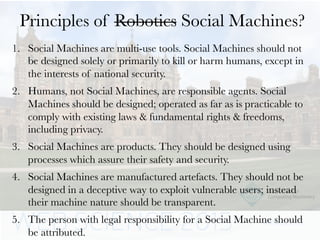
Principles of Robotics Social Machines?
1.  Social Machines are multi-use tools. Social Machines should not
be designed solely or primarily to kill or harm humans, except in
the interests of national security.
2.  Humans, not Social Machines, are responsible agents. Social
Machines should be designed; operated as far as is practicable to
comply with existing laws & fundamental rights & freedoms,
including privacy.
3.  Social Machines are products. They should be designed using
processes which assure their safety and security.
4.  Social Machines are manufactured artefacts. They should not be
designed in a deceptive way to exploit vulnerable users; instead
their machine nature should be transparent.
5.  The person with legal responsibility for a Social Machine should
be attributed.
Studying Social Machines
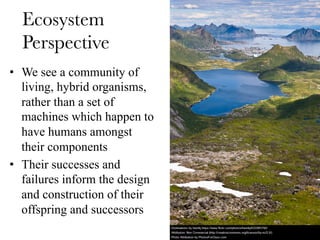
Ecosystem
Perspective
•  We see a community of
living, hybrid organisms,
rather than a set of
machines which happen to
have humans amongst
their components
•  Their successes and
failures inform the design
and construction of their
offspring and successors
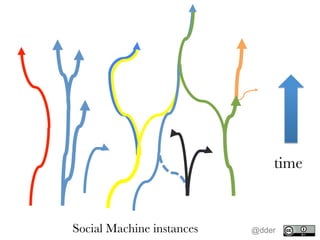
time
Social Machine instances
 @dder
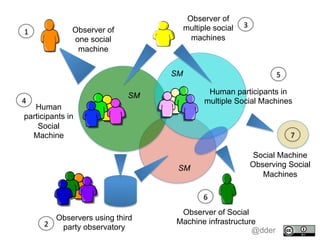
Observer of
one social
machine
Observers using third
party observatory
Observer of
multiple social
machines
Human
participants in
Social
Machine
Human participants in
multiple Social Machines
Observer of Social
Machine infrastructure
1	
  
4	
  
2	
  
3	
  
5	
  
6	
  
SM
SM
SM
Social Machine
Observing Social
Machines
7	
  
@dder
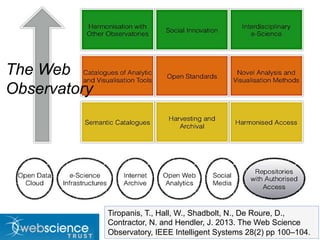
The Web
Observatory
Tiropanis, T., Hall, W., Shadbolt, N., De Roure, D.,
Contractor, N. and Hendler, J. 2013. The Web Science
Observatory, IEEE Intelligent Systems 28(2) pp 100–104.
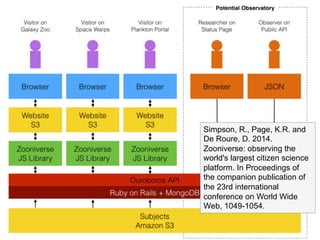
Simpson, R., Page, K.R. and
De Roure, D. 2014.
Zooniverse: observing the
world's largest citizen science
platform. In Proceedings of
the companion publication of
the 23rd international
conference on World Wide
Web, 1049-1054.
By Ségolène Tarte, David De Roure
and Pip Willcox
Working out the Plot
The Role of Stories in
Social Machines
Tarte, S.M., De Roure, D. and Willcox, P. 2014. Working out the Plot: the Role of
Stories in Social Machines. SOCM2014: The Theory and Practice of Social
Machines, Seoul, Korea, International World Wide Web Conferences pp. 909–914
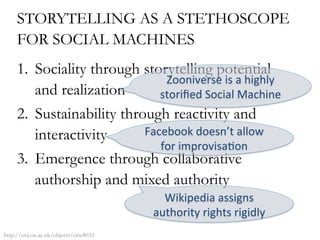
STORYTELLING AS A STETHOSCOPE
FOR SOCIAL MACHINES
1.  Sociality through storytelling potential
and realization
2.  Sustainability through reactivity and
interactivity
3.  Emergence through collaborative
authorship and mixed authority
Zooniverse	
  is	
  a	
  highly	
  
storified	
  Social	
  Machine	
  
Facebook	
  doesn’t	
  allow	
  
for	
  improvisa6on	
  
Wikipedia	
  assigns	
  
authority	
  rights	
  rigidly	
  
http://ora.ox.ac.uk/objects/ora:8033
Pip Willcox
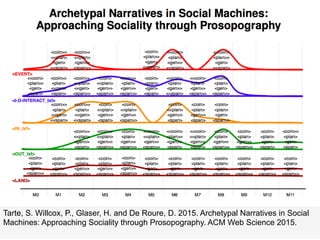
Tarte, S. Willcox, P., Glaser, H. and De Roure, D. 2015. Archetypal Narratives in Social
Machines: Approaching Sociality through Prosopography. ACM Web Science 2015.
SégolèneTarte
Normal Science – computer science is a
puzzle-solving activity under our current
paradigm, inspired by great achievements. 
Successful social machines, like Wikipedia, are
the anomaly. They do not yield to standard
techniques despite attempts to extend those
techniques and fit social machines in as
machines. cf Newtonian mechanics.
Kuhn cycle
We are in the period of crisis, where the failure of established
methods permits us to experiment with new methods to crack
the anomaly. We experiment with social machines as an
underpinning model.
If successful, social machines become the new paradigm and
scientific revolution has occurred. This is evidenced by the
papers and books that train the next generation. 
De Roure, D. 2014. The
Emerging Paradigm of Social
Machines, Digital
Enlightenment Yearbook 2014
227 K. O’Hara et al. (Eds.)
IOS Press, 2014. pp 227-234.
In 1999 Tim Berners-Lee predicted the rise of social
machines, anticipating that “the ability to create new
forms of social process would be given to the world at
large, and development would be rapid”.
This is clearly demonstrated through today’s social
media, an arena where democratization and
disintermediation encourage participation, and where
new phenomena are set to emerge with increasing
automation.
The social machines perspective is a useful lens for all
those engaged with socio-technical systems – which is
all of us, as participants, observers and designers, but
above all as humans.
david.deroure@oerc.ox.ac.uk
@dder
Thanks to Chris Lintott, Grant Miller, Kevin Page, Ségolène
Tarte, Pip Willcox, our SOCIAM colleagues in Southampton
and Edinburgh, Susan Halford, and Alan Winfield. 
http://www.slideshare.net/davidderoure/social-machines-democratization
Supported by SOCIAM: The Theory and Practice of Social Machines, funded by the UK Engineering and Physical
Sciences Research Council (EPSRC), under grant number EP/J017728/1, also FAST EP/L019981/1, and Smart
Society: Hybrid and Diversity-Aware Collective Adaptive Systems: When People Meet Machines to Build a Smarter
Society, funded under the European Commission FP7-ICT FET Proactive Initiative: Fundamentals of Collective
Adaptive Systems (FOCAS), Project Reference 600854.

Social Machines Democratization

  • 1.
    David De Roure @dder Social Machines: democratization, disintermediation, and citizens at scale DIRECTOR, UNIVERSITY OF OXFORD E-RESEARCH CENTRE
  • 2.
  • 3.
    The  Big  Picture   More people Moremachines Big Data Big Compute Conventional Computation “Big Social” Social Networks e-infrastructure Online R&D (Science 2.0) Social Machines @dder
  • 4.
  • 5.
    Data Detect StoreAnalyticsFilter Analysts @dder
  • 6.
    There is nosuch thing as the Internet of Things There is no such thing as a closed system Humans are creative and subversive The Rise of the Bots A Swarm of Drones Accidents happen (in the lab, bin) Holding machines to account Software vulnerability Where are the throttle points? @dder
  • 7.
  • 8.
    Social  Machines  Defini6on  TBL   Pip Willcox
  • 9.
    SOCIAM: The Theoryand Practice of Social Machines is funded by the UK Engineering and Physical Sciences Research Council (EPSRC) under grant number EPJ017728/1 and comprises the Universities of Southampton, Oxford and Edinburgh. See sociam.org
  • 11.
  • 12.
  • 13.
    https://twitter.com/CR_UK/status/446223117841494016/ Some people's smartphones hadautocorrected the word "BEAT" to instead read "BEAR". "Thank you for choosing an adorable polar bear," the reply from the WWF said. "We will call you today to set up your adoption." http://www.bbc.com/news/technology-26723457
  • 15.
  • 17.
    Research benefits ofnew data ▶ Undertaking research on pressing policy-related issues without the need for new data collection •  Food consumption, social background and obesity •  Energy consumption, housing type and climatic conditions •  Rural location, private/public transport alternatives and incomes •  School attainment, higher education participation, subject choices, student debt and later incomes http://www.oecd.org/science/sci-tech/new-data-for-understanding-the-human-condition.htm
  • 18.
    A rehearsal forthe future ▶  The Internet of Things describes a world in which everyday objects are connected to a network so that data can be shared. ▶  But it is really as much about people as the inanimate objects. ▶  It is impossible to anticipate all the social changes that could be created by connecting billions of devices. https://www.gov.uk/government/publications/internet-of-things-blackett-review
  • 19.
  • 20.
    “Yet  Wikipedia  and  its  stated  ambi6on  to  “compile  the  sum  of  all   human  knowledge”  are  in  trouble.  The  volunteer  workforce  that   built  the  project’s  flagship,  the  English-­‐language  Wikipedia—and   must  defend  it  against  vandalism,  hoaxes,  and  manipula6on— has  shrunk  by  more  than  a  third  since  2007  and  is  s6ll  shrinking…     The  main  source  of  those  problems  is  not  mysterious.  The  loose   collec6ve  running  the  site  today,  es6mated  to  be  90  percent   male,  operates  a  crushing  bureaucracy  with  an  oSen  abrasive   atmosphere  that  deters  newcomers  who  might  increase   par6cipa6on  in  Wikipedia  and  broaden  its  coverage…”    http://www.technologyreview.com/featuredstory/520446/the-decline-of-wikipedia/
  • 21.
  • 22.
    http://www.wired.com/2015/08/cant-squat-spotifys-eerie-new-privacy-policy/ Spotify Wants toGo Through Your Phone “With your permission, we may collect information stored on your mobile device, such as contacts, photos, or media files. Local law may require that you seek the consent of your contacts to provide their personal information to Spotify, which may use that information for the purposes specified in this Privacy Policy.” – Spotify Like a jealous ex, Spotify wants to see (and collect) your photos and see who you’re talking to. What kind of media files Spotify will collect from you is vague, and why the company needs it is unclear, but it’s doing it regardless. Also, the fact that Spotify expects you to go through your contact list and ask everyone for their consent in sharing their data with Spotify is–what’s the word? Oh yes: it’s ridiculous.
  • 23.
  • 24.
    Principles of Robotics 1. Robots are multi-use tools. Robots should not be designed solely or primarily to kill or harm humans, except in the interests of national security. 2.  Humans, not robots, are responsible agents. Robots should be designed; operated as far as is practicable to comply with existing laws & fundamental rights & freedoms, including privacy. 3.  Robots are products. They should be designed using processes which assure their safety and security. 4.  Robots are manufactured artefacts. They should not be designed in a deceptive way to exploit vulnerable users; instead their machine nature should be transparent. 5.  The person with legal responsibility for a robot should be attributed. https://www.epsrc.ac.uk/research/ourportfolio/themes/engineering/activities/principlesofrobotics/ AlanWinfield
  • 25.
    Principles of RoboticsSocial Machines? 1.  Social Machines are multi-use tools. Social Machines should not be designed solely or primarily to kill or harm humans, except in the interests of national security. 2.  Humans, not Social Machines, are responsible agents. Social Machines should be designed; operated as far as is practicable to comply with existing laws & fundamental rights & freedoms, including privacy. 3.  Social Machines are products. They should be designed using processes which assure their safety and security. 4.  Social Machines are manufactured artefacts. They should not be designed in a deceptive way to exploit vulnerable users; instead their machine nature should be transparent. 5.  The person with legal responsibility for a Social Machine should be attributed.
  • 26.
  • 27.
    Ecosystem Perspective •  We seea community of living, hybrid organisms, rather than a set of machines which happen to have humans amongst their components •  Their successes and failures inform the design and construction of their offspring and successors
  • 28.
  • 29.
    Observer of one social machine Observersusing third party observatory Observer of multiple social machines Human participants in Social Machine Human participants in multiple Social Machines Observer of Social Machine infrastructure 1   4   2   3   5   6   SM SM SM Social Machine Observing Social Machines 7   @dder
  • 30.
    The Web Observatory Tiropanis, T.,Hall, W., Shadbolt, N., De Roure, D., Contractor, N. and Hendler, J. 2013. The Web Science Observatory, IEEE Intelligent Systems 28(2) pp 100–104.
  • 31.
    Simpson, R., Page,K.R. and De Roure, D. 2014. Zooniverse: observing the world's largest citizen science platform. In Proceedings of the companion publication of the 23rd international conference on World Wide Web, 1049-1054.
  • 32.
    By Ségolène Tarte,David De Roure and Pip Willcox Working out the Plot The Role of Stories in Social Machines Tarte, S.M., De Roure, D. and Willcox, P. 2014. Working out the Plot: the Role of Stories in Social Machines. SOCM2014: The Theory and Practice of Social Machines, Seoul, Korea, International World Wide Web Conferences pp. 909–914
  • 33.
    STORYTELLING AS ASTETHOSCOPE FOR SOCIAL MACHINES 1.  Sociality through storytelling potential and realization 2.  Sustainability through reactivity and interactivity 3.  Emergence through collaborative authorship and mixed authority Zooniverse  is  a  highly   storified  Social  Machine   Facebook  doesn’t  allow   for  improvisa6on   Wikipedia  assigns   authority  rights  rigidly   http://ora.ox.ac.uk/objects/ora:8033
  • 34.
  • 35.
    Tarte, S. Willcox,P., Glaser, H. and De Roure, D. 2015. Archetypal Narratives in Social Machines: Approaching Sociality through Prosopography. ACM Web Science 2015. SégolèneTarte
  • 36.
    Normal Science –computer science is a puzzle-solving activity under our current paradigm, inspired by great achievements. Successful social machines, like Wikipedia, are the anomaly. They do not yield to standard techniques despite attempts to extend those techniques and fit social machines in as machines. cf Newtonian mechanics. Kuhn cycle We are in the period of crisis, where the failure of established methods permits us to experiment with new methods to crack the anomaly. We experiment with social machines as an underpinning model. If successful, social machines become the new paradigm and scientific revolution has occurred. This is evidenced by the papers and books that train the next generation. De Roure, D. 2014. The Emerging Paradigm of Social Machines, Digital Enlightenment Yearbook 2014 227 K. O’Hara et al. (Eds.) IOS Press, 2014. pp 227-234.
  • 37.
    In 1999 TimBerners-Lee predicted the rise of social machines, anticipating that “the ability to create new forms of social process would be given to the world at large, and development would be rapid”. This is clearly demonstrated through today’s social media, an arena where democratization and disintermediation encourage participation, and where new phenomena are set to emerge with increasing automation. The social machines perspective is a useful lens for all those engaged with socio-technical systems – which is all of us, as participants, observers and designers, but above all as humans.
  • 38.
    david.deroure@oerc.ox.ac.uk @dder Thanks to ChrisLintott, Grant Miller, Kevin Page, Ségolène Tarte, Pip Willcox, our SOCIAM colleagues in Southampton and Edinburgh, Susan Halford, and Alan Winfield. http://www.slideshare.net/davidderoure/social-machines-democratization Supported by SOCIAM: The Theory and Practice of Social Machines, funded by the UK Engineering and Physical Sciences Research Council (EPSRC), under grant number EP/J017728/1, also FAST EP/L019981/1, and Smart Society: Hybrid and Diversity-Aware Collective Adaptive Systems: When People Meet Machines to Build a Smarter Society, funded under the European Commission FP7-ICT FET Proactive Initiative: Fundamentals of Collective Adaptive Systems (FOCAS), Project Reference 600854.