Best Practices: A Guide for  Online Facilitators Team CyberProf: Neal Cross, Greg Downing, Thomas Flanagan January 2008
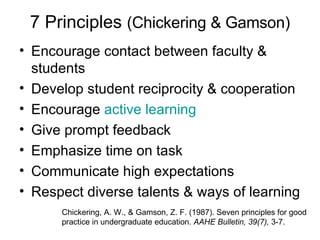
7 Principles  (Chickering & Gamson) Encourage contact between faculty & students Develop student reciprocity & cooperation Encourage  active learning Give prompt feedback Emphasize time on task Communicate high expectations Respect diverse talents & ways of learning Chickering, A. W., & Gamson, Z. F. (1987). Seven principles for good practice in undergraduate education.  AAHE Bulletin, 39(7),  3-7.
EDMC Mission Statement Our mission is to provide excellence in postsecondary education  in a learning-centered environment where students can acquire the requisite skills and knowledge  to pursue a career in their chosen field of study
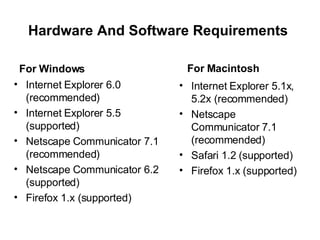
Hardware And Software Requirements   For Windows Internet Explorer 6.0 (recommended)  Internet Explorer 5.5 (supported)  Netscape Communicator 7.1 (recommended)  Netscape Communicator 6.2 (supported)  Firefox 1.x (supported)  For Macintosh Internet Explorer 5.1x, 5.2x (recommended)  Netscape Communicator 7.1 (recommended)  Safari 1.2 (supported)  Firefox 1.x (supported)
The Asynchronous Classroom Asynchronous: Not synchronized! You and students can find your best times to do a good job You and students are not necessarily on the course site at the same times Freedom to self-schedule, as long as you and students meet weekly requirements
Roles of the Online Facilitator  Guide:  you will guide students through the material by… setting expectations  helping first-time-online students navigate the course  making it clear what attendance, participation, etc. will be  Coach:  encourage discussion and interaction by… using good questioning techniques re-focusing conversations on the learning objectives  providing feedback which encourages continued learning & application   Supporter:  Provide friendly assistance as students work & learn to think Students gain self-confidence by encouragement & recognition of abilities   Reviewer:  grading and final projects  providing feedback on accomplishments  Particularly accomplishments students completed independently
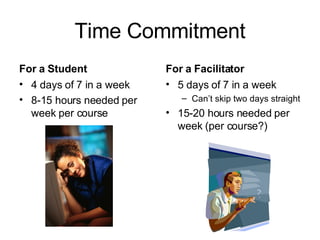
Time Commitment For a Student 4 days of 7 in a week 8-15 hours needed per week per course For a Facilitator 5 days of 7 in a week Can’t skip two days straight 15-20 hours needed per week (per course?)
Modeling Behaviors  “ Human behavior is learned observationally through modeling: from observing others one forms an idea of how new behaviors are performed, and on later occasions this coded information serves as a guide for action."  Learning theorist Albert Bandura Students observe & take cues from facilitators Model, demonstrate, & embody in courses via: substantive posting understanding content better  positive interpersonal interactions
Being present as a Facilitator During your 5 of 7 days (without 2 days off in a row) Being online and posting grades, discussion topics, comments etc.  Respond to student postings daily during your 5 days  respond to student questions no later than 48 hours  even if they post during your days off respond to assignments within 48 hours of the due date  Daily postings even if there are no student comments Provide detailed feedback in the online gradebook  no more than three days after the week ends.  commentary on what the student did well & needs to improve Grading criteria included  based on rubric which shows where points are awarded/deducted
Being effective as a Facilitator   Set clear communication expectations:   Communicate your “days off”  to your program director  to your students  Allows them to “expect” a longer reply time on those days  If you will be changing your day off Notify your program director and students Check & respond to postings at consistent times Students helped by knowing when to expect a response  Check postings more often  just before a major graded project is due  immediately after you returned grades  Students more likely to have questions or concerns at those times
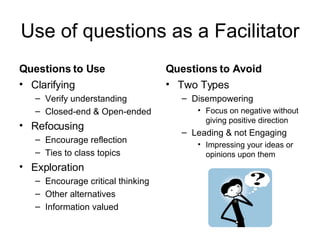
Use of questions as a Facilitator Questions to Use Clarifying Verify understanding Closed-end & Open-ended Refocusing Encourage reflection Ties to class topics Exploration Encourage critical thinking Other alternatives Information valued Questions to Avoid Two Types Disempowering Focus on negative without giving positive direction Leading & not Engaging Impressing your ideas or opinions upon them
Identifying At-Risk Students Early intervention ensures learning success Factors for considering at-risk status Late/failed assignments Certain skill deficiencies Technology problems Overwhelming pace Required materials missing Interfering personal issues Poor attendance Exhibits problem behaviors Questions or comments made suggest need for counseling
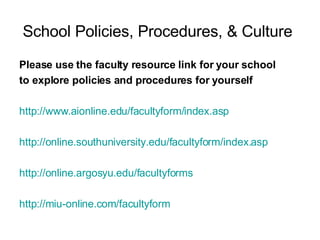
School Policies, Procedures, & Culture   Please use the faculty resource link for your school  to explore policies and procedures for yourself http://www.aionline.edu/facultyform/index.asp   http://online.southuniversity.edu/facultyform/index.asp   http://online.argosyu.edu/facultyforms   http://miu-online.com/facultyform
Credits and Thanks EDMC and their family of schools Heidi and our fellow students Professor Cohort 183 Slideshare.net Free sharing of slides, and slidecasts Archive.org Free location for mp3 file to use in slidecast

Team Cyber Prof Best Practices Ngt2008

  • 1.
    Best Practices: AGuide for Online Facilitators Team CyberProf: Neal Cross, Greg Downing, Thomas Flanagan January 2008
  • 2.
    7 Principles (Chickering & Gamson) Encourage contact between faculty & students Develop student reciprocity & cooperation Encourage active learning Give prompt feedback Emphasize time on task Communicate high expectations Respect diverse talents & ways of learning Chickering, A. W., & Gamson, Z. F. (1987). Seven principles for good practice in undergraduate education. AAHE Bulletin, 39(7), 3-7.
  • 3.
    EDMC Mission StatementOur mission is to provide excellence in postsecondary education in a learning-centered environment where students can acquire the requisite skills and knowledge to pursue a career in their chosen field of study
  • 4.
    Hardware And SoftwareRequirements For Windows Internet Explorer 6.0 (recommended) Internet Explorer 5.5 (supported) Netscape Communicator 7.1 (recommended) Netscape Communicator 6.2 (supported) Firefox 1.x (supported) For Macintosh Internet Explorer 5.1x, 5.2x (recommended) Netscape Communicator 7.1 (recommended) Safari 1.2 (supported) Firefox 1.x (supported)
  • 5.
    The Asynchronous ClassroomAsynchronous: Not synchronized! You and students can find your best times to do a good job You and students are not necessarily on the course site at the same times Freedom to self-schedule, as long as you and students meet weekly requirements
  • 6.
    Roles of theOnline Facilitator Guide: you will guide students through the material by… setting expectations helping first-time-online students navigate the course making it clear what attendance, participation, etc. will be Coach: encourage discussion and interaction by… using good questioning techniques re-focusing conversations on the learning objectives providing feedback which encourages continued learning & application Supporter: Provide friendly assistance as students work & learn to think Students gain self-confidence by encouragement & recognition of abilities Reviewer: grading and final projects providing feedback on accomplishments Particularly accomplishments students completed independently
  • 7.
    Time Commitment Fora Student 4 days of 7 in a week 8-15 hours needed per week per course For a Facilitator 5 days of 7 in a week Can’t skip two days straight 15-20 hours needed per week (per course?)
  • 8.
    Modeling Behaviors “ Human behavior is learned observationally through modeling: from observing others one forms an idea of how new behaviors are performed, and on later occasions this coded information serves as a guide for action." Learning theorist Albert Bandura Students observe & take cues from facilitators Model, demonstrate, & embody in courses via: substantive posting understanding content better positive interpersonal interactions
  • 9.
    Being present asa Facilitator During your 5 of 7 days (without 2 days off in a row) Being online and posting grades, discussion topics, comments etc. Respond to student postings daily during your 5 days respond to student questions no later than 48 hours even if they post during your days off respond to assignments within 48 hours of the due date Daily postings even if there are no student comments Provide detailed feedback in the online gradebook no more than three days after the week ends. commentary on what the student did well & needs to improve Grading criteria included based on rubric which shows where points are awarded/deducted
  • 10.
    Being effective asa Facilitator Set clear communication expectations: Communicate your “days off” to your program director to your students Allows them to “expect” a longer reply time on those days If you will be changing your day off Notify your program director and students Check & respond to postings at consistent times Students helped by knowing when to expect a response Check postings more often just before a major graded project is due immediately after you returned grades Students more likely to have questions or concerns at those times
  • 11.
    Use of questionsas a Facilitator Questions to Use Clarifying Verify understanding Closed-end & Open-ended Refocusing Encourage reflection Ties to class topics Exploration Encourage critical thinking Other alternatives Information valued Questions to Avoid Two Types Disempowering Focus on negative without giving positive direction Leading & not Engaging Impressing your ideas or opinions upon them
  • 12.
    Identifying At-Risk StudentsEarly intervention ensures learning success Factors for considering at-risk status Late/failed assignments Certain skill deficiencies Technology problems Overwhelming pace Required materials missing Interfering personal issues Poor attendance Exhibits problem behaviors Questions or comments made suggest need for counseling
  • 13.
    School Policies, Procedures,& Culture Please use the faculty resource link for your school to explore policies and procedures for yourself http://www.aionline.edu/facultyform/index.asp http://online.southuniversity.edu/facultyform/index.asp http://online.argosyu.edu/facultyforms http://miu-online.com/facultyform
  • 14.
    Credits and ThanksEDMC and their family of schools Heidi and our fellow students Professor Cohort 183 Slideshare.net Free sharing of slides, and slidecasts Archive.org Free location for mp3 file to use in slidecast

Editor's Notes

  • #2 Script: Welcome to TeamCyberProf’s Best Practices, a guide for online facilitators. On behalf of Greg Downing and Thomas Flanagan, this is Neal Cross. Before we move further into our team’s presentation, let me mention that our slides are available for download, and include the narration text in the Notes, in case your are audio-impaired or having audio problems. OK, let’s get started!