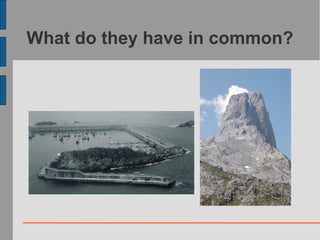
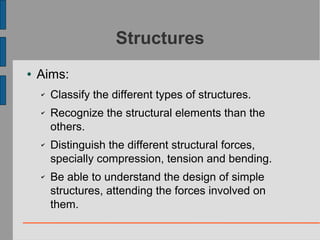
What do they have in common?
Structures
Technology Department
I.E.S. El Batán, Mieres
2007
Structures
Aims:
● Classify the different types of structures.
● Recognize the structural elements than the
others.
● Distinguish the different structural forces,
specially compression, tension and bending.
● Be able to understand the design of simple
structures, attending the forces involved on
them.
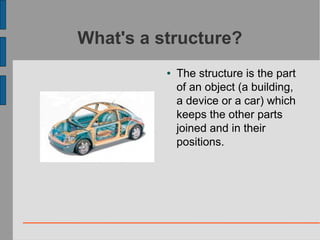
What's a structure?
The structure is the
part of an object
(a building, a
device or a car)
which keeps the
other parts joined
and in their
positions.
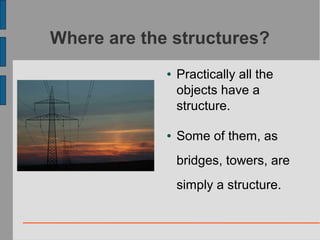
Where are the structures?
Practically all the
objects have a
structure.
Some of them, as
bridges, towers, are
simply a structure.
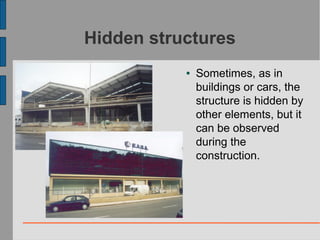
Hidden structures
Sometimes, as in
buildings or cars, the
structure is hidden by
other elements, but it
can be observed
during the
construction.
Types of Structures
Massive:
Great amount of mass, stones, concrete or land.
Casing or Shell:
An exterior box made of rigid material support all
the other parts.
Framework:
Rigid linear elements joined by their ends.
Massive Structures
They can use arcs to
make the openings.
Examples:
Great China Wall
Egyptian Pyramids
Cathedrals
Dams
Harbours
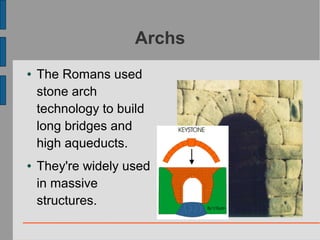
Arcs
The Romans used
stone arch
technology to build
long bridges and
high aqueducts.
They are widely used
in massive
structures.
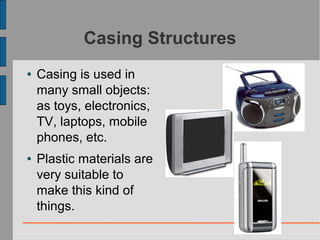
Casing Structures
Casing is used in
many small objects:
as toys, electronics,
TV, laptops, mobile
phones, etc.
Plastic materials are
very suitable to
make this kind of
things.
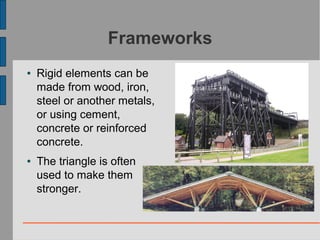
Frameworks
Rigid elements can be
made from wood, iron,
steel or another metals,
or using cement,
concrete or reinforced
concrete.
The triangle is often used
to make them stronger.
Why the triangle?
If the elements are
rigid, even if the
joints are articulated,
the triangle keeps its
shape.
Otherwise, square is
not a rigid shape.
Trusses & Girders
Trusses
Girders
Structural elements are subjected to forces
(stresses) from the other elements and from
the weight of the load.
There are six fundamental stresses. They are:
Tension
Compression
Bending (Flexure)
We will study some of them.
Stresses
Shear
Torsion
Buckling
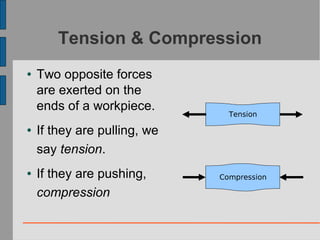
Tension & Compression
Two opposite forces are
exerted on the ends of
a workpiece.
If they are pulling, we
say tension.
If they are pushing,
compression
Flexure, Bending
If an horizontal beam supports a load, it's
subjected to flexure or bending.
Torsion
The element is twisted between both ends, one of
them clockwise and another counter-clockwise.
The bar is said to be in a state of torsion.
Shear
Shear attempts to move adjacent sections of
an element in opposite directions.
Beams
Beams are used to cross an opening, such as
the distance between two walls. They are
made from different ‘sections’ or shapes.
Modern Bridges
Modern bridges use towers and cables to keep
the deck in its place.
Watch the video about the Tacoma Narrows Bridge
(1940), and try to explain what you have seen. Look
for information in the Internet about it.
Study the structure of an Asturian Horreo.
Design & construct a 15 cm height structure with paper
and cardboard which can support a load of 1 kg.
Activities
Analysing a structure
1: Compression
2: Tension
3: Bending
4: Bending & torsion
5: Shear
1
1
1
1
2
2
3
4
5
Credits
Made with OpenOffice & LibreOffice
running on Knoppix & Ubuntu Linux.
All of them are Free Software under
GPL License Software.
This presentation is licensed under
Creative Commons 3.0

Structures

  • 1.
    What do theyhave in common?
  • 2.
    What do theyhave in common?
  • 3.
    What do theyhave in common?
  • 4.
  • 5.
    Structures Aims: ● Classify thedifferent types of structures. ● Recognize the structural elements than the others. ● Distinguish the different structural forces, specially compression, tension and bending. ● Be able to understand the design of simple structures, attending the forces involved on them.
  • 6.
    What's a structure? Thestructure is the part of an object (a building, a device or a car) which keeps the other parts joined and in their positions.
  • 7.
    Where are thestructures? Practically all the objects have a structure. Some of them, as bridges, towers, are simply a structure.
  • 8.
    Hidden structures Sometimes, asin buildings or cars, the structure is hidden by other elements, but it can be observed during the construction.
  • 9.
    Types of Structures Massive: Greatamount of mass, stones, concrete or land. Casing or Shell: An exterior box made of rigid material support all the other parts. Framework: Rigid linear elements joined by their ends.
  • 10.
    Massive Structures They canuse arcs to make the openings. Examples: Great China Wall Egyptian Pyramids Cathedrals Dams Harbours
  • 11.
    Arcs The Romans used stonearch technology to build long bridges and high aqueducts. They are widely used in massive structures.
  • 12.
    Casing Structures Casing isused in many small objects: as toys, electronics, TV, laptops, mobile phones, etc. Plastic materials are very suitable to make this kind of things.
  • 13.
    Frameworks Rigid elements canbe made from wood, iron, steel or another metals, or using cement, concrete or reinforced concrete. The triangle is often used to make them stronger.
  • 14.
    Why the triangle? Ifthe elements are rigid, even if the joints are articulated, the triangle keeps its shape. Otherwise, square is not a rigid shape.
  • 15.
  • 16.
    Structural elements aresubjected to forces (stresses) from the other elements and from the weight of the load. There are six fundamental stresses. They are: Tension Compression Bending (Flexure) We will study some of them. Stresses Shear Torsion Buckling
  • 17.
    Tension & Compression Twoopposite forces are exerted on the ends of a workpiece. If they are pulling, we say tension. If they are pushing, compression
  • 18.
    Flexure, Bending If anhorizontal beam supports a load, it's subjected to flexure or bending.
  • 19.
    Torsion The element istwisted between both ends, one of them clockwise and another counter-clockwise. The bar is said to be in a state of torsion.
  • 20.
    Shear Shear attempts tomove adjacent sections of an element in opposite directions.
  • 21.
    Beams Beams are usedto cross an opening, such as the distance between two walls. They are made from different ‘sections’ or shapes.
  • 22.
    Modern Bridges Modern bridgesuse towers and cables to keep the deck in its place.
  • 23.
    Watch the videoabout the Tacoma Narrows Bridge (1940), and try to explain what you have seen. Look for information in the Internet about it. Study the structure of an Asturian Horreo. Design & construct a 15 cm height structure with paper and cardboard which can support a load of 1 kg. Activities
  • 24.
    Analysing a structure 1:Compression 2: Tension 3: Bending 4: Bending & torsion 5: Shear 1 1 1 1 2 2 3 4 5
  • 25.
    Credits Made with OpenOffice& LibreOffice running on Knoppix & Ubuntu Linux. All of them are Free Software under GPL License Software. This presentation is licensed under Creative Commons 3.0