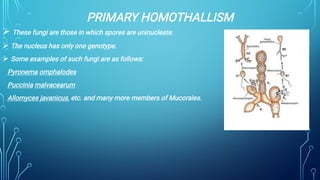
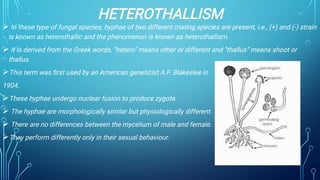
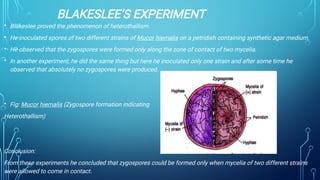
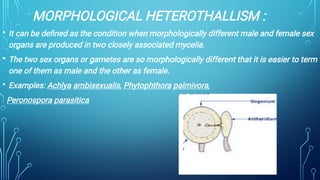
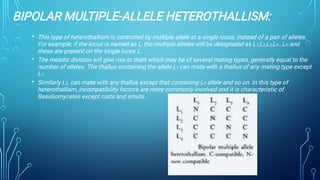
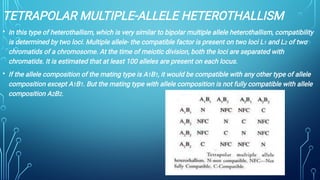
This document discusses different types of sexual reproduction in fungi. It describes homothallism, where a single mycelium is self-fertile, and heterothallism, where two different mating types are required. There are two types of homothallism: primary, where spores contain a single genotype, and secondary, where spores contain nuclei of compatible mating types. Heterothallism can involve morphological or physiological differences between mating types, and be controlled by multiple alleles at one or two unlinked loci. Experiments by Blakeslee demonstrated that zygospores in Mucor hiemalis only form between two different fungal strains, proving the existence of heterothallism.