©2021 Dr Rohit Bhaskar PT https://www.pt-pedia.com/ 1
STROKE
PHYSIOTHERAPY MANAGEMENT
Stroke is an acute onset of
neurological dysfunction due to an
abnormality in cerebral circulation
with resultant signs & symptoms which
corresponds to involvement of focal
areas of the brain
©2021 Dr Rohit Bhaskar PT https://www.pt-pedia.com/ 2
It is defined as the sudden onset of
neurological deficits due to an
abnormality in cerebral circulation
with the signs and symptoms lasting
for more than 24 hours or longer
©2021 Dr Rohit Bhaskar PT https://www.pt-pedia.com/ 3
It is defined as the sudden onset of
neurological deficits due to an
abnormality in cerebral circulation
with the signs and symptoms lasting
for less than 24 hours
©2021 Dr Rohit Bhaskar PT https://www.pt-pedia.com/ 4
TIA
Third leading cause of death
The incidence of stroke is about
1.25 times greater for males than
females
Most common cause of disability
among adults
©2021 Dr Rohit Bhaskar PT https://www.pt-pedia.com/ 5
EPIDEMIOLOGY
 Atherosclerosis
©2021 Dr Rohit Bhaskar PT https://www.pt-pedia.com/
 Cerebral Thrombus
 Cerebral embolus
 Embolism from the heart (cardiac origin)
 Intracranial hemorrhage
 Subarachnoid hemorrhage
 Intracranial small vessel disease
 Arterial aneurysms
 Arterio-venous malformation
 Haematological disorders
(haemoglobinopathies, leukemia)
6
ETIOLOGY
 Infective endocarditis & HIV infection
 Tumour
 Perioperative stroke (due to hypotension and boundary
zone infarction, trauma to and dissection of neck
arteries, paradoxical embolism, fat embolism, infective endocarditis)
 Migraine
©2021 Dr Rohit Bhaskar PT https://www.pt-pedia.com/
colitis)
 Chronic meningitis
 Inflammatory bowel disease (ulcerative and Crohn's
 Hypoglycemia
 Snake bite, fat embolism
7
RARE CAUSES
MODIFIABLE
©2021 Dr Rohit Bhaskar PT https://www.pt-pedia.com/
NON MODIFIABLE
 Ageing & gender
 Positive family history
 Circadian and seasonal
factors (peaks between 10
am till noon)
 Heart disease
 Diabetes mellitus
 Hypertension
 Peripheral arterial disease
 Blood pathology
(increased haematocrit,
clotting abnormalities,
sickle cell anaemia etc)
 Hyperlipidemia
 TIA
 Smoking
 Obesity
 Lack of physical
exercise or sedentary
life style
 Diet & excess alcohol
consumption
 Oral contraceptives
 Infection
(meningeal
infection)
 Psychological factors
 Vasectomy
8
RISK FACTORS
 Sudden numbness or weakness of face, arm,
or leg, on one side of body
 Sudden confusion, trouble speaking
or understanding
 Sudden blurring of vision
 Sudden onset of dizziness, loss of balance
or coordination
 Sudden, severe headaches with no known cause
 Other important but less common stroke
symptoms include:
• Sudden nausea, fever, & vomiting distinguished from a
viral illness by speed of onset (minutes or hours vs several
days)
• Brief loss of consciousness or a period of decreased
consciousness (fainting, confusion, convulsions, or coma)
©2021 Dr Rohit Bhaskar PT https://www.pt-pedia.com/ 9
WARNING SIGNS
 Ischemia results in irreversible cellular
damage with a core area of focal
infarction within minutes
• Transitional area surrounding core is termed
ischemic penumbra & consists of viable but
metabolically lethargic cells
 Ischemia produce cerebral edema, that
begins within minutes of insult & reaches a
maximum by 3 to 4 days.
 Swelling gradually subsides & generally
disappears by 2 to 3 weeks
©2021 Dr Rohit Bhaskar PT https://www.pt-pedia.com/ 10
PATHOPHYSIOLOGY
Oedema elevates ICP, leading to
intracranial HT & neurological
deterioration associated with
contralateral & caudal shifts of
brain structures
Cerebral edema is the most frequent
cause of death in acute stroke & is
characteristic of large infarcts involving
MCA & ICA
©2021 Dr Rohit Bhaskar PT https://www.pt-pedia.com/ 11
Depending on the cause
• Haemorrhagic stroke
 Intracranial haemorrhage
 Subarachnoid haemorrhage
 Signs of raised ICP will be evident with a history of a
traumatic accident
©2021 Dr Rohit Bhaskar PT https://www.pt-pedia.com/ 12
CLASSIFICATION
• Ischemic stroke
 Thrombotic: more common. Usually occurs in
the sleeping hours. Characterised by gradual
onset of symptoms
 Embolic: Occurs in the waking hours of the day.
Sudden onset of symptoms preceded by
giddiness in most conditions
©2021 Dr Rohit Bhaskar PT https://www.pt-pedia.com/ 13
Depending on the severity
• Mild stroke: symptoms subside with no deficit
in a week period
• Moderate stroke: symptoms recover in a
period of 3 - 6 months with minimal
neurological deficit
• Severe stroke: there is no complete
recovery of the symptoms even after 1
years. Always ends up with severe
neurological deficit
©2021 Dr Rohit Bhaskar PT https://www.pt-pedia.com/ 14
Depending on the duration
• Acute stroke: to a period of one week or
until spasticity develops
• Sub acute stroke: after the development
of spasticity & last for a period of 3-12
months
• Chronic stroke: more than 12 months
©2021 Dr Rohit Bhaskar PT https://www.pt-pedia.com/ 15
Depending on the
symptoms
• MCA Syndrome
• ACA Syndrome
• PCA syndrome
• Vertebro basilar artery syndrome
 Vertebral artery
 Basilar artery
 Internal carotid artery
• Lacunar syndrome
©2021 Dr Rohit Bhaskar PT https://www.pt-pedia.com/ 16
• Stage 1: recovery occurs in a stereotyped
sequence of events that begins with a period
of flaccidity immediately following acute
episode. No movement of limbs can be
elicited
• Stage 2: basic limb synergies or some of their
components may appear as associated
reactions. Minimal voluntary movement may
be present. Spasticity begins to develop
©2021 Dr Rohit Bhaskar PT https://www.pt-pedia.com/ 17
STAGES OF RECOVERY
• Stage 3: Gains voluntary control of
movement synergy although full range is not
developed. Spasticity has further increased
• Stage 4: some movement combination that do
not follow the synergy are mastered first with
difficulty & later with more ease. Spasticity
begins to decline
©2021 Dr Rohit Bhaskar PT https://www.pt-pedia.com/ 18
• Stage 5: more difficult movement are learnt
as the basic limb synergy lose their
dominance over motor roots. Spasticity
further declines
• Stage 6: disappearance of spasticity,
individual joint movement become possible
& coordination approaches normal. Normal
motor function is restored
©2021 Dr Rohit Bhaskar PT https://www.pt-pedia.com/ 19
 Contralateral hemiplegia (UL & face
more affected than LL)
 Contralateral hemisensory loss (UL &
face
more affected than LL)
 Ideomotor apraxia
 Ataxia of contralateral limb
 Contralateral Homonymous hemianopia
 Left hemisphere infarction
• Contralateral neglect
• Possible contralateral visual field deficit
• Aphasia: Broca’s (expressive) or Wernicke’s
(receptive)
©2021 Dr Rohit Bhaskar PT https://www.pt-pedia.com/ 20
MCA
 Coordination disorders such as tremor
or ataxia
 Contralateral homonymous field deficit
 Cortical blindness
 Cognitive impairment including memory
impairment
 Contralateral sensory impairment
 Thalamic syndrome (abnormal sensation
of severe pain from light touch or
temperature changes)
 Weber’s syndrome
(contralateral hemiplegia &
third nerve palsy)
©2021 Dr Rohit Bhaskar PT https://www.pt-pedia.com/ 21
PCA
 Contralateral Hemiplegia or monoplegia
of LL (LL more affected than UL)
 Contralateral sensory loss of LL
 Urinary incontinence
 Problems with imitation & bimanual task
 Abulia (akinetic mutism)
 Apraxia
 Amnesia
 Contralateral grasp reflex, sucking
reflex
©2021 Dr Rohit Bhaskar PT https://www.pt-pedia.com/ 22
ACA
 Medial medullary syndrome (vertebral
artery)
 Lateral medullary (Wallenberg's) syndrome
(PICA)
 Complete basilar artery syndrome (locked-
in syndrome)
 Medial inferior pontine syndrome
 Lateral inferior pontine syndrome (AICA)
 Medial midpontine syndrome
 Lateral midpontine syndrome
 Medial superior pontine syndrome
 Lateral superior pontine syndrome
©2021 Dr Rohit Bhaskar PT https://www.pt-pedia.com/ 23
VERT.-BASILAR SYNDROMES
Locked-in syndrome (LIS)
• Acute hemiparesis rapidly progressing to
tetraplegia & lower bulbar paralysis (CN
V through XII are involved)
• Initially patient is dysarthria & dysphonic &
progresses to mutism (anarthria)
• There is preserved consciousness & sensation
• Horizontal eye movements are impaired
but vertical eye movements & blinking
remain intact.
• Communication can be established via these
eye movements.
©2021 Dr Rohit Bhaskar PT https://www.pt-pedia.com/ 24
 Caused by small vessel disease of deep
white mater
• Pure motor lacunar stroke: posterior limb of internal
capsule, pons, & pyramids
• Pure sensory lacunar stroke: ventrolateral
thalamus or thalamocortical projections
 Ataxic hemiparesis
 Dysarthria
 Clumsy hand syndrome
 Sensory/motor stroke
 Dystonia/involuntary movements
©2021 Dr Rohit Bhaskar PT https://www.pt-pedia.com/ 25
LACUNAR SYNDROMES
1. Altered sensation
• Pain (central pain or thalamic pain
syndrome characterized by constant,
severe burning pain with intermittent sharp
pains
• Hyperalgesia
• Loud sound, bright light etc. may trigger pain
©2021 Dr Rohit Bhaskar PT https://www.pt-pedia.com/ 26
PRIMARY IMPAIRMENT
2. Vision
• Homonymous hemianopia, a visual field
defect, occurs with lesions involving the
optic radiation (MCA) or to primary visual
cortex (PCA)
• Visual neglect & problems with
depth perception, and spatial
relationships
©2021 Dr Rohit Bhaskar PT https://www.pt-pedia.com/ 27
3. Weakness
• Usually seen in the contralateral side of
the lesion
• MCA stroke are more common so
weakness is largely seen in the UL in clinical
practice
• Distal muscle are more affected than
proximal muscles
• Mild weakness of ipsilateral side
©2021 Dr Rohit Bhaskar PT https://www.pt-pedia.com/ 28
4. Alteration of tone
• Flaccidity (hypotonicity) is present
immediately after stroke
• Spasticity (hypertonicity) emerges in about
90 percent of cases
©2021 Dr Rohit Bhaskar PT https://www.pt-pedia.com/ 29
Muscles not involved in either
synergy
• Latissimus dorsi
• Teres major
• Serratus anterior
• Finger extensors
• Ankle evertors
©2021 Dr Rohit Bhaskar PT https://www.pt-pedia.com/ 30
 6. Abnormal reflexes
• Initially, hyporeflexia with flaccidity & later
hyperreflexia
• May demonstrate clonus, & +ve Babinski
• Movement of head or position of body may elicit a
change in tone or movement of extremities
 The most commonly seen is asymmetric tonic neck
reflex (ATNR)
• Associated reactions are also present in patients
who exhibit strong spasticity and synergies
 unintentional movements of hemiparetic limb caused by
voluntary action of another limb
 by stimulation of yawning, sneezing, or coughing.
©2021 Dr Rohit Bhaskar PT https://www.pt-pedia.com/ 31
7. Altered co-ordination
• Proprioceptive losses can result in
sensory ataxia
• Strokes affecting cerebellum typically
produce cerebellar ataxia (e.g.basilar artery
syndrome, pontine syndromes) &
motor weakness.
• Basal ganglia involvement (PCA syndrome)
may lead to bradykinesia or involuntary
movements
©2021 Dr Rohit Bhaskar PT https://www.pt-pedia.com/ 32
8. Altered motor programing
• Motor praxis is ability to plan &
execute coordinated movement
• Lesions of premotor frontal cortex of either
hemisphere, left inferior parietal lobe, &
corpus callosum can produce apraxia.
• Apraxia is more evident with left
hemisphere damage than right and is
commonly seen with aphasia.
 Ideational apraxia
 Ideomotor apraxia
©2021 Dr Rohit Bhaskar PT https://www.pt-pedia.com/ 33
9. Postural Control & Balance
• Impairments in steadiness, symmetry, &
dynamic stability
• Problems may exist when reacting to a
destabilizing external force (reactive
postural control) or during self-initiated
movements (anticipatory postural control).
• Pusher syndrome: characterized by active
pushing with stronger extremities toward
affected
side, leading to lateral postural imbalance
©2021 Dr Rohit Bhaskar PT https://www.pt-pedia.com/ 34
 10. Speech, Language, and Swallowing
• Lesions involving cortex of dominant hemisphere
• Aphasia: impairment of language
comprehension, formulation, and use.
• Dysarthria: motor speech disorders caused by
lesions of CNS or PNS that mediate speech
production.
• Dysphagia, occurs with lesions affecting medullary
brainstem (CN IX and X), large vessel pontine
lesions, as well as in acute MCA and PCA lesion
©2021 Dr Rohit Bhaskar PT https://www.pt-pedia.com/ 35
11. Perception and Cognition
• They are the result of lesions in right parietal
cortex & seen more with left hemiplegia
than right.
• These may include disorders of body
scheme/body image, spatial relations,
and agnosias.
©2021 Dr Rohit Bhaskar PT https://www.pt-pedia.com/ 36
12. Emotional Status
• Lesions of brain affecting frontal
lobe, hypothalamus, & limbic
system
• May demonstrate pseudobulbar affect
(PBA), also known as emotional lability
or emotional dysregulation syndrome.
 emotional outbursts of uncontrolled or
exaggerated laughing or crying that are
inconsistent with mood.
• Depression is extremely common
 persistent feelings of sadness,feelings of
hopelessness, worthlessness or helplessness.
©2021 Dr Rohit Bhaskar PT https://www.pt-pedia.com/ 37
13. Bladder and Bowel Function
• Disturbances of bladder function are
common during acute phase
• Urinary incontinence can result from bladder
hyperreflexia or hyporeflexia, disturbances of
sphincter control, or sensory loss.
• Disturbances of bowel function can
include incontinence & diarrhea or
constipation
©2021 Dr Rohit Bhaskar PT https://www.pt-pedia.com/ 38
1. Musculoskeletal changes
• Loss of voluntary movement and immobility
can result in loss of ROM & contractures.
 Contractures are apparent in spastic muscles
of paretic limbs
• Disuse atrophy & muscle weakness results
from inactivity and immobility
• Osteoporosis, results from decreased
physical activity, changes in protein
nutrition, hormonal deficiency, & calcium
deficiency.
©2021 Dr Rohit Bhaskar PT https://www.pt-pedia.com/ 39
INDIRECT IMPAIRMENTS
2. Neurological signs
• Seizures occur in a small % of patients - more
common in occlusive carotid disease than
in MCA disease
• Hydrocephalus is rare but can occur with
subarachnoid or intracerebral
hemorrhage.
©2021 Dr Rohit Bhaskar PT https://www.pt-pedia.com/ 40
3. Thrombophlebitis & deep
venous thrombosis (DVT)
• complications for all immobilized
patients.
©2021 Dr Rohit Bhaskar PT https://www.pt-pedia.com/ 41
4. Cardiac Function
• Stroke as a result of underlying coronary
artery disease (CAD) may demonstrate
impaired CO, cardiac decompensation, &
rhythm disorders.
• If these problems persist, they can alter
cerebral perfusion & produce additional
focal signs (e.g., mental confusion).
• Cardiac limitations in exercise tolerance
©2021 Dr Rohit Bhaskar PT https://www.pt-pedia.com/ 42
5. Pulmonary Function
• Decreased lung volume, decreased
pulmonary perfusion & vital capacity &
altered chest wall excursion
• Aspiration, occurs in about one third
of patients with dysphagia.
©2021 Dr Rohit Bhaskar PT https://www.pt-pedia.com/ 43
6. Integumentary
• The skin breaks down over bony
prominences from pressure, friction,
shearing, and/or maceration
©2021 Dr Rohit Bhaskar PT https://www.pt-pedia.com/ 44
Urine analysis
CBC count
Blood sugar level
Blood cholesterol & lipid
profile
Cardiac evaluation
Lumbar puncture
©2021 Dr Rohit Bhaskar PT https://www.pt-pedia.com/ 45
TESTS
CT Scan
• In acute phase, CT scans are used to rule
out brain lesions such as tumor or abscess
& to identify hemorrhagic stroke
• In sub-acute phase, CT scans can identify
development of cerebral edema (within 3
days) & cerebral infarction (within 3 to 5
days) by showing areas of decreased
density.
©2021 Dr Rohit Bhaskar PT https://www.pt-pedia.com/ 46
Magnetic Resonance Imaging (MRI).
• MRI is more sensitive in diagnosis of acute
strokes, allowing detection of cerebral
infarction within 2 to 6 hours after stroke.
• It is also able to detail extent of infarction or
hemorrhage & can detect smaller lesions
©2021 Dr Rohit Bhaskar PT https://www.pt-pedia.com/ 47
Cerebral Angiography.
• Involves injection of radiopaque dye into
blood vessels with subsequent radiography.
• It provides visualization of vascular system
and used when surgery is considered
(carotid stenosis, AVM).
©2021 Dr Rohit Bhaskar PT https://www.pt-pedia.com/ 48
Fastest in first weeks after onset
Measurable neurological & functional
recovery occurring in first month after
stroke.
Continue to make measurable
functional gains for months or years
after insult
©2021 Dr Rohit Bhaskar PT https://www.pt-pedia.com/ 49
RECOVER & PROGNOSIS
Late recovery of function is also seen
in patients with chronic stroke who
undergo extensive functional training
• These changes are due to function-
induced plasticity
©2021 Dr Rohit Bhaskar PT https://www.pt-pedia.com/ 50
Recovery also depends on severity
of stroke
Depends on type of stroke
– hemorrhagic or ischemic
Varies from individual to individual
Depends on intensity of therapy
Depends on age of the patient
©2021 Dr Rohit Bhaskar PT https://www.pt-pedia.com/ 51
 A male patient with a known case of
hypertension came to emergency
department with history of sudden
collapse & LOC
 On examination there is decrease DTR on
right side of body with +ve Babinski’s sign
 There is gradual regain of consciousness but
seems to be confused
©2021 Dr Rohit Bhaskar PT https://www.pt-pedia.com/ 52
A CASE
 After a few days in hospital he regain
some of his LL movement but less
improvement in UL
 On careful examination he has right
Homonymous hemianopia & sensory loss
including two-point
discrimination, texture, & sense of
weight
 He also has unilateral neglect & Broca’s
(expressive) aphasia
©2021 Dr Rohit Bhaskar PT https://www.pt-pedia.com/ 53
What is the condition?
What may be the cause?
What emergency investigation is
called for ?
Which artery may be involved?
Which areas of the brain is involved?
©2021 Dr Rohit Bhaskar PT https://www.pt-pedia.com/ 54
©2021 Dr Rohit Bhaskar PT https://www.pt-pedia.com/ 55
PT ASSESSMENT
Abrupt onset with rapid coma is
suggestive of cerebral
hemorrhage.
Severe headache typically precedes
LOC
Embolus also occurs rapidly, with no
warning, & is frequently associated
with heart disease or heart
complications.
Uneven onset is typical with thrombosis.
©2021 Dr Rohit Bhaskar PT https://www.pt-pedia.com/ 56
HISTORY
Past history include TIAs or head
trauma, presence of major or minor
risk factors, medications, positive
family history, & recent alterations in
patient function
©2021 Dr Rohit Bhaskar PT https://www.pt-pedia.com/ 57
May have abnormal posturing of
limbs
Synergistic patterns in the UL & LL
Facial asymmetry
May use a walking aid E.g. cane
Abnormal gait pattern may also
be observed
©2021 Dr Rohit Bhaskar PT https://www.pt-pedia.com/ 58
OBSERVATION
May present with hypertension
Pain
 Shoulder pain, secondary to subluxation, is a
common issue
 Shoulder-hand syndrome involves swelling
& tenderness in hand and pain in entire
limb
 Complex Regional Pain Syndrome involves
pain & swelling of hand
©2021 Dr Rohit Bhaskar PT https://www.pt-pedia.com/ 59
VITALS
Expressive and/or receptive aphasia
Attention disorders
Memory deficits, including
declarative and procedural
memory
Executive function deficits
©2021 Dr Rohit Bhaskar PT https://www.pt-pedia.com/ 60
ATTENTION
Visual field deficits
Weakness & sensory loss in
facial musculature
Deficits in laryngeal & pharyngeal
function
Hypoactive gag reflex
Diminished, but perceived,
superficial sensations
©2021 Dr Rohit Bhaskar PT https://www.pt-pedia.com/ 61
CN EXAM
 Hemi sensory loss (dysesthesia, or
hyperesthesia, joint position & movement
sense)
 May be able to identify sensations but difficulty
in localizing
 Cortical sensations s/a 2 point
discrimination, stereognosis & graphaesthesia
are affected secondary to loss of grip function
 Agnosia
 Perceptual problems
 Unilateral spatial neglect
 Pusher syndrome
©2021 Dr Rohit Bhaskar PT https://www.pt-pedia.com/ 62
SENSORY EXAM
Glenohumeral subluxation
Shoulder impingement syndrome
Adhesive capsulitis
Complex Regional Pain Syndrome
and Shoulder-Hand Syndrome
©2021 Dr Rohit Bhaskar PT https://www.pt-pedia.com/ 63
JOINT EXAM
Soft tissue shortening and contractures
Increased muscle stiffness
Joint immobility
Disuse-provoked soft tissue changes
Over extensibility of capsular
structures of Glenohumeral joint
©2021 Dr Rohit Bhaskar PT https://www.pt-pedia.com/ 64
ROM
Synergistic patterns of movement
Hypertonicity
Weakness
Associated movements or synkinesis
Apraxia including motor & verbal
apraxia
©2021 Dr Rohit Bhaskar PT https://www.pt-pedia.com/ 65
MOTOR FUNCTION
Exaggerated deep tendon reflexes
Diminished superficial reflexes
Positive Babinski’s reflex
Impaired Righting, equilibrium,
and protective reactions
Abnormal primitive reflex (ATNR) may
be present
©2021 Dr Rohit Bhaskar PT https://www.pt-pedia.com/ 66
REFLEXES
BP, RR, & HR at rest & during exercise
may have a sudden rise
Review pulse oximetry, blood gas,
tidal volume, & vital capacity
Administer a 2 or 6-minute walk test
Administer Borg RPE after walk test or
other physical activity
©2021 Dr Rohit Bhaskar PT https://www.pt-pedia.com/ 67
ENDURANCE
Edema may occur in affected limbs
May be associated with shoulder
hand syndrome
©2021 Dr Rohit Bhaskar PT https://www.pt-pedia.com/ 68
LYMPHATIC DRAINAGE
• Decrease Tidal volume & vital
capacity
• Decrease Respiratory muscle
strength
• Ability to cough & strength of cough
is decreases
• Dyspnea during exercise
©2021 Dr Rohit Bhaskar PT https://www.pt-pedia.com/ 69
VENTILATION
Decreased extension of hip
& hyperextension of knee
Decreased flexion of knee & hip
during swing phase
Decreased ankle DF at initial contact
& during stance resulting in hip
circumduction
Trendelenburg
©2021 Dr Rohit Bhaskar PT https://www.pt-pedia.com/ 70
GAIT & LOCOMOTION
Compromised static as well as
dynamic balance
Pusher’s syndrome may be present
resulting in fall on the affected side
©2021 Dr Rohit Bhaskar PT https://www.pt-pedia.com/ 71
BALANCE
Spastic patterns can involve flexion
& abduction of arm, flexion of
elbow, & supination of elbow with
finger flexion
Hip & knee extension with
ankle plantarflexion &
inversion
Protracted & depressed
shoulder, scoliosis & hip
hiking
©2021 Dr Rohit Bhaskar PT https://www.pt-pedia.com/ 72
POSTURE
Using FIM, Barthel index, FMA
There is compromised basic as well
as instrumental ADL
Ambulatory capacity is
compromised
©2021 Dr Rohit Bhaskar PT https://www.pt-pedia.com/ 73
FUNCTIONAL ASSESS.
Flaccid bowel & bladder during the
acute stage
Bowel & bladder function
gradually regains
Uninhibited bladder if frontal lobe is
involved
Constipation is frequently seen
©2021 Dr Rohit Bhaskar PT https://www.pt-pedia.com/ 74
BOWEL & BLADDER
Tonal abnormalities
Muscular weakness
Synergistic pattern
Tightness & contracture
Imbalance &
incoordination
Gait abnormalities
Postural abnormalities
Functional disability
©2021 Dr Rohit Bhaskar PT https://www.pt-pedia.com/ 75
PROBLEM LIST
©2021 Dr Rohit Bhaskar PT https://www.pt-pedia.com/ 76
PT MANAGEMENT
Positioning strategies
Improve respiratory & circulatory
function
Prevent pressure sores
Prevent from deconditioning
©2021 Dr Rohit Bhaskar PT https://www.pt-pedia.com/ 77
ACUTE STAGE
Positioning strategies
• In supine
• In side lying on normal side
• In side lying on affected
side
©2021 Dr Rohit Bhaskar PT https://www.pt-pedia.com/ 78
Improve respiratory & circulatory
function
• Breathing exercise
• Chest expansion exercise
• Postural drainage
• Huffing & Coughing techniques
• Passive & active ankle & toe exercise
 (after careful & thorough examination of
cardiopulmonary system)
©2021 Dr Rohit Bhaskar PT https://www.pt-pedia.com/ 79
Prevent pressure sores
• Proper positioning
• Relieve pressure points by padding &
cushion
• Frequent turning & changing position
• Prevent from moisture
• Use cotton clothing
• Tight fitting cloth is prevented
• Use of water bed, air bed & foam mattress
©2021 Dr Rohit Bhaskar PT https://www.pt-pedia.com/ 80
Prevent from deconditioning
• Early mobilization in the bed (active
turning, supine to sit, sit to supine, sitting, sit
to stand)
• Pelvic bridging exercise
• Early propped up positioning, sitting &
then later to standing
• Moving around the bed
• Facilitate movement of functioning limbs
©2021 Dr Rohit Bhaskar PT https://www.pt-pedia.com/ 81
5 days a week for a minimum of 3
hours of active rehabilitation per day
Intensive rehabilitation if vitals are
stable
©2021 Dr Rohit Bhaskar PT https://www.pt-pedia.com/ 82
POST ACUTE STAGE
©2021 Dr Rohit Bhaskar PT https://www.pt-pedia.com/ 83
PT INTERVENTIONS
 Positioning hemiplegic side towards door
or main part of room
 Presentation of repeated sensory stimuli
 Stretching, stroking, superficial & deep
pressure, iceing, vibration etc.
 Wt bearing ex & Joint approximation
tech
 Stoking with different texture fabrics
 Pressure application
 Improve other senses like use of visual &
auditory
 PNF tech., use of bilateral UE
©2021 Dr Rohit Bhaskar PT https://www.pt-pedia.com/ 84
IMPROVE SENSORY FUNCTION
Soft tissue, joint mobilization & ROM
exercise
AROM & PROM with end range stretch
Effective positioning & edema
reduction
Stretching program & splinting
Suggested activities
• Arm cradling
• Table top polishing
• Self overhead activities in supine & sitting &
reaching to the floor
©2021 Dr Rohit Bhaskar PT https://www.pt-pedia.com/ 85
FLEXIBILITY
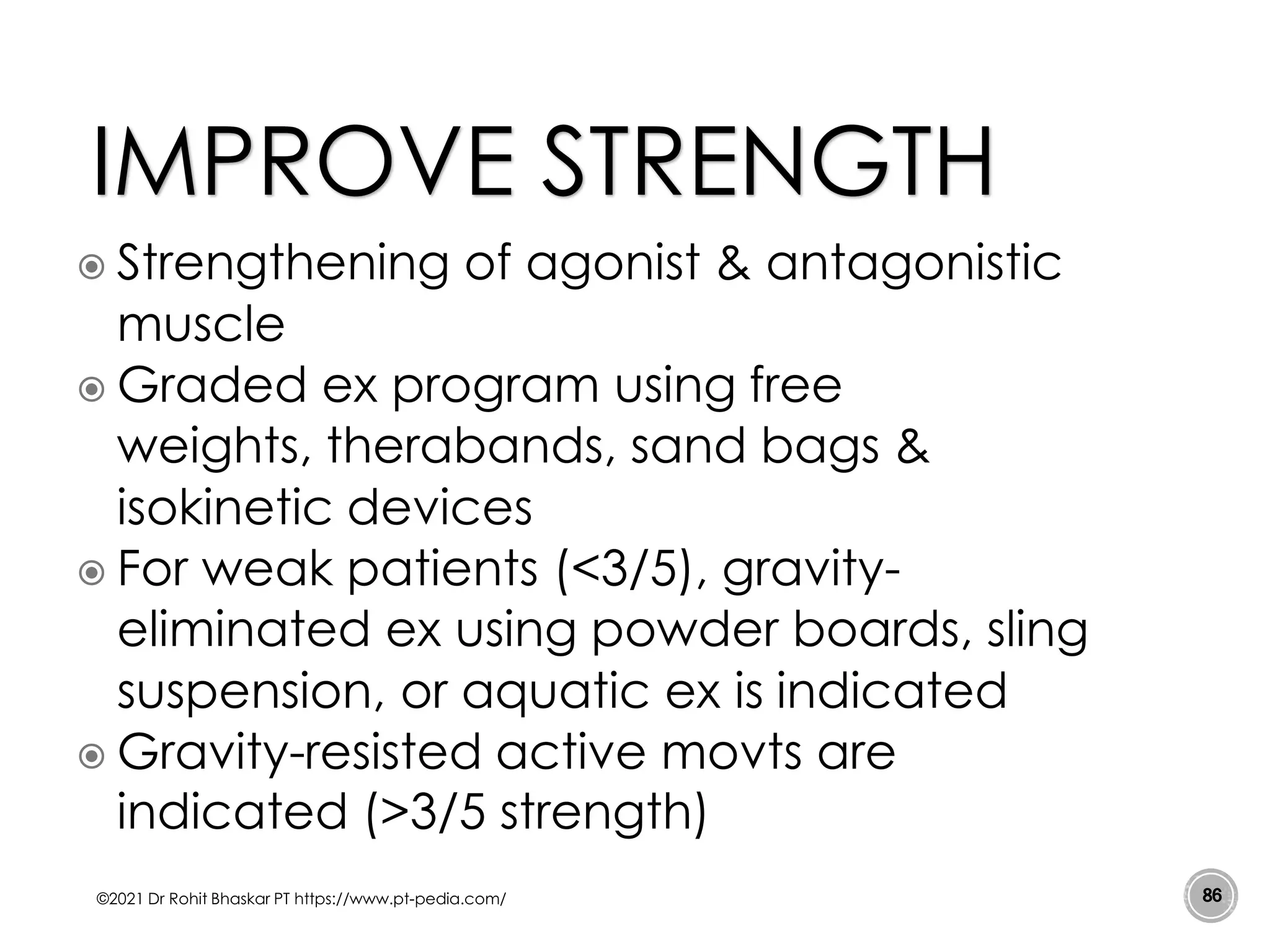
 Strengthening of agonist & antagonistic
muscle
 Graded ex program using free
weights, therabands, sand bags &
isokinetic devices
 For weak patients (<3/5), gravity-
eliminated ex using powder boards, sling
suspension, or aquatic ex is indicated
 Gravity-resisted active movts are
indicated (>3/5 strength)
©2021 Dr Rohit Bhaskar PT https://www.pt-pedia.com/ 86
IMPROVE STRENGTH
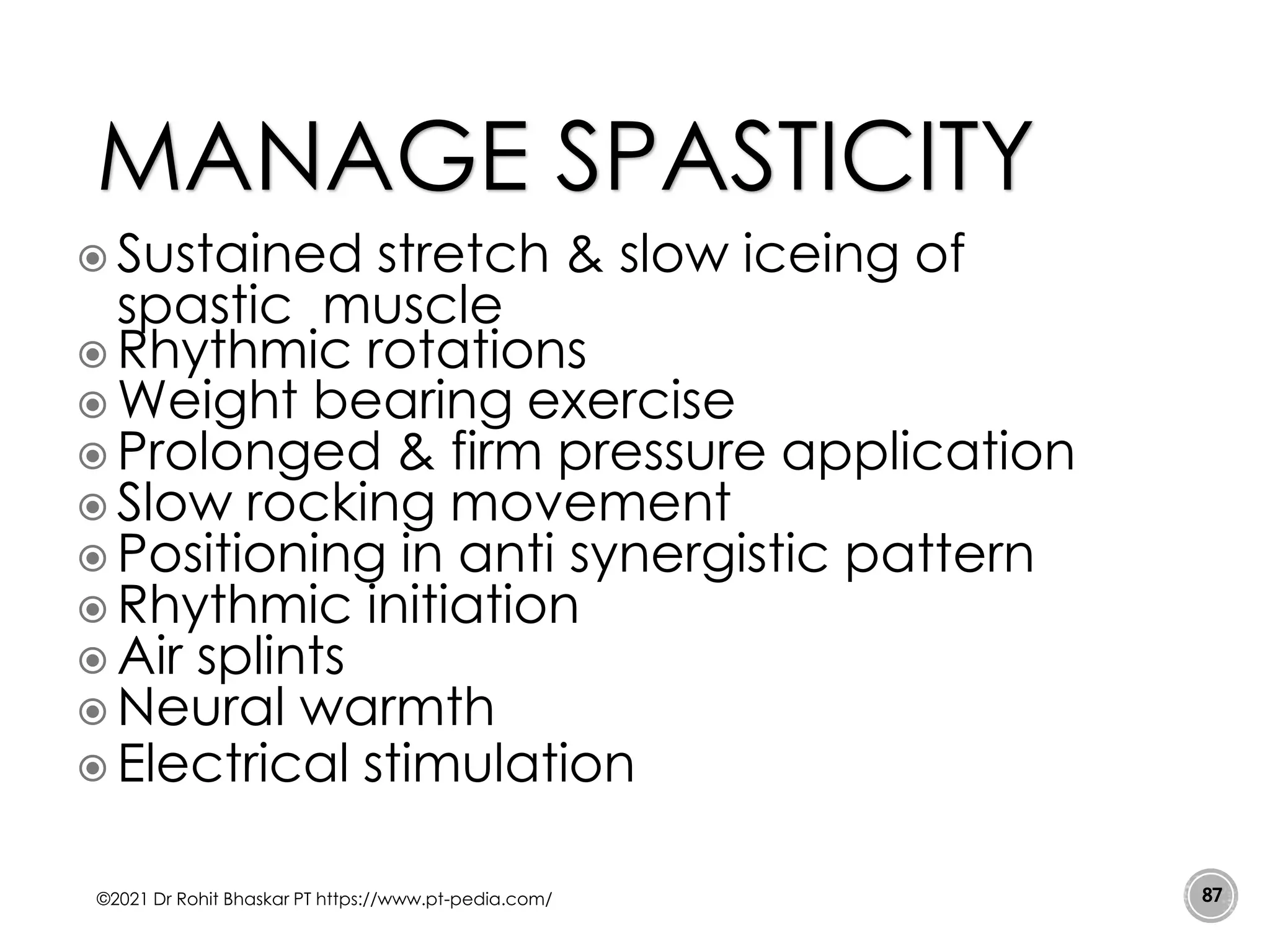
 Sustained stretch & slow iceing of
spastic muscle
 Rhythmic rotations
 Weight bearing exercise
 Prolonged & firm pressure application
 Slow rocking movement
 Positioning in anti synergistic pattern
 Rhythmic initiation
 Air splints
 Neural warmth
 Electrical stimulation
©2021 Dr Rohit Bhaskar PT https://www.pt-pedia.com/ 87
MANAGE SPASTICITY
Dissociation & selection of desired
movt patterns
Select postures that assist desired
movements through optimal
biomechanical stabilization & use of
optimal point in range
Start with assisted movt, followed by
active & resisted movt
Task oriented exercise
©2021 Dr Rohit Bhaskar PT https://www.pt-pedia.com/ 88
IMPROVE MOVT CONTROL
Suggested exercise
• Rolling
• Supine to sit & sit to supine
• Sitting
• Bridging
• Sit to stand & Sit down
• Modified plantigrade
• Standing
• Transfer
©2021 Dr Rohit Bhaskar PT https://www.pt-pedia.com/ 89
POSTURAL CONTROL
In pusher syndrome
• Passive correction often fails
• Use visual stimuli to correct
• Sit on the normal side & ask patient to lean
on you
• Sitting on swiss ball
• Environmental boundary can be used e.g.
corner or doorway
©2021 Dr Rohit Bhaskar PT https://www.pt-pedia.com/ 90
• Early mobilization, ROM, & positioning strategies
• Relearning of movt pattern & retraining of missing
component
• UL weight bearing exercise
• Dynamic stabilization exercise
• Picking up objects, Reaching activities
• Lifting activities
• Manipulation of common objects
• Push up ex. in various position
• Kitchen sink exercise
• Functional movement like hand to mouth & hand to
opposite shoulder
• Advance training – CIMT, biofeedback, NMES, FES
©2021 Dr Rohit Bhaskar PT https://www.pt-pedia.com/ 91
IMPROVE UE FUNCTION
Proper handling & positioning of
shoulder joint
Reducing subluxation, NMES,
gentle mobilization (grade 1 & 2)
Use of supportive devices & slings
Use of overhead pulley is
contraindicated
TENS & heat therapy
©2021 Dr Rohit Bhaskar PT https://www.pt-pedia.com/ 92
MANAGE SHOULDER PAIN
 Strengthening muscles in appropriate
pattern
 Suggested activities
• PNF pattern of LL
• Holding against elastic band resistance around
upper thighs in supine or standing positions
• Standing, lateral side-steps
• Exercise to improve pelvic control
 Facilitation of DF
 Cycling & treadmill training
©2021 Dr Rohit Bhaskar PT https://www.pt-pedia.com/ 93
IMPROVE LL FUNCTION
 Facilitate symmetrical wt bearing on both side
 Postural perturbations can be induced
in different positions
 Sit or stand on movable surface to increase
challenge
 Reaching activities
 Dual task training s/a kicking ball in
standing, throwing activities, carrying an
object while walking
 Divert attention
 Single limb stance
 Exercise on trampoline
©2021 Dr Rohit Bhaskar PT https://www.pt-pedia.com/ 94
IMPROVE BALANCE
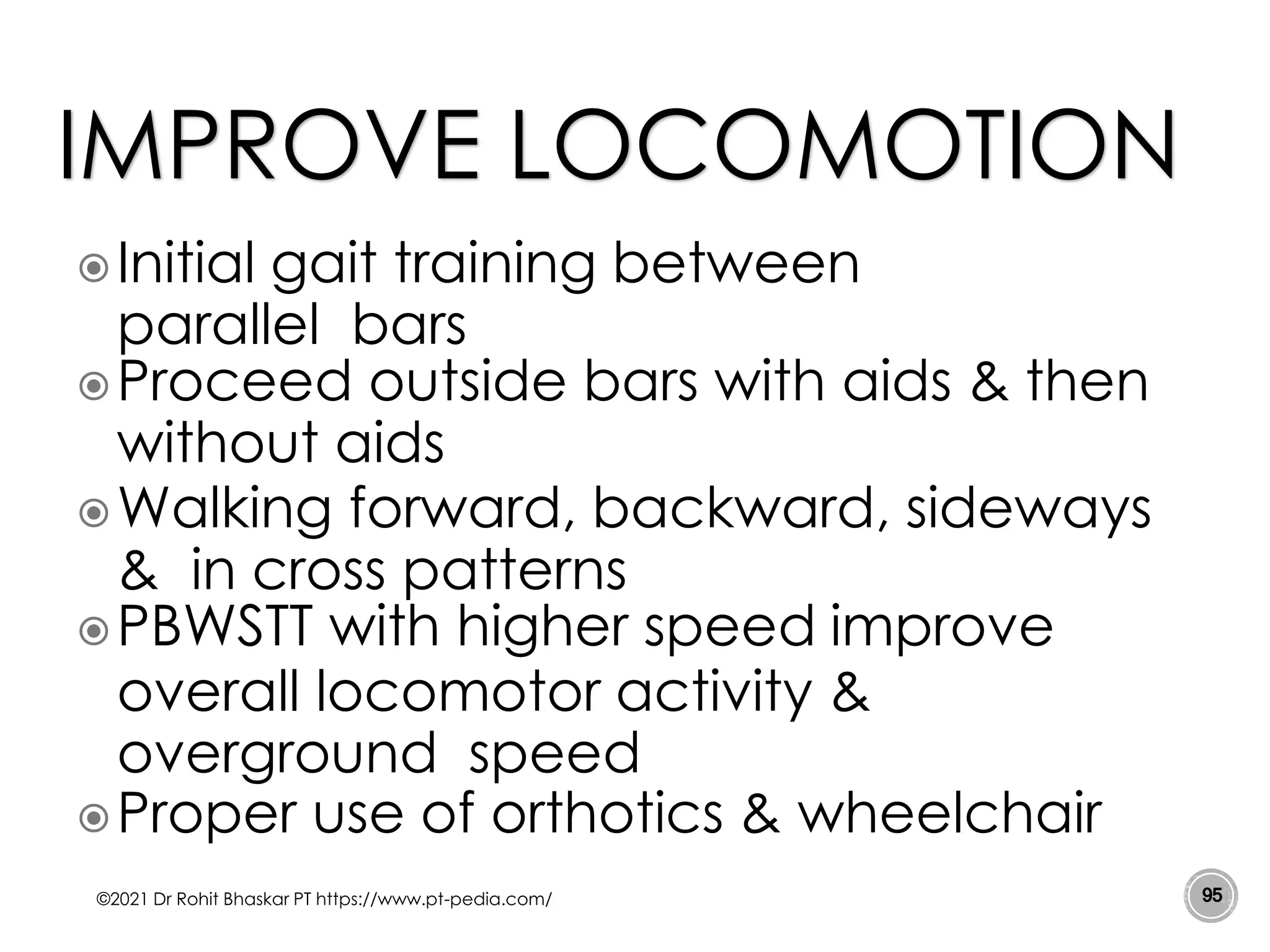
Initial gait training between
parallel bars
Proceed outside bars with aids & then
without aids
Walking forward, backward, sideways
& in cross patterns
PBWSTT with higher speed improve
overall locomotor activity &
overground speed
Proper use of orthotics & wheelchair
©2021 Dr Rohit Bhaskar PT https://www.pt-pedia.com/ 95
IMPROVE LOCOMOTION
• Early mobilization & functional activity
• Treadmill training & cycle ergometer
• Symptom limited graded ex. training
• Ex at 40- 70 % of VO2max, 3 times a week for
20-60 minutes
• Proper rest should be given
• Gradually progressed to 30 minutes
continous program
• Regular ex reduces risk of recurrent stroke
©2021 Dr Rohit Bhaskar PT https://www.pt-pedia.com/ 96
IMPROVE AEROBIC FUNCTION
 Proper head position in chin down position
 Movements of lips, tongue, cheeks, & jaw
 Firm pressure to anterior 3rd oftongue
with tongue depressor to stimulate
posterior elevation of tongue,
 Puffing, blowing bubbles, & drinking thick
liquids through straw
 Food presentation in proper position
 Texture of food should be smooth
 Tasty food should be given to facilitate
swallowing reflex
 Stroking the neck during swallowing
©2021 Dr Rohit Bhaskar PT https://www.pt-pedia.com/ 97
IMPROVE FEEDING
Strategy development
• Patient as an active explorer of activity
• Modify strategy of activity in correct patterns
Feedback
• Intrinsic or extrinsic feedback
• Positive & negative feedbacks
Practice
• Repeated practice of functional activity
• Practice in different environment
©2021 Dr Rohit Bhaskar PT https://www.pt-pedia.com/ 98
IMPROVE MOTOR LEARNING
 Give factual information, counsel family
members about patient’s capabilities &
limitations
 Give information as much as Pt or family
can assimilate
 Provide open discussion & communication
 Be supportive, sensitive & maintain a
positive supporting nature
 Give psychological support
 Refer to help groups
©2021 Dr Rohit Bhaskar PT https://www.pt-pedia.com/ 99
PATEINT & FAMILY EDU.
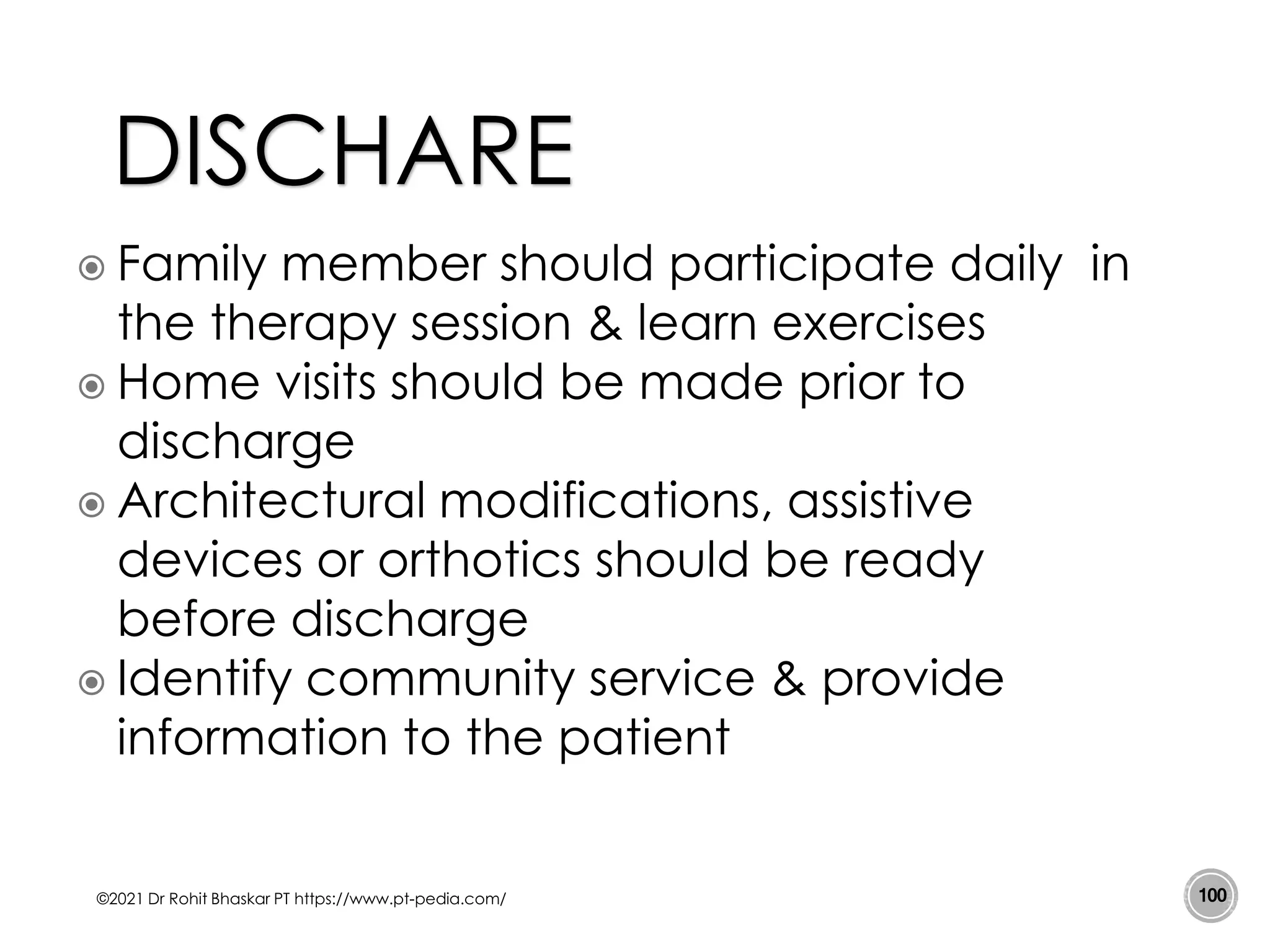
 Family member should participate daily in
the therapy session & learn exercises
 Home visits should be made prior to
discharge
 Architectural modifications, assistive
devices or orthotics should be ready
before discharge
 Identify community service & provide
information to the patient
©2021 Dr Rohit Bhaskar PT https://www.pt-pedia.com/ 100
DISCHARE
O’ Sullivan SB, Schmitz TJ. Stroke.
Physical rehabilitation. 5th ed.,
New Delhi: Jaypee Brothers, 2007.
Darcy A. Umphred.
Neurological Rehabilitation,
5th ed., Mosby Elsevier,
Missouri, 2007.
©2021 Dr Rohit Bhaskar PT https://www.pt-pedia.com/ 101
REFERENCES

Stroke - Physiotherapy Treatment - Dr Rohit Bhaskar

  • 1.
    ©2021 Dr RohitBhaskar PT https://www.pt-pedia.com/ 1 STROKE PHYSIOTHERAPY MANAGEMENT
  • 2.
    Stroke is anacute onset of neurological dysfunction due to an abnormality in cerebral circulation with resultant signs & symptoms which corresponds to involvement of focal areas of the brain ©2021 Dr Rohit Bhaskar PT https://www.pt-pedia.com/ 2
  • 3.
    It is definedas the sudden onset of neurological deficits due to an abnormality in cerebral circulation with the signs and symptoms lasting for more than 24 hours or longer ©2021 Dr Rohit Bhaskar PT https://www.pt-pedia.com/ 3
  • 4.
    It is definedas the sudden onset of neurological deficits due to an abnormality in cerebral circulation with the signs and symptoms lasting for less than 24 hours ©2021 Dr Rohit Bhaskar PT https://www.pt-pedia.com/ 4 TIA
  • 5.
    Third leading causeof death The incidence of stroke is about 1.25 times greater for males than females Most common cause of disability among adults ©2021 Dr Rohit Bhaskar PT https://www.pt-pedia.com/ 5 EPIDEMIOLOGY
  • 6.
     Atherosclerosis ©2021 DrRohit Bhaskar PT https://www.pt-pedia.com/  Cerebral Thrombus  Cerebral embolus  Embolism from the heart (cardiac origin)  Intracranial hemorrhage  Subarachnoid hemorrhage  Intracranial small vessel disease  Arterial aneurysms  Arterio-venous malformation  Haematological disorders (haemoglobinopathies, leukemia) 6 ETIOLOGY
  • 7.
     Infective endocarditis& HIV infection  Tumour  Perioperative stroke (due to hypotension and boundary zone infarction, trauma to and dissection of neck arteries, paradoxical embolism, fat embolism, infective endocarditis)  Migraine ©2021 Dr Rohit Bhaskar PT https://www.pt-pedia.com/ colitis)  Chronic meningitis  Inflammatory bowel disease (ulcerative and Crohn's  Hypoglycemia  Snake bite, fat embolism 7 RARE CAUSES
  • 8.
    MODIFIABLE ©2021 Dr RohitBhaskar PT https://www.pt-pedia.com/ NON MODIFIABLE  Ageing & gender  Positive family history  Circadian and seasonal factors (peaks between 10 am till noon)  Heart disease  Diabetes mellitus  Hypertension  Peripheral arterial disease  Blood pathology (increased haematocrit, clotting abnormalities, sickle cell anaemia etc)  Hyperlipidemia  TIA  Smoking  Obesity  Lack of physical exercise or sedentary life style  Diet & excess alcohol consumption  Oral contraceptives  Infection (meningeal infection)  Psychological factors  Vasectomy 8 RISK FACTORS
  • 9.
     Sudden numbnessor weakness of face, arm, or leg, on one side of body  Sudden confusion, trouble speaking or understanding  Sudden blurring of vision  Sudden onset of dizziness, loss of balance or coordination  Sudden, severe headaches with no known cause  Other important but less common stroke symptoms include: • Sudden nausea, fever, & vomiting distinguished from a viral illness by speed of onset (minutes or hours vs several days) • Brief loss of consciousness or a period of decreased consciousness (fainting, confusion, convulsions, or coma) ©2021 Dr Rohit Bhaskar PT https://www.pt-pedia.com/ 9 WARNING SIGNS
  • 10.
     Ischemia resultsin irreversible cellular damage with a core area of focal infarction within minutes • Transitional area surrounding core is termed ischemic penumbra & consists of viable but metabolically lethargic cells  Ischemia produce cerebral edema, that begins within minutes of insult & reaches a maximum by 3 to 4 days.  Swelling gradually subsides & generally disappears by 2 to 3 weeks ©2021 Dr Rohit Bhaskar PT https://www.pt-pedia.com/ 10 PATHOPHYSIOLOGY
  • 11.
    Oedema elevates ICP,leading to intracranial HT & neurological deterioration associated with contralateral & caudal shifts of brain structures Cerebral edema is the most frequent cause of death in acute stroke & is characteristic of large infarcts involving MCA & ICA ©2021 Dr Rohit Bhaskar PT https://www.pt-pedia.com/ 11
  • 12.
    Depending on thecause • Haemorrhagic stroke  Intracranial haemorrhage  Subarachnoid haemorrhage  Signs of raised ICP will be evident with a history of a traumatic accident ©2021 Dr Rohit Bhaskar PT https://www.pt-pedia.com/ 12 CLASSIFICATION
  • 13.
    • Ischemic stroke Thrombotic: more common. Usually occurs in the sleeping hours. Characterised by gradual onset of symptoms  Embolic: Occurs in the waking hours of the day. Sudden onset of symptoms preceded by giddiness in most conditions ©2021 Dr Rohit Bhaskar PT https://www.pt-pedia.com/ 13
  • 14.
    Depending on theseverity • Mild stroke: symptoms subside with no deficit in a week period • Moderate stroke: symptoms recover in a period of 3 - 6 months with minimal neurological deficit • Severe stroke: there is no complete recovery of the symptoms even after 1 years. Always ends up with severe neurological deficit ©2021 Dr Rohit Bhaskar PT https://www.pt-pedia.com/ 14
  • 15.
    Depending on theduration • Acute stroke: to a period of one week or until spasticity develops • Sub acute stroke: after the development of spasticity & last for a period of 3-12 months • Chronic stroke: more than 12 months ©2021 Dr Rohit Bhaskar PT https://www.pt-pedia.com/ 15
  • 16.
    Depending on the symptoms •MCA Syndrome • ACA Syndrome • PCA syndrome • Vertebro basilar artery syndrome  Vertebral artery  Basilar artery  Internal carotid artery • Lacunar syndrome ©2021 Dr Rohit Bhaskar PT https://www.pt-pedia.com/ 16
  • 17.
    • Stage 1:recovery occurs in a stereotyped sequence of events that begins with a period of flaccidity immediately following acute episode. No movement of limbs can be elicited • Stage 2: basic limb synergies or some of their components may appear as associated reactions. Minimal voluntary movement may be present. Spasticity begins to develop ©2021 Dr Rohit Bhaskar PT https://www.pt-pedia.com/ 17 STAGES OF RECOVERY
  • 18.
    • Stage 3:Gains voluntary control of movement synergy although full range is not developed. Spasticity has further increased • Stage 4: some movement combination that do not follow the synergy are mastered first with difficulty & later with more ease. Spasticity begins to decline ©2021 Dr Rohit Bhaskar PT https://www.pt-pedia.com/ 18
  • 19.
    • Stage 5:more difficult movement are learnt as the basic limb synergy lose their dominance over motor roots. Spasticity further declines • Stage 6: disappearance of spasticity, individual joint movement become possible & coordination approaches normal. Normal motor function is restored ©2021 Dr Rohit Bhaskar PT https://www.pt-pedia.com/ 19
  • 20.
     Contralateral hemiplegia(UL & face more affected than LL)  Contralateral hemisensory loss (UL & face more affected than LL)  Ideomotor apraxia  Ataxia of contralateral limb  Contralateral Homonymous hemianopia  Left hemisphere infarction • Contralateral neglect • Possible contralateral visual field deficit • Aphasia: Broca’s (expressive) or Wernicke’s (receptive) ©2021 Dr Rohit Bhaskar PT https://www.pt-pedia.com/ 20 MCA
  • 21.
     Coordination disorderssuch as tremor or ataxia  Contralateral homonymous field deficit  Cortical blindness  Cognitive impairment including memory impairment  Contralateral sensory impairment  Thalamic syndrome (abnormal sensation of severe pain from light touch or temperature changes)  Weber’s syndrome (contralateral hemiplegia & third nerve palsy) ©2021 Dr Rohit Bhaskar PT https://www.pt-pedia.com/ 21 PCA
  • 22.
     Contralateral Hemiplegiaor monoplegia of LL (LL more affected than UL)  Contralateral sensory loss of LL  Urinary incontinence  Problems with imitation & bimanual task  Abulia (akinetic mutism)  Apraxia  Amnesia  Contralateral grasp reflex, sucking reflex ©2021 Dr Rohit Bhaskar PT https://www.pt-pedia.com/ 22 ACA
  • 23.
     Medial medullarysyndrome (vertebral artery)  Lateral medullary (Wallenberg's) syndrome (PICA)  Complete basilar artery syndrome (locked- in syndrome)  Medial inferior pontine syndrome  Lateral inferior pontine syndrome (AICA)  Medial midpontine syndrome  Lateral midpontine syndrome  Medial superior pontine syndrome  Lateral superior pontine syndrome ©2021 Dr Rohit Bhaskar PT https://www.pt-pedia.com/ 23 VERT.-BASILAR SYNDROMES
  • 24.
    Locked-in syndrome (LIS) •Acute hemiparesis rapidly progressing to tetraplegia & lower bulbar paralysis (CN V through XII are involved) • Initially patient is dysarthria & dysphonic & progresses to mutism (anarthria) • There is preserved consciousness & sensation • Horizontal eye movements are impaired but vertical eye movements & blinking remain intact. • Communication can be established via these eye movements. ©2021 Dr Rohit Bhaskar PT https://www.pt-pedia.com/ 24
  • 25.
     Caused bysmall vessel disease of deep white mater • Pure motor lacunar stroke: posterior limb of internal capsule, pons, & pyramids • Pure sensory lacunar stroke: ventrolateral thalamus or thalamocortical projections  Ataxic hemiparesis  Dysarthria  Clumsy hand syndrome  Sensory/motor stroke  Dystonia/involuntary movements ©2021 Dr Rohit Bhaskar PT https://www.pt-pedia.com/ 25 LACUNAR SYNDROMES
  • 26.
    1. Altered sensation •Pain (central pain or thalamic pain syndrome characterized by constant, severe burning pain with intermittent sharp pains • Hyperalgesia • Loud sound, bright light etc. may trigger pain ©2021 Dr Rohit Bhaskar PT https://www.pt-pedia.com/ 26 PRIMARY IMPAIRMENT
  • 27.
    2. Vision • Homonymoushemianopia, a visual field defect, occurs with lesions involving the optic radiation (MCA) or to primary visual cortex (PCA) • Visual neglect & problems with depth perception, and spatial relationships ©2021 Dr Rohit Bhaskar PT https://www.pt-pedia.com/ 27
  • 28.
    3. Weakness • Usuallyseen in the contralateral side of the lesion • MCA stroke are more common so weakness is largely seen in the UL in clinical practice • Distal muscle are more affected than proximal muscles • Mild weakness of ipsilateral side ©2021 Dr Rohit Bhaskar PT https://www.pt-pedia.com/ 28
  • 29.
    4. Alteration oftone • Flaccidity (hypotonicity) is present immediately after stroke • Spasticity (hypertonicity) emerges in about 90 percent of cases ©2021 Dr Rohit Bhaskar PT https://www.pt-pedia.com/ 29
  • 30.
    Muscles not involvedin either synergy • Latissimus dorsi • Teres major • Serratus anterior • Finger extensors • Ankle evertors ©2021 Dr Rohit Bhaskar PT https://www.pt-pedia.com/ 30
  • 31.
     6. Abnormalreflexes • Initially, hyporeflexia with flaccidity & later hyperreflexia • May demonstrate clonus, & +ve Babinski • Movement of head or position of body may elicit a change in tone or movement of extremities  The most commonly seen is asymmetric tonic neck reflex (ATNR) • Associated reactions are also present in patients who exhibit strong spasticity and synergies  unintentional movements of hemiparetic limb caused by voluntary action of another limb  by stimulation of yawning, sneezing, or coughing. ©2021 Dr Rohit Bhaskar PT https://www.pt-pedia.com/ 31
  • 32.
    7. Altered co-ordination •Proprioceptive losses can result in sensory ataxia • Strokes affecting cerebellum typically produce cerebellar ataxia (e.g.basilar artery syndrome, pontine syndromes) & motor weakness. • Basal ganglia involvement (PCA syndrome) may lead to bradykinesia or involuntary movements ©2021 Dr Rohit Bhaskar PT https://www.pt-pedia.com/ 32
  • 33.
    8. Altered motorprograming • Motor praxis is ability to plan & execute coordinated movement • Lesions of premotor frontal cortex of either hemisphere, left inferior parietal lobe, & corpus callosum can produce apraxia. • Apraxia is more evident with left hemisphere damage than right and is commonly seen with aphasia.  Ideational apraxia  Ideomotor apraxia ©2021 Dr Rohit Bhaskar PT https://www.pt-pedia.com/ 33
  • 34.
    9. Postural Control& Balance • Impairments in steadiness, symmetry, & dynamic stability • Problems may exist when reacting to a destabilizing external force (reactive postural control) or during self-initiated movements (anticipatory postural control). • Pusher syndrome: characterized by active pushing with stronger extremities toward affected side, leading to lateral postural imbalance ©2021 Dr Rohit Bhaskar PT https://www.pt-pedia.com/ 34
  • 35.
     10. Speech,Language, and Swallowing • Lesions involving cortex of dominant hemisphere • Aphasia: impairment of language comprehension, formulation, and use. • Dysarthria: motor speech disorders caused by lesions of CNS or PNS that mediate speech production. • Dysphagia, occurs with lesions affecting medullary brainstem (CN IX and X), large vessel pontine lesions, as well as in acute MCA and PCA lesion ©2021 Dr Rohit Bhaskar PT https://www.pt-pedia.com/ 35
  • 36.
    11. Perception andCognition • They are the result of lesions in right parietal cortex & seen more with left hemiplegia than right. • These may include disorders of body scheme/body image, spatial relations, and agnosias. ©2021 Dr Rohit Bhaskar PT https://www.pt-pedia.com/ 36
  • 37.
    12. Emotional Status •Lesions of brain affecting frontal lobe, hypothalamus, & limbic system • May demonstrate pseudobulbar affect (PBA), also known as emotional lability or emotional dysregulation syndrome.  emotional outbursts of uncontrolled or exaggerated laughing or crying that are inconsistent with mood. • Depression is extremely common  persistent feelings of sadness,feelings of hopelessness, worthlessness or helplessness. ©2021 Dr Rohit Bhaskar PT https://www.pt-pedia.com/ 37
  • 38.
    13. Bladder andBowel Function • Disturbances of bladder function are common during acute phase • Urinary incontinence can result from bladder hyperreflexia or hyporeflexia, disturbances of sphincter control, or sensory loss. • Disturbances of bowel function can include incontinence & diarrhea or constipation ©2021 Dr Rohit Bhaskar PT https://www.pt-pedia.com/ 38
  • 39.
    1. Musculoskeletal changes •Loss of voluntary movement and immobility can result in loss of ROM & contractures.  Contractures are apparent in spastic muscles of paretic limbs • Disuse atrophy & muscle weakness results from inactivity and immobility • Osteoporosis, results from decreased physical activity, changes in protein nutrition, hormonal deficiency, & calcium deficiency. ©2021 Dr Rohit Bhaskar PT https://www.pt-pedia.com/ 39 INDIRECT IMPAIRMENTS
  • 40.
    2. Neurological signs •Seizures occur in a small % of patients - more common in occlusive carotid disease than in MCA disease • Hydrocephalus is rare but can occur with subarachnoid or intracerebral hemorrhage. ©2021 Dr Rohit Bhaskar PT https://www.pt-pedia.com/ 40
  • 41.
    3. Thrombophlebitis &deep venous thrombosis (DVT) • complications for all immobilized patients. ©2021 Dr Rohit Bhaskar PT https://www.pt-pedia.com/ 41
  • 42.
    4. Cardiac Function •Stroke as a result of underlying coronary artery disease (CAD) may demonstrate impaired CO, cardiac decompensation, & rhythm disorders. • If these problems persist, they can alter cerebral perfusion & produce additional focal signs (e.g., mental confusion). • Cardiac limitations in exercise tolerance ©2021 Dr Rohit Bhaskar PT https://www.pt-pedia.com/ 42
  • 43.
    5. Pulmonary Function •Decreased lung volume, decreased pulmonary perfusion & vital capacity & altered chest wall excursion • Aspiration, occurs in about one third of patients with dysphagia. ©2021 Dr Rohit Bhaskar PT https://www.pt-pedia.com/ 43
  • 44.
    6. Integumentary • Theskin breaks down over bony prominences from pressure, friction, shearing, and/or maceration ©2021 Dr Rohit Bhaskar PT https://www.pt-pedia.com/ 44
  • 45.
    Urine analysis CBC count Bloodsugar level Blood cholesterol & lipid profile Cardiac evaluation Lumbar puncture ©2021 Dr Rohit Bhaskar PT https://www.pt-pedia.com/ 45 TESTS
  • 46.
    CT Scan • Inacute phase, CT scans are used to rule out brain lesions such as tumor or abscess & to identify hemorrhagic stroke • In sub-acute phase, CT scans can identify development of cerebral edema (within 3 days) & cerebral infarction (within 3 to 5 days) by showing areas of decreased density. ©2021 Dr Rohit Bhaskar PT https://www.pt-pedia.com/ 46
  • 47.
    Magnetic Resonance Imaging(MRI). • MRI is more sensitive in diagnosis of acute strokes, allowing detection of cerebral infarction within 2 to 6 hours after stroke. • It is also able to detail extent of infarction or hemorrhage & can detect smaller lesions ©2021 Dr Rohit Bhaskar PT https://www.pt-pedia.com/ 47
  • 48.
    Cerebral Angiography. • Involvesinjection of radiopaque dye into blood vessels with subsequent radiography. • It provides visualization of vascular system and used when surgery is considered (carotid stenosis, AVM). ©2021 Dr Rohit Bhaskar PT https://www.pt-pedia.com/ 48
  • 49.
    Fastest in firstweeks after onset Measurable neurological & functional recovery occurring in first month after stroke. Continue to make measurable functional gains for months or years after insult ©2021 Dr Rohit Bhaskar PT https://www.pt-pedia.com/ 49 RECOVER & PROGNOSIS
  • 50.
    Late recovery offunction is also seen in patients with chronic stroke who undergo extensive functional training • These changes are due to function- induced plasticity ©2021 Dr Rohit Bhaskar PT https://www.pt-pedia.com/ 50
  • 51.
    Recovery also dependson severity of stroke Depends on type of stroke – hemorrhagic or ischemic Varies from individual to individual Depends on intensity of therapy Depends on age of the patient ©2021 Dr Rohit Bhaskar PT https://www.pt-pedia.com/ 51
  • 52.
     A malepatient with a known case of hypertension came to emergency department with history of sudden collapse & LOC  On examination there is decrease DTR on right side of body with +ve Babinski’s sign  There is gradual regain of consciousness but seems to be confused ©2021 Dr Rohit Bhaskar PT https://www.pt-pedia.com/ 52 A CASE
  • 53.
     After afew days in hospital he regain some of his LL movement but less improvement in UL  On careful examination he has right Homonymous hemianopia & sensory loss including two-point discrimination, texture, & sense of weight  He also has unilateral neglect & Broca’s (expressive) aphasia ©2021 Dr Rohit Bhaskar PT https://www.pt-pedia.com/ 53
  • 54.
    What is thecondition? What may be the cause? What emergency investigation is called for ? Which artery may be involved? Which areas of the brain is involved? ©2021 Dr Rohit Bhaskar PT https://www.pt-pedia.com/ 54
  • 55.
    ©2021 Dr RohitBhaskar PT https://www.pt-pedia.com/ 55 PT ASSESSMENT
  • 56.
    Abrupt onset withrapid coma is suggestive of cerebral hemorrhage. Severe headache typically precedes LOC Embolus also occurs rapidly, with no warning, & is frequently associated with heart disease or heart complications. Uneven onset is typical with thrombosis. ©2021 Dr Rohit Bhaskar PT https://www.pt-pedia.com/ 56 HISTORY
  • 57.
    Past history includeTIAs or head trauma, presence of major or minor risk factors, medications, positive family history, & recent alterations in patient function ©2021 Dr Rohit Bhaskar PT https://www.pt-pedia.com/ 57
  • 58.
    May have abnormalposturing of limbs Synergistic patterns in the UL & LL Facial asymmetry May use a walking aid E.g. cane Abnormal gait pattern may also be observed ©2021 Dr Rohit Bhaskar PT https://www.pt-pedia.com/ 58 OBSERVATION
  • 59.
    May present withhypertension Pain  Shoulder pain, secondary to subluxation, is a common issue  Shoulder-hand syndrome involves swelling & tenderness in hand and pain in entire limb  Complex Regional Pain Syndrome involves pain & swelling of hand ©2021 Dr Rohit Bhaskar PT https://www.pt-pedia.com/ 59 VITALS
  • 60.
    Expressive and/or receptiveaphasia Attention disorders Memory deficits, including declarative and procedural memory Executive function deficits ©2021 Dr Rohit Bhaskar PT https://www.pt-pedia.com/ 60 ATTENTION
  • 61.
    Visual field deficits Weakness& sensory loss in facial musculature Deficits in laryngeal & pharyngeal function Hypoactive gag reflex Diminished, but perceived, superficial sensations ©2021 Dr Rohit Bhaskar PT https://www.pt-pedia.com/ 61 CN EXAM
  • 62.
     Hemi sensoryloss (dysesthesia, or hyperesthesia, joint position & movement sense)  May be able to identify sensations but difficulty in localizing  Cortical sensations s/a 2 point discrimination, stereognosis & graphaesthesia are affected secondary to loss of grip function  Agnosia  Perceptual problems  Unilateral spatial neglect  Pusher syndrome ©2021 Dr Rohit Bhaskar PT https://www.pt-pedia.com/ 62 SENSORY EXAM
  • 63.
    Glenohumeral subluxation Shoulder impingementsyndrome Adhesive capsulitis Complex Regional Pain Syndrome and Shoulder-Hand Syndrome ©2021 Dr Rohit Bhaskar PT https://www.pt-pedia.com/ 63 JOINT EXAM
  • 64.
    Soft tissue shorteningand contractures Increased muscle stiffness Joint immobility Disuse-provoked soft tissue changes Over extensibility of capsular structures of Glenohumeral joint ©2021 Dr Rohit Bhaskar PT https://www.pt-pedia.com/ 64 ROM
  • 65.
    Synergistic patterns ofmovement Hypertonicity Weakness Associated movements or synkinesis Apraxia including motor & verbal apraxia ©2021 Dr Rohit Bhaskar PT https://www.pt-pedia.com/ 65 MOTOR FUNCTION
  • 66.
    Exaggerated deep tendonreflexes Diminished superficial reflexes Positive Babinski’s reflex Impaired Righting, equilibrium, and protective reactions Abnormal primitive reflex (ATNR) may be present ©2021 Dr Rohit Bhaskar PT https://www.pt-pedia.com/ 66 REFLEXES
  • 67.
    BP, RR, &HR at rest & during exercise may have a sudden rise Review pulse oximetry, blood gas, tidal volume, & vital capacity Administer a 2 or 6-minute walk test Administer Borg RPE after walk test or other physical activity ©2021 Dr Rohit Bhaskar PT https://www.pt-pedia.com/ 67 ENDURANCE
  • 68.
    Edema may occurin affected limbs May be associated with shoulder hand syndrome ©2021 Dr Rohit Bhaskar PT https://www.pt-pedia.com/ 68 LYMPHATIC DRAINAGE
  • 69.
    • Decrease Tidalvolume & vital capacity • Decrease Respiratory muscle strength • Ability to cough & strength of cough is decreases • Dyspnea during exercise ©2021 Dr Rohit Bhaskar PT https://www.pt-pedia.com/ 69 VENTILATION
  • 70.
    Decreased extension ofhip & hyperextension of knee Decreased flexion of knee & hip during swing phase Decreased ankle DF at initial contact & during stance resulting in hip circumduction Trendelenburg ©2021 Dr Rohit Bhaskar PT https://www.pt-pedia.com/ 70 GAIT & LOCOMOTION
  • 71.
    Compromised static aswell as dynamic balance Pusher’s syndrome may be present resulting in fall on the affected side ©2021 Dr Rohit Bhaskar PT https://www.pt-pedia.com/ 71 BALANCE
  • 72.
    Spastic patterns caninvolve flexion & abduction of arm, flexion of elbow, & supination of elbow with finger flexion Hip & knee extension with ankle plantarflexion & inversion Protracted & depressed shoulder, scoliosis & hip hiking ©2021 Dr Rohit Bhaskar PT https://www.pt-pedia.com/ 72 POSTURE
  • 73.
    Using FIM, Barthelindex, FMA There is compromised basic as well as instrumental ADL Ambulatory capacity is compromised ©2021 Dr Rohit Bhaskar PT https://www.pt-pedia.com/ 73 FUNCTIONAL ASSESS.
  • 74.
    Flaccid bowel &bladder during the acute stage Bowel & bladder function gradually regains Uninhibited bladder if frontal lobe is involved Constipation is frequently seen ©2021 Dr Rohit Bhaskar PT https://www.pt-pedia.com/ 74 BOWEL & BLADDER
  • 75.
    Tonal abnormalities Muscular weakness Synergisticpattern Tightness & contracture Imbalance & incoordination Gait abnormalities Postural abnormalities Functional disability ©2021 Dr Rohit Bhaskar PT https://www.pt-pedia.com/ 75 PROBLEM LIST
  • 76.
    ©2021 Dr RohitBhaskar PT https://www.pt-pedia.com/ 76 PT MANAGEMENT
  • 77.
    Positioning strategies Improve respiratory& circulatory function Prevent pressure sores Prevent from deconditioning ©2021 Dr Rohit Bhaskar PT https://www.pt-pedia.com/ 77 ACUTE STAGE
  • 78.
    Positioning strategies • Insupine • In side lying on normal side • In side lying on affected side ©2021 Dr Rohit Bhaskar PT https://www.pt-pedia.com/ 78
  • 79.
    Improve respiratory &circulatory function • Breathing exercise • Chest expansion exercise • Postural drainage • Huffing & Coughing techniques • Passive & active ankle & toe exercise  (after careful & thorough examination of cardiopulmonary system) ©2021 Dr Rohit Bhaskar PT https://www.pt-pedia.com/ 79
  • 80.
    Prevent pressure sores •Proper positioning • Relieve pressure points by padding & cushion • Frequent turning & changing position • Prevent from moisture • Use cotton clothing • Tight fitting cloth is prevented • Use of water bed, air bed & foam mattress ©2021 Dr Rohit Bhaskar PT https://www.pt-pedia.com/ 80
  • 81.
    Prevent from deconditioning •Early mobilization in the bed (active turning, supine to sit, sit to supine, sitting, sit to stand) • Pelvic bridging exercise • Early propped up positioning, sitting & then later to standing • Moving around the bed • Facilitate movement of functioning limbs ©2021 Dr Rohit Bhaskar PT https://www.pt-pedia.com/ 81
  • 82.
    5 days aweek for a minimum of 3 hours of active rehabilitation per day Intensive rehabilitation if vitals are stable ©2021 Dr Rohit Bhaskar PT https://www.pt-pedia.com/ 82 POST ACUTE STAGE
  • 83.
    ©2021 Dr RohitBhaskar PT https://www.pt-pedia.com/ 83 PT INTERVENTIONS
  • 84.
     Positioning hemiplegicside towards door or main part of room  Presentation of repeated sensory stimuli  Stretching, stroking, superficial & deep pressure, iceing, vibration etc.  Wt bearing ex & Joint approximation tech  Stoking with different texture fabrics  Pressure application  Improve other senses like use of visual & auditory  PNF tech., use of bilateral UE ©2021 Dr Rohit Bhaskar PT https://www.pt-pedia.com/ 84 IMPROVE SENSORY FUNCTION
  • 85.
    Soft tissue, jointmobilization & ROM exercise AROM & PROM with end range stretch Effective positioning & edema reduction Stretching program & splinting Suggested activities • Arm cradling • Table top polishing • Self overhead activities in supine & sitting & reaching to the floor ©2021 Dr Rohit Bhaskar PT https://www.pt-pedia.com/ 85 FLEXIBILITY
  • 86.
     Strengthening ofagonist & antagonistic muscle  Graded ex program using free weights, therabands, sand bags & isokinetic devices  For weak patients (<3/5), gravity- eliminated ex using powder boards, sling suspension, or aquatic ex is indicated  Gravity-resisted active movts are indicated (>3/5 strength) ©2021 Dr Rohit Bhaskar PT https://www.pt-pedia.com/ 86 IMPROVE STRENGTH
  • 87.
     Sustained stretch& slow iceing of spastic muscle  Rhythmic rotations  Weight bearing exercise  Prolonged & firm pressure application  Slow rocking movement  Positioning in anti synergistic pattern  Rhythmic initiation  Air splints  Neural warmth  Electrical stimulation ©2021 Dr Rohit Bhaskar PT https://www.pt-pedia.com/ 87 MANAGE SPASTICITY
  • 88.
    Dissociation & selectionof desired movt patterns Select postures that assist desired movements through optimal biomechanical stabilization & use of optimal point in range Start with assisted movt, followed by active & resisted movt Task oriented exercise ©2021 Dr Rohit Bhaskar PT https://www.pt-pedia.com/ 88 IMPROVE MOVT CONTROL
  • 89.
    Suggested exercise • Rolling •Supine to sit & sit to supine • Sitting • Bridging • Sit to stand & Sit down • Modified plantigrade • Standing • Transfer ©2021 Dr Rohit Bhaskar PT https://www.pt-pedia.com/ 89 POSTURAL CONTROL
  • 90.
    In pusher syndrome •Passive correction often fails • Use visual stimuli to correct • Sit on the normal side & ask patient to lean on you • Sitting on swiss ball • Environmental boundary can be used e.g. corner or doorway ©2021 Dr Rohit Bhaskar PT https://www.pt-pedia.com/ 90
  • 91.
    • Early mobilization,ROM, & positioning strategies • Relearning of movt pattern & retraining of missing component • UL weight bearing exercise • Dynamic stabilization exercise • Picking up objects, Reaching activities • Lifting activities • Manipulation of common objects • Push up ex. in various position • Kitchen sink exercise • Functional movement like hand to mouth & hand to opposite shoulder • Advance training – CIMT, biofeedback, NMES, FES ©2021 Dr Rohit Bhaskar PT https://www.pt-pedia.com/ 91 IMPROVE UE FUNCTION
  • 92.
    Proper handling &positioning of shoulder joint Reducing subluxation, NMES, gentle mobilization (grade 1 & 2) Use of supportive devices & slings Use of overhead pulley is contraindicated TENS & heat therapy ©2021 Dr Rohit Bhaskar PT https://www.pt-pedia.com/ 92 MANAGE SHOULDER PAIN
  • 93.
     Strengthening musclesin appropriate pattern  Suggested activities • PNF pattern of LL • Holding against elastic band resistance around upper thighs in supine or standing positions • Standing, lateral side-steps • Exercise to improve pelvic control  Facilitation of DF  Cycling & treadmill training ©2021 Dr Rohit Bhaskar PT https://www.pt-pedia.com/ 93 IMPROVE LL FUNCTION
  • 94.
     Facilitate symmetricalwt bearing on both side  Postural perturbations can be induced in different positions  Sit or stand on movable surface to increase challenge  Reaching activities  Dual task training s/a kicking ball in standing, throwing activities, carrying an object while walking  Divert attention  Single limb stance  Exercise on trampoline ©2021 Dr Rohit Bhaskar PT https://www.pt-pedia.com/ 94 IMPROVE BALANCE
  • 95.
    Initial gait trainingbetween parallel bars Proceed outside bars with aids & then without aids Walking forward, backward, sideways & in cross patterns PBWSTT with higher speed improve overall locomotor activity & overground speed Proper use of orthotics & wheelchair ©2021 Dr Rohit Bhaskar PT https://www.pt-pedia.com/ 95 IMPROVE LOCOMOTION
  • 96.
    • Early mobilization& functional activity • Treadmill training & cycle ergometer • Symptom limited graded ex. training • Ex at 40- 70 % of VO2max, 3 times a week for 20-60 minutes • Proper rest should be given • Gradually progressed to 30 minutes continous program • Regular ex reduces risk of recurrent stroke ©2021 Dr Rohit Bhaskar PT https://www.pt-pedia.com/ 96 IMPROVE AEROBIC FUNCTION
  • 97.
     Proper headposition in chin down position  Movements of lips, tongue, cheeks, & jaw  Firm pressure to anterior 3rd oftongue with tongue depressor to stimulate posterior elevation of tongue,  Puffing, blowing bubbles, & drinking thick liquids through straw  Food presentation in proper position  Texture of food should be smooth  Tasty food should be given to facilitate swallowing reflex  Stroking the neck during swallowing ©2021 Dr Rohit Bhaskar PT https://www.pt-pedia.com/ 97 IMPROVE FEEDING
  • 98.
    Strategy development • Patientas an active explorer of activity • Modify strategy of activity in correct patterns Feedback • Intrinsic or extrinsic feedback • Positive & negative feedbacks Practice • Repeated practice of functional activity • Practice in different environment ©2021 Dr Rohit Bhaskar PT https://www.pt-pedia.com/ 98 IMPROVE MOTOR LEARNING
  • 99.
     Give factualinformation, counsel family members about patient’s capabilities & limitations  Give information as much as Pt or family can assimilate  Provide open discussion & communication  Be supportive, sensitive & maintain a positive supporting nature  Give psychological support  Refer to help groups ©2021 Dr Rohit Bhaskar PT https://www.pt-pedia.com/ 99 PATEINT & FAMILY EDU.
  • 100.
     Family membershould participate daily in the therapy session & learn exercises  Home visits should be made prior to discharge  Architectural modifications, assistive devices or orthotics should be ready before discharge  Identify community service & provide information to the patient ©2021 Dr Rohit Bhaskar PT https://www.pt-pedia.com/ 100 DISCHARE
  • 101.
    O’ Sullivan SB,Schmitz TJ. Stroke. Physical rehabilitation. 5th ed., New Delhi: Jaypee Brothers, 2007. Darcy A. Umphred. Neurological Rehabilitation, 5th ed., Mosby Elsevier, Missouri, 2007. ©2021 Dr Rohit Bhaskar PT https://www.pt-pedia.com/ 101 REFERENCES