MANAGEMENT OF
STRIDOR
HISTORY TAKING-
• Stridor is a physical sign and not a disease.
• Attempt should always be made to discover the cause.
• It is important to elicit:
1. Time of onset-To find whether cause is congenital or acquired.
2. Mode of onset-
• Sudden onset (foreign body, oedema),
• gradual and progressive (laryngomalacia, subglottic haemangioma, juvenile
papillomas).
3. Duration-
• Short (foreign body, oedema, infections),
• Long (laryngomalacia, laryngeal stenosis, subglottic haemangioma, anomalies of
tongue and jaw).
4. Relation to feeding- Aspiration in laryngeal paralysis, oesophageal
atresia, laryngeal cleft, vascular ring, foreign body oesophagus.
5. Cyanotic spells-Indicate need for airway maintenance.
6. Aspiration or ingestion of a foreign body.
7. Laryngeal trauma-Blunt injuries to larynx, intubation, endoscopy.
PHYSICAL EXAMINATION-
1. Stridor is always associated with respiratory distress.
There may be recession in suprasternal notch, sternum, intercostal spaces and
epigastrium during inspiratory efforts.
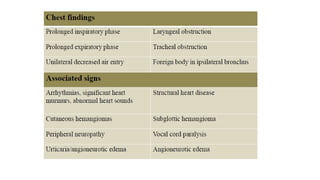
2. Note whether stridor is inspiratory, expiratory or biphasic which indicates the
probable site of obstruction.
3. Note associated characteristics of stridor.
(a) Snoring or snorting sound—nasal or nasopharyngeal cause.
(b) Gurgling sound and muffled voice—pharyngeal cause.
(c) Hoarse cry or voice—laryngeal cause at vocal cords.Cry is normal in
laryngomalacia and subglottic stenosis.
(d) Expiratory wheeze—bronchial obstruction.
4. Associated fever indicates infective condition, e.g. acute laryngitis,
epiglottitis, laryngo-tracheo-bronchitis or diphtheria.
5. Stridor of laryngomalacia, micrognathia, macroglossia and innominate
artery compression disappears when baby lies in prone position.
6. Sequential auscultation with unaided ear and with stethoscope over
the nose, open mouth, neck and the chest helps to localize the probable
site of origin of stridor.
7. Examination of nose, tongue, jaw and pharynx and larynx can exclude
local pathology in these areas. In adults, indirect laryngoscopy can be
done easily while infants and children require flexible fibreoptic
laryngoscopy.
FLEXIBLE FIBREOPTIC LARYNGOSCOPY
It can be done under topical anaesthesia as an outdoor procedure and allows
examination of nose, nasopharynx and larynx.
It helps in the diagnosis of-
• Laryngomalacia.
• Vocal cord paralysis.
• Laryngeal papillomas.
• Laryngeal cysts.
• Congenital anomalies of larynx, e.g. laryngeal web or clefts.
INVESTIGATIONS
• History and clinical examination will dictate the type of tests required.
1. Soft tissue lateral and PA view of neck and X-ray chest in PA and lateral
view help in diagnosing the foreign bodies of the airway.
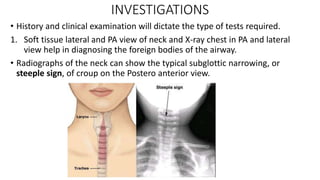
• Radiographs of the neck can show the typical subglottic narrowing, or
steeple sign, of croup on the Postero anterior view.
2. X-ray chest in inspiratory and expiratory phases or a fluoroscopy of
chest help to diagnose radiolucent foreign bodies.
3. Oesophagogram with contrast may be needed for tracheobronchial
fistula or aberrant vessels or oesophageal atresia.
4. CT scan with contrast-
It is helpful for mediastinal mass and other congenital vascular
anomalies compressing the trachea or bronchi, e.g. anomalous
innominate artery, double aortic arch or an anomalous left pulmonary
artery forming a sling around the trachea.
5.Angiography may be needed for above vascular anomalies before
operation.
DIRECT LARYNGOSCOPY
• Microlaryngoscopy and bronchoscopy under general anaesthesia.
• This procedure is done in operation theatre with full preparation for
resuscitative measures to deal with respiratory distress.
• Patient is monitored for oxygen saturation, pulse, blood pressure and
electrocardiography.
• Services of an expert anaesthetist are essential.
• Anaesthesia is induced with insufflation and i.v. route established.
• Patient is kept on spontaneous respiration.
LARYNGOSCOPY IN EPIGLOTTITIS
• After a quick and short direct laryngoscopy, bronchoscope is inserted to
examine the air passage from the subglottis to bronchi for any obstruction.
• Secretions can be collected for culture and sensitivity, crusts and foreign
body if any removed.
• After bronchoscopy, child is intubated and examination of larynx or
oesophagus can be done.
• Microlaryngoscopy can be done without intubation with patient on
spontaneous breathing and oxygen and gases being delivered through a
catheter via the laryngoscope.
• Magnification can be provided with telescope or microscope.
TREATMENT
• Once the diagnosis has been made, treatment of exact cause can be
planned.
MANAGEMENT OF CROUP-
• Racemic epinephrine :
• 0.05 ml/kg/dose ( with a maximum of 0.5ml) of a 2.25% of solution diluted to 3 ml
total volume with normal saline. Given via neb over 15 minutes.
• L- epinephrine
• 0.5ml/kg/dose ( max. of 5 ml) of a 1:1000 dilution. Given via neb over 15 minutes.
• Dexamethasone
• 0.6 mg/kg IV, IM or PO as a single dose
• Nebulized Budesonide (2mg/4cc) has proved as effective as adrenaline
nebulizer (4mg/4cc)
• Antibiotics are not indicated.
• Sedatives are contraindicated
MANAGEMENT OF EPIGLOTTITIS
• Once the diagnosis of epiglottitis is suspected, urgent hospitalization
is required (ICU or OT or Anaesthetic room with resuscitation
facilities).
• Intubate child under general anaesthesia.
• Urgent tracheostomy (very rare) if intubation impossible.
• Culture for blood, and epiglottic surface should be collected. (Only
after airway is secured!).
• Start patient on antibiotics immediately (e.g. cefotaxime,ceftriaxone, or
meropenem) for at least 10 days as most patients might have
concomitant bacteremia.
• Tracheal tube can be removed usually within 24 hours (Depending on
patient’s progress).
• Most children recover fully within 2-3 days.
• Indication for Rifampicin prophylaxis(20mg/kg X 4d) for-
• All house members include a child <4yr of age and incompletely immunized.
• Younger than 12 months of age and hasn’t completed the primary vaccination.
• Immunocompromised.
MANAGEMENT OF FOREIGN BODY ASPIRATION
• Most cases of inhalation events are not witnessed, hence diagnosis
usually depends on high index of suspicion.
• Immediately do a lateral neck X-ray, AP-Chest X-ray(but hard to detect
at times).
• Prompt endoscopic removal of foreign object with rigid instruments is
the treatment of choice.
• Bronchoscopy is deferred only until pre-op studies have been
obtained and the patient has been prepared by adequate hydration
and emptying of stomach.
MANAGEMENT OF LARYNGOMALACIA
• EXPECTANT OBSERVATION (as most symptoms resolve spontaneously
as the child and airway grows).
• SURGICAL INTERVENTION – Endoscopic Supraglottoplasty for patients
with severe obstruction (Especially when there are other life-
threatening events associated together e.g. cor pulmonale, cyanosis,
failure to thrive).

Stridor

  • 1.
  • 2.
    HISTORY TAKING- • Stridoris a physical sign and not a disease. • Attempt should always be made to discover the cause. • It is important to elicit: 1. Time of onset-To find whether cause is congenital or acquired. 2. Mode of onset- • Sudden onset (foreign body, oedema), • gradual and progressive (laryngomalacia, subglottic haemangioma, juvenile papillomas). 3. Duration- • Short (foreign body, oedema, infections), • Long (laryngomalacia, laryngeal stenosis, subglottic haemangioma, anomalies of tongue and jaw).
  • 3.
    4. Relation tofeeding- Aspiration in laryngeal paralysis, oesophageal atresia, laryngeal cleft, vascular ring, foreign body oesophagus. 5. Cyanotic spells-Indicate need for airway maintenance. 6. Aspiration or ingestion of a foreign body. 7. Laryngeal trauma-Blunt injuries to larynx, intubation, endoscopy.
  • 4.
    PHYSICAL EXAMINATION- 1. Stridoris always associated with respiratory distress. There may be recession in suprasternal notch, sternum, intercostal spaces and epigastrium during inspiratory efforts. 2. Note whether stridor is inspiratory, expiratory or biphasic which indicates the probable site of obstruction. 3. Note associated characteristics of stridor. (a) Snoring or snorting sound—nasal or nasopharyngeal cause. (b) Gurgling sound and muffled voice—pharyngeal cause. (c) Hoarse cry or voice—laryngeal cause at vocal cords.Cry is normal in laryngomalacia and subglottic stenosis. (d) Expiratory wheeze—bronchial obstruction.
  • 5.
    4. Associated feverindicates infective condition, e.g. acute laryngitis, epiglottitis, laryngo-tracheo-bronchitis or diphtheria. 5. Stridor of laryngomalacia, micrognathia, macroglossia and innominate artery compression disappears when baby lies in prone position. 6. Sequential auscultation with unaided ear and with stethoscope over the nose, open mouth, neck and the chest helps to localize the probable site of origin of stridor. 7. Examination of nose, tongue, jaw and pharynx and larynx can exclude local pathology in these areas. In adults, indirect laryngoscopy can be done easily while infants and children require flexible fibreoptic laryngoscopy.
  • 8.
    FLEXIBLE FIBREOPTIC LARYNGOSCOPY Itcan be done under topical anaesthesia as an outdoor procedure and allows examination of nose, nasopharynx and larynx. It helps in the diagnosis of- • Laryngomalacia. • Vocal cord paralysis. • Laryngeal papillomas. • Laryngeal cysts. • Congenital anomalies of larynx, e.g. laryngeal web or clefts.
  • 9.
    INVESTIGATIONS • History andclinical examination will dictate the type of tests required. 1. Soft tissue lateral and PA view of neck and X-ray chest in PA and lateral view help in diagnosing the foreign bodies of the airway. • Radiographs of the neck can show the typical subglottic narrowing, or steeple sign, of croup on the Postero anterior view.
  • 10.
    2. X-ray chestin inspiratory and expiratory phases or a fluoroscopy of chest help to diagnose radiolucent foreign bodies. 3. Oesophagogram with contrast may be needed for tracheobronchial fistula or aberrant vessels or oesophageal atresia.
  • 11.
    4. CT scanwith contrast- It is helpful for mediastinal mass and other congenital vascular anomalies compressing the trachea or bronchi, e.g. anomalous innominate artery, double aortic arch or an anomalous left pulmonary artery forming a sling around the trachea. 5.Angiography may be needed for above vascular anomalies before operation.
  • 12.
    DIRECT LARYNGOSCOPY • Microlaryngoscopyand bronchoscopy under general anaesthesia. • This procedure is done in operation theatre with full preparation for resuscitative measures to deal with respiratory distress. • Patient is monitored for oxygen saturation, pulse, blood pressure and electrocardiography. • Services of an expert anaesthetist are essential. • Anaesthesia is induced with insufflation and i.v. route established. • Patient is kept on spontaneous respiration.
  • 13.
  • 14.
    • After aquick and short direct laryngoscopy, bronchoscope is inserted to examine the air passage from the subglottis to bronchi for any obstruction. • Secretions can be collected for culture and sensitivity, crusts and foreign body if any removed. • After bronchoscopy, child is intubated and examination of larynx or oesophagus can be done. • Microlaryngoscopy can be done without intubation with patient on spontaneous breathing and oxygen and gases being delivered through a catheter via the laryngoscope. • Magnification can be provided with telescope or microscope.
  • 15.
    TREATMENT • Once thediagnosis has been made, treatment of exact cause can be planned.
  • 16.
    MANAGEMENT OF CROUP- •Racemic epinephrine : • 0.05 ml/kg/dose ( with a maximum of 0.5ml) of a 2.25% of solution diluted to 3 ml total volume with normal saline. Given via neb over 15 minutes. • L- epinephrine • 0.5ml/kg/dose ( max. of 5 ml) of a 1:1000 dilution. Given via neb over 15 minutes. • Dexamethasone • 0.6 mg/kg IV, IM or PO as a single dose • Nebulized Budesonide (2mg/4cc) has proved as effective as adrenaline nebulizer (4mg/4cc) • Antibiotics are not indicated. • Sedatives are contraindicated
  • 17.
    MANAGEMENT OF EPIGLOTTITIS •Once the diagnosis of epiglottitis is suspected, urgent hospitalization is required (ICU or OT or Anaesthetic room with resuscitation facilities). • Intubate child under general anaesthesia. • Urgent tracheostomy (very rare) if intubation impossible. • Culture for blood, and epiglottic surface should be collected. (Only after airway is secured!).
  • 18.
    • Start patienton antibiotics immediately (e.g. cefotaxime,ceftriaxone, or meropenem) for at least 10 days as most patients might have concomitant bacteremia. • Tracheal tube can be removed usually within 24 hours (Depending on patient’s progress). • Most children recover fully within 2-3 days. • Indication for Rifampicin prophylaxis(20mg/kg X 4d) for- • All house members include a child <4yr of age and incompletely immunized. • Younger than 12 months of age and hasn’t completed the primary vaccination. • Immunocompromised.
  • 19.
    MANAGEMENT OF FOREIGNBODY ASPIRATION • Most cases of inhalation events are not witnessed, hence diagnosis usually depends on high index of suspicion. • Immediately do a lateral neck X-ray, AP-Chest X-ray(but hard to detect at times). • Prompt endoscopic removal of foreign object with rigid instruments is the treatment of choice. • Bronchoscopy is deferred only until pre-op studies have been obtained and the patient has been prepared by adequate hydration and emptying of stomach.
  • 20.
    MANAGEMENT OF LARYNGOMALACIA •EXPECTANT OBSERVATION (as most symptoms resolve spontaneously as the child and airway grows). • SURGICAL INTERVENTION – Endoscopic Supraglottoplasty for patients with severe obstruction (Especially when there are other life- threatening events associated together e.g. cor pulmonale, cyanosis, failure to thrive).