Stress Management for Allied
       Health Professionals

              Richard Gevirtz, Ph.D.
            CSPP@Alliant International
              University-San Diego

9/11/2007                                1
Theme of the presentation
• Understanding the underlying physiology of
  stress is useful in managing it.
• “If our brain was simple enough for us to
  understand, we would be too dumb to
  understand it”


9/11/2007                                  2
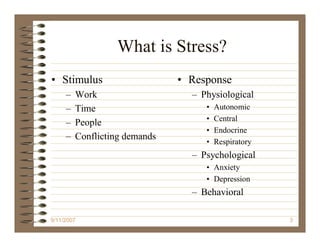
What is Stress?
• Stimulus                     • Response
     –   Work                    – Physiological
     –   Time                       •   Autonomic
                                    •   Central
     –   People
                                    •   Endocrine
     –   Conflicting demands
                                    •   Respiratory
                                 – Psychological
                                    • Anxiety
                                    • Depression
                                 – Behavioral

9/11/2007                                             3
Interactional Models of Stress
•   Perception/appraisal
•   Physiological Mediators
•   Phenomenological experiences
•   Responses


9/11/2007                             4
Nature of Modern Stressors
• Few require massive mobilization
  (fight/flight)
• Most involve interpersonal challenges,
  social hierarchies, rejection/acceptance
• Often characterized by internal rumination
  and worry states; anticipatory anxiety
• Strong involvement of negative or critical
  self-judgement
9/11/2007                                      5
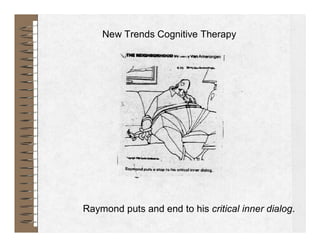
New Trends Cognitive Therapy


            Raymond puts and end to his critical inner dialog.
9/11/2007                                                   6
Physiology of Stress
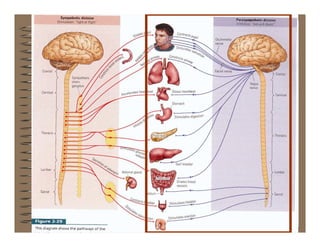
• Four most important systems:
     – Sympathetic Nervous System/Adrenal Medullary
       system
            • Fight/Flight/Fright
     – Parasympathetic Nervous System
            • Rest/Digest
     – Hypothalamic Pituitary System
            • Cortisol
     – Respiratory System
            • Hyperventilation


9/11/2007                                             7
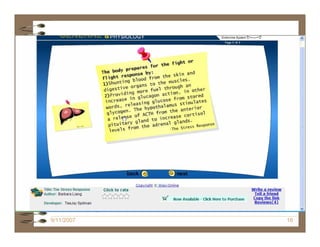
9/11/2007   8
9/11/2007   9
9/11/2007   10
9/11/2007   11
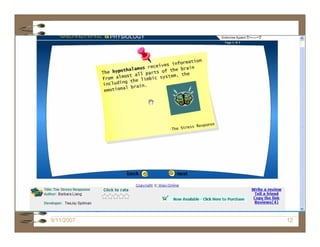
9/11/2007   12
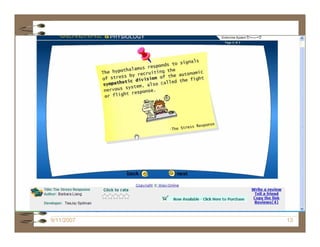
9/11/2007   13
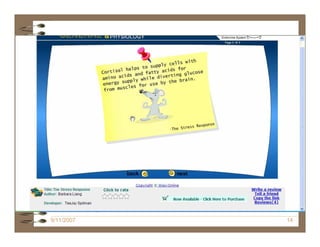
9/11/2007   14
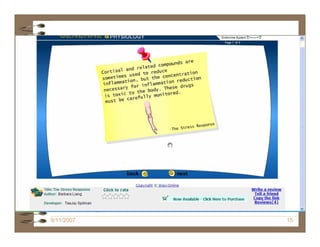
9/11/2007   15
9/11/2007   16
9/11/2007   17
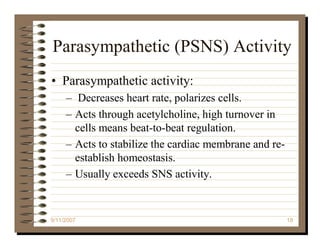
Parasympathetic (PSNS) Activity
• Parasympathetic activity:
     – Decreases heart rate, polarizes cells.
     – Acts through acetylcholine, high turnover in
       cells means beat-to-beat regulation.
     – Acts to stabilize the cardiac membrane and re-
       establish homeostasis.
     – Usually exceeds SNS activity.


9/11/2007                                               18
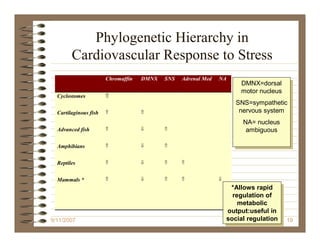
Phylogenetic Hierarchy in
        Cardiovascular Response to Stress
                       Chromaffin   DMNX   SNS   Adrenal Med   NA
                                                                       DMNX=dorsal
                                                                        DMNX=dorsal
                                                                       motor nucleus
                                                                       motor nucleus
  Cyclostomes          ⇑
                                                                     SNS=sympathetic
                                                                      SNS=sympathetic
  Cartilaginous fish   ⇑            ⇑                                 nervous system
                                                                       nervous system
                                                                        NA= nucleus
                                                                         NA= nucleus
  Advanced fish        ⇑            ⇓      ⇑                             ambiguous
                                                                          ambiguous

  Amphibians           ⇑            ⇓      ⇑


  Reptiles             ⇑            ⇓      ⇑     ⇑


  Mammals *            ⇑            ⇓      ⇑     ⇑             ⇓
                                                                     *Allows rapid
                                                                      *Allows rapid
                                                                     regulation of
                                                                      regulation of
                                                                       metabolic
                                                                        metabolic
                                                                   output:useful in
                                                                    output:useful in
9/11/2007                                                          social regulation 19
                                                                    social regulation
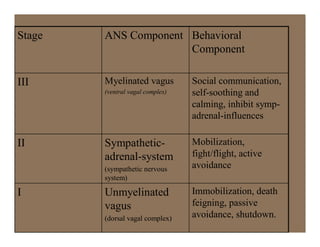
Stage   ANS Component Behavioral
                      Component

III     Myelinated vagus          Social communication,
        (ventral vagal complex)   self-soothing and
                                  calming, inhibit symp-
                                  adrenal-influences

II      Sympathetic-              Mobilization,
        adrenal-system            fight/flight, active
        (sympathetic nervous      avoidance
        system)

I       Unmyelinated              Immobilization, death
        vagus                     feigning, passive
        (dorsal vagal complex)    avoidance, shutdown.
9/11/2007   21
9/11/2007   22
9/11/2007   23
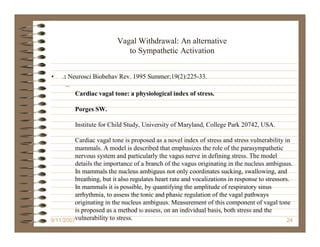
Vagal Withdrawal: An alternative
                             to Sympathetic Activation


•   .: Neurosci Biobehav Rev. 1995 Summer;19(2):225-33.
      –
         Cardiac vagal tone: a physiological index of stress.

         Porges SW.

         Institute for Child Study, University of Maryland, College Park 20742, USA.

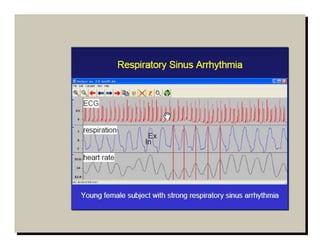
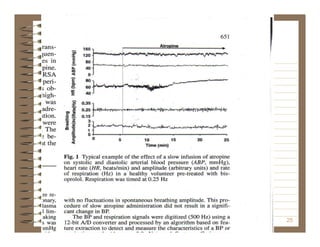
         Cardiac vagal tone is proposed as a novel index of stress and stress vulnerability in
         mammals. A model is described that emphasizes the role of the parasympathetic
         nervous system and particularly the vagus nerve in defining stress. The model
         details the importance of a branch of the vagus originating in the nucleus ambiguus.
         In mammals the nucleus ambiguus not only coordinates sucking, swallowing, and
         breathing, but it also regulates heart rate and vocalizations in response to stressors.
         In mammals it is possible, by quantifying the amplitude of respiratory sinus
         arrhythmia, to assess the tonic and phasic regulation of the vagal pathways
         originating in the nucleus ambiguus. Measurement of this component of vagal tone
         is proposed as a method to assess, on an individual basis, both stress and the
9/11/2007vulnerability to stress.                                                              24
9/11/2007   25
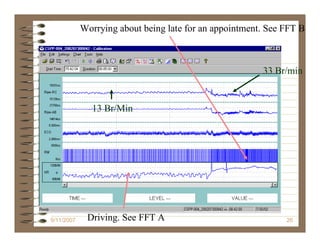
Worrying about being late for an appointment. See FFT B


                                                        33 Br/min


              13 Br/Min


9/11/2007    Driving. See FFT A                               26
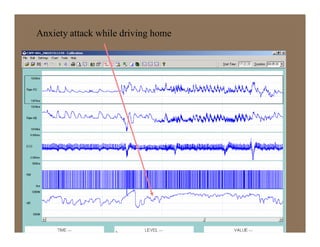
Anxiety attack while driving home
9/11/2007   28
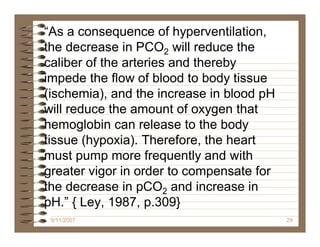
“As a consequence of hyperventilation,
the decrease in PCO2 will reduce the
caliber of the arteries and thereby
impede the flow of blood to body tissue
(ischemia), and the increase in blood pH
will reduce the amount of oxygen that
hemoglobin can release to the body
tissue (hypoxia). Therefore, the heart
must pump more frequently and with
greater vigor in order to compensate for
the decrease in pCO2 and increase in
pH.” { Ley, 1987, p.309}
 9/11/2007                                 29
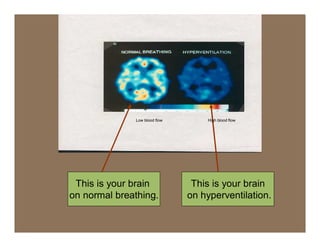
Low blood flow       High blood flow


 This is your brain             This is your brain
on normal breathing.           on hyperventilation.
9/11/2007   31
Stress Management
• Using our knowledge of stress physiology


9/11/2007                                    32
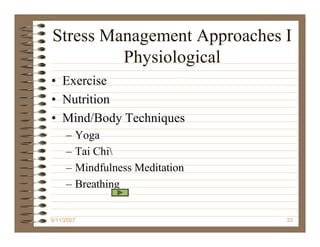
Stress Management Approaches I
         Physiological
• Exercise
• Nutrition
• Mind/Body Techniques
     –   Yoga
     –   Tai Chi
     –   Mindfulness Meditation
     –   Breathing


9/11/2007                         33
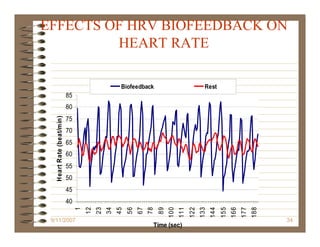
EFFECTS OF HRV BIOFEEDBACK ON
         HEART RATE

                                                      Biofeedback                                 Rest
                             85
                             80
   H eart R ate (beat/min)


                             75
                             70
                             65
                             60
                             55
                             50
                             45
                             40
                                  1
                                      12
                                           23
                                                34
                                                     45
                                                          56
                                                               67
                                                                    78
                                                                         89
                                                                              100
                                                                                    111
                                                                                          122
                                                                                                133
                                                                                                      144
                                                                                                            155
                                                                                                                  166
                                                                                                                        177
                                                                                                                              188
 9/11/2007                                                                                                                          34
                                                                     Time (sec)
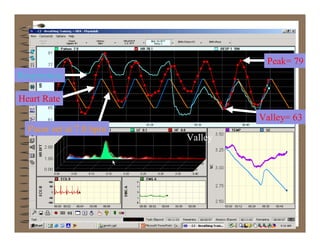
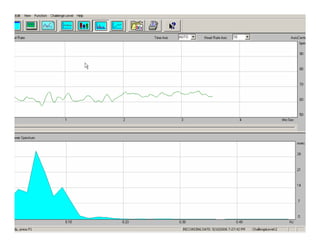
Peak= 79
Respiration

Heart Rate
                                  Valley= 63
  Pacer set at 7.0 bpm
                         Valley


        9/11/2007                       35
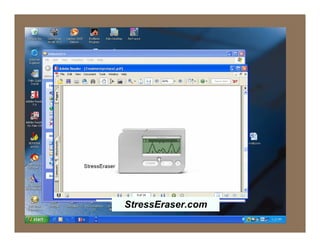
StressEraser.com
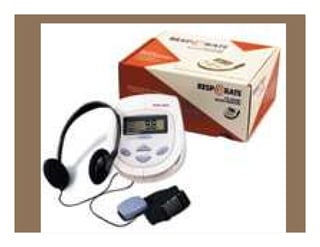
HeartMath.Com
9/11/2007   38
Stress Management Techniques II:
           Cognitive
 • Reframing/ humor
 • Decatastrophizing
 • Reducing the duration of “stress attacks”
      –   Acceptance of flawed self
      –   Acceptance of early engrams
      –   Reduction of duration
      –   Experiential avoidance can’t work
 • Cognitive workbooks (Ex. Mind over Mood)
 • Get Out of your Mind and into your Life-
   Hayes
 9/11/2007                                     40

stressmanagement

  • 1.
    Stress Management forAllied Health Professionals Richard Gevirtz, Ph.D. CSPP@Alliant International University-San Diego 9/11/2007 1
  • 2.
    Theme of thepresentation • Understanding the underlying physiology of stress is useful in managing it. • “If our brain was simple enough for us to understand, we would be too dumb to understand it” 9/11/2007 2
  • 3.
    What is Stress? •Stimulus • Response – Work – Physiological – Time • Autonomic • Central – People • Endocrine – Conflicting demands • Respiratory – Psychological • Anxiety • Depression – Behavioral 9/11/2007 3
  • 4.
    Interactional Models ofStress • Perception/appraisal • Physiological Mediators • Phenomenological experiences • Responses 9/11/2007 4
  • 5.
    Nature of ModernStressors • Few require massive mobilization (fight/flight) • Most involve interpersonal challenges, social hierarchies, rejection/acceptance • Often characterized by internal rumination and worry states; anticipatory anxiety • Strong involvement of negative or critical self-judgement 9/11/2007 5
  • 6.
    New Trends CognitiveTherapy Raymond puts and end to his critical inner dialog. 9/11/2007 6
  • 7.
    Physiology of Stress •Four most important systems: – Sympathetic Nervous System/Adrenal Medullary system • Fight/Flight/Fright – Parasympathetic Nervous System • Rest/Digest – Hypothalamic Pituitary System • Cortisol – Respiratory System • Hyperventilation 9/11/2007 7
  • 8.
  • 9.
  • 10.
  • 11.
  • 12.
  • 13.
  • 14.
  • 15.
  • 16.
  • 17.
  • 18.
    Parasympathetic (PSNS) Activity •Parasympathetic activity: – Decreases heart rate, polarizes cells. – Acts through acetylcholine, high turnover in cells means beat-to-beat regulation. – Acts to stabilize the cardiac membrane and re- establish homeostasis. – Usually exceeds SNS activity. 9/11/2007 18
  • 19.
    Phylogenetic Hierarchy in Cardiovascular Response to Stress Chromaffin DMNX SNS Adrenal Med NA DMNX=dorsal DMNX=dorsal motor nucleus motor nucleus Cyclostomes ⇑ SNS=sympathetic SNS=sympathetic Cartilaginous fish ⇑ ⇑ nervous system nervous system NA= nucleus NA= nucleus Advanced fish ⇑ ⇓ ⇑ ambiguous ambiguous Amphibians ⇑ ⇓ ⇑ Reptiles ⇑ ⇓ ⇑ ⇑ Mammals * ⇑ ⇓ ⇑ ⇑ ⇓ *Allows rapid *Allows rapid regulation of regulation of metabolic metabolic output:useful in output:useful in 9/11/2007 social regulation 19 social regulation
  • 20.
    Stage ANS Component Behavioral Component III Myelinated vagus Social communication, (ventral vagal complex) self-soothing and calming, inhibit symp- adrenal-influences II Sympathetic- Mobilization, adrenal-system fight/flight, active (sympathetic nervous avoidance system) I Unmyelinated Immobilization, death vagus feigning, passive (dorsal vagal complex) avoidance, shutdown.
  • 21.
  • 22.
  • 23.
  • 24.
    Vagal Withdrawal: Analternative to Sympathetic Activation • .: Neurosci Biobehav Rev. 1995 Summer;19(2):225-33. – Cardiac vagal tone: a physiological index of stress. Porges SW. Institute for Child Study, University of Maryland, College Park 20742, USA. Cardiac vagal tone is proposed as a novel index of stress and stress vulnerability in mammals. A model is described that emphasizes the role of the parasympathetic nervous system and particularly the vagus nerve in defining stress. The model details the importance of a branch of the vagus originating in the nucleus ambiguus. In mammals the nucleus ambiguus not only coordinates sucking, swallowing, and breathing, but it also regulates heart rate and vocalizations in response to stressors. In mammals it is possible, by quantifying the amplitude of respiratory sinus arrhythmia, to assess the tonic and phasic regulation of the vagal pathways originating in the nucleus ambiguus. Measurement of this component of vagal tone is proposed as a method to assess, on an individual basis, both stress and the 9/11/2007vulnerability to stress. 24
  • 25.
  • 26.
    Worrying about beinglate for an appointment. See FFT B 33 Br/min 13 Br/Min 9/11/2007 Driving. See FFT A 26
  • 27.
  • 28.
  • 29.
    “As a consequenceof hyperventilation, the decrease in PCO2 will reduce the caliber of the arteries and thereby impede the flow of blood to body tissue (ischemia), and the increase in blood pH will reduce the amount of oxygen that hemoglobin can release to the body tissue (hypoxia). Therefore, the heart must pump more frequently and with greater vigor in order to compensate for the decrease in pCO2 and increase in pH.” { Ley, 1987, p.309} 9/11/2007 29
  • 30.
    Low blood flow High blood flow This is your brain This is your brain on normal breathing. on hyperventilation.
  • 31.
  • 32.
    Stress Management • Usingour knowledge of stress physiology 9/11/2007 32
  • 33.
    Stress Management ApproachesI Physiological • Exercise • Nutrition • Mind/Body Techniques – Yoga – Tai Chi – Mindfulness Meditation – Breathing 9/11/2007 33
  • 34.
    EFFECTS OF HRVBIOFEEDBACK ON HEART RATE Biofeedback Rest 85 80 H eart R ate (beat/min) 75 70 65 60 55 50 45 40 1 12 23 34 45 56 67 78 89 100 111 122 133 144 155 166 177 188 9/11/2007 34 Time (sec)
  • 35.
    Peak= 79 Respiration Heart Rate Valley= 63 Pacer set at 7.0 bpm Valley 9/11/2007 35
  • 36.
  • 37.
  • 38.
  • 40.
    Stress Management TechniquesII: Cognitive • Reframing/ humor • Decatastrophizing • Reducing the duration of “stress attacks” – Acceptance of flawed self – Acceptance of early engrams – Reduction of duration – Experiential avoidance can’t work • Cognitive workbooks (Ex. Mind over Mood) • Get Out of your Mind and into your Life- Hayes 9/11/2007 40