
STRESS AND ADAPTATION
INTRODUCTION:
Stress is a part of life. Everyone feels
stress at one time or another. The
experience of stress & the way one
response to it are unique to each
individual. The process of responding to
stress is constant & dynamic & is
essential to the person’s physical,
emotional & social well being.
STRESS
It is a condition in which the human system responds to
changing in its normal balanced state .Stress result from a
change in the environment ,that is presided as a challenge,
a threat or a danger and can have both negative and
positive effects.
STRESSOR
Stressors are themselves neither positive
nor negative but they can have positive
and negative effects as the persons
responds to the changes.
ADAPTATION
When person is in a threatening situation
immediate response occur .Those response are
often involuntary ,are called coping response.
The change that take places as a result of the
responses to a stressor is adaptation .
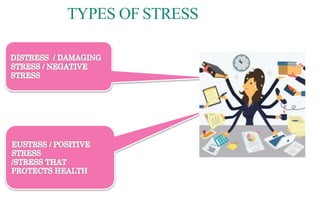
TYPES OF STRESS
NEGATIVE STRESS
It is a contributory factor in minor
conditions, such as headaches, digestive
problems, skin complaints, insomnia and ulcers.
Excessive, prolonged and unrelieved stress can
have a harmful effect on mental, physical and
spiritual health.
POSITIVE STRESS
Stress can also have a positive effect,
spurring motivation and awareness, providing
the stimulation to cope with challenging
situations.
Stress also provides the sense of urgency and
alertness needed for survival when confronting
threatening situations.
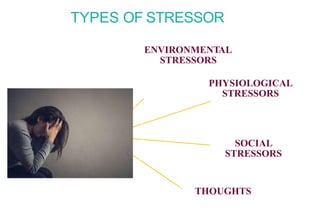
TYPES OF STRESSOR
ENVIRONMENTAL
STRESSORS
PHYSIOLOGICAL
STRESSORS
SOCIAL
STRESSORS
THOUGHTS
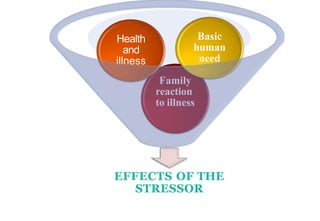
EFFECTS OF THE
STRESSOR
Family
reaction
to illness
Health
and
illness
Basic
human
need
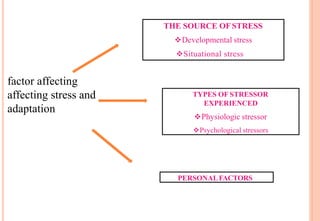
factor affecting
affecting stress and
adaptation
THE SOURCE OF STRESS
Developmental stress
Situational stress
TYPES OF STRESSOR
EXPERIENCED
Physiologic stressor
Psychological stressors
PERSONALFACTORS
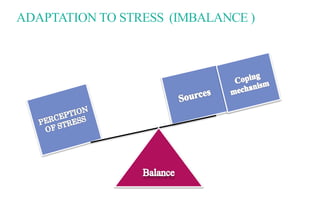
ADAPTATION TO STRESS (IMBALANCE )
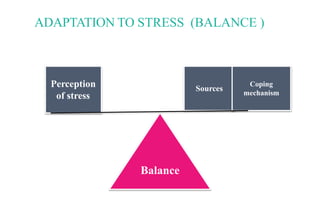
ADAPTATION TO STRESS (BALANCE )
Perception
of stress
Sources
Coping
mechanism
Balance
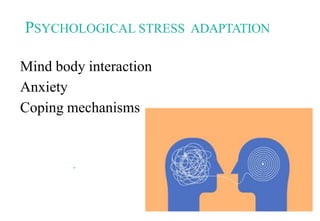
PSYCHOLOGICAL STRESS ADAPTATION
Mind body interaction
Anxiety
Coping mechanisms
MIND BODY INTERACTION
 humans react to threats of danger as if they were physiologic
threats of a person perceives the threat on an emotional level&
the body prepares itself to either resist the danger or to run away
from it. Each person reacts in Backache
 Constipation
 Diarrhea
 Dilated pupils
 Dry mouth
 Headache nausea
 Sleep disturbances
ANXIETY
MILD
ANXIETY
MODERATE
SEVERE
PANIC
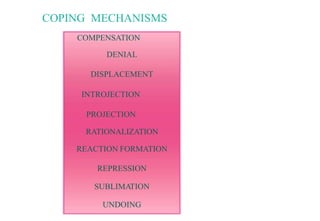
COPING MECHANISMS
COMPENSATION
DENIAL
DISPLACEMENT
INTROJECTION
PROJECTION
RATIONALIZATION
REACTION FORMATION
REPRESSION
SUBLIMATION
UNDOING
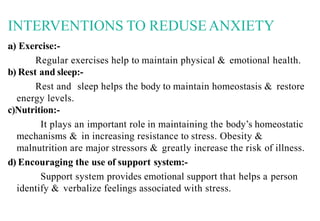
INTERVENTIONS TO REDUSEANXIETY
a) Exercise:-
Regular exercises help to maintain physical & emotional health.
b) Rest and sleep:-
Rest and sleep helps the body to maintain homeostasis & restore
energy levels.
c)Nutrition:-
It plays an important role in maintaining the body’s homeostatic
mechanisms & in increasing resistance to stress. Obesity &
malnutrition are major stressors & greatly increase the risk of illness.
d) Encouraging the use of support system:-
Support system provides emotional support that helps a person
identify & verbalize feelings associated with stress.
STRESS MANAGEMENT
MEDITATION
PROBLEM
SOLVING
RELAXATION
INTERPERSONAL
COMMUNICATION WITH
CARING
PETS
MUSIC
AWARENESS
Thank you

Stressandadaptatiton