Understanding Wellbeing
Week 2: Stress & Stress Management
with Michelle Walsh @ The Waterside Centre
01254 354413 or mwalsh@accross.ac.uk
Lo 1: Recap on induction information, group rules and the purpose for them
LO 2: Take part in the icebreaker
LO 3: Outline what is meant by stress (1.1) Re-cap
LO 4: Outline the purpose (Re-cap)/ usefulness of stress on the body (1.2, 2.2)
LO 5: Define a range of different types of stress and potential causes and triggers (1.3, 3.1,
3.3)
LO 6: Identify short and long-term effects of stress on a person (2.1)
LO 7: Investigate the harms associated with prolonged stress and potential symptoms
(2.3, 2.4, 4.1)
LO 8: Outline how people can respond to a stressful situation and give examples of how
stress can change behaviour (4.2, 4.3)
Session 2 Outcomes
Housekeeping
 Fire Evacuation
 Toilets
 Smoking – Away from the door
 Kitchen – Washing own cups
 Mobile Phones – Silent or vibrate
 Commitment – Minimum is 70%
 Absences – To be reported, you
would be required to catch up
 Agreed group rules are now typed up and on
the board
 Please consider the rules that you all took part
in creating and agreeing whilst you are at
Waterside
Group Rules
 You each have a paper plate
 Please write "what is on your plate"
(Eg, children, education and so on)
Once everyone has completed their plate, we will
share the information within the class
Q. How do you think this activity relates to stress?
Icebreaker – What is on your plate?
According to the ONS, Wellbeing is measurable…
“In October 2014 we released the first ever combined 3 year Personal Well-
being Annual Population Dataset”
This survey asked 4 key questions…
 “How satisfied are you with your life nowadays?”
 “To what extent do you feel the things you do in your life are worthwhile?”
 “How happy did you feel yesterday?”
 “How anxious did you feel yesterday?”
1. Out of 10 what do you think the UK population results are for the
questions above?
Recap – did you think
about these figures?
 Remember we spoke about Wellbeing
Recap
Homework was set on ItsLearning – did everyone access it?
I have assessed the ones I received – If you haven’t already,
log back in to see your feedback (In your portfolio please
write on 1.1 & 1.2, page 2 – ItsLearning Week 1)
Anyone who didn’t complete homework via ItsLearning –
Please hand in your written work so this can be assessed
Homework discussion
Group discussion
 What is meant by stress?
 What is the purpose of stress on the body?
Sharing what you know…
Stress happens when we feel that we can't cope with pressure
and this pressure comes in many shapes and forms, and triggers
physiological responses. These changes are best described as the
fight or flight response, a hard-wired reaction to perceived
threats to our survival. When survival had meant facing
immediate and real threats such as confronting a charging
elephant, our response has saved lives.
http://www.stress.org.uk/What-is-stress.aspx
Summary
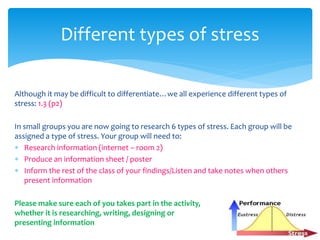
Although it may be difficult to differentiate…we all experience different types of
stress: 1.3 (p2)
In small groups you are now going to research 6 types of stress. Each group will be
assigned a type of stress. Your group will need to:
 Research information (internet – room 2)
 Produce an information sheet / poster
 Inform the rest of the class of your findings/Listen and take notes when others
present information
Please make sure each of you takes part in the activity,
whether it is researching, writing, designing or
presenting information
Different types of stress
15 minutes = Plenty of time for
a brew, chat, drink of water,
toilet visit 
BREAK TIME
 Short-term stress or…
Acute stress usually results from from specific events or situations that involve novelty,
unpredictability, a threat to the ego, and leave us with a poor sense of control. This ‘on the spot’
type of stress can be good for you because the stress hormones released help your mind and
body to deal with the situation.
 Long-term stress or…
Chronic stress usually results from repeated exposure to situations that lead to the release of
stress hormones. This type of stress can cause wear and tear on your mind and body. Many
scientists think that our stress response system was not designed to be constantly activated. This
overuse may contribute to the breakdown of many bodily systems.
Watch the following video and note down any words or phrases that will help us to
identify and list effects of long and short-term stress on a person AC 2.1 (p3)
The long and short of it…
 Discuss in groups of 4 and decide on an appropriate
answer between you – A sentence or 2
 Please make sure that each person in your group takes
part/shares ideas/writes
 You will share this information with the rest of the class
AC 2.2 Page 3
Why can stress be useful?
Stress and particularly chronic stress can have a very damaging effect on
many systems and organs in the body.
Read the information provided in hand out 1. Fill in the blanks using the
information you have read. Ask for help if you need it.
Now complete 2.3 (p3), 2.4 (p3) and 4.1 (p5)
Symptoms and harm
 Use hand-out 2 (your stress) to informally reflect on and assess your own
experience(s) of stress. Complete this task individually.
Now think about possible causes of stress – For you and others
 Use a sticky note to write an answer and place it on the board at the front
of the class
What is it & why is it?
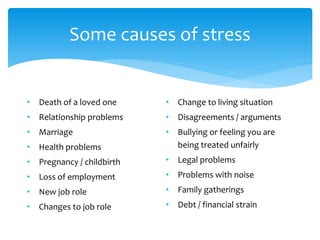
Some causes of stress
• Death of a loved one
• Relationship problems
• Marriage
• Health problems
• Pregnancy / childbirth
• Loss of employment
• New job role
• Changes to job role
• Change to living situation
• Disagreements / arguments
• Bullying or feeling you are
being treated unfairly
• Legal problems
• Problems with noise
• Family gatherings
• Debt / financial strain
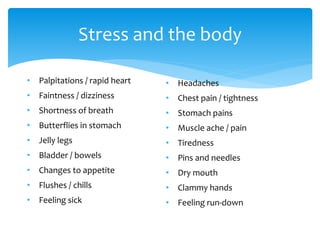
Stress and the body
• Palpitations / rapid heart
• Faintness / dizziness
• Shortness of breath
• Butterflies in stomach
• Jelly legs
• Bladder / bowels
• Changes to appetite
• Flushes / chills
• Feeling sick
• Headaches
• Chest pain / tightness
• Stomach pains
• Muscle ache / pain
• Tiredness
• Pins and needles
• Dry mouth
• Clammy hands
• Feeling run-down
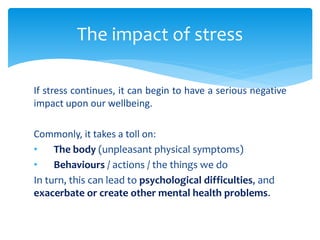
The impact of stress
If stress continues, it can begin to have a serious negative
impact upon our wellbeing.
Commonly, it takes a toll on:
• The body (unpleasant physical symptoms)
• Behaviours / actions / the things we do
In turn, this can lead to psychological difficulties, and
exacerbate or create other mental health problems.
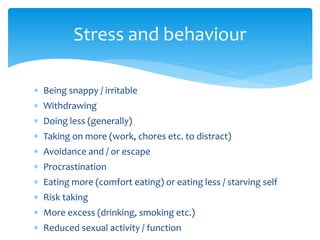
Stress and behaviour
 Being snappy / irritable
 Withdrawing
 Doing less (generally)
 Taking on more (work, chores etc. to distract)
 Avoidance and / or escape
 Procrastination
 Eating more (comfort eating) or eating less / starving self
 Risk taking
 More excess (drinking, smoking etc.)
 Reduced sexual activity / function
Psychological impact
 Burn-out
 Reduced self-esteem / confidence/ self-
belief
 Unhelpful thought patterns
 Negative view of self, world, others
 Catastrophic thinking, excessive worry
Other mental health problems
 Depression / low mood
 Generalised Anxiety Disorder (GAD)
 Panic
 Other anxiety disorders
 Obsessive Compulsive Disorder (OCD)
 Social anxiety / social phobia
 Health anxiety
Another way to look at stress…
Psychologist Kelly McGonigal urges us to see stress as a
positive, and introduces us to an unsung mechanism for
stress reduction: reaching out to others.
Hot to make stress your friend
Workbook
Complete 3.1 (p4), 3.2 (p4), 3.3, 4.2 & 4.3 (p5). Make
sure you read and answer the questions fully.
 Lo 1: Recap on induction information, group rules and the purpose for them
 LO 2: Take part in the icebreaker
 LO 3: Outline what is meant by stress (1.1) Re-cap
 LO 4: Outline the purpose (Re-cap)/ usefulness of stress on the body (1.2, 2.2)
 LO 5: Define a range of different types of stress and potential causes and triggers (1.3,
3.1, 3.3)
 LO 6: Identify short and long-term effects of stress on a person (2.1)
 LO 7: Investigate the harms associated with prolonged stress and potential symptoms
(2.3, 2.4, 4.1)
 LO 8: Outline how people can respond to a stressful situation and give examples of
how stress can change behaviour (4.2, 4.3)
Session 2 Outcomes
Have you..?
Access ItsLearning (Wellbeing course) – Week 2 folder
I have started a presentation off for you, I would like you to complete it.
Each person is able to work on this project.
Here’s what I would like you to do;
 Create your own slide (click the + sign on the left) to include ONE
healthy strategy that can be used to prevent or reduce stress
 Add key information about the strategy and the benefits to someone
from using that strategy
 Add your name to your slide
 Examples of some healthy strategies - Yoga, breathing exercises,
Mindfulness, aromatherapy
Homework

Stress & Stress Management Week 2

  • 1.
    Understanding Wellbeing Week 2:Stress & Stress Management with Michelle Walsh @ The Waterside Centre 01254 354413 or mwalsh@accross.ac.uk
  • 2.
    Lo 1: Recapon induction information, group rules and the purpose for them LO 2: Take part in the icebreaker LO 3: Outline what is meant by stress (1.1) Re-cap LO 4: Outline the purpose (Re-cap)/ usefulness of stress on the body (1.2, 2.2) LO 5: Define a range of different types of stress and potential causes and triggers (1.3, 3.1, 3.3) LO 6: Identify short and long-term effects of stress on a person (2.1) LO 7: Investigate the harms associated with prolonged stress and potential symptoms (2.3, 2.4, 4.1) LO 8: Outline how people can respond to a stressful situation and give examples of how stress can change behaviour (4.2, 4.3) Session 2 Outcomes
  • 3.
    Housekeeping  Fire Evacuation Toilets  Smoking – Away from the door  Kitchen – Washing own cups  Mobile Phones – Silent or vibrate  Commitment – Minimum is 70%  Absences – To be reported, you would be required to catch up
  • 4.
     Agreed grouprules are now typed up and on the board  Please consider the rules that you all took part in creating and agreeing whilst you are at Waterside Group Rules
  • 5.
     You eachhave a paper plate  Please write "what is on your plate" (Eg, children, education and so on) Once everyone has completed their plate, we will share the information within the class Q. How do you think this activity relates to stress? Icebreaker – What is on your plate?
  • 6.
    According to theONS, Wellbeing is measurable… “In October 2014 we released the first ever combined 3 year Personal Well- being Annual Population Dataset” This survey asked 4 key questions…  “How satisfied are you with your life nowadays?”  “To what extent do you feel the things you do in your life are worthwhile?”  “How happy did you feel yesterday?”  “How anxious did you feel yesterday?” 1. Out of 10 what do you think the UK population results are for the questions above? Recap – did you think about these figures?
  • 7.
     Remember wespoke about Wellbeing Recap
  • 8.
    Homework was seton ItsLearning – did everyone access it? I have assessed the ones I received – If you haven’t already, log back in to see your feedback (In your portfolio please write on 1.1 & 1.2, page 2 – ItsLearning Week 1) Anyone who didn’t complete homework via ItsLearning – Please hand in your written work so this can be assessed Homework discussion
  • 9.
    Group discussion  Whatis meant by stress?  What is the purpose of stress on the body? Sharing what you know…
  • 10.
    Stress happens whenwe feel that we can't cope with pressure and this pressure comes in many shapes and forms, and triggers physiological responses. These changes are best described as the fight or flight response, a hard-wired reaction to perceived threats to our survival. When survival had meant facing immediate and real threats such as confronting a charging elephant, our response has saved lives. http://www.stress.org.uk/What-is-stress.aspx Summary
  • 11.
    Although it maybe difficult to differentiate…we all experience different types of stress: 1.3 (p2) In small groups you are now going to research 6 types of stress. Each group will be assigned a type of stress. Your group will need to:  Research information (internet – room 2)  Produce an information sheet / poster  Inform the rest of the class of your findings/Listen and take notes when others present information Please make sure each of you takes part in the activity, whether it is researching, writing, designing or presenting information Different types of stress
  • 12.
    15 minutes =Plenty of time for a brew, chat, drink of water, toilet visit  BREAK TIME
  • 13.
     Short-term stressor… Acute stress usually results from from specific events or situations that involve novelty, unpredictability, a threat to the ego, and leave us with a poor sense of control. This ‘on the spot’ type of stress can be good for you because the stress hormones released help your mind and body to deal with the situation.  Long-term stress or… Chronic stress usually results from repeated exposure to situations that lead to the release of stress hormones. This type of stress can cause wear and tear on your mind and body. Many scientists think that our stress response system was not designed to be constantly activated. This overuse may contribute to the breakdown of many bodily systems. Watch the following video and note down any words or phrases that will help us to identify and list effects of long and short-term stress on a person AC 2.1 (p3) The long and short of it…
  • 14.
     Discuss ingroups of 4 and decide on an appropriate answer between you – A sentence or 2  Please make sure that each person in your group takes part/shares ideas/writes  You will share this information with the rest of the class AC 2.2 Page 3 Why can stress be useful?
  • 15.
    Stress and particularlychronic stress can have a very damaging effect on many systems and organs in the body. Read the information provided in hand out 1. Fill in the blanks using the information you have read. Ask for help if you need it. Now complete 2.3 (p3), 2.4 (p3) and 4.1 (p5) Symptoms and harm
  • 16.
     Use hand-out2 (your stress) to informally reflect on and assess your own experience(s) of stress. Complete this task individually. Now think about possible causes of stress – For you and others  Use a sticky note to write an answer and place it on the board at the front of the class What is it & why is it?
  • 17.
    Some causes ofstress • Death of a loved one • Relationship problems • Marriage • Health problems • Pregnancy / childbirth • Loss of employment • New job role • Changes to job role • Change to living situation • Disagreements / arguments • Bullying or feeling you are being treated unfairly • Legal problems • Problems with noise • Family gatherings • Debt / financial strain
  • 18.
    Stress and thebody • Palpitations / rapid heart • Faintness / dizziness • Shortness of breath • Butterflies in stomach • Jelly legs • Bladder / bowels • Changes to appetite • Flushes / chills • Feeling sick • Headaches • Chest pain / tightness • Stomach pains • Muscle ache / pain • Tiredness • Pins and needles • Dry mouth • Clammy hands • Feeling run-down
  • 19.
    The impact ofstress If stress continues, it can begin to have a serious negative impact upon our wellbeing. Commonly, it takes a toll on: • The body (unpleasant physical symptoms) • Behaviours / actions / the things we do In turn, this can lead to psychological difficulties, and exacerbate or create other mental health problems.
  • 20.
    Stress and behaviour Being snappy / irritable  Withdrawing  Doing less (generally)  Taking on more (work, chores etc. to distract)  Avoidance and / or escape  Procrastination  Eating more (comfort eating) or eating less / starving self  Risk taking  More excess (drinking, smoking etc.)  Reduced sexual activity / function
  • 21.
    Psychological impact  Burn-out Reduced self-esteem / confidence/ self- belief  Unhelpful thought patterns  Negative view of self, world, others  Catastrophic thinking, excessive worry
  • 22.
    Other mental healthproblems  Depression / low mood  Generalised Anxiety Disorder (GAD)  Panic  Other anxiety disorders  Obsessive Compulsive Disorder (OCD)  Social anxiety / social phobia  Health anxiety
  • 23.
    Another way tolook at stress… Psychologist Kelly McGonigal urges us to see stress as a positive, and introduces us to an unsung mechanism for stress reduction: reaching out to others. Hot to make stress your friend
  • 24.
    Workbook Complete 3.1 (p4),3.2 (p4), 3.3, 4.2 & 4.3 (p5). Make sure you read and answer the questions fully.
  • 25.
     Lo 1:Recap on induction information, group rules and the purpose for them  LO 2: Take part in the icebreaker  LO 3: Outline what is meant by stress (1.1) Re-cap  LO 4: Outline the purpose (Re-cap)/ usefulness of stress on the body (1.2, 2.2)  LO 5: Define a range of different types of stress and potential causes and triggers (1.3, 3.1, 3.3)  LO 6: Identify short and long-term effects of stress on a person (2.1)  LO 7: Investigate the harms associated with prolonged stress and potential symptoms (2.3, 2.4, 4.1)  LO 8: Outline how people can respond to a stressful situation and give examples of how stress can change behaviour (4.2, 4.3) Session 2 Outcomes Have you..?
  • 26.
    Access ItsLearning (Wellbeingcourse) – Week 2 folder I have started a presentation off for you, I would like you to complete it. Each person is able to work on this project. Here’s what I would like you to do;  Create your own slide (click the + sign on the left) to include ONE healthy strategy that can be used to prevent or reduce stress  Add key information about the strategy and the benefits to someone from using that strategy  Add your name to your slide  Examples of some healthy strategies - Yoga, breathing exercises, Mindfulness, aromatherapy Homework