
STRESS
MANAGEMENT
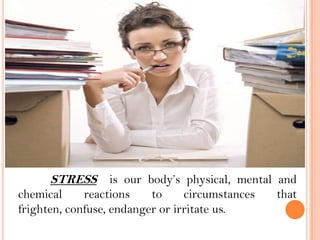
STRESS is our body’s physical, mental and
chemical reactions to circumstances that
frighten, confuse, endanger or irritate us.
According to Beehr and Newman,
“Job stress is a condition arising from the
interaction of the people and their jobs, and
characterized by changes within people that
force them to deviate from their normal
functioning.”
Some important points relating to
the nature of stress are :-
 Stress is a neutral word
- It is not bad in and of itself. But when stress is
created by undesirable outcomes, it becomes Distress.
On the other hand, if it is created by desirable and
successful effects it is called Eustress.
 Stress is associated with constraints and demand
- Constraints prevent an individual from doing
what he or she desire.
Demand refers to the loss of something desired.
 Two conditions are necessary for potential stress to
become actual stress. They must be :
i. Uncertainty over the outcome, and
ii. Outcome must be important.
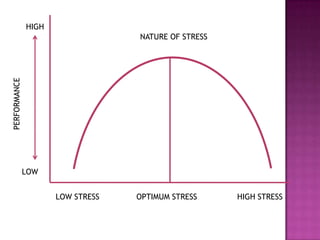
NATURE OF STRESS
PERFORMANCE
HIGH
LOW
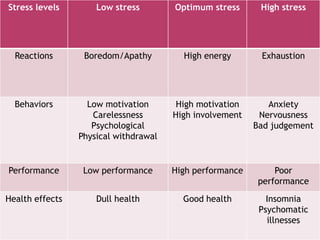
LOW STRESS OPTIMUM STRESS HIGH STRESS
Stress levels Low stress Optimum stress High stress
Reactions Boredom/Apathy High energy Exhaustion
Behaviors Low motivation
Carelessness
Psychological
Physical withdrawal
High motivation
High involvement
Anxiety
Nervousness
Bad judgement
Performance Low performance High performance Poor
performance
Health effects Dull health Good health Insomnia
Psychomatic
illnesses
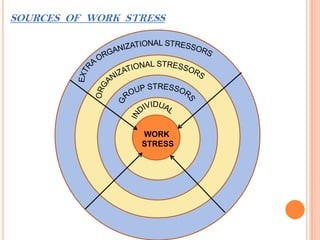
WORK
STRESS
SOURCES OF WORK STRESS
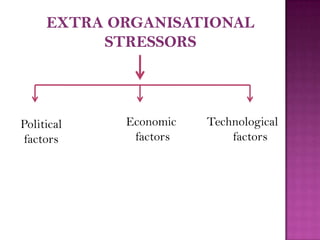
Political
factors
Economic
factors
Technological
factors
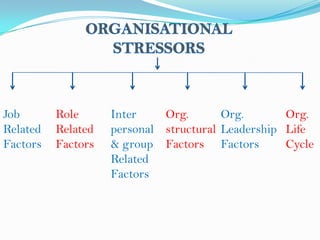
Job
Related
Factors
Role
Related
Factors
Inter
personal
& group
Related
Factors
Org.
structural
Factors
Org.
Leadership
Factors
Org.
Life
Cycle
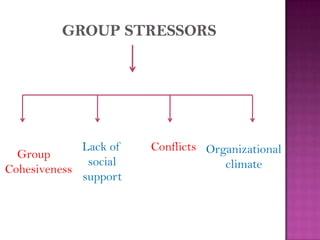
Group
Cohesiveness
Lack of
social
support
Conflicts Organizational
climate
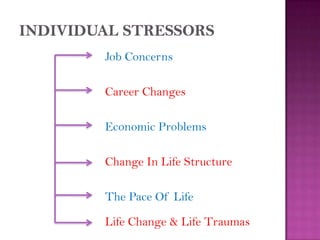
Job Concerns
Career Changes
Economic Problems
Change In Life Structure
The Pace Of Life
Life Change & Life Traumas
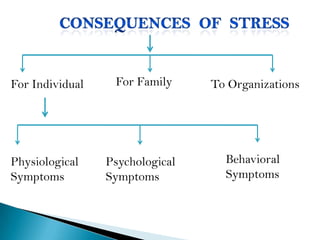
For Individual For Family To Organizations
Physiological
Symptoms
Psychological
Symptoms
Behavioral
Symptoms
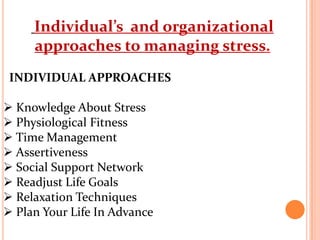
Individual’s and organizational
approaches to managing stress.
INDIVIDUAL APPROACHES
 Knowledge About Stress
 Physiological Fitness
 Time Management
 Assertiveness
 Social Support Network
 Readjust Life Goals
 Relaxation Techniques
 Plan Your Life In Advance
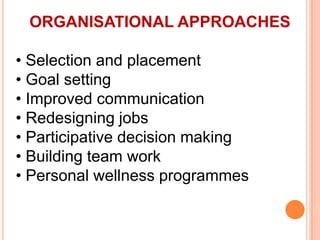
ORGANISATIONAL APPROACHES
• Selection and placement
• Goal setting
• Improved communication
• Redesigning jobs
• Participative decision making
• Building team work
• Personal wellness programmes
Stress mangement in Organization

Stress mangement in Organization