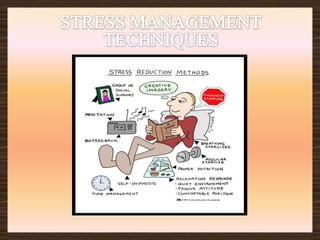
STRESS MANAGEMENT
PRESENTATION OUTLINEPart 1 – Stress in GeneralPart 2 - Stress at WorkPart 3 – Stress Management
PART 1STRESS IN GENERAL
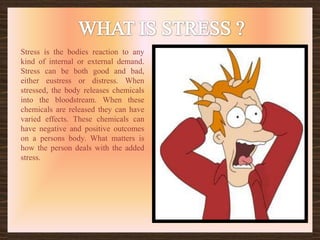
WHAT IS STRESS ?Stress is the bodies reaction to any kind of internal or external demand. Stress can be both good and bad, either eustress or distress. When stressed, the body releases chemicals into the bloodstream. When these chemicals are released they can have varied effects. These chemicals can have negative and positive outcomes on a persons body. What matters is how the person deals with the added stress.
CAUSES OF STRESSThere can be many causes of stress. They can be either physical (such as fear of something dangerous) or emotional (such as worry over your family or job). Some of the most common sources of stress are:Survival Stress
Internal Stress
Environmental Stress
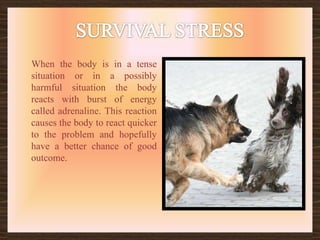
Fatigue and Overwork StressSURVIVAL STRESS     When the body is in a tense situation or in a possibly harmful situation the body reacts with burst of energy called adrenaline. This reaction causes the body to react quicker  to the problem and hopefully have a better chance of good outcome.
INTERNAL STRESSInternal Stress- Internal is the stress felt when individuals make them selves stressed.  Most times internal stress is over things that the individual may not be in control of or situations that are out of their hands. In some cases people have been known to be addicted to the tense, stressed feelings, only causing to more complications in their lifestyle. They even look for stressful situations and feel stress about things that aren't stressful.
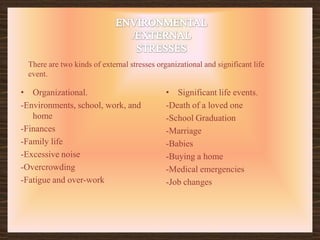
ENVIRONMENTAL/EXTERNAL STRESSESThere are two kinds of external stresses organizational and significant life event.Organizational.-Environments, school, work, and home-Finances-Family life-Excessive noise-Overcrowding-Fatigue and over-workSignificant life events.-Death of a loved one-School Graduation-Marriage-Babies-Buying a home-Medical emergencies-Job changes
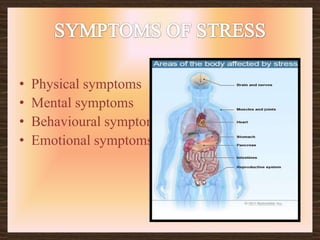
SYMPTOMS OF STRESSPhysical symptomsMental symptomsBehavioural symptomsEmotional symptoms
PHYSICAL SYMPTOMSPhysical symptoms occur in the body either causing harm or pain to an individual. They can vary between. -Headaches -Lowered immunity -Muscle spasms -Fatigue -Skin irritations -Breathlessness
MENTAL SYMPTOMSMental symptoms occur in the mind of an individual either causing irregular behaviours. -Paranoia  -Unclear thinking  -Unsound Judgement -Nightmares -Indecisiveness -Negativity -Rash decisions
BEHAVIOURAL SYMPTOMSBehavioural are the actions of an individual under stress, these can vary from lows to extremes. -Accident Prone -Loss of Appetite -Loss of Sex drive -Drug abuse -Over or under eating -Insomnia -Restlessness
EMOTIONAL SYMPTOMSEmotional symptoms are the direct feelings of stress. They can range between: -Loss of confidence -More Picky -Irritability -Depression -Apathy -Alienation -Apprehension
TYPES OF STRESSORSThere many different types of stressors The most common are: -Environmental: Death of a loved one,  loneliness,  and racism.-Educational: illiteracy, poor academic environment, and lack of skills to be employed.-Occupational: unemployment, recent lay-offs, job     changes-shifts and office space.-Housing: homelessness, unsafe neighbourhood, problems with landlords or neighbours.-Financial: poverty, problems with credit, bankruptcy.-Public care: lack of services, and  lack transport.-Legal: victim of a crime, litigation, indictment, arrest, divorce and custody battles.-Other: natural disasters, war, and  industrial downfalls.
POSITIVE STRESSPositive is called eustress. This kind of stress can have positive outcomes and fills the individual with thrill and excitement.  This positive stress can help encourage an individual to complete new more challenging assignments at work and at home. Also students can find this positive stress necessary to pass tests and exams. Without this positive stress life would become dull and almost boring.
NEGATIVE STRESSNegative stress is also called distress.  Negative comes from an overload of stressors usually over-bearing the individual to the point of breaking. Negative stress usually wears out a persons body causing fatigue and over-tiredness.This can also lead to depression, anxiety, lower self esteem and other mental health issues.
PERSONAL STRESSPersonal stress is the way you deal with all your stressors.  There are few steps to take to manage the stress you experience:-Find out what it is that is stressing you-Realize you cannot control everything-Don’t overburden yourself-Take time to relax and unwind
STRESS RELATED ILLNESSES   Stress is not the same as ill-health, but has been related to such illnesses as;- Chronic Fatigue- Cancer- Depression- Obesity
PART 2STRESS AT WORK
COSTS OF STRESSThe cost of stress is high. There are many things at a chance of loss when in high stress jobs. This can effect both the employer and the employee. They can cost in such ways as:-Lives of those who are under high stress-Loss of productivity-loss of happiness and contentment-Higher chance of a breakdown-Employee dissatisfaction.
LEGAL OVERVIEWHEALTH AND SAFETY IN EMPLOYMENT ACT 1992 (sect 6)Every employer shall take all practicable steps to ensure the safety of employees while at work.HEALTH AND SAFETY IN EMPLOYMENT ACT 1992 (sect 7)Every employer shall ensure that there are in place effective methods for identifying existing hazards, and  (if possible before they arise) new hazards to employees at work.
PART 3STRESSMANAGEMENT
FACTORS INFLUENCING WORK STRESSThe work place is a field ground for stress and there are many factors influencing the outcome of each stressor. These are the top 10 work related stressors:1 Uncontrollable hours, usually long and out of place.2 Difficulty saying no to further tasks for fear of losing future work. 3 Traumatic experiences during work, which are usual to police officers, prison officers, ambulance workers and other health professionals face on an almost on a daily basis. 4 Feeling undervalued at work. 5 Lack of stimulation or Boredom. A lack of motivation can leave you doubling your self-worth and ability to cope. 6 Frustration - often experienced by people who find the path to promotion is constantly being blocked by someone else. 7 Being near the bottom of the ladder in a large hierarchical organisation where you have little control over your working day.8 Fear of redundancy can put added pressure on a person to spend more time at work, and to take on extra responsibilities. 9 Workplace victimisation or bullying can seriously affect a person’s self-esteem. 10 Dealing with constant change in the workplace environment and the tasks you are expected to perform.

Tazzmins stress assignment

  • 1.
  • 2.
    PRESENTATION OUTLINEPart 1– Stress in GeneralPart 2 - Stress at WorkPart 3 – Stress Management
  • 3.
  • 4.
    WHAT IS STRESS?Stress is the bodies reaction to any kind of internal or external demand. Stress can be both good and bad, either eustress or distress. When stressed, the body releases chemicals into the bloodstream. When these chemicals are released they can have varied effects. These chemicals can have negative and positive outcomes on a persons body. What matters is how the person deals with the added stress.
  • 5.
    CAUSES OF STRESSTherecan be many causes of stress. They can be either physical (such as fear of something dangerous) or emotional (such as worry over your family or job). Some of the most common sources of stress are:Survival Stress
  • 6.
  • 7.
  • 8.
    Fatigue and OverworkStressSURVIVAL STRESS When the body is in a tense situation or in a possibly harmful situation the body reacts with burst of energy called adrenaline. This reaction causes the body to react quicker to the problem and hopefully have a better chance of good outcome.
  • 9.
    INTERNAL STRESSInternal Stress-Internal is the stress felt when individuals make them selves stressed. Most times internal stress is over things that the individual may not be in control of or situations that are out of their hands. In some cases people have been known to be addicted to the tense, stressed feelings, only causing to more complications in their lifestyle. They even look for stressful situations and feel stress about things that aren't stressful.
  • 10.
    ENVIRONMENTAL/EXTERNAL STRESSESThere aretwo kinds of external stresses organizational and significant life event.Organizational.-Environments, school, work, and home-Finances-Family life-Excessive noise-Overcrowding-Fatigue and over-workSignificant life events.-Death of a loved one-School Graduation-Marriage-Babies-Buying a home-Medical emergencies-Job changes
  • 11.
    SYMPTOMS OF STRESSPhysicalsymptomsMental symptomsBehavioural symptomsEmotional symptoms
  • 12.
    PHYSICAL SYMPTOMSPhysical symptomsoccur in the body either causing harm or pain to an individual. They can vary between. -Headaches -Lowered immunity -Muscle spasms -Fatigue -Skin irritations -Breathlessness
  • 13.
    MENTAL SYMPTOMSMental symptomsoccur in the mind of an individual either causing irregular behaviours. -Paranoia -Unclear thinking -Unsound Judgement -Nightmares -Indecisiveness -Negativity -Rash decisions
  • 14.
    BEHAVIOURAL SYMPTOMSBehavioural arethe actions of an individual under stress, these can vary from lows to extremes. -Accident Prone -Loss of Appetite -Loss of Sex drive -Drug abuse -Over or under eating -Insomnia -Restlessness
  • 15.
    EMOTIONAL SYMPTOMSEmotional symptomsare the direct feelings of stress. They can range between: -Loss of confidence -More Picky -Irritability -Depression -Apathy -Alienation -Apprehension
  • 16.
    TYPES OF STRESSORSTheremany different types of stressors The most common are: -Environmental: Death of a loved one, loneliness, and racism.-Educational: illiteracy, poor academic environment, and lack of skills to be employed.-Occupational: unemployment, recent lay-offs, job changes-shifts and office space.-Housing: homelessness, unsafe neighbourhood, problems with landlords or neighbours.-Financial: poverty, problems with credit, bankruptcy.-Public care: lack of services, and lack transport.-Legal: victim of a crime, litigation, indictment, arrest, divorce and custody battles.-Other: natural disasters, war, and industrial downfalls.
  • 17.
    POSITIVE STRESSPositive iscalled eustress. This kind of stress can have positive outcomes and fills the individual with thrill and excitement. This positive stress can help encourage an individual to complete new more challenging assignments at work and at home. Also students can find this positive stress necessary to pass tests and exams. Without this positive stress life would become dull and almost boring.
  • 18.
    NEGATIVE STRESSNegative stressis also called distress. Negative comes from an overload of stressors usually over-bearing the individual to the point of breaking. Negative stress usually wears out a persons body causing fatigue and over-tiredness.This can also lead to depression, anxiety, lower self esteem and other mental health issues.
  • 19.
    PERSONAL STRESSPersonal stressis the way you deal with all your stressors. There are few steps to take to manage the stress you experience:-Find out what it is that is stressing you-Realize you cannot control everything-Don’t overburden yourself-Take time to relax and unwind
  • 20.
    STRESS RELATED ILLNESSES Stress is not the same as ill-health, but has been related to such illnesses as;- Chronic Fatigue- Cancer- Depression- Obesity
  • 21.
  • 22.
    COSTS OF STRESSThecost of stress is high. There are many things at a chance of loss when in high stress jobs. This can effect both the employer and the employee. They can cost in such ways as:-Lives of those who are under high stress-Loss of productivity-loss of happiness and contentment-Higher chance of a breakdown-Employee dissatisfaction.
  • 23.
    LEGAL OVERVIEWHEALTH ANDSAFETY IN EMPLOYMENT ACT 1992 (sect 6)Every employer shall take all practicable steps to ensure the safety of employees while at work.HEALTH AND SAFETY IN EMPLOYMENT ACT 1992 (sect 7)Every employer shall ensure that there are in place effective methods for identifying existing hazards, and (if possible before they arise) new hazards to employees at work.
  • 24.
  • 25.
    FACTORS INFLUENCING WORKSTRESSThe work place is a field ground for stress and there are many factors influencing the outcome of each stressor. These are the top 10 work related stressors:1 Uncontrollable hours, usually long and out of place.2 Difficulty saying no to further tasks for fear of losing future work. 3 Traumatic experiences during work, which are usual to police officers, prison officers, ambulance workers and other health professionals face on an almost on a daily basis. 4 Feeling undervalued at work. 5 Lack of stimulation or Boredom. A lack of motivation can leave you doubling your self-worth and ability to cope. 6 Frustration - often experienced by people who find the path to promotion is constantly being blocked by someone else. 7 Being near the bottom of the ladder in a large hierarchical organisation where you have little control over your working day.8 Fear of redundancy can put added pressure on a person to spend more time at work, and to take on extra responsibilities. 9 Workplace victimisation or bullying can seriously affect a person’s self-esteem. 10 Dealing with constant change in the workplace environment and the tasks you are expected to perform.