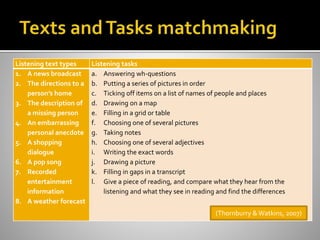
Listening text types Listening tasks
1. A news broadcast
2. The directions to a
person’s home
3. The description of
a missing person
4. An embarrassing
personal anecdote
5. A shopping
dialogue
6. A pop song
7. Recorded
entertainment
information
8. A weather forecast
a. Answering wh-questions
b. Putting a series of pictures in order
c. Ticking off items on a list of names of people and places
d. Drawing on a map
e. Filling in a grid or table
f. Choosing one of several pictures
g. Taking notes
h. Choosing one of several adjectives
i. Writing the exact words
j. Drawing a picture
k. Filling in gaps in a transcript
l. Give a piece of reading, and compare what they hear from the
listening and what they see in reading and find the differences
(Thornburry &Watkins, 2007)
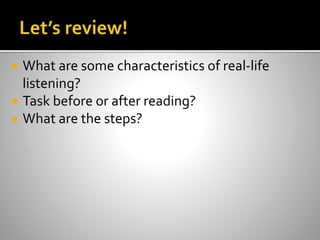
 What are some characteristics of real-life
listening?
 Task before or after reading?
 What are the steps?
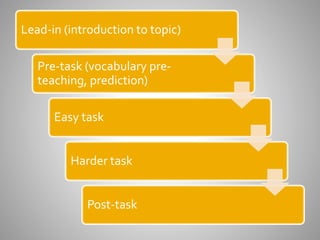
Lead-in (introduction to topic)
Pre-task (vocabulary pre-
teaching, prediction)
Easy task
Harder task
Post-task
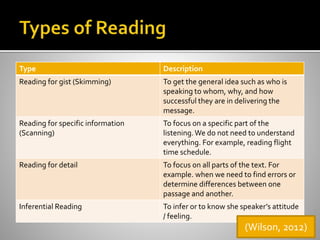
Type Description
Reading for gist (Skimming) To get the general idea such as who is
speaking to whom, why, and how
successful they are in delivering the
message.
Reading for specific information
(Scanning)
To focus on a specific part of the
listening.We do not need to understand
everything. For example, reading flight
time schedule.
Reading for detail To focus on all parts of the text. For
example. when we need to find errors or
determine differences between one
passage and another.
Inferential Reading To infer or to know she speaker’s attitude
/ feeling.
(Wilson, 2012)
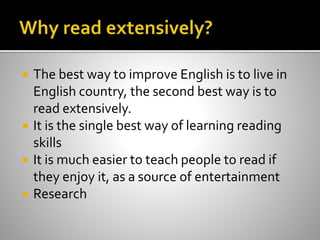
 The best way to improve English is to live in
English country, the second best way is to
read extensively.
 It is the single best way of learning reading
skills
 It is much easier to teach people to read if
they enjoy it, as a source of entertainment
 Research
 The reading is easy
 Has a lot of variety
 Learners are free to choose what they read
 They read as much as possible
 Reading speed is faster
 The purpose is to read for pleasure
 Reading is individual and silent
 The teacher guides the students
 The teacher is the role model of a reader
 Enjoy!
 Enjoy!
 Enjoy!
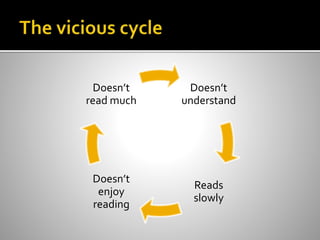
Doesn’t
understand
Reads
slowly
Doesn’t
enjoy
reading
Doesn’t
read much
Reads
faster
Reads more
Understand
better
Enjoys
reading

Teaching reading

  • 2.
    Listening text typesListening tasks 1. A news broadcast 2. The directions to a person’s home 3. The description of a missing person 4. An embarrassing personal anecdote 5. A shopping dialogue 6. A pop song 7. Recorded entertainment information 8. A weather forecast a. Answering wh-questions b. Putting a series of pictures in order c. Ticking off items on a list of names of people and places d. Drawing on a map e. Filling in a grid or table f. Choosing one of several pictures g. Taking notes h. Choosing one of several adjectives i. Writing the exact words j. Drawing a picture k. Filling in gaps in a transcript l. Give a piece of reading, and compare what they hear from the listening and what they see in reading and find the differences (Thornburry &Watkins, 2007)
  • 3.
     What aresome characteristics of real-life listening?  Task before or after reading?  What are the steps?
  • 4.
    Lead-in (introduction totopic) Pre-task (vocabulary pre- teaching, prediction) Easy task Harder task Post-task
  • 5.
    Type Description Reading forgist (Skimming) To get the general idea such as who is speaking to whom, why, and how successful they are in delivering the message. Reading for specific information (Scanning) To focus on a specific part of the listening.We do not need to understand everything. For example, reading flight time schedule. Reading for detail To focus on all parts of the text. For example. when we need to find errors or determine differences between one passage and another. Inferential Reading To infer or to know she speaker’s attitude / feeling. (Wilson, 2012)
  • 6.
     The bestway to improve English is to live in English country, the second best way is to read extensively.  It is the single best way of learning reading skills  It is much easier to teach people to read if they enjoy it, as a source of entertainment  Research
  • 7.
     The readingis easy  Has a lot of variety  Learners are free to choose what they read  They read as much as possible  Reading speed is faster  The purpose is to read for pleasure  Reading is individual and silent  The teacher guides the students  The teacher is the role model of a reader
  • 8.
  • 9.
  • 10.