Assay Genes Selected Hotspots
Oncomine Lung
cfDNA assay
ALK, BRAF, EGFR,
ERBB2, KRAS,
MAP2K1, MET, NRAS,
PIK3CA, ROS1, TP53
EGFR: T790M, C797S, L858R,
Exon 19 del
KRAS: G12X, G13X, Q61X BRAF:
V600E
ALK: Exon 21-25
PIK3CA: E545K, H1047R, E542K
Oncomine Colon
cfDNA assay
AKT1, BRAF, CTNNB1,
EGFR, ERBB2,
FBXW7, GNAS, KRAS,
MAP2K1, NRAS,
PIK3CA, SMAD4,
TP53, and APC
KRAS/NRAS: G12/G13/Q61
BRAF: V600E
PIK3CA: E545K, H1047R
TP53: R175H R273H/C/L
Recurrent deleterious APC
mutations (including p.R876*,
p.R1114*, p.Q1378*, and
p.R1450*)
SMAD4: R361C/H
CTNNB1: S45F, T41A
Oncomine Breast
cfDNA assay
AKT1, EGFR, ERBB2,
ERBB3, ESR1,
FBXW7, KRAS,
PIK3CA, SF3B1, TP53
PIK3CA: E545K and H1047R
AKT1: E17K ESR1: Mutations
associated with anti-estrogen
resistance
TP53: Mutations associated with
loss of function
ERBB2: Mutations associated with
sensitivity to antiERBB2 therapies
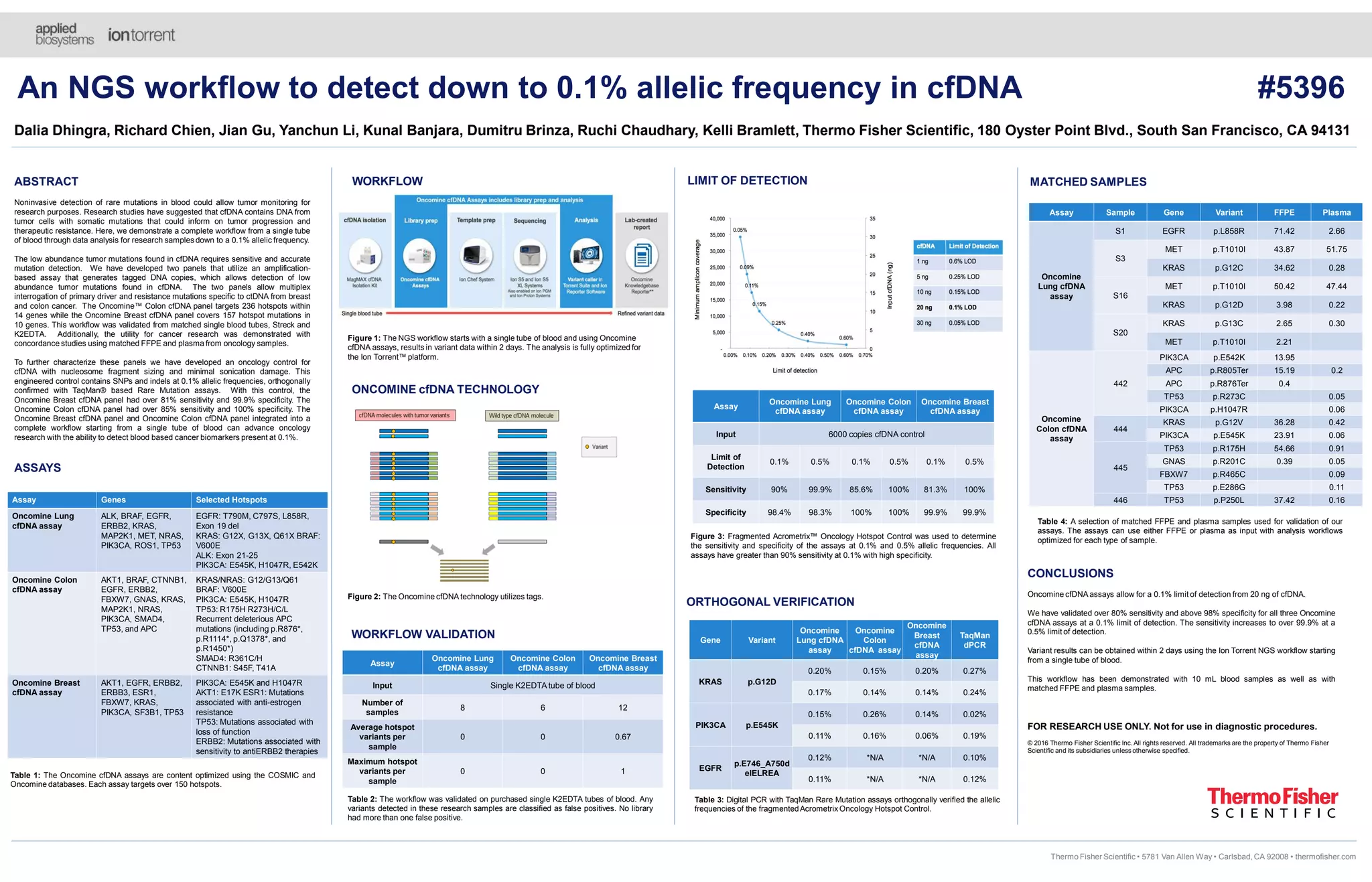
Dalia Dhingra, Richard Chien, Jian Gu, Yanchun Li, Kunal Banjara, Dumitru Brinza, Ruchi Chaudhary, Kelli Bramlett, Thermo Fisher Scientific, 180 Oyster Point Blvd., South San Francisco, CA 94131
ABSTRACT
Noninvasive detection of rare mutations in blood could allow tumor monitoring for
research purposes. Research studies have suggested that cfDNA contains DNA from
tumor cells with somatic mutations that could inform on tumor progression and
therapeutic resistance. Here, we demonstrate a complete workflow from a single tube
of blood through data analysis for research samples down to a 0.1% allelic frequency.
The low abundance tumor mutations found in cfDNA requires sensitive and accurate
mutation detection. We have developed two panels that utilize an amplification-
based assay that generates tagged DNA copies, which allows detection of low
abundance tumor mutations found in cfDNA. The two panels allow multiplex
interrogation of primary driver and resistance mutations specific to ctDNA from breast
and colon cancer. The Oncomine™ Colon cfDNA panel targets 236 hotspots within
14 genes while the Oncomine Breast cfDNA panel covers 157 hotspot mutations in
10 genes. This workflow was validated from matched single blood tubes, Streck and
K2EDTA. Additionally, the utility for cancer research was demonstrated with
concordance studies using matched FFPE and plasma from oncology samples.
To further characterize these panels we have developed an oncology control for
cfDNA with nucleosome fragment sizing and minimal sonication damage. This
engineered control contains SNPs and indels at 0.1% allelic frequencies, orthogonally
confirmed with TaqMan® based Rare Mutation assays. With this control, the
Oncomine Breast cfDNA panel had over 81% sensitivity and 99.9% specificity. The
Oncomine Colon cfDNA panel had over 85% sensitivity and 100% specificity. The
Oncomine Breast cfDNA panel and Oncomine Colon cfDNA panel integrated into a
complete workflow starting from a single tube of blood can advance oncology
research with the ability to detect blood based cancer biomarkers present at 0.1%.
ASSAYS
CONCLUSIONS
Oncomine cfDNA assays allow for a 0.1% limit of detection from 20 ng of cfDNA.
We have validated over 80% sensitivity and above 98% specificity for all three Oncomine
cfDNA assays at a 0.1% limit of detection. The sensitivity increases to over 99.9% at a
0.5% limit of detection.
Variant results can be obtained within 2 days using the Ion Torrent NGS workflow starting
from a single tube of blood.
This workflow has been demonstrated with 10 mL blood samples as well as with
matched FFPE and plasma samples.
FOR RESEARCH USE ONLY. Not for use in diagnostic procedures.
© 2016 Thermo Fisher Scientific Inc. All rights reserved. All trademarks are the property of Thermo Fisher
Scientific and its subsidiaries unless otherwise specified.
An NGS workflow to detect down to 0.1% allelic frequency in cfDNA #5396
Thermo Fisher Scientific • 5781 Van Allen Way • Carlsbad, CA 92008 • thermofisher.com
Assay
Oncomine Lung
cfDNA assay
Oncomine Colon
cfDNA assay
Oncomine Breast
cfDNA assay
Input 6000 copies cfDNA control
Limit of
Detection
0.1% 0.5% 0.1% 0.5% 0.1% 0.5%
Sensitivity 90% 99.9% 85.6% 100% 81.3% 100%
Specificity 98.4% 98.3% 100% 100% 99.9% 99.9%
Gene Variant
Oncomine
Lung cfDNA
assay
Oncomine
Colon
cfDNA assay
Oncomine
Breast
cfDNA
assay
TaqMan
dPCR
KRAS p.G12D
0.20% 0.15% 0.20% 0.27%
0.17% 0.14% 0.14% 0.24%
PIK3CA p.E545K
0.15% 0.26% 0.14% 0.02%
0.11% 0.16% 0.06% 0.19%
EGFR
p.E746_A750d
elELREA
0.12% *N/A *N/A 0.10%
0.11% *N/A *N/A 0.12%
WORKFLOW LIMIT OF DETECTION
Figure 1: The NGS workflow starts with a single tube of blood and using Oncomine
cfDNA assays, results in variant data within 2 days. The analysis is fully optimized for
the Ion Torrent™ platform.
Assay
Oncomine Lung
cfDNA assay
Oncomine Colon
cfDNA assay
Oncomine Breast
cfDNA assay
Input Single K2EDTA tube of blood
Number of
samples
8 6 12
Average hotspot
variants per
sample
0 0 0.67
Maximum hotspot
variants per
sample
0 0 1
ONCOMINE cfDNA TECHNOLOGY
WORKFLOW VALIDATION
ORTHOGONAL VERIFICATION
MATCHED SAMPLES
Table 1: The Oncomine cfDNA assays are content optimized using the COSMIC and
Oncomine databases. Each assay targets over 150 hotspots.
Assay Sample Gene Variant FFPE Plasma
Oncomine
Lung cfDNA
assay
S1 EGFR p.L858R 71.42 2.66
S3
MET p.T1010I 43.87 51.75
KRAS p.G12C 34.62 0.28
S16
MET p.T1010I 50.42 47.44
KRAS p.G12D 3.98 0.22
S20
KRAS p.G13C 2.65 0.30
MET p.T1010I 2.21
Oncomine
Colon cfDNA
assay
442
PIK3CA p.E542K 13.95
APC p.R805Ter 15.19 0.2
APC p.R876Ter 0.4
TP53 p.R273C 0.05
PIK3CA p.H1047R 0.06
444
KRAS p.G12V 36.28 0.42
PIK3CA p.E545K 23.91 0.06
445
TP53 p.R175H 54.66 0.91
GNAS p.R201C 0.39 0.05
FBXW7 p.R465C 0.09
TP53 p.E286G 0.11
446 TP53 p.P250L 37.42 0.16
Figure 2: The Oncomine cfDNA technology utilizes tags.
Table 2: The workflow was validated on purchased single K2EDTA tubes of blood. Any
variants detected in these research samples are classified as false positives. No library
had more than one false positive.
Figure 3: Fragmented Acrometrix™ Oncology Hotspot Control was used to determine
the sensitivity and specificity of the assays at 0.1% and 0.5% allelic frequencies. All
assays have greater than 90% sensitivity at 0.1% with high specificity.
Table 3: Digital PCR with TaqMan Rare Mutation assays orthogonally verified the allelic
frequencies of the fragmentedAcrometrix Oncology Hotspot Control.
Table 4: A selection of matched FFPE and plasma samples used for validation of our
assays. The assays can use either FFPE or plasma as input with analysis workflows
optimized for each type of sample.

An NGS workflow to detect down to 0.1% allelic frequency in cfDNA

  • 1.
    Assay Genes SelectedHotspots Oncomine Lung cfDNA assay ALK, BRAF, EGFR, ERBB2, KRAS, MAP2K1, MET, NRAS, PIK3CA, ROS1, TP53 EGFR: T790M, C797S, L858R, Exon 19 del KRAS: G12X, G13X, Q61X BRAF: V600E ALK: Exon 21-25 PIK3CA: E545K, H1047R, E542K Oncomine Colon cfDNA assay AKT1, BRAF, CTNNB1, EGFR, ERBB2, FBXW7, GNAS, KRAS, MAP2K1, NRAS, PIK3CA, SMAD4, TP53, and APC KRAS/NRAS: G12/G13/Q61 BRAF: V600E PIK3CA: E545K, H1047R TP53: R175H R273H/C/L Recurrent deleterious APC mutations (including p.R876*, p.R1114*, p.Q1378*, and p.R1450*) SMAD4: R361C/H CTNNB1: S45F, T41A Oncomine Breast cfDNA assay AKT1, EGFR, ERBB2, ERBB3, ESR1, FBXW7, KRAS, PIK3CA, SF3B1, TP53 PIK3CA: E545K and H1047R AKT1: E17K ESR1: Mutations associated with anti-estrogen resistance TP53: Mutations associated with loss of function ERBB2: Mutations associated with sensitivity to antiERBB2 therapies Dalia Dhingra, Richard Chien, Jian Gu, Yanchun Li, Kunal Banjara, Dumitru Brinza, Ruchi Chaudhary, Kelli Bramlett, Thermo Fisher Scientific, 180 Oyster Point Blvd., South San Francisco, CA 94131 ABSTRACT Noninvasive detection of rare mutations in blood could allow tumor monitoring for research purposes. Research studies have suggested that cfDNA contains DNA from tumor cells with somatic mutations that could inform on tumor progression and therapeutic resistance. Here, we demonstrate a complete workflow from a single tube of blood through data analysis for research samples down to a 0.1% allelic frequency. The low abundance tumor mutations found in cfDNA requires sensitive and accurate mutation detection. We have developed two panels that utilize an amplification- based assay that generates tagged DNA copies, which allows detection of low abundance tumor mutations found in cfDNA. The two panels allow multiplex interrogation of primary driver and resistance mutations specific to ctDNA from breast and colon cancer. The Oncomine™ Colon cfDNA panel targets 236 hotspots within 14 genes while the Oncomine Breast cfDNA panel covers 157 hotspot mutations in 10 genes. This workflow was validated from matched single blood tubes, Streck and K2EDTA. Additionally, the utility for cancer research was demonstrated with concordance studies using matched FFPE and plasma from oncology samples. To further characterize these panels we have developed an oncology control for cfDNA with nucleosome fragment sizing and minimal sonication damage. This engineered control contains SNPs and indels at 0.1% allelic frequencies, orthogonally confirmed with TaqMan® based Rare Mutation assays. With this control, the Oncomine Breast cfDNA panel had over 81% sensitivity and 99.9% specificity. The Oncomine Colon cfDNA panel had over 85% sensitivity and 100% specificity. The Oncomine Breast cfDNA panel and Oncomine Colon cfDNA panel integrated into a complete workflow starting from a single tube of blood can advance oncology research with the ability to detect blood based cancer biomarkers present at 0.1%. ASSAYS CONCLUSIONS Oncomine cfDNA assays allow for a 0.1% limit of detection from 20 ng of cfDNA. We have validated over 80% sensitivity and above 98% specificity for all three Oncomine cfDNA assays at a 0.1% limit of detection. The sensitivity increases to over 99.9% at a 0.5% limit of detection. Variant results can be obtained within 2 days using the Ion Torrent NGS workflow starting from a single tube of blood. This workflow has been demonstrated with 10 mL blood samples as well as with matched FFPE and plasma samples. FOR RESEARCH USE ONLY. Not for use in diagnostic procedures. © 2016 Thermo Fisher Scientific Inc. All rights reserved. All trademarks are the property of Thermo Fisher Scientific and its subsidiaries unless otherwise specified. An NGS workflow to detect down to 0.1% allelic frequency in cfDNA #5396 Thermo Fisher Scientific • 5781 Van Allen Way • Carlsbad, CA 92008 • thermofisher.com Assay Oncomine Lung cfDNA assay Oncomine Colon cfDNA assay Oncomine Breast cfDNA assay Input 6000 copies cfDNA control Limit of Detection 0.1% 0.5% 0.1% 0.5% 0.1% 0.5% Sensitivity 90% 99.9% 85.6% 100% 81.3% 100% Specificity 98.4% 98.3% 100% 100% 99.9% 99.9% Gene Variant Oncomine Lung cfDNA assay Oncomine Colon cfDNA assay Oncomine Breast cfDNA assay TaqMan dPCR KRAS p.G12D 0.20% 0.15% 0.20% 0.27% 0.17% 0.14% 0.14% 0.24% PIK3CA p.E545K 0.15% 0.26% 0.14% 0.02% 0.11% 0.16% 0.06% 0.19% EGFR p.E746_A750d elELREA 0.12% *N/A *N/A 0.10% 0.11% *N/A *N/A 0.12% WORKFLOW LIMIT OF DETECTION Figure 1: The NGS workflow starts with a single tube of blood and using Oncomine cfDNA assays, results in variant data within 2 days. The analysis is fully optimized for the Ion Torrent™ platform. Assay Oncomine Lung cfDNA assay Oncomine Colon cfDNA assay Oncomine Breast cfDNA assay Input Single K2EDTA tube of blood Number of samples 8 6 12 Average hotspot variants per sample 0 0 0.67 Maximum hotspot variants per sample 0 0 1 ONCOMINE cfDNA TECHNOLOGY WORKFLOW VALIDATION ORTHOGONAL VERIFICATION MATCHED SAMPLES Table 1: The Oncomine cfDNA assays are content optimized using the COSMIC and Oncomine databases. Each assay targets over 150 hotspots. Assay Sample Gene Variant FFPE Plasma Oncomine Lung cfDNA assay S1 EGFR p.L858R 71.42 2.66 S3 MET p.T1010I 43.87 51.75 KRAS p.G12C 34.62 0.28 S16 MET p.T1010I 50.42 47.44 KRAS p.G12D 3.98 0.22 S20 KRAS p.G13C 2.65 0.30 MET p.T1010I 2.21 Oncomine Colon cfDNA assay 442 PIK3CA p.E542K 13.95 APC p.R805Ter 15.19 0.2 APC p.R876Ter 0.4 TP53 p.R273C 0.05 PIK3CA p.H1047R 0.06 444 KRAS p.G12V 36.28 0.42 PIK3CA p.E545K 23.91 0.06 445 TP53 p.R175H 54.66 0.91 GNAS p.R201C 0.39 0.05 FBXW7 p.R465C 0.09 TP53 p.E286G 0.11 446 TP53 p.P250L 37.42 0.16 Figure 2: The Oncomine cfDNA technology utilizes tags. Table 2: The workflow was validated on purchased single K2EDTA tubes of blood. Any variants detected in these research samples are classified as false positives. No library had more than one false positive. Figure 3: Fragmented Acrometrix™ Oncology Hotspot Control was used to determine the sensitivity and specificity of the assays at 0.1% and 0.5% allelic frequencies. All assays have greater than 90% sensitivity at 0.1% with high specificity. Table 3: Digital PCR with TaqMan Rare Mutation assays orthogonally verified the allelic frequencies of the fragmentedAcrometrix Oncology Hotspot Control. Table 4: A selection of matched FFPE and plasma samples used for validation of our assays. The assays can use either FFPE or plasma as input with analysis workflows optimized for each type of sample.