Merck KGaA
Darmstadt, Germany
Make it right –
best practices for
mRNA manufacturing
Shiksha Mantri, Ph.D.
Global Marketing Manager, RNA Solutions
Nargisse El Hajjami, Ph.D. Eng.
Senior Consultant, Bioprocessing Strategy Operationalization,
EMEA, Novel Modalities & mRNA
July 8th, 2021
The life science business of
Merck KGaA, Darmstadt, Germany
operates as MilliporeSigma
in the U.S. and Canada.
Make it right – Best practices for mRNA manufacturing
p
Agenda
1
2
3
The power of mRNA
What impacts mRNA
performance?
Make the right mRNA
Takeaway messages
4
Make it right – Best practices for mRNA manufacturing
p
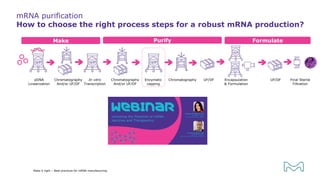
The power of
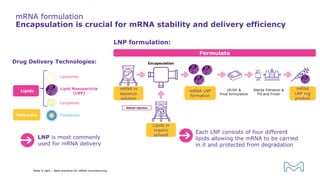
mRNA
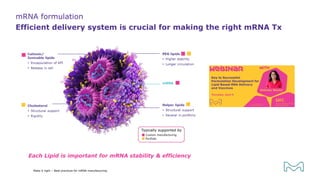
01
Make it right – Best practices for mRNA manufacturing
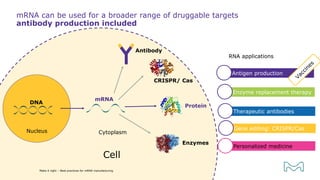
mRNA can be used for a broader range of druggable targets
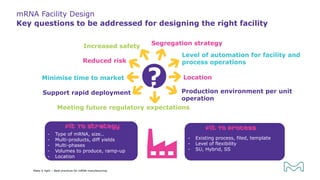
antibody production included
Cell
Nucleus Cytoplasm
DNA
mRNA
Protein
Enzymes
CRISPR/ Cas
Antibody
Antigen production
RNA applications
Personalized medicine
Enzyme replacement therapy
Therapeutic antibodies
Gene editing: CRISPR/Cas
Make it right – Best practices for mRNA manufacturing
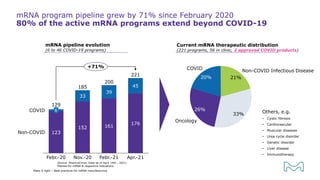
mRNA program pipeline grew by 71% since February 2020
80% of the active mRNA programs extend beyond COVID-19
Make it right – Best practices for mRNA manufacturing
Source: PharmaCircie, Data as of April 14th , 2021;
filtered for mRNA & respective indications
Current mRNA therapeutic distribution
(221 programs, 56 in clinic, 2 approved COVID products)
26%
20% 21%
33%
Oncology
COVID
Non-COVID Infectious Disease
Others, e.g.
 Cystic fibrosis
 Cardiovascular
 Muscular diseases
 Urea cycle disorder
 Genetic disorder
 Liver disease
 Immunotherapy
123
152 161
176
33
39
45
COVID 6
Febr.-20 Apr.-21
Nov.-20 Febr.-21
Non-COVID
200
129
185
221
+71%
mRNA pipeline evolution
(6 to 46 COVID-19 programs)
p
What Impacts
mRNA
Performance?
02
Make it right – Best practices for mRNA manufacturing
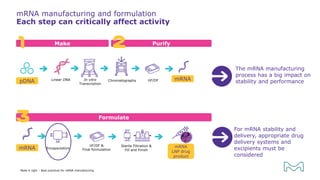
mRNA manufacturing and formulation
Each step can critically affect activity
Make it right – Best practices for mRNA manufacturing
In vitro
Transcription
Chromatography UF/DF
Linear DNA mRNA
pDNA
Purify
Make
mRNA
LNP drug
product
Encapsulation
Sterile Filtration &
Fill and Finish
mRNA
UF/DF &
Final formulation
Formulate
For mRNA stability and
delivery, appropriate drug
delivery systems and
excipients must be
considered
The mRNA manufacturing
process has a big impact on
stability and performance
1 2
3
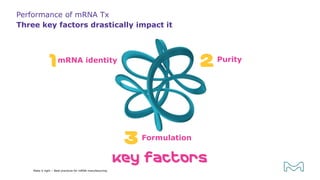
Key factors
mRNA identity Purity
Formulation
1
3
2
Make it right – Best practices for mRNA manufacturing
Performance of mRNA Tx
Three key factors drastically impact it
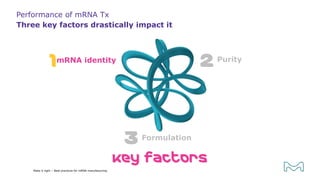
Performance of mRNA Tx
Key factors
mRNA identity Purity
Formulation
1
3
2
Make it right – Best practices for mRNA manufacturing
Three key factors drastically impact it
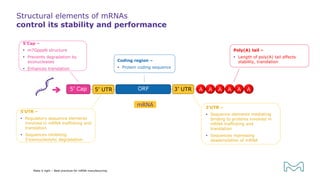
Structural elements of mRNAs
control its stability and performance
5’ UTR ORF 3’ UTR
5’ Cap A A A A A A
5‘Cap –
 m7GpppN structure
 Prevents degradation by
exonucleases
 Enhances translation
5‘UTR –
 Regulatory sequence elements
involved in mRNA trafficking and
translation
 Sequences inhibiting
5‘exonucleolytic degradation
Coding region –
 Protein coding sequence
3‘UTR –
 Sequence elements mediating
binding to proteins involved in
mRNA trafficking and
translation
 Sequences repressing
deadenylation of mRNA
Poly(A) tail –
 Length of poly(A) tail affects
stability, translation
Make it right – Best practices for mRNA manufacturing
mRNA
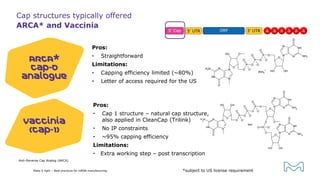
Pros:
• Straightforward
Limitations:
• Capping efficiency limited (~80%)
• Letter of access required for the US
Pros:
• Cap 1 structure – natural cap structure,
also applied in CleanCap (Trilink)
• No IP constraints
• ~95% capping efficiency
Limitations:
• Extra working step – post transcription
ARCA* and Vaccinia
Cap structures typically offered
ARCA*
Cap-0
analogue
Vaccinia
(Cap-1)
Anti-Reverse Cap Analog (ARCA)
*subject to US license requirement
Make it right – Best practices for mRNA manufacturing
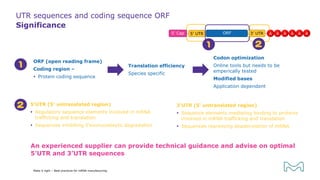
An experienced supplier can provide technical guidance and advise on optimal
5’UTR and 3’UTR sequences
UTR sequences and coding sequence ORF
Make it right – Best practices for mRNA manufacturing
5‘UTR (5‘ untranslated region)
 Regulatory sequence elements involved in mRNA
trafficking and translation
 Sequences inhibiting 5‘exonucleolytic degradation
ORF (open reading frame)
Coding region –
 Protein coding sequence
3‘UTR (5‘ untranslated region)
 Sequence elements mediating binding to proteins
involved in mRNA trafficking and translation
 Sequences repressing deadenylation of mRNA
1
1 Translation efficiency
Species specific
Codon optimization
Online tools but needs to be
emperically tested
Modified bases
Application dependent
2
2
Significance
In vitro
Transcription
Linear DNA
pDNA
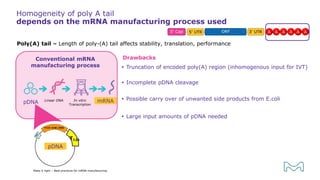
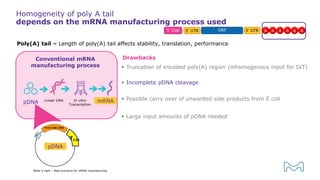
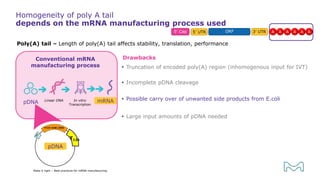
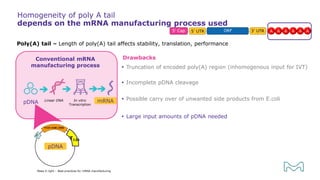
Homogeneity of poly A tail
depends on the mRNA manufacturing process used
Make it right – Best practices for mRNA manufacturing
Poly(A) tail – Length of poly-(A) tail affects stability, translation, performance
Drawbacks
 Truncation of encoded poly(A) region (inhomogenous input for IVT)
 Incomplete pDNA cleavage
 Possible carry over of unwanted side products from E.coli
 Large input amounts of pDNA needed
Conventional mRNA
manufacturing process
T120
pDNA
mRNA
In vitro
Transcription
Linear DNA
pDNA
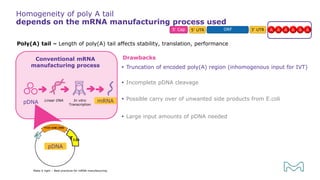
Homogeneity of poly A tail
depends on the mRNA manufacturing process used
Make it right – Best practices for mRNA manufacturing
Poly(A) tail – Length of poly(A) tail affects stability, translation, performance
Drawbacks
 Truncation of encoded poly(A) region (inhomogenous input for IVT)
 Incomplete pDNA cleavage
 Possible carry over of unwanted side products from E.coli
 Large input amounts of pDNA needed
Conventional mRNA
manufacturing process
T120
pDNA
mRNA
In vitro
Transcription
Linear DNA
pDNA
Homogeneity of poly A tail
depends on the mRNA manufacturing process used
Make it right – Best practices for mRNA manufacturing
Poly(A) tail – Length of poly(A) tail affects stability, translation, performance
Drawbacks
 Truncation of encoded poly(A) region (inhomogenous input for IVT)
 Incomplete pDNA cleavage
 Possible carry over of unwanted side products from E.coli
 Large input amounts of pDNA needed
Conventional mRNA
manufacturing process
T120
pDNA
mRNA
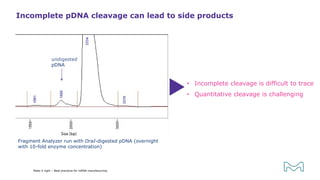
Incomplete pDNA cleavage can lead to side products
Make it right – Best practices for mRNA manufacturing
Fragment Analyzer run with DraI-digested pDNA (overnight
with 10-fold enzyme concentration)
undigested
pDNA
• Incomplete cleavage is difficult to trace
• Quantitative cleavage is challenging
In vitro
Transcription
Linear DNA
pDNA
Homogeneity of poly A tail
depends on the mRNA manufacturing process used
Make it right – Best practices for mRNA manufacturing
Poly(A) tail – Length of poly(A) tail affects stability, translation, performance
Drawbacks
 Truncation of encoded poly(A) region (inhomogenous input for IVT)
 Incomplete pDNA cleavage
 Possible carry over of unwanted side products from E.coli
 Large input amounts of pDNA needed
Conventional mRNA
manufacturing process
T120
pDNA
mRNA
In vitro
Transcription
Linear DNA
pDNA
Homogeneity of poly A tail
depends on the mRNA manufacturing process used
Make it right – Best practices for mRNA manufacturing
Poly(A) tail – Length of poly(A) tail affects stability, translation, performance
Drawbacks
 Truncation of encoded poly(A) region (inhomogenous input for IVT)
 Incomplete pDNA cleavage
 Possible carry over of unwanted side products from E.coli
 Large input amounts of pDNA needed
Conventional mRNA
manufacturing process
T120
pDNA
mRNA
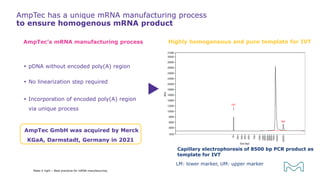
 pDNA without encoded poly(A) region
 No linearization step required
 Incorporation of encoded poly(A) region
via unique process
AmpTec’s mRNA manufacturing process Highly homogeneous and pure template for IVT
AmpTec has a unique mRNA manufacturing process
to ensure homogenous mRNA product
Capillary electrophoresis of 8500 bp PCR product as
template for IVT
LM: lower marker, UM: upper marker
AmpTec GmbH was acquired by Merck
KGaA, Darmstadt, Germany in 2021
Make it right – Best practices for mRNA manufacturing
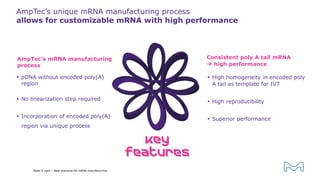
AmpTec’s unique mRNA manufacturing process
allows for customizable mRNA with high performance
Key
features
Consistent poly A tail mRNA
→ high performance
 High homogeneity in encoded poly
A tail as template for IVT
 High reproducibility
 Superior performance
Make it right – Best practices for mRNA manufacturing
 pDNA without encoded poly(A)
region
 No linearization step required
 Incorporation of encoded poly(A)
region via unique process
AmpTec’s mRNA manufacturing
process
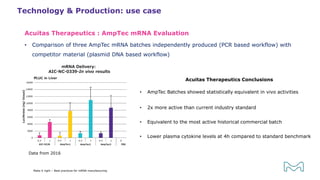
Acuitas Therapeutics : AmpTec mRNA Evaluation
Acuitas Therapeutics Conclusions
• AmpTec Batches showed statistically equivalent in vivo activities
• 2x more active than current industry standard
• Equivalent to the most active historical commercial batch
• Lower plasma cytokine levels at 4h compared to standard benchmark
Technology & Production: use case
• Comparison of three AmpTec mRNA batches independently produced (PCR based workflow) with
competitor material (plasmid DNA based workflow)
Data from 2016
Make it right – Best practices for mRNA manufacturing
Watch out:
Another watchout for mRNA manufacturing: endonucleases
Make it right – Best practices for mRNA manufacturing
ENDONUCLEASES
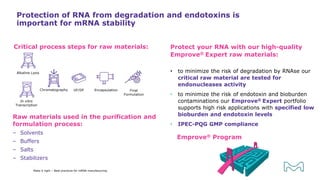
Protect your RNA with our high-quality
Emprove® Expert raw materials:
• to minimize the risk of degradation by RNAse our
critical raw material are tested for
endonucleases activity
• to minimize the risk of endotoxin and bioburden
contaminations our Emprove® Expert portfolio
supports high risk applications with specified low
bioburden and endotoxin levels
• IPEC-PQG GMP compliance
Protection of RNA from degradation and endotoxins is
important for mRNA stability
Make it right – Best practices for mRNA manufacturing
Emprove® Program
In vitro
Transcription
Chromatography UF/DF
Alkaline Lysis
Critical process steps for raw materials:
Encapsulation Final
Formulation
Raw materials used in the purification and
formulation process:
‒ Solvents
‒ Buffers
‒ Salts
‒ Stabilizers
p
Make the
right mRNA
03
Make it right – Best practices for mRNA manufacturing
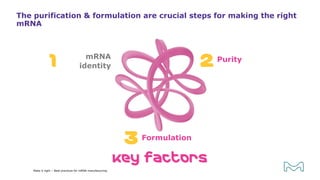
The purification & formulation are crucial steps for making the right
mRNA
Key factors
mRNA
identity
Purity
Formulation
1
3
2
Make it right – Best practices for mRNA manufacturing
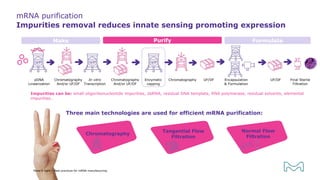
mRNA purification
Impurities removal reduces innate sensing promoting expression
Make Purify Formulate
Tangential Flow
Filtration
Chromatography
Normal Flow
Filtration
Impurities can be: small oligoribonucleotide impurities, dsRNA, residual DNA template, RNA polymerase, residual solvents, elemental
impurities…
Three main technologies are used for efficient mRNA purification:
pDNA
Linearization
Chromatography
And/or UF/DF
In vitro
Transcription
Chromatography
And/or UF/DF
Enzymatic
capping
Chromatography UF/DF Encapsulation
& Formulation
Final Sterile
Filtration
UF/DF
Make it right – Best practices for mRNA manufacturing
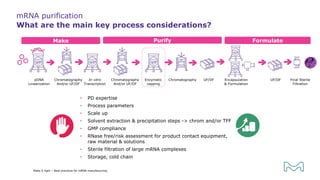
mRNA purification
What are the main key process considerations?
Make Purify Formulate
• PD expertise
• Process parameters
• Scale up
• Solvent extraction & precipitation steps -> chrom and/or TFF
• GMP compliance
• RNase free/risk assessment for product contact equipment,
raw material & solutions
• Sterile filtration of large mRNA complexes
• Storage, cold chain
pDNA
Linearization
Chromatography
And/or UF/DF
In vitro
Transcription
Chromatography
And/or UF/DF
Enzymatic
capping
Chromatography UF/DF Encapsulation
& Formulation
Final Sterile
Filtration
UF/DF
Make it right – Best practices for mRNA manufacturing
mRNA purification
How to choose the right process steps for a robust mRNA production?
Make Purify Formulate
pDNA
Linearization
Chromatography
And/or UF/DF
In vitro
Transcription
Chromatography
And/or UF/DF
Enzymatic
capping
Chromatography UF/DF Encapsulation
& Formulation
Final Sterile
Filtration
UF/DF
Make it right – Best practices for mRNA manufacturing
mRNA formulation
Encapsulation is crucial for mRNA stability and delivery efficiency
Drug Delivery Technologies:
Lipids
Lipid Nanoparticle
(LNP)
Liposomes
Lipoplexes
Polyplexes
LNP formulation:
mRNA in
aqueous
solution
Sterile Filtration &
Fill and Finish
mRNA LNP
formation
Formulate
UF/DF &
Final formulation
Encapsulation
Lipids in
organic
solvent
mRNA
LNP rug
product
LNP is most commonly
used for mRNA delivery
Each LNP consists of four different
lipids allowing the mRNA to be carried
in it and protected from degradation
Polymers
Make it right – Best practices for mRNA manufacturing
Efficient delivery system is crucial for making the right mRNA Tx
mRNA formulation
Each Lipid is important for mRNA stability & efficiency
Make it right – Best practices for mRNA manufacturing
Other considerations to make it right
Key drivers for success
The right
partners
Production
Process
Adequate
Expertise
Facility
Design
32
Success
Drivers
- Suppliers
- Research Institutes
- CDMO
- Optimized
- Flexible
- Next gen
- Robust
- Efficient
- Fast
- Access to experts
- Research & Development
- Process Development
mRNA Facility Design
The trends for the facility of the future
Flexible facility
Increased automation & digitalization
BioContinuum™: Bio4C™ Suite
Bio4C™ ProcessPad
Bio4C™ Orchestrator
Single use, closed, continous, intensified, modular designs
Modular and podular pre-engineered solutions
Bioprocessing 4.0
Next Genenartion Processing
Reduced footprints, time-to-market, service requirements,
operating exp
Less expensise to build & operate
Reduction of classified space
Multi-product –process designs & process trains
Make it right – Best practices for mRNA manufacturing
mRNA Facility Design
Key questions to be addressed for designing the right facility
Production environment per unit
operation
Segregation strategy
Level of automation for facility and
process operations
Location
Increased safety
Reduced risk
Minimise time to market
Support rapid deployment
Meeting future regulatory expectations
Fit To Strategy Fit To Process
- Type of mRNA, size..
- Multi-products, diff yields
- Multi-phases
- Volumes to produce, ramp-up
- Location
- Existing process, filed, template
- Level of flexibility
- SU, Hybrid, SS
Make it right – Best practices for mRNA manufacturing
mRNA Conceptual Facility Design
Case study from KSA
Revamping existing facility to make new Conceptual Facility Design for the first mRNA CDMO
facility in KSA as part of the multi-modality CDMO
3D High level overview of
Warehouse + F&F Building
Warehouse + Fill & Finish building
Deliverables
• Process flow diagrams
• Capacity: Batchs/yr & Doses/yr
• Equipment list
• Facility layouts with process,
waste, people, materials flow,
room classification, pressure
cascade
• APEX, OPEX
• Review and assessment of
regulatory compliance
• Optimization proposals
• 3D layouts and plans
pDNA and mRNA
Facility Layout
Area
Fill & Finish / Cleaning area
mRNA production area
M/B preparation area
pDNA production area
Make it right – Best practices for mRNA manufacturing
p
Conclusions,
perspectives
& Key Take
aways
04
Make it right – Best practices for mRNA manufacturing
1
mRNA technology has
revolutionized the field
of vaccines and
therapeutic
development with its
fully synthetic, simple,
flexible and fast
manufacturing process
FouR Key takeaways
2
The mRNA identity,
purity and formulation
are three critical key
features impacting
mRNA therapeutics
efficacy
3
Advanced technologies,
novel processing
concepts, and next
generation
manufacturing should
be applied for mRNA
manufacturing in
response to “the need
for speed”
4
Choosing the right
partner & starting right
with a robust conceptual
design can boost your
success of drug
development
Make it right – Best practices for mRNA manufacturing
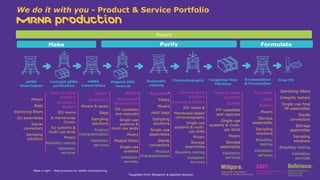
We do it with you - Product & Service Portfolio
mRNA production
Oligos*
Reagents*
Mixers & tanks
Bags
Sampling
solutions
Product
characterization
Validation
services
Buffers
Benzonase®
endonuclease
TFF cassettes
and capsules
Single-use
systems &
multi-use skids
Mixers
Pleated filters
Single-use
systems
Validation
services
Clean-in-place
solutions
Solvents & Buffers
IEX resins &
Membrane-based
chromatography
Single-use
systems & multi-
use skids
Mixers
Storage
assemblies
Biosafety testing
Validation
services
Clean-in-place
solutions
Buffers
TFF cassettes
and capsules
Single-use
systems & multi-
use skids
Mixers
Storage
assemblies
Validation
services
Mixers
Bags
Sterilizing filters
SU assemblies
Sterile
connectors
Sampling
solutions
Excipients
Lipids
Buffers
Mixers
Storage
assemblies
Sampling
solutions
Biosafety
testing
Validation
services
Sterilizing filters
Integrity testers
Single-use final
fill assemblies
Sterile
connectors
Storage
assemblies
Sampling
solutions
Biosafety testing
Validation
services
 *supplied from Research & Applied division
Assure
mRNA
transcription
Plasmid DNA
removal
Chromatography Tangential flow
Filtration
Encapsulation
& Formulation
Final Fill
pDNA
linearization
Linirized pDNA
purification
Enzymatic
capping
Reagents*
Filters
Mixers
Hold bags
Sampling
solutions
Single-use
assemblies
Sterile
connectors
Product
characterization
Clean-in-place
solutions
Solvents &
Buffers
IEX resins
& membranes
Chrom
SU systems &
multi-use skids
Mixers
Biosafety testing
Validation
services
Make it right – Best practices for mRNA manufacturing
For more information about vaccine production, please visit:
SigmaAldrich.com/Vaccines
Merck, Millipore, SAFC, Bioreliance , BioContinuum, Emprove and the vibrant M are trademarks of Merck KGaA, Darmstadt, Germany or its affiliates. All other trademarks are the
property of their respective owners. Detailed information on trademarks is available via publicly accessible resources.
© 2021 Merck KGaA, Darmstadt, Germany and/or its affiliates. All Rights Reserved.
Thank You for Viewing!
Brought to you by our portfolio brands:
Senior Consultant, Bioprocessing Strategy
Operationalization, EMEA, Novel Modalities & mRNA
Nargisse El Hajjami, Ph.D. Eng.
Global Marketing Manager, RNA Solutions
Shiksha Mantri, Ph.D.

Make it Right: Best Practices for mRNA Manufacturing

  • 1.
    Merck KGaA Darmstadt, Germany Makeit right – best practices for mRNA manufacturing Shiksha Mantri, Ph.D. Global Marketing Manager, RNA Solutions Nargisse El Hajjami, Ph.D. Eng. Senior Consultant, Bioprocessing Strategy Operationalization, EMEA, Novel Modalities & mRNA July 8th, 2021
  • 2.
    The life sciencebusiness of Merck KGaA, Darmstadt, Germany operates as MilliporeSigma in the U.S. and Canada. Make it right – Best practices for mRNA manufacturing
  • 3.
    p Agenda 1 2 3 The power ofmRNA What impacts mRNA performance? Make the right mRNA Takeaway messages 4 Make it right – Best practices for mRNA manufacturing
  • 4.
    p The power of mRNA 01 Makeit right – Best practices for mRNA manufacturing
  • 5.
    mRNA can beused for a broader range of druggable targets antibody production included Cell Nucleus Cytoplasm DNA mRNA Protein Enzymes CRISPR/ Cas Antibody Antigen production RNA applications Personalized medicine Enzyme replacement therapy Therapeutic antibodies Gene editing: CRISPR/Cas Make it right – Best practices for mRNA manufacturing
  • 6.
    mRNA program pipelinegrew by 71% since February 2020 80% of the active mRNA programs extend beyond COVID-19 Make it right – Best practices for mRNA manufacturing Source: PharmaCircie, Data as of April 14th , 2021; filtered for mRNA & respective indications Current mRNA therapeutic distribution (221 programs, 56 in clinic, 2 approved COVID products) 26% 20% 21% 33% Oncology COVID Non-COVID Infectious Disease Others, e.g.  Cystic fibrosis  Cardiovascular  Muscular diseases  Urea cycle disorder  Genetic disorder  Liver disease  Immunotherapy 123 152 161 176 33 39 45 COVID 6 Febr.-20 Apr.-21 Nov.-20 Febr.-21 Non-COVID 200 129 185 221 +71% mRNA pipeline evolution (6 to 46 COVID-19 programs)
  • 7.
    p What Impacts mRNA Performance? 02 Make itright – Best practices for mRNA manufacturing
  • 8.
    mRNA manufacturing andformulation Each step can critically affect activity Make it right – Best practices for mRNA manufacturing In vitro Transcription Chromatography UF/DF Linear DNA mRNA pDNA Purify Make mRNA LNP drug product Encapsulation Sterile Filtration & Fill and Finish mRNA UF/DF & Final formulation Formulate For mRNA stability and delivery, appropriate drug delivery systems and excipients must be considered The mRNA manufacturing process has a big impact on stability and performance 1 2 3
  • 9.
    Key factors mRNA identityPurity Formulation 1 3 2 Make it right – Best practices for mRNA manufacturing Performance of mRNA Tx Three key factors drastically impact it
  • 10.
    Performance of mRNATx Key factors mRNA identity Purity Formulation 1 3 2 Make it right – Best practices for mRNA manufacturing Three key factors drastically impact it
  • 11.
    Structural elements ofmRNAs control its stability and performance 5’ UTR ORF 3’ UTR 5’ Cap A A A A A A 5‘Cap –  m7GpppN structure  Prevents degradation by exonucleases  Enhances translation 5‘UTR –  Regulatory sequence elements involved in mRNA trafficking and translation  Sequences inhibiting 5‘exonucleolytic degradation Coding region –  Protein coding sequence 3‘UTR –  Sequence elements mediating binding to proteins involved in mRNA trafficking and translation  Sequences repressing deadenylation of mRNA Poly(A) tail –  Length of poly(A) tail affects stability, translation Make it right – Best practices for mRNA manufacturing mRNA
  • 12.
    Pros: • Straightforward Limitations: • Cappingefficiency limited (~80%) • Letter of access required for the US Pros: • Cap 1 structure – natural cap structure, also applied in CleanCap (Trilink) • No IP constraints • ~95% capping efficiency Limitations: • Extra working step – post transcription ARCA* and Vaccinia Cap structures typically offered ARCA* Cap-0 analogue Vaccinia (Cap-1) Anti-Reverse Cap Analog (ARCA) *subject to US license requirement Make it right – Best practices for mRNA manufacturing
  • 13.
    An experienced suppliercan provide technical guidance and advise on optimal 5’UTR and 3’UTR sequences UTR sequences and coding sequence ORF Make it right – Best practices for mRNA manufacturing 5‘UTR (5‘ untranslated region)  Regulatory sequence elements involved in mRNA trafficking and translation  Sequences inhibiting 5‘exonucleolytic degradation ORF (open reading frame) Coding region –  Protein coding sequence 3‘UTR (5‘ untranslated region)  Sequence elements mediating binding to proteins involved in mRNA trafficking and translation  Sequences repressing deadenylation of mRNA 1 1 Translation efficiency Species specific Codon optimization Online tools but needs to be emperically tested Modified bases Application dependent 2 2 Significance
  • 14.
    In vitro Transcription Linear DNA pDNA Homogeneityof poly A tail depends on the mRNA manufacturing process used Make it right – Best practices for mRNA manufacturing Poly(A) tail – Length of poly-(A) tail affects stability, translation, performance Drawbacks  Truncation of encoded poly(A) region (inhomogenous input for IVT)  Incomplete pDNA cleavage  Possible carry over of unwanted side products from E.coli  Large input amounts of pDNA needed Conventional mRNA manufacturing process T120 pDNA mRNA
  • 15.
    In vitro Transcription Linear DNA pDNA Homogeneityof poly A tail depends on the mRNA manufacturing process used Make it right – Best practices for mRNA manufacturing Poly(A) tail – Length of poly(A) tail affects stability, translation, performance Drawbacks  Truncation of encoded poly(A) region (inhomogenous input for IVT)  Incomplete pDNA cleavage  Possible carry over of unwanted side products from E.coli  Large input amounts of pDNA needed Conventional mRNA manufacturing process T120 pDNA mRNA
  • 16.
    In vitro Transcription Linear DNA pDNA Homogeneityof poly A tail depends on the mRNA manufacturing process used Make it right – Best practices for mRNA manufacturing Poly(A) tail – Length of poly(A) tail affects stability, translation, performance Drawbacks  Truncation of encoded poly(A) region (inhomogenous input for IVT)  Incomplete pDNA cleavage  Possible carry over of unwanted side products from E.coli  Large input amounts of pDNA needed Conventional mRNA manufacturing process T120 pDNA mRNA
  • 17.
    Incomplete pDNA cleavagecan lead to side products Make it right – Best practices for mRNA manufacturing Fragment Analyzer run with DraI-digested pDNA (overnight with 10-fold enzyme concentration) undigested pDNA • Incomplete cleavage is difficult to trace • Quantitative cleavage is challenging
  • 18.
    In vitro Transcription Linear DNA pDNA Homogeneityof poly A tail depends on the mRNA manufacturing process used Make it right – Best practices for mRNA manufacturing Poly(A) tail – Length of poly(A) tail affects stability, translation, performance Drawbacks  Truncation of encoded poly(A) region (inhomogenous input for IVT)  Incomplete pDNA cleavage  Possible carry over of unwanted side products from E.coli  Large input amounts of pDNA needed Conventional mRNA manufacturing process T120 pDNA mRNA
  • 19.
    In vitro Transcription Linear DNA pDNA Homogeneityof poly A tail depends on the mRNA manufacturing process used Make it right – Best practices for mRNA manufacturing Poly(A) tail – Length of poly(A) tail affects stability, translation, performance Drawbacks  Truncation of encoded poly(A) region (inhomogenous input for IVT)  Incomplete pDNA cleavage  Possible carry over of unwanted side products from E.coli  Large input amounts of pDNA needed Conventional mRNA manufacturing process T120 pDNA mRNA
  • 20.
     pDNA withoutencoded poly(A) region  No linearization step required  Incorporation of encoded poly(A) region via unique process AmpTec’s mRNA manufacturing process Highly homogeneous and pure template for IVT AmpTec has a unique mRNA manufacturing process to ensure homogenous mRNA product Capillary electrophoresis of 8500 bp PCR product as template for IVT LM: lower marker, UM: upper marker AmpTec GmbH was acquired by Merck KGaA, Darmstadt, Germany in 2021 Make it right – Best practices for mRNA manufacturing
  • 21.
    AmpTec’s unique mRNAmanufacturing process allows for customizable mRNA with high performance Key features Consistent poly A tail mRNA → high performance  High homogeneity in encoded poly A tail as template for IVT  High reproducibility  Superior performance Make it right – Best practices for mRNA manufacturing  pDNA without encoded poly(A) region  No linearization step required  Incorporation of encoded poly(A) region via unique process AmpTec’s mRNA manufacturing process
  • 22.
    Acuitas Therapeutics :AmpTec mRNA Evaluation Acuitas Therapeutics Conclusions • AmpTec Batches showed statistically equivalent in vivo activities • 2x more active than current industry standard • Equivalent to the most active historical commercial batch • Lower plasma cytokine levels at 4h compared to standard benchmark Technology & Production: use case • Comparison of three AmpTec mRNA batches independently produced (PCR based workflow) with competitor material (plasmid DNA based workflow) Data from 2016 Make it right – Best practices for mRNA manufacturing
  • 23.
    Watch out: Another watchoutfor mRNA manufacturing: endonucleases Make it right – Best practices for mRNA manufacturing ENDONUCLEASES
  • 24.
    Protect your RNAwith our high-quality Emprove® Expert raw materials: • to minimize the risk of degradation by RNAse our critical raw material are tested for endonucleases activity • to minimize the risk of endotoxin and bioburden contaminations our Emprove® Expert portfolio supports high risk applications with specified low bioburden and endotoxin levels • IPEC-PQG GMP compliance Protection of RNA from degradation and endotoxins is important for mRNA stability Make it right – Best practices for mRNA manufacturing Emprove® Program In vitro Transcription Chromatography UF/DF Alkaline Lysis Critical process steps for raw materials: Encapsulation Final Formulation Raw materials used in the purification and formulation process: ‒ Solvents ‒ Buffers ‒ Salts ‒ Stabilizers
  • 25.
    p Make the right mRNA 03 Makeit right – Best practices for mRNA manufacturing
  • 26.
    The purification &formulation are crucial steps for making the right mRNA Key factors mRNA identity Purity Formulation 1 3 2 Make it right – Best practices for mRNA manufacturing
  • 27.
    mRNA purification Impurities removalreduces innate sensing promoting expression Make Purify Formulate Tangential Flow Filtration Chromatography Normal Flow Filtration Impurities can be: small oligoribonucleotide impurities, dsRNA, residual DNA template, RNA polymerase, residual solvents, elemental impurities… Three main technologies are used for efficient mRNA purification: pDNA Linearization Chromatography And/or UF/DF In vitro Transcription Chromatography And/or UF/DF Enzymatic capping Chromatography UF/DF Encapsulation & Formulation Final Sterile Filtration UF/DF Make it right – Best practices for mRNA manufacturing
  • 28.
    mRNA purification What arethe main key process considerations? Make Purify Formulate • PD expertise • Process parameters • Scale up • Solvent extraction & precipitation steps -> chrom and/or TFF • GMP compliance • RNase free/risk assessment for product contact equipment, raw material & solutions • Sterile filtration of large mRNA complexes • Storage, cold chain pDNA Linearization Chromatography And/or UF/DF In vitro Transcription Chromatography And/or UF/DF Enzymatic capping Chromatography UF/DF Encapsulation & Formulation Final Sterile Filtration UF/DF Make it right – Best practices for mRNA manufacturing
  • 29.
    mRNA purification How tochoose the right process steps for a robust mRNA production? Make Purify Formulate pDNA Linearization Chromatography And/or UF/DF In vitro Transcription Chromatography And/or UF/DF Enzymatic capping Chromatography UF/DF Encapsulation & Formulation Final Sterile Filtration UF/DF Make it right – Best practices for mRNA manufacturing
  • 30.
    mRNA formulation Encapsulation iscrucial for mRNA stability and delivery efficiency Drug Delivery Technologies: Lipids Lipid Nanoparticle (LNP) Liposomes Lipoplexes Polyplexes LNP formulation: mRNA in aqueous solution Sterile Filtration & Fill and Finish mRNA LNP formation Formulate UF/DF & Final formulation Encapsulation Lipids in organic solvent mRNA LNP rug product LNP is most commonly used for mRNA delivery Each LNP consists of four different lipids allowing the mRNA to be carried in it and protected from degradation Polymers Make it right – Best practices for mRNA manufacturing
  • 31.
    Efficient delivery systemis crucial for making the right mRNA Tx mRNA formulation Each Lipid is important for mRNA stability & efficiency Make it right – Best practices for mRNA manufacturing
  • 32.
    Make it right– Best practices for mRNA manufacturing Other considerations to make it right Key drivers for success The right partners Production Process Adequate Expertise Facility Design 32 Success Drivers - Suppliers - Research Institutes - CDMO - Optimized - Flexible - Next gen - Robust - Efficient - Fast - Access to experts - Research & Development - Process Development
  • 33.
    mRNA Facility Design Thetrends for the facility of the future Flexible facility Increased automation & digitalization BioContinuum™: Bio4C™ Suite Bio4C™ ProcessPad Bio4C™ Orchestrator Single use, closed, continous, intensified, modular designs Modular and podular pre-engineered solutions Bioprocessing 4.0 Next Genenartion Processing Reduced footprints, time-to-market, service requirements, operating exp Less expensise to build & operate Reduction of classified space Multi-product –process designs & process trains Make it right – Best practices for mRNA manufacturing
  • 34.
    mRNA Facility Design Keyquestions to be addressed for designing the right facility Production environment per unit operation Segregation strategy Level of automation for facility and process operations Location Increased safety Reduced risk Minimise time to market Support rapid deployment Meeting future regulatory expectations Fit To Strategy Fit To Process - Type of mRNA, size.. - Multi-products, diff yields - Multi-phases - Volumes to produce, ramp-up - Location - Existing process, filed, template - Level of flexibility - SU, Hybrid, SS Make it right – Best practices for mRNA manufacturing
  • 35.
    mRNA Conceptual FacilityDesign Case study from KSA Revamping existing facility to make new Conceptual Facility Design for the first mRNA CDMO facility in KSA as part of the multi-modality CDMO 3D High level overview of Warehouse + F&F Building Warehouse + Fill & Finish building Deliverables • Process flow diagrams • Capacity: Batchs/yr & Doses/yr • Equipment list • Facility layouts with process, waste, people, materials flow, room classification, pressure cascade • APEX, OPEX • Review and assessment of regulatory compliance • Optimization proposals • 3D layouts and plans pDNA and mRNA Facility Layout Area Fill & Finish / Cleaning area mRNA production area M/B preparation area pDNA production area Make it right – Best practices for mRNA manufacturing
  • 36.
    p Conclusions, perspectives & Key Take aways 04 Makeit right – Best practices for mRNA manufacturing
  • 37.
    1 mRNA technology has revolutionizedthe field of vaccines and therapeutic development with its fully synthetic, simple, flexible and fast manufacturing process FouR Key takeaways 2 The mRNA identity, purity and formulation are three critical key features impacting mRNA therapeutics efficacy 3 Advanced technologies, novel processing concepts, and next generation manufacturing should be applied for mRNA manufacturing in response to “the need for speed” 4 Choosing the right partner & starting right with a robust conceptual design can boost your success of drug development Make it right – Best practices for mRNA manufacturing
  • 38.
    We do itwith you - Product & Service Portfolio mRNA production Oligos* Reagents* Mixers & tanks Bags Sampling solutions Product characterization Validation services Buffers Benzonase® endonuclease TFF cassettes and capsules Single-use systems & multi-use skids Mixers Pleated filters Single-use systems Validation services Clean-in-place solutions Solvents & Buffers IEX resins & Membrane-based chromatography Single-use systems & multi- use skids Mixers Storage assemblies Biosafety testing Validation services Clean-in-place solutions Buffers TFF cassettes and capsules Single-use systems & multi- use skids Mixers Storage assemblies Validation services Mixers Bags Sterilizing filters SU assemblies Sterile connectors Sampling solutions Excipients Lipids Buffers Mixers Storage assemblies Sampling solutions Biosafety testing Validation services Sterilizing filters Integrity testers Single-use final fill assemblies Sterile connectors Storage assemblies Sampling solutions Biosafety testing Validation services  *supplied from Research & Applied division Assure mRNA transcription Plasmid DNA removal Chromatography Tangential flow Filtration Encapsulation & Formulation Final Fill pDNA linearization Linirized pDNA purification Enzymatic capping Reagents* Filters Mixers Hold bags Sampling solutions Single-use assemblies Sterile connectors Product characterization Clean-in-place solutions Solvents & Buffers IEX resins & membranes Chrom SU systems & multi-use skids Mixers Biosafety testing Validation services Make it right – Best practices for mRNA manufacturing
  • 39.
    Make it right– Best practices for mRNA manufacturing For more information about vaccine production, please visit: SigmaAldrich.com/Vaccines Merck, Millipore, SAFC, Bioreliance , BioContinuum, Emprove and the vibrant M are trademarks of Merck KGaA, Darmstadt, Germany or its affiliates. All other trademarks are the property of their respective owners. Detailed information on trademarks is available via publicly accessible resources. © 2021 Merck KGaA, Darmstadt, Germany and/or its affiliates. All Rights Reserved. Thank You for Viewing! Brought to you by our portfolio brands: Senior Consultant, Bioprocessing Strategy Operationalization, EMEA, Novel Modalities & mRNA Nargisse El Hajjami, Ph.D. Eng. Global Marketing Manager, RNA Solutions Shiksha Mantri, Ph.D.