

Strategies That Work!
Teaching Students with Autism
in Adapted PE Settings
Diane Talarico-Cavanaugh, M.Ed.
Autism Specialist PREP
Independent TEACCH Trainer
July 16, 2013
APE Mini Symposium at the HPAI
James Madison University
The Culture of Autism



Social Relatedness
Communication
Sensory Processing
Difficulty with Change
Cognitive Learning Style



Mesibov, Schoppler & Shea





Strengths of People on the Autism
Spectrum








Processing visual information
Attention to details or selected areas of
interest
Sensory perception
Simple memory
Rule learning
Routine oriented
Challenges











Auditory processing (especially language)
Understanding how details fit together, the Big
Picture
Combining ideas/making inferences
Organizing ideas, materials, activities
Attention (distractible/shifting attention)
Communication (especially social and non-verbal)
Concepts of time
Attachment to routines and interests
Strong sensory preferences and dislikes
Executive Function
The ability to:
 Plan
 Anticipate
 Organize
 Predict
 Inhibit
Executive function is the way we monitor and
control our thoughts, actions, emotions and
behaviors.
Which students have Executive
Dysfunction
For many students, the executive functioning system
of their brain is not working properly.
Executive Dysfunctions are intimately connected with
Asperger's Disorder, Autism, ADHD, some Learning
Disabilities and have also been found in adults with
OCD.
Executive Dysfunctions also effect middle schoolers as
part of the developmental process!!!!
It is also associated with depression, to name but
some of the conditions.
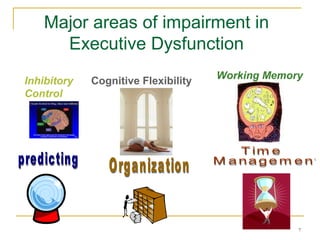
Major areas of impairment in
Executive Dysfunction
Inhibitory
Control

Cognitive Flexibility

Working Memory

7
EXECUTIVE FUNCTION JOBS


Inhibition - The ability to stop one's own
behavior at the appropriate time, including
stopping actions and thoughts.




The flip side of inhibition is impulsivity;

Shift - The ability to move freely from one
situation to another and to think flexibly in
order to respond appropriately to the
situation.
8
EXECUTIVE FUNCTION JOBS cont





Emotional Control - The ability to modulate
emotional responses by bringing rational
thought to bear on feelings.
Initiation - The ability to begin a task or
activity and to independently generate ideas,
responses, or problem-solving strategies.

9
EXECUTIVE FUNCTION JOBS cont





Working memory - The capacity to hold
information in mind for the purpose of
completing a task.
Planning/Organization - The ability to
manage current and future- oriented task
demands.

10
EXECUTIVE FUNCTION JOBS cont





Organization of Materials - The ability to
impose order on work, play, and storage
spaces.
Self-Monitoring - The ability to monitor one's
own performance and to measure it against
some standard of what is needed or expected.

11
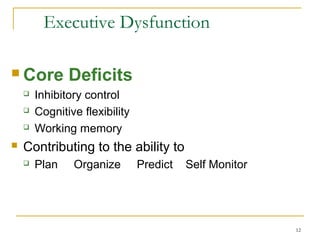
Executive Dysfunction
 Core






Deficits

Inhibitory control
Cognitive flexibility
Working memory

Contributing to the ability to


Plan

Organize

Predict

Self Monitor

12
13
Addressing Executive Function Challenges
Why Use Visual Strategies
 Visuals are not transient and compensate
inattention, poor working memory, inability to
prioritize/organize
 Visuals help sort out or point out what is
important
 Visuals lesson demands on working memory
and other executive functions
14
Theory of Mind



Theory of mind, or the ability to make inferences
about the mental states of other people, is
thought to be the primary mechanism underlying
our ability to function in complex, collaborative
social networks.
15
Theory of Mind (ToM)

Broad & multifaceted construct, including ability to understand













False beliefs
Pretense & Deception
Desire & intention
Appearance-reality & mental-physical distinctions
Affect recognition & causes of emotion
Notion that seeing leads to knowing
Empathy
. . .to understand. . .
Visual perspective taking
Mental state terms & speech acts
Second order thinking (e.g., understanding what
Tiffany thinks Patty thinks)
16
Limitations of Traditional Education
Methods






Use of language: limited ability to attend and
process (even students with HF cognitive
ability) especially implied, idioms, complex
structure and abstract concepts.
Use of modeling: not attending to relevant
cues, theory of mind challenges
Reinforcement: Especially social is not
relevant or meaningful. EF affects the link
between consequences (Sr+) and behavior.
What is Structured Teaching?




A specific antecedent based approach designed
specifically for students with autism. This approach
utilizes the core strengths of the student with autism
to facilitate learning. This approach was born out of
the T.E.A.C.C.H. philosophy.
T.E.A.C.C.H. was founded by the late Eric
Schoppler, PhD. in the early 1970’s at UNC. It
promotes the “Culture of Autism” as a way of
thinking about the characteristic patterns of thinking
and behavior of these individuals.
Goals of Structured Teaching






Promote independence & meaning through
structure.
Transform curriculum/learning tasks into
concrete, visual sequences that compensate
for Executive Function Disorder and poor
communication skills
Structure is not faded or removed but is
modified and adjusted
Structured Teaching






Antecedent based NOT reward or punishment
based
Uses competence motivation rather than
consequence motivation
Levels of Structured Teaching:






Physical Structure
Schedules
Work Systems
Routines and Strategies
Task
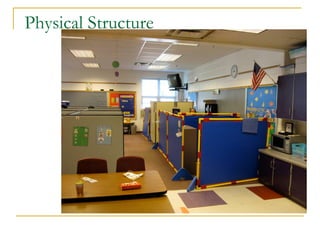
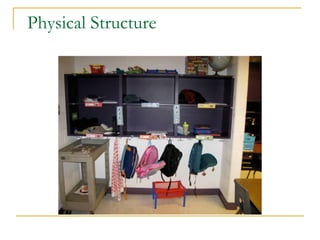
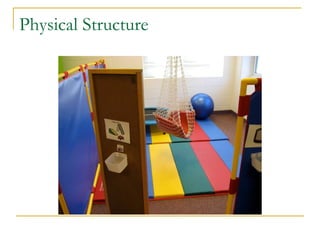
Physical structure






Clearly defined spaces so students can
visually see what the expectations are for that
area
Visual structure that supports the task or
activity
Answers the questions of why am I here and
what do I need to do
Physical Structure
Physical Structure
Physical Structure
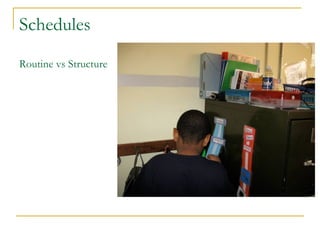
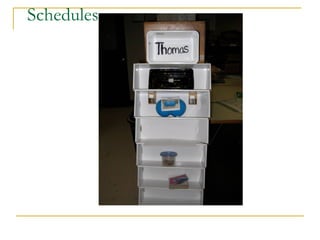
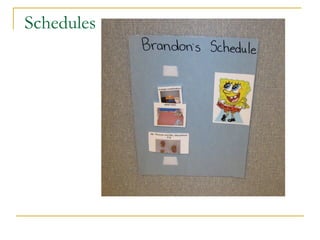
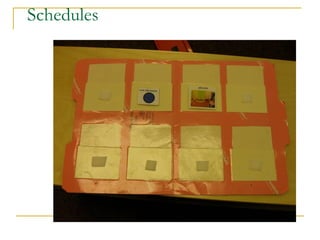
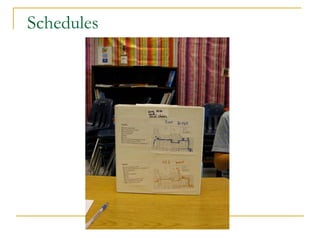
Schedules






Provides a visual (objects, pictures or words)
to tell the person what activities will happen
and in what order
Sometimes it can be faded or changed to
match a student’s skills but not eliminated
Success does not indicate a lack of need
Schedules
Routine vs Structure
Schedules
Schedules
Schedules
Schedules
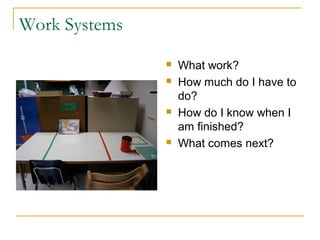
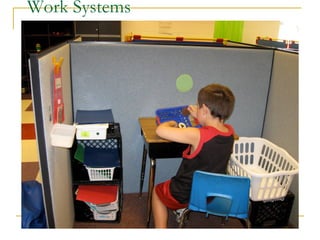
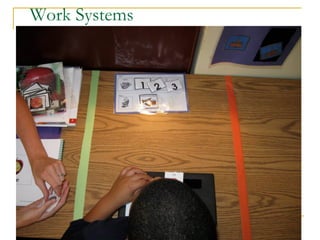
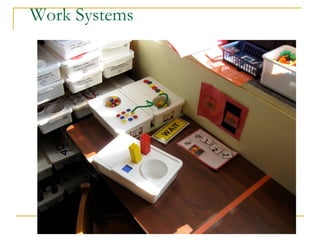
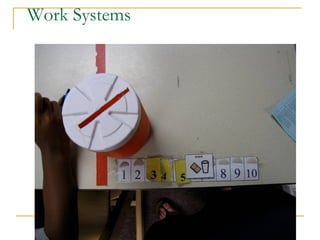
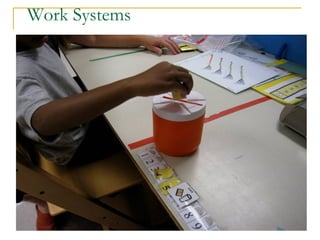
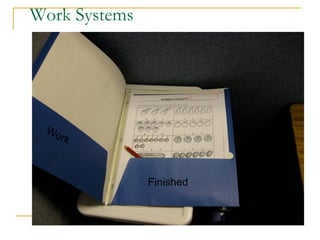
Work Systems







What work?
How much do I have to
do?
How do I know when I
am finished?
What comes next?
Work Systems
Work Systems
Work Systems
Work Systems
Work Systems
Work Systems

Wo
rk

Finished
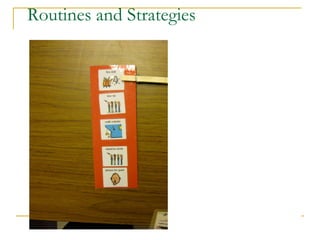
Routines and Strategies








Visually presented sequence to accomplish a
task & address sensory and executive
function needs
Plan for unexpected, unrewarding, or difficult
Uses FIRST-THEN
Couples a desired task with a less desired
task
Social stories
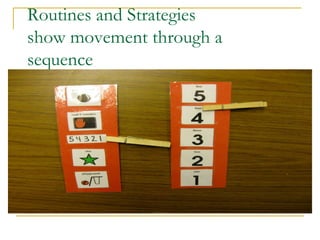
Routines and Strategies
show movement through a
sequence
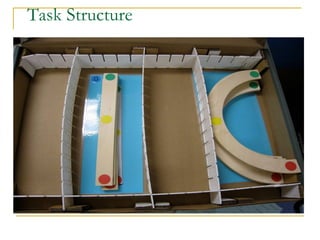
Task structure









Relies on visual cues and instructions rather
than verbal cues
Flows left to right or top to bottom
Flows from task analysis of skills and
sequence
Compensates for weaker areas and supports
areas of strength
Is designed for success and is modified to
lead to independence
Task Structure
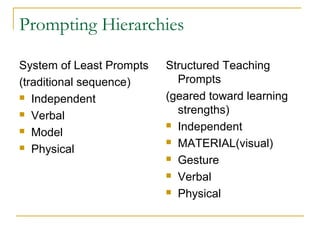
Prompting Hierarchies
System of Least Prompts
(traditional sequence)
 Independent
 Verbal
 Model
 Physical

Structured Teaching
Prompts
(geared toward learning
strengths)
 Independent
 MATERIAL(visual)
 Gesture
 Verbal
 Physical
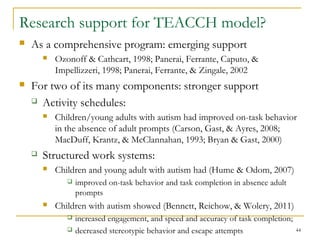
Research support for TEACCH model?


As a comprehensive program: emerging support




Ozonoff & Cathcart, 1998; Panerai, Ferrante, Caputo, &
Impellizzeri, 1998; Panerai, Ferrante, & Zingale, 2002

For two of its many components: stronger support
 Activity schedules:




Children/young adults with autism had improved on-task behavior
in the absence of adult prompts (Carson, Gast, & Ayres, 2008;
MacDuff, Krantz, & McClannahan, 1993; Bryan & Gast, 2000)

Structured work systems:


Children and young adult with autism had (Hume & Odom, 2007)




improved on-task behavior and task completion in absence adult
prompts

Children with autism showed (Bennett, Reichow, & Wolery, 2011)



increased engagement, and speed and accuracy of task completion;
decreased stereotypic behavior and escape attempts

44
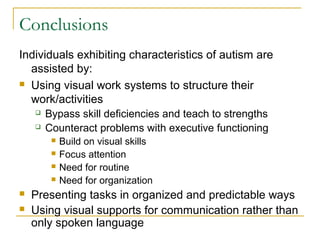
Conclusions
Individuals exhibiting characteristics of autism are
assisted by:
 Using visual work systems to structure their
work/activities



Bypass skill deficiencies and teach to strengths
Counteract problems with executive functioning








Build on visual skills
Focus attention
Need for routine
Need for organization

Presenting tasks in organized and predictable ways
Using visual supports for communication rather than
only spoken language

Strategies that work! teaching students with autism

  • 1.
    Strategies That Work! TeachingStudents with Autism in Adapted PE Settings Diane Talarico-Cavanaugh, M.Ed. Autism Specialist PREP Independent TEACCH Trainer July 16, 2013 APE Mini Symposium at the HPAI James Madison University
  • 2.
    The Culture ofAutism  Social Relatedness Communication Sensory Processing Difficulty with Change Cognitive Learning Style  Mesibov, Schoppler & Shea    
  • 3.
    Strengths of Peopleon the Autism Spectrum       Processing visual information Attention to details or selected areas of interest Sensory perception Simple memory Rule learning Routine oriented
  • 4.
    Challenges          Auditory processing (especiallylanguage) Understanding how details fit together, the Big Picture Combining ideas/making inferences Organizing ideas, materials, activities Attention (distractible/shifting attention) Communication (especially social and non-verbal) Concepts of time Attachment to routines and interests Strong sensory preferences and dislikes
  • 5.
    Executive Function The abilityto:  Plan  Anticipate  Organize  Predict  Inhibit Executive function is the way we monitor and control our thoughts, actions, emotions and behaviors.
  • 6.
    Which students haveExecutive Dysfunction For many students, the executive functioning system of their brain is not working properly. Executive Dysfunctions are intimately connected with Asperger's Disorder, Autism, ADHD, some Learning Disabilities and have also been found in adults with OCD. Executive Dysfunctions also effect middle schoolers as part of the developmental process!!!! It is also associated with depression, to name but some of the conditions.
  • 7.
    Major areas ofimpairment in Executive Dysfunction Inhibitory Control Cognitive Flexibility Working Memory 7
  • 8.
    EXECUTIVE FUNCTION JOBS  Inhibition- The ability to stop one's own behavior at the appropriate time, including stopping actions and thoughts.   The flip side of inhibition is impulsivity; Shift - The ability to move freely from one situation to another and to think flexibly in order to respond appropriately to the situation. 8
  • 9.
    EXECUTIVE FUNCTION JOBScont   Emotional Control - The ability to modulate emotional responses by bringing rational thought to bear on feelings. Initiation - The ability to begin a task or activity and to independently generate ideas, responses, or problem-solving strategies. 9
  • 10.
    EXECUTIVE FUNCTION JOBScont   Working memory - The capacity to hold information in mind for the purpose of completing a task. Planning/Organization - The ability to manage current and future- oriented task demands. 10
  • 11.
    EXECUTIVE FUNCTION JOBScont   Organization of Materials - The ability to impose order on work, play, and storage spaces. Self-Monitoring - The ability to monitor one's own performance and to measure it against some standard of what is needed or expected. 11
  • 12.
    Executive Dysfunction  Core     Deficits Inhibitorycontrol Cognitive flexibility Working memory Contributing to the ability to  Plan Organize Predict Self Monitor 12
  • 13.
  • 14.
    Addressing Executive FunctionChallenges Why Use Visual Strategies  Visuals are not transient and compensate inattention, poor working memory, inability to prioritize/organize  Visuals help sort out or point out what is important  Visuals lesson demands on working memory and other executive functions 14
  • 15.
    Theory of Mind  Theoryof mind, or the ability to make inferences about the mental states of other people, is thought to be the primary mechanism underlying our ability to function in complex, collaborative social networks. 15
  • 16.
    Theory of Mind(ToM) Broad & multifaceted construct, including ability to understand             False beliefs Pretense & Deception Desire & intention Appearance-reality & mental-physical distinctions Affect recognition & causes of emotion Notion that seeing leads to knowing Empathy . . .to understand. . . Visual perspective taking Mental state terms & speech acts Second order thinking (e.g., understanding what Tiffany thinks Patty thinks) 16
  • 17.
    Limitations of TraditionalEducation Methods    Use of language: limited ability to attend and process (even students with HF cognitive ability) especially implied, idioms, complex structure and abstract concepts. Use of modeling: not attending to relevant cues, theory of mind challenges Reinforcement: Especially social is not relevant or meaningful. EF affects the link between consequences (Sr+) and behavior.
  • 18.
    What is StructuredTeaching?   A specific antecedent based approach designed specifically for students with autism. This approach utilizes the core strengths of the student with autism to facilitate learning. This approach was born out of the T.E.A.C.C.H. philosophy. T.E.A.C.C.H. was founded by the late Eric Schoppler, PhD. in the early 1970’s at UNC. It promotes the “Culture of Autism” as a way of thinking about the characteristic patterns of thinking and behavior of these individuals.
  • 19.
    Goals of StructuredTeaching    Promote independence & meaning through structure. Transform curriculum/learning tasks into concrete, visual sequences that compensate for Executive Function Disorder and poor communication skills Structure is not faded or removed but is modified and adjusted
  • 20.
    Structured Teaching    Antecedent basedNOT reward or punishment based Uses competence motivation rather than consequence motivation Levels of Structured Teaching:      Physical Structure Schedules Work Systems Routines and Strategies Task
  • 21.
    Physical structure    Clearly definedspaces so students can visually see what the expectations are for that area Visual structure that supports the task or activity Answers the questions of why am I here and what do I need to do
  • 22.
  • 23.
  • 24.
  • 25.
    Schedules    Provides a visual(objects, pictures or words) to tell the person what activities will happen and in what order Sometimes it can be faded or changed to match a student’s skills but not eliminated Success does not indicate a lack of need
  • 26.
  • 27.
  • 28.
  • 29.
  • 30.
  • 31.
    Work Systems     What work? Howmuch do I have to do? How do I know when I am finished? What comes next?
  • 32.
  • 33.
  • 34.
  • 35.
  • 36.
  • 37.
  • 38.
    Routines and Strategies      Visuallypresented sequence to accomplish a task & address sensory and executive function needs Plan for unexpected, unrewarding, or difficult Uses FIRST-THEN Couples a desired task with a less desired task Social stories
  • 39.
  • 40.
    Routines and Strategies showmovement through a sequence
  • 41.
    Task structure      Relies onvisual cues and instructions rather than verbal cues Flows left to right or top to bottom Flows from task analysis of skills and sequence Compensates for weaker areas and supports areas of strength Is designed for success and is modified to lead to independence
  • 42.
  • 43.
    Prompting Hierarchies System ofLeast Prompts (traditional sequence)  Independent  Verbal  Model  Physical Structured Teaching Prompts (geared toward learning strengths)  Independent  MATERIAL(visual)  Gesture  Verbal  Physical
  • 44.
    Research support forTEACCH model?  As a comprehensive program: emerging support   Ozonoff & Cathcart, 1998; Panerai, Ferrante, Caputo, & Impellizzeri, 1998; Panerai, Ferrante, & Zingale, 2002 For two of its many components: stronger support  Activity schedules:   Children/young adults with autism had improved on-task behavior in the absence of adult prompts (Carson, Gast, & Ayres, 2008; MacDuff, Krantz, & McClannahan, 1993; Bryan & Gast, 2000) Structured work systems:  Children and young adult with autism had (Hume & Odom, 2007)   improved on-task behavior and task completion in absence adult prompts Children with autism showed (Bennett, Reichow, & Wolery, 2011)   increased engagement, and speed and accuracy of task completion; decreased stereotypic behavior and escape attempts 44
  • 45.
    Conclusions Individuals exhibiting characteristicsof autism are assisted by:  Using visual work systems to structure their work/activities   Bypass skill deficiencies and teach to strengths Counteract problems with executive functioning       Build on visual skills Focus attention Need for routine Need for organization Presenting tasks in organized and predictable ways Using visual supports for communication rather than only spoken language

Editor's Notes

  • #46 Limitations: Difficulties in joint attention Little response to directed attention by others Little initiation of joint attention Low motivation for nonpreferred tasks Little response to others’ verbal statements or requests Unclear expression Communication patterns involving problem behavior Difficulty with change Preoccupation with restricted patterns of interest Strengths: Processing visual information Attention to details or selected areas of interest Sensory perception Simple memory Rule learning Routine orientation