
Classroom Accommodations to
Help Special Education Students
with Executive Functioning Skills
Executive Function and
Self-Regulation (EF/SR)
These are the skills that
provide critical supports for
learning and development,
and while we aren’t born
with these skills, we are
born with the potential to
develop them through
interactions and practice.
Executive Function and
Self-Regulation
1. Paying Attention or Focus
Focusing is obviously central to achieving our goals. If we are so
distracted that we can't pay attention, we can't concentrate.
2. Working Memory
Working memory is holding information in our minds while
mentally working with it or updating it, such as relating what you're reading
now to what you just read or relating what you are learning now to what you
learned earlier.
3. Cognitive Flexibility
Cognitive flexibility is being able to flexibly switch perspectives or the focus of
attention and flexibly adjust to changed demands or priorities.
4. Inhibitory Control
This is the ability to resist a strong inclination to do one thing and instead do what is
most appropriate. It means sticking with something you are doing after you've
had an initial failure -- inhibiting the strong inclination to give up or continuing
to work on something even when you're bored.
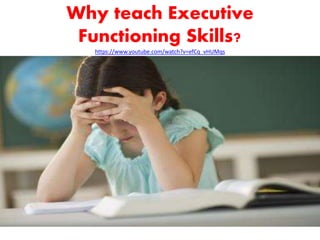
Why teach Executive
Functioning Skills?
https://www.youtube.com/watch?v=efCq_vHUMqs
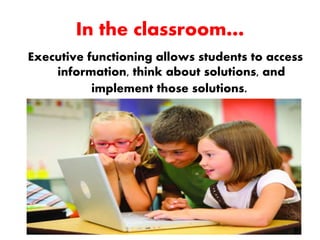
In the classroom…
Executive functioning allows students to access
information, think about solutions, and
implement those solutions.
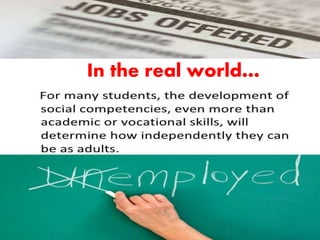
In the real world…
The facts…
• Children with learning disabilities often have
executive functioning disorders as well.
• Executive functioning is a term psychologists
use to describe the many tasks our brains
perform that are necessary to think, act, and
solve problems.
• Executive functioning includes tasks that help
us learn new information, remember and
retrieve information we've learned in the past,
and use this information to solve problems of
everyday life.
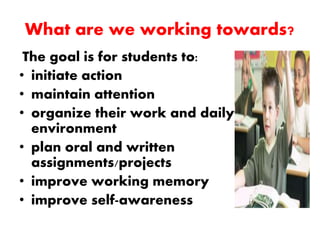
What are we working towards?
The goal is for students to:
• initiate action
• maintain attention
• organize their work and daily
environment
• plan oral and written
assignments/projects
• improve working memory
• improve self-awareness
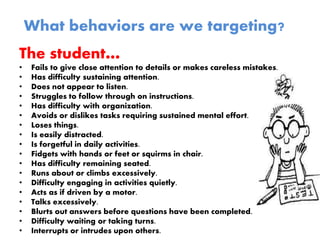
What behaviors are we targeting?
The student…
• Fails to give close attention to details or makes careless mistakes.
• Has difficulty sustaining attention.
• Does not appear to listen.
• Struggles to follow through on instructions.
• Has difficulty with organization.
• Avoids or dislikes tasks requiring sustained mental effort.
• Loses things.
• Is easily distracted.
• Is forgetful in daily activities.
• Fidgets with hands or feet or squirms in chair.
• Has difficulty remaining seated.
• Runs about or climbs excessively.
• Difficulty engaging in activities quietly.
• Acts as if driven by a motor.
• Talks excessively.
• Blurts out answers before questions have been completed.
• Difficulty waiting or taking turns.
• Interrupts or intrudes upon others.
How our brain processes
information
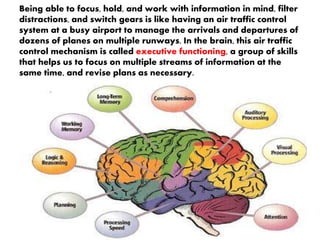
Being able to focus, hold, and work with information in mind, filter
distractions, and switch gears is like having an air traffic control
system at a busy airport to manage the arrivals and departures of
dozens of planes on multiple runways. In the brain, this air traffic
control mechanism is called executive functioning, a group of skills
that helps us to focus on multiple streams of information at the
same time, and revise plans as necessary.
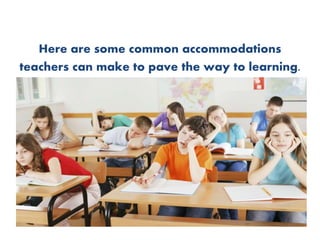
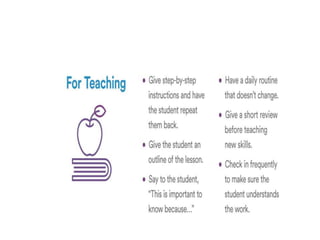
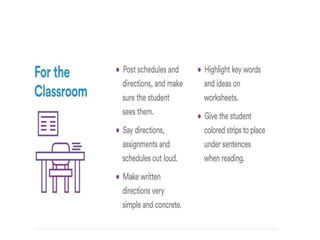
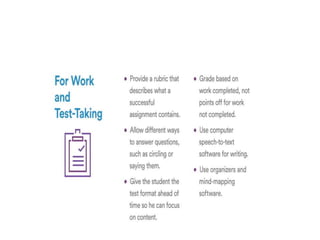
Here are some common accommodations
teachers can make to pave the way to learning.
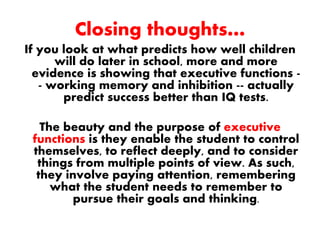
Closing thoughts…
If you look at what predicts how well children
will do later in school, more and more
evidence is showing that executive functions -
- working memory and inhibition -- actually
predict success better than IQ tests.
The beauty and the purpose of executive
functions is they enable the student to control
themselves, to reflect deeply, and to consider
things from multiple points of view. As such,
they involve paying attention, remembering
what the student needs to remember to
pursue their goals and thinking.
Executive function and Self Regulation for Special Education Students

Executive function and Self Regulation for Special Education Students

  • 1.
    Classroom Accommodations to HelpSpecial Education Students with Executive Functioning Skills
  • 3.
    Executive Function and Self-Regulation(EF/SR) These are the skills that provide critical supports for learning and development, and while we aren’t born with these skills, we are born with the potential to develop them through interactions and practice.
  • 4.
    Executive Function and Self-Regulation 1.Paying Attention or Focus Focusing is obviously central to achieving our goals. If we are so distracted that we can't pay attention, we can't concentrate. 2. Working Memory Working memory is holding information in our minds while mentally working with it or updating it, such as relating what you're reading now to what you just read or relating what you are learning now to what you learned earlier. 3. Cognitive Flexibility Cognitive flexibility is being able to flexibly switch perspectives or the focus of attention and flexibly adjust to changed demands or priorities. 4. Inhibitory Control This is the ability to resist a strong inclination to do one thing and instead do what is most appropriate. It means sticking with something you are doing after you've had an initial failure -- inhibiting the strong inclination to give up or continuing to work on something even when you're bored.
  • 5.
    Why teach Executive FunctioningSkills? https://www.youtube.com/watch?v=efCq_vHUMqs
  • 6.
    In the classroom… Executivefunctioning allows students to access information, think about solutions, and implement those solutions.
  • 7.
    In the realworld…
  • 8.
    The facts… • Childrenwith learning disabilities often have executive functioning disorders as well. • Executive functioning is a term psychologists use to describe the many tasks our brains perform that are necessary to think, act, and solve problems. • Executive functioning includes tasks that help us learn new information, remember and retrieve information we've learned in the past, and use this information to solve problems of everyday life.
  • 9.
    What are weworking towards? The goal is for students to: • initiate action • maintain attention • organize their work and daily environment • plan oral and written assignments/projects • improve working memory • improve self-awareness
  • 10.
    What behaviors arewe targeting? The student… • Fails to give close attention to details or makes careless mistakes. • Has difficulty sustaining attention. • Does not appear to listen. • Struggles to follow through on instructions. • Has difficulty with organization. • Avoids or dislikes tasks requiring sustained mental effort. • Loses things. • Is easily distracted. • Is forgetful in daily activities. • Fidgets with hands or feet or squirms in chair. • Has difficulty remaining seated. • Runs about or climbs excessively. • Difficulty engaging in activities quietly. • Acts as if driven by a motor. • Talks excessively. • Blurts out answers before questions have been completed. • Difficulty waiting or taking turns. • Interrupts or intrudes upon others.
  • 11.
    How our brainprocesses information
  • 12.
    Being able tofocus, hold, and work with information in mind, filter distractions, and switch gears is like having an air traffic control system at a busy airport to manage the arrivals and departures of dozens of planes on multiple runways. In the brain, this air traffic control mechanism is called executive functioning, a group of skills that helps us to focus on multiple streams of information at the same time, and revise plans as necessary.
  • 13.
    Here are somecommon accommodations teachers can make to pave the way to learning.
  • 17.
    Closing thoughts… If youlook at what predicts how well children will do later in school, more and more evidence is showing that executive functions - - working memory and inhibition -- actually predict success better than IQ tests. The beauty and the purpose of executive functions is they enable the student to control themselves, to reflect deeply, and to consider things from multiple points of view. As such, they involve paying attention, remembering what the student needs to remember to pursue their goals and thinking.