GOOD MORNIG
Strategic Evaluation
Presented By:
Nikhil B
M.com
Vijayanagara Sri Krishnadevaraya
University Bellary
Strategic Management
Strategic management is generally
considered as the process of formulating,
implementing and evaluating strategies for or
organisation, business policy is usually considered
as an academic field of study, an area of
specialisation or specially named course related to
strategic management.
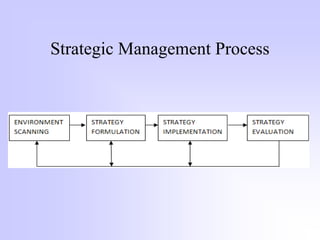
Strategic Management Process
Strategic Evaluation
Strategic Evaluation is defined as the process of determining the
effectiveness of a given strategy in achieving the organizational objectives and
taking corrective action wherever required
Strategy evaluation is the final step of strategy management process.
The key strategy evaluation activities are: appraising internal and external
factors that are the root of present strategies, measuring performance, and
taking remedial / corrective actions. Evaluation makes sure that the
organizational strategy as well as it’s implementation meets the organizational
objectives
Strategic Evaluation is an significant strategy
formulation because it throws light on the efficiency and
effectiveness of the comprehensive plans in achieving the
desired results.
The managers can also assess the appropriateness of the
current strategy in dynamic world with socio-economic, political
and technological innovations. Strategic evaluation is the final
phase of Strategic Management.
Nature of Strategic Evaluation
 Nature of the strategic evaluation and control process is to test the
effectiveness of strategy.
 During the strategic management process, the strategists formulate the
strategy to achieve a set of objectives and then implement the strategy.
 There has to be a way of finding out whether the strategy being implemented
will guide the organisation towards its intended objectives. Strategic
evaluation and control, therefore, performs the crucial task of keeping the
organisation on the right track.
 In the absence of such a mechanism, there would be no means for strategists
to find out whether or not the strategy is producing the desired effect.
Importance of Strategic Evaluation
• Strategic evaluation can help to assess whether the decisions match the
intended strategy requirements.
• Strategic evaluation, through its process of control, feedback, rewards
and review, helps in a successful culmination of the strategic
management process.
• The process of strategic evaluation provides a considerable amount of
information and experience to strategists that can be useful in new
strategic planning.
Participants in Strategic Evaluation
• Shareholders
• Board of Directors
• Chief executives
• Financial controllers
• Company secretaries
• External and Internal Auditors
• Audit and Executive Committees
• Corporate Planning Staff or Department
• Middle-level managers
Process of Strategic Evaluation
1) Fixing benchmark of performance
2) Measurement of performance
3) Analyzing Variance
4) Taking Corrective Action
Fixing Benchmark of Performance
 While fixing the benchmark, strategists encounter questions such
as - what benchmarks to set, how to set them and how to express
them.
 In order to determine the benchmark performance to be set, it is
essential to discover the special requirements for performing the
main task.
 The organization can use both quantitative and qualitative
criteria for comprehensive assessment of performance.
 Quantitative criteria includes determination of net profit, ROI,
earning per share, cost of production, rate of employee turnover
etc. Among the Qualitative factors are subjective evaluation of
factors such as - skills and competencies, risk taking potential,
flexibility etc.
 Qualitative criteria includes the factors such as
capabilities, core competencies, risk-bearing
capacity, strategic clarity, flexibility and
workability.
Measurement of performance
 The standard performance is a bench mark with
which the actual performance is to be compared.
 The reporting and communication system help in
measuring the performance.
 For measuring the performance, financial
statements like - balance sheet, profit and loss
account must be prepared on an annual basis.
Analyzing Variance
 While measuring the actual performance
and comparing it with standard
performance there may be variances which
must be analyzed.
 The strategists must mention the degree of
tolerance limits between which the
variance between actual and standard
performance may be accepted.
Taking Corrective Action
 Once the deviation in performance is
identified, it is essential to plan for a
corrective action.
 If the performance is consistently less than
the desired performance, the strategists
must carry a detailed analysis of the factors
responsible for such performance.
Thank You
Any Queries

Strategicevaluation

  • 1.
  • 2.
    Strategic Evaluation Presented By: NikhilB M.com Vijayanagara Sri Krishnadevaraya University Bellary
  • 3.
    Strategic Management Strategic managementis generally considered as the process of formulating, implementing and evaluating strategies for or organisation, business policy is usually considered as an academic field of study, an area of specialisation or specially named course related to strategic management.
  • 4.
  • 5.
    Strategic Evaluation Strategic Evaluationis defined as the process of determining the effectiveness of a given strategy in achieving the organizational objectives and taking corrective action wherever required Strategy evaluation is the final step of strategy management process. The key strategy evaluation activities are: appraising internal and external factors that are the root of present strategies, measuring performance, and taking remedial / corrective actions. Evaluation makes sure that the organizational strategy as well as it’s implementation meets the organizational objectives
  • 6.
    Strategic Evaluation isan significant strategy formulation because it throws light on the efficiency and effectiveness of the comprehensive plans in achieving the desired results. The managers can also assess the appropriateness of the current strategy in dynamic world with socio-economic, political and technological innovations. Strategic evaluation is the final phase of Strategic Management.
  • 7.
    Nature of StrategicEvaluation  Nature of the strategic evaluation and control process is to test the effectiveness of strategy.  During the strategic management process, the strategists formulate the strategy to achieve a set of objectives and then implement the strategy.  There has to be a way of finding out whether the strategy being implemented will guide the organisation towards its intended objectives. Strategic evaluation and control, therefore, performs the crucial task of keeping the organisation on the right track.  In the absence of such a mechanism, there would be no means for strategists to find out whether or not the strategy is producing the desired effect.
  • 8.
    Importance of StrategicEvaluation • Strategic evaluation can help to assess whether the decisions match the intended strategy requirements. • Strategic evaluation, through its process of control, feedback, rewards and review, helps in a successful culmination of the strategic management process. • The process of strategic evaluation provides a considerable amount of information and experience to strategists that can be useful in new strategic planning.
  • 9.
    Participants in StrategicEvaluation • Shareholders • Board of Directors • Chief executives • Financial controllers • Company secretaries • External and Internal Auditors • Audit and Executive Committees • Corporate Planning Staff or Department • Middle-level managers
  • 10.
    Process of StrategicEvaluation 1) Fixing benchmark of performance 2) Measurement of performance 3) Analyzing Variance 4) Taking Corrective Action
  • 11.
    Fixing Benchmark ofPerformance  While fixing the benchmark, strategists encounter questions such as - what benchmarks to set, how to set them and how to express them.  In order to determine the benchmark performance to be set, it is essential to discover the special requirements for performing the main task.  The organization can use both quantitative and qualitative criteria for comprehensive assessment of performance.  Quantitative criteria includes determination of net profit, ROI, earning per share, cost of production, rate of employee turnover etc. Among the Qualitative factors are subjective evaluation of factors such as - skills and competencies, risk taking potential, flexibility etc.
  • 12.
     Qualitative criteriaincludes the factors such as capabilities, core competencies, risk-bearing capacity, strategic clarity, flexibility and workability.
  • 13.
    Measurement of performance The standard performance is a bench mark with which the actual performance is to be compared.  The reporting and communication system help in measuring the performance.  For measuring the performance, financial statements like - balance sheet, profit and loss account must be prepared on an annual basis.
  • 14.
    Analyzing Variance  Whilemeasuring the actual performance and comparing it with standard performance there may be variances which must be analyzed.  The strategists must mention the degree of tolerance limits between which the variance between actual and standard performance may be accepted.
  • 15.
    Taking Corrective Action Once the deviation in performance is identified, it is essential to plan for a corrective action.  If the performance is consistently less than the desired performance, the strategists must carry a detailed analysis of the factors responsible for such performance.
  • 16.
  • 17.