


HUMAN RESOUCE
MANAGEMENT
(HRM)
Meaning
Human resource management is
a function concerned with hiring,
motivating and maintaining people in
an organisation it focuses on people
in organisation.
Nature of HRM/Characteristics
 People who manage organisations
 It involves application of
management principles and
functions
 It includes decisions regarding
employees integration
 Decision must influence
effectiveness of organisation
 HRM is applicable to non business
organisation
Human Resource Planning
Meaning:
Human resource planning is the process of forecasting a
firms future demand for and supply of the right type of
people in the right number
Definition
According to E.W. Vetter
“Human resource planning is a process by which an
organisation should move from its current man power
position to its desired man power position”. Though
planning, management strives to have the right number and
right kind of people at the right places at the right time
doing things which result in both the organisation and
individual receiving maximum long run benefit.
According to Leon C. Megginson
Human resource planning is “an integrated approach to
performing the planning aspects of personnel function in
order to have a sufficient supply of adequately
developed and motivated people to perform the duties
and tasks required to meet organisational objectives and
satisfy the individual needs and goals of organisational
members”.
Objectives of Human Resource
Planning
 To recruit and retain the human resource of required
quantity and quality
 To meet the needs of the programmes of expansion,
diversification etc.,
 To improve the standards, skills, knowledge, ability,
discipline etc.,
 To make best use of its human resources
 To estimate the cost of human resources.
 To minimise imbalance caused due to non-availability of
human resources of right kind, right number in right time
and right place
 To assess the surplus or shortage of human resources and
take measures accordingly.
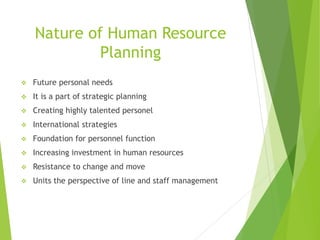
Nature of Human Resource
Planning
 Future personal needs
 It is a part of strategic planning
 Creating highly talented personel
 International strategies
 Foundation for personnel function
 Increasing investment in human resources
 Resistance to change and move
 Units the perspective of line and staff management
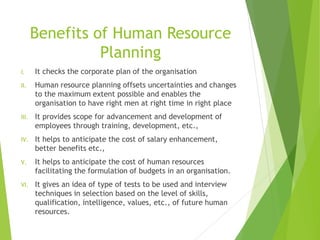
Benefits of Human Resource
Planning
I. It checks the corporate plan of the organisation
II. Human resource planning offsets uncertainties and changes
to the maximum extent possible and enables the
organisation to have right men at right time in right place
III. It provides scope for advancement and development of
employees through training, development, etc.,
IV. It helps to anticipate the cost of salary enhancement,
better benefits etc.,
V. It helps to anticipate the cost of human resources
facilitating the formulation of budgets in an organisation.
VI. It gives an idea of type of tests to be used and interview
techniques in selection based on the level of skills,
qualification, intelligence, values, etc., of future human
resources.
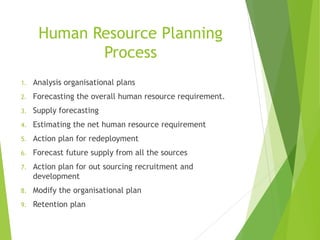
Human Resource Planning
Process
1. Analysis organisational plans
2. Forecasting the overall human resource requirement.
3. Supply forecasting
4. Estimating the net human resource requirement
5. Action plan for redeployment
6. Forecast future supply from all the sources
7. Action plan for out sourcing recruitment and
development
8. Modify the organisational plan
9. Retention plan
Thank
You

Human resouce planning

  • 1.
  • 2.
    Meaning Human resource managementis a function concerned with hiring, motivating and maintaining people in an organisation it focuses on people in organisation.
  • 3.
    Nature of HRM/Characteristics People who manage organisations  It involves application of management principles and functions  It includes decisions regarding employees integration  Decision must influence effectiveness of organisation  HRM is applicable to non business organisation
  • 4.
    Human Resource Planning Meaning: Humanresource planning is the process of forecasting a firms future demand for and supply of the right type of people in the right number Definition According to E.W. Vetter “Human resource planning is a process by which an organisation should move from its current man power position to its desired man power position”. Though planning, management strives to have the right number and right kind of people at the right places at the right time doing things which result in both the organisation and individual receiving maximum long run benefit.
  • 5.
    According to LeonC. Megginson Human resource planning is “an integrated approach to performing the planning aspects of personnel function in order to have a sufficient supply of adequately developed and motivated people to perform the duties and tasks required to meet organisational objectives and satisfy the individual needs and goals of organisational members”.
  • 6.
    Objectives of HumanResource Planning  To recruit and retain the human resource of required quantity and quality  To meet the needs of the programmes of expansion, diversification etc.,  To improve the standards, skills, knowledge, ability, discipline etc.,  To make best use of its human resources  To estimate the cost of human resources.  To minimise imbalance caused due to non-availability of human resources of right kind, right number in right time and right place  To assess the surplus or shortage of human resources and take measures accordingly.
  • 7.
    Nature of HumanResource Planning  Future personal needs  It is a part of strategic planning  Creating highly talented personel  International strategies  Foundation for personnel function  Increasing investment in human resources  Resistance to change and move  Units the perspective of line and staff management
  • 8.
    Benefits of HumanResource Planning I. It checks the corporate plan of the organisation II. Human resource planning offsets uncertainties and changes to the maximum extent possible and enables the organisation to have right men at right time in right place III. It provides scope for advancement and development of employees through training, development, etc., IV. It helps to anticipate the cost of salary enhancement, better benefits etc., V. It helps to anticipate the cost of human resources facilitating the formulation of budgets in an organisation. VI. It gives an idea of type of tests to be used and interview techniques in selection based on the level of skills, qualification, intelligence, values, etc., of future human resources.
  • 9.
    Human Resource Planning Process 1.Analysis organisational plans 2. Forecasting the overall human resource requirement. 3. Supply forecasting 4. Estimating the net human resource requirement 5. Action plan for redeployment 6. Forecast future supply from all the sources 7. Action plan for out sourcing recruitment and development 8. Modify the organisational plan 9. Retention plan
  • 10.