Strategic Evaluation and
Control
Nature of Strategic Evaluation
Evaluate effectiveness of organisational
strategy in achieving organisational
objectives
Perform the task of keeping organisation
on track
Importance of Strategic Evaluation
The need for feedback
Appraisal and reward
Check on the validity of strategic choice
Congruence between decisions and intended
strategy
Successful culmination of the strategic
management process
Creating inputs for new strategic planning
Ability to coordinate the tasks performed
Barriers in Evaluation
Limits of Controls
Difficulties in measurement
Resistance to evaluation
Short-termism
Relying on efficiency versus effectiveness
Requirements of Effective Evaluation
Control should involve only the minimum amount
of information
Control should monitor only managerial activities
and results
Control should be timely
Long term and short term control should be used
Control should aim at pinpointing exceptions
Rewards for meeting or exceeding standards
should be emphasized
Strategic Control
Four Types of Strategic Controls
Premise Control
Implementation Control
Strategic Surveillance
Special alert control
Premise Control
Premises control is necessary to identify the
key assumptions and its implementation.
Premises control serves the purpose of
continually testing the assumptions to find out
whether they are still valid or not. This
enables the strategists to take corrective
action at the right time rather than continuing
with a strategy which is based on erroneous
assumptions.
Implementation Control
Implementation control is aimed at evaluating
whether the plans, programmes, and projects
are actually guiding the organization towards
its predetermined objectives or not.
Strategic Surveillance
Strategic surveillance aimed at a more
generalized and overarching control
“designed to monitor a broad range of events
inside and outside the company that are likely
to threaten the course of a firm’s strategy”.
Special Alert Control
Special alert control, which is based on a
trigger mechanism for rapid response and
immediate reassessment of strategy in the
light of sudden and unexpected events
Operational Control
Aimed at the allocation and use of
organisational resources
Concerned with action or performance
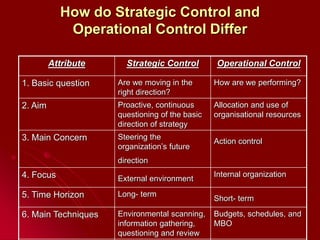
How do Strategic Control and
Operational Control Differ
Attribute Strategic Control Operational Control
1. Basic question Are we moving in the
right direction?
How are we performing?
2. Aim Proactive, continuous
questioning of the basic
direction of strategy
Allocation and use of
organisational resources
3. Main Concern Steering the
organization’s future
direction
Action control
4. Focus External environment
Internal organization
5. Time Horizon Long- term
Short- term
6. Main Techniques Environmental scanning,
information gathering,
questioning and review
Budgets, schedules, and
MBO
Process of Evaluation
Setting standards of performance
Measurement of performance
Analyzing variances
Taking corrective action
Setting of Standards
Quantitative Criteria
 It has performed as compared to its past
achievements
 Its performance with the industry average or that
of major competitors
Qualitative Criteria
There has to be a special set of qualitative criteria for a
subjective assessment of the factors like capabilities,
core competencies, risk- bearing capacity, strategic
clarity, flexibility, and workability
Measurement of Performance
The evaluation process operates at the
performance level as action takes place.
Standards of performance act as the
benchmark against which the actual
performance is to be compared. It is
important, however, to understand how the
measurement of performance can take
place.
Analyzing Variances
The measurement of actual performance and its
comparison with standard or budgeted
performance leads to an analysis of variances.
Broadly, the following three situations may arise:
The actual performance matches the budgeted
performance
The actual performance deviates positively over
the budget performance
The actual performance deviates negatively
from the budgeted
Taking Corrective Actions
There are three courses for corrective
action: checking of performance, checking
of standards, and reformulating strategies,
plans, and objectives.
Techniques of Strategic
Evaluation and Control
Evaluation Techniques for Strategic Control
Evaluation Techniques for Operational Control
Evaluation Techniques for Strategic
Control
Techniques for strategic control could be
classified into two groups on the basis of the
type of environment faced by the organisation.
The organisation that operate in a relative stable
environment may use strategic momentum
control, while those which face a relatively
turbulent environment may find strategic leap
control more appropriate.
Evaluation Techniques for
Operational Control
Operational control is aimed at the
allocation and use of organisational
resources
The evaluation techniques are classified
into three parts:
Internal analysis
Comparative analysis
Comprehensive analysis.

6895776-Strategic-Evaluation-and-Control.ppt

  • 1.
  • 2.
    Nature of StrategicEvaluation Evaluate effectiveness of organisational strategy in achieving organisational objectives Perform the task of keeping organisation on track
  • 3.
    Importance of StrategicEvaluation The need for feedback Appraisal and reward Check on the validity of strategic choice Congruence between decisions and intended strategy Successful culmination of the strategic management process Creating inputs for new strategic planning Ability to coordinate the tasks performed
  • 4.
    Barriers in Evaluation Limitsof Controls Difficulties in measurement Resistance to evaluation Short-termism Relying on efficiency versus effectiveness
  • 5.
    Requirements of EffectiveEvaluation Control should involve only the minimum amount of information Control should monitor only managerial activities and results Control should be timely Long term and short term control should be used Control should aim at pinpointing exceptions Rewards for meeting or exceeding standards should be emphasized
  • 6.
  • 7.
    Four Types ofStrategic Controls Premise Control Implementation Control Strategic Surveillance Special alert control
  • 8.
    Premise Control Premises controlis necessary to identify the key assumptions and its implementation. Premises control serves the purpose of continually testing the assumptions to find out whether they are still valid or not. This enables the strategists to take corrective action at the right time rather than continuing with a strategy which is based on erroneous assumptions.
  • 9.
    Implementation Control Implementation controlis aimed at evaluating whether the plans, programmes, and projects are actually guiding the organization towards its predetermined objectives or not.
  • 10.
    Strategic Surveillance Strategic surveillanceaimed at a more generalized and overarching control “designed to monitor a broad range of events inside and outside the company that are likely to threaten the course of a firm’s strategy”.
  • 11.
    Special Alert Control Specialalert control, which is based on a trigger mechanism for rapid response and immediate reassessment of strategy in the light of sudden and unexpected events
  • 12.
    Operational Control Aimed atthe allocation and use of organisational resources Concerned with action or performance
  • 13.
    How do StrategicControl and Operational Control Differ Attribute Strategic Control Operational Control 1. Basic question Are we moving in the right direction? How are we performing? 2. Aim Proactive, continuous questioning of the basic direction of strategy Allocation and use of organisational resources 3. Main Concern Steering the organization’s future direction Action control 4. Focus External environment Internal organization 5. Time Horizon Long- term Short- term 6. Main Techniques Environmental scanning, information gathering, questioning and review Budgets, schedules, and MBO
  • 14.
    Process of Evaluation Settingstandards of performance Measurement of performance Analyzing variances Taking corrective action
  • 15.
    Setting of Standards QuantitativeCriteria  It has performed as compared to its past achievements  Its performance with the industry average or that of major competitors Qualitative Criteria There has to be a special set of qualitative criteria for a subjective assessment of the factors like capabilities, core competencies, risk- bearing capacity, strategic clarity, flexibility, and workability
  • 16.
    Measurement of Performance Theevaluation process operates at the performance level as action takes place. Standards of performance act as the benchmark against which the actual performance is to be compared. It is important, however, to understand how the measurement of performance can take place.
  • 17.
    Analyzing Variances The measurementof actual performance and its comparison with standard or budgeted performance leads to an analysis of variances. Broadly, the following three situations may arise: The actual performance matches the budgeted performance The actual performance deviates positively over the budget performance The actual performance deviates negatively from the budgeted
  • 18.
    Taking Corrective Actions Thereare three courses for corrective action: checking of performance, checking of standards, and reformulating strategies, plans, and objectives.
  • 19.
    Techniques of Strategic Evaluationand Control Evaluation Techniques for Strategic Control Evaluation Techniques for Operational Control
  • 20.
    Evaluation Techniques forStrategic Control Techniques for strategic control could be classified into two groups on the basis of the type of environment faced by the organisation. The organisation that operate in a relative stable environment may use strategic momentum control, while those which face a relatively turbulent environment may find strategic leap control more appropriate.
  • 21.
    Evaluation Techniques for OperationalControl Operational control is aimed at the allocation and use of organisational resources The evaluation techniques are classified into three parts: Internal analysis Comparative analysis Comprehensive analysis.