Economics of Strategy
             Fifth Edition
Besanko, Dranove, Shanley, and Schaefer


               Chapter 9

 Strategic Commitment

   Slides by: Richard Ponarul, California State University, Chico
                          Copyright  2010 John Wiley  Sons, Inc.
Strategic Commitment

 Strategic commitments
  have long run impact and
  are hard to reverse

 Strategic commitments can affect choices
  made by rivals
 Assessing strategic commitments involves
  anticipating market rivalry
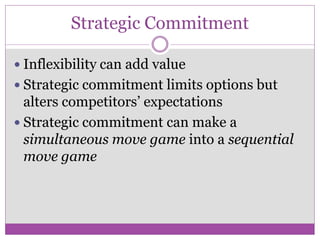
Strategic Commitment

 Inflexibility can add value
 Strategic commitment limits options but
  alters competitors’ expectations
 Strategic commitment can make a
  simultaneous move game into a sequential
  move game
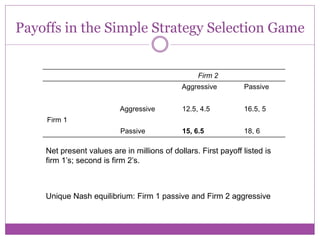
Payoffs in the Simple Strategy Selection Game


                                                  Firm 2
                                             Aggressive         Passive


                          Aggressive         12.5, 4.5          16.5, 5
    Firm 1
                          Passive            15, 6.5            18, 6

    Net present values are in millions of dollars. First payoff listed is
    firm 1’s; second is firm 2’s.


    Unique Nash equilibrium: Firm 1 passive and Firm 2 aggressive
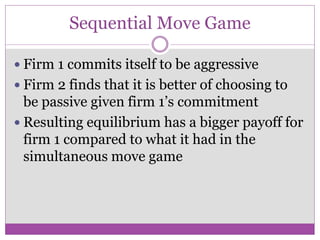
Sequential Move Game

 Firm 1 commits itself to be aggressive
 Firm 2 finds that it is better of choosing to
  be passive given firm 1’s commitment
 Resulting equilibrium has a bigger payoff for
  firm 1 compared to what it had in the
  simultaneous move game
Strategic Commitment

 To achieve the desired result, the
 commitment should be
  Visible

  Understandable

  Credible

 To be credible, the commitment should be
 irreversible
Strategic Commitment

 Moves that represent commitment:
   Capacity expansion with investment in
    relationship specific assets
   Contracts with clauses such as most favored
    customer clause
   Public announcements provided the reputation
    of the firm/management will suffer when not
    backed by action
 The move should be difficult to stop once set
 in motion
Strategic Commitment & Competition

 Concepts to describe how a firm reacts to
 price/quantity change by a competitor
  Strategic complements
  Strategic substitutes

 Concepts that distinguish between actions
 by a firm that puts its competitors at a
 disadvantage and those that do not
  Tough commitments
  Soft commitments
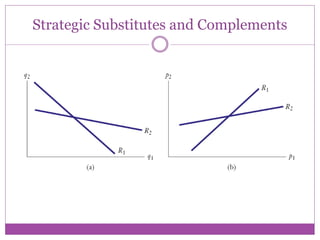
Strategic Complements

 When a firm’s action induces the rival to
  take the same action the actions are strategic
  complements
 In Bertrand duopoly model prices are
  strategic complements
 A price cut is the profit maximizing response
  to competitor’s price cut
 The reaction function is upward sloping
Strategic Substitutes

 When a firm’s action induces the rival to
  take the opposite action the actions are
  strategic substitutes
 In Cournot duopoly model quantities are
  strategic substitutes
 A quantity increase is the profit maximizing
  response to competitor’s quantity reduction
 Reaction function slopes downward
Strategic Substitutes and Complements
Incentives to Make Commitments

 Commitments affect the present value of the
 firm’s profits
  Direct effect: Due entirely to its own tactical decisions
  Strategic effect: Due to the effect on the tactical decisions
   of the competitors
 The strategic effect can be positive or
 negative depending on the choice variables
 being strategic complements or strategic
 substitutes
Tough Commitments and Soft Commitments

 A tough commitment hurts the competitors
  while a soft commitment helps them
 Tough commitment conforms to the
  traditional view of competition
 A soft commitment may be beneficial if the
  strategic effect of the commitment is
  sufficiently positive
The Value of Soft Commitments

 A firm that makes a soft commitment to
  raise its price may experience a negative
  direct effect on its profitability
 If the optimal response of the rival is to raise
  its price, the strategic effect can be beneficial
 If the strategic effect is sufficiently large, the
  net benefit from the commitment will be
  positive
An Analysis of Soft and Tough Commitments

 The market has two firms and decisions are
  made in two stages
 In the first stage Firm 1 makes either a soft
  commitment or a tough commitment
 The second stage competition between the
  rivals will be either Cournot or Bertrand
Cournot After Tough Commitment

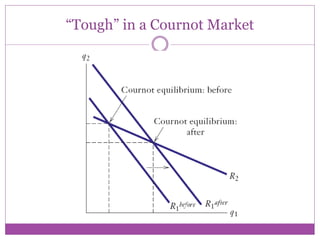
 Firm 1 commits to a higher than previous
  output for every output choice of the rival
 Firm 2’s reaction function makes the
  equilibrium output of Firm 1 even higher
 Firm 2 produces less than what it used to
  produce.
“Tough” in a Cournot Market
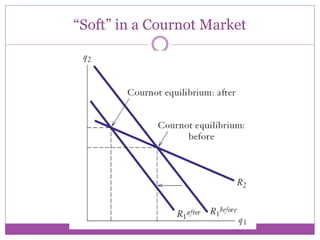
Cournot After Soft Commitment

 Firm 1 shifts its reaction function to the left,
  committing to produce less (than pre-
  commitment level) for every level of rival’s
  output
 Rival’s reaction hurts Firm 1 by making its
  output fall further
 Firm 2 produces more than what it produced
  without Firm 1’s soft commitment
“Soft” in a Cournot Market
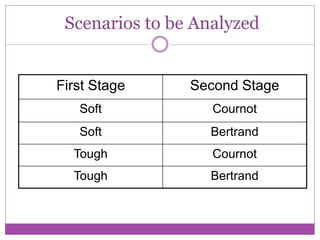
Scenarios to be Analyzed


First Stage     Second Stage
   Soft            Cournot
   Soft           Bertrand
  Tough            Cournot
  Tough           Bertrand
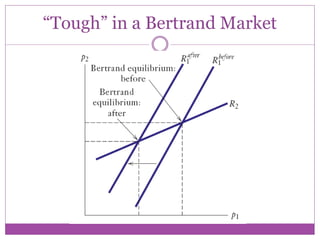
Bertrand After Tough Commitment

 Firm 1 commits to a lower price by shifting
  its reaction function to the left
 Firm 2’s reaction further lowers the
  equilibrium price
 Both firms end up being hurt by Firm 1’s
  tough commitment
“Tough” in a Bertrand Market
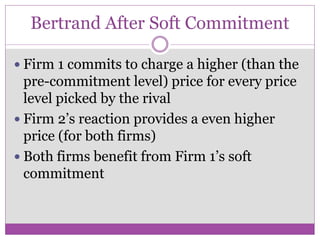
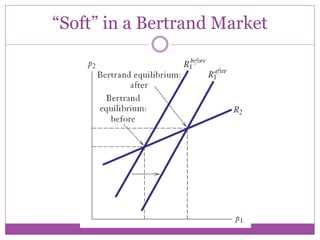
Bertrand After Soft Commitment

 Firm 1 commits to charge a higher (than the
  pre-commitment level) price for every price
  level picked by the rival
 Firm 2’s reaction provides a even higher
  price (for both firms)
 Both firms benefit from Firm 1’s soft
  commitment
“Soft” in a Bertrand Market
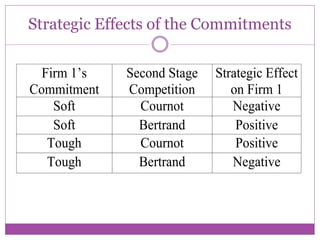
Strategic Effects of the Commitments


  Firm 1’s   Second Stage   Strategic Effect
Commitment   Competition       on Firm 1
    Soft       Cournot         Negative
    Soft       Bertrand         Positive
   Tough       Cournot          Positive
   Tough       Bertrand        Negative
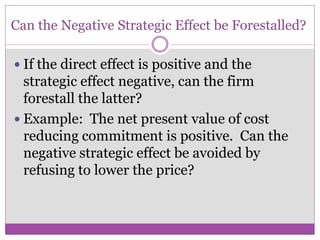
Can the Negative Strategic Effect be Forestalled?

 If the direct effect is positive and the
  strategic effect negative, can the firm
  forestall the latter?
 Example: The net present value of cost
  reducing commitment is positive. Can the
  negative strategic effect be avoided by
  refusing to lower the price?
Can the Negative Strategic Effect be Forestalled?

 If the profit maximizing strategy (after the
  commitment) is to lower the price, rival will
  assume that the firm will do so
 It is difficult to convince a rival that your
  firm will act against its own interest in the
  second stage
A Taxonomy of Strategic Commitments

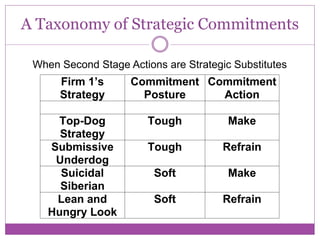
 When Second Stage Actions are Strategic Substitutes
      Firm 1’s      Commitment Commitment
      Strategy        Posture    Action

      Top-Dog           Tough           Make
      Strategy
    Submissive          Tough          Refrain
     Underdog
      Suicidal           Soft           Make
      Siberian
     Lean and            Soft          Refrain
    Hungry Look
A Taxonomy of Strategic Commitments

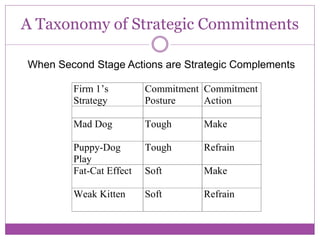
When Second Stage Actions are Strategic Complements

        Firm 1’s         Commitment Commitment
        Strategy         Posture    Action

        Mad Dog          Tough     Make

        Puppy-Dog        Tough     Refrain
        Play
        Fat-Cat Effect   Soft      Make

        Weak Kitten      Soft      Refrain
Factors that Influence the Strategic Effect

 In general, commitments that lead to less
  aggressive behavior from the rivals will have
  beneficial strategic effect
 If the rival is a potential entrant rather than
  an existing firm, a tough commitment to
  price aggressively may deter entry
Factors that Influence the Strategic Effect

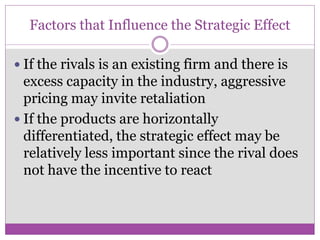
 If the rivals is an existing firm and there is
  excess capacity in the industry, aggressive
  pricing may invite retaliation
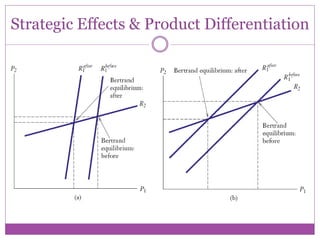
 If the products are horizontally
  differentiated, the strategic effect may be
  relatively less important since the rival does
  not have the incentive to react
Strategic Effects & Product Differentiation
Flexibility and Options

 The value of commitments lies in creating
  inflexibility
 However, when there is uncertainty,
  flexibility is valuable since future options are
  kept open
 Commitments can sacrifice the value of the
  options
Commitment-Flexibility Tradeoff

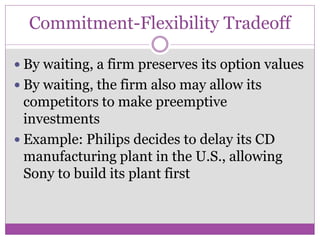
 By waiting, a firm preserves its option values
 By waiting, the firm also may allow its
  competitors to make preemptive
  investments
 Example: Philips decides to delay its CD
  manufacturing plant in the U.S., allowing
  Sony to build its plant first
Preserving Flexibility

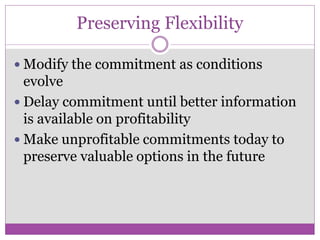
 Modify the commitment as conditions
  evolve
 Delay commitment until better information
  is available on profitability
 Make unprofitable commitments today to
  preserve valuable options in the future
Flexibility and Real Options

 A real option exists if future information can
  be used to tailor decisions
 Better information about demand can be
  utilized by delaying implementation of
  projects
 Value of real options may be limited by the
  risk of preemption
 Key managerial skill in spotting valuable real
  options
A Framework for Analyzing Commitments

 Pankaj Ghemawat has developed a four step
 process for analyzing commitment intensive
 decisions
  Positioning  Analysis
  Sustainability Analysis

  Flexibility Analysis

  Judgment Analysis
Positioning Analysis
 Positioning analysis is akin to the
  determination of the direct effect of
  commitment
 The focus is on whether the firm operates
  with lower costs than its competitors or
  offers superior benefits to its customers
Sustainability Analysis

 Sustainability analysis resembles the
  determination of the strategic effect
 It analyzes the response by competitors and
  potential entrants
 It also looks at the market imperfections
  that protect the firm’s competitive advantage
Flexibility Analysis

 Flexibility analysis incorporates uncertainty
  and option value
 A key determinant of the option value is the
  ratio of the “learn rate” to the “burn rate” of
  the firm
 The rate at which a firm receives new
  information that allows it adjust its strategy
  is termed the “learn rate”
Flexibility Analysis

 The rate at which the firm makes
  irreversible investments in support of its
  strategy is the “burn rate”
 A high learn to burn ratio indicates that the
  option value of delay is low
 Firms can increase their learn to burn ratios
  through experimentation and pilot programs
Judgment Analysis

 Judgment analysis involves looking at the
  organizational and managerial factors to
  ensure that incentives exist to support the
  optimal strategy
 Hierarchical decision making may create a
  bias towards Type I errors - rejecting good
  projects
Judgment Analysis

 Decentralized decision making may result in
  higher incidence of Type II errors -
  accepting unprofitable projects
 Managers should be cognizant of the biases
  imparted by the structure of the
  organization and its politics and culture
Copyright © 2010 John Wiley & Sons, Inc.

All rights reserved. Reproduction or translation of this work beyond
that permitted in section 117 of the1976 United States Copyright Act
without express permission from the copyright owner is unlawful.
Requests for further information should be addressed to the
Permissions Department, John Wiley & Sons, Inc. The purchaser may
make back-up copies for his/her own use only and not for distribution
or resale. The Publisher assumes no responsibility for errors,
omissions, or damages caused by the use of these programs or from
the use of the information herein.

Strategic commitment ~ industry and competitive analysis

  • 1.
    Economics of Strategy Fifth Edition Besanko, Dranove, Shanley, and Schaefer Chapter 9 Strategic Commitment Slides by: Richard Ponarul, California State University, Chico Copyright  2010 John Wiley  Sons, Inc.
  • 2.
    Strategic Commitment  Strategiccommitments  have long run impact and  are hard to reverse  Strategic commitments can affect choices made by rivals  Assessing strategic commitments involves anticipating market rivalry
  • 3.
    Strategic Commitment  Inflexibilitycan add value  Strategic commitment limits options but alters competitors’ expectations  Strategic commitment can make a simultaneous move game into a sequential move game
  • 4.
    Payoffs in theSimple Strategy Selection Game Firm 2 Aggressive Passive Aggressive 12.5, 4.5 16.5, 5 Firm 1 Passive 15, 6.5 18, 6 Net present values are in millions of dollars. First payoff listed is firm 1’s; second is firm 2’s. Unique Nash equilibrium: Firm 1 passive and Firm 2 aggressive
  • 5.
    Sequential Move Game Firm 1 commits itself to be aggressive  Firm 2 finds that it is better of choosing to be passive given firm 1’s commitment  Resulting equilibrium has a bigger payoff for firm 1 compared to what it had in the simultaneous move game
  • 6.
    Strategic Commitment  Toachieve the desired result, the commitment should be  Visible  Understandable  Credible  To be credible, the commitment should be irreversible
  • 7.
    Strategic Commitment  Movesthat represent commitment:  Capacity expansion with investment in relationship specific assets  Contracts with clauses such as most favored customer clause  Public announcements provided the reputation of the firm/management will suffer when not backed by action  The move should be difficult to stop once set in motion
  • 8.
    Strategic Commitment &Competition  Concepts to describe how a firm reacts to price/quantity change by a competitor  Strategic complements  Strategic substitutes  Concepts that distinguish between actions by a firm that puts its competitors at a disadvantage and those that do not  Tough commitments  Soft commitments
  • 9.
    Strategic Complements  Whena firm’s action induces the rival to take the same action the actions are strategic complements  In Bertrand duopoly model prices are strategic complements  A price cut is the profit maximizing response to competitor’s price cut  The reaction function is upward sloping
  • 10.
    Strategic Substitutes  Whena firm’s action induces the rival to take the opposite action the actions are strategic substitutes  In Cournot duopoly model quantities are strategic substitutes  A quantity increase is the profit maximizing response to competitor’s quantity reduction  Reaction function slopes downward
  • 11.
  • 12.
    Incentives to MakeCommitments  Commitments affect the present value of the firm’s profits  Direct effect: Due entirely to its own tactical decisions  Strategic effect: Due to the effect on the tactical decisions of the competitors  The strategic effect can be positive or negative depending on the choice variables being strategic complements or strategic substitutes
  • 13.
    Tough Commitments andSoft Commitments  A tough commitment hurts the competitors while a soft commitment helps them  Tough commitment conforms to the traditional view of competition  A soft commitment may be beneficial if the strategic effect of the commitment is sufficiently positive
  • 14.
    The Value ofSoft Commitments  A firm that makes a soft commitment to raise its price may experience a negative direct effect on its profitability  If the optimal response of the rival is to raise its price, the strategic effect can be beneficial  If the strategic effect is sufficiently large, the net benefit from the commitment will be positive
  • 15.
    An Analysis ofSoft and Tough Commitments  The market has two firms and decisions are made in two stages  In the first stage Firm 1 makes either a soft commitment or a tough commitment  The second stage competition between the rivals will be either Cournot or Bertrand
  • 16.
    Cournot After ToughCommitment  Firm 1 commits to a higher than previous output for every output choice of the rival  Firm 2’s reaction function makes the equilibrium output of Firm 1 even higher  Firm 2 produces less than what it used to produce.
  • 17.
    “Tough” in aCournot Market
  • 18.
    Cournot After SoftCommitment  Firm 1 shifts its reaction function to the left, committing to produce less (than pre- commitment level) for every level of rival’s output  Rival’s reaction hurts Firm 1 by making its output fall further  Firm 2 produces more than what it produced without Firm 1’s soft commitment
  • 19.
    “Soft” in aCournot Market
  • 20.
    Scenarios to beAnalyzed First Stage Second Stage Soft Cournot Soft Bertrand Tough Cournot Tough Bertrand
  • 21.
    Bertrand After ToughCommitment  Firm 1 commits to a lower price by shifting its reaction function to the left  Firm 2’s reaction further lowers the equilibrium price  Both firms end up being hurt by Firm 1’s tough commitment
  • 22.
    “Tough” in aBertrand Market
  • 23.
    Bertrand After SoftCommitment  Firm 1 commits to charge a higher (than the pre-commitment level) price for every price level picked by the rival  Firm 2’s reaction provides a even higher price (for both firms)  Both firms benefit from Firm 1’s soft commitment
  • 24.
    “Soft” in aBertrand Market
  • 25.
    Strategic Effects ofthe Commitments Firm 1’s Second Stage Strategic Effect Commitment Competition on Firm 1 Soft Cournot Negative Soft Bertrand Positive Tough Cournot Positive Tough Bertrand Negative
  • 26.
    Can the NegativeStrategic Effect be Forestalled?  If the direct effect is positive and the strategic effect negative, can the firm forestall the latter?  Example: The net present value of cost reducing commitment is positive. Can the negative strategic effect be avoided by refusing to lower the price?
  • 27.
    Can the NegativeStrategic Effect be Forestalled?  If the profit maximizing strategy (after the commitment) is to lower the price, rival will assume that the firm will do so  It is difficult to convince a rival that your firm will act against its own interest in the second stage
  • 28.
    A Taxonomy ofStrategic Commitments When Second Stage Actions are Strategic Substitutes Firm 1’s Commitment Commitment Strategy Posture Action Top-Dog Tough Make Strategy Submissive Tough Refrain Underdog Suicidal Soft Make Siberian Lean and Soft Refrain Hungry Look
  • 29.
    A Taxonomy ofStrategic Commitments When Second Stage Actions are Strategic Complements Firm 1’s Commitment Commitment Strategy Posture Action Mad Dog Tough Make Puppy-Dog Tough Refrain Play Fat-Cat Effect Soft Make Weak Kitten Soft Refrain
  • 30.
    Factors that Influencethe Strategic Effect  In general, commitments that lead to less aggressive behavior from the rivals will have beneficial strategic effect  If the rival is a potential entrant rather than an existing firm, a tough commitment to price aggressively may deter entry
  • 31.
    Factors that Influencethe Strategic Effect  If the rivals is an existing firm and there is excess capacity in the industry, aggressive pricing may invite retaliation  If the products are horizontally differentiated, the strategic effect may be relatively less important since the rival does not have the incentive to react
  • 32.
    Strategic Effects &Product Differentiation
  • 33.
    Flexibility and Options The value of commitments lies in creating inflexibility  However, when there is uncertainty, flexibility is valuable since future options are kept open  Commitments can sacrifice the value of the options
  • 34.
    Commitment-Flexibility Tradeoff  Bywaiting, a firm preserves its option values  By waiting, the firm also may allow its competitors to make preemptive investments  Example: Philips decides to delay its CD manufacturing plant in the U.S., allowing Sony to build its plant first
  • 35.
    Preserving Flexibility  Modifythe commitment as conditions evolve  Delay commitment until better information is available on profitability  Make unprofitable commitments today to preserve valuable options in the future
  • 36.
    Flexibility and RealOptions  A real option exists if future information can be used to tailor decisions  Better information about demand can be utilized by delaying implementation of projects  Value of real options may be limited by the risk of preemption  Key managerial skill in spotting valuable real options
  • 37.
    A Framework forAnalyzing Commitments  Pankaj Ghemawat has developed a four step process for analyzing commitment intensive decisions  Positioning Analysis  Sustainability Analysis  Flexibility Analysis  Judgment Analysis
  • 38.
    Positioning Analysis  Positioninganalysis is akin to the determination of the direct effect of commitment  The focus is on whether the firm operates with lower costs than its competitors or offers superior benefits to its customers
  • 39.
    Sustainability Analysis  Sustainabilityanalysis resembles the determination of the strategic effect  It analyzes the response by competitors and potential entrants  It also looks at the market imperfections that protect the firm’s competitive advantage
  • 40.
    Flexibility Analysis  Flexibilityanalysis incorporates uncertainty and option value  A key determinant of the option value is the ratio of the “learn rate” to the “burn rate” of the firm  The rate at which a firm receives new information that allows it adjust its strategy is termed the “learn rate”
  • 41.
    Flexibility Analysis  Therate at which the firm makes irreversible investments in support of its strategy is the “burn rate”  A high learn to burn ratio indicates that the option value of delay is low  Firms can increase their learn to burn ratios through experimentation and pilot programs
  • 42.
    Judgment Analysis  Judgmentanalysis involves looking at the organizational and managerial factors to ensure that incentives exist to support the optimal strategy  Hierarchical decision making may create a bias towards Type I errors - rejecting good projects
  • 43.
    Judgment Analysis  Decentralizeddecision making may result in higher incidence of Type II errors - accepting unprofitable projects  Managers should be cognizant of the biases imparted by the structure of the organization and its politics and culture
  • 44.
    Copyright © 2010John Wiley & Sons, Inc. All rights reserved. Reproduction or translation of this work beyond that permitted in section 117 of the1976 United States Copyright Act without express permission from the copyright owner is unlawful. Requests for further information should be addressed to the Permissions Department, John Wiley & Sons, Inc. The purchaser may make back-up copies for his/her own use only and not for distribution or resale. The Publisher assumes no responsibility for errors, omissions, or damages caused by the use of these programs or from the use of the information herein.