U N I T E D N AT I O N S C O N F E R E N C E O N T R A D E A N D D E V E L O P M E N T
2019
STATE OF COMMODITY
DEPENDENCE
Geneva, 2019
© 2019, United Nations
All rights reserved worldwide
Requests to reproduce excerpts or to photocopy should be addressed to the Copyright Clearance Center at
copyright.com.
All other queries on rights and licenses, including subsidiary rights, should be addressed to: United Nations
Publications, 300 East 42nd St, New York, NY 10017, United States of America.
Email: publications@un.org; website: un.org/publications
The findings, interpretations, and conclusions expressed herein are those of the author(s) and do not necessarily
reflect the views of the United Nations or its officials or Member States.
This publication has been edited externally.
United Nations publication issued by the United Nations Conference on Trade and Development.
UNCTAD | DITC | COM | 2019 | 1
ISBN: 978-92-1-112945-8
eISBN: 978-92-1-004034-1
Sales no.: E.19.II.D.8
Print ISSN: 2663-7111
Online ISSN: 2663-712X
iii
Acknowledgements
Acknowledgements
The State of Commodity Dependence 2019 was prepared by the Commodities Branch of the Division on International
Trade and Commodities of UNCTAD, under the overall guidance of Pamela Coke-Hamilton, Division Director.
Yanchun Zhang, Chief of Commodities Branch, led the writing team, comprising Rodrigo Carcamo and Alexandra
Laurent.
The report benefited from comments received from UNCTAD colleagues Janvier Nkurunziza and Romain Perez.
Onno Hoffmeister provided the commodity price series included in the report. Catherine Katongola and Danièle
Boglio of the Commodities Branch provided administrative assistance.
Magali Studer created the publication’s cover and was responsible for the desktop publishing and graphics.
For further information about this publication, please contact the Commodities Branch, Division on International
Trade and Commodities, UNCTAD, Palais des Nations, CH-1211 Geneva 10, Switzerland, tel. +41 22 917 56 76,
e-mail: commodities@unctad.org.
Table of contents Introduction
Chapter 1
Key Findings
from the Report
Chapter 2
Country Statistical
Profiles
List of Country
Statistical Profiles
THE STATE OF COMMODITY DEPENDENCE 2019
iv
Introduction
A country is considered to be export-commodity-dependent when more than 60 per cent of its total merchandise
exports are composed of commodities. Given that commodity dependence can have a negative impact on a
country’s economic development, it is extremely important to monitor the evolution of such dependence in countries
throughout the world. In particular, detailed statistics on commodity dependence provide an invaluable tool for a
comprehensive analysis of its causes and consequences, and contribute significantly to the policy debate about
measures necessary to address it in the short and long terms.
The UNCTAD report titled State of Commodity Dependence is published every two years. This 2019 issue contains
statistical profiles for 189 countries comprising 30 indicators aimed at describing the extent of each country’s export
and import commodity dependence, as well as key structural and socioeconomic variables that are related to the
commodity dependence phenomenon, such as growth of gross domestic product (GDP) and per capita GDP levels,
the Human Development Index, value added by sector of the economy and institutional quality index, among others.
In order to expand the knowledge about commodity dependence, some changes have been made since the
2016 edition of the report. For example, statistical profiles for individual developed countries and economies in
transition have been added to those for individual developing countries. Also, the key socioeconomic and structural
indicators in each country profile have been revised, and an additional historical reference point (the year 1995, when
UNCTADStat started to disaggregate trade data) has been included for each monitored variable.
Further, an analytical chapter has been included in this 2019 issue of the State of Commodity Dependence to
complement the rich statistical section. The following are its key elements:
•	 Characterizes and quantifies the state of commodity dependence around the world.
•	 Presents the evolution of world commodity dependence over the past 20 years and provides examples
of how exports of countries with different economic structures and commodity dependence have evolved
during this period.
•	 Examines how economic growth and external debt deteriorated in many CDDCs following the drop in
commodity prices from their peak values.
•	 Explores the relationship between the level of development (measured in terms of GDP per capita), and
export concentration, in countries with different compositions of their export basket.
The topics covered in the analytical chapter of the State of Commodity Dependence 2019 are elaborated
in more detail in a background paper entitled “Commodity Dependence: A Twenty-Year Perspective”
(UNCTAD/DITC/COM/2019/2).
Material in this publication may be freely quoted or reprinted, but acknowledgement is requested, together with a
copy of the publication containing the quotation or reprint, to be sent to the UNCTAD secretariat.
Table of contents Introduction
Chapter 1
Key Findings
from the Report
Chapter 2
Country Statistical
Profiles
List of Country
Statistical Profiles
v
TABLE OF CONTENTS
Table of contents
Acknowledgements . . . . . . . . . . . . . . . . . . . . . . . . . . . . . . . . . . . . . . . . . . . . . . . . . . . . . . . iii
Introduction . . . . . . . . . . . . . . . . . . . . . . . . . . . . . . . . . . . . . . . . . . . . . . . . . . . . . . . . . . . . . iv
Abbreviations and Acronyms . . . . . . . . . . . . . . . . . . . . . . . . . . . . . . . . . . . . . . . . . . . . . . . . vi
Chapter 1 - Key Findings from the Report  . . . . . . . . . . . . . . . . . . . . . . . . . . . . . . . . . . . . . . 1
Chapter 2 - Country Statistical Profiles . . . . . . . . . . . . . . . . . . . . . . . . . . . . . . . . . . . . . . . . 21
List of Country Statistical Profiles . . . . . . . . . . . . . . . . . . . . . . . . . . . . . . . . . . . . . . . . . . . . 22
Commodity-Dependent Countries and country classifications, 2013–2017 . . . . . . . . . . . . . 25
Explanatory Notes for the Country Statistical Profiles . . . . . . . . . . . . . . . . . . . . . . . . . . . . 220
List of Standard International Trade Classification (SITC), Third Revision Codes . . . . . . . . . 237
Table of contents Introduction
Chapter 1
Key Findings
from the Report
Chapter 2
Country Statistical
Profiles
List of Country
Statistical Profiles
THE STATE OF COMMODITY DEPENDENCE 2019
vi
	ABBREVIATIONS AND ACRONYMS
	
	CDC	 commodity-dependent country	
	 CDDC	 commodity-dependent developing country	
	 EIA	 Energy Information Administration (United States)	
	 GDP	 gross domestic product	
	 Ha	hectare	
	HDI	 Human Development Index	
	LDC	 least developed country	
	LLDC	 landlocked developing country	
	OPEC 	 Organization of the Petroleum Exporting Countries	
	SIDS	 small island developing States	
	SITC	 Standard International Trade Classification	
	USDA	 United States Department of Agriculture	
	USGS	 United States Geological Survey	
Table of contents Introduction
Chapter 1
Key Findings
from the Report
Chapter 2
Country Statistical
Profiles
List of Country
Statistical Profiles
KEY FINDINGS FROM THE REPORT
CHAPTER 1
Key Findings
from the Report
THE STATE OF COMMODITY DEPENDENCE 2019THE STATE OF COMMODITY DEPENDENCE 2019
Table of contents Introduction
Chapter 1
Key Findings
from the Report
Chapter 2
Country Statistical
Profiles
List of Country
Statistical Profiles
2
Morethanhalfofallcountries,andtwothirdsofdevelopingcountries
are commodity-dependent
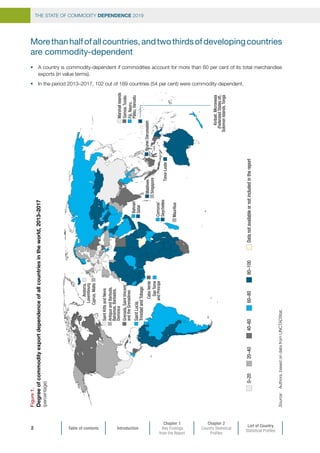
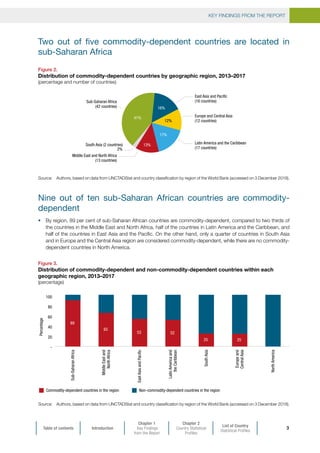
•	 A country is commodity-dependent if commodities account for more than 60 per cent of its total merchandise
exports (in value terms).
•	 In the period 2013–2017, 102 out of 189 countries (54 per cent) were commodity-dependent.Andorra,
Luxembourg
AntiguaandBarbuda,
Bahamas,Barbados,
Dominica
Bahrain
BruneiDarussalamCaboVerde
Comoros
Cyprus,Malta
Fiji,Nauru,
Palau,Vanuatu
Grenada,SaintVincent
andtheGrenadines
Kiribati,Micronesia
(FederatedStatesof),
SolomonIslands,Tonga
Maldives
MarshallIslands
Mauritius
Qatar
SaintKittsandNevis
SaintLucia,
TrinidadandTobago
Samoa,Tuvalu
SaoTome
andPrincipe
Seychelles
Singapore
Timor-Leste
0–2020–4040–6060–8080–100Datanotavailableornotincludedinthereport
Source:	Authors,basedondatafromUNCTADStat.
Figure1.
Degreeofcommodityexportdependenceofallcountriesintheworld,2013–2017
(percentage)
KEY FINDINGS FROM THE REPORT
Table of contents Introduction
Chapter 1
Key Findings
from the Report
Chapter 2
Country Statistical
Profiles
List of Country
Statistical Profiles
3
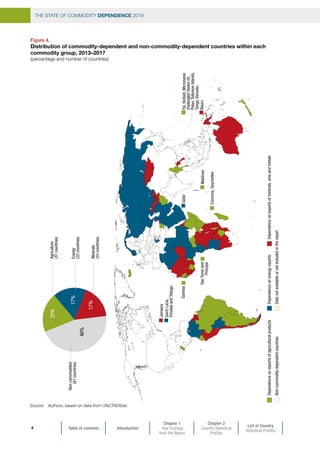
Two out of five commodity-dependent countries are located in
sub-Saharan Africa
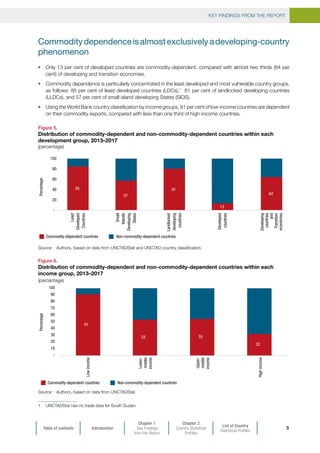
Nine out of ten sub-Saharan African countries are commodity-
dependent
•	 By region, 89 per cent of sub-Saharan African countries are commodity-dependent, compared to two thirds of
the countries in the Middle East and North Africa, half of the countries in Latin America and the Caribbean, and
half of the countries in East Asia and the Pacific. On the other hand, only a quarter of countries in South Asia
and in Europe and the Central Asia region are considered commodity-dependent, while there are no commodity-
dependent countries in North America.
Figure 3.
Distribution of commodity-dependent and non-commodity-dependent countries within each
geographic region, 2013–2017
(percentage)
Source:	 Authors, based on data from UNCTADStat and country classification by region of the World Bank (accessed on 3 December 2018).
-
20
40
60
80
100
89
Sub-SaharanAfrica
65
MiddleEastand
NorthAfrica
53
EastAsiaandPacific
52
LatinAmericaand
theCaribbean
25
Europeand
CentralAsia
NorthAmerica
Percentage
25
SouthAsia
Commodity-dependent countries in the region Non–commodity-dependent countries in the region
Figure 2.
Distribution of commodity-dependent countries by geographic region, 2013–2017
(percentage and number of countries)
Source:	 Authors, based on data from UNCTADStat and country classification by region of the World Bank (accessed on 3 December 2018).
Sub-Saharan Africa
(42 countries)
41%
East Asia and Pacific
(16 countries)
16%
Europe and Central Asia
(12 countries)12%
Latin America and the Caribbean
(17 countries)
17%
Middle East and North Africa
(13 countries)
13%South Asia (2 countries)
2%
THE STATE OF COMMODITY DEPENDENCE 2019THE STATE OF COMMODITY DEPENDENCE 2019
Table of contents Introduction
Chapter 1
Key Findings
from the Report
Chapter 2
Country Statistical
Profiles
List of Country
Statistical Profiles
4
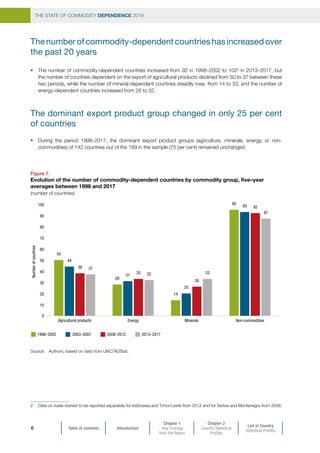
Figure 4.
Distribution of commodity-dependent and non-commodity-dependent countries within each
commodity group, 2013–2017
(percentage and number of countries)
Comoros,Seychelles
Fiji,Kiribati,Micronesia
(FederatedStatesof),
Palau,SolomonIslands,
Tonga,Vanuatu
Gambia
Jamaica
MaldivesNauru
Qatar
SaintLucia,
TrinidadandTobago
SaoTomeand
Principe
Non-commoditydependentcountries
Dependenceonexportsofminerals,oresandmetalsDependenceonexportsofagriculturalproductsDependenceonenergyexports
Datanotavailableornotincludedinthereport
Non-commodities
(87countries)
46%
Agriculture
(37countries)
20%
17%
17%Energy
(32countries)
Minerals
(33countries)
Source:	 Authors, based on data from UNCTADStat.
KEY FINDINGS FROM THE REPORT
Table of contents Introduction
Chapter 1
Key Findings
from the Report
Chapter 2
Country Statistical
Profiles
List of Country
Statistical Profiles
5
Commoditydependenceisalmostexclusivelyadeveloping-country
phenomenon
•	 Only 13 per cent of developed countries are commodity-dependent, compared with almost two thirds (64 per
cent) of developing and transition economies.
•	 Commodity dependence is particularly concentrated in the least developed and most vulnerable country groups,
as follows: 85 per cent of least developed countries (LDCs),1
81 per cent of landlocked developing countries
(LLDCs), and 57 per cent of small island developing States (SIDS).
•	 Using the World Bank country classification by income groups, 91 per cent of low-income countries are dependent
on their commodity exports, compared with less than one third of high-income countries.
1 	 UNCTADStat has no trade data for South Sudan.
Figure 5.
Distribution of commodity-dependent and non-commodity-dependent countries within each
development group, 2013–2017
(percentage)
Source:	 Authors, based on data from UNCTADStat and UNCTAD country classification.
-
85
Least
Developed
Countries
57
Small
Islands
Developing
States
81
Landlocked
developing
countries
13
Developed
countries
64
Developing
countries
and
Transition
economies
Percentage
Commodity-dependent countries Non-commodity-dependent countries
20
40
60
80
100
Figure 6.
Distribution of commodity-dependent and non-commodity-dependent countries within each
income group, 2013–2017
(percentage)
Source:	 Authors, based on data from UNCTADStat.
Lowincome
Lower-
middle
income
Upper-
middle
income
Highincome
Percentage
Commodity-dependent countries Non-commodity-dependent countries
91
53 55
32
-
10
20
30
40
50
60
70
80
90
100
THE STATE OF COMMODITY DEPENDENCE 2019
Table of contents Introduction
Chapter 1
Key Findings
from the Report
Chapter 2
Country Statistical
Profiles
List of Country
Statistical Profiles
6
Thenumberofcommodity-dependentcountrieshasincreasedover
the past 20 years
•	 The number of commodity-dependent countries increased from 92 in 1998–2002 to 1022
in 2013–2017, but
the number of countries dependent on the export of agricultural products declined from 50 to 37 between these
two periods, while the number of mineral-dependent countries steadily rose, from 14 to 33, and the number of
energy-dependent countries increased from 28 to 32.
The dominant export product group changed in only 25 per cent
of countries
•	 During the period 1998–2017, the dominant export product groups (agriculture, minerals, energy, or non-
commodities) of 142 countries out of the 189 in the sample (75 per cent) remained unchanged.
2 	 Data on trade started to be reported separately for Indonesia and Timor-Leste from 2012 and for Serbia and Montenegro from 2008.
Figure 7.
Evolution of the number of commodity-dependent countries by commodity group, five–year
averages between 1998 and 2017
(number of countries)
Source:	 Authors, based on data from UNCTADStat.
0
10
20
30
40
50
60
70
80
90
100
50
44
38 37
Agricultural products
28
31
33 32
Energy
14
20
26
33
Minerals
95
93 92
87
Non-commodities
Numberofcountries
2013–20171998–2002 2003–2007 2008–2012
KEY FINDINGS FROM THE REPORT
Table of contents Introduction
Chapter 1
Key Findings
from the Report
Chapter 2
Country Statistical
Profiles
List of Country
Statistical Profiles
7
Changes in commodity prices partly explain the evolution of
commodity dependence by product group
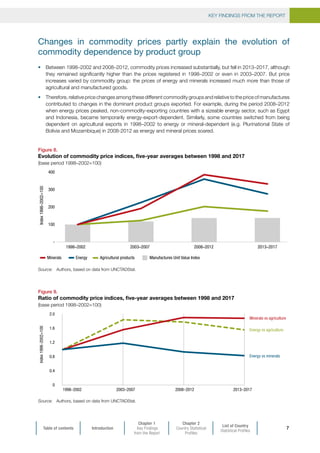
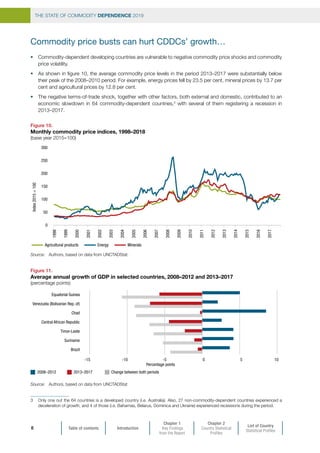
•	 Between 1998–2002 and 2008–2012, commodity prices increased substantially, but fell in 2013–2017, although
they remained significantly higher than the prices registered in 1998–2002 or even in 2003–2007. But price
increases varied by commodity group: the prices of energy and minerals increased much more than those of
agricultural and manufactured goods.
•	 Therefore, relative price changes among these different commodity groups and relative to the price of manufactures
contributed to changes in the dominant product groups exported. For example, during the period 2008–2012
when energy prices peaked, non-commodity-exporting countries with a sizeable energy sector, such as Egypt
and Indonesia, became temporarily energy-export-dependent. Similarly, some countries switched from being
dependent on agricultural exports in 1998–2002 to energy or mineral-dependent (e.g. Plurinational State of
Bolivia and Mozambique) in 2008-2012 as energy and mineral prices soared.
Figure 8.
Evolution of commodity price indices, five-year averages between 1998 and 2017
(base period 1998–2002=100)
Source:	 Authors, based on data from UNCTADStat.
-
100
200
300
400
1998–2002 2003–2007 2008–2012 2013–2017
Index1998–2002=100
Manufactures Unit Value IndexMinerals Energy Agricultural products
Figure 9.
Ratio of commodity price indices, five-year averages between 1998 and 2017
(base period 1998–2002=100)
Source:	 Authors, based on data from UNCTADStat.
0
0.4
0.8
1.2
1.6
2.0
Minerals vs agriculture
Energy vs agriculture
Energy vs minerals
Index1998–2002=100
1998–2002 2003–2007 2008–2012 2013–2017
THE STATE OF COMMODITY DEPENDENCE 2019
Table of contents Introduction
Chapter 1
Key Findings
from the Report
Chapter 2
Country Statistical
Profiles
List of Country
Statistical Profiles
8
Commodity price busts can hurt CDDCs’ growth…
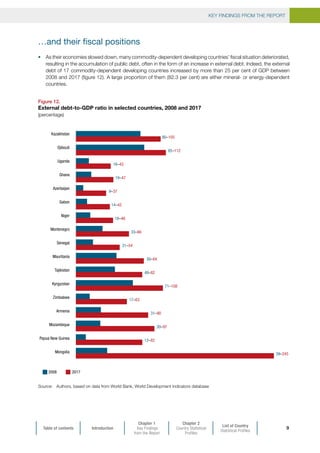
•	 Commodity-dependent developing countries are vulnerable to negative commodity price shocks and commodity
price volatility.
•	 As shown in figure 10, the average commodity price levels in the period 2013–2017 were substantially below
their peak of the 2008–2010 period. For example, energy prices fell by 23.5 per cent, mineral prices by 13.7 per
cent and agricultural prices by 12.8 per cent.
•	 The negative terms-of-trade shock, together with other factors, both external and domestic, contributed to an
economic slowdown in 64 commodity-dependent countries,3
with several of them registering a recession in
2013–2017.
3 	 Only one out the 64 countries is a developed country (i.e. Australia). Also, 27 non-commodity-dependent countries experienced a
deceleration of growth, and 4 of those (i.e. Bahamas, Belarus, Dominica and Ukraine) experienced recessions during the period.
Figure 10.
Monthly commodity price indices, 1998–2018
(base year 2015=100)
Source:	 Authors, based on data from UNCTADStat.
0
50
100
150
200
250
300
1998
1999
2000
2001
2002
2003
2004
2005
2006
2007
2008
2009
2010
2011
2012
2013
2014
2015
2016
2017
Index2015=100
Agricultural products Energy Minerals
Figure 11.
Average annual growth of GDP in selected countries, 2008–2012 and 2013–2017
(percentage points)
Source:	 Authors, based on data from UNCTADStat
-15 -10 -5 0 5 10
Brazil
Suriname
Timor-Leste
Central African Republic
Chad
Venezuela (Bolivarian Rep. of)
Equatorial Guinea
Percentage points
Change between both periods2008–2012 2013–2017
KEY FINDINGS FROM THE REPORT
Table of contents Introduction
Chapter 1
Key Findings
from the Report
Chapter 2
Country Statistical
Profiles
List of Country
Statistical Profiles
9
…and their fiscal positions
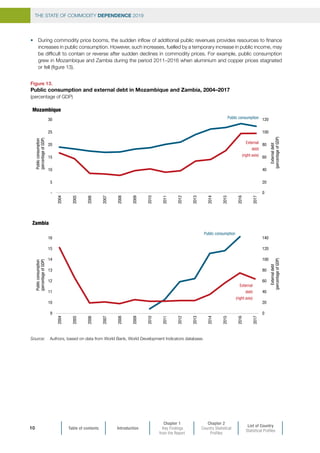
•	 As their economies slowed down, many commodity-dependent developing countries’ fiscal situation deteriorated,
resulting in the accumulation of public debt, often in the form of an increase in external debt. Indeed, the external
debt of 17 commodity-dependent developing countries increased by more than 25 per cent of GDP between
2008 and 2017 (figure 12). A large proportion of them (82.3 per cent) are either mineral- or energy-dependent
countries.
Figure 12.
External debt-to-GDP ratio in selected countries, 2008 and 2017
(percentage)
Source:	 Authors, based on data from World Bank, World Development Indicators database
Mongolia
Papua New Guinea
Mozambique
Armenia
Zimbabwe
Kyrgyzstan
Tajikistan
Mauritania
Senegal
Montenegro
Niger
Gabon
Azerbaijan
Ghana
Uganda
Djibouti
Kazakhstan
2008 2017
80–105
85–112
16–43
19–47
9–37
14–42
18–46
33–66
21–54
50–84
48–82
71–108
17–63
31–90
30–97
12–82
39–245
THE STATE OF COMMODITY DEPENDENCE 2019
Table of contents Introduction
Chapter 1
Key Findings
from the Report
Chapter 2
Country Statistical
Profiles
List of Country
Statistical Profiles
10
•	 During commodity price booms, the sudden inflow of additional public revenues provides resources to finance
increases in public consumption. However, such increases, fuelled by a temporary increase in public income, may
be difficult to contain or reverse after sudden declines in commodity prices. For example, public consumption
grew in Mozambique and Zambia during the period 2011–2016 when aluminium and copper prices stagnated
or fell (figure 13).
Figure 13.
Public consumption and external debt in Mozambique and Zambia, 2004–2017
(percentage of GDP)
Source:	 Authors, based on data from World Bank, World Development Indicators database.
0
20
40
60
80
100
120
-
5
10
15
20
25
30
Externaldebt
(percentageofGDP)
Publicconsumption
(percentageofGDP)
Public consumption
External
debt
(right axis)
Mozambique
0
20
40
60
80
100
120
140
9
10
11
12
13
14
15
16
2004
2005
2006
2007
2008
2009
2010
2011
2012
2013
2014
2015
2016
2017
Public consumption
External
debt
(right axis)
Zambia
Publicconsumption
(percentageofGDP)
2004
2005
2006
2007
2008
2009
2010
2011
2012
2013
2014
2015
2016
2017
Externaldebt
(percentageofGDP)
KEY FINDINGS FROM THE REPORT
Table of contents Introduction
Chapter 1
Key Findings
from the Report
Chapter 2
Country Statistical
Profiles
List of Country
Statistical Profiles
11
While remaining commodity-dependent, some energy-export-
dependent CDDCs managed to increase the share of their non-
commodity exports by adding value in their downstream sectors…
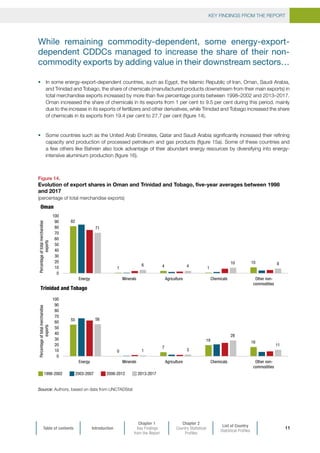
•	 In some energy-export-dependent countries, such as Egypt, the Islamic Republic of Iran, Oman, Saudi Arabia,
and Trinidad and Tobago, the share of chemicals (manufactured products downstream from their main exports) in
total merchandise exports increased by more than five percentage points between 1998–2002 and 2013–2017.
Oman increased the share of chemicals in its exports from 1 per cent to 9.5 per cent during this period, mainly
due to the increase in its exports of fertilizers and other derivatives, while Trinidad and Tobago increased the share
of chemicals in its exports from 19.4 per cent to 27.7 per cent (figure 14).
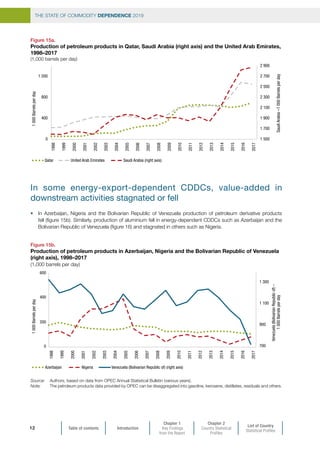
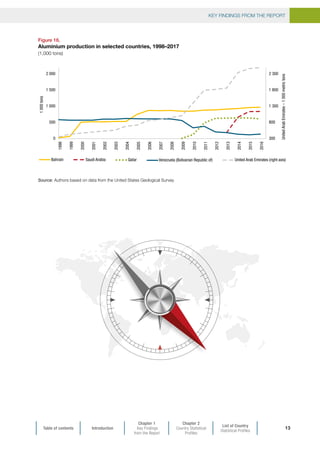
•	 Some countries such as the United Arab Emirates, Qatar and Saudi Arabia significantly increased their refining
capacity and production of processed petroleum and gas products (figure 15a). Some of these countries and
a few others like Bahrein also took advantage of their abundant energy resources by diversifying into energy-
intensive aluminium production (figure 16).
Figure 14.
Evolution of export shares in Oman and Trinidad and Tobago, five-year averages between 1998
and 2017
(percentage of total merchandise exports)
Source: Authors, based on data from UNCTADStat
82
1 4 1
10
71
6 4
10 8
0
10
20
30
40
50
60
70
80
90
100
Energy Minerals Agriculture Chemicals Other non-
commodities
Percentageoftotalmerchandise
exports
1998-2002 2003-2007 2008-2012 2013-2017
Oman
55
0
7
19 16
56
1 3
28
11
0
10
20
30
40
50
60
70
80
90
100
Energy Minerals Agriculture Chemicals Other non-
commodities
Percentageoftotalmerchandise
exports
Trinidad and Tobago
THE STATE OF COMMODITY DEPENDENCE 2019
Table of contents Introduction
Chapter 1
Key Findings
from the Report
Chapter 2
Country Statistical
Profiles
List of Country
Statistical Profiles
12
Figure 15b.
Production of petroleum products in Azerbaijan, Nigeria and the Bolivarian Republic of Venezuela
(right axis), 1998–2017
(1,000 barrels per day)
Source:	 Authors, based on data from OPEC Annual Statistical Bulletin (various years).
Note: 	 The petroleum products data provided by OPEC can be disaggregated into gasoline, kerosene, distillates, residuals and others.
700
900
1 100
1 300
0
200
400
600
1998
1999
2000
2001
2002
2003
2004
2005
2006
2007
2008
2009
2010
2011
2012
2013
2014
2015
2016
2017
Venezuela(BolivarianRepublicof)–
1000Barrelsperday
1000Barrelsperday
Azerbaijan Nigeria Venezuela (Bolivarian Republic of) (right axis)
Figure 15a.
Production of petroleum products in Qatar, Saudi Arabia (right axis) and the United Arab Emirates,
1998–2017
(1,000 barrels per day)
In some energy-export-dependent CDDCs, value-added in
downstream activities stagnated or fell
•	 In Azerbaijan, Nigeria and the Bolivarian Republic of Venezuela production of petroleum derivative products
fell (figure 15b). Similarly, production of aluminium fell in energy-dependent CDDCs such as Azerbaijan and the
Bolivarian Republic of Venezuela (figure 16) and stagnated in others such as Nigeria.
1 500
1 700
1 900
2 100
2 300
2 500
2 700
2 900
0
400
800
1 200
1998
1999
2000
2001
2002
2003
2004
2005
2006
2007
2008
2009
2010
2011
2012
2013
2014
2015
2016
2017
SaudiArabia–1000Barrelsperday
1000Barrelsperday
Qatar United Arab Emirates Saudi Arabia (right axis)
KEY FINDINGS FROM THE REPORT
Table of contents Introduction
Chapter 1
Key Findings
from the Report
Chapter 2
Country Statistical
Profiles
List of Country
Statistical Profiles
13
Figure 16.
Aluminium production in selected countries, 1998–2017
(1,000 tons)
Source: Authors based on data from the United States Geological Survey.
300
800
1 300
1 800
2 300
0
500
1 000
1 500
2 000
1998
1999
2000
2001
2002
2003
2004
2005
2006
2007
2008
2009
2010
2011
2012
2013
2014
2015
2016
UnitedArabEmirates–1000metrictons
1000tons
Bahrain QatarSaudi Arabia Venezuela (Bolivarian Republic of) United Arab Emirates (right axis)
THE STATE OF COMMODITY DEPENDENCE 2019
Table of contents Introduction
Chapter 1
Key Findings
from the Report
Chapter 2
Country Statistical
Profiles
List of Country
Statistical Profiles
14
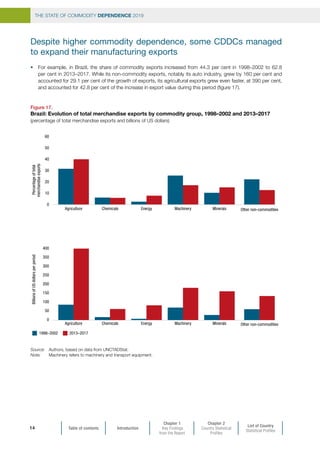
Despite higher commodity dependence, some CDDCs managed
to expand their manufacturing exports
•	 For example, in Brazil, the share of commodity exports increased from 44.3 per cent in 1998–2002 to 62.8
per cent in 2013–2017. While its non-commodity exports, notably its auto industry, grew by 160 per cent and
accounted for 29.1 per cent of the growth of exports, its agricultural exports grew even faster, at 390 per cent,
and accounted for 42.8 per cent of the increase in export value during this period (figure 17).
Figure 17.
Brazil: Evolution of total merchandise exports by commodity group, 1998–2002 and 2013–2017
(percentage of total merchandise exports and billions of US dollars)
Source:	 Authors, based on data from UNCTADStat.
Note: 	 Machinery refers to machinery and transport equipment.
2013–20171998–2002
0
10
20
30
40
50
60
Percentageoftotal
merchandiseexports
Chemicals
Chemicals
Energy
Energy
Other non-commodities
Minerals
Minerals
Machinery
Machinery
Agriculture
Agriculture
0
50
100
150
200
250
300
350
400
BillionsofUSdollarsperperiod
KEY FINDINGS FROM THE REPORT
Table of contents Introduction
Chapter 1
Key Findings
from the Report
Chapter 2
Country Statistical
Profiles
List of Country
Statistical Profiles
15
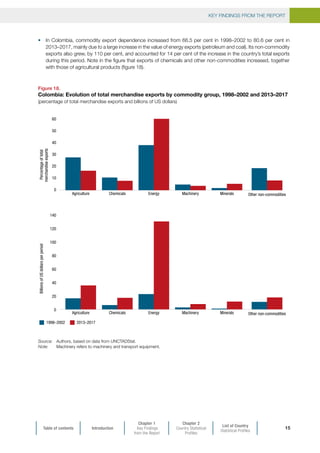
•	 In Colombia, commodity export dependence increased from 66.5 per cent in 1998–2002 to 80.6 per cent in
2013–2017, mainly due to a large increase in the value of energy exports (petroleum and coal). Its non-commodity
exports also grew, by 110 per cent, and accounted for 14 per cent of the increase in the country’s total exports
during this period. Note in the figure that exports of chemicals and other non-commodities increased, together
with those of agricultural products (figure 18).
Figure 18.
Colombia: Evolution of total merchandise exports by commodity group, 1998–2002 and 2013–2017
(percentage of total merchandise exports and billions of US dollars)
Source:	 Authors, based on data from UNCTADStat.
Note: 	 Machinery refers to machinery and transport equipment.
0
20
40
60
80
100
120
140
2013–20171998–2002
0
10
20
30
40
50
60
Percentageoftotal
merchandiseexports
Chemicals
Chemicals
Energy
Energy
Other non-commodities
Minerals
Minerals
Machinery
Machinery
Agriculture
Agriculture
BillionsofUSdollarsperperiod
THE STATE OF COMMODITY DEPENDENCE 2019
Table of contents Introduction
Chapter 1
Key Findings
from the Report
Chapter 2
Country Statistical
Profiles
List of Country
Statistical Profiles
16
Some CDDCs dependent on energy and mineral exports diversified
their exports by boosting agriculture
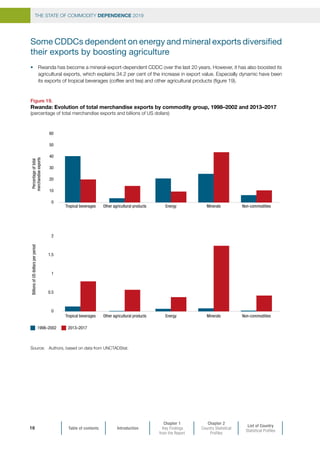
•	 Rwanda has become a mineral-export-dependent CDDC over the last 20 years. However, it has also boosted its
agricultural exports, which explains 34.2 per cent of the increase in export value. Especially dynamic have been
its exports of tropical beverages (coffee and tea) and other agricultural products (figure 19).
Figure 19.
Rwanda: Evolution of total merchandise exports by commodity group, 1998–2002 and 2013–2017
(percentage of total merchandise exports and billions of US dollars)
Source: 	 Authors, based on data from UNCTADStat.
0
10
20
30
40
50
60
0
0.5
1
1.5
2
2013–20171998–2002
Percentageoftotal
merchandiseexports
BillionsofUSdollarsperperiod
Tropical beverages
Tropical beverages
Other agricultural products
Energy
Energy
Minerals
Minerals
Non-commodities
Non-commodities
KEY FINDINGS FROM THE REPORT
Table of contents Introduction
Chapter 1
Key Findings
from the Report
Chapter 2
Country Statistical
Profiles
List of Country
Statistical Profiles
17
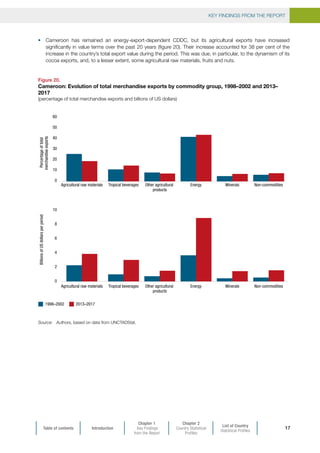
•	 Cameroon has remained an energy-export-dependent CDDC, but its agricultural exports have increased
significantly in value terms over the past 20 years (figure 20). Their increase accounted for 38 per cent of the
increase in the country’s total export value during the period. This was due, in particular, to the dynamism of its
cocoa exports, and, to a lesser extent, some agricultural raw materials, fruits and nuts.
Figure 20.
Cameroon: Evolution of total merchandise exports by commodity group, 1998–2002 and 2013–
2017
(percentage of total merchandise exports and billions of US dollars)
Source:	 Authors, based on data from UNCTADStat.
0
10
20
30
40
50
60
0
2
4
6
8
10
Percentageoftotal
merchandiseexports
BillionsofUSdollarsperperiod
2013–20171998–2002
Agricultural raw materials
Tropical beverages
Tropical beverages
Other agricultural
products
Other agricultural
products
Energy
Energy
Minerals
Minerals
Non-commodities
Non-commodities
THE STATE OF COMMODITY DEPENDENCE 2019
Table of contents Introduction
Chapter 1
Key Findings
from the Report
Chapter 2
Country Statistical
Profiles
List of Country
Statistical Profiles
18
In some CDDCs dependent on energy and mineral exports, the
agricultural sector contracted, and export concentration increased
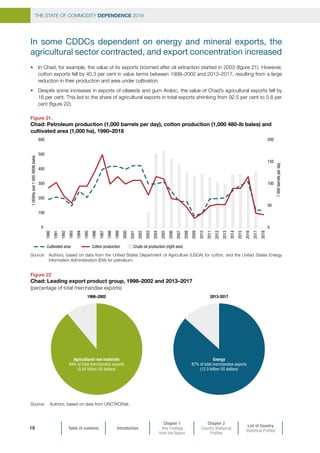
•	 In Chad, for example, the value of its exports boomed after oil extraction started in 2003 (figure 21). However,
cotton exports fell by 40.3 per cent in value terms between 1998–2002 and 2013–2017, resulting from a large
reduction in their production and area under cultivation.
•	 Despite some increases in exports of oilseeds and gum Arabic, the value of Chad’s agricultural exports fell by
16 per cent. This led to the share of agricultural exports in total exports shrinking from 92.5 per cent to 5.8 per
cent (figure 22).
Figure 21.
Chad: Petroleum production (1,000 barrels per day), cotton production (1,000 480-lb bales) and
cultivated area (1,000 ha), 1990–2018
Source:	 Authors, based on data from the United States Department of Agriculture (USDA) for cotton, and the United States Energy
Information Administration (EIA) for petroleum.
0
50
100
150
200
0
100
200
300
400
500
600
1990
1991
1992
1993
1994
1995
1996
1997
1998
1999
2000
2001
2002
2003
2004
2005
2006
2007
2008
2009
2010
2011
2012
2013
2014
2015
2016
2017
2018
1000barrelsperday
1000Haand1000480lbbales
Crude oil production (right axis)Cotton productionCultivated area
Figure 22
Chad: Leading export product group, 1998–2002 and 2013–2017
(percentage of total merchandise exports)
Source:	 Authors, based on data from UNCTADStat.
1998–2002
Agricultural raw materials
89% of total merchandise exports
(0.94 billion US dollars)
2013-2017
Energy
87% of total merchandise exports
(12.3 billion US dollars)
KEY FINDINGS FROM THE REPORT
Table of contents Introduction
Chapter 1
Key Findings
from the Report
Chapter 2
Country Statistical
Profiles
List of Country
Statistical Profiles
19
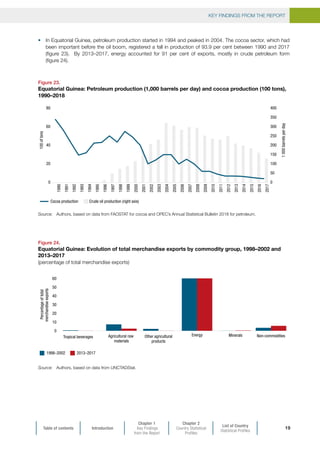
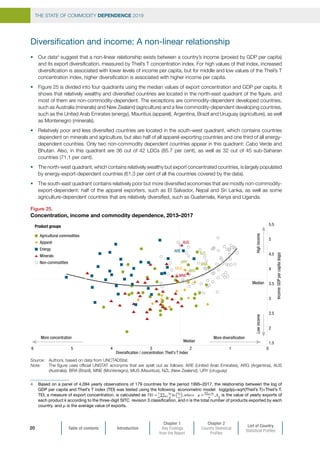
•	 In Equatorial Guinea, petroleum production started in 1994 and peaked in 2004. The cocoa sector, which had
been important before the oil boom, registered a fall in production of 93.9 per cent between 1990 and 2017
(figure 23). By 2013–2017, energy accounted for 91 per cent of exports, mostly in crude petroleum form
(figure 24).
Figure 24.
Equatorial Guinea: Evolution of total merchandise exports by commodity group, 1998–2002 and
2013–2017
(percentage of total merchandise exports)
Source:	 Authors, based on data from UNCTADStat.
0
10
20
30
40
50
60
Tropical beverages Agricultural raw
materials
Other agricultural
products
Energy Minerals Non-commodities
Percentageoftotal
merchandiseexports
2013–20171998–2002
Figure 23.
Equatorial Guinea: Petroleum production (1,000 barrels per day) and cocoa production (100 tons),
1990–2018
Source:	 Authors, based on data from FAOSTAT for cocoa and OPEC’s Annual Statistical Bulletin 2018 for petroleum.
0
50
100
150
200
250
300
350
400
0
20
40
60
80
1990
1991
1992
1993
1994
1995
1996
1997
1998
1999
2000
2001
2002
2003
2004
2005
2006
2007
2008
2009
2010
2011
2012
2013
2014
2015
2016
2017
1000barrelsperday
100oftons
Crude oil production (right axis)Cocoa production
THE STATE OF COMMODITY DEPENDENCE 2019
Table of contents Introduction
Chapter 1
Key Findings
from the Report
Chapter 2
Country Statistical
Profiles
List of Country
Statistical Profiles
20
Diversification and income: A non-linear relationship
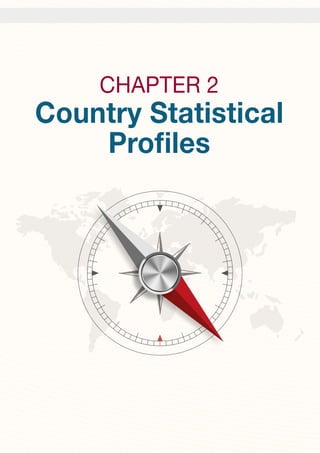
•	 Our data4
suggest that a non-linear relationship exists between a country’s income (proxied by GDP per capita)
and its export diversification, measured by Theil’s T concentration index. For high values of that index, increased
diversification is associated with lower levels of income per capita, but for middle and low values of the Theil’s T
concentration index, higher diversification is associated with higher income per capita.
•	 Figure 25 is divided into four quadrants using the median values of export concentration and GDP per capita. It
shows that relatively wealthy and diversified countries are located in the north-east quadrant of the figure, and
most of them are non-commodity-dependent. The exceptions are commodity-dependent developed countries,
such as Australia (minerals) and New Zealand (agriculture) and a few commodity-dependent developing countries,
such as the United Arab Emirates (energy), Mauritius (apparel), Argentina, Brazil and Uruguay (agriculture), as well
as Montenegro (minerals).
•	 Relatively poor and less diversified countries are located in the south-west quadrant, which contains countries
dependent on minerals and agriculture, but also half of all apparel-exporting countries and one third of all energy-
dependent countries. Only two non-commodity dependent countries appear in this quadrant: Cabo Verde and
Bhutan. Also, in this quadrant are 36 out of 42 LDCs (85.7 per cent), as well as 32 out of 45 sub-Saharan
countries (71.1 per cent).
•	 The north-west quadrant, which contains relatively wealthy but export concentrated countries, is largely populated
by energy-export-dependent countries (61.3 per cent of all the countries covered by the data).
•	 The south-east quadrant contains relatively poor but more diversified economies that are mostly non-commodity-
export-dependent: half of the apparel exporters, such as El Salvador, Nepal and Sri Lanka, as well as some
agriculture-dependent countries that are relatively diversified, such as Guatemala, Kenya and Uganda.
4 	 Based on a panel of 4,094 yearly observations of 179 countries for the period 1995–2017, the relationship between the log of
GDP per capita and Theil’s T index (TEI) was tested using the following econometric model: log(gdp)=sqrt(Theil’s T)+Theil’s T.
TEI, a measure of export concentration, is calculated as ,xk
is the value of yearly exports of
each product k according to the three-digit SITC revision 3 classification, and n is the total number of products exported by each
country. and µ is the average value of exports.
Figure 25.
Concentration, income and commodity dependence, 2013–2017
Source: 	 Authors, based on data from UNCTADStat.
Note: 	 The figure uses official UNSTAT acronyms that are spelt out as follows: ARE (United Arab Emirates), ARG (Argentina), AUS
(Australia), BRA (Brazil), MNE (Montenegro), MUS (Mauritius), NZL (New Zealand), URY (Uruguay)
1.5
2
2.5
3
3.5
4
4.5
5
5.5
0123456
Income:GDPpercapita(logs)
Diversification / concentration: Theil's T Index
Agricultural commodities
Median
Median
More diversificationMore concentration
LowincomeHighincome
Product groups
Apparel
Minerals
Energy
Non-commodities
AUS
NZL
MUS
ARE
ARG
BRA
URY
MNE
KEY FINDINGS FROM THE REPORT
CHAPTER 2
Country Statistical
Profiles
Table of contents Introduction
Chapter 1
Key Findings
from the Report
Chapter 2
Country Statistical
Profiles
List of Country
Statistical Profiles
THE STATE OF COMMODITY DEPENDENCE 2019
22
List of Country Statistical Profiles
Afghanistan	31
Albania	32
Algeria	33
Andorra	34
Angola	35
Antigua and Barbuda	 36
Argentina	37
Armenia	38
Australia	39
Austria	40
Azerbaijan	41
Bahamas	42
Bahrain	43
Bangladesh	44
Barbados	45
Belarus	46
Belgium	47
Belize	48
Benin	49
Bhutan	50
Bolivia (Plurinational State of) 	 51
Bosnia and Herzegovina	 52
Botswana	53
Brazil	54
Brunei Darussalam	 55
Bulgaria	56
Burkina Faso	 57
Burundi	58
Cabo Verde	 59
Cambodia	60
Cameroon	61
Canada	62
Central African Republic	 63
Chad	64
Chile	65
China	66
Colombia	67
Comoros	68
Congo	69
Costa Rica	 70
Côte d’Ivoire	 71
Croatia	72
Cuba	73
Cyprus	74
Czechia	75
Democratic People’s Republic of Korea	 76
Democratic Republic of the Congo	 77
Denmark	78
Djibouti	79
Dominica	80
Dominican Republic	 81
Ecuador	82
Egypt	83
El Salvador	 84
Equatorial Guinea	 85
Eritrea	86
Estonia	87
Eswatini	88
Ethiopia	89
Fiji	90
Finland	91
France	92
Gabon	93
Gambia	94
Georgia	95
Germany	96
Ghana	97
Greece	98
Grenada	99
Guatemala	100
Table of contents Introduction
Chapter 1
Key Findings
from the Report
Chapter 2
Country Statistical
Profiles
List of Country
Statistical Profiles
COUNTRY STATISTICAL PROFILES
23
Guinea	101
Guinea-Bissau	102
Guyana	103
Haiti	104
Honduras	105
Hungary	106
Iceland	107
India	108
Indonesia	109
Iran (Islamic Republic of)	 110
Iraq	111
Ireland	112
Israel	113
Italy	114
Jamaica	115
Japan	116
Jordan	117
Kazakhstan	118
Kenya	119
Kiribati	120
Kuwait	121
Kyrgyzstan	122
Lao People’s Democratic Republic	 123
Latvia	124
Lebanon	125
Lesotho	126
Liberia	127
Libya	128
Lithuania	129
Luxembourg	130
Madagascar	131
Malawi	132
Malaysia	133
Maldives	134
Mali	135
Malta	136
Marshall Islands	 137
Mauritania	138
Mauritius	139
Mexico	140
Micronesia (Federated States of)	 141
Mongolia	142
Montenegro	143
Morocco	144
Mozambique	145
Myanmar	146
Namibia	147
Nauru	148
Nepal	149
Netherlands	150
New Zealand	 151
Nicaragua	152
Niger	153
Nigeria	154
Norway	155
Oman	156
Pakistan	157
Palau	158
Panama	159
Papua New Guinea	 160
Paraguay	161
Peru	162
Philippines	163
Poland	164
Portugal	165
Qatar	166
Republic of Korea	 167
Republic of Moldova	 168
Republic of North Macedonia	 169
Romania	170
Russian Federation	 171
Rwanda	172
Saint Kitts and Nevis	 173
Saint Lucia	 174
Table of contents Introduction
Chapter 1
Key Findings
from the Report
Chapter 2
Country Statistical
Profiles
List of Country
Statistical Profiles
THE STATE OF COMMODITY DEPENDENCE 2019
24
Saint Vincent and the Grenadines	 175
Samoa	176
Sao Tome and Principe	 177
Saudi Arabia	 178
Senegal	179
Serbia	180
Seychelles	181
Sierra Leone	 182
Singapore	183
Slovakia	184
Slovenia	185
Solomon Islands	 186
Somalia	187
South Africa	 188
Spain	189
Sri Lanka	 190
Sudan	191
Suriname	192
Sweden	193
Switzerland	194
Syrian Arab Republic	 195
Tajikistan	196
Thailand	197
Timor-Leste	198
Togo	199
Tonga	200
Trinidad and Tobago	 201
Tunisia	202
Turkey	203
Turkmenistan	204
Tuvalu	205
Uganda	206
Ukraine	207
United Arab Emirates	 208
United Kingdom of Great Britain 209
and Northern Ireland	
United Republic of Tanzania	 210
United States of America	 211
Uruguay	212
Uzbekistan	213
Vanuatu	214
Venezuela (Bolivarian Republic of)	 215
Viet Nam	 216
Yemen	217
Zambia	218
Zimbabwe	219
Table of contents Introduction
Chapter 1
Key Findings
from the Report
Chapter 2
Country Statistical
Profiles
List of Country
Statistical Profiles
COUNTRY STATISTICAL PROFILES
25
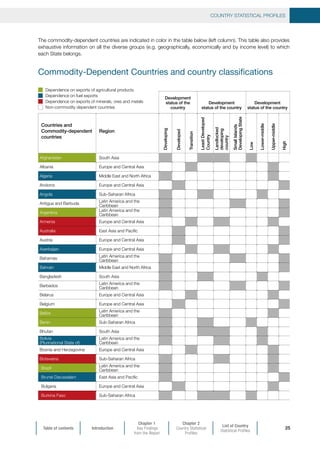
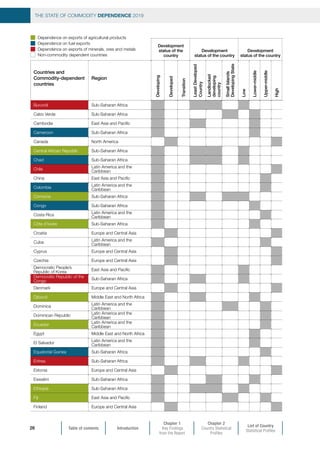
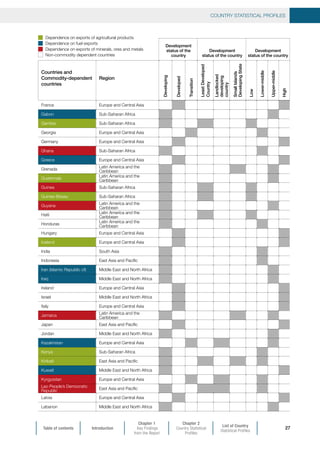
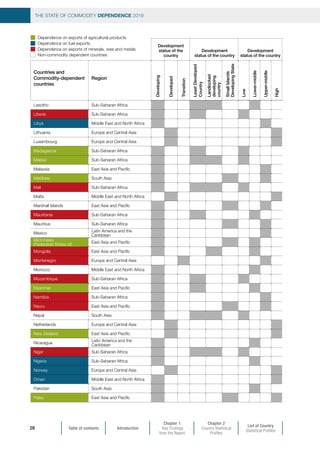
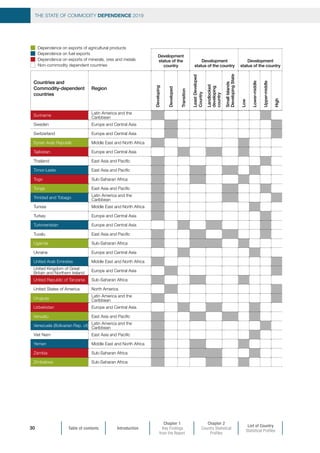
The commodity-dependent countries are indicated in color in the table below (left column). This table also provides
exhaustive information on all the diverse groups (e.g. geographically, economically and by income level) to which
each State belongs.
Commodity-Dependent Countries and country classifications
Countries and
Commodity-dependent
countries
Region
Developing
Developed
Transition
LeastDeveloped
Country
Landlocked
developing
country
SmallIslands
DevelopingState
Low
Lower-middle
Upper-middle
High
Afghanistan South Asia
Albania Europe and Central Asia
Algeria Middle East and North Africa
Andorra Europe and Central Asia
Angola Sub-Saharan Africa
Antigua and Barbuda
Latin America and the
Caribbean
Argentina
Latin America and the
Caribbean
Armenia Europe and Central Asia
Australia East Asia and Pacific
Austria Europe and Central Asia
Azerbaijan Europe and Central Asia
Bahamas
Latin America and the
Caribbean
Bahrain Middle East and North Africa
Bangladesh South Asia
Barbados
Latin America and the
Caribbean
Belarus Europe and Central Asia
Belgium Europe and Central Asia
Belize
Latin America and the
Caribbean
Benin Sub-Saharan Africa
Bhutan South Asia
Bolivia
(Plurinational State of)
Latin America and the
Caribbean
Bosnia and Herzegovina Europe and Central Asia
Botswana Sub-Saharan Africa
Brazil
Latin America and the
Caribbean
Brunei Darussalam East Asia and Pacific
Bulgaria Europe and Central Asia
Burkina Faso Sub-Saharan Africa
Development
status of the
country
Development
status of the country
Development
status of the country
Dependence on exports of agricultural products
Dependence on fuel exports
Dependence on exports of minerals, ores and metals
Non-commodity dependent countries
Table of contents Introduction
Chapter 1
Key Findings
from the Report
Chapter 2
Country Statistical
Profiles
List of Country
Statistical Profiles
26
THE STATE OF COMMODITY DEPENDENCE 2019
Countries and
Commodity-dependent
countries
Region
Developing
Developed
Transition
LeastDeveloped
Country
Landlocked
developing
country
SmallIslands
DevelopingState
Low
Lower-middle
Upper-middle
High
Development
status of the
country
Development
status of the country
Development
status of the country
Burundi Sub-Saharan Africa
Cabo Verde Sub-Saharan Africa
Cambodia East Asia and Pacific
Cameroon Sub-Saharan Africa
Canada North America
Central African Republic Sub-Saharan Africa
Chad Sub-Saharan Africa
Chile
Latin America and the
Caribbean
China East Asia and Pacific
Colombia
Latin America and the
Caribbean
Comoros Sub-Saharan Africa
Congo Sub-Saharan Africa
Costa Rica
Latin America and the
Caribbean
Côte d’Ivoire Sub-Saharan Africa
Croatia Europe and Central Asia
Cuba
Latin America and the
Caribbean
Cyprus Europe and Central Asia
Czechia Europe and Central Asia
Democratic People’s
Republic of Korea
East Asia and Pacific
Democratic Republic of the
Congo
Sub-Saharan Africa
Denmark Europe and Central Asia
Djibouti Middle East and North Africa
Dominica
Latin America and the
Caribbean
Dominican Republic
Latin America and the
Caribbean
Ecuador
Latin America and the
Caribbean
Egypt Middle East and North Africa
El Salvador
Latin America and the
Caribbean
Equatorial Guinea Sub-Saharan Africa
Eritrea Sub-Saharan Africa
Estonia Europe and Central Asia
Eswatini Sub-Saharan Africa
Ethiopia Sub-Saharan Africa
Fiji East Asia and Pacific
Finland Europe and Central Asia
Dependence on exports of agricultural products
Dependence on fuel exports
Dependence on exports of minerals, ores and metals
Non-commodity dependent countries
Table of contents Introduction
Chapter 1
Key Findings
from the Report
Chapter 2
Country Statistical
Profiles
List of Country
Statistical Profiles
27
COUNTRY STATISTICAL PROFILES
Countries and
Commodity-dependent
countries
Region
Developing
Developed
Transition
LeastDeveloped
Country
Landlocked
developing
country
SmallIslands
DevelopingState
Low
Lower-middle
Upper-middle
High
Development
status of the
country
Development
status of the country
Development
status of the country
France Europe and Central Asia
Gabon Sub-Saharan Africa
Gambia Sub-Saharan Africa
Georgia Europe and Central Asia
Germany Europe and Central Asia
Ghana Sub-Saharan Africa
Greece Europe and Central Asia
Grenada
Latin America and the
Caribbean
Guatemala
Latin America and the
Caribbean
Guinea Sub-Saharan Africa
Guinea-Bissau Sub-Saharan Africa
Guyana
Latin America and the
Caribbean
Haiti
Latin America and the
Caribbean
Honduras
Latin America and the
Caribbean
Hungary Europe and Central Asia
Iceland Europe and Central Asia
India South Asia
Indonesia East Asia and Pacific
Iran (Islamic Republic of) Middle East and North Africa
Iraq Middle East and North Africa
Ireland Europe and Central Asia
Israel Middle East and North Africa
Italy Europe and Central Asia
Jamaica
Latin America and the
Caribbean
Japan East Asia and Pacific
Jordan Middle East and North Africa
Kazakhstan Europe and Central Asia
Kenya Sub-Saharan Africa
Kiribati East Asia and Pacific
Kuwait Middle East and North Africa
Kyrgyzstan Europe and Central Asia
Lao People’s Democratic
Republic
East Asia and Pacific
Latvia Europe and Central Asia
Lebanon Middle East and North Africa
Dependence on exports of agricultural products
Dependence on fuel exports
Dependence on exports of minerals, ores and metals
Non-commodity dependent countries
Table of contents Introduction
Chapter 1
Key Findings
from the Report
Chapter 2
Country Statistical
Profiles
List of Country
Statistical Profiles
THE STATE OF COMMODITY DEPENDENCE 2019
28
Countries and
Commodity-dependent
countries
Region
Developing
Developed
Transition
LeastDeveloped
Country
Landlocked
developing
country
SmallIslands
DevelopingState
Low
Lower-middle
Upper-middle
High
Lesotho Sub-Saharan Africa
Liberia Sub-Saharan Africa
Libya Middle East and North Africa
Lithuania Europe and Central Asia
Luxembourg Europe and Central Asia
Madagascar Sub-Saharan Africa
Malawi Sub-Saharan Africa
Malaysia East Asia and Pacific
Maldives South Asia
Mali Sub-Saharan Africa
Malta Middle East and North Africa
Marshall Islands East Asia and Pacific
Mauritania Sub-Saharan Africa
Mauritius Sub-Saharan Africa
Mexico
Latin America and the
Caribbean
Micronesia
(Federated States of)
East Asia and Pacific
Mongolia East Asia and Pacific
Montenegro Europe and Central Asia
Morocco Middle East and North Africa
Mozambique Sub-Saharan Africa
Myanmar East Asia and Pacific
Namibia Sub-Saharan Africa
Nauru East Asia and Pacific
Nepal South Asia
Netherlands Europe and Central Asia
New Zealand East Asia and Pacific
Nicaragua
Latin America and the
Caribbean
Niger Sub-Saharan Africa
Nigeria Sub-Saharan Africa
Norway Europe and Central Asia
Oman Middle East and North Africa
Pakistan South Asia
Palau East Asia and Pacific
Development
status of the
country
Development
status of the country
Development
status of the country
Dependence on exports of agricultural products
Dependence on fuel exports
Dependence on exports of minerals, ores and metals
Non-commodity dependent countries
THE STATE OF COMMODITY DEPENDENCE 2019
Table of contents Introduction
Chapter 1
Key Findings
from the Report
Chapter 2
Country Statistical
Profiles
List of Country
Statistical Profiles
COUNTRY STATISTICAL PROFILES
29
Countries and
Commodity-dependent
countries
Region
Developing
Developed
Transition
LeastDeveloped
Country
Landlocked
developing
country
SmallIslands
DevelopingState
Low
Lower-middle
Upper-middle
High
Panama
Latin America and the
Caribbean
Papua New Guinea East Asia and Pacific
Paraguay
Latin America and the
Caribbean
Peru
Latin America and the
Caribbean
Philippines East Asia and Pacific
Poland Europe and Central Asia
Portugal Europe and Central Asia
Qatar Middle East and North Africa
Republic of Korea East Asia and Pacific
Republic of Moldova Europe and Central Asia
Republic of North Macedonia Europe and Central Asia
Romania Europe and Central Asia
Russian Federation Europe and Central Asia
Rwanda Sub-Saharan Africa
Saint Kitts and Nevis
Latin America and the
Caribbean
Saint Lucia
Latin America and the
Caribbean
Saint Vincent and the
Grenadines
Latin America and the
Caribbean
Samoa East Asia and Pacific
Sao Tome and Principe Sub-Saharan Africa
Saudi Arabia Middle East and North Africa
Senegal Sub-Saharan Africa
Serbia Europe and Central Asia
Seychelles Sub-Saharan Africa
Sierra Leone Sub-Saharan Africa
Singapore East Asia and Pacific
Slovakia Europe and Central Asia
Slovenia Europe and Central Asia
Solomon Islands East Asia and Pacific
Somalia Sub-Saharan Africa
South Africa Sub-Saharan Africa
Spain Europe and Central Asia
Sri Lanka South Asia
Sudan Sub-Saharan Africa
Development
status of the
country
Development
status of the country
Development
status of the country
Dependence on exports of agricultural products
Dependence on fuel exports
Dependence on exports of minerals, ores and metals
Non-commodity dependent countries
COUNTRY STATISTICAL PROFILES
Table of contents Introduction
Chapter 1
Key Findings
from the Report
Chapter 2
Country Statistical
Profiles
List of Country
Statistical Profiles
THE STATE OF COMMODITY DEPENDENCE 2019
30
Countries and
Commodity-dependent
countries
Region
Developing
Developed
Transition
LeastDeveloped
Country
Landlocked
developing
country
SmallIslands
DevelopingState
Low
Lower-middle
Upper-middle
High
Suriname
Latin America and the
Caribbean
Sweden Europe and Central Asia
Switzerland Europe and Central Asia
Syrian Arab Republic Middle East and North Africa
Tajikistan Europe and Central Asia
Thailand East Asia and Pacific
Timor-Leste East Asia and Pacific
Togo Sub-Saharan Africa
Tonga East Asia and Pacific
Trinidad and Tobago
Latin America and the
Caribbean
Tunisia Middle East and North Africa
Turkey Europe and Central Asia
Turkmenistan Europe and Central Asia
Tuvalu East Asia and Pacific
Uganda Sub-Saharan Africa
Ukraine Europe and Central Asia
United Arab Emirates Middle East and North Africa
United Kingdom of Great
Britain and Northern Ireland
Europe and Central Asia
United Republic of Tanzania Sub-Saharan Africa
United States of America North America
Uruguay
Latin America and the
Caribbean
Uzbekistan Europe and Central Asia
Vanuatu East Asia and Pacific
Venezuela (Bolivarian Rep. of)
Latin America and the
Caribbean
Viet Nam East Asia and Pacific
Yemen Middle East and North Africa
Zambia Sub-Saharan Africa
Zimbabwe Sub-Saharan Africa
Development
status of the
country
Development
status of the country
Development
status of the country
Dependence on exports of agricultural products
Dependence on fuel exports
Dependence on exports of minerals, ores and metals
Non-commodity dependent countries
THE STATE OF COMMODITY DEPENDENCE 2019
INDIVIDUAL COUNTRY PROFILES
Table of contents Introduction
Chapter 1
Key Findings
from the Report
Chapter 2
Country Statistical
Profiles
List of Country
Statistical Profiles
31
AFGHANISTAN*
1995 2013-2017 2017
Merchandise export value (millions of US dollars) 166 591 700
Unallocated exports (as a share of merchandise exports) 2.2 13.0 3.5
Merchandise export concentration by product line (Herfindahl-Hirschmann index) 0.3399 0.3146 0.3500
Commodity export value (millions of US dollars) 132 469 628
Commodity exports (as a share of total merchandise exports) 80 79 90
Commodity exports (as a share of GDP) 4.1 2.2 2.9
Total natural resources rents (as a share of GDP) .. 0.7 0.6
Exports by commodity group (as a share of merchandise exports) 80 79 90
Agricultural commodities 77 59 66
Fuels – 7 8
Ores, metals, precious stones and non-monetary gold 2 13 15
Three leading commodity exports (as a share of total merchandise exports) 19 43 50
[057] Fruits and nuts (excluding oil nuts), fresh or dried 17 27 33
[292] Crude vegetable materials, n.e.s. 2 9 9
[321] Coal, whether or not pulverized, not agglomerated – 7 8
Average price index of the leading commodity group exported 80.8 109.0 102.7
Five leading destination markets of commodity exports (as a share of total commodity exports) 91
Pakistan 41
India 31
European Union (28) 10
United Arab Emirates 8
Iran (Islamic Republic of) 2
Commodity imports (millions of US dollars) 124 3,027 3,225
Commodity imports (as a share of total merchandise imports) 32 40 44
Food imports (millions of US dollars and as a share of total merchandise imports) 64 (17) 1,919 (25) 2,052 (28)
Fuel imports (millions of US dollars and as a share of total merchandise imports) 27 (7) 921 (12) 929 (13)
Five-leading trading partners for commodity imports (as a share of total commodity imports) 70
Pakistan 29
Iran (Islamic Republic of) 16
Kazakhstan 12
Russian Federation 9
Turkmenistan 5
Percentage change of GDP measured in constant 2010 prices 49.9 19.6 2.5
GDP per capita measured in constant 2010 US dollars 410 633 624
Population (thousands) 8,926 18,676 20,165
Human Development Index (value and rank) .. 0.4926 (163) 0.4980 (165)
Total employment (as a share of the population) 47.4 49.1 49.4
Share of women in total employment 12.9 15.8 16.6
Proportion of population below international poverty line – SDG 1. Indicator 1.1.1 .. ..
Gini index, latest available year .. ..
Prevalence of undernourishment (per cent) – SDG 2. Indicator 2.1.1 46.1 30.3
Value added of agriculture/industry/services (as a share of GDP) 66/11/24 24/22/54 24/22/54
Employment in agriculture/industry/services (as a share of total employment) 79/4/17 62/7/32 62/7/31
Share of women in agriculture/industry/services 15/9/6 19/13/11 20/14/11
Institutional quality index, 2018 0.1271
Control of corruption –1.29 –1.44 –1.52
Rule of law –1.79 –1.52 –1.57
MERCHANDISE AND COMMODITY EXPORT DEPENDENCE
COMMODITY IMPORT DEPENDENCE
KEY SOCIOECONOMIC INDICATORS
OTHER STRUCTURAL INDICATORS
Table of contents Introduction
Chapter 1
Key Findings
from the Report
Chapter 2
Country Statistical
Profiles
List of Country
Statistical Profiles
32
ALBANIA
1995 2013-2017 2017
Merchandise export value (millions of US dollars) 202 2,183 2,262
Unallocated exports (as a share of merchandise exports) 1.4 11.9 16.5
Merchandise export concentration by product line (Herfindahl-Hirschmann index) 0.1917 0.2601 0.2558
Commodity export value (millions of US dollars) 79 725 518
Commodity exports (as a share of total merchandise exports) 39 33 23
Commodity exports (as a share of GDP) 3.3 5.8 3.9
Total natural resources rents (as a share of GDP) 1.3 2.8 2.0
Exports by commodity group (as a share of merchandise exports) 39 33 23
Agricultural commodities 24 7 8
Fuels 3 17 7
Ores, metals, precious stones and non-monetary gold 12 9 9
Three leading commodity exports (as a share of total merchandise exports) 6 21 14
[333] Petroleum oils, oils from bitumin. materials, crude – 14 5
[287] Ores and concentrates of base metals, n.e.s. 4 5 6
[03] Fishery products 2 2 3
Average price index of the leading commodity group exported 36.5 132.1 103.8
Five leading destination markets of commodity exports (as a share of total commodity exports) 78
China 32
European Union (28) 19
United States of America 11
Serbia 9
India 6
Commodity imports (millions of US dollars) 450 1,300 1,334
Commodity imports (as a share of total merchandise imports) 63 26 23
Food imports (millions of US dollars and as a share of total merchandise imports) 374 (52) 537 (11) 456 (8)
Fuel imports (millions of US dollars and as a share of total merchandise imports) 30 (4) 554 (11) 752 (13)
Five-leading trading partners for commodity imports (as a share of total commodity imports) 79
European Union (28) 60
Serbia 8
Russian Federation 5
Turkey 4
Brazil 3
Percentage change of GDP measured in constant 2010 prices 13.3 8.6 3.8
GDP per capita measured in constant 2010 US dollars 1,746 4,499 4,775
Population (thousands) 2,092 2,389 2,420
Human Development Index (value and rank) 0.6320 (75) 0.7774 (67) 0.7850 (66)
Total employment (as a share of the population) 48.1 46.6 48.3
Share of women in total employment 40.5 42.3 42.3
Proportion of population below international poverty line – SDG 1. Indicator 1.1.1 (1996) 1.1 (2012) 1.1
Gini index, latest available year (1996) 27.0 (2012) 29.0
Prevalence of undernourishment (per cent) – SDG 2. Indicator 2.1.1 7.2 5.5
Value added of agriculture/industry/services (as a share of GDP) 54/26/19 23/25/53 23/24/54
Employment in agriculture/industry/services (as a share of total employment) 70/15/14 42/18/40 40/19/41
Share of women in agriculture/industry/services 46/27/30 50/30/40 49/31/40
Institutional quality index, 2018 0.5637
Control of corruption –0.89 –0.51 –0.42
Rule of law –0.68 –0.38 –0.40
OTHER STRUCTURAL INDICATORS
KEY SOCIOECONOMIC INDICATORS
MERCHANDISE AND COMMODITY EXPORT DEPENDENCE
COMMODITY IMPORT DEPENDENCE
Table of contents Introduction
Chapter 1
Key Findings
from the Report
Chapter 2
Country Statistical
Profiles
List of Country
Statistical Profiles
33
ALGERIA
1995 2013-2017 2017
Merchandise export value (millions of US dollars) 9,357 45,273 35,191
Unallocated exports (as a share of merchandise exports) – – –
Merchandise export concentration by product line (Herfindahl-Hirschmann index) 0.5229 0.4958 0.4795
Commodity export value (millions of US dollars) 9,073 44,308 34,251
Commodity exports (as a share of total merchandise exports) 97 98 97
Commodity exports (as a share of GDP) 21.6 23.9 19.3
Total natural resources rents (as a share of GDP) 9.5 16.6 13.6
Exports by commodity group (as a share of merchandise exports) 97 98 97
Agricultural commodities 1 1 1
Fuels 95 97 96
Ores, metals, precious stones and non-monetary gold 1 – –
Three leading commodity exports (as a share of total merchandise exports) 90 87 85
[333] Petroleum oils, oils from bitumin. materials, crude 46 39 36
[343] Natural gas, whether or not liquefied 26 31 31
[334] Petroleum oils or bituminous minerals  70 % oil 18 17 18
Average price index of the leading commodity group exported 36.5 132.1 103.8
Five leading destination markets of commodity exports (as a share of total commodity exports) 69
European Union (28) 30
United States of America 16
Brazil 9
Turkey 9
Canada 6
COMMODITY IMPORT DEPENDENCE
Commodity imports (millions of US dollars) 3,804 14,218 12,450
Commodity imports (as a share of total merchandise imports) 35 28 27
Food imports (millions of US dollars and as a share of total merchandise imports) 3,091 (29) 9,678 (19) 8,948 (19)
Fuel imports (millions of US dollars and as a share of total merchandise imports) 116 (1) 2,594 (5) 1,938 (4)
Five-leading trading partners for commodity imports (as a share of total commodity imports) 73
European Union (28) 47
Argentina 11
Brazil 8
Russian Federation 3
United States of America 3
KEY SOCIOECONOMIC INDICATORS
Percentage change of GDP measured in constant 2010 prices 3.8 13.7 1.6
GDP per capita measured in constant 2010 US dollars 3,225 4,738 4,821
Population (thousands) 17,430 28,431 29,218
Human Development Index (value and rank) 0.6000 (86) 0.7496 (81) 0.7540 (83)
Total employment (as a share of the population) 30.7 37.5 37.2
Share of women in total employment 12.4 17.0 16.6
Proportion of population below international poverty line – SDG 1. Indicator 1.1.1 (1995) 5.9 (2011) 0.5
Gini index, latest available year (1995) 35.3 (2011) 27.6
Prevalence of undernourishment (per cent) – SDG 2. Indicator 2.1.1 10.7 4.7
OTHER STRUCTURAL INDICATORS
Value added of agriculture/industry/services (as a share of GDP) 10/48/42 11/41/48 13/36/51
Employment in agriculture/industry/services (as a share of total employment) 22/26/51 13/46/41 13/47/40
Share of women in agriculture/industry/services 7/17/13 11/21/15 12/20/14
Institutional quality index, 2018 0.2215
Control of corruption –0.57 –0.61 –0.61
Rule of law –1.22 –0.81 –0.86
MERCHANDISE AND COMMODITY EXPORT DEPENDENCE
Table of contents Introduction
Chapter 1
Key Findings
from the Report
Chapter 2
Country Statistical
Profiles
List of Country
Statistical Profiles
34
ANDORRA
1995 2013-2017 2017
Merchandise export value (millions of US dollars) 48 99 116
Unallocated exports (as a share of merchandise exports) 0.1 5.8 6.7
Merchandise export concentration by product line (Herfindahl-Hirschmann index) 0.2112 0.1970 0.2178
Commodity export value (millions of US dollars) 5 6 5
Commodity exports (as a share of total merchandise exports) 10 6 4
Commodity exports (as a share of GDP) 0.3 0.2 0.2
Total natural resources rents (as a share of GDP) – – –
Exports by commodity group (as a share of merchandise exports) 10 6 4
Agricultural commodities 8 2 1
Fuels – – –
Ores, metals, precious stones and non-monetary gold 2 4 3
Three leading commodity exports (as a share of total merchandise exports) 2 4 2
[282] Ferrous waste, scrape; remelting ingots, iron, steel 1 1 1
[971] Gold, non-monetary (excluding gold ores and concentrates) – 1 –
[24 + 25] Forestry products 1 1 1
Average price index of the leading commodity group exported 44.4 116.0 116.4
Five leading destination markets of commodity exports (as a share of total commodity exports) 100
Switzerland 75
European Union (28) 12
Turkey 12
Commodity imports (millions of US dollars) 356 519 520
Commodity imports (as a share of total merchandise imports) 35 36 35
Food imports (millions of US dollars and as a share of total merchandise imports) 175 (17) 221 (15) 235 (16)
Fuel imports (millions of US dollars and as a share of total merchandise imports) 44 (4) 145 (10) 128 (9)
Five-leading trading partners for commodity imports (as a share of total commodity imports) 99
European Union (28) 96
Mauritania 1
Viet Nam 1
Switzerland 1
Percentage change of GDP measured in constant 2010 prices 2.8 –0.9 0.5
GDP per capita measured in constant 2010 US dollars 33,684 41,479 43,069
Population (thousands) .. .. ..
Human Development Index (value and rank) .. 0.8542 (34) 0.8580 (33)
Total employment (as a share of the population) .. .. ..
Share of women in total employment .. .. ..
Proportion of population below international poverty line – SDG 1. Indicator 1.1.1 .. ..
Gini index, latest available year .. ..
Prevalence of undernourishment (per cent) – SDG 2. Indicator 2.1.1 .. ..
Value added of agriculture/industry/services (as a share of GDP) 1/19/81 1/11/88 1/11/88
Employment in agriculture/industry/services (as a share of total employment) .. .. ..
Share of women in agriculture/industry/services .. .. ..
Institutional quality index, 2018 ..
Control of corruption 1.32 1.24 1.24
Rule of law 1.16 1.56 1.60
KEY SOCIOECONOMIC INDICATORS
OTHER STRUCTURAL INDICATORS
MERCHANDISE AND COMMODITY EXPORT DEPENDENCE
COMMODITY IMPORT DEPENDENCE
Table of contents Introduction
Chapter 1
Key Findings
from the Report
Chapter 2
Country Statistical
Profiles
List of Country
Statistical Profiles
35
ANGOLA*
1995 2013-2017 2017
Merchandise export value (millions of US dollars) 3,723 44,277 34,474
Unallocated exports (as a share of merchandise exports) 0.2 – –
Merchandise export concentration by product line (Herfindahl-Hirschmann index) 0.8916 0.9351 0.9334
Commodity export value (millions of US dollars) 3,705 44,277 34,474
Commodity exports (as a share of total merchandise exports) 100 100 100
Commodity exports (as a share of GDP) 55.8 34.6 25.6
Total natural resources rents (as a share of GDP) 51.1 21.7 13.2
Exports by commodity group (as a share of merchandise exports) 100 100 100
Agricultural commodities 1 – –
Fuels 94 98 97
Ores, metals, precious stones and non-monetary gold 5 2 2
Three leading commodity exports (as a share of total merchandise exports) 90 100 100
[333] Petroleum oils, oils from bitumin. materials, crude 90 96 96
[277] Natural abrasives, n.e.s. (incl. industri. diamonds) – 2 2
[335] Residual petroleum products, n.e.s., related mater. – 2 2
Average price index of the leading commodity group exported 36.5 132.1 103.8
Five leading destination markets of commodity exports (as a share of total commodity exports) 83
China 53
India 10
European Union (28) 8
United States of America 6
Taiwan, Province of China 5
Commodity imports (millions of US dollars) 378 5,110 3,929
Commodity imports (as a share of total merchandise imports) 26 25 27
Food imports (millions of US dollars and as a share of total merchandise imports) 273 (19) 3,224 (16) 2,855 (20)
Fuel imports (millions of US dollars and as a share of total merchandise imports) 15 (1) 984 (5) 462 (3)
Five-leading trading partners for commodity imports (as a share of total commodity imports) 63
European Union (28) 31
Brazil 12
Singapore 7
South Africa 7
Malaysia 6
Percentage change of GDP measured in constant 2010 prices 15.0 14.8 –2.5
GDP per capita measured in constant 2010 US dollars 1,893 3,659 3,375
Population (thousands) 7,437 14,756 15,843
Human Development Index (value and rank) .. 0.5696 (144) 0.5810 (144)
Total employment (as a share of the population) 59.2 71.9 71.3
Share of women in total employment 48.2 49.9 49.9
Proportion of population below international poverty line – SDG 1. Indicator 1.1.1 (2000) 32.3 (2008) 30.1
Gini index, latest available year (2000) 52.0 (2008) 42.7
Prevalence of undernourishment (per cent) – SDG 2. Indicator 2.1.1 71.5 23.9
Value added of agriculture/industry/services (as a share of GDP) 7/67/25 8/46/46 8/46/46
Employment in agriculture/industry/services (as a share of total employment) 42/9/49 49/9/42 51/9/41
Share of women in agriculture/industry/services 59/10/46 57/7/51 57/7/50
Institutional quality index, 2018 0.1166
Control of corruption –1.17 –1.40 –1.41
Rule of law –1.63 –1.13 –1.10
OTHER STRUCTURAL INDICATORS
KEY SOCIOECONOMIC INDICATORS
MERCHANDISE AND COMMODITY EXPORT DEPENDENCE
COMMODITY IMPORT DEPENDENCE
Table of contents Introduction
Chapter 1
Key Findings
from the Report
Chapter 2
Country Statistical
Profiles
List of Country
Statistical Profiles
36
ANTIGUA AND BARBUDA
1995 2013-2017 2017
Merchandise export value (millions of US dollars) 53 78 80
Unallocated exports (as a share of merchandise exports) 1.9 2.9 3.0
Merchandise export concentration by product line (Herfindahl-Hirschmann index) 0.3090 0.5088 0.4172
Commodity export value (millions of US dollars) 40 18 13
Commodity exports (as a share of total merchandise exports) 75 23 16
Commodity exports (as a share of GDP) 6.9 1.3 0.8
Total natural resources rents (as a share of GDP) – – –
Exports by commodity group (as a share of merchandise exports) 75 23 15
Agricultural commodities 23 10 8
Fuels 47 13 7
Ores, metals, precious stones and non-monetary gold 4 1 –
Three leading commodity exports (as a share of total merchandise exports) 26 17 6
[334] Petroleum oils or bituminous minerals  70 % oil 17 12 4
[042] Rice 6 3 –
[081] Feeding stuff for animals (no unmilled cereals) 3 2 2
Average price index of the leading commodity group exported 36.5 132.1 103.8
Five leading destination markets of commodity exports (as a share of total commodity exports) 71
Suriname 40
Senegal 15
Cameroon 7
Dominican Republic 5
Angola 4
Commodity imports (millions of US dollars) 76 172 214
Commodity imports (as a share of total merchandise imports) 22 33 34
Food imports (millions of US dollars and as a share of total merchandise imports) 40 (12) 55 (10) 76 (12)
Fuel imports (millions of US dollars and as a share of total merchandise imports) 17 (5) 93 (18) 104 (17)
Five-leading trading partners for commodity imports (as a share of total commodity imports) 82
United States of America 48
Trinidad and Tobago 14
European Union (28) 10
China 8
Saint Vincent and the Grenadines 2
Percentage change of GDP measured in constant 2010 prices –4.4 9.0 2.2
GDP per capita measured in constant 2010 US dollars 10,400 12,727 13,416
Population (thousands) .. .. ..
Human Development Index (value and rank) .. 0.7742 (68) 0.7800 (68)
Total employment (as a share of the population) .. .. ..
Share of women in total employment .. .. ..
Proportion of population below international poverty line – SDG 1. Indicator 1.1.1 .. ..
Gini index, latest available year .. ..
Prevalence of undernourishment (per cent) – SDG 2. Indicator 2.1.1 .. ..
Value added of agriculture/industry/services (as a share of GDP) 2/14/84 2/18/80 2/20/78
Employment in agriculture/industry/services (as a share of total employment) .. .. ..
Share of women in agriculture/industry/services .. .. ..
Institutional quality index, 2018 0.5641
Control of corruption 0.87 0.71 0.24
Rule of law 1.05 0.44 0.44
OTHER STRUCTURAL INDICATORS
KEY SOCIOECONOMIC INDICATORS
MERCHANDISE AND COMMODITY EXPORT DEPENDENCE
COMMODITY IMPORT DEPENDENCE
Table of contents Introduction
Chapter 1
Key Findings
from the Report
Chapter 2
Country Statistical
Profiles
List of Country
Statistical Profiles
37
ARGENTINA
1995 2013-2017 2017
Merchandise export value (millions of US dollars) 20,963 63,455 58,384
Unallocated exports (as a share of merchandise exports) – 2.1 1.5
Merchandise export concentration by product line (Herfindahl-Hirschmann index) 0.1244 0.1856 0.1794
Commodity export value (millions of US dollars) 13,859 43,687 41,328
Commodity exports (as a share of total merchandise exports) 66 69 71
Commodity exports (as a share of GDP) 5.0 7.3 6.6
Total natural resources rents (as a share of GDP) 1.1 2.1 1.3
Exports by commodity group (as a share of merchandise exports) 66 69 71
Agricultural commodities 54 59 61
Fuels 10 4 3
Ores, metals, precious stones and non-monetary gold 2 6 7
Three leading commodity exports (as a share of total merchandise exports) 19 31 31
[081] Feeding stuff for animals (no unmilled cereals) 6 18 17
[421] Fixed vegetable fats  oils, crude, refined, fractio. 10 7 8
[044] Maize (not including sweet corn), unmilled 3 6 7
Average price index of the leading commodity group exported 80.8 109.0 102.7
Five leading destination markets of commodity exports (as a share of total commodity exports) 44
European Union (28) 15
China 11
Brazil 9
United States of America 6
Viet Nam 4
Commodity imports (millions of US dollars) 2,900 12,170 10,428
Commodity imports (as a share of total merchandise imports) 14 19 16
Food imports (millions of US dollars and as a share of total merchandise imports) 1,008 (5) 1,790 (3) 2,570 (4)
Fuel imports (millions of US dollars and as a share of total merchandise imports) 844 (4) 7,914 (12) 5,461 (8)
Five-leading trading partners for commodity imports (as a share of total commodity imports) 63
Brazil 15
United States of America 15
Bolivia (Plurinational State of) 15
European Union (28) 10
Trinidad and Tobago 8
Percentage change of GDP measured in constant 2010 prices –2.8 4.6 2.9
GDP per capita measured in constant 2010 US dollars 7,682 10,471 10,413
Population (thousands) 24,799 32,477 33,254
Human Development Index (value and rank) 0.7310 (39) 0.8218 (45) 0.8250 (45)
Total employment (as a share of the population) 49.1 55.4 54.8
Share of women in total employment 38.4 40.4 40.4
Proportion of population below international poverty line – SDG 1. Indicator 1.1.1 (1995) 4.1 (2016) 0.6
Gini index, latest available year (1995) 48.9 (2016) 42.4
Prevalence of undernourishment (per cent) – SDG 2. Indicator 2.1.1 3.5 3.8
Value added of agriculture/industry/services (as a share of GDP) 5/26/69 7/28/65 8/27/66
Employment in agriculture/industry/services (as a share of total employment) 1/27/72 1/24/76 1/23/76
Share of women in agriculture/industry/services 22/21/45 12/14/49 11/14/49
Institutional quality index, 2018 0.3914
Control of corruption –0.10 –0.41 –0.26
Rule of law 0.08 –0.60 –0.25
OTHER STRUCTURAL INDICATORS
KEY SOCIOECONOMIC INDICATORS
MERCHANDISE AND COMMODITY EXPORT DEPENDENCE
COMMODITY IMPORT DEPENDENCE
Table of contents Introduction
Chapter 1
Key Findings
from the Report
Chapter 2
Country Statistical
Profiles
List of Country
Statistical Profiles
38
ARMENIA
1995 2013-2017 2017
Merchandise export value (millions of US dollars) 271 1,679 2,145
Unallocated exports (as a share of merchandise exports) 0.2 0.2 0.1
Merchandise export concentration by product line (Herfindahl-Hirschmann index) 0.1284 0.2553 0.3080
Commodity export value (millions of US dollars) 128 1,335 1,716
Commodity exports (as a share of total merchandise exports) 47 80 80
Commodity exports (as a share of GDP) 9.3 12.0 14.9
Total natural resources rents (as a share of GDP) 0.7 4.1 4.8
Exports by commodity group (as a share of merchandise exports) 47 80 80
Agricultural commodities 17 27 27
Fuels 5 3 2
Ores, metals, precious stones and non-monetary gold 24 50 51
Three leading commodity exports (as a share of total merchandise exports) 14 43 49
[283] Copper ores and concentrates; copper mattes, cemen 3 24 30
[112] Alcoholic beverages 11 10 10
[122] Tobacco, manufactured – 9 9
Average price index of the leading commodity group exported 58.3 123.5 127.5
Five leading destination markets of commodity exports (as a share of total commodity exports) 68
Russian Federation 25
China 14
Georgia 11
Iraq 9
European Union (28) 9
Commodity imports (millions of US dollars) 445 1,675 1,590
Commodity imports (as a share of total merchandise imports) 66 45 41
Food imports (millions of US dollars and as a share of total merchandise imports) 195 (29) 581 (15) 583 (15)
Fuel imports (millions of US dollars and as a share of total merchandise imports) 211 (31) 566 (15) 495 (13)
Five-leading trading partners for commodity imports (as a share of total commodity imports) 75
Russian Federation 43
European Union (28) 16
Iran (Islamic Republic of) 7
Ukraine 5
Switzerland 4
Percentage change of GDP measured in constant 2010 prices 6.9 16.4 7.5
GDP per capita measured in constant 2010 US dollars 1,094 4,183 4,497
Population (thousands) 2,276 2,337 2,344
Human Development Index (value and rank) 0.6050 (85) 0.7478 (82) 0.7550 (81)
Total employment (as a share of the population) 54.3 49.6 49.2
Share of women in total employment 43.5 46.3 46.5
Proportion of population below international poverty line – SDG 1. Indicator 1.1.1 (1996) 17.9 (2016) 1.9
Gini index, latest available year (1996) 44.4 (2016) 32.6
Prevalence of undernourishment (per cent) – SDG 2. Indicator 2.1.1 23.8 4.3
Value added of agriculture/industry/services (as a share of GDP) 40/28/31 19/28/53 17/27/56
Employment in agriculture/industry/services (as a share of total employment) 52/18/30 35/16/49 34/16/50
Share of women in agriculture/industry/services 46/30/47 54/21/49 53/22/50
Institutional quality index, 2018 0.5474
Control of corruption –0.47 –0.54 –0.56
Rule of law –0.47 –0.27 –0.16
MERCHANDISE AND COMMODITY EXPORT DEPENDENCE
COMMODITY IMPORT DEPENDENCE
KEY SOCIOECONOMIC INDICATORS
OTHER STRUCTURAL INDICATORS
Table of contents Introduction
Chapter 1
Key Findings
from the Report
Chapter 2
Country Statistical
Profiles
List of Country
Statistical Profiles
39
AUSTRALIA
1995 2013-2017 2017
Merchandise export value (millions of US dollars) 53,001 220,000 230,000
Unallocated exports (as a share of merchandise exports) 2.6 3.6 3.6
Merchandise export concentration by product line (Herfindahl-Hirschmann index) 0.1205 0.2568 0.2640
Commodity export value (millions of US dollars) 37,600 185,234 195,190
Commodity exports (as a share of total merchandise exports) 71 84 85
Commodity exports (as a share of GDP) 9.6 13.3 13.7
Total natural resources rents (as a share of GDP) 2.0 6.4 5.5
Exports by commodity group (as a share of merchandise exports) 71 84 85
Agricultural commodities 28 17 17
Fuels 17 27 30
Ores, metals, precious stones and non-monetary gold 26 40 38
Three leading commodity exports (as a share of total merchandise exports) 16 46 48
[281] Iron ore and concentrates 4 23 21
[321] Coal, whether or not pulverized, not agglomerated 10 16 19
[343] Natural gas, whether or not liquefied 2 7 9
Average price index of the leading commodity group exported 58.3 123.5 127.5
Five leading destination markets of commodity exports (as a share of total commodity exports) 74
China 42
Japan 15
Republic of Korea 8
India 5
European Union (28) 5
Commodity imports (millions of US dollars) 8,094 51,393 48,546
Commodity imports (as a share of total merchandise imports) 14 24 21
Food imports (millions of US dollars and as a share of total merchandise imports) 2,473 (4) 11,287 (5) 12,235 (5)
Fuel imports (millions of US dollars and as a share of total merchandise imports) 2,883 (5) 27,960 (13) 23,615 (10)
Five-leading trading partners for commodity imports (as a share of total commodity imports) 46
Singapore 12
Malaysia 9
New Zealand 8
Republic of Korea 8
European Union (28) 8
Percentage change of GDP measured in constant 2010 prices 3.9 10.8 2.3
GDP per capita measured in constant 2010 US dollars 43,759 62,215 63,356
Population (thousands) 14,178 19,304 19,802
Human Development Index (value and rank) 0.8830 (1) 0.9354 (3) 0.9390 (3)
Total employment (as a share of the population) 58.3 61.1 61.2
Share of women in total employment 42.9 45.9 46.1
Proportion of population below international poverty line – SDG 1. Indicator 1.1.1 (1995) 1.0 (2010) 0.3
Gini index, latest available year (1995) 32.6 (2010) 34.7
Prevalence of undernourishment (per cent) – SDG 2. Indicator 2.1.1  2.5  2.5
Value added of agriculture/industry/services (as a share of GDP) 4/28/68 3/26/72 3/26/72
Employment in agriculture/industry/services (as a share of total employment) 5/23/72 3/20/78 3/19/78
Share of women in agriculture/industry/services 31/22/50 30/18/53 29/19/53
Institutional quality index, 2018 0.9265
Control of corruption 1.88 1.83 1.80
Rule of law 1.71 1.79 1.68
OTHER STRUCTURAL INDICATORS
MERCHANDISE AND COMMODITY EXPORT DEPENDENCE
COMMODITY IMPORT DEPENDENCE
KEY SOCIOECONOMIC INDICATORS
Table of contents Introduction
Chapter 1
Key Findings
from the Report
Chapter 2
Country Statistical
Profiles
List of Country
Statistical Profiles
40
AUSTRIA
1995 2013-2017 2017
Merchandise export value (millions of US dollars) 57,583 157,200 160,000
Unallocated exports (as a share of merchandise exports) 7.6 2.7 –
Merchandise export concentration by product line (Herfindahl-Hirschmann index) 0.0613 0.0609 0.0601
Commodity export value (millions of US dollars) 6,219 23,493 24,281
Commodity exports (as a share of total merchandise exports) 11 15 15
Commodity exports (as a share of GDP) 2.6 5.7 5.8
Total natural resources rents (as a share of GDP) 0.1 0.2 0.1
Exports by commodity group (as a share of merchandise exports) 11 15 15
Agricultural commodities 7 9 9
Fuels 1 2 2
Ores, metals, precious stones and non-monetary gold 3 4 4
Three leading commodity exports (as a share of total merchandise exports) 4 4 4
[684] Aluminium 1 1 1
[24 + 25] Forestry products 3 1 1
[111] Non-alcoholic beverages, n.e.s. – 1 1
Average price index of the leading commodity group exported 58.3 123.5 127.5
Five leading destination markets of commodity exports (as a share of total commodity exports) 67
Switzerland 23
European Union (28) 21
United States of America 15
Russian Federation 4
Japan 4
Commodity imports (millions of US dollars) 11,710 39,676 38,727
Commodity imports (as a share of total merchandise imports) 18 24 23
Food imports (millions of US dollars and as a share of total merchandise imports) 3,508 (5) 11,820 (7) 12,812 (8)
Fuel imports (millions of US dollars and as a share of total merchandise imports) 2,937 (4) 13,811 (9) 10,618 (6)
Five-leading trading partners for commodity imports (as a share of total commodity imports) 86
European Union (28) 71
Switzerland 7
Kazakhstan 4
Russian Federation 3
Libya 1
Percentage change of GDP measured in constant 2010 prices 2.7 4.4 3.0
GDP per capita measured in constant 2010 US dollars 36,393 47,972 49,414
Population (thousands) 6,574 7,441 7,504
Human Development Index (value and rank) 0.8170 (17) 0.9030 (18) 0.9080 (18)
Total employment (as a share of the population) 56.5 56.9 57.0
Share of women in total employment 43.0 46.8 47.0
Proportion of population below international poverty line – SDG 1. Indicator 1.1.1 (2003) 0.2 (2015) 0.7
Gini index, latest available year (2003) 29.5 (2015) 30.5
Prevalence of undernourishment (per cent) – SDG 2. Indicator 2.1.1  2.5  2.5
Value added of agriculture/industry/services (as a share of GDP) 2/32/66 1/28/70 1/28/71
Employment in agriculture/industry/services (as a share of total employment) 7/32/61 5/26/70 4/26/70
Share of women in agriculture/industry/services 48/23/53 43/23/56 42/22/56
Institutional quality index, 2018 0.8858
Control of corruption 1.73 1.52 1.53
Rule of law 1.81 1.86 1.81
OTHER STRUCTURAL INDICATORS
MERCHANDISE AND COMMODITY EXPORT DEPENDENCE
COMMODITY IMPORT DEPENDENCE
KEY SOCIOECONOMIC INDICATORS
Table of contents Introduction
Chapter 1
Key Findings
from the Report
Chapter 2
Country Statistical
Profiles
List of Country
Statistical Profiles
41
AZERBAIJAN
1995 2013-2017 2017
Merchandise export value (millions of US dollars) 636 20,527 13,798
Unallocated exports (as a share of merchandise exports) 0.1 0.7 0.3
Merchandise export concentration by product line (Herfindahl-Hirschmann index) 0.4164 0.8276 0.8091
Commodity export value (millions of US dollars) 464 19,847 13,346
Commodity exports (as a share of total merchandise exports) 73 97 97
Commodity exports (as a share of GDP) 15.1 35.4 33.2
Total natural resources rents (as a share of GDP) 17.4 20.6 20.5
Exports by commodity group (as a share of merchandise exports) 73 97 97
Agricultural commodities 23 4 5
Fuels 46 91 90
Ores, metals, precious stones and non-monetary gold 4 1 2
Three leading commodity exports (as a share of total merchandise exports) 44 91 89
[333] Petroleum oils, oils from bitumin. materials, crude – 85 82
[334] Petroleum oils or bituminous minerals  70 % oil 44 4 2
[343] Natural gas, whether or not liquefied – 2 5
Average price index of the leading commodity group exported 36.5 132.1 103.8
Five leading destination markets of commodity exports (as a share of total commodity exports) 53
European Union (28) 18
Indonesia 15
Thailand 8
India 6
Israel 6
Commodity imports (millions of US dollars) 304 2,334 2,302
Commodity imports (as a share of total merchandise imports) 46 25 26
Food imports (millions of US dollars and as a share of total merchandise imports) 220 (33) 1,197 (13) 1,433 (16)
Fuel imports (millions of US dollars and as a share of total merchandise imports) 43 (6) 248 (3) 379 (4)
Five-leading trading partners for commodity imports (as a share of total commodity imports) 75
Russian Federation 30
European Union (28) 23
Ukraine 9
Brazil 7
Turkey 6
Percentage change of GDP measured in constant 2010 prices –11.8 7.8 0.1
GDP per capita measured in constant 2010 US dollars 1,224 5,944 5,774
Population (thousands) 5,162 7,404 7,540
Human Development Index (value and rank) 0.6120 (80) 0.7564 (77) 0.7570 (78)
Total employment (as a share of the population) 58.3 62.2 62.8
Share of women in total employment 46.0 48.5 48.6
Proportion of population below international poverty line – SDG 1. Indicator 1.1.1 (1995) 7.3 (2005) –
Gini index, latest available year (1995) 34.7 (2005) 16.6
Prevalence of undernourishment (per cent) – SDG 2. Indicator 2.1.1 23.0  2.5
Value added of agriculture/industry/services (as a share of GDP) 27/33/40 6/55/39 6/51/43
Employment in agriculture/industry/services (as a share of total employment) 45/11/44 37/14/49 37/14/48
Share of women in agriculture/industry/services 46/27/50 56/20/51 56/21/51
Institutional quality index, 2018 0.3975
Control of corruption –1.45 –0.93 –0.88
Rule of law –1.20 –0.63 –0.56
MERCHANDISE AND COMMODITY EXPORT DEPENDENCE
COMMODITY IMPORT DEPENDENCE
OTHER STRUCTURAL INDICATORS
KEY SOCIOECONOMIC INDICATORS
Table of contents Introduction
Chapter 1
Key Findings
from the Report
Chapter 2
Country Statistical
Profiles
List of Country
Statistical Profiles
42
BAHAMAS
1995 2013-2017 2017
Merchandise export value (millions of US dollars) 176 679 605
Unallocated exports (as a share of merchandise exports) 1.5 2.5 –
Merchandise export concentration by product line (Herfindahl-Hirschmann index) 0.3432 0.4964 0.4426
Commodity export value (millions of US dollars) 68 236 244
Commodity exports (as a share of total merchandise exports) 39 35 40
Commodity exports (as a share of GDP) 1.3 2.1 2.1
Total natural resources rents (as a share of GDP) 0.1 – –
Exports by commodity group (as a share of merchandise exports) 38 35 40
Agricultural commodities 21 4 5
Fuels 11 28 32
Ores, metals, precious stones and non-monetary gold 7 2 3
Three leading commodity exports (as a share of total merchandise exports) 10 28 31
[334] Petroleum oils or bituminous minerals  70 % oil 8 19 21
[333] Petroleum oils, oils from bitumin. materials, crude 3 6 7
[335] Residual petroleum products, n.e.s., related mater. – 3 3
Average price index of the leading commodity group exported 36.5 132.1 103.8
Five leading destination markets of commodity exports (as a share of total commodity exports) 64
United States of America 24
Dominican Republic 15
India 9
Ecuador 8
Mozambique 7
Commodity imports (millions of US dollars) 420 1,276 1,324
Commodity imports (as a share of total merchandise imports) 34 40 43
Food imports (millions of US dollars and as a share of total merchandise imports) 213 (17) 267 (8) 407 (13)
Fuel imports (millions of US dollars and as a share of total merchandise imports) 156 (13) 915 (29) 779 (25)
Five-leading trading partners for commodity imports (as a share of total commodity imports) 87
United States of America 64
Colombia 8
European Union (28) 6
Brazil 6
India 4
Percentage change of GDP measured in constant 2010 prices 4.4 –0.6 1.3
GDP per capita measured in constant 2010 US dollars 26,213 26,273 25,579
Population (thousands) 192 306 314
Human Development Index (value and rank) .. 0.8068 (49) 0.8070 (52)
Total employment (as a share of the population) 67.2 65.6 66.2
Share of women in total employment 45.7 47.1 47.1
Proportion of population below international poverty line – SDG 1. Indicator 1.1.1 .. ..
Gini index, latest available year .. ..
Prevalence of undernourishment (per cent) – SDG 2. Indicator 2.1.1 .. ..
Value added of agriculture/industry/services (as a share of GDP) 2/10/88 1/13/86 1/13/86
Employment in agriculture/industry/services (as a share of total employment) 5/14/81 4/13/84 4/12/84
Share of women in agriculture/industry/services 17/17/53 22/15/53 22/15/53
Institutional quality index, 2018 0.6526
Control of corruption 1.16 1.21 1.17
Rule of law 1.15 0.47 0.19
OTHER STRUCTURAL INDICATORS
MERCHANDISE AND COMMODITY EXPORT DEPENDENCE
COMMODITY IMPORT DEPENDENCE
KEY SOCIOECONOMIC INDICATORS
Table of contents Introduction
Chapter 1
Key Findings
from the Report
Chapter 2
Country Statistical
Profiles
List of Country
Statistical Profiles
43
BAHRAIN
1995 2013-2017 2017
Merchandise export value (millions of US dollars) 4,113 17,395 17,234
Unallocated exports (as a share of merchandise exports) 0.8 0.6 0.3
Merchandise export concentration by product line (Herfindahl-Hirschmann index) 0.3994 0.3292 0.3264
Commodity export value (millions of US dollars) 2,756 12,014 12,141
Commodity exports (as a share of total merchandise exports) 67 69 70
Commodity exports (as a share of GDP) 40.6 36.5 34.5
Total natural resources rents (as a share of GDP) 4.0 6.6 4.4
Exports by commodity group (as a share of merchandise exports) 67 69 70
Agricultural commodities 4 4 4
Fuels 17 43 43
Ores, metals, precious stones and non-monetary gold 47 21 24
Three leading commodity exports (as a share of total merchandise exports) 54 57 57
[334] Petroleum oils or bituminous minerals  70 % oil 15 31 30
[684] Aluminium 40 17 18
[333] Petroleum oils, oils from bitumin. materials, crude – 10 10
Average price index of the leading commodity group exported 36.5 132.1 103.8
Five leading destination markets of commodity exports (as a share of total commodity exports) 48
United Arab Emirates 15
Saudi Arabia 10
European Union (28) 9
Japan 8
United States of America 6
Commodity imports (millions of US dollars) 1,837 5,215 4,255
Commodity imports (as a share of total merchandise imports) 50 45 41
Food imports (millions of US dollars and as a share of total merchandise imports) 391 (11) 1,074 (9) 1,033 (10)
Fuel imports (millions of US dollars and as a share of total merchandise imports) 1,206 (33) 3,036 (26) 2,024 (20)
Five-leading trading partners for commodity imports (as a share of total commodity imports) 81
Saudi Arabia 61
United Arab Emirates 6
Australia 5
European Union (28) 4
Brazil 4
Percentage change of GDP measured in constant 2010 prices 1.9 16.4 3.9
GDP per capita measured in constant 2010 US dollars 21,540 22,209 22,122
Population (thousands) 393 1,105 1,198
Human Development Index (value and rank) 0.7750 (28) 0.8282 (43) 0.8460 (41)
Total employment (as a share of the population) 64.6 70.9 71.4
Share of women in total employment 18.5 20.9 20.4
Proportion of population below international poverty line – SDG 1. Indicator 1.1.1 .. ..
Gini index, latest available year .. ..
Prevalence of undernourishment (per cent) – SDG 2. Indicator 2.1.1 .. ..
Value added of agriculture/industry/services (as a share of GDP) 1/36/63 –/44/56 –/40/60
Employment in agriculture/industry/services (as a share of total employment) 2/29/69 1/35/64 1/35/64
Share of women in agriculture/industry/services –/5/24 1/5/30 1/5/29
Institutional quality index, 2018 0.5046
Control of corruption 0.33 0.14 –0.14
Rule of law –0.01 0.41 0.45
OTHER STRUCTURAL INDICATORS
MERCHANDISE AND COMMODITY EXPORT DEPENDENCE
COMMODITY IMPORT DEPENDENCE
KEY SOCIOECONOMIC INDICATORS
Table of contents Introduction
Chapter 1
Key Findings
from the Report
Chapter 2
Country Statistical
Profiles
List of Country
Statistical Profiles
44
BANGLADESH*
1995 2013-2017 2017
Merchandise export value (millions of US dollars) 3,407 32,057 35,137
Unallocated exports (as a share of merchandise exports) 3.4 0.8 0.9
Merchandise export concentration by product line (Herfindahl-Hirschmann index) 0.3354 0.4057 0.4054
Commodity export value (millions of US dollars) 413 1,641 1,738
Commodity exports (as a share of total merchandise exports) 12 4 5
Commodity exports (as a share of GDP) 1.1 0.8 0.7
Total natural resources rents (as a share of GDP) 0.5 1.0 0.8
Exports by commodity group (as a share of merchandise exports) 12 4 4
Agricultural commodities 12 4 4
Fuels – – –
Ores, metals, precious stones and non-monetary gold – – –
Three leading commodity exports (as a share of total merchandise exports) 8 2 2
[03] Fishery products 8 2 2
[054] Vegetables – – –
[121] Tobacco, unmanufactured; tobacco refuse – – –
Average price index of the leading commodity group exported 80.8 109.0 102.7
Five leading destination markets of commodity exports (as a share of total commodity exports) 67
European Union (28) 32
India 15
China 10
Saudi Arabia 6
United States of America 4
Commodity imports (millions of US dollars) 1,837 14,841 18,960
Commodity imports (as a share of total merchandise imports) 27 34 36
Food imports (millions of US dollars and as a share of total merchandise imports) 1,085 (16) 6,979 (16) 9,019 (17)
Fuel imports (millions of US dollars and as a share of total merchandise imports) 369 (6) 3,229 (7) 3,546 (7)
Five-leading trading partners for commodity imports (as a share of total commodity imports) 47
India 16
Singapore 9
Brazil 8
Indonesia 8
Malaysia 7
Percentage change of GDP measured in constant 2010 prices 4.9 28.1 7.2
GDP per capita measured in constant 2010 US dollars 428 972 1,085
Population (thousands) 71,312 113,755 117,953
Human Development Index (value and rank) 0.4250 (118) 0.5910 (137) 0.6080 (133)
Total employment (as a share of the population) 55.3 54.1 54.0
Share of women in total employment 21.0 27.7 28.3
Proportion of population below international poverty line – SDG 1. Indicator 1.1.1 (1995) 35.7 (2016) 14.8
Gini index, latest available year (1995) 32.9 (2016) 32.4
Prevalence of undernourishment (per cent) – SDG 2. Indicator 2.1.1 20.8 15.2
Value added of agriculture/industry/services (as a share of GDP) 26/25/49 16/28/56 15/29/56
Employment in agriculture/industry/services (as a share of total employment) 67/10/23 42/21/37 39/21/40
Share of women in agriculture/industry/services 27/15/6 39/24/16 44/22/17
Institutional quality index, 2018 0.2651
Control of corruption –0.97 –0.85 –0.83
Rule of law –0.93 –0.75 –0.67
MERCHANDISE AND COMMODITY EXPORT DEPENDENCE
COMMODITY IMPORT DEPENDENCE
KEY SOCIOECONOMIC INDICATORS
OTHER STRUCTURAL INDICATORS
Table of contents Introduction
Chapter 1
Key Findings
from the Report
Chapter 2
Country Statistical
Profiles
List of Country
Statistical Profiles
45
BARBADOS
1995 2013-2017 2017
Merchandise export value (millions of US dollars) 238 487 485
Unallocated exports (as a share of merchandise exports) 1.3 1.8 1.7
Merchandise export concentration by product line (Herfindahl-Hirschmann index) 0.1719 0.1670 0.1504
Commodity export value (millions of US dollars) 108 190 194
Commodity exports (as a share of total merchandise exports) 45 39 40
Commodity exports (as a share of GDP) 4.7 4.2 4.0
Total natural resources rents (as a share of GDP) 0.2 0.3 0.2
Exports by commodity group (as a share of merchandise exports) 45 39 40
Agricultural commodities 29 24 25
Fuels 14 13 11
Ores, metals, precious stones and non-monetary gold 2 3 5
Three leading commodity exports (as a share of total merchandise exports) 18 24 20
[112] Alcoholic beverages 4 12 13
[334] Petroleum oils or bituminous minerals  70 % oil 14 6 4
[333] Petroleum oils, oils from bitumin. materials, crude – 5 3
Average price index of the leading commodity group exported 80.7 109.2 102.2
Five leading destination markets of commodity exports (as a share of total commodity exports) 66
Trinidad and Tobago 21
United States of America 21
European Union (28) 11
Jamaica 8
Bahamas 6
Commodity imports (millions of US dollars) 234 757 670
Commodity imports (as a share of total merchandise imports) 31 45 42
Food imports (millions of US dollars and as a share of total merchandise imports) 128 (17) 277 (17) 274 (17)
Fuel imports (millions of US dollars and as a share of total merchandise imports) 63 (8) 399 (24) 317 (20)
Five-leading trading partners for commodity imports (as a share of total commodity imports) 80
Trinidad and Tobago 37
United States of America 26
European Union (28) 7
Canada 6
Suriname 4
Percentage change of GDP measured in constant 2010 prices 2.0 2.0 1.0
GDP per capita measured in constant 2010 US dollars 12,943 15,748 16,008
Population (thousands) 204 229 231
Human Development Index (value and rank) 0.7310 (39) 0.7976 (55) 0.8000 (56)
Total employment (as a share of the population) 56.4 59.0 59.7
Share of women in total employment 46.1 49.6 49.3
Proportion of population below international poverty line – SDG 1. Indicator 1.1.1 .. ..
Gini index, latest available year .. ..
Prevalence of undernourishment (per cent) – SDG 2. Indicator 2.1.1 5.4 3.7
Value added of agriculture/industry/services (as a share of GDP) 4/17/80 2/15/83 2/15/83
Employment in agriculture/industry/services (as a share of total employment) 4/23/73 3/20/78 3/19/78
Share of women in agriculture/industry/services 40/27/52 29/25/57 32/24/57
Institutional quality index, 2018 0.5880
Control of corruption 1.54 1.39 1.42
Rule of law 1.05 0.94 0.66
OTHER STRUCTURAL INDICATORS
MERCHANDISE AND COMMODITY EXPORT DEPENDENCE
COMMODITY IMPORT DEPENDENCE
KEY SOCIOECONOMIC INDICATORS
Table of contents Introduction
Chapter 1
Key Findings
from the Report
Chapter 2
Country Statistical
Profiles
List of Country
Statistical Profiles
46
BELARUS
1995 2013-2017 2017
Merchandise export value (millions of US dollars) 4,804 30,538 29,207
Unallocated exports (as a share of merchandise exports) 51.6 3.0 –
Merchandise export concentration by product line (Herfindahl-Hirschmann index) 0.4910 0.2230 0.2037
Commodity export value (millions of US dollars) 733 14,505 13,351
Commodity exports (as a share of total merchandise exports) 15 48 46
Commodity exports (as a share of GDP) 5.1 23.2 24.7
Total natural resources rents (as a share of GDP) 2.2 1.2 1.5
Exports by commodity group (as a share of merchandise exports) 15 48 46
Agricultural commodities 7 18 19
Fuels 5 29 25
Ores, metals, precious stones and non-monetary gold 4 1 1
Three leading commodity exports (as a share of total merchandise exports) 4 30 27
[334] Petroleum oils or bituminous minerals  70 % oil 4 24 21
[022] Milk, cream and milk products (excluding butter, cheese) – 3 3
[333] Petroleum oils, oils from bitumin. materials, crude – 3 2
Average price index of the leading commodity group exported 36.5 132.1 103.8
Five leading destination markets of commodity exports (as a share of total commodity exports) 98
European Union (28) 42
Russian Federation 35
Ukraine 18
Kazakhstan 1
Republic of Moldova 1
Commodity imports (millions of US dollars) 819 15,980 16,354
Commodity imports (as a share of total merchandise imports) 15 45 48
Food imports (millions of US dollars and as a share of total merchandise imports) 484 (9) 3,943 (11) 4,260 (12)
Fuel imports (millions of US dollars and as a share of total merchandise imports) 62 (1) 10,217 (29) 10,083 (29)
Five-leading trading partners for commodity imports (as a share of total commodity imports) 92
Russian Federation 76
European Union (28) 10
Ukraine 4
Turkey 1
Norway 1
Percentage change of GDP measured in constant 2010 prices –10.4 3.8 2.4
GDP per capita measured in constant 2010 US dollars 2,037 6,446 6,393
Population (thousands) 7,945 7,950 7,883
Human Development Index (value and rank) 0.6570 (66) 0.8058 (50) 0.8080 (51)
Total employment (as a share of the population) 58.7 63.8 63.7
Share of women in total employment 48.3 49.7 49.7
Proportion of population below international poverty line – SDG 1. Indicator 1.1.1 (1995) 0.7 (2016) –
Gini index, latest available year (1995) 28.8 (2016) 27.0
Prevalence of undernourishment (per cent) – SDG 2. Indicator 2.1.1  2.5  2.5
Value added of agriculture/industry/services (as a share of GDP) 17/37/46 8/39/54 8/36/56
Employment in agriculture/industry/services (as a share of total employment) 24/36/41 10/33/58 10/31/59
Share of women in agriculture/industry/services 38/39/62 34/32/62 34/31/62
Institutional quality index, 2018 0.4391
Control of corruption –0.39 –0.33 –0.26
Rule of law –0.80 –0.82 –0.82
MERCHANDISE AND COMMODITY EXPORT DEPENDENCE
COMMODITY IMPORT DEPENDENCE
KEY SOCIOECONOMIC INDICATORS
OTHER STRUCTURAL INDICATORS
Table of contents Introduction
Chapter 1
Key Findings
from the Report
Chapter 2
Country Statistical
Profiles
List of Country
Statistical Profiles
47
BELGIUM
1995 2013-2017 2017
Merchandise export value (millions of US dollars) 178,000 442,000 430,000
Unallocated exports (as a share of merchandise exports) 27.8 2.5 2.5
Merchandise export concentration by product line (Herfindahl-Hirschmann index) 0.1168 0.0990 0.0940
Commodity export value (millions of US dollars) 33,453 123,251 112,998
Commodity exports (as a share of total merchandise exports) 19 28 26
Commodity exports (as a share of GDP) 11.6 25.0 22.9
Total natural resources rents (as a share of GDP) – – –
Exports by commodity group (as a share of merchandise exports) 19 28 26
Agricultural commodities 8 11 11
Fuels 2 10 8
Ores, metals, precious stones and non-monetary gold 9 7 7
Three leading commodity exports (as a share of total merchandise exports) 7 13 11
[334] Petroleum oils or bituminous minerals  70 % oil 1 7 6
[667] Pearls, precious  semi-precious stones 6 4 4
[343] Natural gas, whether or not liquefied – 2 1
Average price index of the leading commodity group exported 36.5 132.1 103.8
Five leading destination markets of commodity exports (as a share of total commodity exports) 82
European Union (28) 68
India 7
United States of America 3
United Arab Emirates 2
China 2
Commodity imports (millions of US dollars) 39,104 136,849 122,023
Commodity imports (as a share of total merchandise imports) 24 33 30
Food imports (millions of US dollars and as a share of total merchandise imports) 10,458 (6) 34,052 (8) 34,597 (9)
Fuel imports (millions of US dollars and as a share of total merchandise imports) 8,687 (5) 59,583 (14) 48,282 (12)
Five-leading trading partners for commodity imports (as a share of total commodity imports) 78
European Union (28) 62
Russian Federation 7
Norway 4
United States of America 3
India 2
Percentage change of GDP measured in constant 2010 prices 2.4 4.5 1.7
GDP per capita measured in constant 2010 US dollars 35,057 45,055 45,875
Population (thousands) 8,364 9,370 9,476
Human Development Index (value and rank) 0.8520 (7) 0.9122 (16) 0.9160 (16)
Total employment (as a share of the population) 45.7 49.1 49.4
Share of women in total employment 40.1 46.1 46.0
Proportion of population below international poverty line – SDG 1. Indicator 1.1.1 (2003) 0.2 (2015) –
Gini index, latest available year (2003) 28.1 (2015) 27.7
Prevalence of undernourishment (per cent) – SDG 2. Indicator 2.1.1  2.5  2.5
Value added of agriculture/industry/services (as a share of GDP) 1/29/70 1/22/77 1/22/77
Employment in agriculture/industry/services (as a share of total employment) 3/28/70 1/21/77 1/21/77
Share of women in agriculture/industry/services 26/17/50 29/18/54 28/18/54
Institutional quality index, 2018 0.8510
Control of corruption 1.36 1.59 1.50
Rule of law 1.37 1.43 1.34
OTHER STRUCTURAL INDICATORS
MERCHANDISE AND COMMODITY EXPORT DEPENDENCE
COMMODITY IMPORT DEPENDENCE
KEY SOCIOECONOMIC INDICATORS
Table of contents Introduction
Chapter 1
Key Findings
from the Report
Chapter 2
Country Statistical
Profiles
List of Country
Statistical Profiles
48
BELIZE
1995 2013-2017 2017
Merchandise export value (millions of US dollars) 162 527 458
Unallocated exports (as a share of merchandise exports) 2.5 6.4 6.9
Merchandise export concentration by product line (Herfindahl-Hirschmann index) 0.3178 0.2452 0.2564
Commodity export value (millions of US dollars) 134 406 366
Commodity exports (as a share of total merchandise exports) 83 77 80
Commodity exports (as a share of GDP) 22.9 23.6 20.4
Total natural resources rents (as a share of GDP) 0.6 2.3 1.3
Exports by commodity group (as a share of merchandise exports) 83 77 80
Agricultural commodities 80 67 72
Fuels 3 9 7
Ores, metals, precious stones and non-monetary gold – 1 1
Three leading commodity exports (as a share of total merchandise exports) 60 45 49
[061] Sugar, molasses and honey 26 17 22
[03] Fishery products 19 17 17
[057] Fruits and nuts (excluding oil nuts), fresh or dried 15 11 11
Average price index of the leading commodity group exported 80.8 109.0 102.7
Five leading destination markets of commodity exports (as a share of total commodity exports) 75
European Union (28) 34
United States of America 28
Côte d'Ivoire 5
Jamaica 4
Trinidad and Tobago 4
Commodity imports (millions of US dollars) 82 356 333
Commodity imports (as a share of total merchandise imports) 32 38 36
Food imports (millions of US dollars and as a share of total merchandise imports) 36 (14) 119 (13) 118 (13)
Fuel imports (millions of US dollars and as a share of total merchandise imports) 37 (14) 156 (17) 131 (14)
Five-leading trading partners for commodity imports (as a share of total commodity imports) 71
Curaçao 27
United States of America 20
Mexico 13
Guatemala 7
European Union (28) 5
Percentage change of GDP measured in constant 2010 prices 4.2 9.7 1.6
GDP per capita measured in constant 2010 US dollars 3,423 4,366 4,307
Population (thousands) 119 243 257
Human Development Index (value and rank) 0.6620 (63) 0.7074 (102) 0.7080 (104)
Total employment (as a share of the population) 51.3 60.3 60.7
Share of women in total employment 27.9 37.2 37.8
Proportion of population below international poverty line – SDG 1. Indicator 1.1.1 (1995) 12.3 (1999) 14.9
Gini index, latest available year (1995) 57.6 (1999) 53.3
Prevalence of undernourishment (per cent) – SDG 2. Indicator 2.1.1 5.8 6.5
Value added of agriculture/industry/services (as a share of GDP) 20/23/57 14/18/69 11/18/71
Employment in agriculture/industry/services (as a share of total employment) 27/18/55 16/16/68 15/15/70
Share of women in agriculture/industry/services 6/18/44 9/20/48 8/21/48
Institutional quality index, 2018 0.4545
Control of corruption –0.03 –0.21 –0.27
Rule of law 0.08 –0.75 –0.96
MERCHANDISE AND COMMODITY EXPORT DEPENDENCE
COMMODITY IMPORT DEPENDENCE
KEY SOCIOECONOMIC INDICATORS
OTHER STRUCTURAL INDICATORS
Table of contents Introduction
Chapter 1
Key Findings
from the Report
Chapter 2
Country Statistical
Profiles
List of Country
Statistical Profiles
49
BENIN*
1995 2013-2017 2017
Merchandise export value (millions of US dollars) 420 2,012 2,056
Unallocated exports (as a share of merchandise exports) .. 0.4 0.4
Merchandise export concentration by product line (Herfindahl-Hirschmann index) 0.6696 0.3192 0.3150
Commodity export value (millions of US dollars) 402 1,715 1,780
Commodity exports (as a share of total merchandise exports) 96 85 87
Commodity exports (as a share of GDP) 17.1 18.8 18.6
Total natural resources rents (as a share of GDP) 9.0 5.5 6.8
Exports by commodity group (as a share of merchandise exports) 96 85 87
Agricultural commodities 89 51 56
Fuels 5 14 7
Ores, metals, precious stones and non-monetary gold 2 21 23
Three leading commodity exports (as a share of total merchandise exports) 71 50 49
[263] Cotton 70 19 22
[971] Gold, non-monetary (excluding gold ores and concentrates) – 17 20
[334] Petroleum oils or bituminous minerals  70 % oil 1 13 7
Average price index of the leading commodity group exported 99.7 110.0 105.1
Five leading destination markets of commodity exports (as a share of total commodity exports) 59
India 15
United Arab Emirates 15
Sierra Leone 11
China 9
Nigeria 9
Commodity imports (millions of US dollars) 291 1,301 1,448
Commodity imports (as a share of total merchandise imports) 40 43 45
Food imports (millions of US dollars and as a share of total merchandise imports) 178 (25) 998 (33) 1,088 (34)
Fuel imports (millions of US dollars and as a share of total merchandise imports) 68 (9) 196 (7) 240 (7)
Five-leading trading partners for commodity imports (as a share of total commodity imports) 67
European Union (28) 20
Thailand 17
India 15
Malaysia 10
China 5
Percentage change of GDP measured in constant 2010 prices 10.1 23.0 5.4
GDP per capita measured in constant 2010 US dollars 631 848 889
Population (thousands) 3,226 6,028 6,407
Human Development Index (value and rank) 0.3730 (131) 0.5080 (159) 0.5150 (160)
Total employment (as a share of the population) 71.8 69.0 69.1
Share of women in total employment 43.4 49.0 49.1
Proportion of population below international poverty line – SDG 1. Indicator 1.1.1 (2003) 48.8 (2015) 49.6
Gini index, latest available year (2003) 38.6 (2015) 47.8
Prevalence of undernourishment (per cent) – SDG 2. Indicator 2.1.1 22.7 10.4
Value added of agriculture/industry/services (as a share of GDP) 24/33/44 23/23/53 23/24/53
Employment in agriculture/industry/services (as a share of total employment) 52/8/40 42/18/40 43/18/38
Share of women in agriculture/industry/services 36/28/55 40/45/61 40/45/61
Institutional quality index, 2018 0.3709
Control of corruption –0.55 –0.61 –0.55
Rule of law 0.05 –0.57 –0.62
OTHER STRUCTURAL INDICATORS
MERCHANDISE AND COMMODITY EXPORT DEPENDENCE
COMMODITY IMPORT DEPENDENCE
KEY SOCIOECONOMIC INDICATORS
Table of contents Introduction
Chapter 1
Key Findings
from the Report
Chapter 2
Country Statistical
Profiles
List of Country
Statistical Profiles
50
BHUTAN*
1995 2013-2017 2017
Merchandise export value (millions of US dollars) 103 551 568
Unallocated exports (as a share of merchandise exports) 0.4 0.3 0.1
Merchandise export concentration by product line (Herfindahl-Hirschmann index) 0.2905 0.3697 0.3748
Commodity export value (millions of US dollars) 32 192 224
Commodity exports (as a share of total merchandise exports) 30 35 39
Commodity exports (as a share of GDP) 10.9 9.1 8.7
Total natural resources rents (as a share of GDP) 5.9 3.8 4.5
Exports by commodity group (as a share of merchandise exports) 30 35 39
Agricultural commodities 28 8 9
Fuels – 14 17
Ores, metals, precious stones and non-monetary gold 2 13 13
Three leading commodity exports (as a share of total merchandise exports) 1 21 22
[351] Electric current – 13 16
[682] Copper – 4 4
[273] Stone, sand and gravel 1 3 3
Average price index of the leading commodity group exported 36.5 132.1 103.8
Five leading destination markets of commodity exports (as a share of total commodity exports) 99
India 77
Bangladesh 19
Nepal 3
Nigeria 1
Commodity imports (millions of US dollars) 23 376 402
Commodity imports (as a share of total merchandise imports) 20 38 39
Food imports (millions of US dollars and as a share of total merchandise imports) 13 (12) 119 (12) 126 (12)
Fuel imports (millions of US dollars and as a share of total merchandise imports) 2 (2) 175 (18) 190 (18)
Five-leading trading partners for commodity imports (as a share of total commodity imports) 97
India 93
Republic of Korea 2
Thailand 1
China 1
European Union (28) 1
Percentage change of GDP measured in constant 2010 prices 6.8 25.4 6.8
GDP per capita measured in constant 2010 US dollars 953 2,657 2,955
Population (thousands) 286 571 593
Human Development Index (value and rank) .. 0.6024 (132) 0.6120 (131)
Total employment (as a share of the population) 61.9 64.4 65.3
Share of women in total employment 38.4 39.6 39.8
Proportion of population below international poverty line – SDG 1. Indicator 1.1.1 (2003) 17.6 (2017) 1.5
Gini index, latest available year (2003) 40.9 (2017) 37.4
Prevalence of undernourishment (per cent) – SDG 2. Indicator 2.1.1 .. ..
Value added of agriculture/industry/services (as a share of GDP) 33/34/33 17/44/39 17/43/39
Employment in agriculture/industry/services (as a share of total employment) 83/2/15 27/10/33 57/10/33
Share of women in agriculture/industry/services 43/25/19 46/36/30 46/38/30
Institutional quality index, 2018 0.5663
Control of corruption 0.94 1.18 1.57
Rule of law –0.03 0.46 0.63
MERCHANDISE AND COMMODITY EXPORT DEPENDENCE
COMMODITY IMPORT DEPENDENCE
KEY SOCIOECONOMIC INDICATORS
OTHER STRUCTURAL INDICATORS
Table of contents Introduction
Chapter 1
Key Findings
from the Report
Chapter 2
Country Statistical
Profiles
List of Country
Statistical Profiles
51
BOLIVIA (PLURINATIONAL STATE OF)
1995 2013-2017 2017
Merchandise export value (millions of US dollars) 1,181 9,745 7,852
Unallocated exports (as a share of merchandise exports) 0.3 0.5 0.7
Merchandise export concentration by product line (Herfindahl-Hirschmann index) 0.1991 0.4199 0.3701
Commodity export value (millions of US dollars) 996 9,299 7,443
Commodity exports (as a share of total merchandise exports) 84 95 95
Commodity exports (as a share of GDP) 14.8 27.8 20.2
Total natural resources rents (as a share of GDP) 2.6 8.5 6.0
Exports by commodity group (as a share of merchandise exports) 84 95 95
Agricultural commodities 33 18 16
Fuels 11 46 35
Ores, metals, precious stones and non-monetary gold 40 31 44
Three leading commodity exports (as a share of total merchandise exports) 29 64 65
[343] Natural gas, whether or not liquefied 7 43 33
[287] Ores and concentrates of base metals, n.e.s. 12 11 18
[971] Gold, non-monetary (excluding gold ores and concentrates) 11 9 14
Average price index of the leading commodity group exported 36.5 132.1 103.8
Five leading destination markets of commodity exports (as a share of total commodity exports) 71
Brazil 29
Argentina 18
United States of America 11
European Union (28) 7
Colombia 6
Commodity imports (millions of US dollars) 305 1,754 1,698
Commodity imports (as a share of total merchandise imports) 22 19 18
Food imports (millions of US dollars and as a share of total merchandise imports) 160 (11) 694 (7) 758 (8)
Fuel imports (millions of US dollars and as a share of total merchandise imports) 53 (4) 823 (9) 682 (7)
Five-leading trading partners for commodity imports (as a share of total commodity imports) 82
Argentina 30
Chile 15
Brazil 14
United States of America 12
Peru 10
Percentage change of GDP measured in constant 2010 prices 4.7 22.9 4.2
GDP per capita measured in constant 2010 US dollars 1,504 2,384 2,523
Population (thousands) 4,547 7,244 7,555
Human Development Index (value and rank) 0.5710 (95) 0.6812 (116) 0.6930 (116)
Total employment (as a share of the population) 67.0 66.6 65.3
Share of women in total employment 41.3 41.4 40.8
Proportion of population below international poverty line – SDG 1. Indicator 1.1.1 (1997) 19.3 (2016) 7.1
Gini index, latest available year (1997) 58.2 (2016) 44.6
Prevalence of undernourishment (per cent) – SDG 2. Indicator 2.1.1 33.4 19.8
Value added of agriculture/industry/services (as a share of GDP) 16/32/52 13/33/54 13/29/58
Employment in agriculture/industry/services (as a share of total employment) 39/20/40 28/22/50 27/22/51
Share of women in agriculture/industry/services 41/26/49 42/20/50 41/20/50
Institutional quality index, 2018 0.2525
Control of corruption –0.82 –0.66 –0.66
Rule of law –0.26 –1.13 –1.21
OTHER STRUCTURAL INDICATORS
MERCHANDISE AND COMMODITY EXPORT DEPENDENCE
COMMODITY IMPORT DEPENDENCE
KEY SOCIOECONOMIC INDICATORS
Table of contents Introduction
Chapter 1
Key Findings
from the Report
Chapter 2
Country Statistical
Profiles
List of Country
Statistical Profiles
52
BOSNIA AND HERZEGOVINA
1995 2013-2017 2017
Merchandise export value (millions of US dollars) 152 5,674 6,367
Unallocated exports (as a share of merchandise exports) 0.8 1.0 0.9
Merchandise export concentration by product line (Herfindahl-Hirschmann index) 0.1558 0.1032 0.1004
Commodity export value (millions of US dollars) 72 1,860 2,001
Commodity exports (as a share of total merchandise exports) 47 33 31
Commodity exports (as a share of GDP) 3.5 10.6 11.1
Total natural resources rents (as a share of GDP) 1.1 1.4 1.1
Exports by commodity group (as a share of merchandise exports) 47 33 31
Agricultural commodities 37 15 14
Fuels 4 8 9
Ores, metals, precious stones and non-monetary gold 7 9 9
Three leading commodity exports (as a share of total merchandise exports) 22 14 14
[24 + 25] Forestry products 20 6 5
[684] Aluminium 2 5 4
[351] Electric current – 4 5
Average price index of the leading commodity group exported 99.7 110.0 105.1
Five leading destination markets of commodity exports (as a share of total commodity exports) 93
European Union (28) 63
Serbia 15
Turkey 8
Montenegro 4
Republic of North Macedonia 2
Commodity imports (millions of US dollars) 551 3,489 3,431
Commodity imports (as a share of total merchandise imports) 51 35 33
Food imports (millions of US dollars and as a share of total merchandise imports) 314 (29) 1,486 (15) 1,568 (15)
Fuel imports (millions of US dollars and as a share of total merchandise imports) 114 (11) 1,277 (13) 1,105 (11)
Five-leading trading partners for commodity imports (as a share of total commodity imports) 92
European Union (28) 57
Serbia 19
Russian Federation 12
United States of America 2
Brazil 1
Percentage change of GDP measured in constant 2010 prices 20.8 6.8 3.0
GDP per capita measured in constant 2010 US dollars 1,105 5,203 5,563
Population (thousands) 2,997 3,033 3,011
Human Development Index (value and rank) .. 0.7580 (76) 0.7680 (75)
Total employment (as a share of the population) 37.1 34.4 34.7
Share of women in total employment 38.3 37.3 36.5
Proportion of population below international poverty line – SDG 1. Indicator 1.1.1 (2001) 0.3 (2015) 0.2
Gini index, latest available year (2001) 30.0 (2015) 32.7
Prevalence of undernourishment (per cent) – SDG 2. Indicator 2.1.1 4.4  2.5
Value added of agriculture/industry/services (as a share of GDP) 22/32/46 7/26/66 8/27/65
Employment in agriculture/industry/services (as a share of total employment) 48/27/25 18/32/49 19/32/49
Share of women in agriculture/industry/services 45/24/42 37/23/47 35/22/47
Institutional quality index, 2018 0.4496
Control of corruption –0.27 –0.38 –0.52
Rule of law –0.24 –0.21 –0.21
MERCHANDISE AND COMMODITY EXPORT DEPENDENCE
COMMODITY IMPORT DEPENDENCE
KEY SOCIOECONOMIC INDICATORS
OTHER STRUCTURAL INDICATORS
Table of contents Introduction
Chapter 1
Key Findings
from the Report
Chapter 2
Country Statistical
Profiles
List of Country
Statistical Profiles
53
BOTSWANA
1995 2013-2017 2017
Merchandise export value (millions of US dollars) 2,142 7,005 5,898
Unallocated exports (as a share of merchandise exports) 6.8 0.2 0.1
Merchandise export concentration by product line (Herfindahl-Hirschmann index) 0.7056 0.8428 0.8945
Commodity export value (millions of US dollars) 1,811 6,601 5,556
Commodity exports (as a share of total merchandise exports) 85 94 94
Commodity exports (as a share of GDP) 38.3 42.2 32.5
Total natural resources rents (as a share of GDP) 1.3 2.2 1.0
Exports by commodity group (as a share of merchandise exports) 84 94 94
Agricultural commodities 4 2 2
Fuels – – –
Ores, metals, precious stones and non-monetary gold 81 92 92
Three leading commodity exports (as a share of total merchandise exports) 77 91 91
[667] Pearls, precious  semi-precious stones 72 85 90
[284] Nickel ores  concentrates; nickel mattes, etc. 2 5 –
[011] Meat of bovine animals, fresh, chilled or frozen 3 2 1
Average price index of the leading commodity group exported 33.4 110.1 107.6
Five leading destination markets of commodity exports (as a share of total commodity exports) 73
European Union (28) 38
India 14
United Arab Emirates 9
South Africa 6
Namibia 6
Commodity imports (millions of US dollars) 459 3,961 2,896
Commodity imports (as a share of total merchandise imports) 24 58 55
Food imports (millions of US dollars and as a share of total merchandise imports) 227 (12) 602 (9) 551 (10)
Fuel imports (millions of US dollars and as a share of total merchandise imports) 107 (6) 962 (14) 698 (13)
Five-leading trading partners for commodity imports (as a share of total commodity imports) 96
South Africa 54
Namibia 20
Canada 11
European Union (28) 9
Israel 2
Percentage change of GDP measured in constant 2010 prices 7.0 21.1 2.4
GDP per capita measured in constant 2010 US dollars 4,238 7,460 7,524
Population (thousands) 924 1,507 1,572
Human Development Index (value and rank) 0.5770 (92) 0.7058 (104) 0.7170 (99)
Total employment (as a share of the population) 48.4 59.1 59.4
Share of women in total employment 39.6 44.4 44.5
Proportion of population below international poverty line – SDG 1. Indicator 1.1.1 (2002) 29.8 (2009) 18.2
Gini index, latest available year (2002) 64.7 (2009) 60.5
Prevalence of undernourishment (per cent) – SDG 2. Indicator 2.1.1 35.7 28.5
Value added of agriculture/industry/services (as a share of GDP) 5/46/49 2/35/63 2/35/63
Employment in agriculture/industry/services (as a share of total employment) 16/25/58 26/14/60 26/14/60
Share of women in agriculture/industry/services 26/30/47 36/15/55 36/16/55
Institutional quality index, 2018 0.6635
Control of corruption 0.82 0.87 0.80
Rule of law 0.58 0.57 0.51
OTHER STRUCTURAL INDICATORS
MERCHANDISE AND COMMODITY EXPORT DEPENDENCE
COMMODITY IMPORT DEPENDENCE
KEY SOCIOECONOMIC INDICATORS
Table of contents Introduction
Chapter 1
Key Findings
from the Report
Chapter 2
Country Statistical
Profiles
List of Country
Statistical Profiles
54
BRAZIL
1995 2013-2017 2017
Merchandise export value (millions of US dollars) 46,505 212,200 218,000
Unallocated exports (as a share of merchandise exports) 1.3 1.6 1.2
Merchandise export concentration by product line (Herfindahl-Hirschmann index) 0.0865 0.1397 0.1457
Commodity export value (millions of US dollars) 21,346 133,386 137,674
Commodity exports (as a share of total merchandise exports) 46 63 63
Commodity exports (as a share of GDP) 2.7 6.3 6.7
Total natural resources rents (as a share of GDP) 1.2 3.6 3.1
Exports by commodity group (as a share of merchandise exports) 46 63 63
Agricultural commodities 34 40 40
Fuels 1 8 9
Ores, metals, precious stones and non-monetary gold 11 15 14
Three leading commodity exports (as a share of total merchandise exports) 7 27 28
[222] Oil seeds and oleaginous fruits (excluding flour) 2 11 12
[281] Iron ore and concentrates 5 10 9
[333] Petroleum oils, oils from bitumin. materials, crude – 6 8
Average price index of the leading commodity group exported 80.8 109.0 102.7
Five leading destination markets of commodity exports (as a share of total commodity exports) 61
China 29
European Union (28) 19
United States of America 7
Japan 4
India 2
Commodity imports (millions of US dollars) 15,547 48,546 38,573
Commodity imports (as a share of total merchandise imports) 29 26 26
Food imports (millions of US dollars and as a share of total merchandise imports) 5,399 (10) 9,756 (5) 9,261 (6)
Fuel imports (millions of US dollars and as a share of total merchandise imports) 6,491 (12) 30,492 (16) 21,551 (14)
Five-leading trading partners for commodity imports (as a share of total commodity imports) 51
United States of America 16
European Union (28) 11
Nigeria 11
Argentina 8
Chile 6
Percentage change of GDP measured in constant 2010 prices 4.2 3.3 1.0
GDP per capita measured in constant 2010 US dollars 8,632 11,355 10,846
Population (thousands) 108,740 159,471 163,774
Human Development Index (value and rank) 0.6480 (71) 0.7548 (78) 0.7590 (77)
Total employment (as a share of the population) 59.8 57.9 55.2
Share of women in total employment 36.9 41.9 41.9
Proportion of population below international poverty line – SDG 1. Indicator 1.1.1 (1995) 13.0 (2015) 3.4
Gini index, latest available year (1995) 59.6 (2015) 51.3
Prevalence of undernourishment (per cent) – SDG 2. Indicator 2.1.1 11.9  2.5
Value added of agriculture/industry/services (as a share of GDP) 6/26/69 5/24/71 5/25/70
Employment in agriculture/industry/services (as a share of total employment) 26/20/54 10/22/68 10/21/69
Share of women in agriculture/industry/services 31/17/47 20/22/52 20/22/51
Institutional quality index, 2018 0.4043
Control of corruption –0.02 –0.35 –0.53
Rule of law –0.22 –0.14 –0.28
MERCHANDISE AND COMMODITY EXPORT DEPENDENCE
COMMODITY IMPORT DEPENDENCE
KEY SOCIOECONOMIC INDICATORS
OTHER STRUCTURAL INDICATORS
Table of contents Introduction
Chapter 1
Key Findings
from the Report
Chapter 2
Country Statistical
Profiles
List of Country
Statistical Profiles
55
BRUNEI DARUSSALAM
1995 2013-2017 2017
Merchandise export value (millions of US dollars) 2,379 7,751 5,571
Unallocated exports (as a share of merchandise exports) 0.5 0.2 0.3
Merchandise export concentration by product line (Herfindahl-Hirschmann index) 0.5975 0.6411 0.6276
Commodity export value (millions of US dollars) 2,170 7,341 5,142
Commodity exports (as a share of total merchandise exports) 91 95 92
Commodity exports (as a share of GDP) 41.4 50.8 40.4
Total natural resources rents (as a share of GDP) 15.8 13.5 9.2
Exports by commodity group (as a share of merchandise exports) 91 94 92
Agricultural commodities – – –
Fuels 91 94 92
Ores, metals, precious stones and non-monetary gold – – –
Three leading commodity exports (as a share of total merchandise exports) 88 94 92
[343] Natural gas, whether or not liquefied 47 52 50
[333] Petroleum oils, oils from bitumin. materials, crude 41 42 41
[667] Pearls, precious  semi-precious stones – – –
Average price index of the leading commodity group exported 36.5 132.1 103.8
Five leading destination markets of commodity exports (as a share of total commodity exports) 78
Japan 39
Republic of Korea 15
India 9
Thailand 8
Australia 7
Commodity imports (millions of US dollars) 367 834 789
Commodity imports (as a share of total merchandise imports) 18 26 26
Food imports (millions of US dollars and as a share of total merchandise imports) 241 (12) 466 (14) 426 (14)
Fuel imports (millions of US dollars and as a share of total merchandise imports) 4 (–) 265 (8) 266 (9)
Five-leading trading partners for commodity imports (as a share of total commodity imports) 85
Malaysia 39
Singapore 32
Thailand 6
Australia 4
China 3
Percentage change of GDP measured in constant 2010 prices 4.5 –2.4 0.5
GDP per capita measured in constant 2010 US dollars 37,703 32,631 31,183
Population (thousands) 199 318 330
Human Development Index (value and rank) 0.8050 (20) 0.8526 (35) 0.8530 (37)
Total employment (as a share of the population) 62.8 63.1 62.4
Share of women in total employment 35.2 41.9 42.2
Proportion of population below international poverty line – SDG 1. Indicator 1.1.1 .. ..
Gini index, latest available year .. ..
Prevalence of undernourishment (per cent) – SDG 2. Indicator 2.1.1 3.1 2.6
Value added of agriculture/industry/services (as a share of GDP) 1/53/46 1/63/36 1/56/42
Employment in agriculture/industry/services (as a share of total employment) 2/25/74 1/19/81 1/18/82
Share of women in agriculture/industry/services –/16/42 33/25/46 34/24/46
Institutional quality index, 2018 ..
Control of corruption 0.48 0.61 0.71
Rule of law 0.82 0.54 0.65
OTHER STRUCTURAL INDICATORS
MERCHANDISE AND COMMODITY EXPORT DEPENDENCE
COMMODITY IMPORT DEPENDENCE
KEY SOCIOECONOMIC INDICATORS
Table of contents Introduction
Chapter 1
Key Findings
from the Report
Chapter 2
Country Statistical
Profiles
List of Country
Statistical Profiles
56
BULGARIA
1995 2013-2017 2017
Merchandise export value (millions of US dollars) 5,353 28,189 30,182
Unallocated exports (as a share of merchandise exports) 2.6 4.0 5.4
Merchandise export concentration by product line (Herfindahl-Hirschmann index) 0.0876 0.1020 0.0934
Commodity export value (millions of US dollars) 1,996 12,043 11,578
Commodity exports (as a share of total merchandise exports) 37 43 38
Commodity exports (as a share of GDP) 13.8 22.1 20.3
Total natural resources rents (as a share of GDP) 1.7 1.5 1.3
Exports by commodity group (as a share of merchandise exports) 37 43 38
Agricultural commodities 21 17 16
Fuels 7 11 8
Ores, metals, precious stones and non-monetary gold 10 14 14
Three leading commodity exports (as a share of total merchandise exports) 12 20 17
[682] Copper 5 9 9
[334] Petroleum oils or bituminous minerals  70 % oil 6 8 6
[041] Wheat (including spelt) and meslin, unmilled – 3 3
Average price index of the leading commodity group exported 58.3 123.5 127.5
Five leading destination markets of commodity exports (as a share of total commodity exports) 78
European Union (28) 53
Turkey 14
China 5
Singapore 3
Egypt 2
Commodity imports (millions of US dollars) 2,736 11,881 11,905
Commodity imports (as a share of total merchandise imports) 48 37 35
Food imports (millions of US dollars and as a share of total merchandise imports) 368 (7) 2,631 (8) 2,900 (8)
Fuel imports (millions of US dollars and as a share of total merchandise imports) 1,906 (34) 5,563 (17) 4,827 (14)
Five-leading trading partners for commodity imports (as a share of total commodity imports) 86
European Union (28) 44
Russian Federation 33
Turkey 4
Serbia 2
Georgia 2
Percentage change of GDP measured in constant 2010 prices 2.9 7.6 3.7
GDP per capita measured in constant 2010 US dollars 4,217 7,671 8,313
Population (thousands) 6,879 6,174 6,076
Human Development Index (value and rank) 0.6960 (48) 0.8038 (52) 0.8130 (49)
Total employment (as a share of the population) 46.2 48.7 50.1
Share of women in total employment 47.6 46.9 46.5
Proportion of population below international poverty line – SDG 1. Indicator 1.1.1 (1995) 1.1 (2014) 1.5
Gini index, latest available year (1995) 32.8 (2014) 37.4
Prevalence of undernourishment (per cent) – SDG 2. Indicator 2.1.1 4.8 3.0
Value added of agriculture/industry/services (as a share of GDP) 13/26/61 5/28/67 5/28/67
Employment in agriculture/industry/services (as a share of total employment) 15/34/51 7/30/63 6/29/64
Share of women in agriculture/industry/services 39/41/55 30/36/54 29/34/54
Institutional quality index, 2018 0.6549
Control of corruption –0.36 –0.22 –0.16
Rule of law –0.34 –0.07 –0.04
MERCHANDISE AND COMMODITY EXPORT DEPENDENCE
COMMODITY IMPORT DEPENDENCE
KEY SOCIOECONOMIC INDICATORS
OTHER STRUCTURAL INDICATORS
Table of contents Introduction
Chapter 1
Key Findings
from the Report
Chapter 2
Country Statistical
Profiles
List of Country
Statistical Profiles
57
BURKINA FASO*
1995 2013-2017 2017
Merchandise export value (millions of US dollars) 276 2,479 2,888
Unallocated exports (as a share of merchandise exports) 0.2 0.1 0.1
Merchandise export concentration by product line (Herfindahl-Hirschmann index) 0.5583 0.6106 0.6216
Commodity export value (millions of US dollars) 254 2,364 2,763
Commodity exports (as a share of total merchandise exports) 92 95 96
Commodity exports (as a share of GDP) 10.6 19.9 21.1
Total natural resources rents (as a share of GDP) 13.9 18.6 20.4
Exports by commodity group (as a share of merchandise exports) 92 95 96
Agricultural commodities 79 28 28
Fuels 1 4 2
Ores, metals, precious stones and non-monetary gold 11 64 65
Three leading commodity exports (as a share of total merchandise exports) 74 82 83
[971] Gold, non-monetary (excluding gold ores and concentrates) 11 61 62
[263] Cotton 57 17 16
[222] Oil seeds and oleaginous fruits (excluding flour) 5 5 5
Average price index of the leading commodity group exported 33.4 110.1 107.6
Five leading destination markets of commodity exports (as a share of total commodity exports) 77
Switzerland 56
India 7
European Union (28) 5
Singapore 5
China 4
Commodity imports (millions of US dollars) 159 1,456 1,549
Commodity imports (as a share of total merchandise imports) 33 40 41
Food imports (millions of US dollars and as a share of total merchandise imports) 80 (17) 456 (13) 495 (13)
Fuel imports (millions of US dollars and as a share of total merchandise imports) 55 (11) 853 (24) 894 (24)
Five-leading trading partners for commodity imports (as a share of total commodity imports) 70
Côte d'Ivoire 27
European Union (28) 21
Ghana 8
Niger 8
Togo 6
Percentage change of GDP measured in constant 2010 prices 5.7 24.2 7.4
GDP per capita measured in constant 2010 US dollars 365 655 693
Population (thousands) 5,336 9,866 10,522
Human Development Index (value and rank) .. 0.4122 (182) 0.4230 (180)
Total employment (as a share of the population) 78.8 62.6 62.3
Share of women in total employment 47.3 43.2 43.2
Proportion of population below international poverty line – SDG 1. Indicator 1.1.1 (1998) 81.6 (2014) 43.7
Gini index, latest available year (1998) 49.9 (2014) 35.3
Prevalence of undernourishment (per cent) – SDG 2. Indicator 2.1.1 25.4 21.3
Value added of agriculture/industry/services (as a share of GDP) 34/25/41 33/22/45 30/26/44
Employment in agriculture/industry/services (as a share of total employment) 89/3/8 31/30/39 28/32/40
Share of women in agriculture/industry/services 48/41/40 32/44/52 30/44/52
Institutional quality index, 2018 0.4032
Control of corruption 0.11 –0.31 –0.11
Rule of law –0.93 –0.49 –0.40
OTHER STRUCTURAL INDICATORS
MERCHANDISE AND COMMODITY EXPORT DEPENDENCE
COMMODITY IMPORT DEPENDENCE
KEY SOCIOECONOMIC INDICATORS
Table of contents Introduction
Chapter 1
Key Findings
from the Report
Chapter 2
Country Statistical
Profiles
List of Country
Statistical Profiles
58
BURUNDI*
1995 2013-2017 2017
Merchandise export value (millions of US dollars) 106 126 172
Unallocated exports (as a share of merchandise exports) 0.1 0.3 0.2
Merchandise export concentration by product line (Herfindahl-Hirschmann index) 0.7222 0.4850 0.3952
Commodity export value (millions of US dollars) 101 113 156
Commodity exports (as a share of total merchandise exports) 95 89 91
Commodity exports (as a share of GDP) 10.1 4.0 5.0
Total natural resources rents (as a share of GDP) 24.0 16.0 17.5
Exports by commodity group (as a share of merchandise exports) 96 89 91
Agricultural commodities 92 40 48
Fuels – – –
Ores, metals, precious stones and non-monetary gold 4 49 42
Three leading commodity exports (as a share of total merchandise exports) 84 75 69
[971] Gold, non-monetary (excluding gold ores and concentrates) 2 44 33
[071] Coffee and coffee substitutes 74 20 23
[074] Tea and mate 8 10 13
Average price index of the leading commodity group exported 33.4 110.1 107.6
Five leading destination markets of commodity exports (as a share of total commodity exports) 82
United Arab Emirates 50
European Union (28) 14
Democratic Republic of the Congo 7
Pakistan 7
Switzerland 3
Commodity imports (millions of US dollars) 88 218 247
Commodity imports (as a share of total merchandise imports) 37 30 34
Food imports (millions of US dollars and as a share of total merchandise imports) 39 (16) 96 (13) 126 (17)
Fuel imports (millions of US dollars and as a share of total merchandise imports) 34 (15) 95 (13) 96 (13)
Five-leading trading partners for commodity imports (as a share of total commodity imports) 54
Saudi Arabia 16
United Republic of Tanzania 10
India 10
European Union (28) 10
Kenya 9
Percentage change of GDP measured in constant 2010 prices –7.0 13.5 –
GDP per capita measured in constant 2010 US dollars 262 236 225
Population (thousands) 3,014 5,645 5,976
Human Development Index (value and rank) 0.2960 (140) 0.4176 (179) 0.4170 (182)
Total employment (as a share of the population) 86.1 77.3 77.6
Share of women in total employment 53.2 52.6 52.6
Proportion of population below international poverty line – SDG 1. Indicator 1.1.1 (1998) 84.1 (2013) 71.7
Gini index, latest available year (1998) 42.4 (2013) 38.6
Prevalence of undernourishment (per cent) – SDG 2. Indicator 2.1.1 .. ..
Value added of agriculture/industry/services (as a share of GDP) 48/19/33 39/16/45 38/15/47
Employment in agriculture/industry/services (as a share of total employment) 92/2/6 91/2/6 91/2/6
Share of women in agriculture/industry/services 56/15/24 55/16/24 55/17/24
Institutional quality index, 2018 0.1224
Control of corruption –0.68 –1.29 –1.28
Rule of law –1.42 –1.21 –1.40
MERCHANDISE AND COMMODITY EXPORT DEPENDENCE
COMMODITY IMPORT DEPENDENCE
KEY SOCIOECONOMIC INDICATORS
OTHER STRUCTURAL INDICATORS
Table of contents Introduction
Chapter 1
Key Findings
from the Report
Chapter 2
Country Statistical
Profiles
List of Country
Statistical Profiles
59
CABO VERDE
1995 2013-2017 2017
Merchandise export value (millions of US dollars) 9 65 50
Unallocated exports (as a share of merchandise exports) 1.9 0.2 0.2
Merchandise export concentration by product line (Herfindahl-Hirschmann index) 0.3690 0.3881 0.3899
Commodity export value (millions of US dollars) 3 29 34
Commodity exports (as a share of total merchandise exports) 33 44 68
Commodity exports (as a share of GDP) 0.5 1.7 1.9
Total natural resources rents (as a share of GDP) 0.7 0.7 0.8
Exports by commodity group (as a share of merchandise exports) 29 44 67
Agricultural commodities 15 38 64
Fuels 9 5 1
Ores, metals, precious stones and non-monetary gold 6 1 3
Three leading commodity exports (as a share of total merchandise exports) 22 42 63
[03] Fishery products 13 37 62
[334] Petroleum oils or bituminous minerals  70 % oil 9 5 –
[282] Ferrous waste, scrape; remelting ingots, iron, steel – 1 1
Average price index of the leading commodity group exported 80.8 109.0 102.7
Five leading destination markets of commodity exports (as a share of total commodity exports) 91
European Union (28) 84
India 2
Morocco 2
Turkey 2
El Salvador 2
Commodity imports (millions of US dollars) 122 331 343
Commodity imports (as a share of total merchandise imports) 48 46 43
Food imports (millions of US dollars and as a share of total merchandise imports) 67 (27) 187 (26) 219 (28)
Fuel imports (millions of US dollars and as a share of total merchandise imports) 37 (15) 104 (15) 87 (1)
Five-leading trading partners for commodity imports (as a share of total commodity imports) 87
European Union (28) 73
Brazil 8
Thailand 3
China 2
Argentina 1
Percentage change of GDP measured in constant 2010 prices 7.5 6.7 3.9
GDP per capita measured in constant 2010 US dollars 1,723 3,421 3,537
Population (thousands) 213 367 381
Human Development Index (value and rank) .. 0.6478 (123) 0.6540 (122)
Total employment (as a share of the population) 54.9 53.8 54.3
Share of women in total employment 36.8 40.5 41.1
Proportion of population below international poverty line – SDG 1. Indicator 1.1.1 (2001) 16.0 (2007) 8.1
Gini index, latest available year (2001) 52.5 (2007) 47.2
Prevalence of undernourishment (per cent) – SDG 2. Indicator 2.1.1 17.9 12.3
Value added of agriculture/industry/services (as a share of GDP) 16/30/54 9/20/70 9/20/71
Employment in agriculture/industry/services (as a share of total employment) 79/9/13 68/7/25 68/7/25
Share of women in agriculture/industry/services 40/20/27 45/21/33 46/21/33
Institutional quality index, 2018 0.5485
Control of corruption 1.14 0.89 0.84
Rule of law 1.04 0.50 0.41
OTHER STRUCTURAL INDICATORS
MERCHANDISE AND COMMODITY EXPORT DEPENDENCE
COMMODITY IMPORT DEPENDENCE
KEY SOCIOECONOMIC INDICATORS
Table of contents Introduction
Chapter 1
Key Findings
from the Report
Chapter 2
Country Statistical
Profiles
List of Country
Statistical Profiles
60
CAMBODIA*
1995 2013-2017 2017
Merchandise export value (millions of US dollars) 855 8,627 11,011
Unallocated exports (as a share of merchandise exports) 0.5 0.1 0.2
Merchandise export concentration by product line (Herfindahl-Hirschmann index) 0.4010 0.3103 0.3009
Commodity export value (millions of US dollars) 661 1,135 1,284
Commodity exports (as a share of total merchandise exports) 77 13 12
Commodity exports (as a share of GDP) 20.0 6.1 5.8
Total natural resources rents (as a share of GDP) 8.3 2.0 1.9
Exports by commodity group (as a share of merchandise exports) 77 13 12
Agricultural commodities 77 10 9
Fuels – – –
Ores, metals, precious stones and non-monetary gold – 3 3
Three leading commodity exports (as a share of total merchandise exports) 1 7 6
[971] Gold, non-monetary (excluding gold ores and concentrates) – 2 2
[042] Rice 1 2 2
[054] Vegetables – 2 2
Average price index of the leading commodity group exported 33.4 110.1 107.6
Five leading destination markets of commodity exports (as a share of total commodity exports) 95
Viet Nam 34
Thailand 20
Singapore 15
European Union (28) 14
China 12
Commodity imports (millions of US dollars) 495 3,627 5,093
Commodity imports (as a share of total merchandise imports) 42 30 33
Food imports (millions of US dollars and as a share of total merchandise imports) 88 (7) 813 (7) 917 (6)
Fuel imports (millions of US dollars and as a share of total merchandise imports) 104 (9) 1,177 (10) 1,357 (9)
Five-leading trading partners for commodity imports (as a share of total commodity imports) 86
Thailand 39
Singapore 20
Viet Nam 16
Indonesia 7
European Union (28) 4
Percentage change of GDP measured in constant 2010 prices 5.9 31.6 7.0
GDP per capita measured in constant 2010 US dollars 346 1,027 1,136
Population (thousands) 5,702 10,608 10,999
Human Development Index (value and rank) 0.3870 (129) 0.5710 (143) 0.5820 (143)
Total employment (as a share of the population) 80.0 84.4 84.5
Share of women in total employment 50.8 50.0 49.9
Proportion of population below international poverty line – SDG 1. Indicator 1.1.1 .. ..
Gini index, latest available year .. ..
Prevalence of undernourishment (per cent) – SDG 2. Indicator 2.1.1 29.3 18.5
Value added of agriculture/industry/services (as a share of GDP) 51/13/36 30/28/42 26/31/42
Employment in agriculture/industry/services (as a share of total employment) 80/4/16 29/27/44 27/27/46
Share of women in agriculture/industry/services 53/40/44 49/49/51 49/48/52
Institutional quality index, 2018 0.2915
Control of corruption –1.02 –1.17 –1.29
Rule of law –1.19 –1.01 –1.06
MERCHANDISE AND COMMODITY EXPORT DEPENDENCE
COMMODITY IMPORT DEPENDENCE
KEY SOCIOECONOMIC INDICATORS
OTHER STRUCTURAL INDICATORS
Table of contents Introduction
Chapter 1
Key Findings
from the Report
Chapter 2
Country Statistical
Profiles
List of Country
Statistical Profiles
61
CAMEROON
1995 2013-2017 2017
Merchandise export value (millions of US dollars) 1,539 4,054 3,233
Unallocated exports (as a share of merchandise exports) 0.1 0.2 0.2
Merchandise export concentration by product line (Herfindahl-Hirschmann index) 0.3178 0.3682 0.3468
Commodity export value (millions of US dollars) 1,436 3,739 2,976
Commodity exports (as a share of total merchandise exports) 93 92 92
Commodity exports (as a share of GDP) 14.9 11.4 8.7
Total natural resources rents (as a share of GDP) 10.0 7.2 6.3
Exports by commodity group (as a share of merchandise exports) 93 92 92
Agricultural commodities 58 41 46
Fuels 29 44 38
Ores, metals, precious stones and non-monetary gold 7 7 7
Three leading commodity exports (as a share of total merchandise exports) 59 63 63
[333] Petroleum oils, oils from bitumin. materials, crude 27 36 33
[24 + 25] Forestry products 23 14 16
[072] Cocoa 9 13 14
Average price index of the leading commodity group exported 36.5 132.1 103.8
Five leading destination markets of commodity exports (as a share of total commodity exports) 80
European Union (28) 52
China 11
India 9
United Arab Emirates 4
Chad 4
Commodity imports (millions of US dollars) 289 2,456 1,958
Commodity imports (as a share of total merchandise imports) 27 41 38
Food imports (millions of US dollars and as a share of total merchandise imports) 167 (15) 1,055 (17) 1,046 (20)
Fuel imports (millions of US dollars and as a share of total merchandise imports) 21 (2) 1,119 (18) 652 (13)
Five-leading trading partners for commodity imports (as a share of total commodity imports) 63
Nigeria 27
European Union (28) 21
Thailand 8
Togo 4
China 3
Percentage change of GDP measured in constant 2010 prices 3.5 21.6 3.7
GDP per capita measured in constant 2010 US dollars 1,065 1,458 1,511
Population (thousands) 7,257 13,016 13,777
Human Development Index (value and rank) 0.4220 (120) 0.5470 (148) 0.5560 (148)
Total employment (as a share of the population) 71.2 72.9 73.0
Share of women in total employment 47.4 46.4 46.5
Proportion of population below international poverty line – SDG 1. Indicator 1.1.1 (1996) 48.1 (2014) 23.8
Gini index, latest available year (1996) 44.5 (2014) 46.6
Prevalence of undernourishment (per cent) – SDG 2. Indicator 2.1.1 30.8 7.3
Value added of agriculture/industry/services (as a share of GDP) 18/29/54 16/28/56 17/27/57
Employment in agriculture/industry/services (as a share of total employment) 69/10/22 63/9/28 62/9/29
Share of women in agriculture/industry/services 50/38/44 49/35/45 49/35/45
Institutional quality index, 2018 0.1928
Control of corruption –1.33 –1.16 –1.18
Rule of law –1.44 –1.00 –1.02
MERCHANDISE AND COMMODITY EXPORT DEPENDENCE
COMMODITY IMPORT DEPENDENCE
KEY SOCIOECONOMIC INDICATORS
OTHER STRUCTURAL INDICATORS
Table of contents Introduction
Chapter 1
Key Findings
from the Report
Chapter 2
Country Statistical
Profiles
List of Country
Statistical Profiles
62
CANADA
1995 2013-2017 2017
Merchandise export value (millions of US dollars) 191,000 430,200 421,000
Unallocated exports (as a share of merchandise exports) 4.2 4.2 4.6
Merchandise export concentration by product line (Herfindahl-Hirschmann index) 0.1318 0.1536 0.1427
Commodity export value (millions of US dollars) 64,532 205,394 195,714
Commodity exports (as a share of total merchandise exports) 34 48 46
Commodity exports (as a share of GDP) 10.7 12.3 11.9
Total natural resources rents (as a share of GDP) 2.6 1.7 1.0
Exports by commodity group (as a share of merchandise exports) 34 48 47
Agricultural commodities 17 15 16
Fuels 9 22 20
Ores, metals, precious stones and non-monetary gold 8 11 11
Three leading commodity exports (as a share of total merchandise exports) 13 21 20
[333] Petroleum oils, oils from bitumin. materials, crude 4 14 13
[24 + 25] Forestry products 9 4 4
[971] Gold, non-monetary (excluding gold ores and concentrates) 1 3 3
Average price index of the leading commodity group exported 36.5 132.1 103.8
Five leading destination markets of commodity exports (as a share of total commodity exports) 90
United States of America 69
European Union (28) 9
China 6
Japan 4
Republic of Korea 1
Commodity imports (millions of US dollars) 24,230 95,913 88,496
Commodity imports (as a share of total merchandise imports) 15 22 20
Food imports (millions of US dollars and as a share of total merchandise imports) 8,615 (5) 30,337 (7) 30,979 (7)
Fuel imports (millions of US dollars and as a share of total merchandise imports) 5,948 (4) 36,475 (8) 29,684 (7)
Five-leading trading partners for commodity imports (as a share of total commodity imports) 72
United States of America 55
European Union (28) 9
Mexico 3
Brazil 2
Peru 2
Percentage change of GDP measured in constant 2010 prices 2.7 8.9 3.0
GDP per capita measured in constant 2010 US dollars 37,600 50,131 51,262
Population (thousands) 23,351 30,182 30,755
Human Development Index (value and rank) 0.8610 (4) 0.9194 (12) 0.9260 (11)
Total employment (as a share of the population) 58.3 61.1 61.1
Share of women in total employment 45.1 47.5 47.4
Proportion of population below international poverty line – SDG 1. Indicator 1.1.1 (1997) 0.5 (2013) 0.5
Gini index, latest available year (1997) 31.6 (2013) 34.0
Prevalence of undernourishment (per cent) – SDG 2. Indicator 2.1.1  2.5  2.5
Value added of agriculture/industry/services (as a share of GDP) 3/31/66 2/29/70 2/29/70
Employment in agriculture/industry/services (as a share of total employment) 4/22/74 2/20/78 2/20/78
Share of women in agriculture/industry/services 26/23/53 28/21/55 28/21/54
Institutional quality index, 2018 0.9377
Control of corruption 2.03 1.90 1.92
Rule of law 1.65 1.83 1.80
OTHER STRUCTURAL INDICATORS
MERCHANDISE AND COMMODITY EXPORT DEPENDENCE
COMMODITY IMPORT DEPENDENCE
KEY SOCIOECONOMIC INDICATORS
Table of contents Introduction
Chapter 1
Key Findings
from the Report
Chapter 2
Country Statistical
Profiles
List of Country
Statistical Profiles
63
CENTRAL AFRICAN REPUBLIC*
1995 2013-2017 2017
Merchandise export value (millions of US dollars) 171 106 124
Unallocated exports (as a share of merchandise exports) 7.2 0.4 0.1
Merchandise export concentration by product line (Herfindahl-Hirschmann index) 0.3756 0.4022 0.3727
Commodity export value (millions of US dollars) 140 86 92
Commodity exports (as a share of total merchandise exports) 82 82 74
Commodity exports (as a share of GDP) 12.0 4.9 4.6
Total natural resources rents (as a share of GDP) 12.4 13.7 13.5
Exports by commodity group (as a share of merchandise exports) 82 81 74
Agricultural commodities 80 71 64
Fuels – – –
Ores, metals, precious stones and non-monetary gold 1 10 10
Three leading commodity exports (as a share of total merchandise exports) 22 23 12
[263] Cotton 21 12 5
[667] Pearls, precious  semi-precious stones 1 6 4
[057] Fruits and nuts (excluding oil nuts), fresh or dried – 5 4
Average price index of the leading commodity group exported 99.7 110.0 105.1
Five leading destination markets of commodity exports (as a share of total commodity exports) 76
China 27
European Union (28) 22
Indonesia 11
Viet Nam 8
Belarus 7
Commodity imports (millions of US dollars) 33 96 87
Commodity imports (as a share of total merchandise imports) 19 30 25
Food imports (millions of US dollars and as a share of total merchandise imports) 22 (12) 61 (19) 67 (19)
Fuel imports (millions of US dollars and as a share of total merchandise imports) 2 (1) 22 (7) 6 (2)
Five-leading trading partners for commodity imports (as a share of total commodity imports) 69
European Union (28) 34
Cameroon 14
Norway 9
Republic of Korea 8
Singapore 4
Percentage change of GDP measured in constant 2010 prices 5.2 –24.6 4.2
GDP per capita measured in constant 2010 US dollars 474 316 335
Population (thousands) 1,924 2,580 2,647
Human Development Index (value and rank) 0.3030 (139) 0.3558 (184) 0.3670 (184)
Total employment (as a share of the population) 67.4 67.2 67.2
Share of women in total employment 45.7 44.9 44.9
Proportion of population below international poverty line – SDG 1. Indicator 1.1.1 (2003) 64.8 (2008) 66.3
Gini index, latest available year (2003) 43.6 (2008) 56.2
Prevalence of undernourishment (per cent) – SDG 2. Indicator 2.1.1 42.5 61.8
Value added of agriculture/industry/services (as a share of GDP) 36/27/37 32/27/41 32/25/43
Employment in agriculture/industry/services (as a share of total employment) 85/8/7 86/8/6 86/8/6
Share of women in agriculture/industry/services 49/35/24 47/35/23 47/35/23
Institutional quality index, 2018 0.0974
Control of corruption –1.14 –1.20 –1.17
Rule of law –1.15 –1.74 –1.73
MERCHANDISE AND COMMODITY EXPORT DEPENDENCE
COMMODITY IMPORT DEPENDENCE
KEY SOCIOECONOMIC INDICATORS
OTHER STRUCTURAL INDICATORS
Table of contents Introduction
Chapter 1
Key Findings
from the Report
Chapter 2
Country Statistical
Profiles
List of Country
Statistical Profiles
64
CHAD*
1995 2013-2017 2017
Merchandise export value (millions of US dollars) 243 2,845 1,344
Unallocated exports (as a share of merchandise exports) 2.2 0.1 0.2
Merchandise export concentration by product line (Herfindahl-Hirschmann index) 0.7131 0.8238 0.7696
Commodity export value (millions of US dollars) 223 2,816 1,328
Commodity exports (as a share of total merchandise exports) 92 99 99
Commodity exports (as a share of GDP) 13.6 22.4 11.7
Total natural resources rents (as a share of GDP) 14.2 18.3 15.7
Exports by commodity group (as a share of merchandise exports) 92 99 99
Agricultural commodities 92 6 11
Fuels – 87 78
Ores, metals, precious stones and non-monetary gold – 6 10
Three leading commodity exports (as a share of total merchandise exports) 70 95 93
[333] Petroleum oils, oils from bitumin. materials, crude – 85 78
[971] Gold, non-monetary (excluding gold ores and concentrates) – 6 10
[263] Cotton 70 3 6
Average price index of the leading commodity group exported 36.5 132.1 103.8
Five leading destination markets of commodity exports (as a share of total commodity exports) 87
United States of America 63
Japan 7
United Arab Emirates 6
India 6
European Union (28) 5
Commodity imports (millions of US dollars) 119 740 489
Commodity imports (as a share of total merchandise imports) 33 24 25
Food imports (millions of US dollars and as a share of total merchandise imports) 57 (16) 351 (11) 222 (11)
Fuel imports (millions of US dollars and as a share of total merchandise imports) 51 (14) 189 (6) 125 (6)
Five-leading trading partners for commodity imports (as a share of total commodity imports) 90
European Union (28) 42
Cameroon 28
Gabon 8
United States of America 6
Nigeria 6
Percentage change of GDP measured in constant 2010 prices 1.4 11.1 0.1
GDP per capita measured in constant 2010 US dollars 423 819 772
Population (thousands) 3,624 7,343 7,876
Human Development Index (value and rank) .. 0.4032 (183) 0.4040 (183)
Total employment (as a share of the population) 68.3 67.2 67.0
Share of women in total employment 45.0 45.2 45.2
Proportion of population below international poverty line – SDG 1. Indicator 1.1.1 (2003) 62.9 (2011) 38.4
Gini index, latest available year (2003) 39.8 (2011) 43.3
Prevalence of undernourishment (per cent) – SDG 2. Indicator 2.1.1 40.1 39.7
Value added of agriculture/industry/services (as a share of GDP) 28/15/57 29/32/39 28/33/40
Employment in agriculture/industry/services (as a share of total employment) 87/7/7 86/6/8 87/5/8
Share of women in agriculture/industry/services 48/33/24 48/29/26 48/28/26
Institutional quality index, 2018 0.0905
Control of corruption –1.38 –1.39 –1.43
Rule of law –1.26 –1.28 –1.30
OTHER STRUCTURAL INDICATORS
MERCHANDISE AND COMMODITY EXPORT DEPENDENCE
COMMODITY IMPORT DEPENDENCE
KEY SOCIOECONOMIC INDICATORS
Table of contents Introduction
Chapter 1
Key Findings
from the Report
Chapter 2
Country Statistical
Profiles
List of Country
Statistical Profiles
65
CHILE
1995 2013-2017 2017
Merchandise export value (millions of US dollars) 15,901 68,770 69,229
Unallocated exports (as a share of merchandise exports) 1.3 – –
Merchandise export concentration by product line (Herfindahl-Hirschmann index) 0.3054 0.3267 0.3354
Commodity export value (millions of US dollars) 13,825 59,363 60,285
Commodity exports (as a share of total merchandise exports) 87 86 87
Commodity exports (as a share of GDP) 18.4 22.8 22.0
Total natural resources rents (as a share of GDP) 8.0 13.2 10.5
Exports by commodity group (as a share of merchandise exports) 87 86 87
Agricultural commodities 37 30 30
Fuels – 1 1
Ores, metals, precious stones and non-monetary gold 49 55 56
Three leading commodity exports (as a share of total merchandise exports) 48 57 58
[682] Copper 30 27 25
[283] Copper ores and concentrates; copper mattes, cemen 12 22 25
[057] Fruits and nuts (excluding oil nuts), fresh or dried 6 8 8
Average price index of the leading commodity group exported 58.3 123.5 127.5
Five leading destination markets of commodity exports (as a share of total commodity exports) 74
China 30
European Union (28) 14
United States of America 13
Japan 11
Republic of Korea 7
Commodity imports (millions of US dollars) 2,916 19,095 17,327
Commodity imports (as a share of total merchandise imports) 20 28 27
Food imports (millions of US dollars and as a share of total merchandise imports) 959 (6) 5,612 (8) 6,088 (9)
Fuel imports (millions of US dollars and as a share of total merchandise imports) 1,334 (9) 11,611 (17) 9,586 (15)
Five-leading trading partners for commodity imports (as a share of total commodity imports) 70
United States of America 30
Brazil 15
Argentina 10
Ecuador 9
European Union (28) 6
Percentage change of GDP measured in constant 2010 prices 10.6 14.3 1.6
GDP per capita measured in constant 2010 US dollars 8,322 14,863 15,137
Population (thousands) 10,163 14,057 14,387
Human Development Index (value and rank) 0.7270 (41) 0.8372 (41) 0.8430 (42)
Total employment (as a share of the population) 52.6 58.1 58.0
Share of women in total employment 31.7 40.7 41.0
Proportion of population below international poverty line – SDG 1. Indicator 1.1.1 (1996) 3.4 (2015) 1.3
Gini index, latest available year (1996) 54.9 (2015) 47.7
Prevalence of undernourishment (per cent) – SDG 2. Indicator 2.1.1 4.7 3.3
Value added of agriculture/industry/services (as a share of GDP) 6/40/54 4/33/63 4/31/64
Employment in agriculture/industry/services (as a share of total employment) 16/26/58 9/23/67 10/23/68
Share of women in agriculture/industry/services 11/18/44 20/19/51 21/20/51
Institutional quality index, 2018 0.8123
Control of corruption 1.45 1.30 1.04
Rule of law 1.11 1.26 1.01
MERCHANDISE AND COMMODITY EXPORT DEPENDENCE
COMMODITY IMPORT DEPENDENCE
KEY SOCIOECONOMIC INDICATORS
OTHER STRUCTURAL INDICATORS
Table of contents Introduction
Chapter 1
Key Findings
from the Report
Chapter 2
Country Statistical
Profiles
List of Country
Statistical Profiles
66
CHINA
1995 2013-2017 2017
Merchandise export value (millions of US dollars) 148,780 2,237,155 2,263,371
Unallocated exports (as a share of merchandise exports) 0.3 0.1 0.2
Merchandise export concentration by product line (Herfindahl-Hirschmann index) 0.0700 0.1019 0.0964
Commodity export value (millions of US dollars) 23,917 136,099 143,182
Commodity exports (as a share of total merchandise exports) 16 6 6
Commodity exports (as a share of GDP) 3.2 1.2 1.2
Total natural resources rents (as a share of GDP) 2.9 2.3 1.1
Exports by commodity group (as a share of merchandise exports) 16 6 6
Agricultural commodities 10 3 3
Fuels 4 1 2
Ores, metals, precious stones and non-monetary gold 2 1 1
Three leading commodity exports (as a share of total merchandise exports) 1 4 4
[971] Gold, non-monetary (excluding gold ores and concentrates) – 2 2
[334] Petroleum oils or bituminous minerals  70 % oil 1 1 1
[667] Pearls, precious  semi-precious stones – 1 1
Average price index of the leading commodity group exported 33.4 110.1 107.6
Five leading destination markets of commodity exports (as a share of total commodity exports) 51
China, Hong Kong SAR 15
Japan 11
European Union (28) 10
United States of America 9
Republic of Korea 7
Commodity imports (millions of US dollars) 27,334 660,243 685,561
Commodity imports (as a share of total merchandise imports) 21 37 37
Food imports (millions of US dollars and as a share of total merchandise imports) 8,843 (7) 98,331 (5) 106,431 (6)
Fuel imports (millions of US dollars and as a share of total merchandise imports) 5,127 (4) 251,330 (14) 249,617 (14)
Five-leading trading partners for commodity imports (as a share of total commodity imports) 37
Australia 12
Brazil 7
United States of America 7
Russian Federation 5
European Union (28) 5
Percentage change of GDP measured in constant 2010 prices 11.0 34.6 6.9
GDP per capita measured in constant 2010 US dollars 1,188 6,375 7,209
Population (thousands) 900,006 1,149,665 1,160,360
Human Development Index (value and rank) 0.5500 (100) 0.7420 (86) 0.7520 (84)
Total employment (as a share of the population) 75.1 66.5 65.7
Share of women in total employment 45.3 44.1 43.9
Proportion of population below international poverty line – SDG 1. Indicator 1.1.1 (1996) 42.0 (2014) 0.7
Gini index, latest available year (1996) .. (2014) ..
Prevalence of undernourishment (per cent) – SDG 2. Indicator 2.1.1 15.9 8.7
Value added of agriculture/industry/services (as a share of GDP) 20/47/33 9/42/49 9/40/51
Employment in agriculture/industry/services (as a share of total employment) 49/29/22 20/27/53 18/27/56
Share of women in agriculture/industry/services 47/51/33 51/37/45 51/36/45
Institutional quality index, 2018 0.4104
Control of corruption –0.27 –0.30 –0.27
Rule of law –0.55 –0.39 –0.26
OTHER STRUCTURAL INDICATORS
MERCHANDISE AND COMMODITY EXPORT DEPENDENCE
COMMODITY IMPORT DEPENDENCE
KEY SOCIOECONOMIC INDICATORS
Table of contents Introduction
Chapter 1
Key Findings
from the Report
Chapter 2
Country Statistical
Profiles
List of Country
Statistical Profiles
67
COLOMBIA
1995 2013-2017 2017
Merchandise export value (millions of US dollars) 10,201 43,624 37,766
Unallocated exports (as a share of merchandise exports) – – –
Merchandise export concentration by product line (Herfindahl-Hirschmann index) 0.2430 0.3742 0.3193
Commodity export value (millions of US dollars) 7,163 35,164 30,171
Commodity exports (as a share of total merchandise exports) 70 81 80
Commodity exports (as a share of GDP) 6.5 10.7 9.7
Total natural resources rents (as a share of GDP) 2.4 5.1 3.5
Exports by commodity group (as a share of merchandise exports) 70 81 80
Agricultural commodities 36 16 19
Fuels 27 59 54
Ores, metals, precious stones and non-monetary gold 7 5 6
Three leading commodity exports (as a share of total merchandise exports) 44 58 54
[333] Petroleum oils, oils from bitumin. materials, crude 19 39 29
[321] Coal, whether or not pulverized, not agglomerated 6 13 18
[071] Coffee and coffee substitutes 19 6 7
Average price index of the leading commodity group exported 36.5 132.1 103.8
Five leading destination markets of commodity exports (as a share of total commodity exports) 73
United States of America 34
European Union (28) 20
China 9
Panama 7
India 4
Commodity imports (millions of US dollars) 2,391 12,464 10,767
Commodity imports (as a share of total merchandise imports) 17 23 23
Food imports (millions of US dollars and as a share of total merchandise imports) 1,239 (9) 5,436 (10) 5,322 (12)
Fuel imports (millions of US dollars and as a share of total merchandise imports) 387 (3) 5,324 (10) 3,716 (8)
Five-leading trading partners for commodity imports (as a share of total commodity imports) 74
United States of America 56
European Union (28) 5
Chile 4
Argentina 4
Mexico 4
Percentage change of GDP measured in constant 2010 prices 5.2 17.0 1.8
GDP per capita measured in constant 2010 US dollars 4,912 7,382 7,597
Population (thousands) 24,590 36,508 37,545
Human Development Index (value and rank) 0.6250 (78) 0.7418 (87) 0.7470 (88)
Total employment (as a share of the population) 51.3 64.3 64.1
Share of women in total employment 30.1 41.6 41.7
Proportion of population below international poverty line – SDG 1. Indicator 1.1.1 (1996) 16.5 (2016) 4.5
Gini index, latest available year (1996) 56.9 (2016) 50.8
Prevalence of undernourishment (per cent) – SDG 2. Indicator 2.1.1 9.7 6.5
Value added of agriculture/industry/services (as a share of GDP) 9/30/61 7/35/59 7/33/60
Employment in agriculture/industry/services (as a share of total employment) 25/20/55 16/20/64 16/19/65
Share of women in agriculture/industry/services 8/28/41 17/30/51 18/29/52
Institutional quality index, 2018 0.5103
Control of corruption –0.51 –0.35 –0.37
Rule of law –0.75 –0.32 –0.36
MERCHANDISE AND COMMODITY EXPORT DEPENDENCE
COMMODITY IMPORT DEPENDENCE
KEY SOCIOECONOMIC INDICATORS
OTHER STRUCTURAL INDICATORS
Table of contents Introduction
Chapter 1
Key Findings
from the Report
Chapter 2
Country Statistical
Profiles
List of Country
Statistical Profiles
68
COMOROS*
1995 2013-2017 2017
Merchandise export value (millions of US dollars) 11 27 40
Unallocated exports (as a share of merchandise exports) 0.8 1.1 –
Merchandise export concentration by product line (Herfindahl-Hirschmann index) 0.6264 0.6580 0.6267
Commodity export value (millions of US dollars) 7 19 28
Commodity exports (as a share of total merchandise exports) 61 73 70
Commodity exports (as a share of GDP) 1.4 1.6 2.3
Total natural resources rents (as a share of GDP) 2.9 3.7 4.2
Exports by commodity group (as a share of merchandise exports) 61 73 70
Agricultural commodities 61 69 66
Fuels – – –
Ores, metals, precious stones and non-monetary gold – 3 4
Three leading commodity exports (as a share of total merchandise exports) 58 68 66
[075] Spices 58 66 63
[282] Ferrous waste, scrape; remelting ingots, iron, steel – 2 2
[056] Vegetables, roots, tubers, prepared, preserved, n.e.s. – 1 1
Average price index of the leading commodity group exported 80.8 109.0 102.7
Five leading destination markets of commodity exports (as a share of total commodity exports) 73
European Union (28) 38
Singapore 15
India 11
United Arab Emirates 6
Pakistan 5
Commodity imports (millions of US dollars) 21 97 92
Commodity imports (as a share of total merchandise imports) 33 39 37
Food imports (millions of US dollars and as a share of total merchandise imports) 14 (22) 77 (31) 72 (29)
Fuel imports (millions of US dollars and as a share of total merchandise imports) 3 (4) 8 (3) 8 (3)
Five-leading trading partners for commodity imports (as a share of total commodity imports) 65
European Union (28) 18
United Arab Emirates 15
Pakistan 14
United Republic of Tanzania 11
India 6
Percentage change of GDP measured in constant 2010 prices 3.6 16.9 2.8
GDP per capita measured in constant 2010 US dollars 1,596 1,696 1,687
Population (thousands) 259 465 490
Human Development Index (value and rank) .. 0.5014 (161) 0.5030 (162)
Total employment (as a share of the population) 40.9 41.0 41.2
Share of women in total employment 36.8 41.3 41.6
Proportion of population below international poverty line – SDG 1. Indicator 1.1.1 (2004) 13.5 (2013) 18.1
Gini index, latest available year (2004) 55.9 (2013) 45.3
Prevalence of undernourishment (per cent) – SDG 2. Indicator 2.1.1 .. ..
Value added of agriculture/industry/services (as a share of GDP) 32/12/56 43/11/46 42/12/46
Employment in agriculture/industry/services (as a share of total employment) 57/15/28 55/15/30 55/15/30
Share of women in agriculture/industry/services 43/31/28 46/36/35 47/36/35
Institutional quality index, 2018 0.2783
Control of corruption –1.00 –0.68 –0.68
Rule of law –0.88 –0.94 –1.05
OTHER STRUCTURAL INDICATORS
MERCHANDISE AND COMMODITY EXPORT DEPENDENCE
COMMODITY IMPORT DEPENDENCE
KEY SOCIOECONOMIC INDICATORS
Table of contents Introduction
Chapter 1
Key Findings
from the Report
Chapter 2
Country Statistical
Profiles
List of Country
Statistical Profiles
69
CONGO
1995 2013-2017 2017
Merchandise export value (millions of US dollars) 1,090 6,362 5,428
Unallocated exports (as a share of merchandise exports) 0.3 0.2 0.1
Merchandise export concentration by product line (Herfindahl-Hirschmann index) 0.7498 0.5979 0.5371
Commodity export value (millions of US dollars) 1,037 5,351 4,061
Commodity exports (as a share of total merchandise exports) 95 84 75
Commodity exports (as a share of GDP) 49.0 50.5 47.2
Total natural resources rents (as a share of GDP) 41.0 33.0 24.9
Exports by commodity group (as a share of merchandise exports) 95 84 75
Agricultural commodities 14 4 5
Fuels 79 66 52
Ores, metals, precious stones and non-monetary gold 2 14 18
Three leading commodity exports (as a share of total merchandise exports) 88 77 70
[333] Petroleum oils, oils from bitumin. materials, crude 76 62 50
[682] Copper – 12 15
[24 + 25] Forestry products 12 4 5
Average price index of the leading commodity group exported 36.5 132.1 103.8
Five leading destination markets of commodity exports (as a share of total commodity exports) 88
China 50
European Union (28) 20
Australia 7
United Arab Emirates 6
United States of America 5
Commodity imports (millions of US dollars) 203 1,206 1,124
Commodity imports (as a share of total merchandise imports) 30 20 18
Food imports (millions of US dollars and as a share of total merchandise imports) 83 (12) 884 (15) 834 (13)
Fuel imports (millions of US dollars and as a share of total merchandise imports) 104 (16) 159 (3) 133 (2)
Five-leading trading partners for commodity imports (as a share of total commodity imports) 48
European Union (28) 28
Namibia 5
Norway 5
Australia 5
United Republic of Tanzania 5
Percentage change of GDP measured in constant 2010 prices 4.0 14.0 –3.4
GDP per capita measured in constant 2010 US dollars 2,466 2,878 2,691
Population (thousands) 1,615 2,883 3,037
Human Development Index (value and rank) 0.5070 (107) 0.6016 (133) 0.6060 (134)
Total employment (as a share of the population) 54.1 62.6 62.0
Share of women in total employment 48.1 48.2 48.2
Proportion of population below international poverty line – SDG 1. Indicator 1.1.1 (2005) 51.6 (2011) 37.0
Gini index, latest available year (2005) 47.3 (2011) 48.9
Prevalence of undernourishment (per cent) – SDG 2. Indicator 2.1.1 36.8 37.5
Value added of agriculture/industry/services (as a share of GDP) 11/47/42 7/63/30 9/52/39
Employment in agriculture/industry/services (as a share of total employment) 40/24/36 38/25/37 37/26/37
Share of women in agriculture/industry/services 49/50/46 50/48/47 50/49/46
Institutional quality index, 2018 0.1152
Control of corruption –0.86 –1.21 –1.33
Rule of law –1.04 –1.10 –1.10
MERCHANDISE AND COMMODITY EXPORT DEPENDENCE
COMMODITY IMPORT DEPENDENCE
KEY SOCIOECONOMIC INDICATORS
OTHER STRUCTURAL INDICATORS
Table of contents Introduction
Chapter 1
Key Findings
from the Report
Chapter 2
Country Statistical
Profiles
List of Country
Statistical Profiles
70
COSTA RICA
1995 2013-2017 2017
Merchandise export value (millions of US dollars) 3,476 10,549 10,543
Unallocated exports (as a share of merchandise exports) 2.4 1.2 –
Merchandise export concentration by product line (Herfindahl-Hirschmann index) 0.2925 0.3259 0.2392
Commodity export value (millions of US dollars) 2,196 3,788 4,586
Commodity exports (as a share of total merchandise exports) 63 36 43
Commodity exports (as a share of GDP) 19.1 7.0 7.9
Total natural resources rents (as a share of GDP) 2.9 1.3 1.2
Exports by commodity group (as a share of merchandise exports) 63 36 43
Agricultural commodities 62 35 42
Fuels – – –
Ores, metals, precious stones and non-monetary gold 1 1 1
Three leading commodity exports (as a share of total merchandise exports) 43 23 27
[057] Fruits and nuts (excluding oil nuts), fresh or dried 30 17 20
[098] Edible products and preparations, n.e.s. 1 3 5
[071] Coffee and coffee substitutes 13 2 2
Average price index of the leading commodity group exported 80.8 109.0 102.7
Five leading destination markets of commodity exports (as a share of total commodity exports) 78
European Union (28) 34
United States of America 32
Nicaragua 4
Guatemala 4
Panama 3
Commodity imports (millions of US dollars) 793 3,975 3,659
Commodity imports (as a share of total merchandise imports) 19 24 24
Food imports (millions of US dollars and as a share of total merchandise imports) 354 (9) 1,607 (10) 1,598 (10)
Fuel imports (millions of US dollars and as a share of total merchandise imports) 283 (7) 1,745 (11) 1,426 (9)
Five-leading trading partners for commodity imports (as a share of total commodity imports) 79
United States of America 61
Chile 6
Mexico 4
European Union (28) 4
Nicaragua 3
Percentage change of GDP measured in constant 2010 prices 4.1 16.4 3.2
GDP per capita measured in constant 2010 US dollars 5,646 9,395 9,926
Population (thousands) 2,332 3,733 3,844
Human Development Index (value and rank) 0.6870 (52) 0.7858 (61) 0.7940 (61)
Total employment (as a share of the population) 56.3 55.7 54.7
Share of women in total employment 30.1 37.7 37.4
Proportion of population below international poverty line – SDG 1. Indicator 1.1.1 (1995) 6.9 (2016) 1.3
Gini index, latest available year (1995) 45.7 (2016) 48.7
Prevalence of undernourishment (per cent) – SDG 2. Indicator 2.1.1 5.1 4.4
Value added of agriculture/industry/services (as a share of GDP) 14/29/57 6/22/72 6/22/73
Employment in agriculture/industry/services (as a share of total employment) 22/24/54 12/18/70 12/19/69
Share of women in agriculture/industry/services 9/26/40 13/19/47 13/18/47
Institutional quality index, 2018 0.7646
Control of corruption 0.70 0.67 0.47
Rule of law 0.62 0.51 0.45
MERCHANDISE AND COMMODITY EXPORT DEPENDENCE
COMMODITY IMPORT DEPENDENCE
KEY SOCIOECONOMIC INDICATORS
OTHER STRUCTURAL INDICATORS
Table of contents Introduction
Chapter 1
Key Findings
from the Report
Chapter 2
Country Statistical
Profiles
List of Country
Statistical Profiles
71
CÔTE D’IVOIRE
1995 2013-2017 2017
Merchandise export value (millions of US dollars) 3,737 11,960 11,877
Unallocated exports (as a share of merchandise exports) 0.5 – –
Merchandise export concentration by product line (Herfindahl-Hirschmann index) 0.3423 0.3618 0.3505
Commodity export value (millions of US dollars) 3,189 9,965 10,097
Commodity exports (as a share of total merchandise exports) 85 83 85
Commodity exports (as a share of GDP) 28.7 28.2 24.8
Total natural resources rents (as a share of GDP) 5.1 6.0 5.9
Exports by commodity group (as a share of merchandise exports) 85 83 85
Agricultural commodities 75 59 62
Fuels 10 19 17
Ores, metals, precious stones and non-monetary gold 1 6 6
Three leading commodity exports (as a share of total merchandise exports) 47 57 53
[072] Cocoa 34 35 35
[334] Petroleum oils or bituminous minerals  70 % oil 9 11 9
[057] Fruits and nuts (excluding oil nuts), fresh or dried 4 8 9
Average price index of the leading commodity group exported 87.2 98.3 93.7
Five leading destination markets of commodity exports (as a share of total commodity exports) 65
European Union (28) 43
United States of America 9
Nigeria 5
India 5
Switzerland 4
Commodity imports (millions of US dollars) 1,050 4,299 3,786
Commodity imports (as a share of total merchandise imports) 36 43 43
Food imports (millions of US dollars and as a share of total merchandise imports) 484 (16) 1,607 (16) 1,556 (18)
Fuel imports (millions of US dollars and as a share of total merchandise imports) 474 (16) 2,336 (23) 1,880 (21)
Five-leading trading partners for commodity imports (as a share of total commodity imports) 73
Nigeria 43
European Union (28) 20
Thailand 4
Colombia 3
Viet Nam 3
Percentage change of GDP measured in constant 2010 prices 7.1 33.4 7.6
GDP per capita measured in constant 2010 US dollars 1,295 1,474 1,641
Population (thousands) 8,147 13,237 13,986
Human Development Index (value and rank) 0.3870 (129) 0.4766 (168) 0.4920 (167)
Total employment (as a share of the population) 63.9 56.4 55.8
Share of women in total employment 33.5 40.2 40.8
Proportion of population below international poverty line – SDG 1. Indicator 1.1.1 (1995) 19.6 (2015) 28.2
Gini index, latest available year (1995) 40.6 (2015) 41.5
Prevalence of undernourishment (per cent) – SDG 2. Indicator 2.1.1 20.4 20.7
Value added of agriculture/industry/services (as a share of GDP) 27/22/51 22/31/47 21/33/46
Employment in agriculture/industry/services (as a share of total employment) 52/6/42 50/6/44 48/6/45
Share of women in agriculture/industry/services 31/15/40 34/24/49 34/24/50
Institutional quality index, 2018 0.3606
Control of corruption –0.26 –0.53 –0.52
Rule of law –0.79 –0.68 –0.63
OTHER STRUCTURAL INDICATORS
MERCHANDISE AND COMMODITY EXPORT DEPENDENCE
COMMODITY IMPORT DEPENDENCE
KEY SOCIOECONOMIC INDICATORS
Table of contents Introduction
Chapter 1
Key Findings
from the Report
Chapter 2
Country Statistical
Profiles
List of Country
Statistical Profiles
72
CROATIA
1995 2013-2017 2017
Merchandise export value (millions of US dollars) 4,633 13,770 15,771
Unallocated exports (as a share of merchandise exports) – 0.4 0.2
Merchandise export concentration by product line (Herfindahl-Hirschmann index) 0.1019 0.0742 0.0728
Commodity export value (millions of US dollars) 1,209 4,675 5,138
Commodity exports (as a share of total merchandise exports) 26 34 33
Commodity exports (as a share of GDP) 5.4 8.6 9.4
Total natural resources rents (as a share of GDP) 0.7 0.9 0.7
Exports by commodity group (as a share of merchandise exports) 26 34 33
Agricultural commodities 15 18 18
Fuels 8 12 11
Ores, metals, precious stones and non-monetary gold 2 4 4
Three leading commodity exports (as a share of total merchandise exports) 11 15 14
[334] Petroleum oils or bituminous minerals  70 % oil 7 7 7
[24 + 25] Forestry products 4 5 4
[351] Electric current – 3 3
Average price index of the leading commodity group exported 36.5 132.1 103.8
Five leading destination markets of commodity exports (as a share of total commodity exports) 87
European Union (28) 59
Bosnia and Herzegovina 18
Serbia 6
Egypt 2
Montenegro 2
Commodity imports (millions of US dollars) 2,079 7,323 7,436
Commodity imports (as a share of total merchandise imports) 28 33 30
Food imports (millions of US dollars and as a share of total merchandise imports) 819 (11) 2,616 (12) 2,859 (12)
Fuel imports (millions of US dollars and as a share of total merchandise imports) 871 (12) 3,622 (16) 3,267 (13)
Five-leading trading partners for commodity imports (as a share of total commodity imports) 87
European Union (28) 65
Russian Federation 9
Bosnia and Herzegovina 5
Azerbaijan 4
Serbia 4
Percentage change of GDP measured in constant 2010 prices 6.8 0.8 2.9
GDP per capita measured in constant 2010 US dollars 8,570 14,113 14,981
Population (thousands) 3,765 3,606 3,574
Human Development Index (value and rank) 0.6960 (48) 0.8262 (44) 0.8310 (44)
Total employment (as a share of the population) 49.5 44.0 45.6
Share of women in total employment 43.1 46.1 46.1
Proportion of population below international poverty line – SDG 1. Indicator 1.1.1 (1998) – (2015) 0.8
Gini index, latest available year (1998) 28.8 (2015) 31.1
Prevalence of undernourishment (per cent) – SDG 2. Indicator 2.1.1 10.4  2.5
Value added of agriculture/industry/services (as a share of GDP) 7/32/61 4/26/69 4/26/70
Employment in agriculture/industry/services (as a share of total employment) 21/30/49 9/27/64 8/27/65
Share of women in agriculture/industry/services 46/32/49 37/26/56 34/25/56
Institutional quality index, 2018 0.6115
Control of corruption –0.58 0.20 0.19
Rule of law –0.63 0.31 0.33
MERCHANDISE AND COMMODITY EXPORT DEPENDENCE
COMMODITY IMPORT DEPENDENCE
KEY SOCIOECONOMIC INDICATORS
OTHER STRUCTURAL INDICATORS
Table of contents Introduction
Chapter 1
Key Findings
from the Report
Chapter 2
Country Statistical
Profiles
List of Country
Statistical Profiles
73
CUBA
1995 2013-2017 2017
Merchandise export value (millions of US dollars) 1,625 3,489 2,453
Unallocated exports (as a share of merchandise exports) 0.2 8.2 10.1
Merchandise export concentration by product line (Herfindahl-Hirschmann index) 0.5585 0.2342 0.2601
Commodity export value (millions of US dollars) 1,504 1,984 1,559
Commodity exports (as a share of total merchandise exports) 93 57 64
Commodity exports (as a share of GDP) 4.9 2.3 1.6
Total natural resources rents (as a share of GDP) 0.7 1.6 ..
Exports by commodity group (as a share of merchandise exports) 92 57 64
Agricultural commodities 77 39 49
Fuels – 7 5
Ores, metals, precious stones and non-monetary gold 15 10 10
Three leading commodity exports (as a share of total merchandise exports) 73 36 43
[061] Sugar, molasses and honey 57 16 21
[122] Tobacco, manufactured 4 12 15
[284] Nickel ores  concentrates; nickel mattes, etc. 12 7 7
Average price index of the leading commodity group exported 80.8 109.0 102.7
Five leading destination markets of commodity exports (as a share of total commodity exports) 78
European Union (28) 46
China 16
Russian Federation 10
Canada 4
China, Hong Kong SAR 2
Commodity imports (millions of US dollars) 1,275 4,094 3,657
Commodity imports (as a share of total merchandise imports) 45 34 34
Food imports (millions of US dollars and as a share of total merchandise imports) 545 (19) 2,559 (21) 2,356 (22)
Fuel imports (millions of US dollars and as a share of total merchandise imports) 599 (21) 1,244 (10) 1,017 (9)
Five-leading trading partners for commodity imports (as a share of total commodity imports) 68
Venezuela (Bolivarian Rep. of) 24
European Union (28) 15
United States of America 12
Brazil 9
Viet Nam 8
Percentage change of GDP measured in constant 2010 prices 2.5 9.3 1.6
GDP per capita measured in constant 2010 US dollars 2,844 6,324 6,479
Population (thousands) 8,446 9,585 9,643
Human Development Index (value and rank) 0.6540 (68) 0.7712 (70) 0.7770 (71)
Total employment (as a share of the population) 47.1 53.2 53.0
Share of women in total employment 31.3 38.3 38.3
Proportion of population below international poverty line – SDG 1. Indicator 1.1.1 .. ..
Gini index, latest available year .. ..
Prevalence of undernourishment (per cent) – SDG 2. Indicator 2.1.1 3.7  2.5
Value added of agriculture/industry/services (as a share of GDP) 6/26/68 4/23/73 4/23/73
Employment in agriculture/industry/services (as a share of total employment) 25/23/52 19/17/65 19/16/65
Share of women in agriculture/industry/services 16/22/43 16/25/48 16/24/48
Institutional quality index, 2018 0.1482
Control of corruption 0.29 0.14 0.27
Rule of law –1.14 –0.59 –0.43
OTHER STRUCTURAL INDICATORS
MERCHANDISE AND COMMODITY EXPORT DEPENDENCE
COMMODITY IMPORT DEPENDENCE
KEY SOCIOECONOMIC INDICATORS
Table of contents Introduction
Chapter 1
Key Findings
from the Report
Chapter 2
Country Statistical
Profiles
List of Country
Statistical Profiles
74
CYPRUS
1995 2013-2017 2017
Merchandise export value (millions of US dollars) 1,231 2,256 3,368
Unallocated exports (as a share of merchandise exports) – 7.9 5.6
Merchandise export concentration by product line (Herfindahl-Hirschmann index) 0.2758 0.2237 0.2987
Commodity export value (millions of US dollars) 690 852 1,186
Commodity exports (as a share of total merchandise exports) 56 38 35
Commodity exports (as a share of GDP) 6.9 3.9 5.6
Total natural resources rents (as a share of GDP) – 0.1 –
Exports by commodity group (as a share of merchandise exports) 56 38 35
Agricultural commodities 51 19 15
Fuels 4 13 18
Ores, metals, precious stones and non-monetary gold 1 5 3
Three leading commodity exports (as a share of total merchandise exports) 13 22 25
[334] Petroleum oils or bituminous minerals  70 % oil 4 13 18
[024] Cheese and curd 1 6 6
[054] Vegetables 9 3 2
Average price index of the leading commodity group exported 36.5 132.1 103.8
Five leading destination markets of commodity exports (as a share of total commodity exports) 73
European Union (28) 47
Libya 12
Lebanon 5
Egypt 5
Israel 4
Commodity imports (millions of US dollars) 1,171 2,865 3,054
Commodity imports (as a share of total merchandise imports) 32 41 33
Food imports (millions of US dollars and as a share of total merchandise imports) 355 (10) 987 (14) 1,028 (11)
Fuel imports (millions of US dollars and as a share of total merchandise imports) 285 (8) 1,519 (22) 1,641 (18)
Five-leading trading partners for commodity imports (as a share of total commodity imports) 88
European Union (28) 67
Israel 16
Russian Federation 3
Cuba 2
Ukraine 1
Percentage change of GDP measured in constant 2010 prices 9.9 –4.3 3.9
GDP per capita measured in constant 2010 US dollars 24,030 27,959 29,410
Population (thousands) 647 964 981
Human Development Index (value and rank) 0.7860 (24) 0.8610 (30) 0.8690 (30)
Total employment (as a share of the population) 58.0 53.9 55.9
Share of women in total employment 38.7 46.3 46.4
Proportion of population below international poverty line – SDG 1. Indicator 1.1.1 (2004) – (2015) –
Gini index, latest available year (2004) 30.1 (2015) 34.0
Prevalence of undernourishment (per cent) – SDG 2. Indicator 2.1.1 3.5 4.6
Value added of agriculture/industry/services (as a share of GDP) 5/22/73 2/11/87 2/11/87
Employment in agriculture/industry/services (as a share of total employment) 5/26/69 4/17/79 4/17/79
Share of women in agriculture/industry/services 35/23/45 22/18/53 21/17/54
Institutional quality index, 2018 0.7647
Control of corruption 1.33 0.99 0.78
Rule of law 0.86 0.95 0.88
MERCHANDISE AND COMMODITY EXPORT DEPENDENCE
COMMODITY IMPORT DEPENDENCE
KEY SOCIOECONOMIC INDICATORS
OTHER STRUCTURAL INDICATORS
Table of contents Introduction
Chapter 1
Key Findings
from the Report
Chapter 2
Country Statistical
Profiles
List of Country
Statistical Profiles
75
CZECHIA
1995 2013-2017 2017
Merchandise export value (millions of US dollars) 21,686 167,000 180,000
Unallocated exports (as a share of merchandise exports) 1.6 0.1 0.1
Merchandise export concentration by product line (Herfindahl-Hirschmann index) 0.0446 0.1178 0.1278
Commodity export value (millions of US dollars) 3,657 17,580 16,671
Commodity exports (as a share of total merchandise exports) 17 11 9
Commodity exports (as a share of GDP) 6.1 8.7 7.7
Total natural resources rents (as a share of GDP) 0.7 0.2 0.1
Exports by commodity group (as a share of merchandise exports) 17 11 9
Agricultural commodities 10 6 6
Fuels 4 2 2
Ores, metals, precious stones and non-monetary gold 3 2 2
Three leading commodity exports (as a share of total merchandise exports) 3 2 2
[24 + 25] Forestry products 3 1 1
[351] Electric current – 1 1
[334] Petroleum oils or bituminous minerals  70 % oil 1 1 1
Average price index of the leading commodity group exported 99.7 110.0 105.1
Five leading destination markets of commodity exports (as a share of total commodity exports) 91
European Union (28) 90
Japan 1
Commodity imports (millions of US dollars) 5,447 26,379 25,608
Commodity imports (as a share of total merchandise imports) 22 18 16
Food imports (millions of US dollars and as a share of total merchandise imports) 1,500 (6) 7,956 (5) 8,206 (5)
Fuel imports (millions of US dollars and as a share of total merchandise imports) 1,981 (8) 10,093 (7) 8,796 (5)
Five-leading trading partners for commodity imports (as a share of total commodity imports) 89
European Union (28) 64
Russian Federation 17
Azerbaijan 4
Ukraine 2
Kazakhstan 2
Percentage change of GDP measured in constant 2010 prices 6.2 8.0 4.6
GDP per capita measured in constant 2010 US dollars 13,384 21,147 22,789
Population (thousands) 8,427 9,007 8,986
Human Development Index (value and rank) 0.7530 (34) 0.8816 (25) 0.8880 (25)
Total employment (as a share of the population) 58.9 56.7 58.2
Share of women in total employment 43.9 43.7 44.1
Proportion of population below international poverty line – SDG 1. Indicator 1.1.1 (1996) 0.2 (2015) –
Gini index, latest available year (1996) 25.8 (2015) 25.9
Prevalence of undernourishment (per cent) – SDG 2. Indicator 2.1.1  2.5  2.5
Value added of agriculture/industry/services (as a share of GDP) 4/39/57 3/37/60 2/38/60
Employment in agriculture/industry/services (as a share of total employment) 7/42/51 3/38/59 3/38/59
Share of women in agriculture/industry/services 36/32/55 26/27/55 26/28/55
Institutional quality index, 2018 0.8195
Control of corruption 0.68 0.43 0.57
Rule of law 0.92 1.10 1.12
OTHER STRUCTURAL INDICATORS
MERCHANDISE AND COMMODITY EXPORT DEPENDENCE
COMMODITY IMPORT DEPENDENCE
KEY SOCIOECONOMIC INDICATORS
Table of contents Introduction
Chapter 1
Key Findings
from the Report
Chapter 2
Country Statistical
Profiles
List of Country
Statistical Profiles
76
DEMOCRATIC PEOPLE’S REPUBLIC OF KOREA
1995 2013-2017 2017
Merchandise export value (millions of US dollars) 959 3,438 1,850
Unallocated exports (as a share of merchandise exports) 1.0 2.6 3.6
Merchandise export concentration by product line (Herfindahl-Hirschmann index) 0.1349 0.3383 0.2546
Commodity export value (millions of US dollars) 283 2,049 930
Commodity exports (as a share of total merchandise exports) 30 60 50
Commodity exports (as a share of GDP) 5.8 13.9 11.4
Total natural resources rents (as a share of GDP) .. .. ..
Exports by commodity group (as a share of merchandise exports) 30 60 50
Agricultural commodities 18 9 15
Fuels 2 37 23
Ores, metals, precious stones and non-monetary gold 9 13 13
Three leading commodity exports (as a share of total merchandise exports) 10 45 36
[321] Coal, whether or not pulverized, not agglomerated 2 35 22
[281] Iron ore and concentrates – 5 5
[03] Fishery products 8 5 9
Average price index of the leading commodity group exported 36.5 132.1 103.8
Five leading destination markets of commodity exports (as a share of total commodity exports) 98
China 93
India 1
European Union (28) 1
Taiwan, Province of China 1
Burkina Faso 1
Commodity imports (millions of US dollars) 584 1,300 936
Commodity imports (as a share of total merchandise imports) 42 28 24
Food imports (millions of US dollars and as a share of total merchandise imports) 189 (14) 579 (13) 572 (15)
Fuel imports (millions of US dollars and as a share of total merchandise imports) 255 (18) 404 (9) 169 (4)
Five-leading trading partners for commodity imports (as a share of total commodity imports) 90
China 73
Russian Federation 6
Thailand 6
India 4
Singapore 2
Percentage change of GDP measured in constant 2010 prices –4.4 3.9 1.3
GDP per capita measured in constant 2010 US dollars 594 581 593
Population (thousands) 15,970 19,905 20,235
Human Development Index (value and rank) .. .. ..
Total employment (as a share of the population) 76.8 76.8 76.6
Share of women in total employment 49.4 48.2 48.2
Proportion of population below international poverty line – SDG 1. Indicator 1.1.1 .. ..
Gini index, latest available year .. ..
Prevalence of undernourishment (per cent) – SDG 2. Indicator 2.1.1 37.5 43.4
Value added of agriculture/industry/services (as a share of GDP) 28/42/30 22/47/31 22/47/31
Employment in agriculture/industry/services (as a share of total employment) 67/18/15 67/17/16 67/18/15
Share of women in agriculture/industry/services 52/51/38 51/49/37 51/49/37
Institutional quality index, 2018 0.0164
Control of corruption –1.28 –1.35 –1.48
Rule of law –1.15 –1.61 –1.71
OTHER STRUCTURAL INDICATORS
MERCHANDISE AND COMMODITY EXPORT DEPENDENCE
COMMODITY IMPORT DEPENDENCE
KEY SOCIOECONOMIC INDICATORS
Table of contents Introduction
Chapter 1
Key Findings
from the Report
Chapter 2
Country Statistical
Profiles
List of Country
Statistical Profiles
77
DEMOCRATIC REPUBLIC OF THE CONGO*
1995 2013-2017 2017
Merchandise export value (millions of US dollars) 1,563 6,740 7,765
Unallocated exports (as a share of merchandise exports) .. 1.2 1.1
Merchandise export concentration by product line (Herfindahl-Hirschmann index) 0.5248 0.4622 0.3728
Commodity export value (millions of US dollars) 1,542 6,251 6,712
Commodity exports (as a share of total merchandise exports) 99 93 86
Commodity exports (as a share of GDP) 17.2 16.9 17.6
Total natural resources rents (as a share of GDP) 37.3 33.9 32.7
Exports by commodity group (as a share of merchandise exports) 99 93 86
Agricultural commodities 13 3 2
Fuels 10 9 7
Ores, metals, precious stones and non-monetary gold 75 81 77
Three leading commodity exports (as a share of total merchandise exports) 16 68 65
[682] Copper 4 42 26
[689] Miscellaneous no-ferrous base metals for metallur. 12 14 25
[283] Copper ores and concentrates; copper mattes, cemen 0 12 14
Average price index of the leading commodity group exported 58.3 123.5 127.5
Five leading destination markets of commodity exports (as a share of total commodity exports) 84
China 41
Zambia 15
European Union (28) 15
Saudi Arabia 8
Republic of Korea 6
Commodity imports (millions of US dollars) 325 1,600 1,431
Commodity imports (as a share of total merchandise imports) 37 27 27
Food imports (millions of US dollars and as a share of total merchandise imports) 182 (21) 995 (17) 895 (17)
Fuel imports (millions of US dollars and as a share of total merchandise imports) 87 (10) 308 (5) 198 (4)
Five-leading trading partners for commodity imports (as a share of total commodity imports) 59
European Union (28) 21
Zambia 14
South Africa 12
United Republic of Tanzania 6
Uganda 6
Percentage change of GDP measured in constant 2010 prices 0.7 31.2 2.7
GDP per capita measured in constant 2010 US dollars 401 399 405
Population (thousands) 22,695 40,916 43,694
Human Development Index (value and rank) 0.3330 (137) 0.4430 (175) 0.4570 (173)
Total employment (as a share of the population) 69.5 69.8 69.7
Share of women in total employment 50.4 49.5 49.5
Proportion of population below international poverty line – SDG 1. Indicator 1.1.1 (2004) 94.1 (2012) 77.1
Gini index, latest available year (2004) 42.2 (2012) 42.1
Prevalence of undernourishment (per cent) – SDG 2. Indicator 2.1.1 .. ..
Value added of agriculture/industry/services (as a share of GDP) 57/17/26 20/45/35 21/43/36
Employment in agriculture/industry/services (as a share of total employment) 87/7/6 81/12/7 82/11/7
Share of women in agriculture/industry/services 53/40/26 53/42/26 53/41/27
Institutional quality index, 2018 0.1043
Control of corruption –1.65 –1.33 –1.42
Rule of law –1.88 –1.58 –1.69
OTHER STRUCTURAL INDICATORS
MERCHANDISE AND COMMODITY EXPORT DEPENDENCE
COMMODITY IMPORT DEPENDENCE
KEY SOCIOECONOMIC INDICATORS
Table of contents Introduction
Chapter 1
Key Findings
from the Report
Chapter 2
Country Statistical
Profiles
List of Country
Statistical Profiles
78
DENMARK
1995 2013-2017 2017
Merchandise export value (millions of US dollars) 48,789 102,368 101,646
Unallocated exports (as a share of merchandise exports) 9.5 8.6 2.3
Merchandise export concentration by product line (Herfindahl-Hirschmann index) 0.0920 0.0943 0.0953
Commodity export value (millions of US dollars) 14,977 29,293 27,849
Commodity exports (as a share of total merchandise exports) 31 29 27
Commodity exports (as a share of GDP) 8.1 9.0 8.6
Total natural resources rents (as a share of GDP) 0.3 0.8 0.5
Exports by commodity group (as a share of merchandise exports) 31 29 27
Agricultural commodities 27 22 22
Fuels 3 6 4
Ores, metals, precious stones and non-monetary gold 1 1 2
Three leading commodity exports (as a share of total merchandise exports) 11 9 9
[012] Other meat and edible meat offal 5 3 3
[03] Fishery products 4 3 3
[334] Petroleum oils or bituminous minerals  70 % oil 1 3 2
Average price index of the leading commodity group exported 80.8 109.0 102.7
Five leading destination markets of commodity exports (as a share of total commodity exports) 85
European Union (28) 69
Norway 5
China 5
China, Hong Kong SAR 3
Japan 3
Commodity imports (millions of US dollars) 8,812 23,248 21,650
Commodity imports (as a share of total merchandise imports) 20 25 23
Food imports (millions of US dollars and as a share of total merchandise imports) 4,650 (11) 11,398 (12) 11,393 (12)
Fuel imports (millions of US dollars and as a share of total merchandise imports) 1,436 (3) 6,700 (7) 5,049 (5)
Five-leading trading partners for commodity imports (as a share of total commodity imports) 85
European Union (28) 61
Norway 15
Russian Federation 4
United States of America 2
Greenland 2
Percentage change of GDP measured in constant 2010 prices 3.0 5.4 2.2
GDP per capita measured in constant 2010 US dollars 49,129 60,094 61,945
Population (thousands) 4,324 4,729 4,788
Human Development Index (value and rank) 0.8310 (13) 0.9284 (5) 0.9290 (10)
Total employment (as a share of the population) 60.8 58.6 59.5
Share of women in total employment 44.4 47.2 47.3
Proportion of population below international poverty line – SDG 1. Indicator 1.1.1 (2003) 0.2 (2015) 0.2
Gini index, latest available year (2003) 25.6 (2015) 28.2
Prevalence of undernourishment (per cent) – SDG 2. Indicator 2.1.1  2.5  2.5
Value added of agriculture/industry/services (as a share of GDP) 3/26/71 1/23/76 1/23/76
Employment in agriculture/industry/services (as a share of total employment) 4/27/69 3/19/78 3/19/79
Share of women in agriculture/industry/services 25/24/53 19/23/54 20/24/54
Institutional quality index, 2018 0.9615
Control of corruption 2.23 2.26 2.19
Rule of law 1.82 1.96 1.86
OTHER STRUCTURAL INDICATORS
MERCHANDISE AND COMMODITY EXPORT DEPENDENCE
COMMODITY IMPORT DEPENDENCE
KEY SOCIOECONOMIC INDICATORS
Table of contents Introduction
Chapter 1
Key Findings
from the Report
Chapter 2
Country Statistical
Profiles
List of Country
Statistical Profiles
79
DJIBOUTI*
1995 2013-2017 2017
Merchandise export value (millions of US dollars) 14 130 137
Unallocated exports (as a share of merchandise exports) 2.2 8.7 10.5
Merchandise export concentration by product line (Herfindahl-Hirschmann index) 0.1198 0.1923 0.1602
Commodity export value (millions of US dollars) 6 87 84
Commodity exports (as a share of total merchandise exports) 46 67 61
Commodity exports (as a share of GDP) 1.3 5.0 4.1
Total natural resources rents (as a share of GDP) 0.6 0.9 ..
Exports by commodity group (as a share of merchandise exports) 46 67 61
Agricultural commodities 23 42 43
Fuels 10 11 4
Ores, metals, precious stones and non-monetary gold 12 13 13
Three leading commodity exports (as a share of total merchandise exports) 8 28 21
[001] Live animals other than animals of division 03 6 11 11
[24 + 25] Forestry products 2 9 8
[335] Residual petroleum products, n.e.s., related mater. – 8 2
Average price index of the leading commodity group exported 80.8 109.0 102.7
Five leading destination markets of commodity exports (as a share of total commodity exports) 72
Ethiopia 20
United Arab Emirates 18
Saudi Arabia 16
Eritrea 11
Qatar 6
Commodity imports (millions of US dollars) 71 206 189
Commodity imports (as a share of total merchandise imports) 40 27 26
Food imports (millions of US dollars and as a share of total merchandise imports) 37 (21) 158 (21) 149 (20)
Fuel imports (millions of US dollars and as a share of total merchandise imports) 4 (2) 21 (3) 16 (2)
Five-leading trading partners for commodity imports (as a share of total commodity imports) 58
United Arab Emirates 14
Indonesia 13
European Union (28) 12
Saudi Arabia 10
Ethiopia 8
Percentage change of GDP measured in constant 2010 prices 5.6 24.1 6.8
GDP per capita measured in constant 2010 US dollars 1,061 1,499 1,643
Population (thousands) 358 630 659
Human Development Index (value and rank) 0.3550 (135) 0.4700 (169) 0.4760 (169)
Total employment (as a share of the population) 58.4 55.5 55.5
Share of women in total employment 36.4 41.2 41.5
Proportion of population below international poverty line – SDG 1. Indicator 1.1.1 (2002) 20.6 (2013) 22.5
Gini index, latest available year (2002) 40.0 (2013) 44.1
Prevalence of undernourishment (per cent) – SDG 2. Indicator 2.1.1 48.1 19.7
Value added of agriculture/industry/services (as a share of GDP) 3/15/81 3/21/75 3/22/75
Employment in agriculture/industry/services (as a share of total employment) 33/22/44 31/30/39 30/30/41
Share of women in agriculture/industry/services 33/52/31 38/52/36 37/52/37
Institutional quality index, 2018 0.1642
Control of corruption –0.72 –0.62 –0.64
Rule of law –0.97 –0.89 –0.91
OTHER STRUCTURAL INDICATORS
MERCHANDISE AND COMMODITY EXPORT DEPENDENCE
COMMODITY IMPORT DEPENDENCE
KEY SOCIOECONOMIC INDICATORS
Table of contents Introduction
Chapter 1
Key Findings
from the Report
Chapter 2
Country Statistical
Profiles
List of Country
Statistical Profiles
80
DOMINICA
1995 2013-2017 2017
Merchandise export value (millions of US dollars) 45 32 22
Unallocated exports (as a share of merchandise exports) – – –
Merchandise export concentration by product line (Herfindahl-Hirschmann index) 0.5150 0.4086 0.4105
Commodity export value (millions of US dollars) 23 8 6
Commodity exports (as a share of total merchandise exports) 51 25 25
Commodity exports (as a share of GDP) 9.0 1.5 1.0
Total natural resources rents (as a share of GDP) – 0.1 0.1
Exports by commodity group (as a share of merchandise exports) 52 25 25
Agricultural commodities 51 18 18
Fuels – – –
Ores, metals, precious stones and non-monetary gold 1 7 7
Three leading commodity exports (as a share of total merchandise exports) 48 21 22
[057] Fruits and nuts (excluding oil nuts), fresh or dried 43 10 11
[273] Stone, sand and gravel 1 7 7
[054] Vegetables 4 4 4
Average price index of the leading commodity group exported 80.8 109.0 102.7
Five leading destination markets of commodity exports (as a share of total commodity exports) 87
European Union (28) 45
Antigua and Barbuda 20
Saint Kitts and Nevis 13
Guyana 5
Trinidad and Tobago 4
Commodity imports (millions of US dollars) 40 85 69
Commodity imports (as a share of total merchandise imports) 34 40 34
Food imports (millions of US dollars and as a share of total merchandise imports) 26 (22) 47 (22) 43 (22)
Fuel imports (millions of US dollars and as a share of total merchandise imports) 7 (6) 25 (12) 13 (6)
Five-leading trading partners for commodity imports (as a share of total commodity imports) 79
Trinidad and Tobago 32
United States of America 30
European Union (28) 9
Guyana 4
Canada 4
Percentage change of GDP measured in constant 2010 prices 2.0 1.1 –5.4
GDP per capita measured in constant 2010 US dollars 4,825 6,775 6,502
Population (thousands) .. .. ..
Human Development Index (value and rank) .. 0.7198 (98) 0.7150 (101)
Total employment (as a share of the population) .. .. ..
Share of women in total employment .. .. ..
Proportion of population below international poverty line – SDG 1. Indicator 1.1.1 .. ..
Gini index, latest available year .. ..
Prevalence of undernourishment (per cent) – SDG 2. Indicator 2.1.1 4.7 5.2
Value added of agriculture/industry/services (as a share of GDP) 14/16/70 16/14/70 18/14/68
Employment in agriculture/industry/services (as a share of total employment) .. .. ..
Share of women in agriculture/industry/services .. .. ..
Institutional quality index, 2018 0.6650
Control of corruption 0.87 0.64 0.65
Rule of law 0.84 0.61 0.65
MERCHANDISE AND COMMODITY EXPORT DEPENDENCE
COMMODITY IMPORT DEPENDENCE
KEY SOCIOECONOMIC INDICATORS
OTHER STRUCTURAL INDICATORS
Table of contents Introduction
Chapter 1
Key Findings
from the Report
Chapter 2
Country Statistical
Profiles
List of Country
Statistical Profiles
81
DOMINICAN REPUBLIC
1995 2013-2017 2017
Merchandise export value (millions of US dollars) 3,780 9,796 10,121
Unallocated exports (as a share of merchandise exports) 2.2 2.0 2.5
Merchandise export concentration by product line (Herfindahl-Hirschmann index) 0.2074 0.1937 0.2002
Commodity export value (millions of US dollars) 703 4,268 4,319
Commodity exports (as a share of total merchandise exports) 19 44 43
Commodity exports (as a share of GDP) 4.5 6.2 5.8
Total natural resources rents (as a share of GDP) 1.0 1.7 1.8
Exports by commodity group (as a share of merchandise exports) 19 44 43
Agricultural commodities 16 23 23
Fuels – 1 1
Ores, metals, precious stones and non-monetary gold 2 19 18
Three leading commodity exports (as a share of total merchandise exports) 6 28 29
[971] Gold, non-monetary (excluding gold ores and concentrates) 1 16 16
[122] Tobacco, manufactured 2 7 8
[057] Fruits and nuts (excluding oil nuts), fresh or dried 3 5 4
Average price index of the leading commodity group exported 33.4 110.1 107.6
Five leading destination markets of commodity exports (as a share of total commodity exports) 84
United States of America 31
Canada 22
European Union (28) 17
India 9
Haiti 5
Commodity imports (millions of US dollars) 1,358 6,488 6,736
Commodity imports (as a share of total merchandise imports) 26 36 35
Food imports (millions of US dollars and as a share of total merchandise imports) 567 (11) 2,300 (13) 2,483 (13)
Fuel imports (millions of US dollars and as a share of total merchandise imports) 572 (11) 3,287 (18) 3,286 (17)
Five-leading trading partners for commodity imports (as a share of total commodity imports) 77
United States of America 49
Venezuela (Bolivarian Rep. of) 9
European Union (28) 8
Mexico 7
Trinidad and Tobago 5
Percentage change of GDP measured in constant 2010 prices 5.5 24.4 4.6
GDP per capita measured in constant 2010 US dollars 2,993 6,426 7,039
Population (thousands) 4,967 7,376 7,612
Human Development Index (value and rank) 0.6290 (77) 0.7258 (95) 0.7360 (92)
Total employment (as a share of the population) 59.7 62.4 63.1
Share of women in total employment 34.0 39.6 40.2
Proportion of population below international poverty line – SDG 1. Indicator 1.1.1 (1996) 4.9 (2016) 1.6
Gini index, latest available year (1996) 47.4 (2016) 45.3
Prevalence of undernourishment (per cent) – SDG 2. Indicator 2.1.1 28.1 10.4
Value added of agriculture/industry/services (as a share of GDP) 11/35/54 6/30/64 6/28/65
Employment in agriculture/industry/services (as a share of total employment) 21/26/54 13/17/69 12/17/70
Share of women in agriculture/industry/services 6/29/47 7/22/51 6/21/51
Institutional quality index, 2018 0.4699
Control of corruption –0.42 –0.80 –0.74
Rule of law –0.52 –0.45 –0.42
OTHER STRUCTURAL INDICATORS
MERCHANDISE AND COMMODITY EXPORT DEPENDENCE
COMMODITY IMPORT DEPENDENCE
KEY SOCIOECONOMIC INDICATORS
Table of contents Introduction
Chapter 1
Key Findings
from the Report
Chapter 2
Country Statistical
Profiles
List of Country
Statistical Profiles
82
ECUADOR
1995 2013-2017 2017
Merchandise export value (millions of US dollars) 4,361 20,987 19,122
Unallocated exports (as a share of merchandise exports) – 0.1 0.1
Merchandise export concentration by product line (Herfindahl-Hirschmann index) 0.3720 0.4225 0.3676
Commodity export value (millions of US dollars) 4,028 19,637 17,936
Commodity exports (as a share of total merchandise exports) 92 94 94
Commodity exports (as a share of GDP) 16.5 19.7 17.6
Total natural resources rents (as a share of GDP) 6.3 7.9 4.4
Exports by commodity group (as a share of merchandise exports) 92 94 94
Agricultural commodities 55 46 55
Fuels 35 44 36
Ores, metals, precious stones and non-monetary gold 3 3 2
Three leading commodity exports (as a share of total merchandise exports) 72 74 72
[333] Petroleum oils, oils from bitumin. materials, crude 32 42 32
[03] Fishery products 20 18 23
[057] Fruits and nuts (excluding oil nuts), fresh or dried 19 13 16
Average price index of the leading commodity group exported 36.5 132.1 103.8
Five leading destination markets of commodity exports (as a share of total commodity exports) 74
United States of America 41
European Union (28) 15
Chile 8
Peru 6
Viet Nam 4
Commodity imports (millions of US dollars) 762 7,099 5,914
Commodity imports (as a share of total merchandise imports) 18 32 30
Food imports (millions of US dollars and as a share of total merchandise imports) 294 (7) 1,905 (9) 1,977 (10)
Fuel imports (millions of US dollars and as a share of total merchandise imports) 247 (6) 4,633 (21) 3,377 (17)
Five-leading trading partners for commodity imports (as a share of total commodity imports) 75
United States of America 45
Panama 12
European Union (28) 8
Peru 6
Chile 4
Percentage change of GDP measured in constant 2010 prices 2.3 14.5 3.0
GDP per capita measured in constant 2010 US dollars 3,848 5,308 5,251
Population (thousands) 7,266 11,457 11,897
Human Development Index (value and rank) 0.6620 (63) 0.7440 (85) 0.7520 (84)
Total employment (as a share of the population) 60.7 63.9 65.6
Share of women in total employment 36.5 39.4 40.5
Proportion of population below international poverty line – SDG 1. Indicator 1.1.1 (1998) 15.7 (2016) 3.6
Gini index, latest available year (1998) 49.7 (2016) 45.0
Prevalence of undernourishment (per cent) – SDG 2. Indicator 2.1.1 18.5 7.8
Value added of agriculture/industry/services (as a share of GDP) 23/28/49 10/37/53 10/37/53
Employment in agriculture/industry/services (as a share of total employment) 35/18/47 26/19/54 27/19/55
Share of women in agriculture/industry/services 29/26/46 33/23/48 34/24/49
Institutional quality index, 2018 0.2850
Control of corruption –0.68 –0.66 –0.60
Rule of law –0.45 –0.90 –0.70
OTHER STRUCTURAL INDICATORS
MERCHANDISE AND COMMODITY EXPORT DEPENDENCE
COMMODITY IMPORT DEPENDENCE
KEY SOCIOECONOMIC INDICATORS
Table of contents Introduction
Chapter 1
Key Findings
from the Report
Chapter 2
Country Statistical
Profiles
List of Country
Statistical Profiles
83
EGYPT
1995 2013-2017 2017
Merchandise export value (millions of US dollars) 3,444 25,794 25,943
Unallocated exports (as a share of merchandise exports) 0.9 0.8 0.4
Merchandise export concentration by product line (Herfindahl-Hirschmann index) 0.3095 0.1537 0.1493
Commodity export value (millions of US dollars) 2,214 13,880 13,896
Commodity exports (as a share of total merchandise exports) 64 54 54
Commodity exports (as a share of GDP) 3.4 5.1 7.0
Total natural resources rents (as a share of GDP) 7.0 6.5 4.0
Exports by commodity group (as a share of merchandise exports) 64 54 54
Agricultural commodities 15 19 18
Fuels 45 25 22
Ores, metals, precious stones and non-monetary gold 5 10 13
Three leading commodity exports (as a share of total merchandise exports) 43 27 29
[333] Petroleum oils, oils from bitumin. materials, crude 31 15 13
[334] Petroleum oils or bituminous minerals  70 % oil 12 6 7
[971] Gold, non-monetary (excluding gold ores and concentrates) – 6 9
Average price index of the leading commodity group exported 36.5 132.1 103.8
Five leading destination markets of commodity exports (as a share of total commodity exports) 46
India 14
United Arab Emirates 12
Saudi Arabia 8
China 7
Canada 5
Commodity imports (millions of US dollars) 3,843 25,623 27,759
Commodity imports (as a share of total merchandise imports) 33 39 42
Food imports (millions of US dollars and as a share of total merchandise imports) 2,649 (23) 11,755 (18) 11,875 (18)
Fuel imports (millions of US dollars and as a share of total merchandise imports) 132 (1) 8,805 (14) 10,929 (16)
Five-leading trading partners for commodity imports (as a share of total commodity imports) 53
European Union (28) 26
Russian Federation 8
United States of America 7
Brazil 7
Kuwait 5
Percentage change of GDP measured in constant 2010 prices 4.6 13.8 5.1
GDP per capita measured in constant 2010 US dollars 1,615 2,641 2,784
Population (thousands) 38,495 62,651 64,901
Human Development Index (value and rank) 0.5760 (94) 0.6888 (113) 0.6960 (113)
Total employment (as a share of the population) 41.2 42.2 42.2
Share of women in total employment 19.2 19.8 19.8
Proportion of population below international poverty line – SDG 1. Indicator 1.1.1 (1995) 4.6 (2015) 1.3
Gini index, latest available year (1995) 30.1 (2015) 31.8
Prevalence of undernourishment (per cent) – SDG 2. Indicator 2.1.1 5.2 4.8
Value added of agriculture/industry/services (as a share of GDP) 17/33/51 11/37/52 12/33/55
Employment in agriculture/industry/services (as a share of total employment) 34/22/44 26/25/49 25/26/50
Share of women in agriculture/industry/services 24/8/21 30/4/22 30/5/23
Institutional quality index, 2018 0.2561
Control of corruption –0.47 –0.62 –0.54
Rule of law – –0.59 –0.53
OTHER STRUCTURAL INDICATORS
MERCHANDISE AND COMMODITY EXPORT DEPENDENCE
COMMODITY IMPORT DEPENDENCE
KEY SOCIOECONOMIC INDICATORS
Table of contents Introduction
Chapter 1
Key Findings
from the Report
Chapter 2
Country Statistical
Profiles
List of Country
Statistical Profiles
84
EL SALVADOR
1995 2013-2017 2017
Merchandise export value (millions of US dollars) 1,652 5,502 5,760
Unallocated exports (as a share of merchandise exports) 0.6 0.9 0.9
Merchandise export concentration by product line (Herfindahl-Hirschmann index) 0.2910 0.2081 0.2057
Commodity export value (millions of US dollars) 785 1,352 1,406
Commodity exports (as a share of total merchandise exports) 48 25 24
Commodity exports (as a share of GDP) 8.3 5.2 5.0
Total natural resources rents (as a share of GDP) 0.7 0.9 0.9
Exports by commodity group (as a share of merchandise exports) 47 25 24
Agricultural commodities 45 21 21
Fuels – 2 2
Ores, metals, precious stones and non-monetary gold 2 2 1
Three leading commodity exports (as a share of total merchandise exports) 36 10 9
[061] Sugar, molasses and honey 3 4 5
[071] Coffee and coffee substitutes 31 3 2
[048] Cereal preparations, flour of fruits or vegetables 2 3 3
Average price index of the leading commodity group exported 80.8 109.0 102.7
Five leading destination markets of commodity exports (as a share of total commodity exports) 70
United States of America 21
Guatemala 20
European Union (28) 12
Honduras 11
Nicaragua 6
Commodity imports (millions of US dollars) 859 3,646 3,701
Commodity imports (as a share of total merchandise imports) 26 35 35
Food imports (millions of US dollars and as a share of total merchandise imports) 451 (14) 1,739 (17) 1,854 (18)
Fuel imports (millions of US dollars and as a share of total merchandise imports) 265 (8) 1,474 (14) 1,349 (13)
Five-leading trading partners for commodity imports (as a share of total commodity imports) 78
United States of America 46
Guatemala 15
Nicaragua 7
Honduras 5
Costa Rica 4
Percentage change of GDP measured in constant 2010 prices 6.4 7.9 2.3
GDP per capita measured in constant 2010 US dollars 2,725 3,742 3,870
Population (thousands) 3,490 4,524 4,632
Human Development Index (value and rank) 0.5770 (92) 0.6736 (117) 0.6740 (118)
Total employment (as a share of the population) 57.3 59.0 58.6
Share of women in total employment 37.4 42.2 42.0
Proportion of population below international poverty line – SDG 1. Indicator 1.1.1 (1995) 12.5 (2016) 2.2
Gini index, latest available year (1995) 49.9 (2016) 40.0
Prevalence of undernourishment (per cent) – SDG 2. Indicator 2.1.1 11.0 10.3
Value added of agriculture/industry/services (as a share of GDP) 14/29/57 11/26/64 11/25/64
Employment in agriculture/industry/services (as a share of total employment) 27/26/47 19/21/60 19/21/60
Share of women in agriculture/industry/services 11/37/53 9/36/55 9/34/55
Institutional quality index, 2018 0.4800
Control of corruption –0.87 –0.44 –0.51
Rule of law –0.87 –0.65 –0.86
MERCHANDISE AND COMMODITY EXPORT DEPENDENCE
COMMODITY IMPORT DEPENDENCE
KEY SOCIOECONOMIC INDICATORS
OTHER STRUCTURAL INDICATORS
Table of contents Introduction
Chapter 1
Key Findings
from the Report
Chapter 2
Country Statistical
Profiles
List of Country
Statistical Profiles
85
EQUATORIAL GUINEA
1995 2013-2017 2017
Merchandise export value (millions of US dollars) 127 8,820 5,200
Unallocated exports (as a share of merchandise exports) 0.5 0.7 0.2
Merchandise export concentration by product line (Herfindahl-Hirschmann index) 0.4474 0.6721 0.6395
Commodity export value (millions of US dollars) 119 8,266 4,671
Commodity exports (as a share of total merchandise exports) 94 94 90
Commodity exports (as a share of GDP) 55.5 53.0 42.6
Total natural resources rents (as a share of GDP) 45.7 22.9 16.5
Exports by commodity group (as a share of merchandise exports) 94 93 90
Agricultural commodities 66 2 5
Fuels 28 91 83
Ores, metals, precious stones and non-monetary gold – – 1
Three leading commodity exports (as a share of total merchandise exports) 4 89 83
[333] Petroleum oils, oils from bitumin. materials, crude 4 67 64
[343] Natural gas, whether or not liquefied – 20 15
[342] Liquefied propane and butane – 3 4
Average price index of the leading commodity group exported 36.5 132.1 103.8
Five leading destination markets of commodity exports (as a share of total commodity exports) 77
European Union (28) 33
China 21
Japan 8
India 8
Brazil 7
Commodity imports (millions of US dollars) 39 1,033 1,016
Commodity imports (as a share of total merchandise imports) 32 23 33
Food imports (millions of US dollars and as a share of total merchandise imports) 18 (15) 476 (11) 600 (19)
Fuel imports (millions of US dollars and as a share of total merchandise imports) 4 (3) 216 (5) 87 (3)
Five-leading trading partners for commodity imports (as a share of total commodity imports) 77
European Union (28) 53
Côte d'Ivoire 10
Cameroon 6
Brazil 5
United States of America 3
Percentage change of GDP measured in constant 2010 prices 11.7 –7.7 –6.8
GDP per capita measured in constant 2010 US dollars 1,834 13,996 11,026
Population (thousands) 289 735 796
Human Development Index (value and rank) .. 0.5914 (135) 0.5910 (138)
Total employment (as a share of the population) 57.8 55.7 55.2
Share of women in total employment 39.5 39.6 39.2
Proportion of population below international poverty line – SDG 1. Indicator 1.1.1 .. ..
Gini index, latest available year .. ..
Prevalence of undernourishment (per cent) – SDG 2. Indicator 2.1.1 .. ..
Value added of agriculture/industry/services (as a share of GDP) 13/36/52 2/62/36 3/50/47
Employment in agriculture/industry/services (as a share of total employment) 80/12/8 57/7/36 60/6/34
Share of women in agriculture/industry/services 42/35/29 46/13/35 45/14/33
Institutional quality index, 2018 0.0548
Control of corruption –1.26 –1.75 –1.83
Rule of law –1.28 –1.45 –1.49
OTHER STRUCTURAL INDICATORS
MERCHANDISE AND COMMODITY EXPORT DEPENDENCE
COMMODITY IMPORT DEPENDENCE
KEY SOCIOECONOMIC INDICATORS
Table of contents Introduction
Chapter 1
Key Findings
from the Report
Chapter 2
Country Statistical
Profiles
List of Country
Statistical Profiles
86
ERITREA*
1995 2013-2017 2017
Merchandise export value (millions of US dollars) 86 379 296
Unallocated exports (as a share of merchandise exports) 1.5 0.1 0.1
Merchandise export concentration by product line (Herfindahl-Hirschmann index) 0.3273 0.4093 0.4128
Commodity export value (millions of US dollars) 58 342 282
Commodity exports (as a share of total merchandise exports) 67 90 95
Commodity exports (as a share of GDP) 9.1 7.1 4.6
Total natural resources rents (as a share of GDP) 8.9 .. ..
Exports by commodity group (as a share of merchandise exports) 68 90 95
Agricultural commodities 68 32 31
Fuels – – –
Ores, metals, precious stones and non-monetary gold – 59 64
Three leading commodity exports (as a share of total merchandise exports) – 52 62
[283] Copper ores and concentrates; copper mattes, cemen – 33 5
[971] Gold, non-monetary (excluding gold ores and concentrates) – 13 20
[287] Ores and concentrates of base metals, n.e.s. – 7 36
Average price index of the leading commodity group exported 58.3 123.5 127.5
Five leading destination markets of commodity exports (as a share of total commodity exports) 84
China 39
India 22
United Arab Emirates 8
European Union (28) 7
Republic of Korea 7
Commodity imports (millions of US dollars) 82 415 484
Commodity imports (as a share of total merchandise imports) 19 39 43
Food imports (millions of US dollars and as a share of total merchandise imports) 48 (11) 338 (32) 412 (37)
Fuel imports (millions of US dollars and as a share of total merchandise imports) 22 (5) 40 (4) 31 (3)
Five-leading trading partners for commodity imports (as a share of total commodity imports) 52
European Union (28) 15
United Arab Emirates 14
Turkey 10
Egypt 7
Saudi Arabia 6
Percentage change of GDP measured in constant 2010 prices 20.9 20.7 3.2
GDP per capita measured in constant 2010 US dollars 597 571 589
Population (thousands) 1,618 2,810 2,951
Human Development Index (value and rank) .. 0.4324 (176) 0.4400 (176)
Total employment (as a share of the population) 76.9 76.1 76.2
Share of women in total employment 45.1 46.6 46.6
Proportion of population below international poverty line – SDG 1. Indicator 1.1.1 .. ..
Gini index, latest available year .. ..
Prevalence of undernourishment (per cent) – SDG 2. Indicator 2.1.1 .. ..
Value added of agriculture/industry/services (as a share of GDP) 21/17/62 17/24/59 17/24/59
Employment in agriculture/industry/services (as a share of total employment) 84/7/9 84/7/9 84/7/9
Share of women in agriculture/industry/services 48/34/24 50/33/26 50/32/26
Institutional quality index, 2018 0.0328
Control of corruption 0.51 –1.12 –1.20
Rule of law –0.66 –1.52 –1.56
MERCHANDISE AND COMMODITY EXPORT DEPENDENCE
COMMODITY IMPORT DEPENDENCE
KEY SOCIOECONOMIC INDICATORS
OTHER STRUCTURAL INDICATORS
Table of contents Introduction
Chapter 1
Key Findings
from the Report
Chapter 2
Country Statistical
Profiles
List of Country
Statistical Profiles
87
ESTONIA
1995 2013-2017 2017
Merchandise export value (millions of US dollars) 1,840 15,797 15,353
Unallocated exports (as a share of merchandise exports) – 5.3 5.2
Merchandise export concentration by product line (Herfindahl-Hirschmann index) 0.0813 0.1074 0.0893
Commodity export value (millions of US dollars) 660 4,495 4,456
Commodity exports (as a share of total merchandise exports) 36 28 29
Commodity exports (as a share of GDP) 14.9 18.2 17.2
Total natural resources rents (as a share of GDP) 1.7 1.0 1.0
Exports by commodity group (as a share of merchandise exports) 36 28 29
Agricultural commodities 26 16 17
Fuels 7 10 10
Ores, metals, precious stones and non-monetary gold 3 2 3
Three leading commodity exports (as a share of total merchandise exports) 13 14 15
[334] Petroleum oils or bituminous minerals  70 % oil 3 7 7
[24 + 25] Forestry products 8 5 6
[351] Electric current 1 2 1
Average price index of the leading commodity group exported 36.5 132.1 103.8
Five leading destination markets of commodity exports (as a share of total commodity exports) 83
European Union (28) 60
Russian Federation 9
United States of America 9
Turkey 3
Norway 2
Commodity imports (millions of US dollars) 773 5,145 4,630
Commodity imports (as a share of total merchandise imports) 30 29 27
Food imports (millions of US dollars and as a share of total merchandise imports) 312 (12) 1,574 (9) 1,732 (10)
Fuel imports (millions of US dollars and as a share of total merchandise imports) 289 (11) 2,394 (13) 1,731 (10)
Five-leading trading partners for commodity imports (as a share of total commodity imports) 92
European Union (28) 59
Russian Federation 28
Côte d'Ivoire 2
Norway 1
Belarus 1
Percentage change of GDP measured in constant 2010 prices 4.3 13.2 4.9
GDP per capita measured in constant 2010 US dollars 7,323 17,855 19,082
Population (thousands) 1,138 1,104 1,095
Human Development Index (value and rank) 0.7270 (42) 0.8662 (28) 0.8710 (28)
Total employment (as a share of the population) 55.8 57.8 59.2
Share of women in total employment 48.2 48.8 48.8
Proportion of population below international poverty line – SDG 1. Indicator 1.1.1 (1995) 0.6 (2015) 0.5
Gini index, latest available year (1995) 30.1 (2015) 32.7
Prevalence of undernourishment (per cent) – SDG 2. Indicator 2.1.1 5.6 2.8
Value added of agriculture/industry/services (as a share of GDP) 6/32/62 3/28/69 3/27/71
Employment in agriculture/industry/services (as a share of total employment) 10/34/56 4/30/66 4/30/66
Share of women in agriculture/industry/services 37/37/57 27/28/60 25/29/59
Institutional quality index, 2018 0.9033
Control of corruption 0.45 1.26 1.24
Rule of law 0.57 1.28 1.28
OTHER STRUCTURAL INDICATORS
MERCHANDISE AND COMMODITY EXPORT DEPENDENCE
COMMODITY IMPORT DEPENDENCE
KEY SOCIOECONOMIC INDICATORS
Table of contents Introduction
Chapter 1
Key Findings
from the Report
Chapter 2
Country Statistical
Profiles
List of Country
Statistical Profiles
88
ESWATINI
1995 2013-2017 2017
Merchandise export value (millions of US dollars) 866 1,877 2,016
Unallocated exports (as a share of merchandise exports) 0.2 9.5 13.7
Merchandise export concentration by product line (Herfindahl-Hirschmann index) 0.2517 0.2418 0.2484
Commodity export value (millions of US dollars) 399 684 688
Commodity exports (as a share of total merchandise exports) 46 36 34
Commodity exports (as a share of GDP) 21.0 15.6 14.7
Total natural resources rents (as a share of GDP) 4.3 2.7 3.1
Exports by commodity group (as a share of merchandise exports) 46 36 34
Agricultural commodities 44 32 30
Fuels – 2 2
Ores, metals, precious stones and non-monetary gold 1 3 2
Three leading commodity exports (as a share of total merchandise exports) 28 24 22
[24 + 25] Forestry products 8 12 12
[061] Sugar, molasses and honey 17 10 8
[057] Fruits and nuts (excluding oil nuts), fresh or dried 3 2 2
Average price index of the leading commodity group exported 99.7 110.0 105.1
Five leading destination markets of commodity exports (as a share of total commodity exports) 86
South Africa 56
European Union (28) 19
India 5
China 4
Mozambique 2
Commodity imports (millions of US dollars) 333 607 594
Commodity imports (as a share of total merchandise imports) 33 39 37
Food imports (millions of US dollars and as a share of total merchandise imports) 155 (15) 331 (21) 325 (20)
Fuel imports (millions of US dollars and as a share of total merchandise imports) 104 (10) 210 (13) 201 (12)
Five-leading trading partners for commodity imports (as a share of total commodity imports) 96
South Africa 87
Nigeria 5
United States of America 2
European Union (28) 2
Zambia 1
Percentage change of GDP measured in constant 2010 prices 4.8 15.9 0.2
GDP per capita measured in constant 2010 US dollars 2,914 4,052 4,009
Population (thousands) 507 822 859
Human Development Index (value and rank) 0.5200 (106) 0.5820 (140) 0.5880 (141)
Total employment (as a share of the population) 42.4 39.5 39.9
Share of women in total employment 36.7 40.8 41.1
Proportion of population below international poverty line – SDG 1. Indicator 1.1.1 (2000) 48.4 (2009) 42.0
Gini index, latest available year (2000) 53.1 (2009) 51.5
Prevalence of undernourishment (per cent) – SDG 2. Indicator 2.1.1 19.2 20.7
Value added of agriculture/industry/services (as a share of GDP) 8/41/51 10/37/53 10/37/53
Employment in agriculture/industry/services (as a share of total employment) 70/15/14 68/13/19 69/12/18
Share of women in agriculture/industry/services 42/24/26 46/23/32 47/23/32
Institutional quality index, 2018 0.3128
Control of corruption 0.04 –0.40 –0.30
Rule of law –0.47 –0.35 –0.29
MERCHANDISE AND COMMODITY EXPORT DEPENDENCE
COMMODITY IMPORT DEPENDENCE
KEY SOCIOECONOMIC INDICATORS
OTHER STRUCTURAL INDICATORS
Table of contents Introduction
Chapter 1
Key Findings
from the Report
Chapter 2
Country Statistical
Profiles
List of Country
Statistical Profiles
89
ETHIOPIA*
1995 2013-2017 2017
Merchandise export value (millions of US dollars) 422 3,134 3,161
Unallocated exports (as a share of merchandise exports) 0.3 1.5 –
Merchandise export concentration by product line (Herfindahl-Hirschmann index) 0.5646 0.3023 0.2940
Commodity export value (millions of US dollars) 359 2,692 2,697
Commodity exports (as a share of total merchandise exports) 85 86 85
Commodity exports (as a share of GDP) 4.7 4.4 3.7
Total natural resources rents (as a share of GDP) 31.6 12.8 12.0
Exports by commodity group (as a share of merchandise exports) 85 86 85
Agricultural commodities 83 73 72
Fuels 2 5 4
Ores, metals, precious stones and non-monetary gold – 8 10
Three leading commodity exports (as a share of total merchandise exports) 66 52 51
[071] Coffee and coffee substitutes 58 23 23
[054] Vegetables 3 16 16
[222] Oil seeds and oleaginous fruits (excluding flour) 4 13 12
Average price index of the leading commodity group exported 87.2 98.3 93.7
Five leading destination markets of commodity exports (as a share of total commodity exports) 59
European Union (28) 21
China 10
Sudan 10
Somalia 9
Switzerland 9
Commodity imports (millions of US dollars) 268 3,592 3,695
Commodity imports (as a share of total merchandise imports) 23 23 23
Food imports (millions of US dollars and as a share of total merchandise imports) 162 (14) 1,288 (8) 1,423 (9)
Fuel imports (millions of US dollars and as a share of total merchandise imports) 71 (6) 1,927 (12) 1,854 (12)
Five-leading trading partners for commodity imports (as a share of total commodity imports) 65
Kuwait 25
Saudi Arabia 20
European Union (28) 9
India 7
United Arab Emirates 5
Percentage change of GDP measured in constant 2010 prices 6.1 46.6 8.3
GDP per capita measured in constant 2010 US dollars 160 432 483
Population (thousands) 30,604 58,316 62,393
Human Development Index (value and rank) .. 0.4508 (172) 0.4630 (170)
Total employment (as a share of the population) 75.4 78.5 78.2
Share of women in total employment 42.5 46.0 46.2
Proportion of population below international poverty line – SDG 1. Indicator 1.1.1 (1995) 67.1 (2015) 26.7
Gini index, latest available year (1995) 44.6 (2015) 39.1
Prevalence of undernourishment (per cent) – SDG 2. Indicator 2.1.1 52.0 21.4
Value added of agriculture/industry/services (as a share of GDP) 55/10/35 40/16/43 37/21/42
Employment in agriculture/industry/services (as a share of total employment) 89/2/8 70/8/21 68/9/22
Share of women in agriculture/industry/services 41/52/51 40/47/64 40/45/65
Institutional quality index, 2018 0.2081
Control of corruption –0.93 –0.47 –0.56
Rule of law –0.97 –0.51 –0.45
OTHER STRUCTURAL INDICATORS
MERCHANDISE AND COMMODITY EXPORT DEPENDENCE
COMMODITY IMPORT DEPENDENCE
KEY SOCIOECONOMIC INDICATORS
Table of contents Introduction
Chapter 1
Key Findings
from the Report
Chapter 2
Country Statistical
Profiles
List of Country
Statistical Profiles
90
FIJI
1995 2013-2017 2017
Merchandise export value (millions of US dollars) 619 1,052 956
Unallocated exports (as a share of merchandise exports) 0.4 1.1 0.8
Merchandise export concentration by product line (Herfindahl-Hirschmann index) 0.3765 0.2117 0.2056
Commodity export value (millions of US dollars) 412 810 733
Commodity exports (as a share of total merchandise exports) 67 77 77
Commodity exports (as a share of GDP) 20.7 17.8 14.5
Total natural resources rents (as a share of GDP) 1.8 1.8 1.6
Exports by commodity group (as a share of merchandise exports) 67 77 77
Agricultural commodities 59 53 54
Fuels 1 16 14
Ores, metals, precious stones and non-monetary gold 8 8 8
Three leading commodity exports (as a share of total merchandise exports) 9 42 42
[334] Petroleum oils or bituminous minerals  70 % oil – 16 14
[03] Fishery products 9 14 15
[111] Non-alcoholic beverages, n.e.s. – 12 14
Average price index of the leading commodity group exported 36.5 132.1 103.8
Five leading destination markets of commodity exports (as a share of total commodity exports) 63
United States of America 26
European Union (28) 13
Australia 11
Japan 6
China 6
Commodity imports (millions of US dollars) 257 1,040 937
Commodity imports (as a share of total merchandise imports) 29 40 39
Food imports (millions of US dollars and as a share of total merchandise imports) 116 (13) 431 (17) 416 (17)
Fuel imports (millions of US dollars and as a share of total merchandise imports) 118 (13) 545 (21) 453 (19)
Five-leading trading partners for commodity imports (as a share of total commodity imports) 84
Singapore 44
Australia 14
New Zealand 12
China 9
Republic of Korea 5
Percentage change of GDP measured in constant 2010 prices 2.5 14.8 3.9
GDP per capita measured in constant 2010 US dollars 3,124 4,142 4,327
Population (thousands) 492 637 648
Human Development Index (value and rank) 0.6730 (57) 0.7348 (91) 0.7410 (90)
Total employment (as a share of the population) 56.3 54.6 54.5
Share of women in total employment 32.1 33.7 33.7
Proportion of population below international poverty line – SDG 1. Indicator 1.1.1 (2002) 4.9 (2013) 1.4
Gini index, latest available year (2002) 38.1 (2013) 36.7
Prevalence of undernourishment (per cent) – SDG 2. Indicator 2.1.1 4.8 4.4
Value added of agriculture/industry/services (as a share of GDP) 16/18/66 12/18/70 14/18/69
Employment in agriculture/industry/services (as a share of total employment) 51/13/37 40/13/47 39/13/47
Share of women in agriculture/industry/services 32/23/35 33/22/38 33/22/38
Institutional quality index, 2018 0.4900
Control of corruption 0.66 0.14 0.36
Rule of law 0.32 –0.45 –0.25
OTHER STRUCTURAL INDICATORS
MERCHANDISE AND COMMODITY EXPORT DEPENDENCE
COMMODITY IMPORT DEPENDENCE
KEY SOCIOECONOMIC INDICATORS
Table of contents Introduction
Chapter 1
Key Findings
from the Report
Chapter 2
Country Statistical
Profiles
List of Country
Statistical Profiles
91
FINLAND
1995 2013-2017 2017
Merchandise export value (millions of US dollars) 40,409 66,615 67,281
Unallocated exports (as a share of merchandise exports) 0.9 6.4 9.0
Merchandise export concentration by product line (Herfindahl-Hirschmann index) 0.2031 0.1419 0.1381
Commodity export value (millions of US dollars) 6,374 16,530 16,059
Commodity exports (as a share of total merchandise exports) 16 25 24
Commodity exports (as a share of GDP) 4.7 6.5 6.4
Total natural resources rents (as a share of GDP) 0.5 0.6 0.6
Exports by commodity group (as a share of merchandise exports) 16 25 24
Agricultural commodities 11 10 10
Fuels 2 9 8
Ores, metals, precious stones and non-monetary gold 3 6 6
Three leading commodity exports (as a share of total merchandise exports) 10 17 16
[334] Petroleum oils or bituminous minerals  70 % oil 2 9 7
[24 + 25] Forestry products 7 6 7
[682] Copper 1 2 2
Average price index of the leading commodity group exported 36.5 132.1 103.8
Five leading destination markets of commodity exports (as a share of total commodity exports) 84
European Union (28) 64
China 9
United States of America 5
Russian Federation 4
Japan 2
Commodity imports (millions of US dollars) 7,111 22,359 19,395
Commodity imports (as a share of total merchandise imports) 24 32 28
Food imports (millions of US dollars and as a share of total merchandise imports) 1,567 (5) 4,962 (7) 5,013 (7)
Fuel imports (millions of US dollars and as a share of total merchandise imports) 2,592 (9) 11,278 (16) 8,903 (13)
Five-leading trading partners for commodity imports (as a share of total commodity imports) 87
European Union (28) 43
Russian Federation 35
Norway 5
Brazil 3
United States of America 2
Percentage change of GDP measured in constant 2010 prices 4.2 0.9 2.7
GDP per capita measured in constant 2010 US dollars 31,927 45,728 46,823
Population (thousands) 4,146 4,583 4,617
Human Development Index (value and rank) 0.8160 (18) 0.9158 (14) 0.9200 (14)
Total employment (as a share of the population) 49.7 53.6 53.2
Share of women in total employment 47.9 48.4 48.2
Proportion of population below international poverty line – SDG 1. Indicator 1.1.1 (2003) – (2015) –
Gini index, latest available year (2003) 27.7 (2015) 27.1
Prevalence of undernourishment (per cent), 2015 (SDG 2. Indicator 2.1.1)  2.5  2.5
Value added of agriculture/industry/services (as a share of GDP) 4/34/62 3/27/70 3/27/70
Employment in agriculture/industry/services (as a share of total employment) 8/28/65 4/22/74 4/22/74
Share of women in agriculture/industry/services 33/26/59 26/19/58 26/19/58
Institutional quality index, 2018 0.9499
Control of corruption 2.21 2.22 2.22
Rule of law 1.91 2.03 2.03
MERCHANDISE AND COMMODITY EXPORT DEPENDENCE
COMMODITY IMPORT DEPENDENCE
KEY SOCIOECONOMIC INDICATORS
OTHER STRUCTURAL INDICATORS
Table of contents Introduction
Chapter 1
Key Findings
from the Report
Chapter 2
Country Statistical
Profiles
List of Country
Statistical Profiles
92
FRANCE
1995 2013-2017 2017
Merchandise export value (millions of US dollars) 278,000 528,200 523,000
Unallocated exports (as a share of merchandise exports) 2.5 2.4 2.3
Merchandise export concentration by product line (Herfindahl-Hirschmann index) 0.0585 0.0944 0.0924
Commodity export value (millions of US dollars) 58,016 102,046 97,791
Commodity exports (as a share of total merchandise exports) 21 19 19
Commodity exports (as a share of GDP) 3.6 3.9 3.8
Total natural resources rents (as a share of GDP) 0.1 – –
Exports by commodity group (as a share of merchandise exports) 21 19 19
Agricultural commodities 16 14 13
Fuels 2 3 3
Ores, metals, precious stones and non-monetary gold 3 2 3
Three leading commodity exports (as a share of total merchandise exports) 4 6 5
[112] Alcoholic beverages 3 3 3
[334] Petroleum oils or bituminous minerals  70 % oil 1 2 2
[041] Wheat (including spelt) and meslin, unmilled 1 1 1
Average price index of the leading commodity group exported 80.7 109.2 102.2
Five leading destination markets of commodity exports (as a share of total commodity exports) 80
European Union (28) 66
United States of America 6
Switzerland 4
China 3
Algeria 2
Commodity imports (millions of US dollars) 66,079 156,316 142,641
Commodity imports (as a share of total merchandise imports) 24 25 23
Food imports (millions of US dollars and as a share of total merchandise imports) 26,155 (9) 51,894 (8) 53,438 (9)
Fuel imports (millions of US dollars and as a share of total merchandise imports) 18,931 (7) 74,611 (12) 59,714 (10)
Five-leading trading partners for commodity imports (as a share of total commodity imports) 69
European Union (28) 52
Russian Federation 6
United States of America 4
Saudi Arabia 4
Kazakhstan 3
Percentage change of GDP measured in constant 2010 prices 2.1 4.2 2.2
GDP per capita measured in constant 2010 US dollars 33,962 41,874 42,813
Population (thousands) 48,059 54,207 54,770
Human Development Index (value and rank) 0.8250 (15) 0.8962 (22) 0.9010 (22)
Total employment (as a share of the population) 48.7 50.1 50.0
Share of women in total employment 43.4 47.0 47.1
Proportion of population below international poverty line – SDG 1. Indicator 1.1.1 (2003) – (2015) –
Gini index, latest available year (2003) 31.4 (2015) 32.7
Prevalence of undernourishment (per cent), 2015 (SDG 2. Indicator 2.1.1)  2.5  2.5
Value added of agriculture/industry/services (as a share of GDP) 3/24/73 2/20/79 2/20/79
Employment in agriculture/industry/services (as a share of total employment) 5/27/68 3/21/77 3/20/77
Share of women in agriculture/industry/services 33/24/52 27/22/55 26/21/55
Institutional quality index, 2018 0.7987
Control of corruption 1.25 1.32 1.26
Rule of law 1.48 1.43 1.44
KEY SOCIOECONOMIC INDICATORS
OTHER STRUCTURAL INDICATORS
MERCHANDISE AND COMMODITY EXPORT DEPENDENCE
COMMODITY IMPORT DEPENDENCE
Table of contents Introduction
Chapter 1
Key Findings
from the Report
Chapter 2
Country Statistical
Profiles
List of Country
Statistical Profiles
93
GABON
1995 2013-2017 2017
Merchandise export value (millions of US dollars) 2,718 6,895 5,477
Unallocated exports (as a share of merchandise exports) – – –
Merchandise export concentration by product line (Herfindahl-Hirschmann index) 0.8069 0.6889 0.6539
Commodity export value (millions of US dollars) 2,665 6,342 5,006
Commodity exports (as a share of total merchandise exports) 98 92 91
Commodity exports (as a share of GDP) 48.3 41.2 33.3
Total natural resources rents (as a share of GDP) 33.2 21.9 13.5
Exports by commodity group (as a share of merchandise exports) 98 92 91
Agricultural commodities 13 11 13
Fuels 83 74 70
Ores, metals, precious stones and non-monetary gold 2 6 9
Three leading commodity exports (as a share of total merchandise exports) 96 86 85
[333] Petroleum oils, oils from bitumin. materials, crude 81 71 67
[24 + 25] Forestry products 13 9 10
[287] Ores and concentrates of base metals, n.e.s. 2 6 9
Average price index of the leading commodity group exported 36.5 132.1 103.8
Five leading destination markets of commodity exports (as a share of total commodity exports) 86
United States of America 38
European Union (28) 21
China 12
Republic of Korea 9
Japan 6
Commodity imports (millions of US dollars) 216 857 698
Commodity imports (as a share of total merchandise imports) 24 25 25
Food imports (millions of US dollars and as a share of total merchandise imports) 147 (17) 506 (15) 431 (15)
Fuel imports (millions of US dollars and as a share of total merchandise imports) 30 (3) 211 (6) 137 (5)
Five-leading trading partners for commodity imports (as a share of total commodity imports) 74
European Union (28) 51
Côte d'Ivoire 9
India 6
Brazil 4
Thailand 4
Percentage change of GDP measured in constant 2010 prices 5.0 20.9 0.9
GDP per capita measured in constant 2010 US dollars 10,743 8,611 8,614
Population (thousands) 633 1,233 1,298
Human Development Index (value and rank) 0.6320 (75) 0.6948 (110) 0.7020 (108)
Total employment (as a share of the population) 38.5 40.7 41.3
Share of women in total employment 40.2 35.6 35.8
Proportion of population below international poverty line – SDG 1. Indicator 1.1.1 (2005) 8.0 (2017) 3.4
Gini index, latest available year (2005) 42.2 (2017) 38.0
Prevalence of undernourishment (per cent) – SDG 2. Indicator 2.1.1 10.5 9.4
Value added of agriculture/industry/services (as a share of GDP) 7/55/38 4/51/45 4/51/45
Employment in agriculture/industry/services (as a share of total employment) 43/10/46 42/13/46 42/13/46
Share of women in agriculture/industry/services 58/8/30 52/9/28 53/10/28
Institutional quality index, 2018 0.2532
Control of corruption –1.10 –0.73 –0.81
Rule of law –0.65 –0.58 –0.68
OTHER STRUCTURAL INDICATORS
MERCHANDISE AND COMMODITY EXPORT DEPENDENCE
COMMODITY IMPORT DEPENDENCE
KEY SOCIOECONOMIC INDICATORS
Table of contents Introduction
Chapter 1
Key Findings
from the Report
Chapter 2
Country Statistical
Profiles
List of Country
Statistical Profiles
94
GAMBIA*
1995 2013-2017 2017
Merchandise export value (millions of US dollars) 16 96 68
Unallocated exports (as a share of merchandise exports) 0.4 0.9 0.6
Merchandise export concentration by product line (Herfindahl-Hirschmann index) 0.3535 0.3690 0.4126
Commodity export value (millions of US dollars) 14 79 60
Commodity exports (as a share of total merchandise exports) 85 82 88
Commodity exports (as a share of GDP) 1.8 8.4 5.8
Total natural resources rents (as a share of GDP) 3.0 8.9 9.1
Exports by commodity group (as a share of merchandise exports) 85 82 88
Agricultural commodities 79 72 80
Fuels 1 2 3
Ores, metals, precious stones and non-monetary gold 5 7 6
Three leading commodity exports (as a share of total merchandise exports) 57 57 68
[24 + 25] Forestry products – 32 39
[057] Fruits and nuts (excluding oil nuts), fresh or dried 4 22 24
[03] Fishery products 53 4 5
Average price index of the leading commodity group exported 99.7 110.0 105.1
Five leading destination markets of commodity exports (as a share of total commodity exports) 89
China 40
India 20
European Union (28) 11
Guinea-Bissau 9
Viet Nam 9
Commodity imports (millions of US dollars) 77 188 216
Commodity imports (as a share of total merchandise imports) 42 47 46
Food imports (millions of US dollars and as a share of total merchandise imports) 52 (28) 143 (36) 165 (35)
Fuel imports (millions of US dollars and as a share of total merchandise imports) 16 (9) 32 (8) 36 (8)
Five-leading trading partners for commodity imports (as a share of total commodity imports) 62
Brazil 19
European Union (28) 17
Côte d'Ivoire 13
Malaysia 7
Indonesia 6
Percentage change of GDP measured in constant 2010 prices 0.9 12.0 3.0
GDP per capita measured in constant 2010 US dollars 491 536 533
Population (thousands) 570 1,075 1,148
Human Development Index (value and rank) 0.3530 (136) 0.4562 (171) 0.4600 (171)
Total employment (as a share of the population) 52.3 53.7 53.7
Share of women in total employment 37.9 42.6 42.7
Proportion of population below international poverty line – SDG 1. Indicator 1.1.1 (1998) 70.5 (2015) 10.1
Gini index, latest available year (1998) 48.5 (2015) 35.9
Prevalence of undernourishment (per cent) – SDG 2. Indicator 2.1.1 13.1 9.6
Value added of agriculture/industry/services (as a share of GDP) 22/15/68 21/15/64 21/14/66
Employment in agriculture/industry/services (as a share of total employment) 35/15/50 28/15/56 27/15/58
Share of women in agriculture/industry/services 49/9/39 53/11/46 53/11/46
Institutional quality index, 2018 0.2433
Control of corruption –0.37 –0.73 –0.66
Rule of law 0.02 –0.66 –0.45
OTHER STRUCTURAL INDICATORS
MERCHANDISE AND COMMODITY EXPORT DEPENDENCE
COMMODITY IMPORT DEPENDENCE
KEY SOCIOECONOMIC INDICATORS
Table of contents Introduction
Chapter 1
Key Findings
from the Report
Chapter 2
Country Statistical
Profiles
List of Country
Statistical Profiles
95
GEORGIA
1995 2013-2017 2017
Merchandise export value (millions of US dollars) 158 2,564 2,728
Unallocated exports (as a share of merchandise exports) – 0.4 0.3
Merchandise export concentration by product line (Herfindahl-Hirschmann index) 0.1564 0.2106 0.2053
Commodity export value (millions of US dollars) 94 1,254 1,460
Commodity exports (as a share of total merchandise exports) 59 49 54
Commodity exports (as a share of GDP) 3.5 8.2 9.6
Total natural resources rents (as a share of GDP) 0.4 1.0 0.9
Exports by commodity group (as a share of merchandise exports) 59 49 54
Agricultural commodities 33 29 29
Fuels 19 4 4
Ores, metals, precious stones and non-monetary gold 8 16 20
Three leading commodity exports (as a share of total merchandise exports) 15 27 30
[283] Copper ores and concentrates; copper mattes, cemen 7 11 15
[112] Alcoholic beverages 3 9 11
[057] Fruits and nuts (excluding oil nuts), fresh or dried 5 7 4
Average price index of the leading commodity group exported 58.3 123.5 127.5
Five leading destination markets of commodity exports (as a share of total commodity exports) 71
European Union (28) 36
Russian Federation 13
China 10
Ukraine 6
Azerbaijan 6
Commodity imports (millions of US dollars) 311 2,796 2,848
Commodity imports (as a share of total merchandise imports) 76 35 36
Food imports (millions of US dollars and as a share of total merchandise imports) 121 (29) 969 (12) 953 (12)
Fuel imports (millions of US dollars and as a share of total merchandise imports) 160 (39) 1,265 (16) 1,223 (15)
Five-leading trading partners for commodity imports (as a share of total commodity imports) 74
European Union (28) 26
Russian Federation 16
Azerbaijan 14
Ukraine 11
Turkey 7
Percentage change of GDP measured in constant 2010 prices 2.6 19.2 5.0
GDP per capita measured in constant 2010 US dollars 949 3,732 4,073
Population (thousands) 3,791 3,223 3,162
Human Development Index (value and rank) .. 0.7698 (72) 0.7800 (68)
Total employment (as a share of the population) 59.4 59.0 59.8
Share of women in total employment 47.7 47.0 47.0
Proportion of population below international poverty line – SDG 1. Indicator 1.1.1 (1996) 6.0 (2016) 4.2
Gini index, latest available year (1996) 37.1 (2016) 36.5
Prevalence of undernourishment (per cent) – SDG 2. Indicator 2.1.1 13.5 7.4
Value added of agriculture/industry/services (as a share of GDP) 44/14/41 9/24/67 9/25/66
Employment in agriculture/industry/services (as a share of total employment) 56/10/34 42/12/46 41/12/47
Share of women in agriculture/industry/services 49/27/51 48/16/54 48/15/55
Institutional quality index, 2018 0.7219
Control of corruption –1.53 0.67 0.74
Rule of law –1.26 0.23 0.33
MERCHANDISE AND COMMODITY EXPORT DEPENDENCE
COMMODITY IMPORT DEPENDENCE
KEY SOCIOECONOMIC INDICATORS
OTHER STRUCTURAL INDICATORS
Table of contents Introduction
Chapter 1
Key Findings
from the Report
Chapter 2
Country Statistical
Profiles
List of Country
Statistical Profiles
96
GERMANY
1995 2013-2017 2017
Merchandise export value (millions of US dollars) 524,000 1,414,000 1,450,000
Unallocated exports (as a share of merchandise exports) 6.6 4.9 4.8
Merchandise export concentration by product line (Herfindahl-Hirschmann index) 0.0820 0.1002 0.1004
Commodity export value (millions of US dollars) 52,176 160,869 157,614
Commodity exports (as a share of total merchandise exports) 10 11 11
Commodity exports (as a share of GDP) 2.0 4.4 4.3
Total natural resources rents (as a share of GDP) 0.1 0.1 0.1
Exports by commodity group (as a share of merchandise exports) 10 11 11
Agricultural commodities 6 6 6
Fuels 1 2 2
Ores, metals, precious stones and non-monetary gold 3 3 3
Three leading commodity exports (as a share of total merchandise exports) 2 2 2
[334] Petroleum oils or bituminous minerals  70 % oil 1 1 1
[684] Aluminium 1 1 1
[682] Copper 1 1 1
Average price index of the leading commodity group exported 36.5 132.1 103.8
Five leading destination markets of commodity exports (as a share of total commodity exports) 87
European Union (28) 73
Switzerland 7
United States of America 3
China 3
Saudi Arabia 1
Commodity imports (millions of US dollars) 106,801 275,374 255,571
Commodity imports (as a share of total merchandise imports) 23 24 22
Food imports (millions of US dollars and as a share of total merchandise imports) 40,981 (9) 80,743 (7) 82,539 (7)
Fuel imports (millions of US dollars and as a share of total merchandise imports) 28,754 (6) 116,413 (10) 94,002 (8)
Five-leading trading partners for commodity imports (as a share of total commodity imports) 75
European Union (28) 55
Russian Federation 11
United States of America 3
Norway 3
Switzerland 3
Percentage change of GDP measured in constant 2010 prices 1.7 7.0 2.5
GDP per capita measured in constant 2010 US dollars 34,970 45,506 47,205
Population (thousands) 68,013 70,964 71,378
Human Development Index (value and rank) 0.8340 (12) 0.9322 (4) 0.9360 (5)
Total employment (as a share of the population) 53.4 57.7 58.2
Share of women in total employment 42.1 46.5 46.7
Proportion of population below international poverty line – SDG 1. Indicator 1.1.1 (2000) – (2015) –
Gini index, latest available year (2000) 28.8 (2015) 31.7
Prevalence of undernourishment (per cent) – SDG 2. Indicator 2.1.1  2.5  2.5
Value added of agriculture/industry/services (as a share of GDP) 1/39/60 1/36/63 1/36/63
Employment in agriculture/industry/services (as a share of total employment) 3/36/61 1/28/71 1/27/71
Share of women in agriculture/industry/services 40/24/53 32/23/56 32/23/56
Institutional quality index, 2018 0.9115
Control of corruption 1.91 1.83 1.84
Rule of law 1.61 1.71 1.61
MERCHANDISE AND COMMODITY EXPORT DEPENDENCE
COMMODITY IMPORT DEPENDENCE
KEY SOCIOECONOMIC INDICATORS
OTHER STRUCTURAL INDICATORS
Table of contents Introduction
Chapter 1
Key Findings
from the Report
Chapter 2
Country Statistical
Profiles
List of Country
Statistical Profiles
97
GHANA
1995 2013-2017 2017
Merchandise export value (millions of US dollars) 1,754 11,967 14,359
Unallocated exports (as a share of merchandise exports) 0.2 0.9 0.2
Merchandise export concentration by product line (Herfindahl-Hirschmann index) 0.3609 0.4301 0.4602
Commodity export value (millions of US dollars) 1,596 11,058 13,556
Commodity exports (as a share of total merchandise exports) 91 92 94
Commodity exports (as a share of GDP) 15.4 25.9 29.2
Total natural resources rents (as a share of GDP) 12.4 17.5 16.4
Exports by commodity group (as a share of merchandise exports) 91 92 94
Agricultural commodities 55 31 28
Fuels 4 22 24
Ores, metals, precious stones and non-monetary gold 31 40 43
Three leading commodity exports (as a share of total merchandise exports) 45 75 80
[971] Gold, non-monetary (excluding gold ores and concentrates) 11 36 40
[333] Petroleum oils, oils from bitumin. materials, crude – 20 23
[072] Cocoa 34 19 18
Average price index of the leading commodity group exported 33.4 110.1 107.6
Five leading destination markets of commodity exports (as a share of total commodity exports) 75
European Union (28) 25
India 14
Switzerland 14
United Arab Emirates 12
China 10
Commodity imports (millions of US dollars) 329 3,845 3,281
Commodity imports (as a share of total merchandise imports) 17 27 26
Food imports (millions of US dollars and as a share of total merchandise imports) 148 (8) 2,122 (15) 2,141 (17)
Fuel imports (millions of US dollars and as a share of total merchandise imports) 110 (6) 1,240 (9) 716 (6)
Five-leading trading partners for commodity imports (as a share of total commodity imports) 60
European Union (28) 30
Nigeria 15
China 6
Viet Nam 5
United States of America 5
Percentage change of GDP measured in constant 2010 prices 4.0 28.6 7.0
GDP per capita measured in constant 2010 US dollars 890 1,693 1,784
Population (thousands) 9,602 16,879 17,726
Human Development Index (value and rank) 0.4730 (111) 0.5836 (138) 0.5920 (137)
Total employment (as a share of the population) 70.2 75.1 75.1
Share of women in total employment 47.8 49.5 49.4
Proportion of population below international poverty line – SDG 1. Indicator 1.1.1 (1998) 35.7 (2012) 12.1
Gini index, latest available year (1998) 40.1 (2012) 42.4
Prevalence of undernourishment (per cent) – SDG 2. Indicator 2.1.1 15.6 6.1
Value added of agriculture/industry/services (as a share of GDP) 34/21/45 21/26/53 19/24/57
Employment in agriculture/industry/services (as a share of total employment) 54/16/30 43/14/43 41/14/45
Share of women in agriculture/industry/services 45/48/52 45/37/58 45/37/58
Institutional quality index, 2018 0.4644
Control of corruption –0.34 –0.17 –0.23
Rule of law –0.23 0.10 0.13
OTHER STRUCTURAL INDICATORS
MERCHANDISE AND COMMODITY EXPORT DEPENDENCE
COMMODITY IMPORT DEPENDENCE
KEY SOCIOECONOMIC INDICATORS
Table of contents Introduction
Chapter 1
Key Findings
from the Report
Chapter 2
Country Statistical
Profiles
List of Country
Statistical Profiles
98
GREECE
1995 2013-2017 2017
Merchandise export value (millions of US dollars) 10,955 32,054 32,155
Unallocated exports (as a share of merchandise exports) 2.4 2.0 1.8
Merchandise export concentration by product line (Herfindahl-Hirschmann index) 0.1045 0.2880 0.2690
Commodity export value (millions of US dollars) 5,302 20,434 20,149
Commodity exports (as a share of total merchandise exports) 48 64 63
Commodity exports (as a share of GDP) 3.9 9.6 10.1
Total natural resources rents (as a share of GDP) 0.1 0.1 0.1
Exports by commodity group (as a share of merchandise exports) 48 64 63
Agricultural commodities 34 21 22
Fuels 7 34 32
Ores, metals, precious stones and non-monetary gold 8 8 9
Three leading commodity exports (as a share of total merchandise exports) 14 40 38
[334] Petroleum oils or bituminous minerals  70 % oil 6 32 30
[684] Aluminium 4 5 5
[057] Fruits and nuts (excluding oil nuts), fresh or dried 4 3 3
Average price index of the leading commodity group exported 36.5 132.1 103.8
Five leading destination markets of commodity exports (as a share of total commodity exports) 69
European Union (28) 45
Turkey 12
Lebanon 5
Egypt 4
Gibraltar 4
Commodity imports (millions of US dollars) 7,483 26,168 24,107
Commodity imports (as a share of total merchandise imports) 29 48 44
Food imports (millions of US dollars and as a share of total merchandise imports) 3,609 (14) 6,761 (12) 6,771 (12)
Fuel imports (millions of US dollars and as a share of total merchandise imports) 1,876 (7) 16,277 (30) 13,828 (25)
Five-leading trading partners for commodity imports (as a share of total commodity imports) 77
European Union (28) 31
Russian Federation 20
Iraq 15
Kazakhstan 7
Saudi Arabia 4
Percentage change of GDP measured in constant 2010 prices 2.1 –11.4 1.3
GDP per capita measured in constant 2010 US dollars 19,490 21,854 22,192
Population (thousands) 8,936 9,601 9,573
Human Development Index (value and rank) 0.7680 (30) 0.8648 (29) 0.8700 (29)
Total employment (as a share of the population) 47.0 39.9 41.5
Share of women in total employment 34.3 41.2 41.4
Proportion of population below international poverty line – SDG 1. Indicator 1.1.1 (2003) 0.5 (2015) 1.5
Gini index, latest available year (2003) 32.8 (2015) 36.0
Prevalence of undernourishment (per cent) – SDG 2. Indicator 2.1.1  2.5  2.5
Value added of agriculture/industry/services (as a share of GDP) 8/22/70 4/16/80 4/16/80
Employment in agriculture/industry/services (as a share of total employment) 20/23/56 13/15/72 12/15/73
Share of women in agriculture/industry/services 40/20/38 39/21/46 39/22/46
Institutional quality index, 2018 0.5257
Control of corruption 0.34 –0.09 –0.14
Rule of law 1.05 0.26 0.08
OTHER STRUCTURAL INDICATORS
KEY SOCIOECONOMIC INDICATORS
MERCHANDISE AND COMMODITY EXPORT DEPENDENCE
COMMODITY IMPORT DEPENDENCE
Table of contents Introduction
Chapter 1
Key Findings
from the Report
Chapter 2
Country Statistical
Profiles
List of Country
Statistical Profiles
99
GRENADA
1995 2013-2017 2017
Merchandise export value (millions of US dollars) 22 32 25
Unallocated exports (as a share of merchandise exports) 2.1 – –
Merchandise export concentration by product line (Herfindahl-Hirschmann index) 0.2413 0.2352 0.2184
Commodity export value (millions of US dollars) 16 19 14
Commodity exports (as a share of total merchandise exports) 72 59 57
Commodity exports (as a share of GDP) 1.3 0.8 0.6
Total natural resources rents (as a share of GDP) – – –
Exports by commodity group (as a share of merchandise exports) 72 59 58
Agricultural commodities 71 59 57
Fuels 1 – –
Ores, metals, precious stones and non-monetary gold – – 1
Three leading commodity exports (as a share of total merchandise exports) 37 42 39
[075] Spices 19 19 16
[046] Meal and flour of wheat and flour of meslin 5 15 13
[03] Fishery products 13 8 9
Average price index of the leading commodity group exported 80.8 109.0 102.7
Five leading destination markets of commodity exports (as a share of total commodity exports) 76
Egypt 24
United States of America 19
Dominica 14
Saint Lucia 10
Saint Kitts and Nevis 9
Commodity imports (millions of US dollars) 49 143 158
Commodity imports (as a share of total merchandise imports) 38 39 38
Food imports (millions of US dollars and as a share of total merchandise imports) 33 (25) 72 (20) 82 (19)
Fuel imports (millions of US dollars and as a share of total merchandise imports) 10 (8) 50 (14) 53 (13)
Five-leading trading partners for commodity imports (as a share of total commodity imports) 78
Trinidad and Tobago 35
United States of America 23
Venezuela (Bolivarian Rep. of) 8
European Union (28) 6
Brazil 5
Percentage change of GDP measured in constant 2010 prices 2.1 13.0 2.8
GDP per capita measured in constant 2010 US dollars 4,691 8,191 8,705
Population (thousands) .. .. ..
Human Development Index (value and rank) .. 0.7648 (75) 0.7720 (73)
Total employment (as a share of the population) .. .. ..
Share of women in total employment .. .. ..
Proportion of population below international poverty line – SDG 1. Indicator 1.1.1 .. ..
Gini index, latest available year .. ..
Prevalence of undernourishment (per cent) – SDG 2. Indicator 2.1.1 .. ..
Value added of agriculture/industry/services (as a share of GDP) 10/19/72 7/15/78 7/15/78
Employment in agriculture/industry/services (as a share of total employment) .. .. ..
Share of women in agriculture/industry/services .. .. ..
Institutional quality index, 2018 ..
Control of corruption 0.87 0.45 0.48
Rule of law 0.43 0.22 0.44
OTHER STRUCTURAL INDICATORS
KEY SOCIOECONOMIC INDICATORS
MERCHANDISE AND COMMODITY EXPORT DEPENDENCE
COMMODITY IMPORT DEPENDENCE
Table of contents Introduction
Chapter 1
Key Findings
from the Report
Chapter 2
Country Statistical
Profiles
List of Country
Statistical Profiles
100
GUATEMALA
1995 2013-2017 2017
Merchandise export value (millions of US dollars) 1,936 10,672 11,137
Unallocated exports (as a share of merchandise exports) 0.8 0.6 –
Merchandise export concentration by product line (Herfindahl-Hirschmann index) 0.2521 0.1400 0.1363
Commodity export value (millions of US dollars) 1,230 6,461 6,658
Commodity exports (as a share of total merchandise exports) 64 61 60
Commodity exports (as a share of GDP) 9.4 10.0 8.7
Total natural resources rents (as a share of GDP) 1.6 2.4 2.1
Exports by commodity group (as a share of merchandise exports) 63 61 60
Agricultural commodities 61 50 50
Fuels 2 4 3
Ores, metals, precious stones and non-monetary gold – 7 6
Three leading commodity exports (as a share of total merchandise exports) 44 27 26
[057] Fruits and nuts (excluding oil nuts), fresh or dried 8 12 12
[061] Sugar, molasses and honey 11 9 8
[071] Coffee and coffee substitutes 25 7 5
Average price index of the leading commodity group exported 80.8 109.0 102.7
Five leading destination markets of commodity exports (as a share of total commodity exports) 66
United States of America 37
European Union (28) 11
El Salvador 8
Honduras 5
Canada 5
Commodity imports (millions of US dollars) 889 5,828 5,952
Commodity imports (as a share of total merchandise imports) 27 33 32
Food imports (millions of US dollars and as a share of total merchandise imports) 371 (11) 2,334 (13) 2,493 (14)
Fuel imports (millions of US dollars and as a share of total merchandise imports) 410 (12) 2,901 (16) 2,786 (15)
Five-leading trading partners for commodity imports (as a share of total commodity imports) 79
United States of America 59
Mexico 7
El Salvador 5
Colombia 4
Costa Rica 4
Percentage change of GDP measured in constant 2010 prices 5.0 15.4 2.8
GDP per capita measured in constant 2010 US dollars 2,356 3,050 3,125
Population (thousands) 5,726 10,365 10,985
Human Development Index (value and rank) 0.5070 (107) 0.6406 (125) 0.6500 (124)
Total employment (as a share of the population) 60.5 60.0 60.3
Share of women in total employment 32.8 33.6 33.5
Proportion of population below international poverty line – SDG 1. Indicator 1.1.1 (1998) 13.4 (2014) 8.7
Gini index, latest available year (1998) .. (2014) 48.3
Prevalence of undernourishment (per cent) – SDG 2. Indicator 2.1.1 20.5 15.8
Value added of agriculture/industry/services (as a share of GDP) 25/21/54 11/28/62 11/27/63
Employment in agriculture/industry/services (as a share of total employment) 23/29/48 31/20/50 29/21/50
Share of women in agriculture/industry/services 8/31/46 11/29/49 11/30/49
Institutional quality index, 2018 0.4379
Control of corruption –0.86 –0.71 –0.74
Rule of law –1.13 –1.01 –1.06
MERCHANDISE AND COMMODITY EXPORT DEPENDENCE
COMMODITY IMPORT DEPENDENCE
KEY SOCIOECONOMIC INDICATORS
OTHER STRUCTURAL INDICATORS
Table of contents Introduction
Chapter 1
Key Findings
from the Report
Chapter 2
Country Statistical
Profiles
List of Country
Statistical Profiles
101
GUINEA*
1995 2013-2017 2017
Merchandise export value (millions of US dollars) 702 2,503 4,594
Unallocated exports (as a share of merchandise exports) 0.1 0.2 –
Merchandise export concentration by product line (Herfindahl-Hirschmann index) 0.7007 0.4549 0.4415
Commodity export value (millions of US dollars) 637 2,248 3,951
Commodity exports (as a share of total merchandise exports) 91 90 86
Commodity exports (as a share of GDP) 12.1 25.5 40.7
Total natural resources rents (as a share of GDP) 15.1 18.3 21.8
Exports by commodity group (as a share of merchandise exports) 91 90 86
Agricultural commodities 16 9 9
Fuels 1 11 6
Ores, metals, precious stones and non-monetary gold 74 70 72
Three leading commodity exports (as a share of total merchandise exports) 74 73 66
[971] Gold, non-monetary (excluding gold ores and concentrates) 2 34 37
[285] Aluminium ores and concentrates (incl. alumina) 71 31 28
[333] Petroleum oils, oils from bitumin. materials, crude 1 8 1
Average price index of the leading commodity group exported 33.4 110.1 107.6
Five leading destination markets of commodity exports (as a share of total commodity exports) 73
European Union (28) 21
United Arab Emirates 17
China 16
India 12
Ghana 6
Commodity imports (millions of US dollars) 377 1,169 1,341
Commodity imports (as a share of total merchandise imports) 46 41 39
Food imports (millions of US dollars and as a share of total merchandise imports) 198 (24) 523 (18) 627 (18)
Fuel imports (millions of US dollars and as a share of total merchandise imports) 120 (15) 516 (18) 552 (16)
Five-leading trading partners for commodity imports (as a share of total commodity imports) 76
European Union (28) 53
India 11
United Arab Emirates 5
Morocco 4
Brazil 3
Percentage change of GDP measured in constant 2010 prices 4.7 20.9 6.6
GDP per capita measured in constant 2010 US dollars 524 724 772
Population (thousands) 4,393 6,945 7,343
Human Development Index (value and rank) 0.2950 (141) 0.4452 (174) 0.4590 (172)
Total employment (as a share of the population) 62.6 61.4 61.3
Share of women in total employment 49.1 49.5 49.6
Proportion of population below international poverty line – SDG 1. Indicator 1.1.1 (2002) 62.2 (2012) 35.2
Gini index, latest available year (2002) 43.0 (2012) 33.7
Prevalence of undernourishment (per cent) – SDG 2. Indicator 2.1.1 26.3 19.7
Value added of agriculture/industry/services (as a share of GDP) 26/27/47 20/32/48 20/37/43
Employment in agriculture/industry/services (as a share of total employment) 71/5/23 68/6/26 68/6/26
Share of women in agriculture/industry/services 52/16/49 52/16/50 52/16/50
Institutional quality index, 2018 0.1874
Control of corruption –0.94 –1.00 –1.01
Rule of law –1.45 –1.27 –1.23
MERCHANDISE AND COMMODITY EXPORT DEPENDENCE
COMMODITY IMPORT DEPENDENCE
KEY SOCIOECONOMIC INDICATORS
OTHER STRUCTURAL INDICATORS
Table of contents Introduction
Chapter 1
Key Findings
from the Report
Chapter 2
Country Statistical
Profiles
List of Country
Statistical Profiles
102
GUINEA-BISSAU*
1995 2013-2017 2017
Merchandise export value (millions of US dollars) 24 238 341
Unallocated exports (as a share of merchandise exports) .. – –
Merchandise export concentration by product line (Herfindahl-Hirschmann index) 0.5000 0.8745 0.8752
Commodity export value (millions of US dollars) 23 234 335
Commodity exports (as a share of total merchandise exports) 98 98 98
Commodity exports (as a share of GDP) 2.9 21.2 25.7
Total natural resources rents (as a share of GDP) 26.1 18.3 19.3
Exports by commodity group (as a share of merchandise exports) 98 98 98
Agricultural commodities 90 94 94
Fuels 7 4 4
Ores, metals, precious stones and non-monetary gold – – –
Three leading commodity exports (as a share of total merchandise exports) 39 96 96
[057] Fruits and nuts (excluding oil nuts), fresh or dried 32 88 88
[333] Petroleum oils, oils from bitumin. materials, crude 7 4 4
[03] Fishery products – 4 4
Average price index of the leading commodity group exported 80.8 109.0 102.7
Five leading destination markets of commodity exports (as a share of total commodity exports) 99
India 83
Singapore 7
United States of America 4
Ghana 3
European Union (28) 1
Commodity imports (millions of US dollars) 36 126 196
Commodity imports (as a share of total merchandise imports) 27 58 59
Food imports (millions of US dollars and as a share of total merchandise imports) 18 (13) 65 (30) 108 (33)
Fuel imports (millions of US dollars and as a share of total merchandise imports) 10 (8) 29 (13) 33 (10)
Five-leading trading partners for commodity imports (as a share of total commodity imports) 85
European Union (28) 52
Senegal 16
Pakistan 7
Gambia 6
China 3
Percentage change of GDP measured in constant 2010 prices 4.0 12.6 5.9
GDP per capita measured in constant 2010 US dollars 566 561 587
Population (thousands) 617 1,032 1,089
Human Development Index (value and rank) .. 0.4484 (173) 0.4550 (174)
Total employment (as a share of the population) 68.4 67.1 67.2
Share of women in total employment 46.0 46.8 46.9
Proportion of population below international poverty line – SDG 1. Indicator 1.1.1 (2002) 53.9 (2010) 67.1
Gini index, latest available year (2002) 35.6 (2010) 50.7
Prevalence of undernourishment (per cent) – SDG 2. Indicator 2.1.1 25.7 26.0
Value added of agriculture/industry/services (as a share of GDP) 55/12/33 44/15/41 44/15/41
Employment in agriculture/industry/services (as a share of total employment) 85/7/8 84/7/9 83/7/10
Share of women in agriculture/industry/services 49/29/26 50/31/29 50/30/29
Institutional quality index, 2018 0.1858
Control of corruption –1.19 –1.49 –1.56
Rule of law –1.67 –1.42 –1.44
MERCHANDISE AND COMMODITY EXPORT DEPENDENCE
COMMODITY IMPORT DEPENDENCE
KEY SOCIOECONOMIC INDICATORS
OTHER STRUCTURAL INDICATORS
Table of contents Introduction
Chapter 1
Key Findings
from the Report
Chapter 2
Country Statistical
Profiles
List of Country
Statistical Profiles
103
GUYANA
1995 2013-2017 2017
Merchandise export value (millions of US dollars) 455 1,318 1,436
Unallocated exports (as a share of merchandise exports) – 0.6 0.6
Merchandise export concentration by product line (Herfindahl-Hirschmann index) 0.3710 0.4489 0.4311
Commodity export value (millions of US dollars) 406 1,195 1,218
Commodity exports (as a share of total merchandise exports) 89 91 85
Commodity exports (as a share of GDP) 40.9 36.6 33.4
Total natural resources rents (as a share of GDP) 24.9 20.9 19.3
Exports by commodity group (as a share of merchandise exports) 89 91 85
Agricultural commodities 47 35 32
Fuels – – –
Ores, metals, precious stones and non-monetary gold 42 56 53
Three leading commodity exports (as a share of total merchandise exports) 56 67 62
[971] Gold, non-monetary (excluding gold ores and concentrates) 26 45 43
[042] Rice 15 13 10
[285] Aluminium ores and concentrates (incl. alumina) 15 9 9
Average price index of the leading commodity group exported 33.4 110.1 107.6
Five leading destination markets of commodity exports (as a share of total commodity exports) 80
Canada 28
United States of America 27
European Union (28) 18
Venezuela (Bolivarian Republic of) 4
Ukraine 3
Commodity imports (millions of US dollars) 109 647 640
Commodity imports (as a share of total merchandise imports) 21 39 36
Food imports (millions of US dollars and as a share of total merchandise imports) 68 (13) 202 (12) 223 (13)
Fuel imports (millions of US dollars and as a share of total merchandise imports) 30 (6) 391 (23) 361 (20)
Five-leading trading partners for commodity imports (as a share of total commodity imports) 80
Trinidad and Tobago 39
United States of America 14
Suriname 14
Venezuela (Bolivarian Rep. of) 9
European Union (28) 5
Percentage change of GDP measured in constant 2010 prices 5.0 17.9 2.9
GDP per capita measured in constant 2010 US dollars 2,024 3,662 3,847
Population (thousands) 487 539 552
Human Development Index (value and rank) 0.5780 (91) 0.6500 (122) 0.6540 (122)
Total employment (as a share of the population) 52.0 50.7 50.7
Share of women in total employment 32.0 33.6 33.9
Proportion of population below international poverty line – SDG 1. Indicator 1.1.1 (1998) 14.0 ..
Gini index, latest available year (1998) 44.6 ..
Prevalence of undernourishment (per cent) – SDG 2. Indicator 2.1.1 8.3 7.5
Value added of agriculture/industry/services (as a share of GDP) 37/33/30 17/35/47 15/40/45
Employment in agriculture/industry/services (as a share of total employment) 33/22/45 15/25/60 13/27/60
Share of women in agriculture/industry/services 20/30/42 10/14/48 9/13/48
Institutional quality index, 2018 0.4496
Control of corruption –0.14 –0.57 –0.51
Rule of law –0.20 –0.45 –0.29
OTHER STRUCTURAL INDICATORS
MERCHANDISE AND COMMODITY EXPORT DEPENDENCE
COMMODITY IMPORT DEPENDENCE
KEY SOCIOECONOMIC INDICATORS
Table of contents Introduction
Chapter 1
Key Findings
from the Report
Chapter 2
Country Statistical
Profiles
List of Country
Statistical Profiles
104
HAITI*
1995 2013-2017 2017
Merchandise export value (millions of US dollars) 110 953 987
Unallocated exports (as a share of merchandise exports) 4.7 4.4 5.1
Merchandise export concentration by product line (Herfindahl-Hirschmann index) 0.2033 0.5073 0.5134
Commodity export value (millions of US dollars) 31 109 112
Commodity exports (as a share of total merchandise exports) 28 11 11
Commodity exports (as a share of GDP) 1.2 1.3 1.3
Total natural resources rents (as a share of GDP) 1.2 1.1 1.3
Exports by commodity group (as a share of merchandise exports) 28 11 11
Agricultural commodities 28 9 9
Fuels – – –
Ores, metals, precious stones and non-monetary gold – 2 2
Three leading commodity exports (as a share of total merchandise exports) 9 6 6
[057] Fruits and nuts (excluding oil nuts), fresh or dried 5 3 4
[03] Fishery products 1 2 2
[072] Cocoa 3 1 1
Average price index of the leading commodity group exported 80.8 109.0 102.7
Five leading destination markets of commodity exports (as a share of total commodity exports) 90
United States of America 58
European Union (28) 12
China 10
Canada 9
Thailand 2
Commodity imports (millions of US dollars) 293 1,847 1,764
Commodity imports (as a share of total merchandise imports) 45 52 50
Food imports (millions of US dollars and as a share of total merchandise imports) 243 (37) 1,541 (43) 1,484 (42)
Fuel imports (millions of US dollars and as a share of total merchandise imports) 25 (4) 184 (5) 157 (4)
Five-leading trading partners for commodity imports (as a share of total commodity imports) 85
United States of America 62
European Union (28) 9
Colombia 6
Malaysia 5
Peru 3
Percentage change of GDP measured in constant 2010 prices 9.9 10.2 1.2
GDP per capita measured in constant 2010 US dollars 750 736 738
Population (thousands) 4,489 7,094 7,360
Human Development Index (value and rank) 0.4180 (121) 0.4926 (163) 0.4980 (165)
Total employment (as a share of the population) 61.2 58.1 58.6
Share of women in total employment 45.0 46.9 47.0
Proportion of population below international poverty line – SDG 1. Indicator 1.1.1 (2001) 56.1 (2012) 52.8
Gini index, latest available year (2001) 59.5 (2012) 60.8
Prevalence of undernourishment (per cent) – SDG 2. Indicator 2.1.1 54.9 45.8
Value added of agriculture/industry/services (as a share of GDP) 24/31/44 17/38/45 17/38/45
Employment in agriculture/industry/services (as a share of total employment) 53/11/36 43/12/45 41/12/46
Share of women in agriculture/industry/services 31/38/67 31/26/67 31/26/67
Institutional quality index, 2018 0.2300
Control of corruption –1.17 –1.23 –1.24
Rule of law –1.39 –1.15 –1.09
OTHER STRUCTURAL INDICATORS
MERCHANDISE AND COMMODITY EXPORT DEPENDENCE
COMMODITY IMPORT DEPENDENCE
KEY SOCIOECONOMIC INDICATORS
Table of contents Introduction
Chapter 1
Key Findings
from the Report
Chapter 2
Country Statistical
Profiles
List of Country
Statistical Profiles
105
HONDURAS
1995 2013-2017 2017
Merchandise export value (millions of US dollars) 1,769 8,158 8,675
Unallocated exports (as a share of merchandise exports) 1.1 1.7 2.0
Merchandise export concentration by product line (Herfindahl-Hirschmann index) 0.2817 0.2240 0.2301
Commodity export value (millions of US dollars) 1,001 4,117 4,556
Commodity exports (as a share of total merchandise exports) 57 50 53
Commodity exports (as a share of GDP) 21.2 19.9 19.9
Total natural resources rents (as a share of GDP) 3.4 2.3 2.3
Exports by commodity group (as a share of merchandise exports) 56 50 53
Agricultural commodities 56 44 48
Fuels – 2 1
Ores, metals, precious stones and non-monetary gold 1 5 4
Three leading commodity exports (as a share of total merchandise exports) 48 28 31
[071] Coffee and coffee substitutes 23 16 17
[057] Fruits and nuts (excluding oil nuts), fresh or dried 15 7 7
[03] Fishery products 10 6 7
Average price index of the leading commodity group exported 87.2 98.3 93.7
Five leading destination markets of commodity exports (as a share of total commodity exports) 81
United States of America 35
European Union (28) 33
El Salvador 5
Guatemala 5
Mexico 3
Commodity imports (millions of US dollars) 360 3,687 3,511
Commodity imports (as a share of total merchandise imports) 21 33 31
Food imports (millions of US dollars and as a share of total merchandise imports) 178 (10) 1,584 (14) 1,668 (15)
Fuel imports (millions of US dollars and as a share of total merchandise imports) 131 (8) 1,755 (16) 1,459 (13)
Five-leading trading partners for commodity imports (as a share of total commodity imports) 84
United States of America 62
Guatemala 9
El Salvador 5
Costa Rica 4
Mexico 3
Percentage change of GDP measured in constant 2010 prices 4.1 14.8 4.8
GDP per capita measured in constant 2010 US dollars 1,595 2,107 2,204
Population (thousands) 3,173 6,005 6,333
Human Development Index (value and rank) 0.5290 (103) 0.6086 (131) 0.6170 (130)
Total employment (as a share of the population) 64.2 63.6 65.0
Share of women in total employment 34.5 36.5 37.5
Proportion of population below international poverty line – SDG 1. Indicator 1.1.1 (1995) 27.7 (2016) 16.0
Gini index, latest available year (1995) 55.5 (2016) 50.1
Prevalence of undernourishment (per cent) – SDG 2. Indicator 2.1.1 19.6 15.3
Value added of agriculture/industry/services (as a share of GDP) 20/30/50 13/26/61 13/27/61
Employment in agriculture/industry/services (as a share of total employment) 37/24/38 30/21/49 28/21/50
Share of women in agriculture/industry/services 7/41/58 10/36/53 11/36/53
Institutional quality index, 2018 0.3558
Control of corruption –1.08 –0.73 –0.72
Rule of law –0.93 –1.04 –1.05
OTHER STRUCTURAL INDICATORS
MERCHANDISE AND COMMODITY EXPORT DEPENDENCE
COMMODITY IMPORT DEPENDENCE
KEY SOCIOECONOMIC INDICATORS
Table of contents Introduction
Chapter 1
Key Findings
from the Report
Chapter 2
Country Statistical
Profiles
List of Country
Statistical Profiles
106
HUNGARY
1995 2013-2017 2017
Merchandise export value (millions of US dollars) 12,452 107,400 113,000
Unallocated exports (as a share of merchandise exports) – 2.2 0.8
Merchandise export concentration by product line (Herfindahl-Hirschmann index) 0.0576 0.1159 0.1135
Commodity export value (millions of US dollars) 3,970 14,125 14,609
Commodity exports (as a share of total merchandise exports) 32 13 13
Commodity exports (as a share of GDP) 8.6 10.6 10.5
Total natural resources rents (as a share of GDP) 0.6 0.4 0.3
Exports by commodity group (as a share of merchandise exports) 32 13 13
Agricultural commodities 24 9 9
Fuels 3 3 2
Ores, metals, precious stones and non-monetary gold 5 1 1
Three leading commodity exports (as a share of total merchandise exports) 7 3 3
[334] Petroleum oils or bituminous minerals  70 % oil 3 1 1
[012] Other meat and edible meat offal 4 1 1
[081] Feeding stuff for animals (no unmilled cereals) – 1 1
Average price index of the leading commodity group exported 36.5 132.1 103.8
Five leading destination markets of commodity exports (as a share of total commodity exports) 92
European Union (28) 81
Serbia 5
Ukraine 3
Russian Federation 2
Switzerland 1
Commodity imports (millions of US dollars) 3,771 18,156 18,307
Commodity imports (as a share of total merchandise imports) 25 19 18
Food imports (millions of US dollars and as a share of total merchandise imports) 783 (5) 4,788 (5) 5,510 (5)
Fuel imports (millions of US dollars and as a share of total merchandise imports) 1,801 (12) 9,232 (9) 8,086 (8)
Five-leading trading partners for commodity imports (as a share of total commodity imports) 95
European Union (28) 62
Russian Federation 26
Ukraine 3
Serbia 2
Iraq 2
Percentage change of GDP measured in constant 2010 prices 1.5 8.9 4.2
GDP per capita measured in constant 2010 US dollars 8,934 14,672 15,776
Population (thousands) 8,478 8,371 8,330
Human Development Index (value and rank) 0.7410 (37) 0.8350 (42) 0.8380 (43)
Total employment (as a share of the population) 44.4 50.7 53.3
Share of women in total employment 44.2 45.7 45.6
Proportion of population below international poverty line – SDG 1. Indicator 1.1.1 (1998) 0.04 (2015) 0.5
Gini index, latest available year (1998) 26.4 (2015) 30.4
Prevalence of undernourishment (per cent) – SDG 2. Indicator 2.1.1  2.5  2.5
Value added of agriculture/industry/services (as a share of GDP) 8/30/61 5/31/65 4/31/65
Employment in agriculture/industry/services (as a share of total employment) 8/33/59 5/30/65 5/30/65
Share of women in agriculture/industry/services 26/34/53 25/29/55 26/28/55
Institutional quality index, 2018 0.6460
Control of corruption 0.67 0.16 0.09
Rule of law 0.91 0.49 0.53
OTHER STRUCTURAL INDICATORS
MERCHANDISE AND COMMODITY EXPORT DEPENDENCE
COMMODITY IMPORT DEPENDENCE
KEY SOCIOECONOMIC INDICATORS
Table of contents Introduction
Chapter 1
Key Findings
from the Report
Chapter 2
Country Statistical
Profiles
List of Country
Statistical Profiles
107
ICELAND
1995 2013-2017 2017
Merchandise export value (millions of US dollars) 1,803 4,821 4,883
Unallocated exports (as a share of merchandise exports) 0.3 0.7 0.8
Merchandise export concentration by product line (Herfindahl-Hirschmann index) 0.3974 0.4497 0.4644
Commodity export value (millions of US dollars) 1,589 4,171 4,207
Commodity exports (as a share of total merchandise exports) 88 87 86
Commodity exports (as a share of GDP) 22.1 22.2 17.6
Total natural resources rents (as a share of GDP) – – –
Exports by commodity group (as a share of merchandise exports) 88 87 86
Agricultural commodities 76 46 43
Fuels – 2 1
Ores, metals, precious stones and non-monetary gold 12 39 42
Three leading commodity exports (as a share of total merchandise exports) 83 80 80
[684] Aluminium 11 38 41
[03] Fishery products 67 38 36
[081] Feeding stuff for animals (no unmilled cereals) 5 4 4
Average price index of the leading commodity group exported 58.3 123.5 127.5
Five leading destination markets of commodity exports (as a share of total commodity exports) 90
European Union (28) 76
United States of America 5
Norway 4
Russian Federation 2
Nigeria 2
Commodity imports (millions of US dollars) 441 2,074 2,269
Commodity imports (as a share of total merchandise imports) 25 37 33
Food imports (millions of US dollars and as a share of total merchandise imports) 174 (10) 531 (9) 592 (8)
Fuel imports (millions of US dollars and as a share of total merchandise imports) 127 (7) 784 (14) 778 (11)
Five-leading trading partners for commodity imports (as a share of total commodity imports) 82
European Union (28) 36
Norway 19
Brazil 13
United States of America 11
Australia 4
Percentage change of GDP measured in constant 2010 prices 0.1 12.6 3.6
GDP per capita measured in constant 2010 US dollars 30,287 46,808 50,479
Population (thousands) 202 263 268
Human Development Index (value and rank) 0.8260 (14) 0.9280 (7) 0.9350 (6)
Total employment (as a share of the population) 72.8 73.7 75.0
Share of women in total employment 46.9 47.3 47.3
Proportion of population below international poverty line – SDG 1. Indicator 1.1.1 (2003) – (2014) –
Gini index, latest available year (2003) 26.8 (2014) 27.8
Prevalence of undernourishment (per cent) – SDG 2. Indicator 2.1.1  2.5  2.5
Value added of agriculture/industry/services (as a share of GDP) 11/28/61 6/23/71 6/22/72
Employment in agriculture/industry/services (as a share of total employment) 10/24/66 4/18/78 4/17/80
Share of women in agriculture/industry/services 21/28/58 24/19/55 26/18/54
Institutional quality index, 2018 0.8744
Control of corruption 1.73 1.89 1.84
Rule of law 1.60 1.63 1.61
OTHER STRUCTURAL INDICATORS
MERCHANDISE AND COMMODITY EXPORT DEPENDENCE
COMMODITY IMPORT DEPENDENCE
KEY SOCIOECONOMIC INDICATORS
Table of contents Introduction
Chapter 1
Key Findings
from the Report
Chapter 2
Country Statistical
Profiles
List of Country
Statistical Profiles
108
INDIA
1995 2013-2017 2017
Merchandise export value (millions of US dollars) 31,699 294,600 294,000
Unallocated exports (as a share of merchandise exports) 1.6 0.6 0.2
Merchandise export concentration by product line (Herfindahl-Hirschmann index) 0.1378 0.1440 0.1221
Commodity export value (millions of US dollars) 12,735 123,277 114,096
Commodity exports (as a share of total merchandise exports) 40 42 39
Commodity exports (as a share of GDP) 3.6 5.7 4.5
Total natural resources rents (as a share of GDP) 2.6 2.5 1.9
Exports by commodity group (as a share of merchandise exports) 40 42 39
Agricultural commodities 20 13 13
Fuels 2 15 12
Ores, metals, precious stones and non-monetary gold 19 13 13
Three leading commodity exports (as a share of total merchandise exports) 21 26 23
[334] Petroleum oils or bituminous minerals  70 % oil 1 15 12
[667] Pearls, precious  semi-precious stones 15 9 9
[042] Rice 4 2 2
Average price index of the leading commodity group exported 36.5 132.1 103.8
Five leading destination markets of commodity exports (as a share of total commodity exports) 48
United Arab Emirates 12
United States of America 12
European Union (28) 10
China, Hong Kong SAR 8
China 5
Commodity imports (millions of US dollars) 14,154 240,388 244,276
Commodity imports (as a share of total merchandise imports) 39 57 55
Food imports (millions of US dollars and as a share of total merchandise imports) 1,626 (4) 20,294 (5) 23,745 (5)
Fuel imports (millions of US dollars and as a share of total merchandise imports) 4,927 (13) 127,251 (30) 121,725 (27)
Five-leading trading partners for commodity imports (as a share of total commodity imports) 37
United Arab Emirates 9
Saudi Arabia 8
Switzerland 8
European Union (28) 6
Iraq 6
Percentage change of GDP measured in constant 2010 prices 7.6 31.1 6.2
GDP per capita measured in constant 2010 US dollars 621 1,748 1,948
Population (thousands) 608,671 933,893 967,119
Human Development Index (value and rank) 0.4600 (114) 0.6256 (127) 0.6400 (127)
Total employment (as a share of the population) 58.2 52.0 51.9
Share of women in total employment 28.3 24.3 24.4
Proportion of population below international poverty line – SDG 1. Indicator 1.1.1 (2004) 38.2 (2011) 21.2
Gini index, latest available year (2004) .. (2011) 35.2
Prevalence of undernourishment (per cent) – SDG 2. Indicator 2.1.1 18.2 14.8
Value added of agriculture/industry/services (as a share of GDP) 28/33/40 18/30/52 17/29/54
Employment in agriculture/industry/services (as a share of total employment) 61/16/23 45/24/32 43/24/33
Share of women in agriculture/industry/services 34/22/17 32/18/19 32/18/19
Institutional quality index, 2018 0.5202
Control of corruption –0.38 –0.36 –0.24
Rule of law 0.21 –0.04 –
OTHER STRUCTURAL INDICATORS
MERCHANDISE AND COMMODITY EXPORT DEPENDENCE
COMMODITY IMPORT DEPENDENCE
KEY SOCIOECONOMIC INDICATORS
Table of contents Introduction
Chapter 1
Key Findings
from the Report
Chapter 2
Country Statistical
Profiles
List of Country
Statistical Profiles
109
INDONESIA
1995 2013-2017 2017
Merchandise export value (millions of US dollars) .. 164,400 169,000
Unallocated exports (as a share of merchandise exports) .. – –
Merchandise export concentration by product line (Herfindahl-Hirschmann index) .. 0.1432 0.1421
Commodity export value (millions of US dollars) .. 95,766 98,153
Commodity exports (as a share of total merchandise exports) .. 58 58
Commodity exports (as a share of GDP) .. 10.4 9.7
Total natural resources rents (as a share of GDP) 5.0 3.8 2.5
Exports by commodity group (as a share of merchandise exports) .. 58 58
Agricultural commodities .. 26 29
Fuels .. 25 22
Ores, metals, precious stones and non-monetary gold .. 7 7
Three leading commodity exports (as a share of total merchandise exports) .. 29 29
[422] Fixed vegetable fats  oils, crude, refined, fract. .. 11 13
[321] Coal, whether or not pulverized, not agglomerated .. 11 11
[343] Natural gas, whether or not liquefied .. 7 5
Average price index of the leading commodity group exported .. 115.7 106.2
Five leading destination markets of commodity exports (as a share of total commodity exports) 56
China 15
Japan 14
India 11
Singapore 9
European Union (28) 7
Commodity imports (millions of US dollars) .. 55,131 54,701
Commodity imports (as a share of total merchandise imports) .. 34 35
Food imports (millions of US dollars and as a share of total merchandise imports) .. 14,723 (9) 16,551 (11)
Fuel imports (millions of US dollars and as a share of total merchandise imports) .. 29,412 (18) 25,106 (16)
Five-leading trading partners for commodity imports (as a share of total commodity imports) 49
Singapore 21
Malaysia 8
Australia 7
China 6
United States of America 6
Percentage change of GDP measured in constant 2010 prices .. 23.4 5.1
GDP per capita measured in constant 2010 US dollars .. 3,837 4,131
Population (thousands) 130,662 186,185 191,773
Human Development Index (value and rank) 0.5640 (96) 0.6870 (114) 0.6940 (114)
Total employment (as a share of the population) 63.2 63.8 63.5
Share of women in total employment 37.2 37.8 38.3
Proportion of population below international poverty line – SDG 1. Indicator 1.1.1 (1996) 47.4 (2017) 5.7
Gini index, latest available year (1996) .. (2017) ..
Prevalence of undernourishment (per cent) – SDG 2. Indicator 2.1.1 17.8 7.7
Value added of agriculture/industry/services (as a share of GDP) .. 14/42/44 14/41/45
Employment in agriculture/industry/services (as a share of total employment) 44/18/38 33/22/45 31/22/47
Share of women in agriculture/industry/services 37/32/40 36/28/44 36/28/45
Institutional quality index, 2018 0.5552
Control of corruption –0.86 –0.46 –0.25
Rule of law –0.49 –0.40 –0.35
MERCHANDISE AND COMMODITY EXPORT DEPENDENCE
COMMODITY IMPORT DEPENDENCE
KEY SOCIOECONOMIC INDICATORS
OTHER STRUCTURAL INDICATORS
Table of contents Introduction
Chapter 1
Key Findings
from the Report
Chapter 2
Country Statistical
Profiles
List of Country
Statistical Profiles
110
IRAN (ISLAMIC REPUBLIC OF)
1995 2013-2017 2017
Merchandise export value (millions of US dollars) 18,360 78,801 89,996
Unallocated exports (as a share of merchandise exports) 0.4 8.8 8.6
Merchandise export concentration by product line (Herfindahl-Hirschmann index) 0.7222 0.5546 0.5369
Commodity export value (millions of US dollars) 15,886 58,781 65,780
Commodity exports (as a share of total merchandise exports) 87 75 73
Commodity exports (as a share of GDP) 13.9 13.0 14.3
Total natural resources rents (as a share of GDP) 18.0 19.5 16.0
Exports by commodity group (as a share of merchandise exports) 87 75 73
Agricultural commodities 8 5 5
Fuels 77 65 63
Ores, metals, precious stones and non-monetary gold 2 5 5
Three leading commodity exports (as a share of total merchandise exports) 77 63 60
[333] Petroleum oils, oils from bitumin. materials, crude 74 57 55
[334] Petroleum oils or bituminous minerals  70 % oil 3 3 2
[342] Liquefied propane and butane 1 3 3
Average price index of the leading commodity group exported 36.5 132.1 103.8
Five leading destination markets of commodity exports (as a share of total commodity exports) 77
China 34
India 14
Japan 11
Taiwan, Province of China 10
Republic of Korea 8
Commodity imports (millions of US dollars) 4,191 10,906 11,331
Commodity imports (as a share of total merchandise imports) 30 21 21
Food imports (millions of US dollars and as a share of total merchandise imports) 2,891 (21) 6,393 (13) 6,601 (12)
Fuel imports (millions of US dollars and as a share of total merchandise imports) 250 (2) 1,452 (3) 1,447 (3)
Five-leading trading partners for commodity imports (as a share of total commodity imports) 70
United Arab Emirates 37
India 9
Switzerland 9
European Union (28) 8
Turkey 6
Percentage change of GDP measured in constant 2010 prices 2.4 6.5 4.3
GDP per capita measured in constant 2010 US dollars 4,331 6,415 7,004
Population (thousands) 35,059 60,612 61,936
Human Development Index (value and rank) 0.6400 (74) 0.7910 (58) 0.7980 (58)
Total employment (as a share of the population) 39.4 38.1 38.6
Share of women in total employment 11.1 16.1 17.3
Proportion of population below international poverty line – SDG 1. Indicator 1.1.1 (1998) 2.6 (2014) 0.2
Gini index, latest available year (1998) 44.1 (2014) 38.8
Prevalence of undernourishment (per cent) – SDG 2. Indicator 2.1.1 4.9 4.9
Value added of agriculture/industry/services (as a share of GDP) 12/39/49 10/37/53 10/34/56
Employment in agriculture/industry/services (as a share of total employment) 25/29/46 18/33/49 17/32/50
Share of women in agriculture/industry/services 8/13/12 20/12/17 21/14/18
Institutional quality index, 2018 0.2214
Control of corruption –0.48 –0.69 –0.81
Rule of law –0.94 –0.87 –0.68
OTHER STRUCTURAL INDICATORS
MERCHANDISE AND COMMODITY EXPORT DEPENDENCE
COMMODITY IMPORT DEPENDENCE
KEY SOCIOECONOMIC INDICATORS
Table of contents Introduction
Chapter 1
Key Findings
from the Report
Chapter 2
Country Statistical
Profiles
List of Country
Statistical Profiles
111
IRAQ
1995 2013-2017 2017
Merchandise export value (millions of US dollars) 496 66,755 58,174
Unallocated exports (as a share of merchandise exports) 0.3 0.1 –
Merchandise export concentration by product line (Herfindahl-Hirschmann index) 0.7218 0.9586 0.9412
Commodity export value (millions of US dollars) 459 66,539 57,997
Commodity exports (as a share of total merchandise exports) 93 100 100
Commodity exports (as a share of GDP) 13.2 36.1 30.9
Total natural resources rents (as a share of GDP) .. 40.6 42.4
Exports by commodity group (as a share of merchandise exports) 92 99 99
Agricultural commodities – – –
Fuels 92 97 96
Ores, metals, precious stones and non-monetary gold – 2 3
Three leading commodity exports (as a share of total merchandise exports) 90 99 99
[333] Petroleum oils, oils from bitumin. materials, crude 73 96 94
[971] Gold, non-monetary (excluding gold ores and concentrates) – 2 3
[334] Petroleum oils or bituminous minerals  70 % oil 18 1 2
Average price index of the leading commodity group exported 36.5 132.1 103.8
Five leading destination markets of commodity exports (as a share of total commodity exports) 86
China 22
India 20
European Union (28) 19
United States of America 14
Republic of Korea 10
Commodity imports (millions of US dollars) 436 15,818 14,633
Commodity imports (as a share of total merchandise imports) 66 29 29
Food imports (millions of US dollars and as a share of total merchandise imports) 428 (64) 10,958 (20) 10,860 (21)
Fuel imports (millions of US dollars and as a share of total merchandise imports) – 2,236 (4) 1,020 (2)
Five-leading trading partners for commodity imports (as a share of total commodity imports) 55
Turkey 30
European Union (28) 8
United Arab Emirates 7
Syrian Arab Republic 5
United States of America 5
Percentage change of GDP measured in constant 2010 prices –18.3 43.5 1.2
GDP per capita measured in constant 2010 US dollars 1,450 5,447 5,602
Population (thousands) 11,261 21,406 22,812
Human Development Index (value and rank) 0.5530 (99) 0.6714 (118) 0.6850 (117)
Total employment (as a share of the population) 38.1 42.6 42.7
Share of women in total employment 10.4 19.0 19.3
Proportion of population below international poverty line – SDG 1. Indicator 1.1.1 (2006) 2.1 (2012) 2.5
Gini index, latest available year (2006) 28.6 (2012) 29.5
Prevalence of undernourishment (per cent) – SDG 2. Indicator 2.1.1 28.3 27.7
Value added of agriculture/industry/services (as a share of GDP) 12/66/22 4/49/47 4/40/56
Employment in agriculture/industry/services (as a share of total employment) 28/18/54 20/20/61 19/20/62
Share of women in agriculture/industry/services 18/5/8 44/4/16 45/4/16
Institutional quality index, 2018 0.1276
Control of corruption –1.60 –1.35 –1.37
Rule of law –1.56 –1.49 –1.64
MERCHANDISE AND COMMODITY EXPORT DEPENDENCE
COMMODITY IMPORT DEPENDENCE
KEY SOCIOECONOMIC INDICATORS
OTHER STRUCTURAL INDICATORS
Table of contents Introduction
Chapter 1
Key Findings
from the Report
Chapter 2
Country Statistical
Profiles
List of Country
Statistical Profiles
112
IRELAND
1995 2013-2017 2017
Merchandise export value (millions of US dollars) 43,789 127,200 138,000
Unallocated exports (as a share of merchandise exports) 6.9 1.0 0.8
Merchandise export concentration by product line (Herfindahl-Hirschmann index) 0.1689 0.2366 0.2331
Commodity export value (millions of US dollars) 9,706 16,527 17,630
Commodity exports (as a share of total merchandise exports) 22 13 13
Commodity exports (as a share of GDP) 14.0 5.8 5.3
Total natural resources rents (as a share of GDP) 0.1 0.1 0.1
Exports by commodity group (as a share of merchandise exports) 22 13 13
Agricultural commodities 21 11 11
Fuels – 1 1
Ores, metals, precious stones and non-monetary gold 1 1 1
Three leading commodity exports (as a share of total merchandise exports) 11 5 5
[098] Edible products and preparations, n.e.s. 6 2 2
[011] Meat of bovine animals, fresh, chilled or frozen 3 2 2
[112] Alcoholic beverages 1 1 1
Average price index of the leading commodity group exported 80.8 109.0 102.7
Five leading destination markets of commodity exports (as a share of total commodity exports) 86
European Union (28) 71
United States of America 7
China 4
Russian Federation 1
China, Hong Kong SAR 1
Commodity imports (millions of US dollars) 5,393 18,648 17,669
Commodity imports (as a share of total merchandise imports) 17 23 20
Food imports (millions of US dollars and as a share of total merchandise imports) 2,496 (8) 8,967 (11) 9,512 (11)
Fuel imports (millions of US dollars and as a share of total merchandise imports) 1,273 (4) 6,727 (8) 5,120 (6)
Five-leading trading partners for commodity imports (as a share of total commodity imports) 90
European Union (28) 79
Norway 6
United States of America 3
Argentina 1
Brazil 1
Percentage change of GDP measured in constant 2010 prices 9.6 32.0 7.8
GDP per capita measured in constant 2010 US dollars 28,623 63,237 75,244
Population (thousands) 2,766 3,692 3,731
Human Development Index (value and rank) 0.7950 (23) 0.9266 (8) 0.9380 (4)
Total employment (as a share of the population) 47.4 54.5 56.2
Share of women in total employment 37.7 45.5 45.4
Proportion of population below international poverty line – SDG 1. Indicator 1.1.1 (2003) 0.2 (2015) 0.2
Gini index, latest available year (2003) 32.9 (2015) 31.8
Prevalence of undernourishment (per cent) – SDG 2. Indicator 2.1.1  2.5  2.5
Value added of agriculture/industry/services (as a share of GDP) 6/32/62 1/34/65 1/39/60
Employment in agriculture/industry/services (as a share of total employment) 12/28/60 6/19/76 5/19/75
Share of women in agriculture/industry/services 11/23/50 11/21/54 11/20/54
Institutional quality index, 2018 0.9225
Control of corruption 1.71 1.58 1.55
Rule of law 1.50 1.65 1.43
OTHER STRUCTURAL INDICATORS
MERCHANDISE AND COMMODITY EXPORT DEPENDENCE
COMMODITY IMPORT DEPENDENCE
KEY SOCIOECONOMIC INDICATORS
Table of contents Introduction
Chapter 1
Key Findings
from the Report
Chapter 2
Country Statistical
Profiles
List of Country
Statistical Profiles
113
ISRAEL
1995 2013-2017 2017
Merchandise export value (millions of US dollars) 19,047 64,301 61,126
Unallocated exports (as a share of merchandise exports) 2.4 3.3 12.0
Merchandise export concentration by product line (Herfindahl-Hirschmann index) 0.2732 0.2603 0.2104
Commodity export value (millions of US dollars) 7,374 20,806 14,942
Commodity exports (as a share of total merchandise exports) 39 32 24
Commodity exports (as a share of GDP) 7.3 6.6 4.3
Total natural resources rents (as a share of GDP) – 0.2 0.2
Exports by commodity group (as a share of merchandise exports) 39 32 24
Agricultural commodities 7 4 4
Fuels – 1 1
Ores, metals, precious stones and non-monetary gold 32 27 20
Three leading commodity exports (as a share of total merchandise exports) 32 28 21
[667] Pearls, precious  semi-precious stones 30 26 18
[334] Petroleum oils or bituminous minerals  70 % oil – 1 1
[057] Fruits and nuts (excluding oil nuts), fresh or dried 2 1 1
Average price index of the leading commodity group exported 33.4 110.1 107.6
Five leading destination markets of commodity exports (as a share of total commodity exports) 89
United States of America 35
China, Hong Kong SAR 21
European Union (28) 21
Switzerland 6
India 6
Commodity imports (millions of US dollars) 6,448 21,354 19,280
Commodity imports (as a share of total merchandise imports) 23 31 28
Food imports (millions of US dollars and as a share of total merchandise imports) 2,004 (7) 5,404 (8) 5,477 (8)
Fuel imports (millions of US dollars and as a share of total merchandise imports) 454 (2) 3,667 (5) 2,805 (4)
Five-leading trading partners for commodity imports (as a share of total commodity imports) 68
European Union (28) 25
United States of America 21
India 9
Russian Federation 7
Switzerland 7
Percentage change of GDP measured in constant 2010 prices 8.7 15.2 3.3
GDP per capita measured in constant 2010 US dollars 24,773 34,639 35,874
Population (thousands) 3,787 5,823 6,003
Human Development Index (value and rank) 0.8230 (16) 0.9000 (19) 0.9030 (20)
Total employment (as a share of the population) 56.4 60.7 61.4
Share of women in total employment 41.7 47.0 47.1
Proportion of population below international poverty line – SDG 1. Indicator 1.1.1 (1997) 0.3 (2012) 0.5
Gini index, latest available year (1997) 38.1 (2012) 41.4
Prevalence of undernourishment (per cent) – SDG 2. Indicator 2.1.1  2.5  2.5
Value added of agriculture/industry/services (as a share of GDP) 2/26/72 1/21/77 1/21/78
Employment in agriculture/industry/services (as a share of total employment) 3/29/68 1/18/81 1/17/82
Share of women in agriculture/industry/services 17/21/51 26/22/53 28/21/53
Institutional quality index, 2018 0.7835
Control of corruption 1.35 0.95 0.83
Rule of law 1.28 1.07 1.02
MERCHANDISE AND COMMODITY EXPORT DEPENDENCE
COMMODITY IMPORT DEPENDENCE
KEY SOCIOECONOMIC INDICATORS
OTHER STRUCTURAL INDICATORS
Table of contents Introduction
Chapter 1
Key Findings
from the Report
Chapter 2
Country Statistical
Profiles
List of Country
Statistical Profiles
114
ITALY
1995 2013-2017 2017
Merchandise export value (millions of US dollars) 230,000 494,000 503,000
Unallocated exports (as a share of merchandise exports) 0.9 2.0 1.4
Merchandise export concentration by product line (Herfindahl-Hirschmann index) 0.0550 0.0532 0.0536
Commodity export value (millions of US dollars) 22,901 77,086 77,825
Commodity exports (as a share of total merchandise exports) 10 16 15
Commodity exports (as a share of GDP) 2.0 3.9 4.0
Total natural resources rents (as a share of GDP) 0.1 0.1 0.1
Exports by commodity group (as a share of merchandise exports) 10 16 15
Agricultural commodities 7 9 9
Fuels 1 3 3
Ores, metals, precious stones and non-monetary gold 1 3 3
Three leading commodity exports (as a share of total merchandise exports) 3 6 5
[334] Petroleum oils or bituminous minerals  70 % oil 1 3 3
[112] Alcoholic beverages 1 2 2
[048] Cereal preparations, flour of fruits or vegetables 1 1 1
Average price index of the leading commodity group exported 36.5 132.1 103.8
Five leading destination markets of commodity exports (as a share of total commodity exports) 76
European Union (28) 57
Switzerland 7
United States of America 7
Turkey 2
Libya 2
Commodity imports (millions of US dollars) 61,524 147,055 136,527
Commodity imports (as a share of total merchandise imports) 31 33 30
Food imports (millions of US dollars and as a share of total merchandise imports) 21,050 (11) 43,014 (10) 43,244 (10)
Fuel imports (millions of US dollars and as a share of total merchandise imports) 14,671 (7) 64,059 (14) 54,083 (12)
Five-leading trading partners for commodity imports (as a share of total commodity imports) 64
European Union (28) 42
Russian Federation 11
Azerbaijan 4
Algeria 4
Libya 3
Percentage change of GDP measured in constant 2010 prices 2.9 –1.2 1.6
GDP per capita measured in constant 2010 US dollars 32,594 34,780 35,658
Population (thousands) 48,669 51,353 51,336
Human Development Index (value and rank) 0.8000 (21) 0.8768 (26) 0.8800 (26)
Total employment (as a share of the population) 41.8 42.7 43.2
Share of women in total employment 35.0 41.5 41.5
Proportion of population below international poverty line – SDG 1. Indicator 1.1.1 (2003) 0.7 (2015) 2.0
Gini index, latest available year (2003) 34.9 (2015) 35.4
Prevalence of undernourishment (per cent) – SDG 2. Indicator 2.1.1  2.5  2.5
Value added of agriculture/industry/services (as a share of GDP) 3/29/68 2/24/74 2/24/74
Employment in agriculture/industry/services (as a share of total employment) 7/34/60 4/27/70 4/26/70
Share of women in agriculture/industry/services 34/24/42 27/21/50 27/21/50
Institutional quality index, 2018 0.6872
Control of corruption 0.41 0.06 0.19
Rule of law 1.06 0.34 0.32
OTHER STRUCTURAL INDICATORS
MERCHANDISE AND COMMODITY EXPORT DEPENDENCE
COMMODITY IMPORT DEPENDENCE
KEY SOCIOECONOMIC INDICATORS
Table of contents Introduction
Chapter 1
Key Findings
from the Report
Chapter 2
Country Statistical
Profiles
List of Country
Statistical Profiles
115
JAMAICA
1995 2013-2017 2017
Merchandise export value (millions of US dollars) 1,424 1,359 1,310
Unallocated exports (as a share of merchandise exports) – 2.1 0.3
Merchandise export concentration by product line (Herfindahl-Hirschmann index) 0.4755 0.4685 0.4643
Commodity export value (millions of US dollars) 1,023 1,204 1,202
Commodity exports (as a share of total merchandise exports) 72 89 92
Commodity exports (as a share of GDP) 15.6 8.5 8.4
Total natural resources rents (as a share of GDP) 2.6 1.2 1.3
Exports by commodity group (as a share of merchandise exports) 72 89 92
Agricultural commodities 22 22 26
Fuels 1 19 18
Ores, metals, precious stones and non-monetary gold 49 48 48
Three leading commodity exports (as a share of total merchandise exports) 52 70 71
[285] Aluminium ores and concentrates (incl. alumina) 49 46 46
[334] Petroleum oils or bituminous minerals  70 % oil 1 18 18
[112] Alcoholic beverages 2 5 7
Average price index of the leading commodity group exported 58.3 123.5 127.5
Five leading destination markets of commodity exports (as a share of total commodity exports) 85
United States of America 43
European Union (28) 18
Canada 15
Russian Federation 5
Iceland 5
Commodity imports (millions of US dollars) 817 2,582 2,485
Commodity imports (as a share of total merchandise imports) 29 47 43
Food imports (millions of US dollars and as a share of total merchandise imports) 361 (13) 888 (16) 891 (15)
Fuel imports (millions of US dollars and as a share of total merchandise imports) 351 (13) 1,542 (28) 1,423 (24)
Five-leading trading partners for commodity imports (as a share of total commodity imports) 78
United States of America 36
Trinidad and Tobago 17
Venezuela (Bolivarian Rep. of) 16
Mexico 4
Colombia 4
Percentage change of GDP measured in constant 2010 prices 1.0 2.2 0.5
GDP per capita measured in constant 2010 US dollars 4,952 4,759 4,809
Population (thousands) 1,688 2,194 2,233
Human Development Index (value and rank) 0.6570 (66) 0.7296 (93) 0.7320 (95)
Total employment (as a share of the population) 58.2 57.8 58.9
Share of women in total employment 42.8 41.0 41.4
Proportion of population below international poverty line – SDG 1. Indicator 1.1.1 (1996) 3.4 (2004) 1.7
Gini index, latest available year (1996) 40.4 (2004) 45.5
Prevalence of undernourishment (per cent) – SDG 2. Indicator 2.1.1 7.4 8.9
Value added of agriculture/industry/services (as a share of GDP) 9/29/61 7/21/72 8/22/70
Employment in agriculture/industry/services (as a share of total employment) 23/20/57 18/15/66 19/15/66
Share of women in agriculture/industry/services 21/26/57 18/15/53 18/15/54
Institutional quality index, 2018 0.6540
Control of corruption 0.19 –0.23 –0.17
Rule of law –0.34 –0.24 –0.16
OTHER STRUCTURAL INDICATORS
MERCHANDISE AND COMMODITY EXPORT DEPENDENCE
COMMODITY IMPORT DEPENDENCE
KEY SOCIOECONOMIC INDICATORS
Table of contents Introduction
Chapter 1
Key Findings
from the Report
Chapter 2
Country Statistical
Profiles
List of Country
Statistical Profiles
116
JAPAN
1995 2013-2017 2017
Merchandise export value (millions of US dollars) 443,000 674,600 698,000
Unallocated exports (as a share of merchandise exports) 2.1 5.7 6.3
Merchandise export concentration by product line (Herfindahl-Hirschmann index) 0.1235 0.1338 0.1389
Commodity export value (millions of US dollars) 12,433 48,013 49,984
Commodity exports (as a share of total merchandise exports) 3 7 7
Commodity exports (as a share of GDP) 0.2 1.0 1.0
Total natural resources rents (as a share of GDP) – – –
Exports by commodity group (as a share of merchandise exports) 3 7 7
Agricultural commodities 1 2 2
Fuels 1 2 2
Ores, metals, precious stones and non-monetary gold 1 4 4
Three leading commodity exports (as a share of total merchandise exports) 1 4 4
[334] Petroleum oils or bituminous minerals  70 % oil – 2 1
[971] Gold, non-monetary (excluding gold ores and concentrates) – 1 1
[682] Copper 1 1 1
Average price index of the leading commodity group exported 36.5 132.1 103.8
Five leading destination markets of commodity exports (as a share of total commodity exports) 61
China 20
Republic of Korea 12
China, Hong Kong SAR 11
Singapore 9
Taiwan, Province of China 8
Commodity imports (millions of US dollars) 157,368 310,602 264,622
Commodity imports (as a share of total merchandise imports) 47 44 39
Food imports (millions of US dollars and as a share of total merchandise imports) 48,983 (15) 59,662 (8) 59,817 (9)
Fuel imports (millions of US dollars and as a share of total merchandise imports) 53,916 (16) 184,862 (26) 141,464 (21)
Five-leading trading partners for commodity imports (as a share of total commodity imports) 46
Australia 13
United Arab Emirates 9
Saudi Arabia 9
United States of America 7
Qatar 7
Percentage change of GDP measured in constant 2010 prices 2.7 5.0 1.7
GDP per capita measured in constant 2010 US dollars 40,070 46,856 48,189
Population (thousands) 105,845 111,298 111,056
Human Development Index (value and rank) 0.8400 (10) 0.9046 (17) 0.9090 (17)
Total employment (as a share of the population) 61.6 58.0 58.5
Share of women in total employment 40.2 42.9 43.3
Proportion of population below international poverty line – SDG 1. Indicator 1.1.1 (2008) 0.2 ..
Gini index, latest available year (2008) 32.1 ..
Prevalence of undernourishment (per cent) – SDG 2. Indicator 2.1.1  2.5  2.5
Value added of agriculture/industry/services (as a share of GDP) 2/35/64 1/28/71 1/28/71
Employment in agriculture/industry/services (as a share of total employment) 6/34/61 4/26/71 3/26/71
Share of women in agriculture/industry/services 46/30/45 38/24/50 37/25/50
Institutional quality index, 2018 0.8363
Control of corruption 1.19 1.59 1.52
Rule of law 1.35 1.51 1.57
OTHER STRUCTURAL INDICATORS
MERCHANDISE AND COMMODITY EXPORT DEPENDENCE
COMMODITY IMPORT DEPENDENCE
KEY SOCIOECONOMIC INDICATORS
Table of contents Introduction
Chapter 1
Key Findings
from the Report
Chapter 2
Country Statistical
Profiles
List of Country
Statistical Profiles
117
JORDAN
1995 2013-2017 2017
Merchandise export value (millions of US dollars) 1,769 7,823 7,469
Unallocated exports (as a share of merchandise exports) 1.0 0.7 0.8
Merchandise export concentration by product line (Herfindahl-Hirschmann index) 0.2516 0.1625 0.1686
Commodity export value (millions of US dollars) 828 1,928 1,765
Commodity exports (as a share of total merchandise exports) 47 25 24
Commodity exports (as a share of GDP) 12.3 5.2 4.4
Total natural resources rents (as a share of GDP) 0.1 1.3 1.3
Exports by commodity group (as a share of merchandise exports) 47 24 24
Agricultural commodities 27 16 15
Fuels – – –
Ores, metals, precious stones and non-monetary gold 20 9 9
Three leading commodity exports (as a share of total merchandise exports) 24 13 13
[272] Crude fertilizers (excluding those of division 56) 18 6 6
[054] Vegetables 5 5 5
[001] Live animals other than animals of division 03 2 2 2
Average price index of the leading commodity group exported 44.4 116.0 116.4
Five leading destination markets of commodity exports (as a share of total commodity exports) 62
India 19
Saudi Arabia 16
Iraq 12
United Arab Emirates 8
Kuwait 7
Commodity imports (millions of US dollars) 1,440 9,377 8,274
Commodity imports (as a share of total merchandise imports) 39 45 41
Food imports (millions of US dollars and as a share of total merchandise imports) 747 (20) 3,699 (18) 3,610 (18)
Fuel imports (millions of US dollars and as a share of total merchandise imports) 477 (13) 4,276 (20) 3,407 (17)
Five-leading trading partners for commodity imports (as a share of total commodity imports) 61
Saudi Arabia 27
European Union (28) 18
United Arab Emirates 6
India 6
United States of America 4
Percentage change of GDP measured in constant 2010 prices 6.2 10.9 2.0
GDP per capita measured in constant 2010 US dollars 2,678 3,309 3,239
Population (thousands) 2,713 5,827 6,258
Human Development Index (value and rank) 0.6840 (54) 0.7320 (92) 0.7350 (93)
Total employment (as a share of the population) 36.3 33.8 33.3
Share of women in total employment 11.9 15.5 15.6
Proportion of population below international poverty line – SDG 1. Indicator 1.1.1 (1997) 1.4 (2010) 0.1
Gini index, latest available year (1997) 36.4 (2010) 33.7
Prevalence of undernourishment (per cent) – SDG 2. Indicator 2.1.1 12.6 13.5
Value added of agriculture/industry/services (as a share of GDP) 4/27/68 4/28/69 4/27/69
Employment in agriculture/industry/services (as a share of total employment) 5/23/72 4/27/69 4/27/69
Share of women in agriculture/industry/services 10/8/13 5/10/18 5/10/18
Institutional quality index, 2018 0.5430
Control of corruption –0.04 0.20 0.26
Rule of law 0.28 0.37 0.26
MERCHANDISE AND COMMODITY EXPORT DEPENDENCE
COMMODITY IMPORT DEPENDENCE
KEY SOCIOECONOMIC INDICATORS
OTHER STRUCTURAL INDICATORS
Table of contents Introduction
Chapter 1
Key Findings
from the Report
Chapter 2
Country Statistical
Profiles
List of Country
Statistical Profiles
118
KAZAKHSTAN
1995 2013-2017 2017
Merchandise export value (millions of US dollars) 5,227 59,046 48,342
Unallocated exports (as a share of merchandise exports) – – –
Merchandise export concentration by product line (Herfindahl-Hirschmann index) 0.2036 0.5825 0.5291
Commodity export value (millions of US dollars) 3,233 51,617 40,977
Commodity exports (as a share of total merchandise exports) 62 87 85
Commodity exports (as a share of GDP) 15.7 27.5 25.2
Total natural resources rents (as a share of GDP) 8.4 15.2 15.0
Exports by commodity group (as a share of merchandise exports) 62 87 85
Agricultural commodities 13 4 5
Fuels 25 71 63
Ores, metals, precious stones and non-monetary gold 24 12 16
Three leading commodity exports (as a share of total merchandise exports) 29 69 62
[333] Petroleum oils, oils from bitumin. materials, crude 15 62 55
[682] Copper 12 4 5
[334] Petroleum oils or bituminous minerals  70 % oil 2 3 2
Average price index of the leading commodity group exported 36.5 132.1 103.8
Five leading destination markets of commodity exports (as a share of total commodity exports) 87
European Union (28) 59
China 12
Switzerland 7
Russian Federation 6
Turkey 3
Commodity imports (millions of US dollars) 1,509 6,832 5,718
Commodity imports (as a share of total merchandise imports) 40 19 19
Food imports (millions of US dollars and as a share of total merchandise imports) 292 (8) 2,980 (9) 2,670 (9)
Fuel imports (millions of US dollars and as a share of total merchandise imports) 891 (23) 2,480 (7) 1,570 (5)
Five-leading trading partners for commodity imports (as a share of total commodity imports) 80
Russian Federation 57
European Union (28) 8
Uzbekistan 8
China 4
Ukraine 3
Percentage change of GDP measured in constant 2010 prices –8.2 18.5 4.0
GDP per capita measured in constant 2010 US dollars 3,687 10,633 10,881
Population (thousands) 11,268 12,982 13,120
Human Development Index (value and rank) 0.6640 (61) 0.7950 (56) 0.8000 (56)
Total employment (as a share of the population) 63.7 67.3 67.5
Share of women in total employment 47.1 48.2 48.1
Proportion of population below international poverty line – SDG 1. Indicator 1.1.1 (1996) 6.3 (2015) –
Gini index, latest available year (1996) 35.4 (2015) 26.9
Prevalence of undernourishment (per cent) – SDG 2. Indicator 2.1.1 5.9  2.5
Value added of agriculture/industry/services (as a share of GDP) 13/30/57 5/35/60 5/34/61
Employment in agriculture/industry/services (as a share of total employment) 40/16/45 20/21/60 18/21/61
Share of women in agriculture/industry/services 44/29/56 46/28/56 46/27/56
Institutional quality index, 2018 0.4006
Control of corruption –1.13 –0.85 –0.82
Rule of law –1.19 –0.52 –0.41
OTHER STRUCTURAL INDICATORS
MERCHANDISE AND COMMODITY EXPORT DEPENDENCE
COMMODITY IMPORT DEPENDENCE
KEY SOCIOECONOMIC INDICATORS
Table of contents Introduction
Chapter 1
Key Findings
from the Report
Chapter 2
Country Statistical
Profiles
List of Country
Statistical Profiles
119
KENYA
1995 2013-2017 2017
Merchandise export value (millions of US dollars) 1,826 5,743 5,747
Unallocated exports (as a share of merchandise exports) 0.7 1.7 0.8
Merchandise export concentration by product line (Herfindahl-Hirschmann index) 0.2285 0.2246 0.2444
Commodity export value (millions of US dollars) 1,305 3,872 4,148
Commodity exports (as a share of total merchandise exports) 71 67 72
Commodity exports (as a share of GDP) 9.7 5.9 5.2
Total natural resources rents (as a share of GDP) 7.3 2.9 2.9
Exports by commodity group (as a share of merchandise exports) 71 67 72
Agricultural commodities 64 57 61
Fuels 5 5 5
Ores, metals, precious stones and non-monetary gold 3 5 6
Three leading commodity exports (as a share of total merchandise exports) 31 39 42
[074] Tea and mate 19 22 24
[292] Crude vegetable materials, n.e.s. 7 12 13
[334] Petroleum oils or bituminous minerals  70 % oil 5 5 5
Average price index of the leading commodity group exported 87.2 98.3 93.7
Five leading destination markets of commodity exports (as a share of total commodity exports) 57
European Union (28) 32
Pakistan 9
United Arab Emirates 7
Egypt 5
Uganda 5
Commodity imports (millions of US dollars) 769 5,281 6,126
Commodity imports (as a share of total merchandise imports) 27 32 37
Food imports (millions of US dollars and as a share of total merchandise imports) 308 (11) 1,946 (12) 2,811 (17)
Fuel imports (millions of US dollars and as a share of total merchandise imports) 331 (12) 2,752 (17) 2,806 (17)
Five-leading trading partners for commodity imports (as a share of total commodity imports) 60
India 24
United Arab Emirates 12
Saudi Arabia 9
European Union (28) 8
Indonesia 7
Percentage change of GDP measured in constant 2010 prices 4.4 24.5 4.8
GDP per capita measured in constant 2010 US dollars 861 1,108 1,168
Population (thousands) 14,580 27,729 29,588
Human Development Index (value and rank) 0.4560 (115) 0.5782 (141) 0.5900 (139)
Total employment (as a share of the population) 65.2 58.0 57.9
Share of women in total employment 47.3 46.2 46.4
Proportion of population below international poverty line – SDG 1. Indicator 1.1.1 (1997) 32.0 (2015) 36.8
Gini index, latest available year (1997) 45.0 (2015) 40.8
Prevalence of undernourishment (per cent) – SDG 2. Indicator 2.1.1 31.3 24.2
Value added of agriculture/industry/services (as a share of GDP) 28/21/51 31/19/50 35/18/47
Employment in agriculture/industry/services (as a share of total employment) 46/13/41 38/15/48 38/14/48
Share of women in agriculture/industry/services 57/29/42 57/25/44 58/24/44
Institutional quality index, 2018 0.3733
Control of corruption –1.16 –0.96 –0.96
Rule of law –1.02 –0.49 –0.41
OTHER STRUCTURAL INDICATORS
MERCHANDISE AND COMMODITY EXPORT DEPENDENCE
COMMODITY IMPORT DEPENDENCE
KEY SOCIOECONOMIC INDICATORS
Table of contents Introduction
Chapter 1
Key Findings
from the Report
Chapter 2
Country Statistical
Profiles
List of Country
Statistical Profiles
120
KIRIBATI*
1995 2013-2017 2017
Merchandise export value (millions of US dollars) 7 10 14
Unallocated exports (as a share of merchandise exports) 7.4 1.2 1.8
Merchandise export concentration by product line (Herfindahl-Hirschmann index) 0.4569 0.8844 0.9011
Commodity export value (millions of US dollars) 6 10 13
Commodity exports (as a share of total merchandise exports) 87 95 95
Commodity exports (as a share of GDP) 11.2 5.4 6.8
Total natural resources rents (as a share of GDP) 0.1 0.1 0.1
Exports by commodity group (as a share of merchandise exports) 87 95 95
Agricultural commodities 87 94 94
Fuels – 1 1
Ores, metals, precious stones and non-monetary gold 1 – –
Three leading commodity exports (as a share of total merchandise exports) 39 94 94
[03] Fishery products 39 88 89
[422] Fixed vegetable fats  oils, crude, refined, fract. – 5 4
[334] Petroleum oils or bituminous minerals  70 % oil – 1 1
Average price index of the leading commodity group exported 80.8 109.0 102.7
Five leading destination markets of commodity exports (as a share of total commodity exports) 85
Thailand 66
Japan 6
Ecuador 5
Viet Nam 4
Bangladesh 3
Commodity imports (millions of US dollars) 15 46 44
Commodity imports (as a share of total merchandise imports) 45 40 38
Food imports (millions of US dollars and as a share of total merchandise imports) 9 (26) 22 (19) 21 (18)
Fuel imports (millions of US dollars and as a share of total merchandise imports) 3 (10) 15 (13) 13 (11)
Five-leading trading partners for commodity imports (as a share of total commodity imports) 76
Fiji 29
Australia 22
Singapore 12
China 9
New Zealand 5
Percentage change of GDP measured in constant 2010 prices –0.6 14.9 3.1
GDP per capita measured in constant 2010 US dollars 1,580 1,624 1,696
Population (thousands) .. .. ..
Human Development Index (value and rank) .. 0.6136 (130) 0.6120 (131)
Total employment (as a share of the population) .. .. ..
Share of women in total employment .. .. ..
Proportion of population below international poverty line – SDG 1. Indicator 1.1.1 (2006) 12.9 ..
Gini index, latest available year (2006) 37.0 ..
Prevalence of undernourishment (per cent) – SDG 2. Indicator 2.1.1 4.4 3.1
Value added of agriculture/industry/services (as a share of GDP) 27/9/64 23/14/62 23/14/62
Employment in agriculture/industry/services (as a share of total employment) .. .. ..
Share of women in agriculture/industry/services .. .. ..
Institutional quality index, 2018 0.4379
Control of corruption .. 0.21 0.39
Rule of law 0.81 0.13 0.53
MERCHANDISE AND COMMODITY EXPORT DEPENDENCE
COMMODITY IMPORT DEPENDENCE
KEY SOCIOECONOMIC INDICATORS
OTHER STRUCTURAL INDICATORS
Table of contents Introduction
Chapter 1
Key Findings
from the Report
Chapter 2
Country Statistical
Profiles
List of Country
Statistical Profiles
121
KUWAIT
1995 2013-2017 2017
Merchandise export value (millions of US dollars) 12,944 74,349 54,807
Unallocated exports (as a share of merchandise exports) 0.8 0.6 1.6
Merchandise export concentration by product line (Herfindahl-Hirschmann index) 0.6088 0.6470 0.6252
Commodity export value (millions of US dollars) 11,701 65,717 45,098
Commodity exports (as a share of total merchandise exports) 90 88 82
Commodity exports (as a share of GDP) 44.1 48.4 38.1
Total natural resources rents (as a share of GDP) 32.0 48.2 44.7
Exports by commodity group (as a share of merchandise exports) 90 88 82
Agricultural commodities 1 2 3
Fuels 88 86 79
Ores, metals, precious stones and non-monetary gold 1 1 1
Three leading commodity exports (as a share of total merchandise exports) 87 86 79
[333] Petroleum oils, oils from bitumin. materials, crude 58 66 64
[334] Petroleum oils or bituminous minerals  70 % oil 24 16 10
[342] Liquefied propane and butane 4 4 4
Average price index of the leading commodity group exported 36.5 132.1 103.8
Five leading destination markets of commodity exports (as a share of total commodity exports) 66
Republic of Korea 18
India 13
Japan 13
China 11
United States of America 10
Commodity imports (millions of US dollars) 1,495 6,571 6,676
Commodity imports (as a share of total merchandise imports) 19 21 20
Food imports (millions of US dollars and as a share of total merchandise imports) 1,116 (14) 4,513 (14) 4,729 (14)
Fuel imports (millions of US dollars and as a share of total merchandise imports) 41 (1) 188 (1) 171 (1)
Five-leading trading partners for commodity imports (as a share of total commodity imports) 57
United Arab Emirates 17
European Union (28) 16
India 9
Saudi Arabia 8
United States of America 6
Percentage change of GDP measured in constant 2010 prices 1.4 10.0 –3.2
GDP per capita measured in constant 2010 US dollars 40,705 35,695 33,490
Population (thousands) 1,116 3,075 3,264
Human Development Index (value and rank) 0.7470 (36) 0.8006 (54) 0.8030 (54)
Total employment (as a share of the population) 66.7 68.2 67.6
Share of women in total employment 25.0 27.7 27.5
Proportion of population below international poverty line – SDG 1. Indicator 1.1.1 .. ..
Gini index, latest available year .. ..
Prevalence of undernourishment (per cent) – SDG 2. Indicator 2.1.1  2.5  2.5
Value added of agriculture/industry/services (as a share of GDP) –/53/47 –/59/41 –/59/41
Employment in agriculture/industry/services (as a share of total employment) 2/23/75 3/27/70 4/27/70
Share of women in agriculture/industry/services –/3/33 1/5/38 1/5/38
Institutional quality index, 2018 0.4756
Control of corruption 0.48 –0.25 –0.33
Rule of law 0.60 0.10 0.10
OTHER STRUCTURAL INDICATORS
MERCHANDISE AND COMMODITY EXPORT DEPENDENCE
COMMODITY IMPORT DEPENDENCE
KEY SOCIOECONOMIC INDICATORS
Table of contents Introduction
Chapter 1
Key Findings
from the Report
Chapter 2
Country Statistical
Profiles
List of Country
Statistical Profiles
122
KYRGYZSTAN
1995 2013-2017 2017
Merchandise export value (millions of US dollars) 412 1,721 1,784
Unallocated exports (as a share of merchandise exports) 0.9 2.9 0.1
Merchandise export concentration by product line (Herfindahl-Hirschmann index) 0.1399 0.3723 0.3832
Commodity export value (millions of US dollars) 263 1,199 1,340
Commodity exports (as a share of total merchandise exports) 64 70 75
Commodity exports (as a share of GDP) 17.6 17.0 18.7
Total natural resources rents (as a share of GDP) 0.5 8.0 8.4
Exports by commodity group (as a share of merchandise exports) 64 70 75
Agricultural commodities 37 14 13
Fuels 13 7 8
Ores, metals, precious stones and non-monetary gold 14 49 55
Three leading commodity exports (as a share of total merchandise exports) 3 49 49
[971] Gold, non-monetary (excluding gold ores and concentrates) – 40 41
[334] Petroleum oils or bituminous minerals  70 % oil – 5 4
[054] Vegetables 3 5 4
Average price index of the leading commodity group exported 33.4 110.1 107.6
Five leading destination markets of commodity exports (as a share of total commodity exports) 79
Switzerland 37
Kazakhstan 13
United Arab Emirates 12
European Union (28) 9
Turkey 8
Commodity imports (millions of US dollars) 311 1,668 1,355
Commodity imports (as a share of total merchandise imports) 59 35 30
Food imports (millions of US dollars and as a share of total merchandise imports) 83 (16) 573 (12) 522 (12)
Fuel imports (millions of US dollars and as a share of total merchandise imports) 188 (36) 847 (18) 636 (14)
Five-leading trading partners for commodity imports (as a share of total commodity imports) 90
Russian Federation 56
Kazakhstan 25
China 3
Ukraine 3
European Union (28) 3
Percentage change of GDP measured in constant 2010 prices –5.4 19.7 4.6
GDP per capita measured in constant 2010 US dollars 534 1,035 1,089
Population (thousands) 2,851 4,038 4,120
Human Development Index (value and rank) 0.5630 (97) 0.6656 (119) 0.6720 (119)
Total employment (as a share of the population) 60.8 57.3 57.2
Share of women in total employment 44.2 39.8 39.3
Proportion of population below international poverty line – SDG 1. Indicator 1.1.1 (1998) 30.6 (2016) 1.4
Gini index, latest available year (1998) 46.4 (2016) 26.8
Prevalence of undernourishment (per cent) – SDG 2. Indicator 2.1.1 16.3 6.5
Value added of agriculture/industry/services (as a share of GDP) 43/22/35 16/28/57 14/28/57
Employment in agriculture/industry/services (as a share of total employment) 54/11/35 29/21/50 27/22/51
Share of women in agriculture/industry/services 44/26/50 42/21/46 41/20/47
Institutional quality index, 2018 0.3726
Control of corruption –0.99 –1.11 –1.05
Rule of law –0.73 –0.99 –0.93
MERCHANDISE AND COMMODITY EXPORT DEPENDENCE
COMMODITY IMPORT DEPENDENCE
KEY SOCIOECONOMIC INDICATORS
OTHER STRUCTURAL INDICATORS
Table of contents Introduction
Chapter 1
Key Findings
from the Report
Chapter 2
Country Statistical
Profiles
List of Country
Statistical Profiles
123
LAO PEOPLE’S DEMOCRATIC REPUBLIC*
1995 2013-2017 2017
Merchandise export value (millions of US dollars) 311 3,088 4,495
Unallocated exports (as a share of merchandise exports) 0.3 3.5 3.6
Merchandise export concentration by product line (Herfindahl-Hirschmann index) 0.2655 0.2432 0.2312
Commodity export value (millions of US dollars) 146 2,375 3,367
Commodity exports (as a share of total merchandise exports) 47 77 75
Commodity exports (as a share of GDP) 7.9 16.5 20.1
Total natural resources rents (as a share of GDP) 9.1 11.8 9.5
Exports by commodity group (as a share of merchandise exports) 47 77 75
Agricultural commodities 40 31 25
Fuels – 15 17
Ores, metals, precious stones and non-monetary gold 6 31 33
Three leading commodity exports (as a share of total merchandise exports) 33 46 41
[24 + 25] Forestry products 30 17 11
[351] Electric current – 15 17
[682] Copper 2 14 13
Average price index of the leading commodity group exported 99.7 110.0 105.1
Five leading destination markets of commodity exports (as a share of total commodity exports) 95
Thailand 39
China 35
Viet Nam 15
India 4
European Union (28) 2
Commodity imports (millions of US dollars) 172 1,378 1,669
Commodity imports (as a share of total merchandise imports) 29 30 30
Food imports (millions of US dollars and as a share of total merchandise imports) 57 (10) 470 (10) 593 (11)
Fuel imports (millions of US dollars and as a share of total merchandise imports) 50 (8) 671 (15) 771 (14)
Five-leading trading partners for commodity imports (as a share of total commodity imports) 97
Thailand 84
Viet Nam 8
China 3
European Union (28) 2
Singapore 1
Percentage change of GDP measured in constant 2010 prices 7.5 34.1 6.7
GDP per capita measured in constant 2010 US dollars 555 1,595 1,770
Population (thousands) 2,694 4,422 4,603
Human Development Index (value and rank) 0.4280 (116) 0.5914 (135) 0.6010 (136)
Total employment (as a share of the population) 78.9 77.6 77.8
Share of women in total employment 50.2 49.9 49.8
Proportion of population below international poverty line – SDG 1. Indicator 1.1.1 (1997) 52.4 (2012) 22.7
Gini index, latest available year (1997) 34.9 (2012) 36.4
Prevalence of undernourishment (per cent) – SDG 2. Indicator 2.1.1 37.7 16.6
Value added of agriculture/industry/services (as a share of GDP) 43/16/41 20/32/48 19/33/48
Employment in agriculture/industry/services (as a share of total employment) 85/4/11 63/9/27 61/10/29
Share of women in agriculture/industry/services 53/39/36 51/37/51 51/36/51
Institutional quality index, 2018 0.2508
Control of corruption –0.72 –0.92 –0.94
Rule of law –1.05 –0.81 –0.88
OTHER STRUCTURAL INDICATORS
MERCHANDISE AND COMMODITY EXPORT DEPENDENCE
COMMODITY IMPORT DEPENDENCE
KEY SOCIOECONOMIC INDICATORS
Table of contents Introduction
Chapter 1
Key Findings
from the Report
Chapter 2
Country Statistical
Profiles
List of Country
Statistical Profiles
124
LATVIA
1995 2013-2017 2017
Merchandise export value (millions of US dollars) 1,305 12,557 12,895
Unallocated exports (as a share of merchandise exports) 1.7 5.0 3.8
Merchandise export concentration by product line (Herfindahl-Hirschmann index) 0.1372 0.0892 0.0851
Commodity export value (millions of US dollars) 525 4,783 4,706
Commodity exports (as a share of total merchandise exports) 40 38 36
Commodity exports (as a share of GDP) 9.7 16.3 15.5
Total natural resources rents (as a share of GDP) 2.4 1.0 1.0
Exports by commodity group (as a share of merchandise exports) 40 38 36
Agricultural commodities 37 29 30
Fuels 2 6 4
Ores, metals, precious stones and non-monetary gold 1 3 2
Three leading commodity exports (as a share of total merchandise exports) 23 18 17
[24 + 25] Forestry products 22 10 10
[112] Alcoholic beverages 1 4 5
[334] Petroleum oils or bituminous minerals  70 % oil 1 4 2
Average price index of the leading commodity group exported 99.7 110.0 105.1
Five leading destination markets of commodity exports (as a share of total commodity exports) 86
European Union (28) 68
Russian Federation 11
Turkey 3
China 2
Saudi Arabia 1
Commodity imports (millions of US dollars) 626 4,670 4,520
Commodity imports (as a share of total merchandise imports) 34 30 28
Food imports (millions of US dollars and as a share of total merchandise imports) 153 (8) 1,777 (12) 1,848 (12)
Fuel imports (millions of US dollars and as a share of total merchandise imports) 385 (21) 1,828 (12) 1,416 (9)
Five-leading trading partners for commodity imports (as a share of total commodity imports) 96
European Union (28) 74
Russian Federation 15
Belarus 5
Norway 1
Ukraine 1
Percentage change of GDP measured in constant 2010 prices –0.8 11.6 4.6
GDP per capita measured in constant 2010 US dollars 5,094 14,236 15,485
Population (thousands) 1,988 1,693 1,649
Human Development Index (value and rank) 0.6730 (57) 0.8406 (40) 0.8470 (39)
Total employment (as a share of the population) 48.1 54.0 55.4
Share of women in total employment 48.1 50.5 50.7
Proportion of population below international poverty line – SDG 1. Indicator 1.1.1 (1995) – (2015) 0.7
Gini index, latest available year (1995) 31.0 (2015) 34.2
Prevalence of undernourishment (per cent) – SDG 2. Indicator 2.1.1 5.3  2.5
Value added of agriculture/industry/services (as a share of GDP) 9/30/61 4/22/74 4/22/75
Employment in agriculture/industry/services (as a share of total employment) 18/28/54 8/24/68 8/24/68
Share of women in agriculture/industry/services 39/36/57 32/28/61 33/28/61
Institutional quality index, 2018 0.7971
Control of corruption –0.20 0.44 0.54
Rule of law 0.13 0.87 0.93
OTHER STRUCTURAL INDICATORS
MERCHANDISE AND COMMODITY EXPORT DEPENDENCE
COMMODITY IMPORT DEPENDENCE
KEY SOCIOECONOMIC INDICATORS
Table of contents Introduction
Chapter 1
Key Findings
from the Report
Chapter 2
Country Statistical
Profiles
List of Country
Statistical Profiles
125
LEBANON
1995 2013-2017 2017
Merchandise export value (millions of US dollars) 656 4,331 4,026
Unallocated exports (as a share of merchandise exports) – 0.3 –
Merchandise export concentration by product line (Herfindahl-Hirschmann index) 0.0984 0.1214 0.1429
Commodity export value (millions of US dollars) 208 2,136 2,205
Commodity exports (as a share of total merchandise exports) 32 49 55
Commodity exports (as a share of GDP) 1.8 4.3 4.2
Total natural resources rents (as a share of GDP) – – –
Exports by commodity group (as a share of merchandise exports) 32 49 55
Agricultural commodities 21 23 22
Fuels – 3 1
Ores, metals, precious stones and non-monetary gold 11 24 32
Three leading commodity exports (as a share of total merchandise exports) 8 19 26
[971] Gold, non-monetary (excluding gold ores and concentrates) 2 9 11
[288] Non-ferrous base metal waste and scrap, n.e.s. 2 6 11
[057] Fruits and nuts (excluding oil nuts), fresh or dried 5 4 4
Average price index of the leading commodity group exported 33.4 110.1 107.6
Five leading destination markets of commodity exports (as a share of total commodity exports) 49
South Africa 12
European Union (28) 11
Syrian Arab Republic 10
United Arab Emirates 10
China 6
Commodity imports (millions of US dollars) 2,551 8,582 8,481
Commodity imports (as a share of total merchandise imports) 35 44 44
Food imports (millions of US dollars and as a share of total merchandise imports) 1,182 (16) 2,906 (15) 2,979 (15)
Fuel imports (millions of US dollars and as a share of total merchandise imports) 546 (8) 3,951 (20) 3,806 (20)
Five-leading trading partners for commodity imports (as a share of total commodity imports) 67
European Union (28) 46
Russian Federation 8
United States of America 6
Egypt 4
Switzerland 4
Percentage change of GDP measured in constant 2010 prices 6.5 8.7 1.8
GDP per capita measured in constant 2010 US dollars 6,768 7,315 7,112
Population (thousands) 2,079 4,398 4,678
Human Development Index (value and rank) .. 0.7528 (79) 0.7570 (78)
Total employment (as a share of the population) 39.9 43.8 44.1
Share of women in total employment 22.4 23.2 23.5
Proportion of population below international poverty line – SDG 1. Indicator 1.1.1 (2011) – ..
Gini index, latest available year (2011) 31.8 ..
Prevalence of undernourishment (per cent) – SDG 2. Indicator 2.1.1  2.5 10.9
Value added of agriculture/industry/services (as a share of GDP) 6/32/62 4/16/80 3/11/86
Employment in agriculture/industry/services (as a share of total employment) 3/23/74 3/21/76 3/20/76
Share of women in agriculture/industry/services –/12/27 –/10/28 –/9/28
Institutional quality index, 2018 0.3018
Control of corruption –0.66 –0.96 –1.00
Rule of law –0.28 –0.80 –0.82
MERCHANDISE AND COMMODITY EXPORT DEPENDENCE
COMMODITY IMPORT DEPENDENCE
KEY SOCIOECONOMIC INDICATORS
OTHER STRUCTURAL INDICATORS
Table of contents Introduction
Chapter 1
Key Findings
from the Report
Chapter 2
Country Statistical
Profiles
List of Country
Statistical Profiles
126
LESOTHO*
1995 2013-2017 2017
Merchandise export value (millions of US dollars) 160 887 1,033
Unallocated exports (as a share of merchandise exports) 0.1 – –
Merchandise export concentration by product line (Herfindahl-Hirschmann index) 0.3614 0.2774 0.2776
Commodity export value (millions of US dollars) 13 295 339
Commodity exports (as a share of total merchandise exports) 8 33 33
Commodity exports (as a share of GDP) 1.4 11.9 12.5
Total natural resources rents (as a share of GDP) 4.1 5.5 6.8
Exports by commodity group (as a share of merchandise exports) 8 33 33
Agricultural commodities 5 11 11
Fuels – – –
Ores, metals, precious stones and non-monetary gold 4 22 22
Three leading commodity exports (as a share of total merchandise exports) 6 28 28
[667] Pearls, precious  semi-precious stones 4 22 22
[111] Non-alcoholic beverages, n.e.s. 2 4 4
[268] Wool and other animal hair (incl. wool tops) 1 2 2
Average price index of the leading commodity group exported 33.4 110.1 107.6
Five leading destination markets of commodity exports (as a share of total commodity exports) 99
European Union (28) 57
South Africa 33
United States of America 6
Botswana 2
Eswatini 1
Commodity imports (millions of US dollars) 364 800 800
Commodity imports (as a share of total merchandise imports) 33 39 38
Food imports (millions of US dollars and as a share of total merchandise imports) 175 (16) 395 (19) 406 (19)
Fuel imports (millions of US dollars and as a share of total merchandise imports) 127 (11) 283 (14) 264 (13)
Five-leading trading partners for commodity imports (as a share of total commodity imports) 98
South Africa 97
United States of America 1
Percentage change of GDP measured in constant 2010 prices 4.6 16.9 2.9
GDP per capita measured in constant 2010 US dollars 760 1,360 1,414
Population (thousands) 1,017 1,398 1,443
Human Development Index (value and rank) 0.4920 (109) 0.5122 (158) 0.5200 (156)
Total employment (as a share of the population) 43.7 48.8 48.4
Share of women in total employment 44.4 45.1 44.8
Proportion of population below international poverty line – SDG 1. Indicator 1.1.1 (2002) 61.3 (2010) 59.6
Gini index, latest available year (2002) 51.6 (2010) 54.2
Prevalence of undernourishment (per cent) – SDG 2. Indicator 2.1.1 13.6 12.8
Value added of agriculture/industry/services (as a share of GDP) 9/32/58 6/32/62 6/32/62
Employment in agriculture/industry/services (as a share of total employment) 58/16/26 11/40/49 10/40/49
Share of women in agriculture/industry/services 36/39/66 20/30/63 19/30/63
Institutional quality index, 2018 0.3980
Control of corruption 0.09 0.10 –0.03
Rule of law 0.10 –0.21 –0.27
OTHER STRUCTURAL INDICATORS
MERCHANDISE AND COMMODITY EXPORT DEPENDENCE
COMMODITY IMPORT DEPENDENCE
KEY SOCIOECONOMIC INDICATORS
Table of contents Introduction
Chapter 1
Key Findings
from the Report
Chapter 2
Country Statistical
Profiles
List of Country
Statistical Profiles
127
LIBERIA*
1995 2013-2017 2017
Merchandise export value (millions of US dollars) 820 391 389
Unallocated exports (as a share of merchandise exports) – 0.9 2.5
Merchandise export concentration by product line (Herfindahl-Hirschmann index) 0.8013 0.4187 0.4645
Commodity export value (millions of US dollars) 699 248 192
Commodity exports (as a share of total merchandise exports) 85 63 50
Commodity exports (as a share of GDP) 10.2 7.0
Total natural resources rents (as a share of GDP) 80.6 50.1 49.9
Exports by commodity group (as a share of merchandise exports) 85 63 50
Agricultural commodities 2 21 18
Fuels 2 4 6
Ores, metals, precious stones and non-monetary gold 81 39 25
Three leading commodity exports (as a share of total merchandise exports) 2 49 34
[281] Iron ore and concentrates – 23 7
[971] Gold, non-monetary (excluding gold ores and concentrates) – 14 16
[231] Natural rubber  similar gums, in primary forms 2 12 11
Average price index of the leading commodity group exported 58.3 123.5 127.5
Five leading destination markets of commodity exports (as a share of total commodity exports) 82
European Union (28) 32
China 20
United Arab Emirates 14
United States of America 10
Switzerland 8
Commodity imports (millions of US dollars) 11 130 119
Commodity imports (as a share of total merchandise imports) 2 9 11
Food imports (millions of US dollars and as a share of total merchandise imports) 7 (1) 40 (3) 39 (3)
Fuel imports (millions of US dollars and as a share of total merchandise imports) 3 (1) 83 (6) 76 (7)
Five-leading trading partners for commodity imports (as a share of total commodity imports) 77
China 43
European Union (28) 14
India 11
United States of America 5
Trinidad and Tobago 5
Percentage change of GDP measured in constant 2010 prices –4.3 26.9 2.5
GDP per capita measured in constant 2010 US dollars 84 398 403
Population (thousands) 1,160 2,596 2,753
Human Development Index (value and rank) .. 0.4318 (177) 0.4350 (178)
Total employment (as a share of the population) 54.0 54.5 54.3
Share of women in total employment 46.6 48.4 48.5
Proportion of population below international poverty line – SDG 1. Indicator 1.1.1 (2007) 68.6 (2014) 38.6
Gini index, latest available year (2007) 36.5 (2014) 33.2
Prevalence of undernourishment (per cent) – SDG 2. Indicator 2.1.1 38.4 38.8
Value added of agriculture/industry/services (as a share of GDP) 81/5/14 71/11/18 73/9/18
Employment in agriculture/industry/services (as a share of total employment) 69/8/23 44/12/44 43/12/45
Share of women in agriculture/industry/services 49/27/47 48/24/55 48/24/56
Institutional quality index, 2018 0.2555
Control of corruption –1.50 –0.71 –0.69
Rule of law –1.93 –0.89 –0.97
MERCHANDISE AND COMMODITY EXPORT DEPENDENCE
COMMODITY IMPORT DEPENDENCE
KEY SOCIOECONOMIC INDICATORS
OTHER STRUCTURAL INDICATORS
Table of contents Introduction
Chapter 1
Key Findings
from the Report
Chapter 2
Country Statistical
Profiles
List of Country
Statistical Profiles
128
LIBYA
1995 2013-2017 2017
Merchandise export value (millions of US dollars) 9,364 18,139 9,000
Unallocated exports (as a share of merchandise exports) 0.1 0.5 0.1
Merchandise export concentration by product line (Herfindahl-Hirschmann index) 0.7633 0.6847 0.7399
Commodity export value (millions of US dollars) 8,653 17,435 8,573
Commodity exports (as a share of total merchandise exports) 92 96 95
Commodity exports (as a share of GDP) 30.6 36.5 13.9
Total natural resources rents (as a share of GDP) 23.6 .. ..
Exports by commodity group (as a share of merchandise exports) 92 96 95
Agricultural commodities – – –
Fuels 92 92 88
Ores, metals, precious stones and non-monetary gold – 4 7
Three leading commodity exports (as a share of total merchandise exports) 90 87 84
[333] Petroleum oils, oils from bitumin. materials, crude 77 73 75
[334] Petroleum oils or bituminous minerals  70 % oil 13 7 5
[343] Natural gas, whether or not liquefied 1 6 4
Average price index of the leading commodity group exported 36.5 132.1 103.8
Five leading destination markets of commodity exports (as a share of total commodity exports) 90
European Union (28) 74
China 5
United States of America 4
United Arab Emirates 3
Switzerland 3
Commodity imports (millions of US dollars) 1,442 5,039 4,296
Commodity imports (as a share of total merchandise imports) 29 31 37
Food imports (millions of US dollars and as a share of total merchandise imports) 1,046 (21) 2,894 (18) 2,421 (21)
Fuel imports (millions of US dollars and as a share of total merchandise imports) 220 (4) 1,553 (10) 1,457 (12)
Five-leading trading partners for commodity imports (as a share of total commodity imports) 72
European Union (28) 54
Egypt 5
Brazil 5
Tunisia 4
Ukraine 4
Percentage change of GDP measured in constant 2010 prices –2.2 –51.1 46.2
GDP per capita measured in constant 2010 US dollars 8,904 4,591 5,627
Population (thousands) 3,087 4,480 4,580
Human Development Index (value and rank) 0.7040 (45) 0.6990 (108) 0.7060 (106)
Total employment (as a share of the population) 40.1 42.9 43.2
Share of women in total employment 18.9 22.0 21.7
Proportion of population below international poverty line – SDG 1. Indicator 1.1.1 .. ..
Gini index, latest available year .. ..
Prevalence of undernourishment (per cent) – SDG 2. Indicator 2.1.1 .. ..
Value added of agriculture/industry/services (as a share of GDP) 7/40/53 1/67/32 1/67/32
Employment in agriculture/industry/services (as a share of total employment) 9/25/66 15/27/58 12/27/61
Share of women in agriculture/industry/services 15/14/21 19/24/22 16/23/22
Institutional quality index, 2018 0.0627
Control of corruption –0.87 –1.58 –1.59
Rule of law –1.18 –1.62 –1.78
OTHER STRUCTURAL INDICATORS
MERCHANDISE AND COMMODITY EXPORT DEPENDENCE
COMMODITY IMPORT DEPENDENCE
KEY SOCIOECONOMIC INDICATORS
Table of contents Introduction
Chapter 1
Key Findings
from the Report
Chapter 2
Country Statistical
Profiles
List of Country
Statistical Profiles
129
LITHUANIA
1995 2013-2017 2017
Merchandise export value (millions of US dollars) 2,706 28,955 29,350
Unallocated exports (as a share of merchandise exports) – 1.8 0.4
Merchandise export concentration by product line (Herfindahl-Hirschmann index) 0.0877 0.1377 0.1152
Commodity export value (millions of US dollars) 1,143 11,447 10,808
Commodity exports (as a share of total merchandise exports) 42 40 37
Commodity exports (as a share of GDP) 17.1 25.3 22.9
Total natural resources rents (as a share of GDP) 1.5 0.4 0.4
Exports by commodity group (as a share of merchandise exports) 42 40 37
Agricultural commodities 26 21 20
Fuels 11 17 15
Ores, metals, precious stones and non-monetary gold 5 1 2
Three leading commodity exports (as a share of total merchandise exports) 10 20 18
[334] Petroleum oils or bituminous minerals  70 % oil 9 16 13
[041] Wheat (including spelt) and meslin, unmilled – 2 2
[03] Fishery products 1 2 2
Average price index of the leading commodity group exported 36.5 132.1 103.8
Five leading destination markets of commodity exports (as a share of total commodity exports) 85
European Union (28) 60
Russian Federation 9
United States of America 7
Ukraine 6
Belarus 3
Commodity imports (millions of US dollars) 1,472 12,306 11,078
Commodity imports (as a share of total merchandise imports) 40 39 36
Food imports (millions of US dollars and as a share of total merchandise imports) 416 (11) 3,386 (11) 3,269 (11)
Fuel imports (millions of US dollars and as a share of total merchandise imports) 708 (19) 7,025 (22) 5,839 (19)
Five-leading trading partners for commodity imports (as a share of total commodity imports) 93
Russian Federation 44
European Union (28) 39
Kazakhstan 4
Belarus 4
Norway 2
Percentage change of GDP measured in constant 2010 prices 3.3 14.2 3.8
GDP per capita measured in constant 2010 US dollars 5,327 15,262 16,429
Population (thousands) 2,837 2,508 2,462
Human Development Index (value and rank) 0.7030 (46) 0.8504 (37) 0.8580 (33)
Total employment (as a share of the population) 50.9 54.0 56.3
Share of women in total employment 48.0 51.1 51.4
Proportion of population below international poverty line – SDG 1. Indicator 1.1.1 (1996) – (2015) 0.7
Gini index, latest available year (1996) 32.3 (2015) 37.4
Prevalence of undernourishment (per cent) – SDG 2. Indicator 2.1.1  2.5  2.5
Value added of agriculture/industry/services (as a share of GDP) 11/32/57 4/30/67 3/29/68
Employment in agriculture/industry/services (as a share of total employment) 22/29/48 8/25/66 8/25/67
Share of women in agriculture/industry/services 42/38/57 37/33/60 35/32/61
Institutional quality index, 2018 0.8414
Control of corruption 0.42 0.57 0.55
Rule of law 0.45 0.96 0.99
MERCHANDISE AND COMMODITY EXPORT DEPENDENCE
COMMODITY IMPORT DEPENDENCE
KEY SOCIOECONOMIC INDICATORS
OTHER STRUCTURAL INDICATORS
Table of contents Introduction
Chapter 1
Key Findings
from the Report
Chapter 2
Country Statistical
Profiles
List of Country
Statistical Profiles
130
LUXEMBOURG
1995 2013-2017 2017
Merchandise export value (millions of US dollars) 7,244 17,256 15,750
Unallocated exports (as a share of merchandise exports) 27.3 2.7 2.8
Merchandise export concentration by product line (Herfindahl-Hirschmann index) 0.1085 0.1057 0.1010
Commodity export value (millions of US dollars) 909 3,140 2,834
Commodity exports (as a share of total merchandise exports) 13 18 18
Commodity exports (as a share of GDP) 4.2 5.1 4.6
Total natural resources rents (as a share of GDP) – 0.1 0.1
Exports by commodity group (as a share of merchandise exports) 13 18 18
Agricultural commodities 6 10 10
Fuels 1 1 1
Ores, metals, precious stones and non-monetary gold 6 7 8
Three leading commodity exports (as a share of total merchandise exports) 3 6 6
[684] Aluminium 2 3 3
[971] Gold, non-monetary (excluding gold ores and concentrates) 1 2 2
[024] Cheese and curd – 1 1
Average price index of the leading commodity group exported 58.3 123.5 127.5
Five leading destination markets of commodity exports (as a share of total commodity exports) 95
European Union (28) 85
Switzerland 6
China 2
United States of America 1
Israel 1
Commodity imports (millions of US dollars) 1,494 6,660 5,938
Commodity imports (as a share of total merchandise imports) 17 29 28
Food imports (millions of US dollars and as a share of total merchandise imports) 454 (5) 1,873 (8) 1,763 (8)
Fuel imports (millions of US dollars and as a share of total merchandise imports) 65 (1) 2,178 (10) 1,687 (8)
Five-leading trading partners for commodity imports (as a share of total commodity imports) 97
European Union (28) 92
United States of America 2
Switzerland 1
Mexico 1
Indonesia 1
Percentage change of GDP measured in constant 2010 prices 5.9 13.3 2.3
GDP per capita measured in constant 2010 US dollars 74,864 107,883 110,824
Population (thousands) 333 472 488
Human Development Index (value and rank) 0.8080 (19) 0.8988 (20) 0.9040 (19)
Total employment (as a share of the population) 48.9 55.0 54.7
Share of women in total employment 35.6 44.6 44.9
Proportion of population below international poverty line – SDG 1. Indicator 1.1.1 (2003) – (2015) 0.2
Gini index, latest available year (2003) –30.2 (2015) 33.8
Prevalence of undernourishment (per cent) – SDG 2. Indicator 2.1.1  2.5  2.5
Value added of agriculture/industry/services (as a share of GDP) 1/21/78 –/13/87 –/13/87
Employment in agriculture/industry/services (as a share of total employment) 4/25/71 1/12/87 1/12/87
Share of women in agriculture/industry/services 33/12/44 27/17/49 27/17/49
Institutional quality index, 2018 0.8922
Control of corruption 1.95 2.08 1.99
Rule of law 1.71 1.82 1.74
OTHER STRUCTURAL INDICATORS
MERCHANDISE AND COMMODITY EXPORT DEPENDENCE
COMMODITY IMPORT DEPENDENCE
KEY SOCIOECONOMIC INDICATORS
Table of contents Introduction
Chapter 1
Key Findings
from the Report
Chapter 2
Country Statistical
Profiles
List of Country
Statistical Profiles
131
MADAGASCAR*
1995 2013-2017 2017
Merchandise export value (millions of US dollars) 507 2,287 2,847
Unallocated exports (as a share of merchandise exports) 1.9 0.7 0.2
Merchandise export concentration by product line (Herfindahl-Hirschmann index) 0.2266 0.2870 0.3497
Commodity export value (millions of US dollars) 391 1,621 2,141
Commodity exports (as a share of total merchandise exports) 77 71 75
Commodity exports (as a share of GDP) 10.5 13.4 16.6
Total natural resources rents (as a share of GDP) 9.4 10.9 11.8
Exports by commodity group (as a share of merchandise exports) 77 71 75
Agricultural commodities 69 38 48
Fuels 3 1 1
Ores, metals, precious stones and non-monetary gold 5 32 26
Three leading commodity exports (as a share of total merchandise exports) 31 47 54
[075] Spices 14 21 34
[683] Nickel – 19 13
[03] Fishery products 18 7 6
Average price index of the leading commodity group exported 80.8 109.0 102.7
Five leading destination markets of commodity exports (as a share of total commodity exports) 72
European Union (28) 38
United States of America 14
China 8
Japan 7
Republic of Korea 5
Commodity imports (millions of US dollars) 189 1,239 1,416
Commodity imports (as a share of total merchandise imports) 30 38 39
Food imports (millions of US dollars and as a share of total merchandise imports) 84 (13) 529 (16) 736 (20)
Fuel imports (millions of US dollars and as a share of total merchandise imports) 89 (14) 523 (16) 502 (14)
Five-leading trading partners for commodity imports (as a share of total commodity imports) 52
United Arab Emirates 21
India 8
European Union (28) 8
Saudi Arabia 7
Bahrain 7
Percentage change of GDP measured in constant 2010 prices 1.7 10.5 4.3
GDP per capita measured in constant 2010 US dollars 503 484 495
Population (thousands) 7,390 14,149 15,095
Human Development Index (value and rank) .. 0.5142 (156) 0.5190 (158)
Total employment (as a share of the population) 81.5 85.6 84.9
Share of women in total employment 48.9 48.9 48.8
Proportion of population below international poverty line – SDG 1. Indicator 1.1.1 (1997) 65.4 (2012) 77.6
Gini index, latest available year (1997) 39.5 (2012) 42.7
Prevalence of undernourishment (per cent) – SDG 2. Indicator 2.1.1 34.4 43.1
Value added of agriculture/industry/services (as a share of GDP) 38/11/51 34/12/55 35/8/57
Employment in agriculture/industry/services (as a share of total employment) 78/5/17 74/9/18 74/9/16
Share of women in agriculture/industry/services 50/41/47 47/51/55 47/51/55
Institutional quality index, 2018 0.2615
Control of corruption –0.37 –0.88 –1.05
Rule of law –0.40 –0.80 –0.86
MERCHANDISE AND COMMODITY EXPORT DEPENDENCE
COMMODITY IMPORT DEPENDENCE
OTHER STRUCTURAL INDICATORS
KEY SOCIOECONOMIC INDICATORS
Table of contents Introduction
Chapter 1
Key Findings
from the Report
Chapter 2
Country Statistical
Profiles
List of Country
Statistical Profiles
132
MALAWI*
1995 2013-2017 2017
Merchandise export value (millions of US dollars) 433 1,125 970
Unallocated exports (as a share of merchandise exports) 0.3 1.4 –
Merchandise export concentration by product line (Herfindahl-Hirschmann index) 0.6559 0.4633 0.4477
Commodity export value (millions of US dollars) 386 925 770
Commodity exports (as a share of total merchandise exports) 89 82 79
Commodity exports (as a share of GDP) 15.6 16.0 12.8
Total natural resources rents (as a share of GDP) 18.3 9.6 11.1
Exports by commodity group (as a share of merchandise exports) 89 82 79
Agricultural commodities 89 80 79
Fuels – – –
Ores, metals, precious stones and non-monetary gold – 2 1
Three leading commodity exports (as a share of total merchandise exports) 78 62 61
[121] Tobacco, unmanufactured; tobacco refuse 67 48 46
[061] Sugar, molasses and honey 4 7 7
[074] Tea and mate 6 7 8
Average price index of the leading commodity group exported 80.8 109.0 102.7
Five leading destination markets of commodity exports (as a share of total commodity exports) 62
European Union (28) 38
South Africa 7
Zimbabwe 6
United States of America 6
China 5
Commodity imports (millions of US dollars) 139 597 494
Commodity imports (as a share of total merchandise imports) 28 24 20
Food imports (millions of US dollars and as a share of total merchandise imports) 88 (18) 218 (9) 202 (8)
Fuel imports (millions of US dollars and as a share of total merchandise imports) 33 (7) 224 (9) 147 (6)
Five-leading trading partners for commodity imports (as a share of total commodity imports) 70
Mozambique 19
South Africa 18
Zambia 16
United Arab Emirates 11
European Union (28) 5
Percentage change of GDP measured in constant 2010 prices 9.0 17.8 3.8
GDP per capita measured in constant 2010 US dollars 369 478 485
Population (thousands) 5,345 9,738 10,430
Human Development Index (value and rank) 0.3980 (127) 0.4700 (169) 0.4770 (168)
Total employment (as a share of the population) 71.1 72.6 72.4
Share of women in total employment 49.0 47.5 47.5
Proportion of population below international poverty line – SDG 1. Indicator 1.1.1 (1997) 62.8 (2010) 71.4
Gini index, latest available year (1997) 65.8 (2010) 45.5
Prevalence of undernourishment (per cent) – SDG 2. Indicator 2.1.1 27.1 26.3
Value added of agriculture/industry/services (as a share of GDP) 32/22/46 27/16/57 25/16/59
Employment in agriculture/industry/services (as a share of total employment) 84/10/6 85/8/7 85/8/7
Share of women in agriculture/industry/services 52/43/24 50/38/25 50/38/25
Institutional quality index, 2018 0.3220
Control of corruption –0.32 –0.71 –0.65
Rule of law –0.38 –0.30 –0.37
COMMODITY IMPORT DEPENDENCE
MERCHANDISE AND COMMODITY EXPORT DEPENDENCE
OTHER STRUCTURAL INDICATORS
KEY SOCIOECONOMIC INDICATORS
Table of contents Introduction
Chapter 1
Key Findings
from the Report
Chapter 2
Country Statistical
Profiles
List of Country
Statistical Profiles
133
MALAYSIA
1995 2013-2017 2017
Merchandise export value (millions of US dollars) 73,778 213,400 216,000
Unallocated exports (as a share of merchandise exports) 1.3 0.3 0.8
Merchandise export concentration by product line (Herfindahl-Hirschmann index) 0.1792 0.1771 0.1920
Commodity export value (millions of US dollars) 17,866 75,158 71,292
Commodity exports (as a share of total merchandise exports) 24 35 33
Commodity exports (as a share of GDP) 20.1 24.0 22.7
Total natural resources rents (as a share of GDP) 12.8 6.0 4.3
Exports by commodity group (as a share of merchandise exports) 24 35 33
Agricultural commodities 16 13 13
Fuels 7 18 15
Ores, metals, precious stones and non-monetary gold 2 4 5
Three leading commodity exports (as a share of total merchandise exports) 8 19 15
[334] Petroleum oils or bituminous minerals  70 % oil 1 7 6
[343] Natural gas, whether or not liquefied 2 6 4
[422] Fixed vegetable fats  oils, crude, refined, fract. 5 5 5
Average price index of the leading commodity group exported 36.5 132.1 103.8
Five leading destination markets of commodity exports (as a share of total commodity exports) 54
Japan 15
Singapore 13
China 13
India 7
Australia 6
Commodity imports (millions of US dollars) 10,916 59,222 57,191
Commodity imports (as a share of total merchandise imports) 14 31 30
Food imports (millions of US dollars and as a share of total merchandise imports) 3,460 (4) 14,401 (8) 14,604 (8)
Fuel imports (millions of US dollars and as a share of total merchandise imports) 1,736 (2) 26,466 (14) 24,740 (13)
Five-leading trading partners for commodity imports (as a share of total commodity imports) 46
Singapore 17
Indonesia 9
China 7
Australia 7
United Arab Emirates 6
Percentage change of GDP measured in constant 2010 prices 9.8 23.0 5.9
GDP per capita measured in constant 2010 US dollars 6,275 10,734 11,521
Population (thousands) 13,203 23,002 23,935
Human Development Index (value and rank) 0.6830 (55) 0.7942 (57) 0.8020 (55)
Total employment (as a share of the population) 59.9 62.2 62.3
Share of women in total employment 35.6 37.5 37.9
Proportion of population below international poverty line – SDG 1. Indicator 1.1.1 (1995) 1.8 (2015) –
Gini index, latest available year (1995) 48.5 (2015) 41.0
Prevalence of undernourishment (per cent) – SDG 2. Indicator 2.1.1 2.8 2.9
Value added of agriculture/industry/services (as a share of GDP) 13/40/47 9/40/51 9/40/51
Employment in agriculture/industry/services (as a share of total employment) 20/32/48 12/28/60 11/27/62
Share of women in agriculture/industry/services 30/34/39 24/27/45 22/27/45
Institutional quality index, 2018 0.6488
Control of corruption 0.38 0.22 0.03
Rule of law 0.52 0.49 0.41
COMMODITY IMPORT DEPENDENCE
MERCHANDISE AND COMMODITY EXPORT DEPENDENCE
KEY SOCIOECONOMIC INDICATORS
OTHER STRUCTURAL INDICATORS
Table of contents Introduction
Chapter 1
Key Findings
from the Report
Chapter 2
Country Statistical
Profiles
List of Country
Statistical Profiles
134
MALDIVES
1995 2013-2017 2017
Merchandise export value (millions of US dollars) 85 289 318
Unallocated exports (as a share of merchandise exports) 1.1 1.0 –
Merchandise export concentration by product line (Herfindahl-Hirschmann index) 0.3452 0.7116 0.6676
Commodity export value (millions of US dollars) 59 272 299
Commodity exports (as a share of total merchandise exports) 69 94 94
Commodity exports (as a share of GDP) 10.4 6.9 6.6
Total natural resources rents (as a share of GDP) – – –
Exports by commodity group (as a share of merchandise exports) 69 94 94
Agricultural commodities 69 86 78
Fuels – 7 15
Ores, metals, precious stones and non-monetary gold – 1 1
Three leading commodity exports (as a share of total merchandise exports) 66 96 92
[03] Fishery products 66 79 77
[344] Petroleum gases, other gaseous hydrocarbons, n.e.s. – 16 15
[411] Animals oils and fats – 1 –
Average price index of the leading commodity group exported 80.8 109.0 102.7
Five leading destination markets of commodity exports (as a share of total commodity exports) 88
European Union (28) 38
Thailand 25
Sri Lanka 12
United States of America 10
Japan 4
Commodity imports (millions of US dollars) 105 938 1,017
Commodity imports (as a share of total merchandise imports) 39 46 43
Food imports (millions of US dollars and as a share of total merchandise imports) 53 (20) 385 (19) 462 (20)
Fuel imports (millions of US dollars and as a share of total merchandise imports) 30 (11) 393 (19) 353 (15)
Five-leading trading partners for commodity imports (as a share of total commodity imports) 74
United Arab Emirates 35
India 13
Singapore 13
Malaysia 7
European Union (28) 7
Percentage change of GDP measured in constant 2010 prices 7.1 24.6 4.8
GDP per capita measured in constant 2010 US dollars 4,601 8,214 8,648
Population (thousands) 136 319 334
Human Development Index (value and rank) 0.5390 (102) 0.7080 (100) 0.7170 (99)
Total employment (as a share of the population) 50.7 62.8 62.6
Share of women in total employment 27.5 28.1 26.8
Proportion of population below international poverty line – SDG 1. Indicator 1.1.1 (2002) 10.0 (2009) 7.3
Gini index, latest available year (2002) 41.3 (2009) 38.4
Prevalence of undernourishment (per cent) – SDG 2. Indicator 2.1.1 14.0 11.0
Value added of agriculture/industry/services (as a share of GDP) 7/10/83 6/10/84 7/11/82
Employment in agriculture/industry/services (as a share of total employment) 23/25/52 8/24/68 7/25/68
Share of women in agriculture/industry/services 12/47/25 10/28/30 9/26/29
Institutional quality index, 2018 0.2745
Control of corruption –0.32 –0.61 –0.79
Rule of law 0.02 –0.58 –0.62
COMMODITY IMPORT DEPENDENCE
MERCHANDISE AND COMMODITY EXPORT DEPENDENCE
KEY SOCIOECONOMIC INDICATORS
OTHER STRUCTURAL INDICATORS
Table of contents Introduction
Chapter 1
Key Findings
from the Report
Chapter 2
Country Statistical
Profiles
List of Country
Statistical Profiles
135
MALI*
1995 2013-2017 2017
Merchandise export value (millions of US dollars) 443 2,743 3,009
Unallocated exports (as a share of merchandise exports) 0.5 0.1 0.2
Merchandise export concentration by product line (Herfindahl-Hirschmann index) 0.7158 0.6702 0.6184
Commodity export value (millions of US dollars) 407 2,494 2,688
Commodity exports (as a share of total merchandise exports) 92 91 89
Commodity exports (as a share of GDP) 14.4 17.8 17.6
Total natural resources rents (as a share of GDP) 6.4 12.3 12.6
Exports by commodity group (as a share of merchandise exports) 92 91 89
Agricultural commodities 83 22 27
Fuels 1 1 1
Ores, metals, precious stones and non-monetary gold 8 68 62
Three leading commodity exports (as a share of total merchandise exports) 87 84 82
[971] Gold, non-monetary (excluding gold ores and concentrates) 8 68 62
[263] Cotton 73 12 16
[001] Live animals other than animals of division 03 6 4 3
Average price index of the leading commodity group exported 33.4 110.1 107.6
Five leading destination markets of commodity exports (as a share of total commodity exports) 80
United Arab Emirates 41
Switzerland 18
South Africa 13
Côte d'Ivoire 4
Bangladesh 4
Commodity imports (millions of US dollars) 289 1,379 1,558
Commodity imports (as a share of total merchandise imports) 37 36 35
Food imports (millions of US dollars and as a share of total merchandise imports) 147 (19) 516 (13) 594 (13)
Fuel imports (millions of US dollars and as a share of total merchandise imports) 121 (16) 743 (19) 811 (18)
Five-leading trading partners for commodity imports (as a share of total commodity imports) 79
Senegal 32
Côte d'Ivoire 22
European Union (28) 12
Benin 7
Ghana 5
Percentage change of GDP measured in constant 2010 prices 37.2 36.4 5.3
GDP per capita measured in constant 2010 US dollars 288 907 973
Population (thousands) 5,125 9,118 9,696
Human Development Index (value and rank) 0.2620 (143) 0.4176 (179) 0.4270 (179)
Total employment (as a share of the population) 48.9 65.8 65.9
Share of women in total employment 36.0 42.5 42.7
Proportion of population below international poverty line – SDG 1. Indicator 1.1.1 (2001) 58.5 (2009) 49.7
Gini index, latest available year (2001) 39.9 (2009) 33.0
Prevalence of undernourishment (per cent) – SDG 2. Indicator 2.1.1 14.6 6.0
Value added of agriculture/industry/services (as a share of GDP) 39/18/43 39/20/41 40/19/41
Employment in agriculture/industry/services (as a share of total employment) 50/15/35 63/8/29 58/8/34
Share of women in agriculture/industry/services 27/35/49 42/32/47 42/29/47
Institutional quality index, 2018 0.3177
Control of corruption –0.78 –0.70 –0.63
Rule of law –0.30 –0.74 –0.78
COMMODITY IMPORT DEPENDENCE
MERCHANDISE AND COMMODITY EXPORT DEPENDENCE
OTHER STRUCTURAL INDICATORS
KEY SOCIOECONOMIC INDICATORS
Table of contents Introduction
Chapter 1
Key Findings
from the Report
Chapter 2
Country Statistical
Profiles
List of Country
Statistical Profiles
136
MALTA
1995 2013-2017 2017
Merchandise export value (millions of US dollars) 1,913 2,966 2,516
Unallocated exports (as a share of merchandise exports) 1.1 1.3 –
Merchandise export concentration by product line (Herfindahl-Hirschmann index) 0.4591 0.3469 0.2427
Commodity export value (millions of US dollars) 156 1,097 608
Commodity exports (as a share of total merchandise exports) 8 37 24
Commodity exports (as a share of GDP) 4.2 10.0 5.0
Total natural resources rents (as a share of GDP) – – –
Exports by commodity group (as a share of merchandise exports) 8 37 24
Agricultural commodities 2 6 10
Fuels 5 30 13
Ores, metals, precious stones and non-monetary gold 1 1 1
Three leading commodity exports (as a share of total merchandise exports) 6 33 18
[334] Petroleum oils or bituminous minerals  70 % oil 5 28 11
[03] Fishery products – 3 5
[098] Edible products and preparations, n.e.s. 1 2 2
Average price index of the leading commodity group exported 36.5 132.1 103.8
Five leading destination markets of commodity exports (as a share of total commodity exports) 74
European Union (28) 24
Egypt 24
Republic of Korea 10
Japan 10
Tunisia 5
Commodity imports (millions of US dollars) 621 2,503 2,199
Commodity imports (as a share of total merchandise imports) 21 40 38
Food imports (millions of US dollars and as a share of total merchandise imports) 212 (7) 387 (6) 567 (10)
Fuel imports (millions of US dollars and as a share of total merchandise imports) 313 (11) 1,953 (31) 1,444 (25)
Five-leading trading partners for commodity imports (as a share of total commodity imports) 84
European Union (28) 44
Russian Federation 25
United States of America 7
Turkey 6
Egypt 2
Percentage change of GDP measured in constant 2010 prices 6.3 22.8 6.6
GDP per capita measured in constant 2010 US dollars 14,624 25,652 28,763
Population (thousands) 297 365 369
Human Development Index (value and rank) 0.7590 (33) 0.8684 (27) 0.8780 (27)
Total employment (as a share of the population) 46.8 51.2 52.3
Share of women in total employment 28.8 38.3 38.9
Proportion of population below international poverty line – SDG 1. Indicator 1.1.1 (2006) 0.5 (2015) –
Gini index, latest available year (2006) 28.0 (2015) 29.4
Prevalence of undernourishment (per cent) – SDG 2. Indicator 2.1.1  2.5  2.5
Value added of agriculture/industry/services (as a share of GDP) 3/28/69 1/15/84 1/14/85
Employment in agriculture/industry/services (as a share of total employment) 3/34/63 1/20/78 1/19/79
Share of women in agriculture/industry/services –/23/33 10/18/44 7/18/44
Institutional quality index, 2018 0.7764
Control of corruption 0.48 0.84 0.74
Rule of law 1.05 1.16 1.14
KEY SOCIOECONOMIC INDICATORS
OTHER STRUCTURAL INDICATORS
COMMODITY IMPORT DEPENDENCE
MERCHANDISE AND COMMODITY EXPORT DEPENDENCE
Table of contents Introduction
Chapter 1
Key Findings
from the Report
Chapter 2
Country Statistical
Profiles
List of Country
Statistical Profiles
137
MARSHALL ISLANDS
1995 2013-2017 2017
Merchandise export value (millions of US dollars) 23 53 45
Unallocated exports (as a share of merchandise exports) 23.3 3.7 7.2
Merchandise export concentration by product line (Herfindahl-Hirschmann index) 0.5004 0.6932 0.5919
Commodity export value (millions of US dollars) 14 11 6
Commodity exports (as a share of total merchandise exports) 59 20 13
Commodity exports (as a share of GDP) 11.3 5.8 3.1
Total natural resources rents (as a share of GDP) – – –
Exports by commodity group (as a share of merchandise exports) 59 20 13
Agricultural commodities 59 16 8
Fuels – 4 4
Ores, metals, precious stones and non-monetary gold – – –
Three leading commodity exports (as a share of total merchandise exports) 50 21 12
[03] Fishery products 50 16 8
[334] Petroleum oils or bituminous minerals  70 % oil – 3 2
[321] Coal, whether or not pulverized, not agglomerated – 2 2
Average price index of the leading commodity group exported 80.8 109.0 102.7
Five leading destination markets of commodity exports (as a share of total commodity exports) 75
China 28
Thailand 25
Japan 10
United States of America 9
Republic of Korea 4
Commodity imports (millions of US dollars) 3 3 4
Commodity imports (as a share of total merchandise imports) 3 2 3
Food imports (millions of US dollars and as a share of total merchandise imports) 1.3 (1.7) 0.2 (0.2) 0.2 (0.2)
Fuel imports (millions of US dollars and as a share of total merchandise imports) 0.49 (1) 3 (2) 3 (2)
Five-leading trading partners for commodity imports (as a share of total commodity imports) 88
China 60
United States of America 8
European Union (28) 7
Turkey 7
South Africa 6
Percentage change of GDP measured in constant 2010 prices 8.2 7.1 1.0
GDP per capita measured in constant 2010 US dollars 3,136 3,389 3,468
Population (thousands) .. .. ..
Human Development Index (value and rank) .. 0.7080 (100) 0.7080 (104)
Total employment (as a share of the population) .. .. ..
Share of women in total employment .. .. ..
Proportion of population below international poverty line – SDG 1. Indicator 1.1.1 .. ..
Gini index, latest available year .. ..
Prevalence of undernourishment (per cent) – SDG 2. Indicator 2.1.1 .. ..
Value added of agriculture/industry/services (as a share of GDP) 10/14/76 17/11/72 17/11/72
Employment in agriculture/industry/services (as a share of total employment) .. .. ..
Share of women in agriculture/industry/services .. .. ..
Institutional quality index, 2018 0.4995
Control of corruption .. –0.06 –
Rule of law –0.20 –0.05 0.14
COMMODITY IMPORT DEPENDENCE
MERCHANDISE AND COMMODITY EXPORT DEPENDENCE
OTHER STRUCTURAL INDICATORS
KEY SOCIOECONOMIC INDICATORS
Table of contents Introduction
Chapter 1
Key Findings
from the Report
Chapter 2
Country Statistical
Profiles
List of Country
Statistical Profiles
138
MAURITANIA*
1995 2013-2017 2017
Merchandise export value (millions of US dollars) 509 1,837 1,722
Unallocated exports (as a share of merchandise exports) 0.2 0.8 0.1
Merchandise export concentration by product line (Herfindahl-Hirschmann index) 0.5257 0.3988 0.3668
Commodity export value (millions of US dollars) 502 1,794 1,689
Commodity exports (as a share of total merchandise exports) 99 98 98
Commodity exports (as a share of GDP) 29.9 35.2 33.5
Total natural resources rents (as a share of GDP) 7.3 30.3 26.2
Exports by commodity group (as a share of merchandise exports) 98 98 98
Agricultural commodities 60 34 44
Fuels – 6 4
Ores, metals, precious stones and non-monetary gold 38 58 50
Three leading commodity exports (as a share of total merchandise exports) 97 75 77
[281] Iron ore and concentrates 37 35 28
[03] Fishery products 59 29 36
[971] Gold, non-monetary (excluding gold ores and concentrates) 1 12 13
Average price index of the leading commodity group exported 44.4 116.0 116.4
Five leading destination markets of commodity exports (as a share of total commodity exports) 82
China 39
European Union (28) 22
Switzerland 12
Japan 5
Nigeria 3
Commodity imports (millions of US dollars) 182 921 721
Commodity imports (as a share of total merchandise imports) 40 40 34
Food imports (millions of US dollars and as a share of total merchandise imports) 100 (22) 480 (21) 441 (21)
Fuel imports (millions of US dollars and as a share of total merchandise imports) 58 (13) 397 (17) 237 (11)
Five-leading trading partners for commodity imports (as a share of total commodity imports) 71
European Union (28) 33
United Arab Emirates 24
Brazil 7
China 4
Morocco 4
Percentage change of GDP measured in constant 2010 prices –2.4 20.2 3.8
GDP per capita measured in constant 2010 US dollars 1,002 1,316 1,325
Population (thousands) 1,296 2,498 2,655
Human Development Index (value and rank) 0.4180 (121) 0.5144 (155) 0.5200 (156)
Total employment (as a share of the population) 46.2 44.5 44.6
Share of women in total employment 28.2 30.3 30.3
Proportion of population below international poverty line – SDG 1. Indicator 1.1.1 (1995) 20.6 (2014) 6.0
Gini index, latest available year (1995) 37.8 (2014) 32.6
Prevalence of undernourishment (per cent) – SDG 2. Indicator 2.1.1 11.6 11.3
Value added of agriculture/industry/services (as a share of GDP) 44/25/32 23/36/40 23/36/40
Employment in agriculture/industry/services (as a share of total employment) 80/6/13 76/8/16 76/7/17
Share of women in agriculture/industry/services 31/13/18 33/15/22 34/15/22
Institutional quality index, 2018 0.2191
Control of corruption –0.56 –0.83 –0.75
Rule of law –0.50 –0.81 –0.60
OTHER STRUCTURAL INDICATORS
MERCHANDISE AND COMMODITY EXPORT DEPENDENCE
KEY SOCIOECONOMIC INDICATORS
COMMODITY IMPORT DEPENDENCE
Table of contents Introduction
Chapter 1
Key Findings
from the Report
Chapter 2
Country Statistical
Profiles
List of Country
Statistical Profiles
139
MAURITIUS
1995 2013-2017 2017
Merchandise export value (millions of US dollars) 1,538 2,548 2,103
Unallocated exports (as a share of merchandise exports) – 7.5 –
Merchandise export concentration by product line (Herfindahl-Hirschmann index) 0.3580 0.2178 0.2097
Commodity export value (millions of US dollars) 486 980 980
Commodity exports (as a share of total merchandise exports) 32 38 47
Commodity exports (as a share of GDP) 11.4 7.9 7.5
Total natural resources rents (as a share of GDP) – – –
Exports by commodity group (as a share of merchandise exports) 32 38 47
Agricultural commodities 30 33 40
Fuels – 1 2
Ores, metals, precious stones and non-monetary gold 2 5 5
Three leading commodity exports (as a share of total merchandise exports) 28 30 35
[03] Fishery products 2 17 20
[061] Sugar, molasses and honey 24 10 12
[667] Pearls, precious  semi-precious stones 2 4 3
Average price index of the leading commodity group exported 80.8 109.0 102.7
Five leading destination markets of commodity exports (as a share of total commodity exports) 84
European Union (28) 65
Viet Nam 7
United States of America 6
Madagascar 4
Taiwan, Province of China 3
Commodity imports (millions of US dollars) 594 2,323 2,438
Commodity imports (as a share of total merchandise imports) 30 46 46
Food imports (millions of US dollars and as a share of total merchandise imports) 320 (16) 1,041 (21) 1,148 (22)
Fuel imports (millions of US dollars and as a share of total merchandise imports) 138 (7) 888 (17) 888 (17)
Five-leading trading partners for commodity imports (as a share of total commodity imports) 67
India 32
European Union (28) 18
South Africa 9
Australia 5
United Arab Emirates 3
Percentage change of GDP measured in constant 2010 prices 4.4 15.4 3.5
GDP per capita measured in constant 2010 US dollars 4,546 9,506 10,147
Population (thousands) 818 1,016 1,033
Human Development Index (value and rank) 0.6480 (71) 0.7828 (62) 0.7900 (63)
Total employment (as a share of the population) 54.2 54.5 54.5
Share of women in total employment 31.6 37.3 37.7
Proportion of population below international poverty line – SDG 1. Indicator 1.1.1 (2006) 0.4 (2012) 0.5
Gini index, latest available year (2006) 35.7 (2012) 35.8
Prevalence of undernourishment (per cent) – SDG 2. Indicator 2.1.1 6.6 5.8
Value added of agriculture/industry/services (as a share of GDP) 10/31/59 4/22/74 4/21/76
Employment in agriculture/industry/services (as a share of total employment) 14/40/46 8/26/67 7/26/67
Share of women in agriculture/industry/services 28/33/31 30/25/43 32/24/44
Institutional quality index, 2018 0.7950
Control of corruption 0.03 0.27 0.20
Rule of law 0.90 0.83 0.68
MERCHANDISE AND COMMODITY EXPORT DEPENDENCE
COMMODITY IMPORT DEPENDENCE
OTHER STRUCTURAL INDICATORS
KEY SOCIOECONOMIC INDICATORS
Table of contents Introduction
Chapter 1
Key Findings
from the Report
Chapter 2
Country Statistical
Profiles
List of Country
Statistical Profiles
140
MEXICO
1995 2013-2017 2017
Merchandise export value (millions of US dollars) 79,541 388,200 409,451
Unallocated exports (as a share of merchandise exports) 0.1 1.2 1.3
Merchandise export concentration by product line (Herfindahl-Hirschmann index) 0.1225 0.1298 0.1319
Commodity export value (millions of US dollars) 17,798 74,727 71,604
Commodity exports (as a share of total merchandise exports) 22 19 17
Commodity exports (as a share of GDP) 4.9 6.2 6.2
Total natural resources rents (as a share of GDP) 3.1 3.9 2.6
Exports by commodity group (as a share of merchandise exports) 22 19 17
Agricultural commodities 9 7 8
Fuels 10 8 6
Ores, metals, precious stones and non-monetary gold 3 4 4
Three leading commodity exports (as a share of total merchandise exports) 12 10 8
[333] Petroleum oils, oils from bitumin. materials, crude 9 7 5
[054] Vegetables 2 2 2
[971] Gold, non-monetary (excluding gold ores and concentrates) 0 1 1
Average price index of the leading commodity group exported 36.5 132.1 103.8
Five leading destination markets of commodity exports (as a share of total commodity exports) 87
United States of America 67
European Union (28) 11
China 4
India 3
Republic of Korea 2
Commodity imports (millions of US dollars) 9,446 68,778 75,044
Commodity imports (as a share of total merchandise imports) 13 17 18
Food imports (millions of US dollars and as a share of total merchandise imports) 4,440 (6) 23,485 (6) 23,789 (6)
Fuel imports (millions of US dollars and as a share of total merchandise imports) 1,502 (2) 30,636 (8) 35,530 (8)
Five-leading trading partners for commodity imports (as a share of total commodity imports) 89
United States of America 75
European Union (28) 7
Canada 4
China 2
Chile 1
Percentage change of GDP measured in constant 2010 prices –6.3 12.1 2.3
GDP per capita measured in constant 2010 US dollars 7,522 9,700 9,972
Population (thousands) 59,990 91,264 94,719
Human Development Index (value and rank) 0.6690 (60) 0.7660 (73) 0.7740 (72)
Total employment (as a share of the population) 55.7 58.8 59.2
Share of women in total employment 31.5 36.3 36.4
Proportion of population below international poverty line – SDG 1. Indicator 1.1.1 (1996) 11.2 (2016) 2.5
Gini index, latest available year (1996) 48.2 (2016) 43.4
Prevalence of undernourishment (per cent) – SDG 2. Indicator 2.1.1 4.4 3.8
Value added of agriculture/industry/services (as a share of GDP) 5/34/61 3/32/64 4/31/65
Employment in agriculture/industry/services (as a share of total employment) 24/22/54 13/25/62 13/26/61
Share of women in agriculture/industry/services 13/22/43 10/24/47 10/24/47
Institutional quality index, 2018 0.4878
Control of corruption –0.51 –0.74 –0.93
Rule of law –0.73 –0.51 –0.57
OTHER STRUCTURAL INDICATORS
KEY SOCIOECONOMIC INDICATORS
COMMODITY IMPORT DEPENDENCE
MERCHANDISE AND COMMODITY EXPORT DEPENDENCE
Table of contents Introduction
Chapter 1
Key Findings
from the Report
Chapter 2
Country Statistical
Profiles
List of Country
Statistical Profiles
141
MICRONESIA (FEDERATED STATES OF)
1995 2013-2017 2017
Merchandise export value (millions of US dollars) 21 60 120
Unallocated exports (as a share of merchandise exports) 4.6 0.7 0.5
Merchandise export concentration by product line (Herfindahl-Hirschmann index) 0.8309 0.7451 0.7481
Commodity export value (millions of US dollars) 18 56 111
Commodity exports (as a share of total merchandise exports) 87 93 92
Commodity exports (as a share of GDP) 8.0 17.4 33.5
Total natural resources rents (as a share of GDP) – – –
Exports by commodity group (as a share of merchandise exports) 87 93 92
Agricultural commodities 87 93 92
Fuels – – –
Ores, metals, precious stones and non-monetary gold – – –
Three leading commodity exports (as a share of total merchandise exports) - 14 13
[057] Fruits and nuts (excluding oil nuts), fresh or dried – 11 10
[054] Vegetables – 1 1
[098] Edible products and preparations, n.e.s. – 1 1
Average price index of the leading commodity group exported 80.8 109.0 102.7
Five leading destination markets of commodity exports (as a share of total commodity exports) 98
Thailand 76
Guam 16
United States of America 3
European Union (28) 1
Marshall Islands 1
Commodity imports (millions of US dollars) 37 101 111
Commodity imports (as a share of total merchandise imports) 41 58 57
Food imports (millions of US dollars and as a share of total merchandise imports) 28 (32) 44 (25) 47 (24)
Fuel imports (millions of US dollars and as a share of total merchandise imports) 1 (1) 48 (27) 53 (27)
Five-leading trading partners for commodity imports (as a share of total commodity imports) 85
United States of America 31
Guam 31
Republic of Korea 14
Singapore 5
Australia 4
Percentage change of GDP measured in constant 2010 prices 4.2 –1.3 1.0
GDP per capita measured in constant 2010 US dollars 2,720 2,800 2,835
Population (thousands) .. .. ..
Human Development Index (value and rank) .. 0.6236 (128) 0.6270 (128)
Total employment (as a share of the population) .. .. ..
Share of women in total employment .. .. ..
Proportion of population below international poverty line – SDG 1. Indicator 1.1.1 (2005) 8.5 (2013) 16.0
Gini index, latest available year (2005) 42.4 (2013) 40.1
Prevalence of undernourishment (per cent) – SDG 2. Indicator 2.1.1 .. ..
Value added of agriculture/industry/services (as a share of GDP) 25/7/68 27/7/66 27/7/66
Employment in agriculture/industry/services (as a share of total employment) .. .. ..
Share of women in agriculture/industry/services .. .. ..
Institutional quality index, 2018 0.4757
Control of corruption .. 0.53 0.75
Rule of law 0.81 –0.11 0.01
MERCHANDISE AND COMMODITY EXPORT DEPENDENCE
COMMODITY IMPORT DEPENDENCE
OTHER STRUCTURAL INDICATORS
KEY SOCIOECONOMIC INDICATORS
Table of contents Introduction
Chapter 1
Key Findings
from the Report
Chapter 2
Country Statistical
Profiles
List of Country
Statistical Profiles
142
MONGOLIA
1995 2013-2017 2017
Merchandise export value (millions of US dollars) 473 5,166 6,201
Unallocated exports (as a share of merchandise exports) – 0.1 –
Merchandise export concentration by product line (Herfindahl-Hirschmann index) 0.4831 0.4381 0.4550
Commodity export value (millions of US dollars) 425 5,030 6,068
Commodity exports (as a share of total merchandise exports) 90 97 98
Commodity exports (as a share of GDP) 25.3 42.8 54.6
Total natural resources rents (as a share of GDP) 15.2 22.6 23.2
Exports by commodity group (as a share of merchandise exports) 90 97 98
Agricultural commodities 30 6 6
Fuels – 28 27
Ores, metals, precious stones and non-monetary gold 60 63 64
Three leading commodity exports (as a share of total merchandise exports) 48 68 72
[283] Copper ores and concentrates; copper mattes, cemen 48 39 42
[321] Coal, whether or not pulverized, not agglomerated – 19 20
[971] Gold, non-monetary (excluding gold ores and concentrates) – 10 10
Average price index of the leading commodity group exported 44.4 116.0 116.4
Five leading destination markets of commodity exports (as a share of total commodity exports) 98
China 85
European Union (28) 7
Switzerland 4
Russian Federation 1
Commodity imports (millions of US dollars) 145 1,644 1,535
Commodity imports (as a share of total merchandise imports) 35 36 36
Food imports (millions of US dollars and as a share of total merchandise imports) 52 (13) 407 (9) 418 (10)
Fuel imports (millions of US dollars and as a share of total merchandise imports) 80 (19) 1,104 (24) 979 (23)
Five-leading trading partners for commodity imports (as a share of total commodity imports) 88
Russian Federation 61
China 15
Republic of Korea 5
European Union (28) 5
Kazakhstan 2
Percentage change of GDP measured in constant 2010 prices 6.3 36.3 5.1
GDP per capita measured in constant 2010 US dollars 1,453 3,887 4,029
Population (thousands) 1,410 2,117 2,163
Human Development Index (value and rank) 0.5550 (98) 0.7368 (90) 0.7410 (90)
Total employment (as a share of the population) 56.3 56.5 55.2
Share of women in total employment 45.7 45.7 45.9
Proportion of population below international poverty line – SDG 1. Indicator 1.1.1 (1995) 13.9 (2016) 0.5
Gini index, latest available year (1995) 33.2 (2016) 32.4
Prevalence of undernourishment (per cent) – SDG 2. Indicator 2.1.1 35.1 18.7
Value added of agriculture/industry/services (as a share of GDP) 28/34/38 14/35/51 13/35/51
Employment in agriculture/industry/services (as a share of total employment) 55/14/32 29/20/51 30/19/51
Share of women in agriculture/industry/services 45/43/49 43/30/54 42/30/54
Institutional quality index, 2018 0.5227
Control of corruption 0.11 –0.48 –0.45
Rule of law 0.20 –0.32 –0.30
OTHER STRUCTURAL INDICATORS
KEY SOCIOECONOMIC INDICATORS
COMMODITY IMPORT DEPENDENCE
MERCHANDISE AND COMMODITY EXPORT DEPENDENCE
Table of contents Introduction
Chapter 1
Key Findings
from the Report
Chapter 2
Country Statistical
Profiles
List of Country
Statistical Profiles
143
MONTENEGRO
1995 2013-2017 2017
Merchandise export value (millions of US dollars) .. 413 421
Unallocated exports (as a share of merchandise exports) .. – –
Merchandise export concentration by product line (Herfindahl-Hirschmann index) .. 0.2356 0.2073
Commodity export value (millions of US dollars) .. 319 300
Commodity exports (as a share of total merchandise exports) .. 77 71
Commodity exports (as a share of GDP) .. 7.2 6.3
Total natural resources rents (as a share of GDP) .. 0.8 0.8
Exports by commodity group (as a share of merchandise exports) .. 77 71
Agricultural commodities .. 26 21
Fuels .. 18 12
Ores, metals, precious stones and non-monetary gold .. 33 38
Three leading commodity exports (as a share of total merchandise exports) .. 42 34
[684] Aluminium .. 21 19
[351] Electric current .. 13 6
[24 + 25] Forestry products .. 8 8
Average price index of the leading commodity group exported .. 116.0 116.4
Five leading destination markets of commodity exports (as a share of total commodity exports) 85
European Union (28) 38
Serbia 28
Bosnia and Herzegovina 10
Turkey 5
Albania 5
Commodity imports (millions of US dollars) .. 916 947
Commodity imports (as a share of total merchandise imports) .. 39 36
Food imports (millions of US dollars and as a share of total merchandise imports) .. 490 (21) 501 (19)
Fuel imports (millions of US dollars and as a share of total merchandise imports) .. 275 (12) 290 (11)
Five-leading trading partners for commodity imports (as a share of total commodity imports) 93
European Union (28) 47
Serbia 34
Bosnia and Herzegovina 8
Republic of North Macedonia 2
Albania 2
Percentage change of GDP measured in constant 2010 prices .. 8.7 4.0
GDP per capita measured in constant 2010 US dollars .. 7,234 7,708
Population (thousands) 475 512 515
Human Development Index (value and rank) .. 0.8082 (48) 0.8140 (48)
Total employment (as a share of the population) 36.6 40.2 40.6
Share of women in total employment 39.1 44.6 44.0
Proportion of population below international poverty line – SDG 1. Indicator 1.1.1 (2005) 0.2 (2014) –
Gini index, latest available year (2005) 30.2 (2014) 31.9
Prevalence of undernourishment (per cent) – SDG 2. Indicator 2.1.1 –  2.5
Value added of agriculture/industry/services (as a share of GDP) .. 10/18/72 9/19/72
Employment in agriculture/industry/services (as a share of total employment) 14/26/60 7/18/75 8/18/74
Share of women in agriculture/industry/services 29/29/46 42/19/51 48/19/50
Institutional quality index, 2018 0.5727
Control of corruption .. –0.13 –0.09
Rule of law .. 0.04 0.01
COMMODITY IMPORT DEPENDENCE
MERCHANDISE AND COMMODITY EXPORT DEPENDENCE
OTHER STRUCTURAL INDICATORS
KEY SOCIOECONOMIC INDICATORS
Table of contents Introduction
Chapter 1
Key Findings
from the Report
Chapter 2
Country Statistical
Profiles
List of Country
Statistical Profiles
144
MOROCCO
1995 2013-2017 2017
Merchandise export value (millions of US dollars) 6,881 23,206 25,354
Unallocated exports (as a share of merchandise exports) 0.4 0.8 –
Merchandise export concentration by product line (Herfindahl-Hirschmann index) 0.1658 0.1643 0.1671
Commodity export value (millions of US dollars) 2,874 7,467 7,811
Commodity exports (as a share of total merchandise exports) 42 32 31
Commodity exports (as a share of GDP) 7.4 7.0 7.1
Total natural resources rents (as a share of GDP) 0.3 2.5 2.5
Exports by commodity group (as a share of merchandise exports) 42 32 31
Agricultural commodities 30 21 22
Fuels 2 3 2
Ores, metals, precious stones and non-monetary gold 10 8 7
Three leading commodity exports (as a share of total merchandise exports) 23 16 15
[03] Fishery products 14 7 8
[054] Vegetables 4 5 5
[272] Crude fertilizers (excluding those of division 56) 5 4 3
Average price index of the leading commodity group exported 80.8 109.0 102.7
Five leading destination markets of commodity exports (as a share of total commodity exports) 68
European Union (28) 53
United States of America 5
Russian Federation 4
Turkey 3
Brazil 3
Commodity imports (millions of US dollars) 3,726 15,876 14,653
Commodity imports (as a share of total merchandise imports) 37 37 33
Food imports (millions of US dollars and as a share of total merchandise imports) 1,585 (16) 4,834 (11) 5,201 (12)
Fuel imports (millions of US dollars and as a share of total merchandise imports) 1,173 (12) 8,413 (20) 6,513 (14)
Five-leading trading partners for commodity imports (as a share of total commodity imports) 71
European Union (28) 38
United States of America 11
Russian Federation 8
Saudi Arabia 7
Algeria 6
Percentage change of GDP measured in constant 2010 prices –6.6 18.0 4.0
GDP per capita measured in constant 2010 US dollars 1,685 3,319 3,491
Population (thousands) 17,027 25,168 25,949
Human Development Index (value and rank) 0.4890 (110) 0.6558 (120) 0.6670 (120)
Total employment (as a share of the population) 39.6 44.5 44.4
Share of women in total employment 23.9 25.9 25.8
Proportion of population below international poverty line – SDG 1. Indicator 1.1.1 (1998) 7.5 (2013) 1.0
Gini index, latest available year (1998) 39.5 (2013) 39.6
Prevalence of undernourishment (per cent) – SDG 2. Indicator 2.1.1 6.8 3.9
Value added of agriculture/industry/services (as a share of GDP) 15/30/55 14/29/57 14/30/57
Employment in agriculture/industry/services (as a share of total employment) 42/23/35 38/19/43 37/20/43
Share of women in agriculture/industry/services 25/28/20 39/17/18 39/17/18
Institutional quality index, 2018 0.4404
Control of corruption –0.11 –0.22 –0.13
Rule of law 0.22 –0.15 –0.17
OTHER STRUCTURAL INDICATORS
KEY SOCIOECONOMIC INDICATORS
COMMODITY IMPORT DEPENDENCE
MERCHANDISE AND COMMODITY EXPORT DEPENDENCE
Table of contents Introduction
Chapter 1
Key Findings
from the Report
Chapter 2
Country Statistical
Profiles
List of Country
Statistical Profiles
145
MOZAMBIQUE*
1995 2013-2017 2017
Merchandise export value (millions of US dollars) 174 4,003 4,719
Unallocated exports (as a share of merchandise exports) 1.1 0.3 0.1
Merchandise export concentration by product line (Herfindahl-Hirschmann index) 0.3352 0.2875 0.2948
Commodity export value (millions of US dollars) 144 3,725 4,492
Commodity exports (as a share of total merchandise exports) 83 93 95
Commodity exports (as a share of GDP) 5.6 26.1 35.5
Total natural resources rents (as a share of GDP) 22.4 12.6 17.2
Exports by commodity group (as a share of merchandise exports) 83 93 95
Agricultural commodities 72 21 18
Fuels 4 35 46
Ores, metals, precious stones and non-monetary gold 6 37 31
Three leading commodity exports (as a share of total merchandise exports) 2 43 55
[684] Aluminium – 26 22
[321] Coal, whether or not pulverized, not agglomerated – 10 17
[325] Coke  semi-cokes of coal, lign., peat; retort carbon 2 7 16
Average price index of the leading commodity group exported 44.4 116.0 116.4
Five leading destination markets of commodity exports (as a share of total commodity exports) 79
European Union (28) 37
South Africa 18
India 12
China 11
Malawi 2
Commodity imports (millions of US dollars) 269 3,396 2,966
Commodity imports (as a share of total merchandise imports) 37 45 52
Food imports (millions of US dollars and as a share of total merchandise imports) 180 (25) 951 (13) 816 (14)
Fuel imports (millions of US dollars and as a share of total merchandise imports) 52 (7) 1,830 (24) 1,202 (21)
Five-leading trading partners for commodity imports (as a share of total commodity imports) 65
South Africa 25
India 16
European Union (28) 9
United Arab Emirates 8
Bahrain 6
Percentage change of GDP measured in constant 2010 prices 2.2 28.8 3.3
GDP per capita measured in constant 2010 US dollars 171 502 517
Population (thousands) 8,699 15,367 16,380
Human Development Index (value and rank) 0.2290 (145) 0.4308 (178) 0.4370 (177)
Total employment (as a share of the population) 65.3 59.4 59.0
Share of women in total employment 54.4 53.6 53.5
Proportion of population below international poverty line – SDG 1. Indicator 1.1.1 (1996) 81.6 (2014) 62.9
Gini index, latest available year (1996) 53.6 (2014) 54.0
Prevalence of undernourishment (per cent) – SDG 2. Indicator 2.1.1 40.3 30.5
Value added of agriculture/industry/services (as a share of GDP) 33/14/52 25/20/55 24/21/55
Employment in agriculture/industry/services (as a share of total employment) 85/3/12 74/4/22 73/4/22
Share of women in agriculture/industry/services 59/6/31 62/5/36 62/5/35
Institutional quality index, 2018 0.2051
Control of corruption –0.42 –0.75 –0.86
Rule of law –0.81 –0.91 –1.01
COMMODITY IMPORT DEPENDENCE
OTHER STRUCTURAL INDICATORS
KEY SOCIOECONOMIC INDICATORS
MERCHANDISE AND COMMODITY EXPORT DEPENDENCE
Table of contents Introduction
Chapter 1
Key Findings
from the Report
Chapter 2
Country Statistical
Profiles
List of Country
Statistical Profiles
146
MYANMAR*
1995 2013-2017 2017
Merchandise export value (millions of US dollars) 860 12,127 13,879
Unallocated exports (as a share of merchandise exports) 0.3 4.1 1.0
Merchandise export concentration by product line (Herfindahl-Hirschmann index) 0.3001 0.3237 0.2419
Commodity export value (millions of US dollars) 756 9,250 9,371
Commodity exports (as a share of total merchandise exports) 88 76 68
Commodity exports (as a share of GDP) 9.7 14.3 13.9
Total natural resources rents (as a share of GDP) .. 5.3 4.9
Exports by commodity group (as a share of merchandise exports) 88 76 68
Agricultural commodities 80 35 34
Fuels – 34 27
Ores, metals, precious stones and non-monetary gold 7 8 7
Three leading commodity exports (as a share of total merchandise exports) 19 47 33
[343] Natural gas, whether or not liquefied – 32 24
[054] Vegetables 14 9 7
[667] Pearls, precious  semi-precious stones 5 6 3
Average price index of the leading commodity group exported 36.5 132.1 103.8
Five leading destination markets of commodity exports (as a share of total commodity exports) 91
China 43
Thailand 34
India 9
China, Hong Kong SAR 3
Singapore 3
Commodity imports (millions of US dollars) 379 4,592 6,559
Commodity imports (as a share of total merchandise imports) 28 29 34
Food imports (millions of US dollars and as a share of total merchandise imports) 179 (13) 1,916 (12) 2,657 (14)
Fuel imports (millions of US dollars and as a share of total merchandise imports) 54 (4) 2,381 (15) 3,540 (18)
Five-leading trading partners for commodity imports (as a share of total commodity imports) 81
Singapore 44
Thailand 11
Malaysia 11
Indonesia 9
India 6
Percentage change of GDP measured in constant 2010 prices 6.9 32.9 6.8
GDP per capita measured in constant 2010 US dollars 207 1,118 1,244
Population (thousands) 28,133 37,818 39,051
Human Development Index (value and rank) 0.3980 (127) 0.5686 (145) 0.5780 (145)
Total employment (as a share of the population) 72.0 65.2 64.6
Share of women in total employment 42.8 40.8 40.7
Proportion of population below international poverty line – SDG 1. Indicator 1.1.1 .. (2015) 6.4
Gini index, latest available year .. (2015) 38.1
Prevalence of undernourishment (per cent) – SDG 2. Indicator 2.1.1 48.3 10.5
Value added of agriculture/industry/services (as a share of GDP) 60/10/30 27/34/39 25/35/40
Employment in agriculture/industry/services (as a share of total employment) 78/11/12 53/16/31 50/17/33
Share of women in agriculture/industry/services 42/48/42 40/35/46 39/35/46
Institutional quality index, 2018 0.1532
Control of corruption –1.50 –0.78 –0.56
Rule of law –1.58 –1.10 –0.95
OTHER STRUCTURAL INDICATORS
MERCHANDISE AND COMMODITY EXPORT DEPENDENCE
COMMODITY IMPORT DEPENDENCE
KEY SOCIOECONOMIC INDICATORS
Table of contents Introduction
Chapter 1
Key Findings
from the Report
Chapter 2
Country Statistical
Profiles
List of Country
Statistical Profiles
147
NAMIBIA
1995 2013-2017 2017
Merchandise export value (millions of US dollars) 1,409 4,277 3,994
Unallocated exports (as a share of merchandise exports) 4.2 0.3 0.2
Merchandise export concentration by product line (Herfindahl-Hirschmann index) 0.3354 0.2611 0.2569
Commodity export value (millions of US dollars) 1,131 3,436 3,309
Commodity exports (as a share of total merchandise exports) 80 80 83
Commodity exports (as a share of GDP) 28.7 28.3 26.0
Total natural resources rents (as a share of GDP) 1.5 3.1 4.2
Exports by commodity group (as a share of merchandise exports) 80 80 83
Agricultural commodities 40 27 27
Fuels 2 2 1
Ores, metals, precious stones and non-monetary gold 38 52 55
Three leading commodity exports (as a share of total merchandise exports) 54 46 46
[667] Pearls, precious  semi-precious stones 26 22 21
[03] Fishery products 27 16 15
[682] Copper 2 8 10
Average price index of the leading commodity group exported 33.4 110.1 107.6
Five leading destination markets of commodity exports (as a share of total commodity exports) 76
European Union (28) 26
Botswana 20
South Africa 17
Switzerland 9
China 4
Commodity imports (millions of US dollars) 382 2,664 2,709
Commodity imports (as a share of total merchandise imports) 24 36 40
Food imports (millions of US dollars and as a share of total merchandise imports) 211 (13) 712 (10) 736 (11)
Fuel imports (millions of US dollars and as a share of total merchandise imports) 89 (5) 731 (10) 731 (11)
Five-leading trading partners for commodity imports (as a share of total commodity imports) 79
South Africa 45
Botswana 14
European Union (28) 11
Zambia 5
Peru 3
Percentage change of GDP measured in constant 2010 prices 3.9 21.0 –0.8
GDP per capita measured in constant 2010 US dollars 3,660 5,922 5,869
Population (thousands) 959 1,527 1,604
Human Development Index (value and rank) 0.5880 (89) 0.6396 (126) 0.6470 (126)
Total employment (as a share of the population) 45.3 48.3 47.3
Share of women in total employment 44.0 48.4 48.5
Proportion of population below international poverty line – SDG 1. Indicator 1.1.1 (2003) 31.5 (2015) 13.4
Gini index, latest available year (2003) 63.3 (2015) 59.1
Prevalence of undernourishment (per cent) – SDG 2. Indicator 2.1.1 26.2 25.4
Value added of agriculture/industry/services (as a share of GDP) 11/24/65 7/31/62 7/31/62
Employment in agriculture/industry/services (as a share of total employment) 42/15/43 25/17/58 20/20/60
Share of women in agriculture/industry/services 46/25/49 47/18/58 44/18/60
Institutional quality index, 2018 0.5535
Control of corruption 0.81 0.32 0.32
Rule of law 0.25 0.24 0.24
OTHER STRUCTURAL INDICATORS
MERCHANDISE AND COMMODITY EXPORT DEPENDENCE
COMMODITY IMPORT DEPENDENCE
KEY SOCIOECONOMIC INDICATORS
Table of contents Introduction
Chapter 1
Key Findings
from the Report
Chapter 2
Country Statistical
Profiles
List of Country
Statistical Profiles
148
NAURU
1995 2013-2017 2017
Merchandise export value (millions of US dollars) 28 25 23
Unallocated exports (as a share of merchandise exports) 0.4 0.5 0.9
Merchandise export concentration by product line (Herfindahl-Hirschmann index) 0.7016 0.6225 0.5123
Commodity export value (millions of US dollars) 20 18 11
Commodity exports (as a share of total merchandise exports) 72 72 50
Commodity exports (as a share of GDP) 58.0 17.2 9.9
Total natural resources rents (as a share of GDP) .. – –
Exports by commodity group (as a share of merchandise exports) 72 72 50
Agricultural commodities 2 3 1
Fuels – – –
Ores, metals, precious stones and non-monetary gold 70 69 48
Three leading commodity exports (as a share of total merchandise exports) 69 73 49
[272] Crude fertilizers (excluding those of division 56) 69 64 48
[684] Aluminium – 5 0
[025] Birds' eggs, and eggs' yolks; egg albumin – 4 1
Average price index of the leading commodity group exported 58.3 123.5 127.5
Five leading destination markets of commodity exports (as a share of total commodity exports) 90
Australia 25
Republic of Korea 23
New Zealand 19
Japan 15
Nigeria 9
Commodity imports (millions of US dollars) 11 31 14
Commodity imports (as a share of total merchandise imports) 38 35 33
Food imports (millions of US dollars and as a share of total merchandise imports) 5 (17) 13 (14) 10 (24)
Fuel imports (millions of US dollars and as a share of total merchandise imports) 3 (11) 16 (17) 2 (4)
Five-leading trading partners for commodity imports (as a share of total commodity imports) 95
Australia 41
Fiji 41
Taiwan, Province of China 10
Russian Federation 2
Singapore 1
Percentage change of GDP measured in constant 2010 prices –7.9 106.3 4.0
GDP per capita measured in constant 2010 US dollars 9,282 14,260 16,339
Population (thousands) .. .. ..
Human Development Index (value and rank) .. .. ..
Total employment (as a share of the population) .. .. ..
Share of women in total employment .. .. ..
Proportion of population below international poverty line – SDG 1. Indicator 1.1.1 .. ..
Gini index, latest available year .. ..
Prevalence of undernourishment (per cent) – SDG 2. Indicator 2.1.1 .. ..
Value added of agriculture/industry/services (as a share of GDP) 6/28/66 3/58/38 3/58/38
Employment in agriculture/industry/services (as a share of total employment) .. .. ..
Share of women in agriculture/industry/services .. .. ..
Institutional quality index, 2018 ..
Control of corruption .. –0.51 –0.47
Rule of law 0.81 –0.60 –0.73
OTHER STRUCTURAL INDICATORS
MERCHANDISE AND COMMODITY EXPORT DEPENDENCE
COMMODITY IMPORT DEPENDENCE
KEY SOCIOECONOMIC INDICATORS
Table of contents Introduction
Chapter 1
Key Findings
from the Report
Chapter 2
Country Statistical
Profiles
List of Country
Statistical Profiles
149
NEPAL*
1995 2013-2017 2017
Merchandise export value (millions of US dollars) 359 779 741
Unallocated exports (as a share of merchandise exports) 7.7 1.1 –
Merchandise export concentration by product line (Herfindahl-Hirschmann index) 0.3912 0.1384 0.1457
Commodity export value (millions of US dollars) 33 236 235
Commodity exports (as a share of total merchandise exports) 9 30 32
Commodity exports (as a share of GDP) 0.7 1.1 0.9
Total natural resources rents (as a share of GDP) 1.4 1.1 1.3
Exports by commodity group (as a share of merchandise exports) 9 30 32
Agricultural commodities 9 28 30
Fuels – – –
Ores, metals, precious stones and non-monetary gold – 3 2
Three leading commodity exports (as a share of total merchandise exports) 1 14 17
[059] Fruit and vegetable juices, unfermented, no spirit – 5 6
[075] Spices 1 5 7
[074] Tea and mate – 3 4
Average price index of the leading commodity group exported 80.8 109.0 102.7
Five leading destination markets of commodity exports (as a share of total commodity exports) 91
India 77
Bangladesh 5
Afghanistan 3
China 3
United States of America 3
Commodity imports (millions of US dollars) 568 3,341 4,090
Commodity imports (as a share of total merchandise imports) 44 42 41
Food imports (millions of US dollars and as a share of total merchandise imports) 118 (9) 1,368 (17) 1,695 (17)
Fuel imports (millions of US dollars and as a share of total merchandise imports) 123 (10) 1,236 (16) 1,530 (15)
Five-leading trading partners for commodity imports (as a share of total commodity imports) 84
India 66
United Arab Emirates 8
Argentina 3
Indonesia 3
China 2
Percentage change of GDP measured in constant 2010 prices 3.5 18.1 8.0
GDP per capita measured in constant 2010 US dollars 406 698 745
Population (thousands) 12,501 19,324 20,252
Human Development Index (value and rank) 0.4100 (125) 0.5646 (146) 0.5740 (146)
Total employment (as a share of the population) 82.3 81.6 81.9
Share of women in total employment 47.8 51.9 52.0
Proportion of population below international poverty line – SDG 1. Indicator 1.1.1 (1995) 61.9 (2010) 15.0
Gini index, latest available year (1995) 35.2 (2010) 32.8
Prevalence of undernourishment (per cent) – SDG 2. Indicator 2.1.1 22.0 9.5
Value added of agriculture/industry/services (as a share of GDP) 39/18/43 32/15/53 32/14/54
Employment in agriculture/industry/services (as a share of total employment) 81/5/14 73/8/20 72/8/20
Share of women in agriculture/industry/services 52/26/29 60/41/27 60/42/28
Institutional quality index, 2018 0.3500
Control of corruption –0.64 –0.68 –0.75
Rule of law –0.01 –0.70 –0.68
MERCHANDISE AND COMMODITY EXPORT DEPENDENCE
COMMODITY IMPORT DEPENDENCE
KEY SOCIOECONOMIC INDICATORS
OTHER STRUCTURAL INDICATORS
Table of contents Introduction
Chapter 1
Key Findings
from the Report
Chapter 2
Country Statistical
Profiles
List of Country
Statistical Profiles
150
NETHERLANDS
1995 2013-2017 2017
Merchandise export value (millions of US dollars) 203,000 627,400 652,000
Unallocated exports (as a share of merchandise exports) 2.7 2.4 1.5
Merchandise export concentration by product line (Herfindahl-Hirschmann index) 0.0529 0.0880 0.0744
Commodity export value (millions of US dollars) 71,973 234,705 226,343
Commodity exports (as a share of total merchandise exports) 35 37 35
Commodity exports (as a share of GDP) 16.1 28.6 27.4
Total natural resources rents (as a share of GDP) 0.4 0.7 0.4
Exports by commodity group (as a share of merchandise exports) 35 37 35
Agricultural commodities 25 19 20
Fuels 7 16 12
Ores, metals, precious stones and non-monetary gold 3 3 3
Three leading commodity exports (as a share of total merchandise exports) 9 15 12
[334] Petroleum oils or bituminous minerals  70 % oil 5 10 8
[333] Petroleum oils, oils from bitumin. materials, crude 1 3 2
[292] Crude vegetable materials, n.e.s. 3 2 2
Average price index of the leading commodity group exported 36.5 132.1 103.8
Five leading destination markets of commodity exports (as a share of total commodity exports) 85
European Union (28) 77
United States of America 3
China 2
Singapore 1
Nigeria 1
Commodity imports (millions of US dollars) 51,136 204,534 193,350
Commodity imports (as a share of total merchandise imports) 28 37 34
Food imports (millions of US dollars and as a share of total merchandise imports) 23,474 (13) 59,805 (11) 66,146 (12)
Fuel imports (millions of US dollars and as a share of total merchandise imports) 13,237 (7) 111,289 (20) 93,098 (16)
Five-leading trading partners for commodity imports (as a share of total commodity imports) 72
European Union (28) 41
Russian Federation 17
Norway 6
United States of America 5
Brazil 3
Percentage change of GDP measured in constant 2010 prices 3.1 4.3 3.2
GDP per capita measured in constant 2010 US dollars 38,417 51,605 53,922
Population (thousands) 12,626 14,101 14,240
Human Development Index (value and rank) 0.8610 (4) 0.9264 (9) 0.9310 (9)
Total employment (as a share of the population) 54.3 59.8 60.4
Share of women in total employment 40.5 45.8 45.9
Proportion of population below international poverty line – SDG 1. Indicator 1.1.1 (2004) 0.2 (2015) –
Gini index, latest available year (2004) 29.8 (2015) 28.2
Prevalence of undernourishment (per cent) – SDG 2. Indicator 2.1.1  2.5  2.5
Value added of agriculture/industry/services (as a share of GDP) 3/27/70 2/21/78 2/20/78
Employment in agriculture/industry/services (as a share of total employment) 4/23/73 2/16/81 2/17/81
Share of women in agriculture/industry/services 24/17/49 28/17/52 28/17/52
Institutional quality index, 2018 0.9416
Control of corruption 2.08 1.94 1.87
Rule of law 1.70 1.90 1.83
OTHER STRUCTURAL INDICATORS
MERCHANDISE AND COMMODITY EXPORT DEPENDENCE
COMMODITY IMPORT DEPENDENCE
KEY SOCIOECONOMIC INDICATORS
Table of contents Introduction
Chapter 1
Key Findings
from the Report
Chapter 2
Country Statistical
Profiles
List of Country
Statistical Profiles
151
NEW ZEALAND
1995 2013-2017 2017
Merchandise export value (millions of US dollars) 13,745 37,471 38,050
Unallocated exports (as a share of merchandise exports) 1.2 3.4 3.3
Merchandise export concentration by product line (Herfindahl-Hirschmann index) 0.1166 0.1816 0.1777
Commodity export value (millions of US dollars) 9,383 28,559 29,579
Commodity exports (as a share of total merchandise exports) 68 76 78
Commodity exports (as a share of GDP) 14.9 14.9 14.5
Total natural resources rents (as a share of GDP) 1.3 1.2 0.9
Exports by commodity group (as a share of merchandise exports) 68 76 78
Agricultural commodities 60 70 72
Fuels 2 2 2
Ores, metals, precious stones and non-monetary gold 6 4 4
Three leading commodity exports (as a share of total merchandise exports) 22 33 32
[022] Milk, cream and milk products (excluding butter, cheese) 7 18 16
[24 + 25] Forestry products 8 8 9
[012] Other meat and edible meat offal 7 7 7
Average price index of the leading commodity group exported 80.8 109.0 102.7
Five leading destination markets of commodity exports (as a share of total commodity exports) 62
China 24
Australia 14
European Union (28) 9
United States of America 9
Japan 6
Commodity imports (millions of US dollars) 2,461 10,207 9,544
Commodity imports (as a share of total merchandise imports) 18 26 24
Food imports (millions of US dollars and as a share of total merchandise imports) 904 (6) 3,837 (10) 4,040 (10)
Fuel imports (millions of US dollars and as a share of total merchandise imports) 744 (5) 4,709 (12) 3,774 (9)
Five-leading trading partners for commodity imports (as a share of total commodity imports) 51
Australia 18
Singapore 9
Malaysia 8
European Union (28) 8
United Arab Emirates 7
Percentage change of GDP measured in constant 2010 prices 4.6 11.1 3.0
GDP per capita measured in constant 2010 US dollars 26,281 36,304 37,831
Population (thousands) 2,830 3,692 3,776
Human Development Index (value and rank) 0.8510 (8) 0.9126 (15) 0.9170 (15)
Total employment (as a share of the population) 60.1 64.9 65.8
Share of women in total employment 44.1 47.0 47.2
Proportion of population below international poverty line – SDG 1. Indicator 1.1.1 .. ..
Gini index, latest available year .. ..
Prevalence of undernourishment (per cent) – SDG 2. Indicator 2.1.1  2.5  2.5
Value added of agriculture/industry/services (as a share of GDP) 7/28/65 6/23/71 6/23/71
Employment in agriculture/industry/services (as a share of total employment) 10/25/65 6/21/73 7/20/73
Share of women in agriculture/industry/services 30/25/54 31/21/56 32/21/56
Institutional quality index, 2018 0.9675
Control of corruption 2.11 2.28 2.24
Rule of law 1.86 1.95 1.92
MERCHANDISE AND COMMODITY EXPORT DEPENDENCE
COMMODITY IMPORT DEPENDENCE
KEY SOCIOECONOMIC INDICATORS
OTHER STRUCTURAL INDICATORS
Table of contents Introduction
Chapter 1
Key Findings
from the Report
Chapter 2
Country Statistical
Profiles
List of Country
Statistical Profiles
152
NICARAGUA
1995 2013-2017 2017
Merchandise export value (millions of US dollars) 509 4,751 4,926
Unallocated exports (as a share of merchandise exports) 0.3 0.5 0.2
Merchandise export concentration by product line (Herfindahl-Hirschmann index) 0.2670 0.2225 0.2260
Commodity export value (millions of US dollars) 397 2,555 2,807
Commodity exports (as a share of total merchandise exports) 78 54 57
Commodity exports (as a share of GDP) 9.6 20.4 20.5
Total natural resources rents (as a share of GDP) 2.0 4.1 4.0
Exports by commodity group (as a share of merchandise exports) 78 53 57
Agricultural commodities 75 45 49
Fuels 1 – –
Ores, metals, precious stones and non-monetary gold 3 8 7
Three leading commodity exports (as a share of total merchandise exports) 37 25 27
[011] Meat of bovine animals, fresh, chilled or frozen 10 9 11
[071] Coffee and coffee substitutes 24 9 10
[971] Gold, non-monetary (excluding gold ores and concentrates) 2 7 7
Average price index of the leading commodity group exported 80.8 109.0 102.7
Five leading destination markets of commodity exports (as a share of total commodity exports) 74
United States of America 38
European Union (28) 12
Venezuela (Bolivarian Rep. of) 10
El Salvador 9
Canada 6
Commodity imports (millions of US dollars) 323 2,226 2,065
Commodity imports (as a share of total merchandise imports) 32 31 27
Food imports (millions of US dollars and as a share of total merchandise imports) 186 (18) 964 (13) 991 (13)
Fuel imports (millions of US dollars and as a share of total merchandise imports) 113 (11) 1,000 (14) 765 (10)
Five-leading trading partners for commodity imports (as a share of total commodity imports) 70
United States of America 21
Curaçao 18
Venezuela (Bolivarian Rep. of) 12
Costa Rica 11
Mexico 8
Percentage change of GDP measured in constant 2010 prices 5.9 22.4 4.9
GDP per capita measured in constant 2010 US dollars 1,113 1,882 2,020
Population (thousands) 2,622 4,256 4,412
Human Development Index (value and rank) 0.5240 (105) 0.6510 (121) 0.6580 (121)
Total employment (as a share of the population) 49.0 63.1 63.7
Share of women in total employment 28.2 38.2 38.6
Proportion of population below international poverty line – SDG 1. Indicator 1.1.1 (1998) 24.2 (2014) 3.2
Gini index, latest available year (1998) 54.4 (2014) 46.2
Prevalence of undernourishment (per cent) – SDG 2. Indicator 2.1.1 32.6 16.2
Value added of agriculture/industry/services (as a share of GDP) 22/22/56 18/27/54 17/27/56
Employment in agriculture/industry/services (as a share of total employment) 33/18/49 31/18/52 29/18/53
Share of women in agriculture/industry/services 9/28/42 11/30/57 11/29/57
Institutional quality index, 2018 0.3651
Control of corruption –0.56 –0.85 –0.87
Rule of law –0.52 –0.68 –0.64
OTHER STRUCTURAL INDICATORS
MERCHANDISE AND COMMODITY EXPORT DEPENDENCE
COMMODITY IMPORT DEPENDENCE
KEY SOCIOECONOMIC INDICATORS
Table of contents Introduction
Chapter 1
Key Findings
from the Report
Chapter 2
Country Statistical
Profiles
List of Country
Statistical Profiles
153
NIGER*
1995 2013-2017 2017
Merchandise export value (millions of US dollars) 273 1,211 1,012
Unallocated exports (as a share of merchandise exports) 0.2 5.5 –
Merchandise export concentration by product line (Herfindahl-Hirschmann index) 0.4039 0.3597 0.3502
Commodity export value (millions of US dollars) 130 759 667
Commodity exports (as a share of total merchandise exports) 48 63 66
Commodity exports (as a share of GDP) 7.3 9.8 8.1
Total natural resources rents (as a share of GDP) 11.9 14.0 14.1
Exports by commodity group (as a share of merchandise exports) 48 63 66
Agricultural commodities 20 17 20
Fuels 7 17 14
Ores, metals, precious stones and non-monetary gold 20 28 31
Three leading commodity exports (as a share of total merchandise exports) 20 44 45
[286] Ores and concentrates of uranium or thorium 20 20 19
[334] Petroleum oils or bituminous minerals  70 % oil – 16 14
[971] Gold, non-monetary (excluding gold ores and concentrates) – 8 12
Average price index of the leading commodity group exported 58.3 123.5 127.5
Five leading destination markets of commodity exports (as a share of total commodity exports) 66
European Union (28) 27
Nigeria 10
United Arab Emirates 10
Burkina Faso 10
United States of America 9
Commodity imports (millions of US dollars) 142 679 657
Commodity imports (as a share of total merchandise imports) 41 34 32
Food imports (millions of US dollars and as a share of total merchandise imports) 85 (25) 419 (21) 443 (22)
Fuel imports (millions of US dollars and as a share of total merchandise imports) 29 (8) 159 (8) 119 (6)
Five-leading trading partners for commodity imports (as a share of total commodity imports) 56
European Union (28) 19
Nigeria 17
Thailand 9
Ghana 6
India 6
Percentage change of GDP measured in constant 2010 prices 3.3 27.4 5.2
GDP per capita measured in constant 2010 US dollars 321 387 396
Population (thousands) 4,920 9,919 10,696
Human Development Index (value and rank) 0.2290 (145) 0.3474 (185) 0.3540 (185)
Total employment (as a share of the population) 74.4 78.7 78.6
Share of women in total employment 44.4 43.5 43.5
Proportion of population below international poverty line – SDG 1. Indicator 1.1.1 (2005) 74.9 (2014) 44.5
Gini index, latest available year (2005) 44.4 (2014) 34.3
Prevalence of undernourishment (per cent) – SDG 2. Indicator 2.1.1 21.6 14.4
Value added of agriculture/industry/services (as a share of GDP) 36/14/50 39/20/40 41/18/41
Employment in agriculture/industry/services (as a share of total employment) 76/7/17 76/8/16 76/8/17
Share of women in agriculture/industry/services 43/64/43 41/66/43 41/66/44
Institutional quality index, 2018 0.2683
Control of corruption –0.87 –0.64 –0.65
Rule of law –0.66 –0.65 –0.68
MERCHANDISE AND COMMODITY EXPORT DEPENDENCE
COMMODITY IMPORT DEPENDENCE
KEY SOCIOECONOMIC INDICATORS
OTHER STRUCTURAL INDICATORS
Table of contents Introduction
Chapter 1
Key Findings
from the Report
Chapter 2
Country Statistical
Profiles
List of Country
Statistical Profiles
154
NIGERIA
1995 2013-2017 2017
Merchandise export value (millions of US dollars) 12,342 66,913 44,466
Unallocated exports (as a share of merchandise exports) 0.2 – 0.1
Merchandise export concentration by product line (Herfindahl-Hirschmann index) 0.8536 0.7702 0.7637
Commodity export value (millions of US dollars) 12,009 65,612 43,560
Commodity exports (as a share of total merchandise exports) 97 98 98
Commodity exports (as a share of GDP) 24.5 13.9 11.6
Total natural resources rents (as a share of GDP) 35.5 8.1 5.4
Exports by commodity group (as a share of merchandise exports) 97 98 98
Agricultural commodities 5 4 5
Fuels 92 93 92
Ores, metals, precious stones and non-monetary gold – 1 2
Three leading commodity exports (as a share of total merchandise exports) 92 92 89
[333] Petroleum oils, oils from bitumin. materials, crude 86 78 77
[343] Natural gas, whether or not liquefied 0 10 11
[334] Petroleum oils or bituminous minerals  70 % oil 5 3 1
Average price index of the leading commodity group exported 36.5 132.1 103.8
Five leading destination markets of commodity exports (as a share of total commodity exports) 74
European Union (28) 33
India 21
Brazil 8
United States of America 8
South Africa 5
Commodity imports (millions of US dollars) 1,514 16,318 16,457
Commodity imports (as a share of total merchandise imports) 18 34 37
Food imports (millions of US dollars and as a share of total merchandise imports) 886 (11) 6,295 (13) 5,777 (13)
Fuel imports (millions of US dollars and as a share of total merchandise imports) 423 (5) 8,184 (17) 8,934 (20)
Five-leading trading partners for commodity imports (as a share of total commodity imports) 74
European Union (28) 48
United States of America 14
China 6
Brazil 4
Norway 3
Percentage change of GDP measured in constant 2010 prices 2.1 17.2 0.8
GDP per capita measured in constant 2010 US dollars 1,289 2,494 2,412
Population (thousands) 60,228 101,303 106,912
Human Development Index (value and rank) .. 0.5264 (153) 0.5320 (154)
Total employment (as a share of the population) 53.2 52.2 51.3
Share of women in total employment 42.5 45.6 45.8
Proportion of population below international poverty line – SDG 1. Indicator 1.1.1 (1996) 63.5 (2009) 53.5
Gini index, latest available year (1996) 51.9 (2009) 43.0
Prevalence of undernourishment (per cent) – SDG 2. Indicator 2.1.1 9.3 11.5
Value added of agriculture/industry/services (as a share of GDP) 27/25/48 21/22/57 21/18/60
Employment in agriculture/industry/services (as a share of total employment) 59/9/32 37/12/51 36/12/52
Share of women in agriculture/industry/services 39/46/48 33/47/54 33/48/54
Institutional quality index, 2018 0.2773
Control of corruption –1.19 –1.14 –1.07
Rule of law –1.29 –1.00 –0.87
OTHER STRUCTURAL INDICATORS
MERCHANDISE AND COMMODITY EXPORT DEPENDENCE
COMMODITY IMPORT DEPENDENCE
KEY SOCIOECONOMIC INDICATORS
Table of contents Introduction
Chapter 1
Key Findings
from the Report
Chapter 2
Country Statistical
Profiles
List of Country
Statistical Profiles
155
NORWAY
1995 2013-2017 2017
Merchandise export value (millions of US dollars) 41,740 119,326 102,000
Unallocated exports (as a share of merchandise exports) 7.2 3.7 4.1
Merchandise export concentration by product line (Herfindahl-Hirschmann index) 0.3513 0.3496 0.3287
Commodity export value (millions of US dollars) 27,526 92,100 78,042
Commodity exports (as a share of total merchandise exports) 66 77 77
Commodity exports (as a share of GDP) 18.1 21.2 19.7
Total natural resources rents (as a share of GDP) 5.1 7.1 5.8
Exports by commodity group (as a share of merchandise exports) 66 77 77
Agricultural commodities 10 10 13
Fuels 47 61 57
Ores, metals, precious stones and non-monetary gold 9 6 7
Three leading commodity exports (as a share of total merchandise exports) 49 62 60
[333] Petroleum oils, oils from bitumin. materials, crude 37 28 25
[343] Natural gas, whether or not liquefied 5 25 24
[03] Fishery products 7 9 11
Average price index of the leading commodity group exported 36.5 132.1 103.8
Five leading destination markets of commodity exports (as a share of total commodity exports) 94
European Union (28) 88
United States of America 3
Japan 1
China 1
Canada 1
Commodity imports (millions of US dollars) 6,268 17,476 17,248
Commodity imports (as a share of total merchandise imports) 19 21 20
Food imports (millions of US dollars and as a share of total merchandise imports) 2,016 (6) 6,718 (8) 6,605 (8)
Fuel imports (millions of US dollars and as a share of total merchandise imports) 947 (3) 4,173 (5) 3,829 (4)
Five-leading trading partners for commodity imports (as a share of total commodity imports) 83
European Union (28) 58
Canada 8
Brazil 7
Russian Federation 6
United States of America 4
Percentage change of GDP measured in constant 2010 prices 4.2 6.7 1.8
GDP per capita measured in constant 2010 US dollars 70,332 89,685 90,715
Population (thousands) 3,517 4,261 4,362
Human Development Index (value and rank) 0.8830 (1) 0.9488 (1) 0.9530 (1)
Total employment (as a share of the population) 59.2 62.1 61.6
Share of women in total employment 46.2 47.4 47.3
Proportion of population below international poverty line – SDG 1. Indicator 1.1.1 (2003) 0.2 (2015) 0.2
Gini index, latest available year (2003) 27.6 (2015) 27.5
Prevalence of undernourishment (per cent) – SDG 2. Indicator 2.1.1  2.5  2.5
Value added of agriculture/industry/services (as a share of GDP) 3/33/64 2/38/61 3/35/63
Employment in agriculture/industry/services (as a share of total employment) 5/23/71 2/20/78 2/19/78
Share of women in agriculture/industry/services 28/20/56 22/17/56 22/17/56
Institutional quality index, 2018 0.9502
Control of corruption 2.14 2.24 2.24
Rule of law 1.92 2.02 2.02
MERCHANDISE AND COMMODITY EXPORT DEPENDENCE
COMMODITY IMPORT DEPENDENCE
KEY SOCIOECONOMIC INDICATORS
OTHER STRUCTURAL INDICATORS
Table of contents Introduction
Chapter 1
Key Findings
from the Report
Chapter 2
Country Statistical
Profiles
List of Country
Statistical Profiles
156
OMAN
1995 2013-2017 2017
Merchandise export value (millions of US dollars) 5,917 39,100 32,904
Unallocated exports (as a share of merchandise exports) 0.5 1.8 0.2
Merchandise export concentration by product line (Herfindahl-Hirschmann index) 0.7483 0.5065 0.3945
Commodity export value (millions of US dollars) 5,163 31,490 24,093
Commodity exports (as a share of total merchandise exports) 87 81 73
Commodity exports (as a share of GDP) 37.8 43.2 33.9
Total natural resources rents (as a share of GDP) 27.0 33.2 26.8
Exports by commodity group (as a share of merchandise exports) 87 81 73
Agricultural commodities 4 4 6
Fuels 81 70 59
Ores, metals, precious stones and non-monetary gold 2 6 8
Three leading commodity exports (as a share of total merchandise exports) 81 70 58
[333] Petroleum oils, oils from bitumin. materials, crude 76 53 41
[343] Natural gas, whether or not liquefied – 10 8
[334] Petroleum oils or bituminous minerals  70 % oil 5 7 10
Average price index of the leading commodity group exported 36.5 132.1 103.8
Five leading destination markets of commodity exports (as a share of total commodity exports) 76
China 49
Republic of Korea 10
Japan 8
Taiwan, Province of China 6
United Arab Emirates 4
Commodity imports (millions of US dollars) 1,054 9,047 8,088
Commodity imports (as a share of total merchandise imports) 25 32 31
Food imports (millions of US dollars and as a share of total merchandise imports) 556 (13) 3,205 (11) 3,235 (12)
Fuel imports (millions of US dollars and as a share of total merchandise imports) 57 (1) 3,162 (11) 1,991 (8)
Five-leading trading partners for commodity imports (as a share of total commodity imports) 67
United Arab Emirates 30
India 15
European Union (28) 9
Brazil 8
Saudi Arabia 6
Percentage change of GDP measured in constant 2010 prices 4.8 17.2 1.0
GDP per capita measured in constant 2010 US dollars 16,317 16,966 16,096
Population (thousands) 1,332 3,255 3,627
Human Development Index (value and rank) .. 0.8184 (46) 0.8210 (46)
Total employment (as a share of the population) 58.3 66.7 67.9
Share of women in total employment 11.8 12.4 11.6
Proportion of population below international poverty line – SDG 1. Indicator 1.1.1 .. ..
Gini index, latest available year .. ..
Prevalence of undernourishment (per cent) – SDG 2. Indicator 2.1.1 11.9 5.4
Value added of agriculture/industry/services (as a share of GDP) 3/50/47 1/58/40 1/58/40
Employment in agriculture/industry/services (as a share of total employment) 8/8/84 6/38/55 7/38/55
Share of women in agriculture/industry/services 8/12/12 1/2/21 1/2/20
Institutional quality index, 2018 0.4719
Control of corruption 0.41 0.27 0.25
Rule of law 0.55 0.44 0.43
OTHER STRUCTURAL INDICATORS
MERCHANDISE AND COMMODITY EXPORT DEPENDENCE
COMMODITY IMPORT DEPENDENCE
KEY SOCIOECONOMIC INDICATORS
Table of contents Introduction
Chapter 1
Key Findings
from the Report
Chapter 2
Country Statistical
Profiles
List of Country
Statistical Profiles
157
PAKISTAN
1995 2013-2017 2017
Merchandise export value (millions of US dollars) 8,158 22,869 21,878
Unallocated exports (as a share of merchandise exports) 0.2 – –
Merchandise export concentration by product line (Herfindahl-Hirschmann index) 0.2345 0.2019 0.2103
Commodity export value (millions of US dollars) 1,367 5,508 4,927
Commodity exports (as a share of total merchandise exports) 17 24 23
Commodity exports (as a share of GDP) 1.8 2.1 1.6
Total natural resources rents (as a share of GDP) 0.9 1.7 1.2
Exports by commodity group (as a share of merchandise exports) 17 24 23
Agricultural commodities 16 21 19
Fuels 1 2 1
Ores, metals, precious stones and non-monetary gold – 2 2
Three leading commodity exports (as a share of total merchandise exports) 9 12 11
[042] Rice 6 8 8
[057] Fruits and nuts (excluding oil nuts), fresh or dried – 2 2
[061] Sugar, molasses and honey 3 2 2
Average price index of the leading commodity group exported 80.8 109.0 102.7
Five leading destination markets of commodity exports (as a share of total commodity exports) 51
Afghanistan 20
United Arab Emirates 10
China 9
European Union (28) 8
Saudi Arabia 5
Commodity imports (millions of US dollars) 5,050 22,007 25,021
Commodity imports (as a share of total merchandise imports) 43 46 44
Food imports (millions of US dollars and as a share of total merchandise imports) 2,040 (17) 5,567 (12) 6,738 (12)
Fuel imports (millions of US dollars and as a share of total merchandise imports) 1,890 (16) 12,668 (26) 13,712 (24)
Five-leading trading partners for commodity imports (as a share of total commodity imports) 60
United Arab Emirates 28
Saudi Arabia 9
Kuwait 9
Indonesia 8
European Union (28) 6
Percentage change of GDP measured in constant 2010 prices 5.0 18.2 5.3
GDP per capita measured in constant 2010 US dollars 802 1,129 1,200
Population (thousands) 70,384 122,978 128,498
Human Development Index (value and rank) 0.4280 (116) 0.5518 (147) 0.5620 (147)
Total employment (as a share of the population) 46.7 51.6 52.2
Share of women in total employment 11.0 21.5 21.7
Proportion of population below international poverty line – SDG 1. Indicator 1.1.1 (1996) 15.9 (2015) 4.0
Gini index, latest available year (1996) 28.7 (2015) 33.5
Prevalence of undernourishment (per cent) – SDG 2. Indicator 2.1.1 23.4 20.5
Value added of agriculture/industry/services (as a share of GDP) 28/18/54 25/20/55 25/19/56
Employment in agriculture/industry/services (as a share of total employment) 47/19/35 42/23/35 42/24/34
Share of women in agriculture/industry/services 16/6/7 37/12/8 38/13/8
Institutional quality index, 2018 0.2568
Control of corruption –1.22 –0.85 –0.78
Rule of law –0.63 –0.78 –0.72
OTHER STRUCTURAL INDICATORS
MERCHANDISE AND COMMODITY EXPORT DEPENDENCE
COMMODITY IMPORT DEPENDENCE
KEY SOCIOECONOMIC INDICATORS
Table of contents Introduction
Chapter 1
Key Findings
from the Report
Chapter 2
Country Statistical
Profiles
List of Country
Statistical Profiles
158
PALAU
1995 2013-2017 2017
Merchandise export value (millions of US dollars) 14 8 6
Unallocated exports (as a share of merchandise exports) 0.4 2.3 3.6
Merchandise export concentration by product line (Herfindahl-Hirschmann index) 0.6588 0.6410 0.6642
Commodity export value (millions of US dollars) 11 5 5
Commodity exports (as a share of total merchandise exports) 77 67 73
Commodity exports (as a share of GDP) 9.7 1.8 1.4
Total natural resources rents (as a share of GDP) – – –
Exports by commodity group (as a share of merchandise exports) 76 67 73
Agricultural commodities 76 65 71
Fuels – – –
Ores, metals, precious stones and non-monetary gold – 3 2
Three leading commodity exports (as a share of total merchandise exports) 69 64 69
[03] Fishery products 69 62 69
[971] Gold, non-monetary (excluding gold ores and concentrates) – 1 –
[24 + 25] Forestry products – 1 –
Average price index of the leading commodity group exported 80.8 109.0 102.7
Five leading destination markets of commodity exports (as a share of total commodity exports) 99
Japan 90
United States of America 5
Taiwan, Province of China 2
Micronesia (Federated States of) 1
European Union (28) 1
Commodity imports (millions of US dollars) 18 66 59
Commodity imports (as a share of total merchandise imports) 34 42 38
Food imports (millions of US dollars and as a share of total merchandise imports) 11 (21) 28 (17) 25 (16)
Fuel imports (millions of US dollars and as a share of total merchandise imports) 2 (4) 29 (18) 24 (15)
Five-leading trading partners for commodity imports (as a share of total commodity imports) 80
United States of America 30
Singapore 22
Guam 10
Republic of Korea 10
Japan 8
Percentage change of GDP measured in constant 2010 prices 10.0 16.5 2.0
GDP per capita measured in constant 2010 US dollars 10,217 10,380 11,012
Population (thousands) .. .. ..
Human Development Index (value and rank) .. 0.7910 (58) 0.7980 (58)
Total employment (as a share of the population) .. .. ..
Share of women in total employment .. .. ..
Proportion of population below international poverty line – SDG 1. Indicator 1.1.1 .. ..
Gini index, latest available year .. ..
Prevalence of undernourishment (per cent) – SDG 2. Indicator 2.1.1 .. ..
Value added of agriculture/industry/services (as a share of GDP) 8/11/81 4/8/88 3/8/88
Employment in agriculture/industry/services (as a share of total employment) .. .. ..
Share of women in agriculture/industry/services .. .. ..
Institutional quality index, 2018 0.5728
Control of corruption .. –0.51 –0.47
Rule of law 0.81 0.41 0.28
OTHER STRUCTURAL INDICATORS
MERCHANDISE AND COMMODITY EXPORT DEPENDENCE
COMMODITY IMPORT DEPENDENCE
KEY SOCIOECONOMIC INDICATORS
Table of contents Introduction
Chapter 1
Key Findings
from the Report
Chapter 2
Country Statistical
Profiles
List of Country
Statistical Profiles
159
PANAMA
1995 2013-2017 2017
Merchandise export value (millions of US dollars) 577 12,337 11,450
Unallocated exports (as a share of merchandise exports) 0.8 1.8 2.2
Merchandise export concentration by product line (Herfindahl-Hirschmann index) 0.3135 0.1358 0.1414
Commodity export value (millions of US dollars) 222 3,063 2,953
Commodity exports (as a share of total merchandise exports) 38 25 26
Commodity exports (as a share of GDP) 2.5 5.9 5.0
Total natural resources rents (as a share of GDP) 0.2 0.2 0.2
Exports by commodity group (as a share of merchandise exports) 38 25 26
Agricultural commodities 33 11 11
Fuels 3 12 12
Ores, metals, precious stones and non-monetary gold 2 2 2
Three leading commodity exports (as a share of total merchandise exports) 20 10 11
[334] Petroleum oils or bituminous minerals  70 % oil 2 4 4
[335] Residual petroleum products, n.e.s., related mater. – 4 5
[057] Fruits and nuts (excluding oil nuts), fresh or dried 18 3 3
Average price index of the leading commodity group exported 36.5 132.1 103.8
Five leading destination markets of commodity exports (as a share of total commodity exports) 59
Ecuador 28
European Union (28) 14
China 7
United States of America 5
Switzerland 4
Commodity imports (millions of US dollars) 207 5,759 5,737
Commodity imports (as a share of total merchandise imports) 8 25 26
Food imports (millions of US dollars and as a share of total merchandise imports) 65 (3) 655 (3) 707 (3)
Fuel imports (millions of US dollars and as a share of total merchandise imports) 106 (4) 4,602 (20) 4,448 (20)
Five-leading trading partners for commodity imports (as a share of total commodity imports) 81
United States of America 40
Colombia 17
China 12
Angola 7
Ecuador 6
Percentage change of GDP measured in constant 2010 prices 1.8 30.5 5.4
GDP per capita measured in constant 2010 US dollars 4,799 10,611 11,392
Population (thousands) 1,818 2,862 2,976
Human Development Index (value and rank) 0.6880 (51) 0.7824 (63) 0.7890 (64)
Total employment (as a share of the population) 53.6 63.6 63.9
Share of women in total employment 31.8 38.5 39.1
Proportion of population below international poverty line – SDG 1. Indicator 1.1.1 (1995) 16.3 (2016) 2.2
Gini index, latest available year (1995) 57.8 (2016) 50.4
Prevalence of undernourishment (per cent) – SDG 2. Indicator 2.1.1 27.7 9.2
Value added of agriculture/industry/services (as a share of GDP) 7/20/73 3/27/70 3/28/70
Employment in agriculture/industry/services (as a share of total employment) 21/18/61 16/19/65 15/18/67
Share of women in agriculture/industry/services 5/19/44 21/20/48 22/21/48
Institutional quality index, 2018 0.6318
Control of corruption –0.20 –0.42 –0.54
Rule of law –0.17 –0.06 0.04
MERCHANDISE AND COMMODITY EXPORT DEPENDENCE
COMMODITY IMPORT DEPENDENCE
KEY SOCIOECONOMIC INDICATORS
OTHER STRUCTURAL INDICATORS
Table of contents Introduction
Chapter 1
Key Findings
from the Report
Chapter 2
Country Statistical
Profiles
List of Country
Statistical Profiles
160
PAPUA NEW GUINEA
1995 2013-2017 2017
Merchandise export value (millions of US dollars) 2,654 7,917 8,240
Unallocated exports (as a share of merchandise exports) 0.1 0.2 –
Merchandise export concentration by product line (Herfindahl-Hirschmann index) 0.3671 0.2895 0.2812
Commodity export value (millions of US dollars) 2,632 7,604 7,946
Commodity exports (as a share of total merchandise exports) 99 96 96
Commodity exports (as a share of GDP) 36.2 36.2 38.4
Total natural resources rents (as a share of GDP) 32.5 17.0 16.3
Exports by commodity group (as a share of merchandise exports) 99 96 96
Agricultural commodities 39 26 26
Fuels 24 31 32
Ores, metals, precious stones and non-monetary gold 36 40 38
Three leading commodity exports (as a share of total merchandise exports) 35 46 47
[971] Gold, non-monetary (excluding gold ores and concentrates) 11 19 18
[343] Natural gas, whether or not liquefied – 17 19
[333] Petroleum oils, oils from bitumin. materials, crude 23 11 9
Average price index of the leading commodity group exported 33.4 110.1 107.6
Five leading destination markets of commodity exports (as a share of total commodity exports) 81
Australia 33
Japan 18
China 14
European Union (28) 12
Singapore 4
Commodity imports (millions of US dollars) 384 1,145 1,005
Commodity imports (as a share of total merchandise imports) 26 31 28
Food imports (millions of US dollars and as a share of total merchandise imports) 194 (13) 420 (11) 407 (11)
Fuel imports (millions of US dollars and as a share of total merchandise imports) 156 (11) 650 (18) 519 (14)
Five-leading trading partners for commodity imports (as a share of total commodity imports) 84
Australia 41
Singapore 24
Malaysia 9
Taiwan, Province of China 5
China 5
Percentage change of GDP measured in constant 2010 prices –3.3 21.6 2.1
GDP per capita measured in constant 2010 US dollars 1,924 2,233 2,300
Population (thousands) 2,905 5,021 5,286
Human Development Index (value and rank) 0.4250 (118) 0.5398 (151) 0.5440 (150)
Total employment (as a share of the population) 68.9 68.3 68.0
Share of women in total employment 49.3 49.4 49.4
Proportion of population below international poverty line – SDG 1. Indicator 1.1.1 (1996) 53.2 (2009) 38.0
Gini index, latest available year (1996) 55.4 (2009) 41.9
Prevalence of undernourishment (per cent) – SDG 2. Indicator 2.1.1 .. ..
Value added of agriculture/industry/services (as a share of GDP) 22/23/55 20/28/52 20/28/52
Employment in agriculture/industry/services (as a share of total employment) 70/4/26 21/7/71 21/8/72
Share of women in agriculture/industry/services 47/15/59 37/17/56 37/16/56
Institutional quality index, 2018 0.3917
Control of corruption –0.43 –0.93 –0.90
Rule of law –0.62 –0.84 –0.82
OTHER STRUCTURAL INDICATORS
MERCHANDISE AND COMMODITY EXPORT DEPENDENCE
COMMODITY IMPORT DEPENDENCE
KEY SOCIOECONOMIC INDICATORS
Table of contents Introduction
Chapter 1
Key Findings
from the Report
Chapter 2
Country Statistical
Profiles
List of Country
Statistical Profiles
161
PARAGUAY
1995 2013-2017 2017
Merchandise export value (millions of US dollars) 2,019 8,920 8,680
Unallocated exports (as a share of merchandise exports) 0.5 0.1 –
Merchandise export concentration by product line (Herfindahl-Hirschmann index) 0.3245 0.3367 0.3480
Commodity export value (millions of US dollars) 1,681 8,086 7,781
Commodity exports (as a share of total merchandise exports) 83 91 90
Commodity exports (as a share of GDP) 20.8 28.2 26.6
Total natural resources rents (as a share of GDP) 2.6 2.1 2.3
Exports by commodity group (as a share of merchandise exports) 83 91 90
Agricultural commodities 80 70 68
Fuels 3 19 21
Ores, metals, precious stones and non-monetary gold – 1 1
Three leading commodity exports (as a share of total merchandise exports) 30 59 62
[222] Oil seeds and oleaginous fruits (excluding flour) 23 26 28
[351] Electric current 3 19 20
[011] Meat of bovine animals, fresh, chilled or frozen 4 13 14
Average price index of the leading commodity group exported 76.6 115.7 106.2
Five leading destination markets of commodity exports (as a share of total commodity exports) 69
Brazil 24
European Union (28) 17
Russian Federation 12
Argentina 9
Chile 8
Commodity imports (millions of US dollars) 815 2,657 2,606
Commodity imports (as a share of total merchandise imports) 26 24 22
Food imports (millions of US dollars and as a share of total merchandise imports) 225 (7) 575 (5) 613 (5)
Fuel imports (millions of US dollars and as a share of total merchandise imports) 205 (7) 1,514 (13) 1,383 (12)
Five-leading trading partners for commodity imports (as a share of total commodity imports) 82
Brazil 25
European Union (28) 19
Argentina 19
United States of America 16
Chile 3
Percentage change of GDP measured in constant 2010 prices 5.4 23.9 3.9
GDP per capita measured in constant 2010 US dollars 2,559 3,838 4,028
Population (thousands) 2,845 4,636 4,809
Human Development Index (value and rank) 0.6060 (84) 0.6998 (106) 0.7020 (108)
Total employment (as a share of the population) 67.1 66.9 67.2
Share of women in total employment 37.9 39.4 39.3
Proportion of population below international poverty line – SDG 1. Indicator 1.1.1 (1995) 12.4 (2016) 1.7
Gini index, latest available year (1995) 58.2 (2016) 47.9
Prevalence of undernourishment (per cent) – SDG 2. Indicator 2.1.1 12.9 11.2
Value added of agriculture/industry/services (as a share of GDP) 23/26/51 20/30/50 19/32/49
Employment in agriculture/industry/services (as a share of total employment) 29/19/52 21/19/60 21/19/59
Share of women in agriculture/industry/services 19/23/53 28/18/51 27/17/51
Institutional quality index, 2018 0.3823
Control of corruption –1.17 –0.88 –0.72
Rule of law –0.66 –0.71 –0.65
MERCHANDISE AND COMMODITY EXPORT DEPENDENCE
COMMODITY IMPORT DEPENDENCE
KEY SOCIOECONOMIC INDICATORS
OTHER STRUCTURAL INDICATORS
Table of contents Introduction
Chapter 1
Key Findings
from the Report
Chapter 2
Country Statistical
Profiles
List of Country
Statistical Profiles
162
PERU
1995 2013-2017 2017
Merchandise export value (millions of US dollars) 5,440 39,086 44,238
Unallocated exports (as a share of merchandise exports) – – –
Merchandise export concentration by product line (Herfindahl-Hirschmann index) 0.2427 0.2613 0.2990
Commodity export value (millions of US dollars) 4,702 34,693 40,104
Commodity exports (as a share of total merchandise exports) 86 89 91
Commodity exports (as a share of GDP) 8.8 17.4 18.9
Total natural resources rents (as a share of GDP) 1.9 8.1 7.7
Exports by commodity group (as a share of merchandise exports) 86 89 91
Agricultural commodities 31 21 20
Fuels 5 9 8
Ores, metals, precious stones and non-monetary gold 50 59 62
Three leading commodity exports (as a share of total merchandise exports) 22 46 51
[283] Copper ores and concentrates; copper mattes, cemen 3 21 27
[971] Gold, non-monetary (excluding gold ores and concentrates) 9 17 16
[287] Ores and concentrates of base metals, n.e.s. 10 7 8
Average price index of the leading commodity group exported 44.4 116.0 116.4
Five leading destination markets of commodity exports (as a share of total commodity exports) 71
China 24
European Union (28) 17
United States of America 16
Switzerland 8
Canada 6
Commodity imports (millions of US dollars) 1,897 10,595 11,476
Commodity imports (as a share of total merchandise imports) 25 27 29
Food imports (millions of US dollars and as a share of total merchandise imports) 991 (13) 4,252 (11) 4,670 (12)
Fuel imports (millions of US dollars and as a share of total merchandise imports) 664 (9) 5,268 (13) 5,660 (14)
Five-leading trading partners for commodity imports (as a share of total commodity imports) 64
United States of America 37
Ecuador 12
Argentina 7
Chile 5
Colombia 4
Percentage change of GDP measured in constant 2010 prices 7.4 19.3 2.5
GDP per capita measured in constant 2010 US dollars 3,141 5,956 6,166
Population (thousands) 15,304 22,617 23,357
Human Development Index (value and rank) 0.6430 (73) 0.7450 (84) 0.7500 (87)
Total employment (as a share of the population) 60.6 74.3 73.9
Share of women in total employment 39.5 45.4 45.4
Proportion of population below international poverty line – SDG 1. Indicator 1.1.1 (1997) 17.9 (2016) 3.5
Gini index, latest available year (1997) 53.7 (2016) 43.8
Prevalence of undernourishment (per cent) – SDG 2. Indicator 2.1.1 21.8 8.8
Value added of agriculture/industry/services (as a share of GDP) 9/32/59 8/34/58 8/33/60
Employment in agriculture/industry/services (as a share of total employment) 36/15/49 28/16/55 28/16/56
Share of women in agriculture/industry/services 37/24/46 43/25/52 42/26/53
Institutional quality index, 2018 0.5759
Control of corruption –0.40 –0.48 –0.50
Rule of law –0.70 –0.51 –0.50
OTHER STRUCTURAL INDICATORS
MERCHANDISE AND COMMODITY EXPORT DEPENDENCE
COMMODITY IMPORT DEPENDENCE
KEY SOCIOECONOMIC INDICATORS
Table of contents Introduction
Chapter 1
Key Findings
from the Report
Chapter 2
Country Statistical
Profiles
List of Country
Statistical Profiles
163
PHILIPPINES
1995 2013-2017 2017
Merchandise export value (millions of US dollars) 17,447 60,436 68,713
Unallocated exports (as a share of merchandise exports) 38.2 – –
Merchandise export concentration by product line (Herfindahl-Hirschmann index) 0.3610 0.2527 0.2418
Commodity export value (millions of US dollars) 3,667 11,398 13,186
Commodity exports (as a share of total merchandise exports) 21 19 19
Commodity exports (as a share of GDP) 4.5 3.9 4.2
Total natural resources rents (as a share of GDP) 1.1 2.0 1.3
Exports by commodity group (as a share of merchandise exports) 21 19 19
Agricultural commodities 14 10 10
Fuels 2 2 2
Ores, metals, precious stones and non-monetary gold 5 7 7
Three leading commodity exports (as a share of total merchandise exports) 7 6 7
[057] Fruits and nuts (excluding oil nuts), fresh or dried 2 2 3
[422] Fixed vegetable fats  oils, crude, refined, fract. 5 2 2
[284] Nickel ores  concentrates; nickel mattes, etc. – 2 2
Average price index of the leading commodity group exported 80.8 109.0 102.7
Five leading destination markets of commodity exports (as a share of total commodity exports) 69
Japan 18
China 17
United States of America 13
European Union (28) 10
Republic of Korea 10
Commodity imports (millions of US dollars) 6,540 22,550 26,882
Commodity imports (as a share of total merchandise imports) 23 29 26
Food imports (millions of US dollars and as a share of total merchandise imports) 2,209 (8) 8,511 (11) 10,744 (11)
Fuel imports (millions of US dollars and as a share of total merchandise imports) 2,623 (9) 11,033 (14) 11,402 (11)
Five-leading trading partners for commodity imports (as a share of total commodity imports) 45
United States of America 10
China 9
Saudi Arabia 9
Republic of Korea 9
Indonesia 8
Percentage change of GDP measured in constant 2010 prices 4.7 27.9 6.7
GDP per capita measured in constant 2010 US dollars 1,507 2,634 2,893
Population (thousands) 42,067 68,914 71,643
Human Development Index (value and rank) 0.5980 (87) 0.6924 (111) 0.6990 (111)
Total employment (as a share of the population) 60.2 60.5 60.9
Share of women in total employment 37.5 39.6 39.8
Proportion of population below international poverty line – SDG 1. Indicator 1.1.1 (1997) 17.7 (2015) 8.3
Gini index, latest available year (1997) 46.0 (2015) 40.1
Prevalence of undernourishment (per cent) – SDG 2. Indicator 2.1.1 20.4 13.7
Value added of agriculture/industry/services (as a share of GDP) 19/35/46 11/31/58 10/31/59
Employment in agriculture/industry/services (as a share of total employment) 44/16/40 29/17/55 26/18/56
Share of women in agriculture/industry/services 27/32/52 26/24/52 25/22/52
Institutional quality index, 2018 0.5329
Control of corruption –0.36 –0.45 –0.48
Rule of law 0.07 –0.37 –0.41
MERCHANDISE AND COMMODITY EXPORT DEPENDENCE
COMMODITY IMPORT DEPENDENCE
KEY SOCIOECONOMIC INDICATORS
OTHER STRUCTURAL INDICATORS
Table of contents Introduction
Chapter 1
Key Findings
from the Report
Chapter 2
Country Statistical
Profiles
List of Country
Statistical Profiles
164
POLAND
1995 2013-2017 2017
Merchandise export value (millions of US dollars) 22,862 205,800 221,000
Unallocated exports (as a share of merchandise exports) 0.2 0.1 0.1
Merchandise export concentration by product line (Herfindahl-Hirschmann index) 0.0803 0.0651 0.0642
Commodity export value (millions of US dollars) 6,561 43,921 44,423
Commodity exports (as a share of total merchandise exports) 29 21 20
Commodity exports (as a share of GDP) 4.6 8.6 8.5
Total natural resources rents (as a share of GDP) 1.2 0.9 0.8
Exports by commodity group (as a share of merchandise exports) 29 21 20
Agricultural commodities 13 14 14
Fuels 8 3 3
Ores, metals, precious stones and non-monetary gold 7 4 3
Three leading commodity exports (as a share of total merchandise exports) 6 5 4
[334] Petroleum oils or bituminous minerals  70 % oil 1 2 1
[682] Copper 4 2 1
[012] Other meat and edible meat offal 1 1 2
Average price index of the leading commodity group exported 36.5 132.1 103.8
Five leading destination markets of commodity exports (as a share of total commodity exports) 88
European Union (28) 80
Ukraine 2
Russian Federation 2
China 2
United States of America 2
Commodity imports (millions of US dollars) 7,317 46,046 46,663
Commodity imports (as a share of total merchandise imports) 25 23 21
Food imports (millions of US dollars and as a share of total merchandise imports) 2,558 (9) 16,172 (8) 17,492 (8)
Fuel imports (millions of US dollars and as a share of total merchandise imports) 2,651 (9) 17,897 (9) 16,130 (7)
Five-leading trading partners for commodity imports (as a share of total commodity imports) 83
European Union (28) 46
Russian Federation 29
Norway 3
Ukraine 2
Kazakhstan 2
Percentage change of GDP measured in constant 2010 prices 7.0 12.3 4.6
GDP per capita measured in constant 2010 US dollars 6,564 14,541 15,678
Population (thousands) 29,591 32,564 32,515
Human Development Index (value and rank) 0.7400 (38) 0.8544 (32) 0.8650 (31)
Total employment (as a share of the population) 50.7 52.4 53.8
Share of women in total employment 44.8 44.9 45.0
Proportion of population below international poverty line – SDG 1. Indicator 1.1.1 (1996) 2.6 (2016) –
Gini index, latest available year (1996) 32.7 (2016) 30.8
Prevalence of undernourishment (per cent) – SDG 2. Indicator 2.1.1  2.5  2.5
Value added of agriculture/industry/services (as a share of GDP) 6/37/57 3/33/64 3/34/64
Employment in agriculture/industry/services (as a share of total employment) 23/32/45 11/31/58 11/31/58
Share of women in agriculture/industry/services 44/29/56 40/24/57 40/24/57
Institutional quality index, 2018 0.7486
Control of corruption 0.71 0.67 0.73
Rule of law 0.77 0.71 0.47
OTHER STRUCTURAL INDICATORS
MERCHANDISE AND COMMODITY EXPORT DEPENDENCE
COMMODITY IMPORT DEPENDENCE
KEY SOCIOECONOMIC INDICATORS
Table of contents Introduction
Chapter 1
Key Findings
from the Report
Chapter 2
Country Statistical
Profiles
List of Country
Statistical Profiles
165
PORTUGAL
1995 2013-2017 2017
Merchandise export value (millions of US dollars) 23,370 59,947 62,170
Unallocated exports (as a share of merchandise exports) 0.3 0.2 0.3
Merchandise export concentration by product line (Herfindahl-Hirschmann index) 0.1045 0.0778 0.0740
Commodity export value (millions of US dollars) 4,004 15,145 15,039
Commodity exports (as a share of total merchandise exports) 17 25 24
Commodity exports (as a share of GDP) 3.4 7.0 6.9
Total natural resources rents (as a share of GDP) 0.2 0.3 0.3
Exports by commodity group (as a share of merchandise exports) 17 25 24
Agricultural commodities 12 15 14
Fuels 3 8 7
Ores, metals, precious stones and non-monetary gold 2 3 3
Three leading commodity exports (as a share of total merchandise exports) 6 11 10
[334] Petroleum oils or bituminous minerals  70 % oil 3 7 6
[03] Fishery products 1 2 2
[112] Alcoholic beverages 2 2 2
Average price index of the leading commodity group exported 36.5 132.1 103.8
Five leading destination markets of commodity exports (as a share of total commodity exports) 86
European Union (28) 68
United States of America 7
Angola 6
Brazil 3
Morocco 2
Commodity imports (millions of US dollars) 9,453 25,055 24,168
Commodity imports (as a share of total merchandise imports) 28 34 31
Food imports (millions of US dollars and as a share of total merchandise imports) 4,233 (13) 10,270 (14) 10,800 (14)
Fuel imports (millions of US dollars and as a share of total merchandise imports) 2,729 (8) 10,608 (14) 9,042 (12)
Five-leading trading partners for commodity imports (as a share of total commodity imports) 74
European Union (28) 57
Angola 7
Russian Federation 4
Saudi Arabia 3
Brazil 3
Percentage change of GDP measured in constant 2010 prices 4.3 –0.8 2.7
GDP per capita measured in constant 2010 US dollars 17,860 21,943 23,023
Population (thousands) 8,347 8,959 8,921
Human Development Index (value and rank) 0.7600 (32) 0.8420 (39) 0.8470 (39)
Total employment (as a share of the population) 54.3 51.3 53.0
Share of women in total employment 43.8 48.6 48.6
Proportion of population below international poverty line – SDG 1. Indicator 1.1.1 (2003) 1.0 (2015) 0.5
Gini index, latest available year (2003) 38.7 (2015) 35.5
Prevalence of undernourishment (per cent) – SDG 2. Indicator 2.1.1  2.5  2.5
Value added of agriculture/industry/services (as a share of GDP) 5/28/66 2/22/76 2/22/76
Employment in agriculture/industry/services (as a share of total employment) 11/32/56 8/24/68 7/25/68
Share of women in agriculture/industry/services 48/31/50 35/30/57 34/30/57
Institutional quality index, 2018 0.8085
Control of corruption 1.37 0.93 0.87
Rule of law 1.29 1.11 1.13
MERCHANDISE AND COMMODITY EXPORT DEPENDENCE
COMMODITY IMPORT DEPENDENCE
KEY SOCIOECONOMIC INDICATORS
OTHER STRUCTURAL INDICATORS
Table of contents Introduction
Chapter 1
Key Findings
from the Report
Chapter 2
Country Statistical
Profiles
List of Country
Statistical Profiles
166
QATAR
1995 2013-2017 2017
Merchandise export value (millions of US dollars) 3,557 94,345 67,444
Unallocated exports (as a share of merchandise exports) 0.5 5.5 0.9
Merchandise export concentration by product line (Herfindahl-Hirschmann index) 0.6281 0.5119 0.5017
Commodity export value (millions of US dollars) 2,916 82,643 59,934
Commodity exports (as a share of total merchandise exports) 82 88 89
Commodity exports (as a share of GDP) 36.3 46.6 36.2
Total natural resources rents (as a share of GDP) 24.8 26.0 21.1
Exports by commodity group (as a share of merchandise exports) 82 88 89
Agricultural commodities – – –
Fuels 81 86 86
Ores, metals, precious stones and non-monetary gold 1 2 3
Three leading commodity exports (as a share of total merchandise exports) 74 80 79
[343] Natural gas, whether or not liquefied 3 47 46
[333] Petroleum oils, oils from bitumin. materials, crude 64 25 24
[334] Petroleum oils or bituminous minerals  70 % oil 6 8 10
Average price index of the leading commodity group exported 36.5 132.1 103.8
Five leading destination markets of commodity exports (as a share of total commodity exports) 76
Japan 27
Republic of Korea 21
India 13
European Union (28) 9
China 7
Commodity imports (millions of US dollars) 438 5,563 5,414
Commodity imports (as a share of total merchandise imports) 13 18 18
Food imports (millions of US dollars and as a share of total merchandise imports) 288 (8) 2,751 (9) 2,702 (9)
Fuel imports (millions of US dollars and as a share of total merchandise imports) 15 (–) 315 (1) 291 (1)
Five-leading trading partners for commodity imports (as a share of total commodity imports) 57
United Arab Emirates 19
European Union (28) 14
Saudi Arabia 9
Australia 8
India 7
Percentage change of GDP measured in constant 2010 prices 2.4 21.9 1.6
GDP per capita measured in constant 2010 US dollars 41,795 66,227 64,711
Population (thousands) 373 2,124 2,273
Human Development Index (value and rank) 0.7840 (25) 0.8544 (32) 0.8560 (35)
Total employment (as a share of the population) 76.4 86.8 86.8
Share of women in total employment 13.7 13.7 14.0
Proportion of population below international poverty line – SDG 1. Indicator 1.1.1 .. ..
Gini index, latest available year .. ..
Prevalence of undernourishment (per cent) – SDG 2. Indicator 2.1.1 .. ..
Value added of agriculture/industry/services (as a share of GDP) 1/53/46 –/61/39 –/50/50
Employment in agriculture/industry/services (as a share of total employment) 5/34/61 1/54/45 1/55/44
Share of women in agriculture/industry/services –/1/22 –/1/29 –/2/30
Institutional quality index, 2018 0.6249
Control of corruption –0.05 0.93 0.73
Rule of law –0.04 0.82 0.72
OTHER STRUCTURAL INDICATORS
MERCHANDISE AND COMMODITY EXPORT DEPENDENCE
COMMODITY IMPORT DEPENDENCE
KEY SOCIOECONOMIC INDICATORS
Table of contents Introduction
Chapter 1
Key Findings
from the Report
Chapter 2
Country Statistical
Profiles
List of Country
Statistical Profiles
167
REPUBLIC OF KOREA
1995 2013-2017 2017
Merchandise export value (millions of US dollars) 125,000 545,800 574,000
Unallocated exports (as a share of merchandise exports) – – –
Merchandise export concentration by product line (Herfindahl-Hirschmann index) 0.1485 0.1531 0.1779
Commodity export value (millions of US dollars) 10,636 64,611 61,568
Commodity exports (as a share of total merchandise exports) 9 12 11
Commodity exports (as a share of GDP) 1.9 4.6 4.0
Total natural resources rents (as a share of GDP) – – –
Exports by commodity group (as a share of merchandise exports) 9 12 11
Agricultural commodities 4 2 2
Fuels 2 7 6
Ores, metals, precious stones and non-monetary gold 3 2 2
Three leading commodity exports (as a share of total merchandise exports) 2 8 7
[334] Petroleum oils or bituminous minerals  70 % oil 2 7 6
[682] Copper – 1 1
[232] Synthetic rubber – – 1
Average price index of the leading commodity group exported 36.5 132.1 103.8
Five leading destination markets of commodity exports (as a share of total commodity exports) 55
China 18
Japan 13
Singapore 10
United States of America 8
Australia 6
Commodity imports (millions of US dollars) 45,026 198,199 179,613
Commodity imports (as a share of total merchandise imports) 33 42 38
Food imports (millions of US dollars and as a share of total merchandise imports) 6,804 (5) 25,401 (5) 26,992 (6)
Fuel imports (millions of US dollars and as a share of total merchandise imports) 19,013 (14) 130,252 (28) 109,953 (23)
Five-leading trading partners for commodity imports (as a share of total commodity imports) 43
Saudi Arabia 13
Qatar 9
Australia 9
Kuwait 6
United States of America 6
Percentage change of GDP measured in constant 2010 prices 9.6 13.1 3.1
GDP per capita measured in constant 2010 US dollars 12,001 25,089 26,374
Population (thousands) 34,867 43,513 44,113
Human Development Index (value and rank) 0.7780 (27) 0.8980 (21) 0.9030 (20)
Total employment (as a share of the population) 60.4 60.1 60.3
Share of women in total employment 39.8 41.7 42.0
Proportion of population below international poverty line – SDG 1. Indicator 1.1.1 (2006) 0.3 (2012) 0.3
Gini index, latest available year (2006) 31.7 (2012) 31.6
Prevalence of undernourishment (per cent) – SDG 2. Indicator 2.1.1  2.5  2.5
Value added of agriculture/industry/services (as a share of GDP) 6/40/55 2/38/59 2/39/59
Employment in agriculture/industry/services (as a share of total employment) 12/33/55 5/25/70 5/25/70
Share of women in agriculture/industry/services 47/28/45 42/23/48 41/22/49
Institutional quality index, 2018 0.7979
Control of corruption 0.38 0.49 0.48
Rule of law 0.80 1.04 1.16
OTHER STRUCTURAL INDICATORS
MERCHANDISE AND COMMODITY EXPORT DEPENDENCE
COMMODITY IMPORT DEPENDENCE
KEY SOCIOECONOMIC INDICATORS
Table of contents Introduction
Chapter 1
Key Findings
from the Report
Chapter 2
Country Statistical
Profiles
List of Country
Statistical Profiles
168
REPUBLIC OF MOLDOVA
1995 2013-2017 2017
Merchandise export value (millions of US dollars) 746 2,241 2,425
Unallocated exports (as a share of merchandise exports) 0.2 0.3 0.2
Merchandise export concentration by product line (Herfindahl-Hirschmann index) 0.2222 0.1606 0.1735
Commodity export value (millions of US dollars) 539 1,056 1,150
Commodity exports (as a share of total merchandise exports) 72 47 47
Commodity exports (as a share of GDP) 30.5 14.1 14.2
Total natural resources rents (as a share of GDP) 0.3 0.4 0.3
Exports by commodity group (as a share of merchandise exports) 72 47 47
Agricultural commodities 69 45 46
Fuels 1 1 1
Ores, metals, precious stones and non-monetary gold 3 2 1
Three leading commodity exports (as a share of total merchandise exports) 28 25 27
[057] Fruits and nuts (excluding oil nuts), fresh or dried 4 9 10
[222] Oil seeds and oleaginous fruits (excluding flour) 1 9 10
[112] Alcoholic beverages 23 7 6
Average price index of the leading commodity group exported 80.8 109.0 102.7
Five leading destination markets of commodity exports (as a share of total commodity exports) 83
European Union (28) 47
Russian Federation 13
Turkey 10
Belarus 9
Ukraine 4
Commodity imports (millions of US dollars) 486 1,448 1,468
Commodity imports (as a share of total merchandise imports) 58 31 30
Food imports (millions of US dollars and as a share of total merchandise imports) 65 (8) 538 (11) 557 (12)
Fuel imports (millions of US dollars and as a share of total merchandise imports) 366 (44) 615 (13) 573 (12)
Five-leading trading partners for commodity imports (as a share of total commodity imports) 91
European Union (28) 52
Ukraine 19
Russian Federation 12
Belarus 6
Turkey 3
Percentage change of GDP measured in constant 2010 prices –1.4 18.1 4.5
GDP per capita measured in constant 2010 US dollars 920 1,764 1,892
Population (thousands) 3,185 3,423 3,414
Human Development Index (value and rank) 0.5940 (88) 0.6958 (109) 0.7000 (110)
Total employment (as a share of the population) 46.9 40.6 40.5
Share of women in total employment 52.6 49.5 49.7
Proportion of population below international poverty line – SDG 1. Indicator 1.1.1 (1997) 16.1 (2016) 0.2
Gini index, latest available year (1997) 36.9 (2016) 26.4
Prevalence of undernourishment (per cent) – SDG 2. Indicator 2.1.1 .. ..
Value added of agriculture/industry/services (as a share of GDP) 32/31/36 14/21/64 14/20/66
Employment in agriculture/industry/services (as a share of total employment) 49/18/33 32/18/50 33/17/50
Share of women in agriculture/industry/services 51/43/60 44/34/59 45/35/58
Institutional quality index, 2018 0.4314
Control of corruption –0.44 –0.85 –0.80
Rule of law –0.12 –0.38 –0.41
MERCHANDISE AND COMMODITY EXPORT DEPENDENCE
OTHER STRUCTURAL INDICATORS
KEY SOCIOECONOMIC INDICATORS
COMMODITY IMPORT DEPENDENCE
Table of contents Introduction
Chapter 1
Key Findings
from the Report
Chapter 2
Country Statistical
Profiles
List of Country
Statistical Profiles
169
REPUBLIC OF NORTH MACEDONIA
1995 2013-2017 2017
Merchandise export value (millions of US dollars) 1,204 4,842 5,670
Unallocated exports (as a share of merchandise exports) – – 0.1
Merchandise export concentration by product line (Herfindahl-Hirschmann index) 0.1218 0.1997 0.2149
Commodity export value (millions of US dollars) 504 938 1,000
Commodity exports (as a share of total merchandise exports) 42 19 18
Commodity exports (as a share of GDP) 10.7 8.6 8.8
Total natural resources rents (as a share of GDP) 0.7 2.1 1.5
Exports by commodity group (as a share of merchandise exports) 41 19 18
Agricultural commodities 24 13 11
Fuels – 2 2
Ores, metals, precious stones and non-monetary gold 18 5 5
Three leading commodity exports (as a share of total merchandise exports) 7 6 6
[121] Tobacco, unmanufactured; tobacco refuse 3 3 3
[287] Ores and concentrates of base metals, n.e.s. 1 2 2
[054] Vegetables 3 1 1
Average price index of the leading commodity group exported 80.8 109.0 102.7
Five leading destination markets of commodity exports (as a share of total commodity exports) 89
European Union (28) 57
Serbia 22
Bosnia and Herzegovina 4
Albania 3
United States of America 3
Commodity imports (millions of US dollars) 606 2,695 2,833
Commodity imports (as a share of total merchandise imports) 35 39 37
Food imports (millions of US dollars and as a share of total merchandise imports) 282 (16) 728 (10) 749 (10)
Fuel imports (millions of US dollars and as a share of total merchandise imports) 199 (12) 836 (12) 752 (10)
Five-leading trading partners for commodity imports (as a share of total commodity imports) 86
European Union (28) 64
Serbia 12
South Africa 5
Russian Federation 3
Turkey 2
Percentage change of GDP measured in constant 2010 prices –1.1 10.4 –
GDP per capita measured in constant 2010 US dollars 3,057 5,054 5,244
Population (thousands) 1,485 1,728 1,735
Human Development Index (value and rank) .. 0.7514 (80) 0.7570 (78)
Total employment (as a share of the population) 35.2 41.1 42.7
Share of women in total employment 37.2 39.5 39.2
Proportion of population below international poverty line – SDG 1. Indicator 1.1.1 (1998) 0.9 (2014) 5.0
Gini index, latest available year (1998) 28.1 (2014) 35.6
Prevalence of undernourishment (per cent) – SDG 2. Indicator 2.1.1 7.9 4.1
Value added of agriculture/industry/services (as a share of GDP) 13/25/63 11/27/62 10/28/61
Employment in agriculture/industry/services (as a share of total employment) 22/41/37 18/30/52 16/30/54
Share of women in agriculture/industry/services 36/36/39 39/33/44 37/32/44
Institutional quality index, 2018 0.5832
Control of corruption –0.61 –0.18 –0.31
Rule of law –0.31 –0.19 –0.24
MERCHANDISE AND COMMODITY EXPORT DEPENDENCE
COMMODITY IMPORT DEPENDENCE
KEY SOCIOECONOMIC INDICATORS
OTHER STRUCTURAL INDICATORS
Table of contents Introduction
Chapter 1
Key Findings
from the Report
Chapter 2
Country Statistical
Profiles
List of Country
Statistical Profiles
170
ROMANIA
1995 2013-2017 2017
Merchandise export value (millions of US dollars) 7,910 66,114 70,627
Unallocated exports (as a share of merchandise exports) 0.4 3.2 2.9
Merchandise export concentration by product line (Herfindahl-Hirschmann index) 0.1244 0.1051 0.1135
Commodity export value (millions of US dollars) 1,685 12,549 12,017
Commodity exports (as a share of total merchandise exports) 21 19 17
Commodity exports (as a share of GDP) 4.5 6.5 5.7
Total natural resources rents (as a share of GDP) 2.7 1.4 0.9
Exports by commodity group (as a share of merchandise exports) 21 19 17
Agricultural commodities 10 12 11
Fuels 8 5 4
Ores, metals, precious stones and non-monetary gold 3 2 2
Three leading commodity exports (as a share of total merchandise exports) 9 7 7
[334] Petroleum oils or bituminous minerals  70 % oil 7 4 3
[041] Wheat (including spelt) and meslin, unmilled 1 2 2
[222] Oil seeds and oleaginous fruits (excluding flour) – 2 2
Average price index of the leading commodity group exported 36.5 132.1 103.8
Five leading destination markets of commodity exports (as a share of total commodity exports) 71
European Union (28) 54
Turkey 7
Egypt 4
Republic of Moldova 3
Serbia 2
Commodity imports (millions of US dollars) 3,669 15,556 16,854
Commodity imports (as a share of total merchandise imports) 36 20 20
Food imports (millions of US dollars and as a share of total merchandise imports) 773 (8) 5,982 (8) 6,994 (8)
Fuel imports (millions of US dollars and as a share of total merchandise imports) 2,195 (21) 5,729 (8) 5,572 (7)
Five-leading trading partners for commodity imports (as a share of total commodity imports) 87
European Union (28) 57
Russian Federation 15
Kazakhstan 11
Turkey 2
Brazil 2
Percentage change of GDP measured in constant 2010 prices 7.1 12.3 6.9
GDP per capita measured in constant 2010 US dollars 4,851 9,663 10,791
Population (thousands) 18,187 16,813 16,676
Human Development Index (value and rank) 0.6870 (52) 0.8050 (51) 0.8110 (50)
Total employment (as a share of the population) 62.9 50.6 50.6
Share of women in total employment 46.2 43.9 43.6
Proportion of population below international poverty line – SDG 1. Indicator 1.1.1 (1998) 2.1 (2016) –
Gini index, latest available year (1998) 31.1 (2016) 28.3
Prevalence of undernourishment (per cent) – SDG 2. Indicator 2.1.1  2.5  2.5
Value added of agriculture/industry/services (as a share of GDP) 19/38/42 5/35/60 4/32/63
Employment in agriculture/industry/services (as a share of total employment) 40/31/29 26/29/45 23/29/48
Share of women in agriculture/industry/services 53/36/47 44/31/52 42/30/52
Institutional quality index, 2018 0.6911
Control of corruption –0.45 –0.07 –0.03
Rule of law –0.02 0.24 0.39
OTHER STRUCTURAL INDICATORS
MERCHANDISE AND COMMODITY EXPORT DEPENDENCE
COMMODITY IMPORT DEPENDENCE
KEY SOCIOECONOMIC INDICATORS
Table of contents Introduction
Chapter 1
Key Findings
from the Report
Chapter 2
Country Statistical
Profiles
List of Country
Statistical Profiles
171
RUSSIAN FEDERATION
1995 2013-2017 2017
Merchandise export value (millions of US dollars) 78,217 402,600 359,000
Unallocated exports (as a share of merchandise exports) 15.8 4.7 3.9
Merchandise export concentration by product line (Herfindahl-Hirschmann index) 0.2559 0.3322 0.2923
Commodity export value (millions of US dollars) 45,447 311,573 271,749
Commodity exports (as a share of total merchandise exports) 58 77 76
Commodity exports (as a share of GDP) 11.4 18.7 17.7
Total natural resources rents (as a share of GDP) 7.9 12.1 11.5
Exports by commodity group (as a share of merchandise exports) 58 77 76
Agricultural commodities 5 6 8
Fuels 43 64 59
Ores, metals, precious stones and non-monetary gold 10 7 8
Three leading commodity exports (as a share of total merchandise exports) 41 60 54
[333] Petroleum oils, oils from bitumin. materials, crude 17 29 26
[334] Petroleum oils or bituminous minerals  70 % oil 8 20 16
[343] Natural gas, whether or not liquefied 16 11 12
Average price index of the leading commodity group exported 36.5 132.1 103.8
Five leading destination markets of commodity exports (as a share of total commodity exports) 79
European Union (28) 55
China 11
Japan 5
Republic of Korea 5
Turkey 3
Commodity imports (millions of US dollars) 16,232 41,110 37,809
Commodity imports (as a share of total merchandise imports) 26 17 17
Food imports (millions of US dollars and as a share of total merchandise imports) 10,727 (17) 27,472 (11) 24,761 (11)
Fuel imports (millions of US dollars and as a share of total merchandise imports) 1,429 (2) 3,095 (1) 2,432 (1)
Five-leading trading partners for commodity imports (as a share of total commodity imports) 59
European Union (28) 27
Belarus 12
Kazakhstan 8
Brazil 7
China 6
Percentage change of GDP measured in constant 2010 prices –4.1 4.7 1.5
GDP per capita measured in constant 2010 US dollars 5,928 11,483 11,477
Population (thousands) 116,580 119,647 118,640
Human Development Index (value and rank) 0.7000 (47) 0.8110 (47) 0.8160 (47)
Total employment (as a share of the population) 56.2 60.2 60.2
Share of women in total employment 47.6 48.8 48.7
Proportion of population below international poverty line – SDG 1. Indicator 1.1.1 (1996) 3.6 (2015) –
Gini index, latest available year (1996) 46.1 (2015) 37.7
Prevalence of undernourishment (per cent) – SDG 2. Indicator 2.1.1 5.1  2.5
Value added of agriculture/industry/services (as a share of GDP) 7/39/53 4/33/63 5/32/63
Employment in agriculture/industry/services (as a share of total employment) 12/30/58 7/27/66 7/27/66
Share of women in agriculture/industry/services 31/36/57 37/29/58 36/29/58
Institutional quality index, 2018 0.3878
Control of corruption –1.05 –0.92 –0.89
Rule of law –0.79 –0.77 –0.79
OTHER STRUCTURAL INDICATORS
MERCHANDISE AND COMMODITY EXPORT DEPENDENCE
COMMODITY IMPORT DEPENDENCE
KEY SOCIOECONOMIC INDICATORS
Table of contents Introduction
Chapter 1
Key Findings
from the Report
Chapter 2
Country Statistical
Profiles
List of Country
Statistical Profiles
172
RWANDA*
1995 2013-2017 2017
Merchandise export value (millions of US dollars) 52 795 1,189
Unallocated exports (as a share of merchandise exports) 1.3 1.5 0.6
Merchandise export concentration by product line (Herfindahl-Hirschmann index) 0.6004 0.3497 0.3414
Commodity export value (millions of US dollars) 47 699 1,058
Commodity exports (as a share of total merchandise exports) 90 88 89
Commodity exports (as a share of GDP) 3.8 8.4 11.6
Total natural resources rents (as a share of GDP) 12.6 6.4 6.5
Exports by commodity group (as a share of merchandise exports) 90 88 89
Agricultural commodities 83 35 31
Fuels – 10 8
Ores, metals, precious stones and non-monetary gold 7 44 51
Three leading commodity exports (as a share of total merchandise exports) 66 53 57
[287] Ores and concentrates of base metals, n.e.s. 4 27 20
[971] Gold, non-monetary (excluding gold ores and concentrates) – 15 29
[071] Coffee and coffee substitutes 62 10 9
Average price index of the leading commodity group exported 44.4 116.0 116.4
Five leading destination markets of commodity exports (as a share of total commodity exports) 60
United Arab Emirates 19
Democratic Republic of the Congo 17
Kenya 9
European Union (28) 8
China 7
Commodity imports (millions of US dollars) 103 551 494
Commodity imports (as a share of total merchandise imports) 43 24 25
Food imports (millions of US dollars and as a share of total merchandise imports) 62 (26) 376 (16) 334 (17)
Fuel imports (millions of US dollars and as a share of total merchandise imports) 24 (10) 80 (3) 86 (4)
Five-leading trading partners for commodity imports (as a share of total commodity imports) 61
Uganda 25
Kenya 13
European Union (28) 8
United Arab Emirates 8
United Republic of Tanzania 7
Percentage change of GDP measured in constant 2010 prices 33.5 31.8 6.1
GDP per capita measured in constant 2010 US dollars 268 707 765
Population (thousands) 3,371 6,893 7,308
Human Development Index (value and rank) 0.2340 (144) 0.5132 (157) 0.5240 (155)
Total employment (as a share of the population) 87.0 85.2 85.0
Share of women in total employment 51.0 51.4 51.5
Proportion of population below international poverty line – SDG 1. Indicator 1.1.1 (2000) 76.5 (2013) 56.0
Gini index, latest available year (2000) 48.6 (2013) 45.1
Prevalence of undernourishment (per cent) – SDG 2. Indicator 2.1.1 55.6 36.1
Value added of agriculture/industry/services (as a share of GDP) 44/12/43 31/18/51 32/18/51
Employment in agriculture/industry/services (as a share of total employment) 90/3/8 68/8/24 66/8/25
Share of women in agriculture/industry/services 54/14/31 59/17/41 59/17/42
Institutional quality index, 2018 0.5746
Control of corruption –0.75 0.66 0.63
Rule of law –1.50 0.04 0.13
MERCHANDISE AND COMMODITY EXPORT DEPENDENCE
COMMODITY IMPORT DEPENDENCE
KEY SOCIOECONOMIC INDICATORS
OTHER STRUCTURAL INDICATORS
Table of contents Introduction
Chapter 1
Key Findings
from the Report
Chapter 2
Country Statistical
Profiles
List of Country
Statistical Profiles
173
SAINT KITTS AND NEVIS
1995 2013-2017 2017
Merchandise export value (millions of US dollars) 19 54 50
Unallocated exports (as a share of merchandise exports) 2.4 9.3 6.8
Merchandise export concentration by product line (Herfindahl-Hirschmann index) 0.4285 0.3059 0.2755
Commodity export value (millions of US dollars) 7 5 8
Commodity exports (as a share of total merchandise exports) 38 10 15
Commodity exports (as a share of GDP) 2.4 0.6 0.8
Total natural resources rents (as a share of GDP) – – –
Exports by commodity group (as a share of merchandise exports) 38 10 15
Agricultural commodities 38 8 15
Fuels – 1 –
Ores, metals, precious stones and non-monetary gold – – –
Three leading commodity exports (as a share of total merchandise exports) 2 6 5
[112] Alcoholic beverages – 3 2
[111] Non-alcoholic beverages, n.e.s. 2 2 1
[222] Oil seeds and oleaginous fruits (excluding flour) – 1 2
Average price index of the leading commodity group exported 80.8 109.0 102.7
Five leading destination markets of commodity exports (as a share of total commodity exports) 69
Bangladesh 30
United States of America 13
Trinidad and Tobago 11
Bolivia (Plurinational State of) 11
Belize 5
Commodity imports (millions of US dollars) 38 79 89
Commodity imports (as a share of total merchandise imports) 29 27 29
Food imports (millions of US dollars and as a share of total merchandise imports) 24 (18) 57 (20) 68 (22)
Fuel imports (millions of US dollars and as a share of total merchandise imports) 6 (4) 4 (1) 2 (1)
Five-leading trading partners for commodity imports (as a share of total commodity imports) 82
United States of America 61
Trinidad and Tobago 9
European Union (28) 7
Saint Vincent and the Grenadines 3
Canada 3
Percentage change of GDP measured in constant 2010 prices 5.8 14.2 2.1
GDP per capita measured in constant 2010 US dollars 10,618 15,270 15,839
Population (thousands) .. .. ..
Human Development Index (value and rank) .. 0.7716 (69) 0.7780 (70)
Total employment (as a share of the population) .. .. ..
Share of women in total employment .. .. ..
Proportion of population below international poverty line – SDG 1. Indicator 1.1.1 .. ..
Gini index, latest available year .. ..
Prevalence of undernourishment (per cent) – SDG 2. Indicator 2.1.1 .. ..
Value added of agriculture/industry/services (as a share of GDP) 3/24/73 1/27/72 1/28/71
Employment in agriculture/industry/services (as a share of total employment) .. .. ..
Share of women in agriculture/industry/services .. .. ..
Institutional quality index, 2018 0.5445
Control of corruption .. 0.54 0.51
Rule of law 0.81 0.46 0.53
OTHER STRUCTURAL INDICATORS
MERCHANDISE AND COMMODITY EXPORT DEPENDENCE
COMMODITY IMPORT DEPENDENCE
KEY SOCIOECONOMIC INDICATORS
Table of contents Introduction
Chapter 1
Key Findings
from the Report
Chapter 2
Country Statistical
Profiles
List of Country
Statistical Profiles
174
SAINT LUCIA
1995 2013-2017 2017
Merchandise export value (millions of US dollars) 109 150 127
Unallocated exports (as a share of merchandise exports) 7.4 2.5 3.0
Merchandise export concentration by product line (Herfindahl-Hirschmann index) 0.4982 0.4177 0.3665
Commodity export value (millions of US dollars) 64 97 76
Commodity exports (as a share of total merchandise exports) 59 65 60
Commodity exports (as a share of GDP) 10.4 6.9 5.3
Total natural resources rents (as a share of GDP) – – –
Exports by commodity group (as a share of merchandise exports) 59 65 60
Agricultural commodities 59 18 17
Fuels – 43 38
Ores, metals, precious stones and non-monetary gold – 4 5
Three leading commodity exports (as a share of total merchandise exports) 56 55 50
[334] Petroleum oils or bituminous minerals  70 % oil – 42 38
[112] Alcoholic beverages 4 8 7
[057] Fruits and nuts (excluding oil nuts), fresh or dried 52 5 5
Average price index of the leading commodity group exported 36.5 132.1 103.8
Five leading destination markets of commodity exports (as a share of total commodity exports) 71
Suriname 19
Barbados 15
Trinidad and Tobago 14
European Union (28) 14
United States of America 8
Commodity imports (millions of US dollars) 135 441 448
Commodity imports (as a share of total merchandise imports) 44 69 67
Food imports (millions of US dollars and as a share of total merchandise imports) 57 (19) 70 (11) 78 (12)
Fuel imports (millions of US dollars and as a share of total merchandise imports) 59 (19) 353 (55) 349 (52)
Five-leading trading partners for commodity imports (as a share of total commodity imports) 92
United States of America 36
Brazil 34
Trinidad and Tobago 11
Colombia 8
European Union (28) 3
Percentage change of GDP measured in constant 2010 prices 1.1 1.3 2.8
GDP per capita measured in constant 2010 US dollars 6,145 7,125 7,309
Population (thousands) 96 142 145
Human Development Index (value and rank) .. 0.7412 (89) 0.7470 (88)
Total employment (as a share of the population) 53.1 52.8 53.8
Share of women in total employment 39.2 44.3 44.9
Proportion of population below international poverty line – SDG 1. Indicator 1.1.1 (1995) 35.8 ..
Gini index, latest available year (1995) 42.6 ..
Prevalence of undernourishment (per cent) – SDG 2. Indicator 2.1.1 .. ..
Value added of agriculture/industry/services (as a share of GDP) 7/16/76 3/13/84 3/14/83
Employment in agriculture/industry/services (as a share of total employment) 24/26/50 15/17/68 15/17/67
Share of women in agriculture/industry/services 25/38/48 29/21/54 30/21/55
Institutional quality index, 2018 0.7097
Control of corruption .. 0.66 0.59
Rule of law 0.81 0.61 0.60
OTHER STRUCTURAL INDICATORS
MERCHANDISE AND COMMODITY EXPORT DEPENDENCE
COMMODITY IMPORT DEPENDENCE
KEY SOCIOECONOMIC INDICATORS
Table of contents Introduction
Chapter 1
Key Findings
from the Report
Chapter 2
Country Statistical
Profiles
List of Country
Statistical Profiles
175
SAINT VINCENT AND THE GRENADINES
1995 2013-2017 2017
Merchandise export value (millions of US dollars) 43 46 42
Unallocated exports (as a share of merchandise exports) 1.0 0.8 0.8
Merchandise export concentration by product line (Herfindahl-Hirschmann index) 0.3540 0.4133 0.4046
Commodity export value (millions of US dollars) 29 21 20
Commodity exports (as a share of total merchandise exports) 67 45 48
Commodity exports (as a share of GDP) 9.3 2.8 2.5
Total natural resources rents (as a share of GDP) – – –
Exports by commodity group (as a share of merchandise exports) 68 45 47
Agricultural commodities 68 44 46
Fuels – – –
Ores, metals, precious stones and non-monetary gold – 1 1
Three leading commodity exports (as a share of total merchandise exports) 11 26 27
[046] Meal and flour of wheat and flour of meslin 9 15 15
[054] Vegetables 2 6 6
[112] Alcoholic beverages – 5 6
Average price index of the leading commodity group exported 80.8 109.0 102.7
Five leading destination markets of commodity exports (as a share of total commodity exports) 75
Saint Lucia 20
Barbados 20
Antigua and Barbuda 15
Trinidad and Tobago 14
Dominica 7
Commodity imports (millions of US dollars) 37 124 120
Commodity imports (as a share of total merchandise imports) 28 36 36
Food imports (millions of US dollars and as a share of total merchandise imports) 21 (15) 61 (18) 63 (19)
Fuel imports (millions of US dollars and as a share of total merchandise imports) 12 (9) 43 (12) 36 (11)
Five-leading trading partners for commodity imports (as a share of total commodity imports) 77
United States of America 30
Trinidad and Tobago 28
European Union (28) 9
Venezuela (Bolivarian Rep. of) 6
Guyana 4
Percentage change of GDP measured in constant 2010 prices 7.5 4.0 0.8
GDP per capita measured in constant 2010 US dollars 4,035 6,558 6,689
Population (thousands) 71 83 84
Human Development Index (value and rank) .. 0.7210 (96) 0.7230 (97)
Total employment (as a share of the population) 52.1 57.0 57.1
Share of women in total employment 35.1 40.7 41.7
Proportion of population below international poverty line – SDG 1. Indicator 1.1.1 .. ..
Gini index, latest available year .. ..
Prevalence of undernourishment (per cent) – SDG 2. Indicator 2.1.1 16.7 5.7
Value added of agriculture/industry/services (as a share of GDP) 11/21/68 8/18/75 8/17/74
Employment in agriculture/industry/services (as a share of total employment) 11/14/76 6/13/81 6/13/81
Share of women in agriculture/industry/services –/20/43 9/21/47 9/21/47
Institutional quality index, 2018 0.6514
Control of corruption .. 0.73 0.72
Rule of law 0.81 0.57 0.43
MERCHANDISE AND COMMODITY EXPORT DEPENDENCE
COMMODITY IMPORT DEPENDENCE
KEY SOCIOECONOMIC INDICATORS
OTHER STRUCTURAL INDICATORS
Table of contents Introduction
Chapter 1
Key Findings
from the Report
Chapter 2
Country Statistical
Profiles
List of Country
Statistical Profiles
176
SAMOA
1995 2013-2017 2017
Merchandise export value (millions of US dollars) 9 54 44
Unallocated exports (as a share of merchandise exports) 0.6 10.6 8.3
Merchandise export concentration by product line (Herfindahl-Hirschmann index) 0.7229 0.3060 0.3006
Commodity export value (millions of US dollars) 1 22 21
Commodity exports (as a share of total merchandise exports) 16 40 48
Commodity exports (as a share of GDP) 0.7 2.7 2.5
Total natural resources rents (as a share of GDP) 2.0 0.4 0.5
Exports by commodity group (as a share of merchandise exports) 16 40 48
Agricultural commodities 14 32 37
Fuels – 6 9
Ores, metals, precious stones and non-monetary gold 2 3 2
Three leading commodity exports (as a share of total merchandise exports) – 27 35
[03] Fishery products – 16 21
[334] Petroleum oils or bituminous minerals  70 % oil – 6 9
[112] Alcoholic beverages – 5 4
Average price index of the leading commodity group exported 80.8 109.0 102.7
Five leading destination markets of commodity exports (as a share of total commodity exports) 74
American Samoa 29
Australia 14
New Zealand 14
Colombia 10
United States of America 7
Commodity imports (millions of US dollars) 23 165 153
Commodity imports (as a share of total merchandise imports) 25 45 43
Food imports (millions of US dollars and as a share of total merchandise imports) 15 (16) 84 (23) 84 (24)
Fuel imports (millions of US dollars and as a share of total merchandise imports) 7 (7) 65 (18) 54 (15)
Five-leading trading partners for commodity imports (as a share of total commodity imports) 80
Singapore 34
New Zealand 20
United States of America 13
Fiji 7
China 6
Percentage change of GDP measured in constant 2010 prices 6.0 7.6 2.4
GDP per capita measured in constant 2010 US dollars 2,379 3,791 3,998
Population (thousands) 101 122 125
Human Development Index (value and rank) 0.6180 (79) 0.7066 (103) 0.7130 (102)
Total employment (as a share of the population) 33.7 29.1 28.8
Share of women in total employment 35.3 36.2 36.1
Proportion of population below international poverty line – SDG 1. Indicator 1.1.1 (2008) 0.6 ..
Gini index, latest available year (2008) 42.1 ..
Prevalence of undernourishment (per cent) – SDG 2. Indicator 2.1.1 5.3 3.1
Value added of agriculture/industry/services (as a share of GDP) 20/27/53 10/24/66 10/23/67
Employment in agriculture/industry/services (as a share of total employment) 12/15/74 5/15/80 6/15/79
Share of women in agriculture/industry/services 25/20/40 23/18/40 24/18/40
Institutional quality index, 2018 0.6274
Control of corruption –0.03 0.33 0.66
Rule of law 0.95 0.75 0.87
OTHER STRUCTURAL INDICATORS
MERCHANDISE AND COMMODITY EXPORT DEPENDENCE
COMMODITY IMPORT DEPENDENCE
KEY SOCIOECONOMIC INDICATORS
Table of contents Introduction
Chapter 1
Key Findings
from the Report
Chapter 2
Country Statistical
Profiles
List of Country
Statistical Profiles
177
SAO TOME AND PRINCIPE*
1995 2013-2017 2017
Merchandise export value (millions of US dollars) 5 13 16
Unallocated exports (as a share of merchandise exports) 0.9 1.2 2.4
Merchandise export concentration by product line (Herfindahl-Hirschmann index) 0.4915 0.6508 0.6197
Commodity export value (millions of US dollars) 3 10 13
Commodity exports (as a share of total merchandise exports) 61 78 86
Commodity exports (as a share of GDP) 3.1 3.0 3.6
Total natural resources rents (as a share of GDP) .. 3.3 3.4
Exports by commodity group (as a share of merchandise exports) 61 78 86
Agricultural commodities 61 73 71
Fuels – 3 12
Ores, metals, precious stones and non-monetary gold – 2 3
Three leading commodity exports (as a share of total merchandise exports) 54 77 78
[072] Cocoa 54 67 63
[334] Petroleum oils or bituminous minerals  70 % oil – 7 12
[263] Cotton – 3 2
Average price index of the leading commodity group exported 87.2 98.3 93.7
Five leading destination markets of commodity exports (as a share of total commodity exports) 95
European Union (28) 86
Guyana 4
Switzerland 2
Turkey 2
Angola 1
Commodity imports (millions of US dollars) 8 72 76
Commodity imports (as a share of total merchandise imports) 28 48 52
Food imports (millions of US dollars and as a share of total merchandise imports) 5 (17) 36 (24) 35 (24)
Fuel imports (millions of US dollars and as a share of total merchandise imports) 1 (2) 22 (14) 29 (19)
Five-leading trading partners for commodity imports (as a share of total commodity imports) 94
European Union (28) 62
Angola 28
Japan 2
United States of America 1
China 1
Percentage change of GDP measured in constant 2010 prices 2.0 18.3 4.5
GDP per capita measured in constant 2010 US dollars 867 1,238 1,262
Population (thousands) 69 111 117
Human Development Index (value and rank) 0.4690 (112) 0.5760 (142) 0.5890 (140)
Total employment (as a share of the population) 46.4 50.3 50.4
Share of women in total employment 31.3 32.6 32.2
Proportion of population below international poverty line – SDG 1. Indicator 1.1.1 (2000) 29.8 (2010) 32.3
Gini index, latest available year (2000) 32.1 (2010) 30.8
Prevalence of undernourishment (per cent) – SDG 2. Indicator 2.1.1 17.8 10.2
Value added of agriculture/industry/services (as a share of GDP) 26/20/54 12/16/72 11/17/72
Employment in agriculture/industry/services (as a share of total employment) 37/16/47 19/14/67 17/14/69
Share of women in agriculture/industry/services 25/–/47 19/12/41 18/12/41
Institutional quality index, 2018 0.3743
Control of corruption 0.40 –0.03 0.14
Rule of law 0.27 –0.73 –0.68
MERCHANDISE AND COMMODITY EXPORT DEPENDENCE
COMMODITY IMPORT DEPENDENCE
KEY SOCIOECONOMIC INDICATORS
OTHER STRUCTURAL INDICATORS
Table of contents Introduction
Chapter 1
Key Findings
from the Report
Chapter 2
Country Statistical
Profiles
List of Country
Statistical Profiles
178
SAUDI ARABIA
1995 2013-2017 2017
Merchandise export value (millions of US dollars) 49,030 274,600 247,000
Unallocated exports (as a share of merchandise exports) 0.2 0.1 0.2
Merchandise export concentration by product line (Herfindahl-Hirschmann index) 0.6871 0.6343 0.5853
Commodity export value (millions of US dollars) 41,572 218,195 186,575
Commodity exports (as a share of total merchandise exports) 85 79 76
Commodity exports (as a share of GDP) 29.0 31.4 27.5
Total natural resources rents (as a share of GDP) 24.9 33.9 27.2
Exports by commodity group (as a share of merchandise exports) 85 79 76
Agricultural commodities 2 2 2
Fuels 82 76 71
Ores, metals, precious stones and non-monetary gold 1 2 2
Three leading commodity exports (as a share of total merchandise exports) 82 76 70
[333] Petroleum oils, oils from bitumin. materials, crude 70 67 60
[334] Petroleum oils or bituminous minerals  70 % oil 6 7 8
[342] Liquefied propane and butane 5 2 2
Average price index of the leading commodity group exported 36.5 132.1 103.8
Five leading destination markets of commodity exports (as a share of total commodity exports) 61
Japan 15
China 13
United States of America 12
Republic of Korea 11
India 10
Commodity imports (millions of US dollars) 6,890 34,492 30,553
Commodity imports (as a share of total merchandise imports) 25 23 25
Food imports (millions of US dollars and as a share of total merchandise imports) 4,290 (15) 20,428 (14) 18,348 (15)
Fuel imports (millions of US dollars and as a share of total merchandise imports) 61 (–) 1,625 (1) 1,411 (1)
Five-leading trading partners for commodity imports (as a share of total commodity imports) 55
European Union (28) 24
United Arab Emirates 12
Brazil 7
India 6
Switzerland 6
Percentage change of GDP measured in constant 2010 prices 0.2 16.7 –0.7
GDP per capita measured in constant 2010 US dollars 18,649 21,154 20,748
Population (thousands) 10,918 23,286 24,650
Human Development Index (value and rank) 0.7220 (43) 0.8514 (36) 0.8530 (37)
Total employment (as a share of the population) 48.9 52.3 53.0
Share of women in total employment 11.8 13.3 13.5
Proportion of population below international poverty line – SDG 1. Indicator 1.1.1 .. ..
Gini index, latest available year .. ..
Prevalence of undernourishment (per cent) – SDG 2. Indicator 2.1.1 6.1 5.5
Value added of agriculture/industry/services (as a share of GDP) 6/49/45 2/51/46 3/43/54
Employment in agriculture/industry/services (as a share of total employment) 7/23/69 6/23/71 6/23/71
Share of women in agriculture/industry/services 1/1/17 1/1/18 1/1/19
Institutional quality index, 2018 0.4389
Control of corruption –0.16 0.14 0.36
Rule of law 0.11 0.17 0.10
OTHER STRUCTURAL INDICATORS
MERCHANDISE AND COMMODITY EXPORT DEPENDENCE
COMMODITY IMPORT DEPENDENCE
KEY SOCIOECONOMIC INDICATORS
Table of contents Introduction
Chapter 1
Key Findings
from the Report
Chapter 2
Country Statistical
Profiles
List of Country
Statistical Profiles
179
SENEGAL*
1995 2013-2017 2017
Merchandise export value (millions of US dollars) 993 2,730 2,989
Unallocated exports (as a share of merchandise exports) 0.3 1.0 0.2
Merchandise export concentration by product line (Herfindahl-Hirschmann index) 0.2187 0.2276 0.2146
Commodity export value (millions of US dollars) 705 1,958 2,056
Commodity exports (as a share of total merchandise exports) 71 72 69
Commodity exports (as a share of GDP) 14.5 13.1 12.7
Total natural resources rents (as a share of GDP) 4.1 5.1 5.4
Exports by commodity group (as a share of merchandise exports) 71 72 69
Agricultural commodities 46 34 33
Fuels 13 18 15
Ores, metals, precious stones and non-monetary gold 12 19 20
Three leading commodity exports (as a share of total merchandise exports) 36 45 41
[334] Petroleum oils or bituminous minerals  70 % oil 13 18 15
[03] Fishery products 23 15 14
[971] Gold, non-monetary (excluding gold ores and concentrates) – 13 12
Average price index of the leading commodity group exported 36.5 132.1 103.8
Five leading destination markets of commodity exports (as a share of total commodity exports) 64
European Union (28) 22
Mali 18
Switzerland 14
United Arab Emirates 6
Côte d'Ivoire 5
Commodity imports (millions of US dollars) 567 2,971 3,119
Commodity imports (as a share of total merchandise imports) 40 48 46
Food imports (millions of US dollars and as a share of total merchandise imports) 385 (27) 1,230 (20) 1,406 (21)
Fuel imports (millions of US dollars and as a share of total merchandise imports) 122 (9) 1,502 (24) 1,455 (22)
Five-leading trading partners for commodity imports (as a share of total commodity imports) 70
European Union (28) 41
Nigeria 16
India 7
China 3
Thailand 3
Percentage change of GDP measured in constant 2010 prices 4.7 19.9 6.7
GDP per capita measured in constant 2010 US dollars 784 1,060 1,132
Population (thousands) 4,725 8,533 9,054
Human Development Index (value and rank) 0.3680 (133) 0.4926 (163) 0.5050 (161)
Total employment (as a share of the population) 49.9 53.7 54.4
Share of women in total employment 31.6 41.0 41.3
Proportion of population below international poverty line – SDG 1. Indicator 1.1.1 (2001) 49.2 (2011) 38.0
Gini index, latest available year (2001) 41.2 (2011) 40.3
Prevalence of undernourishment (per cent) – SDG 2. Indicator 2.1.1 28.7 11.3
Value added of agriculture/industry/services (as a share of GDP) 19/25/56 16/24/60 17/23/60
Employment in agriculture/industry/services (as a share of total employment) 47/16/37 54/20/26 53/20/26
Share of women in agriculture/industry/services 34/12/38 46/24/44 46/24/45
Institutional quality index, 2018 0.4073
Control of corruption –0.14 –0.03 –0.09
Rule of law –0.18 –0.14 –0.15
MERCHANDISE AND COMMODITY EXPORT DEPENDENCE
COMMODITY IMPORT DEPENDENCE
KEY SOCIOECONOMIC INDICATORS
OTHER STRUCTURAL INDICATORS
Table of contents Introduction
Chapter 1
Key Findings
from the Report
Chapter 2
Country Statistical
Profiles
List of Country
Statistical Profiles
180
SERBIA
1995 2013-2017 2017
Merchandise export value (millions of US dollars) .. 14,929 16,959
Unallocated exports (as a share of merchandise exports) .. 1.4 2.1
Merchandise export concentration by product line (Herfindahl-Hirschmann index) .. 0.0956 0.0808
Commodity export value (millions of US dollars) .. 4,525 4,811
Commodity exports (as a share of total merchandise exports) .. 30 28
Commodity exports (as a share of GDP) .. 9.4 9.8
Total natural resources rents (as a share of GDP) 0.6 1.8 1.5
Exports by commodity group (as a share of merchandise exports) .. 30 28
Agricultural commodities .. 21 19
Fuels .. 3 3
Ores, metals, precious stones and non-monetary gold .. 6 6
Three leading commodity exports (as a share of total merchandise exports) .. 8 8
[682] Copper .. 3 3
[058] Fruit, preserved, and fruit preparations (no juice) .. 3 2
[044] Maize (not including sweet corn), unmilled .. 2 2
Average price index of the leading commodity group exported .. 123.5 127.5
Five leading destination markets of commodity exports (as a share of total commodity exports) 88
European Union (28) 54
Bosnia and Herzegovina 13
Russian Federation 8
Montenegro 7
Republic of North Macedonia 6
Commodity imports (millions of US dollars) .. 5,205 5,560
Commodity imports (as a share of total merchandise imports) .. 26 25
Food imports (millions of US dollars and as a share of total merchandise imports) .. 1,273 (6) 1,349 (6)
Fuel imports (millions of US dollars and as a share of total merchandise imports) .. 2,420 (12) 2,301 (10)
Five-leading trading partners for commodity imports (as a share of total commodity imports) .. 82
European Union (28) 41
Russian Federation 28
Bosnia and Herzegovina 5
Kazakhstan 5
Iraq 3
Percentage change of GDP measured in constant 2010 prices .. 4.0 2.2
GDP per capita measured in constant 2010 US dollars .. 5,387 5,629
Population (thousands) 7,703 7,377 7,344
Human Development Index (value and rank) 0.6950 (50) 0.7796 (66) 0.7870 (65)
Total employment (as a share of the population) 49.4 43.4 46.0
Share of women in total employment 42.3 43.3 43.8
Proportion of population below international poverty line – SDG 1. Indicator 1.1.1 (2002) 0.2 (2015) 0.1
Gini index, latest available year (2002) 32.0 (2015) 28.5
Prevalence of undernourishment (per cent) – SDG 2. Indicator 2.1.1 – 5.6
Value added of agriculture/industry/services (as a share of GDP) .. 9/31/60 9/31/60
Employment in agriculture/industry/services (as a share of total employment) 31/29/40 20/25/56 19/24/57
Share of women in agriculture/industry/services 44/32/49 38/29/51 38/29/52
Institutional quality index, 2018 0.5441
Control of corruption –1.14 –0.30 –0.37
Rule of law –1.26 –0.19 –0.19
OTHER STRUCTURAL INDICATORS
MERCHANDISE AND COMMODITY EXPORT DEPENDENCE
COMMODITY IMPORT DEPENDENCE
KEY SOCIOECONOMIC INDICATORS
Table of contents Introduction
Chapter 1
Key Findings
from the Report
Chapter 2
Country Statistical
Profiles
List of Country
Statistical Profiles
181
SEYCHELLES
1995 2013-2017 2017
Merchandise export value (millions of US dollars) 53 524 597
Unallocated exports (as a share of merchandise exports) 2.1 1.5 0.1
Merchandise export concentration by product line (Herfindahl-Hirschmann index) 0.4574 0.5596 0.5747
Commodity export value (millions of US dollars) 49 470 528
Commodity exports (as a share of total merchandise exports) 92 90 88
Commodity exports (as a share of GDP) 7.9 33.7 35.5
Total natural resources rents (as a share of GDP) 0.1 0.1 0.1
Exports by commodity group (as a share of merchandise exports) 91 89 88
Agricultural commodities 52 73 65
Fuels 40 16 23
Ores, metals, precious stones and non-monetary gold – – –
Three leading commodity exports (as a share of total merchandise exports) 85 87 86
[03] Fishery products 45 69 62
[334] Petroleum oils or bituminous minerals  70 % oil 40 16 23
[081] Feeding stuff for animals (no unmilled cereals) – 1 1
Average price index of the leading commodity group exported 80.8 109.0 102.7
Five leading destination markets of commodity exports (as a share of total commodity exports) 93
European Union (28) 65
United Arab Emirates 18
Mauritius 4
Japan 4
Thailand 1
Commodity imports (millions of US dollars) 97 433 487
Commodity imports (as a share of total merchandise imports) 38 39 36
Food imports (millions of US dollars and as a share of total merchandise imports) 49 (19) 224 (20) 256 (19)
Fuel imports (millions of US dollars and as a share of total merchandise imports) 36 (14) 162 (15) 175 (13)
Five-leading trading partners for commodity imports (as a share of total commodity imports) 81
United Arab Emirates 35
European Union (28) 34
Singapore 4
South Africa 4
Malaysia 3
Percentage change of GDP measured in constant 2010 prices –0.6 19.5 4.2
GDP per capita measured in constant 2010 US dollars 7,764 12,978 13,759
Population (thousands) .. .. ..
Human Development Index (value and rank) .. 0.7892 (60) 0.7970 (60)
Total employment (as a share of the population) .. .. ..
Share of women in total employment .. .. ..
Proportion of population below international poverty line – SDG 1. Indicator 1.1.1 (1999) 0.6 (2013) 1.1
Gini index, latest available year (1999) 42.8 (2013) 46.8
Prevalence of undernourishment (per cent) – SDG 2. Indicator 2.1.1 .. ..
Value added of agriculture/industry/services (as a share of GDP) 6/13/81 3/14/83 2/13/85
Employment in agriculture/industry/services (as a share of total employment) .. .. ..
Share of women in agriculture/industry/services .. .. ..
Institutional quality index, 2018 0.5473
Control of corruption 0.55 0.64 0.68
Rule of law 0.60 0.13 0.10
MERCHANDISE AND COMMODITY EXPORT DEPENDENCE
COMMODITY IMPORT DEPENDENCE
KEY SOCIOECONOMIC INDICATORS
OTHER STRUCTURAL INDICATORS
Table of contents Introduction
Chapter 1
Key Findings
from the Report
Chapter 2
Country Statistical
Profiles
List of Country
Statistical Profiles
182
SIERRA LEONE*
1995 2013-2017 2017
Merchandise export value (millions of US dollars) 42 1,067 794
Unallocated exports (as a share of merchandise exports) 0.9 0.3 0.2
Merchandise export concentration by product line (Herfindahl-Hirschmann index) 0.2776 0.4156 0.3273
Commodity export value (millions of US dollars) 36 930 716
Commodity exports (as a share of total merchandise exports) 86 87 90
Commodity exports (as a share of GDP) 3.0 21.8 20.5
Total natural resources rents (as a share of GDP) 15.9 24.2 21.8
Exports by commodity group (as a share of merchandise exports) 85 87 90
Agricultural commodities 57 12 19
Fuels 1 – –
Ores, metals, precious stones and non-monetary gold 26 75 71
Three leading commodity exports (as a share of total merchandise exports) 20 67 56
[281] Iron ore and concentrates – 44 25
[667] Pearls, precious  semi-precious stones 16 13 13
[287] Ores and concentrates of base metals, n.e.s. 4 10 18
Average price index of the leading commodity group exported 58.3 123.5 127.5
Five leading destination markets of commodity exports (as a share of total commodity exports) 90
China 57
European Union (28) 26
United States of America 5
United Arab Emirates 2
Saudi Arabia 2
Commodity imports (millions of US dollars) 60 664 341
Commodity imports (as a share of total merchandise imports) 45 49 37
Food imports (millions of US dollars and as a share of total merchandise imports) 39 (29) 287 (21) 279 (30)
Fuel imports (millions of US dollars and as a share of total merchandise imports) 13 (10) 288 (21) 8 (1)
Five-leading trading partners for commodity imports (as a share of total commodity imports) 63
Côte d'Ivoire 21
European Union (28) 18
Benin 11
Senegal 9
United States of America 5
Percentage change of GDP measured in constant 2010 prices –10.0 21.2 5.6
GDP per capita measured in constant 2010 US dollars 438 495 469
Population (thousands) 2,360 4,146 4,376
Human Development Index (value and rank) 0.2740 (142) 0.4174 (181) 0.4190 (181)
Total employment (as a share of the population) 62.4 55.5 55.3
Share of women in total employment 50.6 50.6 50.6
Proportion of population below international poverty line – SDG 1. Indicator 1.1.1 (2003) 61.3 (2011) 52.2
Gini index, latest available year (2003) 40.2 (2011) 34.0
Prevalence of undernourishment (per cent) – SDG 2. Indicator 2.1.1 39.6 25.5
Value added of agriculture/industry/services (as a share of GDP) 48/9/43 56/12/32 60/6/34
Employment in agriculture/industry/services (as a share of total employment) 66/6/28 60/6/34 61/6/33
Share of women in agriculture/industry/services 51/8/59 50/7/60 50/7/60
Institutional quality index, 2018 0.2413
Control of corruption –0.76 –0.81 –0.59
Rule of law –1.38 –0.84 –0.79
OTHER STRUCTURAL INDICATORS
MERCHANDISE AND COMMODITY EXPORT DEPENDENCE
COMMODITY IMPORT DEPENDENCE
KEY SOCIOECONOMIC INDICATORS
Table of contents Introduction
Chapter 1
Key Findings
from the Report
Chapter 2
Country Statistical
Profiles
List of Country
Statistical Profiles
183
SINGAPORE
1995 2013-2017 2017
Merchandise export value (millions of US dollars) 118,000 375,600 373,000
Unallocated exports (as a share of merchandise exports) 2.3 5.6 5.2
Merchandise export concentration by product line (Herfindahl-Hirschmann index) 0.2224 0.2423 0.2406
Commodity export value (millions of US dollars) 18,615 86,822 83,981
Commodity exports (as a share of total merchandise exports) 16 23 23
Commodity exports (as a share of GDP) 21.2 28.7 27.1
Total natural resources rents (as a share of GDP) – – –
Exports by commodity group (as a share of merchandise exports) 16 23 22
Agricultural commodities 5 3 3
Fuels 9 17 15
Ores, metals, precious stones and non-monetary gold 2 3 5
Three leading commodity exports (as a share of total merchandise exports) 9 19 18
[334] Petroleum oils or bituminous minerals  70 % oil 9 16 14
[971] Gold, non-monetary (excluding gold ores and concentrates) – 2 3
[098] Edible products and preparations, n.e.s. – 1 1
Average price index of the leading commodity group exported 36.5 132.1 103.8
Five leading destination markets of commodity exports (as a share of total commodity exports) 60
Malaysia 18
Indonesia 16
China 10
Australia 9
China, Hong Kong SAR 7
Commodity imports (millions of US dollars) 20,942 111,517 109,216
Commodity imports (as a share of total merchandise imports) 17 34 33
Food imports (millions of US dollars and as a share of total merchandise imports) 4,474 (4) 9,639 (3) 9,537 (3)
Fuel imports (millions of US dollars and as a share of total merchandise imports) 9,292 (7) 80,207 (24) 75,794 (23)
Five-leading trading partners for commodity imports (as a share of total commodity imports) 38
Malaysia 10
Indonesia 8
United Arab Emirates 7
European Union (28) 7
Republic of Korea 5
Percentage change of GDP measured in constant 2010 prices 7.0 17.9 3.6
GDP per capita measured in constant 2010 US dollars 29,390 52,277 53,524
Population (thousands) 2,705 4,675 4,854
Human Development Index (value and rank) 0.7730 (29) 0.9284 (5) 0.9320 (8)
Total employment (as a share of the population) 62.9 66.9 67.1
Share of women in total employment 39.0 44.7 44.9
Proportion of population below international poverty line – SDG 1. Indicator 1.1.1 .. ..
Gini index, latest available year .. ..
Prevalence of undernourishment (per cent) – SDG 2. Indicator 2.1.1 .. ..
Value added of agriculture/industry/services (as a share of GDP) –/34/66 –/26/74 –/26/74
Employment in agriculture/industry/services (as a share of total employment) –/31/69 1/17/82 –/16/84
Share of women in agriculture/industry/services 25/31/42 28/32/47 21/32/47
Institutional quality index, 2018 0.8164
Control of corruption 2.11 2.09 2.13
Rule of law 1.24 1.80 1.82
MERCHANDISE AND COMMODITY EXPORT DEPENDENCE
COMMODITY IMPORT DEPENDENCE
KEY SOCIOECONOMIC INDICATORS
OTHER STRUCTURAL INDICATORS
Table of contents Introduction
Chapter 1
Key Findings
from the Report
Chapter 2
Country Statistical
Profiles
List of Country
Statistical Profiles
184
SLOVAKIA
1995 2013-2017 2017
Merchandise export value (millions of US dollars) 8,374 81,653 84,525
Unallocated exports (as a share of merchandise exports) – 0.1 0.1
Merchandise export concentration by product line (Herfindahl-Hirschmann index) 0.0918 0.1827 0.1880
Commodity export value (millions of US dollars) 1,479 9,506 9,474
Commodity exports (as a share of total merchandise exports) 18 12 11
Commodity exports (as a share of GDP) 7.4 10.1 9.9
Total natural resources rents (as a share of GDP) 0.5 0.3 0.3
Exports by commodity group (as a share of merchandise exports) 18 12 11
Agricultural commodities 10 5 4
Fuels 4 4 5
Ores, metals, precious stones and non-monetary gold 4 2 2
Three leading commodity exports (as a share of total merchandise exports) 7 5 5
[334] Petroleum oils or bituminous minerals  70 % oil 4 3 2
[343] Natural gas, whether or not liquefied – 1 2
[24 + 25] Forestry products 3 1 1
Average price index of the leading commodity group exported 36.5 132.1 103.8
Five leading destination markets of commodity exports (as a share of total commodity exports) 97
European Union (28) 96
Ukraine 1
Commodity imports (millions of US dollars) 2,481 15,380 15,302
Commodity imports (as a share of total merchandise imports) 30 20 18
Food imports (millions of US dollars and as a share of total merchandise imports) 631 (8) 4,114 (5) 4,105 (5)
Fuel imports (millions of US dollars and as a share of total merchandise imports) 1,037 (13) 7,374 (9) 7,105 (9)
Five-leading trading partners for commodity imports (as a share of total commodity imports) 94
European Union (28) 56
Russian Federation 33
Ukraine 3
United States of America 1
Switzerland 1
Percentage change of GDP measured in constant 2010 prices 5.8 11.3 3.4
GDP per capita measured in constant 2010 US dollars 8,677 18,636 19,869
Population (thousands) 4,151 4,607 4,610
Human Development Index (value and rank) 0.7510 (35) 0.8496 (38) 0.8550 (36)
Total employment (as a share of the population) 52.1 52.8 54.9
Share of women in total employment 44.5 44.8 45.4
Proportion of population below international poverty line – SDG 1. Indicator 1.1.1 (1996) 0.5 (2015) 0.7
Gini index, latest available year (1996) 25.8 (2015) 26.5
Prevalence of undernourishment (per cent) – SDG 2. Indicator 2.1.1 5.9 2.7
Value added of agriculture/industry/services (as a share of GDP) 6/37/58 4/34/62 4/35/62
Employment in agriculture/industry/services (as a share of total employment) 9/39/52 3/36/61 3/36/61
Share of women in agriculture/industry/services 31/33/56 21/25/57 22/26/58
Institutional quality index, 2018 0.7139
Control of corruption 0.22 0.18 0.22
Rule of law 0.16 0.54 0.57
MERCHANDISE AND COMMODITY EXPORT DEPENDENCE
COMMODITY IMPORT DEPENDENCE
OTHER STRUCTURAL INDICATORS
KEY SOCIOECONOMIC INDICATORS
Table of contents Introduction
Chapter 1
Key Findings
from the Report
Chapter 2
Country Statistical
Profiles
List of Country
Statistical Profiles
185
SLOVENIA
1995 2013-2017 2017
Merchandise export value (millions of US dollars) 8,316 34,651 38,443
Unallocated exports (as a share of merchandise exports) 0.5 1.7 1.9
Merchandise export concentration by product line (Herfindahl-Hirschmann index) 0.0912 0.1083 0.1152
Commodity export value (millions of US dollars) 827 5,566 5,751
Commodity exports (as a share of total merchandise exports) 10 16 15
Commodity exports (as a share of GDP) 3.9 11.9 11.8
Total natural resources rents (as a share of GDP) 0.2 0.2 0.3
Exports by commodity group (as a share of merchandise exports) 10 16 15
Agricultural commodities 6 7 6
Fuels 1 5 4
Ores, metals, precious stones and non-monetary gold 3 4 4
Three leading commodity exports (as a share of total merchandise exports) 4 7 7
[334] Petroleum oils or bituminous minerals  70 % oil – 3 2
[684] Aluminium 2 2 3
[24 + 25] Forestry products 2 2 2
Average price index of the leading commodity group exported 36.5 132.1 103.8
Five leading destination markets of commodity exports (as a share of total commodity exports) 93
European Union (28) 86
Bosnia and Herzegovina 3
Algeria 2
Serbia 2
Russian Federation 1
Commodity imports (millions of US dollars) 2,170 8,534 8,556
Commodity imports (as a share of total merchandise imports) 23 26 24
Food imports (millions of US dollars and as a share of total merchandise imports) 688 (7) 2,551 (8) 2,694 (7)
Fuel imports (millions of US dollars and as a share of total merchandise imports) 571 (6) 2,993 (9) 2,742 (8)
Five-leading trading partners for commodity imports (as a share of total commodity imports) 87
European Union (28) 76
Russian Federation 4
Brazil 4
Serbia 2
Bosnia and Herzegovina 2
Percentage change of GDP measured in constant 2010 prices 4.1 4.0 5.0
GDP per capita measured in constant 2010 US dollars 15,051 23,809 25,499
Population (thousands) 1,629 1,769 1,769
Human Development Index (value and rank) 0.7820 (26) 0.8902 (23) 0.8960 (23)
Total employment (as a share of the population) 53.7 52.1 52.6
Share of women in total employment 46.6 45.8 46.1
Proportion of population below international poverty line – SDG 1. Indicator 1.1.1 (1998) – (2015) –
Gini index, latest available year (1998) 28.4 (2015) 25.4
Prevalence of undernourishment (per cent) – SDG 2. Indicator 2.1.1  2.5  2.5
Value added of agriculture/industry/services (as a share of GDP) 4/35/61 2/32/65 2/32/66
Employment in agriculture/industry/services (as a share of total employment) 10/43/46 7/32/61 5/33/62
Share of women in agriculture/industry/services 48/36/56 43/26/56 38/26/57
Institutional quality index, 2018 0.7433
Control of corruption 1.11 0.77 0.81
Rule of law 1.07 1.02 1.02
MERCHANDISE AND COMMODITY EXPORT DEPENDENCE
COMMODITY IMPORT DEPENDENCE
OTHER STRUCTURAL INDICATORS
KEY SOCIOECONOMIC INDICATORS
Table of contents Introduction
Chapter 1
Key Findings
from the Report
Chapter 2
Country Statistical
Profiles
List of Country
Statistical Profiles
186
SOLOMON ISLANDS*
1995 2013-2017 2017
Merchandise export value (millions of US dollars) 168 457 500
Unallocated exports (as a share of merchandise exports) 0.1 10.6 0.2
Merchandise export concentration by product line (Herfindahl-Hirschmann index) 0.5771 0.6104 0.6487
Commodity export value (millions of US dollars) 166 401 488
Commodity exports (as a share of total merchandise exports) 99 88 98
Commodity exports (as a share of GDP) 45.5 36.1 40.7
Total natural resources rents (as a share of GDP) 7.7 21.9 20.2
Exports by commodity group (as a share of merchandise exports) 99 88 98
Agricultural commodities 99 82 89
Fuels – – –
Ores, metals, precious stones and non-monetary gold – 6 9
Three leading commodity exports (as a share of total merchandise exports) 30 19 16
[03] Fishery products 23 9 10
[422] Fixed vegetable fats  oils, crude, refined, fract. 6 6 6
[971] Gold, non-monetary (excluding gold ores and concentrates) – 3 0
Average price index of the leading commodity group exported 80.8 109.0 102.7
Five leading destination markets of commodity exports (as a share of total commodity exports) 86
China 63
European Union (28) 11
India 5
Australia 5
Thailand 2
Commodity imports (millions of US dollars) 44 204 230
Commodity imports (as a share of total merchandise imports) 29 40 40
Food imports (millions of US dollars and as a share of total merchandise imports) 14 (9) 96 (19) 127 (22)
Fuel imports (millions of US dollars and as a share of total merchandise imports) 23 (15) 91 (18) 80 (14)
Five-leading trading partners for commodity imports (as a share of total commodity imports) 72
Singapore 35
Australia 19
Viet Nam 7
China 6
Papua New Guinea 5
Percentage change of GDP measured in constant 2010 prices 10.0 13.6 3.1
GDP per capita measured in constant 2010 US dollars 1,420 1,443 1,464
Population (thousands) 204 355 374
Human Development Index (value and rank) .. 0.5426 (150) 0.5460 (149)
Total employment (as a share of the population) 68.6 70.2 70.1
Share of women in total employment 42.9 43.4 43.1
Proportion of population below international poverty line – SDG 1. Indicator 1.1.1 (2005) 45.6 (2013) 25.1
Gini index, latest available year (2005) 46.1 (2013) 37.1
Prevalence of undernourishment (per cent) – SDG 2. Indicator 2.1.1 15.0 12.3
Value added of agriculture/industry/services (as a share of GDP) 45/14/41 27/15/58 27/15/58
Employment in agriculture/industry/services (as a share of total employment) 71/9/21 69/9/21 70/10/21
Share of women in agriculture/industry/services 43/25/45 45/31/45 44/32/45
Institutional quality index, 2018 0.4813
Control of corruption 0.34 –0.25 0.11
Rule of law 0.74 –0.41 –0.21
OTHER STRUCTURAL INDICATORS
KEY SOCIOECONOMIC INDICATORS
COMMODITY IMPORT DEPENDENCE
MERCHANDISE AND COMMODITY EXPORT DEPENDENCE
Table of contents Introduction
Chapter 1
Key Findings
from the Report
Chapter 2
Country Statistical
Profiles
List of Country
Statistical Profiles
187
SOMALIA*
1995 2013-2017 2017
Merchandise export value (millions of US dollars) 170 468 430
Unallocated exports (as a share of merchandise exports) 0.3 0.8 0.1
Merchandise export concentration by product line (Herfindahl-Hirschmann index) 0.7021 0.6902 0.5515
Commodity export value (millions of US dollars) 165 436 366
Commodity exports (as a share of total merchandise exports) 97 93 85
Commodity exports (as a share of GDP) 14.7 31.9 25.7
Total natural resources rents (as a share of GDP) .. 15.9 17.7
Exports by commodity group (as a share of merchandise exports) 97 93 85
Agricultural commodities 97 88 84
Fuels – – –
Ores, metals, precious stones and non-monetary gold – 5 1
Three leading commodity exports (as a share of total merchandise exports) 72 84 58
[001] Live animals other than animals of division 03 72 71 57
[222] Oil seeds and oleaginous fruits (excluding flour) – 7 1
[971] Gold, non-monetary (excluding gold ores and concentrates) – 6 –
Average price index of the leading commodity group exported 80.8 109.0 102.7
Five leading destination markets of commodity exports (as a share of total commodity exports) 90
Saudi Arabia 39
Oman 29
United Arab Emirates 13
India 5
China 3
Commodity imports (millions of US dollars) 186 627 582
Commodity imports (as a share of total merchandise imports) 69 54 55
Food imports (millions of US dollars and as a share of total merchandise imports) 157 (58) 534 (46) 476 (45)
Fuel imports (millions of US dollars and as a share of total merchandise imports) 4 (1) 23 (2) 47 (4)
Five-leading trading partners for commodity imports (as a share of total commodity imports) 72
United Arab Emirates 22
India 17
Oman 14
Ethiopia 14
Malaysia 4
Percentage change of GDP measured in constant 2010 prices – 10.8 2.5
GDP per capita measured in constant 2010 US dollars 95 88 87
Population (thousands) 4,215 7,418 7,897
Human Development Index (value and rank) .. .. ..
Total employment (as a share of the population) 45.6 43.2 43.4
Share of women in total employment 20.2 20.1 20.3
Proportion of population below international poverty line – SDG 1. Indicator 1.1.1 .. ..
Gini index, latest available year .. ..
Prevalence of undernourishment (per cent) – SDG 2. Indicator 2.1.1 .. ..
Value added of agriculture/industry/services (as a share of GDP) 60/7/33 60/7/32 60/7/32
Employment in agriculture/industry/services (as a share of total employment) 87/7/6 86/8/6 86/8/6
Share of women in agriculture/industry/services 21/14/9 21/14/9 22/14/9
Institutional quality index, 2018 0.0264
Control of corruption –1.27 –1.65 –1.72
Rule of law –2.14 –2.34 –2.31
MERCHANDISE AND COMMODITY EXPORT DEPENDENCE
COMMODITY IMPORT DEPENDENCE
OTHER STRUCTURAL INDICATORS
KEY SOCIOECONOMIC INDICATORS
Table of contents Introduction
Chapter 1
Key Findings
from the Report
Chapter 2
Country Statistical
Profiles
List of Country
Statistical Profiles
188
SOUTH AFRICA
1995 2013-2017 2017
Merchandise export value (millions of US dollars) 27,853 86,059 88,268
Unallocated exports (as a share of merchandise exports) 2.6 0.5 0.8
Merchandise export concentration by product line (Herfindahl-Hirschmann index) 0.1140 0.1260 0.1276
Commodity export value (millions of US dollars) 15,014 48,493 50,723
Commodity exports (as a share of total merchandise exports) 54 56 57
Commodity exports (as a share of GDP) 9.5 14.4 14.6
Total natural resources rents (as a share of GDP) 4.0 5.4 4.7
Exports by commodity group (as a share of merchandise exports) 54 56 57
Agricultural commodities 13 13 13
Fuels 11 10 12
Ores, metals, precious stones and non-monetary gold 30 33 32
Three leading commodity exports (as a share of total merchandise exports) 15 21 19
[681] Silver, platinum, other metals of the platinum group 9 8 7
[281] Iron ore and concentrates 1 6 5
[971] Gold, non-monetary (excluding gold ores and concentrates) 5 6 6
Average price index of the leading commodity group exported 58.3 123.5 127.5
Five leading destination markets of commodity exports (as a share of total commodity exports) 58
European Union (28) 20
China 17
Japan 8
India 7
United States of America 6
Commodity imports (millions of US dollars) 7,451 26,272 22,702
Commodity imports (as a share of total merchandise imports) 24 29 27
Food imports (millions of US dollars and as a share of total merchandise imports) 1,234 (4) 5,641 (6) 5,802 (7)
Fuel imports (millions of US dollars and as a share of total merchandise imports) 4,324 (14) 16,235 (18) 12,249 (15)
Five-leading trading partners for commodity imports (as a share of total commodity imports) 53
Saudi Arabia 17
Nigeria 12
European Union (28) 12
India 6
Angola 6
Percentage change of GDP measured in constant 2010 prices 3.1 7.9 1.2
GDP per capita measured in constant 2010 US dollars 5,529 7,534 7,486
Population (thousands) 26,848 39,039 40,278
Human Development Index (value and rank) 0.6490 (70) 0.6894 (112) 0.6990 (111)
Total employment (as a share of the population) 44.3 40.2 39.8
Share of women in total employment 40.1 43.6 43.7
Proportion of population below international poverty line – SDG 1. Indicator 1.1.1 (1996) 33.8 (2014) 18.9
Gini index, latest available year (1996) 60.7 (2014) 63.0
Prevalence of undernourishment (per cent) – SDG 2. Indicator 2.1.1 5.0 6.1
Value added of agriculture/industry/services (as a share of GDP) 4/34/62 2/29/68 2/29/69
Employment in agriculture/industry/services (as a share of total employment) 19/25/56 5/23/71 6/23/71
Share of women in agriculture/industry/services 43/21/48 31/22/52 30/22/52
Institutional quality index, 2018 0.5787
Control of corruption 0.73 – –0.01
Rule of law 0.09 0.11 –0.01
OTHER STRUCTURAL INDICATORS
KEY SOCIOECONOMIC INDICATORS
COMMODITY IMPORT DEPENDENCE
MERCHANDISE AND COMMODITY EXPORT DEPENDENCE
Table of contents Introduction
Chapter 1
Key Findings
from the Report
Chapter 2
Country Statistical
Profiles
List of Country
Statistical Profiles
189
SPAIN
1995 2013-2017 2017
Merchandise export value (millions of US dollars) 89,616 302,000 320,000
Unallocated exports (as a share of merchandise exports) 0.8 3.7 4.6
Merchandise export concentration by product line (Herfindahl-Hirschmann index) 0.1417 0.0984 0.1002
Commodity export value (millions of US dollars) 19,149 80,850 85,930
Commodity exports (as a share of total merchandise exports) 21 27 27
Commodity exports (as a share of GDP) 3.1 6.2 6.5
Total natural resources rents (as a share of GDP) 0.1 0.1 0.1
Exports by commodity group (as a share of merchandise exports) 21 27 27
Agricultural commodities 17 17 17
Fuels 2 6 6
Ores, metals, precious stones and non-monetary gold 3 4 4
Three leading commodity exports (as a share of total merchandise exports) 8 9 9
[334] Petroleum oils or bituminous minerals  70 % oil 1 4 4
[057] Fruits and nuts (excluding oil nuts), fresh or dried 4 3 3
[054] Vegetables 3 2 2
Average price index of the leading commodity group exported 36.5 132.1 103.8
Five leading destination markets of commodity exports (as a share of total commodity exports) 80
European Union (28) 68
United States of America 5
China 3
Morocco 3
Gibraltar 2
Commodity imports (millions of US dollars) 33,072 108,155 103,612
Commodity imports (as a share of total merchandise imports) 29 33 30
Food imports (millions of US dollars and as a share of total merchandise imports) 13,562 (12) 33,162 (10) 35,744 (10)
Fuel imports (millions of US dollars and as a share of total merchandise imports) 9,442 (8) 54,094 (16) 45,517 (13)
Five-leading trading partners for commodity imports (as a share of total commodity imports) 55
European Union (28) 33
Algeria 8
Nigeria 6
Russian Federation 5
Saudi Arabia 4
Percentage change of GDP measured in constant 2010 prices 2.8 1.5 3.1
GDP per capita measured in constant 2010 US dollars 23,588 30,633 32,573
Population (thousands) 33,236 39,573 39,546
Human Development Index (value and rank) 0.8000 (21) 0.8840 (24) 0.8910 (24)
Total employment (as a share of the population) 38.6 45.6 47.9
Share of women in total employment 34.0 45.3 45.3
Proportion of population below international poverty line – SDG 1. Indicator 1.1.1 (2003) 0.7 (2015) 1.0
Gini index, latest available year (2003) 31.8 (2015) 36.2
Prevalence of undernourishment (per cent) – SDG 2. Indicator 2.1.1  2.5  2.5
Value added of agriculture/industry/services (as a share of GDP) 4/31/65 3/23/74 3/23/74
Employment in agriculture/industry/services (as a share of total employment) 9/30/61 4/20/76 4/19/76
Share of women in agriculture/industry/services 27/16/44 23/20/53 23/19/53
Institutional quality index, 2018 0.7767
Control of corruption 1.13 0.62 0.49
Rule of law 1.44 0.97 1.01
MERCHANDISE AND COMMODITY EXPORT DEPENDENCE
COMMODITY IMPORT DEPENDENCE
OTHER STRUCTURAL INDICATORS
KEY SOCIOECONOMIC INDICATORS
Table of contents Introduction
Chapter 1
Key Findings
from the Report
Chapter 2
Country Statistical
Profiles
List of Country
Statistical Profiles
190
SRI LANKA
1995 2013-2017 2017
Merchandise export value (millions of US dollars) 3,798 10,805 11,741
Unallocated exports (as a share of merchandise exports) 0.7 – 0.1
Merchandise export concentration by product line (Herfindahl-Hirschmann index) 0.2168 0.2030 0.1920
Commodity export value (millions of US dollars) 1,152 3,581 3,901
Commodity exports (as a share of total merchandise exports) 30 33 33
Commodity exports (as a share of GDP) 7.5 4.4 4.5
Total natural resources rents (as a share of GDP) 0.4 0.1 0.1
Exports by commodity group (as a share of merchandise exports) 31 33 33
Agricultural commodities 23 28 28
Fuels 1 2 3
Ores, metals, precious stones and non-monetary gold 7 3 3
Three leading commodity exports (as a share of total merchandise exports) 18 19 18
[074] Tea and mate 10 14 13
[075] Spices 1 3 3
[667] Pearls, precious  semi-precious stones 6 3 2
Average price index of the leading commodity group exported 87.2 98.3 93.7
Five leading destination markets of commodity exports (as a share of total commodity exports) 44
European Union (28) 17
India 10
United States of America 7
Russian Federation 6
Iran (Islamic Republic of) 5
Commodity imports (millions of US dollars) 1,239 6,835 7,430
Commodity imports (as a share of total merchandise imports) 24 35 35
Food imports (millions of US dollars and as a share of total merchandise imports) 728 (14) 2,328 (12) 2,645 (12)
Fuel imports (millions of US dollars and as a share of total merchandise imports) 115 (2) 3,360 (17) 3,215 (15)
Five-leading trading partners for commodity imports (as a share of total commodity imports) 58
United Arab Emirates 18
India 17
Singapore 14
China 5
Malaysia 5
Percentage change of GDP measured in constant 2010 prices 5.5 23.9 3.3
GDP per capita measured in constant 2010 US dollars 1,466 3,675 3,944
Population (thousands) 12,864 15,629 15,864
Human Development Index (value and rank) 0.6500 (69) 0.7652 (74) 0.7700 (74)
Total employment (as a share of the population) 48.8 51.7 51.4
Share of women in total employment 29.7 33.2 33.6
Proportion of population below international poverty line – SDG 1. Indicator 1.1.1 (1995) 8.8 (2016) 0.7
Gini index, latest available year (1995) 35.4 (2016) 39.8
Prevalence of undernourishment (per cent) – SDG 2. Indicator 2.1.1 18.6 10.9
Value added of agriculture/industry/services (as a share of GDP) 17/33/51 8/30/61 8/30/62
Employment in agriculture/industry/services (as a share of total employment) 40/25/36 28/26/46 27/26/48
Share of women in agriculture/industry/services 32/36/23 37/33/31 37/33/32
Institutional quality index, 2018 0.4353
Control of corruption –0.06 –0.33 –0.45
Rule of law 0.16 –0.05 0.06
MERCHANDISE AND COMMODITY EXPORT DEPENDENCE
COMMODITY IMPORT DEPENDENCE
OTHER STRUCTURAL INDICATORS
KEY SOCIOECONOMIC INDICATORS
Table of contents Introduction
Chapter 1
Key Findings
from the Report
Chapter 2
Country Statistical
Profiles
List of Country
Statistical Profiles
191
SUDAN*
1995 2013-2017 2017
Merchandise export value (millions of US dollars) .. 4,402 4,241
Unallocated exports (as a share of merchandise exports) .. – –
Merchandise export concentration by product line (Herfindahl-Hirschmann index) .. 0.5507 0.4779
Commodity export value (millions of US dollars) .. 4,303 4,123
Commodity exports (as a share of total merchandise exports) .. 98 97
Commodity exports (as a share of GDP) .. 5.3 3.9
Total natural resources rents (as a share of GDP) .. 6.1 4.8
Exports by commodity group (as a share of merchandise exports) .. 98 97
Agricultural commodities .. 18 28
Fuels .. 55 44
Ores, metals, precious stones and non-monetary gold .. 25 25
Three leading commodity exports (as a share of total merchandise exports) .. 84 77
[333] Petroleum oils, oils from bitumin. materials, crude .. 53 43
[971] Gold, non-monetary (excluding gold ores and concentrates) .. 25 24
[001] Live animals other than animals of division 03 .. 6 10
Average price index of the leading commodity group exported .. 98.3 93.7
Five leading destination markets of commodity exports (as a share of total commodity exports) 89
China 46
United Arab Emirates 26
Saudi Arabia 8
Japan 6
European Union (28) 3
Commodity imports (millions of US dollars) .. 2,686 2,576
Commodity imports (as a share of total merchandise imports) .. 29 28
Food imports (millions of US dollars and as a share of total merchandise imports) .. 2,033 (22) 2,102 (23)
Fuel imports (millions of US dollars and as a share of total merchandise imports) .. 410 (4) 270 (3)
Five-leading trading partners for commodity imports (as a share of total commodity imports) .. 41
European Union (28) 12
India 9
Egypt 8
Turkey 6
United Arab Emirates 6
Percentage change of GDP measured in constant 2010 prices .. 9.0 3.1
GDP per capita measured in constant 2010 US dollars .. 1,535 1,561
Population (thousands) 13,454 22,629 23,987
Human Development Index (value and rank) 0.3660 (134) 0.4930 (162) 0.5020 (164)
Total employment (as a share of the population) 44.2 40.7 40.6
Share of women in total employment 23.2 22.5 22.7
Proportion of population below international poverty line – SDG 1. Indicator 1.1.1 (2009) 14.9 ..
Gini index, latest available year (2009) 35.4 ..
Prevalence of undernourishment (per cent) – SDG 2. Indicator 2.1.1 – 25.2
Value added of agriculture/industry/services (as a share of GDP) .. 32/21/48 32/21/48
Employment in agriculture/industry/services (as a share of total employment) 61/18/21 53/19/28 53/19/28
Share of women in agriculture/industry/services 21/41/16 20/37/18 20/38/18
Institutional quality index, 2018 0.0859
Control of corruption –1.24 –1.50 –1.54
Rule of law –1.71 –1.20 –1.11
OTHER STRUCTURAL INDICATORS
KEY SOCIOECONOMIC INDICATORS
COMMODITY IMPORT DEPENDENCE
MERCHANDISE AND COMMODITY EXPORT DEPENDENCE
Table of contents Introduction
Chapter 1
Key Findings
from the Report
Chapter 2
Country Statistical
Profiles
List of Country
Statistical Profiles
192
SURINAME
1995 2013-2017 2017
Merchandise export value (millions of US dollars) 483 1,827 2,043
Unallocated exports (as a share of merchandise exports) 1.4 22.8 0.3
Merchandise export concentration by product line (Herfindahl-Hirschmann index) 0.5686 0.5558 0.7474
Commodity export value (millions of US dollars) 458 1,354 1,991
Commodity exports (as a share of total merchandise exports) 95 74 97
Commodity exports (as a share of GDP) 54.3 31.0 59.9
Total natural resources rents (as a share of GDP) 7.9 24.4 29.0
Exports by commodity group (as a share of merchandise exports) 95 74 97
Agricultural commodities 20 12 14
Fuels 2 10 7
Ores, metals, precious stones and non-monetary gold 74 53 76
Three leading commodity exports (as a share of total merchandise exports) 63 62 83
[971] Gold, non-monetary (excluding gold ores and concentrates) 5 47 76
[334] Petroleum oils or bituminous minerals  70 % oil – 9 7
[285] Aluminium ores and concentrates (incl. alumina) 58 5 0
Average price index of the leading commodity group exported 33.4 110.1 107.6
Five leading destination markets of commodity exports (as a share of total commodity exports) 79
Switzerland 27
United Arab Emirates 21
European Union (28) 14
United States of America 9
Guyana 7
Commodity imports (millions of US dollars) 251 538 354
Commodity imports (as a share of total merchandise imports) 43 32 29
Food imports (millions of US dollars and as a share of total merchandise imports) 57 (10) 206 (12) 180 (15)
Fuel imports (millions of US dollars and as a share of total merchandise imports) 176 (30) 263 (16) 111 (9)
Five-leading trading partners for commodity imports (as a share of total commodity imports) 77
Trinidad and Tobago 28
European Union (28) 18
Curaçao 13
United States of America 12
Saint Lucia 6
Percentage change of GDP measured in constant 2010 prices – 3.5 –0.7
GDP per capita measured in constant 2010 US dollars 5,586 8,533 7,980
Population (thousands) 292 404 414
Human Development Index (value and rank) .. 0.7188 (99) 0.7200 (98)
Total employment (as a share of the population) 45.9 49.7 49.0
Share of women in total employment 32.1 37.6 37.4
Proportion of population below international poverty line – SDG 1. Indicator 1.1.1 (1999) 23.4 ..
Gini index, latest available year (1999) 57.6 ..
Prevalence of undernourishment (per cent) – SDG 2. Indicator 2.1.1 13.0 7.6
Value added of agriculture/industry/services (as a share of GDP) 30/28/43 10/32/58 10/32/58
Employment in agriculture/industry/services (as a share of total employment) 6/22/72 3/24/73 3/24/73
Share of women in agriculture/industry/services 12/10/41 16/11/47 14/12/47
Institutional quality index, 2018 0.4101
Control of corruption 0.19 –0.29 –0.17
Rule of law –0.08 –0.14 –0.15
MERCHANDISE AND COMMODITY EXPORT DEPENDENCE
COMMODITY IMPORT DEPENDENCE
OTHER STRUCTURAL INDICATORS
KEY SOCIOECONOMIC INDICATORS
Table of contents Introduction
Chapter 1
Key Findings
from the Report
Chapter 2
Country Statistical
Profiles
List of Country
Statistical Profiles
193
SWEDEN
1995 2013-2017 2017
Merchandise export value (millions of US dollars) 77,436 152,800 153,000
Unallocated exports (as a share of merchandise exports) 7.7 4.2 4.3
Merchandise export concentration by product line (Herfindahl-Hirschmann index) 0.1272 0.0904 0.0899
Commodity export value (millions of US dollars) 10,640 33,614 33,300
Commodity exports (as a share of total merchandise exports) 14 22 22
Commodity exports (as a share of GDP) 4.0 6.2 6.2
Total natural resources rents (as a share of GDP) 0.4 0.6 0.4
Exports by commodity group (as a share of merchandise exports) 14 22 22
Agricultural commodities 9 10 10
Fuels 2 7 6
Ores, metals, precious stones and non-monetary gold 3 5 5
Three leading commodity exports (as a share of total merchandise exports) 8 12 11
[334] Petroleum oils or bituminous minerals  70 % oil 2 6 5
[24 + 25] Forestry products 6 4 4
[03] Fishery products – 3 3
Average price index of the leading commodity group exported 87.2 98.3 93.7
Five leading destination markets of commodity exports (as a share of total commodity exports) 88
European Union (28) 72
Norway 9
United States of America 3
Switzerland 2
China 2
Commodity imports (millions of US dollars) 11,441 39,688 37,897
Commodity imports (as a share of total merchandise imports) 19 26 25
Food imports (millions of US dollars and as a share of total merchandise imports) 3,728 (6) 14,765 (10) 14,919 (10)
Fuel imports (millions of US dollars and as a share of total merchandise imports) 3,589 (6) 17,270 (11) 15,461 (10)
Five-leading trading partners for commodity imports (as a share of total commodity imports) 91
European Union (28) 53
Norway 22
Russian Federation 12
Nigeria 3
United States of America 2
Percentage change of GDP measured in constant 2010 prices 4.0 10.0 2.3
GDP per capita measured in constant 2010 US dollars 37,646 55,344 57,882
Population (thousands) 7,172 8,081 8,173
Human Development Index (value and rank) 0.8560 (6) 0.9252 (10) 0.9330 (7)
Total employment (as a share of the population) 58.0 59.2 59.7
Share of women in total employment 47.9 47.7 47.8
Proportion of population below international poverty line – SDG 1. Indicator 1.1.1 (2003) 0.2 (2015) 0.5
Gini index, latest available year (2003) 25.3 (2015) 29.2
Prevalence of undernourishment (per cent) – SDG 2. Indicator 2.1.1  2.5  2.5
Value added of agriculture/industry/services (as a share of GDP) 3/31/66 1/25/73 1/25/74
Employment in agriculture/industry/services (as a share of total employment) 3/25/72 2/18/80 2/18/80
Share of women in agriculture/industry/services 23/21/58 24/18/55 25/18/55
Institutional quality index, 2018 0.9540
Control of corruption 2.17 2.20 2.14
Rule of law 1.80 1.99 1.94
COMMODITY IMPORT DEPENDENCE
MERCHANDISE AND COMMODITY EXPORT DEPENDENCE
KEY SOCIOECONOMIC INDICATORS
OTHER STRUCTURAL INDICATORS
Table of contents Introduction
Chapter 1
Key Findings
from the Report
Chapter 2
Country Statistical
Profiles
List of Country
Statistical Profiles
194
SWITZERLAND
1995 2013-2017 2017
Merchandise export value (millions of US dollars) 81,641 313,000 299,000
Unallocated exports (as a share of merchandise exports) – 1.2 1.2
Merchandise export concentration by product line (Herfindahl-Hirschmann index) 0.0901 0.2846 0.2576
Commodity export value (millions of US dollars) 7,402 106,669 87,337
Commodity exports (as a share of total merchandise exports) 9 34 29
Commodity exports (as a share of GDP) 2.1 15.4 12.7
Total natural resources rents (as a share of GDP) – – –
Exports by commodity group (as a share of merchandise exports) 9 34 29
Agricultural commodities 4 3 3
Fuels – 1 1
Ores, metals, precious stones and non-monetary gold 5 30 25
Three leading commodity exports (as a share of total merchandise exports) 3 29 24
[971] Gold, non-monetary (excluding gold ores and concentrates) – 27 23
[681] Silver, platinum, other metals of the platinum group 1 1 1
[667] Pearls, precious  semi-precious stones 2 1 1
Average price index of the leading commodity group exported 33.4 110.1 107.6
Five leading destination markets of commodity exports (as a share of total commodity exports) 81
European Union (28) 27
China, Hong Kong SAR 20
India 18
China 12
Singapore 5
Commodity imports (millions of US dollars) 13,562 117,016 101,902
Commodity imports (as a share of total merchandise imports) 17 42 38
Food imports (millions of US dollars and as a share of total merchandise imports) 4,156 (5) 9,557 (3) 9,638 (4)
Fuel imports (millions of US dollars and as a share of total merchandise imports) 2,317 (3) 10,595 (4) 8,197 (3)
Five-leading trading partners for commodity imports (as a share of total commodity imports) 71
European Union (28) 52
United States of America 8
United Arab Emirates 5
China, Hong Kong SAR 3
Peru 2
Percentage change of GDP measured in constant 2010 prices 0.5 7.0 1.1
GDP per capita measured in constant 2010 US dollars 62,187 76,421 76,956
Population (thousands) 5,780 7,081 7,215
Human Development Index (value and rank) 0.8480 (9) 0.9412 (2) 0.9440 (2)
Total employment (as a share of the population) 64.8 64.9 65.1
Share of women in total employment 42.8 46.4 46.5
Proportion of population below international poverty line – SDG 1. Indicator 1.1.1 (2006) – (2015) –
Gini index, latest available year (2006) 33.9 (2015) 32.3
Prevalence of undernourishment (per cent) – SDG 2. Indicator 2.1.1  2.5  2.5
Value added of agriculture/industry/services (as a share of GDP) 2/30/68 1/26/73 1/26/73
Employment in agriculture/industry/services (as a share of total employment) 4/28/68 3/21/75 4/21/76
Share of women in agriculture/industry/services 36/23/51 38/23/53 40/23/53
Institutional quality index, 2018 0.9645
Control of corruption 1.99 2.08 1.99
Rule of law 1.93 1.92 1.93
KEY SOCIOECONOMIC INDICATORS
OTHER STRUCTURAL INDICATORS
COMMODITY IMPORT DEPENDENCE
MERCHANDISE AND COMMODITY EXPORT DEPENDENCE
Table of contents Introduction
Chapter 1
Key Findings
from the Report
Chapter 2
Country Statistical
Profiles
List of Country
Statistical Profiles
195
SYRIAN ARAB REPUBLIC
1995 2013-2017 2017
Merchandise export value (millions of US dollars) 3,563 2,080 1,800
Unallocated exports (as a share of merchandise exports) 0.1 0.4 –
Merchandise export concentration by product line (Herfindahl-Hirschmann index) 0.5272 0.1790 0.1698
Commodity export value (millions of US dollars) 3,067 1,408 1,243
Commodity exports (as a share of total merchandise exports) 86 68 69
Commodity exports (as a share of GDP) 22.6 5.0 4.8
Total natural resources rents (as a share of GDP) 23.2 .. ..
Exports by commodity group (as a share of merchandise exports) 86 68 69
Agricultural commodities 22 46 48
Fuels 63 17 17
Ores, metals, precious stones and non-monetary gold 1 5 4
Three leading commodity exports (as a share of total merchandise exports) 63 30 32
[111] Non-alcoholic beverages, n.e.s. – 14 15
[333] Petroleum oils, oils from bitumin. materials, crude 54 10 10
[334] Petroleum oils or bituminous minerals  70 % oil 9 6 6
Average price index of the leading commodity group exported 80.8 109.0 102.7
Five leading destination markets of commodity exports (as a share of total commodity exports) 77
Iraq 41
European Union (28) 17
Lebanon 9
Jordan 6
Turkey 4
Commodity imports (millions of US dollars) 1,055 2,671 2,500
Commodity imports (as a share of total merchandise imports) 22 49 49
Food imports (millions of US dollars and as a share of total merchandise imports) 756 (16) 974 (18) 899 (18)
Fuel imports (millions of US dollars and as a share of total merchandise imports) 51 (1) 1,364 (25) 1,254 (25)
Five-leading trading partners for commodity imports (as a share of total commodity imports) 76
Russian Federation 43
European Union (28) 13
Turkey 13
Ukraine 4
Egypt 3
Percentage change of GDP measured in constant 2010 prices 7.0 –37.5 –2.0
GDP per capita measured in constant 2010 US dollars 2,169 1,670 1,629
Population (thousands) 8,047 11,807 11,587
Human Development Index (value and rank) 0.5790 (90) 0.5464 (149) 0.5360 (152)
Total employment (as a share of the population) 49.0 35.6 35.0
Share of women in total employment 20.4 10.6 10.5
Proportion of population below international poverty line – SDG 1. Indicator 1.1.1 (2004) 1.7 ..
Gini index, latest available year (2004) 35.8 ..
Prevalence of undernourishment (per cent) – SDG 2. Indicator 2.1.1 .. ..
Value added of agriculture/industry/services (as a share of GDP) 28/18/54 21/30/49 21/30/49
Employment in agriculture/industry/services (as a share of total employment) 28/31/41 21/32/47 23/33/44
Share of women in agriculture/industry/services 43/7/14 10/4/15 10/5/15
Institutional quality index, 2018 0.0447
Control of corruption –0.88 –1.50 –1.56
Rule of law –0.55 –1.65 –2.09
MERCHANDISE AND COMMODITY EXPORT DEPENDENCE
COMMODITY IMPORT DEPENDENCE
KEY SOCIOECONOMIC INDICATORS
OTHER STRUCTURAL INDICATORS
Table of contents Introduction
Chapter 1
Key Findings
from the Report
Chapter 2
Country Statistical
Profiles
List of Country
Statistical Profiles
196
TAJIKISTAN
1995 2013-2017 2017
Merchandise export value (millions of US dollars) 749 1,007 1,176
Unallocated exports (as a share of merchandise exports) 0.1 2.1 0.2
Merchandise export concentration by product line (Herfindahl-Hirschmann index) 0.4413 0.3698 0.3067
Commodity export value (millions of US dollars) 635 847 955
Commodity exports (as a share of total merchandise exports) 85 84 81
Commodity exports (as a share of GDP) 52.1 10.6 13.1
Total natural resources rents (as a share of GDP) 0.3 2.2 3.0
Exports by commodity group (as a share of merchandise exports) 85 84 81
Agricultural commodities 47 28 26
Fuels 1 1 2
Ores, metals, precious stones and non-monetary gold 37 55 54
Three leading commodity exports (as a share of total merchandise exports) 68 61 54
[684] Aluminium 34 33 26
[263] Cotton 33 18 15
[287] Ores and concentrates of base metals, n.e.s. 1 10 13
Average price index of the leading commodity group exported 58.3 123.5 127.5
Five leading destination markets of commodity exports (as a share of total commodity exports) 67
Turkey 25
China 13
Russian Federation 11
Switzerland 10
Kazakhstan 8
Commodity imports (millions of US dollars) 432 1,390 1,126
Commodity imports (as a share of total merchandise imports) 53 39 41
Food imports (millions of US dollars and as a share of total merchandise imports) 159 (20) 563 (16) 483 (17)
Fuel imports (millions of US dollars and as a share of total merchandise imports) 114 (14) 536 (15) 393 (14)
Five-leading trading partners for commodity imports (as a share of total commodity imports) 78
Russian Federation 35
Kazakhstan 23
Uzbekistan 8
China 6
European Union (28) 5
Percentage change of GDP measured in constant 2010 prices –12.4 28.5 7.1
GDP per capita measured in constant 2010 US dollars 450 889 969
Population (thousands) 3,212 5,541 5,776
Human Development Index (value and rank) 0.5500 (100) 0.6466 (124) 0.6500 (124)
Total employment (as a share of the population) 53.4 53.0 53.2
Share of women in total employment 40.5 38.6 38.4
Proportion of population below international poverty line – SDG 1. Indicator 1.1.1 (1999) 54.4 (2015) 4.8
Gini index, latest available year (1999) 29.5 (2015) 34.0
Prevalence of undernourishment (per cent) – SDG 2. Indicator 2.1.1 .. ..
Value added of agriculture/industry/services (as a share of GDP) 32/48/20 24/27/48 23/30/47
Employment in agriculture/industry/services (as a share of total employment) 61/18/21 52/16/32 52/16/32
Share of women in agriculture/industry/services 52/13/30 52/10/31 51/10/32
Institutional quality index, 2018 0.2554
Control of corruption –1.27 –1.20 –1.33
Rule of law –1.65 –1.16 –1.35
OTHER STRUCTURAL INDICATORS
MERCHANDISE AND COMMODITY EXPORT DEPENDENCE
COMMODITY IMPORT DEPENDENCE
KEY SOCIOECONOMIC INDICATORS
Table of contents Introduction
Chapter 1
Key Findings
from the Report
Chapter 2
Country Statistical
Profiles
List of Country
Statistical Profiles
197
THAILAND
1995 2013-2017 2017
Merchandise export value (millions of US dollars) 56,439 223,400 235,000
Unallocated exports (as a share of merchandise exports) 0.8 0.2 –
Merchandise export concentration by product line (Herfindahl-Hirschmann index) 0.0895 0.0762 0.0719
Commodity export value (millions of US dollars) 15,929 59,208 62,340
Commodity exports (as a share of total merchandise exports) 28 27 27
Commodity exports (as a share of GDP) 9.4 14.2 13.9
Total natural resources rents (as a share of GDP) 0.6 1.8 1.2
Exports by commodity group (as a share of merchandise exports) 28 27 27
Agricultural commodities 25 18 18
Fuels 1 4 3
Ores, metals, precious stones and non-monetary gold 3 5 5
Three leading commodity exports (as a share of total merchandise exports) 12 9 8
[334] Petroleum oils or bituminous minerals  70 % oil – 3 3
[03] Fishery products 8 3 3
[231] Natural rubber  similar gums, in primary forms 4 3 3
Average price index of the leading commodity group exported 36.5 132.1 103.8
Five leading destination markets of commodity exports (as a share of total commodity exports) 47
China 16
Japan 10
European Union (28) 8
United States of America 7
Singapore 6
Commodity imports (millions of US dollars) 14,190 72,487 69,648
Commodity imports (as a share of total merchandise imports) 20 33 31
Food imports (millions of US dollars and as a share of total merchandise imports) 2,400 (3) 12,511 (6) 13,419 (6)
Fuel imports (millions of US dollars and as a share of total merchandise imports) 4,775 (7) 37,158 (17) 30,739 (14)
Five-leading trading partners for commodity imports (as a share of total commodity imports) 38
United Arab Emirates 14
Saudi Arabia 8
Switzerland 6
Australia 6
Indonesia 5
Percentage change of GDP measured in constant 2010 prices 8.1 13.8 3.9
GDP per capita measured in constant 2010 US dollars 3,522 5,806 6,180
Population (thousands) 43,378 56,307 57,081
Human Development Index (value and rank) 0.6110 (81) 0.7414 (88) 0.7550 (81)
Total employment (as a share of the population) 73.8 69.1 67.8
Share of women in total employment 45.2 45.7 45.6
Proportion of population below international poverty line – SDG 1. Indicator 1.1.1 (1996) 2.2 (2015) –
Gini index, latest available year (1996) 42.9 (2015) 36.0
Prevalence of undernourishment (per cent) – SDG 2. Indicator 2.1.1 18.8 9.0
Value added of agriculture/industry/services (as a share of GDP) 9/38/53 10/37/54 8/36/56
Employment in agriculture/industry/services (as a share of total employment) 52/20/28 34/23/43 33/23/45
Share of women in agriculture/industry/services 46/41/45 42/40/51 42/39/51
Institutional quality index, 2018 0.5258
Control of corruption –0.36 –0.41 –0.39
Rule of law 0.54 –0.08 0.04
OTHER STRUCTURAL INDICATORS
MERCHANDISE AND COMMODITY EXPORT DEPENDENCE
COMMODITY IMPORT DEPENDENCE
KEY SOCIOECONOMIC INDICATORS
Table of contents Introduction
Chapter 1
Key Findings
from the Report
Chapter 2
Country Statistical
Profiles
List of Country
Statistical Profiles
198
TIMOR-LESTE*
1995 2013-2017 2017
Merchandise export value (millions of US dollars) .. 18 17
Unallocated exports (as a share of merchandise exports) .. 0.7 0.8
Merchandise export concentration by product line (Herfindahl-Hirschmann index) .. 0.6735 0.6124
Commodity export value (millions of US dollars) .. 16 15
Commodity exports (as a share of total merchandise exports) .. 91 89
Commodity exports (as a share of GDP) .. 0.4 0.5
Total natural resources rents (as a share of GDP) .. 29.4 20.2
Exports by commodity group (as a share of merchandise exports) .. 91 89
Agricultural commodities .. 21 27
Fuels .. 69 61
Ores, metals, precious stones and non-monetary gold .. 1 1
Three leading commodity exports (as a share of total merchandise exports) .. 87 83
[333] Petroleum oils, oils from bitumin. materials, crude .. 62 60
[071] Coffee and coffee substitutes .. 18 22
[342] Liquefied propane and butane .. 7 1
Average price index of the leading commodity group exported .. 132.1 103.8
Five leading destination markets of commodity exports (as a share of total commodity exports) 86
Singapore 36
Republic of Korea 21
Thailand 15
Indonesia 7
European Union (28) 7
Commodity imports (millions of US dollars) .. 408 363
Commodity imports (as a share of total merchandise imports) .. 49 47
Food imports (millions of US dollars and as a share of total merchandise imports) .. 215 (26) 213 (27)
Fuel imports (millions of US dollars and as a share of total merchandise imports) .. 93 (11) 60 (8)
Five-leading trading partners for commodity imports (as a share of total commodity imports) .. 82
Viet Nam 25
Indonesia 22
Malaysia 16
Singapore 13
Australia 7
Percentage change of GDP measured in constant 2010 prices .. –12.0 –0.5
GDP per capita measured in constant 2010 US dollars .. 3,036 3,009
Population (thousands) 501 694 731
Human Development Index (value and rank) .. 0.6220 (129) 0.6250 (129)
Total employment (as a share of the population) 56.9 38.0 37.5
Share of women in total employment 32.3 31.4 31.4
Proportion of population below international poverty line – SDG 1. Indicator 1.1.1 (2001) 46.0 (2014) 30.3
Gini index, latest available year (2001) 35.9 (2014) 28.7
Prevalence of undernourishment (per cent) – SDG 2. Indicator 2.1.1 40.4 27.2
Value added of agriculture/industry/services (as a share of GDP) .. 7/69/24 7/69/24
Employment in agriculture/industry/services (as a share of total employment) 51/9/40 34/14/52 25/15/60
Share of women in agriculture/industry/services 34/28/32 36/16/33 35/13/34
Institutional quality index, 2018 0.2912
Control of corruption – –0.56 –0.54
Rule of law –1.57 –1.16 –1.17
MERCHANDISE AND COMMODITY EXPORT DEPENDENCE
COMMODITY IMPORT DEPENDENCE
KEY SOCIOECONOMIC INDICATORS
OTHER STRUCTURAL INDICATORS
Table of contents Introduction
Chapter 1
Key Findings
from the Report
Chapter 2
Country Statistical
Profiles
List of Country
Statistical Profiles
199
TOGO*
1995 2013-2017 2017
Merchandise export value (millions of US dollars) 383 1,175 982
Unallocated exports (as a share of merchandise exports) 0.2 0.5 0.6
Merchandise export concentration by product line (Herfindahl-Hirschmann index) 0.3596 0.2342 0.2433
Commodity export value (millions of US dollars) 337 816 706
Commodity exports (as a share of total merchandise exports) 88 69 72
Commodity exports (as a share of GDP) 20.3 18.3 14.7
Total natural resources rents (as a share of GDP) 12.6 21.8 19.8
Exports by commodity group (as a share of merchandise exports) 88 69 72
Agricultural commodities 48 20 23
Fuels 6 19 26
Ores, metals, precious stones and non-monetary gold 34 30 23
Three leading commodity exports (as a share of total merchandise exports) 32 40 41
[971] Gold, non-monetary (excluding gold ores and concentrates) 5 20 16
[334] Petroleum oils or bituminous minerals  70 % oil 2 12 20
[272] Crude fertilizers (excluding those of division 56) 25 7 4
Average price index of the leading commodity group exported 33.4 110.1 107.6
Five leading destination markets of commodity exports (as a share of total commodity exports) 49
United Arab Emirates 12
India 11
Switzerland 9
Cameroon 9
Benin 8
Commodity imports (millions of US dollars) 223 1,438 1,438
Commodity imports (as a share of total merchandise imports) 40 59 61
Food imports (millions of US dollars and as a share of total merchandise imports) 91 (16) 207 (8) 222 (9)
Fuel imports (millions of US dollars and as a share of total merchandise imports) 98 (18) 1,182 (48) 1,168 (50)
Five-leading trading partners for commodity imports (as a share of total commodity imports) 75
European Union (28) 54
United States of America 8
Republic of Korea 5
India 4
Malaysia 3
Percentage change of GDP measured in constant 2010 prices 6.8 25.9 5.3
GDP per capita measured in constant 2010 US dollars 579 621 655
Population (thousands) 2,329 4,303 4,555
Human Development Index (value and rank) 0.4090 (126) 0.4902 (166) 0.5030 (162)
Total employment (as a share of the population) 80.3 76.4 76.1
Share of women in total employment 50.2 49.4 49.4
Proportion of population below international poverty line – SDG 1. Indicator 1.1.1 (2006) 55.6 (2015) 49.2
Gini index, latest available year (2006) 42.2 (2015) 43.1
Prevalence of undernourishment (per cent) – SDG 2. Indicator 2.1.1 31.1 16.2
Value added of agriculture/industry/services (as a share of GDP) 33/20/47 29/18/53 29/17/54
Employment in agriculture/industry/services (as a share of total employment) 44/18/38 39/18/43 38/17/45
Share of women in agriculture/industry/services 45/57/53 44/51/54 44/50/54
Institutional quality index, 2018 0.2325
Control of corruption –0.84 –0.81 –0.71
Rule of law –0.73 –0.80 –0.71
OTHER STRUCTURAL INDICATORS
MERCHANDISE AND COMMODITY EXPORT DEPENDENCE
COMMODITY IMPORT DEPENDENCE
KEY SOCIOECONOMIC INDICATORS
Table of contents Introduction
Chapter 1
Key Findings
from the Report
Chapter 2
Country Statistical
Profiles
List of Country
Statistical Profiles
200
TONGA
1995 2013-2017 2017
Merchandise export value (millions of US dollars) 15 22 32
Unallocated exports (as a share of merchandise exports) 11.7 1.6 1.6
Merchandise export concentration by product line (Herfindahl-Hirschmann index) 0.4696 0.3321 0.3343
Commodity export value (millions of US dollars) 13 19 27
Commodity exports (as a share of total merchandise exports) 85 83 84
Commodity exports (as a share of GDP) 6.3 4.4 6.3
Total natural resources rents (as a share of GDP) 0.1 – –
Exports by commodity group (as a share of merchandise exports) 84 83 84
Agricultural commodities 84 80 82
Fuels – – –
Ores, metals, precious stones and non-monetary gold – 3 2
Three leading commodity exports (as a share of total merchandise exports) 69 67 70
[03] Fishery products 18 33 37
[054] Vegetables 50 28 27
[057] Fruits and nuts (excluding oil nuts), fresh or dried 2 6 6
Average price index of the leading commodity group exported 80.8 109.0 102.7
Five leading destination markets of commodity exports (as a share of total commodity exports) 81
New Zealand 21
Japan 18
China, Hong Kong SAR 17
United States of America 15
Republic of Korea 9
Commodity imports (millions of US dollars) 32 103 94
Commodity imports (as a share of total merchandise imports) 41 49 47
Food imports (millions of US dollars and as a share of total merchandise imports) 20 (26) 54 (26) 52 (26)
Fuel imports (millions of US dollars and as a share of total merchandise imports) 3 (4) 36 (17) 30 (15)
Five-leading trading partners for commodity imports (as a share of total commodity imports) -
New Zealand 25
Fiji 24
Singapore 20
United States of America 13
Australia 4
Percentage change of GDP measured in constant 2010 prices 4.0 5.9 3.7
GDP per capita measured in constant 2010 US dollars 3,089 3,742 3,946
Population (thousands) 58 67 69
Human Development Index (value and rank) 0.6710 (59) 0.7208 (97) 0.7260 (96)
Total employment (as a share of the population) 58.6 59.1 59.4
Share of women in total employment 38.2 38.2 39.0
Proportion of population below international poverty line – SDG 1. Indicator 1.1.1 (2001) 2.8 (2009) 1.1
Gini index, latest available year (2001) 37.7 (2009) 37.5
Prevalence of undernourishment (per cent) – SDG 2. Indicator 2.1.1 .. ..
Value added of agriculture/industry/services (as a share of GDP) 22/22/56 20/19/62 19/19/61
Employment in agriculture/industry/services (as a share of total employment) 34/31/34 31/31/38 32/32/37
Share of women in agriculture/industry/services 8/73/33 5/72/39 5/71/39
Institutional quality index, 2018 0.6137
Control of corruption – –0.33 –0.16
Rule of law 0.81 0.04 0.31
MERCHANDISE AND COMMODITY EXPORT DEPENDENCE
KEY SOCIOECONOMIC INDICATORS
COMMODITY IMPORT DEPENDENCE
OTHER STRUCTURAL INDICATORS
Table of contents Introduction
Chapter 1
Key Findings
from the Report
Chapter 2
Country Statistical
Profiles
List of Country
Statistical Profiles
201
TRINIDAD AND TOBAGO
1995 2013-2017 2017
Merchandise export value (millions of US dollars) 2,467 12,105 8,861
Unallocated exports (as a share of merchandise exports) 1.1 0.6 –
Merchandise export concentration by product line (Herfindahl-Hirschmann index) 0.2996 0.3423 0.3096
Commodity export value (millions of US dollars) 1,334 7,329 4,916
Commodity exports (as a share of total merchandise exports) 54 61 55
Commodity exports (as a share of GDP) 25.0 28.8 21.1
Total natural resources rents (as a share of GDP) 9.0 12.0 7.1
Exports by commodity group (as a share of merchandise exports) 54 61 55
Agricultural commodities 10 3 4
Fuels 43 56 49
Ores, metals, precious stones and non-monetary gold 1 1 3
Three leading commodity exports (as a share of total merchandise exports) 39 53 44
[343] Natural gas, whether or not liquefied – 27 23
[334] Petroleum oils or bituminous minerals  70 % oil 26 20 16
[333] Petroleum oils, oils from bitumin. materials, crude 13 6 5
Average price index of the leading commodity group exported 36.5 132.1 103.8
Five leading destination markets of commodity exports (as a share of total commodity exports) 57
United States of America 24
Argentina 13
European Union (28) 9
Chile 6
Jamaica 6
Commodity imports (millions of US dollars) 452 5,007 3,481
Commodity imports (as a share of total merchandise imports) 26 53 54
Food imports (millions of US dollars and as a share of total merchandise imports) 255 (15) 893 (9) 600 (9)
Fuel imports (millions of US dollars and as a share of total merchandise imports) 92 (5) 3,546 (37) 2,540 (39)
Five-leading trading partners for commodity imports (as a share of total commodity imports) 81
Gabon 31
Russian Federation 18
Colombia 15
United States of America 12
Brazil 6
Percentage change of GDP measured in constant 2010 prices 4.0 1.0 –2.3
GDP per capita measured in constant 2010 US dollars 6,855 16,465 15,801
Population (thousands) 869 1,077 1,086
Human Development Index (value and rank) 0.6830 (55) 0.7820 (64) 0.7840 (67)
Total employment (as a share of the population) 49.8 60.3 59.1
Share of women in total employment 36.3 41.8 41.4
Proportion of population below international poverty line – SDG 1. Indicator 1.1.1 .. ..
Gini index, latest available year .. ..
Prevalence of undernourishment (per cent) – SDG 2. Indicator 2.1.1 11.6 4.9
Value added of agriculture/industry/services (as a share of GDP) 2/42/56 –/44/56 –/38/62
Employment in agriculture/industry/services (as a share of total employment) 11/25/64 4/28/68 4/27/70
Share of women in agriculture/industry/services 17/18/47 20/21/52 19/21/51
Institutional quality index, 2018 0.5203
Control of corruption 0.90 –0.31 –0.36
Rule of law 0.53 –0.13 –0.11
OTHER STRUCTURAL INDICATORS
KEY SOCIOECONOMIC INDICATORS
COMMODITY IMPORT DEPENDENCE
MERCHANDISE AND COMMODITY EXPORT DEPENDENCE
Table of contents Introduction
Chapter 1
Key Findings
from the Report
Chapter 2
Country Statistical
Profiles
List of Country
Statistical Profiles
202
TUNISIA
1995 2013-2017 2017
Merchandise export value (millions of US dollars) 5,475 15,134 14,200
Unallocated exports (as a share of merchandise exports) – – 0.2
Merchandise export concentration by product line (Herfindahl-Hirschmann index) 0.2128 0.1423 0.1410
Commodity export value (millions of US dollars) 1,134 3,383 2,663
Commodity exports (as a share of total merchandise exports) 21 22 19
Commodity exports (as a share of GDP) 5.7 7.7 6.7
Total natural resources rents (as a share of GDP) 2.3 4.0 2.8
Exports by commodity group (as a share of merchandise exports) 21 22 19
Agricultural commodities 10 11 11
Fuels 8 10 6
Ores, metals, precious stones and non-monetary gold 2 2 2
Three leading commodity exports (as a share of total merchandise exports) 13 13 9
[333] Petroleum oils, oils from bitumin. materials, crude 7 6 4
[421] Fixed vegetable fats  oils, crude, refined, fractio. 4 4 3
[334] Petroleum oils or bituminous minerals  70 % oil 2 3 2
Average price index of the leading commodity group exported 36.5 132.1 103.8
Five leading destination markets of commodity exports (as a share of total commodity exports) 86
European Union (28) 62
Switzerland 8
Libya 8
United States of America 5
Morocco 2
Commodity imports (millions of US dollars) 2,152 6,830 6,106
Commodity imports (as a share of total merchandise imports) 27 31 30
Food imports (millions of US dollars and as a share of total merchandise imports) 926 (12) 2,194 (10) 2,103 (10)
Fuel imports (millions of US dollars and as a share of total merchandise imports) 572 (7) 3,310 (15) 2,679 (13)
Five-leading trading partners for commodity imports (as a share of total commodity imports) 73
European Union (28) 38
Algeria 14
Russian Federation 8
Azerbaijan 7
United States of America 4
Percentage change of GDP measured in constant 2010 prices 2.3 7.5 1.9
GDP per capita measured in constant 2010 US dollars 2,389 4,212 4,243
Population (thousands) 6,036 8,599 8,763
Human Development Index (value and rank) 0.6070 (82) 0.7286 (94) 0.7350 (93)
Total employment (as a share of the population) 40.6 39.9 39.7
Share of women in total employment 23.1 24.4 24.0
Proportion of population below international poverty line – SDG 1. Indicator 1.1.1 (1995) 10.9 (2010) 2.0
Gini index, latest available year (1995) 41.7 (2010) 35.8
Prevalence of undernourishment (per cent) – SDG 2. Indicator 2.1.1 4.9 4.9
Value added of agriculture/industry/services (as a share of GDP) 10/30/60 10/28/62 10/26/64
Employment in agriculture/industry/services (as a share of total employment) 26/43/31 14/44/42 14/43/44
Share of women in agriculture/industry/services 24/24/21 21/23/27 21/22/27
Institutional quality index, 2018 0.4674
Control of corruption –0.53 –0.08 –0.11
Rule of law –0.30 –0.06 0.07
OTHER STRUCTURAL INDICATORS
KEY SOCIOECONOMIC INDICATORS
COMMODITY IMPORT DEPENDENCE
MERCHANDISE AND COMMODITY EXPORT DEPENDENCE
Table of contents Introduction
Chapter 1
Key Findings
from the Report
Chapter 2
Country Statistical
Profiles
List of Country
Statistical Profiles
203
TURKEY
1995 2013-2017 2017
Merchandise export value (millions of US dollars) 21,599 150,800 157,000
Unallocated exports (as a share of merchandise exports) – 1.6 1.5
Merchandise export concentration by product line (Herfindahl-Hirschmann index) 0.1114 0.0738 0.0795
Commodity export value (millions of US dollars) 5,545 33,936 34,490
Commodity exports (as a share of total merchandise exports) 26 23 22
Commodity exports (as a share of GDP) 2.4 3.8 4.0
Total natural resources rents (as a share of GDP) 0.3 0.4 0.3
Exports by commodity group (as a share of merchandise exports) 26 23 22
Agricultural commodities 21 12 11
Fuels 1 3 3
Ores, metals, precious stones and non-monetary gold 3 8 8
Three leading commodity exports (as a share of total merchandise exports) 7 9 9
[971] Gold, non-monetary (excluding gold ores and concentrates) – 4 4
[334] Petroleum oils or bituminous minerals  70 % oil 1 3 2
[057] Fruits and nuts (excluding oil nuts), fresh or dried 6 3 2
Average price index of the leading commodity group exported 33.4 110.1 107.6
Five leading destination markets of commodity exports (as a share of total commodity exports) 63
European Union (28) 32
Iraq 10
United Arab Emirates 8
Switzerland 6
China 6
Commodity imports (millions of US dollars) 11,204 58,159 67,182
Commodity imports (as a share of total merchandise imports) 31 26 29
Food imports (millions of US dollars and as a share of total merchandise imports) 2,324 (7) 10,606 (5) 11,596 (5)
Fuel imports (millions of US dollars and as a share of total merchandise imports) 4,619 (13) 16,631 (7) 16,497 (7)
Five-leading trading partners for commodity imports (as a share of total commodity imports) 61
European Union (28) 26
Russian Federation 15
United States of America 8
United Arab Emirates 6
Switzerland 6
Percentage change of GDP measured in constant 2010 prices 7.2 28.5 7.4
GDP per capita measured in constant 2010 US dollars 7,288 13,825 14,933
Population (thousands) 39,168 58,265 60,593
Human Development Index (value and rank) 0.6070 (82) 0.7820 (64) 0.7910 (62)
Total employment (as a share of the population) 49.4 45.7 45.8
Share of women in total employment 29.7 30.9 31.1
Proportion of population below international poverty line – SDG 1. Indicator 1.1.1 (2002) 1.7 (2016) 0.2
Gini index, latest available year (2002) 41.4 (2016) 41.9
Prevalence of undernourishment (per cent) – SDG 2. Indicator 2.1.1  2.5  2.5
Value added of agriculture/industry/services (as a share of GDP) 12/38/49 7/32/61 7/32/61
Employment in agriculture/industry/services (as a share of total employment) 43/22/34 21/27/52 19/27/54
Share of women in agriculture/industry/services 48/13/17 47/18/31 46/19/32
Institutional quality index, 2018 0.5020
Control of corruption –0.15 –0.12 –0.19
Rule of law –0.14 –0.10 –0.25
MERCHANDISE AND COMMODITY EXPORT DEPENDENCE
COMMODITY IMPORT DEPENDENCE
KEY SOCIOECONOMIC INDICATORS
OTHER STRUCTURAL INDICATORS
Table of contents Introduction
Chapter 1
Key Findings
from the Report
Chapter 2
Country Statistical
Profiles
List of Country
Statistical Profiles
204
TURKMENISTAN
1995 2013-2017 2017
Merchandise export value (millions of US dollars) 1,939 11,860 7,000
Unallocated exports (as a share of merchandise exports) 0.2 0.2 –
Merchandise export concentration by product line (Herfindahl-Hirschmann index) 0.4845 0.7065 0.5211
Commodity export value (millions of US dollars) 1,804 11,001 5,850
Commodity exports (as a share of total merchandise exports) 93 93 84
Commodity exports (as a share of GDP) 82.4 28.5 15.5
Total natural resources rents (as a share of GDP) 30.7 24.3 16.7
Exports by commodity group (as a share of merchandise exports) 93 93 83
Agricultural commodities 23 7 26
Fuels 69 84 57
Ores, metals, precious stones and non-monetary gold 1 1 –
Three leading commodity exports (as a share of total merchandise exports) 80 86 74
[343] Natural gas, whether or not liquefied 46 74 51
[334] Petroleum oils or bituminous minerals  70 % oil 14 7 4
[263] Cotton 20 6 19
Average price index of the leading commodity group exported 36.5 132.1 103.8
Five leading destination markets of commodity exports (as a share of total commodity exports) 91
China 61
Ukraine 16
European Union (28) 9
Turkey 3
Iran (Islamic Republic of) 3
Commodity imports (millions of US dollars) 443 990 795
Commodity imports (as a share of total merchandise imports) 32 12 13
Food imports (millions of US dollars and as a share of total merchandise imports) 336 (25) 618 (8) 517 (9)
Fuel imports (millions of US dollars and as a share of total merchandise imports) 26 (2) 87 (1) 59 (1)
Five-leading trading partners for commodity imports (as a share of total commodity imports) 71
Turkey 22
Russian Federation 21
European Union (28) 16
Kazakhstan 7
Ukraine 6
Percentage change of GDP measured in constant 2010 prices –7.2 43.0 5.9
GDP per capita measured in constant 2010 US dollars 2,054 6,653 7,276
Population (thousands) 2,547 3,868 3,978
Human Development Index (value and rank) .. 0.7002 (105) 0.7060 (106)
Total employment (as a share of the population) 61.0 63.0 63.2
Share of women in total employment 42.1 41.9 41.8
Proportion of population below international poverty line – SDG 1. Indicator 1.1.1 (1998) 51.4 ..
Gini index, latest available year (1998) 40.8 ..
Prevalence of undernourishment (per cent) – SDG 2. Indicator 2.1.1 8.2 5.5
Value added of agriculture/industry/services (as a share of GDP) 17/65/18 13/51/36 13/51/36
Employment in agriculture/industry/services (as a share of total employment) 19/50/31 9/45/46 8/45/47
Share of women in agriculture/industry/services 49/33/52 56/25/55 55/25/56
Institutional quality index, 2018 0.0521
Control of corruption –1.02 –1.41 –1.48
Rule of law –1.49 –1.43 –1.49
OTHER STRUCTURAL INDICATORS
KEY SOCIOECONOMIC INDICATORS
MERCHANDISE AND COMMODITY EXPORT DEPENDENCE
COMMODITY IMPORT DEPENDENCE
Table of contents Introduction
Chapter 1
Key Findings
from the Report
Chapter 2
Country Statistical
Profiles
List of Country
Statistical Profiles
205
TUVALU*
1995 2013-2017 2017
Merchandise export value (in 1,000 US$) 164 166 99
Unallocated exports (as a share of merchandise exports) 1.8 0.8 5.1
Merchandise export concentration by product line (Herfindahl-Hirschmann index) 0.2180 0.5849 0.5540
Commodity export value (in 1,000 US$) 6 98 60
Commodity exports (as a share of total merchandise exports) 4 59 61
Commodity exports (as a share of GDP) – 0.3 0.2
Total natural resources rents (as a share of GDP) – – –
Exports by commodity group (as a share of merchandise exports) 3 59 61
Agricultural commodities 2 58 60
Fuels – 1 1
Ores, metals, precious stones and non-monetary gold 1 – –
Three leading commodity exports (as a share of total merchandise exports) 1 59 61
[03] Fishery products 0.4 57 59
[334] Petroleum oils or bituminous minerals  70 % oil - 1 1
[057] Fruits and nuts (excluding oil nuts), fresh or dried 0.1 1 1
Average price index of the leading commodity group exported 80.8 109.0 102.7
Five leading destination markets of commodity exports (as a share of total commodity exports) 98
Japan 77
China 16
Australia 2
Fiji 2
Taiwan, Province of China 1
Commodity imports (millions of US dollars) 2 7 10
Commodity imports (as a share of total merchandise imports) 36 23 26
Food imports (millions of US dollars and as a share of total merchandise imports) 1 (26) 3 (10) 5 (11)
Fuel imports (millions of US dollars and as a share of total merchandise imports) 0.08 (1) 2 (8) 3 (8)
Five-leading trading partners for commodity imports (as a share of total commodity imports) 81
Fiji 30
Australia 17
Taiwan, Province of China 16
New Zealand 12
China 7
Percentage change of GDP measured in constant 2010 prices –5.0 12.3 1.5
GDP per capita measured in constant 2010 US dollars 2,386 3,379 3,549
Population (thousands) .. .. ..
Human Development Index (value and rank) .. .. ..
Total employment (as a share of the population) .. .. ..
Share of women in total employment .. .. ..
Proportion of population below international poverty line – SDG 1. Indicator 1.1.1 (2010) 3.3 ..
Gini index, latest available year (2010) 39.1 ..
Prevalence of undernourishment (per cent) – SDG 2. Indicator 2.1.1 .. ..
Value added of agriculture/industry/services (as a share of GDP) 24/14/62 23/9/68 24/8/67
Employment in agriculture/industry/services (as a share of total employment) .. .. ..
Share of women in agriculture/industry/services .. .. ..
Institutional quality index, 2018 ..
Control of corruption – –0.07 0.06
Rule of law 0.81 0.45 0.56
OTHER STRUCTURAL INDICATORS
MERCHANDISE AND COMMODITY EXPORT DEPENDENCE
COMMODITY IMPORT DEPENDENCE
KEY SOCIOECONOMIC INDICATORS
Table of contents Introduction
Chapter 1
Key Findings
from the Report
Chapter 2
Country Statistical
Profiles
List of Country
Statistical Profiles
206
UGANDA*
1995 2013-2017 2017
Merchandise export value (millions of US dollars) 460 2,464 2,901
Unallocated exports (as a share of merchandise exports) 0.1 2.0 0.5
Merchandise export concentration by product line (Herfindahl-Hirschmann index) 0.7047 0.1915 0.2102
Commodity export value (millions of US dollars) 447 1,807 2,381
Commodity exports (as a share of total merchandise exports) 97 73 82
Commodity exports (as a share of GDP) 6.3 6.9 8.9
Total natural resources rents (as a share of GDP) 19.5 12.8 15.3
Exports by commodity group (as a share of merchandise exports) 97 73 82
Agricultural commodities 93 64 63
Fuels – 2 4
Ores, metals, precious stones and non-monetary gold 4 8 15
Three leading commodity exports (as a share of total merchandise exports) 82 32 38
[071] Coffee and coffee substitutes 72 19 19
[971] Gold, non-monetary (excluding gold ores and concentrates) 4 7 14
[03] Fishery products 6 6 5
Average price index of the leading commodity group exported 87.2 98.3 93.7
Five leading destination markets of commodity exports (as a share of total commodity exports) 69
European Union (28) 28
Kenya 16
United Arab Emirates 11
South Sudan 8
Rwanda 5
Commodity imports (millions of US dollars) 245 1,674 1,839
Commodity imports (as a share of total merchandise imports) 24 30 33
Food imports (millions of US dollars and as a share of total merchandise imports) 150 (14) 581 (10) 670 (12)
Fuel imports (millions of US dollars and as a share of total merchandise imports) 44 (4) 849 (15) 955 (17)
Five-leading trading partners for commodity imports (as a share of total commodity imports) 66
India 22
United Arab Emirates 16
Kenya 14
Saudi Arabia 7
European Union (28) 7
Percentage change of GDP measured in constant 2010 prices 9.4 20.2 6.4
GDP per capita measured in constant 2010 US dollars 332 618 636
Population (thousands) 10,485 20,806 22,413
Human Development Index (value and rank) 0.3210 (138) 0.5050 (160) 0.5160 (159)
Total employment (as a share of the population) 68.7 69.4 69.2
Share of women in total employment 46.1 47.5 47.6
Proportion of population below international poverty line – SDG 1. Indicator 1.1.1 (1996) 61.3 (2016) 41.6
Gini index, latest available year (1996) 39.0 (2016) 42.8
Prevalence of undernourishment (per cent) – SDG 2. Indicator 2.1.1 27.7 41.4
Value added of agriculture/industry/services (as a share of GDP) 40/17/43 26/22/52 26/23/52
Employment in agriculture/industry/services (as a share of total employment) 74/7/19 71/7/22 69/7/24
Share of women in agriculture/industry/services 51/31/34 51/23/44 51/22/44
Institutional quality index, 2018 0.3749
Control of corruption –0.72 –1.06 –1.04
Rule of law –0.58 –0.33 –0.30
OTHER STRUCTURAL INDICATORS
MERCHANDISE AND COMMODITY EXPORT DEPENDENCE
COMMODITY IMPORT DEPENDENCE
KEY SOCIOECONOMIC INDICATORS
Table of contents Introduction
Chapter 1
Key Findings
from the Report
Chapter 2
Country Statistical
Profiles
List of Country
Statistical Profiles
207
UKRAINE
1995 2013-2017 2017
Merchandise export value (millions of US dollars) 13,317 47,030 43,428
Unallocated exports (as a share of merchandise exports) 1.2 0.6 0.8
Merchandise export concentration by product line (Herfindahl-Hirschmann index) 0.1059 0.1339 0.1415
Commodity export value (millions of US dollars) 4,325 22,691 23,397
Commodity exports (as a share of total merchandise exports) 32 48 54
Commodity exports (as a share of GDP) 8.6 18.6 21.4
Total natural resources rents (as a share of GDP) 2.0 4.9 3.8
Exports by commodity group (as a share of merchandise exports) 32 48 54
Agricultural commodities 20 36 43
Fuels 4 3 2
Ores, metals, precious stones and non-monetary gold 8 9 10
Three leading commodity exports (as a share of total merchandise exports) 4 20 23
[421] Fixed vegetable fats  oils, crude, refined, fractio. 1 8 10
[044] Maize (not including sweet corn), unmilled – 7 7
[281] Iron ore and concentrates 3 6 6
Average price index of the leading commodity group exported 76.6 115.7 106.2
Five leading destination markets of commodity exports (as a share of total commodity exports) 61
European Union (28) 33
China 9
Russian Federation 7
India 7
Egypt 6
Commodity imports (millions of US dollars) 9,815 20,456 17,586
Commodity imports (as a share of total merchandise imports) 61 40 36
Food imports (millions of US dollars and as a share of total merchandise imports) 1,040 (6) 4,198 (8) 3,391 (7)
Fuel imports (millions of US dollars and as a share of total merchandise imports) 7,665 (48) 13,329 (26) 11,559 (23)
Five-leading trading partners for commodity imports (as a share of total commodity imports) 80
Russian Federation 34
European Union (28) 28
Belarus 12
United States of America 3
Switzerland 3
Percentage change of GDP measured in constant 2010 prices –12.2 –7.4 2.5
GDP per capita measured in constant 2010 US dollars 2,016 2,912 2,874
Population (thousands) 40,795 37,949 37,371
Human Development Index (value and rank) 0.6640 (61) 0.7466 (83) 0.7510 (86)
Total employment (as a share of the population) 56.4 49.8 49.1
Share of women in total employment 49.6 48.2 48.2
Proportion of population below international poverty line – SDG 1. Indicator 1.1.1 (1995) 5.4 (2016) 0.1
Gini index, latest available year (1995) 39.3 (2016) 25.0
Prevalence of undernourishment (per cent) – SDG 2. Indicator 2.1.1 4.5 3.3
Value added of agriculture/industry/services (as a share of GDP) 14/42/44 12/26/61 14/27/59
Employment in agriculture/industry/services (as a share of total employment) 19/37/43 16/25/59 15/25/60
Share of women in agriculture/industry/services 47/38/61 43/27/59 43/27/58
Institutional quality index, 2018 0.3408
Control of corruption –1.11 –0.94 –0.78
Rule of law –0.82 –0.78 –0.71
OTHER STRUCTURAL INDICATORS
MERCHANDISE AND COMMODITY EXPORT DEPENDENCE
COMMODITY IMPORT DEPENDENCE
KEY SOCIOECONOMIC INDICATORS
Table of contents Introduction
Chapter 1
Key Findings
from the Report
Chapter 2
Country Statistical
Profiles
List of Country
Statistical Profiles
208
UNITED ARAB EMIRATES
1995 2013-2017 2017
Merchandise export value (millions of US dollars) 27,753 341,600 317,000
Unallocated exports (as a share of merchandise exports) 0.9 0.4 0.1
Merchandise export concentration by product line (Herfindahl-Hirschmann index) 0.5658 0.2772 0.2443
Commodity export value (millions of US dollars) 22,568 228,986 209,987
Commodity exports (as a share of total merchandise exports) 81 67 66
Commodity exports (as a share of GDP) 33.9 60.8 54.8
Total natural resources rents (as a share of GDP) 15.0 19.2 15.3
Exports by commodity group (as a share of merchandise exports) 81 67 66
Agricultural commodities 4 5 5
Fuels 72 42 38
Ores, metals, precious stones and non-monetary gold 5 20 23
Three leading commodity exports (as a share of total merchandise exports) 66 46 44
[333] Petroleum oils, oils from bitumin. materials, crude 59 28 23
[971] Gold, non-monetary (excluding gold ores and concentrates) 1 9 11
[334] Petroleum oils or bituminous minerals  70 % oil 7 9 9
Average price index of the leading commodity group exported 36.5 132.1 103.8
Five leading destination markets of commodity exports (as a share of total commodity exports) 51
Japan 17
India 13
Taiwan, Province of China 8
Republic of Korea 7
Thailand 6
Commodity imports (millions of US dollars) 3,584 82,575 84,947
Commodity imports (as a share of total merchandise imports) 15 30 31
Food imports (millions of US dollars and as a share of total merchandise imports) 2,100 (9) 18,525 (7) 19,687 (7)
Fuel imports (millions of US dollars and as a share of total merchandise imports) 395 (2) 13,441 (5) 13,137 (5)
Five-leading trading partners for commodity imports (as a share of total commodity imports) 45
India 19
European Union (28) 14
United States of America 5
Switzerland 4
Saudi Arabia 4
Percentage change of GDP measured in constant 2010 prices 8.2 18.1 2.1
GDP per capita measured in constant 2010 US dollars 59,115 39,853 41,143
Population (thousands) 1,781 7,917 8,094
Human Development Index (value and rank) 0.7640 (31) 0.8582 (31) 0.8630 (32)
Total employment (as a share of the population) 73.8 79.2 78.3
Share of women in total employment 11.6 11.5 12.0
Proportion of population below international poverty line – SDG 1. Indicator 1.1.1 .. ..
Gini index, latest available year .. ..
Prevalence of undernourishment (per cent) – SDG 2. Indicator 2.1.1  2.5 2.5
Value added of agriculture/industry/services (as a share of GDP) 2/47/51 1/48/51 1/40/59
Employment in agriculture/industry/services (as a share of total employment) 8/34/58 –/34/66 –/39/61
Share of women in agriculture/industry/services –/5/17 1/2/17 1/2/18
Institutional quality index, 2018 0.6955
Control of corruption –0.01 1.17 1.13
Rule of law 0.69 0.71 0.80
MERCHANDISE AND COMMODITY EXPORT DEPENDENCE
COMMODITY IMPORT DEPENDENCE
KEY SOCIOECONOMIC INDICATORS
OTHER STRUCTURAL INDICATORS
Table of contents Introduction
Chapter 1
Key Findings
from the Report
Chapter 2
Country Statistical
Profiles
List of Country
Statistical Profiles
209
UNITED KINGDOM OF GREAT BRITAIN
AND NORTHERN IRELAND
1995 2013-2017 2017
Merchandise export value (millions of US dollars) 234,000 475,600 442,000
Unallocated exports (as a share of merchandise exports) 0.7 3.6 3.6
Merchandise export concentration by product line (Herfindahl-Hirschmann index) 0.0699 0.1184 0.1080
Commodity export value (millions of US dollars) 45,284 132,415 103,354
Commodity exports (as a share of total merchandise exports) 19 28 23
Commodity exports (as a share of GDP) 3.4 4.8 3.9
Total natural resources rents (as a share of GDP) 0.6 0.5 0.4
Exports by commodity group (as a share of merchandise exports) 19 28 23
Agricultural commodities 8 7 7
Fuels 6 9 8
Ores, metals, precious stones and non-monetary gold 5 12 8
Three leading commodity exports (as a share of total merchandise exports) 6 16 11
[971] Gold, non-monetary (excluding gold ores and concentrates) – 8 4
[333] Petroleum oils, oils from bitumin. materials, crude 4 5 4
[334] Petroleum oils or bituminous minerals  70 % oil 1 3 3
Average price index of the leading commodity group exported 33.4 110.1 107.6
Five leading destination markets of commodity exports (as a share of total commodity exports) 81
European Union (28) 44
Switzerland 21
United States of America 7
China 6
China, Hong Kong SAR 3
Commodity imports (millions of US dollars) 55,425 184,714 176,943
Commodity imports (as a share of total merchandise imports) 21 28 28
Food imports (millions of US dollars and as a share of total merchandise imports) 22,454 (9) 53,938 (8) 53,188 (8)
Fuel imports (millions of US dollars and as a share of total merchandise imports) 9,241 (4) 62,302 (10) 51,647 (8)
Five-leading trading partners for commodity imports (as a share of total commodity imports) 68
European Union (28) 41
Norway 11
United States of America 6
Canada 6
Russian Federation 4
Percentage change of GDP measured in constant 2010 prices 2.5 8.7 1.8
GDP per capita measured in constant 2010 US dollars 30,583 41,029 42,199
Population (thousands) 46,696 53,894 54,460
Human Development Index (value and rank) 0.8390 (11) 0.9188 (13) 0.9220 (13)
Total employment (as a share of the population) 55.5 58.8 59.6
Share of women in total employment 45.1 46.6 46.6
Proportion of population below international poverty line – SDG 1. Indicator 1.1.1 (2004) 0.5 (2015) 0.2
Gini index, latest available year (2004) 36.0 (2015) 33.2
Prevalence of undernourishment (per cent) – SDG 2. Indicator 2.1.1  2.5  2.5
Value added of agriculture/industry/services (as a share of GDP) 1/27/71 1/20/79 1/20/79
Employment in agriculture/industry/services (as a share of total employment) 2/27/71 1/19/80 1/18/81
Share of women in agriculture/industry/services 27/23/54 26/19/53 26/19/53
Institutional quality index, 2018 0.9303
Control of corruption 1.98 1.81 1.84
Rule of law 1.63 1.76 1.68
OTHER STRUCTURAL INDICATORS
MERCHANDISE AND COMMODITY EXPORT DEPENDENCE
COMMODITY IMPORT DEPENDENCE
KEY SOCIOECONOMIC INDICATORS
Table of contents Introduction
Chapter 1
Key Findings
from the Report
Chapter 2
Country Statistical
Profiles
List of Country
Statistical Profiles
210
UNITED REPUBLIC OF TANZANIA*
1995 2013-2017 2017
Merchandise export value (millions of US dollars) 685 4,570 4,178
Unallocated exports (as a share of merchandise exports) 0.3 0.6 0.7
Merchandise export concentration by product line (Herfindahl-Hirschmann index) 0.2645 0.2932 0.2901
Commodity export value (millions of US dollars) 634 3,918 3,602
Commodity exports (as a share of total merchandise exports) 93 85 86
Commodity exports (as a share of GDP) 8.2 8.0 6.7
Total natural resources rents (as a share of GDP) 14.0 6.9 7.4
Exports by commodity group (as a share of merchandise exports) 92 86 86
Agricultural commodities 88 41 45
Fuels – 2 2
Ores, metals, precious stones and non-monetary gold 4 43 39
Three leading commodity exports (as a share of total merchandise exports) 24 43 48
[971] Gold, non-monetary (excluding gold ores and concentrates) – 30 29
[057] Fruits and nuts (excluding oil nuts), fresh or dried 11 7 12
[121] Tobacco, unmanufactured; tobacco refuse 12 6 6
Average price index of the leading commodity group exported 33.4 110.1 107.6
Five leading destination markets of commodity exports (as a share of total commodity exports) 64
India 21
European Union (28) 14
United Arab Emirates 11
China 9
South Africa 8
Commodity imports (millions of US dollars) 398 4,168 3,181
Commodity imports (as a share of total merchandise imports) 24 38 32
Food imports (millions of US dollars and as a share of total merchandise imports) 208 (13) 970 (9) 1,061 (11)
Fuel imports (millions of US dollars and as a share of total merchandise imports) 83 (5) 2,889 (26) 1,862 (19)
Five-leading trading partners for commodity imports (as a share of total commodity imports) 66
India 29
Saudi Arabia 16
United Arab Emirates 10
Switzerland 7
Malaysia 4
Percentage change of GDP measured in constant 2010 prices 3.6 30.2 7.0
GDP per capita measured in constant 2010 US dollars 457 824 885
Population (thousands) 16,305 29,580 31,572
Human Development Index (value and rank) 0.3710 (132) 0.5242 (154) 0.5380 (151)
Total employment (as a share of the population) 79.8 81.5 81.5
Share of women in total employment 49.7 48.7 48.6
Proportion of population below international poverty line – SDG 1. Indicator 1.1.1 (2000) 86.0 (2011) 49.1
Gini index, latest available year (2000) 37.3 (2011) 37.8
Prevalence of undernourishment (per cent) – SDG 2. Indicator 2.1.1 36.5 32.0
Value added of agriculture/industry/services (as a share of GDP) 34/17/49 31/25/43 31/27/42
Employment in agriculture/industry/services (as a share of total employment) 78/5/17 68/6/26 67/6/27
Share of women in agriculture/industry/services 52/31/45 51/23/49 51/21/49
Institutional quality index, 2018 0.3823
Control of corruption –0.70 –0.64 –0.48
Rule of law –0.19 –0.41 –0.45
COMMODITY IMPORT DEPENDENCE
KEY SOCIOECONOMIC INDICATORS
OTHER STRUCTURAL INDICATORS
MERCHANDISE AND COMMODITY EXPORT DEPENDENCE
Table of contents Introduction
Chapter 1
Key Findings
from the Report
Chapter 2
Country Statistical
Profiles
List of Country
Statistical Profiles
211
UNITED STATES OF AMERICA
1995 2013-2017 2017
Merchandise export value (millions of US dollars) 583,000 1,540,000 1,550,000
Unallocated exports (as a share of merchandise exports) 3.0 10.3 10.6
Merchandise export concentration by product line (Herfindahl-Hirschmann index) 0.0746 0.0967 0.0968
Commodity export value (millions of US dollars) 113,229 384,910 388,312
Commodity exports (as a share of total merchandise exports) 19 25 25
Commodity exports (as a share of GDP) 1.5 2.1 2.0
Total natural resources rents (as a share of GDP) 0.9 0.6 0.3
Exports by commodity group (as a share of merchandise exports) 19 25 25
Agricultural commodities 14 11 11
Fuels 2 8 9
Ores, metals, precious stones and non-monetary gold 4 6 5
Three leading commodity exports (as a share of total merchandise exports) 3 9 8
[334] Petroleum oils or bituminous minerals  70 % oil 1 6 5
[971] Gold, non-monetary (excluding gold ores and concentrates) 1 2 1
[222] Oil seeds and oleaginous fruits (excluding flour) 1 1 1
Average price index of the leading commodity group exported 36.5 132.1 103.8
Five leading destination markets of commodity exports (as a share of total commodity exports) 57
Canada 15
Mexico 13
European Union (28) 13
China 11
Japan 5
Commodity imports (millions of US dollars) 145,530 509,608 464,657
Commodity imports (as a share of total merchandise imports) 19 22 19
Food imports (millions of US dollars and as a share of total merchandise imports) 31,170 (4) 111,226 (5) 120,437 (5)
Fuel imports (millions of US dollars and as a share of total merchandise imports) 62,984 (8) 262,942 (11) 203,932 (8)
Five-leading trading partners for commodity imports (as a share of total commodity imports) 58
Canada 28
European Union (28) 10
Mexico 10
Saudi Arabia 6
Venezuela (Bolivarian Rep. of) 4
Percentage change of GDP measured in constant 2010 prices 2.8 8.9 2.3
GDP per capita measured in constant 2010 US dollars 38,514 51,506 53,023
Population (thousands) 207,153 258,472 263,094
Human Development Index (value and rank) 0.8770 (3) 0.9200 (11) 0.9240 (12)
Total employment (as a share of the population) 62.1 58.7 59.2
Share of women in total employment 45.2 45.9 45.8
Proportion of population below international poverty line – SDG 1. Indicator 1.1.1 (1997) 0.7 (2016) 1.3
Gini index, latest available year (1997) 40.8 (2016) 41.5
Prevalence of undernourishment (per cent) – SDG 2. Indicator 2.1.1  2.5  2.5
Value added of agriculture/industry/services (as a share of GDP) 1/24/74 1/20/79 1/19/80
Employment in agriculture/industry/services (as a share of total employment) 3/24/74 2/19/80 2/19/79
Share of women in agriculture/industry/services 25/24/53 24/20/52 24/20/52
Institutional quality index, 2018 0.9141
Control of corruption 1.57 1.37 1.38
Rule of law 1.50 1.61 1.64
MERCHANDISE AND COMMODITY EXPORT DEPENDENCE
COMMODITY IMPORT DEPENDENCE
KEY SOCIOECONOMIC INDICATORS
OTHER STRUCTURAL INDICATORS
Table of contents Introduction
Chapter 1
Key Findings
from the Report
Chapter 2
Country Statistical
Profiles
List of Country
Statistical Profiles
212
URUGUAY
1995 2013-2017 2017
Merchandise export value (millions of US dollars) 2,106 8,151 7,889
Unallocated exports (as a share of merchandise exports) 0.3 – –
Merchandise export concentration by product line (Herfindahl-Hirschmann index) 0.1594 0.2241 0.2311
Commodity export value (millions of US dollars) 1,286 6,365 6,384
Commodity exports (as a share of total merchandise exports) 61 78 81
Commodity exports (as a share of GDP) 6.0 11.4 10.7
Total natural resources rents (as a share of GDP) 0.4 1.6 1.8
Exports by commodity group (as a share of merchandise exports) 61 78 81
Agricultural commodities 59 76 78
Fuels 1 1 2
Ores, metals, precious stones and non-monetary gold 1 1 1
Three leading commodity exports (as a share of total merchandise exports) 12 42 45
[011] Meat of bovine animals, fresh, chilled or frozen 10 17 19
[222] Oil seeds and oleaginous fruits (excluding flour) – 16 15
[24 + 25] Forestry products 2 8 11
Average price index of the leading commodity group exported 80.8 109.0 102.7
Five leading destination markets of commodity exports (as a share of total commodity exports) 65
China 23
European Union (28) 16
Brazil 15
United States of America 6
Venezuela (Bolivarian Rep. of) 4
Commodity imports (millions of US dollars) 735 2,846 2,415
Commodity imports (as a share of total merchandise imports) 26 29 29
Food imports (millions of US dollars and as a share of total merchandise imports) 270 (9) 1,083 (11) 1,032 (12)
Fuel imports (millions of US dollars and as a share of total merchandise imports) 288 (10) 1,378 (14) 1,041 (12)
Five-leading trading partners for commodity imports (as a share of total commodity imports) 70
Brazil 20
Argentina 17
Nigeria 13
European Union (28) 11
United States of America 8
Percentage change of GDP measured in constant 2010 prices –1.5 13.8 2.7
GDP per capita measured in constant 2010 US dollars 8,323 13,906 14,335
Population (thousands) 2,418 2,697 2,729
Human Development Index (value and rank) 0.7110 (44) 0.8008 (53) 0.8040 (53)
Total employment (as a share of the population) 56.2 60.2 59.7
Share of women in total employment 40.1 44.3 44.6
Proportion of population below international poverty line – SDG 1. Indicator 1.1.1 (2006) 0.5 (2016) 0.1
Gini index, latest available year (2006) 46.0 (2016) 39.7
Prevalence of undernourishment (per cent) – SDG 2. Indicator 2.1.1 4.2  2.5
Value added of agriculture/industry/services (as a share of GDP) 8/26/66 7/27/65 7/28/66
Employment in agriculture/industry/services (as a share of total employment) 5/27/69 9/21/71 8/20/72
Share of women in agriculture/industry/services 12/25/48 21/21/54 21/21/54
Institutional quality index, 2018 0.7036
Control of corruption 1.12 1.33 1.29
Rule of law 0.56 0.64 0.59
OTHER STRUCTURAL INDICATORS
MERCHANDISE AND COMMODITY EXPORT DEPENDENCE
COMMODITY IMPORT DEPENDENCE
KEY SOCIOECONOMIC INDICATORS
Table of contents Introduction
Chapter 1
Key Findings
from the Report
Chapter 2
Country Statistical
Profiles
List of Country
Statistical Profiles
213
UZBEKISTAN
1995 2013-2017 2017
Merchandise export value (millions of US dollars) 3,430 10,700 10,500
Unallocated exports (as a share of merchandise exports) 0.1 0.7 0.1
Merchandise export concentration by product line (Herfindahl-Hirschmann index) 0.5938 0.3341 0.4248
Commodity export value (millions of US dollars) 3,181 7,540 7,746
Commodity exports (as a share of total merchandise exports) 93 70 74
Commodity exports (as a share of GDP) 23.6 12.3 15.9
Total natural resources rents (as a share of GDP) 10.3 15.7 11.4
Exports by commodity group (as a share of merchandise exports) 93 70 74
Agricultural commodities 64 17 11
Fuels 15 13 9
Ores, metals, precious stones and non-monetary gold 14 41 54
Three leading commodity exports (as a share of total merchandise exports) 79 50 55
[971] Gold, non-monetary (excluding gold ores and concentrates) 10 31 44
[343] Natural gas, whether or not liquefied 8 12 9
[263] Cotton 61 8 2
Average price index of the leading commodity group exported 33.4 110.1 107.6
Five leading destination markets of commodity exports (as a share of total commodity exports) 90
Switzerland 42
China 21
Turkey 12
Kazakhstan 10
Russian Federation 4
Commodity imports (millions of US dollars) 721 2,531 2,512
Commodity imports (as a share of total merchandise imports) 26 21 20
Food imports (millions of US dollars and as a share of total merchandise imports) 511 (19) 1,158 (10) 1,120 (9)
Fuel imports (millions of US dollars and as a share of total merchandise imports) 62 (2) 684 (6) 753 (6)
Five-leading trading partners for commodity imports (as a share of total commodity imports) 91
Russian Federation 43
Kazakhstan 33
European Union (28) 8
China 4
Malaysia 2
Percentage change of GDP measured in constant 2010 prices –0.9 34.4 5.3
GDP per capita measured in constant 2010 US dollars 727 1,863 2,037
Population (thousands) 13,671 22,272 22,981
Human Development Index (value and rank) .. 0.6992 (107) 0.7100 (103)
Total employment (as a share of the population) 58.5 60.3 60.9
Share of women in total employment 41.5 41.8 41.7
Proportion of population below international poverty line – SDG 1. Indicator 1.1.1 (1998) 40.2 (2003) 62.1
Gini index, latest available year (1998) 44.7 (2003) 35.3
Prevalence of undernourishment (per cent) – SDG 2. Indicator 2.1.1 16.2 7.4
Value added of agriculture/industry/services (as a share of GDP) 31/31/38 18/33/49 18/33/50
Employment in agriculture/industry/services (as a share of total employment) 37/34/29 23/38/39 22/38/40
Share of women in agriculture/industry/services 48/29/48 50/27/51 50/26/52
Institutional quality index, 2018 0.2308
Control of corruption –1.13 –1.21 –1.16
Rule of law –1.24 –1.14 –1.11
MERCHANDISE AND COMMODITY EXPORT DEPENDENCE
COMMODITY IMPORT DEPENDENCE
KEY SOCIOECONOMIC INDICATORS
OTHER STRUCTURAL INDICATORS
Table of contents Introduction
Chapter 1
Key Findings
from the Report
Chapter 2
Country Statistical
Profiles
List of Country
Statistical Profiles
214
VANUATU*
1995 2013-2017 2017
Merchandise export value (millions of US dollars) 28 43 36
Unallocated exports (as a share of merchandise exports) 0.3 1.1 1.1
Merchandise export concentration by product line (Herfindahl-Hirschmann index) 0.2278 0.4539 0.4062
Commodity export value (millions of US dollars) 25 26 21
Commodity exports (as a share of total merchandise exports) 89 61 58
Commodity exports (as a share of GDP) 9.0 3.2 2.3
Total natural resources rents (as a share of GDP) 1.0 0.8 0.9
Exports by commodity group (as a share of merchandise exports) 88 61 58
Agricultural commodities 88 59 58
Fuels – 1 –
Ores, metals, precious stones and non-monetary gold – – –
Three leading commodity exports (as a share of total merchandise exports) 31 48 36
[03] Fishery products 31 36 36
[048] Cereal preparations, flour of fruits or vegetables – 9 –
[042] Rice – 3 –
Average price index of the leading commodity group exported 80.8 109.0 102.7
Five leading destination markets of commodity exports (as a share of total commodity exports) 73
Japan 27
Thailand 22
Mauritania 15
China 4
Philippines 4
Commodity imports (millions of US dollars) 11 119 128
Commodity imports (as a share of total merchandise imports) 12 36 36
Food imports (millions of US dollars and as a share of total merchandise imports) 4 (5) 50 (15) 53 (15)
Fuel imports (millions of US dollars and as a share of total merchandise imports) 2 (2) 54 (16) 56 (16)
Five-leading trading partners for commodity imports (as a share of total commodity imports) 88
Singapore 40
Australia 24
Fiji 9
United States of America 9
New Zealand 6
Percentage change of GDP measured in constant 2010 prices 4.7 8.9 3.4
GDP per capita measured in constant 2010 US dollars 2,655 2,926 2,978
Population (thousands) 96 168 177
Human Development Index (value and rank) .. 0.5994 (134) 0.6030 (135)
Total employment (as a share of the population) 66.7 66.6 66.7
Share of women in total employment 42.2 43.4 43.2
Proportion of population below international poverty line – SDG 1. Indicator 1.1.1 (2010) 13.2 ..
Gini index, latest available year (2010) 37.6 ..
Prevalence of undernourishment (per cent) – SDG 2. Indicator 2.1.1 8.2 7.1
Value added of agriculture/industry/services (as a share of GDP) 30/9/60 27/10/63 27/10/63
Employment in agriculture/industry/services (as a share of total employment) 62/5/33 63/6/31 65/6/29
Share of women in agriculture/industry/services 42/33/43 44/16/47 45/17/46
Institutional quality index, 2018 0.6771
Control of corruption 0.22 0.11 0.01
Rule of law 0.32 0.28 0.49
OTHER STRUCTURAL INDICATORS
MERCHANDISE AND COMMODITY EXPORT DEPENDENCE
COMMODITY IMPORT DEPENDENCE
KEY SOCIOECONOMIC INDICATORS
Table of contents Introduction
Chapter 1
Key Findings
from the Report
Chapter 2
Country Statistical
Profiles
List of Country
Statistical Profiles
215
VENEZUELA (BOLIVARIAN REPUBLIC OF)
1995 2013-2017 2017
Merchandise export value (millions of US dollars) 19,093 51,312 31,130
Unallocated exports (as a share of merchandise exports) 0.2 0.1 0.1
Merchandise export concentration by product line (Herfindahl-Hirschmann index) 0.4984 0.7211 0.6119
Commodity export value (millions of US dollars) 16,079 47,548 25,435
Commodity exports (as a share of total merchandise exports) 84 93 82
Commodity exports (as a share of GDP) 21.5 12.2 4.4
Total natural resources rents (as a share of GDP) 12.0 12.7 ..
Exports by commodity group (as a share of merchandise exports) 84 93 82
Agricultural commodities 3 1 3
Fuels 74 90 77
Ores, metals, precious stones and non-monetary gold 7 2 2
Three leading commodity exports (as a share of total merchandise exports) 72 90 77
[333] Petroleum oils, oils from bitumin. materials, crude 46 74 61
[334] Petroleum oils or bituminous minerals  70 % oil 25 16 15
[971] Gold, non-monetary (excluding gold ores and concentrates) – 1 –
Average price index of the leading commodity group exported 36.5 132.1 103.8
Five leading destination markets of commodity exports (as a share of total commodity exports) 87
United States of America 37
India 16
China 15
Taiwan, Province of China 12
Singapore 7
Commodity imports (millions of US dollars) 2,880 6,685 2,234
Commodity imports (as a share of total merchandise imports) 23 24 23
Food imports (millions of US dollars and as a share of total merchandise imports) 1,609 (13) 4,846 (17) 1,639 (17)
Fuel imports (millions of US dollars and as a share of total merchandise imports) 162 (1) 1,106 (4) 309 (3)
Five-leading trading partners for commodity imports (as a share of total commodity imports) 68
United States of America 23
Brazil 19
Argentina 11
European Union (28) 8
Colombia 7
Percentage change of GDP measured in constant 2010 prices 4.0 –9.1 –9.5
GDP per capita measured in constant 2010 US dollars 12,565 12,150 9,358
Population (thousands) 14,139 22,370 23,153
Human Development Index (value and rank) 0.6580 (65) 0.7712 (70) 0.7610 (76)
Total employment (as a share of the population) 56.4 59.4 58.8
Share of women in total employment 34.6 39.7 39.7
Proportion of population below international poverty line – SDG 1. Indicator 1.1.1 (1995) 10.4 (2006) 10.2
Gini index, latest available year (1995) 47.8 (2006) 46.9
Prevalence of undernourishment (per cent) – SDG 2. Indicator 2.1.1 16.4 11.7
Value added of agriculture/industry/services (as a share of GDP) 6/47/47 6/39/55 6/39/55
Employment in agriculture/industry/services (as a share of total employment) 14/24/63 9/23/68 10/23/67
Share of women in agriculture/industry/services 5/21/46 12/21/49 15/23/49
Institutional quality index, 2018 0.0645
Control of corruption –0.86 –1.36 –1.36
Rule of law –0.75 –2.05 –2.26
OTHER STRUCTURAL INDICATORS
MERCHANDISE AND COMMODITY EXPORT DEPENDENCE
COMMODITY IMPORT DEPENDENCE
KEY SOCIOECONOMIC INDICATORS
Table of contents Introduction
Chapter 1
Key Findings
from the Report
Chapter 2
Country Statistical
Profiles
List of Country
Statistical Profiles
216
VIET NAM
1995 2013-2017 2017
Merchandise export value (millions of US dollars) 5,449 167,000 214,000
Unallocated exports (as a share of merchandise exports) 4.3 0.2 –
Merchandise export concentration by product line (Herfindahl-Hirschmann index) 0.2000 0.1813 0.1777
Commodity export value (millions of US dollars) 2,837 35,647 44,749
Commodity exports (as a share of total merchandise exports) 52 21 21
Commodity exports (as a share of GDP) 13.7 18.2 20.0
Total natural resources rents (as a share of GDP) 6.9 4.1 2.3
Exports by commodity group (as a share of merchandise exports) 52 21 21
Agricultural commodities 33 16 16
Fuels 18 4 3
Ores, metals, precious stones and non-monetary gold 1 1 1
Three leading commodity exports (as a share of total merchandise exports) 25 10 10
[03] Fishery products 8 5 5
[333] Petroleum oils, oils from bitumin. materials, crude 15 3 2
[057] Fruits and nuts (excluding oil nuts), fresh or dried 1 2 3
Average price index of the leading commodity group exported 80.8 109.0 102.7
Five leading destination markets of commodity exports (as a share of total commodity exports) 63
China 23
European Union (28) 12
United States of America 12
Japan 10
Republic of Korea 6
Commodity imports (millions of US dollars) 1,634 35,521 43,904
Commodity imports (as a share of total merchandise imports) 20 21 21
Food imports (millions of US dollars and as a share of total merchandise imports) 345 (4) 13,616 (8) 16,852 (8)
Fuel imports (millions of US dollars and as a share of total merchandise imports) 840 (10) 9,210 (6) 10,025 (5)
Five-leading trading partners for commodity imports (as a share of total commodity imports) 39
China 11
United States of America 8
Singapore 7
Republic of Korea 7
Thailand 6
Percentage change of GDP measured in constant 2010 prices 9.5 26.2 6.7
GDP per capita measured in constant 2010 US dollars 571 1,656 1,833
Population (thousands) 48,452 71,941 73,508
Human Development Index (value and rank) 0.5290 (103) 0.6840 (115) 0.6940 (114)
Total employment (as a share of the population) 75.9 76.7 76.6
Share of women in total employment 48.7 48.2 48.2
Proportion of population below international poverty line – SDG 1. Indicator 1.1.1 (1998) 35.5 (2016) 2.0
Gini index, latest available year (1998) 35.4 (2016) 35.2
Prevalence of undernourishment (per cent) – SDG 2. Indicator 2.1.1 24.3 10.8
Value added of agriculture/industry/services (as a share of GDP) 25/26/49 19/37/44 18/36/45
Employment in agriculture/industry/services (as a share of total employment) 71/11/19 44/23/33 41/25/34
Share of women in agriculture/industry/services 49/41/52 50/40/52 50/40/52
Institutional quality index, 2018 0.3675
Control of corruption –0.49 –0.48 –0.58
Rule of law –0.48 –0.21 0.07
MERCHANDISE AND COMMODITY EXPORT DEPENDENCE
COMMODITY IMPORT DEPENDENCE
KEY SOCIOECONOMIC INDICATORS
OTHER STRUCTURAL INDICATORS
Table of contents Introduction
Chapter 1
Key Findings
from the Report
Chapter 2
Country Statistical
Profiles
List of Country
Statistical Profiles
217
YEMEN*
1995 2013-2017 2017
Merchandise export value (millions of US dollars) 1,917 3,917 1,209
Unallocated exports (as a share of merchandise exports) 0.2 1.0 0.1
Merchandise export concentration by product line (Herfindahl-Hirschmann index) 0.8127 0.4684 0.3736
Commodity export value (millions of US dollars) 1,873 3,729 1,114
Commodity exports (as a share of total merchandise exports) 98 95 92
Commodity exports (as a share of GDP) 31.6 12.6 4.0
Total natural resources rents (as a share of GDP) 34.7 7.9 1.0
Exports by commodity group (as a share of merchandise exports) 98 95 92
Agricultural commodities 4 10 20
Fuels 93 82 46
Ores, metals, precious stones and non-monetary gold 1 3 26
Three leading commodity exports (as a share of total merchandise exports) 91 81 46
[333] Petroleum oils, oils from bitumin. materials, crude 82 40 30
[343] Natural gas, whether or not liquefied – 36 13
[334] Petroleum oils or bituminous minerals  70 % oil 9 5 3
Average price index of the leading commodity group exported 36.5 132.1 103.8
Five leading destination markets of commodity exports (as a share of total commodity exports) 76
China 32
Republic of Korea 18
Thailand 14
Japan 6
India 6
Commodity imports (millions of US dollars) 709 4,312 3,658
Commodity imports (as a share of total merchandise imports) 45 47 52
Food imports (millions of US dollars and as a share of total merchandise imports) 485 (31) 3,140 (34) 2,722 (39)
Fuel imports (millions of US dollars and as a share of total merchandise imports) 154 (10) 768 (8) 532 (8)
Five-leading trading partners for commodity imports (as a share of total commodity imports) 51
European Union (28) 13
United Arab Emirates 12
Brazil 10
India 9
Saudi Arabia 6
Percentage change of GDP measured in constant 2010 prices 16.7 –29.8 –9.5
GDP per capita measured in constant 2010 US dollars 773 677 457
Population (thousands) 7,632 15,995 16,973
Human Development Index (value and rank) 0.4150 (123) 0.4818 (167) 0.4520 (175)
Total employment (as a share of the population) 41.6 32.4 32.6
Share of women in total employment 20.2 6.9 6.6
Proportion of population below international poverty line – SDG 1. Indicator 1.1.1 (1998) 7.4 (2014) 18.8
Gini index, latest available year (1998) 35.0 (2014) 36.7
Prevalence of undernourishment (per cent) – SDG 2. Indicator 2.1.1 29.9 34.4
Value added of agriculture/industry/services (as a share of GDP) 17/27/55 15/31/54 15/31/54
Employment in agriculture/industry/services (as a share of total employment) 55/11/34 35/14/51 45/13/43
Share of women in agriculture/industry/services 32/5/5 11/7/4 10/6/3
Institutional quality index, 2018 0.0756
Control of corruption –0.74 –1.51 –1.59
Rule of law –1.38 –1.41 –1.75
OTHER STRUCTURAL INDICATORS
MERCHANDISE AND COMMODITY EXPORT DEPENDENCE
COMMODITY IMPORT DEPENDENCE
KEY SOCIOECONOMIC INDICATORS
Table of contents Introduction
Chapter 1
Key Findings
from the Report
Chapter 2
Country Statistical
Profiles
List of Country
Statistical Profiles
218
ZAMBIA*
1995 2013-2017 2017
Merchandise export value (millions of US dollars) 1,055 8,386 8,158
Unallocated exports (as a share of merchandise exports) 0.1 0.4 0.3
Merchandise export concentration by product line (Herfindahl-Hirschmann index) 0.7548 0.6536 0.6682
Commodity export value (millions of US dollars) 990 7,301 7,154
Commodity exports (as a share of total merchandise exports) 94 87 88
Commodity exports (as a share of GDP) 26.0 29.6 27.8
Total natural resources rents (as a share of GDP) 15.7 15.9 15.1
Exports by commodity group (as a share of merchandise exports) 94 87 88
Agricultural commodities 5 13 12
Fuels 2 1 1
Ores, metals, precious stones and non-monetary gold 87 73 75
Three leading commodity exports (as a share of total merchandise exports) 77 72 72
[682] Copper 77 67 69
[121] Tobacco, unmanufactured; tobacco refuse – 3 2
[044] Maize (not including sweet corn), unmilled – 2 2
Average price index of the leading commodity group exported 58.3 123.5 127.5
Five leading destination markets of commodity exports (as a share of total commodity exports) 72
Switzerland 28
China 28
United Arab Emirates 7
South Africa 5
Zimbabwe 4
Commodity imports (millions of US dollars) 187 3,057 3,085
Commodity imports (as a share of total merchandise imports) 26 34 35
Food imports (millions of US dollars and as a share of total merchandise imports) 63 (9) 467 (5) 480 (5)
Fuel imports (millions of US dollars and as a share of total merchandise imports) 94 (13) 948 (11) 1,138 (13)
Five-leading trading partners for commodity imports (as a share of total commodity imports) 82
Democratic Republic of the Congo 42
South Africa 19
Kuwait 11
Kenya 7
Mauritius 3
Percentage change of GDP measured in constant 2010 prices 2.9 21.8 4.1
GDP per capita measured in constant 2010 US dollars 906 1,621 1,644
Population (thousands) 4,878 8,801 9,439
Human Development Index (value and rank) 0.4120 (124) 0.5822 (139) 0.5880 (141)
Total employment (as a share of the population) 65.6 69.1 69.0
Share of women in total employment 46.9 47.4 47.5
Proportion of population below international poverty line – SDG 1. Indicator 1.1.1 (1996) 41.7 (2015) 57.5
Gini index, latest available year (1996) 48.3 (2015) 57.1
Prevalence of undernourishment (per cent) – SDG 2. Indicator 2.1.1 47.4 44.5
Value added of agriculture/industry/services (as a share of GDP) 15/37/48 7/35/58 5/36/59
Employment in agriculture/industry/services (as a share of total employment) 71/6/23 54/11/35 53/12/35
Share of women in agriculture/industry/services 52/16/39 56/16/44 56/16/45
Institutional quality index, 2018 0.3740
Control of corruption –0.84 –0.39 –0.54
Rule of law –0.53 –0.27 –0.33
MERCHANDISE AND COMMODITY EXPORT DEPENDENCE
COMMODITY IMPORT DEPENDENCE
KEY SOCIOECONOMIC INDICATORS
OTHER STRUCTURAL INDICATORS
Table of contents Introduction
Chapter 1
Key Findings
from the Report
Chapter 2
Country Statistical
Profiles
List of Country
Statistical Profiles
219
ZIMBABWE
1995 2013-2017 2017
Merchandise export value (millions of US dollars) 2,121 3,600 4,060
Unallocated exports (as a share of merchandise exports) 0.4 0.4 0.1
Merchandise export concentration by product line (Herfindahl-Hirschmann index) 0.2352 0.3293 0.3337
Commodity export value (millions of US dollars) 1,441 3,080 3,495
Commodity exports (as a share of total merchandise exports) 68 86 86
Commodity exports (as a share of GDP) 15.1 19.1 20.2
Total natural resources rents (as a share of GDP) 8.0 8.2 8.8
Exports by commodity group (as a share of merchandise exports) 68 86 86
Agricultural commodities 51 48 50
Fuels 2 2 1
Ores, metals, precious stones and non-monetary gold 14 35 35
Three leading commodity exports (as a share of total merchandise exports) 23 51 50
[121] Tobacco, unmanufactured; tobacco refuse 23 31 32
[971] Gold, non-monetary (excluding gold ores and concentrates) – 12 13
[284] Nickel ores  concentrates; nickel mattes, etc. 1 8 5
Average price index of the leading commodity group exported 80.8 109.0 102.7
Five leading destination markets of commodity exports (as a share of total commodity exports) 85
South Africa 38
China 19
European Union (28) 12
United Arab Emirates 10
Mozambique 5
Commodity imports (millions of US dollars) 461 1,459 1,321
Commodity imports (as a share of total merchandise imports) 17 36 34
Food imports (millions of US dollars and as a share of total merchandise imports) 173 (7) 865 (22) 787 (20)
Fuel imports (millions of US dollars and as a share of total merchandise imports) 119 (4) 403 (10) 342 (9)
Five-leading trading partners for commodity imports (as a share of total commodity imports) 81
South Africa 40
Zambia 25
Singapore 7
Kuwait 6
Malawi 4
Percentage change of GDP measured in constant 2010 prices 0.2 25.7 1.8
GDP per capita measured in constant 2010 US dollars 683 919 904
Population (thousands) 6,260 9,248 9,719
Human Development Index (value and rank) 0.4670 (113) 0.5274 (152) 0.5350 (153)
Total employment (as a share of the population) 69.9 79.0 79.4
Share of women in total employment 47.8 48.8 48.8
Proportion of population below international poverty line – SDG 1. Indicator 1.1.1 (2011) 21.4 ..
Gini index, latest available year (2011) 43.1 ..
Prevalence of undernourishment (per cent) – SDG 2. Indicator 2.1.1 40.2 46.6
Value added of agriculture/industry/services (as a share of GDP) 14/29/57 11/25/63 11/24/64
Employment in agriculture/industry/services (as a share of total employment) 60/14/27 67/7/25 68/7/24
Share of women in agriculture/industry/services 56/21/44 52/15/50 52/16/50
Institutional quality index, 2018 0.1285
Control of corruption –0.28 –1.32 –1.27
Rule of law –0.81 –1.41 –1.38
OTHER STRUCTURAL INDICATORS
MERCHANDISE AND COMMODITY EXPORT DEPENDENCE
COMMODITY IMPORT DEPENDENCE
KEY SOCIOECONOMIC INDICATORS
Table of contents Introduction
Chapter 1
Key Findings
from the Report
Chapter 2
Country Statistical
Profiles
List of Country
Statistical Profiles
THE STATE OF COMMODITY DEPENDENCE 2019
220
Explanatory Notes for the Country
Statistical Profiles
In the 2019 edition of the State of Commodity Dependence some changes have been introduced in terms of countries
and indicators included as well as the period covered. All developed economies and economies in transition have
been included in this edition, in addition to the developing countries group that was in previous editions of the report.
Regarding the time period selected for data coverage, its aim is to provide readers with both a long-term and short-
term perspective to compare changes in the statistical indicators. More precisely:
•	Left column: 1995 represents the historical reference point for all data series (when available)
•	2013–2017 is the computed five-year average of the last available period in the data
•	2017 is the last year for which data were available for most data series included in the report
Use of an en-dash (–) between dates representing years, e.g. 2013–2017, signifies the full period involved including
the initial and final years
An asterix (*) highlights a Least Developed Country in the statistical profiles
A dot (.) in a table indicates a decimal point
Two dots (..) in a table indicate that the data are not available, or are not separately reported
A dash (-) in a table indicates that the amount is nil or negligible
The symbol, % in a graph indicates a percentage
Merchandise and commodity export dependence
Trade data are based on the third revision of the Standard International Trade Classification (SITC), using disaggregation
up to the 3-digit level.
No trade-related statistics for the following countries are presented in the left column (1995) for the following reasons:
•	Indonesia and Timor-Leste – trade data started to be reported separately only from 2012 onwards.
•	Serbia and Montenegro – trade data started to be reported separately for these two countries only from
2008 onwards.
•	Sudan – trade data started to be reported only from 2012 onwards.
Given the absence of trade data for South Sudan, this country has not been included in the 2019 edition of the State
of Commodity Dependence.
Table of contents Introduction
Chapter 1
Key Findings
from the Report
Chapter 2
Country Statistical
Profiles
List of Country
Statistical Profiles
COUNTRY STATISTICAL PROFILES
221
1. Merchandise export value (millions of US dollars)
Source UNCTADStat
Website https://unctad.org/en/Pages/statistics.aspx
Unit Millions of US dollars
Definition Merchandise trade data are based on the SITC commodity classification, Revision 3
Data extracted 15 October 2018
Data not
available
1995 data are missing for: Indonesia, Montenegro, Serbia, the Sudan, and Timor-Leste
Comments
(1)	 From 2011 onwards, data for Eritrea include commercial mining
(2)	 Prior to 2009, data for the Gambia exclude re-exports
(3)	 Trade data for Tuvalu are expressed in thousands of US dollars
(4)	 Data for this indicator are rounded to the nearest whole number
2. Unallocated exports (as a share of merchandise exports)
Source UNCTADStat
Website https://unctad.org/en/Pages/statistics.aspx
Unit Per cent
Definition
In some cases, available data corresponding to a reporting country do not allocate
specific trade flows to certain trading partners and/or specific product lines. In such cases,
unallocated values have been computed using the following formula: Total merchandise
export value reported by the country (indicator #1) minus the sum of all individual product
lines allocated to one specific trading partner and one specific item. The value thus
obtained is then estimated as a share of total merchandise exports, in value terms, as
reported by the country and available in UNCTADStat
Data extracted 19 November 2018
Data not
available
1995 data are missing for: Benin, Democratic Republic of the Congo,
Guinea-Bissau, Indonesia, Montenegro, Serbia, the Sudan and Timor-Leste
Table of contents Introduction
Chapter 1
Key Findings
from the Report
Chapter 2
Country Statistical
Profiles
List of Country
Statistical Profiles
THE STATE OF COMMODITY DEPENDENCE 2019
222
3. Merchandise export concentration by product line (Herfindahl-Hirschmann index)
Source UNCTADStat
Website https://unctad.org/en/Pages/statistics.aspx
Unit Index value
Definition
Concentration index, also named Herfindahl-Hirschmann Index (Product HHI), is a
measure of the degree of product concentration. The following normalized HHI is used in
order to obtain values between 0 and 1:
Hj = country or country group index
xij = value of export for country j and product i
and
n = number of products (SITC Revision 3 at 3-digit group level).
An index value closer to 1 indicates a country’s exports or imports are highly concentrated
on a few products. On the contrary, values closer to 0 reflect exports or imports are more
homogeneously distributed among a series of products.
Data extracted 16 October 2018
Data not
available
1995 data are missing for: Indonesia, Montenegro, Serbia, the Sudan and
Timor-Leste
Comment Data for this indicator are rounded to 4 digits after the comma
Table of contents Introduction
Chapter 1
Key Findings
from the Report
Chapter 2
Country Statistical
Profiles
List of Country
Statistical Profiles
COUNTRY STATISTICAL PROFILES
223
4. Commodity export value (millions of US dollars)
Source UNCTADStat
Website https://unctad.org/en/Pages/statistics.aspx
Unit Millions of US dollars
Definition
Commodity export data include data for food and live animals [0], Beverages and tobacco
[1], Crude materials, inedible, except fuels [2], Mineral fuels, lubricants and related
materials [3], Animal and vegetable oils, fats and waxes [4], Non-ferrous metals [68],
Pearls, precious and semi-precious stones [667], Gold, non-monetary (excluding gold
ores and concentrates) [971]
Data extracted 15 October 2018
Data not
available
1995 data are missing for: Indonesia, Montenegro, Serbia, the Sudan and Timor-Leste
Comments
(1)	 From 2011 onwards, data for Eritrea include commercial mining
(2)	 Prior to 2009, data for the Gambia exclude re-exports
(3)	 Trade data for Tuvalu are expressed in thousands of 1,000 US dollars
(4)	 Data for this indicator are rounded to the nearest whole number
5. Commodity exports (as a share of total merchandise exports)
Source UNCTADStat
Website https://unctad.org/en/Pages/statistics.aspx
Unit Per cent
Definition
Ratio (in percentage) of data series 3 (Commodity export value) versus data series 1
(Merchandise export value)
Data extracted 15 October 2018
Data not
available
1995 data are missing for: Indonesia, Montenegro, Serbia, the Sudan,
Timor-Leste
Comment Data for this indicator are rounded to the nearest whole number
Table of contents Introduction
Chapter 1
Key Findings
from the Report
Chapter 2
Country Statistical
Profiles
List of Country
Statistical Profiles
THE STATE OF COMMODITY DEPENDENCE 2019
224
6. Commodity exports (as a share of GDP)
Source UNCTADStat
Website https://unctad.org/en/Pages/statistics.aspx
Unit Per cent
Definition
Ratio (in percentage) of data series 3 (Commodity export value) versus national GDP in
current prices
In UNCTADStat, GDP data at current prices in US dollars are converted from GDP in
national currency using annual period-average exchange rates
Data extracted 17 October 2018
Data not
available
1995 data are missing for: Indonesia, Montenegro, Serbia, the Sudan and Timor- Leste
Comment Data for this indicator are rounded to 1 digit after the comma
7. Total natural resources rents (as a share of GDP)
Source World Bank, World Development Indicators database
Website http://databank.worldbank.org/data/source/world-development-indicators/preview/on
Unit Per cent
Definition
Total rents from natural resources are the sum of rents from oil, natural gas, coal (hard and
soft), minerals, and forests
Data extracted 2 November 2018
Data not
available
(1)	 1995 data are missing for: Afghanistan, Iraq, the Democratic People’s Republic of
Korea, Montenegro, Myanmar, Nauru, Sao Tome and Principe, Somalia and Timor-
Leste
(2)	 2013–2016 average data are missing for: the Democratic People’s Republic of Korea,
Eritrea, Libya and the Syrian Arab Republic
(3)	 2016 data are missing for: Cuba, the Democratic People’s Republic of Korea, Djibouti,
Eritrea, Libya, the Syrian Arab Republic, and Bolivarian Republic of Venezuela
Comments
(1)	 Data for 2017 are not available for this data series. As a result, the average period
2013–2017 (second column of individual country profiles) has been replaced by the
five-year average: 2013–2016 and the right column displays data for 2016, which is
the last year available
(2)	 Data for this indicator are rounded to 1 digit after the comma
Table of contents Introduction
Chapter 1
Key Findings
from the Report
Chapter 2
Country Statistical
Profiles
List of Country
Statistical Profiles
COUNTRY STATISTICAL PROFILES
225
8. Exports by commodity group (as a share of merchandise exports)
Source UNCTADStat
Website https://unctad.org/en/Pages/statistics.aspx
Unit Per cent
Definition
Distribution of commodity exports by commodity group:
(1)	 Agricultural products (SITC 0 + 1 + 2 (less 27 and 28) + 4)
(2)	 Fuels (SITC 3)
(3)	 Ores, metals, precious stones and non-monetary gold (SITC 27 + 28 +667 + 68
+971)
Data extracted 18 October 2018
Data not
available
1995 data are missing for: Indonesia, Montenegro, Serbia, the Sudan and Timor- Leste
Comment Data for this indicator are rounded to the nearest whole number
9. Three leading commodity exports (as a share of total merchandise exports)
Source UNCTADStat
Website https://unctad.org/en/Pages/statistics.aspx
Unit Per cent
Definitions
Leading commodity exports are the main individual commodities exports at the 3-digit
level, except for “fishery products” and “forestry products” which are the result of the
aggregation of several 3-digit commodity items, as follows:
(1)	 Fishery products
[034] Fish, fresh (live or dead), chilled or frozen,
[035] Fish, dried, salted or in brine; smoked fish,
[036] Crustaceans, molluscs and aquatic invertebrates,
[037] Fish, aqua. invertebrates, prepared, preserved, n.e.s.)
(2)	 Forestry products
[245] Fuel wood (excluding wood waste) and wood charcoal,
[246] Wood in chips or particles and wood waste,
[247] Wood in the rough or roughly squared,
[248] Wood simply worked, and railway sleepers of wood,
[251] Pulp and waste paper
The share of each individual commodity product in the total merchandise exports has
been computed using data from indicator #1 as the denominator
Data extracted 25 October 2018
Data not
available
1995 data are missing for: Indonesia, Montenegro, Serbia, the Sudan and Timor- Leste
Table of contents Introduction
Chapter 1
Key Findings
from the Report
Chapter 2
Country Statistical
Profiles
List of Country
Statistical Profiles
THE STATE OF COMMODITY DEPENDENCE 2019
226
10. Average price index of the leading commodity group exported
Source UNCTADStat
Website https://unctad.org/en/Pages/statistics.aspx
Unit Index value (2015=100)
Definition
Composition of UNCTAD commodity price indices, as of December 2018
Data extracted 29 November 2018
11. Five leading destination markets of commodity exports (as a share of total commodity exports)
Source UNCTADStat
Website https://unctad.org/en/Pages/statistics.aspx
Unit Per cent
Definition
Leading destination markets are the main countries/territories to which commodities
are exported as a share of the exporting country’s total commodity exports over the
period 2013–2017. An aggregated total for the leading export destination markets which
individually represents more than 1 per cent of the country’s total commodity exports is
indicated as a reference
Data extracted 26 November 2018
Data not
available
None
Comment
The data indicated represent the average share over the period 2013–2017.
Only trade flows higher than 1 per cent of a country’s commodity exports have been
reported
Data for this indicator are rounded to the nearest whole number.
All trade flows related to Austria, Belgium, Bulgaria, Croatia, Cyprus, Czechia, Denmark,
Estonia, Finland, France, Germany, Greece, Hungary, Ireland, Italy, Latvia, Lithuania,
Luxembourg, Malta, the Netherlands, Poland, Portugal, Romania, Slovakia, Slovenia,
Spain, Sweden and the United Kingdom have been aggregated under the generic title of
European Union (28). Consequently, these countries do not appear as an individual trading
partner in the country profiles
Agricultural raw
materials
Minerals ores and
metals Precious metals
Other minerals, ores
and metals
Fuels
Agricultural products All food Food
Tropical beverages
Vegetable oilseeds
and oils
Table of contents Introduction
Chapter 1
Key Findings
from the Report
Chapter 2
Country Statistical
Profiles
List of Country
Statistical Profiles
COUNTRY STATISTICAL PROFILES
227
Commodity import dependence
12. Commodity imports (millions of US dollars)
Source UNCTADStat
Website https://unctad.org/en/Pages/statistics.aspx
Unit Millions of US dollars
Definition
Import data for primary commodities are based on the SITC third revision. They include
the following commodity groups and individual commodities:
(1)	 Food and live animals [0]
(2)	 Beverages and tobacco [1]
(3)	 Crude materials, inedible, except fuels [2]
(4)	 Mineral fuels, lubricants and related materials [3]
(5)	 Animal and vegetable oils, fats and waxes [4]
(6)	 Non-ferrous metals [68]
(7)	 Pearls, precious and semi-precious stones [667]
Gold, non-monetary (excluding gold ores and concentrates) [971]
Data extracted 29 October 2018
Data not
available
1995 data are missing for: Indonesia, Montenegro, Serbia, the Sudan and Timor- Leste
Data for this indicator are rounded to the nearest whole number
13. Commodity imports (as a share of total merchandise imports)
Source UNCTADStat
Website https://unctad.org/en/Pages/statistics.aspx
Unit Per cent
Definition
Ratio (in percentage) of indicator #11 (Commodity imports) versus Merchandise imports,
in value terms
Data extracted 30 October 2018
Data not
available
1995 data are missing for: Indonesia, Montenegro, Serbia, the Sudan and Timor-Leste
Table of contents Introduction
Chapter 1
Key Findings
from the Report
Chapter 2
Country Statistical
Profiles
List of Country
Statistical Profiles
THE STATE OF COMMODITY DEPENDENCE 2019
228
14. Food imports (millions of US dollars and as a share of total merchandise imports)
Source UNCTADStat
Website https://unctad.org/en/Pages/statistics.aspx
Unit Millions of US dollars and per cent
Definitions
Basic food imports have been considered for indicator #14. Thus, data cover all 3-digit
commodity items under the following titles: [0] Food and live animals, [22] Oil seeds and
oleaginous fruits and [4] Animal and vegetable oils, fats and waxes
Data extracted 21 November 2018
Data not
available
1995 data are missing for: Indonesia, Montenegro, Serbia, the Sudan and Timor-Leste
Data are rounded to the nearest whole number in both absolute and percentage terms
15. Fuel imports (millions of US dollars and as a share of total merchandise imports)
Source UNCTADStat
Website https://unctad.org/en/Pages/statistics.aspx
Unit Millions of US dollars and per cent
Definition Fuel import data are based on SITC, third revision, SITC code [3]
Data extracted 30 October 2018
Data not
available
1995 data are missing for: Indonesia, Montenegro, Serbia, the Sudan and Timor-Leste
Data are rounded to the nearest whole number in both absolute and percentage terms
16. Five-leading trading partners for commodity imports (as a share of total commodity imports)
Source UNCTADStat
Website https://unctad.org/en/Pages/statistics.aspx
Unit Per cent
Definition
Leading importing markets are the main individual countries/territories in terms of a
country’s commodity imports as a share of its total commodities imports over the 2013–
2017 period. An aggregated total is indicated as a reference
Data extracted 26 November 2018
Data not available None
Comment
The data indicated represent the average share over the 2013–2017 period.
Only trade flows higher than 1 per cent of a country’s commodity imports have been
presented. Data are rounded to the nearest whole number
Table of contents Introduction
Chapter 1
Key Findings
from the Report
Chapter 2
Country Statistical
Profiles
List of Country
Statistical Profiles
COUNTRY STATISTICAL PROFILES
229
Key socioeconomic indicators
17. Percentage change of GDP measured in constant 2010 prices
Source UNCTADStat
Website https://unctad.org/en/Pages/statistics.aspx
Unit Per cent
Definition
GDP data in constant prices in dollars are converted from GDP in national currency using
the annual period-average exchange rate of the base year for all years.
Data extracted 31 October 2018
Data not available 1995 data are missing for: Indonesia, Montenegro, Serbia, the Sudan and Timor-Leste
Comment
Column 1995 gives the percentage change between 1994 and 1995
Column 2013–2017 gives the percentage change between the average GDP in constant
2010 prices in 2009–2013 and 2013–2017
Column 2017 shows the percentage change in constant GDP between 2016 and 2017
All data for this indicator are rounded to 1 digit after the comma
18. GDP per capita measured in constant 2010 US dollars
Source UNCTADStat
Website https://unctad.org/en/Pages/statistics.aspx
Unit US dollars at constant prices (2010) and constant exchange rates (2010) per capita
Definition
GDP data per capita in constant prices in US dollars are converted from GDP in national
currency using the annual period-average exchange rate of the base year for all years,
divided by the total population
Data extracted 31 October 2018
Data not available 1995 data are missing for: Indonesia, Montenegro, Serbia, the Sudan and Timor-Leste
Comment Data are rounded to the nearest whole number
Table of contents Introduction
Chapter 1
Key Findings
from the Report
Chapter 2
Country Statistical
Profiles
List of Country
Statistical Profiles
THE STATE OF COMMODITY DEPENDENCE 2019
230
19. Population (thousands)
Source International Labour Organization (ILO)
Website http://www.ilo.org/ilostat/
Unit Thousands of people
Definition
The total population comprises persons of all ages who were living in the country during
the reference period, regardless of residency status or citizenship.
Data extracted 19 September 2018
Data not
available
Andorra, Antigua and Barbuda, Dominica, Grenada, Kiribati, Marshall Islands, Micronesia
(Federated States of), Nauru, Palau, Saint Kitts and Nevis, Seychelles and Tuvalu
Data are rounded to the nearest whole number
20. Human Development Index (value and rank)
Source United Nations Development Programme (UNDP)
Website http://hdr.undp.org/en/data
Unit Index value
Definition
The Human Development Index (HDI) is a summary measure of achievements in three key
dimensions of human development: a long and healthy life, access to knowledge and a
decent standard of living. The HDI is the geometric mean of normalized indices for each
of the three dimensions
Data extracted 4 October 2018
Data not
available
(1)	 1995 data are missing for: Afghanistan, Andorra, Angola, Antigua and Barbuda,
Bahamas, Bhutan, Bosnia and Herzegovina, Burkina Faso, Cabo Verde, Chad,
Comoros, Dominica, Equatorial Guinea, Eritrea, Ethiopia, Georgia, Grenada, Guinea-
Bissau, Kiribati, Lebanon, Liberia, Republic of North Macedonia, Madagascar,
Micronesia (Federated States of), Montenegro, Nigeria, Oman, Palau, Saint Kitts and
Nevis, Saint Lucia, Saint Vincent and the Grenadines, Seychelles, Solomon Islands,
Suriname, Timor-Leste, Turkmenistan, Uzbekistan and Vanuatu
(2)	 1995, 2013–2017 and 2017 data are missing for the Democratic People’s Republic
of Korea, Nauru, Somalia and Tuvalu
Comment
There are 189 countries with HDI data for 2017. The countries are divided into four
categories:
(1)	 Very high human development (HDI ≥ 0.800)
(2)	 High human development (0.700 ≤ HDI ≤ 0.800)
(3)	 Medium human development (0.550 ≤ HDI ≤ 0.700)
(4)	 Low human development (HDI  0.550)
Data for this indicator are rounded to 4 digits after the comma
Table of contents Introduction
Chapter 1
Key Findings
from the Report
Chapter 2
Country Statistical
Profiles
List of Country
Statistical Profiles
COUNTRY STATISTICAL PROFILES
231
21. Total employment (as a share of the population)
Source International Labour Organization (ILO)
Website http://www.ilo.org/ilostat/
Unit Per cent
Definition
The employment-to-population ratio is defined as the proportion of a country’s working-
age population (15 years and older) that is employed
Data extracted 19 September 2018
Data not available
Andorra, Antigua and Barbuda, Dominica, Grenada, Kiribati, Marshall Islands, Micronesia
(Federated States of), Nauru, Palau, Saint Kitts and Nevis, Seychelles and Tuvalu
Comment Data for this indicator are rounded to 1 digit after the comma
22. Share of women in total employment
Source International Labour Organization (ILO)
Website http://www.ilo.org/ilostat/
Unit Per cent
Definition Percentage of women (aged 15 years and older) in total employment
Data extracted 19 September 2018
Data not available
Andorra, Antigua and Barbuda, Dominica, Grenada, Kiribati, Marshall Islands, Micronesia
(Federated States of), Nauru, Palau, Saint Kitts and Nevis, Seychelles and Tuvalu
Comment Data for this indicator are rounded to 1 digit after the comma
Table of contents Introduction
Chapter 1
Key Findings
from the Report
Chapter 2
Country Statistical
Profiles
List of Country
Statistical Profiles
THE STATE OF COMMODITY DEPENDENCE 2019
232
23. Proportion of population below international poverty line – SDG 1. Indicator 1.1.1
Source World Bank, PovcalNet
Website http://iresearch.worldbank.org/PovcalNet/povOnDemand.aspx
Unit Per cent
Definition Percentage of the population living on less than $1.90 a day at 2011 international prices
Data extracted 25 September 2018
Data not available
Afghanistan, Andorra, Antigua and Barbuda, Bahamas, Bahrain, Barbados, Brunei
Darussalam, Cambodia, Cuba, Dominica, Equatorial Guinea, Eritrea, Grenada, Guyana
(2), Haiti (2), Japan (2), Kiribati (2), Democratic People’s Republic of Korea, Kuwait,
Lebanon (2), Libya, Marshall Islands, Myanmar (1), Nauru, New Zealand, Oman, Palau,
Qatar, Saint Kitts and Nevis, Saint Lucia (2), Saint Vincent and the Grenadines, Samoa
(2), Saudi Arabia, Singapore, Somalia, Sudan (2), Suriname (2), Syrian Arab Republic (2),
Trinidad and Tobago, Turkmenistan (2), Tuvalu (2), United Arab Emirates, Vanuatu (2) and
Zimbabwe (2)
Beginning and end of period data are missing
Comment
The data series displays differences in terms of the individual years available. As a result,
country tables present the oldest available data in the left column and the most recent one
in the right column. Individual years are indicated within brackets
Given the limited number of years available for this indicator, the average column is not
calculated
Data for this indicator are rounded to 1 digit after comma
Table of contents Introduction
Chapter 1
Key Findings
from the Report
Chapter 2
Country Statistical
Profiles
List of Country
Statistical Profiles
COUNTRY STATISTICAL PROFILES
233
24. Gini Index
Source World Bank, PovcalNet
Website http://iresearch.worldbank.org/PovcalNet/povOnDemand.aspx
Unit Per cent
Definition
The Gini index measures the extent to which the distribution of income (or, in some cases,
consumption expenditure) among individuals or households within an economy deviates
from a perfectly equal distribution. A Lorenz curve plots the cumulative percentages of total
income received against the cumulative number of recipients, starting with the poorest
individual or household. The Gini index measures the area between the Lorenz curve and
a hypothetical line of absolute equality, expressed as a percentage of the maximum area
below the line. Thus, a Gini index of 0 represents perfect equality, while an index of 100
implies perfect inequality
Data extracted 25 September 2018
Data not available
Afghanistan, Andorra, Antigua and Barbuda, Bahamas, Bahrain, Barbados, Brunei
Darussalam, Cambodia, Cuba, Dominica, Equatorial Guinea, Eritrea, Grenada, Guatemala
(1), Guyana (2), Haiti (2), India (1), Indonesia, Japan (2), Kiribati (2), Democratic People’s
Republic of Korea, Kuwait, Lebanon (2), Libya, Marshall Islands, Myanmar (1), Nauru, New
Zealand, Oman, Palau, Qatar, Saint Kitts and Nevis, Saint Lucia (2), Saint Vincent and
the Grenadines, Samoa (2), Saudi Arabia, Singapore, Somalia, Sudan (2), Suriname (2),
Syrian Arab Republic (2), Trinidad and Tobago, Turkmenistan (2), Tuvalu (2), United Arab
Emirates, Vanuatu (2) and Zimbabwe (2)
Beginning and end of period data are missing
Comment
In the data series there are differences in terms of the individual years available. As a result,
country tables present the earliest available data in the left column and the most recent
ones in the right column. Individual years are indicated within brackets
Given the limited number of years available for this indicator, the average column is not
calculated
Data for this indicator are rounded to 1 digit after the comma
Table of contents Introduction
Chapter 1
Key Findings
from the Report
Chapter 2
Country Statistical
Profiles
List of Country
Statistical Profiles
THE STATE OF COMMODITY DEPENDENCE 2019
234
Other structural indicators
25. Prevalence of undernourishment (per cent) – SDG 2. Indicator 2.1.1
Source Food and Agriculture Organization of the United Nations, Food security indicators
Website http://www.fao.org/economic/ess/ess-fs/ess-fadata/en/#.W7IMyXszaHs
Unit Per cent
Definition
The prevalence of undernourishment expresses the probability that a randomly selected
individual from the population consumes a number of calories that are insufficient to cover
her/his energy requirement for an active and healthy life. The indicator is computed by
comparing a probability distribution of habitual daily dietary energy consumption with a
threshold level called the minimum dietary energy requirement. Both are based on the
notion of an average individual in the reference population
Data extracted 1 October 2018
Data not available
Andorra, Antigua and Barbuda, Bahamas, Bahrain, Bhutan, Burundi, Comoros,
Democratic Republic of the Congo, Equatorial Guinea, Eritrea, Grenada, Libya, Marshall
Islands, Micronesia (Federated States of), Republic of Moldova, Nauru, Palau, Papua New
Guinea, Qatar, Saint Kitts and Nevis, Saint Lucia, Seychelles, Singapore, Somalia, Syrian
Arab Republic, Tajikistan, Tonga and Tuvalu
Comment
The indicator is calculated in three-year averages to reduce the impact of possible errors
in estimated Dietary Energy Supply, due to the difficulties in properly accounting for stock
variations in major food items. Data presented in individual tables are for 1999–2001 (left
column) and 2015–2017 (right column)
Data for this indicator are rounded to 1 digit after the comma
26. Value added of agriculture/industry/services (as a share of GDP)
Source UNCTADStat
Website https://unctad.org/en/Pages/statistics.aspx
Unit Per cent of GDP
Definition
The breakdown of GDP by kind of economic activity is classified into three categories:
agriculture, industry and services.
(1)	 Agriculture consists of agriculture, hunting, forestry and fishing (ISIC Rev.3, divisions
01-05)
(2)	 Industry consists of mining and quarrying, manufacturing, electricity, gas and water
supply, and construction (ISIC Rev.3, divisions 10-45)
(3)	 Services include all other economic activities (ISIC Rev.3, divisions 50-99)
Data extracted 1 November 2018
Data not available 1995 data are missing for: Indonesia, Montenegro, Serbia, the Sudan and Timor-Leste
Comment
Shares are rounded to the nearest whole number. Because of rounding, totals do not
necessarily add up to 100 per cent
Table of contents Introduction
Chapter 1
Key Findings
from the Report
Chapter 2
Country Statistical
Profiles
List of Country
Statistical Profiles
COUNTRY STATISTICAL PROFILES
235
27. Employment in agriculture/industry/services (as a share of total employment)
Source International Labour Organization (ILO)
Website http://www.ilo.org/ilostat/
Unit Per cent
Definition
Distribution of the country’s working-age population (15 years and older) by economic
activity as a percentage of total employment
Data extracted 24 September 2018
Data not available
Andorra, Antigua and Barbuda, Dominica, Grenada, Kiribati, Marshall Islands, Micronesia
(Federated States of), Nauru, Palau, Saint Kitts and Nevis, Seychelles and Tuvalu
Comment
Shares are rounded to the nearest whole number. Because of rounding, totals do not
necessarily add up to 100 per cent
28. Share of women in agriculture/industry/services
Source International Labour Organization (ILO)
Website http://www.ilo.org/ilostat/
Unit Per cent
Definition
Percentage of women (aged 15 years and older) employed in agriculture, industry and
services, respectively, as a percentage of total employment in each of those economic
activities
Data extracted 24 September 2018
Data not available
Andorra, Antigua and Barbuda, Dominica, Grenada, Kiribati, Marshall Islands, Micronesia
(Federated States of), Nauru, Palau, Saint Kitts and Nevis, Seychelles and Tuvalu
Comment Shares are rounded to the nearest whole number
29. Institutional Quality Index, 2018
Source Institutional Quality Index 2018, Friedrich Naumann Stiftung für die freiheit
Website http://en.libertadyprogresonline.org/files/2018/05/IQI-2018.pdf
Unit Index value
Definition The index measures the state of institutions throughout the world
Data extracted 1 October 2018
Data not available Andorra, Brunei Darussalam, Grenada, Nauru and Tuvalu
Comment Data for this indicator are rounded to 4 digits after the comma
Table of contents Introduction
Chapter 1
Key Findings
from the Report
Chapter 2
Country Statistical
Profiles
List of Country
Statistical Profiles
THE STATE OF COMMODITY DEPENDENCE 2019
236
30. Control of corruption
Source World Bank, Worldwide Governance Indicators
Website http://databank.worldbank.org/data/source/worldwide-governance-indicators#
Unit Estimates
Definition
Control of corruption captures perceptions of the extent to which public power is
exercised for private gain, including both petty and grand forms of corruption, as well as
«capture» of the State by elites and private interests. Estimate gives the country’s score
on the aggregate indicator in units of a standard normal distribution, i.e. ranging from
approximately -2.5 to 2.5.
Data extracted 9 October 2018
Data not available
Data for 1996 are not available. Please refer to comment(s) for: Kiribati (1995), Marshall
Islands, Micronesia (Federated States of), Montenegro, Nauru, Palau, Saint Kitts and
Nevis, Saint Lucia, Saint Vincent and the Grenadines, Timor-Leste, Tonga and Tuvalu
Comment
This data series starts in 1996 in the World Bank database. As a result, 1996 has been
used as the start date (left column in individual country tables)
Data for this indicator are rounded to 2 digits after the comma
31. Rule of law
Source World Bank, Worldwide Governance Indicators
Website http://databank.worldbank.org/data/source/worldwide-governance-indicators#
Unit Estimates
Definition
Rule of law captures perceptions of the extent to which agents have confidence in and
abide by the rules of society, and in particular the quality of contract enforcement, property
rights, the police, and the courts, as well as the likelihood of crime and violence. The
country’s score is estimated on the aggregate indicator in units of a standard normal
distribution, i.e. ranging from approximately -2.5 to 2.5.
Data extracted 10 October 2018
Data not available Data for 1996 are not available (left column in individual column) for: Montenegro
Comment
This data series starts in 1996 in the World Bank database. As a result, 1996 has been
used as the start date (left column in individual country tables).
Data for this indicator are rounded to 2 digits after the comma
Table of contents Introduction
Chapter 1
Key Findings
from the Report
Chapter 2
Country Statistical
Profiles
List of Country
Statistical Profiles
COUNTRY STATISTICAL PROFILES
237
List of Standard International Trade Classification (SITC),
Third Revision Codes
All commodities [0 + 1 + 2 + 3 + 4 + 667 + 68 + 971]
Fishery products [034 +035 + 036 + 037]
Forestry products [245 + 246 + 247 + 248 + 251]
This classification follows closely that of UNCTADStat, except that code 26 (Textile Fibres and their Wastes) is not
included in Apparel and Textiles, but in Agricultural Raw Materials.
See https://unctadstat.unctad.org/EN/Classifications/DimSitcRev3Products_DsibSpecialGroupings_Hierarchy.pdf
	 1.	AGRICULTURAL PRODUCTS
	 a.	FOOD
[001]	Live animals other than animals of division 03
[011]	Meat of bovine animals, fresh, chilled or frozen
[012]	Other meat and edible meat offal
[016]	Meat, edible meat offal, salted, dried; flours,
meals
[017]	Meat, edible meat offal, prepared, preserved,
n.e.s.
[022]	Milk, cream and milk products (excluding butter,
cheese)
[023]	Butter and other fats and oils derived from milk
[024]	Cheese and curd
[025]	Birds’ eggs, and eggs’ yolks; egg albumin
[034]	Fish, fresh (live or dead), chilled or frozen
[035]	Fish, dried, salted or in brine; smoked fish
[036]	Crustaceans, mollusks and aquatic invertebrates
[037]	Fish, aqua. invertebrates, prepared, preserved,
n.e.s.
[041]	Wheat (including spelt) and meslin, unmilled
[042]	Rice
[043]	Barley, unmilled
[044]	Maize (not including sweet corn), unmilled
[045]	Cereals, unmilled (excluding wheat, rice, barley,
maize)
[046]	Meal and flour of wheat and flour of meslin
[047]	Other cereal meals and flour
[048]	Cereal preparations, flour of fruits or vegetables
[054]	Vegetables
[056]	Vegetables, roots, tubers, prepared, preserved,
n.e.s.
[057]	Fruits and nuts (excluding oil nuts), fresh or dried
[058]	Fruit, preserved, and fruit preparations (no juice)
[059]	Fruit and vegetable juices, unfermented, no spirit
[061]	Sugar, molasses and honey
[062]	Sugar confectionery
[081]	Feeding stuff for animals (no unmilled cereals)
[091]	Margarine and shortening
[098]	Edible products and preparations, n.e.s.
[222]	Oil seeds and oleaginous fruits (excluding flour)
[223]	Oil seeds  oleaginous fruits (incl. flour, n.e.s.)
[411]	Animals oils and fats
[421]	Fixed vegetable fats  oils, crude, refined,
fractio.
[422]	Fixed vegetable fats  oils, crude, refined, fract.
[431]	Animal or veg. oils  fats, processed, n.e.s.;
mixt.
	 b.	TROPICAL BEVERAGES AND SPICES
[071]	Coffee and coffee substitutes
[072]	Cocoa
[073]	Chocolate, food preparations with cocoa, n.e.s.
[074]	Tea and mate
[075]	Spices
	 c.	BEVERAGES AND TOBACCO
[111]	Non-alcoholic beverages, n.e.s.
[112]	Alcoholic beverages
[121] 	Tobacco, unmanufactured; tobacco refuse
[122]	Tobacco, manufactured
Table of contents Introduction
Chapter 1
Key Findings
from the Report
Chapter 2
Country Statistical
Profiles
List of Country
Statistical Profiles
THE STATE OF COMMODITY DEPENDENCE 2019
238
	 d.	AGRICULTURAL RAW MATERIALS
[211]	Hides and skins (except furskins), raw
[212]	Furskins, raw, other than hides  skins of group
211
[231]	Natural rubber  similar gums, in primary forms
[232]	Synthetic rubber
[245]	Fuel wood (excluding wood waste) and wood
charcoal
[246]	Wood in chips or particles and wood waste
[247]	Wood in the rough or roughly squared
[248]	Wood simply worked, and railway sleepers of
wood
[251]	Pulp and waste paper
[261]	Silk
[263]	Cotton
[265]	Vegetable textile fibres, not spun; waste of them
[266]	Synthetic fibres suitable for spinning
[267]	Other man-made fibres suitable for spinning
[268]	Wool and other animal hair (incl. wool tops)
[269]	Worn clothing and other worn textile articles
[291]	Crude animal materials, n.e.s.
[292]	Crude vegetable materials, n.e.s.
	 2.	ENERGY
[321]	Coal, whether or not pulverized, not
agglomerated
[322]	Briquettes, lignites and peat
[325]	Coke  semi-cokes of coal, lign., peat; retort
carbon
[333]	Petroleum oils, oils from bitumin. materials,
crude
[334]	Petroleum oils or bituminous minerals  70 % oil
[335]	Residual petroleum products, n.e.s., related
mater.
[342]	Liquefied propane and butane
[343]	Natural gas, whether or not liquefied
[344]	Petroleum gases, other gaseous hydrocarbons,
n.e.s.
[351]	Electric current
	 3.	MINERALS, ORES AND METALS
[272]	Crude fertilizers (excluding those of division 56)
[273]	Stone, sand and gravel
[274]	Sulphur and unroasted iron pyrites
[277]	Natural abrasives, n.e.s. (incl. industri. diamonds)
[278]	Other crude minerals
[281]	Iron ore and concentrates
[282]	Ferrous waste, scrape; remelting ingots, iron,
steel
[283]	Copper ores and concentrates; copper mattes,
cemen
[284]	Nickel ores  concentrates; nickel mattes, etc.
[285]	Aluminium ores and concentrates (incl. alumina)
[286]	Ores and concentrates of uranium or thorium
[287]	Ores and concentrates of base metals, n.e.s.
[288]	Non-ferrous base metal waste and scrap, n.e.s.
[289]	Ores  concentrates of precious metals; waste,
scrap
[667]	Pearls, precious  semi-precious stones
[681]	Silver, platinum, other metals of the platinum
group
[682]	Copper
[683]	Nickel
[684]	Aluminium
[685]	Lead
[686]	Zinc
[687]	Tin
[689]	Miscellaneous no-ferrous base metals for
metallur.
[971]	Gold, non-monetary (excluding gold ores and
concentrates
All other products are considered as non-commodities.
They include the following sub-groups:
- Chemical products [5]
- Manufactures [61 + 62 + 63 + 64 + 66 (less 667) +
67 + 69]
- Machinery and Transport Equipment [7]
- Apparel and Textiles [65 + 84]
- Other Manufactures [8 (less 84)]

State of commodity dependance 2019

  • 1.
    U N IT E D N AT I O N S C O N F E R E N C E O N T R A D E A N D D E V E L O P M E N T 2019 STATE OF COMMODITY DEPENDENCE Geneva, 2019
  • 2.
    © 2019, UnitedNations All rights reserved worldwide Requests to reproduce excerpts or to photocopy should be addressed to the Copyright Clearance Center at copyright.com. All other queries on rights and licenses, including subsidiary rights, should be addressed to: United Nations Publications, 300 East 42nd St, New York, NY 10017, United States of America. Email: publications@un.org; website: un.org/publications The findings, interpretations, and conclusions expressed herein are those of the author(s) and do not necessarily reflect the views of the United Nations or its officials or Member States. This publication has been edited externally. United Nations publication issued by the United Nations Conference on Trade and Development. UNCTAD | DITC | COM | 2019 | 1 ISBN: 978-92-1-112945-8 eISBN: 978-92-1-004034-1 Sales no.: E.19.II.D.8 Print ISSN: 2663-7111 Online ISSN: 2663-712X
  • 3.
    iii Acknowledgements Acknowledgements The State ofCommodity Dependence 2019 was prepared by the Commodities Branch of the Division on International Trade and Commodities of UNCTAD, under the overall guidance of Pamela Coke-Hamilton, Division Director. Yanchun Zhang, Chief of Commodities Branch, led the writing team, comprising Rodrigo Carcamo and Alexandra Laurent. The report benefited from comments received from UNCTAD colleagues Janvier Nkurunziza and Romain Perez. Onno Hoffmeister provided the commodity price series included in the report. Catherine Katongola and Danièle Boglio of the Commodities Branch provided administrative assistance. Magali Studer created the publication’s cover and was responsible for the desktop publishing and graphics. For further information about this publication, please contact the Commodities Branch, Division on International Trade and Commodities, UNCTAD, Palais des Nations, CH-1211 Geneva 10, Switzerland, tel. +41 22 917 56 76, e-mail: commodities@unctad.org. Table of contents Introduction Chapter 1 Key Findings from the Report Chapter 2 Country Statistical Profiles List of Country Statistical Profiles
  • 4.
    THE STATE OFCOMMODITY DEPENDENCE 2019 iv Introduction A country is considered to be export-commodity-dependent when more than 60 per cent of its total merchandise exports are composed of commodities. Given that commodity dependence can have a negative impact on a country’s economic development, it is extremely important to monitor the evolution of such dependence in countries throughout the world. In particular, detailed statistics on commodity dependence provide an invaluable tool for a comprehensive analysis of its causes and consequences, and contribute significantly to the policy debate about measures necessary to address it in the short and long terms. The UNCTAD report titled State of Commodity Dependence is published every two years. This 2019 issue contains statistical profiles for 189 countries comprising 30 indicators aimed at describing the extent of each country’s export and import commodity dependence, as well as key structural and socioeconomic variables that are related to the commodity dependence phenomenon, such as growth of gross domestic product (GDP) and per capita GDP levels, the Human Development Index, value added by sector of the economy and institutional quality index, among others. In order to expand the knowledge about commodity dependence, some changes have been made since the 2016 edition of the report. For example, statistical profiles for individual developed countries and economies in transition have been added to those for individual developing countries. Also, the key socioeconomic and structural indicators in each country profile have been revised, and an additional historical reference point (the year 1995, when UNCTADStat started to disaggregate trade data) has been included for each monitored variable. Further, an analytical chapter has been included in this 2019 issue of the State of Commodity Dependence to complement the rich statistical section. The following are its key elements: • Characterizes and quantifies the state of commodity dependence around the world. • Presents the evolution of world commodity dependence over the past 20 years and provides examples of how exports of countries with different economic structures and commodity dependence have evolved during this period. • Examines how economic growth and external debt deteriorated in many CDDCs following the drop in commodity prices from their peak values. • Explores the relationship between the level of development (measured in terms of GDP per capita), and export concentration, in countries with different compositions of their export basket. The topics covered in the analytical chapter of the State of Commodity Dependence 2019 are elaborated in more detail in a background paper entitled “Commodity Dependence: A Twenty-Year Perspective” (UNCTAD/DITC/COM/2019/2). Material in this publication may be freely quoted or reprinted, but acknowledgement is requested, together with a copy of the publication containing the quotation or reprint, to be sent to the UNCTAD secretariat. Table of contents Introduction Chapter 1 Key Findings from the Report Chapter 2 Country Statistical Profiles List of Country Statistical Profiles
  • 5.
    v TABLE OF CONTENTS Tableof contents Acknowledgements . . . . . . . . . . . . . . . . . . . . . . . . . . . . . . . . . . . . . . . . . . . . . . . . . . . . . . . iii Introduction . . . . . . . . . . . . . . . . . . . . . . . . . . . . . . . . . . . . . . . . . . . . . . . . . . . . . . . . . . . . . iv Abbreviations and Acronyms . . . . . . . . . . . . . . . . . . . . . . . . . . . . . . . . . . . . . . . . . . . . . . . . vi Chapter 1 - Key Findings from the Report . . . . . . . . . . . . . . . . . . . . . . . . . . . . . . . . . . . . . . 1 Chapter 2 - Country Statistical Profiles . . . . . . . . . . . . . . . . . . . . . . . . . . . . . . . . . . . . . . . . 21 List of Country Statistical Profiles . . . . . . . . . . . . . . . . . . . . . . . . . . . . . . . . . . . . . . . . . . . . 22 Commodity-Dependent Countries and country classifications, 2013–2017 . . . . . . . . . . . . . 25 Explanatory Notes for the Country Statistical Profiles . . . . . . . . . . . . . . . . . . . . . . . . . . . . 220 List of Standard International Trade Classification (SITC), Third Revision Codes . . . . . . . . . 237 Table of contents Introduction Chapter 1 Key Findings from the Report Chapter 2 Country Statistical Profiles List of Country Statistical Profiles
  • 6.
    THE STATE OFCOMMODITY DEPENDENCE 2019 vi ABBREVIATIONS AND ACRONYMS CDC commodity-dependent country CDDC commodity-dependent developing country EIA Energy Information Administration (United States) GDP gross domestic product Ha hectare HDI Human Development Index LDC least developed country LLDC landlocked developing country OPEC Organization of the Petroleum Exporting Countries SIDS small island developing States SITC Standard International Trade Classification USDA United States Department of Agriculture USGS United States Geological Survey Table of contents Introduction Chapter 1 Key Findings from the Report Chapter 2 Country Statistical Profiles List of Country Statistical Profiles
  • 7.
    KEY FINDINGS FROMTHE REPORT CHAPTER 1 Key Findings from the Report
  • 8.
    THE STATE OFCOMMODITY DEPENDENCE 2019THE STATE OF COMMODITY DEPENDENCE 2019 Table of contents Introduction Chapter 1 Key Findings from the Report Chapter 2 Country Statistical Profiles List of Country Statistical Profiles 2 Morethanhalfofallcountries,andtwothirdsofdevelopingcountries are commodity-dependent • A country is commodity-dependent if commodities account for more than 60 per cent of its total merchandise exports (in value terms). • In the period 2013–2017, 102 out of 189 countries (54 per cent) were commodity-dependent.Andorra, Luxembourg AntiguaandBarbuda, Bahamas,Barbados, Dominica Bahrain BruneiDarussalamCaboVerde Comoros Cyprus,Malta Fiji,Nauru, Palau,Vanuatu Grenada,SaintVincent andtheGrenadines Kiribati,Micronesia (FederatedStatesof), SolomonIslands,Tonga Maldives MarshallIslands Mauritius Qatar SaintKittsandNevis SaintLucia, TrinidadandTobago Samoa,Tuvalu SaoTome andPrincipe Seychelles Singapore Timor-Leste 0–2020–4040–6060–8080–100Datanotavailableornotincludedinthereport Source: Authors,basedondatafromUNCTADStat. Figure1. Degreeofcommodityexportdependenceofallcountriesintheworld,2013–2017 (percentage)
  • 9.
    KEY FINDINGS FROMTHE REPORT Table of contents Introduction Chapter 1 Key Findings from the Report Chapter 2 Country Statistical Profiles List of Country Statistical Profiles 3 Two out of five commodity-dependent countries are located in sub-Saharan Africa Nine out of ten sub-Saharan African countries are commodity- dependent • By region, 89 per cent of sub-Saharan African countries are commodity-dependent, compared to two thirds of the countries in the Middle East and North Africa, half of the countries in Latin America and the Caribbean, and half of the countries in East Asia and the Pacific. On the other hand, only a quarter of countries in South Asia and in Europe and the Central Asia region are considered commodity-dependent, while there are no commodity- dependent countries in North America. Figure 3. Distribution of commodity-dependent and non-commodity-dependent countries within each geographic region, 2013–2017 (percentage) Source: Authors, based on data from UNCTADStat and country classification by region of the World Bank (accessed on 3 December 2018). - 20 40 60 80 100 89 Sub-SaharanAfrica 65 MiddleEastand NorthAfrica 53 EastAsiaandPacific 52 LatinAmericaand theCaribbean 25 Europeand CentralAsia NorthAmerica Percentage 25 SouthAsia Commodity-dependent countries in the region Non–commodity-dependent countries in the region Figure 2. Distribution of commodity-dependent countries by geographic region, 2013–2017 (percentage and number of countries) Source: Authors, based on data from UNCTADStat and country classification by region of the World Bank (accessed on 3 December 2018). Sub-Saharan Africa (42 countries) 41% East Asia and Pacific (16 countries) 16% Europe and Central Asia (12 countries)12% Latin America and the Caribbean (17 countries) 17% Middle East and North Africa (13 countries) 13%South Asia (2 countries) 2%
  • 10.
    THE STATE OFCOMMODITY DEPENDENCE 2019THE STATE OF COMMODITY DEPENDENCE 2019 Table of contents Introduction Chapter 1 Key Findings from the Report Chapter 2 Country Statistical Profiles List of Country Statistical Profiles 4 Figure 4. Distribution of commodity-dependent and non-commodity-dependent countries within each commodity group, 2013–2017 (percentage and number of countries) Comoros,Seychelles Fiji,Kiribati,Micronesia (FederatedStatesof), Palau,SolomonIslands, Tonga,Vanuatu Gambia Jamaica MaldivesNauru Qatar SaintLucia, TrinidadandTobago SaoTomeand Principe Non-commoditydependentcountries Dependenceonexportsofminerals,oresandmetalsDependenceonexportsofagriculturalproductsDependenceonenergyexports Datanotavailableornotincludedinthereport Non-commodities (87countries) 46% Agriculture (37countries) 20% 17% 17%Energy (32countries) Minerals (33countries) Source: Authors, based on data from UNCTADStat.
  • 11.
    KEY FINDINGS FROMTHE REPORT Table of contents Introduction Chapter 1 Key Findings from the Report Chapter 2 Country Statistical Profiles List of Country Statistical Profiles 5 Commoditydependenceisalmostexclusivelyadeveloping-country phenomenon • Only 13 per cent of developed countries are commodity-dependent, compared with almost two thirds (64 per cent) of developing and transition economies. • Commodity dependence is particularly concentrated in the least developed and most vulnerable country groups, as follows: 85 per cent of least developed countries (LDCs),1 81 per cent of landlocked developing countries (LLDCs), and 57 per cent of small island developing States (SIDS). • Using the World Bank country classification by income groups, 91 per cent of low-income countries are dependent on their commodity exports, compared with less than one third of high-income countries. 1 UNCTADStat has no trade data for South Sudan. Figure 5. Distribution of commodity-dependent and non-commodity-dependent countries within each development group, 2013–2017 (percentage) Source: Authors, based on data from UNCTADStat and UNCTAD country classification. - 85 Least Developed Countries 57 Small Islands Developing States 81 Landlocked developing countries 13 Developed countries 64 Developing countries and Transition economies Percentage Commodity-dependent countries Non-commodity-dependent countries 20 40 60 80 100 Figure 6. Distribution of commodity-dependent and non-commodity-dependent countries within each income group, 2013–2017 (percentage) Source: Authors, based on data from UNCTADStat. Lowincome Lower- middle income Upper- middle income Highincome Percentage Commodity-dependent countries Non-commodity-dependent countries 91 53 55 32 - 10 20 30 40 50 60 70 80 90 100
  • 12.
    THE STATE OFCOMMODITY DEPENDENCE 2019 Table of contents Introduction Chapter 1 Key Findings from the Report Chapter 2 Country Statistical Profiles List of Country Statistical Profiles 6 Thenumberofcommodity-dependentcountrieshasincreasedover the past 20 years • The number of commodity-dependent countries increased from 92 in 1998–2002 to 1022 in 2013–2017, but the number of countries dependent on the export of agricultural products declined from 50 to 37 between these two periods, while the number of mineral-dependent countries steadily rose, from 14 to 33, and the number of energy-dependent countries increased from 28 to 32. The dominant export product group changed in only 25 per cent of countries • During the period 1998–2017, the dominant export product groups (agriculture, minerals, energy, or non- commodities) of 142 countries out of the 189 in the sample (75 per cent) remained unchanged. 2 Data on trade started to be reported separately for Indonesia and Timor-Leste from 2012 and for Serbia and Montenegro from 2008. Figure 7. Evolution of the number of commodity-dependent countries by commodity group, five–year averages between 1998 and 2017 (number of countries) Source: Authors, based on data from UNCTADStat. 0 10 20 30 40 50 60 70 80 90 100 50 44 38 37 Agricultural products 28 31 33 32 Energy 14 20 26 33 Minerals 95 93 92 87 Non-commodities Numberofcountries 2013–20171998–2002 2003–2007 2008–2012
  • 13.
    KEY FINDINGS FROMTHE REPORT Table of contents Introduction Chapter 1 Key Findings from the Report Chapter 2 Country Statistical Profiles List of Country Statistical Profiles 7 Changes in commodity prices partly explain the evolution of commodity dependence by product group • Between 1998–2002 and 2008–2012, commodity prices increased substantially, but fell in 2013–2017, although they remained significantly higher than the prices registered in 1998–2002 or even in 2003–2007. But price increases varied by commodity group: the prices of energy and minerals increased much more than those of agricultural and manufactured goods. • Therefore, relative price changes among these different commodity groups and relative to the price of manufactures contributed to changes in the dominant product groups exported. For example, during the period 2008–2012 when energy prices peaked, non-commodity-exporting countries with a sizeable energy sector, such as Egypt and Indonesia, became temporarily energy-export-dependent. Similarly, some countries switched from being dependent on agricultural exports in 1998–2002 to energy or mineral-dependent (e.g. Plurinational State of Bolivia and Mozambique) in 2008-2012 as energy and mineral prices soared. Figure 8. Evolution of commodity price indices, five-year averages between 1998 and 2017 (base period 1998–2002=100) Source: Authors, based on data from UNCTADStat. - 100 200 300 400 1998–2002 2003–2007 2008–2012 2013–2017 Index1998–2002=100 Manufactures Unit Value IndexMinerals Energy Agricultural products Figure 9. Ratio of commodity price indices, five-year averages between 1998 and 2017 (base period 1998–2002=100) Source: Authors, based on data from UNCTADStat. 0 0.4 0.8 1.2 1.6 2.0 Minerals vs agriculture Energy vs agriculture Energy vs minerals Index1998–2002=100 1998–2002 2003–2007 2008–2012 2013–2017
  • 14.
    THE STATE OFCOMMODITY DEPENDENCE 2019 Table of contents Introduction Chapter 1 Key Findings from the Report Chapter 2 Country Statistical Profiles List of Country Statistical Profiles 8 Commodity price busts can hurt CDDCs’ growth… • Commodity-dependent developing countries are vulnerable to negative commodity price shocks and commodity price volatility. • As shown in figure 10, the average commodity price levels in the period 2013–2017 were substantially below their peak of the 2008–2010 period. For example, energy prices fell by 23.5 per cent, mineral prices by 13.7 per cent and agricultural prices by 12.8 per cent. • The negative terms-of-trade shock, together with other factors, both external and domestic, contributed to an economic slowdown in 64 commodity-dependent countries,3 with several of them registering a recession in 2013–2017. 3 Only one out the 64 countries is a developed country (i.e. Australia). Also, 27 non-commodity-dependent countries experienced a deceleration of growth, and 4 of those (i.e. Bahamas, Belarus, Dominica and Ukraine) experienced recessions during the period. Figure 10. Monthly commodity price indices, 1998–2018 (base year 2015=100) Source: Authors, based on data from UNCTADStat. 0 50 100 150 200 250 300 1998 1999 2000 2001 2002 2003 2004 2005 2006 2007 2008 2009 2010 2011 2012 2013 2014 2015 2016 2017 Index2015=100 Agricultural products Energy Minerals Figure 11. Average annual growth of GDP in selected countries, 2008–2012 and 2013–2017 (percentage points) Source: Authors, based on data from UNCTADStat -15 -10 -5 0 5 10 Brazil Suriname Timor-Leste Central African Republic Chad Venezuela (Bolivarian Rep. of) Equatorial Guinea Percentage points Change between both periods2008–2012 2013–2017
  • 15.
    KEY FINDINGS FROMTHE REPORT Table of contents Introduction Chapter 1 Key Findings from the Report Chapter 2 Country Statistical Profiles List of Country Statistical Profiles 9 …and their fiscal positions • As their economies slowed down, many commodity-dependent developing countries’ fiscal situation deteriorated, resulting in the accumulation of public debt, often in the form of an increase in external debt. Indeed, the external debt of 17 commodity-dependent developing countries increased by more than 25 per cent of GDP between 2008 and 2017 (figure 12). A large proportion of them (82.3 per cent) are either mineral- or energy-dependent countries. Figure 12. External debt-to-GDP ratio in selected countries, 2008 and 2017 (percentage) Source: Authors, based on data from World Bank, World Development Indicators database Mongolia Papua New Guinea Mozambique Armenia Zimbabwe Kyrgyzstan Tajikistan Mauritania Senegal Montenegro Niger Gabon Azerbaijan Ghana Uganda Djibouti Kazakhstan 2008 2017 80–105 85–112 16–43 19–47 9–37 14–42 18–46 33–66 21–54 50–84 48–82 71–108 17–63 31–90 30–97 12–82 39–245
  • 16.
    THE STATE OFCOMMODITY DEPENDENCE 2019 Table of contents Introduction Chapter 1 Key Findings from the Report Chapter 2 Country Statistical Profiles List of Country Statistical Profiles 10 • During commodity price booms, the sudden inflow of additional public revenues provides resources to finance increases in public consumption. However, such increases, fuelled by a temporary increase in public income, may be difficult to contain or reverse after sudden declines in commodity prices. For example, public consumption grew in Mozambique and Zambia during the period 2011–2016 when aluminium and copper prices stagnated or fell (figure 13). Figure 13. Public consumption and external debt in Mozambique and Zambia, 2004–2017 (percentage of GDP) Source: Authors, based on data from World Bank, World Development Indicators database. 0 20 40 60 80 100 120 - 5 10 15 20 25 30 Externaldebt (percentageofGDP) Publicconsumption (percentageofGDP) Public consumption External debt (right axis) Mozambique 0 20 40 60 80 100 120 140 9 10 11 12 13 14 15 16 2004 2005 2006 2007 2008 2009 2010 2011 2012 2013 2014 2015 2016 2017 Public consumption External debt (right axis) Zambia Publicconsumption (percentageofGDP) 2004 2005 2006 2007 2008 2009 2010 2011 2012 2013 2014 2015 2016 2017 Externaldebt (percentageofGDP)
  • 17.
    KEY FINDINGS FROMTHE REPORT Table of contents Introduction Chapter 1 Key Findings from the Report Chapter 2 Country Statistical Profiles List of Country Statistical Profiles 11 While remaining commodity-dependent, some energy-export- dependent CDDCs managed to increase the share of their non- commodity exports by adding value in their downstream sectors… • In some energy-export-dependent countries, such as Egypt, the Islamic Republic of Iran, Oman, Saudi Arabia, and Trinidad and Tobago, the share of chemicals (manufactured products downstream from their main exports) in total merchandise exports increased by more than five percentage points between 1998–2002 and 2013–2017. Oman increased the share of chemicals in its exports from 1 per cent to 9.5 per cent during this period, mainly due to the increase in its exports of fertilizers and other derivatives, while Trinidad and Tobago increased the share of chemicals in its exports from 19.4 per cent to 27.7 per cent (figure 14). • Some countries such as the United Arab Emirates, Qatar and Saudi Arabia significantly increased their refining capacity and production of processed petroleum and gas products (figure 15a). Some of these countries and a few others like Bahrein also took advantage of their abundant energy resources by diversifying into energy- intensive aluminium production (figure 16). Figure 14. Evolution of export shares in Oman and Trinidad and Tobago, five-year averages between 1998 and 2017 (percentage of total merchandise exports) Source: Authors, based on data from UNCTADStat 82 1 4 1 10 71 6 4 10 8 0 10 20 30 40 50 60 70 80 90 100 Energy Minerals Agriculture Chemicals Other non- commodities Percentageoftotalmerchandise exports 1998-2002 2003-2007 2008-2012 2013-2017 Oman 55 0 7 19 16 56 1 3 28 11 0 10 20 30 40 50 60 70 80 90 100 Energy Minerals Agriculture Chemicals Other non- commodities Percentageoftotalmerchandise exports Trinidad and Tobago
  • 18.
    THE STATE OFCOMMODITY DEPENDENCE 2019 Table of contents Introduction Chapter 1 Key Findings from the Report Chapter 2 Country Statistical Profiles List of Country Statistical Profiles 12 Figure 15b. Production of petroleum products in Azerbaijan, Nigeria and the Bolivarian Republic of Venezuela (right axis), 1998–2017 (1,000 barrels per day) Source: Authors, based on data from OPEC Annual Statistical Bulletin (various years). Note: The petroleum products data provided by OPEC can be disaggregated into gasoline, kerosene, distillates, residuals and others. 700 900 1 100 1 300 0 200 400 600 1998 1999 2000 2001 2002 2003 2004 2005 2006 2007 2008 2009 2010 2011 2012 2013 2014 2015 2016 2017 Venezuela(BolivarianRepublicof)– 1000Barrelsperday 1000Barrelsperday Azerbaijan Nigeria Venezuela (Bolivarian Republic of) (right axis) Figure 15a. Production of petroleum products in Qatar, Saudi Arabia (right axis) and the United Arab Emirates, 1998–2017 (1,000 barrels per day) In some energy-export-dependent CDDCs, value-added in downstream activities stagnated or fell • In Azerbaijan, Nigeria and the Bolivarian Republic of Venezuela production of petroleum derivative products fell (figure 15b). Similarly, production of aluminium fell in energy-dependent CDDCs such as Azerbaijan and the Bolivarian Republic of Venezuela (figure 16) and stagnated in others such as Nigeria. 1 500 1 700 1 900 2 100 2 300 2 500 2 700 2 900 0 400 800 1 200 1998 1999 2000 2001 2002 2003 2004 2005 2006 2007 2008 2009 2010 2011 2012 2013 2014 2015 2016 2017 SaudiArabia–1000Barrelsperday 1000Barrelsperday Qatar United Arab Emirates Saudi Arabia (right axis)
  • 19.
    KEY FINDINGS FROMTHE REPORT Table of contents Introduction Chapter 1 Key Findings from the Report Chapter 2 Country Statistical Profiles List of Country Statistical Profiles 13 Figure 16. Aluminium production in selected countries, 1998–2017 (1,000 tons) Source: Authors based on data from the United States Geological Survey. 300 800 1 300 1 800 2 300 0 500 1 000 1 500 2 000 1998 1999 2000 2001 2002 2003 2004 2005 2006 2007 2008 2009 2010 2011 2012 2013 2014 2015 2016 UnitedArabEmirates–1000metrictons 1000tons Bahrain QatarSaudi Arabia Venezuela (Bolivarian Republic of) United Arab Emirates (right axis)
  • 20.
    THE STATE OFCOMMODITY DEPENDENCE 2019 Table of contents Introduction Chapter 1 Key Findings from the Report Chapter 2 Country Statistical Profiles List of Country Statistical Profiles 14 Despite higher commodity dependence, some CDDCs managed to expand their manufacturing exports • For example, in Brazil, the share of commodity exports increased from 44.3 per cent in 1998–2002 to 62.8 per cent in 2013–2017. While its non-commodity exports, notably its auto industry, grew by 160 per cent and accounted for 29.1 per cent of the growth of exports, its agricultural exports grew even faster, at 390 per cent, and accounted for 42.8 per cent of the increase in export value during this period (figure 17). Figure 17. Brazil: Evolution of total merchandise exports by commodity group, 1998–2002 and 2013–2017 (percentage of total merchandise exports and billions of US dollars) Source: Authors, based on data from UNCTADStat. Note: Machinery refers to machinery and transport equipment. 2013–20171998–2002 0 10 20 30 40 50 60 Percentageoftotal merchandiseexports Chemicals Chemicals Energy Energy Other non-commodities Other non-commodities Minerals Minerals Machinery Machinery Agriculture Agriculture 0 50 100 150 200 250 300 350 400 BillionsofUSdollarsperperiod
  • 21.
    KEY FINDINGS FROMTHE REPORT Table of contents Introduction Chapter 1 Key Findings from the Report Chapter 2 Country Statistical Profiles List of Country Statistical Profiles 15 • In Colombia, commodity export dependence increased from 66.5 per cent in 1998–2002 to 80.6 per cent in 2013–2017, mainly due to a large increase in the value of energy exports (petroleum and coal). Its non-commodity exports also grew, by 110 per cent, and accounted for 14 per cent of the increase in the country’s total exports during this period. Note in the figure that exports of chemicals and other non-commodities increased, together with those of agricultural products (figure 18). Figure 18. Colombia: Evolution of total merchandise exports by commodity group, 1998–2002 and 2013–2017 (percentage of total merchandise exports and billions of US dollars) Source: Authors, based on data from UNCTADStat. Note: Machinery refers to machinery and transport equipment. 0 20 40 60 80 100 120 140 2013–20171998–2002 0 10 20 30 40 50 60 Percentageoftotal merchandiseexports Chemicals Chemicals Energy Energy Other non-commodities Other non-commodities Minerals Minerals Machinery Machinery Agriculture Agriculture BillionsofUSdollarsperperiod
  • 22.
    THE STATE OFCOMMODITY DEPENDENCE 2019 Table of contents Introduction Chapter 1 Key Findings from the Report Chapter 2 Country Statistical Profiles List of Country Statistical Profiles 16 Some CDDCs dependent on energy and mineral exports diversified their exports by boosting agriculture • Rwanda has become a mineral-export-dependent CDDC over the last 20 years. However, it has also boosted its agricultural exports, which explains 34.2 per cent of the increase in export value. Especially dynamic have been its exports of tropical beverages (coffee and tea) and other agricultural products (figure 19). Figure 19. Rwanda: Evolution of total merchandise exports by commodity group, 1998–2002 and 2013–2017 (percentage of total merchandise exports and billions of US dollars) Source: Authors, based on data from UNCTADStat. 0 10 20 30 40 50 60 0 0.5 1 1.5 2 2013–20171998–2002 Percentageoftotal merchandiseexports BillionsofUSdollarsperperiod Tropical beverages Tropical beverages Other agricultural products Other agricultural products Energy Energy Minerals Minerals Non-commodities Non-commodities
  • 23.
    KEY FINDINGS FROMTHE REPORT Table of contents Introduction Chapter 1 Key Findings from the Report Chapter 2 Country Statistical Profiles List of Country Statistical Profiles 17 • Cameroon has remained an energy-export-dependent CDDC, but its agricultural exports have increased significantly in value terms over the past 20 years (figure 20). Their increase accounted for 38 per cent of the increase in the country’s total export value during the period. This was due, in particular, to the dynamism of its cocoa exports, and, to a lesser extent, some agricultural raw materials, fruits and nuts. Figure 20. Cameroon: Evolution of total merchandise exports by commodity group, 1998–2002 and 2013– 2017 (percentage of total merchandise exports and billions of US dollars) Source: Authors, based on data from UNCTADStat. 0 10 20 30 40 50 60 0 2 4 6 8 10 Percentageoftotal merchandiseexports BillionsofUSdollarsperperiod 2013–20171998–2002 Agricultural raw materials Agricultural raw materials Tropical beverages Tropical beverages Other agricultural products Other agricultural products Energy Energy Minerals Minerals Non-commodities Non-commodities
  • 24.
    THE STATE OFCOMMODITY DEPENDENCE 2019 Table of contents Introduction Chapter 1 Key Findings from the Report Chapter 2 Country Statistical Profiles List of Country Statistical Profiles 18 In some CDDCs dependent on energy and mineral exports, the agricultural sector contracted, and export concentration increased • In Chad, for example, the value of its exports boomed after oil extraction started in 2003 (figure 21). However, cotton exports fell by 40.3 per cent in value terms between 1998–2002 and 2013–2017, resulting from a large reduction in their production and area under cultivation. • Despite some increases in exports of oilseeds and gum Arabic, the value of Chad’s agricultural exports fell by 16 per cent. This led to the share of agricultural exports in total exports shrinking from 92.5 per cent to 5.8 per cent (figure 22). Figure 21. Chad: Petroleum production (1,000 barrels per day), cotton production (1,000 480-lb bales) and cultivated area (1,000 ha), 1990–2018 Source: Authors, based on data from the United States Department of Agriculture (USDA) for cotton, and the United States Energy Information Administration (EIA) for petroleum. 0 50 100 150 200 0 100 200 300 400 500 600 1990 1991 1992 1993 1994 1995 1996 1997 1998 1999 2000 2001 2002 2003 2004 2005 2006 2007 2008 2009 2010 2011 2012 2013 2014 2015 2016 2017 2018 1000barrelsperday 1000Haand1000480lbbales Crude oil production (right axis)Cotton productionCultivated area Figure 22 Chad: Leading export product group, 1998–2002 and 2013–2017 (percentage of total merchandise exports) Source: Authors, based on data from UNCTADStat. 1998–2002 Agricultural raw materials 89% of total merchandise exports (0.94 billion US dollars) 2013-2017 Energy 87% of total merchandise exports (12.3 billion US dollars)
  • 25.
    KEY FINDINGS FROMTHE REPORT Table of contents Introduction Chapter 1 Key Findings from the Report Chapter 2 Country Statistical Profiles List of Country Statistical Profiles 19 • In Equatorial Guinea, petroleum production started in 1994 and peaked in 2004. The cocoa sector, which had been important before the oil boom, registered a fall in production of 93.9 per cent between 1990 and 2017 (figure 23). By 2013–2017, energy accounted for 91 per cent of exports, mostly in crude petroleum form (figure 24). Figure 24. Equatorial Guinea: Evolution of total merchandise exports by commodity group, 1998–2002 and 2013–2017 (percentage of total merchandise exports) Source: Authors, based on data from UNCTADStat. 0 10 20 30 40 50 60 Tropical beverages Agricultural raw materials Other agricultural products Energy Minerals Non-commodities Percentageoftotal merchandiseexports 2013–20171998–2002 Figure 23. Equatorial Guinea: Petroleum production (1,000 barrels per day) and cocoa production (100 tons), 1990–2018 Source: Authors, based on data from FAOSTAT for cocoa and OPEC’s Annual Statistical Bulletin 2018 for petroleum. 0 50 100 150 200 250 300 350 400 0 20 40 60 80 1990 1991 1992 1993 1994 1995 1996 1997 1998 1999 2000 2001 2002 2003 2004 2005 2006 2007 2008 2009 2010 2011 2012 2013 2014 2015 2016 2017 1000barrelsperday 100oftons Crude oil production (right axis)Cocoa production
  • 26.
    THE STATE OFCOMMODITY DEPENDENCE 2019 Table of contents Introduction Chapter 1 Key Findings from the Report Chapter 2 Country Statistical Profiles List of Country Statistical Profiles 20 Diversification and income: A non-linear relationship • Our data4 suggest that a non-linear relationship exists between a country’s income (proxied by GDP per capita) and its export diversification, measured by Theil’s T concentration index. For high values of that index, increased diversification is associated with lower levels of income per capita, but for middle and low values of the Theil’s T concentration index, higher diversification is associated with higher income per capita. • Figure 25 is divided into four quadrants using the median values of export concentration and GDP per capita. It shows that relatively wealthy and diversified countries are located in the north-east quadrant of the figure, and most of them are non-commodity-dependent. The exceptions are commodity-dependent developed countries, such as Australia (minerals) and New Zealand (agriculture) and a few commodity-dependent developing countries, such as the United Arab Emirates (energy), Mauritius (apparel), Argentina, Brazil and Uruguay (agriculture), as well as Montenegro (minerals). • Relatively poor and less diversified countries are located in the south-west quadrant, which contains countries dependent on minerals and agriculture, but also half of all apparel-exporting countries and one third of all energy- dependent countries. Only two non-commodity dependent countries appear in this quadrant: Cabo Verde and Bhutan. Also, in this quadrant are 36 out of 42 LDCs (85.7 per cent), as well as 32 out of 45 sub-Saharan countries (71.1 per cent). • The north-west quadrant, which contains relatively wealthy but export concentrated countries, is largely populated by energy-export-dependent countries (61.3 per cent of all the countries covered by the data). • The south-east quadrant contains relatively poor but more diversified economies that are mostly non-commodity- export-dependent: half of the apparel exporters, such as El Salvador, Nepal and Sri Lanka, as well as some agriculture-dependent countries that are relatively diversified, such as Guatemala, Kenya and Uganda. 4 Based on a panel of 4,094 yearly observations of 179 countries for the period 1995–2017, the relationship between the log of GDP per capita and Theil’s T index (TEI) was tested using the following econometric model: log(gdp)=sqrt(Theil’s T)+Theil’s T. TEI, a measure of export concentration, is calculated as ,xk is the value of yearly exports of each product k according to the three-digit SITC revision 3 classification, and n is the total number of products exported by each country. and µ is the average value of exports. Figure 25. Concentration, income and commodity dependence, 2013–2017 Source: Authors, based on data from UNCTADStat. Note: The figure uses official UNSTAT acronyms that are spelt out as follows: ARE (United Arab Emirates), ARG (Argentina), AUS (Australia), BRA (Brazil), MNE (Montenegro), MUS (Mauritius), NZL (New Zealand), URY (Uruguay) 1.5 2 2.5 3 3.5 4 4.5 5 5.5 0123456 Income:GDPpercapita(logs) Diversification / concentration: Theil's T Index Agricultural commodities Median Median More diversificationMore concentration LowincomeHighincome Product groups Apparel Minerals Energy Non-commodities AUS NZL MUS ARE ARG BRA URY MNE
  • 27.
    KEY FINDINGS FROMTHE REPORT CHAPTER 2 Country Statistical Profiles
  • 28.
    Table of contentsIntroduction Chapter 1 Key Findings from the Report Chapter 2 Country Statistical Profiles List of Country Statistical Profiles THE STATE OF COMMODITY DEPENDENCE 2019 22 List of Country Statistical Profiles Afghanistan 31 Albania 32 Algeria 33 Andorra 34 Angola 35 Antigua and Barbuda 36 Argentina 37 Armenia 38 Australia 39 Austria 40 Azerbaijan 41 Bahamas 42 Bahrain 43 Bangladesh 44 Barbados 45 Belarus 46 Belgium 47 Belize 48 Benin 49 Bhutan 50 Bolivia (Plurinational State of) 51 Bosnia and Herzegovina 52 Botswana 53 Brazil 54 Brunei Darussalam 55 Bulgaria 56 Burkina Faso 57 Burundi 58 Cabo Verde 59 Cambodia 60 Cameroon 61 Canada 62 Central African Republic 63 Chad 64 Chile 65 China 66 Colombia 67 Comoros 68 Congo 69 Costa Rica 70 Côte d’Ivoire 71 Croatia 72 Cuba 73 Cyprus 74 Czechia 75 Democratic People’s Republic of Korea 76 Democratic Republic of the Congo 77 Denmark 78 Djibouti 79 Dominica 80 Dominican Republic 81 Ecuador 82 Egypt 83 El Salvador 84 Equatorial Guinea 85 Eritrea 86 Estonia 87 Eswatini 88 Ethiopia 89 Fiji 90 Finland 91 France 92 Gabon 93 Gambia 94 Georgia 95 Germany 96 Ghana 97 Greece 98 Grenada 99 Guatemala 100
  • 29.
    Table of contentsIntroduction Chapter 1 Key Findings from the Report Chapter 2 Country Statistical Profiles List of Country Statistical Profiles COUNTRY STATISTICAL PROFILES 23 Guinea 101 Guinea-Bissau 102 Guyana 103 Haiti 104 Honduras 105 Hungary 106 Iceland 107 India 108 Indonesia 109 Iran (Islamic Republic of) 110 Iraq 111 Ireland 112 Israel 113 Italy 114 Jamaica 115 Japan 116 Jordan 117 Kazakhstan 118 Kenya 119 Kiribati 120 Kuwait 121 Kyrgyzstan 122 Lao People’s Democratic Republic 123 Latvia 124 Lebanon 125 Lesotho 126 Liberia 127 Libya 128 Lithuania 129 Luxembourg 130 Madagascar 131 Malawi 132 Malaysia 133 Maldives 134 Mali 135 Malta 136 Marshall Islands 137 Mauritania 138 Mauritius 139 Mexico 140 Micronesia (Federated States of) 141 Mongolia 142 Montenegro 143 Morocco 144 Mozambique 145 Myanmar 146 Namibia 147 Nauru 148 Nepal 149 Netherlands 150 New Zealand 151 Nicaragua 152 Niger 153 Nigeria 154 Norway 155 Oman 156 Pakistan 157 Palau 158 Panama 159 Papua New Guinea 160 Paraguay 161 Peru 162 Philippines 163 Poland 164 Portugal 165 Qatar 166 Republic of Korea 167 Republic of Moldova 168 Republic of North Macedonia 169 Romania 170 Russian Federation 171 Rwanda 172 Saint Kitts and Nevis 173 Saint Lucia 174
  • 30.
    Table of contentsIntroduction Chapter 1 Key Findings from the Report Chapter 2 Country Statistical Profiles List of Country Statistical Profiles THE STATE OF COMMODITY DEPENDENCE 2019 24 Saint Vincent and the Grenadines 175 Samoa 176 Sao Tome and Principe 177 Saudi Arabia 178 Senegal 179 Serbia 180 Seychelles 181 Sierra Leone 182 Singapore 183 Slovakia 184 Slovenia 185 Solomon Islands 186 Somalia 187 South Africa 188 Spain 189 Sri Lanka 190 Sudan 191 Suriname 192 Sweden 193 Switzerland 194 Syrian Arab Republic 195 Tajikistan 196 Thailand 197 Timor-Leste 198 Togo 199 Tonga 200 Trinidad and Tobago 201 Tunisia 202 Turkey 203 Turkmenistan 204 Tuvalu 205 Uganda 206 Ukraine 207 United Arab Emirates 208 United Kingdom of Great Britain 209 and Northern Ireland United Republic of Tanzania 210 United States of America 211 Uruguay 212 Uzbekistan 213 Vanuatu 214 Venezuela (Bolivarian Republic of) 215 Viet Nam 216 Yemen 217 Zambia 218 Zimbabwe 219
  • 31.
    Table of contentsIntroduction Chapter 1 Key Findings from the Report Chapter 2 Country Statistical Profiles List of Country Statistical Profiles COUNTRY STATISTICAL PROFILES 25 The commodity-dependent countries are indicated in color in the table below (left column). This table also provides exhaustive information on all the diverse groups (e.g. geographically, economically and by income level) to which each State belongs. Commodity-Dependent Countries and country classifications Countries and Commodity-dependent countries Region Developing Developed Transition LeastDeveloped Country Landlocked developing country SmallIslands DevelopingState Low Lower-middle Upper-middle High Afghanistan South Asia Albania Europe and Central Asia Algeria Middle East and North Africa Andorra Europe and Central Asia Angola Sub-Saharan Africa Antigua and Barbuda Latin America and the Caribbean Argentina Latin America and the Caribbean Armenia Europe and Central Asia Australia East Asia and Pacific Austria Europe and Central Asia Azerbaijan Europe and Central Asia Bahamas Latin America and the Caribbean Bahrain Middle East and North Africa Bangladesh South Asia Barbados Latin America and the Caribbean Belarus Europe and Central Asia Belgium Europe and Central Asia Belize Latin America and the Caribbean Benin Sub-Saharan Africa Bhutan South Asia Bolivia (Plurinational State of) Latin America and the Caribbean Bosnia and Herzegovina Europe and Central Asia Botswana Sub-Saharan Africa Brazil Latin America and the Caribbean Brunei Darussalam East Asia and Pacific Bulgaria Europe and Central Asia Burkina Faso Sub-Saharan Africa Development status of the country Development status of the country Development status of the country Dependence on exports of agricultural products Dependence on fuel exports Dependence on exports of minerals, ores and metals Non-commodity dependent countries
  • 32.
    Table of contentsIntroduction Chapter 1 Key Findings from the Report Chapter 2 Country Statistical Profiles List of Country Statistical Profiles 26 THE STATE OF COMMODITY DEPENDENCE 2019 Countries and Commodity-dependent countries Region Developing Developed Transition LeastDeveloped Country Landlocked developing country SmallIslands DevelopingState Low Lower-middle Upper-middle High Development status of the country Development status of the country Development status of the country Burundi Sub-Saharan Africa Cabo Verde Sub-Saharan Africa Cambodia East Asia and Pacific Cameroon Sub-Saharan Africa Canada North America Central African Republic Sub-Saharan Africa Chad Sub-Saharan Africa Chile Latin America and the Caribbean China East Asia and Pacific Colombia Latin America and the Caribbean Comoros Sub-Saharan Africa Congo Sub-Saharan Africa Costa Rica Latin America and the Caribbean Côte d’Ivoire Sub-Saharan Africa Croatia Europe and Central Asia Cuba Latin America and the Caribbean Cyprus Europe and Central Asia Czechia Europe and Central Asia Democratic People’s Republic of Korea East Asia and Pacific Democratic Republic of the Congo Sub-Saharan Africa Denmark Europe and Central Asia Djibouti Middle East and North Africa Dominica Latin America and the Caribbean Dominican Republic Latin America and the Caribbean Ecuador Latin America and the Caribbean Egypt Middle East and North Africa El Salvador Latin America and the Caribbean Equatorial Guinea Sub-Saharan Africa Eritrea Sub-Saharan Africa Estonia Europe and Central Asia Eswatini Sub-Saharan Africa Ethiopia Sub-Saharan Africa Fiji East Asia and Pacific Finland Europe and Central Asia Dependence on exports of agricultural products Dependence on fuel exports Dependence on exports of minerals, ores and metals Non-commodity dependent countries
  • 33.
    Table of contentsIntroduction Chapter 1 Key Findings from the Report Chapter 2 Country Statistical Profiles List of Country Statistical Profiles 27 COUNTRY STATISTICAL PROFILES Countries and Commodity-dependent countries Region Developing Developed Transition LeastDeveloped Country Landlocked developing country SmallIslands DevelopingState Low Lower-middle Upper-middle High Development status of the country Development status of the country Development status of the country France Europe and Central Asia Gabon Sub-Saharan Africa Gambia Sub-Saharan Africa Georgia Europe and Central Asia Germany Europe and Central Asia Ghana Sub-Saharan Africa Greece Europe and Central Asia Grenada Latin America and the Caribbean Guatemala Latin America and the Caribbean Guinea Sub-Saharan Africa Guinea-Bissau Sub-Saharan Africa Guyana Latin America and the Caribbean Haiti Latin America and the Caribbean Honduras Latin America and the Caribbean Hungary Europe and Central Asia Iceland Europe and Central Asia India South Asia Indonesia East Asia and Pacific Iran (Islamic Republic of) Middle East and North Africa Iraq Middle East and North Africa Ireland Europe and Central Asia Israel Middle East and North Africa Italy Europe and Central Asia Jamaica Latin America and the Caribbean Japan East Asia and Pacific Jordan Middle East and North Africa Kazakhstan Europe and Central Asia Kenya Sub-Saharan Africa Kiribati East Asia and Pacific Kuwait Middle East and North Africa Kyrgyzstan Europe and Central Asia Lao People’s Democratic Republic East Asia and Pacific Latvia Europe and Central Asia Lebanon Middle East and North Africa Dependence on exports of agricultural products Dependence on fuel exports Dependence on exports of minerals, ores and metals Non-commodity dependent countries
  • 34.
    Table of contentsIntroduction Chapter 1 Key Findings from the Report Chapter 2 Country Statistical Profiles List of Country Statistical Profiles THE STATE OF COMMODITY DEPENDENCE 2019 28 Countries and Commodity-dependent countries Region Developing Developed Transition LeastDeveloped Country Landlocked developing country SmallIslands DevelopingState Low Lower-middle Upper-middle High Lesotho Sub-Saharan Africa Liberia Sub-Saharan Africa Libya Middle East and North Africa Lithuania Europe and Central Asia Luxembourg Europe and Central Asia Madagascar Sub-Saharan Africa Malawi Sub-Saharan Africa Malaysia East Asia and Pacific Maldives South Asia Mali Sub-Saharan Africa Malta Middle East and North Africa Marshall Islands East Asia and Pacific Mauritania Sub-Saharan Africa Mauritius Sub-Saharan Africa Mexico Latin America and the Caribbean Micronesia (Federated States of) East Asia and Pacific Mongolia East Asia and Pacific Montenegro Europe and Central Asia Morocco Middle East and North Africa Mozambique Sub-Saharan Africa Myanmar East Asia and Pacific Namibia Sub-Saharan Africa Nauru East Asia and Pacific Nepal South Asia Netherlands Europe and Central Asia New Zealand East Asia and Pacific Nicaragua Latin America and the Caribbean Niger Sub-Saharan Africa Nigeria Sub-Saharan Africa Norway Europe and Central Asia Oman Middle East and North Africa Pakistan South Asia Palau East Asia and Pacific Development status of the country Development status of the country Development status of the country Dependence on exports of agricultural products Dependence on fuel exports Dependence on exports of minerals, ores and metals Non-commodity dependent countries THE STATE OF COMMODITY DEPENDENCE 2019
  • 35.
    Table of contentsIntroduction Chapter 1 Key Findings from the Report Chapter 2 Country Statistical Profiles List of Country Statistical Profiles COUNTRY STATISTICAL PROFILES 29 Countries and Commodity-dependent countries Region Developing Developed Transition LeastDeveloped Country Landlocked developing country SmallIslands DevelopingState Low Lower-middle Upper-middle High Panama Latin America and the Caribbean Papua New Guinea East Asia and Pacific Paraguay Latin America and the Caribbean Peru Latin America and the Caribbean Philippines East Asia and Pacific Poland Europe and Central Asia Portugal Europe and Central Asia Qatar Middle East and North Africa Republic of Korea East Asia and Pacific Republic of Moldova Europe and Central Asia Republic of North Macedonia Europe and Central Asia Romania Europe and Central Asia Russian Federation Europe and Central Asia Rwanda Sub-Saharan Africa Saint Kitts and Nevis Latin America and the Caribbean Saint Lucia Latin America and the Caribbean Saint Vincent and the Grenadines Latin America and the Caribbean Samoa East Asia and Pacific Sao Tome and Principe Sub-Saharan Africa Saudi Arabia Middle East and North Africa Senegal Sub-Saharan Africa Serbia Europe and Central Asia Seychelles Sub-Saharan Africa Sierra Leone Sub-Saharan Africa Singapore East Asia and Pacific Slovakia Europe and Central Asia Slovenia Europe and Central Asia Solomon Islands East Asia and Pacific Somalia Sub-Saharan Africa South Africa Sub-Saharan Africa Spain Europe and Central Asia Sri Lanka South Asia Sudan Sub-Saharan Africa Development status of the country Development status of the country Development status of the country Dependence on exports of agricultural products Dependence on fuel exports Dependence on exports of minerals, ores and metals Non-commodity dependent countries COUNTRY STATISTICAL PROFILES
  • 36.
    Table of contentsIntroduction Chapter 1 Key Findings from the Report Chapter 2 Country Statistical Profiles List of Country Statistical Profiles THE STATE OF COMMODITY DEPENDENCE 2019 30 Countries and Commodity-dependent countries Region Developing Developed Transition LeastDeveloped Country Landlocked developing country SmallIslands DevelopingState Low Lower-middle Upper-middle High Suriname Latin America and the Caribbean Sweden Europe and Central Asia Switzerland Europe and Central Asia Syrian Arab Republic Middle East and North Africa Tajikistan Europe and Central Asia Thailand East Asia and Pacific Timor-Leste East Asia and Pacific Togo Sub-Saharan Africa Tonga East Asia and Pacific Trinidad and Tobago Latin America and the Caribbean Tunisia Middle East and North Africa Turkey Europe and Central Asia Turkmenistan Europe and Central Asia Tuvalu East Asia and Pacific Uganda Sub-Saharan Africa Ukraine Europe and Central Asia United Arab Emirates Middle East and North Africa United Kingdom of Great Britain and Northern Ireland Europe and Central Asia United Republic of Tanzania Sub-Saharan Africa United States of America North America Uruguay Latin America and the Caribbean Uzbekistan Europe and Central Asia Vanuatu East Asia and Pacific Venezuela (Bolivarian Rep. of) Latin America and the Caribbean Viet Nam East Asia and Pacific Yemen Middle East and North Africa Zambia Sub-Saharan Africa Zimbabwe Sub-Saharan Africa Development status of the country Development status of the country Development status of the country Dependence on exports of agricultural products Dependence on fuel exports Dependence on exports of minerals, ores and metals Non-commodity dependent countries THE STATE OF COMMODITY DEPENDENCE 2019
  • 37.
    INDIVIDUAL COUNTRY PROFILES Tableof contents Introduction Chapter 1 Key Findings from the Report Chapter 2 Country Statistical Profiles List of Country Statistical Profiles 31 AFGHANISTAN* 1995 2013-2017 2017 Merchandise export value (millions of US dollars) 166 591 700 Unallocated exports (as a share of merchandise exports) 2.2 13.0 3.5 Merchandise export concentration by product line (Herfindahl-Hirschmann index) 0.3399 0.3146 0.3500 Commodity export value (millions of US dollars) 132 469 628 Commodity exports (as a share of total merchandise exports) 80 79 90 Commodity exports (as a share of GDP) 4.1 2.2 2.9 Total natural resources rents (as a share of GDP) .. 0.7 0.6 Exports by commodity group (as a share of merchandise exports) 80 79 90 Agricultural commodities 77 59 66 Fuels – 7 8 Ores, metals, precious stones and non-monetary gold 2 13 15 Three leading commodity exports (as a share of total merchandise exports) 19 43 50 [057] Fruits and nuts (excluding oil nuts), fresh or dried 17 27 33 [292] Crude vegetable materials, n.e.s. 2 9 9 [321] Coal, whether or not pulverized, not agglomerated – 7 8 Average price index of the leading commodity group exported 80.8 109.0 102.7 Five leading destination markets of commodity exports (as a share of total commodity exports) 91 Pakistan 41 India 31 European Union (28) 10 United Arab Emirates 8 Iran (Islamic Republic of) 2 Commodity imports (millions of US dollars) 124 3,027 3,225 Commodity imports (as a share of total merchandise imports) 32 40 44 Food imports (millions of US dollars and as a share of total merchandise imports) 64 (17) 1,919 (25) 2,052 (28) Fuel imports (millions of US dollars and as a share of total merchandise imports) 27 (7) 921 (12) 929 (13) Five-leading trading partners for commodity imports (as a share of total commodity imports) 70 Pakistan 29 Iran (Islamic Republic of) 16 Kazakhstan 12 Russian Federation 9 Turkmenistan 5 Percentage change of GDP measured in constant 2010 prices 49.9 19.6 2.5 GDP per capita measured in constant 2010 US dollars 410 633 624 Population (thousands) 8,926 18,676 20,165 Human Development Index (value and rank) .. 0.4926 (163) 0.4980 (165) Total employment (as a share of the population) 47.4 49.1 49.4 Share of women in total employment 12.9 15.8 16.6 Proportion of population below international poverty line – SDG 1. Indicator 1.1.1 .. .. Gini index, latest available year .. .. Prevalence of undernourishment (per cent) – SDG 2. Indicator 2.1.1 46.1 30.3 Value added of agriculture/industry/services (as a share of GDP) 66/11/24 24/22/54 24/22/54 Employment in agriculture/industry/services (as a share of total employment) 79/4/17 62/7/32 62/7/31 Share of women in agriculture/industry/services 15/9/6 19/13/11 20/14/11 Institutional quality index, 2018 0.1271 Control of corruption –1.29 –1.44 –1.52 Rule of law –1.79 –1.52 –1.57 MERCHANDISE AND COMMODITY EXPORT DEPENDENCE COMMODITY IMPORT DEPENDENCE KEY SOCIOECONOMIC INDICATORS OTHER STRUCTURAL INDICATORS
  • 38.
    Table of contentsIntroduction Chapter 1 Key Findings from the Report Chapter 2 Country Statistical Profiles List of Country Statistical Profiles 32 ALBANIA 1995 2013-2017 2017 Merchandise export value (millions of US dollars) 202 2,183 2,262 Unallocated exports (as a share of merchandise exports) 1.4 11.9 16.5 Merchandise export concentration by product line (Herfindahl-Hirschmann index) 0.1917 0.2601 0.2558 Commodity export value (millions of US dollars) 79 725 518 Commodity exports (as a share of total merchandise exports) 39 33 23 Commodity exports (as a share of GDP) 3.3 5.8 3.9 Total natural resources rents (as a share of GDP) 1.3 2.8 2.0 Exports by commodity group (as a share of merchandise exports) 39 33 23 Agricultural commodities 24 7 8 Fuels 3 17 7 Ores, metals, precious stones and non-monetary gold 12 9 9 Three leading commodity exports (as a share of total merchandise exports) 6 21 14 [333] Petroleum oils, oils from bitumin. materials, crude – 14 5 [287] Ores and concentrates of base metals, n.e.s. 4 5 6 [03] Fishery products 2 2 3 Average price index of the leading commodity group exported 36.5 132.1 103.8 Five leading destination markets of commodity exports (as a share of total commodity exports) 78 China 32 European Union (28) 19 United States of America 11 Serbia 9 India 6 Commodity imports (millions of US dollars) 450 1,300 1,334 Commodity imports (as a share of total merchandise imports) 63 26 23 Food imports (millions of US dollars and as a share of total merchandise imports) 374 (52) 537 (11) 456 (8) Fuel imports (millions of US dollars and as a share of total merchandise imports) 30 (4) 554 (11) 752 (13) Five-leading trading partners for commodity imports (as a share of total commodity imports) 79 European Union (28) 60 Serbia 8 Russian Federation 5 Turkey 4 Brazil 3 Percentage change of GDP measured in constant 2010 prices 13.3 8.6 3.8 GDP per capita measured in constant 2010 US dollars 1,746 4,499 4,775 Population (thousands) 2,092 2,389 2,420 Human Development Index (value and rank) 0.6320 (75) 0.7774 (67) 0.7850 (66) Total employment (as a share of the population) 48.1 46.6 48.3 Share of women in total employment 40.5 42.3 42.3 Proportion of population below international poverty line – SDG 1. Indicator 1.1.1 (1996) 1.1 (2012) 1.1 Gini index, latest available year (1996) 27.0 (2012) 29.0 Prevalence of undernourishment (per cent) – SDG 2. Indicator 2.1.1 7.2 5.5 Value added of agriculture/industry/services (as a share of GDP) 54/26/19 23/25/53 23/24/54 Employment in agriculture/industry/services (as a share of total employment) 70/15/14 42/18/40 40/19/41 Share of women in agriculture/industry/services 46/27/30 50/30/40 49/31/40 Institutional quality index, 2018 0.5637 Control of corruption –0.89 –0.51 –0.42 Rule of law –0.68 –0.38 –0.40 OTHER STRUCTURAL INDICATORS KEY SOCIOECONOMIC INDICATORS MERCHANDISE AND COMMODITY EXPORT DEPENDENCE COMMODITY IMPORT DEPENDENCE
  • 39.
    Table of contentsIntroduction Chapter 1 Key Findings from the Report Chapter 2 Country Statistical Profiles List of Country Statistical Profiles 33 ALGERIA 1995 2013-2017 2017 Merchandise export value (millions of US dollars) 9,357 45,273 35,191 Unallocated exports (as a share of merchandise exports) – – – Merchandise export concentration by product line (Herfindahl-Hirschmann index) 0.5229 0.4958 0.4795 Commodity export value (millions of US dollars) 9,073 44,308 34,251 Commodity exports (as a share of total merchandise exports) 97 98 97 Commodity exports (as a share of GDP) 21.6 23.9 19.3 Total natural resources rents (as a share of GDP) 9.5 16.6 13.6 Exports by commodity group (as a share of merchandise exports) 97 98 97 Agricultural commodities 1 1 1 Fuels 95 97 96 Ores, metals, precious stones and non-monetary gold 1 – – Three leading commodity exports (as a share of total merchandise exports) 90 87 85 [333] Petroleum oils, oils from bitumin. materials, crude 46 39 36 [343] Natural gas, whether or not liquefied 26 31 31 [334] Petroleum oils or bituminous minerals 70 % oil 18 17 18 Average price index of the leading commodity group exported 36.5 132.1 103.8 Five leading destination markets of commodity exports (as a share of total commodity exports) 69 European Union (28) 30 United States of America 16 Brazil 9 Turkey 9 Canada 6 COMMODITY IMPORT DEPENDENCE Commodity imports (millions of US dollars) 3,804 14,218 12,450 Commodity imports (as a share of total merchandise imports) 35 28 27 Food imports (millions of US dollars and as a share of total merchandise imports) 3,091 (29) 9,678 (19) 8,948 (19) Fuel imports (millions of US dollars and as a share of total merchandise imports) 116 (1) 2,594 (5) 1,938 (4) Five-leading trading partners for commodity imports (as a share of total commodity imports) 73 European Union (28) 47 Argentina 11 Brazil 8 Russian Federation 3 United States of America 3 KEY SOCIOECONOMIC INDICATORS Percentage change of GDP measured in constant 2010 prices 3.8 13.7 1.6 GDP per capita measured in constant 2010 US dollars 3,225 4,738 4,821 Population (thousands) 17,430 28,431 29,218 Human Development Index (value and rank) 0.6000 (86) 0.7496 (81) 0.7540 (83) Total employment (as a share of the population) 30.7 37.5 37.2 Share of women in total employment 12.4 17.0 16.6 Proportion of population below international poverty line – SDG 1. Indicator 1.1.1 (1995) 5.9 (2011) 0.5 Gini index, latest available year (1995) 35.3 (2011) 27.6 Prevalence of undernourishment (per cent) – SDG 2. Indicator 2.1.1 10.7 4.7 OTHER STRUCTURAL INDICATORS Value added of agriculture/industry/services (as a share of GDP) 10/48/42 11/41/48 13/36/51 Employment in agriculture/industry/services (as a share of total employment) 22/26/51 13/46/41 13/47/40 Share of women in agriculture/industry/services 7/17/13 11/21/15 12/20/14 Institutional quality index, 2018 0.2215 Control of corruption –0.57 –0.61 –0.61 Rule of law –1.22 –0.81 –0.86 MERCHANDISE AND COMMODITY EXPORT DEPENDENCE
  • 40.
    Table of contentsIntroduction Chapter 1 Key Findings from the Report Chapter 2 Country Statistical Profiles List of Country Statistical Profiles 34 ANDORRA 1995 2013-2017 2017 Merchandise export value (millions of US dollars) 48 99 116 Unallocated exports (as a share of merchandise exports) 0.1 5.8 6.7 Merchandise export concentration by product line (Herfindahl-Hirschmann index) 0.2112 0.1970 0.2178 Commodity export value (millions of US dollars) 5 6 5 Commodity exports (as a share of total merchandise exports) 10 6 4 Commodity exports (as a share of GDP) 0.3 0.2 0.2 Total natural resources rents (as a share of GDP) – – – Exports by commodity group (as a share of merchandise exports) 10 6 4 Agricultural commodities 8 2 1 Fuels – – – Ores, metals, precious stones and non-monetary gold 2 4 3 Three leading commodity exports (as a share of total merchandise exports) 2 4 2 [282] Ferrous waste, scrape; remelting ingots, iron, steel 1 1 1 [971] Gold, non-monetary (excluding gold ores and concentrates) – 1 – [24 + 25] Forestry products 1 1 1 Average price index of the leading commodity group exported 44.4 116.0 116.4 Five leading destination markets of commodity exports (as a share of total commodity exports) 100 Switzerland 75 European Union (28) 12 Turkey 12 Commodity imports (millions of US dollars) 356 519 520 Commodity imports (as a share of total merchandise imports) 35 36 35 Food imports (millions of US dollars and as a share of total merchandise imports) 175 (17) 221 (15) 235 (16) Fuel imports (millions of US dollars and as a share of total merchandise imports) 44 (4) 145 (10) 128 (9) Five-leading trading partners for commodity imports (as a share of total commodity imports) 99 European Union (28) 96 Mauritania 1 Viet Nam 1 Switzerland 1 Percentage change of GDP measured in constant 2010 prices 2.8 –0.9 0.5 GDP per capita measured in constant 2010 US dollars 33,684 41,479 43,069 Population (thousands) .. .. .. Human Development Index (value and rank) .. 0.8542 (34) 0.8580 (33) Total employment (as a share of the population) .. .. .. Share of women in total employment .. .. .. Proportion of population below international poverty line – SDG 1. Indicator 1.1.1 .. .. Gini index, latest available year .. .. Prevalence of undernourishment (per cent) – SDG 2. Indicator 2.1.1 .. .. Value added of agriculture/industry/services (as a share of GDP) 1/19/81 1/11/88 1/11/88 Employment in agriculture/industry/services (as a share of total employment) .. .. .. Share of women in agriculture/industry/services .. .. .. Institutional quality index, 2018 .. Control of corruption 1.32 1.24 1.24 Rule of law 1.16 1.56 1.60 KEY SOCIOECONOMIC INDICATORS OTHER STRUCTURAL INDICATORS MERCHANDISE AND COMMODITY EXPORT DEPENDENCE COMMODITY IMPORT DEPENDENCE
  • 41.
    Table of contentsIntroduction Chapter 1 Key Findings from the Report Chapter 2 Country Statistical Profiles List of Country Statistical Profiles 35 ANGOLA* 1995 2013-2017 2017 Merchandise export value (millions of US dollars) 3,723 44,277 34,474 Unallocated exports (as a share of merchandise exports) 0.2 – – Merchandise export concentration by product line (Herfindahl-Hirschmann index) 0.8916 0.9351 0.9334 Commodity export value (millions of US dollars) 3,705 44,277 34,474 Commodity exports (as a share of total merchandise exports) 100 100 100 Commodity exports (as a share of GDP) 55.8 34.6 25.6 Total natural resources rents (as a share of GDP) 51.1 21.7 13.2 Exports by commodity group (as a share of merchandise exports) 100 100 100 Agricultural commodities 1 – – Fuels 94 98 97 Ores, metals, precious stones and non-monetary gold 5 2 2 Three leading commodity exports (as a share of total merchandise exports) 90 100 100 [333] Petroleum oils, oils from bitumin. materials, crude 90 96 96 [277] Natural abrasives, n.e.s. (incl. industri. diamonds) – 2 2 [335] Residual petroleum products, n.e.s., related mater. – 2 2 Average price index of the leading commodity group exported 36.5 132.1 103.8 Five leading destination markets of commodity exports (as a share of total commodity exports) 83 China 53 India 10 European Union (28) 8 United States of America 6 Taiwan, Province of China 5 Commodity imports (millions of US dollars) 378 5,110 3,929 Commodity imports (as a share of total merchandise imports) 26 25 27 Food imports (millions of US dollars and as a share of total merchandise imports) 273 (19) 3,224 (16) 2,855 (20) Fuel imports (millions of US dollars and as a share of total merchandise imports) 15 (1) 984 (5) 462 (3) Five-leading trading partners for commodity imports (as a share of total commodity imports) 63 European Union (28) 31 Brazil 12 Singapore 7 South Africa 7 Malaysia 6 Percentage change of GDP measured in constant 2010 prices 15.0 14.8 –2.5 GDP per capita measured in constant 2010 US dollars 1,893 3,659 3,375 Population (thousands) 7,437 14,756 15,843 Human Development Index (value and rank) .. 0.5696 (144) 0.5810 (144) Total employment (as a share of the population) 59.2 71.9 71.3 Share of women in total employment 48.2 49.9 49.9 Proportion of population below international poverty line – SDG 1. Indicator 1.1.1 (2000) 32.3 (2008) 30.1 Gini index, latest available year (2000) 52.0 (2008) 42.7 Prevalence of undernourishment (per cent) – SDG 2. Indicator 2.1.1 71.5 23.9 Value added of agriculture/industry/services (as a share of GDP) 7/67/25 8/46/46 8/46/46 Employment in agriculture/industry/services (as a share of total employment) 42/9/49 49/9/42 51/9/41 Share of women in agriculture/industry/services 59/10/46 57/7/51 57/7/50 Institutional quality index, 2018 0.1166 Control of corruption –1.17 –1.40 –1.41 Rule of law –1.63 –1.13 –1.10 OTHER STRUCTURAL INDICATORS KEY SOCIOECONOMIC INDICATORS MERCHANDISE AND COMMODITY EXPORT DEPENDENCE COMMODITY IMPORT DEPENDENCE
  • 42.
    Table of contentsIntroduction Chapter 1 Key Findings from the Report Chapter 2 Country Statistical Profiles List of Country Statistical Profiles 36 ANTIGUA AND BARBUDA 1995 2013-2017 2017 Merchandise export value (millions of US dollars) 53 78 80 Unallocated exports (as a share of merchandise exports) 1.9 2.9 3.0 Merchandise export concentration by product line (Herfindahl-Hirschmann index) 0.3090 0.5088 0.4172 Commodity export value (millions of US dollars) 40 18 13 Commodity exports (as a share of total merchandise exports) 75 23 16 Commodity exports (as a share of GDP) 6.9 1.3 0.8 Total natural resources rents (as a share of GDP) – – – Exports by commodity group (as a share of merchandise exports) 75 23 15 Agricultural commodities 23 10 8 Fuels 47 13 7 Ores, metals, precious stones and non-monetary gold 4 1 – Three leading commodity exports (as a share of total merchandise exports) 26 17 6 [334] Petroleum oils or bituminous minerals 70 % oil 17 12 4 [042] Rice 6 3 – [081] Feeding stuff for animals (no unmilled cereals) 3 2 2 Average price index of the leading commodity group exported 36.5 132.1 103.8 Five leading destination markets of commodity exports (as a share of total commodity exports) 71 Suriname 40 Senegal 15 Cameroon 7 Dominican Republic 5 Angola 4 Commodity imports (millions of US dollars) 76 172 214 Commodity imports (as a share of total merchandise imports) 22 33 34 Food imports (millions of US dollars and as a share of total merchandise imports) 40 (12) 55 (10) 76 (12) Fuel imports (millions of US dollars and as a share of total merchandise imports) 17 (5) 93 (18) 104 (17) Five-leading trading partners for commodity imports (as a share of total commodity imports) 82 United States of America 48 Trinidad and Tobago 14 European Union (28) 10 China 8 Saint Vincent and the Grenadines 2 Percentage change of GDP measured in constant 2010 prices –4.4 9.0 2.2 GDP per capita measured in constant 2010 US dollars 10,400 12,727 13,416 Population (thousands) .. .. .. Human Development Index (value and rank) .. 0.7742 (68) 0.7800 (68) Total employment (as a share of the population) .. .. .. Share of women in total employment .. .. .. Proportion of population below international poverty line – SDG 1. Indicator 1.1.1 .. .. Gini index, latest available year .. .. Prevalence of undernourishment (per cent) – SDG 2. Indicator 2.1.1 .. .. Value added of agriculture/industry/services (as a share of GDP) 2/14/84 2/18/80 2/20/78 Employment in agriculture/industry/services (as a share of total employment) .. .. .. Share of women in agriculture/industry/services .. .. .. Institutional quality index, 2018 0.5641 Control of corruption 0.87 0.71 0.24 Rule of law 1.05 0.44 0.44 OTHER STRUCTURAL INDICATORS KEY SOCIOECONOMIC INDICATORS MERCHANDISE AND COMMODITY EXPORT DEPENDENCE COMMODITY IMPORT DEPENDENCE
  • 43.
    Table of contentsIntroduction Chapter 1 Key Findings from the Report Chapter 2 Country Statistical Profiles List of Country Statistical Profiles 37 ARGENTINA 1995 2013-2017 2017 Merchandise export value (millions of US dollars) 20,963 63,455 58,384 Unallocated exports (as a share of merchandise exports) – 2.1 1.5 Merchandise export concentration by product line (Herfindahl-Hirschmann index) 0.1244 0.1856 0.1794 Commodity export value (millions of US dollars) 13,859 43,687 41,328 Commodity exports (as a share of total merchandise exports) 66 69 71 Commodity exports (as a share of GDP) 5.0 7.3 6.6 Total natural resources rents (as a share of GDP) 1.1 2.1 1.3 Exports by commodity group (as a share of merchandise exports) 66 69 71 Agricultural commodities 54 59 61 Fuels 10 4 3 Ores, metals, precious stones and non-monetary gold 2 6 7 Three leading commodity exports (as a share of total merchandise exports) 19 31 31 [081] Feeding stuff for animals (no unmilled cereals) 6 18 17 [421] Fixed vegetable fats oils, crude, refined, fractio. 10 7 8 [044] Maize (not including sweet corn), unmilled 3 6 7 Average price index of the leading commodity group exported 80.8 109.0 102.7 Five leading destination markets of commodity exports (as a share of total commodity exports) 44 European Union (28) 15 China 11 Brazil 9 United States of America 6 Viet Nam 4 Commodity imports (millions of US dollars) 2,900 12,170 10,428 Commodity imports (as a share of total merchandise imports) 14 19 16 Food imports (millions of US dollars and as a share of total merchandise imports) 1,008 (5) 1,790 (3) 2,570 (4) Fuel imports (millions of US dollars and as a share of total merchandise imports) 844 (4) 7,914 (12) 5,461 (8) Five-leading trading partners for commodity imports (as a share of total commodity imports) 63 Brazil 15 United States of America 15 Bolivia (Plurinational State of) 15 European Union (28) 10 Trinidad and Tobago 8 Percentage change of GDP measured in constant 2010 prices –2.8 4.6 2.9 GDP per capita measured in constant 2010 US dollars 7,682 10,471 10,413 Population (thousands) 24,799 32,477 33,254 Human Development Index (value and rank) 0.7310 (39) 0.8218 (45) 0.8250 (45) Total employment (as a share of the population) 49.1 55.4 54.8 Share of women in total employment 38.4 40.4 40.4 Proportion of population below international poverty line – SDG 1. Indicator 1.1.1 (1995) 4.1 (2016) 0.6 Gini index, latest available year (1995) 48.9 (2016) 42.4 Prevalence of undernourishment (per cent) – SDG 2. Indicator 2.1.1 3.5 3.8 Value added of agriculture/industry/services (as a share of GDP) 5/26/69 7/28/65 8/27/66 Employment in agriculture/industry/services (as a share of total employment) 1/27/72 1/24/76 1/23/76 Share of women in agriculture/industry/services 22/21/45 12/14/49 11/14/49 Institutional quality index, 2018 0.3914 Control of corruption –0.10 –0.41 –0.26 Rule of law 0.08 –0.60 –0.25 OTHER STRUCTURAL INDICATORS KEY SOCIOECONOMIC INDICATORS MERCHANDISE AND COMMODITY EXPORT DEPENDENCE COMMODITY IMPORT DEPENDENCE
  • 44.
    Table of contentsIntroduction Chapter 1 Key Findings from the Report Chapter 2 Country Statistical Profiles List of Country Statistical Profiles 38 ARMENIA 1995 2013-2017 2017 Merchandise export value (millions of US dollars) 271 1,679 2,145 Unallocated exports (as a share of merchandise exports) 0.2 0.2 0.1 Merchandise export concentration by product line (Herfindahl-Hirschmann index) 0.1284 0.2553 0.3080 Commodity export value (millions of US dollars) 128 1,335 1,716 Commodity exports (as a share of total merchandise exports) 47 80 80 Commodity exports (as a share of GDP) 9.3 12.0 14.9 Total natural resources rents (as a share of GDP) 0.7 4.1 4.8 Exports by commodity group (as a share of merchandise exports) 47 80 80 Agricultural commodities 17 27 27 Fuels 5 3 2 Ores, metals, precious stones and non-monetary gold 24 50 51 Three leading commodity exports (as a share of total merchandise exports) 14 43 49 [283] Copper ores and concentrates; copper mattes, cemen 3 24 30 [112] Alcoholic beverages 11 10 10 [122] Tobacco, manufactured – 9 9 Average price index of the leading commodity group exported 58.3 123.5 127.5 Five leading destination markets of commodity exports (as a share of total commodity exports) 68 Russian Federation 25 China 14 Georgia 11 Iraq 9 European Union (28) 9 Commodity imports (millions of US dollars) 445 1,675 1,590 Commodity imports (as a share of total merchandise imports) 66 45 41 Food imports (millions of US dollars and as a share of total merchandise imports) 195 (29) 581 (15) 583 (15) Fuel imports (millions of US dollars and as a share of total merchandise imports) 211 (31) 566 (15) 495 (13) Five-leading trading partners for commodity imports (as a share of total commodity imports) 75 Russian Federation 43 European Union (28) 16 Iran (Islamic Republic of) 7 Ukraine 5 Switzerland 4 Percentage change of GDP measured in constant 2010 prices 6.9 16.4 7.5 GDP per capita measured in constant 2010 US dollars 1,094 4,183 4,497 Population (thousands) 2,276 2,337 2,344 Human Development Index (value and rank) 0.6050 (85) 0.7478 (82) 0.7550 (81) Total employment (as a share of the population) 54.3 49.6 49.2 Share of women in total employment 43.5 46.3 46.5 Proportion of population below international poverty line – SDG 1. Indicator 1.1.1 (1996) 17.9 (2016) 1.9 Gini index, latest available year (1996) 44.4 (2016) 32.6 Prevalence of undernourishment (per cent) – SDG 2. Indicator 2.1.1 23.8 4.3 Value added of agriculture/industry/services (as a share of GDP) 40/28/31 19/28/53 17/27/56 Employment in agriculture/industry/services (as a share of total employment) 52/18/30 35/16/49 34/16/50 Share of women in agriculture/industry/services 46/30/47 54/21/49 53/22/50 Institutional quality index, 2018 0.5474 Control of corruption –0.47 –0.54 –0.56 Rule of law –0.47 –0.27 –0.16 MERCHANDISE AND COMMODITY EXPORT DEPENDENCE COMMODITY IMPORT DEPENDENCE KEY SOCIOECONOMIC INDICATORS OTHER STRUCTURAL INDICATORS
  • 45.
    Table of contentsIntroduction Chapter 1 Key Findings from the Report Chapter 2 Country Statistical Profiles List of Country Statistical Profiles 39 AUSTRALIA 1995 2013-2017 2017 Merchandise export value (millions of US dollars) 53,001 220,000 230,000 Unallocated exports (as a share of merchandise exports) 2.6 3.6 3.6 Merchandise export concentration by product line (Herfindahl-Hirschmann index) 0.1205 0.2568 0.2640 Commodity export value (millions of US dollars) 37,600 185,234 195,190 Commodity exports (as a share of total merchandise exports) 71 84 85 Commodity exports (as a share of GDP) 9.6 13.3 13.7 Total natural resources rents (as a share of GDP) 2.0 6.4 5.5 Exports by commodity group (as a share of merchandise exports) 71 84 85 Agricultural commodities 28 17 17 Fuels 17 27 30 Ores, metals, precious stones and non-monetary gold 26 40 38 Three leading commodity exports (as a share of total merchandise exports) 16 46 48 [281] Iron ore and concentrates 4 23 21 [321] Coal, whether or not pulverized, not agglomerated 10 16 19 [343] Natural gas, whether or not liquefied 2 7 9 Average price index of the leading commodity group exported 58.3 123.5 127.5 Five leading destination markets of commodity exports (as a share of total commodity exports) 74 China 42 Japan 15 Republic of Korea 8 India 5 European Union (28) 5 Commodity imports (millions of US dollars) 8,094 51,393 48,546 Commodity imports (as a share of total merchandise imports) 14 24 21 Food imports (millions of US dollars and as a share of total merchandise imports) 2,473 (4) 11,287 (5) 12,235 (5) Fuel imports (millions of US dollars and as a share of total merchandise imports) 2,883 (5) 27,960 (13) 23,615 (10) Five-leading trading partners for commodity imports (as a share of total commodity imports) 46 Singapore 12 Malaysia 9 New Zealand 8 Republic of Korea 8 European Union (28) 8 Percentage change of GDP measured in constant 2010 prices 3.9 10.8 2.3 GDP per capita measured in constant 2010 US dollars 43,759 62,215 63,356 Population (thousands) 14,178 19,304 19,802 Human Development Index (value and rank) 0.8830 (1) 0.9354 (3) 0.9390 (3) Total employment (as a share of the population) 58.3 61.1 61.2 Share of women in total employment 42.9 45.9 46.1 Proportion of population below international poverty line – SDG 1. Indicator 1.1.1 (1995) 1.0 (2010) 0.3 Gini index, latest available year (1995) 32.6 (2010) 34.7 Prevalence of undernourishment (per cent) – SDG 2. Indicator 2.1.1 2.5 2.5 Value added of agriculture/industry/services (as a share of GDP) 4/28/68 3/26/72 3/26/72 Employment in agriculture/industry/services (as a share of total employment) 5/23/72 3/20/78 3/19/78 Share of women in agriculture/industry/services 31/22/50 30/18/53 29/19/53 Institutional quality index, 2018 0.9265 Control of corruption 1.88 1.83 1.80 Rule of law 1.71 1.79 1.68 OTHER STRUCTURAL INDICATORS MERCHANDISE AND COMMODITY EXPORT DEPENDENCE COMMODITY IMPORT DEPENDENCE KEY SOCIOECONOMIC INDICATORS
  • 46.
    Table of contentsIntroduction Chapter 1 Key Findings from the Report Chapter 2 Country Statistical Profiles List of Country Statistical Profiles 40 AUSTRIA 1995 2013-2017 2017 Merchandise export value (millions of US dollars) 57,583 157,200 160,000 Unallocated exports (as a share of merchandise exports) 7.6 2.7 – Merchandise export concentration by product line (Herfindahl-Hirschmann index) 0.0613 0.0609 0.0601 Commodity export value (millions of US dollars) 6,219 23,493 24,281 Commodity exports (as a share of total merchandise exports) 11 15 15 Commodity exports (as a share of GDP) 2.6 5.7 5.8 Total natural resources rents (as a share of GDP) 0.1 0.2 0.1 Exports by commodity group (as a share of merchandise exports) 11 15 15 Agricultural commodities 7 9 9 Fuels 1 2 2 Ores, metals, precious stones and non-monetary gold 3 4 4 Three leading commodity exports (as a share of total merchandise exports) 4 4 4 [684] Aluminium 1 1 1 [24 + 25] Forestry products 3 1 1 [111] Non-alcoholic beverages, n.e.s. – 1 1 Average price index of the leading commodity group exported 58.3 123.5 127.5 Five leading destination markets of commodity exports (as a share of total commodity exports) 67 Switzerland 23 European Union (28) 21 United States of America 15 Russian Federation 4 Japan 4 Commodity imports (millions of US dollars) 11,710 39,676 38,727 Commodity imports (as a share of total merchandise imports) 18 24 23 Food imports (millions of US dollars and as a share of total merchandise imports) 3,508 (5) 11,820 (7) 12,812 (8) Fuel imports (millions of US dollars and as a share of total merchandise imports) 2,937 (4) 13,811 (9) 10,618 (6) Five-leading trading partners for commodity imports (as a share of total commodity imports) 86 European Union (28) 71 Switzerland 7 Kazakhstan 4 Russian Federation 3 Libya 1 Percentage change of GDP measured in constant 2010 prices 2.7 4.4 3.0 GDP per capita measured in constant 2010 US dollars 36,393 47,972 49,414 Population (thousands) 6,574 7,441 7,504 Human Development Index (value and rank) 0.8170 (17) 0.9030 (18) 0.9080 (18) Total employment (as a share of the population) 56.5 56.9 57.0 Share of women in total employment 43.0 46.8 47.0 Proportion of population below international poverty line – SDG 1. Indicator 1.1.1 (2003) 0.2 (2015) 0.7 Gini index, latest available year (2003) 29.5 (2015) 30.5 Prevalence of undernourishment (per cent) – SDG 2. Indicator 2.1.1 2.5 2.5 Value added of agriculture/industry/services (as a share of GDP) 2/32/66 1/28/70 1/28/71 Employment in agriculture/industry/services (as a share of total employment) 7/32/61 5/26/70 4/26/70 Share of women in agriculture/industry/services 48/23/53 43/23/56 42/22/56 Institutional quality index, 2018 0.8858 Control of corruption 1.73 1.52 1.53 Rule of law 1.81 1.86 1.81 OTHER STRUCTURAL INDICATORS MERCHANDISE AND COMMODITY EXPORT DEPENDENCE COMMODITY IMPORT DEPENDENCE KEY SOCIOECONOMIC INDICATORS
  • 47.
    Table of contentsIntroduction Chapter 1 Key Findings from the Report Chapter 2 Country Statistical Profiles List of Country Statistical Profiles 41 AZERBAIJAN 1995 2013-2017 2017 Merchandise export value (millions of US dollars) 636 20,527 13,798 Unallocated exports (as a share of merchandise exports) 0.1 0.7 0.3 Merchandise export concentration by product line (Herfindahl-Hirschmann index) 0.4164 0.8276 0.8091 Commodity export value (millions of US dollars) 464 19,847 13,346 Commodity exports (as a share of total merchandise exports) 73 97 97 Commodity exports (as a share of GDP) 15.1 35.4 33.2 Total natural resources rents (as a share of GDP) 17.4 20.6 20.5 Exports by commodity group (as a share of merchandise exports) 73 97 97 Agricultural commodities 23 4 5 Fuels 46 91 90 Ores, metals, precious stones and non-monetary gold 4 1 2 Three leading commodity exports (as a share of total merchandise exports) 44 91 89 [333] Petroleum oils, oils from bitumin. materials, crude – 85 82 [334] Petroleum oils or bituminous minerals 70 % oil 44 4 2 [343] Natural gas, whether or not liquefied – 2 5 Average price index of the leading commodity group exported 36.5 132.1 103.8 Five leading destination markets of commodity exports (as a share of total commodity exports) 53 European Union (28) 18 Indonesia 15 Thailand 8 India 6 Israel 6 Commodity imports (millions of US dollars) 304 2,334 2,302 Commodity imports (as a share of total merchandise imports) 46 25 26 Food imports (millions of US dollars and as a share of total merchandise imports) 220 (33) 1,197 (13) 1,433 (16) Fuel imports (millions of US dollars and as a share of total merchandise imports) 43 (6) 248 (3) 379 (4) Five-leading trading partners for commodity imports (as a share of total commodity imports) 75 Russian Federation 30 European Union (28) 23 Ukraine 9 Brazil 7 Turkey 6 Percentage change of GDP measured in constant 2010 prices –11.8 7.8 0.1 GDP per capita measured in constant 2010 US dollars 1,224 5,944 5,774 Population (thousands) 5,162 7,404 7,540 Human Development Index (value and rank) 0.6120 (80) 0.7564 (77) 0.7570 (78) Total employment (as a share of the population) 58.3 62.2 62.8 Share of women in total employment 46.0 48.5 48.6 Proportion of population below international poverty line – SDG 1. Indicator 1.1.1 (1995) 7.3 (2005) – Gini index, latest available year (1995) 34.7 (2005) 16.6 Prevalence of undernourishment (per cent) – SDG 2. Indicator 2.1.1 23.0 2.5 Value added of agriculture/industry/services (as a share of GDP) 27/33/40 6/55/39 6/51/43 Employment in agriculture/industry/services (as a share of total employment) 45/11/44 37/14/49 37/14/48 Share of women in agriculture/industry/services 46/27/50 56/20/51 56/21/51 Institutional quality index, 2018 0.3975 Control of corruption –1.45 –0.93 –0.88 Rule of law –1.20 –0.63 –0.56 MERCHANDISE AND COMMODITY EXPORT DEPENDENCE COMMODITY IMPORT DEPENDENCE OTHER STRUCTURAL INDICATORS KEY SOCIOECONOMIC INDICATORS
  • 48.
    Table of contentsIntroduction Chapter 1 Key Findings from the Report Chapter 2 Country Statistical Profiles List of Country Statistical Profiles 42 BAHAMAS 1995 2013-2017 2017 Merchandise export value (millions of US dollars) 176 679 605 Unallocated exports (as a share of merchandise exports) 1.5 2.5 – Merchandise export concentration by product line (Herfindahl-Hirschmann index) 0.3432 0.4964 0.4426 Commodity export value (millions of US dollars) 68 236 244 Commodity exports (as a share of total merchandise exports) 39 35 40 Commodity exports (as a share of GDP) 1.3 2.1 2.1 Total natural resources rents (as a share of GDP) 0.1 – – Exports by commodity group (as a share of merchandise exports) 38 35 40 Agricultural commodities 21 4 5 Fuels 11 28 32 Ores, metals, precious stones and non-monetary gold 7 2 3 Three leading commodity exports (as a share of total merchandise exports) 10 28 31 [334] Petroleum oils or bituminous minerals 70 % oil 8 19 21 [333] Petroleum oils, oils from bitumin. materials, crude 3 6 7 [335] Residual petroleum products, n.e.s., related mater. – 3 3 Average price index of the leading commodity group exported 36.5 132.1 103.8 Five leading destination markets of commodity exports (as a share of total commodity exports) 64 United States of America 24 Dominican Republic 15 India 9 Ecuador 8 Mozambique 7 Commodity imports (millions of US dollars) 420 1,276 1,324 Commodity imports (as a share of total merchandise imports) 34 40 43 Food imports (millions of US dollars and as a share of total merchandise imports) 213 (17) 267 (8) 407 (13) Fuel imports (millions of US dollars and as a share of total merchandise imports) 156 (13) 915 (29) 779 (25) Five-leading trading partners for commodity imports (as a share of total commodity imports) 87 United States of America 64 Colombia 8 European Union (28) 6 Brazil 6 India 4 Percentage change of GDP measured in constant 2010 prices 4.4 –0.6 1.3 GDP per capita measured in constant 2010 US dollars 26,213 26,273 25,579 Population (thousands) 192 306 314 Human Development Index (value and rank) .. 0.8068 (49) 0.8070 (52) Total employment (as a share of the population) 67.2 65.6 66.2 Share of women in total employment 45.7 47.1 47.1 Proportion of population below international poverty line – SDG 1. Indicator 1.1.1 .. .. Gini index, latest available year .. .. Prevalence of undernourishment (per cent) – SDG 2. Indicator 2.1.1 .. .. Value added of agriculture/industry/services (as a share of GDP) 2/10/88 1/13/86 1/13/86 Employment in agriculture/industry/services (as a share of total employment) 5/14/81 4/13/84 4/12/84 Share of women in agriculture/industry/services 17/17/53 22/15/53 22/15/53 Institutional quality index, 2018 0.6526 Control of corruption 1.16 1.21 1.17 Rule of law 1.15 0.47 0.19 OTHER STRUCTURAL INDICATORS MERCHANDISE AND COMMODITY EXPORT DEPENDENCE COMMODITY IMPORT DEPENDENCE KEY SOCIOECONOMIC INDICATORS
  • 49.
    Table of contentsIntroduction Chapter 1 Key Findings from the Report Chapter 2 Country Statistical Profiles List of Country Statistical Profiles 43 BAHRAIN 1995 2013-2017 2017 Merchandise export value (millions of US dollars) 4,113 17,395 17,234 Unallocated exports (as a share of merchandise exports) 0.8 0.6 0.3 Merchandise export concentration by product line (Herfindahl-Hirschmann index) 0.3994 0.3292 0.3264 Commodity export value (millions of US dollars) 2,756 12,014 12,141 Commodity exports (as a share of total merchandise exports) 67 69 70 Commodity exports (as a share of GDP) 40.6 36.5 34.5 Total natural resources rents (as a share of GDP) 4.0 6.6 4.4 Exports by commodity group (as a share of merchandise exports) 67 69 70 Agricultural commodities 4 4 4 Fuels 17 43 43 Ores, metals, precious stones and non-monetary gold 47 21 24 Three leading commodity exports (as a share of total merchandise exports) 54 57 57 [334] Petroleum oils or bituminous minerals 70 % oil 15 31 30 [684] Aluminium 40 17 18 [333] Petroleum oils, oils from bitumin. materials, crude – 10 10 Average price index of the leading commodity group exported 36.5 132.1 103.8 Five leading destination markets of commodity exports (as a share of total commodity exports) 48 United Arab Emirates 15 Saudi Arabia 10 European Union (28) 9 Japan 8 United States of America 6 Commodity imports (millions of US dollars) 1,837 5,215 4,255 Commodity imports (as a share of total merchandise imports) 50 45 41 Food imports (millions of US dollars and as a share of total merchandise imports) 391 (11) 1,074 (9) 1,033 (10) Fuel imports (millions of US dollars and as a share of total merchandise imports) 1,206 (33) 3,036 (26) 2,024 (20) Five-leading trading partners for commodity imports (as a share of total commodity imports) 81 Saudi Arabia 61 United Arab Emirates 6 Australia 5 European Union (28) 4 Brazil 4 Percentage change of GDP measured in constant 2010 prices 1.9 16.4 3.9 GDP per capita measured in constant 2010 US dollars 21,540 22,209 22,122 Population (thousands) 393 1,105 1,198 Human Development Index (value and rank) 0.7750 (28) 0.8282 (43) 0.8460 (41) Total employment (as a share of the population) 64.6 70.9 71.4 Share of women in total employment 18.5 20.9 20.4 Proportion of population below international poverty line – SDG 1. Indicator 1.1.1 .. .. Gini index, latest available year .. .. Prevalence of undernourishment (per cent) – SDG 2. Indicator 2.1.1 .. .. Value added of agriculture/industry/services (as a share of GDP) 1/36/63 –/44/56 –/40/60 Employment in agriculture/industry/services (as a share of total employment) 2/29/69 1/35/64 1/35/64 Share of women in agriculture/industry/services –/5/24 1/5/30 1/5/29 Institutional quality index, 2018 0.5046 Control of corruption 0.33 0.14 –0.14 Rule of law –0.01 0.41 0.45 OTHER STRUCTURAL INDICATORS MERCHANDISE AND COMMODITY EXPORT DEPENDENCE COMMODITY IMPORT DEPENDENCE KEY SOCIOECONOMIC INDICATORS
  • 50.
    Table of contentsIntroduction Chapter 1 Key Findings from the Report Chapter 2 Country Statistical Profiles List of Country Statistical Profiles 44 BANGLADESH* 1995 2013-2017 2017 Merchandise export value (millions of US dollars) 3,407 32,057 35,137 Unallocated exports (as a share of merchandise exports) 3.4 0.8 0.9 Merchandise export concentration by product line (Herfindahl-Hirschmann index) 0.3354 0.4057 0.4054 Commodity export value (millions of US dollars) 413 1,641 1,738 Commodity exports (as a share of total merchandise exports) 12 4 5 Commodity exports (as a share of GDP) 1.1 0.8 0.7 Total natural resources rents (as a share of GDP) 0.5 1.0 0.8 Exports by commodity group (as a share of merchandise exports) 12 4 4 Agricultural commodities 12 4 4 Fuels – – – Ores, metals, precious stones and non-monetary gold – – – Three leading commodity exports (as a share of total merchandise exports) 8 2 2 [03] Fishery products 8 2 2 [054] Vegetables – – – [121] Tobacco, unmanufactured; tobacco refuse – – – Average price index of the leading commodity group exported 80.8 109.0 102.7 Five leading destination markets of commodity exports (as a share of total commodity exports) 67 European Union (28) 32 India 15 China 10 Saudi Arabia 6 United States of America 4 Commodity imports (millions of US dollars) 1,837 14,841 18,960 Commodity imports (as a share of total merchandise imports) 27 34 36 Food imports (millions of US dollars and as a share of total merchandise imports) 1,085 (16) 6,979 (16) 9,019 (17) Fuel imports (millions of US dollars and as a share of total merchandise imports) 369 (6) 3,229 (7) 3,546 (7) Five-leading trading partners for commodity imports (as a share of total commodity imports) 47 India 16 Singapore 9 Brazil 8 Indonesia 8 Malaysia 7 Percentage change of GDP measured in constant 2010 prices 4.9 28.1 7.2 GDP per capita measured in constant 2010 US dollars 428 972 1,085 Population (thousands) 71,312 113,755 117,953 Human Development Index (value and rank) 0.4250 (118) 0.5910 (137) 0.6080 (133) Total employment (as a share of the population) 55.3 54.1 54.0 Share of women in total employment 21.0 27.7 28.3 Proportion of population below international poverty line – SDG 1. Indicator 1.1.1 (1995) 35.7 (2016) 14.8 Gini index, latest available year (1995) 32.9 (2016) 32.4 Prevalence of undernourishment (per cent) – SDG 2. Indicator 2.1.1 20.8 15.2 Value added of agriculture/industry/services (as a share of GDP) 26/25/49 16/28/56 15/29/56 Employment in agriculture/industry/services (as a share of total employment) 67/10/23 42/21/37 39/21/40 Share of women in agriculture/industry/services 27/15/6 39/24/16 44/22/17 Institutional quality index, 2018 0.2651 Control of corruption –0.97 –0.85 –0.83 Rule of law –0.93 –0.75 –0.67 MERCHANDISE AND COMMODITY EXPORT DEPENDENCE COMMODITY IMPORT DEPENDENCE KEY SOCIOECONOMIC INDICATORS OTHER STRUCTURAL INDICATORS
  • 51.
    Table of contentsIntroduction Chapter 1 Key Findings from the Report Chapter 2 Country Statistical Profiles List of Country Statistical Profiles 45 BARBADOS 1995 2013-2017 2017 Merchandise export value (millions of US dollars) 238 487 485 Unallocated exports (as a share of merchandise exports) 1.3 1.8 1.7 Merchandise export concentration by product line (Herfindahl-Hirschmann index) 0.1719 0.1670 0.1504 Commodity export value (millions of US dollars) 108 190 194 Commodity exports (as a share of total merchandise exports) 45 39 40 Commodity exports (as a share of GDP) 4.7 4.2 4.0 Total natural resources rents (as a share of GDP) 0.2 0.3 0.2 Exports by commodity group (as a share of merchandise exports) 45 39 40 Agricultural commodities 29 24 25 Fuels 14 13 11 Ores, metals, precious stones and non-monetary gold 2 3 5 Three leading commodity exports (as a share of total merchandise exports) 18 24 20 [112] Alcoholic beverages 4 12 13 [334] Petroleum oils or bituminous minerals 70 % oil 14 6 4 [333] Petroleum oils, oils from bitumin. materials, crude – 5 3 Average price index of the leading commodity group exported 80.7 109.2 102.2 Five leading destination markets of commodity exports (as a share of total commodity exports) 66 Trinidad and Tobago 21 United States of America 21 European Union (28) 11 Jamaica 8 Bahamas 6 Commodity imports (millions of US dollars) 234 757 670 Commodity imports (as a share of total merchandise imports) 31 45 42 Food imports (millions of US dollars and as a share of total merchandise imports) 128 (17) 277 (17) 274 (17) Fuel imports (millions of US dollars and as a share of total merchandise imports) 63 (8) 399 (24) 317 (20) Five-leading trading partners for commodity imports (as a share of total commodity imports) 80 Trinidad and Tobago 37 United States of America 26 European Union (28) 7 Canada 6 Suriname 4 Percentage change of GDP measured in constant 2010 prices 2.0 2.0 1.0 GDP per capita measured in constant 2010 US dollars 12,943 15,748 16,008 Population (thousands) 204 229 231 Human Development Index (value and rank) 0.7310 (39) 0.7976 (55) 0.8000 (56) Total employment (as a share of the population) 56.4 59.0 59.7 Share of women in total employment 46.1 49.6 49.3 Proportion of population below international poverty line – SDG 1. Indicator 1.1.1 .. .. Gini index, latest available year .. .. Prevalence of undernourishment (per cent) – SDG 2. Indicator 2.1.1 5.4 3.7 Value added of agriculture/industry/services (as a share of GDP) 4/17/80 2/15/83 2/15/83 Employment in agriculture/industry/services (as a share of total employment) 4/23/73 3/20/78 3/19/78 Share of women in agriculture/industry/services 40/27/52 29/25/57 32/24/57 Institutional quality index, 2018 0.5880 Control of corruption 1.54 1.39 1.42 Rule of law 1.05 0.94 0.66 OTHER STRUCTURAL INDICATORS MERCHANDISE AND COMMODITY EXPORT DEPENDENCE COMMODITY IMPORT DEPENDENCE KEY SOCIOECONOMIC INDICATORS
  • 52.
    Table of contentsIntroduction Chapter 1 Key Findings from the Report Chapter 2 Country Statistical Profiles List of Country Statistical Profiles 46 BELARUS 1995 2013-2017 2017 Merchandise export value (millions of US dollars) 4,804 30,538 29,207 Unallocated exports (as a share of merchandise exports) 51.6 3.0 – Merchandise export concentration by product line (Herfindahl-Hirschmann index) 0.4910 0.2230 0.2037 Commodity export value (millions of US dollars) 733 14,505 13,351 Commodity exports (as a share of total merchandise exports) 15 48 46 Commodity exports (as a share of GDP) 5.1 23.2 24.7 Total natural resources rents (as a share of GDP) 2.2 1.2 1.5 Exports by commodity group (as a share of merchandise exports) 15 48 46 Agricultural commodities 7 18 19 Fuels 5 29 25 Ores, metals, precious stones and non-monetary gold 4 1 1 Three leading commodity exports (as a share of total merchandise exports) 4 30 27 [334] Petroleum oils or bituminous minerals 70 % oil 4 24 21 [022] Milk, cream and milk products (excluding butter, cheese) – 3 3 [333] Petroleum oils, oils from bitumin. materials, crude – 3 2 Average price index of the leading commodity group exported 36.5 132.1 103.8 Five leading destination markets of commodity exports (as a share of total commodity exports) 98 European Union (28) 42 Russian Federation 35 Ukraine 18 Kazakhstan 1 Republic of Moldova 1 Commodity imports (millions of US dollars) 819 15,980 16,354 Commodity imports (as a share of total merchandise imports) 15 45 48 Food imports (millions of US dollars and as a share of total merchandise imports) 484 (9) 3,943 (11) 4,260 (12) Fuel imports (millions of US dollars and as a share of total merchandise imports) 62 (1) 10,217 (29) 10,083 (29) Five-leading trading partners for commodity imports (as a share of total commodity imports) 92 Russian Federation 76 European Union (28) 10 Ukraine 4 Turkey 1 Norway 1 Percentage change of GDP measured in constant 2010 prices –10.4 3.8 2.4 GDP per capita measured in constant 2010 US dollars 2,037 6,446 6,393 Population (thousands) 7,945 7,950 7,883 Human Development Index (value and rank) 0.6570 (66) 0.8058 (50) 0.8080 (51) Total employment (as a share of the population) 58.7 63.8 63.7 Share of women in total employment 48.3 49.7 49.7 Proportion of population below international poverty line – SDG 1. Indicator 1.1.1 (1995) 0.7 (2016) – Gini index, latest available year (1995) 28.8 (2016) 27.0 Prevalence of undernourishment (per cent) – SDG 2. Indicator 2.1.1 2.5 2.5 Value added of agriculture/industry/services (as a share of GDP) 17/37/46 8/39/54 8/36/56 Employment in agriculture/industry/services (as a share of total employment) 24/36/41 10/33/58 10/31/59 Share of women in agriculture/industry/services 38/39/62 34/32/62 34/31/62 Institutional quality index, 2018 0.4391 Control of corruption –0.39 –0.33 –0.26 Rule of law –0.80 –0.82 –0.82 MERCHANDISE AND COMMODITY EXPORT DEPENDENCE COMMODITY IMPORT DEPENDENCE KEY SOCIOECONOMIC INDICATORS OTHER STRUCTURAL INDICATORS
  • 53.
    Table of contentsIntroduction Chapter 1 Key Findings from the Report Chapter 2 Country Statistical Profiles List of Country Statistical Profiles 47 BELGIUM 1995 2013-2017 2017 Merchandise export value (millions of US dollars) 178,000 442,000 430,000 Unallocated exports (as a share of merchandise exports) 27.8 2.5 2.5 Merchandise export concentration by product line (Herfindahl-Hirschmann index) 0.1168 0.0990 0.0940 Commodity export value (millions of US dollars) 33,453 123,251 112,998 Commodity exports (as a share of total merchandise exports) 19 28 26 Commodity exports (as a share of GDP) 11.6 25.0 22.9 Total natural resources rents (as a share of GDP) – – – Exports by commodity group (as a share of merchandise exports) 19 28 26 Agricultural commodities 8 11 11 Fuels 2 10 8 Ores, metals, precious stones and non-monetary gold 9 7 7 Three leading commodity exports (as a share of total merchandise exports) 7 13 11 [334] Petroleum oils or bituminous minerals 70 % oil 1 7 6 [667] Pearls, precious semi-precious stones 6 4 4 [343] Natural gas, whether or not liquefied – 2 1 Average price index of the leading commodity group exported 36.5 132.1 103.8 Five leading destination markets of commodity exports (as a share of total commodity exports) 82 European Union (28) 68 India 7 United States of America 3 United Arab Emirates 2 China 2 Commodity imports (millions of US dollars) 39,104 136,849 122,023 Commodity imports (as a share of total merchandise imports) 24 33 30 Food imports (millions of US dollars and as a share of total merchandise imports) 10,458 (6) 34,052 (8) 34,597 (9) Fuel imports (millions of US dollars and as a share of total merchandise imports) 8,687 (5) 59,583 (14) 48,282 (12) Five-leading trading partners for commodity imports (as a share of total commodity imports) 78 European Union (28) 62 Russian Federation 7 Norway 4 United States of America 3 India 2 Percentage change of GDP measured in constant 2010 prices 2.4 4.5 1.7 GDP per capita measured in constant 2010 US dollars 35,057 45,055 45,875 Population (thousands) 8,364 9,370 9,476 Human Development Index (value and rank) 0.8520 (7) 0.9122 (16) 0.9160 (16) Total employment (as a share of the population) 45.7 49.1 49.4 Share of women in total employment 40.1 46.1 46.0 Proportion of population below international poverty line – SDG 1. Indicator 1.1.1 (2003) 0.2 (2015) – Gini index, latest available year (2003) 28.1 (2015) 27.7 Prevalence of undernourishment (per cent) – SDG 2. Indicator 2.1.1 2.5 2.5 Value added of agriculture/industry/services (as a share of GDP) 1/29/70 1/22/77 1/22/77 Employment in agriculture/industry/services (as a share of total employment) 3/28/70 1/21/77 1/21/77 Share of women in agriculture/industry/services 26/17/50 29/18/54 28/18/54 Institutional quality index, 2018 0.8510 Control of corruption 1.36 1.59 1.50 Rule of law 1.37 1.43 1.34 OTHER STRUCTURAL INDICATORS MERCHANDISE AND COMMODITY EXPORT DEPENDENCE COMMODITY IMPORT DEPENDENCE KEY SOCIOECONOMIC INDICATORS
  • 54.
    Table of contentsIntroduction Chapter 1 Key Findings from the Report Chapter 2 Country Statistical Profiles List of Country Statistical Profiles 48 BELIZE 1995 2013-2017 2017 Merchandise export value (millions of US dollars) 162 527 458 Unallocated exports (as a share of merchandise exports) 2.5 6.4 6.9 Merchandise export concentration by product line (Herfindahl-Hirschmann index) 0.3178 0.2452 0.2564 Commodity export value (millions of US dollars) 134 406 366 Commodity exports (as a share of total merchandise exports) 83 77 80 Commodity exports (as a share of GDP) 22.9 23.6 20.4 Total natural resources rents (as a share of GDP) 0.6 2.3 1.3 Exports by commodity group (as a share of merchandise exports) 83 77 80 Agricultural commodities 80 67 72 Fuels 3 9 7 Ores, metals, precious stones and non-monetary gold – 1 1 Three leading commodity exports (as a share of total merchandise exports) 60 45 49 [061] Sugar, molasses and honey 26 17 22 [03] Fishery products 19 17 17 [057] Fruits and nuts (excluding oil nuts), fresh or dried 15 11 11 Average price index of the leading commodity group exported 80.8 109.0 102.7 Five leading destination markets of commodity exports (as a share of total commodity exports) 75 European Union (28) 34 United States of America 28 Côte d'Ivoire 5 Jamaica 4 Trinidad and Tobago 4 Commodity imports (millions of US dollars) 82 356 333 Commodity imports (as a share of total merchandise imports) 32 38 36 Food imports (millions of US dollars and as a share of total merchandise imports) 36 (14) 119 (13) 118 (13) Fuel imports (millions of US dollars and as a share of total merchandise imports) 37 (14) 156 (17) 131 (14) Five-leading trading partners for commodity imports (as a share of total commodity imports) 71 Curaçao 27 United States of America 20 Mexico 13 Guatemala 7 European Union (28) 5 Percentage change of GDP measured in constant 2010 prices 4.2 9.7 1.6 GDP per capita measured in constant 2010 US dollars 3,423 4,366 4,307 Population (thousands) 119 243 257 Human Development Index (value and rank) 0.6620 (63) 0.7074 (102) 0.7080 (104) Total employment (as a share of the population) 51.3 60.3 60.7 Share of women in total employment 27.9 37.2 37.8 Proportion of population below international poverty line – SDG 1. Indicator 1.1.1 (1995) 12.3 (1999) 14.9 Gini index, latest available year (1995) 57.6 (1999) 53.3 Prevalence of undernourishment (per cent) – SDG 2. Indicator 2.1.1 5.8 6.5 Value added of agriculture/industry/services (as a share of GDP) 20/23/57 14/18/69 11/18/71 Employment in agriculture/industry/services (as a share of total employment) 27/18/55 16/16/68 15/15/70 Share of women in agriculture/industry/services 6/18/44 9/20/48 8/21/48 Institutional quality index, 2018 0.4545 Control of corruption –0.03 –0.21 –0.27 Rule of law 0.08 –0.75 –0.96 MERCHANDISE AND COMMODITY EXPORT DEPENDENCE COMMODITY IMPORT DEPENDENCE KEY SOCIOECONOMIC INDICATORS OTHER STRUCTURAL INDICATORS
  • 55.
    Table of contentsIntroduction Chapter 1 Key Findings from the Report Chapter 2 Country Statistical Profiles List of Country Statistical Profiles 49 BENIN* 1995 2013-2017 2017 Merchandise export value (millions of US dollars) 420 2,012 2,056 Unallocated exports (as a share of merchandise exports) .. 0.4 0.4 Merchandise export concentration by product line (Herfindahl-Hirschmann index) 0.6696 0.3192 0.3150 Commodity export value (millions of US dollars) 402 1,715 1,780 Commodity exports (as a share of total merchandise exports) 96 85 87 Commodity exports (as a share of GDP) 17.1 18.8 18.6 Total natural resources rents (as a share of GDP) 9.0 5.5 6.8 Exports by commodity group (as a share of merchandise exports) 96 85 87 Agricultural commodities 89 51 56 Fuels 5 14 7 Ores, metals, precious stones and non-monetary gold 2 21 23 Three leading commodity exports (as a share of total merchandise exports) 71 50 49 [263] Cotton 70 19 22 [971] Gold, non-monetary (excluding gold ores and concentrates) – 17 20 [334] Petroleum oils or bituminous minerals 70 % oil 1 13 7 Average price index of the leading commodity group exported 99.7 110.0 105.1 Five leading destination markets of commodity exports (as a share of total commodity exports) 59 India 15 United Arab Emirates 15 Sierra Leone 11 China 9 Nigeria 9 Commodity imports (millions of US dollars) 291 1,301 1,448 Commodity imports (as a share of total merchandise imports) 40 43 45 Food imports (millions of US dollars and as a share of total merchandise imports) 178 (25) 998 (33) 1,088 (34) Fuel imports (millions of US dollars and as a share of total merchandise imports) 68 (9) 196 (7) 240 (7) Five-leading trading partners for commodity imports (as a share of total commodity imports) 67 European Union (28) 20 Thailand 17 India 15 Malaysia 10 China 5 Percentage change of GDP measured in constant 2010 prices 10.1 23.0 5.4 GDP per capita measured in constant 2010 US dollars 631 848 889 Population (thousands) 3,226 6,028 6,407 Human Development Index (value and rank) 0.3730 (131) 0.5080 (159) 0.5150 (160) Total employment (as a share of the population) 71.8 69.0 69.1 Share of women in total employment 43.4 49.0 49.1 Proportion of population below international poverty line – SDG 1. Indicator 1.1.1 (2003) 48.8 (2015) 49.6 Gini index, latest available year (2003) 38.6 (2015) 47.8 Prevalence of undernourishment (per cent) – SDG 2. Indicator 2.1.1 22.7 10.4 Value added of agriculture/industry/services (as a share of GDP) 24/33/44 23/23/53 23/24/53 Employment in agriculture/industry/services (as a share of total employment) 52/8/40 42/18/40 43/18/38 Share of women in agriculture/industry/services 36/28/55 40/45/61 40/45/61 Institutional quality index, 2018 0.3709 Control of corruption –0.55 –0.61 –0.55 Rule of law 0.05 –0.57 –0.62 OTHER STRUCTURAL INDICATORS MERCHANDISE AND COMMODITY EXPORT DEPENDENCE COMMODITY IMPORT DEPENDENCE KEY SOCIOECONOMIC INDICATORS
  • 56.
    Table of contentsIntroduction Chapter 1 Key Findings from the Report Chapter 2 Country Statistical Profiles List of Country Statistical Profiles 50 BHUTAN* 1995 2013-2017 2017 Merchandise export value (millions of US dollars) 103 551 568 Unallocated exports (as a share of merchandise exports) 0.4 0.3 0.1 Merchandise export concentration by product line (Herfindahl-Hirschmann index) 0.2905 0.3697 0.3748 Commodity export value (millions of US dollars) 32 192 224 Commodity exports (as a share of total merchandise exports) 30 35 39 Commodity exports (as a share of GDP) 10.9 9.1 8.7 Total natural resources rents (as a share of GDP) 5.9 3.8 4.5 Exports by commodity group (as a share of merchandise exports) 30 35 39 Agricultural commodities 28 8 9 Fuels – 14 17 Ores, metals, precious stones and non-monetary gold 2 13 13 Three leading commodity exports (as a share of total merchandise exports) 1 21 22 [351] Electric current – 13 16 [682] Copper – 4 4 [273] Stone, sand and gravel 1 3 3 Average price index of the leading commodity group exported 36.5 132.1 103.8 Five leading destination markets of commodity exports (as a share of total commodity exports) 99 India 77 Bangladesh 19 Nepal 3 Nigeria 1 Commodity imports (millions of US dollars) 23 376 402 Commodity imports (as a share of total merchandise imports) 20 38 39 Food imports (millions of US dollars and as a share of total merchandise imports) 13 (12) 119 (12) 126 (12) Fuel imports (millions of US dollars and as a share of total merchandise imports) 2 (2) 175 (18) 190 (18) Five-leading trading partners for commodity imports (as a share of total commodity imports) 97 India 93 Republic of Korea 2 Thailand 1 China 1 European Union (28) 1 Percentage change of GDP measured in constant 2010 prices 6.8 25.4 6.8 GDP per capita measured in constant 2010 US dollars 953 2,657 2,955 Population (thousands) 286 571 593 Human Development Index (value and rank) .. 0.6024 (132) 0.6120 (131) Total employment (as a share of the population) 61.9 64.4 65.3 Share of women in total employment 38.4 39.6 39.8 Proportion of population below international poverty line – SDG 1. Indicator 1.1.1 (2003) 17.6 (2017) 1.5 Gini index, latest available year (2003) 40.9 (2017) 37.4 Prevalence of undernourishment (per cent) – SDG 2. Indicator 2.1.1 .. .. Value added of agriculture/industry/services (as a share of GDP) 33/34/33 17/44/39 17/43/39 Employment in agriculture/industry/services (as a share of total employment) 83/2/15 27/10/33 57/10/33 Share of women in agriculture/industry/services 43/25/19 46/36/30 46/38/30 Institutional quality index, 2018 0.5663 Control of corruption 0.94 1.18 1.57 Rule of law –0.03 0.46 0.63 MERCHANDISE AND COMMODITY EXPORT DEPENDENCE COMMODITY IMPORT DEPENDENCE KEY SOCIOECONOMIC INDICATORS OTHER STRUCTURAL INDICATORS
  • 57.
    Table of contentsIntroduction Chapter 1 Key Findings from the Report Chapter 2 Country Statistical Profiles List of Country Statistical Profiles 51 BOLIVIA (PLURINATIONAL STATE OF) 1995 2013-2017 2017 Merchandise export value (millions of US dollars) 1,181 9,745 7,852 Unallocated exports (as a share of merchandise exports) 0.3 0.5 0.7 Merchandise export concentration by product line (Herfindahl-Hirschmann index) 0.1991 0.4199 0.3701 Commodity export value (millions of US dollars) 996 9,299 7,443 Commodity exports (as a share of total merchandise exports) 84 95 95 Commodity exports (as a share of GDP) 14.8 27.8 20.2 Total natural resources rents (as a share of GDP) 2.6 8.5 6.0 Exports by commodity group (as a share of merchandise exports) 84 95 95 Agricultural commodities 33 18 16 Fuels 11 46 35 Ores, metals, precious stones and non-monetary gold 40 31 44 Three leading commodity exports (as a share of total merchandise exports) 29 64 65 [343] Natural gas, whether or not liquefied 7 43 33 [287] Ores and concentrates of base metals, n.e.s. 12 11 18 [971] Gold, non-monetary (excluding gold ores and concentrates) 11 9 14 Average price index of the leading commodity group exported 36.5 132.1 103.8 Five leading destination markets of commodity exports (as a share of total commodity exports) 71 Brazil 29 Argentina 18 United States of America 11 European Union (28) 7 Colombia 6 Commodity imports (millions of US dollars) 305 1,754 1,698 Commodity imports (as a share of total merchandise imports) 22 19 18 Food imports (millions of US dollars and as a share of total merchandise imports) 160 (11) 694 (7) 758 (8) Fuel imports (millions of US dollars and as a share of total merchandise imports) 53 (4) 823 (9) 682 (7) Five-leading trading partners for commodity imports (as a share of total commodity imports) 82 Argentina 30 Chile 15 Brazil 14 United States of America 12 Peru 10 Percentage change of GDP measured in constant 2010 prices 4.7 22.9 4.2 GDP per capita measured in constant 2010 US dollars 1,504 2,384 2,523 Population (thousands) 4,547 7,244 7,555 Human Development Index (value and rank) 0.5710 (95) 0.6812 (116) 0.6930 (116) Total employment (as a share of the population) 67.0 66.6 65.3 Share of women in total employment 41.3 41.4 40.8 Proportion of population below international poverty line – SDG 1. Indicator 1.1.1 (1997) 19.3 (2016) 7.1 Gini index, latest available year (1997) 58.2 (2016) 44.6 Prevalence of undernourishment (per cent) – SDG 2. Indicator 2.1.1 33.4 19.8 Value added of agriculture/industry/services (as a share of GDP) 16/32/52 13/33/54 13/29/58 Employment in agriculture/industry/services (as a share of total employment) 39/20/40 28/22/50 27/22/51 Share of women in agriculture/industry/services 41/26/49 42/20/50 41/20/50 Institutional quality index, 2018 0.2525 Control of corruption –0.82 –0.66 –0.66 Rule of law –0.26 –1.13 –1.21 OTHER STRUCTURAL INDICATORS MERCHANDISE AND COMMODITY EXPORT DEPENDENCE COMMODITY IMPORT DEPENDENCE KEY SOCIOECONOMIC INDICATORS
  • 58.
    Table of contentsIntroduction Chapter 1 Key Findings from the Report Chapter 2 Country Statistical Profiles List of Country Statistical Profiles 52 BOSNIA AND HERZEGOVINA 1995 2013-2017 2017 Merchandise export value (millions of US dollars) 152 5,674 6,367 Unallocated exports (as a share of merchandise exports) 0.8 1.0 0.9 Merchandise export concentration by product line (Herfindahl-Hirschmann index) 0.1558 0.1032 0.1004 Commodity export value (millions of US dollars) 72 1,860 2,001 Commodity exports (as a share of total merchandise exports) 47 33 31 Commodity exports (as a share of GDP) 3.5 10.6 11.1 Total natural resources rents (as a share of GDP) 1.1 1.4 1.1 Exports by commodity group (as a share of merchandise exports) 47 33 31 Agricultural commodities 37 15 14 Fuels 4 8 9 Ores, metals, precious stones and non-monetary gold 7 9 9 Three leading commodity exports (as a share of total merchandise exports) 22 14 14 [24 + 25] Forestry products 20 6 5 [684] Aluminium 2 5 4 [351] Electric current – 4 5 Average price index of the leading commodity group exported 99.7 110.0 105.1 Five leading destination markets of commodity exports (as a share of total commodity exports) 93 European Union (28) 63 Serbia 15 Turkey 8 Montenegro 4 Republic of North Macedonia 2 Commodity imports (millions of US dollars) 551 3,489 3,431 Commodity imports (as a share of total merchandise imports) 51 35 33 Food imports (millions of US dollars and as a share of total merchandise imports) 314 (29) 1,486 (15) 1,568 (15) Fuel imports (millions of US dollars and as a share of total merchandise imports) 114 (11) 1,277 (13) 1,105 (11) Five-leading trading partners for commodity imports (as a share of total commodity imports) 92 European Union (28) 57 Serbia 19 Russian Federation 12 United States of America 2 Brazil 1 Percentage change of GDP measured in constant 2010 prices 20.8 6.8 3.0 GDP per capita measured in constant 2010 US dollars 1,105 5,203 5,563 Population (thousands) 2,997 3,033 3,011 Human Development Index (value and rank) .. 0.7580 (76) 0.7680 (75) Total employment (as a share of the population) 37.1 34.4 34.7 Share of women in total employment 38.3 37.3 36.5 Proportion of population below international poverty line – SDG 1. Indicator 1.1.1 (2001) 0.3 (2015) 0.2 Gini index, latest available year (2001) 30.0 (2015) 32.7 Prevalence of undernourishment (per cent) – SDG 2. Indicator 2.1.1 4.4 2.5 Value added of agriculture/industry/services (as a share of GDP) 22/32/46 7/26/66 8/27/65 Employment in agriculture/industry/services (as a share of total employment) 48/27/25 18/32/49 19/32/49 Share of women in agriculture/industry/services 45/24/42 37/23/47 35/22/47 Institutional quality index, 2018 0.4496 Control of corruption –0.27 –0.38 –0.52 Rule of law –0.24 –0.21 –0.21 MERCHANDISE AND COMMODITY EXPORT DEPENDENCE COMMODITY IMPORT DEPENDENCE KEY SOCIOECONOMIC INDICATORS OTHER STRUCTURAL INDICATORS
  • 59.
    Table of contentsIntroduction Chapter 1 Key Findings from the Report Chapter 2 Country Statistical Profiles List of Country Statistical Profiles 53 BOTSWANA 1995 2013-2017 2017 Merchandise export value (millions of US dollars) 2,142 7,005 5,898 Unallocated exports (as a share of merchandise exports) 6.8 0.2 0.1 Merchandise export concentration by product line (Herfindahl-Hirschmann index) 0.7056 0.8428 0.8945 Commodity export value (millions of US dollars) 1,811 6,601 5,556 Commodity exports (as a share of total merchandise exports) 85 94 94 Commodity exports (as a share of GDP) 38.3 42.2 32.5 Total natural resources rents (as a share of GDP) 1.3 2.2 1.0 Exports by commodity group (as a share of merchandise exports) 84 94 94 Agricultural commodities 4 2 2 Fuels – – – Ores, metals, precious stones and non-monetary gold 81 92 92 Three leading commodity exports (as a share of total merchandise exports) 77 91 91 [667] Pearls, precious semi-precious stones 72 85 90 [284] Nickel ores concentrates; nickel mattes, etc. 2 5 – [011] Meat of bovine animals, fresh, chilled or frozen 3 2 1 Average price index of the leading commodity group exported 33.4 110.1 107.6 Five leading destination markets of commodity exports (as a share of total commodity exports) 73 European Union (28) 38 India 14 United Arab Emirates 9 South Africa 6 Namibia 6 Commodity imports (millions of US dollars) 459 3,961 2,896 Commodity imports (as a share of total merchandise imports) 24 58 55 Food imports (millions of US dollars and as a share of total merchandise imports) 227 (12) 602 (9) 551 (10) Fuel imports (millions of US dollars and as a share of total merchandise imports) 107 (6) 962 (14) 698 (13) Five-leading trading partners for commodity imports (as a share of total commodity imports) 96 South Africa 54 Namibia 20 Canada 11 European Union (28) 9 Israel 2 Percentage change of GDP measured in constant 2010 prices 7.0 21.1 2.4 GDP per capita measured in constant 2010 US dollars 4,238 7,460 7,524 Population (thousands) 924 1,507 1,572 Human Development Index (value and rank) 0.5770 (92) 0.7058 (104) 0.7170 (99) Total employment (as a share of the population) 48.4 59.1 59.4 Share of women in total employment 39.6 44.4 44.5 Proportion of population below international poverty line – SDG 1. Indicator 1.1.1 (2002) 29.8 (2009) 18.2 Gini index, latest available year (2002) 64.7 (2009) 60.5 Prevalence of undernourishment (per cent) – SDG 2. Indicator 2.1.1 35.7 28.5 Value added of agriculture/industry/services (as a share of GDP) 5/46/49 2/35/63 2/35/63 Employment in agriculture/industry/services (as a share of total employment) 16/25/58 26/14/60 26/14/60 Share of women in agriculture/industry/services 26/30/47 36/15/55 36/16/55 Institutional quality index, 2018 0.6635 Control of corruption 0.82 0.87 0.80 Rule of law 0.58 0.57 0.51 OTHER STRUCTURAL INDICATORS MERCHANDISE AND COMMODITY EXPORT DEPENDENCE COMMODITY IMPORT DEPENDENCE KEY SOCIOECONOMIC INDICATORS
  • 60.
    Table of contentsIntroduction Chapter 1 Key Findings from the Report Chapter 2 Country Statistical Profiles List of Country Statistical Profiles 54 BRAZIL 1995 2013-2017 2017 Merchandise export value (millions of US dollars) 46,505 212,200 218,000 Unallocated exports (as a share of merchandise exports) 1.3 1.6 1.2 Merchandise export concentration by product line (Herfindahl-Hirschmann index) 0.0865 0.1397 0.1457 Commodity export value (millions of US dollars) 21,346 133,386 137,674 Commodity exports (as a share of total merchandise exports) 46 63 63 Commodity exports (as a share of GDP) 2.7 6.3 6.7 Total natural resources rents (as a share of GDP) 1.2 3.6 3.1 Exports by commodity group (as a share of merchandise exports) 46 63 63 Agricultural commodities 34 40 40 Fuels 1 8 9 Ores, metals, precious stones and non-monetary gold 11 15 14 Three leading commodity exports (as a share of total merchandise exports) 7 27 28 [222] Oil seeds and oleaginous fruits (excluding flour) 2 11 12 [281] Iron ore and concentrates 5 10 9 [333] Petroleum oils, oils from bitumin. materials, crude – 6 8 Average price index of the leading commodity group exported 80.8 109.0 102.7 Five leading destination markets of commodity exports (as a share of total commodity exports) 61 China 29 European Union (28) 19 United States of America 7 Japan 4 India 2 Commodity imports (millions of US dollars) 15,547 48,546 38,573 Commodity imports (as a share of total merchandise imports) 29 26 26 Food imports (millions of US dollars and as a share of total merchandise imports) 5,399 (10) 9,756 (5) 9,261 (6) Fuel imports (millions of US dollars and as a share of total merchandise imports) 6,491 (12) 30,492 (16) 21,551 (14) Five-leading trading partners for commodity imports (as a share of total commodity imports) 51 United States of America 16 European Union (28) 11 Nigeria 11 Argentina 8 Chile 6 Percentage change of GDP measured in constant 2010 prices 4.2 3.3 1.0 GDP per capita measured in constant 2010 US dollars 8,632 11,355 10,846 Population (thousands) 108,740 159,471 163,774 Human Development Index (value and rank) 0.6480 (71) 0.7548 (78) 0.7590 (77) Total employment (as a share of the population) 59.8 57.9 55.2 Share of women in total employment 36.9 41.9 41.9 Proportion of population below international poverty line – SDG 1. Indicator 1.1.1 (1995) 13.0 (2015) 3.4 Gini index, latest available year (1995) 59.6 (2015) 51.3 Prevalence of undernourishment (per cent) – SDG 2. Indicator 2.1.1 11.9 2.5 Value added of agriculture/industry/services (as a share of GDP) 6/26/69 5/24/71 5/25/70 Employment in agriculture/industry/services (as a share of total employment) 26/20/54 10/22/68 10/21/69 Share of women in agriculture/industry/services 31/17/47 20/22/52 20/22/51 Institutional quality index, 2018 0.4043 Control of corruption –0.02 –0.35 –0.53 Rule of law –0.22 –0.14 –0.28 MERCHANDISE AND COMMODITY EXPORT DEPENDENCE COMMODITY IMPORT DEPENDENCE KEY SOCIOECONOMIC INDICATORS OTHER STRUCTURAL INDICATORS
  • 61.
    Table of contentsIntroduction Chapter 1 Key Findings from the Report Chapter 2 Country Statistical Profiles List of Country Statistical Profiles 55 BRUNEI DARUSSALAM 1995 2013-2017 2017 Merchandise export value (millions of US dollars) 2,379 7,751 5,571 Unallocated exports (as a share of merchandise exports) 0.5 0.2 0.3 Merchandise export concentration by product line (Herfindahl-Hirschmann index) 0.5975 0.6411 0.6276 Commodity export value (millions of US dollars) 2,170 7,341 5,142 Commodity exports (as a share of total merchandise exports) 91 95 92 Commodity exports (as a share of GDP) 41.4 50.8 40.4 Total natural resources rents (as a share of GDP) 15.8 13.5 9.2 Exports by commodity group (as a share of merchandise exports) 91 94 92 Agricultural commodities – – – Fuels 91 94 92 Ores, metals, precious stones and non-monetary gold – – – Three leading commodity exports (as a share of total merchandise exports) 88 94 92 [343] Natural gas, whether or not liquefied 47 52 50 [333] Petroleum oils, oils from bitumin. materials, crude 41 42 41 [667] Pearls, precious semi-precious stones – – – Average price index of the leading commodity group exported 36.5 132.1 103.8 Five leading destination markets of commodity exports (as a share of total commodity exports) 78 Japan 39 Republic of Korea 15 India 9 Thailand 8 Australia 7 Commodity imports (millions of US dollars) 367 834 789 Commodity imports (as a share of total merchandise imports) 18 26 26 Food imports (millions of US dollars and as a share of total merchandise imports) 241 (12) 466 (14) 426 (14) Fuel imports (millions of US dollars and as a share of total merchandise imports) 4 (–) 265 (8) 266 (9) Five-leading trading partners for commodity imports (as a share of total commodity imports) 85 Malaysia 39 Singapore 32 Thailand 6 Australia 4 China 3 Percentage change of GDP measured in constant 2010 prices 4.5 –2.4 0.5 GDP per capita measured in constant 2010 US dollars 37,703 32,631 31,183 Population (thousands) 199 318 330 Human Development Index (value and rank) 0.8050 (20) 0.8526 (35) 0.8530 (37) Total employment (as a share of the population) 62.8 63.1 62.4 Share of women in total employment 35.2 41.9 42.2 Proportion of population below international poverty line – SDG 1. Indicator 1.1.1 .. .. Gini index, latest available year .. .. Prevalence of undernourishment (per cent) – SDG 2. Indicator 2.1.1 3.1 2.6 Value added of agriculture/industry/services (as a share of GDP) 1/53/46 1/63/36 1/56/42 Employment in agriculture/industry/services (as a share of total employment) 2/25/74 1/19/81 1/18/82 Share of women in agriculture/industry/services –/16/42 33/25/46 34/24/46 Institutional quality index, 2018 .. Control of corruption 0.48 0.61 0.71 Rule of law 0.82 0.54 0.65 OTHER STRUCTURAL INDICATORS MERCHANDISE AND COMMODITY EXPORT DEPENDENCE COMMODITY IMPORT DEPENDENCE KEY SOCIOECONOMIC INDICATORS
  • 62.
    Table of contentsIntroduction Chapter 1 Key Findings from the Report Chapter 2 Country Statistical Profiles List of Country Statistical Profiles 56 BULGARIA 1995 2013-2017 2017 Merchandise export value (millions of US dollars) 5,353 28,189 30,182 Unallocated exports (as a share of merchandise exports) 2.6 4.0 5.4 Merchandise export concentration by product line (Herfindahl-Hirschmann index) 0.0876 0.1020 0.0934 Commodity export value (millions of US dollars) 1,996 12,043 11,578 Commodity exports (as a share of total merchandise exports) 37 43 38 Commodity exports (as a share of GDP) 13.8 22.1 20.3 Total natural resources rents (as a share of GDP) 1.7 1.5 1.3 Exports by commodity group (as a share of merchandise exports) 37 43 38 Agricultural commodities 21 17 16 Fuels 7 11 8 Ores, metals, precious stones and non-monetary gold 10 14 14 Three leading commodity exports (as a share of total merchandise exports) 12 20 17 [682] Copper 5 9 9 [334] Petroleum oils or bituminous minerals 70 % oil 6 8 6 [041] Wheat (including spelt) and meslin, unmilled – 3 3 Average price index of the leading commodity group exported 58.3 123.5 127.5 Five leading destination markets of commodity exports (as a share of total commodity exports) 78 European Union (28) 53 Turkey 14 China 5 Singapore 3 Egypt 2 Commodity imports (millions of US dollars) 2,736 11,881 11,905 Commodity imports (as a share of total merchandise imports) 48 37 35 Food imports (millions of US dollars and as a share of total merchandise imports) 368 (7) 2,631 (8) 2,900 (8) Fuel imports (millions of US dollars and as a share of total merchandise imports) 1,906 (34) 5,563 (17) 4,827 (14) Five-leading trading partners for commodity imports (as a share of total commodity imports) 86 European Union (28) 44 Russian Federation 33 Turkey 4 Serbia 2 Georgia 2 Percentage change of GDP measured in constant 2010 prices 2.9 7.6 3.7 GDP per capita measured in constant 2010 US dollars 4,217 7,671 8,313 Population (thousands) 6,879 6,174 6,076 Human Development Index (value and rank) 0.6960 (48) 0.8038 (52) 0.8130 (49) Total employment (as a share of the population) 46.2 48.7 50.1 Share of women in total employment 47.6 46.9 46.5 Proportion of population below international poverty line – SDG 1. Indicator 1.1.1 (1995) 1.1 (2014) 1.5 Gini index, latest available year (1995) 32.8 (2014) 37.4 Prevalence of undernourishment (per cent) – SDG 2. Indicator 2.1.1 4.8 3.0 Value added of agriculture/industry/services (as a share of GDP) 13/26/61 5/28/67 5/28/67 Employment in agriculture/industry/services (as a share of total employment) 15/34/51 7/30/63 6/29/64 Share of women in agriculture/industry/services 39/41/55 30/36/54 29/34/54 Institutional quality index, 2018 0.6549 Control of corruption –0.36 –0.22 –0.16 Rule of law –0.34 –0.07 –0.04 MERCHANDISE AND COMMODITY EXPORT DEPENDENCE COMMODITY IMPORT DEPENDENCE KEY SOCIOECONOMIC INDICATORS OTHER STRUCTURAL INDICATORS
  • 63.
    Table of contentsIntroduction Chapter 1 Key Findings from the Report Chapter 2 Country Statistical Profiles List of Country Statistical Profiles 57 BURKINA FASO* 1995 2013-2017 2017 Merchandise export value (millions of US dollars) 276 2,479 2,888 Unallocated exports (as a share of merchandise exports) 0.2 0.1 0.1 Merchandise export concentration by product line (Herfindahl-Hirschmann index) 0.5583 0.6106 0.6216 Commodity export value (millions of US dollars) 254 2,364 2,763 Commodity exports (as a share of total merchandise exports) 92 95 96 Commodity exports (as a share of GDP) 10.6 19.9 21.1 Total natural resources rents (as a share of GDP) 13.9 18.6 20.4 Exports by commodity group (as a share of merchandise exports) 92 95 96 Agricultural commodities 79 28 28 Fuels 1 4 2 Ores, metals, precious stones and non-monetary gold 11 64 65 Three leading commodity exports (as a share of total merchandise exports) 74 82 83 [971] Gold, non-monetary (excluding gold ores and concentrates) 11 61 62 [263] Cotton 57 17 16 [222] Oil seeds and oleaginous fruits (excluding flour) 5 5 5 Average price index of the leading commodity group exported 33.4 110.1 107.6 Five leading destination markets of commodity exports (as a share of total commodity exports) 77 Switzerland 56 India 7 European Union (28) 5 Singapore 5 China 4 Commodity imports (millions of US dollars) 159 1,456 1,549 Commodity imports (as a share of total merchandise imports) 33 40 41 Food imports (millions of US dollars and as a share of total merchandise imports) 80 (17) 456 (13) 495 (13) Fuel imports (millions of US dollars and as a share of total merchandise imports) 55 (11) 853 (24) 894 (24) Five-leading trading partners for commodity imports (as a share of total commodity imports) 70 Côte d'Ivoire 27 European Union (28) 21 Ghana 8 Niger 8 Togo 6 Percentage change of GDP measured in constant 2010 prices 5.7 24.2 7.4 GDP per capita measured in constant 2010 US dollars 365 655 693 Population (thousands) 5,336 9,866 10,522 Human Development Index (value and rank) .. 0.4122 (182) 0.4230 (180) Total employment (as a share of the population) 78.8 62.6 62.3 Share of women in total employment 47.3 43.2 43.2 Proportion of population below international poverty line – SDG 1. Indicator 1.1.1 (1998) 81.6 (2014) 43.7 Gini index, latest available year (1998) 49.9 (2014) 35.3 Prevalence of undernourishment (per cent) – SDG 2. Indicator 2.1.1 25.4 21.3 Value added of agriculture/industry/services (as a share of GDP) 34/25/41 33/22/45 30/26/44 Employment in agriculture/industry/services (as a share of total employment) 89/3/8 31/30/39 28/32/40 Share of women in agriculture/industry/services 48/41/40 32/44/52 30/44/52 Institutional quality index, 2018 0.4032 Control of corruption 0.11 –0.31 –0.11 Rule of law –0.93 –0.49 –0.40 OTHER STRUCTURAL INDICATORS MERCHANDISE AND COMMODITY EXPORT DEPENDENCE COMMODITY IMPORT DEPENDENCE KEY SOCIOECONOMIC INDICATORS
  • 64.
    Table of contentsIntroduction Chapter 1 Key Findings from the Report Chapter 2 Country Statistical Profiles List of Country Statistical Profiles 58 BURUNDI* 1995 2013-2017 2017 Merchandise export value (millions of US dollars) 106 126 172 Unallocated exports (as a share of merchandise exports) 0.1 0.3 0.2 Merchandise export concentration by product line (Herfindahl-Hirschmann index) 0.7222 0.4850 0.3952 Commodity export value (millions of US dollars) 101 113 156 Commodity exports (as a share of total merchandise exports) 95 89 91 Commodity exports (as a share of GDP) 10.1 4.0 5.0 Total natural resources rents (as a share of GDP) 24.0 16.0 17.5 Exports by commodity group (as a share of merchandise exports) 96 89 91 Agricultural commodities 92 40 48 Fuels – – – Ores, metals, precious stones and non-monetary gold 4 49 42 Three leading commodity exports (as a share of total merchandise exports) 84 75 69 [971] Gold, non-monetary (excluding gold ores and concentrates) 2 44 33 [071] Coffee and coffee substitutes 74 20 23 [074] Tea and mate 8 10 13 Average price index of the leading commodity group exported 33.4 110.1 107.6 Five leading destination markets of commodity exports (as a share of total commodity exports) 82 United Arab Emirates 50 European Union (28) 14 Democratic Republic of the Congo 7 Pakistan 7 Switzerland 3 Commodity imports (millions of US dollars) 88 218 247 Commodity imports (as a share of total merchandise imports) 37 30 34 Food imports (millions of US dollars and as a share of total merchandise imports) 39 (16) 96 (13) 126 (17) Fuel imports (millions of US dollars and as a share of total merchandise imports) 34 (15) 95 (13) 96 (13) Five-leading trading partners for commodity imports (as a share of total commodity imports) 54 Saudi Arabia 16 United Republic of Tanzania 10 India 10 European Union (28) 10 Kenya 9 Percentage change of GDP measured in constant 2010 prices –7.0 13.5 – GDP per capita measured in constant 2010 US dollars 262 236 225 Population (thousands) 3,014 5,645 5,976 Human Development Index (value and rank) 0.2960 (140) 0.4176 (179) 0.4170 (182) Total employment (as a share of the population) 86.1 77.3 77.6 Share of women in total employment 53.2 52.6 52.6 Proportion of population below international poverty line – SDG 1. Indicator 1.1.1 (1998) 84.1 (2013) 71.7 Gini index, latest available year (1998) 42.4 (2013) 38.6 Prevalence of undernourishment (per cent) – SDG 2. Indicator 2.1.1 .. .. Value added of agriculture/industry/services (as a share of GDP) 48/19/33 39/16/45 38/15/47 Employment in agriculture/industry/services (as a share of total employment) 92/2/6 91/2/6 91/2/6 Share of women in agriculture/industry/services 56/15/24 55/16/24 55/17/24 Institutional quality index, 2018 0.1224 Control of corruption –0.68 –1.29 –1.28 Rule of law –1.42 –1.21 –1.40 MERCHANDISE AND COMMODITY EXPORT DEPENDENCE COMMODITY IMPORT DEPENDENCE KEY SOCIOECONOMIC INDICATORS OTHER STRUCTURAL INDICATORS
  • 65.
    Table of contentsIntroduction Chapter 1 Key Findings from the Report Chapter 2 Country Statistical Profiles List of Country Statistical Profiles 59 CABO VERDE 1995 2013-2017 2017 Merchandise export value (millions of US dollars) 9 65 50 Unallocated exports (as a share of merchandise exports) 1.9 0.2 0.2 Merchandise export concentration by product line (Herfindahl-Hirschmann index) 0.3690 0.3881 0.3899 Commodity export value (millions of US dollars) 3 29 34 Commodity exports (as a share of total merchandise exports) 33 44 68 Commodity exports (as a share of GDP) 0.5 1.7 1.9 Total natural resources rents (as a share of GDP) 0.7 0.7 0.8 Exports by commodity group (as a share of merchandise exports) 29 44 67 Agricultural commodities 15 38 64 Fuels 9 5 1 Ores, metals, precious stones and non-monetary gold 6 1 3 Three leading commodity exports (as a share of total merchandise exports) 22 42 63 [03] Fishery products 13 37 62 [334] Petroleum oils or bituminous minerals 70 % oil 9 5 – [282] Ferrous waste, scrape; remelting ingots, iron, steel – 1 1 Average price index of the leading commodity group exported 80.8 109.0 102.7 Five leading destination markets of commodity exports (as a share of total commodity exports) 91 European Union (28) 84 India 2 Morocco 2 Turkey 2 El Salvador 2 Commodity imports (millions of US dollars) 122 331 343 Commodity imports (as a share of total merchandise imports) 48 46 43 Food imports (millions of US dollars and as a share of total merchandise imports) 67 (27) 187 (26) 219 (28) Fuel imports (millions of US dollars and as a share of total merchandise imports) 37 (15) 104 (15) 87 (1) Five-leading trading partners for commodity imports (as a share of total commodity imports) 87 European Union (28) 73 Brazil 8 Thailand 3 China 2 Argentina 1 Percentage change of GDP measured in constant 2010 prices 7.5 6.7 3.9 GDP per capita measured in constant 2010 US dollars 1,723 3,421 3,537 Population (thousands) 213 367 381 Human Development Index (value and rank) .. 0.6478 (123) 0.6540 (122) Total employment (as a share of the population) 54.9 53.8 54.3 Share of women in total employment 36.8 40.5 41.1 Proportion of population below international poverty line – SDG 1. Indicator 1.1.1 (2001) 16.0 (2007) 8.1 Gini index, latest available year (2001) 52.5 (2007) 47.2 Prevalence of undernourishment (per cent) – SDG 2. Indicator 2.1.1 17.9 12.3 Value added of agriculture/industry/services (as a share of GDP) 16/30/54 9/20/70 9/20/71 Employment in agriculture/industry/services (as a share of total employment) 79/9/13 68/7/25 68/7/25 Share of women in agriculture/industry/services 40/20/27 45/21/33 46/21/33 Institutional quality index, 2018 0.5485 Control of corruption 1.14 0.89 0.84 Rule of law 1.04 0.50 0.41 OTHER STRUCTURAL INDICATORS MERCHANDISE AND COMMODITY EXPORT DEPENDENCE COMMODITY IMPORT DEPENDENCE KEY SOCIOECONOMIC INDICATORS
  • 66.
    Table of contentsIntroduction Chapter 1 Key Findings from the Report Chapter 2 Country Statistical Profiles List of Country Statistical Profiles 60 CAMBODIA* 1995 2013-2017 2017 Merchandise export value (millions of US dollars) 855 8,627 11,011 Unallocated exports (as a share of merchandise exports) 0.5 0.1 0.2 Merchandise export concentration by product line (Herfindahl-Hirschmann index) 0.4010 0.3103 0.3009 Commodity export value (millions of US dollars) 661 1,135 1,284 Commodity exports (as a share of total merchandise exports) 77 13 12 Commodity exports (as a share of GDP) 20.0 6.1 5.8 Total natural resources rents (as a share of GDP) 8.3 2.0 1.9 Exports by commodity group (as a share of merchandise exports) 77 13 12 Agricultural commodities 77 10 9 Fuels – – – Ores, metals, precious stones and non-monetary gold – 3 3 Three leading commodity exports (as a share of total merchandise exports) 1 7 6 [971] Gold, non-monetary (excluding gold ores and concentrates) – 2 2 [042] Rice 1 2 2 [054] Vegetables – 2 2 Average price index of the leading commodity group exported 33.4 110.1 107.6 Five leading destination markets of commodity exports (as a share of total commodity exports) 95 Viet Nam 34 Thailand 20 Singapore 15 European Union (28) 14 China 12 Commodity imports (millions of US dollars) 495 3,627 5,093 Commodity imports (as a share of total merchandise imports) 42 30 33 Food imports (millions of US dollars and as a share of total merchandise imports) 88 (7) 813 (7) 917 (6) Fuel imports (millions of US dollars and as a share of total merchandise imports) 104 (9) 1,177 (10) 1,357 (9) Five-leading trading partners for commodity imports (as a share of total commodity imports) 86 Thailand 39 Singapore 20 Viet Nam 16 Indonesia 7 European Union (28) 4 Percentage change of GDP measured in constant 2010 prices 5.9 31.6 7.0 GDP per capita measured in constant 2010 US dollars 346 1,027 1,136 Population (thousands) 5,702 10,608 10,999 Human Development Index (value and rank) 0.3870 (129) 0.5710 (143) 0.5820 (143) Total employment (as a share of the population) 80.0 84.4 84.5 Share of women in total employment 50.8 50.0 49.9 Proportion of population below international poverty line – SDG 1. Indicator 1.1.1 .. .. Gini index, latest available year .. .. Prevalence of undernourishment (per cent) – SDG 2. Indicator 2.1.1 29.3 18.5 Value added of agriculture/industry/services (as a share of GDP) 51/13/36 30/28/42 26/31/42 Employment in agriculture/industry/services (as a share of total employment) 80/4/16 29/27/44 27/27/46 Share of women in agriculture/industry/services 53/40/44 49/49/51 49/48/52 Institutional quality index, 2018 0.2915 Control of corruption –1.02 –1.17 –1.29 Rule of law –1.19 –1.01 –1.06 MERCHANDISE AND COMMODITY EXPORT DEPENDENCE COMMODITY IMPORT DEPENDENCE KEY SOCIOECONOMIC INDICATORS OTHER STRUCTURAL INDICATORS
  • 67.
    Table of contentsIntroduction Chapter 1 Key Findings from the Report Chapter 2 Country Statistical Profiles List of Country Statistical Profiles 61 CAMEROON 1995 2013-2017 2017 Merchandise export value (millions of US dollars) 1,539 4,054 3,233 Unallocated exports (as a share of merchandise exports) 0.1 0.2 0.2 Merchandise export concentration by product line (Herfindahl-Hirschmann index) 0.3178 0.3682 0.3468 Commodity export value (millions of US dollars) 1,436 3,739 2,976 Commodity exports (as a share of total merchandise exports) 93 92 92 Commodity exports (as a share of GDP) 14.9 11.4 8.7 Total natural resources rents (as a share of GDP) 10.0 7.2 6.3 Exports by commodity group (as a share of merchandise exports) 93 92 92 Agricultural commodities 58 41 46 Fuels 29 44 38 Ores, metals, precious stones and non-monetary gold 7 7 7 Three leading commodity exports (as a share of total merchandise exports) 59 63 63 [333] Petroleum oils, oils from bitumin. materials, crude 27 36 33 [24 + 25] Forestry products 23 14 16 [072] Cocoa 9 13 14 Average price index of the leading commodity group exported 36.5 132.1 103.8 Five leading destination markets of commodity exports (as a share of total commodity exports) 80 European Union (28) 52 China 11 India 9 United Arab Emirates 4 Chad 4 Commodity imports (millions of US dollars) 289 2,456 1,958 Commodity imports (as a share of total merchandise imports) 27 41 38 Food imports (millions of US dollars and as a share of total merchandise imports) 167 (15) 1,055 (17) 1,046 (20) Fuel imports (millions of US dollars and as a share of total merchandise imports) 21 (2) 1,119 (18) 652 (13) Five-leading trading partners for commodity imports (as a share of total commodity imports) 63 Nigeria 27 European Union (28) 21 Thailand 8 Togo 4 China 3 Percentage change of GDP measured in constant 2010 prices 3.5 21.6 3.7 GDP per capita measured in constant 2010 US dollars 1,065 1,458 1,511 Population (thousands) 7,257 13,016 13,777 Human Development Index (value and rank) 0.4220 (120) 0.5470 (148) 0.5560 (148) Total employment (as a share of the population) 71.2 72.9 73.0 Share of women in total employment 47.4 46.4 46.5 Proportion of population below international poverty line – SDG 1. Indicator 1.1.1 (1996) 48.1 (2014) 23.8 Gini index, latest available year (1996) 44.5 (2014) 46.6 Prevalence of undernourishment (per cent) – SDG 2. Indicator 2.1.1 30.8 7.3 Value added of agriculture/industry/services (as a share of GDP) 18/29/54 16/28/56 17/27/57 Employment in agriculture/industry/services (as a share of total employment) 69/10/22 63/9/28 62/9/29 Share of women in agriculture/industry/services 50/38/44 49/35/45 49/35/45 Institutional quality index, 2018 0.1928 Control of corruption –1.33 –1.16 –1.18 Rule of law –1.44 –1.00 –1.02 MERCHANDISE AND COMMODITY EXPORT DEPENDENCE COMMODITY IMPORT DEPENDENCE KEY SOCIOECONOMIC INDICATORS OTHER STRUCTURAL INDICATORS
  • 68.
    Table of contentsIntroduction Chapter 1 Key Findings from the Report Chapter 2 Country Statistical Profiles List of Country Statistical Profiles 62 CANADA 1995 2013-2017 2017 Merchandise export value (millions of US dollars) 191,000 430,200 421,000 Unallocated exports (as a share of merchandise exports) 4.2 4.2 4.6 Merchandise export concentration by product line (Herfindahl-Hirschmann index) 0.1318 0.1536 0.1427 Commodity export value (millions of US dollars) 64,532 205,394 195,714 Commodity exports (as a share of total merchandise exports) 34 48 46 Commodity exports (as a share of GDP) 10.7 12.3 11.9 Total natural resources rents (as a share of GDP) 2.6 1.7 1.0 Exports by commodity group (as a share of merchandise exports) 34 48 47 Agricultural commodities 17 15 16 Fuels 9 22 20 Ores, metals, precious stones and non-monetary gold 8 11 11 Three leading commodity exports (as a share of total merchandise exports) 13 21 20 [333] Petroleum oils, oils from bitumin. materials, crude 4 14 13 [24 + 25] Forestry products 9 4 4 [971] Gold, non-monetary (excluding gold ores and concentrates) 1 3 3 Average price index of the leading commodity group exported 36.5 132.1 103.8 Five leading destination markets of commodity exports (as a share of total commodity exports) 90 United States of America 69 European Union (28) 9 China 6 Japan 4 Republic of Korea 1 Commodity imports (millions of US dollars) 24,230 95,913 88,496 Commodity imports (as a share of total merchandise imports) 15 22 20 Food imports (millions of US dollars and as a share of total merchandise imports) 8,615 (5) 30,337 (7) 30,979 (7) Fuel imports (millions of US dollars and as a share of total merchandise imports) 5,948 (4) 36,475 (8) 29,684 (7) Five-leading trading partners for commodity imports (as a share of total commodity imports) 72 United States of America 55 European Union (28) 9 Mexico 3 Brazil 2 Peru 2 Percentage change of GDP measured in constant 2010 prices 2.7 8.9 3.0 GDP per capita measured in constant 2010 US dollars 37,600 50,131 51,262 Population (thousands) 23,351 30,182 30,755 Human Development Index (value and rank) 0.8610 (4) 0.9194 (12) 0.9260 (11) Total employment (as a share of the population) 58.3 61.1 61.1 Share of women in total employment 45.1 47.5 47.4 Proportion of population below international poverty line – SDG 1. Indicator 1.1.1 (1997) 0.5 (2013) 0.5 Gini index, latest available year (1997) 31.6 (2013) 34.0 Prevalence of undernourishment (per cent) – SDG 2. Indicator 2.1.1 2.5 2.5 Value added of agriculture/industry/services (as a share of GDP) 3/31/66 2/29/70 2/29/70 Employment in agriculture/industry/services (as a share of total employment) 4/22/74 2/20/78 2/20/78 Share of women in agriculture/industry/services 26/23/53 28/21/55 28/21/54 Institutional quality index, 2018 0.9377 Control of corruption 2.03 1.90 1.92 Rule of law 1.65 1.83 1.80 OTHER STRUCTURAL INDICATORS MERCHANDISE AND COMMODITY EXPORT DEPENDENCE COMMODITY IMPORT DEPENDENCE KEY SOCIOECONOMIC INDICATORS
  • 69.
    Table of contentsIntroduction Chapter 1 Key Findings from the Report Chapter 2 Country Statistical Profiles List of Country Statistical Profiles 63 CENTRAL AFRICAN REPUBLIC* 1995 2013-2017 2017 Merchandise export value (millions of US dollars) 171 106 124 Unallocated exports (as a share of merchandise exports) 7.2 0.4 0.1 Merchandise export concentration by product line (Herfindahl-Hirschmann index) 0.3756 0.4022 0.3727 Commodity export value (millions of US dollars) 140 86 92 Commodity exports (as a share of total merchandise exports) 82 82 74 Commodity exports (as a share of GDP) 12.0 4.9 4.6 Total natural resources rents (as a share of GDP) 12.4 13.7 13.5 Exports by commodity group (as a share of merchandise exports) 82 81 74 Agricultural commodities 80 71 64 Fuels – – – Ores, metals, precious stones and non-monetary gold 1 10 10 Three leading commodity exports (as a share of total merchandise exports) 22 23 12 [263] Cotton 21 12 5 [667] Pearls, precious semi-precious stones 1 6 4 [057] Fruits and nuts (excluding oil nuts), fresh or dried – 5 4 Average price index of the leading commodity group exported 99.7 110.0 105.1 Five leading destination markets of commodity exports (as a share of total commodity exports) 76 China 27 European Union (28) 22 Indonesia 11 Viet Nam 8 Belarus 7 Commodity imports (millions of US dollars) 33 96 87 Commodity imports (as a share of total merchandise imports) 19 30 25 Food imports (millions of US dollars and as a share of total merchandise imports) 22 (12) 61 (19) 67 (19) Fuel imports (millions of US dollars and as a share of total merchandise imports) 2 (1) 22 (7) 6 (2) Five-leading trading partners for commodity imports (as a share of total commodity imports) 69 European Union (28) 34 Cameroon 14 Norway 9 Republic of Korea 8 Singapore 4 Percentage change of GDP measured in constant 2010 prices 5.2 –24.6 4.2 GDP per capita measured in constant 2010 US dollars 474 316 335 Population (thousands) 1,924 2,580 2,647 Human Development Index (value and rank) 0.3030 (139) 0.3558 (184) 0.3670 (184) Total employment (as a share of the population) 67.4 67.2 67.2 Share of women in total employment 45.7 44.9 44.9 Proportion of population below international poverty line – SDG 1. Indicator 1.1.1 (2003) 64.8 (2008) 66.3 Gini index, latest available year (2003) 43.6 (2008) 56.2 Prevalence of undernourishment (per cent) – SDG 2. Indicator 2.1.1 42.5 61.8 Value added of agriculture/industry/services (as a share of GDP) 36/27/37 32/27/41 32/25/43 Employment in agriculture/industry/services (as a share of total employment) 85/8/7 86/8/6 86/8/6 Share of women in agriculture/industry/services 49/35/24 47/35/23 47/35/23 Institutional quality index, 2018 0.0974 Control of corruption –1.14 –1.20 –1.17 Rule of law –1.15 –1.74 –1.73 MERCHANDISE AND COMMODITY EXPORT DEPENDENCE COMMODITY IMPORT DEPENDENCE KEY SOCIOECONOMIC INDICATORS OTHER STRUCTURAL INDICATORS
  • 70.
    Table of contentsIntroduction Chapter 1 Key Findings from the Report Chapter 2 Country Statistical Profiles List of Country Statistical Profiles 64 CHAD* 1995 2013-2017 2017 Merchandise export value (millions of US dollars) 243 2,845 1,344 Unallocated exports (as a share of merchandise exports) 2.2 0.1 0.2 Merchandise export concentration by product line (Herfindahl-Hirschmann index) 0.7131 0.8238 0.7696 Commodity export value (millions of US dollars) 223 2,816 1,328 Commodity exports (as a share of total merchandise exports) 92 99 99 Commodity exports (as a share of GDP) 13.6 22.4 11.7 Total natural resources rents (as a share of GDP) 14.2 18.3 15.7 Exports by commodity group (as a share of merchandise exports) 92 99 99 Agricultural commodities 92 6 11 Fuels – 87 78 Ores, metals, precious stones and non-monetary gold – 6 10 Three leading commodity exports (as a share of total merchandise exports) 70 95 93 [333] Petroleum oils, oils from bitumin. materials, crude – 85 78 [971] Gold, non-monetary (excluding gold ores and concentrates) – 6 10 [263] Cotton 70 3 6 Average price index of the leading commodity group exported 36.5 132.1 103.8 Five leading destination markets of commodity exports (as a share of total commodity exports) 87 United States of America 63 Japan 7 United Arab Emirates 6 India 6 European Union (28) 5 Commodity imports (millions of US dollars) 119 740 489 Commodity imports (as a share of total merchandise imports) 33 24 25 Food imports (millions of US dollars and as a share of total merchandise imports) 57 (16) 351 (11) 222 (11) Fuel imports (millions of US dollars and as a share of total merchandise imports) 51 (14) 189 (6) 125 (6) Five-leading trading partners for commodity imports (as a share of total commodity imports) 90 European Union (28) 42 Cameroon 28 Gabon 8 United States of America 6 Nigeria 6 Percentage change of GDP measured in constant 2010 prices 1.4 11.1 0.1 GDP per capita measured in constant 2010 US dollars 423 819 772 Population (thousands) 3,624 7,343 7,876 Human Development Index (value and rank) .. 0.4032 (183) 0.4040 (183) Total employment (as a share of the population) 68.3 67.2 67.0 Share of women in total employment 45.0 45.2 45.2 Proportion of population below international poverty line – SDG 1. Indicator 1.1.1 (2003) 62.9 (2011) 38.4 Gini index, latest available year (2003) 39.8 (2011) 43.3 Prevalence of undernourishment (per cent) – SDG 2. Indicator 2.1.1 40.1 39.7 Value added of agriculture/industry/services (as a share of GDP) 28/15/57 29/32/39 28/33/40 Employment in agriculture/industry/services (as a share of total employment) 87/7/7 86/6/8 87/5/8 Share of women in agriculture/industry/services 48/33/24 48/29/26 48/28/26 Institutional quality index, 2018 0.0905 Control of corruption –1.38 –1.39 –1.43 Rule of law –1.26 –1.28 –1.30 OTHER STRUCTURAL INDICATORS MERCHANDISE AND COMMODITY EXPORT DEPENDENCE COMMODITY IMPORT DEPENDENCE KEY SOCIOECONOMIC INDICATORS
  • 71.
    Table of contentsIntroduction Chapter 1 Key Findings from the Report Chapter 2 Country Statistical Profiles List of Country Statistical Profiles 65 CHILE 1995 2013-2017 2017 Merchandise export value (millions of US dollars) 15,901 68,770 69,229 Unallocated exports (as a share of merchandise exports) 1.3 – – Merchandise export concentration by product line (Herfindahl-Hirschmann index) 0.3054 0.3267 0.3354 Commodity export value (millions of US dollars) 13,825 59,363 60,285 Commodity exports (as a share of total merchandise exports) 87 86 87 Commodity exports (as a share of GDP) 18.4 22.8 22.0 Total natural resources rents (as a share of GDP) 8.0 13.2 10.5 Exports by commodity group (as a share of merchandise exports) 87 86 87 Agricultural commodities 37 30 30 Fuels – 1 1 Ores, metals, precious stones and non-monetary gold 49 55 56 Three leading commodity exports (as a share of total merchandise exports) 48 57 58 [682] Copper 30 27 25 [283] Copper ores and concentrates; copper mattes, cemen 12 22 25 [057] Fruits and nuts (excluding oil nuts), fresh or dried 6 8 8 Average price index of the leading commodity group exported 58.3 123.5 127.5 Five leading destination markets of commodity exports (as a share of total commodity exports) 74 China 30 European Union (28) 14 United States of America 13 Japan 11 Republic of Korea 7 Commodity imports (millions of US dollars) 2,916 19,095 17,327 Commodity imports (as a share of total merchandise imports) 20 28 27 Food imports (millions of US dollars and as a share of total merchandise imports) 959 (6) 5,612 (8) 6,088 (9) Fuel imports (millions of US dollars and as a share of total merchandise imports) 1,334 (9) 11,611 (17) 9,586 (15) Five-leading trading partners for commodity imports (as a share of total commodity imports) 70 United States of America 30 Brazil 15 Argentina 10 Ecuador 9 European Union (28) 6 Percentage change of GDP measured in constant 2010 prices 10.6 14.3 1.6 GDP per capita measured in constant 2010 US dollars 8,322 14,863 15,137 Population (thousands) 10,163 14,057 14,387 Human Development Index (value and rank) 0.7270 (41) 0.8372 (41) 0.8430 (42) Total employment (as a share of the population) 52.6 58.1 58.0 Share of women in total employment 31.7 40.7 41.0 Proportion of population below international poverty line – SDG 1. Indicator 1.1.1 (1996) 3.4 (2015) 1.3 Gini index, latest available year (1996) 54.9 (2015) 47.7 Prevalence of undernourishment (per cent) – SDG 2. Indicator 2.1.1 4.7 3.3 Value added of agriculture/industry/services (as a share of GDP) 6/40/54 4/33/63 4/31/64 Employment in agriculture/industry/services (as a share of total employment) 16/26/58 9/23/67 10/23/68 Share of women in agriculture/industry/services 11/18/44 20/19/51 21/20/51 Institutional quality index, 2018 0.8123 Control of corruption 1.45 1.30 1.04 Rule of law 1.11 1.26 1.01 MERCHANDISE AND COMMODITY EXPORT DEPENDENCE COMMODITY IMPORT DEPENDENCE KEY SOCIOECONOMIC INDICATORS OTHER STRUCTURAL INDICATORS
  • 72.
    Table of contentsIntroduction Chapter 1 Key Findings from the Report Chapter 2 Country Statistical Profiles List of Country Statistical Profiles 66 CHINA 1995 2013-2017 2017 Merchandise export value (millions of US dollars) 148,780 2,237,155 2,263,371 Unallocated exports (as a share of merchandise exports) 0.3 0.1 0.2 Merchandise export concentration by product line (Herfindahl-Hirschmann index) 0.0700 0.1019 0.0964 Commodity export value (millions of US dollars) 23,917 136,099 143,182 Commodity exports (as a share of total merchandise exports) 16 6 6 Commodity exports (as a share of GDP) 3.2 1.2 1.2 Total natural resources rents (as a share of GDP) 2.9 2.3 1.1 Exports by commodity group (as a share of merchandise exports) 16 6 6 Agricultural commodities 10 3 3 Fuels 4 1 2 Ores, metals, precious stones and non-monetary gold 2 1 1 Three leading commodity exports (as a share of total merchandise exports) 1 4 4 [971] Gold, non-monetary (excluding gold ores and concentrates) – 2 2 [334] Petroleum oils or bituminous minerals 70 % oil 1 1 1 [667] Pearls, precious semi-precious stones – 1 1 Average price index of the leading commodity group exported 33.4 110.1 107.6 Five leading destination markets of commodity exports (as a share of total commodity exports) 51 China, Hong Kong SAR 15 Japan 11 European Union (28) 10 United States of America 9 Republic of Korea 7 Commodity imports (millions of US dollars) 27,334 660,243 685,561 Commodity imports (as a share of total merchandise imports) 21 37 37 Food imports (millions of US dollars and as a share of total merchandise imports) 8,843 (7) 98,331 (5) 106,431 (6) Fuel imports (millions of US dollars and as a share of total merchandise imports) 5,127 (4) 251,330 (14) 249,617 (14) Five-leading trading partners for commodity imports (as a share of total commodity imports) 37 Australia 12 Brazil 7 United States of America 7 Russian Federation 5 European Union (28) 5 Percentage change of GDP measured in constant 2010 prices 11.0 34.6 6.9 GDP per capita measured in constant 2010 US dollars 1,188 6,375 7,209 Population (thousands) 900,006 1,149,665 1,160,360 Human Development Index (value and rank) 0.5500 (100) 0.7420 (86) 0.7520 (84) Total employment (as a share of the population) 75.1 66.5 65.7 Share of women in total employment 45.3 44.1 43.9 Proportion of population below international poverty line – SDG 1. Indicator 1.1.1 (1996) 42.0 (2014) 0.7 Gini index, latest available year (1996) .. (2014) .. Prevalence of undernourishment (per cent) – SDG 2. Indicator 2.1.1 15.9 8.7 Value added of agriculture/industry/services (as a share of GDP) 20/47/33 9/42/49 9/40/51 Employment in agriculture/industry/services (as a share of total employment) 49/29/22 20/27/53 18/27/56 Share of women in agriculture/industry/services 47/51/33 51/37/45 51/36/45 Institutional quality index, 2018 0.4104 Control of corruption –0.27 –0.30 –0.27 Rule of law –0.55 –0.39 –0.26 OTHER STRUCTURAL INDICATORS MERCHANDISE AND COMMODITY EXPORT DEPENDENCE COMMODITY IMPORT DEPENDENCE KEY SOCIOECONOMIC INDICATORS
  • 73.
    Table of contentsIntroduction Chapter 1 Key Findings from the Report Chapter 2 Country Statistical Profiles List of Country Statistical Profiles 67 COLOMBIA 1995 2013-2017 2017 Merchandise export value (millions of US dollars) 10,201 43,624 37,766 Unallocated exports (as a share of merchandise exports) – – – Merchandise export concentration by product line (Herfindahl-Hirschmann index) 0.2430 0.3742 0.3193 Commodity export value (millions of US dollars) 7,163 35,164 30,171 Commodity exports (as a share of total merchandise exports) 70 81 80 Commodity exports (as a share of GDP) 6.5 10.7 9.7 Total natural resources rents (as a share of GDP) 2.4 5.1 3.5 Exports by commodity group (as a share of merchandise exports) 70 81 80 Agricultural commodities 36 16 19 Fuels 27 59 54 Ores, metals, precious stones and non-monetary gold 7 5 6 Three leading commodity exports (as a share of total merchandise exports) 44 58 54 [333] Petroleum oils, oils from bitumin. materials, crude 19 39 29 [321] Coal, whether or not pulverized, not agglomerated 6 13 18 [071] Coffee and coffee substitutes 19 6 7 Average price index of the leading commodity group exported 36.5 132.1 103.8 Five leading destination markets of commodity exports (as a share of total commodity exports) 73 United States of America 34 European Union (28) 20 China 9 Panama 7 India 4 Commodity imports (millions of US dollars) 2,391 12,464 10,767 Commodity imports (as a share of total merchandise imports) 17 23 23 Food imports (millions of US dollars and as a share of total merchandise imports) 1,239 (9) 5,436 (10) 5,322 (12) Fuel imports (millions of US dollars and as a share of total merchandise imports) 387 (3) 5,324 (10) 3,716 (8) Five-leading trading partners for commodity imports (as a share of total commodity imports) 74 United States of America 56 European Union (28) 5 Chile 4 Argentina 4 Mexico 4 Percentage change of GDP measured in constant 2010 prices 5.2 17.0 1.8 GDP per capita measured in constant 2010 US dollars 4,912 7,382 7,597 Population (thousands) 24,590 36,508 37,545 Human Development Index (value and rank) 0.6250 (78) 0.7418 (87) 0.7470 (88) Total employment (as a share of the population) 51.3 64.3 64.1 Share of women in total employment 30.1 41.6 41.7 Proportion of population below international poverty line – SDG 1. Indicator 1.1.1 (1996) 16.5 (2016) 4.5 Gini index, latest available year (1996) 56.9 (2016) 50.8 Prevalence of undernourishment (per cent) – SDG 2. Indicator 2.1.1 9.7 6.5 Value added of agriculture/industry/services (as a share of GDP) 9/30/61 7/35/59 7/33/60 Employment in agriculture/industry/services (as a share of total employment) 25/20/55 16/20/64 16/19/65 Share of women in agriculture/industry/services 8/28/41 17/30/51 18/29/52 Institutional quality index, 2018 0.5103 Control of corruption –0.51 –0.35 –0.37 Rule of law –0.75 –0.32 –0.36 MERCHANDISE AND COMMODITY EXPORT DEPENDENCE COMMODITY IMPORT DEPENDENCE KEY SOCIOECONOMIC INDICATORS OTHER STRUCTURAL INDICATORS
  • 74.
    Table of contentsIntroduction Chapter 1 Key Findings from the Report Chapter 2 Country Statistical Profiles List of Country Statistical Profiles 68 COMOROS* 1995 2013-2017 2017 Merchandise export value (millions of US dollars) 11 27 40 Unallocated exports (as a share of merchandise exports) 0.8 1.1 – Merchandise export concentration by product line (Herfindahl-Hirschmann index) 0.6264 0.6580 0.6267 Commodity export value (millions of US dollars) 7 19 28 Commodity exports (as a share of total merchandise exports) 61 73 70 Commodity exports (as a share of GDP) 1.4 1.6 2.3 Total natural resources rents (as a share of GDP) 2.9 3.7 4.2 Exports by commodity group (as a share of merchandise exports) 61 73 70 Agricultural commodities 61 69 66 Fuels – – – Ores, metals, precious stones and non-monetary gold – 3 4 Three leading commodity exports (as a share of total merchandise exports) 58 68 66 [075] Spices 58 66 63 [282] Ferrous waste, scrape; remelting ingots, iron, steel – 2 2 [056] Vegetables, roots, tubers, prepared, preserved, n.e.s. – 1 1 Average price index of the leading commodity group exported 80.8 109.0 102.7 Five leading destination markets of commodity exports (as a share of total commodity exports) 73 European Union (28) 38 Singapore 15 India 11 United Arab Emirates 6 Pakistan 5 Commodity imports (millions of US dollars) 21 97 92 Commodity imports (as a share of total merchandise imports) 33 39 37 Food imports (millions of US dollars and as a share of total merchandise imports) 14 (22) 77 (31) 72 (29) Fuel imports (millions of US dollars and as a share of total merchandise imports) 3 (4) 8 (3) 8 (3) Five-leading trading partners for commodity imports (as a share of total commodity imports) 65 European Union (28) 18 United Arab Emirates 15 Pakistan 14 United Republic of Tanzania 11 India 6 Percentage change of GDP measured in constant 2010 prices 3.6 16.9 2.8 GDP per capita measured in constant 2010 US dollars 1,596 1,696 1,687 Population (thousands) 259 465 490 Human Development Index (value and rank) .. 0.5014 (161) 0.5030 (162) Total employment (as a share of the population) 40.9 41.0 41.2 Share of women in total employment 36.8 41.3 41.6 Proportion of population below international poverty line – SDG 1. Indicator 1.1.1 (2004) 13.5 (2013) 18.1 Gini index, latest available year (2004) 55.9 (2013) 45.3 Prevalence of undernourishment (per cent) – SDG 2. Indicator 2.1.1 .. .. Value added of agriculture/industry/services (as a share of GDP) 32/12/56 43/11/46 42/12/46 Employment in agriculture/industry/services (as a share of total employment) 57/15/28 55/15/30 55/15/30 Share of women in agriculture/industry/services 43/31/28 46/36/35 47/36/35 Institutional quality index, 2018 0.2783 Control of corruption –1.00 –0.68 –0.68 Rule of law –0.88 –0.94 –1.05 OTHER STRUCTURAL INDICATORS MERCHANDISE AND COMMODITY EXPORT DEPENDENCE COMMODITY IMPORT DEPENDENCE KEY SOCIOECONOMIC INDICATORS
  • 75.
    Table of contentsIntroduction Chapter 1 Key Findings from the Report Chapter 2 Country Statistical Profiles List of Country Statistical Profiles 69 CONGO 1995 2013-2017 2017 Merchandise export value (millions of US dollars) 1,090 6,362 5,428 Unallocated exports (as a share of merchandise exports) 0.3 0.2 0.1 Merchandise export concentration by product line (Herfindahl-Hirschmann index) 0.7498 0.5979 0.5371 Commodity export value (millions of US dollars) 1,037 5,351 4,061 Commodity exports (as a share of total merchandise exports) 95 84 75 Commodity exports (as a share of GDP) 49.0 50.5 47.2 Total natural resources rents (as a share of GDP) 41.0 33.0 24.9 Exports by commodity group (as a share of merchandise exports) 95 84 75 Agricultural commodities 14 4 5 Fuels 79 66 52 Ores, metals, precious stones and non-monetary gold 2 14 18 Three leading commodity exports (as a share of total merchandise exports) 88 77 70 [333] Petroleum oils, oils from bitumin. materials, crude 76 62 50 [682] Copper – 12 15 [24 + 25] Forestry products 12 4 5 Average price index of the leading commodity group exported 36.5 132.1 103.8 Five leading destination markets of commodity exports (as a share of total commodity exports) 88 China 50 European Union (28) 20 Australia 7 United Arab Emirates 6 United States of America 5 Commodity imports (millions of US dollars) 203 1,206 1,124 Commodity imports (as a share of total merchandise imports) 30 20 18 Food imports (millions of US dollars and as a share of total merchandise imports) 83 (12) 884 (15) 834 (13) Fuel imports (millions of US dollars and as a share of total merchandise imports) 104 (16) 159 (3) 133 (2) Five-leading trading partners for commodity imports (as a share of total commodity imports) 48 European Union (28) 28 Namibia 5 Norway 5 Australia 5 United Republic of Tanzania 5 Percentage change of GDP measured in constant 2010 prices 4.0 14.0 –3.4 GDP per capita measured in constant 2010 US dollars 2,466 2,878 2,691 Population (thousands) 1,615 2,883 3,037 Human Development Index (value and rank) 0.5070 (107) 0.6016 (133) 0.6060 (134) Total employment (as a share of the population) 54.1 62.6 62.0 Share of women in total employment 48.1 48.2 48.2 Proportion of population below international poverty line – SDG 1. Indicator 1.1.1 (2005) 51.6 (2011) 37.0 Gini index, latest available year (2005) 47.3 (2011) 48.9 Prevalence of undernourishment (per cent) – SDG 2. Indicator 2.1.1 36.8 37.5 Value added of agriculture/industry/services (as a share of GDP) 11/47/42 7/63/30 9/52/39 Employment in agriculture/industry/services (as a share of total employment) 40/24/36 38/25/37 37/26/37 Share of women in agriculture/industry/services 49/50/46 50/48/47 50/49/46 Institutional quality index, 2018 0.1152 Control of corruption –0.86 –1.21 –1.33 Rule of law –1.04 –1.10 –1.10 MERCHANDISE AND COMMODITY EXPORT DEPENDENCE COMMODITY IMPORT DEPENDENCE KEY SOCIOECONOMIC INDICATORS OTHER STRUCTURAL INDICATORS
  • 76.
    Table of contentsIntroduction Chapter 1 Key Findings from the Report Chapter 2 Country Statistical Profiles List of Country Statistical Profiles 70 COSTA RICA 1995 2013-2017 2017 Merchandise export value (millions of US dollars) 3,476 10,549 10,543 Unallocated exports (as a share of merchandise exports) 2.4 1.2 – Merchandise export concentration by product line (Herfindahl-Hirschmann index) 0.2925 0.3259 0.2392 Commodity export value (millions of US dollars) 2,196 3,788 4,586 Commodity exports (as a share of total merchandise exports) 63 36 43 Commodity exports (as a share of GDP) 19.1 7.0 7.9 Total natural resources rents (as a share of GDP) 2.9 1.3 1.2 Exports by commodity group (as a share of merchandise exports) 63 36 43 Agricultural commodities 62 35 42 Fuels – – – Ores, metals, precious stones and non-monetary gold 1 1 1 Three leading commodity exports (as a share of total merchandise exports) 43 23 27 [057] Fruits and nuts (excluding oil nuts), fresh or dried 30 17 20 [098] Edible products and preparations, n.e.s. 1 3 5 [071] Coffee and coffee substitutes 13 2 2 Average price index of the leading commodity group exported 80.8 109.0 102.7 Five leading destination markets of commodity exports (as a share of total commodity exports) 78 European Union (28) 34 United States of America 32 Nicaragua 4 Guatemala 4 Panama 3 Commodity imports (millions of US dollars) 793 3,975 3,659 Commodity imports (as a share of total merchandise imports) 19 24 24 Food imports (millions of US dollars and as a share of total merchandise imports) 354 (9) 1,607 (10) 1,598 (10) Fuel imports (millions of US dollars and as a share of total merchandise imports) 283 (7) 1,745 (11) 1,426 (9) Five-leading trading partners for commodity imports (as a share of total commodity imports) 79 United States of America 61 Chile 6 Mexico 4 European Union (28) 4 Nicaragua 3 Percentage change of GDP measured in constant 2010 prices 4.1 16.4 3.2 GDP per capita measured in constant 2010 US dollars 5,646 9,395 9,926 Population (thousands) 2,332 3,733 3,844 Human Development Index (value and rank) 0.6870 (52) 0.7858 (61) 0.7940 (61) Total employment (as a share of the population) 56.3 55.7 54.7 Share of women in total employment 30.1 37.7 37.4 Proportion of population below international poverty line – SDG 1. Indicator 1.1.1 (1995) 6.9 (2016) 1.3 Gini index, latest available year (1995) 45.7 (2016) 48.7 Prevalence of undernourishment (per cent) – SDG 2. Indicator 2.1.1 5.1 4.4 Value added of agriculture/industry/services (as a share of GDP) 14/29/57 6/22/72 6/22/73 Employment in agriculture/industry/services (as a share of total employment) 22/24/54 12/18/70 12/19/69 Share of women in agriculture/industry/services 9/26/40 13/19/47 13/18/47 Institutional quality index, 2018 0.7646 Control of corruption 0.70 0.67 0.47 Rule of law 0.62 0.51 0.45 MERCHANDISE AND COMMODITY EXPORT DEPENDENCE COMMODITY IMPORT DEPENDENCE KEY SOCIOECONOMIC INDICATORS OTHER STRUCTURAL INDICATORS
  • 77.
    Table of contentsIntroduction Chapter 1 Key Findings from the Report Chapter 2 Country Statistical Profiles List of Country Statistical Profiles 71 CÔTE D’IVOIRE 1995 2013-2017 2017 Merchandise export value (millions of US dollars) 3,737 11,960 11,877 Unallocated exports (as a share of merchandise exports) 0.5 – – Merchandise export concentration by product line (Herfindahl-Hirschmann index) 0.3423 0.3618 0.3505 Commodity export value (millions of US dollars) 3,189 9,965 10,097 Commodity exports (as a share of total merchandise exports) 85 83 85 Commodity exports (as a share of GDP) 28.7 28.2 24.8 Total natural resources rents (as a share of GDP) 5.1 6.0 5.9 Exports by commodity group (as a share of merchandise exports) 85 83 85 Agricultural commodities 75 59 62 Fuels 10 19 17 Ores, metals, precious stones and non-monetary gold 1 6 6 Three leading commodity exports (as a share of total merchandise exports) 47 57 53 [072] Cocoa 34 35 35 [334] Petroleum oils or bituminous minerals 70 % oil 9 11 9 [057] Fruits and nuts (excluding oil nuts), fresh or dried 4 8 9 Average price index of the leading commodity group exported 87.2 98.3 93.7 Five leading destination markets of commodity exports (as a share of total commodity exports) 65 European Union (28) 43 United States of America 9 Nigeria 5 India 5 Switzerland 4 Commodity imports (millions of US dollars) 1,050 4,299 3,786 Commodity imports (as a share of total merchandise imports) 36 43 43 Food imports (millions of US dollars and as a share of total merchandise imports) 484 (16) 1,607 (16) 1,556 (18) Fuel imports (millions of US dollars and as a share of total merchandise imports) 474 (16) 2,336 (23) 1,880 (21) Five-leading trading partners for commodity imports (as a share of total commodity imports) 73 Nigeria 43 European Union (28) 20 Thailand 4 Colombia 3 Viet Nam 3 Percentage change of GDP measured in constant 2010 prices 7.1 33.4 7.6 GDP per capita measured in constant 2010 US dollars 1,295 1,474 1,641 Population (thousands) 8,147 13,237 13,986 Human Development Index (value and rank) 0.3870 (129) 0.4766 (168) 0.4920 (167) Total employment (as a share of the population) 63.9 56.4 55.8 Share of women in total employment 33.5 40.2 40.8 Proportion of population below international poverty line – SDG 1. Indicator 1.1.1 (1995) 19.6 (2015) 28.2 Gini index, latest available year (1995) 40.6 (2015) 41.5 Prevalence of undernourishment (per cent) – SDG 2. Indicator 2.1.1 20.4 20.7 Value added of agriculture/industry/services (as a share of GDP) 27/22/51 22/31/47 21/33/46 Employment in agriculture/industry/services (as a share of total employment) 52/6/42 50/6/44 48/6/45 Share of women in agriculture/industry/services 31/15/40 34/24/49 34/24/50 Institutional quality index, 2018 0.3606 Control of corruption –0.26 –0.53 –0.52 Rule of law –0.79 –0.68 –0.63 OTHER STRUCTURAL INDICATORS MERCHANDISE AND COMMODITY EXPORT DEPENDENCE COMMODITY IMPORT DEPENDENCE KEY SOCIOECONOMIC INDICATORS
  • 78.
    Table of contentsIntroduction Chapter 1 Key Findings from the Report Chapter 2 Country Statistical Profiles List of Country Statistical Profiles 72 CROATIA 1995 2013-2017 2017 Merchandise export value (millions of US dollars) 4,633 13,770 15,771 Unallocated exports (as a share of merchandise exports) – 0.4 0.2 Merchandise export concentration by product line (Herfindahl-Hirschmann index) 0.1019 0.0742 0.0728 Commodity export value (millions of US dollars) 1,209 4,675 5,138 Commodity exports (as a share of total merchandise exports) 26 34 33 Commodity exports (as a share of GDP) 5.4 8.6 9.4 Total natural resources rents (as a share of GDP) 0.7 0.9 0.7 Exports by commodity group (as a share of merchandise exports) 26 34 33 Agricultural commodities 15 18 18 Fuels 8 12 11 Ores, metals, precious stones and non-monetary gold 2 4 4 Three leading commodity exports (as a share of total merchandise exports) 11 15 14 [334] Petroleum oils or bituminous minerals 70 % oil 7 7 7 [24 + 25] Forestry products 4 5 4 [351] Electric current – 3 3 Average price index of the leading commodity group exported 36.5 132.1 103.8 Five leading destination markets of commodity exports (as a share of total commodity exports) 87 European Union (28) 59 Bosnia and Herzegovina 18 Serbia 6 Egypt 2 Montenegro 2 Commodity imports (millions of US dollars) 2,079 7,323 7,436 Commodity imports (as a share of total merchandise imports) 28 33 30 Food imports (millions of US dollars and as a share of total merchandise imports) 819 (11) 2,616 (12) 2,859 (12) Fuel imports (millions of US dollars and as a share of total merchandise imports) 871 (12) 3,622 (16) 3,267 (13) Five-leading trading partners for commodity imports (as a share of total commodity imports) 87 European Union (28) 65 Russian Federation 9 Bosnia and Herzegovina 5 Azerbaijan 4 Serbia 4 Percentage change of GDP measured in constant 2010 prices 6.8 0.8 2.9 GDP per capita measured in constant 2010 US dollars 8,570 14,113 14,981 Population (thousands) 3,765 3,606 3,574 Human Development Index (value and rank) 0.6960 (48) 0.8262 (44) 0.8310 (44) Total employment (as a share of the population) 49.5 44.0 45.6 Share of women in total employment 43.1 46.1 46.1 Proportion of population below international poverty line – SDG 1. Indicator 1.1.1 (1998) – (2015) 0.8 Gini index, latest available year (1998) 28.8 (2015) 31.1 Prevalence of undernourishment (per cent) – SDG 2. Indicator 2.1.1 10.4 2.5 Value added of agriculture/industry/services (as a share of GDP) 7/32/61 4/26/69 4/26/70 Employment in agriculture/industry/services (as a share of total employment) 21/30/49 9/27/64 8/27/65 Share of women in agriculture/industry/services 46/32/49 37/26/56 34/25/56 Institutional quality index, 2018 0.6115 Control of corruption –0.58 0.20 0.19 Rule of law –0.63 0.31 0.33 MERCHANDISE AND COMMODITY EXPORT DEPENDENCE COMMODITY IMPORT DEPENDENCE KEY SOCIOECONOMIC INDICATORS OTHER STRUCTURAL INDICATORS
  • 79.
    Table of contentsIntroduction Chapter 1 Key Findings from the Report Chapter 2 Country Statistical Profiles List of Country Statistical Profiles 73 CUBA 1995 2013-2017 2017 Merchandise export value (millions of US dollars) 1,625 3,489 2,453 Unallocated exports (as a share of merchandise exports) 0.2 8.2 10.1 Merchandise export concentration by product line (Herfindahl-Hirschmann index) 0.5585 0.2342 0.2601 Commodity export value (millions of US dollars) 1,504 1,984 1,559 Commodity exports (as a share of total merchandise exports) 93 57 64 Commodity exports (as a share of GDP) 4.9 2.3 1.6 Total natural resources rents (as a share of GDP) 0.7 1.6 .. Exports by commodity group (as a share of merchandise exports) 92 57 64 Agricultural commodities 77 39 49 Fuels – 7 5 Ores, metals, precious stones and non-monetary gold 15 10 10 Three leading commodity exports (as a share of total merchandise exports) 73 36 43 [061] Sugar, molasses and honey 57 16 21 [122] Tobacco, manufactured 4 12 15 [284] Nickel ores concentrates; nickel mattes, etc. 12 7 7 Average price index of the leading commodity group exported 80.8 109.0 102.7 Five leading destination markets of commodity exports (as a share of total commodity exports) 78 European Union (28) 46 China 16 Russian Federation 10 Canada 4 China, Hong Kong SAR 2 Commodity imports (millions of US dollars) 1,275 4,094 3,657 Commodity imports (as a share of total merchandise imports) 45 34 34 Food imports (millions of US dollars and as a share of total merchandise imports) 545 (19) 2,559 (21) 2,356 (22) Fuel imports (millions of US dollars and as a share of total merchandise imports) 599 (21) 1,244 (10) 1,017 (9) Five-leading trading partners for commodity imports (as a share of total commodity imports) 68 Venezuela (Bolivarian Rep. of) 24 European Union (28) 15 United States of America 12 Brazil 9 Viet Nam 8 Percentage change of GDP measured in constant 2010 prices 2.5 9.3 1.6 GDP per capita measured in constant 2010 US dollars 2,844 6,324 6,479 Population (thousands) 8,446 9,585 9,643 Human Development Index (value and rank) 0.6540 (68) 0.7712 (70) 0.7770 (71) Total employment (as a share of the population) 47.1 53.2 53.0 Share of women in total employment 31.3 38.3 38.3 Proportion of population below international poverty line – SDG 1. Indicator 1.1.1 .. .. Gini index, latest available year .. .. Prevalence of undernourishment (per cent) – SDG 2. Indicator 2.1.1 3.7 2.5 Value added of agriculture/industry/services (as a share of GDP) 6/26/68 4/23/73 4/23/73 Employment in agriculture/industry/services (as a share of total employment) 25/23/52 19/17/65 19/16/65 Share of women in agriculture/industry/services 16/22/43 16/25/48 16/24/48 Institutional quality index, 2018 0.1482 Control of corruption 0.29 0.14 0.27 Rule of law –1.14 –0.59 –0.43 OTHER STRUCTURAL INDICATORS MERCHANDISE AND COMMODITY EXPORT DEPENDENCE COMMODITY IMPORT DEPENDENCE KEY SOCIOECONOMIC INDICATORS
  • 80.
    Table of contentsIntroduction Chapter 1 Key Findings from the Report Chapter 2 Country Statistical Profiles List of Country Statistical Profiles 74 CYPRUS 1995 2013-2017 2017 Merchandise export value (millions of US dollars) 1,231 2,256 3,368 Unallocated exports (as a share of merchandise exports) – 7.9 5.6 Merchandise export concentration by product line (Herfindahl-Hirschmann index) 0.2758 0.2237 0.2987 Commodity export value (millions of US dollars) 690 852 1,186 Commodity exports (as a share of total merchandise exports) 56 38 35 Commodity exports (as a share of GDP) 6.9 3.9 5.6 Total natural resources rents (as a share of GDP) – 0.1 – Exports by commodity group (as a share of merchandise exports) 56 38 35 Agricultural commodities 51 19 15 Fuels 4 13 18 Ores, metals, precious stones and non-monetary gold 1 5 3 Three leading commodity exports (as a share of total merchandise exports) 13 22 25 [334] Petroleum oils or bituminous minerals 70 % oil 4 13 18 [024] Cheese and curd 1 6 6 [054] Vegetables 9 3 2 Average price index of the leading commodity group exported 36.5 132.1 103.8 Five leading destination markets of commodity exports (as a share of total commodity exports) 73 European Union (28) 47 Libya 12 Lebanon 5 Egypt 5 Israel 4 Commodity imports (millions of US dollars) 1,171 2,865 3,054 Commodity imports (as a share of total merchandise imports) 32 41 33 Food imports (millions of US dollars and as a share of total merchandise imports) 355 (10) 987 (14) 1,028 (11) Fuel imports (millions of US dollars and as a share of total merchandise imports) 285 (8) 1,519 (22) 1,641 (18) Five-leading trading partners for commodity imports (as a share of total commodity imports) 88 European Union (28) 67 Israel 16 Russian Federation 3 Cuba 2 Ukraine 1 Percentage change of GDP measured in constant 2010 prices 9.9 –4.3 3.9 GDP per capita measured in constant 2010 US dollars 24,030 27,959 29,410 Population (thousands) 647 964 981 Human Development Index (value and rank) 0.7860 (24) 0.8610 (30) 0.8690 (30) Total employment (as a share of the population) 58.0 53.9 55.9 Share of women in total employment 38.7 46.3 46.4 Proportion of population below international poverty line – SDG 1. Indicator 1.1.1 (2004) – (2015) – Gini index, latest available year (2004) 30.1 (2015) 34.0 Prevalence of undernourishment (per cent) – SDG 2. Indicator 2.1.1 3.5 4.6 Value added of agriculture/industry/services (as a share of GDP) 5/22/73 2/11/87 2/11/87 Employment in agriculture/industry/services (as a share of total employment) 5/26/69 4/17/79 4/17/79 Share of women in agriculture/industry/services 35/23/45 22/18/53 21/17/54 Institutional quality index, 2018 0.7647 Control of corruption 1.33 0.99 0.78 Rule of law 0.86 0.95 0.88 MERCHANDISE AND COMMODITY EXPORT DEPENDENCE COMMODITY IMPORT DEPENDENCE KEY SOCIOECONOMIC INDICATORS OTHER STRUCTURAL INDICATORS
  • 81.
    Table of contentsIntroduction Chapter 1 Key Findings from the Report Chapter 2 Country Statistical Profiles List of Country Statistical Profiles 75 CZECHIA 1995 2013-2017 2017 Merchandise export value (millions of US dollars) 21,686 167,000 180,000 Unallocated exports (as a share of merchandise exports) 1.6 0.1 0.1 Merchandise export concentration by product line (Herfindahl-Hirschmann index) 0.0446 0.1178 0.1278 Commodity export value (millions of US dollars) 3,657 17,580 16,671 Commodity exports (as a share of total merchandise exports) 17 11 9 Commodity exports (as a share of GDP) 6.1 8.7 7.7 Total natural resources rents (as a share of GDP) 0.7 0.2 0.1 Exports by commodity group (as a share of merchandise exports) 17 11 9 Agricultural commodities 10 6 6 Fuels 4 2 2 Ores, metals, precious stones and non-monetary gold 3 2 2 Three leading commodity exports (as a share of total merchandise exports) 3 2 2 [24 + 25] Forestry products 3 1 1 [351] Electric current – 1 1 [334] Petroleum oils or bituminous minerals 70 % oil 1 1 1 Average price index of the leading commodity group exported 99.7 110.0 105.1 Five leading destination markets of commodity exports (as a share of total commodity exports) 91 European Union (28) 90 Japan 1 Commodity imports (millions of US dollars) 5,447 26,379 25,608 Commodity imports (as a share of total merchandise imports) 22 18 16 Food imports (millions of US dollars and as a share of total merchandise imports) 1,500 (6) 7,956 (5) 8,206 (5) Fuel imports (millions of US dollars and as a share of total merchandise imports) 1,981 (8) 10,093 (7) 8,796 (5) Five-leading trading partners for commodity imports (as a share of total commodity imports) 89 European Union (28) 64 Russian Federation 17 Azerbaijan 4 Ukraine 2 Kazakhstan 2 Percentage change of GDP measured in constant 2010 prices 6.2 8.0 4.6 GDP per capita measured in constant 2010 US dollars 13,384 21,147 22,789 Population (thousands) 8,427 9,007 8,986 Human Development Index (value and rank) 0.7530 (34) 0.8816 (25) 0.8880 (25) Total employment (as a share of the population) 58.9 56.7 58.2 Share of women in total employment 43.9 43.7 44.1 Proportion of population below international poverty line – SDG 1. Indicator 1.1.1 (1996) 0.2 (2015) – Gini index, latest available year (1996) 25.8 (2015) 25.9 Prevalence of undernourishment (per cent) – SDG 2. Indicator 2.1.1 2.5 2.5 Value added of agriculture/industry/services (as a share of GDP) 4/39/57 3/37/60 2/38/60 Employment in agriculture/industry/services (as a share of total employment) 7/42/51 3/38/59 3/38/59 Share of women in agriculture/industry/services 36/32/55 26/27/55 26/28/55 Institutional quality index, 2018 0.8195 Control of corruption 0.68 0.43 0.57 Rule of law 0.92 1.10 1.12 OTHER STRUCTURAL INDICATORS MERCHANDISE AND COMMODITY EXPORT DEPENDENCE COMMODITY IMPORT DEPENDENCE KEY SOCIOECONOMIC INDICATORS
  • 82.
    Table of contentsIntroduction Chapter 1 Key Findings from the Report Chapter 2 Country Statistical Profiles List of Country Statistical Profiles 76 DEMOCRATIC PEOPLE’S REPUBLIC OF KOREA 1995 2013-2017 2017 Merchandise export value (millions of US dollars) 959 3,438 1,850 Unallocated exports (as a share of merchandise exports) 1.0 2.6 3.6 Merchandise export concentration by product line (Herfindahl-Hirschmann index) 0.1349 0.3383 0.2546 Commodity export value (millions of US dollars) 283 2,049 930 Commodity exports (as a share of total merchandise exports) 30 60 50 Commodity exports (as a share of GDP) 5.8 13.9 11.4 Total natural resources rents (as a share of GDP) .. .. .. Exports by commodity group (as a share of merchandise exports) 30 60 50 Agricultural commodities 18 9 15 Fuels 2 37 23 Ores, metals, precious stones and non-monetary gold 9 13 13 Three leading commodity exports (as a share of total merchandise exports) 10 45 36 [321] Coal, whether or not pulverized, not agglomerated 2 35 22 [281] Iron ore and concentrates – 5 5 [03] Fishery products 8 5 9 Average price index of the leading commodity group exported 36.5 132.1 103.8 Five leading destination markets of commodity exports (as a share of total commodity exports) 98 China 93 India 1 European Union (28) 1 Taiwan, Province of China 1 Burkina Faso 1 Commodity imports (millions of US dollars) 584 1,300 936 Commodity imports (as a share of total merchandise imports) 42 28 24 Food imports (millions of US dollars and as a share of total merchandise imports) 189 (14) 579 (13) 572 (15) Fuel imports (millions of US dollars and as a share of total merchandise imports) 255 (18) 404 (9) 169 (4) Five-leading trading partners for commodity imports (as a share of total commodity imports) 90 China 73 Russian Federation 6 Thailand 6 India 4 Singapore 2 Percentage change of GDP measured in constant 2010 prices –4.4 3.9 1.3 GDP per capita measured in constant 2010 US dollars 594 581 593 Population (thousands) 15,970 19,905 20,235 Human Development Index (value and rank) .. .. .. Total employment (as a share of the population) 76.8 76.8 76.6 Share of women in total employment 49.4 48.2 48.2 Proportion of population below international poverty line – SDG 1. Indicator 1.1.1 .. .. Gini index, latest available year .. .. Prevalence of undernourishment (per cent) – SDG 2. Indicator 2.1.1 37.5 43.4 Value added of agriculture/industry/services (as a share of GDP) 28/42/30 22/47/31 22/47/31 Employment in agriculture/industry/services (as a share of total employment) 67/18/15 67/17/16 67/18/15 Share of women in agriculture/industry/services 52/51/38 51/49/37 51/49/37 Institutional quality index, 2018 0.0164 Control of corruption –1.28 –1.35 –1.48 Rule of law –1.15 –1.61 –1.71 OTHER STRUCTURAL INDICATORS MERCHANDISE AND COMMODITY EXPORT DEPENDENCE COMMODITY IMPORT DEPENDENCE KEY SOCIOECONOMIC INDICATORS
  • 83.
    Table of contentsIntroduction Chapter 1 Key Findings from the Report Chapter 2 Country Statistical Profiles List of Country Statistical Profiles 77 DEMOCRATIC REPUBLIC OF THE CONGO* 1995 2013-2017 2017 Merchandise export value (millions of US dollars) 1,563 6,740 7,765 Unallocated exports (as a share of merchandise exports) .. 1.2 1.1 Merchandise export concentration by product line (Herfindahl-Hirschmann index) 0.5248 0.4622 0.3728 Commodity export value (millions of US dollars) 1,542 6,251 6,712 Commodity exports (as a share of total merchandise exports) 99 93 86 Commodity exports (as a share of GDP) 17.2 16.9 17.6 Total natural resources rents (as a share of GDP) 37.3 33.9 32.7 Exports by commodity group (as a share of merchandise exports) 99 93 86 Agricultural commodities 13 3 2 Fuels 10 9 7 Ores, metals, precious stones and non-monetary gold 75 81 77 Three leading commodity exports (as a share of total merchandise exports) 16 68 65 [682] Copper 4 42 26 [689] Miscellaneous no-ferrous base metals for metallur. 12 14 25 [283] Copper ores and concentrates; copper mattes, cemen 0 12 14 Average price index of the leading commodity group exported 58.3 123.5 127.5 Five leading destination markets of commodity exports (as a share of total commodity exports) 84 China 41 Zambia 15 European Union (28) 15 Saudi Arabia 8 Republic of Korea 6 Commodity imports (millions of US dollars) 325 1,600 1,431 Commodity imports (as a share of total merchandise imports) 37 27 27 Food imports (millions of US dollars and as a share of total merchandise imports) 182 (21) 995 (17) 895 (17) Fuel imports (millions of US dollars and as a share of total merchandise imports) 87 (10) 308 (5) 198 (4) Five-leading trading partners for commodity imports (as a share of total commodity imports) 59 European Union (28) 21 Zambia 14 South Africa 12 United Republic of Tanzania 6 Uganda 6 Percentage change of GDP measured in constant 2010 prices 0.7 31.2 2.7 GDP per capita measured in constant 2010 US dollars 401 399 405 Population (thousands) 22,695 40,916 43,694 Human Development Index (value and rank) 0.3330 (137) 0.4430 (175) 0.4570 (173) Total employment (as a share of the population) 69.5 69.8 69.7 Share of women in total employment 50.4 49.5 49.5 Proportion of population below international poverty line – SDG 1. Indicator 1.1.1 (2004) 94.1 (2012) 77.1 Gini index, latest available year (2004) 42.2 (2012) 42.1 Prevalence of undernourishment (per cent) – SDG 2. Indicator 2.1.1 .. .. Value added of agriculture/industry/services (as a share of GDP) 57/17/26 20/45/35 21/43/36 Employment in agriculture/industry/services (as a share of total employment) 87/7/6 81/12/7 82/11/7 Share of women in agriculture/industry/services 53/40/26 53/42/26 53/41/27 Institutional quality index, 2018 0.1043 Control of corruption –1.65 –1.33 –1.42 Rule of law –1.88 –1.58 –1.69 OTHER STRUCTURAL INDICATORS MERCHANDISE AND COMMODITY EXPORT DEPENDENCE COMMODITY IMPORT DEPENDENCE KEY SOCIOECONOMIC INDICATORS
  • 84.
    Table of contentsIntroduction Chapter 1 Key Findings from the Report Chapter 2 Country Statistical Profiles List of Country Statistical Profiles 78 DENMARK 1995 2013-2017 2017 Merchandise export value (millions of US dollars) 48,789 102,368 101,646 Unallocated exports (as a share of merchandise exports) 9.5 8.6 2.3 Merchandise export concentration by product line (Herfindahl-Hirschmann index) 0.0920 0.0943 0.0953 Commodity export value (millions of US dollars) 14,977 29,293 27,849 Commodity exports (as a share of total merchandise exports) 31 29 27 Commodity exports (as a share of GDP) 8.1 9.0 8.6 Total natural resources rents (as a share of GDP) 0.3 0.8 0.5 Exports by commodity group (as a share of merchandise exports) 31 29 27 Agricultural commodities 27 22 22 Fuels 3 6 4 Ores, metals, precious stones and non-monetary gold 1 1 2 Three leading commodity exports (as a share of total merchandise exports) 11 9 9 [012] Other meat and edible meat offal 5 3 3 [03] Fishery products 4 3 3 [334] Petroleum oils or bituminous minerals 70 % oil 1 3 2 Average price index of the leading commodity group exported 80.8 109.0 102.7 Five leading destination markets of commodity exports (as a share of total commodity exports) 85 European Union (28) 69 Norway 5 China 5 China, Hong Kong SAR 3 Japan 3 Commodity imports (millions of US dollars) 8,812 23,248 21,650 Commodity imports (as a share of total merchandise imports) 20 25 23 Food imports (millions of US dollars and as a share of total merchandise imports) 4,650 (11) 11,398 (12) 11,393 (12) Fuel imports (millions of US dollars and as a share of total merchandise imports) 1,436 (3) 6,700 (7) 5,049 (5) Five-leading trading partners for commodity imports (as a share of total commodity imports) 85 European Union (28) 61 Norway 15 Russian Federation 4 United States of America 2 Greenland 2 Percentage change of GDP measured in constant 2010 prices 3.0 5.4 2.2 GDP per capita measured in constant 2010 US dollars 49,129 60,094 61,945 Population (thousands) 4,324 4,729 4,788 Human Development Index (value and rank) 0.8310 (13) 0.9284 (5) 0.9290 (10) Total employment (as a share of the population) 60.8 58.6 59.5 Share of women in total employment 44.4 47.2 47.3 Proportion of population below international poverty line – SDG 1. Indicator 1.1.1 (2003) 0.2 (2015) 0.2 Gini index, latest available year (2003) 25.6 (2015) 28.2 Prevalence of undernourishment (per cent) – SDG 2. Indicator 2.1.1 2.5 2.5 Value added of agriculture/industry/services (as a share of GDP) 3/26/71 1/23/76 1/23/76 Employment in agriculture/industry/services (as a share of total employment) 4/27/69 3/19/78 3/19/79 Share of women in agriculture/industry/services 25/24/53 19/23/54 20/24/54 Institutional quality index, 2018 0.9615 Control of corruption 2.23 2.26 2.19 Rule of law 1.82 1.96 1.86 OTHER STRUCTURAL INDICATORS MERCHANDISE AND COMMODITY EXPORT DEPENDENCE COMMODITY IMPORT DEPENDENCE KEY SOCIOECONOMIC INDICATORS
  • 85.
    Table of contentsIntroduction Chapter 1 Key Findings from the Report Chapter 2 Country Statistical Profiles List of Country Statistical Profiles 79 DJIBOUTI* 1995 2013-2017 2017 Merchandise export value (millions of US dollars) 14 130 137 Unallocated exports (as a share of merchandise exports) 2.2 8.7 10.5 Merchandise export concentration by product line (Herfindahl-Hirschmann index) 0.1198 0.1923 0.1602 Commodity export value (millions of US dollars) 6 87 84 Commodity exports (as a share of total merchandise exports) 46 67 61 Commodity exports (as a share of GDP) 1.3 5.0 4.1 Total natural resources rents (as a share of GDP) 0.6 0.9 .. Exports by commodity group (as a share of merchandise exports) 46 67 61 Agricultural commodities 23 42 43 Fuels 10 11 4 Ores, metals, precious stones and non-monetary gold 12 13 13 Three leading commodity exports (as a share of total merchandise exports) 8 28 21 [001] Live animals other than animals of division 03 6 11 11 [24 + 25] Forestry products 2 9 8 [335] Residual petroleum products, n.e.s., related mater. – 8 2 Average price index of the leading commodity group exported 80.8 109.0 102.7 Five leading destination markets of commodity exports (as a share of total commodity exports) 72 Ethiopia 20 United Arab Emirates 18 Saudi Arabia 16 Eritrea 11 Qatar 6 Commodity imports (millions of US dollars) 71 206 189 Commodity imports (as a share of total merchandise imports) 40 27 26 Food imports (millions of US dollars and as a share of total merchandise imports) 37 (21) 158 (21) 149 (20) Fuel imports (millions of US dollars and as a share of total merchandise imports) 4 (2) 21 (3) 16 (2) Five-leading trading partners for commodity imports (as a share of total commodity imports) 58 United Arab Emirates 14 Indonesia 13 European Union (28) 12 Saudi Arabia 10 Ethiopia 8 Percentage change of GDP measured in constant 2010 prices 5.6 24.1 6.8 GDP per capita measured in constant 2010 US dollars 1,061 1,499 1,643 Population (thousands) 358 630 659 Human Development Index (value and rank) 0.3550 (135) 0.4700 (169) 0.4760 (169) Total employment (as a share of the population) 58.4 55.5 55.5 Share of women in total employment 36.4 41.2 41.5 Proportion of population below international poverty line – SDG 1. Indicator 1.1.1 (2002) 20.6 (2013) 22.5 Gini index, latest available year (2002) 40.0 (2013) 44.1 Prevalence of undernourishment (per cent) – SDG 2. Indicator 2.1.1 48.1 19.7 Value added of agriculture/industry/services (as a share of GDP) 3/15/81 3/21/75 3/22/75 Employment in agriculture/industry/services (as a share of total employment) 33/22/44 31/30/39 30/30/41 Share of women in agriculture/industry/services 33/52/31 38/52/36 37/52/37 Institutional quality index, 2018 0.1642 Control of corruption –0.72 –0.62 –0.64 Rule of law –0.97 –0.89 –0.91 OTHER STRUCTURAL INDICATORS MERCHANDISE AND COMMODITY EXPORT DEPENDENCE COMMODITY IMPORT DEPENDENCE KEY SOCIOECONOMIC INDICATORS
  • 86.
    Table of contentsIntroduction Chapter 1 Key Findings from the Report Chapter 2 Country Statistical Profiles List of Country Statistical Profiles 80 DOMINICA 1995 2013-2017 2017 Merchandise export value (millions of US dollars) 45 32 22 Unallocated exports (as a share of merchandise exports) – – – Merchandise export concentration by product line (Herfindahl-Hirschmann index) 0.5150 0.4086 0.4105 Commodity export value (millions of US dollars) 23 8 6 Commodity exports (as a share of total merchandise exports) 51 25 25 Commodity exports (as a share of GDP) 9.0 1.5 1.0 Total natural resources rents (as a share of GDP) – 0.1 0.1 Exports by commodity group (as a share of merchandise exports) 52 25 25 Agricultural commodities 51 18 18 Fuels – – – Ores, metals, precious stones and non-monetary gold 1 7 7 Three leading commodity exports (as a share of total merchandise exports) 48 21 22 [057] Fruits and nuts (excluding oil nuts), fresh or dried 43 10 11 [273] Stone, sand and gravel 1 7 7 [054] Vegetables 4 4 4 Average price index of the leading commodity group exported 80.8 109.0 102.7 Five leading destination markets of commodity exports (as a share of total commodity exports) 87 European Union (28) 45 Antigua and Barbuda 20 Saint Kitts and Nevis 13 Guyana 5 Trinidad and Tobago 4 Commodity imports (millions of US dollars) 40 85 69 Commodity imports (as a share of total merchandise imports) 34 40 34 Food imports (millions of US dollars and as a share of total merchandise imports) 26 (22) 47 (22) 43 (22) Fuel imports (millions of US dollars and as a share of total merchandise imports) 7 (6) 25 (12) 13 (6) Five-leading trading partners for commodity imports (as a share of total commodity imports) 79 Trinidad and Tobago 32 United States of America 30 European Union (28) 9 Guyana 4 Canada 4 Percentage change of GDP measured in constant 2010 prices 2.0 1.1 –5.4 GDP per capita measured in constant 2010 US dollars 4,825 6,775 6,502 Population (thousands) .. .. .. Human Development Index (value and rank) .. 0.7198 (98) 0.7150 (101) Total employment (as a share of the population) .. .. .. Share of women in total employment .. .. .. Proportion of population below international poverty line – SDG 1. Indicator 1.1.1 .. .. Gini index, latest available year .. .. Prevalence of undernourishment (per cent) – SDG 2. Indicator 2.1.1 4.7 5.2 Value added of agriculture/industry/services (as a share of GDP) 14/16/70 16/14/70 18/14/68 Employment in agriculture/industry/services (as a share of total employment) .. .. .. Share of women in agriculture/industry/services .. .. .. Institutional quality index, 2018 0.6650 Control of corruption 0.87 0.64 0.65 Rule of law 0.84 0.61 0.65 MERCHANDISE AND COMMODITY EXPORT DEPENDENCE COMMODITY IMPORT DEPENDENCE KEY SOCIOECONOMIC INDICATORS OTHER STRUCTURAL INDICATORS
  • 87.
    Table of contentsIntroduction Chapter 1 Key Findings from the Report Chapter 2 Country Statistical Profiles List of Country Statistical Profiles 81 DOMINICAN REPUBLIC 1995 2013-2017 2017 Merchandise export value (millions of US dollars) 3,780 9,796 10,121 Unallocated exports (as a share of merchandise exports) 2.2 2.0 2.5 Merchandise export concentration by product line (Herfindahl-Hirschmann index) 0.2074 0.1937 0.2002 Commodity export value (millions of US dollars) 703 4,268 4,319 Commodity exports (as a share of total merchandise exports) 19 44 43 Commodity exports (as a share of GDP) 4.5 6.2 5.8 Total natural resources rents (as a share of GDP) 1.0 1.7 1.8 Exports by commodity group (as a share of merchandise exports) 19 44 43 Agricultural commodities 16 23 23 Fuels – 1 1 Ores, metals, precious stones and non-monetary gold 2 19 18 Three leading commodity exports (as a share of total merchandise exports) 6 28 29 [971] Gold, non-monetary (excluding gold ores and concentrates) 1 16 16 [122] Tobacco, manufactured 2 7 8 [057] Fruits and nuts (excluding oil nuts), fresh or dried 3 5 4 Average price index of the leading commodity group exported 33.4 110.1 107.6 Five leading destination markets of commodity exports (as a share of total commodity exports) 84 United States of America 31 Canada 22 European Union (28) 17 India 9 Haiti 5 Commodity imports (millions of US dollars) 1,358 6,488 6,736 Commodity imports (as a share of total merchandise imports) 26 36 35 Food imports (millions of US dollars and as a share of total merchandise imports) 567 (11) 2,300 (13) 2,483 (13) Fuel imports (millions of US dollars and as a share of total merchandise imports) 572 (11) 3,287 (18) 3,286 (17) Five-leading trading partners for commodity imports (as a share of total commodity imports) 77 United States of America 49 Venezuela (Bolivarian Rep. of) 9 European Union (28) 8 Mexico 7 Trinidad and Tobago 5 Percentage change of GDP measured in constant 2010 prices 5.5 24.4 4.6 GDP per capita measured in constant 2010 US dollars 2,993 6,426 7,039 Population (thousands) 4,967 7,376 7,612 Human Development Index (value and rank) 0.6290 (77) 0.7258 (95) 0.7360 (92) Total employment (as a share of the population) 59.7 62.4 63.1 Share of women in total employment 34.0 39.6 40.2 Proportion of population below international poverty line – SDG 1. Indicator 1.1.1 (1996) 4.9 (2016) 1.6 Gini index, latest available year (1996) 47.4 (2016) 45.3 Prevalence of undernourishment (per cent) – SDG 2. Indicator 2.1.1 28.1 10.4 Value added of agriculture/industry/services (as a share of GDP) 11/35/54 6/30/64 6/28/65 Employment in agriculture/industry/services (as a share of total employment) 21/26/54 13/17/69 12/17/70 Share of women in agriculture/industry/services 6/29/47 7/22/51 6/21/51 Institutional quality index, 2018 0.4699 Control of corruption –0.42 –0.80 –0.74 Rule of law –0.52 –0.45 –0.42 OTHER STRUCTURAL INDICATORS MERCHANDISE AND COMMODITY EXPORT DEPENDENCE COMMODITY IMPORT DEPENDENCE KEY SOCIOECONOMIC INDICATORS
  • 88.
    Table of contentsIntroduction Chapter 1 Key Findings from the Report Chapter 2 Country Statistical Profiles List of Country Statistical Profiles 82 ECUADOR 1995 2013-2017 2017 Merchandise export value (millions of US dollars) 4,361 20,987 19,122 Unallocated exports (as a share of merchandise exports) – 0.1 0.1 Merchandise export concentration by product line (Herfindahl-Hirschmann index) 0.3720 0.4225 0.3676 Commodity export value (millions of US dollars) 4,028 19,637 17,936 Commodity exports (as a share of total merchandise exports) 92 94 94 Commodity exports (as a share of GDP) 16.5 19.7 17.6 Total natural resources rents (as a share of GDP) 6.3 7.9 4.4 Exports by commodity group (as a share of merchandise exports) 92 94 94 Agricultural commodities 55 46 55 Fuels 35 44 36 Ores, metals, precious stones and non-monetary gold 3 3 2 Three leading commodity exports (as a share of total merchandise exports) 72 74 72 [333] Petroleum oils, oils from bitumin. materials, crude 32 42 32 [03] Fishery products 20 18 23 [057] Fruits and nuts (excluding oil nuts), fresh or dried 19 13 16 Average price index of the leading commodity group exported 36.5 132.1 103.8 Five leading destination markets of commodity exports (as a share of total commodity exports) 74 United States of America 41 European Union (28) 15 Chile 8 Peru 6 Viet Nam 4 Commodity imports (millions of US dollars) 762 7,099 5,914 Commodity imports (as a share of total merchandise imports) 18 32 30 Food imports (millions of US dollars and as a share of total merchandise imports) 294 (7) 1,905 (9) 1,977 (10) Fuel imports (millions of US dollars and as a share of total merchandise imports) 247 (6) 4,633 (21) 3,377 (17) Five-leading trading partners for commodity imports (as a share of total commodity imports) 75 United States of America 45 Panama 12 European Union (28) 8 Peru 6 Chile 4 Percentage change of GDP measured in constant 2010 prices 2.3 14.5 3.0 GDP per capita measured in constant 2010 US dollars 3,848 5,308 5,251 Population (thousands) 7,266 11,457 11,897 Human Development Index (value and rank) 0.6620 (63) 0.7440 (85) 0.7520 (84) Total employment (as a share of the population) 60.7 63.9 65.6 Share of women in total employment 36.5 39.4 40.5 Proportion of population below international poverty line – SDG 1. Indicator 1.1.1 (1998) 15.7 (2016) 3.6 Gini index, latest available year (1998) 49.7 (2016) 45.0 Prevalence of undernourishment (per cent) – SDG 2. Indicator 2.1.1 18.5 7.8 Value added of agriculture/industry/services (as a share of GDP) 23/28/49 10/37/53 10/37/53 Employment in agriculture/industry/services (as a share of total employment) 35/18/47 26/19/54 27/19/55 Share of women in agriculture/industry/services 29/26/46 33/23/48 34/24/49 Institutional quality index, 2018 0.2850 Control of corruption –0.68 –0.66 –0.60 Rule of law –0.45 –0.90 –0.70 OTHER STRUCTURAL INDICATORS MERCHANDISE AND COMMODITY EXPORT DEPENDENCE COMMODITY IMPORT DEPENDENCE KEY SOCIOECONOMIC INDICATORS
  • 89.
    Table of contentsIntroduction Chapter 1 Key Findings from the Report Chapter 2 Country Statistical Profiles List of Country Statistical Profiles 83 EGYPT 1995 2013-2017 2017 Merchandise export value (millions of US dollars) 3,444 25,794 25,943 Unallocated exports (as a share of merchandise exports) 0.9 0.8 0.4 Merchandise export concentration by product line (Herfindahl-Hirschmann index) 0.3095 0.1537 0.1493 Commodity export value (millions of US dollars) 2,214 13,880 13,896 Commodity exports (as a share of total merchandise exports) 64 54 54 Commodity exports (as a share of GDP) 3.4 5.1 7.0 Total natural resources rents (as a share of GDP) 7.0 6.5 4.0 Exports by commodity group (as a share of merchandise exports) 64 54 54 Agricultural commodities 15 19 18 Fuels 45 25 22 Ores, metals, precious stones and non-monetary gold 5 10 13 Three leading commodity exports (as a share of total merchandise exports) 43 27 29 [333] Petroleum oils, oils from bitumin. materials, crude 31 15 13 [334] Petroleum oils or bituminous minerals 70 % oil 12 6 7 [971] Gold, non-monetary (excluding gold ores and concentrates) – 6 9 Average price index of the leading commodity group exported 36.5 132.1 103.8 Five leading destination markets of commodity exports (as a share of total commodity exports) 46 India 14 United Arab Emirates 12 Saudi Arabia 8 China 7 Canada 5 Commodity imports (millions of US dollars) 3,843 25,623 27,759 Commodity imports (as a share of total merchandise imports) 33 39 42 Food imports (millions of US dollars and as a share of total merchandise imports) 2,649 (23) 11,755 (18) 11,875 (18) Fuel imports (millions of US dollars and as a share of total merchandise imports) 132 (1) 8,805 (14) 10,929 (16) Five-leading trading partners for commodity imports (as a share of total commodity imports) 53 European Union (28) 26 Russian Federation 8 United States of America 7 Brazil 7 Kuwait 5 Percentage change of GDP measured in constant 2010 prices 4.6 13.8 5.1 GDP per capita measured in constant 2010 US dollars 1,615 2,641 2,784 Population (thousands) 38,495 62,651 64,901 Human Development Index (value and rank) 0.5760 (94) 0.6888 (113) 0.6960 (113) Total employment (as a share of the population) 41.2 42.2 42.2 Share of women in total employment 19.2 19.8 19.8 Proportion of population below international poverty line – SDG 1. Indicator 1.1.1 (1995) 4.6 (2015) 1.3 Gini index, latest available year (1995) 30.1 (2015) 31.8 Prevalence of undernourishment (per cent) – SDG 2. Indicator 2.1.1 5.2 4.8 Value added of agriculture/industry/services (as a share of GDP) 17/33/51 11/37/52 12/33/55 Employment in agriculture/industry/services (as a share of total employment) 34/22/44 26/25/49 25/26/50 Share of women in agriculture/industry/services 24/8/21 30/4/22 30/5/23 Institutional quality index, 2018 0.2561 Control of corruption –0.47 –0.62 –0.54 Rule of law – –0.59 –0.53 OTHER STRUCTURAL INDICATORS MERCHANDISE AND COMMODITY EXPORT DEPENDENCE COMMODITY IMPORT DEPENDENCE KEY SOCIOECONOMIC INDICATORS
  • 90.
    Table of contentsIntroduction Chapter 1 Key Findings from the Report Chapter 2 Country Statistical Profiles List of Country Statistical Profiles 84 EL SALVADOR 1995 2013-2017 2017 Merchandise export value (millions of US dollars) 1,652 5,502 5,760 Unallocated exports (as a share of merchandise exports) 0.6 0.9 0.9 Merchandise export concentration by product line (Herfindahl-Hirschmann index) 0.2910 0.2081 0.2057 Commodity export value (millions of US dollars) 785 1,352 1,406 Commodity exports (as a share of total merchandise exports) 48 25 24 Commodity exports (as a share of GDP) 8.3 5.2 5.0 Total natural resources rents (as a share of GDP) 0.7 0.9 0.9 Exports by commodity group (as a share of merchandise exports) 47 25 24 Agricultural commodities 45 21 21 Fuels – 2 2 Ores, metals, precious stones and non-monetary gold 2 2 1 Three leading commodity exports (as a share of total merchandise exports) 36 10 9 [061] Sugar, molasses and honey 3 4 5 [071] Coffee and coffee substitutes 31 3 2 [048] Cereal preparations, flour of fruits or vegetables 2 3 3 Average price index of the leading commodity group exported 80.8 109.0 102.7 Five leading destination markets of commodity exports (as a share of total commodity exports) 70 United States of America 21 Guatemala 20 European Union (28) 12 Honduras 11 Nicaragua 6 Commodity imports (millions of US dollars) 859 3,646 3,701 Commodity imports (as a share of total merchandise imports) 26 35 35 Food imports (millions of US dollars and as a share of total merchandise imports) 451 (14) 1,739 (17) 1,854 (18) Fuel imports (millions of US dollars and as a share of total merchandise imports) 265 (8) 1,474 (14) 1,349 (13) Five-leading trading partners for commodity imports (as a share of total commodity imports) 78 United States of America 46 Guatemala 15 Nicaragua 7 Honduras 5 Costa Rica 4 Percentage change of GDP measured in constant 2010 prices 6.4 7.9 2.3 GDP per capita measured in constant 2010 US dollars 2,725 3,742 3,870 Population (thousands) 3,490 4,524 4,632 Human Development Index (value and rank) 0.5770 (92) 0.6736 (117) 0.6740 (118) Total employment (as a share of the population) 57.3 59.0 58.6 Share of women in total employment 37.4 42.2 42.0 Proportion of population below international poverty line – SDG 1. Indicator 1.1.1 (1995) 12.5 (2016) 2.2 Gini index, latest available year (1995) 49.9 (2016) 40.0 Prevalence of undernourishment (per cent) – SDG 2. Indicator 2.1.1 11.0 10.3 Value added of agriculture/industry/services (as a share of GDP) 14/29/57 11/26/64 11/25/64 Employment in agriculture/industry/services (as a share of total employment) 27/26/47 19/21/60 19/21/60 Share of women in agriculture/industry/services 11/37/53 9/36/55 9/34/55 Institutional quality index, 2018 0.4800 Control of corruption –0.87 –0.44 –0.51 Rule of law –0.87 –0.65 –0.86 MERCHANDISE AND COMMODITY EXPORT DEPENDENCE COMMODITY IMPORT DEPENDENCE KEY SOCIOECONOMIC INDICATORS OTHER STRUCTURAL INDICATORS
  • 91.
    Table of contentsIntroduction Chapter 1 Key Findings from the Report Chapter 2 Country Statistical Profiles List of Country Statistical Profiles 85 EQUATORIAL GUINEA 1995 2013-2017 2017 Merchandise export value (millions of US dollars) 127 8,820 5,200 Unallocated exports (as a share of merchandise exports) 0.5 0.7 0.2 Merchandise export concentration by product line (Herfindahl-Hirschmann index) 0.4474 0.6721 0.6395 Commodity export value (millions of US dollars) 119 8,266 4,671 Commodity exports (as a share of total merchandise exports) 94 94 90 Commodity exports (as a share of GDP) 55.5 53.0 42.6 Total natural resources rents (as a share of GDP) 45.7 22.9 16.5 Exports by commodity group (as a share of merchandise exports) 94 93 90 Agricultural commodities 66 2 5 Fuels 28 91 83 Ores, metals, precious stones and non-monetary gold – – 1 Three leading commodity exports (as a share of total merchandise exports) 4 89 83 [333] Petroleum oils, oils from bitumin. materials, crude 4 67 64 [343] Natural gas, whether or not liquefied – 20 15 [342] Liquefied propane and butane – 3 4 Average price index of the leading commodity group exported 36.5 132.1 103.8 Five leading destination markets of commodity exports (as a share of total commodity exports) 77 European Union (28) 33 China 21 Japan 8 India 8 Brazil 7 Commodity imports (millions of US dollars) 39 1,033 1,016 Commodity imports (as a share of total merchandise imports) 32 23 33 Food imports (millions of US dollars and as a share of total merchandise imports) 18 (15) 476 (11) 600 (19) Fuel imports (millions of US dollars and as a share of total merchandise imports) 4 (3) 216 (5) 87 (3) Five-leading trading partners for commodity imports (as a share of total commodity imports) 77 European Union (28) 53 Côte d'Ivoire 10 Cameroon 6 Brazil 5 United States of America 3 Percentage change of GDP measured in constant 2010 prices 11.7 –7.7 –6.8 GDP per capita measured in constant 2010 US dollars 1,834 13,996 11,026 Population (thousands) 289 735 796 Human Development Index (value and rank) .. 0.5914 (135) 0.5910 (138) Total employment (as a share of the population) 57.8 55.7 55.2 Share of women in total employment 39.5 39.6 39.2 Proportion of population below international poverty line – SDG 1. Indicator 1.1.1 .. .. Gini index, latest available year .. .. Prevalence of undernourishment (per cent) – SDG 2. Indicator 2.1.1 .. .. Value added of agriculture/industry/services (as a share of GDP) 13/36/52 2/62/36 3/50/47 Employment in agriculture/industry/services (as a share of total employment) 80/12/8 57/7/36 60/6/34 Share of women in agriculture/industry/services 42/35/29 46/13/35 45/14/33 Institutional quality index, 2018 0.0548 Control of corruption –1.26 –1.75 –1.83 Rule of law –1.28 –1.45 –1.49 OTHER STRUCTURAL INDICATORS MERCHANDISE AND COMMODITY EXPORT DEPENDENCE COMMODITY IMPORT DEPENDENCE KEY SOCIOECONOMIC INDICATORS
  • 92.
    Table of contentsIntroduction Chapter 1 Key Findings from the Report Chapter 2 Country Statistical Profiles List of Country Statistical Profiles 86 ERITREA* 1995 2013-2017 2017 Merchandise export value (millions of US dollars) 86 379 296 Unallocated exports (as a share of merchandise exports) 1.5 0.1 0.1 Merchandise export concentration by product line (Herfindahl-Hirschmann index) 0.3273 0.4093 0.4128 Commodity export value (millions of US dollars) 58 342 282 Commodity exports (as a share of total merchandise exports) 67 90 95 Commodity exports (as a share of GDP) 9.1 7.1 4.6 Total natural resources rents (as a share of GDP) 8.9 .. .. Exports by commodity group (as a share of merchandise exports) 68 90 95 Agricultural commodities 68 32 31 Fuels – – – Ores, metals, precious stones and non-monetary gold – 59 64 Three leading commodity exports (as a share of total merchandise exports) – 52 62 [283] Copper ores and concentrates; copper mattes, cemen – 33 5 [971] Gold, non-monetary (excluding gold ores and concentrates) – 13 20 [287] Ores and concentrates of base metals, n.e.s. – 7 36 Average price index of the leading commodity group exported 58.3 123.5 127.5 Five leading destination markets of commodity exports (as a share of total commodity exports) 84 China 39 India 22 United Arab Emirates 8 European Union (28) 7 Republic of Korea 7 Commodity imports (millions of US dollars) 82 415 484 Commodity imports (as a share of total merchandise imports) 19 39 43 Food imports (millions of US dollars and as a share of total merchandise imports) 48 (11) 338 (32) 412 (37) Fuel imports (millions of US dollars and as a share of total merchandise imports) 22 (5) 40 (4) 31 (3) Five-leading trading partners for commodity imports (as a share of total commodity imports) 52 European Union (28) 15 United Arab Emirates 14 Turkey 10 Egypt 7 Saudi Arabia 6 Percentage change of GDP measured in constant 2010 prices 20.9 20.7 3.2 GDP per capita measured in constant 2010 US dollars 597 571 589 Population (thousands) 1,618 2,810 2,951 Human Development Index (value and rank) .. 0.4324 (176) 0.4400 (176) Total employment (as a share of the population) 76.9 76.1 76.2 Share of women in total employment 45.1 46.6 46.6 Proportion of population below international poverty line – SDG 1. Indicator 1.1.1 .. .. Gini index, latest available year .. .. Prevalence of undernourishment (per cent) – SDG 2. Indicator 2.1.1 .. .. Value added of agriculture/industry/services (as a share of GDP) 21/17/62 17/24/59 17/24/59 Employment in agriculture/industry/services (as a share of total employment) 84/7/9 84/7/9 84/7/9 Share of women in agriculture/industry/services 48/34/24 50/33/26 50/32/26 Institutional quality index, 2018 0.0328 Control of corruption 0.51 –1.12 –1.20 Rule of law –0.66 –1.52 –1.56 MERCHANDISE AND COMMODITY EXPORT DEPENDENCE COMMODITY IMPORT DEPENDENCE KEY SOCIOECONOMIC INDICATORS OTHER STRUCTURAL INDICATORS
  • 93.
    Table of contentsIntroduction Chapter 1 Key Findings from the Report Chapter 2 Country Statistical Profiles List of Country Statistical Profiles 87 ESTONIA 1995 2013-2017 2017 Merchandise export value (millions of US dollars) 1,840 15,797 15,353 Unallocated exports (as a share of merchandise exports) – 5.3 5.2 Merchandise export concentration by product line (Herfindahl-Hirschmann index) 0.0813 0.1074 0.0893 Commodity export value (millions of US dollars) 660 4,495 4,456 Commodity exports (as a share of total merchandise exports) 36 28 29 Commodity exports (as a share of GDP) 14.9 18.2 17.2 Total natural resources rents (as a share of GDP) 1.7 1.0 1.0 Exports by commodity group (as a share of merchandise exports) 36 28 29 Agricultural commodities 26 16 17 Fuels 7 10 10 Ores, metals, precious stones and non-monetary gold 3 2 3 Three leading commodity exports (as a share of total merchandise exports) 13 14 15 [334] Petroleum oils or bituminous minerals 70 % oil 3 7 7 [24 + 25] Forestry products 8 5 6 [351] Electric current 1 2 1 Average price index of the leading commodity group exported 36.5 132.1 103.8 Five leading destination markets of commodity exports (as a share of total commodity exports) 83 European Union (28) 60 Russian Federation 9 United States of America 9 Turkey 3 Norway 2 Commodity imports (millions of US dollars) 773 5,145 4,630 Commodity imports (as a share of total merchandise imports) 30 29 27 Food imports (millions of US dollars and as a share of total merchandise imports) 312 (12) 1,574 (9) 1,732 (10) Fuel imports (millions of US dollars and as a share of total merchandise imports) 289 (11) 2,394 (13) 1,731 (10) Five-leading trading partners for commodity imports (as a share of total commodity imports) 92 European Union (28) 59 Russian Federation 28 Côte d'Ivoire 2 Norway 1 Belarus 1 Percentage change of GDP measured in constant 2010 prices 4.3 13.2 4.9 GDP per capita measured in constant 2010 US dollars 7,323 17,855 19,082 Population (thousands) 1,138 1,104 1,095 Human Development Index (value and rank) 0.7270 (42) 0.8662 (28) 0.8710 (28) Total employment (as a share of the population) 55.8 57.8 59.2 Share of women in total employment 48.2 48.8 48.8 Proportion of population below international poverty line – SDG 1. Indicator 1.1.1 (1995) 0.6 (2015) 0.5 Gini index, latest available year (1995) 30.1 (2015) 32.7 Prevalence of undernourishment (per cent) – SDG 2. Indicator 2.1.1 5.6 2.8 Value added of agriculture/industry/services (as a share of GDP) 6/32/62 3/28/69 3/27/71 Employment in agriculture/industry/services (as a share of total employment) 10/34/56 4/30/66 4/30/66 Share of women in agriculture/industry/services 37/37/57 27/28/60 25/29/59 Institutional quality index, 2018 0.9033 Control of corruption 0.45 1.26 1.24 Rule of law 0.57 1.28 1.28 OTHER STRUCTURAL INDICATORS MERCHANDISE AND COMMODITY EXPORT DEPENDENCE COMMODITY IMPORT DEPENDENCE KEY SOCIOECONOMIC INDICATORS
  • 94.
    Table of contentsIntroduction Chapter 1 Key Findings from the Report Chapter 2 Country Statistical Profiles List of Country Statistical Profiles 88 ESWATINI 1995 2013-2017 2017 Merchandise export value (millions of US dollars) 866 1,877 2,016 Unallocated exports (as a share of merchandise exports) 0.2 9.5 13.7 Merchandise export concentration by product line (Herfindahl-Hirschmann index) 0.2517 0.2418 0.2484 Commodity export value (millions of US dollars) 399 684 688 Commodity exports (as a share of total merchandise exports) 46 36 34 Commodity exports (as a share of GDP) 21.0 15.6 14.7 Total natural resources rents (as a share of GDP) 4.3 2.7 3.1 Exports by commodity group (as a share of merchandise exports) 46 36 34 Agricultural commodities 44 32 30 Fuels – 2 2 Ores, metals, precious stones and non-monetary gold 1 3 2 Three leading commodity exports (as a share of total merchandise exports) 28 24 22 [24 + 25] Forestry products 8 12 12 [061] Sugar, molasses and honey 17 10 8 [057] Fruits and nuts (excluding oil nuts), fresh or dried 3 2 2 Average price index of the leading commodity group exported 99.7 110.0 105.1 Five leading destination markets of commodity exports (as a share of total commodity exports) 86 South Africa 56 European Union (28) 19 India 5 China 4 Mozambique 2 Commodity imports (millions of US dollars) 333 607 594 Commodity imports (as a share of total merchandise imports) 33 39 37 Food imports (millions of US dollars and as a share of total merchandise imports) 155 (15) 331 (21) 325 (20) Fuel imports (millions of US dollars and as a share of total merchandise imports) 104 (10) 210 (13) 201 (12) Five-leading trading partners for commodity imports (as a share of total commodity imports) 96 South Africa 87 Nigeria 5 United States of America 2 European Union (28) 2 Zambia 1 Percentage change of GDP measured in constant 2010 prices 4.8 15.9 0.2 GDP per capita measured in constant 2010 US dollars 2,914 4,052 4,009 Population (thousands) 507 822 859 Human Development Index (value and rank) 0.5200 (106) 0.5820 (140) 0.5880 (141) Total employment (as a share of the population) 42.4 39.5 39.9 Share of women in total employment 36.7 40.8 41.1 Proportion of population below international poverty line – SDG 1. Indicator 1.1.1 (2000) 48.4 (2009) 42.0 Gini index, latest available year (2000) 53.1 (2009) 51.5 Prevalence of undernourishment (per cent) – SDG 2. Indicator 2.1.1 19.2 20.7 Value added of agriculture/industry/services (as a share of GDP) 8/41/51 10/37/53 10/37/53 Employment in agriculture/industry/services (as a share of total employment) 70/15/14 68/13/19 69/12/18 Share of women in agriculture/industry/services 42/24/26 46/23/32 47/23/32 Institutional quality index, 2018 0.3128 Control of corruption 0.04 –0.40 –0.30 Rule of law –0.47 –0.35 –0.29 MERCHANDISE AND COMMODITY EXPORT DEPENDENCE COMMODITY IMPORT DEPENDENCE KEY SOCIOECONOMIC INDICATORS OTHER STRUCTURAL INDICATORS
  • 95.
    Table of contentsIntroduction Chapter 1 Key Findings from the Report Chapter 2 Country Statistical Profiles List of Country Statistical Profiles 89 ETHIOPIA* 1995 2013-2017 2017 Merchandise export value (millions of US dollars) 422 3,134 3,161 Unallocated exports (as a share of merchandise exports) 0.3 1.5 – Merchandise export concentration by product line (Herfindahl-Hirschmann index) 0.5646 0.3023 0.2940 Commodity export value (millions of US dollars) 359 2,692 2,697 Commodity exports (as a share of total merchandise exports) 85 86 85 Commodity exports (as a share of GDP) 4.7 4.4 3.7 Total natural resources rents (as a share of GDP) 31.6 12.8 12.0 Exports by commodity group (as a share of merchandise exports) 85 86 85 Agricultural commodities 83 73 72 Fuels 2 5 4 Ores, metals, precious stones and non-monetary gold – 8 10 Three leading commodity exports (as a share of total merchandise exports) 66 52 51 [071] Coffee and coffee substitutes 58 23 23 [054] Vegetables 3 16 16 [222] Oil seeds and oleaginous fruits (excluding flour) 4 13 12 Average price index of the leading commodity group exported 87.2 98.3 93.7 Five leading destination markets of commodity exports (as a share of total commodity exports) 59 European Union (28) 21 China 10 Sudan 10 Somalia 9 Switzerland 9 Commodity imports (millions of US dollars) 268 3,592 3,695 Commodity imports (as a share of total merchandise imports) 23 23 23 Food imports (millions of US dollars and as a share of total merchandise imports) 162 (14) 1,288 (8) 1,423 (9) Fuel imports (millions of US dollars and as a share of total merchandise imports) 71 (6) 1,927 (12) 1,854 (12) Five-leading trading partners for commodity imports (as a share of total commodity imports) 65 Kuwait 25 Saudi Arabia 20 European Union (28) 9 India 7 United Arab Emirates 5 Percentage change of GDP measured in constant 2010 prices 6.1 46.6 8.3 GDP per capita measured in constant 2010 US dollars 160 432 483 Population (thousands) 30,604 58,316 62,393 Human Development Index (value and rank) .. 0.4508 (172) 0.4630 (170) Total employment (as a share of the population) 75.4 78.5 78.2 Share of women in total employment 42.5 46.0 46.2 Proportion of population below international poverty line – SDG 1. Indicator 1.1.1 (1995) 67.1 (2015) 26.7 Gini index, latest available year (1995) 44.6 (2015) 39.1 Prevalence of undernourishment (per cent) – SDG 2. Indicator 2.1.1 52.0 21.4 Value added of agriculture/industry/services (as a share of GDP) 55/10/35 40/16/43 37/21/42 Employment in agriculture/industry/services (as a share of total employment) 89/2/8 70/8/21 68/9/22 Share of women in agriculture/industry/services 41/52/51 40/47/64 40/45/65 Institutional quality index, 2018 0.2081 Control of corruption –0.93 –0.47 –0.56 Rule of law –0.97 –0.51 –0.45 OTHER STRUCTURAL INDICATORS MERCHANDISE AND COMMODITY EXPORT DEPENDENCE COMMODITY IMPORT DEPENDENCE KEY SOCIOECONOMIC INDICATORS
  • 96.
    Table of contentsIntroduction Chapter 1 Key Findings from the Report Chapter 2 Country Statistical Profiles List of Country Statistical Profiles 90 FIJI 1995 2013-2017 2017 Merchandise export value (millions of US dollars) 619 1,052 956 Unallocated exports (as a share of merchandise exports) 0.4 1.1 0.8 Merchandise export concentration by product line (Herfindahl-Hirschmann index) 0.3765 0.2117 0.2056 Commodity export value (millions of US dollars) 412 810 733 Commodity exports (as a share of total merchandise exports) 67 77 77 Commodity exports (as a share of GDP) 20.7 17.8 14.5 Total natural resources rents (as a share of GDP) 1.8 1.8 1.6 Exports by commodity group (as a share of merchandise exports) 67 77 77 Agricultural commodities 59 53 54 Fuels 1 16 14 Ores, metals, precious stones and non-monetary gold 8 8 8 Three leading commodity exports (as a share of total merchandise exports) 9 42 42 [334] Petroleum oils or bituminous minerals 70 % oil – 16 14 [03] Fishery products 9 14 15 [111] Non-alcoholic beverages, n.e.s. – 12 14 Average price index of the leading commodity group exported 36.5 132.1 103.8 Five leading destination markets of commodity exports (as a share of total commodity exports) 63 United States of America 26 European Union (28) 13 Australia 11 Japan 6 China 6 Commodity imports (millions of US dollars) 257 1,040 937 Commodity imports (as a share of total merchandise imports) 29 40 39 Food imports (millions of US dollars and as a share of total merchandise imports) 116 (13) 431 (17) 416 (17) Fuel imports (millions of US dollars and as a share of total merchandise imports) 118 (13) 545 (21) 453 (19) Five-leading trading partners for commodity imports (as a share of total commodity imports) 84 Singapore 44 Australia 14 New Zealand 12 China 9 Republic of Korea 5 Percentage change of GDP measured in constant 2010 prices 2.5 14.8 3.9 GDP per capita measured in constant 2010 US dollars 3,124 4,142 4,327 Population (thousands) 492 637 648 Human Development Index (value and rank) 0.6730 (57) 0.7348 (91) 0.7410 (90) Total employment (as a share of the population) 56.3 54.6 54.5 Share of women in total employment 32.1 33.7 33.7 Proportion of population below international poverty line – SDG 1. Indicator 1.1.1 (2002) 4.9 (2013) 1.4 Gini index, latest available year (2002) 38.1 (2013) 36.7 Prevalence of undernourishment (per cent) – SDG 2. Indicator 2.1.1 4.8 4.4 Value added of agriculture/industry/services (as a share of GDP) 16/18/66 12/18/70 14/18/69 Employment in agriculture/industry/services (as a share of total employment) 51/13/37 40/13/47 39/13/47 Share of women in agriculture/industry/services 32/23/35 33/22/38 33/22/38 Institutional quality index, 2018 0.4900 Control of corruption 0.66 0.14 0.36 Rule of law 0.32 –0.45 –0.25 OTHER STRUCTURAL INDICATORS MERCHANDISE AND COMMODITY EXPORT DEPENDENCE COMMODITY IMPORT DEPENDENCE KEY SOCIOECONOMIC INDICATORS
  • 97.
    Table of contentsIntroduction Chapter 1 Key Findings from the Report Chapter 2 Country Statistical Profiles List of Country Statistical Profiles 91 FINLAND 1995 2013-2017 2017 Merchandise export value (millions of US dollars) 40,409 66,615 67,281 Unallocated exports (as a share of merchandise exports) 0.9 6.4 9.0 Merchandise export concentration by product line (Herfindahl-Hirschmann index) 0.2031 0.1419 0.1381 Commodity export value (millions of US dollars) 6,374 16,530 16,059 Commodity exports (as a share of total merchandise exports) 16 25 24 Commodity exports (as a share of GDP) 4.7 6.5 6.4 Total natural resources rents (as a share of GDP) 0.5 0.6 0.6 Exports by commodity group (as a share of merchandise exports) 16 25 24 Agricultural commodities 11 10 10 Fuels 2 9 8 Ores, metals, precious stones and non-monetary gold 3 6 6 Three leading commodity exports (as a share of total merchandise exports) 10 17 16 [334] Petroleum oils or bituminous minerals 70 % oil 2 9 7 [24 + 25] Forestry products 7 6 7 [682] Copper 1 2 2 Average price index of the leading commodity group exported 36.5 132.1 103.8 Five leading destination markets of commodity exports (as a share of total commodity exports) 84 European Union (28) 64 China 9 United States of America 5 Russian Federation 4 Japan 2 Commodity imports (millions of US dollars) 7,111 22,359 19,395 Commodity imports (as a share of total merchandise imports) 24 32 28 Food imports (millions of US dollars and as a share of total merchandise imports) 1,567 (5) 4,962 (7) 5,013 (7) Fuel imports (millions of US dollars and as a share of total merchandise imports) 2,592 (9) 11,278 (16) 8,903 (13) Five-leading trading partners for commodity imports (as a share of total commodity imports) 87 European Union (28) 43 Russian Federation 35 Norway 5 Brazil 3 United States of America 2 Percentage change of GDP measured in constant 2010 prices 4.2 0.9 2.7 GDP per capita measured in constant 2010 US dollars 31,927 45,728 46,823 Population (thousands) 4,146 4,583 4,617 Human Development Index (value and rank) 0.8160 (18) 0.9158 (14) 0.9200 (14) Total employment (as a share of the population) 49.7 53.6 53.2 Share of women in total employment 47.9 48.4 48.2 Proportion of population below international poverty line – SDG 1. Indicator 1.1.1 (2003) – (2015) – Gini index, latest available year (2003) 27.7 (2015) 27.1 Prevalence of undernourishment (per cent), 2015 (SDG 2. Indicator 2.1.1) 2.5 2.5 Value added of agriculture/industry/services (as a share of GDP) 4/34/62 3/27/70 3/27/70 Employment in agriculture/industry/services (as a share of total employment) 8/28/65 4/22/74 4/22/74 Share of women in agriculture/industry/services 33/26/59 26/19/58 26/19/58 Institutional quality index, 2018 0.9499 Control of corruption 2.21 2.22 2.22 Rule of law 1.91 2.03 2.03 MERCHANDISE AND COMMODITY EXPORT DEPENDENCE COMMODITY IMPORT DEPENDENCE KEY SOCIOECONOMIC INDICATORS OTHER STRUCTURAL INDICATORS
  • 98.
    Table of contentsIntroduction Chapter 1 Key Findings from the Report Chapter 2 Country Statistical Profiles List of Country Statistical Profiles 92 FRANCE 1995 2013-2017 2017 Merchandise export value (millions of US dollars) 278,000 528,200 523,000 Unallocated exports (as a share of merchandise exports) 2.5 2.4 2.3 Merchandise export concentration by product line (Herfindahl-Hirschmann index) 0.0585 0.0944 0.0924 Commodity export value (millions of US dollars) 58,016 102,046 97,791 Commodity exports (as a share of total merchandise exports) 21 19 19 Commodity exports (as a share of GDP) 3.6 3.9 3.8 Total natural resources rents (as a share of GDP) 0.1 – – Exports by commodity group (as a share of merchandise exports) 21 19 19 Agricultural commodities 16 14 13 Fuels 2 3 3 Ores, metals, precious stones and non-monetary gold 3 2 3 Three leading commodity exports (as a share of total merchandise exports) 4 6 5 [112] Alcoholic beverages 3 3 3 [334] Petroleum oils or bituminous minerals 70 % oil 1 2 2 [041] Wheat (including spelt) and meslin, unmilled 1 1 1 Average price index of the leading commodity group exported 80.7 109.2 102.2 Five leading destination markets of commodity exports (as a share of total commodity exports) 80 European Union (28) 66 United States of America 6 Switzerland 4 China 3 Algeria 2 Commodity imports (millions of US dollars) 66,079 156,316 142,641 Commodity imports (as a share of total merchandise imports) 24 25 23 Food imports (millions of US dollars and as a share of total merchandise imports) 26,155 (9) 51,894 (8) 53,438 (9) Fuel imports (millions of US dollars and as a share of total merchandise imports) 18,931 (7) 74,611 (12) 59,714 (10) Five-leading trading partners for commodity imports (as a share of total commodity imports) 69 European Union (28) 52 Russian Federation 6 United States of America 4 Saudi Arabia 4 Kazakhstan 3 Percentage change of GDP measured in constant 2010 prices 2.1 4.2 2.2 GDP per capita measured in constant 2010 US dollars 33,962 41,874 42,813 Population (thousands) 48,059 54,207 54,770 Human Development Index (value and rank) 0.8250 (15) 0.8962 (22) 0.9010 (22) Total employment (as a share of the population) 48.7 50.1 50.0 Share of women in total employment 43.4 47.0 47.1 Proportion of population below international poverty line – SDG 1. Indicator 1.1.1 (2003) – (2015) – Gini index, latest available year (2003) 31.4 (2015) 32.7 Prevalence of undernourishment (per cent), 2015 (SDG 2. Indicator 2.1.1) 2.5 2.5 Value added of agriculture/industry/services (as a share of GDP) 3/24/73 2/20/79 2/20/79 Employment in agriculture/industry/services (as a share of total employment) 5/27/68 3/21/77 3/20/77 Share of women in agriculture/industry/services 33/24/52 27/22/55 26/21/55 Institutional quality index, 2018 0.7987 Control of corruption 1.25 1.32 1.26 Rule of law 1.48 1.43 1.44 KEY SOCIOECONOMIC INDICATORS OTHER STRUCTURAL INDICATORS MERCHANDISE AND COMMODITY EXPORT DEPENDENCE COMMODITY IMPORT DEPENDENCE
  • 99.
    Table of contentsIntroduction Chapter 1 Key Findings from the Report Chapter 2 Country Statistical Profiles List of Country Statistical Profiles 93 GABON 1995 2013-2017 2017 Merchandise export value (millions of US dollars) 2,718 6,895 5,477 Unallocated exports (as a share of merchandise exports) – – – Merchandise export concentration by product line (Herfindahl-Hirschmann index) 0.8069 0.6889 0.6539 Commodity export value (millions of US dollars) 2,665 6,342 5,006 Commodity exports (as a share of total merchandise exports) 98 92 91 Commodity exports (as a share of GDP) 48.3 41.2 33.3 Total natural resources rents (as a share of GDP) 33.2 21.9 13.5 Exports by commodity group (as a share of merchandise exports) 98 92 91 Agricultural commodities 13 11 13 Fuels 83 74 70 Ores, metals, precious stones and non-monetary gold 2 6 9 Three leading commodity exports (as a share of total merchandise exports) 96 86 85 [333] Petroleum oils, oils from bitumin. materials, crude 81 71 67 [24 + 25] Forestry products 13 9 10 [287] Ores and concentrates of base metals, n.e.s. 2 6 9 Average price index of the leading commodity group exported 36.5 132.1 103.8 Five leading destination markets of commodity exports (as a share of total commodity exports) 86 United States of America 38 European Union (28) 21 China 12 Republic of Korea 9 Japan 6 Commodity imports (millions of US dollars) 216 857 698 Commodity imports (as a share of total merchandise imports) 24 25 25 Food imports (millions of US dollars and as a share of total merchandise imports) 147 (17) 506 (15) 431 (15) Fuel imports (millions of US dollars and as a share of total merchandise imports) 30 (3) 211 (6) 137 (5) Five-leading trading partners for commodity imports (as a share of total commodity imports) 74 European Union (28) 51 Côte d'Ivoire 9 India 6 Brazil 4 Thailand 4 Percentage change of GDP measured in constant 2010 prices 5.0 20.9 0.9 GDP per capita measured in constant 2010 US dollars 10,743 8,611 8,614 Population (thousands) 633 1,233 1,298 Human Development Index (value and rank) 0.6320 (75) 0.6948 (110) 0.7020 (108) Total employment (as a share of the population) 38.5 40.7 41.3 Share of women in total employment 40.2 35.6 35.8 Proportion of population below international poverty line – SDG 1. Indicator 1.1.1 (2005) 8.0 (2017) 3.4 Gini index, latest available year (2005) 42.2 (2017) 38.0 Prevalence of undernourishment (per cent) – SDG 2. Indicator 2.1.1 10.5 9.4 Value added of agriculture/industry/services (as a share of GDP) 7/55/38 4/51/45 4/51/45 Employment in agriculture/industry/services (as a share of total employment) 43/10/46 42/13/46 42/13/46 Share of women in agriculture/industry/services 58/8/30 52/9/28 53/10/28 Institutional quality index, 2018 0.2532 Control of corruption –1.10 –0.73 –0.81 Rule of law –0.65 –0.58 –0.68 OTHER STRUCTURAL INDICATORS MERCHANDISE AND COMMODITY EXPORT DEPENDENCE COMMODITY IMPORT DEPENDENCE KEY SOCIOECONOMIC INDICATORS
  • 100.
    Table of contentsIntroduction Chapter 1 Key Findings from the Report Chapter 2 Country Statistical Profiles List of Country Statistical Profiles 94 GAMBIA* 1995 2013-2017 2017 Merchandise export value (millions of US dollars) 16 96 68 Unallocated exports (as a share of merchandise exports) 0.4 0.9 0.6 Merchandise export concentration by product line (Herfindahl-Hirschmann index) 0.3535 0.3690 0.4126 Commodity export value (millions of US dollars) 14 79 60 Commodity exports (as a share of total merchandise exports) 85 82 88 Commodity exports (as a share of GDP) 1.8 8.4 5.8 Total natural resources rents (as a share of GDP) 3.0 8.9 9.1 Exports by commodity group (as a share of merchandise exports) 85 82 88 Agricultural commodities 79 72 80 Fuels 1 2 3 Ores, metals, precious stones and non-monetary gold 5 7 6 Three leading commodity exports (as a share of total merchandise exports) 57 57 68 [24 + 25] Forestry products – 32 39 [057] Fruits and nuts (excluding oil nuts), fresh or dried 4 22 24 [03] Fishery products 53 4 5 Average price index of the leading commodity group exported 99.7 110.0 105.1 Five leading destination markets of commodity exports (as a share of total commodity exports) 89 China 40 India 20 European Union (28) 11 Guinea-Bissau 9 Viet Nam 9 Commodity imports (millions of US dollars) 77 188 216 Commodity imports (as a share of total merchandise imports) 42 47 46 Food imports (millions of US dollars and as a share of total merchandise imports) 52 (28) 143 (36) 165 (35) Fuel imports (millions of US dollars and as a share of total merchandise imports) 16 (9) 32 (8) 36 (8) Five-leading trading partners for commodity imports (as a share of total commodity imports) 62 Brazil 19 European Union (28) 17 Côte d'Ivoire 13 Malaysia 7 Indonesia 6 Percentage change of GDP measured in constant 2010 prices 0.9 12.0 3.0 GDP per capita measured in constant 2010 US dollars 491 536 533 Population (thousands) 570 1,075 1,148 Human Development Index (value and rank) 0.3530 (136) 0.4562 (171) 0.4600 (171) Total employment (as a share of the population) 52.3 53.7 53.7 Share of women in total employment 37.9 42.6 42.7 Proportion of population below international poverty line – SDG 1. Indicator 1.1.1 (1998) 70.5 (2015) 10.1 Gini index, latest available year (1998) 48.5 (2015) 35.9 Prevalence of undernourishment (per cent) – SDG 2. Indicator 2.1.1 13.1 9.6 Value added of agriculture/industry/services (as a share of GDP) 22/15/68 21/15/64 21/14/66 Employment in agriculture/industry/services (as a share of total employment) 35/15/50 28/15/56 27/15/58 Share of women in agriculture/industry/services 49/9/39 53/11/46 53/11/46 Institutional quality index, 2018 0.2433 Control of corruption –0.37 –0.73 –0.66 Rule of law 0.02 –0.66 –0.45 OTHER STRUCTURAL INDICATORS MERCHANDISE AND COMMODITY EXPORT DEPENDENCE COMMODITY IMPORT DEPENDENCE KEY SOCIOECONOMIC INDICATORS
  • 101.
    Table of contentsIntroduction Chapter 1 Key Findings from the Report Chapter 2 Country Statistical Profiles List of Country Statistical Profiles 95 GEORGIA 1995 2013-2017 2017 Merchandise export value (millions of US dollars) 158 2,564 2,728 Unallocated exports (as a share of merchandise exports) – 0.4 0.3 Merchandise export concentration by product line (Herfindahl-Hirschmann index) 0.1564 0.2106 0.2053 Commodity export value (millions of US dollars) 94 1,254 1,460 Commodity exports (as a share of total merchandise exports) 59 49 54 Commodity exports (as a share of GDP) 3.5 8.2 9.6 Total natural resources rents (as a share of GDP) 0.4 1.0 0.9 Exports by commodity group (as a share of merchandise exports) 59 49 54 Agricultural commodities 33 29 29 Fuels 19 4 4 Ores, metals, precious stones and non-monetary gold 8 16 20 Three leading commodity exports (as a share of total merchandise exports) 15 27 30 [283] Copper ores and concentrates; copper mattes, cemen 7 11 15 [112] Alcoholic beverages 3 9 11 [057] Fruits and nuts (excluding oil nuts), fresh or dried 5 7 4 Average price index of the leading commodity group exported 58.3 123.5 127.5 Five leading destination markets of commodity exports (as a share of total commodity exports) 71 European Union (28) 36 Russian Federation 13 China 10 Ukraine 6 Azerbaijan 6 Commodity imports (millions of US dollars) 311 2,796 2,848 Commodity imports (as a share of total merchandise imports) 76 35 36 Food imports (millions of US dollars and as a share of total merchandise imports) 121 (29) 969 (12) 953 (12) Fuel imports (millions of US dollars and as a share of total merchandise imports) 160 (39) 1,265 (16) 1,223 (15) Five-leading trading partners for commodity imports (as a share of total commodity imports) 74 European Union (28) 26 Russian Federation 16 Azerbaijan 14 Ukraine 11 Turkey 7 Percentage change of GDP measured in constant 2010 prices 2.6 19.2 5.0 GDP per capita measured in constant 2010 US dollars 949 3,732 4,073 Population (thousands) 3,791 3,223 3,162 Human Development Index (value and rank) .. 0.7698 (72) 0.7800 (68) Total employment (as a share of the population) 59.4 59.0 59.8 Share of women in total employment 47.7 47.0 47.0 Proportion of population below international poverty line – SDG 1. Indicator 1.1.1 (1996) 6.0 (2016) 4.2 Gini index, latest available year (1996) 37.1 (2016) 36.5 Prevalence of undernourishment (per cent) – SDG 2. Indicator 2.1.1 13.5 7.4 Value added of agriculture/industry/services (as a share of GDP) 44/14/41 9/24/67 9/25/66 Employment in agriculture/industry/services (as a share of total employment) 56/10/34 42/12/46 41/12/47 Share of women in agriculture/industry/services 49/27/51 48/16/54 48/15/55 Institutional quality index, 2018 0.7219 Control of corruption –1.53 0.67 0.74 Rule of law –1.26 0.23 0.33 MERCHANDISE AND COMMODITY EXPORT DEPENDENCE COMMODITY IMPORT DEPENDENCE KEY SOCIOECONOMIC INDICATORS OTHER STRUCTURAL INDICATORS
  • 102.
    Table of contentsIntroduction Chapter 1 Key Findings from the Report Chapter 2 Country Statistical Profiles List of Country Statistical Profiles 96 GERMANY 1995 2013-2017 2017 Merchandise export value (millions of US dollars) 524,000 1,414,000 1,450,000 Unallocated exports (as a share of merchandise exports) 6.6 4.9 4.8 Merchandise export concentration by product line (Herfindahl-Hirschmann index) 0.0820 0.1002 0.1004 Commodity export value (millions of US dollars) 52,176 160,869 157,614 Commodity exports (as a share of total merchandise exports) 10 11 11 Commodity exports (as a share of GDP) 2.0 4.4 4.3 Total natural resources rents (as a share of GDP) 0.1 0.1 0.1 Exports by commodity group (as a share of merchandise exports) 10 11 11 Agricultural commodities 6 6 6 Fuels 1 2 2 Ores, metals, precious stones and non-monetary gold 3 3 3 Three leading commodity exports (as a share of total merchandise exports) 2 2 2 [334] Petroleum oils or bituminous minerals 70 % oil 1 1 1 [684] Aluminium 1 1 1 [682] Copper 1 1 1 Average price index of the leading commodity group exported 36.5 132.1 103.8 Five leading destination markets of commodity exports (as a share of total commodity exports) 87 European Union (28) 73 Switzerland 7 United States of America 3 China 3 Saudi Arabia 1 Commodity imports (millions of US dollars) 106,801 275,374 255,571 Commodity imports (as a share of total merchandise imports) 23 24 22 Food imports (millions of US dollars and as a share of total merchandise imports) 40,981 (9) 80,743 (7) 82,539 (7) Fuel imports (millions of US dollars and as a share of total merchandise imports) 28,754 (6) 116,413 (10) 94,002 (8) Five-leading trading partners for commodity imports (as a share of total commodity imports) 75 European Union (28) 55 Russian Federation 11 United States of America 3 Norway 3 Switzerland 3 Percentage change of GDP measured in constant 2010 prices 1.7 7.0 2.5 GDP per capita measured in constant 2010 US dollars 34,970 45,506 47,205 Population (thousands) 68,013 70,964 71,378 Human Development Index (value and rank) 0.8340 (12) 0.9322 (4) 0.9360 (5) Total employment (as a share of the population) 53.4 57.7 58.2 Share of women in total employment 42.1 46.5 46.7 Proportion of population below international poverty line – SDG 1. Indicator 1.1.1 (2000) – (2015) – Gini index, latest available year (2000) 28.8 (2015) 31.7 Prevalence of undernourishment (per cent) – SDG 2. Indicator 2.1.1 2.5 2.5 Value added of agriculture/industry/services (as a share of GDP) 1/39/60 1/36/63 1/36/63 Employment in agriculture/industry/services (as a share of total employment) 3/36/61 1/28/71 1/27/71 Share of women in agriculture/industry/services 40/24/53 32/23/56 32/23/56 Institutional quality index, 2018 0.9115 Control of corruption 1.91 1.83 1.84 Rule of law 1.61 1.71 1.61 MERCHANDISE AND COMMODITY EXPORT DEPENDENCE COMMODITY IMPORT DEPENDENCE KEY SOCIOECONOMIC INDICATORS OTHER STRUCTURAL INDICATORS
  • 103.
    Table of contentsIntroduction Chapter 1 Key Findings from the Report Chapter 2 Country Statistical Profiles List of Country Statistical Profiles 97 GHANA 1995 2013-2017 2017 Merchandise export value (millions of US dollars) 1,754 11,967 14,359 Unallocated exports (as a share of merchandise exports) 0.2 0.9 0.2 Merchandise export concentration by product line (Herfindahl-Hirschmann index) 0.3609 0.4301 0.4602 Commodity export value (millions of US dollars) 1,596 11,058 13,556 Commodity exports (as a share of total merchandise exports) 91 92 94 Commodity exports (as a share of GDP) 15.4 25.9 29.2 Total natural resources rents (as a share of GDP) 12.4 17.5 16.4 Exports by commodity group (as a share of merchandise exports) 91 92 94 Agricultural commodities 55 31 28 Fuels 4 22 24 Ores, metals, precious stones and non-monetary gold 31 40 43 Three leading commodity exports (as a share of total merchandise exports) 45 75 80 [971] Gold, non-monetary (excluding gold ores and concentrates) 11 36 40 [333] Petroleum oils, oils from bitumin. materials, crude – 20 23 [072] Cocoa 34 19 18 Average price index of the leading commodity group exported 33.4 110.1 107.6 Five leading destination markets of commodity exports (as a share of total commodity exports) 75 European Union (28) 25 India 14 Switzerland 14 United Arab Emirates 12 China 10 Commodity imports (millions of US dollars) 329 3,845 3,281 Commodity imports (as a share of total merchandise imports) 17 27 26 Food imports (millions of US dollars and as a share of total merchandise imports) 148 (8) 2,122 (15) 2,141 (17) Fuel imports (millions of US dollars and as a share of total merchandise imports) 110 (6) 1,240 (9) 716 (6) Five-leading trading partners for commodity imports (as a share of total commodity imports) 60 European Union (28) 30 Nigeria 15 China 6 Viet Nam 5 United States of America 5 Percentage change of GDP measured in constant 2010 prices 4.0 28.6 7.0 GDP per capita measured in constant 2010 US dollars 890 1,693 1,784 Population (thousands) 9,602 16,879 17,726 Human Development Index (value and rank) 0.4730 (111) 0.5836 (138) 0.5920 (137) Total employment (as a share of the population) 70.2 75.1 75.1 Share of women in total employment 47.8 49.5 49.4 Proportion of population below international poverty line – SDG 1. Indicator 1.1.1 (1998) 35.7 (2012) 12.1 Gini index, latest available year (1998) 40.1 (2012) 42.4 Prevalence of undernourishment (per cent) – SDG 2. Indicator 2.1.1 15.6 6.1 Value added of agriculture/industry/services (as a share of GDP) 34/21/45 21/26/53 19/24/57 Employment in agriculture/industry/services (as a share of total employment) 54/16/30 43/14/43 41/14/45 Share of women in agriculture/industry/services 45/48/52 45/37/58 45/37/58 Institutional quality index, 2018 0.4644 Control of corruption –0.34 –0.17 –0.23 Rule of law –0.23 0.10 0.13 OTHER STRUCTURAL INDICATORS MERCHANDISE AND COMMODITY EXPORT DEPENDENCE COMMODITY IMPORT DEPENDENCE KEY SOCIOECONOMIC INDICATORS
  • 104.
    Table of contentsIntroduction Chapter 1 Key Findings from the Report Chapter 2 Country Statistical Profiles List of Country Statistical Profiles 98 GREECE 1995 2013-2017 2017 Merchandise export value (millions of US dollars) 10,955 32,054 32,155 Unallocated exports (as a share of merchandise exports) 2.4 2.0 1.8 Merchandise export concentration by product line (Herfindahl-Hirschmann index) 0.1045 0.2880 0.2690 Commodity export value (millions of US dollars) 5,302 20,434 20,149 Commodity exports (as a share of total merchandise exports) 48 64 63 Commodity exports (as a share of GDP) 3.9 9.6 10.1 Total natural resources rents (as a share of GDP) 0.1 0.1 0.1 Exports by commodity group (as a share of merchandise exports) 48 64 63 Agricultural commodities 34 21 22 Fuels 7 34 32 Ores, metals, precious stones and non-monetary gold 8 8 9 Three leading commodity exports (as a share of total merchandise exports) 14 40 38 [334] Petroleum oils or bituminous minerals 70 % oil 6 32 30 [684] Aluminium 4 5 5 [057] Fruits and nuts (excluding oil nuts), fresh or dried 4 3 3 Average price index of the leading commodity group exported 36.5 132.1 103.8 Five leading destination markets of commodity exports (as a share of total commodity exports) 69 European Union (28) 45 Turkey 12 Lebanon 5 Egypt 4 Gibraltar 4 Commodity imports (millions of US dollars) 7,483 26,168 24,107 Commodity imports (as a share of total merchandise imports) 29 48 44 Food imports (millions of US dollars and as a share of total merchandise imports) 3,609 (14) 6,761 (12) 6,771 (12) Fuel imports (millions of US dollars and as a share of total merchandise imports) 1,876 (7) 16,277 (30) 13,828 (25) Five-leading trading partners for commodity imports (as a share of total commodity imports) 77 European Union (28) 31 Russian Federation 20 Iraq 15 Kazakhstan 7 Saudi Arabia 4 Percentage change of GDP measured in constant 2010 prices 2.1 –11.4 1.3 GDP per capita measured in constant 2010 US dollars 19,490 21,854 22,192 Population (thousands) 8,936 9,601 9,573 Human Development Index (value and rank) 0.7680 (30) 0.8648 (29) 0.8700 (29) Total employment (as a share of the population) 47.0 39.9 41.5 Share of women in total employment 34.3 41.2 41.4 Proportion of population below international poverty line – SDG 1. Indicator 1.1.1 (2003) 0.5 (2015) 1.5 Gini index, latest available year (2003) 32.8 (2015) 36.0 Prevalence of undernourishment (per cent) – SDG 2. Indicator 2.1.1 2.5 2.5 Value added of agriculture/industry/services (as a share of GDP) 8/22/70 4/16/80 4/16/80 Employment in agriculture/industry/services (as a share of total employment) 20/23/56 13/15/72 12/15/73 Share of women in agriculture/industry/services 40/20/38 39/21/46 39/22/46 Institutional quality index, 2018 0.5257 Control of corruption 0.34 –0.09 –0.14 Rule of law 1.05 0.26 0.08 OTHER STRUCTURAL INDICATORS KEY SOCIOECONOMIC INDICATORS MERCHANDISE AND COMMODITY EXPORT DEPENDENCE COMMODITY IMPORT DEPENDENCE
  • 105.
    Table of contentsIntroduction Chapter 1 Key Findings from the Report Chapter 2 Country Statistical Profiles List of Country Statistical Profiles 99 GRENADA 1995 2013-2017 2017 Merchandise export value (millions of US dollars) 22 32 25 Unallocated exports (as a share of merchandise exports) 2.1 – – Merchandise export concentration by product line (Herfindahl-Hirschmann index) 0.2413 0.2352 0.2184 Commodity export value (millions of US dollars) 16 19 14 Commodity exports (as a share of total merchandise exports) 72 59 57 Commodity exports (as a share of GDP) 1.3 0.8 0.6 Total natural resources rents (as a share of GDP) – – – Exports by commodity group (as a share of merchandise exports) 72 59 58 Agricultural commodities 71 59 57 Fuels 1 – – Ores, metals, precious stones and non-monetary gold – – 1 Three leading commodity exports (as a share of total merchandise exports) 37 42 39 [075] Spices 19 19 16 [046] Meal and flour of wheat and flour of meslin 5 15 13 [03] Fishery products 13 8 9 Average price index of the leading commodity group exported 80.8 109.0 102.7 Five leading destination markets of commodity exports (as a share of total commodity exports) 76 Egypt 24 United States of America 19 Dominica 14 Saint Lucia 10 Saint Kitts and Nevis 9 Commodity imports (millions of US dollars) 49 143 158 Commodity imports (as a share of total merchandise imports) 38 39 38 Food imports (millions of US dollars and as a share of total merchandise imports) 33 (25) 72 (20) 82 (19) Fuel imports (millions of US dollars and as a share of total merchandise imports) 10 (8) 50 (14) 53 (13) Five-leading trading partners for commodity imports (as a share of total commodity imports) 78 Trinidad and Tobago 35 United States of America 23 Venezuela (Bolivarian Rep. of) 8 European Union (28) 6 Brazil 5 Percentage change of GDP measured in constant 2010 prices 2.1 13.0 2.8 GDP per capita measured in constant 2010 US dollars 4,691 8,191 8,705 Population (thousands) .. .. .. Human Development Index (value and rank) .. 0.7648 (75) 0.7720 (73) Total employment (as a share of the population) .. .. .. Share of women in total employment .. .. .. Proportion of population below international poverty line – SDG 1. Indicator 1.1.1 .. .. Gini index, latest available year .. .. Prevalence of undernourishment (per cent) – SDG 2. Indicator 2.1.1 .. .. Value added of agriculture/industry/services (as a share of GDP) 10/19/72 7/15/78 7/15/78 Employment in agriculture/industry/services (as a share of total employment) .. .. .. Share of women in agriculture/industry/services .. .. .. Institutional quality index, 2018 .. Control of corruption 0.87 0.45 0.48 Rule of law 0.43 0.22 0.44 OTHER STRUCTURAL INDICATORS KEY SOCIOECONOMIC INDICATORS MERCHANDISE AND COMMODITY EXPORT DEPENDENCE COMMODITY IMPORT DEPENDENCE
  • 106.
    Table of contentsIntroduction Chapter 1 Key Findings from the Report Chapter 2 Country Statistical Profiles List of Country Statistical Profiles 100 GUATEMALA 1995 2013-2017 2017 Merchandise export value (millions of US dollars) 1,936 10,672 11,137 Unallocated exports (as a share of merchandise exports) 0.8 0.6 – Merchandise export concentration by product line (Herfindahl-Hirschmann index) 0.2521 0.1400 0.1363 Commodity export value (millions of US dollars) 1,230 6,461 6,658 Commodity exports (as a share of total merchandise exports) 64 61 60 Commodity exports (as a share of GDP) 9.4 10.0 8.7 Total natural resources rents (as a share of GDP) 1.6 2.4 2.1 Exports by commodity group (as a share of merchandise exports) 63 61 60 Agricultural commodities 61 50 50 Fuels 2 4 3 Ores, metals, precious stones and non-monetary gold – 7 6 Three leading commodity exports (as a share of total merchandise exports) 44 27 26 [057] Fruits and nuts (excluding oil nuts), fresh or dried 8 12 12 [061] Sugar, molasses and honey 11 9 8 [071] Coffee and coffee substitutes 25 7 5 Average price index of the leading commodity group exported 80.8 109.0 102.7 Five leading destination markets of commodity exports (as a share of total commodity exports) 66 United States of America 37 European Union (28) 11 El Salvador 8 Honduras 5 Canada 5 Commodity imports (millions of US dollars) 889 5,828 5,952 Commodity imports (as a share of total merchandise imports) 27 33 32 Food imports (millions of US dollars and as a share of total merchandise imports) 371 (11) 2,334 (13) 2,493 (14) Fuel imports (millions of US dollars and as a share of total merchandise imports) 410 (12) 2,901 (16) 2,786 (15) Five-leading trading partners for commodity imports (as a share of total commodity imports) 79 United States of America 59 Mexico 7 El Salvador 5 Colombia 4 Costa Rica 4 Percentage change of GDP measured in constant 2010 prices 5.0 15.4 2.8 GDP per capita measured in constant 2010 US dollars 2,356 3,050 3,125 Population (thousands) 5,726 10,365 10,985 Human Development Index (value and rank) 0.5070 (107) 0.6406 (125) 0.6500 (124) Total employment (as a share of the population) 60.5 60.0 60.3 Share of women in total employment 32.8 33.6 33.5 Proportion of population below international poverty line – SDG 1. Indicator 1.1.1 (1998) 13.4 (2014) 8.7 Gini index, latest available year (1998) .. (2014) 48.3 Prevalence of undernourishment (per cent) – SDG 2. Indicator 2.1.1 20.5 15.8 Value added of agriculture/industry/services (as a share of GDP) 25/21/54 11/28/62 11/27/63 Employment in agriculture/industry/services (as a share of total employment) 23/29/48 31/20/50 29/21/50 Share of women in agriculture/industry/services 8/31/46 11/29/49 11/30/49 Institutional quality index, 2018 0.4379 Control of corruption –0.86 –0.71 –0.74 Rule of law –1.13 –1.01 –1.06 MERCHANDISE AND COMMODITY EXPORT DEPENDENCE COMMODITY IMPORT DEPENDENCE KEY SOCIOECONOMIC INDICATORS OTHER STRUCTURAL INDICATORS
  • 107.
    Table of contentsIntroduction Chapter 1 Key Findings from the Report Chapter 2 Country Statistical Profiles List of Country Statistical Profiles 101 GUINEA* 1995 2013-2017 2017 Merchandise export value (millions of US dollars) 702 2,503 4,594 Unallocated exports (as a share of merchandise exports) 0.1 0.2 – Merchandise export concentration by product line (Herfindahl-Hirschmann index) 0.7007 0.4549 0.4415 Commodity export value (millions of US dollars) 637 2,248 3,951 Commodity exports (as a share of total merchandise exports) 91 90 86 Commodity exports (as a share of GDP) 12.1 25.5 40.7 Total natural resources rents (as a share of GDP) 15.1 18.3 21.8 Exports by commodity group (as a share of merchandise exports) 91 90 86 Agricultural commodities 16 9 9 Fuels 1 11 6 Ores, metals, precious stones and non-monetary gold 74 70 72 Three leading commodity exports (as a share of total merchandise exports) 74 73 66 [971] Gold, non-monetary (excluding gold ores and concentrates) 2 34 37 [285] Aluminium ores and concentrates (incl. alumina) 71 31 28 [333] Petroleum oils, oils from bitumin. materials, crude 1 8 1 Average price index of the leading commodity group exported 33.4 110.1 107.6 Five leading destination markets of commodity exports (as a share of total commodity exports) 73 European Union (28) 21 United Arab Emirates 17 China 16 India 12 Ghana 6 Commodity imports (millions of US dollars) 377 1,169 1,341 Commodity imports (as a share of total merchandise imports) 46 41 39 Food imports (millions of US dollars and as a share of total merchandise imports) 198 (24) 523 (18) 627 (18) Fuel imports (millions of US dollars and as a share of total merchandise imports) 120 (15) 516 (18) 552 (16) Five-leading trading partners for commodity imports (as a share of total commodity imports) 76 European Union (28) 53 India 11 United Arab Emirates 5 Morocco 4 Brazil 3 Percentage change of GDP measured in constant 2010 prices 4.7 20.9 6.6 GDP per capita measured in constant 2010 US dollars 524 724 772 Population (thousands) 4,393 6,945 7,343 Human Development Index (value and rank) 0.2950 (141) 0.4452 (174) 0.4590 (172) Total employment (as a share of the population) 62.6 61.4 61.3 Share of women in total employment 49.1 49.5 49.6 Proportion of population below international poverty line – SDG 1. Indicator 1.1.1 (2002) 62.2 (2012) 35.2 Gini index, latest available year (2002) 43.0 (2012) 33.7 Prevalence of undernourishment (per cent) – SDG 2. Indicator 2.1.1 26.3 19.7 Value added of agriculture/industry/services (as a share of GDP) 26/27/47 20/32/48 20/37/43 Employment in agriculture/industry/services (as a share of total employment) 71/5/23 68/6/26 68/6/26 Share of women in agriculture/industry/services 52/16/49 52/16/50 52/16/50 Institutional quality index, 2018 0.1874 Control of corruption –0.94 –1.00 –1.01 Rule of law –1.45 –1.27 –1.23 MERCHANDISE AND COMMODITY EXPORT DEPENDENCE COMMODITY IMPORT DEPENDENCE KEY SOCIOECONOMIC INDICATORS OTHER STRUCTURAL INDICATORS
  • 108.
    Table of contentsIntroduction Chapter 1 Key Findings from the Report Chapter 2 Country Statistical Profiles List of Country Statistical Profiles 102 GUINEA-BISSAU* 1995 2013-2017 2017 Merchandise export value (millions of US dollars) 24 238 341 Unallocated exports (as a share of merchandise exports) .. – – Merchandise export concentration by product line (Herfindahl-Hirschmann index) 0.5000 0.8745 0.8752 Commodity export value (millions of US dollars) 23 234 335 Commodity exports (as a share of total merchandise exports) 98 98 98 Commodity exports (as a share of GDP) 2.9 21.2 25.7 Total natural resources rents (as a share of GDP) 26.1 18.3 19.3 Exports by commodity group (as a share of merchandise exports) 98 98 98 Agricultural commodities 90 94 94 Fuels 7 4 4 Ores, metals, precious stones and non-monetary gold – – – Three leading commodity exports (as a share of total merchandise exports) 39 96 96 [057] Fruits and nuts (excluding oil nuts), fresh or dried 32 88 88 [333] Petroleum oils, oils from bitumin. materials, crude 7 4 4 [03] Fishery products – 4 4 Average price index of the leading commodity group exported 80.8 109.0 102.7 Five leading destination markets of commodity exports (as a share of total commodity exports) 99 India 83 Singapore 7 United States of America 4 Ghana 3 European Union (28) 1 Commodity imports (millions of US dollars) 36 126 196 Commodity imports (as a share of total merchandise imports) 27 58 59 Food imports (millions of US dollars and as a share of total merchandise imports) 18 (13) 65 (30) 108 (33) Fuel imports (millions of US dollars and as a share of total merchandise imports) 10 (8) 29 (13) 33 (10) Five-leading trading partners for commodity imports (as a share of total commodity imports) 85 European Union (28) 52 Senegal 16 Pakistan 7 Gambia 6 China 3 Percentage change of GDP measured in constant 2010 prices 4.0 12.6 5.9 GDP per capita measured in constant 2010 US dollars 566 561 587 Population (thousands) 617 1,032 1,089 Human Development Index (value and rank) .. 0.4484 (173) 0.4550 (174) Total employment (as a share of the population) 68.4 67.1 67.2 Share of women in total employment 46.0 46.8 46.9 Proportion of population below international poverty line – SDG 1. Indicator 1.1.1 (2002) 53.9 (2010) 67.1 Gini index, latest available year (2002) 35.6 (2010) 50.7 Prevalence of undernourishment (per cent) – SDG 2. Indicator 2.1.1 25.7 26.0 Value added of agriculture/industry/services (as a share of GDP) 55/12/33 44/15/41 44/15/41 Employment in agriculture/industry/services (as a share of total employment) 85/7/8 84/7/9 83/7/10 Share of women in agriculture/industry/services 49/29/26 50/31/29 50/30/29 Institutional quality index, 2018 0.1858 Control of corruption –1.19 –1.49 –1.56 Rule of law –1.67 –1.42 –1.44 MERCHANDISE AND COMMODITY EXPORT DEPENDENCE COMMODITY IMPORT DEPENDENCE KEY SOCIOECONOMIC INDICATORS OTHER STRUCTURAL INDICATORS
  • 109.
    Table of contentsIntroduction Chapter 1 Key Findings from the Report Chapter 2 Country Statistical Profiles List of Country Statistical Profiles 103 GUYANA 1995 2013-2017 2017 Merchandise export value (millions of US dollars) 455 1,318 1,436 Unallocated exports (as a share of merchandise exports) – 0.6 0.6 Merchandise export concentration by product line (Herfindahl-Hirschmann index) 0.3710 0.4489 0.4311 Commodity export value (millions of US dollars) 406 1,195 1,218 Commodity exports (as a share of total merchandise exports) 89 91 85 Commodity exports (as a share of GDP) 40.9 36.6 33.4 Total natural resources rents (as a share of GDP) 24.9 20.9 19.3 Exports by commodity group (as a share of merchandise exports) 89 91 85 Agricultural commodities 47 35 32 Fuels – – – Ores, metals, precious stones and non-monetary gold 42 56 53 Three leading commodity exports (as a share of total merchandise exports) 56 67 62 [971] Gold, non-monetary (excluding gold ores and concentrates) 26 45 43 [042] Rice 15 13 10 [285] Aluminium ores and concentrates (incl. alumina) 15 9 9 Average price index of the leading commodity group exported 33.4 110.1 107.6 Five leading destination markets of commodity exports (as a share of total commodity exports) 80 Canada 28 United States of America 27 European Union (28) 18 Venezuela (Bolivarian Republic of) 4 Ukraine 3 Commodity imports (millions of US dollars) 109 647 640 Commodity imports (as a share of total merchandise imports) 21 39 36 Food imports (millions of US dollars and as a share of total merchandise imports) 68 (13) 202 (12) 223 (13) Fuel imports (millions of US dollars and as a share of total merchandise imports) 30 (6) 391 (23) 361 (20) Five-leading trading partners for commodity imports (as a share of total commodity imports) 80 Trinidad and Tobago 39 United States of America 14 Suriname 14 Venezuela (Bolivarian Rep. of) 9 European Union (28) 5 Percentage change of GDP measured in constant 2010 prices 5.0 17.9 2.9 GDP per capita measured in constant 2010 US dollars 2,024 3,662 3,847 Population (thousands) 487 539 552 Human Development Index (value and rank) 0.5780 (91) 0.6500 (122) 0.6540 (122) Total employment (as a share of the population) 52.0 50.7 50.7 Share of women in total employment 32.0 33.6 33.9 Proportion of population below international poverty line – SDG 1. Indicator 1.1.1 (1998) 14.0 .. Gini index, latest available year (1998) 44.6 .. Prevalence of undernourishment (per cent) – SDG 2. Indicator 2.1.1 8.3 7.5 Value added of agriculture/industry/services (as a share of GDP) 37/33/30 17/35/47 15/40/45 Employment in agriculture/industry/services (as a share of total employment) 33/22/45 15/25/60 13/27/60 Share of women in agriculture/industry/services 20/30/42 10/14/48 9/13/48 Institutional quality index, 2018 0.4496 Control of corruption –0.14 –0.57 –0.51 Rule of law –0.20 –0.45 –0.29 OTHER STRUCTURAL INDICATORS MERCHANDISE AND COMMODITY EXPORT DEPENDENCE COMMODITY IMPORT DEPENDENCE KEY SOCIOECONOMIC INDICATORS
  • 110.
    Table of contentsIntroduction Chapter 1 Key Findings from the Report Chapter 2 Country Statistical Profiles List of Country Statistical Profiles 104 HAITI* 1995 2013-2017 2017 Merchandise export value (millions of US dollars) 110 953 987 Unallocated exports (as a share of merchandise exports) 4.7 4.4 5.1 Merchandise export concentration by product line (Herfindahl-Hirschmann index) 0.2033 0.5073 0.5134 Commodity export value (millions of US dollars) 31 109 112 Commodity exports (as a share of total merchandise exports) 28 11 11 Commodity exports (as a share of GDP) 1.2 1.3 1.3 Total natural resources rents (as a share of GDP) 1.2 1.1 1.3 Exports by commodity group (as a share of merchandise exports) 28 11 11 Agricultural commodities 28 9 9 Fuels – – – Ores, metals, precious stones and non-monetary gold – 2 2 Three leading commodity exports (as a share of total merchandise exports) 9 6 6 [057] Fruits and nuts (excluding oil nuts), fresh or dried 5 3 4 [03] Fishery products 1 2 2 [072] Cocoa 3 1 1 Average price index of the leading commodity group exported 80.8 109.0 102.7 Five leading destination markets of commodity exports (as a share of total commodity exports) 90 United States of America 58 European Union (28) 12 China 10 Canada 9 Thailand 2 Commodity imports (millions of US dollars) 293 1,847 1,764 Commodity imports (as a share of total merchandise imports) 45 52 50 Food imports (millions of US dollars and as a share of total merchandise imports) 243 (37) 1,541 (43) 1,484 (42) Fuel imports (millions of US dollars and as a share of total merchandise imports) 25 (4) 184 (5) 157 (4) Five-leading trading partners for commodity imports (as a share of total commodity imports) 85 United States of America 62 European Union (28) 9 Colombia 6 Malaysia 5 Peru 3 Percentage change of GDP measured in constant 2010 prices 9.9 10.2 1.2 GDP per capita measured in constant 2010 US dollars 750 736 738 Population (thousands) 4,489 7,094 7,360 Human Development Index (value and rank) 0.4180 (121) 0.4926 (163) 0.4980 (165) Total employment (as a share of the population) 61.2 58.1 58.6 Share of women in total employment 45.0 46.9 47.0 Proportion of population below international poverty line – SDG 1. Indicator 1.1.1 (2001) 56.1 (2012) 52.8 Gini index, latest available year (2001) 59.5 (2012) 60.8 Prevalence of undernourishment (per cent) – SDG 2. Indicator 2.1.1 54.9 45.8 Value added of agriculture/industry/services (as a share of GDP) 24/31/44 17/38/45 17/38/45 Employment in agriculture/industry/services (as a share of total employment) 53/11/36 43/12/45 41/12/46 Share of women in agriculture/industry/services 31/38/67 31/26/67 31/26/67 Institutional quality index, 2018 0.2300 Control of corruption –1.17 –1.23 –1.24 Rule of law –1.39 –1.15 –1.09 OTHER STRUCTURAL INDICATORS MERCHANDISE AND COMMODITY EXPORT DEPENDENCE COMMODITY IMPORT DEPENDENCE KEY SOCIOECONOMIC INDICATORS
  • 111.
    Table of contentsIntroduction Chapter 1 Key Findings from the Report Chapter 2 Country Statistical Profiles List of Country Statistical Profiles 105 HONDURAS 1995 2013-2017 2017 Merchandise export value (millions of US dollars) 1,769 8,158 8,675 Unallocated exports (as a share of merchandise exports) 1.1 1.7 2.0 Merchandise export concentration by product line (Herfindahl-Hirschmann index) 0.2817 0.2240 0.2301 Commodity export value (millions of US dollars) 1,001 4,117 4,556 Commodity exports (as a share of total merchandise exports) 57 50 53 Commodity exports (as a share of GDP) 21.2 19.9 19.9 Total natural resources rents (as a share of GDP) 3.4 2.3 2.3 Exports by commodity group (as a share of merchandise exports) 56 50 53 Agricultural commodities 56 44 48 Fuels – 2 1 Ores, metals, precious stones and non-monetary gold 1 5 4 Three leading commodity exports (as a share of total merchandise exports) 48 28 31 [071] Coffee and coffee substitutes 23 16 17 [057] Fruits and nuts (excluding oil nuts), fresh or dried 15 7 7 [03] Fishery products 10 6 7 Average price index of the leading commodity group exported 87.2 98.3 93.7 Five leading destination markets of commodity exports (as a share of total commodity exports) 81 United States of America 35 European Union (28) 33 El Salvador 5 Guatemala 5 Mexico 3 Commodity imports (millions of US dollars) 360 3,687 3,511 Commodity imports (as a share of total merchandise imports) 21 33 31 Food imports (millions of US dollars and as a share of total merchandise imports) 178 (10) 1,584 (14) 1,668 (15) Fuel imports (millions of US dollars and as a share of total merchandise imports) 131 (8) 1,755 (16) 1,459 (13) Five-leading trading partners for commodity imports (as a share of total commodity imports) 84 United States of America 62 Guatemala 9 El Salvador 5 Costa Rica 4 Mexico 3 Percentage change of GDP measured in constant 2010 prices 4.1 14.8 4.8 GDP per capita measured in constant 2010 US dollars 1,595 2,107 2,204 Population (thousands) 3,173 6,005 6,333 Human Development Index (value and rank) 0.5290 (103) 0.6086 (131) 0.6170 (130) Total employment (as a share of the population) 64.2 63.6 65.0 Share of women in total employment 34.5 36.5 37.5 Proportion of population below international poverty line – SDG 1. Indicator 1.1.1 (1995) 27.7 (2016) 16.0 Gini index, latest available year (1995) 55.5 (2016) 50.1 Prevalence of undernourishment (per cent) – SDG 2. Indicator 2.1.1 19.6 15.3 Value added of agriculture/industry/services (as a share of GDP) 20/30/50 13/26/61 13/27/61 Employment in agriculture/industry/services (as a share of total employment) 37/24/38 30/21/49 28/21/50 Share of women in agriculture/industry/services 7/41/58 10/36/53 11/36/53 Institutional quality index, 2018 0.3558 Control of corruption –1.08 –0.73 –0.72 Rule of law –0.93 –1.04 –1.05 OTHER STRUCTURAL INDICATORS MERCHANDISE AND COMMODITY EXPORT DEPENDENCE COMMODITY IMPORT DEPENDENCE KEY SOCIOECONOMIC INDICATORS
  • 112.
    Table of contentsIntroduction Chapter 1 Key Findings from the Report Chapter 2 Country Statistical Profiles List of Country Statistical Profiles 106 HUNGARY 1995 2013-2017 2017 Merchandise export value (millions of US dollars) 12,452 107,400 113,000 Unallocated exports (as a share of merchandise exports) – 2.2 0.8 Merchandise export concentration by product line (Herfindahl-Hirschmann index) 0.0576 0.1159 0.1135 Commodity export value (millions of US dollars) 3,970 14,125 14,609 Commodity exports (as a share of total merchandise exports) 32 13 13 Commodity exports (as a share of GDP) 8.6 10.6 10.5 Total natural resources rents (as a share of GDP) 0.6 0.4 0.3 Exports by commodity group (as a share of merchandise exports) 32 13 13 Agricultural commodities 24 9 9 Fuels 3 3 2 Ores, metals, precious stones and non-monetary gold 5 1 1 Three leading commodity exports (as a share of total merchandise exports) 7 3 3 [334] Petroleum oils or bituminous minerals 70 % oil 3 1 1 [012] Other meat and edible meat offal 4 1 1 [081] Feeding stuff for animals (no unmilled cereals) – 1 1 Average price index of the leading commodity group exported 36.5 132.1 103.8 Five leading destination markets of commodity exports (as a share of total commodity exports) 92 European Union (28) 81 Serbia 5 Ukraine 3 Russian Federation 2 Switzerland 1 Commodity imports (millions of US dollars) 3,771 18,156 18,307 Commodity imports (as a share of total merchandise imports) 25 19 18 Food imports (millions of US dollars and as a share of total merchandise imports) 783 (5) 4,788 (5) 5,510 (5) Fuel imports (millions of US dollars and as a share of total merchandise imports) 1,801 (12) 9,232 (9) 8,086 (8) Five-leading trading partners for commodity imports (as a share of total commodity imports) 95 European Union (28) 62 Russian Federation 26 Ukraine 3 Serbia 2 Iraq 2 Percentage change of GDP measured in constant 2010 prices 1.5 8.9 4.2 GDP per capita measured in constant 2010 US dollars 8,934 14,672 15,776 Population (thousands) 8,478 8,371 8,330 Human Development Index (value and rank) 0.7410 (37) 0.8350 (42) 0.8380 (43) Total employment (as a share of the population) 44.4 50.7 53.3 Share of women in total employment 44.2 45.7 45.6 Proportion of population below international poverty line – SDG 1. Indicator 1.1.1 (1998) 0.04 (2015) 0.5 Gini index, latest available year (1998) 26.4 (2015) 30.4 Prevalence of undernourishment (per cent) – SDG 2. Indicator 2.1.1 2.5 2.5 Value added of agriculture/industry/services (as a share of GDP) 8/30/61 5/31/65 4/31/65 Employment in agriculture/industry/services (as a share of total employment) 8/33/59 5/30/65 5/30/65 Share of women in agriculture/industry/services 26/34/53 25/29/55 26/28/55 Institutional quality index, 2018 0.6460 Control of corruption 0.67 0.16 0.09 Rule of law 0.91 0.49 0.53 OTHER STRUCTURAL INDICATORS MERCHANDISE AND COMMODITY EXPORT DEPENDENCE COMMODITY IMPORT DEPENDENCE KEY SOCIOECONOMIC INDICATORS
  • 113.
    Table of contentsIntroduction Chapter 1 Key Findings from the Report Chapter 2 Country Statistical Profiles List of Country Statistical Profiles 107 ICELAND 1995 2013-2017 2017 Merchandise export value (millions of US dollars) 1,803 4,821 4,883 Unallocated exports (as a share of merchandise exports) 0.3 0.7 0.8 Merchandise export concentration by product line (Herfindahl-Hirschmann index) 0.3974 0.4497 0.4644 Commodity export value (millions of US dollars) 1,589 4,171 4,207 Commodity exports (as a share of total merchandise exports) 88 87 86 Commodity exports (as a share of GDP) 22.1 22.2 17.6 Total natural resources rents (as a share of GDP) – – – Exports by commodity group (as a share of merchandise exports) 88 87 86 Agricultural commodities 76 46 43 Fuels – 2 1 Ores, metals, precious stones and non-monetary gold 12 39 42 Three leading commodity exports (as a share of total merchandise exports) 83 80 80 [684] Aluminium 11 38 41 [03] Fishery products 67 38 36 [081] Feeding stuff for animals (no unmilled cereals) 5 4 4 Average price index of the leading commodity group exported 58.3 123.5 127.5 Five leading destination markets of commodity exports (as a share of total commodity exports) 90 European Union (28) 76 United States of America 5 Norway 4 Russian Federation 2 Nigeria 2 Commodity imports (millions of US dollars) 441 2,074 2,269 Commodity imports (as a share of total merchandise imports) 25 37 33 Food imports (millions of US dollars and as a share of total merchandise imports) 174 (10) 531 (9) 592 (8) Fuel imports (millions of US dollars and as a share of total merchandise imports) 127 (7) 784 (14) 778 (11) Five-leading trading partners for commodity imports (as a share of total commodity imports) 82 European Union (28) 36 Norway 19 Brazil 13 United States of America 11 Australia 4 Percentage change of GDP measured in constant 2010 prices 0.1 12.6 3.6 GDP per capita measured in constant 2010 US dollars 30,287 46,808 50,479 Population (thousands) 202 263 268 Human Development Index (value and rank) 0.8260 (14) 0.9280 (7) 0.9350 (6) Total employment (as a share of the population) 72.8 73.7 75.0 Share of women in total employment 46.9 47.3 47.3 Proportion of population below international poverty line – SDG 1. Indicator 1.1.1 (2003) – (2014) – Gini index, latest available year (2003) 26.8 (2014) 27.8 Prevalence of undernourishment (per cent) – SDG 2. Indicator 2.1.1 2.5 2.5 Value added of agriculture/industry/services (as a share of GDP) 11/28/61 6/23/71 6/22/72 Employment in agriculture/industry/services (as a share of total employment) 10/24/66 4/18/78 4/17/80 Share of women in agriculture/industry/services 21/28/58 24/19/55 26/18/54 Institutional quality index, 2018 0.8744 Control of corruption 1.73 1.89 1.84 Rule of law 1.60 1.63 1.61 OTHER STRUCTURAL INDICATORS MERCHANDISE AND COMMODITY EXPORT DEPENDENCE COMMODITY IMPORT DEPENDENCE KEY SOCIOECONOMIC INDICATORS
  • 114.
    Table of contentsIntroduction Chapter 1 Key Findings from the Report Chapter 2 Country Statistical Profiles List of Country Statistical Profiles 108 INDIA 1995 2013-2017 2017 Merchandise export value (millions of US dollars) 31,699 294,600 294,000 Unallocated exports (as a share of merchandise exports) 1.6 0.6 0.2 Merchandise export concentration by product line (Herfindahl-Hirschmann index) 0.1378 0.1440 0.1221 Commodity export value (millions of US dollars) 12,735 123,277 114,096 Commodity exports (as a share of total merchandise exports) 40 42 39 Commodity exports (as a share of GDP) 3.6 5.7 4.5 Total natural resources rents (as a share of GDP) 2.6 2.5 1.9 Exports by commodity group (as a share of merchandise exports) 40 42 39 Agricultural commodities 20 13 13 Fuels 2 15 12 Ores, metals, precious stones and non-monetary gold 19 13 13 Three leading commodity exports (as a share of total merchandise exports) 21 26 23 [334] Petroleum oils or bituminous minerals 70 % oil 1 15 12 [667] Pearls, precious semi-precious stones 15 9 9 [042] Rice 4 2 2 Average price index of the leading commodity group exported 36.5 132.1 103.8 Five leading destination markets of commodity exports (as a share of total commodity exports) 48 United Arab Emirates 12 United States of America 12 European Union (28) 10 China, Hong Kong SAR 8 China 5 Commodity imports (millions of US dollars) 14,154 240,388 244,276 Commodity imports (as a share of total merchandise imports) 39 57 55 Food imports (millions of US dollars and as a share of total merchandise imports) 1,626 (4) 20,294 (5) 23,745 (5) Fuel imports (millions of US dollars and as a share of total merchandise imports) 4,927 (13) 127,251 (30) 121,725 (27) Five-leading trading partners for commodity imports (as a share of total commodity imports) 37 United Arab Emirates 9 Saudi Arabia 8 Switzerland 8 European Union (28) 6 Iraq 6 Percentage change of GDP measured in constant 2010 prices 7.6 31.1 6.2 GDP per capita measured in constant 2010 US dollars 621 1,748 1,948 Population (thousands) 608,671 933,893 967,119 Human Development Index (value and rank) 0.4600 (114) 0.6256 (127) 0.6400 (127) Total employment (as a share of the population) 58.2 52.0 51.9 Share of women in total employment 28.3 24.3 24.4 Proportion of population below international poverty line – SDG 1. Indicator 1.1.1 (2004) 38.2 (2011) 21.2 Gini index, latest available year (2004) .. (2011) 35.2 Prevalence of undernourishment (per cent) – SDG 2. Indicator 2.1.1 18.2 14.8 Value added of agriculture/industry/services (as a share of GDP) 28/33/40 18/30/52 17/29/54 Employment in agriculture/industry/services (as a share of total employment) 61/16/23 45/24/32 43/24/33 Share of women in agriculture/industry/services 34/22/17 32/18/19 32/18/19 Institutional quality index, 2018 0.5202 Control of corruption –0.38 –0.36 –0.24 Rule of law 0.21 –0.04 – OTHER STRUCTURAL INDICATORS MERCHANDISE AND COMMODITY EXPORT DEPENDENCE COMMODITY IMPORT DEPENDENCE KEY SOCIOECONOMIC INDICATORS
  • 115.
    Table of contentsIntroduction Chapter 1 Key Findings from the Report Chapter 2 Country Statistical Profiles List of Country Statistical Profiles 109 INDONESIA 1995 2013-2017 2017 Merchandise export value (millions of US dollars) .. 164,400 169,000 Unallocated exports (as a share of merchandise exports) .. – – Merchandise export concentration by product line (Herfindahl-Hirschmann index) .. 0.1432 0.1421 Commodity export value (millions of US dollars) .. 95,766 98,153 Commodity exports (as a share of total merchandise exports) .. 58 58 Commodity exports (as a share of GDP) .. 10.4 9.7 Total natural resources rents (as a share of GDP) 5.0 3.8 2.5 Exports by commodity group (as a share of merchandise exports) .. 58 58 Agricultural commodities .. 26 29 Fuels .. 25 22 Ores, metals, precious stones and non-monetary gold .. 7 7 Three leading commodity exports (as a share of total merchandise exports) .. 29 29 [422] Fixed vegetable fats oils, crude, refined, fract. .. 11 13 [321] Coal, whether or not pulverized, not agglomerated .. 11 11 [343] Natural gas, whether or not liquefied .. 7 5 Average price index of the leading commodity group exported .. 115.7 106.2 Five leading destination markets of commodity exports (as a share of total commodity exports) 56 China 15 Japan 14 India 11 Singapore 9 European Union (28) 7 Commodity imports (millions of US dollars) .. 55,131 54,701 Commodity imports (as a share of total merchandise imports) .. 34 35 Food imports (millions of US dollars and as a share of total merchandise imports) .. 14,723 (9) 16,551 (11) Fuel imports (millions of US dollars and as a share of total merchandise imports) .. 29,412 (18) 25,106 (16) Five-leading trading partners for commodity imports (as a share of total commodity imports) 49 Singapore 21 Malaysia 8 Australia 7 China 6 United States of America 6 Percentage change of GDP measured in constant 2010 prices .. 23.4 5.1 GDP per capita measured in constant 2010 US dollars .. 3,837 4,131 Population (thousands) 130,662 186,185 191,773 Human Development Index (value and rank) 0.5640 (96) 0.6870 (114) 0.6940 (114) Total employment (as a share of the population) 63.2 63.8 63.5 Share of women in total employment 37.2 37.8 38.3 Proportion of population below international poverty line – SDG 1. Indicator 1.1.1 (1996) 47.4 (2017) 5.7 Gini index, latest available year (1996) .. (2017) .. Prevalence of undernourishment (per cent) – SDG 2. Indicator 2.1.1 17.8 7.7 Value added of agriculture/industry/services (as a share of GDP) .. 14/42/44 14/41/45 Employment in agriculture/industry/services (as a share of total employment) 44/18/38 33/22/45 31/22/47 Share of women in agriculture/industry/services 37/32/40 36/28/44 36/28/45 Institutional quality index, 2018 0.5552 Control of corruption –0.86 –0.46 –0.25 Rule of law –0.49 –0.40 –0.35 MERCHANDISE AND COMMODITY EXPORT DEPENDENCE COMMODITY IMPORT DEPENDENCE KEY SOCIOECONOMIC INDICATORS OTHER STRUCTURAL INDICATORS
  • 116.
    Table of contentsIntroduction Chapter 1 Key Findings from the Report Chapter 2 Country Statistical Profiles List of Country Statistical Profiles 110 IRAN (ISLAMIC REPUBLIC OF) 1995 2013-2017 2017 Merchandise export value (millions of US dollars) 18,360 78,801 89,996 Unallocated exports (as a share of merchandise exports) 0.4 8.8 8.6 Merchandise export concentration by product line (Herfindahl-Hirschmann index) 0.7222 0.5546 0.5369 Commodity export value (millions of US dollars) 15,886 58,781 65,780 Commodity exports (as a share of total merchandise exports) 87 75 73 Commodity exports (as a share of GDP) 13.9 13.0 14.3 Total natural resources rents (as a share of GDP) 18.0 19.5 16.0 Exports by commodity group (as a share of merchandise exports) 87 75 73 Agricultural commodities 8 5 5 Fuels 77 65 63 Ores, metals, precious stones and non-monetary gold 2 5 5 Three leading commodity exports (as a share of total merchandise exports) 77 63 60 [333] Petroleum oils, oils from bitumin. materials, crude 74 57 55 [334] Petroleum oils or bituminous minerals 70 % oil 3 3 2 [342] Liquefied propane and butane 1 3 3 Average price index of the leading commodity group exported 36.5 132.1 103.8 Five leading destination markets of commodity exports (as a share of total commodity exports) 77 China 34 India 14 Japan 11 Taiwan, Province of China 10 Republic of Korea 8 Commodity imports (millions of US dollars) 4,191 10,906 11,331 Commodity imports (as a share of total merchandise imports) 30 21 21 Food imports (millions of US dollars and as a share of total merchandise imports) 2,891 (21) 6,393 (13) 6,601 (12) Fuel imports (millions of US dollars and as a share of total merchandise imports) 250 (2) 1,452 (3) 1,447 (3) Five-leading trading partners for commodity imports (as a share of total commodity imports) 70 United Arab Emirates 37 India 9 Switzerland 9 European Union (28) 8 Turkey 6 Percentage change of GDP measured in constant 2010 prices 2.4 6.5 4.3 GDP per capita measured in constant 2010 US dollars 4,331 6,415 7,004 Population (thousands) 35,059 60,612 61,936 Human Development Index (value and rank) 0.6400 (74) 0.7910 (58) 0.7980 (58) Total employment (as a share of the population) 39.4 38.1 38.6 Share of women in total employment 11.1 16.1 17.3 Proportion of population below international poverty line – SDG 1. Indicator 1.1.1 (1998) 2.6 (2014) 0.2 Gini index, latest available year (1998) 44.1 (2014) 38.8 Prevalence of undernourishment (per cent) – SDG 2. Indicator 2.1.1 4.9 4.9 Value added of agriculture/industry/services (as a share of GDP) 12/39/49 10/37/53 10/34/56 Employment in agriculture/industry/services (as a share of total employment) 25/29/46 18/33/49 17/32/50 Share of women in agriculture/industry/services 8/13/12 20/12/17 21/14/18 Institutional quality index, 2018 0.2214 Control of corruption –0.48 –0.69 –0.81 Rule of law –0.94 –0.87 –0.68 OTHER STRUCTURAL INDICATORS MERCHANDISE AND COMMODITY EXPORT DEPENDENCE COMMODITY IMPORT DEPENDENCE KEY SOCIOECONOMIC INDICATORS
  • 117.
    Table of contentsIntroduction Chapter 1 Key Findings from the Report Chapter 2 Country Statistical Profiles List of Country Statistical Profiles 111 IRAQ 1995 2013-2017 2017 Merchandise export value (millions of US dollars) 496 66,755 58,174 Unallocated exports (as a share of merchandise exports) 0.3 0.1 – Merchandise export concentration by product line (Herfindahl-Hirschmann index) 0.7218 0.9586 0.9412 Commodity export value (millions of US dollars) 459 66,539 57,997 Commodity exports (as a share of total merchandise exports) 93 100 100 Commodity exports (as a share of GDP) 13.2 36.1 30.9 Total natural resources rents (as a share of GDP) .. 40.6 42.4 Exports by commodity group (as a share of merchandise exports) 92 99 99 Agricultural commodities – – – Fuels 92 97 96 Ores, metals, precious stones and non-monetary gold – 2 3 Three leading commodity exports (as a share of total merchandise exports) 90 99 99 [333] Petroleum oils, oils from bitumin. materials, crude 73 96 94 [971] Gold, non-monetary (excluding gold ores and concentrates) – 2 3 [334] Petroleum oils or bituminous minerals 70 % oil 18 1 2 Average price index of the leading commodity group exported 36.5 132.1 103.8 Five leading destination markets of commodity exports (as a share of total commodity exports) 86 China 22 India 20 European Union (28) 19 United States of America 14 Republic of Korea 10 Commodity imports (millions of US dollars) 436 15,818 14,633 Commodity imports (as a share of total merchandise imports) 66 29 29 Food imports (millions of US dollars and as a share of total merchandise imports) 428 (64) 10,958 (20) 10,860 (21) Fuel imports (millions of US dollars and as a share of total merchandise imports) – 2,236 (4) 1,020 (2) Five-leading trading partners for commodity imports (as a share of total commodity imports) 55 Turkey 30 European Union (28) 8 United Arab Emirates 7 Syrian Arab Republic 5 United States of America 5 Percentage change of GDP measured in constant 2010 prices –18.3 43.5 1.2 GDP per capita measured in constant 2010 US dollars 1,450 5,447 5,602 Population (thousands) 11,261 21,406 22,812 Human Development Index (value and rank) 0.5530 (99) 0.6714 (118) 0.6850 (117) Total employment (as a share of the population) 38.1 42.6 42.7 Share of women in total employment 10.4 19.0 19.3 Proportion of population below international poverty line – SDG 1. Indicator 1.1.1 (2006) 2.1 (2012) 2.5 Gini index, latest available year (2006) 28.6 (2012) 29.5 Prevalence of undernourishment (per cent) – SDG 2. Indicator 2.1.1 28.3 27.7 Value added of agriculture/industry/services (as a share of GDP) 12/66/22 4/49/47 4/40/56 Employment in agriculture/industry/services (as a share of total employment) 28/18/54 20/20/61 19/20/62 Share of women in agriculture/industry/services 18/5/8 44/4/16 45/4/16 Institutional quality index, 2018 0.1276 Control of corruption –1.60 –1.35 –1.37 Rule of law –1.56 –1.49 –1.64 MERCHANDISE AND COMMODITY EXPORT DEPENDENCE COMMODITY IMPORT DEPENDENCE KEY SOCIOECONOMIC INDICATORS OTHER STRUCTURAL INDICATORS
  • 118.
    Table of contentsIntroduction Chapter 1 Key Findings from the Report Chapter 2 Country Statistical Profiles List of Country Statistical Profiles 112 IRELAND 1995 2013-2017 2017 Merchandise export value (millions of US dollars) 43,789 127,200 138,000 Unallocated exports (as a share of merchandise exports) 6.9 1.0 0.8 Merchandise export concentration by product line (Herfindahl-Hirschmann index) 0.1689 0.2366 0.2331 Commodity export value (millions of US dollars) 9,706 16,527 17,630 Commodity exports (as a share of total merchandise exports) 22 13 13 Commodity exports (as a share of GDP) 14.0 5.8 5.3 Total natural resources rents (as a share of GDP) 0.1 0.1 0.1 Exports by commodity group (as a share of merchandise exports) 22 13 13 Agricultural commodities 21 11 11 Fuels – 1 1 Ores, metals, precious stones and non-monetary gold 1 1 1 Three leading commodity exports (as a share of total merchandise exports) 11 5 5 [098] Edible products and preparations, n.e.s. 6 2 2 [011] Meat of bovine animals, fresh, chilled or frozen 3 2 2 [112] Alcoholic beverages 1 1 1 Average price index of the leading commodity group exported 80.8 109.0 102.7 Five leading destination markets of commodity exports (as a share of total commodity exports) 86 European Union (28) 71 United States of America 7 China 4 Russian Federation 1 China, Hong Kong SAR 1 Commodity imports (millions of US dollars) 5,393 18,648 17,669 Commodity imports (as a share of total merchandise imports) 17 23 20 Food imports (millions of US dollars and as a share of total merchandise imports) 2,496 (8) 8,967 (11) 9,512 (11) Fuel imports (millions of US dollars and as a share of total merchandise imports) 1,273 (4) 6,727 (8) 5,120 (6) Five-leading trading partners for commodity imports (as a share of total commodity imports) 90 European Union (28) 79 Norway 6 United States of America 3 Argentina 1 Brazil 1 Percentage change of GDP measured in constant 2010 prices 9.6 32.0 7.8 GDP per capita measured in constant 2010 US dollars 28,623 63,237 75,244 Population (thousands) 2,766 3,692 3,731 Human Development Index (value and rank) 0.7950 (23) 0.9266 (8) 0.9380 (4) Total employment (as a share of the population) 47.4 54.5 56.2 Share of women in total employment 37.7 45.5 45.4 Proportion of population below international poverty line – SDG 1. Indicator 1.1.1 (2003) 0.2 (2015) 0.2 Gini index, latest available year (2003) 32.9 (2015) 31.8 Prevalence of undernourishment (per cent) – SDG 2. Indicator 2.1.1 2.5 2.5 Value added of agriculture/industry/services (as a share of GDP) 6/32/62 1/34/65 1/39/60 Employment in agriculture/industry/services (as a share of total employment) 12/28/60 6/19/76 5/19/75 Share of women in agriculture/industry/services 11/23/50 11/21/54 11/20/54 Institutional quality index, 2018 0.9225 Control of corruption 1.71 1.58 1.55 Rule of law 1.50 1.65 1.43 OTHER STRUCTURAL INDICATORS MERCHANDISE AND COMMODITY EXPORT DEPENDENCE COMMODITY IMPORT DEPENDENCE KEY SOCIOECONOMIC INDICATORS
  • 119.
    Table of contentsIntroduction Chapter 1 Key Findings from the Report Chapter 2 Country Statistical Profiles List of Country Statistical Profiles 113 ISRAEL 1995 2013-2017 2017 Merchandise export value (millions of US dollars) 19,047 64,301 61,126 Unallocated exports (as a share of merchandise exports) 2.4 3.3 12.0 Merchandise export concentration by product line (Herfindahl-Hirschmann index) 0.2732 0.2603 0.2104 Commodity export value (millions of US dollars) 7,374 20,806 14,942 Commodity exports (as a share of total merchandise exports) 39 32 24 Commodity exports (as a share of GDP) 7.3 6.6 4.3 Total natural resources rents (as a share of GDP) – 0.2 0.2 Exports by commodity group (as a share of merchandise exports) 39 32 24 Agricultural commodities 7 4 4 Fuels – 1 1 Ores, metals, precious stones and non-monetary gold 32 27 20 Three leading commodity exports (as a share of total merchandise exports) 32 28 21 [667] Pearls, precious semi-precious stones 30 26 18 [334] Petroleum oils or bituminous minerals 70 % oil – 1 1 [057] Fruits and nuts (excluding oil nuts), fresh or dried 2 1 1 Average price index of the leading commodity group exported 33.4 110.1 107.6 Five leading destination markets of commodity exports (as a share of total commodity exports) 89 United States of America 35 China, Hong Kong SAR 21 European Union (28) 21 Switzerland 6 India 6 Commodity imports (millions of US dollars) 6,448 21,354 19,280 Commodity imports (as a share of total merchandise imports) 23 31 28 Food imports (millions of US dollars and as a share of total merchandise imports) 2,004 (7) 5,404 (8) 5,477 (8) Fuel imports (millions of US dollars and as a share of total merchandise imports) 454 (2) 3,667 (5) 2,805 (4) Five-leading trading partners for commodity imports (as a share of total commodity imports) 68 European Union (28) 25 United States of America 21 India 9 Russian Federation 7 Switzerland 7 Percentage change of GDP measured in constant 2010 prices 8.7 15.2 3.3 GDP per capita measured in constant 2010 US dollars 24,773 34,639 35,874 Population (thousands) 3,787 5,823 6,003 Human Development Index (value and rank) 0.8230 (16) 0.9000 (19) 0.9030 (20) Total employment (as a share of the population) 56.4 60.7 61.4 Share of women in total employment 41.7 47.0 47.1 Proportion of population below international poverty line – SDG 1. Indicator 1.1.1 (1997) 0.3 (2012) 0.5 Gini index, latest available year (1997) 38.1 (2012) 41.4 Prevalence of undernourishment (per cent) – SDG 2. Indicator 2.1.1 2.5 2.5 Value added of agriculture/industry/services (as a share of GDP) 2/26/72 1/21/77 1/21/78 Employment in agriculture/industry/services (as a share of total employment) 3/29/68 1/18/81 1/17/82 Share of women in agriculture/industry/services 17/21/51 26/22/53 28/21/53 Institutional quality index, 2018 0.7835 Control of corruption 1.35 0.95 0.83 Rule of law 1.28 1.07 1.02 MERCHANDISE AND COMMODITY EXPORT DEPENDENCE COMMODITY IMPORT DEPENDENCE KEY SOCIOECONOMIC INDICATORS OTHER STRUCTURAL INDICATORS
  • 120.
    Table of contentsIntroduction Chapter 1 Key Findings from the Report Chapter 2 Country Statistical Profiles List of Country Statistical Profiles 114 ITALY 1995 2013-2017 2017 Merchandise export value (millions of US dollars) 230,000 494,000 503,000 Unallocated exports (as a share of merchandise exports) 0.9 2.0 1.4 Merchandise export concentration by product line (Herfindahl-Hirschmann index) 0.0550 0.0532 0.0536 Commodity export value (millions of US dollars) 22,901 77,086 77,825 Commodity exports (as a share of total merchandise exports) 10 16 15 Commodity exports (as a share of GDP) 2.0 3.9 4.0 Total natural resources rents (as a share of GDP) 0.1 0.1 0.1 Exports by commodity group (as a share of merchandise exports) 10 16 15 Agricultural commodities 7 9 9 Fuels 1 3 3 Ores, metals, precious stones and non-monetary gold 1 3 3 Three leading commodity exports (as a share of total merchandise exports) 3 6 5 [334] Petroleum oils or bituminous minerals 70 % oil 1 3 3 [112] Alcoholic beverages 1 2 2 [048] Cereal preparations, flour of fruits or vegetables 1 1 1 Average price index of the leading commodity group exported 36.5 132.1 103.8 Five leading destination markets of commodity exports (as a share of total commodity exports) 76 European Union (28) 57 Switzerland 7 United States of America 7 Turkey 2 Libya 2 Commodity imports (millions of US dollars) 61,524 147,055 136,527 Commodity imports (as a share of total merchandise imports) 31 33 30 Food imports (millions of US dollars and as a share of total merchandise imports) 21,050 (11) 43,014 (10) 43,244 (10) Fuel imports (millions of US dollars and as a share of total merchandise imports) 14,671 (7) 64,059 (14) 54,083 (12) Five-leading trading partners for commodity imports (as a share of total commodity imports) 64 European Union (28) 42 Russian Federation 11 Azerbaijan 4 Algeria 4 Libya 3 Percentage change of GDP measured in constant 2010 prices 2.9 –1.2 1.6 GDP per capita measured in constant 2010 US dollars 32,594 34,780 35,658 Population (thousands) 48,669 51,353 51,336 Human Development Index (value and rank) 0.8000 (21) 0.8768 (26) 0.8800 (26) Total employment (as a share of the population) 41.8 42.7 43.2 Share of women in total employment 35.0 41.5 41.5 Proportion of population below international poverty line – SDG 1. Indicator 1.1.1 (2003) 0.7 (2015) 2.0 Gini index, latest available year (2003) 34.9 (2015) 35.4 Prevalence of undernourishment (per cent) – SDG 2. Indicator 2.1.1 2.5 2.5 Value added of agriculture/industry/services (as a share of GDP) 3/29/68 2/24/74 2/24/74 Employment in agriculture/industry/services (as a share of total employment) 7/34/60 4/27/70 4/26/70 Share of women in agriculture/industry/services 34/24/42 27/21/50 27/21/50 Institutional quality index, 2018 0.6872 Control of corruption 0.41 0.06 0.19 Rule of law 1.06 0.34 0.32 OTHER STRUCTURAL INDICATORS MERCHANDISE AND COMMODITY EXPORT DEPENDENCE COMMODITY IMPORT DEPENDENCE KEY SOCIOECONOMIC INDICATORS
  • 121.
    Table of contentsIntroduction Chapter 1 Key Findings from the Report Chapter 2 Country Statistical Profiles List of Country Statistical Profiles 115 JAMAICA 1995 2013-2017 2017 Merchandise export value (millions of US dollars) 1,424 1,359 1,310 Unallocated exports (as a share of merchandise exports) – 2.1 0.3 Merchandise export concentration by product line (Herfindahl-Hirschmann index) 0.4755 0.4685 0.4643 Commodity export value (millions of US dollars) 1,023 1,204 1,202 Commodity exports (as a share of total merchandise exports) 72 89 92 Commodity exports (as a share of GDP) 15.6 8.5 8.4 Total natural resources rents (as a share of GDP) 2.6 1.2 1.3 Exports by commodity group (as a share of merchandise exports) 72 89 92 Agricultural commodities 22 22 26 Fuels 1 19 18 Ores, metals, precious stones and non-monetary gold 49 48 48 Three leading commodity exports (as a share of total merchandise exports) 52 70 71 [285] Aluminium ores and concentrates (incl. alumina) 49 46 46 [334] Petroleum oils or bituminous minerals 70 % oil 1 18 18 [112] Alcoholic beverages 2 5 7 Average price index of the leading commodity group exported 58.3 123.5 127.5 Five leading destination markets of commodity exports (as a share of total commodity exports) 85 United States of America 43 European Union (28) 18 Canada 15 Russian Federation 5 Iceland 5 Commodity imports (millions of US dollars) 817 2,582 2,485 Commodity imports (as a share of total merchandise imports) 29 47 43 Food imports (millions of US dollars and as a share of total merchandise imports) 361 (13) 888 (16) 891 (15) Fuel imports (millions of US dollars and as a share of total merchandise imports) 351 (13) 1,542 (28) 1,423 (24) Five-leading trading partners for commodity imports (as a share of total commodity imports) 78 United States of America 36 Trinidad and Tobago 17 Venezuela (Bolivarian Rep. of) 16 Mexico 4 Colombia 4 Percentage change of GDP measured in constant 2010 prices 1.0 2.2 0.5 GDP per capita measured in constant 2010 US dollars 4,952 4,759 4,809 Population (thousands) 1,688 2,194 2,233 Human Development Index (value and rank) 0.6570 (66) 0.7296 (93) 0.7320 (95) Total employment (as a share of the population) 58.2 57.8 58.9 Share of women in total employment 42.8 41.0 41.4 Proportion of population below international poverty line – SDG 1. Indicator 1.1.1 (1996) 3.4 (2004) 1.7 Gini index, latest available year (1996) 40.4 (2004) 45.5 Prevalence of undernourishment (per cent) – SDG 2. Indicator 2.1.1 7.4 8.9 Value added of agriculture/industry/services (as a share of GDP) 9/29/61 7/21/72 8/22/70 Employment in agriculture/industry/services (as a share of total employment) 23/20/57 18/15/66 19/15/66 Share of women in agriculture/industry/services 21/26/57 18/15/53 18/15/54 Institutional quality index, 2018 0.6540 Control of corruption 0.19 –0.23 –0.17 Rule of law –0.34 –0.24 –0.16 OTHER STRUCTURAL INDICATORS MERCHANDISE AND COMMODITY EXPORT DEPENDENCE COMMODITY IMPORT DEPENDENCE KEY SOCIOECONOMIC INDICATORS
  • 122.
    Table of contentsIntroduction Chapter 1 Key Findings from the Report Chapter 2 Country Statistical Profiles List of Country Statistical Profiles 116 JAPAN 1995 2013-2017 2017 Merchandise export value (millions of US dollars) 443,000 674,600 698,000 Unallocated exports (as a share of merchandise exports) 2.1 5.7 6.3 Merchandise export concentration by product line (Herfindahl-Hirschmann index) 0.1235 0.1338 0.1389 Commodity export value (millions of US dollars) 12,433 48,013 49,984 Commodity exports (as a share of total merchandise exports) 3 7 7 Commodity exports (as a share of GDP) 0.2 1.0 1.0 Total natural resources rents (as a share of GDP) – – – Exports by commodity group (as a share of merchandise exports) 3 7 7 Agricultural commodities 1 2 2 Fuels 1 2 2 Ores, metals, precious stones and non-monetary gold 1 4 4 Three leading commodity exports (as a share of total merchandise exports) 1 4 4 [334] Petroleum oils or bituminous minerals 70 % oil – 2 1 [971] Gold, non-monetary (excluding gold ores and concentrates) – 1 1 [682] Copper 1 1 1 Average price index of the leading commodity group exported 36.5 132.1 103.8 Five leading destination markets of commodity exports (as a share of total commodity exports) 61 China 20 Republic of Korea 12 China, Hong Kong SAR 11 Singapore 9 Taiwan, Province of China 8 Commodity imports (millions of US dollars) 157,368 310,602 264,622 Commodity imports (as a share of total merchandise imports) 47 44 39 Food imports (millions of US dollars and as a share of total merchandise imports) 48,983 (15) 59,662 (8) 59,817 (9) Fuel imports (millions of US dollars and as a share of total merchandise imports) 53,916 (16) 184,862 (26) 141,464 (21) Five-leading trading partners for commodity imports (as a share of total commodity imports) 46 Australia 13 United Arab Emirates 9 Saudi Arabia 9 United States of America 7 Qatar 7 Percentage change of GDP measured in constant 2010 prices 2.7 5.0 1.7 GDP per capita measured in constant 2010 US dollars 40,070 46,856 48,189 Population (thousands) 105,845 111,298 111,056 Human Development Index (value and rank) 0.8400 (10) 0.9046 (17) 0.9090 (17) Total employment (as a share of the population) 61.6 58.0 58.5 Share of women in total employment 40.2 42.9 43.3 Proportion of population below international poverty line – SDG 1. Indicator 1.1.1 (2008) 0.2 .. Gini index, latest available year (2008) 32.1 .. Prevalence of undernourishment (per cent) – SDG 2. Indicator 2.1.1 2.5 2.5 Value added of agriculture/industry/services (as a share of GDP) 2/35/64 1/28/71 1/28/71 Employment in agriculture/industry/services (as a share of total employment) 6/34/61 4/26/71 3/26/71 Share of women in agriculture/industry/services 46/30/45 38/24/50 37/25/50 Institutional quality index, 2018 0.8363 Control of corruption 1.19 1.59 1.52 Rule of law 1.35 1.51 1.57 OTHER STRUCTURAL INDICATORS MERCHANDISE AND COMMODITY EXPORT DEPENDENCE COMMODITY IMPORT DEPENDENCE KEY SOCIOECONOMIC INDICATORS
  • 123.
    Table of contentsIntroduction Chapter 1 Key Findings from the Report Chapter 2 Country Statistical Profiles List of Country Statistical Profiles 117 JORDAN 1995 2013-2017 2017 Merchandise export value (millions of US dollars) 1,769 7,823 7,469 Unallocated exports (as a share of merchandise exports) 1.0 0.7 0.8 Merchandise export concentration by product line (Herfindahl-Hirschmann index) 0.2516 0.1625 0.1686 Commodity export value (millions of US dollars) 828 1,928 1,765 Commodity exports (as a share of total merchandise exports) 47 25 24 Commodity exports (as a share of GDP) 12.3 5.2 4.4 Total natural resources rents (as a share of GDP) 0.1 1.3 1.3 Exports by commodity group (as a share of merchandise exports) 47 24 24 Agricultural commodities 27 16 15 Fuels – – – Ores, metals, precious stones and non-monetary gold 20 9 9 Three leading commodity exports (as a share of total merchandise exports) 24 13 13 [272] Crude fertilizers (excluding those of division 56) 18 6 6 [054] Vegetables 5 5 5 [001] Live animals other than animals of division 03 2 2 2 Average price index of the leading commodity group exported 44.4 116.0 116.4 Five leading destination markets of commodity exports (as a share of total commodity exports) 62 India 19 Saudi Arabia 16 Iraq 12 United Arab Emirates 8 Kuwait 7 Commodity imports (millions of US dollars) 1,440 9,377 8,274 Commodity imports (as a share of total merchandise imports) 39 45 41 Food imports (millions of US dollars and as a share of total merchandise imports) 747 (20) 3,699 (18) 3,610 (18) Fuel imports (millions of US dollars and as a share of total merchandise imports) 477 (13) 4,276 (20) 3,407 (17) Five-leading trading partners for commodity imports (as a share of total commodity imports) 61 Saudi Arabia 27 European Union (28) 18 United Arab Emirates 6 India 6 United States of America 4 Percentage change of GDP measured in constant 2010 prices 6.2 10.9 2.0 GDP per capita measured in constant 2010 US dollars 2,678 3,309 3,239 Population (thousands) 2,713 5,827 6,258 Human Development Index (value and rank) 0.6840 (54) 0.7320 (92) 0.7350 (93) Total employment (as a share of the population) 36.3 33.8 33.3 Share of women in total employment 11.9 15.5 15.6 Proportion of population below international poverty line – SDG 1. Indicator 1.1.1 (1997) 1.4 (2010) 0.1 Gini index, latest available year (1997) 36.4 (2010) 33.7 Prevalence of undernourishment (per cent) – SDG 2. Indicator 2.1.1 12.6 13.5 Value added of agriculture/industry/services (as a share of GDP) 4/27/68 4/28/69 4/27/69 Employment in agriculture/industry/services (as a share of total employment) 5/23/72 4/27/69 4/27/69 Share of women in agriculture/industry/services 10/8/13 5/10/18 5/10/18 Institutional quality index, 2018 0.5430 Control of corruption –0.04 0.20 0.26 Rule of law 0.28 0.37 0.26 MERCHANDISE AND COMMODITY EXPORT DEPENDENCE COMMODITY IMPORT DEPENDENCE KEY SOCIOECONOMIC INDICATORS OTHER STRUCTURAL INDICATORS
  • 124.
    Table of contentsIntroduction Chapter 1 Key Findings from the Report Chapter 2 Country Statistical Profiles List of Country Statistical Profiles 118 KAZAKHSTAN 1995 2013-2017 2017 Merchandise export value (millions of US dollars) 5,227 59,046 48,342 Unallocated exports (as a share of merchandise exports) – – – Merchandise export concentration by product line (Herfindahl-Hirschmann index) 0.2036 0.5825 0.5291 Commodity export value (millions of US dollars) 3,233 51,617 40,977 Commodity exports (as a share of total merchandise exports) 62 87 85 Commodity exports (as a share of GDP) 15.7 27.5 25.2 Total natural resources rents (as a share of GDP) 8.4 15.2 15.0 Exports by commodity group (as a share of merchandise exports) 62 87 85 Agricultural commodities 13 4 5 Fuels 25 71 63 Ores, metals, precious stones and non-monetary gold 24 12 16 Three leading commodity exports (as a share of total merchandise exports) 29 69 62 [333] Petroleum oils, oils from bitumin. materials, crude 15 62 55 [682] Copper 12 4 5 [334] Petroleum oils or bituminous minerals 70 % oil 2 3 2 Average price index of the leading commodity group exported 36.5 132.1 103.8 Five leading destination markets of commodity exports (as a share of total commodity exports) 87 European Union (28) 59 China 12 Switzerland 7 Russian Federation 6 Turkey 3 Commodity imports (millions of US dollars) 1,509 6,832 5,718 Commodity imports (as a share of total merchandise imports) 40 19 19 Food imports (millions of US dollars and as a share of total merchandise imports) 292 (8) 2,980 (9) 2,670 (9) Fuel imports (millions of US dollars and as a share of total merchandise imports) 891 (23) 2,480 (7) 1,570 (5) Five-leading trading partners for commodity imports (as a share of total commodity imports) 80 Russian Federation 57 European Union (28) 8 Uzbekistan 8 China 4 Ukraine 3 Percentage change of GDP measured in constant 2010 prices –8.2 18.5 4.0 GDP per capita measured in constant 2010 US dollars 3,687 10,633 10,881 Population (thousands) 11,268 12,982 13,120 Human Development Index (value and rank) 0.6640 (61) 0.7950 (56) 0.8000 (56) Total employment (as a share of the population) 63.7 67.3 67.5 Share of women in total employment 47.1 48.2 48.1 Proportion of population below international poverty line – SDG 1. Indicator 1.1.1 (1996) 6.3 (2015) – Gini index, latest available year (1996) 35.4 (2015) 26.9 Prevalence of undernourishment (per cent) – SDG 2. Indicator 2.1.1 5.9 2.5 Value added of agriculture/industry/services (as a share of GDP) 13/30/57 5/35/60 5/34/61 Employment in agriculture/industry/services (as a share of total employment) 40/16/45 20/21/60 18/21/61 Share of women in agriculture/industry/services 44/29/56 46/28/56 46/27/56 Institutional quality index, 2018 0.4006 Control of corruption –1.13 –0.85 –0.82 Rule of law –1.19 –0.52 –0.41 OTHER STRUCTURAL INDICATORS MERCHANDISE AND COMMODITY EXPORT DEPENDENCE COMMODITY IMPORT DEPENDENCE KEY SOCIOECONOMIC INDICATORS
  • 125.
    Table of contentsIntroduction Chapter 1 Key Findings from the Report Chapter 2 Country Statistical Profiles List of Country Statistical Profiles 119 KENYA 1995 2013-2017 2017 Merchandise export value (millions of US dollars) 1,826 5,743 5,747 Unallocated exports (as a share of merchandise exports) 0.7 1.7 0.8 Merchandise export concentration by product line (Herfindahl-Hirschmann index) 0.2285 0.2246 0.2444 Commodity export value (millions of US dollars) 1,305 3,872 4,148 Commodity exports (as a share of total merchandise exports) 71 67 72 Commodity exports (as a share of GDP) 9.7 5.9 5.2 Total natural resources rents (as a share of GDP) 7.3 2.9 2.9 Exports by commodity group (as a share of merchandise exports) 71 67 72 Agricultural commodities 64 57 61 Fuels 5 5 5 Ores, metals, precious stones and non-monetary gold 3 5 6 Three leading commodity exports (as a share of total merchandise exports) 31 39 42 [074] Tea and mate 19 22 24 [292] Crude vegetable materials, n.e.s. 7 12 13 [334] Petroleum oils or bituminous minerals 70 % oil 5 5 5 Average price index of the leading commodity group exported 87.2 98.3 93.7 Five leading destination markets of commodity exports (as a share of total commodity exports) 57 European Union (28) 32 Pakistan 9 United Arab Emirates 7 Egypt 5 Uganda 5 Commodity imports (millions of US dollars) 769 5,281 6,126 Commodity imports (as a share of total merchandise imports) 27 32 37 Food imports (millions of US dollars and as a share of total merchandise imports) 308 (11) 1,946 (12) 2,811 (17) Fuel imports (millions of US dollars and as a share of total merchandise imports) 331 (12) 2,752 (17) 2,806 (17) Five-leading trading partners for commodity imports (as a share of total commodity imports) 60 India 24 United Arab Emirates 12 Saudi Arabia 9 European Union (28) 8 Indonesia 7 Percentage change of GDP measured in constant 2010 prices 4.4 24.5 4.8 GDP per capita measured in constant 2010 US dollars 861 1,108 1,168 Population (thousands) 14,580 27,729 29,588 Human Development Index (value and rank) 0.4560 (115) 0.5782 (141) 0.5900 (139) Total employment (as a share of the population) 65.2 58.0 57.9 Share of women in total employment 47.3 46.2 46.4 Proportion of population below international poverty line – SDG 1. Indicator 1.1.1 (1997) 32.0 (2015) 36.8 Gini index, latest available year (1997) 45.0 (2015) 40.8 Prevalence of undernourishment (per cent) – SDG 2. Indicator 2.1.1 31.3 24.2 Value added of agriculture/industry/services (as a share of GDP) 28/21/51 31/19/50 35/18/47 Employment in agriculture/industry/services (as a share of total employment) 46/13/41 38/15/48 38/14/48 Share of women in agriculture/industry/services 57/29/42 57/25/44 58/24/44 Institutional quality index, 2018 0.3733 Control of corruption –1.16 –0.96 –0.96 Rule of law –1.02 –0.49 –0.41 OTHER STRUCTURAL INDICATORS MERCHANDISE AND COMMODITY EXPORT DEPENDENCE COMMODITY IMPORT DEPENDENCE KEY SOCIOECONOMIC INDICATORS
  • 126.
    Table of contentsIntroduction Chapter 1 Key Findings from the Report Chapter 2 Country Statistical Profiles List of Country Statistical Profiles 120 KIRIBATI* 1995 2013-2017 2017 Merchandise export value (millions of US dollars) 7 10 14 Unallocated exports (as a share of merchandise exports) 7.4 1.2 1.8 Merchandise export concentration by product line (Herfindahl-Hirschmann index) 0.4569 0.8844 0.9011 Commodity export value (millions of US dollars) 6 10 13 Commodity exports (as a share of total merchandise exports) 87 95 95 Commodity exports (as a share of GDP) 11.2 5.4 6.8 Total natural resources rents (as a share of GDP) 0.1 0.1 0.1 Exports by commodity group (as a share of merchandise exports) 87 95 95 Agricultural commodities 87 94 94 Fuels – 1 1 Ores, metals, precious stones and non-monetary gold 1 – – Three leading commodity exports (as a share of total merchandise exports) 39 94 94 [03] Fishery products 39 88 89 [422] Fixed vegetable fats oils, crude, refined, fract. – 5 4 [334] Petroleum oils or bituminous minerals 70 % oil – 1 1 Average price index of the leading commodity group exported 80.8 109.0 102.7 Five leading destination markets of commodity exports (as a share of total commodity exports) 85 Thailand 66 Japan 6 Ecuador 5 Viet Nam 4 Bangladesh 3 Commodity imports (millions of US dollars) 15 46 44 Commodity imports (as a share of total merchandise imports) 45 40 38 Food imports (millions of US dollars and as a share of total merchandise imports) 9 (26) 22 (19) 21 (18) Fuel imports (millions of US dollars and as a share of total merchandise imports) 3 (10) 15 (13) 13 (11) Five-leading trading partners for commodity imports (as a share of total commodity imports) 76 Fiji 29 Australia 22 Singapore 12 China 9 New Zealand 5 Percentage change of GDP measured in constant 2010 prices –0.6 14.9 3.1 GDP per capita measured in constant 2010 US dollars 1,580 1,624 1,696 Population (thousands) .. .. .. Human Development Index (value and rank) .. 0.6136 (130) 0.6120 (131) Total employment (as a share of the population) .. .. .. Share of women in total employment .. .. .. Proportion of population below international poverty line – SDG 1. Indicator 1.1.1 (2006) 12.9 .. Gini index, latest available year (2006) 37.0 .. Prevalence of undernourishment (per cent) – SDG 2. Indicator 2.1.1 4.4 3.1 Value added of agriculture/industry/services (as a share of GDP) 27/9/64 23/14/62 23/14/62 Employment in agriculture/industry/services (as a share of total employment) .. .. .. Share of women in agriculture/industry/services .. .. .. Institutional quality index, 2018 0.4379 Control of corruption .. 0.21 0.39 Rule of law 0.81 0.13 0.53 MERCHANDISE AND COMMODITY EXPORT DEPENDENCE COMMODITY IMPORT DEPENDENCE KEY SOCIOECONOMIC INDICATORS OTHER STRUCTURAL INDICATORS
  • 127.
    Table of contentsIntroduction Chapter 1 Key Findings from the Report Chapter 2 Country Statistical Profiles List of Country Statistical Profiles 121 KUWAIT 1995 2013-2017 2017 Merchandise export value (millions of US dollars) 12,944 74,349 54,807 Unallocated exports (as a share of merchandise exports) 0.8 0.6 1.6 Merchandise export concentration by product line (Herfindahl-Hirschmann index) 0.6088 0.6470 0.6252 Commodity export value (millions of US dollars) 11,701 65,717 45,098 Commodity exports (as a share of total merchandise exports) 90 88 82 Commodity exports (as a share of GDP) 44.1 48.4 38.1 Total natural resources rents (as a share of GDP) 32.0 48.2 44.7 Exports by commodity group (as a share of merchandise exports) 90 88 82 Agricultural commodities 1 2 3 Fuels 88 86 79 Ores, metals, precious stones and non-monetary gold 1 1 1 Three leading commodity exports (as a share of total merchandise exports) 87 86 79 [333] Petroleum oils, oils from bitumin. materials, crude 58 66 64 [334] Petroleum oils or bituminous minerals 70 % oil 24 16 10 [342] Liquefied propane and butane 4 4 4 Average price index of the leading commodity group exported 36.5 132.1 103.8 Five leading destination markets of commodity exports (as a share of total commodity exports) 66 Republic of Korea 18 India 13 Japan 13 China 11 United States of America 10 Commodity imports (millions of US dollars) 1,495 6,571 6,676 Commodity imports (as a share of total merchandise imports) 19 21 20 Food imports (millions of US dollars and as a share of total merchandise imports) 1,116 (14) 4,513 (14) 4,729 (14) Fuel imports (millions of US dollars and as a share of total merchandise imports) 41 (1) 188 (1) 171 (1) Five-leading trading partners for commodity imports (as a share of total commodity imports) 57 United Arab Emirates 17 European Union (28) 16 India 9 Saudi Arabia 8 United States of America 6 Percentage change of GDP measured in constant 2010 prices 1.4 10.0 –3.2 GDP per capita measured in constant 2010 US dollars 40,705 35,695 33,490 Population (thousands) 1,116 3,075 3,264 Human Development Index (value and rank) 0.7470 (36) 0.8006 (54) 0.8030 (54) Total employment (as a share of the population) 66.7 68.2 67.6 Share of women in total employment 25.0 27.7 27.5 Proportion of population below international poverty line – SDG 1. Indicator 1.1.1 .. .. Gini index, latest available year .. .. Prevalence of undernourishment (per cent) – SDG 2. Indicator 2.1.1 2.5 2.5 Value added of agriculture/industry/services (as a share of GDP) –/53/47 –/59/41 –/59/41 Employment in agriculture/industry/services (as a share of total employment) 2/23/75 3/27/70 4/27/70 Share of women in agriculture/industry/services –/3/33 1/5/38 1/5/38 Institutional quality index, 2018 0.4756 Control of corruption 0.48 –0.25 –0.33 Rule of law 0.60 0.10 0.10 OTHER STRUCTURAL INDICATORS MERCHANDISE AND COMMODITY EXPORT DEPENDENCE COMMODITY IMPORT DEPENDENCE KEY SOCIOECONOMIC INDICATORS
  • 128.
    Table of contentsIntroduction Chapter 1 Key Findings from the Report Chapter 2 Country Statistical Profiles List of Country Statistical Profiles 122 KYRGYZSTAN 1995 2013-2017 2017 Merchandise export value (millions of US dollars) 412 1,721 1,784 Unallocated exports (as a share of merchandise exports) 0.9 2.9 0.1 Merchandise export concentration by product line (Herfindahl-Hirschmann index) 0.1399 0.3723 0.3832 Commodity export value (millions of US dollars) 263 1,199 1,340 Commodity exports (as a share of total merchandise exports) 64 70 75 Commodity exports (as a share of GDP) 17.6 17.0 18.7 Total natural resources rents (as a share of GDP) 0.5 8.0 8.4 Exports by commodity group (as a share of merchandise exports) 64 70 75 Agricultural commodities 37 14 13 Fuels 13 7 8 Ores, metals, precious stones and non-monetary gold 14 49 55 Three leading commodity exports (as a share of total merchandise exports) 3 49 49 [971] Gold, non-monetary (excluding gold ores and concentrates) – 40 41 [334] Petroleum oils or bituminous minerals 70 % oil – 5 4 [054] Vegetables 3 5 4 Average price index of the leading commodity group exported 33.4 110.1 107.6 Five leading destination markets of commodity exports (as a share of total commodity exports) 79 Switzerland 37 Kazakhstan 13 United Arab Emirates 12 European Union (28) 9 Turkey 8 Commodity imports (millions of US dollars) 311 1,668 1,355 Commodity imports (as a share of total merchandise imports) 59 35 30 Food imports (millions of US dollars and as a share of total merchandise imports) 83 (16) 573 (12) 522 (12) Fuel imports (millions of US dollars and as a share of total merchandise imports) 188 (36) 847 (18) 636 (14) Five-leading trading partners for commodity imports (as a share of total commodity imports) 90 Russian Federation 56 Kazakhstan 25 China 3 Ukraine 3 European Union (28) 3 Percentage change of GDP measured in constant 2010 prices –5.4 19.7 4.6 GDP per capita measured in constant 2010 US dollars 534 1,035 1,089 Population (thousands) 2,851 4,038 4,120 Human Development Index (value and rank) 0.5630 (97) 0.6656 (119) 0.6720 (119) Total employment (as a share of the population) 60.8 57.3 57.2 Share of women in total employment 44.2 39.8 39.3 Proportion of population below international poverty line – SDG 1. Indicator 1.1.1 (1998) 30.6 (2016) 1.4 Gini index, latest available year (1998) 46.4 (2016) 26.8 Prevalence of undernourishment (per cent) – SDG 2. Indicator 2.1.1 16.3 6.5 Value added of agriculture/industry/services (as a share of GDP) 43/22/35 16/28/57 14/28/57 Employment in agriculture/industry/services (as a share of total employment) 54/11/35 29/21/50 27/22/51 Share of women in agriculture/industry/services 44/26/50 42/21/46 41/20/47 Institutional quality index, 2018 0.3726 Control of corruption –0.99 –1.11 –1.05 Rule of law –0.73 –0.99 –0.93 MERCHANDISE AND COMMODITY EXPORT DEPENDENCE COMMODITY IMPORT DEPENDENCE KEY SOCIOECONOMIC INDICATORS OTHER STRUCTURAL INDICATORS
  • 129.
    Table of contentsIntroduction Chapter 1 Key Findings from the Report Chapter 2 Country Statistical Profiles List of Country Statistical Profiles 123 LAO PEOPLE’S DEMOCRATIC REPUBLIC* 1995 2013-2017 2017 Merchandise export value (millions of US dollars) 311 3,088 4,495 Unallocated exports (as a share of merchandise exports) 0.3 3.5 3.6 Merchandise export concentration by product line (Herfindahl-Hirschmann index) 0.2655 0.2432 0.2312 Commodity export value (millions of US dollars) 146 2,375 3,367 Commodity exports (as a share of total merchandise exports) 47 77 75 Commodity exports (as a share of GDP) 7.9 16.5 20.1 Total natural resources rents (as a share of GDP) 9.1 11.8 9.5 Exports by commodity group (as a share of merchandise exports) 47 77 75 Agricultural commodities 40 31 25 Fuels – 15 17 Ores, metals, precious stones and non-monetary gold 6 31 33 Three leading commodity exports (as a share of total merchandise exports) 33 46 41 [24 + 25] Forestry products 30 17 11 [351] Electric current – 15 17 [682] Copper 2 14 13 Average price index of the leading commodity group exported 99.7 110.0 105.1 Five leading destination markets of commodity exports (as a share of total commodity exports) 95 Thailand 39 China 35 Viet Nam 15 India 4 European Union (28) 2 Commodity imports (millions of US dollars) 172 1,378 1,669 Commodity imports (as a share of total merchandise imports) 29 30 30 Food imports (millions of US dollars and as a share of total merchandise imports) 57 (10) 470 (10) 593 (11) Fuel imports (millions of US dollars and as a share of total merchandise imports) 50 (8) 671 (15) 771 (14) Five-leading trading partners for commodity imports (as a share of total commodity imports) 97 Thailand 84 Viet Nam 8 China 3 European Union (28) 2 Singapore 1 Percentage change of GDP measured in constant 2010 prices 7.5 34.1 6.7 GDP per capita measured in constant 2010 US dollars 555 1,595 1,770 Population (thousands) 2,694 4,422 4,603 Human Development Index (value and rank) 0.4280 (116) 0.5914 (135) 0.6010 (136) Total employment (as a share of the population) 78.9 77.6 77.8 Share of women in total employment 50.2 49.9 49.8 Proportion of population below international poverty line – SDG 1. Indicator 1.1.1 (1997) 52.4 (2012) 22.7 Gini index, latest available year (1997) 34.9 (2012) 36.4 Prevalence of undernourishment (per cent) – SDG 2. Indicator 2.1.1 37.7 16.6 Value added of agriculture/industry/services (as a share of GDP) 43/16/41 20/32/48 19/33/48 Employment in agriculture/industry/services (as a share of total employment) 85/4/11 63/9/27 61/10/29 Share of women in agriculture/industry/services 53/39/36 51/37/51 51/36/51 Institutional quality index, 2018 0.2508 Control of corruption –0.72 –0.92 –0.94 Rule of law –1.05 –0.81 –0.88 OTHER STRUCTURAL INDICATORS MERCHANDISE AND COMMODITY EXPORT DEPENDENCE COMMODITY IMPORT DEPENDENCE KEY SOCIOECONOMIC INDICATORS
  • 130.
    Table of contentsIntroduction Chapter 1 Key Findings from the Report Chapter 2 Country Statistical Profiles List of Country Statistical Profiles 124 LATVIA 1995 2013-2017 2017 Merchandise export value (millions of US dollars) 1,305 12,557 12,895 Unallocated exports (as a share of merchandise exports) 1.7 5.0 3.8 Merchandise export concentration by product line (Herfindahl-Hirschmann index) 0.1372 0.0892 0.0851 Commodity export value (millions of US dollars) 525 4,783 4,706 Commodity exports (as a share of total merchandise exports) 40 38 36 Commodity exports (as a share of GDP) 9.7 16.3 15.5 Total natural resources rents (as a share of GDP) 2.4 1.0 1.0 Exports by commodity group (as a share of merchandise exports) 40 38 36 Agricultural commodities 37 29 30 Fuels 2 6 4 Ores, metals, precious stones and non-monetary gold 1 3 2 Three leading commodity exports (as a share of total merchandise exports) 23 18 17 [24 + 25] Forestry products 22 10 10 [112] Alcoholic beverages 1 4 5 [334] Petroleum oils or bituminous minerals 70 % oil 1 4 2 Average price index of the leading commodity group exported 99.7 110.0 105.1 Five leading destination markets of commodity exports (as a share of total commodity exports) 86 European Union (28) 68 Russian Federation 11 Turkey 3 China 2 Saudi Arabia 1 Commodity imports (millions of US dollars) 626 4,670 4,520 Commodity imports (as a share of total merchandise imports) 34 30 28 Food imports (millions of US dollars and as a share of total merchandise imports) 153 (8) 1,777 (12) 1,848 (12) Fuel imports (millions of US dollars and as a share of total merchandise imports) 385 (21) 1,828 (12) 1,416 (9) Five-leading trading partners for commodity imports (as a share of total commodity imports) 96 European Union (28) 74 Russian Federation 15 Belarus 5 Norway 1 Ukraine 1 Percentage change of GDP measured in constant 2010 prices –0.8 11.6 4.6 GDP per capita measured in constant 2010 US dollars 5,094 14,236 15,485 Population (thousands) 1,988 1,693 1,649 Human Development Index (value and rank) 0.6730 (57) 0.8406 (40) 0.8470 (39) Total employment (as a share of the population) 48.1 54.0 55.4 Share of women in total employment 48.1 50.5 50.7 Proportion of population below international poverty line – SDG 1. Indicator 1.1.1 (1995) – (2015) 0.7 Gini index, latest available year (1995) 31.0 (2015) 34.2 Prevalence of undernourishment (per cent) – SDG 2. Indicator 2.1.1 5.3 2.5 Value added of agriculture/industry/services (as a share of GDP) 9/30/61 4/22/74 4/22/75 Employment in agriculture/industry/services (as a share of total employment) 18/28/54 8/24/68 8/24/68 Share of women in agriculture/industry/services 39/36/57 32/28/61 33/28/61 Institutional quality index, 2018 0.7971 Control of corruption –0.20 0.44 0.54 Rule of law 0.13 0.87 0.93 OTHER STRUCTURAL INDICATORS MERCHANDISE AND COMMODITY EXPORT DEPENDENCE COMMODITY IMPORT DEPENDENCE KEY SOCIOECONOMIC INDICATORS
  • 131.
    Table of contentsIntroduction Chapter 1 Key Findings from the Report Chapter 2 Country Statistical Profiles List of Country Statistical Profiles 125 LEBANON 1995 2013-2017 2017 Merchandise export value (millions of US dollars) 656 4,331 4,026 Unallocated exports (as a share of merchandise exports) – 0.3 – Merchandise export concentration by product line (Herfindahl-Hirschmann index) 0.0984 0.1214 0.1429 Commodity export value (millions of US dollars) 208 2,136 2,205 Commodity exports (as a share of total merchandise exports) 32 49 55 Commodity exports (as a share of GDP) 1.8 4.3 4.2 Total natural resources rents (as a share of GDP) – – – Exports by commodity group (as a share of merchandise exports) 32 49 55 Agricultural commodities 21 23 22 Fuels – 3 1 Ores, metals, precious stones and non-monetary gold 11 24 32 Three leading commodity exports (as a share of total merchandise exports) 8 19 26 [971] Gold, non-monetary (excluding gold ores and concentrates) 2 9 11 [288] Non-ferrous base metal waste and scrap, n.e.s. 2 6 11 [057] Fruits and nuts (excluding oil nuts), fresh or dried 5 4 4 Average price index of the leading commodity group exported 33.4 110.1 107.6 Five leading destination markets of commodity exports (as a share of total commodity exports) 49 South Africa 12 European Union (28) 11 Syrian Arab Republic 10 United Arab Emirates 10 China 6 Commodity imports (millions of US dollars) 2,551 8,582 8,481 Commodity imports (as a share of total merchandise imports) 35 44 44 Food imports (millions of US dollars and as a share of total merchandise imports) 1,182 (16) 2,906 (15) 2,979 (15) Fuel imports (millions of US dollars and as a share of total merchandise imports) 546 (8) 3,951 (20) 3,806 (20) Five-leading trading partners for commodity imports (as a share of total commodity imports) 67 European Union (28) 46 Russian Federation 8 United States of America 6 Egypt 4 Switzerland 4 Percentage change of GDP measured in constant 2010 prices 6.5 8.7 1.8 GDP per capita measured in constant 2010 US dollars 6,768 7,315 7,112 Population (thousands) 2,079 4,398 4,678 Human Development Index (value and rank) .. 0.7528 (79) 0.7570 (78) Total employment (as a share of the population) 39.9 43.8 44.1 Share of women in total employment 22.4 23.2 23.5 Proportion of population below international poverty line – SDG 1. Indicator 1.1.1 (2011) – .. Gini index, latest available year (2011) 31.8 .. Prevalence of undernourishment (per cent) – SDG 2. Indicator 2.1.1 2.5 10.9 Value added of agriculture/industry/services (as a share of GDP) 6/32/62 4/16/80 3/11/86 Employment in agriculture/industry/services (as a share of total employment) 3/23/74 3/21/76 3/20/76 Share of women in agriculture/industry/services –/12/27 –/10/28 –/9/28 Institutional quality index, 2018 0.3018 Control of corruption –0.66 –0.96 –1.00 Rule of law –0.28 –0.80 –0.82 MERCHANDISE AND COMMODITY EXPORT DEPENDENCE COMMODITY IMPORT DEPENDENCE KEY SOCIOECONOMIC INDICATORS OTHER STRUCTURAL INDICATORS
  • 132.
    Table of contentsIntroduction Chapter 1 Key Findings from the Report Chapter 2 Country Statistical Profiles List of Country Statistical Profiles 126 LESOTHO* 1995 2013-2017 2017 Merchandise export value (millions of US dollars) 160 887 1,033 Unallocated exports (as a share of merchandise exports) 0.1 – – Merchandise export concentration by product line (Herfindahl-Hirschmann index) 0.3614 0.2774 0.2776 Commodity export value (millions of US dollars) 13 295 339 Commodity exports (as a share of total merchandise exports) 8 33 33 Commodity exports (as a share of GDP) 1.4 11.9 12.5 Total natural resources rents (as a share of GDP) 4.1 5.5 6.8 Exports by commodity group (as a share of merchandise exports) 8 33 33 Agricultural commodities 5 11 11 Fuels – – – Ores, metals, precious stones and non-monetary gold 4 22 22 Three leading commodity exports (as a share of total merchandise exports) 6 28 28 [667] Pearls, precious semi-precious stones 4 22 22 [111] Non-alcoholic beverages, n.e.s. 2 4 4 [268] Wool and other animal hair (incl. wool tops) 1 2 2 Average price index of the leading commodity group exported 33.4 110.1 107.6 Five leading destination markets of commodity exports (as a share of total commodity exports) 99 European Union (28) 57 South Africa 33 United States of America 6 Botswana 2 Eswatini 1 Commodity imports (millions of US dollars) 364 800 800 Commodity imports (as a share of total merchandise imports) 33 39 38 Food imports (millions of US dollars and as a share of total merchandise imports) 175 (16) 395 (19) 406 (19) Fuel imports (millions of US dollars and as a share of total merchandise imports) 127 (11) 283 (14) 264 (13) Five-leading trading partners for commodity imports (as a share of total commodity imports) 98 South Africa 97 United States of America 1 Percentage change of GDP measured in constant 2010 prices 4.6 16.9 2.9 GDP per capita measured in constant 2010 US dollars 760 1,360 1,414 Population (thousands) 1,017 1,398 1,443 Human Development Index (value and rank) 0.4920 (109) 0.5122 (158) 0.5200 (156) Total employment (as a share of the population) 43.7 48.8 48.4 Share of women in total employment 44.4 45.1 44.8 Proportion of population below international poverty line – SDG 1. Indicator 1.1.1 (2002) 61.3 (2010) 59.6 Gini index, latest available year (2002) 51.6 (2010) 54.2 Prevalence of undernourishment (per cent) – SDG 2. Indicator 2.1.1 13.6 12.8 Value added of agriculture/industry/services (as a share of GDP) 9/32/58 6/32/62 6/32/62 Employment in agriculture/industry/services (as a share of total employment) 58/16/26 11/40/49 10/40/49 Share of women in agriculture/industry/services 36/39/66 20/30/63 19/30/63 Institutional quality index, 2018 0.3980 Control of corruption 0.09 0.10 –0.03 Rule of law 0.10 –0.21 –0.27 OTHER STRUCTURAL INDICATORS MERCHANDISE AND COMMODITY EXPORT DEPENDENCE COMMODITY IMPORT DEPENDENCE KEY SOCIOECONOMIC INDICATORS
  • 133.
    Table of contentsIntroduction Chapter 1 Key Findings from the Report Chapter 2 Country Statistical Profiles List of Country Statistical Profiles 127 LIBERIA* 1995 2013-2017 2017 Merchandise export value (millions of US dollars) 820 391 389 Unallocated exports (as a share of merchandise exports) – 0.9 2.5 Merchandise export concentration by product line (Herfindahl-Hirschmann index) 0.8013 0.4187 0.4645 Commodity export value (millions of US dollars) 699 248 192 Commodity exports (as a share of total merchandise exports) 85 63 50 Commodity exports (as a share of GDP) 10.2 7.0 Total natural resources rents (as a share of GDP) 80.6 50.1 49.9 Exports by commodity group (as a share of merchandise exports) 85 63 50 Agricultural commodities 2 21 18 Fuels 2 4 6 Ores, metals, precious stones and non-monetary gold 81 39 25 Three leading commodity exports (as a share of total merchandise exports) 2 49 34 [281] Iron ore and concentrates – 23 7 [971] Gold, non-monetary (excluding gold ores and concentrates) – 14 16 [231] Natural rubber similar gums, in primary forms 2 12 11 Average price index of the leading commodity group exported 58.3 123.5 127.5 Five leading destination markets of commodity exports (as a share of total commodity exports) 82 European Union (28) 32 China 20 United Arab Emirates 14 United States of America 10 Switzerland 8 Commodity imports (millions of US dollars) 11 130 119 Commodity imports (as a share of total merchandise imports) 2 9 11 Food imports (millions of US dollars and as a share of total merchandise imports) 7 (1) 40 (3) 39 (3) Fuel imports (millions of US dollars and as a share of total merchandise imports) 3 (1) 83 (6) 76 (7) Five-leading trading partners for commodity imports (as a share of total commodity imports) 77 China 43 European Union (28) 14 India 11 United States of America 5 Trinidad and Tobago 5 Percentage change of GDP measured in constant 2010 prices –4.3 26.9 2.5 GDP per capita measured in constant 2010 US dollars 84 398 403 Population (thousands) 1,160 2,596 2,753 Human Development Index (value and rank) .. 0.4318 (177) 0.4350 (178) Total employment (as a share of the population) 54.0 54.5 54.3 Share of women in total employment 46.6 48.4 48.5 Proportion of population below international poverty line – SDG 1. Indicator 1.1.1 (2007) 68.6 (2014) 38.6 Gini index, latest available year (2007) 36.5 (2014) 33.2 Prevalence of undernourishment (per cent) – SDG 2. Indicator 2.1.1 38.4 38.8 Value added of agriculture/industry/services (as a share of GDP) 81/5/14 71/11/18 73/9/18 Employment in agriculture/industry/services (as a share of total employment) 69/8/23 44/12/44 43/12/45 Share of women in agriculture/industry/services 49/27/47 48/24/55 48/24/56 Institutional quality index, 2018 0.2555 Control of corruption –1.50 –0.71 –0.69 Rule of law –1.93 –0.89 –0.97 MERCHANDISE AND COMMODITY EXPORT DEPENDENCE COMMODITY IMPORT DEPENDENCE KEY SOCIOECONOMIC INDICATORS OTHER STRUCTURAL INDICATORS
  • 134.
    Table of contentsIntroduction Chapter 1 Key Findings from the Report Chapter 2 Country Statistical Profiles List of Country Statistical Profiles 128 LIBYA 1995 2013-2017 2017 Merchandise export value (millions of US dollars) 9,364 18,139 9,000 Unallocated exports (as a share of merchandise exports) 0.1 0.5 0.1 Merchandise export concentration by product line (Herfindahl-Hirschmann index) 0.7633 0.6847 0.7399 Commodity export value (millions of US dollars) 8,653 17,435 8,573 Commodity exports (as a share of total merchandise exports) 92 96 95 Commodity exports (as a share of GDP) 30.6 36.5 13.9 Total natural resources rents (as a share of GDP) 23.6 .. .. Exports by commodity group (as a share of merchandise exports) 92 96 95 Agricultural commodities – – – Fuels 92 92 88 Ores, metals, precious stones and non-monetary gold – 4 7 Three leading commodity exports (as a share of total merchandise exports) 90 87 84 [333] Petroleum oils, oils from bitumin. materials, crude 77 73 75 [334] Petroleum oils or bituminous minerals 70 % oil 13 7 5 [343] Natural gas, whether or not liquefied 1 6 4 Average price index of the leading commodity group exported 36.5 132.1 103.8 Five leading destination markets of commodity exports (as a share of total commodity exports) 90 European Union (28) 74 China 5 United States of America 4 United Arab Emirates 3 Switzerland 3 Commodity imports (millions of US dollars) 1,442 5,039 4,296 Commodity imports (as a share of total merchandise imports) 29 31 37 Food imports (millions of US dollars and as a share of total merchandise imports) 1,046 (21) 2,894 (18) 2,421 (21) Fuel imports (millions of US dollars and as a share of total merchandise imports) 220 (4) 1,553 (10) 1,457 (12) Five-leading trading partners for commodity imports (as a share of total commodity imports) 72 European Union (28) 54 Egypt 5 Brazil 5 Tunisia 4 Ukraine 4 Percentage change of GDP measured in constant 2010 prices –2.2 –51.1 46.2 GDP per capita measured in constant 2010 US dollars 8,904 4,591 5,627 Population (thousands) 3,087 4,480 4,580 Human Development Index (value and rank) 0.7040 (45) 0.6990 (108) 0.7060 (106) Total employment (as a share of the population) 40.1 42.9 43.2 Share of women in total employment 18.9 22.0 21.7 Proportion of population below international poverty line – SDG 1. Indicator 1.1.1 .. .. Gini index, latest available year .. .. Prevalence of undernourishment (per cent) – SDG 2. Indicator 2.1.1 .. .. Value added of agriculture/industry/services (as a share of GDP) 7/40/53 1/67/32 1/67/32 Employment in agriculture/industry/services (as a share of total employment) 9/25/66 15/27/58 12/27/61 Share of women in agriculture/industry/services 15/14/21 19/24/22 16/23/22 Institutional quality index, 2018 0.0627 Control of corruption –0.87 –1.58 –1.59 Rule of law –1.18 –1.62 –1.78 OTHER STRUCTURAL INDICATORS MERCHANDISE AND COMMODITY EXPORT DEPENDENCE COMMODITY IMPORT DEPENDENCE KEY SOCIOECONOMIC INDICATORS
  • 135.
    Table of contentsIntroduction Chapter 1 Key Findings from the Report Chapter 2 Country Statistical Profiles List of Country Statistical Profiles 129 LITHUANIA 1995 2013-2017 2017 Merchandise export value (millions of US dollars) 2,706 28,955 29,350 Unallocated exports (as a share of merchandise exports) – 1.8 0.4 Merchandise export concentration by product line (Herfindahl-Hirschmann index) 0.0877 0.1377 0.1152 Commodity export value (millions of US dollars) 1,143 11,447 10,808 Commodity exports (as a share of total merchandise exports) 42 40 37 Commodity exports (as a share of GDP) 17.1 25.3 22.9 Total natural resources rents (as a share of GDP) 1.5 0.4 0.4 Exports by commodity group (as a share of merchandise exports) 42 40 37 Agricultural commodities 26 21 20 Fuels 11 17 15 Ores, metals, precious stones and non-monetary gold 5 1 2 Three leading commodity exports (as a share of total merchandise exports) 10 20 18 [334] Petroleum oils or bituminous minerals 70 % oil 9 16 13 [041] Wheat (including spelt) and meslin, unmilled – 2 2 [03] Fishery products 1 2 2 Average price index of the leading commodity group exported 36.5 132.1 103.8 Five leading destination markets of commodity exports (as a share of total commodity exports) 85 European Union (28) 60 Russian Federation 9 United States of America 7 Ukraine 6 Belarus 3 Commodity imports (millions of US dollars) 1,472 12,306 11,078 Commodity imports (as a share of total merchandise imports) 40 39 36 Food imports (millions of US dollars and as a share of total merchandise imports) 416 (11) 3,386 (11) 3,269 (11) Fuel imports (millions of US dollars and as a share of total merchandise imports) 708 (19) 7,025 (22) 5,839 (19) Five-leading trading partners for commodity imports (as a share of total commodity imports) 93 Russian Federation 44 European Union (28) 39 Kazakhstan 4 Belarus 4 Norway 2 Percentage change of GDP measured in constant 2010 prices 3.3 14.2 3.8 GDP per capita measured in constant 2010 US dollars 5,327 15,262 16,429 Population (thousands) 2,837 2,508 2,462 Human Development Index (value and rank) 0.7030 (46) 0.8504 (37) 0.8580 (33) Total employment (as a share of the population) 50.9 54.0 56.3 Share of women in total employment 48.0 51.1 51.4 Proportion of population below international poverty line – SDG 1. Indicator 1.1.1 (1996) – (2015) 0.7 Gini index, latest available year (1996) 32.3 (2015) 37.4 Prevalence of undernourishment (per cent) – SDG 2. Indicator 2.1.1 2.5 2.5 Value added of agriculture/industry/services (as a share of GDP) 11/32/57 4/30/67 3/29/68 Employment in agriculture/industry/services (as a share of total employment) 22/29/48 8/25/66 8/25/67 Share of women in agriculture/industry/services 42/38/57 37/33/60 35/32/61 Institutional quality index, 2018 0.8414 Control of corruption 0.42 0.57 0.55 Rule of law 0.45 0.96 0.99 MERCHANDISE AND COMMODITY EXPORT DEPENDENCE COMMODITY IMPORT DEPENDENCE KEY SOCIOECONOMIC INDICATORS OTHER STRUCTURAL INDICATORS
  • 136.
    Table of contentsIntroduction Chapter 1 Key Findings from the Report Chapter 2 Country Statistical Profiles List of Country Statistical Profiles 130 LUXEMBOURG 1995 2013-2017 2017 Merchandise export value (millions of US dollars) 7,244 17,256 15,750 Unallocated exports (as a share of merchandise exports) 27.3 2.7 2.8 Merchandise export concentration by product line (Herfindahl-Hirschmann index) 0.1085 0.1057 0.1010 Commodity export value (millions of US dollars) 909 3,140 2,834 Commodity exports (as a share of total merchandise exports) 13 18 18 Commodity exports (as a share of GDP) 4.2 5.1 4.6 Total natural resources rents (as a share of GDP) – 0.1 0.1 Exports by commodity group (as a share of merchandise exports) 13 18 18 Agricultural commodities 6 10 10 Fuels 1 1 1 Ores, metals, precious stones and non-monetary gold 6 7 8 Three leading commodity exports (as a share of total merchandise exports) 3 6 6 [684] Aluminium 2 3 3 [971] Gold, non-monetary (excluding gold ores and concentrates) 1 2 2 [024] Cheese and curd – 1 1 Average price index of the leading commodity group exported 58.3 123.5 127.5 Five leading destination markets of commodity exports (as a share of total commodity exports) 95 European Union (28) 85 Switzerland 6 China 2 United States of America 1 Israel 1 Commodity imports (millions of US dollars) 1,494 6,660 5,938 Commodity imports (as a share of total merchandise imports) 17 29 28 Food imports (millions of US dollars and as a share of total merchandise imports) 454 (5) 1,873 (8) 1,763 (8) Fuel imports (millions of US dollars and as a share of total merchandise imports) 65 (1) 2,178 (10) 1,687 (8) Five-leading trading partners for commodity imports (as a share of total commodity imports) 97 European Union (28) 92 United States of America 2 Switzerland 1 Mexico 1 Indonesia 1 Percentage change of GDP measured in constant 2010 prices 5.9 13.3 2.3 GDP per capita measured in constant 2010 US dollars 74,864 107,883 110,824 Population (thousands) 333 472 488 Human Development Index (value and rank) 0.8080 (19) 0.8988 (20) 0.9040 (19) Total employment (as a share of the population) 48.9 55.0 54.7 Share of women in total employment 35.6 44.6 44.9 Proportion of population below international poverty line – SDG 1. Indicator 1.1.1 (2003) – (2015) 0.2 Gini index, latest available year (2003) –30.2 (2015) 33.8 Prevalence of undernourishment (per cent) – SDG 2. Indicator 2.1.1 2.5 2.5 Value added of agriculture/industry/services (as a share of GDP) 1/21/78 –/13/87 –/13/87 Employment in agriculture/industry/services (as a share of total employment) 4/25/71 1/12/87 1/12/87 Share of women in agriculture/industry/services 33/12/44 27/17/49 27/17/49 Institutional quality index, 2018 0.8922 Control of corruption 1.95 2.08 1.99 Rule of law 1.71 1.82 1.74 OTHER STRUCTURAL INDICATORS MERCHANDISE AND COMMODITY EXPORT DEPENDENCE COMMODITY IMPORT DEPENDENCE KEY SOCIOECONOMIC INDICATORS
  • 137.
    Table of contentsIntroduction Chapter 1 Key Findings from the Report Chapter 2 Country Statistical Profiles List of Country Statistical Profiles 131 MADAGASCAR* 1995 2013-2017 2017 Merchandise export value (millions of US dollars) 507 2,287 2,847 Unallocated exports (as a share of merchandise exports) 1.9 0.7 0.2 Merchandise export concentration by product line (Herfindahl-Hirschmann index) 0.2266 0.2870 0.3497 Commodity export value (millions of US dollars) 391 1,621 2,141 Commodity exports (as a share of total merchandise exports) 77 71 75 Commodity exports (as a share of GDP) 10.5 13.4 16.6 Total natural resources rents (as a share of GDP) 9.4 10.9 11.8 Exports by commodity group (as a share of merchandise exports) 77 71 75 Agricultural commodities 69 38 48 Fuels 3 1 1 Ores, metals, precious stones and non-monetary gold 5 32 26 Three leading commodity exports (as a share of total merchandise exports) 31 47 54 [075] Spices 14 21 34 [683] Nickel – 19 13 [03] Fishery products 18 7 6 Average price index of the leading commodity group exported 80.8 109.0 102.7 Five leading destination markets of commodity exports (as a share of total commodity exports) 72 European Union (28) 38 United States of America 14 China 8 Japan 7 Republic of Korea 5 Commodity imports (millions of US dollars) 189 1,239 1,416 Commodity imports (as a share of total merchandise imports) 30 38 39 Food imports (millions of US dollars and as a share of total merchandise imports) 84 (13) 529 (16) 736 (20) Fuel imports (millions of US dollars and as a share of total merchandise imports) 89 (14) 523 (16) 502 (14) Five-leading trading partners for commodity imports (as a share of total commodity imports) 52 United Arab Emirates 21 India 8 European Union (28) 8 Saudi Arabia 7 Bahrain 7 Percentage change of GDP measured in constant 2010 prices 1.7 10.5 4.3 GDP per capita measured in constant 2010 US dollars 503 484 495 Population (thousands) 7,390 14,149 15,095 Human Development Index (value and rank) .. 0.5142 (156) 0.5190 (158) Total employment (as a share of the population) 81.5 85.6 84.9 Share of women in total employment 48.9 48.9 48.8 Proportion of population below international poverty line – SDG 1. Indicator 1.1.1 (1997) 65.4 (2012) 77.6 Gini index, latest available year (1997) 39.5 (2012) 42.7 Prevalence of undernourishment (per cent) – SDG 2. Indicator 2.1.1 34.4 43.1 Value added of agriculture/industry/services (as a share of GDP) 38/11/51 34/12/55 35/8/57 Employment in agriculture/industry/services (as a share of total employment) 78/5/17 74/9/18 74/9/16 Share of women in agriculture/industry/services 50/41/47 47/51/55 47/51/55 Institutional quality index, 2018 0.2615 Control of corruption –0.37 –0.88 –1.05 Rule of law –0.40 –0.80 –0.86 MERCHANDISE AND COMMODITY EXPORT DEPENDENCE COMMODITY IMPORT DEPENDENCE OTHER STRUCTURAL INDICATORS KEY SOCIOECONOMIC INDICATORS
  • 138.
    Table of contentsIntroduction Chapter 1 Key Findings from the Report Chapter 2 Country Statistical Profiles List of Country Statistical Profiles 132 MALAWI* 1995 2013-2017 2017 Merchandise export value (millions of US dollars) 433 1,125 970 Unallocated exports (as a share of merchandise exports) 0.3 1.4 – Merchandise export concentration by product line (Herfindahl-Hirschmann index) 0.6559 0.4633 0.4477 Commodity export value (millions of US dollars) 386 925 770 Commodity exports (as a share of total merchandise exports) 89 82 79 Commodity exports (as a share of GDP) 15.6 16.0 12.8 Total natural resources rents (as a share of GDP) 18.3 9.6 11.1 Exports by commodity group (as a share of merchandise exports) 89 82 79 Agricultural commodities 89 80 79 Fuels – – – Ores, metals, precious stones and non-monetary gold – 2 1 Three leading commodity exports (as a share of total merchandise exports) 78 62 61 [121] Tobacco, unmanufactured; tobacco refuse 67 48 46 [061] Sugar, molasses and honey 4 7 7 [074] Tea and mate 6 7 8 Average price index of the leading commodity group exported 80.8 109.0 102.7 Five leading destination markets of commodity exports (as a share of total commodity exports) 62 European Union (28) 38 South Africa 7 Zimbabwe 6 United States of America 6 China 5 Commodity imports (millions of US dollars) 139 597 494 Commodity imports (as a share of total merchandise imports) 28 24 20 Food imports (millions of US dollars and as a share of total merchandise imports) 88 (18) 218 (9) 202 (8) Fuel imports (millions of US dollars and as a share of total merchandise imports) 33 (7) 224 (9) 147 (6) Five-leading trading partners for commodity imports (as a share of total commodity imports) 70 Mozambique 19 South Africa 18 Zambia 16 United Arab Emirates 11 European Union (28) 5 Percentage change of GDP measured in constant 2010 prices 9.0 17.8 3.8 GDP per capita measured in constant 2010 US dollars 369 478 485 Population (thousands) 5,345 9,738 10,430 Human Development Index (value and rank) 0.3980 (127) 0.4700 (169) 0.4770 (168) Total employment (as a share of the population) 71.1 72.6 72.4 Share of women in total employment 49.0 47.5 47.5 Proportion of population below international poverty line – SDG 1. Indicator 1.1.1 (1997) 62.8 (2010) 71.4 Gini index, latest available year (1997) 65.8 (2010) 45.5 Prevalence of undernourishment (per cent) – SDG 2. Indicator 2.1.1 27.1 26.3 Value added of agriculture/industry/services (as a share of GDP) 32/22/46 27/16/57 25/16/59 Employment in agriculture/industry/services (as a share of total employment) 84/10/6 85/8/7 85/8/7 Share of women in agriculture/industry/services 52/43/24 50/38/25 50/38/25 Institutional quality index, 2018 0.3220 Control of corruption –0.32 –0.71 –0.65 Rule of law –0.38 –0.30 –0.37 COMMODITY IMPORT DEPENDENCE MERCHANDISE AND COMMODITY EXPORT DEPENDENCE OTHER STRUCTURAL INDICATORS KEY SOCIOECONOMIC INDICATORS
  • 139.
    Table of contentsIntroduction Chapter 1 Key Findings from the Report Chapter 2 Country Statistical Profiles List of Country Statistical Profiles 133 MALAYSIA 1995 2013-2017 2017 Merchandise export value (millions of US dollars) 73,778 213,400 216,000 Unallocated exports (as a share of merchandise exports) 1.3 0.3 0.8 Merchandise export concentration by product line (Herfindahl-Hirschmann index) 0.1792 0.1771 0.1920 Commodity export value (millions of US dollars) 17,866 75,158 71,292 Commodity exports (as a share of total merchandise exports) 24 35 33 Commodity exports (as a share of GDP) 20.1 24.0 22.7 Total natural resources rents (as a share of GDP) 12.8 6.0 4.3 Exports by commodity group (as a share of merchandise exports) 24 35 33 Agricultural commodities 16 13 13 Fuels 7 18 15 Ores, metals, precious stones and non-monetary gold 2 4 5 Three leading commodity exports (as a share of total merchandise exports) 8 19 15 [334] Petroleum oils or bituminous minerals 70 % oil 1 7 6 [343] Natural gas, whether or not liquefied 2 6 4 [422] Fixed vegetable fats oils, crude, refined, fract. 5 5 5 Average price index of the leading commodity group exported 36.5 132.1 103.8 Five leading destination markets of commodity exports (as a share of total commodity exports) 54 Japan 15 Singapore 13 China 13 India 7 Australia 6 Commodity imports (millions of US dollars) 10,916 59,222 57,191 Commodity imports (as a share of total merchandise imports) 14 31 30 Food imports (millions of US dollars and as a share of total merchandise imports) 3,460 (4) 14,401 (8) 14,604 (8) Fuel imports (millions of US dollars and as a share of total merchandise imports) 1,736 (2) 26,466 (14) 24,740 (13) Five-leading trading partners for commodity imports (as a share of total commodity imports) 46 Singapore 17 Indonesia 9 China 7 Australia 7 United Arab Emirates 6 Percentage change of GDP measured in constant 2010 prices 9.8 23.0 5.9 GDP per capita measured in constant 2010 US dollars 6,275 10,734 11,521 Population (thousands) 13,203 23,002 23,935 Human Development Index (value and rank) 0.6830 (55) 0.7942 (57) 0.8020 (55) Total employment (as a share of the population) 59.9 62.2 62.3 Share of women in total employment 35.6 37.5 37.9 Proportion of population below international poverty line – SDG 1. Indicator 1.1.1 (1995) 1.8 (2015) – Gini index, latest available year (1995) 48.5 (2015) 41.0 Prevalence of undernourishment (per cent) – SDG 2. Indicator 2.1.1 2.8 2.9 Value added of agriculture/industry/services (as a share of GDP) 13/40/47 9/40/51 9/40/51 Employment in agriculture/industry/services (as a share of total employment) 20/32/48 12/28/60 11/27/62 Share of women in agriculture/industry/services 30/34/39 24/27/45 22/27/45 Institutional quality index, 2018 0.6488 Control of corruption 0.38 0.22 0.03 Rule of law 0.52 0.49 0.41 COMMODITY IMPORT DEPENDENCE MERCHANDISE AND COMMODITY EXPORT DEPENDENCE KEY SOCIOECONOMIC INDICATORS OTHER STRUCTURAL INDICATORS
  • 140.
    Table of contentsIntroduction Chapter 1 Key Findings from the Report Chapter 2 Country Statistical Profiles List of Country Statistical Profiles 134 MALDIVES 1995 2013-2017 2017 Merchandise export value (millions of US dollars) 85 289 318 Unallocated exports (as a share of merchandise exports) 1.1 1.0 – Merchandise export concentration by product line (Herfindahl-Hirschmann index) 0.3452 0.7116 0.6676 Commodity export value (millions of US dollars) 59 272 299 Commodity exports (as a share of total merchandise exports) 69 94 94 Commodity exports (as a share of GDP) 10.4 6.9 6.6 Total natural resources rents (as a share of GDP) – – – Exports by commodity group (as a share of merchandise exports) 69 94 94 Agricultural commodities 69 86 78 Fuels – 7 15 Ores, metals, precious stones and non-monetary gold – 1 1 Three leading commodity exports (as a share of total merchandise exports) 66 96 92 [03] Fishery products 66 79 77 [344] Petroleum gases, other gaseous hydrocarbons, n.e.s. – 16 15 [411] Animals oils and fats – 1 – Average price index of the leading commodity group exported 80.8 109.0 102.7 Five leading destination markets of commodity exports (as a share of total commodity exports) 88 European Union (28) 38 Thailand 25 Sri Lanka 12 United States of America 10 Japan 4 Commodity imports (millions of US dollars) 105 938 1,017 Commodity imports (as a share of total merchandise imports) 39 46 43 Food imports (millions of US dollars and as a share of total merchandise imports) 53 (20) 385 (19) 462 (20) Fuel imports (millions of US dollars and as a share of total merchandise imports) 30 (11) 393 (19) 353 (15) Five-leading trading partners for commodity imports (as a share of total commodity imports) 74 United Arab Emirates 35 India 13 Singapore 13 Malaysia 7 European Union (28) 7 Percentage change of GDP measured in constant 2010 prices 7.1 24.6 4.8 GDP per capita measured in constant 2010 US dollars 4,601 8,214 8,648 Population (thousands) 136 319 334 Human Development Index (value and rank) 0.5390 (102) 0.7080 (100) 0.7170 (99) Total employment (as a share of the population) 50.7 62.8 62.6 Share of women in total employment 27.5 28.1 26.8 Proportion of population below international poverty line – SDG 1. Indicator 1.1.1 (2002) 10.0 (2009) 7.3 Gini index, latest available year (2002) 41.3 (2009) 38.4 Prevalence of undernourishment (per cent) – SDG 2. Indicator 2.1.1 14.0 11.0 Value added of agriculture/industry/services (as a share of GDP) 7/10/83 6/10/84 7/11/82 Employment in agriculture/industry/services (as a share of total employment) 23/25/52 8/24/68 7/25/68 Share of women in agriculture/industry/services 12/47/25 10/28/30 9/26/29 Institutional quality index, 2018 0.2745 Control of corruption –0.32 –0.61 –0.79 Rule of law 0.02 –0.58 –0.62 COMMODITY IMPORT DEPENDENCE MERCHANDISE AND COMMODITY EXPORT DEPENDENCE KEY SOCIOECONOMIC INDICATORS OTHER STRUCTURAL INDICATORS
  • 141.
    Table of contentsIntroduction Chapter 1 Key Findings from the Report Chapter 2 Country Statistical Profiles List of Country Statistical Profiles 135 MALI* 1995 2013-2017 2017 Merchandise export value (millions of US dollars) 443 2,743 3,009 Unallocated exports (as a share of merchandise exports) 0.5 0.1 0.2 Merchandise export concentration by product line (Herfindahl-Hirschmann index) 0.7158 0.6702 0.6184 Commodity export value (millions of US dollars) 407 2,494 2,688 Commodity exports (as a share of total merchandise exports) 92 91 89 Commodity exports (as a share of GDP) 14.4 17.8 17.6 Total natural resources rents (as a share of GDP) 6.4 12.3 12.6 Exports by commodity group (as a share of merchandise exports) 92 91 89 Agricultural commodities 83 22 27 Fuels 1 1 1 Ores, metals, precious stones and non-monetary gold 8 68 62 Three leading commodity exports (as a share of total merchandise exports) 87 84 82 [971] Gold, non-monetary (excluding gold ores and concentrates) 8 68 62 [263] Cotton 73 12 16 [001] Live animals other than animals of division 03 6 4 3 Average price index of the leading commodity group exported 33.4 110.1 107.6 Five leading destination markets of commodity exports (as a share of total commodity exports) 80 United Arab Emirates 41 Switzerland 18 South Africa 13 Côte d'Ivoire 4 Bangladesh 4 Commodity imports (millions of US dollars) 289 1,379 1,558 Commodity imports (as a share of total merchandise imports) 37 36 35 Food imports (millions of US dollars and as a share of total merchandise imports) 147 (19) 516 (13) 594 (13) Fuel imports (millions of US dollars and as a share of total merchandise imports) 121 (16) 743 (19) 811 (18) Five-leading trading partners for commodity imports (as a share of total commodity imports) 79 Senegal 32 Côte d'Ivoire 22 European Union (28) 12 Benin 7 Ghana 5 Percentage change of GDP measured in constant 2010 prices 37.2 36.4 5.3 GDP per capita measured in constant 2010 US dollars 288 907 973 Population (thousands) 5,125 9,118 9,696 Human Development Index (value and rank) 0.2620 (143) 0.4176 (179) 0.4270 (179) Total employment (as a share of the population) 48.9 65.8 65.9 Share of women in total employment 36.0 42.5 42.7 Proportion of population below international poverty line – SDG 1. Indicator 1.1.1 (2001) 58.5 (2009) 49.7 Gini index, latest available year (2001) 39.9 (2009) 33.0 Prevalence of undernourishment (per cent) – SDG 2. Indicator 2.1.1 14.6 6.0 Value added of agriculture/industry/services (as a share of GDP) 39/18/43 39/20/41 40/19/41 Employment in agriculture/industry/services (as a share of total employment) 50/15/35 63/8/29 58/8/34 Share of women in agriculture/industry/services 27/35/49 42/32/47 42/29/47 Institutional quality index, 2018 0.3177 Control of corruption –0.78 –0.70 –0.63 Rule of law –0.30 –0.74 –0.78 COMMODITY IMPORT DEPENDENCE MERCHANDISE AND COMMODITY EXPORT DEPENDENCE OTHER STRUCTURAL INDICATORS KEY SOCIOECONOMIC INDICATORS
  • 142.
    Table of contentsIntroduction Chapter 1 Key Findings from the Report Chapter 2 Country Statistical Profiles List of Country Statistical Profiles 136 MALTA 1995 2013-2017 2017 Merchandise export value (millions of US dollars) 1,913 2,966 2,516 Unallocated exports (as a share of merchandise exports) 1.1 1.3 – Merchandise export concentration by product line (Herfindahl-Hirschmann index) 0.4591 0.3469 0.2427 Commodity export value (millions of US dollars) 156 1,097 608 Commodity exports (as a share of total merchandise exports) 8 37 24 Commodity exports (as a share of GDP) 4.2 10.0 5.0 Total natural resources rents (as a share of GDP) – – – Exports by commodity group (as a share of merchandise exports) 8 37 24 Agricultural commodities 2 6 10 Fuels 5 30 13 Ores, metals, precious stones and non-monetary gold 1 1 1 Three leading commodity exports (as a share of total merchandise exports) 6 33 18 [334] Petroleum oils or bituminous minerals 70 % oil 5 28 11 [03] Fishery products – 3 5 [098] Edible products and preparations, n.e.s. 1 2 2 Average price index of the leading commodity group exported 36.5 132.1 103.8 Five leading destination markets of commodity exports (as a share of total commodity exports) 74 European Union (28) 24 Egypt 24 Republic of Korea 10 Japan 10 Tunisia 5 Commodity imports (millions of US dollars) 621 2,503 2,199 Commodity imports (as a share of total merchandise imports) 21 40 38 Food imports (millions of US dollars and as a share of total merchandise imports) 212 (7) 387 (6) 567 (10) Fuel imports (millions of US dollars and as a share of total merchandise imports) 313 (11) 1,953 (31) 1,444 (25) Five-leading trading partners for commodity imports (as a share of total commodity imports) 84 European Union (28) 44 Russian Federation 25 United States of America 7 Turkey 6 Egypt 2 Percentage change of GDP measured in constant 2010 prices 6.3 22.8 6.6 GDP per capita measured in constant 2010 US dollars 14,624 25,652 28,763 Population (thousands) 297 365 369 Human Development Index (value and rank) 0.7590 (33) 0.8684 (27) 0.8780 (27) Total employment (as a share of the population) 46.8 51.2 52.3 Share of women in total employment 28.8 38.3 38.9 Proportion of population below international poverty line – SDG 1. Indicator 1.1.1 (2006) 0.5 (2015) – Gini index, latest available year (2006) 28.0 (2015) 29.4 Prevalence of undernourishment (per cent) – SDG 2. Indicator 2.1.1 2.5 2.5 Value added of agriculture/industry/services (as a share of GDP) 3/28/69 1/15/84 1/14/85 Employment in agriculture/industry/services (as a share of total employment) 3/34/63 1/20/78 1/19/79 Share of women in agriculture/industry/services –/23/33 10/18/44 7/18/44 Institutional quality index, 2018 0.7764 Control of corruption 0.48 0.84 0.74 Rule of law 1.05 1.16 1.14 KEY SOCIOECONOMIC INDICATORS OTHER STRUCTURAL INDICATORS COMMODITY IMPORT DEPENDENCE MERCHANDISE AND COMMODITY EXPORT DEPENDENCE
  • 143.
    Table of contentsIntroduction Chapter 1 Key Findings from the Report Chapter 2 Country Statistical Profiles List of Country Statistical Profiles 137 MARSHALL ISLANDS 1995 2013-2017 2017 Merchandise export value (millions of US dollars) 23 53 45 Unallocated exports (as a share of merchandise exports) 23.3 3.7 7.2 Merchandise export concentration by product line (Herfindahl-Hirschmann index) 0.5004 0.6932 0.5919 Commodity export value (millions of US dollars) 14 11 6 Commodity exports (as a share of total merchandise exports) 59 20 13 Commodity exports (as a share of GDP) 11.3 5.8 3.1 Total natural resources rents (as a share of GDP) – – – Exports by commodity group (as a share of merchandise exports) 59 20 13 Agricultural commodities 59 16 8 Fuels – 4 4 Ores, metals, precious stones and non-monetary gold – – – Three leading commodity exports (as a share of total merchandise exports) 50 21 12 [03] Fishery products 50 16 8 [334] Petroleum oils or bituminous minerals 70 % oil – 3 2 [321] Coal, whether or not pulverized, not agglomerated – 2 2 Average price index of the leading commodity group exported 80.8 109.0 102.7 Five leading destination markets of commodity exports (as a share of total commodity exports) 75 China 28 Thailand 25 Japan 10 United States of America 9 Republic of Korea 4 Commodity imports (millions of US dollars) 3 3 4 Commodity imports (as a share of total merchandise imports) 3 2 3 Food imports (millions of US dollars and as a share of total merchandise imports) 1.3 (1.7) 0.2 (0.2) 0.2 (0.2) Fuel imports (millions of US dollars and as a share of total merchandise imports) 0.49 (1) 3 (2) 3 (2) Five-leading trading partners for commodity imports (as a share of total commodity imports) 88 China 60 United States of America 8 European Union (28) 7 Turkey 7 South Africa 6 Percentage change of GDP measured in constant 2010 prices 8.2 7.1 1.0 GDP per capita measured in constant 2010 US dollars 3,136 3,389 3,468 Population (thousands) .. .. .. Human Development Index (value and rank) .. 0.7080 (100) 0.7080 (104) Total employment (as a share of the population) .. .. .. Share of women in total employment .. .. .. Proportion of population below international poverty line – SDG 1. Indicator 1.1.1 .. .. Gini index, latest available year .. .. Prevalence of undernourishment (per cent) – SDG 2. Indicator 2.1.1 .. .. Value added of agriculture/industry/services (as a share of GDP) 10/14/76 17/11/72 17/11/72 Employment in agriculture/industry/services (as a share of total employment) .. .. .. Share of women in agriculture/industry/services .. .. .. Institutional quality index, 2018 0.4995 Control of corruption .. –0.06 – Rule of law –0.20 –0.05 0.14 COMMODITY IMPORT DEPENDENCE MERCHANDISE AND COMMODITY EXPORT DEPENDENCE OTHER STRUCTURAL INDICATORS KEY SOCIOECONOMIC INDICATORS
  • 144.
    Table of contentsIntroduction Chapter 1 Key Findings from the Report Chapter 2 Country Statistical Profiles List of Country Statistical Profiles 138 MAURITANIA* 1995 2013-2017 2017 Merchandise export value (millions of US dollars) 509 1,837 1,722 Unallocated exports (as a share of merchandise exports) 0.2 0.8 0.1 Merchandise export concentration by product line (Herfindahl-Hirschmann index) 0.5257 0.3988 0.3668 Commodity export value (millions of US dollars) 502 1,794 1,689 Commodity exports (as a share of total merchandise exports) 99 98 98 Commodity exports (as a share of GDP) 29.9 35.2 33.5 Total natural resources rents (as a share of GDP) 7.3 30.3 26.2 Exports by commodity group (as a share of merchandise exports) 98 98 98 Agricultural commodities 60 34 44 Fuels – 6 4 Ores, metals, precious stones and non-monetary gold 38 58 50 Three leading commodity exports (as a share of total merchandise exports) 97 75 77 [281] Iron ore and concentrates 37 35 28 [03] Fishery products 59 29 36 [971] Gold, non-monetary (excluding gold ores and concentrates) 1 12 13 Average price index of the leading commodity group exported 44.4 116.0 116.4 Five leading destination markets of commodity exports (as a share of total commodity exports) 82 China 39 European Union (28) 22 Switzerland 12 Japan 5 Nigeria 3 Commodity imports (millions of US dollars) 182 921 721 Commodity imports (as a share of total merchandise imports) 40 40 34 Food imports (millions of US dollars and as a share of total merchandise imports) 100 (22) 480 (21) 441 (21) Fuel imports (millions of US dollars and as a share of total merchandise imports) 58 (13) 397 (17) 237 (11) Five-leading trading partners for commodity imports (as a share of total commodity imports) 71 European Union (28) 33 United Arab Emirates 24 Brazil 7 China 4 Morocco 4 Percentage change of GDP measured in constant 2010 prices –2.4 20.2 3.8 GDP per capita measured in constant 2010 US dollars 1,002 1,316 1,325 Population (thousands) 1,296 2,498 2,655 Human Development Index (value and rank) 0.4180 (121) 0.5144 (155) 0.5200 (156) Total employment (as a share of the population) 46.2 44.5 44.6 Share of women in total employment 28.2 30.3 30.3 Proportion of population below international poverty line – SDG 1. Indicator 1.1.1 (1995) 20.6 (2014) 6.0 Gini index, latest available year (1995) 37.8 (2014) 32.6 Prevalence of undernourishment (per cent) – SDG 2. Indicator 2.1.1 11.6 11.3 Value added of agriculture/industry/services (as a share of GDP) 44/25/32 23/36/40 23/36/40 Employment in agriculture/industry/services (as a share of total employment) 80/6/13 76/8/16 76/7/17 Share of women in agriculture/industry/services 31/13/18 33/15/22 34/15/22 Institutional quality index, 2018 0.2191 Control of corruption –0.56 –0.83 –0.75 Rule of law –0.50 –0.81 –0.60 OTHER STRUCTURAL INDICATORS MERCHANDISE AND COMMODITY EXPORT DEPENDENCE KEY SOCIOECONOMIC INDICATORS COMMODITY IMPORT DEPENDENCE
  • 145.
    Table of contentsIntroduction Chapter 1 Key Findings from the Report Chapter 2 Country Statistical Profiles List of Country Statistical Profiles 139 MAURITIUS 1995 2013-2017 2017 Merchandise export value (millions of US dollars) 1,538 2,548 2,103 Unallocated exports (as a share of merchandise exports) – 7.5 – Merchandise export concentration by product line (Herfindahl-Hirschmann index) 0.3580 0.2178 0.2097 Commodity export value (millions of US dollars) 486 980 980 Commodity exports (as a share of total merchandise exports) 32 38 47 Commodity exports (as a share of GDP) 11.4 7.9 7.5 Total natural resources rents (as a share of GDP) – – – Exports by commodity group (as a share of merchandise exports) 32 38 47 Agricultural commodities 30 33 40 Fuels – 1 2 Ores, metals, precious stones and non-monetary gold 2 5 5 Three leading commodity exports (as a share of total merchandise exports) 28 30 35 [03] Fishery products 2 17 20 [061] Sugar, molasses and honey 24 10 12 [667] Pearls, precious semi-precious stones 2 4 3 Average price index of the leading commodity group exported 80.8 109.0 102.7 Five leading destination markets of commodity exports (as a share of total commodity exports) 84 European Union (28) 65 Viet Nam 7 United States of America 6 Madagascar 4 Taiwan, Province of China 3 Commodity imports (millions of US dollars) 594 2,323 2,438 Commodity imports (as a share of total merchandise imports) 30 46 46 Food imports (millions of US dollars and as a share of total merchandise imports) 320 (16) 1,041 (21) 1,148 (22) Fuel imports (millions of US dollars and as a share of total merchandise imports) 138 (7) 888 (17) 888 (17) Five-leading trading partners for commodity imports (as a share of total commodity imports) 67 India 32 European Union (28) 18 South Africa 9 Australia 5 United Arab Emirates 3 Percentage change of GDP measured in constant 2010 prices 4.4 15.4 3.5 GDP per capita measured in constant 2010 US dollars 4,546 9,506 10,147 Population (thousands) 818 1,016 1,033 Human Development Index (value and rank) 0.6480 (71) 0.7828 (62) 0.7900 (63) Total employment (as a share of the population) 54.2 54.5 54.5 Share of women in total employment 31.6 37.3 37.7 Proportion of population below international poverty line – SDG 1. Indicator 1.1.1 (2006) 0.4 (2012) 0.5 Gini index, latest available year (2006) 35.7 (2012) 35.8 Prevalence of undernourishment (per cent) – SDG 2. Indicator 2.1.1 6.6 5.8 Value added of agriculture/industry/services (as a share of GDP) 10/31/59 4/22/74 4/21/76 Employment in agriculture/industry/services (as a share of total employment) 14/40/46 8/26/67 7/26/67 Share of women in agriculture/industry/services 28/33/31 30/25/43 32/24/44 Institutional quality index, 2018 0.7950 Control of corruption 0.03 0.27 0.20 Rule of law 0.90 0.83 0.68 MERCHANDISE AND COMMODITY EXPORT DEPENDENCE COMMODITY IMPORT DEPENDENCE OTHER STRUCTURAL INDICATORS KEY SOCIOECONOMIC INDICATORS
  • 146.
    Table of contentsIntroduction Chapter 1 Key Findings from the Report Chapter 2 Country Statistical Profiles List of Country Statistical Profiles 140 MEXICO 1995 2013-2017 2017 Merchandise export value (millions of US dollars) 79,541 388,200 409,451 Unallocated exports (as a share of merchandise exports) 0.1 1.2 1.3 Merchandise export concentration by product line (Herfindahl-Hirschmann index) 0.1225 0.1298 0.1319 Commodity export value (millions of US dollars) 17,798 74,727 71,604 Commodity exports (as a share of total merchandise exports) 22 19 17 Commodity exports (as a share of GDP) 4.9 6.2 6.2 Total natural resources rents (as a share of GDP) 3.1 3.9 2.6 Exports by commodity group (as a share of merchandise exports) 22 19 17 Agricultural commodities 9 7 8 Fuels 10 8 6 Ores, metals, precious stones and non-monetary gold 3 4 4 Three leading commodity exports (as a share of total merchandise exports) 12 10 8 [333] Petroleum oils, oils from bitumin. materials, crude 9 7 5 [054] Vegetables 2 2 2 [971] Gold, non-monetary (excluding gold ores and concentrates) 0 1 1 Average price index of the leading commodity group exported 36.5 132.1 103.8 Five leading destination markets of commodity exports (as a share of total commodity exports) 87 United States of America 67 European Union (28) 11 China 4 India 3 Republic of Korea 2 Commodity imports (millions of US dollars) 9,446 68,778 75,044 Commodity imports (as a share of total merchandise imports) 13 17 18 Food imports (millions of US dollars and as a share of total merchandise imports) 4,440 (6) 23,485 (6) 23,789 (6) Fuel imports (millions of US dollars and as a share of total merchandise imports) 1,502 (2) 30,636 (8) 35,530 (8) Five-leading trading partners for commodity imports (as a share of total commodity imports) 89 United States of America 75 European Union (28) 7 Canada 4 China 2 Chile 1 Percentage change of GDP measured in constant 2010 prices –6.3 12.1 2.3 GDP per capita measured in constant 2010 US dollars 7,522 9,700 9,972 Population (thousands) 59,990 91,264 94,719 Human Development Index (value and rank) 0.6690 (60) 0.7660 (73) 0.7740 (72) Total employment (as a share of the population) 55.7 58.8 59.2 Share of women in total employment 31.5 36.3 36.4 Proportion of population below international poverty line – SDG 1. Indicator 1.1.1 (1996) 11.2 (2016) 2.5 Gini index, latest available year (1996) 48.2 (2016) 43.4 Prevalence of undernourishment (per cent) – SDG 2. Indicator 2.1.1 4.4 3.8 Value added of agriculture/industry/services (as a share of GDP) 5/34/61 3/32/64 4/31/65 Employment in agriculture/industry/services (as a share of total employment) 24/22/54 13/25/62 13/26/61 Share of women in agriculture/industry/services 13/22/43 10/24/47 10/24/47 Institutional quality index, 2018 0.4878 Control of corruption –0.51 –0.74 –0.93 Rule of law –0.73 –0.51 –0.57 OTHER STRUCTURAL INDICATORS KEY SOCIOECONOMIC INDICATORS COMMODITY IMPORT DEPENDENCE MERCHANDISE AND COMMODITY EXPORT DEPENDENCE
  • 147.
    Table of contentsIntroduction Chapter 1 Key Findings from the Report Chapter 2 Country Statistical Profiles List of Country Statistical Profiles 141 MICRONESIA (FEDERATED STATES OF) 1995 2013-2017 2017 Merchandise export value (millions of US dollars) 21 60 120 Unallocated exports (as a share of merchandise exports) 4.6 0.7 0.5 Merchandise export concentration by product line (Herfindahl-Hirschmann index) 0.8309 0.7451 0.7481 Commodity export value (millions of US dollars) 18 56 111 Commodity exports (as a share of total merchandise exports) 87 93 92 Commodity exports (as a share of GDP) 8.0 17.4 33.5 Total natural resources rents (as a share of GDP) – – – Exports by commodity group (as a share of merchandise exports) 87 93 92 Agricultural commodities 87 93 92 Fuels – – – Ores, metals, precious stones and non-monetary gold – – – Three leading commodity exports (as a share of total merchandise exports) - 14 13 [057] Fruits and nuts (excluding oil nuts), fresh or dried – 11 10 [054] Vegetables – 1 1 [098] Edible products and preparations, n.e.s. – 1 1 Average price index of the leading commodity group exported 80.8 109.0 102.7 Five leading destination markets of commodity exports (as a share of total commodity exports) 98 Thailand 76 Guam 16 United States of America 3 European Union (28) 1 Marshall Islands 1 Commodity imports (millions of US dollars) 37 101 111 Commodity imports (as a share of total merchandise imports) 41 58 57 Food imports (millions of US dollars and as a share of total merchandise imports) 28 (32) 44 (25) 47 (24) Fuel imports (millions of US dollars and as a share of total merchandise imports) 1 (1) 48 (27) 53 (27) Five-leading trading partners for commodity imports (as a share of total commodity imports) 85 United States of America 31 Guam 31 Republic of Korea 14 Singapore 5 Australia 4 Percentage change of GDP measured in constant 2010 prices 4.2 –1.3 1.0 GDP per capita measured in constant 2010 US dollars 2,720 2,800 2,835 Population (thousands) .. .. .. Human Development Index (value and rank) .. 0.6236 (128) 0.6270 (128) Total employment (as a share of the population) .. .. .. Share of women in total employment .. .. .. Proportion of population below international poverty line – SDG 1. Indicator 1.1.1 (2005) 8.5 (2013) 16.0 Gini index, latest available year (2005) 42.4 (2013) 40.1 Prevalence of undernourishment (per cent) – SDG 2. Indicator 2.1.1 .. .. Value added of agriculture/industry/services (as a share of GDP) 25/7/68 27/7/66 27/7/66 Employment in agriculture/industry/services (as a share of total employment) .. .. .. Share of women in agriculture/industry/services .. .. .. Institutional quality index, 2018 0.4757 Control of corruption .. 0.53 0.75 Rule of law 0.81 –0.11 0.01 MERCHANDISE AND COMMODITY EXPORT DEPENDENCE COMMODITY IMPORT DEPENDENCE OTHER STRUCTURAL INDICATORS KEY SOCIOECONOMIC INDICATORS
  • 148.
    Table of contentsIntroduction Chapter 1 Key Findings from the Report Chapter 2 Country Statistical Profiles List of Country Statistical Profiles 142 MONGOLIA 1995 2013-2017 2017 Merchandise export value (millions of US dollars) 473 5,166 6,201 Unallocated exports (as a share of merchandise exports) – 0.1 – Merchandise export concentration by product line (Herfindahl-Hirschmann index) 0.4831 0.4381 0.4550 Commodity export value (millions of US dollars) 425 5,030 6,068 Commodity exports (as a share of total merchandise exports) 90 97 98 Commodity exports (as a share of GDP) 25.3 42.8 54.6 Total natural resources rents (as a share of GDP) 15.2 22.6 23.2 Exports by commodity group (as a share of merchandise exports) 90 97 98 Agricultural commodities 30 6 6 Fuels – 28 27 Ores, metals, precious stones and non-monetary gold 60 63 64 Three leading commodity exports (as a share of total merchandise exports) 48 68 72 [283] Copper ores and concentrates; copper mattes, cemen 48 39 42 [321] Coal, whether or not pulverized, not agglomerated – 19 20 [971] Gold, non-monetary (excluding gold ores and concentrates) – 10 10 Average price index of the leading commodity group exported 44.4 116.0 116.4 Five leading destination markets of commodity exports (as a share of total commodity exports) 98 China 85 European Union (28) 7 Switzerland 4 Russian Federation 1 Commodity imports (millions of US dollars) 145 1,644 1,535 Commodity imports (as a share of total merchandise imports) 35 36 36 Food imports (millions of US dollars and as a share of total merchandise imports) 52 (13) 407 (9) 418 (10) Fuel imports (millions of US dollars and as a share of total merchandise imports) 80 (19) 1,104 (24) 979 (23) Five-leading trading partners for commodity imports (as a share of total commodity imports) 88 Russian Federation 61 China 15 Republic of Korea 5 European Union (28) 5 Kazakhstan 2 Percentage change of GDP measured in constant 2010 prices 6.3 36.3 5.1 GDP per capita measured in constant 2010 US dollars 1,453 3,887 4,029 Population (thousands) 1,410 2,117 2,163 Human Development Index (value and rank) 0.5550 (98) 0.7368 (90) 0.7410 (90) Total employment (as a share of the population) 56.3 56.5 55.2 Share of women in total employment 45.7 45.7 45.9 Proportion of population below international poverty line – SDG 1. Indicator 1.1.1 (1995) 13.9 (2016) 0.5 Gini index, latest available year (1995) 33.2 (2016) 32.4 Prevalence of undernourishment (per cent) – SDG 2. Indicator 2.1.1 35.1 18.7 Value added of agriculture/industry/services (as a share of GDP) 28/34/38 14/35/51 13/35/51 Employment in agriculture/industry/services (as a share of total employment) 55/14/32 29/20/51 30/19/51 Share of women in agriculture/industry/services 45/43/49 43/30/54 42/30/54 Institutional quality index, 2018 0.5227 Control of corruption 0.11 –0.48 –0.45 Rule of law 0.20 –0.32 –0.30 OTHER STRUCTURAL INDICATORS KEY SOCIOECONOMIC INDICATORS COMMODITY IMPORT DEPENDENCE MERCHANDISE AND COMMODITY EXPORT DEPENDENCE
  • 149.
    Table of contentsIntroduction Chapter 1 Key Findings from the Report Chapter 2 Country Statistical Profiles List of Country Statistical Profiles 143 MONTENEGRO 1995 2013-2017 2017 Merchandise export value (millions of US dollars) .. 413 421 Unallocated exports (as a share of merchandise exports) .. – – Merchandise export concentration by product line (Herfindahl-Hirschmann index) .. 0.2356 0.2073 Commodity export value (millions of US dollars) .. 319 300 Commodity exports (as a share of total merchandise exports) .. 77 71 Commodity exports (as a share of GDP) .. 7.2 6.3 Total natural resources rents (as a share of GDP) .. 0.8 0.8 Exports by commodity group (as a share of merchandise exports) .. 77 71 Agricultural commodities .. 26 21 Fuels .. 18 12 Ores, metals, precious stones and non-monetary gold .. 33 38 Three leading commodity exports (as a share of total merchandise exports) .. 42 34 [684] Aluminium .. 21 19 [351] Electric current .. 13 6 [24 + 25] Forestry products .. 8 8 Average price index of the leading commodity group exported .. 116.0 116.4 Five leading destination markets of commodity exports (as a share of total commodity exports) 85 European Union (28) 38 Serbia 28 Bosnia and Herzegovina 10 Turkey 5 Albania 5 Commodity imports (millions of US dollars) .. 916 947 Commodity imports (as a share of total merchandise imports) .. 39 36 Food imports (millions of US dollars and as a share of total merchandise imports) .. 490 (21) 501 (19) Fuel imports (millions of US dollars and as a share of total merchandise imports) .. 275 (12) 290 (11) Five-leading trading partners for commodity imports (as a share of total commodity imports) 93 European Union (28) 47 Serbia 34 Bosnia and Herzegovina 8 Republic of North Macedonia 2 Albania 2 Percentage change of GDP measured in constant 2010 prices .. 8.7 4.0 GDP per capita measured in constant 2010 US dollars .. 7,234 7,708 Population (thousands) 475 512 515 Human Development Index (value and rank) .. 0.8082 (48) 0.8140 (48) Total employment (as a share of the population) 36.6 40.2 40.6 Share of women in total employment 39.1 44.6 44.0 Proportion of population below international poverty line – SDG 1. Indicator 1.1.1 (2005) 0.2 (2014) – Gini index, latest available year (2005) 30.2 (2014) 31.9 Prevalence of undernourishment (per cent) – SDG 2. Indicator 2.1.1 – 2.5 Value added of agriculture/industry/services (as a share of GDP) .. 10/18/72 9/19/72 Employment in agriculture/industry/services (as a share of total employment) 14/26/60 7/18/75 8/18/74 Share of women in agriculture/industry/services 29/29/46 42/19/51 48/19/50 Institutional quality index, 2018 0.5727 Control of corruption .. –0.13 –0.09 Rule of law .. 0.04 0.01 COMMODITY IMPORT DEPENDENCE MERCHANDISE AND COMMODITY EXPORT DEPENDENCE OTHER STRUCTURAL INDICATORS KEY SOCIOECONOMIC INDICATORS
  • 150.
    Table of contentsIntroduction Chapter 1 Key Findings from the Report Chapter 2 Country Statistical Profiles List of Country Statistical Profiles 144 MOROCCO 1995 2013-2017 2017 Merchandise export value (millions of US dollars) 6,881 23,206 25,354 Unallocated exports (as a share of merchandise exports) 0.4 0.8 – Merchandise export concentration by product line (Herfindahl-Hirschmann index) 0.1658 0.1643 0.1671 Commodity export value (millions of US dollars) 2,874 7,467 7,811 Commodity exports (as a share of total merchandise exports) 42 32 31 Commodity exports (as a share of GDP) 7.4 7.0 7.1 Total natural resources rents (as a share of GDP) 0.3 2.5 2.5 Exports by commodity group (as a share of merchandise exports) 42 32 31 Agricultural commodities 30 21 22 Fuels 2 3 2 Ores, metals, precious stones and non-monetary gold 10 8 7 Three leading commodity exports (as a share of total merchandise exports) 23 16 15 [03] Fishery products 14 7 8 [054] Vegetables 4 5 5 [272] Crude fertilizers (excluding those of division 56) 5 4 3 Average price index of the leading commodity group exported 80.8 109.0 102.7 Five leading destination markets of commodity exports (as a share of total commodity exports) 68 European Union (28) 53 United States of America 5 Russian Federation 4 Turkey 3 Brazil 3 Commodity imports (millions of US dollars) 3,726 15,876 14,653 Commodity imports (as a share of total merchandise imports) 37 37 33 Food imports (millions of US dollars and as a share of total merchandise imports) 1,585 (16) 4,834 (11) 5,201 (12) Fuel imports (millions of US dollars and as a share of total merchandise imports) 1,173 (12) 8,413 (20) 6,513 (14) Five-leading trading partners for commodity imports (as a share of total commodity imports) 71 European Union (28) 38 United States of America 11 Russian Federation 8 Saudi Arabia 7 Algeria 6 Percentage change of GDP measured in constant 2010 prices –6.6 18.0 4.0 GDP per capita measured in constant 2010 US dollars 1,685 3,319 3,491 Population (thousands) 17,027 25,168 25,949 Human Development Index (value and rank) 0.4890 (110) 0.6558 (120) 0.6670 (120) Total employment (as a share of the population) 39.6 44.5 44.4 Share of women in total employment 23.9 25.9 25.8 Proportion of population below international poverty line – SDG 1. Indicator 1.1.1 (1998) 7.5 (2013) 1.0 Gini index, latest available year (1998) 39.5 (2013) 39.6 Prevalence of undernourishment (per cent) – SDG 2. Indicator 2.1.1 6.8 3.9 Value added of agriculture/industry/services (as a share of GDP) 15/30/55 14/29/57 14/30/57 Employment in agriculture/industry/services (as a share of total employment) 42/23/35 38/19/43 37/20/43 Share of women in agriculture/industry/services 25/28/20 39/17/18 39/17/18 Institutional quality index, 2018 0.4404 Control of corruption –0.11 –0.22 –0.13 Rule of law 0.22 –0.15 –0.17 OTHER STRUCTURAL INDICATORS KEY SOCIOECONOMIC INDICATORS COMMODITY IMPORT DEPENDENCE MERCHANDISE AND COMMODITY EXPORT DEPENDENCE
  • 151.
    Table of contentsIntroduction Chapter 1 Key Findings from the Report Chapter 2 Country Statistical Profiles List of Country Statistical Profiles 145 MOZAMBIQUE* 1995 2013-2017 2017 Merchandise export value (millions of US dollars) 174 4,003 4,719 Unallocated exports (as a share of merchandise exports) 1.1 0.3 0.1 Merchandise export concentration by product line (Herfindahl-Hirschmann index) 0.3352 0.2875 0.2948 Commodity export value (millions of US dollars) 144 3,725 4,492 Commodity exports (as a share of total merchandise exports) 83 93 95 Commodity exports (as a share of GDP) 5.6 26.1 35.5 Total natural resources rents (as a share of GDP) 22.4 12.6 17.2 Exports by commodity group (as a share of merchandise exports) 83 93 95 Agricultural commodities 72 21 18 Fuels 4 35 46 Ores, metals, precious stones and non-monetary gold 6 37 31 Three leading commodity exports (as a share of total merchandise exports) 2 43 55 [684] Aluminium – 26 22 [321] Coal, whether or not pulverized, not agglomerated – 10 17 [325] Coke semi-cokes of coal, lign., peat; retort carbon 2 7 16 Average price index of the leading commodity group exported 44.4 116.0 116.4 Five leading destination markets of commodity exports (as a share of total commodity exports) 79 European Union (28) 37 South Africa 18 India 12 China 11 Malawi 2 Commodity imports (millions of US dollars) 269 3,396 2,966 Commodity imports (as a share of total merchandise imports) 37 45 52 Food imports (millions of US dollars and as a share of total merchandise imports) 180 (25) 951 (13) 816 (14) Fuel imports (millions of US dollars and as a share of total merchandise imports) 52 (7) 1,830 (24) 1,202 (21) Five-leading trading partners for commodity imports (as a share of total commodity imports) 65 South Africa 25 India 16 European Union (28) 9 United Arab Emirates 8 Bahrain 6 Percentage change of GDP measured in constant 2010 prices 2.2 28.8 3.3 GDP per capita measured in constant 2010 US dollars 171 502 517 Population (thousands) 8,699 15,367 16,380 Human Development Index (value and rank) 0.2290 (145) 0.4308 (178) 0.4370 (177) Total employment (as a share of the population) 65.3 59.4 59.0 Share of women in total employment 54.4 53.6 53.5 Proportion of population below international poverty line – SDG 1. Indicator 1.1.1 (1996) 81.6 (2014) 62.9 Gini index, latest available year (1996) 53.6 (2014) 54.0 Prevalence of undernourishment (per cent) – SDG 2. Indicator 2.1.1 40.3 30.5 Value added of agriculture/industry/services (as a share of GDP) 33/14/52 25/20/55 24/21/55 Employment in agriculture/industry/services (as a share of total employment) 85/3/12 74/4/22 73/4/22 Share of women in agriculture/industry/services 59/6/31 62/5/36 62/5/35 Institutional quality index, 2018 0.2051 Control of corruption –0.42 –0.75 –0.86 Rule of law –0.81 –0.91 –1.01 COMMODITY IMPORT DEPENDENCE OTHER STRUCTURAL INDICATORS KEY SOCIOECONOMIC INDICATORS MERCHANDISE AND COMMODITY EXPORT DEPENDENCE
  • 152.
    Table of contentsIntroduction Chapter 1 Key Findings from the Report Chapter 2 Country Statistical Profiles List of Country Statistical Profiles 146 MYANMAR* 1995 2013-2017 2017 Merchandise export value (millions of US dollars) 860 12,127 13,879 Unallocated exports (as a share of merchandise exports) 0.3 4.1 1.0 Merchandise export concentration by product line (Herfindahl-Hirschmann index) 0.3001 0.3237 0.2419 Commodity export value (millions of US dollars) 756 9,250 9,371 Commodity exports (as a share of total merchandise exports) 88 76 68 Commodity exports (as a share of GDP) 9.7 14.3 13.9 Total natural resources rents (as a share of GDP) .. 5.3 4.9 Exports by commodity group (as a share of merchandise exports) 88 76 68 Agricultural commodities 80 35 34 Fuels – 34 27 Ores, metals, precious stones and non-monetary gold 7 8 7 Three leading commodity exports (as a share of total merchandise exports) 19 47 33 [343] Natural gas, whether or not liquefied – 32 24 [054] Vegetables 14 9 7 [667] Pearls, precious semi-precious stones 5 6 3 Average price index of the leading commodity group exported 36.5 132.1 103.8 Five leading destination markets of commodity exports (as a share of total commodity exports) 91 China 43 Thailand 34 India 9 China, Hong Kong SAR 3 Singapore 3 Commodity imports (millions of US dollars) 379 4,592 6,559 Commodity imports (as a share of total merchandise imports) 28 29 34 Food imports (millions of US dollars and as a share of total merchandise imports) 179 (13) 1,916 (12) 2,657 (14) Fuel imports (millions of US dollars and as a share of total merchandise imports) 54 (4) 2,381 (15) 3,540 (18) Five-leading trading partners for commodity imports (as a share of total commodity imports) 81 Singapore 44 Thailand 11 Malaysia 11 Indonesia 9 India 6 Percentage change of GDP measured in constant 2010 prices 6.9 32.9 6.8 GDP per capita measured in constant 2010 US dollars 207 1,118 1,244 Population (thousands) 28,133 37,818 39,051 Human Development Index (value and rank) 0.3980 (127) 0.5686 (145) 0.5780 (145) Total employment (as a share of the population) 72.0 65.2 64.6 Share of women in total employment 42.8 40.8 40.7 Proportion of population below international poverty line – SDG 1. Indicator 1.1.1 .. (2015) 6.4 Gini index, latest available year .. (2015) 38.1 Prevalence of undernourishment (per cent) – SDG 2. Indicator 2.1.1 48.3 10.5 Value added of agriculture/industry/services (as a share of GDP) 60/10/30 27/34/39 25/35/40 Employment in agriculture/industry/services (as a share of total employment) 78/11/12 53/16/31 50/17/33 Share of women in agriculture/industry/services 42/48/42 40/35/46 39/35/46 Institutional quality index, 2018 0.1532 Control of corruption –1.50 –0.78 –0.56 Rule of law –1.58 –1.10 –0.95 OTHER STRUCTURAL INDICATORS MERCHANDISE AND COMMODITY EXPORT DEPENDENCE COMMODITY IMPORT DEPENDENCE KEY SOCIOECONOMIC INDICATORS
  • 153.
    Table of contentsIntroduction Chapter 1 Key Findings from the Report Chapter 2 Country Statistical Profiles List of Country Statistical Profiles 147 NAMIBIA 1995 2013-2017 2017 Merchandise export value (millions of US dollars) 1,409 4,277 3,994 Unallocated exports (as a share of merchandise exports) 4.2 0.3 0.2 Merchandise export concentration by product line (Herfindahl-Hirschmann index) 0.3354 0.2611 0.2569 Commodity export value (millions of US dollars) 1,131 3,436 3,309 Commodity exports (as a share of total merchandise exports) 80 80 83 Commodity exports (as a share of GDP) 28.7 28.3 26.0 Total natural resources rents (as a share of GDP) 1.5 3.1 4.2 Exports by commodity group (as a share of merchandise exports) 80 80 83 Agricultural commodities 40 27 27 Fuels 2 2 1 Ores, metals, precious stones and non-monetary gold 38 52 55 Three leading commodity exports (as a share of total merchandise exports) 54 46 46 [667] Pearls, precious semi-precious stones 26 22 21 [03] Fishery products 27 16 15 [682] Copper 2 8 10 Average price index of the leading commodity group exported 33.4 110.1 107.6 Five leading destination markets of commodity exports (as a share of total commodity exports) 76 European Union (28) 26 Botswana 20 South Africa 17 Switzerland 9 China 4 Commodity imports (millions of US dollars) 382 2,664 2,709 Commodity imports (as a share of total merchandise imports) 24 36 40 Food imports (millions of US dollars and as a share of total merchandise imports) 211 (13) 712 (10) 736 (11) Fuel imports (millions of US dollars and as a share of total merchandise imports) 89 (5) 731 (10) 731 (11) Five-leading trading partners for commodity imports (as a share of total commodity imports) 79 South Africa 45 Botswana 14 European Union (28) 11 Zambia 5 Peru 3 Percentage change of GDP measured in constant 2010 prices 3.9 21.0 –0.8 GDP per capita measured in constant 2010 US dollars 3,660 5,922 5,869 Population (thousands) 959 1,527 1,604 Human Development Index (value and rank) 0.5880 (89) 0.6396 (126) 0.6470 (126) Total employment (as a share of the population) 45.3 48.3 47.3 Share of women in total employment 44.0 48.4 48.5 Proportion of population below international poverty line – SDG 1. Indicator 1.1.1 (2003) 31.5 (2015) 13.4 Gini index, latest available year (2003) 63.3 (2015) 59.1 Prevalence of undernourishment (per cent) – SDG 2. Indicator 2.1.1 26.2 25.4 Value added of agriculture/industry/services (as a share of GDP) 11/24/65 7/31/62 7/31/62 Employment in agriculture/industry/services (as a share of total employment) 42/15/43 25/17/58 20/20/60 Share of women in agriculture/industry/services 46/25/49 47/18/58 44/18/60 Institutional quality index, 2018 0.5535 Control of corruption 0.81 0.32 0.32 Rule of law 0.25 0.24 0.24 OTHER STRUCTURAL INDICATORS MERCHANDISE AND COMMODITY EXPORT DEPENDENCE COMMODITY IMPORT DEPENDENCE KEY SOCIOECONOMIC INDICATORS
  • 154.
    Table of contentsIntroduction Chapter 1 Key Findings from the Report Chapter 2 Country Statistical Profiles List of Country Statistical Profiles 148 NAURU 1995 2013-2017 2017 Merchandise export value (millions of US dollars) 28 25 23 Unallocated exports (as a share of merchandise exports) 0.4 0.5 0.9 Merchandise export concentration by product line (Herfindahl-Hirschmann index) 0.7016 0.6225 0.5123 Commodity export value (millions of US dollars) 20 18 11 Commodity exports (as a share of total merchandise exports) 72 72 50 Commodity exports (as a share of GDP) 58.0 17.2 9.9 Total natural resources rents (as a share of GDP) .. – – Exports by commodity group (as a share of merchandise exports) 72 72 50 Agricultural commodities 2 3 1 Fuels – – – Ores, metals, precious stones and non-monetary gold 70 69 48 Three leading commodity exports (as a share of total merchandise exports) 69 73 49 [272] Crude fertilizers (excluding those of division 56) 69 64 48 [684] Aluminium – 5 0 [025] Birds' eggs, and eggs' yolks; egg albumin – 4 1 Average price index of the leading commodity group exported 58.3 123.5 127.5 Five leading destination markets of commodity exports (as a share of total commodity exports) 90 Australia 25 Republic of Korea 23 New Zealand 19 Japan 15 Nigeria 9 Commodity imports (millions of US dollars) 11 31 14 Commodity imports (as a share of total merchandise imports) 38 35 33 Food imports (millions of US dollars and as a share of total merchandise imports) 5 (17) 13 (14) 10 (24) Fuel imports (millions of US dollars and as a share of total merchandise imports) 3 (11) 16 (17) 2 (4) Five-leading trading partners for commodity imports (as a share of total commodity imports) 95 Australia 41 Fiji 41 Taiwan, Province of China 10 Russian Federation 2 Singapore 1 Percentage change of GDP measured in constant 2010 prices –7.9 106.3 4.0 GDP per capita measured in constant 2010 US dollars 9,282 14,260 16,339 Population (thousands) .. .. .. Human Development Index (value and rank) .. .. .. Total employment (as a share of the population) .. .. .. Share of women in total employment .. .. .. Proportion of population below international poverty line – SDG 1. Indicator 1.1.1 .. .. Gini index, latest available year .. .. Prevalence of undernourishment (per cent) – SDG 2. Indicator 2.1.1 .. .. Value added of agriculture/industry/services (as a share of GDP) 6/28/66 3/58/38 3/58/38 Employment in agriculture/industry/services (as a share of total employment) .. .. .. Share of women in agriculture/industry/services .. .. .. Institutional quality index, 2018 .. Control of corruption .. –0.51 –0.47 Rule of law 0.81 –0.60 –0.73 OTHER STRUCTURAL INDICATORS MERCHANDISE AND COMMODITY EXPORT DEPENDENCE COMMODITY IMPORT DEPENDENCE KEY SOCIOECONOMIC INDICATORS
  • 155.
    Table of contentsIntroduction Chapter 1 Key Findings from the Report Chapter 2 Country Statistical Profiles List of Country Statistical Profiles 149 NEPAL* 1995 2013-2017 2017 Merchandise export value (millions of US dollars) 359 779 741 Unallocated exports (as a share of merchandise exports) 7.7 1.1 – Merchandise export concentration by product line (Herfindahl-Hirschmann index) 0.3912 0.1384 0.1457 Commodity export value (millions of US dollars) 33 236 235 Commodity exports (as a share of total merchandise exports) 9 30 32 Commodity exports (as a share of GDP) 0.7 1.1 0.9 Total natural resources rents (as a share of GDP) 1.4 1.1 1.3 Exports by commodity group (as a share of merchandise exports) 9 30 32 Agricultural commodities 9 28 30 Fuels – – – Ores, metals, precious stones and non-monetary gold – 3 2 Three leading commodity exports (as a share of total merchandise exports) 1 14 17 [059] Fruit and vegetable juices, unfermented, no spirit – 5 6 [075] Spices 1 5 7 [074] Tea and mate – 3 4 Average price index of the leading commodity group exported 80.8 109.0 102.7 Five leading destination markets of commodity exports (as a share of total commodity exports) 91 India 77 Bangladesh 5 Afghanistan 3 China 3 United States of America 3 Commodity imports (millions of US dollars) 568 3,341 4,090 Commodity imports (as a share of total merchandise imports) 44 42 41 Food imports (millions of US dollars and as a share of total merchandise imports) 118 (9) 1,368 (17) 1,695 (17) Fuel imports (millions of US dollars and as a share of total merchandise imports) 123 (10) 1,236 (16) 1,530 (15) Five-leading trading partners for commodity imports (as a share of total commodity imports) 84 India 66 United Arab Emirates 8 Argentina 3 Indonesia 3 China 2 Percentage change of GDP measured in constant 2010 prices 3.5 18.1 8.0 GDP per capita measured in constant 2010 US dollars 406 698 745 Population (thousands) 12,501 19,324 20,252 Human Development Index (value and rank) 0.4100 (125) 0.5646 (146) 0.5740 (146) Total employment (as a share of the population) 82.3 81.6 81.9 Share of women in total employment 47.8 51.9 52.0 Proportion of population below international poverty line – SDG 1. Indicator 1.1.1 (1995) 61.9 (2010) 15.0 Gini index, latest available year (1995) 35.2 (2010) 32.8 Prevalence of undernourishment (per cent) – SDG 2. Indicator 2.1.1 22.0 9.5 Value added of agriculture/industry/services (as a share of GDP) 39/18/43 32/15/53 32/14/54 Employment in agriculture/industry/services (as a share of total employment) 81/5/14 73/8/20 72/8/20 Share of women in agriculture/industry/services 52/26/29 60/41/27 60/42/28 Institutional quality index, 2018 0.3500 Control of corruption –0.64 –0.68 –0.75 Rule of law –0.01 –0.70 –0.68 MERCHANDISE AND COMMODITY EXPORT DEPENDENCE COMMODITY IMPORT DEPENDENCE KEY SOCIOECONOMIC INDICATORS OTHER STRUCTURAL INDICATORS
  • 156.
    Table of contentsIntroduction Chapter 1 Key Findings from the Report Chapter 2 Country Statistical Profiles List of Country Statistical Profiles 150 NETHERLANDS 1995 2013-2017 2017 Merchandise export value (millions of US dollars) 203,000 627,400 652,000 Unallocated exports (as a share of merchandise exports) 2.7 2.4 1.5 Merchandise export concentration by product line (Herfindahl-Hirschmann index) 0.0529 0.0880 0.0744 Commodity export value (millions of US dollars) 71,973 234,705 226,343 Commodity exports (as a share of total merchandise exports) 35 37 35 Commodity exports (as a share of GDP) 16.1 28.6 27.4 Total natural resources rents (as a share of GDP) 0.4 0.7 0.4 Exports by commodity group (as a share of merchandise exports) 35 37 35 Agricultural commodities 25 19 20 Fuels 7 16 12 Ores, metals, precious stones and non-monetary gold 3 3 3 Three leading commodity exports (as a share of total merchandise exports) 9 15 12 [334] Petroleum oils or bituminous minerals 70 % oil 5 10 8 [333] Petroleum oils, oils from bitumin. materials, crude 1 3 2 [292] Crude vegetable materials, n.e.s. 3 2 2 Average price index of the leading commodity group exported 36.5 132.1 103.8 Five leading destination markets of commodity exports (as a share of total commodity exports) 85 European Union (28) 77 United States of America 3 China 2 Singapore 1 Nigeria 1 Commodity imports (millions of US dollars) 51,136 204,534 193,350 Commodity imports (as a share of total merchandise imports) 28 37 34 Food imports (millions of US dollars and as a share of total merchandise imports) 23,474 (13) 59,805 (11) 66,146 (12) Fuel imports (millions of US dollars and as a share of total merchandise imports) 13,237 (7) 111,289 (20) 93,098 (16) Five-leading trading partners for commodity imports (as a share of total commodity imports) 72 European Union (28) 41 Russian Federation 17 Norway 6 United States of America 5 Brazil 3 Percentage change of GDP measured in constant 2010 prices 3.1 4.3 3.2 GDP per capita measured in constant 2010 US dollars 38,417 51,605 53,922 Population (thousands) 12,626 14,101 14,240 Human Development Index (value and rank) 0.8610 (4) 0.9264 (9) 0.9310 (9) Total employment (as a share of the population) 54.3 59.8 60.4 Share of women in total employment 40.5 45.8 45.9 Proportion of population below international poverty line – SDG 1. Indicator 1.1.1 (2004) 0.2 (2015) – Gini index, latest available year (2004) 29.8 (2015) 28.2 Prevalence of undernourishment (per cent) – SDG 2. Indicator 2.1.1 2.5 2.5 Value added of agriculture/industry/services (as a share of GDP) 3/27/70 2/21/78 2/20/78 Employment in agriculture/industry/services (as a share of total employment) 4/23/73 2/16/81 2/17/81 Share of women in agriculture/industry/services 24/17/49 28/17/52 28/17/52 Institutional quality index, 2018 0.9416 Control of corruption 2.08 1.94 1.87 Rule of law 1.70 1.90 1.83 OTHER STRUCTURAL INDICATORS MERCHANDISE AND COMMODITY EXPORT DEPENDENCE COMMODITY IMPORT DEPENDENCE KEY SOCIOECONOMIC INDICATORS
  • 157.
    Table of contentsIntroduction Chapter 1 Key Findings from the Report Chapter 2 Country Statistical Profiles List of Country Statistical Profiles 151 NEW ZEALAND 1995 2013-2017 2017 Merchandise export value (millions of US dollars) 13,745 37,471 38,050 Unallocated exports (as a share of merchandise exports) 1.2 3.4 3.3 Merchandise export concentration by product line (Herfindahl-Hirschmann index) 0.1166 0.1816 0.1777 Commodity export value (millions of US dollars) 9,383 28,559 29,579 Commodity exports (as a share of total merchandise exports) 68 76 78 Commodity exports (as a share of GDP) 14.9 14.9 14.5 Total natural resources rents (as a share of GDP) 1.3 1.2 0.9 Exports by commodity group (as a share of merchandise exports) 68 76 78 Agricultural commodities 60 70 72 Fuels 2 2 2 Ores, metals, precious stones and non-monetary gold 6 4 4 Three leading commodity exports (as a share of total merchandise exports) 22 33 32 [022] Milk, cream and milk products (excluding butter, cheese) 7 18 16 [24 + 25] Forestry products 8 8 9 [012] Other meat and edible meat offal 7 7 7 Average price index of the leading commodity group exported 80.8 109.0 102.7 Five leading destination markets of commodity exports (as a share of total commodity exports) 62 China 24 Australia 14 European Union (28) 9 United States of America 9 Japan 6 Commodity imports (millions of US dollars) 2,461 10,207 9,544 Commodity imports (as a share of total merchandise imports) 18 26 24 Food imports (millions of US dollars and as a share of total merchandise imports) 904 (6) 3,837 (10) 4,040 (10) Fuel imports (millions of US dollars and as a share of total merchandise imports) 744 (5) 4,709 (12) 3,774 (9) Five-leading trading partners for commodity imports (as a share of total commodity imports) 51 Australia 18 Singapore 9 Malaysia 8 European Union (28) 8 United Arab Emirates 7 Percentage change of GDP measured in constant 2010 prices 4.6 11.1 3.0 GDP per capita measured in constant 2010 US dollars 26,281 36,304 37,831 Population (thousands) 2,830 3,692 3,776 Human Development Index (value and rank) 0.8510 (8) 0.9126 (15) 0.9170 (15) Total employment (as a share of the population) 60.1 64.9 65.8 Share of women in total employment 44.1 47.0 47.2 Proportion of population below international poverty line – SDG 1. Indicator 1.1.1 .. .. Gini index, latest available year .. .. Prevalence of undernourishment (per cent) – SDG 2. Indicator 2.1.1 2.5 2.5 Value added of agriculture/industry/services (as a share of GDP) 7/28/65 6/23/71 6/23/71 Employment in agriculture/industry/services (as a share of total employment) 10/25/65 6/21/73 7/20/73 Share of women in agriculture/industry/services 30/25/54 31/21/56 32/21/56 Institutional quality index, 2018 0.9675 Control of corruption 2.11 2.28 2.24 Rule of law 1.86 1.95 1.92 MERCHANDISE AND COMMODITY EXPORT DEPENDENCE COMMODITY IMPORT DEPENDENCE KEY SOCIOECONOMIC INDICATORS OTHER STRUCTURAL INDICATORS
  • 158.
    Table of contentsIntroduction Chapter 1 Key Findings from the Report Chapter 2 Country Statistical Profiles List of Country Statistical Profiles 152 NICARAGUA 1995 2013-2017 2017 Merchandise export value (millions of US dollars) 509 4,751 4,926 Unallocated exports (as a share of merchandise exports) 0.3 0.5 0.2 Merchandise export concentration by product line (Herfindahl-Hirschmann index) 0.2670 0.2225 0.2260 Commodity export value (millions of US dollars) 397 2,555 2,807 Commodity exports (as a share of total merchandise exports) 78 54 57 Commodity exports (as a share of GDP) 9.6 20.4 20.5 Total natural resources rents (as a share of GDP) 2.0 4.1 4.0 Exports by commodity group (as a share of merchandise exports) 78 53 57 Agricultural commodities 75 45 49 Fuels 1 – – Ores, metals, precious stones and non-monetary gold 3 8 7 Three leading commodity exports (as a share of total merchandise exports) 37 25 27 [011] Meat of bovine animals, fresh, chilled or frozen 10 9 11 [071] Coffee and coffee substitutes 24 9 10 [971] Gold, non-monetary (excluding gold ores and concentrates) 2 7 7 Average price index of the leading commodity group exported 80.8 109.0 102.7 Five leading destination markets of commodity exports (as a share of total commodity exports) 74 United States of America 38 European Union (28) 12 Venezuela (Bolivarian Rep. of) 10 El Salvador 9 Canada 6 Commodity imports (millions of US dollars) 323 2,226 2,065 Commodity imports (as a share of total merchandise imports) 32 31 27 Food imports (millions of US dollars and as a share of total merchandise imports) 186 (18) 964 (13) 991 (13) Fuel imports (millions of US dollars and as a share of total merchandise imports) 113 (11) 1,000 (14) 765 (10) Five-leading trading partners for commodity imports (as a share of total commodity imports) 70 United States of America 21 Curaçao 18 Venezuela (Bolivarian Rep. of) 12 Costa Rica 11 Mexico 8 Percentage change of GDP measured in constant 2010 prices 5.9 22.4 4.9 GDP per capita measured in constant 2010 US dollars 1,113 1,882 2,020 Population (thousands) 2,622 4,256 4,412 Human Development Index (value and rank) 0.5240 (105) 0.6510 (121) 0.6580 (121) Total employment (as a share of the population) 49.0 63.1 63.7 Share of women in total employment 28.2 38.2 38.6 Proportion of population below international poverty line – SDG 1. Indicator 1.1.1 (1998) 24.2 (2014) 3.2 Gini index, latest available year (1998) 54.4 (2014) 46.2 Prevalence of undernourishment (per cent) – SDG 2. Indicator 2.1.1 32.6 16.2 Value added of agriculture/industry/services (as a share of GDP) 22/22/56 18/27/54 17/27/56 Employment in agriculture/industry/services (as a share of total employment) 33/18/49 31/18/52 29/18/53 Share of women in agriculture/industry/services 9/28/42 11/30/57 11/29/57 Institutional quality index, 2018 0.3651 Control of corruption –0.56 –0.85 –0.87 Rule of law –0.52 –0.68 –0.64 OTHER STRUCTURAL INDICATORS MERCHANDISE AND COMMODITY EXPORT DEPENDENCE COMMODITY IMPORT DEPENDENCE KEY SOCIOECONOMIC INDICATORS
  • 159.
    Table of contentsIntroduction Chapter 1 Key Findings from the Report Chapter 2 Country Statistical Profiles List of Country Statistical Profiles 153 NIGER* 1995 2013-2017 2017 Merchandise export value (millions of US dollars) 273 1,211 1,012 Unallocated exports (as a share of merchandise exports) 0.2 5.5 – Merchandise export concentration by product line (Herfindahl-Hirschmann index) 0.4039 0.3597 0.3502 Commodity export value (millions of US dollars) 130 759 667 Commodity exports (as a share of total merchandise exports) 48 63 66 Commodity exports (as a share of GDP) 7.3 9.8 8.1 Total natural resources rents (as a share of GDP) 11.9 14.0 14.1 Exports by commodity group (as a share of merchandise exports) 48 63 66 Agricultural commodities 20 17 20 Fuels 7 17 14 Ores, metals, precious stones and non-monetary gold 20 28 31 Three leading commodity exports (as a share of total merchandise exports) 20 44 45 [286] Ores and concentrates of uranium or thorium 20 20 19 [334] Petroleum oils or bituminous minerals 70 % oil – 16 14 [971] Gold, non-monetary (excluding gold ores and concentrates) – 8 12 Average price index of the leading commodity group exported 58.3 123.5 127.5 Five leading destination markets of commodity exports (as a share of total commodity exports) 66 European Union (28) 27 Nigeria 10 United Arab Emirates 10 Burkina Faso 10 United States of America 9 Commodity imports (millions of US dollars) 142 679 657 Commodity imports (as a share of total merchandise imports) 41 34 32 Food imports (millions of US dollars and as a share of total merchandise imports) 85 (25) 419 (21) 443 (22) Fuel imports (millions of US dollars and as a share of total merchandise imports) 29 (8) 159 (8) 119 (6) Five-leading trading partners for commodity imports (as a share of total commodity imports) 56 European Union (28) 19 Nigeria 17 Thailand 9 Ghana 6 India 6 Percentage change of GDP measured in constant 2010 prices 3.3 27.4 5.2 GDP per capita measured in constant 2010 US dollars 321 387 396 Population (thousands) 4,920 9,919 10,696 Human Development Index (value and rank) 0.2290 (145) 0.3474 (185) 0.3540 (185) Total employment (as a share of the population) 74.4 78.7 78.6 Share of women in total employment 44.4 43.5 43.5 Proportion of population below international poverty line – SDG 1. Indicator 1.1.1 (2005) 74.9 (2014) 44.5 Gini index, latest available year (2005) 44.4 (2014) 34.3 Prevalence of undernourishment (per cent) – SDG 2. Indicator 2.1.1 21.6 14.4 Value added of agriculture/industry/services (as a share of GDP) 36/14/50 39/20/40 41/18/41 Employment in agriculture/industry/services (as a share of total employment) 76/7/17 76/8/16 76/8/17 Share of women in agriculture/industry/services 43/64/43 41/66/43 41/66/44 Institutional quality index, 2018 0.2683 Control of corruption –0.87 –0.64 –0.65 Rule of law –0.66 –0.65 –0.68 MERCHANDISE AND COMMODITY EXPORT DEPENDENCE COMMODITY IMPORT DEPENDENCE KEY SOCIOECONOMIC INDICATORS OTHER STRUCTURAL INDICATORS
  • 160.
    Table of contentsIntroduction Chapter 1 Key Findings from the Report Chapter 2 Country Statistical Profiles List of Country Statistical Profiles 154 NIGERIA 1995 2013-2017 2017 Merchandise export value (millions of US dollars) 12,342 66,913 44,466 Unallocated exports (as a share of merchandise exports) 0.2 – 0.1 Merchandise export concentration by product line (Herfindahl-Hirschmann index) 0.8536 0.7702 0.7637 Commodity export value (millions of US dollars) 12,009 65,612 43,560 Commodity exports (as a share of total merchandise exports) 97 98 98 Commodity exports (as a share of GDP) 24.5 13.9 11.6 Total natural resources rents (as a share of GDP) 35.5 8.1 5.4 Exports by commodity group (as a share of merchandise exports) 97 98 98 Agricultural commodities 5 4 5 Fuels 92 93 92 Ores, metals, precious stones and non-monetary gold – 1 2 Three leading commodity exports (as a share of total merchandise exports) 92 92 89 [333] Petroleum oils, oils from bitumin. materials, crude 86 78 77 [343] Natural gas, whether or not liquefied 0 10 11 [334] Petroleum oils or bituminous minerals 70 % oil 5 3 1 Average price index of the leading commodity group exported 36.5 132.1 103.8 Five leading destination markets of commodity exports (as a share of total commodity exports) 74 European Union (28) 33 India 21 Brazil 8 United States of America 8 South Africa 5 Commodity imports (millions of US dollars) 1,514 16,318 16,457 Commodity imports (as a share of total merchandise imports) 18 34 37 Food imports (millions of US dollars and as a share of total merchandise imports) 886 (11) 6,295 (13) 5,777 (13) Fuel imports (millions of US dollars and as a share of total merchandise imports) 423 (5) 8,184 (17) 8,934 (20) Five-leading trading partners for commodity imports (as a share of total commodity imports) 74 European Union (28) 48 United States of America 14 China 6 Brazil 4 Norway 3 Percentage change of GDP measured in constant 2010 prices 2.1 17.2 0.8 GDP per capita measured in constant 2010 US dollars 1,289 2,494 2,412 Population (thousands) 60,228 101,303 106,912 Human Development Index (value and rank) .. 0.5264 (153) 0.5320 (154) Total employment (as a share of the population) 53.2 52.2 51.3 Share of women in total employment 42.5 45.6 45.8 Proportion of population below international poverty line – SDG 1. Indicator 1.1.1 (1996) 63.5 (2009) 53.5 Gini index, latest available year (1996) 51.9 (2009) 43.0 Prevalence of undernourishment (per cent) – SDG 2. Indicator 2.1.1 9.3 11.5 Value added of agriculture/industry/services (as a share of GDP) 27/25/48 21/22/57 21/18/60 Employment in agriculture/industry/services (as a share of total employment) 59/9/32 37/12/51 36/12/52 Share of women in agriculture/industry/services 39/46/48 33/47/54 33/48/54 Institutional quality index, 2018 0.2773 Control of corruption –1.19 –1.14 –1.07 Rule of law –1.29 –1.00 –0.87 OTHER STRUCTURAL INDICATORS MERCHANDISE AND COMMODITY EXPORT DEPENDENCE COMMODITY IMPORT DEPENDENCE KEY SOCIOECONOMIC INDICATORS
  • 161.
    Table of contentsIntroduction Chapter 1 Key Findings from the Report Chapter 2 Country Statistical Profiles List of Country Statistical Profiles 155 NORWAY 1995 2013-2017 2017 Merchandise export value (millions of US dollars) 41,740 119,326 102,000 Unallocated exports (as a share of merchandise exports) 7.2 3.7 4.1 Merchandise export concentration by product line (Herfindahl-Hirschmann index) 0.3513 0.3496 0.3287 Commodity export value (millions of US dollars) 27,526 92,100 78,042 Commodity exports (as a share of total merchandise exports) 66 77 77 Commodity exports (as a share of GDP) 18.1 21.2 19.7 Total natural resources rents (as a share of GDP) 5.1 7.1 5.8 Exports by commodity group (as a share of merchandise exports) 66 77 77 Agricultural commodities 10 10 13 Fuels 47 61 57 Ores, metals, precious stones and non-monetary gold 9 6 7 Three leading commodity exports (as a share of total merchandise exports) 49 62 60 [333] Petroleum oils, oils from bitumin. materials, crude 37 28 25 [343] Natural gas, whether or not liquefied 5 25 24 [03] Fishery products 7 9 11 Average price index of the leading commodity group exported 36.5 132.1 103.8 Five leading destination markets of commodity exports (as a share of total commodity exports) 94 European Union (28) 88 United States of America 3 Japan 1 China 1 Canada 1 Commodity imports (millions of US dollars) 6,268 17,476 17,248 Commodity imports (as a share of total merchandise imports) 19 21 20 Food imports (millions of US dollars and as a share of total merchandise imports) 2,016 (6) 6,718 (8) 6,605 (8) Fuel imports (millions of US dollars and as a share of total merchandise imports) 947 (3) 4,173 (5) 3,829 (4) Five-leading trading partners for commodity imports (as a share of total commodity imports) 83 European Union (28) 58 Canada 8 Brazil 7 Russian Federation 6 United States of America 4 Percentage change of GDP measured in constant 2010 prices 4.2 6.7 1.8 GDP per capita measured in constant 2010 US dollars 70,332 89,685 90,715 Population (thousands) 3,517 4,261 4,362 Human Development Index (value and rank) 0.8830 (1) 0.9488 (1) 0.9530 (1) Total employment (as a share of the population) 59.2 62.1 61.6 Share of women in total employment 46.2 47.4 47.3 Proportion of population below international poverty line – SDG 1. Indicator 1.1.1 (2003) 0.2 (2015) 0.2 Gini index, latest available year (2003) 27.6 (2015) 27.5 Prevalence of undernourishment (per cent) – SDG 2. Indicator 2.1.1 2.5 2.5 Value added of agriculture/industry/services (as a share of GDP) 3/33/64 2/38/61 3/35/63 Employment in agriculture/industry/services (as a share of total employment) 5/23/71 2/20/78 2/19/78 Share of women in agriculture/industry/services 28/20/56 22/17/56 22/17/56 Institutional quality index, 2018 0.9502 Control of corruption 2.14 2.24 2.24 Rule of law 1.92 2.02 2.02 MERCHANDISE AND COMMODITY EXPORT DEPENDENCE COMMODITY IMPORT DEPENDENCE KEY SOCIOECONOMIC INDICATORS OTHER STRUCTURAL INDICATORS
  • 162.
    Table of contentsIntroduction Chapter 1 Key Findings from the Report Chapter 2 Country Statistical Profiles List of Country Statistical Profiles 156 OMAN 1995 2013-2017 2017 Merchandise export value (millions of US dollars) 5,917 39,100 32,904 Unallocated exports (as a share of merchandise exports) 0.5 1.8 0.2 Merchandise export concentration by product line (Herfindahl-Hirschmann index) 0.7483 0.5065 0.3945 Commodity export value (millions of US dollars) 5,163 31,490 24,093 Commodity exports (as a share of total merchandise exports) 87 81 73 Commodity exports (as a share of GDP) 37.8 43.2 33.9 Total natural resources rents (as a share of GDP) 27.0 33.2 26.8 Exports by commodity group (as a share of merchandise exports) 87 81 73 Agricultural commodities 4 4 6 Fuels 81 70 59 Ores, metals, precious stones and non-monetary gold 2 6 8 Three leading commodity exports (as a share of total merchandise exports) 81 70 58 [333] Petroleum oils, oils from bitumin. materials, crude 76 53 41 [343] Natural gas, whether or not liquefied – 10 8 [334] Petroleum oils or bituminous minerals 70 % oil 5 7 10 Average price index of the leading commodity group exported 36.5 132.1 103.8 Five leading destination markets of commodity exports (as a share of total commodity exports) 76 China 49 Republic of Korea 10 Japan 8 Taiwan, Province of China 6 United Arab Emirates 4 Commodity imports (millions of US dollars) 1,054 9,047 8,088 Commodity imports (as a share of total merchandise imports) 25 32 31 Food imports (millions of US dollars and as a share of total merchandise imports) 556 (13) 3,205 (11) 3,235 (12) Fuel imports (millions of US dollars and as a share of total merchandise imports) 57 (1) 3,162 (11) 1,991 (8) Five-leading trading partners for commodity imports (as a share of total commodity imports) 67 United Arab Emirates 30 India 15 European Union (28) 9 Brazil 8 Saudi Arabia 6 Percentage change of GDP measured in constant 2010 prices 4.8 17.2 1.0 GDP per capita measured in constant 2010 US dollars 16,317 16,966 16,096 Population (thousands) 1,332 3,255 3,627 Human Development Index (value and rank) .. 0.8184 (46) 0.8210 (46) Total employment (as a share of the population) 58.3 66.7 67.9 Share of women in total employment 11.8 12.4 11.6 Proportion of population below international poverty line – SDG 1. Indicator 1.1.1 .. .. Gini index, latest available year .. .. Prevalence of undernourishment (per cent) – SDG 2. Indicator 2.1.1 11.9 5.4 Value added of agriculture/industry/services (as a share of GDP) 3/50/47 1/58/40 1/58/40 Employment in agriculture/industry/services (as a share of total employment) 8/8/84 6/38/55 7/38/55 Share of women in agriculture/industry/services 8/12/12 1/2/21 1/2/20 Institutional quality index, 2018 0.4719 Control of corruption 0.41 0.27 0.25 Rule of law 0.55 0.44 0.43 OTHER STRUCTURAL INDICATORS MERCHANDISE AND COMMODITY EXPORT DEPENDENCE COMMODITY IMPORT DEPENDENCE KEY SOCIOECONOMIC INDICATORS
  • 163.
    Table of contentsIntroduction Chapter 1 Key Findings from the Report Chapter 2 Country Statistical Profiles List of Country Statistical Profiles 157 PAKISTAN 1995 2013-2017 2017 Merchandise export value (millions of US dollars) 8,158 22,869 21,878 Unallocated exports (as a share of merchandise exports) 0.2 – – Merchandise export concentration by product line (Herfindahl-Hirschmann index) 0.2345 0.2019 0.2103 Commodity export value (millions of US dollars) 1,367 5,508 4,927 Commodity exports (as a share of total merchandise exports) 17 24 23 Commodity exports (as a share of GDP) 1.8 2.1 1.6 Total natural resources rents (as a share of GDP) 0.9 1.7 1.2 Exports by commodity group (as a share of merchandise exports) 17 24 23 Agricultural commodities 16 21 19 Fuels 1 2 1 Ores, metals, precious stones and non-monetary gold – 2 2 Three leading commodity exports (as a share of total merchandise exports) 9 12 11 [042] Rice 6 8 8 [057] Fruits and nuts (excluding oil nuts), fresh or dried – 2 2 [061] Sugar, molasses and honey 3 2 2 Average price index of the leading commodity group exported 80.8 109.0 102.7 Five leading destination markets of commodity exports (as a share of total commodity exports) 51 Afghanistan 20 United Arab Emirates 10 China 9 European Union (28) 8 Saudi Arabia 5 Commodity imports (millions of US dollars) 5,050 22,007 25,021 Commodity imports (as a share of total merchandise imports) 43 46 44 Food imports (millions of US dollars and as a share of total merchandise imports) 2,040 (17) 5,567 (12) 6,738 (12) Fuel imports (millions of US dollars and as a share of total merchandise imports) 1,890 (16) 12,668 (26) 13,712 (24) Five-leading trading partners for commodity imports (as a share of total commodity imports) 60 United Arab Emirates 28 Saudi Arabia 9 Kuwait 9 Indonesia 8 European Union (28) 6 Percentage change of GDP measured in constant 2010 prices 5.0 18.2 5.3 GDP per capita measured in constant 2010 US dollars 802 1,129 1,200 Population (thousands) 70,384 122,978 128,498 Human Development Index (value and rank) 0.4280 (116) 0.5518 (147) 0.5620 (147) Total employment (as a share of the population) 46.7 51.6 52.2 Share of women in total employment 11.0 21.5 21.7 Proportion of population below international poverty line – SDG 1. Indicator 1.1.1 (1996) 15.9 (2015) 4.0 Gini index, latest available year (1996) 28.7 (2015) 33.5 Prevalence of undernourishment (per cent) – SDG 2. Indicator 2.1.1 23.4 20.5 Value added of agriculture/industry/services (as a share of GDP) 28/18/54 25/20/55 25/19/56 Employment in agriculture/industry/services (as a share of total employment) 47/19/35 42/23/35 42/24/34 Share of women in agriculture/industry/services 16/6/7 37/12/8 38/13/8 Institutional quality index, 2018 0.2568 Control of corruption –1.22 –0.85 –0.78 Rule of law –0.63 –0.78 –0.72 OTHER STRUCTURAL INDICATORS MERCHANDISE AND COMMODITY EXPORT DEPENDENCE COMMODITY IMPORT DEPENDENCE KEY SOCIOECONOMIC INDICATORS
  • 164.
    Table of contentsIntroduction Chapter 1 Key Findings from the Report Chapter 2 Country Statistical Profiles List of Country Statistical Profiles 158 PALAU 1995 2013-2017 2017 Merchandise export value (millions of US dollars) 14 8 6 Unallocated exports (as a share of merchandise exports) 0.4 2.3 3.6 Merchandise export concentration by product line (Herfindahl-Hirschmann index) 0.6588 0.6410 0.6642 Commodity export value (millions of US dollars) 11 5 5 Commodity exports (as a share of total merchandise exports) 77 67 73 Commodity exports (as a share of GDP) 9.7 1.8 1.4 Total natural resources rents (as a share of GDP) – – – Exports by commodity group (as a share of merchandise exports) 76 67 73 Agricultural commodities 76 65 71 Fuels – – – Ores, metals, precious stones and non-monetary gold – 3 2 Three leading commodity exports (as a share of total merchandise exports) 69 64 69 [03] Fishery products 69 62 69 [971] Gold, non-monetary (excluding gold ores and concentrates) – 1 – [24 + 25] Forestry products – 1 – Average price index of the leading commodity group exported 80.8 109.0 102.7 Five leading destination markets of commodity exports (as a share of total commodity exports) 99 Japan 90 United States of America 5 Taiwan, Province of China 2 Micronesia (Federated States of) 1 European Union (28) 1 Commodity imports (millions of US dollars) 18 66 59 Commodity imports (as a share of total merchandise imports) 34 42 38 Food imports (millions of US dollars and as a share of total merchandise imports) 11 (21) 28 (17) 25 (16) Fuel imports (millions of US dollars and as a share of total merchandise imports) 2 (4) 29 (18) 24 (15) Five-leading trading partners for commodity imports (as a share of total commodity imports) 80 United States of America 30 Singapore 22 Guam 10 Republic of Korea 10 Japan 8 Percentage change of GDP measured in constant 2010 prices 10.0 16.5 2.0 GDP per capita measured in constant 2010 US dollars 10,217 10,380 11,012 Population (thousands) .. .. .. Human Development Index (value and rank) .. 0.7910 (58) 0.7980 (58) Total employment (as a share of the population) .. .. .. Share of women in total employment .. .. .. Proportion of population below international poverty line – SDG 1. Indicator 1.1.1 .. .. Gini index, latest available year .. .. Prevalence of undernourishment (per cent) – SDG 2. Indicator 2.1.1 .. .. Value added of agriculture/industry/services (as a share of GDP) 8/11/81 4/8/88 3/8/88 Employment in agriculture/industry/services (as a share of total employment) .. .. .. Share of women in agriculture/industry/services .. .. .. Institutional quality index, 2018 0.5728 Control of corruption .. –0.51 –0.47 Rule of law 0.81 0.41 0.28 OTHER STRUCTURAL INDICATORS MERCHANDISE AND COMMODITY EXPORT DEPENDENCE COMMODITY IMPORT DEPENDENCE KEY SOCIOECONOMIC INDICATORS
  • 165.
    Table of contentsIntroduction Chapter 1 Key Findings from the Report Chapter 2 Country Statistical Profiles List of Country Statistical Profiles 159 PANAMA 1995 2013-2017 2017 Merchandise export value (millions of US dollars) 577 12,337 11,450 Unallocated exports (as a share of merchandise exports) 0.8 1.8 2.2 Merchandise export concentration by product line (Herfindahl-Hirschmann index) 0.3135 0.1358 0.1414 Commodity export value (millions of US dollars) 222 3,063 2,953 Commodity exports (as a share of total merchandise exports) 38 25 26 Commodity exports (as a share of GDP) 2.5 5.9 5.0 Total natural resources rents (as a share of GDP) 0.2 0.2 0.2 Exports by commodity group (as a share of merchandise exports) 38 25 26 Agricultural commodities 33 11 11 Fuels 3 12 12 Ores, metals, precious stones and non-monetary gold 2 2 2 Three leading commodity exports (as a share of total merchandise exports) 20 10 11 [334] Petroleum oils or bituminous minerals 70 % oil 2 4 4 [335] Residual petroleum products, n.e.s., related mater. – 4 5 [057] Fruits and nuts (excluding oil nuts), fresh or dried 18 3 3 Average price index of the leading commodity group exported 36.5 132.1 103.8 Five leading destination markets of commodity exports (as a share of total commodity exports) 59 Ecuador 28 European Union (28) 14 China 7 United States of America 5 Switzerland 4 Commodity imports (millions of US dollars) 207 5,759 5,737 Commodity imports (as a share of total merchandise imports) 8 25 26 Food imports (millions of US dollars and as a share of total merchandise imports) 65 (3) 655 (3) 707 (3) Fuel imports (millions of US dollars and as a share of total merchandise imports) 106 (4) 4,602 (20) 4,448 (20) Five-leading trading partners for commodity imports (as a share of total commodity imports) 81 United States of America 40 Colombia 17 China 12 Angola 7 Ecuador 6 Percentage change of GDP measured in constant 2010 prices 1.8 30.5 5.4 GDP per capita measured in constant 2010 US dollars 4,799 10,611 11,392 Population (thousands) 1,818 2,862 2,976 Human Development Index (value and rank) 0.6880 (51) 0.7824 (63) 0.7890 (64) Total employment (as a share of the population) 53.6 63.6 63.9 Share of women in total employment 31.8 38.5 39.1 Proportion of population below international poverty line – SDG 1. Indicator 1.1.1 (1995) 16.3 (2016) 2.2 Gini index, latest available year (1995) 57.8 (2016) 50.4 Prevalence of undernourishment (per cent) – SDG 2. Indicator 2.1.1 27.7 9.2 Value added of agriculture/industry/services (as a share of GDP) 7/20/73 3/27/70 3/28/70 Employment in agriculture/industry/services (as a share of total employment) 21/18/61 16/19/65 15/18/67 Share of women in agriculture/industry/services 5/19/44 21/20/48 22/21/48 Institutional quality index, 2018 0.6318 Control of corruption –0.20 –0.42 –0.54 Rule of law –0.17 –0.06 0.04 MERCHANDISE AND COMMODITY EXPORT DEPENDENCE COMMODITY IMPORT DEPENDENCE KEY SOCIOECONOMIC INDICATORS OTHER STRUCTURAL INDICATORS
  • 166.
    Table of contentsIntroduction Chapter 1 Key Findings from the Report Chapter 2 Country Statistical Profiles List of Country Statistical Profiles 160 PAPUA NEW GUINEA 1995 2013-2017 2017 Merchandise export value (millions of US dollars) 2,654 7,917 8,240 Unallocated exports (as a share of merchandise exports) 0.1 0.2 – Merchandise export concentration by product line (Herfindahl-Hirschmann index) 0.3671 0.2895 0.2812 Commodity export value (millions of US dollars) 2,632 7,604 7,946 Commodity exports (as a share of total merchandise exports) 99 96 96 Commodity exports (as a share of GDP) 36.2 36.2 38.4 Total natural resources rents (as a share of GDP) 32.5 17.0 16.3 Exports by commodity group (as a share of merchandise exports) 99 96 96 Agricultural commodities 39 26 26 Fuels 24 31 32 Ores, metals, precious stones and non-monetary gold 36 40 38 Three leading commodity exports (as a share of total merchandise exports) 35 46 47 [971] Gold, non-monetary (excluding gold ores and concentrates) 11 19 18 [343] Natural gas, whether or not liquefied – 17 19 [333] Petroleum oils, oils from bitumin. materials, crude 23 11 9 Average price index of the leading commodity group exported 33.4 110.1 107.6 Five leading destination markets of commodity exports (as a share of total commodity exports) 81 Australia 33 Japan 18 China 14 European Union (28) 12 Singapore 4 Commodity imports (millions of US dollars) 384 1,145 1,005 Commodity imports (as a share of total merchandise imports) 26 31 28 Food imports (millions of US dollars and as a share of total merchandise imports) 194 (13) 420 (11) 407 (11) Fuel imports (millions of US dollars and as a share of total merchandise imports) 156 (11) 650 (18) 519 (14) Five-leading trading partners for commodity imports (as a share of total commodity imports) 84 Australia 41 Singapore 24 Malaysia 9 Taiwan, Province of China 5 China 5 Percentage change of GDP measured in constant 2010 prices –3.3 21.6 2.1 GDP per capita measured in constant 2010 US dollars 1,924 2,233 2,300 Population (thousands) 2,905 5,021 5,286 Human Development Index (value and rank) 0.4250 (118) 0.5398 (151) 0.5440 (150) Total employment (as a share of the population) 68.9 68.3 68.0 Share of women in total employment 49.3 49.4 49.4 Proportion of population below international poverty line – SDG 1. Indicator 1.1.1 (1996) 53.2 (2009) 38.0 Gini index, latest available year (1996) 55.4 (2009) 41.9 Prevalence of undernourishment (per cent) – SDG 2. Indicator 2.1.1 .. .. Value added of agriculture/industry/services (as a share of GDP) 22/23/55 20/28/52 20/28/52 Employment in agriculture/industry/services (as a share of total employment) 70/4/26 21/7/71 21/8/72 Share of women in agriculture/industry/services 47/15/59 37/17/56 37/16/56 Institutional quality index, 2018 0.3917 Control of corruption –0.43 –0.93 –0.90 Rule of law –0.62 –0.84 –0.82 OTHER STRUCTURAL INDICATORS MERCHANDISE AND COMMODITY EXPORT DEPENDENCE COMMODITY IMPORT DEPENDENCE KEY SOCIOECONOMIC INDICATORS
  • 167.
    Table of contentsIntroduction Chapter 1 Key Findings from the Report Chapter 2 Country Statistical Profiles List of Country Statistical Profiles 161 PARAGUAY 1995 2013-2017 2017 Merchandise export value (millions of US dollars) 2,019 8,920 8,680 Unallocated exports (as a share of merchandise exports) 0.5 0.1 – Merchandise export concentration by product line (Herfindahl-Hirschmann index) 0.3245 0.3367 0.3480 Commodity export value (millions of US dollars) 1,681 8,086 7,781 Commodity exports (as a share of total merchandise exports) 83 91 90 Commodity exports (as a share of GDP) 20.8 28.2 26.6 Total natural resources rents (as a share of GDP) 2.6 2.1 2.3 Exports by commodity group (as a share of merchandise exports) 83 91 90 Agricultural commodities 80 70 68 Fuels 3 19 21 Ores, metals, precious stones and non-monetary gold – 1 1 Three leading commodity exports (as a share of total merchandise exports) 30 59 62 [222] Oil seeds and oleaginous fruits (excluding flour) 23 26 28 [351] Electric current 3 19 20 [011] Meat of bovine animals, fresh, chilled or frozen 4 13 14 Average price index of the leading commodity group exported 76.6 115.7 106.2 Five leading destination markets of commodity exports (as a share of total commodity exports) 69 Brazil 24 European Union (28) 17 Russian Federation 12 Argentina 9 Chile 8 Commodity imports (millions of US dollars) 815 2,657 2,606 Commodity imports (as a share of total merchandise imports) 26 24 22 Food imports (millions of US dollars and as a share of total merchandise imports) 225 (7) 575 (5) 613 (5) Fuel imports (millions of US dollars and as a share of total merchandise imports) 205 (7) 1,514 (13) 1,383 (12) Five-leading trading partners for commodity imports (as a share of total commodity imports) 82 Brazil 25 European Union (28) 19 Argentina 19 United States of America 16 Chile 3 Percentage change of GDP measured in constant 2010 prices 5.4 23.9 3.9 GDP per capita measured in constant 2010 US dollars 2,559 3,838 4,028 Population (thousands) 2,845 4,636 4,809 Human Development Index (value and rank) 0.6060 (84) 0.6998 (106) 0.7020 (108) Total employment (as a share of the population) 67.1 66.9 67.2 Share of women in total employment 37.9 39.4 39.3 Proportion of population below international poverty line – SDG 1. Indicator 1.1.1 (1995) 12.4 (2016) 1.7 Gini index, latest available year (1995) 58.2 (2016) 47.9 Prevalence of undernourishment (per cent) – SDG 2. Indicator 2.1.1 12.9 11.2 Value added of agriculture/industry/services (as a share of GDP) 23/26/51 20/30/50 19/32/49 Employment in agriculture/industry/services (as a share of total employment) 29/19/52 21/19/60 21/19/59 Share of women in agriculture/industry/services 19/23/53 28/18/51 27/17/51 Institutional quality index, 2018 0.3823 Control of corruption –1.17 –0.88 –0.72 Rule of law –0.66 –0.71 –0.65 MERCHANDISE AND COMMODITY EXPORT DEPENDENCE COMMODITY IMPORT DEPENDENCE KEY SOCIOECONOMIC INDICATORS OTHER STRUCTURAL INDICATORS
  • 168.
    Table of contentsIntroduction Chapter 1 Key Findings from the Report Chapter 2 Country Statistical Profiles List of Country Statistical Profiles 162 PERU 1995 2013-2017 2017 Merchandise export value (millions of US dollars) 5,440 39,086 44,238 Unallocated exports (as a share of merchandise exports) – – – Merchandise export concentration by product line (Herfindahl-Hirschmann index) 0.2427 0.2613 0.2990 Commodity export value (millions of US dollars) 4,702 34,693 40,104 Commodity exports (as a share of total merchandise exports) 86 89 91 Commodity exports (as a share of GDP) 8.8 17.4 18.9 Total natural resources rents (as a share of GDP) 1.9 8.1 7.7 Exports by commodity group (as a share of merchandise exports) 86 89 91 Agricultural commodities 31 21 20 Fuels 5 9 8 Ores, metals, precious stones and non-monetary gold 50 59 62 Three leading commodity exports (as a share of total merchandise exports) 22 46 51 [283] Copper ores and concentrates; copper mattes, cemen 3 21 27 [971] Gold, non-monetary (excluding gold ores and concentrates) 9 17 16 [287] Ores and concentrates of base metals, n.e.s. 10 7 8 Average price index of the leading commodity group exported 44.4 116.0 116.4 Five leading destination markets of commodity exports (as a share of total commodity exports) 71 China 24 European Union (28) 17 United States of America 16 Switzerland 8 Canada 6 Commodity imports (millions of US dollars) 1,897 10,595 11,476 Commodity imports (as a share of total merchandise imports) 25 27 29 Food imports (millions of US dollars and as a share of total merchandise imports) 991 (13) 4,252 (11) 4,670 (12) Fuel imports (millions of US dollars and as a share of total merchandise imports) 664 (9) 5,268 (13) 5,660 (14) Five-leading trading partners for commodity imports (as a share of total commodity imports) 64 United States of America 37 Ecuador 12 Argentina 7 Chile 5 Colombia 4 Percentage change of GDP measured in constant 2010 prices 7.4 19.3 2.5 GDP per capita measured in constant 2010 US dollars 3,141 5,956 6,166 Population (thousands) 15,304 22,617 23,357 Human Development Index (value and rank) 0.6430 (73) 0.7450 (84) 0.7500 (87) Total employment (as a share of the population) 60.6 74.3 73.9 Share of women in total employment 39.5 45.4 45.4 Proportion of population below international poverty line – SDG 1. Indicator 1.1.1 (1997) 17.9 (2016) 3.5 Gini index, latest available year (1997) 53.7 (2016) 43.8 Prevalence of undernourishment (per cent) – SDG 2. Indicator 2.1.1 21.8 8.8 Value added of agriculture/industry/services (as a share of GDP) 9/32/59 8/34/58 8/33/60 Employment in agriculture/industry/services (as a share of total employment) 36/15/49 28/16/55 28/16/56 Share of women in agriculture/industry/services 37/24/46 43/25/52 42/26/53 Institutional quality index, 2018 0.5759 Control of corruption –0.40 –0.48 –0.50 Rule of law –0.70 –0.51 –0.50 OTHER STRUCTURAL INDICATORS MERCHANDISE AND COMMODITY EXPORT DEPENDENCE COMMODITY IMPORT DEPENDENCE KEY SOCIOECONOMIC INDICATORS
  • 169.
    Table of contentsIntroduction Chapter 1 Key Findings from the Report Chapter 2 Country Statistical Profiles List of Country Statistical Profiles 163 PHILIPPINES 1995 2013-2017 2017 Merchandise export value (millions of US dollars) 17,447 60,436 68,713 Unallocated exports (as a share of merchandise exports) 38.2 – – Merchandise export concentration by product line (Herfindahl-Hirschmann index) 0.3610 0.2527 0.2418 Commodity export value (millions of US dollars) 3,667 11,398 13,186 Commodity exports (as a share of total merchandise exports) 21 19 19 Commodity exports (as a share of GDP) 4.5 3.9 4.2 Total natural resources rents (as a share of GDP) 1.1 2.0 1.3 Exports by commodity group (as a share of merchandise exports) 21 19 19 Agricultural commodities 14 10 10 Fuels 2 2 2 Ores, metals, precious stones and non-monetary gold 5 7 7 Three leading commodity exports (as a share of total merchandise exports) 7 6 7 [057] Fruits and nuts (excluding oil nuts), fresh or dried 2 2 3 [422] Fixed vegetable fats oils, crude, refined, fract. 5 2 2 [284] Nickel ores concentrates; nickel mattes, etc. – 2 2 Average price index of the leading commodity group exported 80.8 109.0 102.7 Five leading destination markets of commodity exports (as a share of total commodity exports) 69 Japan 18 China 17 United States of America 13 European Union (28) 10 Republic of Korea 10 Commodity imports (millions of US dollars) 6,540 22,550 26,882 Commodity imports (as a share of total merchandise imports) 23 29 26 Food imports (millions of US dollars and as a share of total merchandise imports) 2,209 (8) 8,511 (11) 10,744 (11) Fuel imports (millions of US dollars and as a share of total merchandise imports) 2,623 (9) 11,033 (14) 11,402 (11) Five-leading trading partners for commodity imports (as a share of total commodity imports) 45 United States of America 10 China 9 Saudi Arabia 9 Republic of Korea 9 Indonesia 8 Percentage change of GDP measured in constant 2010 prices 4.7 27.9 6.7 GDP per capita measured in constant 2010 US dollars 1,507 2,634 2,893 Population (thousands) 42,067 68,914 71,643 Human Development Index (value and rank) 0.5980 (87) 0.6924 (111) 0.6990 (111) Total employment (as a share of the population) 60.2 60.5 60.9 Share of women in total employment 37.5 39.6 39.8 Proportion of population below international poverty line – SDG 1. Indicator 1.1.1 (1997) 17.7 (2015) 8.3 Gini index, latest available year (1997) 46.0 (2015) 40.1 Prevalence of undernourishment (per cent) – SDG 2. Indicator 2.1.1 20.4 13.7 Value added of agriculture/industry/services (as a share of GDP) 19/35/46 11/31/58 10/31/59 Employment in agriculture/industry/services (as a share of total employment) 44/16/40 29/17/55 26/18/56 Share of women in agriculture/industry/services 27/32/52 26/24/52 25/22/52 Institutional quality index, 2018 0.5329 Control of corruption –0.36 –0.45 –0.48 Rule of law 0.07 –0.37 –0.41 MERCHANDISE AND COMMODITY EXPORT DEPENDENCE COMMODITY IMPORT DEPENDENCE KEY SOCIOECONOMIC INDICATORS OTHER STRUCTURAL INDICATORS
  • 170.
    Table of contentsIntroduction Chapter 1 Key Findings from the Report Chapter 2 Country Statistical Profiles List of Country Statistical Profiles 164 POLAND 1995 2013-2017 2017 Merchandise export value (millions of US dollars) 22,862 205,800 221,000 Unallocated exports (as a share of merchandise exports) 0.2 0.1 0.1 Merchandise export concentration by product line (Herfindahl-Hirschmann index) 0.0803 0.0651 0.0642 Commodity export value (millions of US dollars) 6,561 43,921 44,423 Commodity exports (as a share of total merchandise exports) 29 21 20 Commodity exports (as a share of GDP) 4.6 8.6 8.5 Total natural resources rents (as a share of GDP) 1.2 0.9 0.8 Exports by commodity group (as a share of merchandise exports) 29 21 20 Agricultural commodities 13 14 14 Fuels 8 3 3 Ores, metals, precious stones and non-monetary gold 7 4 3 Three leading commodity exports (as a share of total merchandise exports) 6 5 4 [334] Petroleum oils or bituminous minerals 70 % oil 1 2 1 [682] Copper 4 2 1 [012] Other meat and edible meat offal 1 1 2 Average price index of the leading commodity group exported 36.5 132.1 103.8 Five leading destination markets of commodity exports (as a share of total commodity exports) 88 European Union (28) 80 Ukraine 2 Russian Federation 2 China 2 United States of America 2 Commodity imports (millions of US dollars) 7,317 46,046 46,663 Commodity imports (as a share of total merchandise imports) 25 23 21 Food imports (millions of US dollars and as a share of total merchandise imports) 2,558 (9) 16,172 (8) 17,492 (8) Fuel imports (millions of US dollars and as a share of total merchandise imports) 2,651 (9) 17,897 (9) 16,130 (7) Five-leading trading partners for commodity imports (as a share of total commodity imports) 83 European Union (28) 46 Russian Federation 29 Norway 3 Ukraine 2 Kazakhstan 2 Percentage change of GDP measured in constant 2010 prices 7.0 12.3 4.6 GDP per capita measured in constant 2010 US dollars 6,564 14,541 15,678 Population (thousands) 29,591 32,564 32,515 Human Development Index (value and rank) 0.7400 (38) 0.8544 (32) 0.8650 (31) Total employment (as a share of the population) 50.7 52.4 53.8 Share of women in total employment 44.8 44.9 45.0 Proportion of population below international poverty line – SDG 1. Indicator 1.1.1 (1996) 2.6 (2016) – Gini index, latest available year (1996) 32.7 (2016) 30.8 Prevalence of undernourishment (per cent) – SDG 2. Indicator 2.1.1 2.5 2.5 Value added of agriculture/industry/services (as a share of GDP) 6/37/57 3/33/64 3/34/64 Employment in agriculture/industry/services (as a share of total employment) 23/32/45 11/31/58 11/31/58 Share of women in agriculture/industry/services 44/29/56 40/24/57 40/24/57 Institutional quality index, 2018 0.7486 Control of corruption 0.71 0.67 0.73 Rule of law 0.77 0.71 0.47 OTHER STRUCTURAL INDICATORS MERCHANDISE AND COMMODITY EXPORT DEPENDENCE COMMODITY IMPORT DEPENDENCE KEY SOCIOECONOMIC INDICATORS
  • 171.
    Table of contentsIntroduction Chapter 1 Key Findings from the Report Chapter 2 Country Statistical Profiles List of Country Statistical Profiles 165 PORTUGAL 1995 2013-2017 2017 Merchandise export value (millions of US dollars) 23,370 59,947 62,170 Unallocated exports (as a share of merchandise exports) 0.3 0.2 0.3 Merchandise export concentration by product line (Herfindahl-Hirschmann index) 0.1045 0.0778 0.0740 Commodity export value (millions of US dollars) 4,004 15,145 15,039 Commodity exports (as a share of total merchandise exports) 17 25 24 Commodity exports (as a share of GDP) 3.4 7.0 6.9 Total natural resources rents (as a share of GDP) 0.2 0.3 0.3 Exports by commodity group (as a share of merchandise exports) 17 25 24 Agricultural commodities 12 15 14 Fuels 3 8 7 Ores, metals, precious stones and non-monetary gold 2 3 3 Three leading commodity exports (as a share of total merchandise exports) 6 11 10 [334] Petroleum oils or bituminous minerals 70 % oil 3 7 6 [03] Fishery products 1 2 2 [112] Alcoholic beverages 2 2 2 Average price index of the leading commodity group exported 36.5 132.1 103.8 Five leading destination markets of commodity exports (as a share of total commodity exports) 86 European Union (28) 68 United States of America 7 Angola 6 Brazil 3 Morocco 2 Commodity imports (millions of US dollars) 9,453 25,055 24,168 Commodity imports (as a share of total merchandise imports) 28 34 31 Food imports (millions of US dollars and as a share of total merchandise imports) 4,233 (13) 10,270 (14) 10,800 (14) Fuel imports (millions of US dollars and as a share of total merchandise imports) 2,729 (8) 10,608 (14) 9,042 (12) Five-leading trading partners for commodity imports (as a share of total commodity imports) 74 European Union (28) 57 Angola 7 Russian Federation 4 Saudi Arabia 3 Brazil 3 Percentage change of GDP measured in constant 2010 prices 4.3 –0.8 2.7 GDP per capita measured in constant 2010 US dollars 17,860 21,943 23,023 Population (thousands) 8,347 8,959 8,921 Human Development Index (value and rank) 0.7600 (32) 0.8420 (39) 0.8470 (39) Total employment (as a share of the population) 54.3 51.3 53.0 Share of women in total employment 43.8 48.6 48.6 Proportion of population below international poverty line – SDG 1. Indicator 1.1.1 (2003) 1.0 (2015) 0.5 Gini index, latest available year (2003) 38.7 (2015) 35.5 Prevalence of undernourishment (per cent) – SDG 2. Indicator 2.1.1 2.5 2.5 Value added of agriculture/industry/services (as a share of GDP) 5/28/66 2/22/76 2/22/76 Employment in agriculture/industry/services (as a share of total employment) 11/32/56 8/24/68 7/25/68 Share of women in agriculture/industry/services 48/31/50 35/30/57 34/30/57 Institutional quality index, 2018 0.8085 Control of corruption 1.37 0.93 0.87 Rule of law 1.29 1.11 1.13 MERCHANDISE AND COMMODITY EXPORT DEPENDENCE COMMODITY IMPORT DEPENDENCE KEY SOCIOECONOMIC INDICATORS OTHER STRUCTURAL INDICATORS
  • 172.
    Table of contentsIntroduction Chapter 1 Key Findings from the Report Chapter 2 Country Statistical Profiles List of Country Statistical Profiles 166 QATAR 1995 2013-2017 2017 Merchandise export value (millions of US dollars) 3,557 94,345 67,444 Unallocated exports (as a share of merchandise exports) 0.5 5.5 0.9 Merchandise export concentration by product line (Herfindahl-Hirschmann index) 0.6281 0.5119 0.5017 Commodity export value (millions of US dollars) 2,916 82,643 59,934 Commodity exports (as a share of total merchandise exports) 82 88 89 Commodity exports (as a share of GDP) 36.3 46.6 36.2 Total natural resources rents (as a share of GDP) 24.8 26.0 21.1 Exports by commodity group (as a share of merchandise exports) 82 88 89 Agricultural commodities – – – Fuels 81 86 86 Ores, metals, precious stones and non-monetary gold 1 2 3 Three leading commodity exports (as a share of total merchandise exports) 74 80 79 [343] Natural gas, whether or not liquefied 3 47 46 [333] Petroleum oils, oils from bitumin. materials, crude 64 25 24 [334] Petroleum oils or bituminous minerals 70 % oil 6 8 10 Average price index of the leading commodity group exported 36.5 132.1 103.8 Five leading destination markets of commodity exports (as a share of total commodity exports) 76 Japan 27 Republic of Korea 21 India 13 European Union (28) 9 China 7 Commodity imports (millions of US dollars) 438 5,563 5,414 Commodity imports (as a share of total merchandise imports) 13 18 18 Food imports (millions of US dollars and as a share of total merchandise imports) 288 (8) 2,751 (9) 2,702 (9) Fuel imports (millions of US dollars and as a share of total merchandise imports) 15 (–) 315 (1) 291 (1) Five-leading trading partners for commodity imports (as a share of total commodity imports) 57 United Arab Emirates 19 European Union (28) 14 Saudi Arabia 9 Australia 8 India 7 Percentage change of GDP measured in constant 2010 prices 2.4 21.9 1.6 GDP per capita measured in constant 2010 US dollars 41,795 66,227 64,711 Population (thousands) 373 2,124 2,273 Human Development Index (value and rank) 0.7840 (25) 0.8544 (32) 0.8560 (35) Total employment (as a share of the population) 76.4 86.8 86.8 Share of women in total employment 13.7 13.7 14.0 Proportion of population below international poverty line – SDG 1. Indicator 1.1.1 .. .. Gini index, latest available year .. .. Prevalence of undernourishment (per cent) – SDG 2. Indicator 2.1.1 .. .. Value added of agriculture/industry/services (as a share of GDP) 1/53/46 –/61/39 –/50/50 Employment in agriculture/industry/services (as a share of total employment) 5/34/61 1/54/45 1/55/44 Share of women in agriculture/industry/services –/1/22 –/1/29 –/2/30 Institutional quality index, 2018 0.6249 Control of corruption –0.05 0.93 0.73 Rule of law –0.04 0.82 0.72 OTHER STRUCTURAL INDICATORS MERCHANDISE AND COMMODITY EXPORT DEPENDENCE COMMODITY IMPORT DEPENDENCE KEY SOCIOECONOMIC INDICATORS
  • 173.
    Table of contentsIntroduction Chapter 1 Key Findings from the Report Chapter 2 Country Statistical Profiles List of Country Statistical Profiles 167 REPUBLIC OF KOREA 1995 2013-2017 2017 Merchandise export value (millions of US dollars) 125,000 545,800 574,000 Unallocated exports (as a share of merchandise exports) – – – Merchandise export concentration by product line (Herfindahl-Hirschmann index) 0.1485 0.1531 0.1779 Commodity export value (millions of US dollars) 10,636 64,611 61,568 Commodity exports (as a share of total merchandise exports) 9 12 11 Commodity exports (as a share of GDP) 1.9 4.6 4.0 Total natural resources rents (as a share of GDP) – – – Exports by commodity group (as a share of merchandise exports) 9 12 11 Agricultural commodities 4 2 2 Fuels 2 7 6 Ores, metals, precious stones and non-monetary gold 3 2 2 Three leading commodity exports (as a share of total merchandise exports) 2 8 7 [334] Petroleum oils or bituminous minerals 70 % oil 2 7 6 [682] Copper – 1 1 [232] Synthetic rubber – – 1 Average price index of the leading commodity group exported 36.5 132.1 103.8 Five leading destination markets of commodity exports (as a share of total commodity exports) 55 China 18 Japan 13 Singapore 10 United States of America 8 Australia 6 Commodity imports (millions of US dollars) 45,026 198,199 179,613 Commodity imports (as a share of total merchandise imports) 33 42 38 Food imports (millions of US dollars and as a share of total merchandise imports) 6,804 (5) 25,401 (5) 26,992 (6) Fuel imports (millions of US dollars and as a share of total merchandise imports) 19,013 (14) 130,252 (28) 109,953 (23) Five-leading trading partners for commodity imports (as a share of total commodity imports) 43 Saudi Arabia 13 Qatar 9 Australia 9 Kuwait 6 United States of America 6 Percentage change of GDP measured in constant 2010 prices 9.6 13.1 3.1 GDP per capita measured in constant 2010 US dollars 12,001 25,089 26,374 Population (thousands) 34,867 43,513 44,113 Human Development Index (value and rank) 0.7780 (27) 0.8980 (21) 0.9030 (20) Total employment (as a share of the population) 60.4 60.1 60.3 Share of women in total employment 39.8 41.7 42.0 Proportion of population below international poverty line – SDG 1. Indicator 1.1.1 (2006) 0.3 (2012) 0.3 Gini index, latest available year (2006) 31.7 (2012) 31.6 Prevalence of undernourishment (per cent) – SDG 2. Indicator 2.1.1 2.5 2.5 Value added of agriculture/industry/services (as a share of GDP) 6/40/55 2/38/59 2/39/59 Employment in agriculture/industry/services (as a share of total employment) 12/33/55 5/25/70 5/25/70 Share of women in agriculture/industry/services 47/28/45 42/23/48 41/22/49 Institutional quality index, 2018 0.7979 Control of corruption 0.38 0.49 0.48 Rule of law 0.80 1.04 1.16 OTHER STRUCTURAL INDICATORS MERCHANDISE AND COMMODITY EXPORT DEPENDENCE COMMODITY IMPORT DEPENDENCE KEY SOCIOECONOMIC INDICATORS
  • 174.
    Table of contentsIntroduction Chapter 1 Key Findings from the Report Chapter 2 Country Statistical Profiles List of Country Statistical Profiles 168 REPUBLIC OF MOLDOVA 1995 2013-2017 2017 Merchandise export value (millions of US dollars) 746 2,241 2,425 Unallocated exports (as a share of merchandise exports) 0.2 0.3 0.2 Merchandise export concentration by product line (Herfindahl-Hirschmann index) 0.2222 0.1606 0.1735 Commodity export value (millions of US dollars) 539 1,056 1,150 Commodity exports (as a share of total merchandise exports) 72 47 47 Commodity exports (as a share of GDP) 30.5 14.1 14.2 Total natural resources rents (as a share of GDP) 0.3 0.4 0.3 Exports by commodity group (as a share of merchandise exports) 72 47 47 Agricultural commodities 69 45 46 Fuels 1 1 1 Ores, metals, precious stones and non-monetary gold 3 2 1 Three leading commodity exports (as a share of total merchandise exports) 28 25 27 [057] Fruits and nuts (excluding oil nuts), fresh or dried 4 9 10 [222] Oil seeds and oleaginous fruits (excluding flour) 1 9 10 [112] Alcoholic beverages 23 7 6 Average price index of the leading commodity group exported 80.8 109.0 102.7 Five leading destination markets of commodity exports (as a share of total commodity exports) 83 European Union (28) 47 Russian Federation 13 Turkey 10 Belarus 9 Ukraine 4 Commodity imports (millions of US dollars) 486 1,448 1,468 Commodity imports (as a share of total merchandise imports) 58 31 30 Food imports (millions of US dollars and as a share of total merchandise imports) 65 (8) 538 (11) 557 (12) Fuel imports (millions of US dollars and as a share of total merchandise imports) 366 (44) 615 (13) 573 (12) Five-leading trading partners for commodity imports (as a share of total commodity imports) 91 European Union (28) 52 Ukraine 19 Russian Federation 12 Belarus 6 Turkey 3 Percentage change of GDP measured in constant 2010 prices –1.4 18.1 4.5 GDP per capita measured in constant 2010 US dollars 920 1,764 1,892 Population (thousands) 3,185 3,423 3,414 Human Development Index (value and rank) 0.5940 (88) 0.6958 (109) 0.7000 (110) Total employment (as a share of the population) 46.9 40.6 40.5 Share of women in total employment 52.6 49.5 49.7 Proportion of population below international poverty line – SDG 1. Indicator 1.1.1 (1997) 16.1 (2016) 0.2 Gini index, latest available year (1997) 36.9 (2016) 26.4 Prevalence of undernourishment (per cent) – SDG 2. Indicator 2.1.1 .. .. Value added of agriculture/industry/services (as a share of GDP) 32/31/36 14/21/64 14/20/66 Employment in agriculture/industry/services (as a share of total employment) 49/18/33 32/18/50 33/17/50 Share of women in agriculture/industry/services 51/43/60 44/34/59 45/35/58 Institutional quality index, 2018 0.4314 Control of corruption –0.44 –0.85 –0.80 Rule of law –0.12 –0.38 –0.41 MERCHANDISE AND COMMODITY EXPORT DEPENDENCE OTHER STRUCTURAL INDICATORS KEY SOCIOECONOMIC INDICATORS COMMODITY IMPORT DEPENDENCE
  • 175.
    Table of contentsIntroduction Chapter 1 Key Findings from the Report Chapter 2 Country Statistical Profiles List of Country Statistical Profiles 169 REPUBLIC OF NORTH MACEDONIA 1995 2013-2017 2017 Merchandise export value (millions of US dollars) 1,204 4,842 5,670 Unallocated exports (as a share of merchandise exports) – – 0.1 Merchandise export concentration by product line (Herfindahl-Hirschmann index) 0.1218 0.1997 0.2149 Commodity export value (millions of US dollars) 504 938 1,000 Commodity exports (as a share of total merchandise exports) 42 19 18 Commodity exports (as a share of GDP) 10.7 8.6 8.8 Total natural resources rents (as a share of GDP) 0.7 2.1 1.5 Exports by commodity group (as a share of merchandise exports) 41 19 18 Agricultural commodities 24 13 11 Fuels – 2 2 Ores, metals, precious stones and non-monetary gold 18 5 5 Three leading commodity exports (as a share of total merchandise exports) 7 6 6 [121] Tobacco, unmanufactured; tobacco refuse 3 3 3 [287] Ores and concentrates of base metals, n.e.s. 1 2 2 [054] Vegetables 3 1 1 Average price index of the leading commodity group exported 80.8 109.0 102.7 Five leading destination markets of commodity exports (as a share of total commodity exports) 89 European Union (28) 57 Serbia 22 Bosnia and Herzegovina 4 Albania 3 United States of America 3 Commodity imports (millions of US dollars) 606 2,695 2,833 Commodity imports (as a share of total merchandise imports) 35 39 37 Food imports (millions of US dollars and as a share of total merchandise imports) 282 (16) 728 (10) 749 (10) Fuel imports (millions of US dollars and as a share of total merchandise imports) 199 (12) 836 (12) 752 (10) Five-leading trading partners for commodity imports (as a share of total commodity imports) 86 European Union (28) 64 Serbia 12 South Africa 5 Russian Federation 3 Turkey 2 Percentage change of GDP measured in constant 2010 prices –1.1 10.4 – GDP per capita measured in constant 2010 US dollars 3,057 5,054 5,244 Population (thousands) 1,485 1,728 1,735 Human Development Index (value and rank) .. 0.7514 (80) 0.7570 (78) Total employment (as a share of the population) 35.2 41.1 42.7 Share of women in total employment 37.2 39.5 39.2 Proportion of population below international poverty line – SDG 1. Indicator 1.1.1 (1998) 0.9 (2014) 5.0 Gini index, latest available year (1998) 28.1 (2014) 35.6 Prevalence of undernourishment (per cent) – SDG 2. Indicator 2.1.1 7.9 4.1 Value added of agriculture/industry/services (as a share of GDP) 13/25/63 11/27/62 10/28/61 Employment in agriculture/industry/services (as a share of total employment) 22/41/37 18/30/52 16/30/54 Share of women in agriculture/industry/services 36/36/39 39/33/44 37/32/44 Institutional quality index, 2018 0.5832 Control of corruption –0.61 –0.18 –0.31 Rule of law –0.31 –0.19 –0.24 MERCHANDISE AND COMMODITY EXPORT DEPENDENCE COMMODITY IMPORT DEPENDENCE KEY SOCIOECONOMIC INDICATORS OTHER STRUCTURAL INDICATORS
  • 176.
    Table of contentsIntroduction Chapter 1 Key Findings from the Report Chapter 2 Country Statistical Profiles List of Country Statistical Profiles 170 ROMANIA 1995 2013-2017 2017 Merchandise export value (millions of US dollars) 7,910 66,114 70,627 Unallocated exports (as a share of merchandise exports) 0.4 3.2 2.9 Merchandise export concentration by product line (Herfindahl-Hirschmann index) 0.1244 0.1051 0.1135 Commodity export value (millions of US dollars) 1,685 12,549 12,017 Commodity exports (as a share of total merchandise exports) 21 19 17 Commodity exports (as a share of GDP) 4.5 6.5 5.7 Total natural resources rents (as a share of GDP) 2.7 1.4 0.9 Exports by commodity group (as a share of merchandise exports) 21 19 17 Agricultural commodities 10 12 11 Fuels 8 5 4 Ores, metals, precious stones and non-monetary gold 3 2 2 Three leading commodity exports (as a share of total merchandise exports) 9 7 7 [334] Petroleum oils or bituminous minerals 70 % oil 7 4 3 [041] Wheat (including spelt) and meslin, unmilled 1 2 2 [222] Oil seeds and oleaginous fruits (excluding flour) – 2 2 Average price index of the leading commodity group exported 36.5 132.1 103.8 Five leading destination markets of commodity exports (as a share of total commodity exports) 71 European Union (28) 54 Turkey 7 Egypt 4 Republic of Moldova 3 Serbia 2 Commodity imports (millions of US dollars) 3,669 15,556 16,854 Commodity imports (as a share of total merchandise imports) 36 20 20 Food imports (millions of US dollars and as a share of total merchandise imports) 773 (8) 5,982 (8) 6,994 (8) Fuel imports (millions of US dollars and as a share of total merchandise imports) 2,195 (21) 5,729 (8) 5,572 (7) Five-leading trading partners for commodity imports (as a share of total commodity imports) 87 European Union (28) 57 Russian Federation 15 Kazakhstan 11 Turkey 2 Brazil 2 Percentage change of GDP measured in constant 2010 prices 7.1 12.3 6.9 GDP per capita measured in constant 2010 US dollars 4,851 9,663 10,791 Population (thousands) 18,187 16,813 16,676 Human Development Index (value and rank) 0.6870 (52) 0.8050 (51) 0.8110 (50) Total employment (as a share of the population) 62.9 50.6 50.6 Share of women in total employment 46.2 43.9 43.6 Proportion of population below international poverty line – SDG 1. Indicator 1.1.1 (1998) 2.1 (2016) – Gini index, latest available year (1998) 31.1 (2016) 28.3 Prevalence of undernourishment (per cent) – SDG 2. Indicator 2.1.1 2.5 2.5 Value added of agriculture/industry/services (as a share of GDP) 19/38/42 5/35/60 4/32/63 Employment in agriculture/industry/services (as a share of total employment) 40/31/29 26/29/45 23/29/48 Share of women in agriculture/industry/services 53/36/47 44/31/52 42/30/52 Institutional quality index, 2018 0.6911 Control of corruption –0.45 –0.07 –0.03 Rule of law –0.02 0.24 0.39 OTHER STRUCTURAL INDICATORS MERCHANDISE AND COMMODITY EXPORT DEPENDENCE COMMODITY IMPORT DEPENDENCE KEY SOCIOECONOMIC INDICATORS
  • 177.
    Table of contentsIntroduction Chapter 1 Key Findings from the Report Chapter 2 Country Statistical Profiles List of Country Statistical Profiles 171 RUSSIAN FEDERATION 1995 2013-2017 2017 Merchandise export value (millions of US dollars) 78,217 402,600 359,000 Unallocated exports (as a share of merchandise exports) 15.8 4.7 3.9 Merchandise export concentration by product line (Herfindahl-Hirschmann index) 0.2559 0.3322 0.2923 Commodity export value (millions of US dollars) 45,447 311,573 271,749 Commodity exports (as a share of total merchandise exports) 58 77 76 Commodity exports (as a share of GDP) 11.4 18.7 17.7 Total natural resources rents (as a share of GDP) 7.9 12.1 11.5 Exports by commodity group (as a share of merchandise exports) 58 77 76 Agricultural commodities 5 6 8 Fuels 43 64 59 Ores, metals, precious stones and non-monetary gold 10 7 8 Three leading commodity exports (as a share of total merchandise exports) 41 60 54 [333] Petroleum oils, oils from bitumin. materials, crude 17 29 26 [334] Petroleum oils or bituminous minerals 70 % oil 8 20 16 [343] Natural gas, whether or not liquefied 16 11 12 Average price index of the leading commodity group exported 36.5 132.1 103.8 Five leading destination markets of commodity exports (as a share of total commodity exports) 79 European Union (28) 55 China 11 Japan 5 Republic of Korea 5 Turkey 3 Commodity imports (millions of US dollars) 16,232 41,110 37,809 Commodity imports (as a share of total merchandise imports) 26 17 17 Food imports (millions of US dollars and as a share of total merchandise imports) 10,727 (17) 27,472 (11) 24,761 (11) Fuel imports (millions of US dollars and as a share of total merchandise imports) 1,429 (2) 3,095 (1) 2,432 (1) Five-leading trading partners for commodity imports (as a share of total commodity imports) 59 European Union (28) 27 Belarus 12 Kazakhstan 8 Brazil 7 China 6 Percentage change of GDP measured in constant 2010 prices –4.1 4.7 1.5 GDP per capita measured in constant 2010 US dollars 5,928 11,483 11,477 Population (thousands) 116,580 119,647 118,640 Human Development Index (value and rank) 0.7000 (47) 0.8110 (47) 0.8160 (47) Total employment (as a share of the population) 56.2 60.2 60.2 Share of women in total employment 47.6 48.8 48.7 Proportion of population below international poverty line – SDG 1. Indicator 1.1.1 (1996) 3.6 (2015) – Gini index, latest available year (1996) 46.1 (2015) 37.7 Prevalence of undernourishment (per cent) – SDG 2. Indicator 2.1.1 5.1 2.5 Value added of agriculture/industry/services (as a share of GDP) 7/39/53 4/33/63 5/32/63 Employment in agriculture/industry/services (as a share of total employment) 12/30/58 7/27/66 7/27/66 Share of women in agriculture/industry/services 31/36/57 37/29/58 36/29/58 Institutional quality index, 2018 0.3878 Control of corruption –1.05 –0.92 –0.89 Rule of law –0.79 –0.77 –0.79 OTHER STRUCTURAL INDICATORS MERCHANDISE AND COMMODITY EXPORT DEPENDENCE COMMODITY IMPORT DEPENDENCE KEY SOCIOECONOMIC INDICATORS
  • 178.
    Table of contentsIntroduction Chapter 1 Key Findings from the Report Chapter 2 Country Statistical Profiles List of Country Statistical Profiles 172 RWANDA* 1995 2013-2017 2017 Merchandise export value (millions of US dollars) 52 795 1,189 Unallocated exports (as a share of merchandise exports) 1.3 1.5 0.6 Merchandise export concentration by product line (Herfindahl-Hirschmann index) 0.6004 0.3497 0.3414 Commodity export value (millions of US dollars) 47 699 1,058 Commodity exports (as a share of total merchandise exports) 90 88 89 Commodity exports (as a share of GDP) 3.8 8.4 11.6 Total natural resources rents (as a share of GDP) 12.6 6.4 6.5 Exports by commodity group (as a share of merchandise exports) 90 88 89 Agricultural commodities 83 35 31 Fuels – 10 8 Ores, metals, precious stones and non-monetary gold 7 44 51 Three leading commodity exports (as a share of total merchandise exports) 66 53 57 [287] Ores and concentrates of base metals, n.e.s. 4 27 20 [971] Gold, non-monetary (excluding gold ores and concentrates) – 15 29 [071] Coffee and coffee substitutes 62 10 9 Average price index of the leading commodity group exported 44.4 116.0 116.4 Five leading destination markets of commodity exports (as a share of total commodity exports) 60 United Arab Emirates 19 Democratic Republic of the Congo 17 Kenya 9 European Union (28) 8 China 7 Commodity imports (millions of US dollars) 103 551 494 Commodity imports (as a share of total merchandise imports) 43 24 25 Food imports (millions of US dollars and as a share of total merchandise imports) 62 (26) 376 (16) 334 (17) Fuel imports (millions of US dollars and as a share of total merchandise imports) 24 (10) 80 (3) 86 (4) Five-leading trading partners for commodity imports (as a share of total commodity imports) 61 Uganda 25 Kenya 13 European Union (28) 8 United Arab Emirates 8 United Republic of Tanzania 7 Percentage change of GDP measured in constant 2010 prices 33.5 31.8 6.1 GDP per capita measured in constant 2010 US dollars 268 707 765 Population (thousands) 3,371 6,893 7,308 Human Development Index (value and rank) 0.2340 (144) 0.5132 (157) 0.5240 (155) Total employment (as a share of the population) 87.0 85.2 85.0 Share of women in total employment 51.0 51.4 51.5 Proportion of population below international poverty line – SDG 1. Indicator 1.1.1 (2000) 76.5 (2013) 56.0 Gini index, latest available year (2000) 48.6 (2013) 45.1 Prevalence of undernourishment (per cent) – SDG 2. Indicator 2.1.1 55.6 36.1 Value added of agriculture/industry/services (as a share of GDP) 44/12/43 31/18/51 32/18/51 Employment in agriculture/industry/services (as a share of total employment) 90/3/8 68/8/24 66/8/25 Share of women in agriculture/industry/services 54/14/31 59/17/41 59/17/42 Institutional quality index, 2018 0.5746 Control of corruption –0.75 0.66 0.63 Rule of law –1.50 0.04 0.13 MERCHANDISE AND COMMODITY EXPORT DEPENDENCE COMMODITY IMPORT DEPENDENCE KEY SOCIOECONOMIC INDICATORS OTHER STRUCTURAL INDICATORS
  • 179.
    Table of contentsIntroduction Chapter 1 Key Findings from the Report Chapter 2 Country Statistical Profiles List of Country Statistical Profiles 173 SAINT KITTS AND NEVIS 1995 2013-2017 2017 Merchandise export value (millions of US dollars) 19 54 50 Unallocated exports (as a share of merchandise exports) 2.4 9.3 6.8 Merchandise export concentration by product line (Herfindahl-Hirschmann index) 0.4285 0.3059 0.2755 Commodity export value (millions of US dollars) 7 5 8 Commodity exports (as a share of total merchandise exports) 38 10 15 Commodity exports (as a share of GDP) 2.4 0.6 0.8 Total natural resources rents (as a share of GDP) – – – Exports by commodity group (as a share of merchandise exports) 38 10 15 Agricultural commodities 38 8 15 Fuels – 1 – Ores, metals, precious stones and non-monetary gold – – – Three leading commodity exports (as a share of total merchandise exports) 2 6 5 [112] Alcoholic beverages – 3 2 [111] Non-alcoholic beverages, n.e.s. 2 2 1 [222] Oil seeds and oleaginous fruits (excluding flour) – 1 2 Average price index of the leading commodity group exported 80.8 109.0 102.7 Five leading destination markets of commodity exports (as a share of total commodity exports) 69 Bangladesh 30 United States of America 13 Trinidad and Tobago 11 Bolivia (Plurinational State of) 11 Belize 5 Commodity imports (millions of US dollars) 38 79 89 Commodity imports (as a share of total merchandise imports) 29 27 29 Food imports (millions of US dollars and as a share of total merchandise imports) 24 (18) 57 (20) 68 (22) Fuel imports (millions of US dollars and as a share of total merchandise imports) 6 (4) 4 (1) 2 (1) Five-leading trading partners for commodity imports (as a share of total commodity imports) 82 United States of America 61 Trinidad and Tobago 9 European Union (28) 7 Saint Vincent and the Grenadines 3 Canada 3 Percentage change of GDP measured in constant 2010 prices 5.8 14.2 2.1 GDP per capita measured in constant 2010 US dollars 10,618 15,270 15,839 Population (thousands) .. .. .. Human Development Index (value and rank) .. 0.7716 (69) 0.7780 (70) Total employment (as a share of the population) .. .. .. Share of women in total employment .. .. .. Proportion of population below international poverty line – SDG 1. Indicator 1.1.1 .. .. Gini index, latest available year .. .. Prevalence of undernourishment (per cent) – SDG 2. Indicator 2.1.1 .. .. Value added of agriculture/industry/services (as a share of GDP) 3/24/73 1/27/72 1/28/71 Employment in agriculture/industry/services (as a share of total employment) .. .. .. Share of women in agriculture/industry/services .. .. .. Institutional quality index, 2018 0.5445 Control of corruption .. 0.54 0.51 Rule of law 0.81 0.46 0.53 OTHER STRUCTURAL INDICATORS MERCHANDISE AND COMMODITY EXPORT DEPENDENCE COMMODITY IMPORT DEPENDENCE KEY SOCIOECONOMIC INDICATORS
  • 180.
    Table of contentsIntroduction Chapter 1 Key Findings from the Report Chapter 2 Country Statistical Profiles List of Country Statistical Profiles 174 SAINT LUCIA 1995 2013-2017 2017 Merchandise export value (millions of US dollars) 109 150 127 Unallocated exports (as a share of merchandise exports) 7.4 2.5 3.0 Merchandise export concentration by product line (Herfindahl-Hirschmann index) 0.4982 0.4177 0.3665 Commodity export value (millions of US dollars) 64 97 76 Commodity exports (as a share of total merchandise exports) 59 65 60 Commodity exports (as a share of GDP) 10.4 6.9 5.3 Total natural resources rents (as a share of GDP) – – – Exports by commodity group (as a share of merchandise exports) 59 65 60 Agricultural commodities 59 18 17 Fuels – 43 38 Ores, metals, precious stones and non-monetary gold – 4 5 Three leading commodity exports (as a share of total merchandise exports) 56 55 50 [334] Petroleum oils or bituminous minerals 70 % oil – 42 38 [112] Alcoholic beverages 4 8 7 [057] Fruits and nuts (excluding oil nuts), fresh or dried 52 5 5 Average price index of the leading commodity group exported 36.5 132.1 103.8 Five leading destination markets of commodity exports (as a share of total commodity exports) 71 Suriname 19 Barbados 15 Trinidad and Tobago 14 European Union (28) 14 United States of America 8 Commodity imports (millions of US dollars) 135 441 448 Commodity imports (as a share of total merchandise imports) 44 69 67 Food imports (millions of US dollars and as a share of total merchandise imports) 57 (19) 70 (11) 78 (12) Fuel imports (millions of US dollars and as a share of total merchandise imports) 59 (19) 353 (55) 349 (52) Five-leading trading partners for commodity imports (as a share of total commodity imports) 92 United States of America 36 Brazil 34 Trinidad and Tobago 11 Colombia 8 European Union (28) 3 Percentage change of GDP measured in constant 2010 prices 1.1 1.3 2.8 GDP per capita measured in constant 2010 US dollars 6,145 7,125 7,309 Population (thousands) 96 142 145 Human Development Index (value and rank) .. 0.7412 (89) 0.7470 (88) Total employment (as a share of the population) 53.1 52.8 53.8 Share of women in total employment 39.2 44.3 44.9 Proportion of population below international poverty line – SDG 1. Indicator 1.1.1 (1995) 35.8 .. Gini index, latest available year (1995) 42.6 .. Prevalence of undernourishment (per cent) – SDG 2. Indicator 2.1.1 .. .. Value added of agriculture/industry/services (as a share of GDP) 7/16/76 3/13/84 3/14/83 Employment in agriculture/industry/services (as a share of total employment) 24/26/50 15/17/68 15/17/67 Share of women in agriculture/industry/services 25/38/48 29/21/54 30/21/55 Institutional quality index, 2018 0.7097 Control of corruption .. 0.66 0.59 Rule of law 0.81 0.61 0.60 OTHER STRUCTURAL INDICATORS MERCHANDISE AND COMMODITY EXPORT DEPENDENCE COMMODITY IMPORT DEPENDENCE KEY SOCIOECONOMIC INDICATORS
  • 181.
    Table of contentsIntroduction Chapter 1 Key Findings from the Report Chapter 2 Country Statistical Profiles List of Country Statistical Profiles 175 SAINT VINCENT AND THE GRENADINES 1995 2013-2017 2017 Merchandise export value (millions of US dollars) 43 46 42 Unallocated exports (as a share of merchandise exports) 1.0 0.8 0.8 Merchandise export concentration by product line (Herfindahl-Hirschmann index) 0.3540 0.4133 0.4046 Commodity export value (millions of US dollars) 29 21 20 Commodity exports (as a share of total merchandise exports) 67 45 48 Commodity exports (as a share of GDP) 9.3 2.8 2.5 Total natural resources rents (as a share of GDP) – – – Exports by commodity group (as a share of merchandise exports) 68 45 47 Agricultural commodities 68 44 46 Fuels – – – Ores, metals, precious stones and non-monetary gold – 1 1 Three leading commodity exports (as a share of total merchandise exports) 11 26 27 [046] Meal and flour of wheat and flour of meslin 9 15 15 [054] Vegetables 2 6 6 [112] Alcoholic beverages – 5 6 Average price index of the leading commodity group exported 80.8 109.0 102.7 Five leading destination markets of commodity exports (as a share of total commodity exports) 75 Saint Lucia 20 Barbados 20 Antigua and Barbuda 15 Trinidad and Tobago 14 Dominica 7 Commodity imports (millions of US dollars) 37 124 120 Commodity imports (as a share of total merchandise imports) 28 36 36 Food imports (millions of US dollars and as a share of total merchandise imports) 21 (15) 61 (18) 63 (19) Fuel imports (millions of US dollars and as a share of total merchandise imports) 12 (9) 43 (12) 36 (11) Five-leading trading partners for commodity imports (as a share of total commodity imports) 77 United States of America 30 Trinidad and Tobago 28 European Union (28) 9 Venezuela (Bolivarian Rep. of) 6 Guyana 4 Percentage change of GDP measured in constant 2010 prices 7.5 4.0 0.8 GDP per capita measured in constant 2010 US dollars 4,035 6,558 6,689 Population (thousands) 71 83 84 Human Development Index (value and rank) .. 0.7210 (96) 0.7230 (97) Total employment (as a share of the population) 52.1 57.0 57.1 Share of women in total employment 35.1 40.7 41.7 Proportion of population below international poverty line – SDG 1. Indicator 1.1.1 .. .. Gini index, latest available year .. .. Prevalence of undernourishment (per cent) – SDG 2. Indicator 2.1.1 16.7 5.7 Value added of agriculture/industry/services (as a share of GDP) 11/21/68 8/18/75 8/17/74 Employment in agriculture/industry/services (as a share of total employment) 11/14/76 6/13/81 6/13/81 Share of women in agriculture/industry/services –/20/43 9/21/47 9/21/47 Institutional quality index, 2018 0.6514 Control of corruption .. 0.73 0.72 Rule of law 0.81 0.57 0.43 MERCHANDISE AND COMMODITY EXPORT DEPENDENCE COMMODITY IMPORT DEPENDENCE KEY SOCIOECONOMIC INDICATORS OTHER STRUCTURAL INDICATORS
  • 182.
    Table of contentsIntroduction Chapter 1 Key Findings from the Report Chapter 2 Country Statistical Profiles List of Country Statistical Profiles 176 SAMOA 1995 2013-2017 2017 Merchandise export value (millions of US dollars) 9 54 44 Unallocated exports (as a share of merchandise exports) 0.6 10.6 8.3 Merchandise export concentration by product line (Herfindahl-Hirschmann index) 0.7229 0.3060 0.3006 Commodity export value (millions of US dollars) 1 22 21 Commodity exports (as a share of total merchandise exports) 16 40 48 Commodity exports (as a share of GDP) 0.7 2.7 2.5 Total natural resources rents (as a share of GDP) 2.0 0.4 0.5 Exports by commodity group (as a share of merchandise exports) 16 40 48 Agricultural commodities 14 32 37 Fuels – 6 9 Ores, metals, precious stones and non-monetary gold 2 3 2 Three leading commodity exports (as a share of total merchandise exports) – 27 35 [03] Fishery products – 16 21 [334] Petroleum oils or bituminous minerals 70 % oil – 6 9 [112] Alcoholic beverages – 5 4 Average price index of the leading commodity group exported 80.8 109.0 102.7 Five leading destination markets of commodity exports (as a share of total commodity exports) 74 American Samoa 29 Australia 14 New Zealand 14 Colombia 10 United States of America 7 Commodity imports (millions of US dollars) 23 165 153 Commodity imports (as a share of total merchandise imports) 25 45 43 Food imports (millions of US dollars and as a share of total merchandise imports) 15 (16) 84 (23) 84 (24) Fuel imports (millions of US dollars and as a share of total merchandise imports) 7 (7) 65 (18) 54 (15) Five-leading trading partners for commodity imports (as a share of total commodity imports) 80 Singapore 34 New Zealand 20 United States of America 13 Fiji 7 China 6 Percentage change of GDP measured in constant 2010 prices 6.0 7.6 2.4 GDP per capita measured in constant 2010 US dollars 2,379 3,791 3,998 Population (thousands) 101 122 125 Human Development Index (value and rank) 0.6180 (79) 0.7066 (103) 0.7130 (102) Total employment (as a share of the population) 33.7 29.1 28.8 Share of women in total employment 35.3 36.2 36.1 Proportion of population below international poverty line – SDG 1. Indicator 1.1.1 (2008) 0.6 .. Gini index, latest available year (2008) 42.1 .. Prevalence of undernourishment (per cent) – SDG 2. Indicator 2.1.1 5.3 3.1 Value added of agriculture/industry/services (as a share of GDP) 20/27/53 10/24/66 10/23/67 Employment in agriculture/industry/services (as a share of total employment) 12/15/74 5/15/80 6/15/79 Share of women in agriculture/industry/services 25/20/40 23/18/40 24/18/40 Institutional quality index, 2018 0.6274 Control of corruption –0.03 0.33 0.66 Rule of law 0.95 0.75 0.87 OTHER STRUCTURAL INDICATORS MERCHANDISE AND COMMODITY EXPORT DEPENDENCE COMMODITY IMPORT DEPENDENCE KEY SOCIOECONOMIC INDICATORS
  • 183.
    Table of contentsIntroduction Chapter 1 Key Findings from the Report Chapter 2 Country Statistical Profiles List of Country Statistical Profiles 177 SAO TOME AND PRINCIPE* 1995 2013-2017 2017 Merchandise export value (millions of US dollars) 5 13 16 Unallocated exports (as a share of merchandise exports) 0.9 1.2 2.4 Merchandise export concentration by product line (Herfindahl-Hirschmann index) 0.4915 0.6508 0.6197 Commodity export value (millions of US dollars) 3 10 13 Commodity exports (as a share of total merchandise exports) 61 78 86 Commodity exports (as a share of GDP) 3.1 3.0 3.6 Total natural resources rents (as a share of GDP) .. 3.3 3.4 Exports by commodity group (as a share of merchandise exports) 61 78 86 Agricultural commodities 61 73 71 Fuels – 3 12 Ores, metals, precious stones and non-monetary gold – 2 3 Three leading commodity exports (as a share of total merchandise exports) 54 77 78 [072] Cocoa 54 67 63 [334] Petroleum oils or bituminous minerals 70 % oil – 7 12 [263] Cotton – 3 2 Average price index of the leading commodity group exported 87.2 98.3 93.7 Five leading destination markets of commodity exports (as a share of total commodity exports) 95 European Union (28) 86 Guyana 4 Switzerland 2 Turkey 2 Angola 1 Commodity imports (millions of US dollars) 8 72 76 Commodity imports (as a share of total merchandise imports) 28 48 52 Food imports (millions of US dollars and as a share of total merchandise imports) 5 (17) 36 (24) 35 (24) Fuel imports (millions of US dollars and as a share of total merchandise imports) 1 (2) 22 (14) 29 (19) Five-leading trading partners for commodity imports (as a share of total commodity imports) 94 European Union (28) 62 Angola 28 Japan 2 United States of America 1 China 1 Percentage change of GDP measured in constant 2010 prices 2.0 18.3 4.5 GDP per capita measured in constant 2010 US dollars 867 1,238 1,262 Population (thousands) 69 111 117 Human Development Index (value and rank) 0.4690 (112) 0.5760 (142) 0.5890 (140) Total employment (as a share of the population) 46.4 50.3 50.4 Share of women in total employment 31.3 32.6 32.2 Proportion of population below international poverty line – SDG 1. Indicator 1.1.1 (2000) 29.8 (2010) 32.3 Gini index, latest available year (2000) 32.1 (2010) 30.8 Prevalence of undernourishment (per cent) – SDG 2. Indicator 2.1.1 17.8 10.2 Value added of agriculture/industry/services (as a share of GDP) 26/20/54 12/16/72 11/17/72 Employment in agriculture/industry/services (as a share of total employment) 37/16/47 19/14/67 17/14/69 Share of women in agriculture/industry/services 25/–/47 19/12/41 18/12/41 Institutional quality index, 2018 0.3743 Control of corruption 0.40 –0.03 0.14 Rule of law 0.27 –0.73 –0.68 MERCHANDISE AND COMMODITY EXPORT DEPENDENCE COMMODITY IMPORT DEPENDENCE KEY SOCIOECONOMIC INDICATORS OTHER STRUCTURAL INDICATORS
  • 184.
    Table of contentsIntroduction Chapter 1 Key Findings from the Report Chapter 2 Country Statistical Profiles List of Country Statistical Profiles 178 SAUDI ARABIA 1995 2013-2017 2017 Merchandise export value (millions of US dollars) 49,030 274,600 247,000 Unallocated exports (as a share of merchandise exports) 0.2 0.1 0.2 Merchandise export concentration by product line (Herfindahl-Hirschmann index) 0.6871 0.6343 0.5853 Commodity export value (millions of US dollars) 41,572 218,195 186,575 Commodity exports (as a share of total merchandise exports) 85 79 76 Commodity exports (as a share of GDP) 29.0 31.4 27.5 Total natural resources rents (as a share of GDP) 24.9 33.9 27.2 Exports by commodity group (as a share of merchandise exports) 85 79 76 Agricultural commodities 2 2 2 Fuels 82 76 71 Ores, metals, precious stones and non-monetary gold 1 2 2 Three leading commodity exports (as a share of total merchandise exports) 82 76 70 [333] Petroleum oils, oils from bitumin. materials, crude 70 67 60 [334] Petroleum oils or bituminous minerals 70 % oil 6 7 8 [342] Liquefied propane and butane 5 2 2 Average price index of the leading commodity group exported 36.5 132.1 103.8 Five leading destination markets of commodity exports (as a share of total commodity exports) 61 Japan 15 China 13 United States of America 12 Republic of Korea 11 India 10 Commodity imports (millions of US dollars) 6,890 34,492 30,553 Commodity imports (as a share of total merchandise imports) 25 23 25 Food imports (millions of US dollars and as a share of total merchandise imports) 4,290 (15) 20,428 (14) 18,348 (15) Fuel imports (millions of US dollars and as a share of total merchandise imports) 61 (–) 1,625 (1) 1,411 (1) Five-leading trading partners for commodity imports (as a share of total commodity imports) 55 European Union (28) 24 United Arab Emirates 12 Brazil 7 India 6 Switzerland 6 Percentage change of GDP measured in constant 2010 prices 0.2 16.7 –0.7 GDP per capita measured in constant 2010 US dollars 18,649 21,154 20,748 Population (thousands) 10,918 23,286 24,650 Human Development Index (value and rank) 0.7220 (43) 0.8514 (36) 0.8530 (37) Total employment (as a share of the population) 48.9 52.3 53.0 Share of women in total employment 11.8 13.3 13.5 Proportion of population below international poverty line – SDG 1. Indicator 1.1.1 .. .. Gini index, latest available year .. .. Prevalence of undernourishment (per cent) – SDG 2. Indicator 2.1.1 6.1 5.5 Value added of agriculture/industry/services (as a share of GDP) 6/49/45 2/51/46 3/43/54 Employment in agriculture/industry/services (as a share of total employment) 7/23/69 6/23/71 6/23/71 Share of women in agriculture/industry/services 1/1/17 1/1/18 1/1/19 Institutional quality index, 2018 0.4389 Control of corruption –0.16 0.14 0.36 Rule of law 0.11 0.17 0.10 OTHER STRUCTURAL INDICATORS MERCHANDISE AND COMMODITY EXPORT DEPENDENCE COMMODITY IMPORT DEPENDENCE KEY SOCIOECONOMIC INDICATORS
  • 185.
    Table of contentsIntroduction Chapter 1 Key Findings from the Report Chapter 2 Country Statistical Profiles List of Country Statistical Profiles 179 SENEGAL* 1995 2013-2017 2017 Merchandise export value (millions of US dollars) 993 2,730 2,989 Unallocated exports (as a share of merchandise exports) 0.3 1.0 0.2 Merchandise export concentration by product line (Herfindahl-Hirschmann index) 0.2187 0.2276 0.2146 Commodity export value (millions of US dollars) 705 1,958 2,056 Commodity exports (as a share of total merchandise exports) 71 72 69 Commodity exports (as a share of GDP) 14.5 13.1 12.7 Total natural resources rents (as a share of GDP) 4.1 5.1 5.4 Exports by commodity group (as a share of merchandise exports) 71 72 69 Agricultural commodities 46 34 33 Fuels 13 18 15 Ores, metals, precious stones and non-monetary gold 12 19 20 Three leading commodity exports (as a share of total merchandise exports) 36 45 41 [334] Petroleum oils or bituminous minerals 70 % oil 13 18 15 [03] Fishery products 23 15 14 [971] Gold, non-monetary (excluding gold ores and concentrates) – 13 12 Average price index of the leading commodity group exported 36.5 132.1 103.8 Five leading destination markets of commodity exports (as a share of total commodity exports) 64 European Union (28) 22 Mali 18 Switzerland 14 United Arab Emirates 6 Côte d'Ivoire 5 Commodity imports (millions of US dollars) 567 2,971 3,119 Commodity imports (as a share of total merchandise imports) 40 48 46 Food imports (millions of US dollars and as a share of total merchandise imports) 385 (27) 1,230 (20) 1,406 (21) Fuel imports (millions of US dollars and as a share of total merchandise imports) 122 (9) 1,502 (24) 1,455 (22) Five-leading trading partners for commodity imports (as a share of total commodity imports) 70 European Union (28) 41 Nigeria 16 India 7 China 3 Thailand 3 Percentage change of GDP measured in constant 2010 prices 4.7 19.9 6.7 GDP per capita measured in constant 2010 US dollars 784 1,060 1,132 Population (thousands) 4,725 8,533 9,054 Human Development Index (value and rank) 0.3680 (133) 0.4926 (163) 0.5050 (161) Total employment (as a share of the population) 49.9 53.7 54.4 Share of women in total employment 31.6 41.0 41.3 Proportion of population below international poverty line – SDG 1. Indicator 1.1.1 (2001) 49.2 (2011) 38.0 Gini index, latest available year (2001) 41.2 (2011) 40.3 Prevalence of undernourishment (per cent) – SDG 2. Indicator 2.1.1 28.7 11.3 Value added of agriculture/industry/services (as a share of GDP) 19/25/56 16/24/60 17/23/60 Employment in agriculture/industry/services (as a share of total employment) 47/16/37 54/20/26 53/20/26 Share of women in agriculture/industry/services 34/12/38 46/24/44 46/24/45 Institutional quality index, 2018 0.4073 Control of corruption –0.14 –0.03 –0.09 Rule of law –0.18 –0.14 –0.15 MERCHANDISE AND COMMODITY EXPORT DEPENDENCE COMMODITY IMPORT DEPENDENCE KEY SOCIOECONOMIC INDICATORS OTHER STRUCTURAL INDICATORS
  • 186.
    Table of contentsIntroduction Chapter 1 Key Findings from the Report Chapter 2 Country Statistical Profiles List of Country Statistical Profiles 180 SERBIA 1995 2013-2017 2017 Merchandise export value (millions of US dollars) .. 14,929 16,959 Unallocated exports (as a share of merchandise exports) .. 1.4 2.1 Merchandise export concentration by product line (Herfindahl-Hirschmann index) .. 0.0956 0.0808 Commodity export value (millions of US dollars) .. 4,525 4,811 Commodity exports (as a share of total merchandise exports) .. 30 28 Commodity exports (as a share of GDP) .. 9.4 9.8 Total natural resources rents (as a share of GDP) 0.6 1.8 1.5 Exports by commodity group (as a share of merchandise exports) .. 30 28 Agricultural commodities .. 21 19 Fuels .. 3 3 Ores, metals, precious stones and non-monetary gold .. 6 6 Three leading commodity exports (as a share of total merchandise exports) .. 8 8 [682] Copper .. 3 3 [058] Fruit, preserved, and fruit preparations (no juice) .. 3 2 [044] Maize (not including sweet corn), unmilled .. 2 2 Average price index of the leading commodity group exported .. 123.5 127.5 Five leading destination markets of commodity exports (as a share of total commodity exports) 88 European Union (28) 54 Bosnia and Herzegovina 13 Russian Federation 8 Montenegro 7 Republic of North Macedonia 6 Commodity imports (millions of US dollars) .. 5,205 5,560 Commodity imports (as a share of total merchandise imports) .. 26 25 Food imports (millions of US dollars and as a share of total merchandise imports) .. 1,273 (6) 1,349 (6) Fuel imports (millions of US dollars and as a share of total merchandise imports) .. 2,420 (12) 2,301 (10) Five-leading trading partners for commodity imports (as a share of total commodity imports) .. 82 European Union (28) 41 Russian Federation 28 Bosnia and Herzegovina 5 Kazakhstan 5 Iraq 3 Percentage change of GDP measured in constant 2010 prices .. 4.0 2.2 GDP per capita measured in constant 2010 US dollars .. 5,387 5,629 Population (thousands) 7,703 7,377 7,344 Human Development Index (value and rank) 0.6950 (50) 0.7796 (66) 0.7870 (65) Total employment (as a share of the population) 49.4 43.4 46.0 Share of women in total employment 42.3 43.3 43.8 Proportion of population below international poverty line – SDG 1. Indicator 1.1.1 (2002) 0.2 (2015) 0.1 Gini index, latest available year (2002) 32.0 (2015) 28.5 Prevalence of undernourishment (per cent) – SDG 2. Indicator 2.1.1 – 5.6 Value added of agriculture/industry/services (as a share of GDP) .. 9/31/60 9/31/60 Employment in agriculture/industry/services (as a share of total employment) 31/29/40 20/25/56 19/24/57 Share of women in agriculture/industry/services 44/32/49 38/29/51 38/29/52 Institutional quality index, 2018 0.5441 Control of corruption –1.14 –0.30 –0.37 Rule of law –1.26 –0.19 –0.19 OTHER STRUCTURAL INDICATORS MERCHANDISE AND COMMODITY EXPORT DEPENDENCE COMMODITY IMPORT DEPENDENCE KEY SOCIOECONOMIC INDICATORS
  • 187.
    Table of contentsIntroduction Chapter 1 Key Findings from the Report Chapter 2 Country Statistical Profiles List of Country Statistical Profiles 181 SEYCHELLES 1995 2013-2017 2017 Merchandise export value (millions of US dollars) 53 524 597 Unallocated exports (as a share of merchandise exports) 2.1 1.5 0.1 Merchandise export concentration by product line (Herfindahl-Hirschmann index) 0.4574 0.5596 0.5747 Commodity export value (millions of US dollars) 49 470 528 Commodity exports (as a share of total merchandise exports) 92 90 88 Commodity exports (as a share of GDP) 7.9 33.7 35.5 Total natural resources rents (as a share of GDP) 0.1 0.1 0.1 Exports by commodity group (as a share of merchandise exports) 91 89 88 Agricultural commodities 52 73 65 Fuels 40 16 23 Ores, metals, precious stones and non-monetary gold – – – Three leading commodity exports (as a share of total merchandise exports) 85 87 86 [03] Fishery products 45 69 62 [334] Petroleum oils or bituminous minerals 70 % oil 40 16 23 [081] Feeding stuff for animals (no unmilled cereals) – 1 1 Average price index of the leading commodity group exported 80.8 109.0 102.7 Five leading destination markets of commodity exports (as a share of total commodity exports) 93 European Union (28) 65 United Arab Emirates 18 Mauritius 4 Japan 4 Thailand 1 Commodity imports (millions of US dollars) 97 433 487 Commodity imports (as a share of total merchandise imports) 38 39 36 Food imports (millions of US dollars and as a share of total merchandise imports) 49 (19) 224 (20) 256 (19) Fuel imports (millions of US dollars and as a share of total merchandise imports) 36 (14) 162 (15) 175 (13) Five-leading trading partners for commodity imports (as a share of total commodity imports) 81 United Arab Emirates 35 European Union (28) 34 Singapore 4 South Africa 4 Malaysia 3 Percentage change of GDP measured in constant 2010 prices –0.6 19.5 4.2 GDP per capita measured in constant 2010 US dollars 7,764 12,978 13,759 Population (thousands) .. .. .. Human Development Index (value and rank) .. 0.7892 (60) 0.7970 (60) Total employment (as a share of the population) .. .. .. Share of women in total employment .. .. .. Proportion of population below international poverty line – SDG 1. Indicator 1.1.1 (1999) 0.6 (2013) 1.1 Gini index, latest available year (1999) 42.8 (2013) 46.8 Prevalence of undernourishment (per cent) – SDG 2. Indicator 2.1.1 .. .. Value added of agriculture/industry/services (as a share of GDP) 6/13/81 3/14/83 2/13/85 Employment in agriculture/industry/services (as a share of total employment) .. .. .. Share of women in agriculture/industry/services .. .. .. Institutional quality index, 2018 0.5473 Control of corruption 0.55 0.64 0.68 Rule of law 0.60 0.13 0.10 MERCHANDISE AND COMMODITY EXPORT DEPENDENCE COMMODITY IMPORT DEPENDENCE KEY SOCIOECONOMIC INDICATORS OTHER STRUCTURAL INDICATORS
  • 188.
    Table of contentsIntroduction Chapter 1 Key Findings from the Report Chapter 2 Country Statistical Profiles List of Country Statistical Profiles 182 SIERRA LEONE* 1995 2013-2017 2017 Merchandise export value (millions of US dollars) 42 1,067 794 Unallocated exports (as a share of merchandise exports) 0.9 0.3 0.2 Merchandise export concentration by product line (Herfindahl-Hirschmann index) 0.2776 0.4156 0.3273 Commodity export value (millions of US dollars) 36 930 716 Commodity exports (as a share of total merchandise exports) 86 87 90 Commodity exports (as a share of GDP) 3.0 21.8 20.5 Total natural resources rents (as a share of GDP) 15.9 24.2 21.8 Exports by commodity group (as a share of merchandise exports) 85 87 90 Agricultural commodities 57 12 19 Fuels 1 – – Ores, metals, precious stones and non-monetary gold 26 75 71 Three leading commodity exports (as a share of total merchandise exports) 20 67 56 [281] Iron ore and concentrates – 44 25 [667] Pearls, precious semi-precious stones 16 13 13 [287] Ores and concentrates of base metals, n.e.s. 4 10 18 Average price index of the leading commodity group exported 58.3 123.5 127.5 Five leading destination markets of commodity exports (as a share of total commodity exports) 90 China 57 European Union (28) 26 United States of America 5 United Arab Emirates 2 Saudi Arabia 2 Commodity imports (millions of US dollars) 60 664 341 Commodity imports (as a share of total merchandise imports) 45 49 37 Food imports (millions of US dollars and as a share of total merchandise imports) 39 (29) 287 (21) 279 (30) Fuel imports (millions of US dollars and as a share of total merchandise imports) 13 (10) 288 (21) 8 (1) Five-leading trading partners for commodity imports (as a share of total commodity imports) 63 Côte d'Ivoire 21 European Union (28) 18 Benin 11 Senegal 9 United States of America 5 Percentage change of GDP measured in constant 2010 prices –10.0 21.2 5.6 GDP per capita measured in constant 2010 US dollars 438 495 469 Population (thousands) 2,360 4,146 4,376 Human Development Index (value and rank) 0.2740 (142) 0.4174 (181) 0.4190 (181) Total employment (as a share of the population) 62.4 55.5 55.3 Share of women in total employment 50.6 50.6 50.6 Proportion of population below international poverty line – SDG 1. Indicator 1.1.1 (2003) 61.3 (2011) 52.2 Gini index, latest available year (2003) 40.2 (2011) 34.0 Prevalence of undernourishment (per cent) – SDG 2. Indicator 2.1.1 39.6 25.5 Value added of agriculture/industry/services (as a share of GDP) 48/9/43 56/12/32 60/6/34 Employment in agriculture/industry/services (as a share of total employment) 66/6/28 60/6/34 61/6/33 Share of women in agriculture/industry/services 51/8/59 50/7/60 50/7/60 Institutional quality index, 2018 0.2413 Control of corruption –0.76 –0.81 –0.59 Rule of law –1.38 –0.84 –0.79 OTHER STRUCTURAL INDICATORS MERCHANDISE AND COMMODITY EXPORT DEPENDENCE COMMODITY IMPORT DEPENDENCE KEY SOCIOECONOMIC INDICATORS
  • 189.
    Table of contentsIntroduction Chapter 1 Key Findings from the Report Chapter 2 Country Statistical Profiles List of Country Statistical Profiles 183 SINGAPORE 1995 2013-2017 2017 Merchandise export value (millions of US dollars) 118,000 375,600 373,000 Unallocated exports (as a share of merchandise exports) 2.3 5.6 5.2 Merchandise export concentration by product line (Herfindahl-Hirschmann index) 0.2224 0.2423 0.2406 Commodity export value (millions of US dollars) 18,615 86,822 83,981 Commodity exports (as a share of total merchandise exports) 16 23 23 Commodity exports (as a share of GDP) 21.2 28.7 27.1 Total natural resources rents (as a share of GDP) – – – Exports by commodity group (as a share of merchandise exports) 16 23 22 Agricultural commodities 5 3 3 Fuels 9 17 15 Ores, metals, precious stones and non-monetary gold 2 3 5 Three leading commodity exports (as a share of total merchandise exports) 9 19 18 [334] Petroleum oils or bituminous minerals 70 % oil 9 16 14 [971] Gold, non-monetary (excluding gold ores and concentrates) – 2 3 [098] Edible products and preparations, n.e.s. – 1 1 Average price index of the leading commodity group exported 36.5 132.1 103.8 Five leading destination markets of commodity exports (as a share of total commodity exports) 60 Malaysia 18 Indonesia 16 China 10 Australia 9 China, Hong Kong SAR 7 Commodity imports (millions of US dollars) 20,942 111,517 109,216 Commodity imports (as a share of total merchandise imports) 17 34 33 Food imports (millions of US dollars and as a share of total merchandise imports) 4,474 (4) 9,639 (3) 9,537 (3) Fuel imports (millions of US dollars and as a share of total merchandise imports) 9,292 (7) 80,207 (24) 75,794 (23) Five-leading trading partners for commodity imports (as a share of total commodity imports) 38 Malaysia 10 Indonesia 8 United Arab Emirates 7 European Union (28) 7 Republic of Korea 5 Percentage change of GDP measured in constant 2010 prices 7.0 17.9 3.6 GDP per capita measured in constant 2010 US dollars 29,390 52,277 53,524 Population (thousands) 2,705 4,675 4,854 Human Development Index (value and rank) 0.7730 (29) 0.9284 (5) 0.9320 (8) Total employment (as a share of the population) 62.9 66.9 67.1 Share of women in total employment 39.0 44.7 44.9 Proportion of population below international poverty line – SDG 1. Indicator 1.1.1 .. .. Gini index, latest available year .. .. Prevalence of undernourishment (per cent) – SDG 2. Indicator 2.1.1 .. .. Value added of agriculture/industry/services (as a share of GDP) –/34/66 –/26/74 –/26/74 Employment in agriculture/industry/services (as a share of total employment) –/31/69 1/17/82 –/16/84 Share of women in agriculture/industry/services 25/31/42 28/32/47 21/32/47 Institutional quality index, 2018 0.8164 Control of corruption 2.11 2.09 2.13 Rule of law 1.24 1.80 1.82 MERCHANDISE AND COMMODITY EXPORT DEPENDENCE COMMODITY IMPORT DEPENDENCE KEY SOCIOECONOMIC INDICATORS OTHER STRUCTURAL INDICATORS
  • 190.
    Table of contentsIntroduction Chapter 1 Key Findings from the Report Chapter 2 Country Statistical Profiles List of Country Statistical Profiles 184 SLOVAKIA 1995 2013-2017 2017 Merchandise export value (millions of US dollars) 8,374 81,653 84,525 Unallocated exports (as a share of merchandise exports) – 0.1 0.1 Merchandise export concentration by product line (Herfindahl-Hirschmann index) 0.0918 0.1827 0.1880 Commodity export value (millions of US dollars) 1,479 9,506 9,474 Commodity exports (as a share of total merchandise exports) 18 12 11 Commodity exports (as a share of GDP) 7.4 10.1 9.9 Total natural resources rents (as a share of GDP) 0.5 0.3 0.3 Exports by commodity group (as a share of merchandise exports) 18 12 11 Agricultural commodities 10 5 4 Fuels 4 4 5 Ores, metals, precious stones and non-monetary gold 4 2 2 Three leading commodity exports (as a share of total merchandise exports) 7 5 5 [334] Petroleum oils or bituminous minerals 70 % oil 4 3 2 [343] Natural gas, whether or not liquefied – 1 2 [24 + 25] Forestry products 3 1 1 Average price index of the leading commodity group exported 36.5 132.1 103.8 Five leading destination markets of commodity exports (as a share of total commodity exports) 97 European Union (28) 96 Ukraine 1 Commodity imports (millions of US dollars) 2,481 15,380 15,302 Commodity imports (as a share of total merchandise imports) 30 20 18 Food imports (millions of US dollars and as a share of total merchandise imports) 631 (8) 4,114 (5) 4,105 (5) Fuel imports (millions of US dollars and as a share of total merchandise imports) 1,037 (13) 7,374 (9) 7,105 (9) Five-leading trading partners for commodity imports (as a share of total commodity imports) 94 European Union (28) 56 Russian Federation 33 Ukraine 3 United States of America 1 Switzerland 1 Percentage change of GDP measured in constant 2010 prices 5.8 11.3 3.4 GDP per capita measured in constant 2010 US dollars 8,677 18,636 19,869 Population (thousands) 4,151 4,607 4,610 Human Development Index (value and rank) 0.7510 (35) 0.8496 (38) 0.8550 (36) Total employment (as a share of the population) 52.1 52.8 54.9 Share of women in total employment 44.5 44.8 45.4 Proportion of population below international poverty line – SDG 1. Indicator 1.1.1 (1996) 0.5 (2015) 0.7 Gini index, latest available year (1996) 25.8 (2015) 26.5 Prevalence of undernourishment (per cent) – SDG 2. Indicator 2.1.1 5.9 2.7 Value added of agriculture/industry/services (as a share of GDP) 6/37/58 4/34/62 4/35/62 Employment in agriculture/industry/services (as a share of total employment) 9/39/52 3/36/61 3/36/61 Share of women in agriculture/industry/services 31/33/56 21/25/57 22/26/58 Institutional quality index, 2018 0.7139 Control of corruption 0.22 0.18 0.22 Rule of law 0.16 0.54 0.57 MERCHANDISE AND COMMODITY EXPORT DEPENDENCE COMMODITY IMPORT DEPENDENCE OTHER STRUCTURAL INDICATORS KEY SOCIOECONOMIC INDICATORS
  • 191.
    Table of contentsIntroduction Chapter 1 Key Findings from the Report Chapter 2 Country Statistical Profiles List of Country Statistical Profiles 185 SLOVENIA 1995 2013-2017 2017 Merchandise export value (millions of US dollars) 8,316 34,651 38,443 Unallocated exports (as a share of merchandise exports) 0.5 1.7 1.9 Merchandise export concentration by product line (Herfindahl-Hirschmann index) 0.0912 0.1083 0.1152 Commodity export value (millions of US dollars) 827 5,566 5,751 Commodity exports (as a share of total merchandise exports) 10 16 15 Commodity exports (as a share of GDP) 3.9 11.9 11.8 Total natural resources rents (as a share of GDP) 0.2 0.2 0.3 Exports by commodity group (as a share of merchandise exports) 10 16 15 Agricultural commodities 6 7 6 Fuels 1 5 4 Ores, metals, precious stones and non-monetary gold 3 4 4 Three leading commodity exports (as a share of total merchandise exports) 4 7 7 [334] Petroleum oils or bituminous minerals 70 % oil – 3 2 [684] Aluminium 2 2 3 [24 + 25] Forestry products 2 2 2 Average price index of the leading commodity group exported 36.5 132.1 103.8 Five leading destination markets of commodity exports (as a share of total commodity exports) 93 European Union (28) 86 Bosnia and Herzegovina 3 Algeria 2 Serbia 2 Russian Federation 1 Commodity imports (millions of US dollars) 2,170 8,534 8,556 Commodity imports (as a share of total merchandise imports) 23 26 24 Food imports (millions of US dollars and as a share of total merchandise imports) 688 (7) 2,551 (8) 2,694 (7) Fuel imports (millions of US dollars and as a share of total merchandise imports) 571 (6) 2,993 (9) 2,742 (8) Five-leading trading partners for commodity imports (as a share of total commodity imports) 87 European Union (28) 76 Russian Federation 4 Brazil 4 Serbia 2 Bosnia and Herzegovina 2 Percentage change of GDP measured in constant 2010 prices 4.1 4.0 5.0 GDP per capita measured in constant 2010 US dollars 15,051 23,809 25,499 Population (thousands) 1,629 1,769 1,769 Human Development Index (value and rank) 0.7820 (26) 0.8902 (23) 0.8960 (23) Total employment (as a share of the population) 53.7 52.1 52.6 Share of women in total employment 46.6 45.8 46.1 Proportion of population below international poverty line – SDG 1. Indicator 1.1.1 (1998) – (2015) – Gini index, latest available year (1998) 28.4 (2015) 25.4 Prevalence of undernourishment (per cent) – SDG 2. Indicator 2.1.1 2.5 2.5 Value added of agriculture/industry/services (as a share of GDP) 4/35/61 2/32/65 2/32/66 Employment in agriculture/industry/services (as a share of total employment) 10/43/46 7/32/61 5/33/62 Share of women in agriculture/industry/services 48/36/56 43/26/56 38/26/57 Institutional quality index, 2018 0.7433 Control of corruption 1.11 0.77 0.81 Rule of law 1.07 1.02 1.02 MERCHANDISE AND COMMODITY EXPORT DEPENDENCE COMMODITY IMPORT DEPENDENCE OTHER STRUCTURAL INDICATORS KEY SOCIOECONOMIC INDICATORS
  • 192.
    Table of contentsIntroduction Chapter 1 Key Findings from the Report Chapter 2 Country Statistical Profiles List of Country Statistical Profiles 186 SOLOMON ISLANDS* 1995 2013-2017 2017 Merchandise export value (millions of US dollars) 168 457 500 Unallocated exports (as a share of merchandise exports) 0.1 10.6 0.2 Merchandise export concentration by product line (Herfindahl-Hirschmann index) 0.5771 0.6104 0.6487 Commodity export value (millions of US dollars) 166 401 488 Commodity exports (as a share of total merchandise exports) 99 88 98 Commodity exports (as a share of GDP) 45.5 36.1 40.7 Total natural resources rents (as a share of GDP) 7.7 21.9 20.2 Exports by commodity group (as a share of merchandise exports) 99 88 98 Agricultural commodities 99 82 89 Fuels – – – Ores, metals, precious stones and non-monetary gold – 6 9 Three leading commodity exports (as a share of total merchandise exports) 30 19 16 [03] Fishery products 23 9 10 [422] Fixed vegetable fats oils, crude, refined, fract. 6 6 6 [971] Gold, non-monetary (excluding gold ores and concentrates) – 3 0 Average price index of the leading commodity group exported 80.8 109.0 102.7 Five leading destination markets of commodity exports (as a share of total commodity exports) 86 China 63 European Union (28) 11 India 5 Australia 5 Thailand 2 Commodity imports (millions of US dollars) 44 204 230 Commodity imports (as a share of total merchandise imports) 29 40 40 Food imports (millions of US dollars and as a share of total merchandise imports) 14 (9) 96 (19) 127 (22) Fuel imports (millions of US dollars and as a share of total merchandise imports) 23 (15) 91 (18) 80 (14) Five-leading trading partners for commodity imports (as a share of total commodity imports) 72 Singapore 35 Australia 19 Viet Nam 7 China 6 Papua New Guinea 5 Percentage change of GDP measured in constant 2010 prices 10.0 13.6 3.1 GDP per capita measured in constant 2010 US dollars 1,420 1,443 1,464 Population (thousands) 204 355 374 Human Development Index (value and rank) .. 0.5426 (150) 0.5460 (149) Total employment (as a share of the population) 68.6 70.2 70.1 Share of women in total employment 42.9 43.4 43.1 Proportion of population below international poverty line – SDG 1. Indicator 1.1.1 (2005) 45.6 (2013) 25.1 Gini index, latest available year (2005) 46.1 (2013) 37.1 Prevalence of undernourishment (per cent) – SDG 2. Indicator 2.1.1 15.0 12.3 Value added of agriculture/industry/services (as a share of GDP) 45/14/41 27/15/58 27/15/58 Employment in agriculture/industry/services (as a share of total employment) 71/9/21 69/9/21 70/10/21 Share of women in agriculture/industry/services 43/25/45 45/31/45 44/32/45 Institutional quality index, 2018 0.4813 Control of corruption 0.34 –0.25 0.11 Rule of law 0.74 –0.41 –0.21 OTHER STRUCTURAL INDICATORS KEY SOCIOECONOMIC INDICATORS COMMODITY IMPORT DEPENDENCE MERCHANDISE AND COMMODITY EXPORT DEPENDENCE
  • 193.
    Table of contentsIntroduction Chapter 1 Key Findings from the Report Chapter 2 Country Statistical Profiles List of Country Statistical Profiles 187 SOMALIA* 1995 2013-2017 2017 Merchandise export value (millions of US dollars) 170 468 430 Unallocated exports (as a share of merchandise exports) 0.3 0.8 0.1 Merchandise export concentration by product line (Herfindahl-Hirschmann index) 0.7021 0.6902 0.5515 Commodity export value (millions of US dollars) 165 436 366 Commodity exports (as a share of total merchandise exports) 97 93 85 Commodity exports (as a share of GDP) 14.7 31.9 25.7 Total natural resources rents (as a share of GDP) .. 15.9 17.7 Exports by commodity group (as a share of merchandise exports) 97 93 85 Agricultural commodities 97 88 84 Fuels – – – Ores, metals, precious stones and non-monetary gold – 5 1 Three leading commodity exports (as a share of total merchandise exports) 72 84 58 [001] Live animals other than animals of division 03 72 71 57 [222] Oil seeds and oleaginous fruits (excluding flour) – 7 1 [971] Gold, non-monetary (excluding gold ores and concentrates) – 6 – Average price index of the leading commodity group exported 80.8 109.0 102.7 Five leading destination markets of commodity exports (as a share of total commodity exports) 90 Saudi Arabia 39 Oman 29 United Arab Emirates 13 India 5 China 3 Commodity imports (millions of US dollars) 186 627 582 Commodity imports (as a share of total merchandise imports) 69 54 55 Food imports (millions of US dollars and as a share of total merchandise imports) 157 (58) 534 (46) 476 (45) Fuel imports (millions of US dollars and as a share of total merchandise imports) 4 (1) 23 (2) 47 (4) Five-leading trading partners for commodity imports (as a share of total commodity imports) 72 United Arab Emirates 22 India 17 Oman 14 Ethiopia 14 Malaysia 4 Percentage change of GDP measured in constant 2010 prices – 10.8 2.5 GDP per capita measured in constant 2010 US dollars 95 88 87 Population (thousands) 4,215 7,418 7,897 Human Development Index (value and rank) .. .. .. Total employment (as a share of the population) 45.6 43.2 43.4 Share of women in total employment 20.2 20.1 20.3 Proportion of population below international poverty line – SDG 1. Indicator 1.1.1 .. .. Gini index, latest available year .. .. Prevalence of undernourishment (per cent) – SDG 2. Indicator 2.1.1 .. .. Value added of agriculture/industry/services (as a share of GDP) 60/7/33 60/7/32 60/7/32 Employment in agriculture/industry/services (as a share of total employment) 87/7/6 86/8/6 86/8/6 Share of women in agriculture/industry/services 21/14/9 21/14/9 22/14/9 Institutional quality index, 2018 0.0264 Control of corruption –1.27 –1.65 –1.72 Rule of law –2.14 –2.34 –2.31 MERCHANDISE AND COMMODITY EXPORT DEPENDENCE COMMODITY IMPORT DEPENDENCE OTHER STRUCTURAL INDICATORS KEY SOCIOECONOMIC INDICATORS
  • 194.
    Table of contentsIntroduction Chapter 1 Key Findings from the Report Chapter 2 Country Statistical Profiles List of Country Statistical Profiles 188 SOUTH AFRICA 1995 2013-2017 2017 Merchandise export value (millions of US dollars) 27,853 86,059 88,268 Unallocated exports (as a share of merchandise exports) 2.6 0.5 0.8 Merchandise export concentration by product line (Herfindahl-Hirschmann index) 0.1140 0.1260 0.1276 Commodity export value (millions of US dollars) 15,014 48,493 50,723 Commodity exports (as a share of total merchandise exports) 54 56 57 Commodity exports (as a share of GDP) 9.5 14.4 14.6 Total natural resources rents (as a share of GDP) 4.0 5.4 4.7 Exports by commodity group (as a share of merchandise exports) 54 56 57 Agricultural commodities 13 13 13 Fuels 11 10 12 Ores, metals, precious stones and non-monetary gold 30 33 32 Three leading commodity exports (as a share of total merchandise exports) 15 21 19 [681] Silver, platinum, other metals of the platinum group 9 8 7 [281] Iron ore and concentrates 1 6 5 [971] Gold, non-monetary (excluding gold ores and concentrates) 5 6 6 Average price index of the leading commodity group exported 58.3 123.5 127.5 Five leading destination markets of commodity exports (as a share of total commodity exports) 58 European Union (28) 20 China 17 Japan 8 India 7 United States of America 6 Commodity imports (millions of US dollars) 7,451 26,272 22,702 Commodity imports (as a share of total merchandise imports) 24 29 27 Food imports (millions of US dollars and as a share of total merchandise imports) 1,234 (4) 5,641 (6) 5,802 (7) Fuel imports (millions of US dollars and as a share of total merchandise imports) 4,324 (14) 16,235 (18) 12,249 (15) Five-leading trading partners for commodity imports (as a share of total commodity imports) 53 Saudi Arabia 17 Nigeria 12 European Union (28) 12 India 6 Angola 6 Percentage change of GDP measured in constant 2010 prices 3.1 7.9 1.2 GDP per capita measured in constant 2010 US dollars 5,529 7,534 7,486 Population (thousands) 26,848 39,039 40,278 Human Development Index (value and rank) 0.6490 (70) 0.6894 (112) 0.6990 (111) Total employment (as a share of the population) 44.3 40.2 39.8 Share of women in total employment 40.1 43.6 43.7 Proportion of population below international poverty line – SDG 1. Indicator 1.1.1 (1996) 33.8 (2014) 18.9 Gini index, latest available year (1996) 60.7 (2014) 63.0 Prevalence of undernourishment (per cent) – SDG 2. Indicator 2.1.1 5.0 6.1 Value added of agriculture/industry/services (as a share of GDP) 4/34/62 2/29/68 2/29/69 Employment in agriculture/industry/services (as a share of total employment) 19/25/56 5/23/71 6/23/71 Share of women in agriculture/industry/services 43/21/48 31/22/52 30/22/52 Institutional quality index, 2018 0.5787 Control of corruption 0.73 – –0.01 Rule of law 0.09 0.11 –0.01 OTHER STRUCTURAL INDICATORS KEY SOCIOECONOMIC INDICATORS COMMODITY IMPORT DEPENDENCE MERCHANDISE AND COMMODITY EXPORT DEPENDENCE
  • 195.
    Table of contentsIntroduction Chapter 1 Key Findings from the Report Chapter 2 Country Statistical Profiles List of Country Statistical Profiles 189 SPAIN 1995 2013-2017 2017 Merchandise export value (millions of US dollars) 89,616 302,000 320,000 Unallocated exports (as a share of merchandise exports) 0.8 3.7 4.6 Merchandise export concentration by product line (Herfindahl-Hirschmann index) 0.1417 0.0984 0.1002 Commodity export value (millions of US dollars) 19,149 80,850 85,930 Commodity exports (as a share of total merchandise exports) 21 27 27 Commodity exports (as a share of GDP) 3.1 6.2 6.5 Total natural resources rents (as a share of GDP) 0.1 0.1 0.1 Exports by commodity group (as a share of merchandise exports) 21 27 27 Agricultural commodities 17 17 17 Fuels 2 6 6 Ores, metals, precious stones and non-monetary gold 3 4 4 Three leading commodity exports (as a share of total merchandise exports) 8 9 9 [334] Petroleum oils or bituminous minerals 70 % oil 1 4 4 [057] Fruits and nuts (excluding oil nuts), fresh or dried 4 3 3 [054] Vegetables 3 2 2 Average price index of the leading commodity group exported 36.5 132.1 103.8 Five leading destination markets of commodity exports (as a share of total commodity exports) 80 European Union (28) 68 United States of America 5 China 3 Morocco 3 Gibraltar 2 Commodity imports (millions of US dollars) 33,072 108,155 103,612 Commodity imports (as a share of total merchandise imports) 29 33 30 Food imports (millions of US dollars and as a share of total merchandise imports) 13,562 (12) 33,162 (10) 35,744 (10) Fuel imports (millions of US dollars and as a share of total merchandise imports) 9,442 (8) 54,094 (16) 45,517 (13) Five-leading trading partners for commodity imports (as a share of total commodity imports) 55 European Union (28) 33 Algeria 8 Nigeria 6 Russian Federation 5 Saudi Arabia 4 Percentage change of GDP measured in constant 2010 prices 2.8 1.5 3.1 GDP per capita measured in constant 2010 US dollars 23,588 30,633 32,573 Population (thousands) 33,236 39,573 39,546 Human Development Index (value and rank) 0.8000 (21) 0.8840 (24) 0.8910 (24) Total employment (as a share of the population) 38.6 45.6 47.9 Share of women in total employment 34.0 45.3 45.3 Proportion of population below international poverty line – SDG 1. Indicator 1.1.1 (2003) 0.7 (2015) 1.0 Gini index, latest available year (2003) 31.8 (2015) 36.2 Prevalence of undernourishment (per cent) – SDG 2. Indicator 2.1.1 2.5 2.5 Value added of agriculture/industry/services (as a share of GDP) 4/31/65 3/23/74 3/23/74 Employment in agriculture/industry/services (as a share of total employment) 9/30/61 4/20/76 4/19/76 Share of women in agriculture/industry/services 27/16/44 23/20/53 23/19/53 Institutional quality index, 2018 0.7767 Control of corruption 1.13 0.62 0.49 Rule of law 1.44 0.97 1.01 MERCHANDISE AND COMMODITY EXPORT DEPENDENCE COMMODITY IMPORT DEPENDENCE OTHER STRUCTURAL INDICATORS KEY SOCIOECONOMIC INDICATORS
  • 196.
    Table of contentsIntroduction Chapter 1 Key Findings from the Report Chapter 2 Country Statistical Profiles List of Country Statistical Profiles 190 SRI LANKA 1995 2013-2017 2017 Merchandise export value (millions of US dollars) 3,798 10,805 11,741 Unallocated exports (as a share of merchandise exports) 0.7 – 0.1 Merchandise export concentration by product line (Herfindahl-Hirschmann index) 0.2168 0.2030 0.1920 Commodity export value (millions of US dollars) 1,152 3,581 3,901 Commodity exports (as a share of total merchandise exports) 30 33 33 Commodity exports (as a share of GDP) 7.5 4.4 4.5 Total natural resources rents (as a share of GDP) 0.4 0.1 0.1 Exports by commodity group (as a share of merchandise exports) 31 33 33 Agricultural commodities 23 28 28 Fuels 1 2 3 Ores, metals, precious stones and non-monetary gold 7 3 3 Three leading commodity exports (as a share of total merchandise exports) 18 19 18 [074] Tea and mate 10 14 13 [075] Spices 1 3 3 [667] Pearls, precious semi-precious stones 6 3 2 Average price index of the leading commodity group exported 87.2 98.3 93.7 Five leading destination markets of commodity exports (as a share of total commodity exports) 44 European Union (28) 17 India 10 United States of America 7 Russian Federation 6 Iran (Islamic Republic of) 5 Commodity imports (millions of US dollars) 1,239 6,835 7,430 Commodity imports (as a share of total merchandise imports) 24 35 35 Food imports (millions of US dollars and as a share of total merchandise imports) 728 (14) 2,328 (12) 2,645 (12) Fuel imports (millions of US dollars and as a share of total merchandise imports) 115 (2) 3,360 (17) 3,215 (15) Five-leading trading partners for commodity imports (as a share of total commodity imports) 58 United Arab Emirates 18 India 17 Singapore 14 China 5 Malaysia 5 Percentage change of GDP measured in constant 2010 prices 5.5 23.9 3.3 GDP per capita measured in constant 2010 US dollars 1,466 3,675 3,944 Population (thousands) 12,864 15,629 15,864 Human Development Index (value and rank) 0.6500 (69) 0.7652 (74) 0.7700 (74) Total employment (as a share of the population) 48.8 51.7 51.4 Share of women in total employment 29.7 33.2 33.6 Proportion of population below international poverty line – SDG 1. Indicator 1.1.1 (1995) 8.8 (2016) 0.7 Gini index, latest available year (1995) 35.4 (2016) 39.8 Prevalence of undernourishment (per cent) – SDG 2. Indicator 2.1.1 18.6 10.9 Value added of agriculture/industry/services (as a share of GDP) 17/33/51 8/30/61 8/30/62 Employment in agriculture/industry/services (as a share of total employment) 40/25/36 28/26/46 27/26/48 Share of women in agriculture/industry/services 32/36/23 37/33/31 37/33/32 Institutional quality index, 2018 0.4353 Control of corruption –0.06 –0.33 –0.45 Rule of law 0.16 –0.05 0.06 MERCHANDISE AND COMMODITY EXPORT DEPENDENCE COMMODITY IMPORT DEPENDENCE OTHER STRUCTURAL INDICATORS KEY SOCIOECONOMIC INDICATORS
  • 197.
    Table of contentsIntroduction Chapter 1 Key Findings from the Report Chapter 2 Country Statistical Profiles List of Country Statistical Profiles 191 SUDAN* 1995 2013-2017 2017 Merchandise export value (millions of US dollars) .. 4,402 4,241 Unallocated exports (as a share of merchandise exports) .. – – Merchandise export concentration by product line (Herfindahl-Hirschmann index) .. 0.5507 0.4779 Commodity export value (millions of US dollars) .. 4,303 4,123 Commodity exports (as a share of total merchandise exports) .. 98 97 Commodity exports (as a share of GDP) .. 5.3 3.9 Total natural resources rents (as a share of GDP) .. 6.1 4.8 Exports by commodity group (as a share of merchandise exports) .. 98 97 Agricultural commodities .. 18 28 Fuels .. 55 44 Ores, metals, precious stones and non-monetary gold .. 25 25 Three leading commodity exports (as a share of total merchandise exports) .. 84 77 [333] Petroleum oils, oils from bitumin. materials, crude .. 53 43 [971] Gold, non-monetary (excluding gold ores and concentrates) .. 25 24 [001] Live animals other than animals of division 03 .. 6 10 Average price index of the leading commodity group exported .. 98.3 93.7 Five leading destination markets of commodity exports (as a share of total commodity exports) 89 China 46 United Arab Emirates 26 Saudi Arabia 8 Japan 6 European Union (28) 3 Commodity imports (millions of US dollars) .. 2,686 2,576 Commodity imports (as a share of total merchandise imports) .. 29 28 Food imports (millions of US dollars and as a share of total merchandise imports) .. 2,033 (22) 2,102 (23) Fuel imports (millions of US dollars and as a share of total merchandise imports) .. 410 (4) 270 (3) Five-leading trading partners for commodity imports (as a share of total commodity imports) .. 41 European Union (28) 12 India 9 Egypt 8 Turkey 6 United Arab Emirates 6 Percentage change of GDP measured in constant 2010 prices .. 9.0 3.1 GDP per capita measured in constant 2010 US dollars .. 1,535 1,561 Population (thousands) 13,454 22,629 23,987 Human Development Index (value and rank) 0.3660 (134) 0.4930 (162) 0.5020 (164) Total employment (as a share of the population) 44.2 40.7 40.6 Share of women in total employment 23.2 22.5 22.7 Proportion of population below international poverty line – SDG 1. Indicator 1.1.1 (2009) 14.9 .. Gini index, latest available year (2009) 35.4 .. Prevalence of undernourishment (per cent) – SDG 2. Indicator 2.1.1 – 25.2 Value added of agriculture/industry/services (as a share of GDP) .. 32/21/48 32/21/48 Employment in agriculture/industry/services (as a share of total employment) 61/18/21 53/19/28 53/19/28 Share of women in agriculture/industry/services 21/41/16 20/37/18 20/38/18 Institutional quality index, 2018 0.0859 Control of corruption –1.24 –1.50 –1.54 Rule of law –1.71 –1.20 –1.11 OTHER STRUCTURAL INDICATORS KEY SOCIOECONOMIC INDICATORS COMMODITY IMPORT DEPENDENCE MERCHANDISE AND COMMODITY EXPORT DEPENDENCE
  • 198.
    Table of contentsIntroduction Chapter 1 Key Findings from the Report Chapter 2 Country Statistical Profiles List of Country Statistical Profiles 192 SURINAME 1995 2013-2017 2017 Merchandise export value (millions of US dollars) 483 1,827 2,043 Unallocated exports (as a share of merchandise exports) 1.4 22.8 0.3 Merchandise export concentration by product line (Herfindahl-Hirschmann index) 0.5686 0.5558 0.7474 Commodity export value (millions of US dollars) 458 1,354 1,991 Commodity exports (as a share of total merchandise exports) 95 74 97 Commodity exports (as a share of GDP) 54.3 31.0 59.9 Total natural resources rents (as a share of GDP) 7.9 24.4 29.0 Exports by commodity group (as a share of merchandise exports) 95 74 97 Agricultural commodities 20 12 14 Fuels 2 10 7 Ores, metals, precious stones and non-monetary gold 74 53 76 Three leading commodity exports (as a share of total merchandise exports) 63 62 83 [971] Gold, non-monetary (excluding gold ores and concentrates) 5 47 76 [334] Petroleum oils or bituminous minerals 70 % oil – 9 7 [285] Aluminium ores and concentrates (incl. alumina) 58 5 0 Average price index of the leading commodity group exported 33.4 110.1 107.6 Five leading destination markets of commodity exports (as a share of total commodity exports) 79 Switzerland 27 United Arab Emirates 21 European Union (28) 14 United States of America 9 Guyana 7 Commodity imports (millions of US dollars) 251 538 354 Commodity imports (as a share of total merchandise imports) 43 32 29 Food imports (millions of US dollars and as a share of total merchandise imports) 57 (10) 206 (12) 180 (15) Fuel imports (millions of US dollars and as a share of total merchandise imports) 176 (30) 263 (16) 111 (9) Five-leading trading partners for commodity imports (as a share of total commodity imports) 77 Trinidad and Tobago 28 European Union (28) 18 Curaçao 13 United States of America 12 Saint Lucia 6 Percentage change of GDP measured in constant 2010 prices – 3.5 –0.7 GDP per capita measured in constant 2010 US dollars 5,586 8,533 7,980 Population (thousands) 292 404 414 Human Development Index (value and rank) .. 0.7188 (99) 0.7200 (98) Total employment (as a share of the population) 45.9 49.7 49.0 Share of women in total employment 32.1 37.6 37.4 Proportion of population below international poverty line – SDG 1. Indicator 1.1.1 (1999) 23.4 .. Gini index, latest available year (1999) 57.6 .. Prevalence of undernourishment (per cent) – SDG 2. Indicator 2.1.1 13.0 7.6 Value added of agriculture/industry/services (as a share of GDP) 30/28/43 10/32/58 10/32/58 Employment in agriculture/industry/services (as a share of total employment) 6/22/72 3/24/73 3/24/73 Share of women in agriculture/industry/services 12/10/41 16/11/47 14/12/47 Institutional quality index, 2018 0.4101 Control of corruption 0.19 –0.29 –0.17 Rule of law –0.08 –0.14 –0.15 MERCHANDISE AND COMMODITY EXPORT DEPENDENCE COMMODITY IMPORT DEPENDENCE OTHER STRUCTURAL INDICATORS KEY SOCIOECONOMIC INDICATORS
  • 199.
    Table of contentsIntroduction Chapter 1 Key Findings from the Report Chapter 2 Country Statistical Profiles List of Country Statistical Profiles 193 SWEDEN 1995 2013-2017 2017 Merchandise export value (millions of US dollars) 77,436 152,800 153,000 Unallocated exports (as a share of merchandise exports) 7.7 4.2 4.3 Merchandise export concentration by product line (Herfindahl-Hirschmann index) 0.1272 0.0904 0.0899 Commodity export value (millions of US dollars) 10,640 33,614 33,300 Commodity exports (as a share of total merchandise exports) 14 22 22 Commodity exports (as a share of GDP) 4.0 6.2 6.2 Total natural resources rents (as a share of GDP) 0.4 0.6 0.4 Exports by commodity group (as a share of merchandise exports) 14 22 22 Agricultural commodities 9 10 10 Fuels 2 7 6 Ores, metals, precious stones and non-monetary gold 3 5 5 Three leading commodity exports (as a share of total merchandise exports) 8 12 11 [334] Petroleum oils or bituminous minerals 70 % oil 2 6 5 [24 + 25] Forestry products 6 4 4 [03] Fishery products – 3 3 Average price index of the leading commodity group exported 87.2 98.3 93.7 Five leading destination markets of commodity exports (as a share of total commodity exports) 88 European Union (28) 72 Norway 9 United States of America 3 Switzerland 2 China 2 Commodity imports (millions of US dollars) 11,441 39,688 37,897 Commodity imports (as a share of total merchandise imports) 19 26 25 Food imports (millions of US dollars and as a share of total merchandise imports) 3,728 (6) 14,765 (10) 14,919 (10) Fuel imports (millions of US dollars and as a share of total merchandise imports) 3,589 (6) 17,270 (11) 15,461 (10) Five-leading trading partners for commodity imports (as a share of total commodity imports) 91 European Union (28) 53 Norway 22 Russian Federation 12 Nigeria 3 United States of America 2 Percentage change of GDP measured in constant 2010 prices 4.0 10.0 2.3 GDP per capita measured in constant 2010 US dollars 37,646 55,344 57,882 Population (thousands) 7,172 8,081 8,173 Human Development Index (value and rank) 0.8560 (6) 0.9252 (10) 0.9330 (7) Total employment (as a share of the population) 58.0 59.2 59.7 Share of women in total employment 47.9 47.7 47.8 Proportion of population below international poverty line – SDG 1. Indicator 1.1.1 (2003) 0.2 (2015) 0.5 Gini index, latest available year (2003) 25.3 (2015) 29.2 Prevalence of undernourishment (per cent) – SDG 2. Indicator 2.1.1 2.5 2.5 Value added of agriculture/industry/services (as a share of GDP) 3/31/66 1/25/73 1/25/74 Employment in agriculture/industry/services (as a share of total employment) 3/25/72 2/18/80 2/18/80 Share of women in agriculture/industry/services 23/21/58 24/18/55 25/18/55 Institutional quality index, 2018 0.9540 Control of corruption 2.17 2.20 2.14 Rule of law 1.80 1.99 1.94 COMMODITY IMPORT DEPENDENCE MERCHANDISE AND COMMODITY EXPORT DEPENDENCE KEY SOCIOECONOMIC INDICATORS OTHER STRUCTURAL INDICATORS
  • 200.
    Table of contentsIntroduction Chapter 1 Key Findings from the Report Chapter 2 Country Statistical Profiles List of Country Statistical Profiles 194 SWITZERLAND 1995 2013-2017 2017 Merchandise export value (millions of US dollars) 81,641 313,000 299,000 Unallocated exports (as a share of merchandise exports) – 1.2 1.2 Merchandise export concentration by product line (Herfindahl-Hirschmann index) 0.0901 0.2846 0.2576 Commodity export value (millions of US dollars) 7,402 106,669 87,337 Commodity exports (as a share of total merchandise exports) 9 34 29 Commodity exports (as a share of GDP) 2.1 15.4 12.7 Total natural resources rents (as a share of GDP) – – – Exports by commodity group (as a share of merchandise exports) 9 34 29 Agricultural commodities 4 3 3 Fuels – 1 1 Ores, metals, precious stones and non-monetary gold 5 30 25 Three leading commodity exports (as a share of total merchandise exports) 3 29 24 [971] Gold, non-monetary (excluding gold ores and concentrates) – 27 23 [681] Silver, platinum, other metals of the platinum group 1 1 1 [667] Pearls, precious semi-precious stones 2 1 1 Average price index of the leading commodity group exported 33.4 110.1 107.6 Five leading destination markets of commodity exports (as a share of total commodity exports) 81 European Union (28) 27 China, Hong Kong SAR 20 India 18 China 12 Singapore 5 Commodity imports (millions of US dollars) 13,562 117,016 101,902 Commodity imports (as a share of total merchandise imports) 17 42 38 Food imports (millions of US dollars and as a share of total merchandise imports) 4,156 (5) 9,557 (3) 9,638 (4) Fuel imports (millions of US dollars and as a share of total merchandise imports) 2,317 (3) 10,595 (4) 8,197 (3) Five-leading trading partners for commodity imports (as a share of total commodity imports) 71 European Union (28) 52 United States of America 8 United Arab Emirates 5 China, Hong Kong SAR 3 Peru 2 Percentage change of GDP measured in constant 2010 prices 0.5 7.0 1.1 GDP per capita measured in constant 2010 US dollars 62,187 76,421 76,956 Population (thousands) 5,780 7,081 7,215 Human Development Index (value and rank) 0.8480 (9) 0.9412 (2) 0.9440 (2) Total employment (as a share of the population) 64.8 64.9 65.1 Share of women in total employment 42.8 46.4 46.5 Proportion of population below international poverty line – SDG 1. Indicator 1.1.1 (2006) – (2015) – Gini index, latest available year (2006) 33.9 (2015) 32.3 Prevalence of undernourishment (per cent) – SDG 2. Indicator 2.1.1 2.5 2.5 Value added of agriculture/industry/services (as a share of GDP) 2/30/68 1/26/73 1/26/73 Employment in agriculture/industry/services (as a share of total employment) 4/28/68 3/21/75 4/21/76 Share of women in agriculture/industry/services 36/23/51 38/23/53 40/23/53 Institutional quality index, 2018 0.9645 Control of corruption 1.99 2.08 1.99 Rule of law 1.93 1.92 1.93 KEY SOCIOECONOMIC INDICATORS OTHER STRUCTURAL INDICATORS COMMODITY IMPORT DEPENDENCE MERCHANDISE AND COMMODITY EXPORT DEPENDENCE
  • 201.
    Table of contentsIntroduction Chapter 1 Key Findings from the Report Chapter 2 Country Statistical Profiles List of Country Statistical Profiles 195 SYRIAN ARAB REPUBLIC 1995 2013-2017 2017 Merchandise export value (millions of US dollars) 3,563 2,080 1,800 Unallocated exports (as a share of merchandise exports) 0.1 0.4 – Merchandise export concentration by product line (Herfindahl-Hirschmann index) 0.5272 0.1790 0.1698 Commodity export value (millions of US dollars) 3,067 1,408 1,243 Commodity exports (as a share of total merchandise exports) 86 68 69 Commodity exports (as a share of GDP) 22.6 5.0 4.8 Total natural resources rents (as a share of GDP) 23.2 .. .. Exports by commodity group (as a share of merchandise exports) 86 68 69 Agricultural commodities 22 46 48 Fuels 63 17 17 Ores, metals, precious stones and non-monetary gold 1 5 4 Three leading commodity exports (as a share of total merchandise exports) 63 30 32 [111] Non-alcoholic beverages, n.e.s. – 14 15 [333] Petroleum oils, oils from bitumin. materials, crude 54 10 10 [334] Petroleum oils or bituminous minerals 70 % oil 9 6 6 Average price index of the leading commodity group exported 80.8 109.0 102.7 Five leading destination markets of commodity exports (as a share of total commodity exports) 77 Iraq 41 European Union (28) 17 Lebanon 9 Jordan 6 Turkey 4 Commodity imports (millions of US dollars) 1,055 2,671 2,500 Commodity imports (as a share of total merchandise imports) 22 49 49 Food imports (millions of US dollars and as a share of total merchandise imports) 756 (16) 974 (18) 899 (18) Fuel imports (millions of US dollars and as a share of total merchandise imports) 51 (1) 1,364 (25) 1,254 (25) Five-leading trading partners for commodity imports (as a share of total commodity imports) 76 Russian Federation 43 European Union (28) 13 Turkey 13 Ukraine 4 Egypt 3 Percentage change of GDP measured in constant 2010 prices 7.0 –37.5 –2.0 GDP per capita measured in constant 2010 US dollars 2,169 1,670 1,629 Population (thousands) 8,047 11,807 11,587 Human Development Index (value and rank) 0.5790 (90) 0.5464 (149) 0.5360 (152) Total employment (as a share of the population) 49.0 35.6 35.0 Share of women in total employment 20.4 10.6 10.5 Proportion of population below international poverty line – SDG 1. Indicator 1.1.1 (2004) 1.7 .. Gini index, latest available year (2004) 35.8 .. Prevalence of undernourishment (per cent) – SDG 2. Indicator 2.1.1 .. .. Value added of agriculture/industry/services (as a share of GDP) 28/18/54 21/30/49 21/30/49 Employment in agriculture/industry/services (as a share of total employment) 28/31/41 21/32/47 23/33/44 Share of women in agriculture/industry/services 43/7/14 10/4/15 10/5/15 Institutional quality index, 2018 0.0447 Control of corruption –0.88 –1.50 –1.56 Rule of law –0.55 –1.65 –2.09 MERCHANDISE AND COMMODITY EXPORT DEPENDENCE COMMODITY IMPORT DEPENDENCE KEY SOCIOECONOMIC INDICATORS OTHER STRUCTURAL INDICATORS
  • 202.
    Table of contentsIntroduction Chapter 1 Key Findings from the Report Chapter 2 Country Statistical Profiles List of Country Statistical Profiles 196 TAJIKISTAN 1995 2013-2017 2017 Merchandise export value (millions of US dollars) 749 1,007 1,176 Unallocated exports (as a share of merchandise exports) 0.1 2.1 0.2 Merchandise export concentration by product line (Herfindahl-Hirschmann index) 0.4413 0.3698 0.3067 Commodity export value (millions of US dollars) 635 847 955 Commodity exports (as a share of total merchandise exports) 85 84 81 Commodity exports (as a share of GDP) 52.1 10.6 13.1 Total natural resources rents (as a share of GDP) 0.3 2.2 3.0 Exports by commodity group (as a share of merchandise exports) 85 84 81 Agricultural commodities 47 28 26 Fuels 1 1 2 Ores, metals, precious stones and non-monetary gold 37 55 54 Three leading commodity exports (as a share of total merchandise exports) 68 61 54 [684] Aluminium 34 33 26 [263] Cotton 33 18 15 [287] Ores and concentrates of base metals, n.e.s. 1 10 13 Average price index of the leading commodity group exported 58.3 123.5 127.5 Five leading destination markets of commodity exports (as a share of total commodity exports) 67 Turkey 25 China 13 Russian Federation 11 Switzerland 10 Kazakhstan 8 Commodity imports (millions of US dollars) 432 1,390 1,126 Commodity imports (as a share of total merchandise imports) 53 39 41 Food imports (millions of US dollars and as a share of total merchandise imports) 159 (20) 563 (16) 483 (17) Fuel imports (millions of US dollars and as a share of total merchandise imports) 114 (14) 536 (15) 393 (14) Five-leading trading partners for commodity imports (as a share of total commodity imports) 78 Russian Federation 35 Kazakhstan 23 Uzbekistan 8 China 6 European Union (28) 5 Percentage change of GDP measured in constant 2010 prices –12.4 28.5 7.1 GDP per capita measured in constant 2010 US dollars 450 889 969 Population (thousands) 3,212 5,541 5,776 Human Development Index (value and rank) 0.5500 (100) 0.6466 (124) 0.6500 (124) Total employment (as a share of the population) 53.4 53.0 53.2 Share of women in total employment 40.5 38.6 38.4 Proportion of population below international poverty line – SDG 1. Indicator 1.1.1 (1999) 54.4 (2015) 4.8 Gini index, latest available year (1999) 29.5 (2015) 34.0 Prevalence of undernourishment (per cent) – SDG 2. Indicator 2.1.1 .. .. Value added of agriculture/industry/services (as a share of GDP) 32/48/20 24/27/48 23/30/47 Employment in agriculture/industry/services (as a share of total employment) 61/18/21 52/16/32 52/16/32 Share of women in agriculture/industry/services 52/13/30 52/10/31 51/10/32 Institutional quality index, 2018 0.2554 Control of corruption –1.27 –1.20 –1.33 Rule of law –1.65 –1.16 –1.35 OTHER STRUCTURAL INDICATORS MERCHANDISE AND COMMODITY EXPORT DEPENDENCE COMMODITY IMPORT DEPENDENCE KEY SOCIOECONOMIC INDICATORS
  • 203.
    Table of contentsIntroduction Chapter 1 Key Findings from the Report Chapter 2 Country Statistical Profiles List of Country Statistical Profiles 197 THAILAND 1995 2013-2017 2017 Merchandise export value (millions of US dollars) 56,439 223,400 235,000 Unallocated exports (as a share of merchandise exports) 0.8 0.2 – Merchandise export concentration by product line (Herfindahl-Hirschmann index) 0.0895 0.0762 0.0719 Commodity export value (millions of US dollars) 15,929 59,208 62,340 Commodity exports (as a share of total merchandise exports) 28 27 27 Commodity exports (as a share of GDP) 9.4 14.2 13.9 Total natural resources rents (as a share of GDP) 0.6 1.8 1.2 Exports by commodity group (as a share of merchandise exports) 28 27 27 Agricultural commodities 25 18 18 Fuels 1 4 3 Ores, metals, precious stones and non-monetary gold 3 5 5 Three leading commodity exports (as a share of total merchandise exports) 12 9 8 [334] Petroleum oils or bituminous minerals 70 % oil – 3 3 [03] Fishery products 8 3 3 [231] Natural rubber similar gums, in primary forms 4 3 3 Average price index of the leading commodity group exported 36.5 132.1 103.8 Five leading destination markets of commodity exports (as a share of total commodity exports) 47 China 16 Japan 10 European Union (28) 8 United States of America 7 Singapore 6 Commodity imports (millions of US dollars) 14,190 72,487 69,648 Commodity imports (as a share of total merchandise imports) 20 33 31 Food imports (millions of US dollars and as a share of total merchandise imports) 2,400 (3) 12,511 (6) 13,419 (6) Fuel imports (millions of US dollars and as a share of total merchandise imports) 4,775 (7) 37,158 (17) 30,739 (14) Five-leading trading partners for commodity imports (as a share of total commodity imports) 38 United Arab Emirates 14 Saudi Arabia 8 Switzerland 6 Australia 6 Indonesia 5 Percentage change of GDP measured in constant 2010 prices 8.1 13.8 3.9 GDP per capita measured in constant 2010 US dollars 3,522 5,806 6,180 Population (thousands) 43,378 56,307 57,081 Human Development Index (value and rank) 0.6110 (81) 0.7414 (88) 0.7550 (81) Total employment (as a share of the population) 73.8 69.1 67.8 Share of women in total employment 45.2 45.7 45.6 Proportion of population below international poverty line – SDG 1. Indicator 1.1.1 (1996) 2.2 (2015) – Gini index, latest available year (1996) 42.9 (2015) 36.0 Prevalence of undernourishment (per cent) – SDG 2. Indicator 2.1.1 18.8 9.0 Value added of agriculture/industry/services (as a share of GDP) 9/38/53 10/37/54 8/36/56 Employment in agriculture/industry/services (as a share of total employment) 52/20/28 34/23/43 33/23/45 Share of women in agriculture/industry/services 46/41/45 42/40/51 42/39/51 Institutional quality index, 2018 0.5258 Control of corruption –0.36 –0.41 –0.39 Rule of law 0.54 –0.08 0.04 OTHER STRUCTURAL INDICATORS MERCHANDISE AND COMMODITY EXPORT DEPENDENCE COMMODITY IMPORT DEPENDENCE KEY SOCIOECONOMIC INDICATORS
  • 204.
    Table of contentsIntroduction Chapter 1 Key Findings from the Report Chapter 2 Country Statistical Profiles List of Country Statistical Profiles 198 TIMOR-LESTE* 1995 2013-2017 2017 Merchandise export value (millions of US dollars) .. 18 17 Unallocated exports (as a share of merchandise exports) .. 0.7 0.8 Merchandise export concentration by product line (Herfindahl-Hirschmann index) .. 0.6735 0.6124 Commodity export value (millions of US dollars) .. 16 15 Commodity exports (as a share of total merchandise exports) .. 91 89 Commodity exports (as a share of GDP) .. 0.4 0.5 Total natural resources rents (as a share of GDP) .. 29.4 20.2 Exports by commodity group (as a share of merchandise exports) .. 91 89 Agricultural commodities .. 21 27 Fuels .. 69 61 Ores, metals, precious stones and non-monetary gold .. 1 1 Three leading commodity exports (as a share of total merchandise exports) .. 87 83 [333] Petroleum oils, oils from bitumin. materials, crude .. 62 60 [071] Coffee and coffee substitutes .. 18 22 [342] Liquefied propane and butane .. 7 1 Average price index of the leading commodity group exported .. 132.1 103.8 Five leading destination markets of commodity exports (as a share of total commodity exports) 86 Singapore 36 Republic of Korea 21 Thailand 15 Indonesia 7 European Union (28) 7 Commodity imports (millions of US dollars) .. 408 363 Commodity imports (as a share of total merchandise imports) .. 49 47 Food imports (millions of US dollars and as a share of total merchandise imports) .. 215 (26) 213 (27) Fuel imports (millions of US dollars and as a share of total merchandise imports) .. 93 (11) 60 (8) Five-leading trading partners for commodity imports (as a share of total commodity imports) .. 82 Viet Nam 25 Indonesia 22 Malaysia 16 Singapore 13 Australia 7 Percentage change of GDP measured in constant 2010 prices .. –12.0 –0.5 GDP per capita measured in constant 2010 US dollars .. 3,036 3,009 Population (thousands) 501 694 731 Human Development Index (value and rank) .. 0.6220 (129) 0.6250 (129) Total employment (as a share of the population) 56.9 38.0 37.5 Share of women in total employment 32.3 31.4 31.4 Proportion of population below international poverty line – SDG 1. Indicator 1.1.1 (2001) 46.0 (2014) 30.3 Gini index, latest available year (2001) 35.9 (2014) 28.7 Prevalence of undernourishment (per cent) – SDG 2. Indicator 2.1.1 40.4 27.2 Value added of agriculture/industry/services (as a share of GDP) .. 7/69/24 7/69/24 Employment in agriculture/industry/services (as a share of total employment) 51/9/40 34/14/52 25/15/60 Share of women in agriculture/industry/services 34/28/32 36/16/33 35/13/34 Institutional quality index, 2018 0.2912 Control of corruption – –0.56 –0.54 Rule of law –1.57 –1.16 –1.17 MERCHANDISE AND COMMODITY EXPORT DEPENDENCE COMMODITY IMPORT DEPENDENCE KEY SOCIOECONOMIC INDICATORS OTHER STRUCTURAL INDICATORS
  • 205.
    Table of contentsIntroduction Chapter 1 Key Findings from the Report Chapter 2 Country Statistical Profiles List of Country Statistical Profiles 199 TOGO* 1995 2013-2017 2017 Merchandise export value (millions of US dollars) 383 1,175 982 Unallocated exports (as a share of merchandise exports) 0.2 0.5 0.6 Merchandise export concentration by product line (Herfindahl-Hirschmann index) 0.3596 0.2342 0.2433 Commodity export value (millions of US dollars) 337 816 706 Commodity exports (as a share of total merchandise exports) 88 69 72 Commodity exports (as a share of GDP) 20.3 18.3 14.7 Total natural resources rents (as a share of GDP) 12.6 21.8 19.8 Exports by commodity group (as a share of merchandise exports) 88 69 72 Agricultural commodities 48 20 23 Fuels 6 19 26 Ores, metals, precious stones and non-monetary gold 34 30 23 Three leading commodity exports (as a share of total merchandise exports) 32 40 41 [971] Gold, non-monetary (excluding gold ores and concentrates) 5 20 16 [334] Petroleum oils or bituminous minerals 70 % oil 2 12 20 [272] Crude fertilizers (excluding those of division 56) 25 7 4 Average price index of the leading commodity group exported 33.4 110.1 107.6 Five leading destination markets of commodity exports (as a share of total commodity exports) 49 United Arab Emirates 12 India 11 Switzerland 9 Cameroon 9 Benin 8 Commodity imports (millions of US dollars) 223 1,438 1,438 Commodity imports (as a share of total merchandise imports) 40 59 61 Food imports (millions of US dollars and as a share of total merchandise imports) 91 (16) 207 (8) 222 (9) Fuel imports (millions of US dollars and as a share of total merchandise imports) 98 (18) 1,182 (48) 1,168 (50) Five-leading trading partners for commodity imports (as a share of total commodity imports) 75 European Union (28) 54 United States of America 8 Republic of Korea 5 India 4 Malaysia 3 Percentage change of GDP measured in constant 2010 prices 6.8 25.9 5.3 GDP per capita measured in constant 2010 US dollars 579 621 655 Population (thousands) 2,329 4,303 4,555 Human Development Index (value and rank) 0.4090 (126) 0.4902 (166) 0.5030 (162) Total employment (as a share of the population) 80.3 76.4 76.1 Share of women in total employment 50.2 49.4 49.4 Proportion of population below international poverty line – SDG 1. Indicator 1.1.1 (2006) 55.6 (2015) 49.2 Gini index, latest available year (2006) 42.2 (2015) 43.1 Prevalence of undernourishment (per cent) – SDG 2. Indicator 2.1.1 31.1 16.2 Value added of agriculture/industry/services (as a share of GDP) 33/20/47 29/18/53 29/17/54 Employment in agriculture/industry/services (as a share of total employment) 44/18/38 39/18/43 38/17/45 Share of women in agriculture/industry/services 45/57/53 44/51/54 44/50/54 Institutional quality index, 2018 0.2325 Control of corruption –0.84 –0.81 –0.71 Rule of law –0.73 –0.80 –0.71 OTHER STRUCTURAL INDICATORS MERCHANDISE AND COMMODITY EXPORT DEPENDENCE COMMODITY IMPORT DEPENDENCE KEY SOCIOECONOMIC INDICATORS
  • 206.
    Table of contentsIntroduction Chapter 1 Key Findings from the Report Chapter 2 Country Statistical Profiles List of Country Statistical Profiles 200 TONGA 1995 2013-2017 2017 Merchandise export value (millions of US dollars) 15 22 32 Unallocated exports (as a share of merchandise exports) 11.7 1.6 1.6 Merchandise export concentration by product line (Herfindahl-Hirschmann index) 0.4696 0.3321 0.3343 Commodity export value (millions of US dollars) 13 19 27 Commodity exports (as a share of total merchandise exports) 85 83 84 Commodity exports (as a share of GDP) 6.3 4.4 6.3 Total natural resources rents (as a share of GDP) 0.1 – – Exports by commodity group (as a share of merchandise exports) 84 83 84 Agricultural commodities 84 80 82 Fuels – – – Ores, metals, precious stones and non-monetary gold – 3 2 Three leading commodity exports (as a share of total merchandise exports) 69 67 70 [03] Fishery products 18 33 37 [054] Vegetables 50 28 27 [057] Fruits and nuts (excluding oil nuts), fresh or dried 2 6 6 Average price index of the leading commodity group exported 80.8 109.0 102.7 Five leading destination markets of commodity exports (as a share of total commodity exports) 81 New Zealand 21 Japan 18 China, Hong Kong SAR 17 United States of America 15 Republic of Korea 9 Commodity imports (millions of US dollars) 32 103 94 Commodity imports (as a share of total merchandise imports) 41 49 47 Food imports (millions of US dollars and as a share of total merchandise imports) 20 (26) 54 (26) 52 (26) Fuel imports (millions of US dollars and as a share of total merchandise imports) 3 (4) 36 (17) 30 (15) Five-leading trading partners for commodity imports (as a share of total commodity imports) - New Zealand 25 Fiji 24 Singapore 20 United States of America 13 Australia 4 Percentage change of GDP measured in constant 2010 prices 4.0 5.9 3.7 GDP per capita measured in constant 2010 US dollars 3,089 3,742 3,946 Population (thousands) 58 67 69 Human Development Index (value and rank) 0.6710 (59) 0.7208 (97) 0.7260 (96) Total employment (as a share of the population) 58.6 59.1 59.4 Share of women in total employment 38.2 38.2 39.0 Proportion of population below international poverty line – SDG 1. Indicator 1.1.1 (2001) 2.8 (2009) 1.1 Gini index, latest available year (2001) 37.7 (2009) 37.5 Prevalence of undernourishment (per cent) – SDG 2. Indicator 2.1.1 .. .. Value added of agriculture/industry/services (as a share of GDP) 22/22/56 20/19/62 19/19/61 Employment in agriculture/industry/services (as a share of total employment) 34/31/34 31/31/38 32/32/37 Share of women in agriculture/industry/services 8/73/33 5/72/39 5/71/39 Institutional quality index, 2018 0.6137 Control of corruption – –0.33 –0.16 Rule of law 0.81 0.04 0.31 MERCHANDISE AND COMMODITY EXPORT DEPENDENCE KEY SOCIOECONOMIC INDICATORS COMMODITY IMPORT DEPENDENCE OTHER STRUCTURAL INDICATORS
  • 207.
    Table of contentsIntroduction Chapter 1 Key Findings from the Report Chapter 2 Country Statistical Profiles List of Country Statistical Profiles 201 TRINIDAD AND TOBAGO 1995 2013-2017 2017 Merchandise export value (millions of US dollars) 2,467 12,105 8,861 Unallocated exports (as a share of merchandise exports) 1.1 0.6 – Merchandise export concentration by product line (Herfindahl-Hirschmann index) 0.2996 0.3423 0.3096 Commodity export value (millions of US dollars) 1,334 7,329 4,916 Commodity exports (as a share of total merchandise exports) 54 61 55 Commodity exports (as a share of GDP) 25.0 28.8 21.1 Total natural resources rents (as a share of GDP) 9.0 12.0 7.1 Exports by commodity group (as a share of merchandise exports) 54 61 55 Agricultural commodities 10 3 4 Fuels 43 56 49 Ores, metals, precious stones and non-monetary gold 1 1 3 Three leading commodity exports (as a share of total merchandise exports) 39 53 44 [343] Natural gas, whether or not liquefied – 27 23 [334] Petroleum oils or bituminous minerals 70 % oil 26 20 16 [333] Petroleum oils, oils from bitumin. materials, crude 13 6 5 Average price index of the leading commodity group exported 36.5 132.1 103.8 Five leading destination markets of commodity exports (as a share of total commodity exports) 57 United States of America 24 Argentina 13 European Union (28) 9 Chile 6 Jamaica 6 Commodity imports (millions of US dollars) 452 5,007 3,481 Commodity imports (as a share of total merchandise imports) 26 53 54 Food imports (millions of US dollars and as a share of total merchandise imports) 255 (15) 893 (9) 600 (9) Fuel imports (millions of US dollars and as a share of total merchandise imports) 92 (5) 3,546 (37) 2,540 (39) Five-leading trading partners for commodity imports (as a share of total commodity imports) 81 Gabon 31 Russian Federation 18 Colombia 15 United States of America 12 Brazil 6 Percentage change of GDP measured in constant 2010 prices 4.0 1.0 –2.3 GDP per capita measured in constant 2010 US dollars 6,855 16,465 15,801 Population (thousands) 869 1,077 1,086 Human Development Index (value and rank) 0.6830 (55) 0.7820 (64) 0.7840 (67) Total employment (as a share of the population) 49.8 60.3 59.1 Share of women in total employment 36.3 41.8 41.4 Proportion of population below international poverty line – SDG 1. Indicator 1.1.1 .. .. Gini index, latest available year .. .. Prevalence of undernourishment (per cent) – SDG 2. Indicator 2.1.1 11.6 4.9 Value added of agriculture/industry/services (as a share of GDP) 2/42/56 –/44/56 –/38/62 Employment in agriculture/industry/services (as a share of total employment) 11/25/64 4/28/68 4/27/70 Share of women in agriculture/industry/services 17/18/47 20/21/52 19/21/51 Institutional quality index, 2018 0.5203 Control of corruption 0.90 –0.31 –0.36 Rule of law 0.53 –0.13 –0.11 OTHER STRUCTURAL INDICATORS KEY SOCIOECONOMIC INDICATORS COMMODITY IMPORT DEPENDENCE MERCHANDISE AND COMMODITY EXPORT DEPENDENCE
  • 208.
    Table of contentsIntroduction Chapter 1 Key Findings from the Report Chapter 2 Country Statistical Profiles List of Country Statistical Profiles 202 TUNISIA 1995 2013-2017 2017 Merchandise export value (millions of US dollars) 5,475 15,134 14,200 Unallocated exports (as a share of merchandise exports) – – 0.2 Merchandise export concentration by product line (Herfindahl-Hirschmann index) 0.2128 0.1423 0.1410 Commodity export value (millions of US dollars) 1,134 3,383 2,663 Commodity exports (as a share of total merchandise exports) 21 22 19 Commodity exports (as a share of GDP) 5.7 7.7 6.7 Total natural resources rents (as a share of GDP) 2.3 4.0 2.8 Exports by commodity group (as a share of merchandise exports) 21 22 19 Agricultural commodities 10 11 11 Fuels 8 10 6 Ores, metals, precious stones and non-monetary gold 2 2 2 Three leading commodity exports (as a share of total merchandise exports) 13 13 9 [333] Petroleum oils, oils from bitumin. materials, crude 7 6 4 [421] Fixed vegetable fats oils, crude, refined, fractio. 4 4 3 [334] Petroleum oils or bituminous minerals 70 % oil 2 3 2 Average price index of the leading commodity group exported 36.5 132.1 103.8 Five leading destination markets of commodity exports (as a share of total commodity exports) 86 European Union (28) 62 Switzerland 8 Libya 8 United States of America 5 Morocco 2 Commodity imports (millions of US dollars) 2,152 6,830 6,106 Commodity imports (as a share of total merchandise imports) 27 31 30 Food imports (millions of US dollars and as a share of total merchandise imports) 926 (12) 2,194 (10) 2,103 (10) Fuel imports (millions of US dollars and as a share of total merchandise imports) 572 (7) 3,310 (15) 2,679 (13) Five-leading trading partners for commodity imports (as a share of total commodity imports) 73 European Union (28) 38 Algeria 14 Russian Federation 8 Azerbaijan 7 United States of America 4 Percentage change of GDP measured in constant 2010 prices 2.3 7.5 1.9 GDP per capita measured in constant 2010 US dollars 2,389 4,212 4,243 Population (thousands) 6,036 8,599 8,763 Human Development Index (value and rank) 0.6070 (82) 0.7286 (94) 0.7350 (93) Total employment (as a share of the population) 40.6 39.9 39.7 Share of women in total employment 23.1 24.4 24.0 Proportion of population below international poverty line – SDG 1. Indicator 1.1.1 (1995) 10.9 (2010) 2.0 Gini index, latest available year (1995) 41.7 (2010) 35.8 Prevalence of undernourishment (per cent) – SDG 2. Indicator 2.1.1 4.9 4.9 Value added of agriculture/industry/services (as a share of GDP) 10/30/60 10/28/62 10/26/64 Employment in agriculture/industry/services (as a share of total employment) 26/43/31 14/44/42 14/43/44 Share of women in agriculture/industry/services 24/24/21 21/23/27 21/22/27 Institutional quality index, 2018 0.4674 Control of corruption –0.53 –0.08 –0.11 Rule of law –0.30 –0.06 0.07 OTHER STRUCTURAL INDICATORS KEY SOCIOECONOMIC INDICATORS COMMODITY IMPORT DEPENDENCE MERCHANDISE AND COMMODITY EXPORT DEPENDENCE
  • 209.
    Table of contentsIntroduction Chapter 1 Key Findings from the Report Chapter 2 Country Statistical Profiles List of Country Statistical Profiles 203 TURKEY 1995 2013-2017 2017 Merchandise export value (millions of US dollars) 21,599 150,800 157,000 Unallocated exports (as a share of merchandise exports) – 1.6 1.5 Merchandise export concentration by product line (Herfindahl-Hirschmann index) 0.1114 0.0738 0.0795 Commodity export value (millions of US dollars) 5,545 33,936 34,490 Commodity exports (as a share of total merchandise exports) 26 23 22 Commodity exports (as a share of GDP) 2.4 3.8 4.0 Total natural resources rents (as a share of GDP) 0.3 0.4 0.3 Exports by commodity group (as a share of merchandise exports) 26 23 22 Agricultural commodities 21 12 11 Fuels 1 3 3 Ores, metals, precious stones and non-monetary gold 3 8 8 Three leading commodity exports (as a share of total merchandise exports) 7 9 9 [971] Gold, non-monetary (excluding gold ores and concentrates) – 4 4 [334] Petroleum oils or bituminous minerals 70 % oil 1 3 2 [057] Fruits and nuts (excluding oil nuts), fresh or dried 6 3 2 Average price index of the leading commodity group exported 33.4 110.1 107.6 Five leading destination markets of commodity exports (as a share of total commodity exports) 63 European Union (28) 32 Iraq 10 United Arab Emirates 8 Switzerland 6 China 6 Commodity imports (millions of US dollars) 11,204 58,159 67,182 Commodity imports (as a share of total merchandise imports) 31 26 29 Food imports (millions of US dollars and as a share of total merchandise imports) 2,324 (7) 10,606 (5) 11,596 (5) Fuel imports (millions of US dollars and as a share of total merchandise imports) 4,619 (13) 16,631 (7) 16,497 (7) Five-leading trading partners for commodity imports (as a share of total commodity imports) 61 European Union (28) 26 Russian Federation 15 United States of America 8 United Arab Emirates 6 Switzerland 6 Percentage change of GDP measured in constant 2010 prices 7.2 28.5 7.4 GDP per capita measured in constant 2010 US dollars 7,288 13,825 14,933 Population (thousands) 39,168 58,265 60,593 Human Development Index (value and rank) 0.6070 (82) 0.7820 (64) 0.7910 (62) Total employment (as a share of the population) 49.4 45.7 45.8 Share of women in total employment 29.7 30.9 31.1 Proportion of population below international poverty line – SDG 1. Indicator 1.1.1 (2002) 1.7 (2016) 0.2 Gini index, latest available year (2002) 41.4 (2016) 41.9 Prevalence of undernourishment (per cent) – SDG 2. Indicator 2.1.1 2.5 2.5 Value added of agriculture/industry/services (as a share of GDP) 12/38/49 7/32/61 7/32/61 Employment in agriculture/industry/services (as a share of total employment) 43/22/34 21/27/52 19/27/54 Share of women in agriculture/industry/services 48/13/17 47/18/31 46/19/32 Institutional quality index, 2018 0.5020 Control of corruption –0.15 –0.12 –0.19 Rule of law –0.14 –0.10 –0.25 MERCHANDISE AND COMMODITY EXPORT DEPENDENCE COMMODITY IMPORT DEPENDENCE KEY SOCIOECONOMIC INDICATORS OTHER STRUCTURAL INDICATORS
  • 210.
    Table of contentsIntroduction Chapter 1 Key Findings from the Report Chapter 2 Country Statistical Profiles List of Country Statistical Profiles 204 TURKMENISTAN 1995 2013-2017 2017 Merchandise export value (millions of US dollars) 1,939 11,860 7,000 Unallocated exports (as a share of merchandise exports) 0.2 0.2 – Merchandise export concentration by product line (Herfindahl-Hirschmann index) 0.4845 0.7065 0.5211 Commodity export value (millions of US dollars) 1,804 11,001 5,850 Commodity exports (as a share of total merchandise exports) 93 93 84 Commodity exports (as a share of GDP) 82.4 28.5 15.5 Total natural resources rents (as a share of GDP) 30.7 24.3 16.7 Exports by commodity group (as a share of merchandise exports) 93 93 83 Agricultural commodities 23 7 26 Fuels 69 84 57 Ores, metals, precious stones and non-monetary gold 1 1 – Three leading commodity exports (as a share of total merchandise exports) 80 86 74 [343] Natural gas, whether or not liquefied 46 74 51 [334] Petroleum oils or bituminous minerals 70 % oil 14 7 4 [263] Cotton 20 6 19 Average price index of the leading commodity group exported 36.5 132.1 103.8 Five leading destination markets of commodity exports (as a share of total commodity exports) 91 China 61 Ukraine 16 European Union (28) 9 Turkey 3 Iran (Islamic Republic of) 3 Commodity imports (millions of US dollars) 443 990 795 Commodity imports (as a share of total merchandise imports) 32 12 13 Food imports (millions of US dollars and as a share of total merchandise imports) 336 (25) 618 (8) 517 (9) Fuel imports (millions of US dollars and as a share of total merchandise imports) 26 (2) 87 (1) 59 (1) Five-leading trading partners for commodity imports (as a share of total commodity imports) 71 Turkey 22 Russian Federation 21 European Union (28) 16 Kazakhstan 7 Ukraine 6 Percentage change of GDP measured in constant 2010 prices –7.2 43.0 5.9 GDP per capita measured in constant 2010 US dollars 2,054 6,653 7,276 Population (thousands) 2,547 3,868 3,978 Human Development Index (value and rank) .. 0.7002 (105) 0.7060 (106) Total employment (as a share of the population) 61.0 63.0 63.2 Share of women in total employment 42.1 41.9 41.8 Proportion of population below international poverty line – SDG 1. Indicator 1.1.1 (1998) 51.4 .. Gini index, latest available year (1998) 40.8 .. Prevalence of undernourishment (per cent) – SDG 2. Indicator 2.1.1 8.2 5.5 Value added of agriculture/industry/services (as a share of GDP) 17/65/18 13/51/36 13/51/36 Employment in agriculture/industry/services (as a share of total employment) 19/50/31 9/45/46 8/45/47 Share of women in agriculture/industry/services 49/33/52 56/25/55 55/25/56 Institutional quality index, 2018 0.0521 Control of corruption –1.02 –1.41 –1.48 Rule of law –1.49 –1.43 –1.49 OTHER STRUCTURAL INDICATORS KEY SOCIOECONOMIC INDICATORS MERCHANDISE AND COMMODITY EXPORT DEPENDENCE COMMODITY IMPORT DEPENDENCE
  • 211.
    Table of contentsIntroduction Chapter 1 Key Findings from the Report Chapter 2 Country Statistical Profiles List of Country Statistical Profiles 205 TUVALU* 1995 2013-2017 2017 Merchandise export value (in 1,000 US$) 164 166 99 Unallocated exports (as a share of merchandise exports) 1.8 0.8 5.1 Merchandise export concentration by product line (Herfindahl-Hirschmann index) 0.2180 0.5849 0.5540 Commodity export value (in 1,000 US$) 6 98 60 Commodity exports (as a share of total merchandise exports) 4 59 61 Commodity exports (as a share of GDP) – 0.3 0.2 Total natural resources rents (as a share of GDP) – – – Exports by commodity group (as a share of merchandise exports) 3 59 61 Agricultural commodities 2 58 60 Fuels – 1 1 Ores, metals, precious stones and non-monetary gold 1 – – Three leading commodity exports (as a share of total merchandise exports) 1 59 61 [03] Fishery products 0.4 57 59 [334] Petroleum oils or bituminous minerals 70 % oil - 1 1 [057] Fruits and nuts (excluding oil nuts), fresh or dried 0.1 1 1 Average price index of the leading commodity group exported 80.8 109.0 102.7 Five leading destination markets of commodity exports (as a share of total commodity exports) 98 Japan 77 China 16 Australia 2 Fiji 2 Taiwan, Province of China 1 Commodity imports (millions of US dollars) 2 7 10 Commodity imports (as a share of total merchandise imports) 36 23 26 Food imports (millions of US dollars and as a share of total merchandise imports) 1 (26) 3 (10) 5 (11) Fuel imports (millions of US dollars and as a share of total merchandise imports) 0.08 (1) 2 (8) 3 (8) Five-leading trading partners for commodity imports (as a share of total commodity imports) 81 Fiji 30 Australia 17 Taiwan, Province of China 16 New Zealand 12 China 7 Percentage change of GDP measured in constant 2010 prices –5.0 12.3 1.5 GDP per capita measured in constant 2010 US dollars 2,386 3,379 3,549 Population (thousands) .. .. .. Human Development Index (value and rank) .. .. .. Total employment (as a share of the population) .. .. .. Share of women in total employment .. .. .. Proportion of population below international poverty line – SDG 1. Indicator 1.1.1 (2010) 3.3 .. Gini index, latest available year (2010) 39.1 .. Prevalence of undernourishment (per cent) – SDG 2. Indicator 2.1.1 .. .. Value added of agriculture/industry/services (as a share of GDP) 24/14/62 23/9/68 24/8/67 Employment in agriculture/industry/services (as a share of total employment) .. .. .. Share of women in agriculture/industry/services .. .. .. Institutional quality index, 2018 .. Control of corruption – –0.07 0.06 Rule of law 0.81 0.45 0.56 OTHER STRUCTURAL INDICATORS MERCHANDISE AND COMMODITY EXPORT DEPENDENCE COMMODITY IMPORT DEPENDENCE KEY SOCIOECONOMIC INDICATORS
  • 212.
    Table of contentsIntroduction Chapter 1 Key Findings from the Report Chapter 2 Country Statistical Profiles List of Country Statistical Profiles 206 UGANDA* 1995 2013-2017 2017 Merchandise export value (millions of US dollars) 460 2,464 2,901 Unallocated exports (as a share of merchandise exports) 0.1 2.0 0.5 Merchandise export concentration by product line (Herfindahl-Hirschmann index) 0.7047 0.1915 0.2102 Commodity export value (millions of US dollars) 447 1,807 2,381 Commodity exports (as a share of total merchandise exports) 97 73 82 Commodity exports (as a share of GDP) 6.3 6.9 8.9 Total natural resources rents (as a share of GDP) 19.5 12.8 15.3 Exports by commodity group (as a share of merchandise exports) 97 73 82 Agricultural commodities 93 64 63 Fuels – 2 4 Ores, metals, precious stones and non-monetary gold 4 8 15 Three leading commodity exports (as a share of total merchandise exports) 82 32 38 [071] Coffee and coffee substitutes 72 19 19 [971] Gold, non-monetary (excluding gold ores and concentrates) 4 7 14 [03] Fishery products 6 6 5 Average price index of the leading commodity group exported 87.2 98.3 93.7 Five leading destination markets of commodity exports (as a share of total commodity exports) 69 European Union (28) 28 Kenya 16 United Arab Emirates 11 South Sudan 8 Rwanda 5 Commodity imports (millions of US dollars) 245 1,674 1,839 Commodity imports (as a share of total merchandise imports) 24 30 33 Food imports (millions of US dollars and as a share of total merchandise imports) 150 (14) 581 (10) 670 (12) Fuel imports (millions of US dollars and as a share of total merchandise imports) 44 (4) 849 (15) 955 (17) Five-leading trading partners for commodity imports (as a share of total commodity imports) 66 India 22 United Arab Emirates 16 Kenya 14 Saudi Arabia 7 European Union (28) 7 Percentage change of GDP measured in constant 2010 prices 9.4 20.2 6.4 GDP per capita measured in constant 2010 US dollars 332 618 636 Population (thousands) 10,485 20,806 22,413 Human Development Index (value and rank) 0.3210 (138) 0.5050 (160) 0.5160 (159) Total employment (as a share of the population) 68.7 69.4 69.2 Share of women in total employment 46.1 47.5 47.6 Proportion of population below international poverty line – SDG 1. Indicator 1.1.1 (1996) 61.3 (2016) 41.6 Gini index, latest available year (1996) 39.0 (2016) 42.8 Prevalence of undernourishment (per cent) – SDG 2. Indicator 2.1.1 27.7 41.4 Value added of agriculture/industry/services (as a share of GDP) 40/17/43 26/22/52 26/23/52 Employment in agriculture/industry/services (as a share of total employment) 74/7/19 71/7/22 69/7/24 Share of women in agriculture/industry/services 51/31/34 51/23/44 51/22/44 Institutional quality index, 2018 0.3749 Control of corruption –0.72 –1.06 –1.04 Rule of law –0.58 –0.33 –0.30 OTHER STRUCTURAL INDICATORS MERCHANDISE AND COMMODITY EXPORT DEPENDENCE COMMODITY IMPORT DEPENDENCE KEY SOCIOECONOMIC INDICATORS
  • 213.
    Table of contentsIntroduction Chapter 1 Key Findings from the Report Chapter 2 Country Statistical Profiles List of Country Statistical Profiles 207 UKRAINE 1995 2013-2017 2017 Merchandise export value (millions of US dollars) 13,317 47,030 43,428 Unallocated exports (as a share of merchandise exports) 1.2 0.6 0.8 Merchandise export concentration by product line (Herfindahl-Hirschmann index) 0.1059 0.1339 0.1415 Commodity export value (millions of US dollars) 4,325 22,691 23,397 Commodity exports (as a share of total merchandise exports) 32 48 54 Commodity exports (as a share of GDP) 8.6 18.6 21.4 Total natural resources rents (as a share of GDP) 2.0 4.9 3.8 Exports by commodity group (as a share of merchandise exports) 32 48 54 Agricultural commodities 20 36 43 Fuels 4 3 2 Ores, metals, precious stones and non-monetary gold 8 9 10 Three leading commodity exports (as a share of total merchandise exports) 4 20 23 [421] Fixed vegetable fats oils, crude, refined, fractio. 1 8 10 [044] Maize (not including sweet corn), unmilled – 7 7 [281] Iron ore and concentrates 3 6 6 Average price index of the leading commodity group exported 76.6 115.7 106.2 Five leading destination markets of commodity exports (as a share of total commodity exports) 61 European Union (28) 33 China 9 Russian Federation 7 India 7 Egypt 6 Commodity imports (millions of US dollars) 9,815 20,456 17,586 Commodity imports (as a share of total merchandise imports) 61 40 36 Food imports (millions of US dollars and as a share of total merchandise imports) 1,040 (6) 4,198 (8) 3,391 (7) Fuel imports (millions of US dollars and as a share of total merchandise imports) 7,665 (48) 13,329 (26) 11,559 (23) Five-leading trading partners for commodity imports (as a share of total commodity imports) 80 Russian Federation 34 European Union (28) 28 Belarus 12 United States of America 3 Switzerland 3 Percentage change of GDP measured in constant 2010 prices –12.2 –7.4 2.5 GDP per capita measured in constant 2010 US dollars 2,016 2,912 2,874 Population (thousands) 40,795 37,949 37,371 Human Development Index (value and rank) 0.6640 (61) 0.7466 (83) 0.7510 (86) Total employment (as a share of the population) 56.4 49.8 49.1 Share of women in total employment 49.6 48.2 48.2 Proportion of population below international poverty line – SDG 1. Indicator 1.1.1 (1995) 5.4 (2016) 0.1 Gini index, latest available year (1995) 39.3 (2016) 25.0 Prevalence of undernourishment (per cent) – SDG 2. Indicator 2.1.1 4.5 3.3 Value added of agriculture/industry/services (as a share of GDP) 14/42/44 12/26/61 14/27/59 Employment in agriculture/industry/services (as a share of total employment) 19/37/43 16/25/59 15/25/60 Share of women in agriculture/industry/services 47/38/61 43/27/59 43/27/58 Institutional quality index, 2018 0.3408 Control of corruption –1.11 –0.94 –0.78 Rule of law –0.82 –0.78 –0.71 OTHER STRUCTURAL INDICATORS MERCHANDISE AND COMMODITY EXPORT DEPENDENCE COMMODITY IMPORT DEPENDENCE KEY SOCIOECONOMIC INDICATORS
  • 214.
    Table of contentsIntroduction Chapter 1 Key Findings from the Report Chapter 2 Country Statistical Profiles List of Country Statistical Profiles 208 UNITED ARAB EMIRATES 1995 2013-2017 2017 Merchandise export value (millions of US dollars) 27,753 341,600 317,000 Unallocated exports (as a share of merchandise exports) 0.9 0.4 0.1 Merchandise export concentration by product line (Herfindahl-Hirschmann index) 0.5658 0.2772 0.2443 Commodity export value (millions of US dollars) 22,568 228,986 209,987 Commodity exports (as a share of total merchandise exports) 81 67 66 Commodity exports (as a share of GDP) 33.9 60.8 54.8 Total natural resources rents (as a share of GDP) 15.0 19.2 15.3 Exports by commodity group (as a share of merchandise exports) 81 67 66 Agricultural commodities 4 5 5 Fuels 72 42 38 Ores, metals, precious stones and non-monetary gold 5 20 23 Three leading commodity exports (as a share of total merchandise exports) 66 46 44 [333] Petroleum oils, oils from bitumin. materials, crude 59 28 23 [971] Gold, non-monetary (excluding gold ores and concentrates) 1 9 11 [334] Petroleum oils or bituminous minerals 70 % oil 7 9 9 Average price index of the leading commodity group exported 36.5 132.1 103.8 Five leading destination markets of commodity exports (as a share of total commodity exports) 51 Japan 17 India 13 Taiwan, Province of China 8 Republic of Korea 7 Thailand 6 Commodity imports (millions of US dollars) 3,584 82,575 84,947 Commodity imports (as a share of total merchandise imports) 15 30 31 Food imports (millions of US dollars and as a share of total merchandise imports) 2,100 (9) 18,525 (7) 19,687 (7) Fuel imports (millions of US dollars and as a share of total merchandise imports) 395 (2) 13,441 (5) 13,137 (5) Five-leading trading partners for commodity imports (as a share of total commodity imports) 45 India 19 European Union (28) 14 United States of America 5 Switzerland 4 Saudi Arabia 4 Percentage change of GDP measured in constant 2010 prices 8.2 18.1 2.1 GDP per capita measured in constant 2010 US dollars 59,115 39,853 41,143 Population (thousands) 1,781 7,917 8,094 Human Development Index (value and rank) 0.7640 (31) 0.8582 (31) 0.8630 (32) Total employment (as a share of the population) 73.8 79.2 78.3 Share of women in total employment 11.6 11.5 12.0 Proportion of population below international poverty line – SDG 1. Indicator 1.1.1 .. .. Gini index, latest available year .. .. Prevalence of undernourishment (per cent) – SDG 2. Indicator 2.1.1 2.5 2.5 Value added of agriculture/industry/services (as a share of GDP) 2/47/51 1/48/51 1/40/59 Employment in agriculture/industry/services (as a share of total employment) 8/34/58 –/34/66 –/39/61 Share of women in agriculture/industry/services –/5/17 1/2/17 1/2/18 Institutional quality index, 2018 0.6955 Control of corruption –0.01 1.17 1.13 Rule of law 0.69 0.71 0.80 MERCHANDISE AND COMMODITY EXPORT DEPENDENCE COMMODITY IMPORT DEPENDENCE KEY SOCIOECONOMIC INDICATORS OTHER STRUCTURAL INDICATORS
  • 215.
    Table of contentsIntroduction Chapter 1 Key Findings from the Report Chapter 2 Country Statistical Profiles List of Country Statistical Profiles 209 UNITED KINGDOM OF GREAT BRITAIN AND NORTHERN IRELAND 1995 2013-2017 2017 Merchandise export value (millions of US dollars) 234,000 475,600 442,000 Unallocated exports (as a share of merchandise exports) 0.7 3.6 3.6 Merchandise export concentration by product line (Herfindahl-Hirschmann index) 0.0699 0.1184 0.1080 Commodity export value (millions of US dollars) 45,284 132,415 103,354 Commodity exports (as a share of total merchandise exports) 19 28 23 Commodity exports (as a share of GDP) 3.4 4.8 3.9 Total natural resources rents (as a share of GDP) 0.6 0.5 0.4 Exports by commodity group (as a share of merchandise exports) 19 28 23 Agricultural commodities 8 7 7 Fuels 6 9 8 Ores, metals, precious stones and non-monetary gold 5 12 8 Three leading commodity exports (as a share of total merchandise exports) 6 16 11 [971] Gold, non-monetary (excluding gold ores and concentrates) – 8 4 [333] Petroleum oils, oils from bitumin. materials, crude 4 5 4 [334] Petroleum oils or bituminous minerals 70 % oil 1 3 3 Average price index of the leading commodity group exported 33.4 110.1 107.6 Five leading destination markets of commodity exports (as a share of total commodity exports) 81 European Union (28) 44 Switzerland 21 United States of America 7 China 6 China, Hong Kong SAR 3 Commodity imports (millions of US dollars) 55,425 184,714 176,943 Commodity imports (as a share of total merchandise imports) 21 28 28 Food imports (millions of US dollars and as a share of total merchandise imports) 22,454 (9) 53,938 (8) 53,188 (8) Fuel imports (millions of US dollars and as a share of total merchandise imports) 9,241 (4) 62,302 (10) 51,647 (8) Five-leading trading partners for commodity imports (as a share of total commodity imports) 68 European Union (28) 41 Norway 11 United States of America 6 Canada 6 Russian Federation 4 Percentage change of GDP measured in constant 2010 prices 2.5 8.7 1.8 GDP per capita measured in constant 2010 US dollars 30,583 41,029 42,199 Population (thousands) 46,696 53,894 54,460 Human Development Index (value and rank) 0.8390 (11) 0.9188 (13) 0.9220 (13) Total employment (as a share of the population) 55.5 58.8 59.6 Share of women in total employment 45.1 46.6 46.6 Proportion of population below international poverty line – SDG 1. Indicator 1.1.1 (2004) 0.5 (2015) 0.2 Gini index, latest available year (2004) 36.0 (2015) 33.2 Prevalence of undernourishment (per cent) – SDG 2. Indicator 2.1.1 2.5 2.5 Value added of agriculture/industry/services (as a share of GDP) 1/27/71 1/20/79 1/20/79 Employment in agriculture/industry/services (as a share of total employment) 2/27/71 1/19/80 1/18/81 Share of women in agriculture/industry/services 27/23/54 26/19/53 26/19/53 Institutional quality index, 2018 0.9303 Control of corruption 1.98 1.81 1.84 Rule of law 1.63 1.76 1.68 OTHER STRUCTURAL INDICATORS MERCHANDISE AND COMMODITY EXPORT DEPENDENCE COMMODITY IMPORT DEPENDENCE KEY SOCIOECONOMIC INDICATORS
  • 216.
    Table of contentsIntroduction Chapter 1 Key Findings from the Report Chapter 2 Country Statistical Profiles List of Country Statistical Profiles 210 UNITED REPUBLIC OF TANZANIA* 1995 2013-2017 2017 Merchandise export value (millions of US dollars) 685 4,570 4,178 Unallocated exports (as a share of merchandise exports) 0.3 0.6 0.7 Merchandise export concentration by product line (Herfindahl-Hirschmann index) 0.2645 0.2932 0.2901 Commodity export value (millions of US dollars) 634 3,918 3,602 Commodity exports (as a share of total merchandise exports) 93 85 86 Commodity exports (as a share of GDP) 8.2 8.0 6.7 Total natural resources rents (as a share of GDP) 14.0 6.9 7.4 Exports by commodity group (as a share of merchandise exports) 92 86 86 Agricultural commodities 88 41 45 Fuels – 2 2 Ores, metals, precious stones and non-monetary gold 4 43 39 Three leading commodity exports (as a share of total merchandise exports) 24 43 48 [971] Gold, non-monetary (excluding gold ores and concentrates) – 30 29 [057] Fruits and nuts (excluding oil nuts), fresh or dried 11 7 12 [121] Tobacco, unmanufactured; tobacco refuse 12 6 6 Average price index of the leading commodity group exported 33.4 110.1 107.6 Five leading destination markets of commodity exports (as a share of total commodity exports) 64 India 21 European Union (28) 14 United Arab Emirates 11 China 9 South Africa 8 Commodity imports (millions of US dollars) 398 4,168 3,181 Commodity imports (as a share of total merchandise imports) 24 38 32 Food imports (millions of US dollars and as a share of total merchandise imports) 208 (13) 970 (9) 1,061 (11) Fuel imports (millions of US dollars and as a share of total merchandise imports) 83 (5) 2,889 (26) 1,862 (19) Five-leading trading partners for commodity imports (as a share of total commodity imports) 66 India 29 Saudi Arabia 16 United Arab Emirates 10 Switzerland 7 Malaysia 4 Percentage change of GDP measured in constant 2010 prices 3.6 30.2 7.0 GDP per capita measured in constant 2010 US dollars 457 824 885 Population (thousands) 16,305 29,580 31,572 Human Development Index (value and rank) 0.3710 (132) 0.5242 (154) 0.5380 (151) Total employment (as a share of the population) 79.8 81.5 81.5 Share of women in total employment 49.7 48.7 48.6 Proportion of population below international poverty line – SDG 1. Indicator 1.1.1 (2000) 86.0 (2011) 49.1 Gini index, latest available year (2000) 37.3 (2011) 37.8 Prevalence of undernourishment (per cent) – SDG 2. Indicator 2.1.1 36.5 32.0 Value added of agriculture/industry/services (as a share of GDP) 34/17/49 31/25/43 31/27/42 Employment in agriculture/industry/services (as a share of total employment) 78/5/17 68/6/26 67/6/27 Share of women in agriculture/industry/services 52/31/45 51/23/49 51/21/49 Institutional quality index, 2018 0.3823 Control of corruption –0.70 –0.64 –0.48 Rule of law –0.19 –0.41 –0.45 COMMODITY IMPORT DEPENDENCE KEY SOCIOECONOMIC INDICATORS OTHER STRUCTURAL INDICATORS MERCHANDISE AND COMMODITY EXPORT DEPENDENCE
  • 217.
    Table of contentsIntroduction Chapter 1 Key Findings from the Report Chapter 2 Country Statistical Profiles List of Country Statistical Profiles 211 UNITED STATES OF AMERICA 1995 2013-2017 2017 Merchandise export value (millions of US dollars) 583,000 1,540,000 1,550,000 Unallocated exports (as a share of merchandise exports) 3.0 10.3 10.6 Merchandise export concentration by product line (Herfindahl-Hirschmann index) 0.0746 0.0967 0.0968 Commodity export value (millions of US dollars) 113,229 384,910 388,312 Commodity exports (as a share of total merchandise exports) 19 25 25 Commodity exports (as a share of GDP) 1.5 2.1 2.0 Total natural resources rents (as a share of GDP) 0.9 0.6 0.3 Exports by commodity group (as a share of merchandise exports) 19 25 25 Agricultural commodities 14 11 11 Fuels 2 8 9 Ores, metals, precious stones and non-monetary gold 4 6 5 Three leading commodity exports (as a share of total merchandise exports) 3 9 8 [334] Petroleum oils or bituminous minerals 70 % oil 1 6 5 [971] Gold, non-monetary (excluding gold ores and concentrates) 1 2 1 [222] Oil seeds and oleaginous fruits (excluding flour) 1 1 1 Average price index of the leading commodity group exported 36.5 132.1 103.8 Five leading destination markets of commodity exports (as a share of total commodity exports) 57 Canada 15 Mexico 13 European Union (28) 13 China 11 Japan 5 Commodity imports (millions of US dollars) 145,530 509,608 464,657 Commodity imports (as a share of total merchandise imports) 19 22 19 Food imports (millions of US dollars and as a share of total merchandise imports) 31,170 (4) 111,226 (5) 120,437 (5) Fuel imports (millions of US dollars and as a share of total merchandise imports) 62,984 (8) 262,942 (11) 203,932 (8) Five-leading trading partners for commodity imports (as a share of total commodity imports) 58 Canada 28 European Union (28) 10 Mexico 10 Saudi Arabia 6 Venezuela (Bolivarian Rep. of) 4 Percentage change of GDP measured in constant 2010 prices 2.8 8.9 2.3 GDP per capita measured in constant 2010 US dollars 38,514 51,506 53,023 Population (thousands) 207,153 258,472 263,094 Human Development Index (value and rank) 0.8770 (3) 0.9200 (11) 0.9240 (12) Total employment (as a share of the population) 62.1 58.7 59.2 Share of women in total employment 45.2 45.9 45.8 Proportion of population below international poverty line – SDG 1. Indicator 1.1.1 (1997) 0.7 (2016) 1.3 Gini index, latest available year (1997) 40.8 (2016) 41.5 Prevalence of undernourishment (per cent) – SDG 2. Indicator 2.1.1 2.5 2.5 Value added of agriculture/industry/services (as a share of GDP) 1/24/74 1/20/79 1/19/80 Employment in agriculture/industry/services (as a share of total employment) 3/24/74 2/19/80 2/19/79 Share of women in agriculture/industry/services 25/24/53 24/20/52 24/20/52 Institutional quality index, 2018 0.9141 Control of corruption 1.57 1.37 1.38 Rule of law 1.50 1.61 1.64 MERCHANDISE AND COMMODITY EXPORT DEPENDENCE COMMODITY IMPORT DEPENDENCE KEY SOCIOECONOMIC INDICATORS OTHER STRUCTURAL INDICATORS
  • 218.
    Table of contentsIntroduction Chapter 1 Key Findings from the Report Chapter 2 Country Statistical Profiles List of Country Statistical Profiles 212 URUGUAY 1995 2013-2017 2017 Merchandise export value (millions of US dollars) 2,106 8,151 7,889 Unallocated exports (as a share of merchandise exports) 0.3 – – Merchandise export concentration by product line (Herfindahl-Hirschmann index) 0.1594 0.2241 0.2311 Commodity export value (millions of US dollars) 1,286 6,365 6,384 Commodity exports (as a share of total merchandise exports) 61 78 81 Commodity exports (as a share of GDP) 6.0 11.4 10.7 Total natural resources rents (as a share of GDP) 0.4 1.6 1.8 Exports by commodity group (as a share of merchandise exports) 61 78 81 Agricultural commodities 59 76 78 Fuels 1 1 2 Ores, metals, precious stones and non-monetary gold 1 1 1 Three leading commodity exports (as a share of total merchandise exports) 12 42 45 [011] Meat of bovine animals, fresh, chilled or frozen 10 17 19 [222] Oil seeds and oleaginous fruits (excluding flour) – 16 15 [24 + 25] Forestry products 2 8 11 Average price index of the leading commodity group exported 80.8 109.0 102.7 Five leading destination markets of commodity exports (as a share of total commodity exports) 65 China 23 European Union (28) 16 Brazil 15 United States of America 6 Venezuela (Bolivarian Rep. of) 4 Commodity imports (millions of US dollars) 735 2,846 2,415 Commodity imports (as a share of total merchandise imports) 26 29 29 Food imports (millions of US dollars and as a share of total merchandise imports) 270 (9) 1,083 (11) 1,032 (12) Fuel imports (millions of US dollars and as a share of total merchandise imports) 288 (10) 1,378 (14) 1,041 (12) Five-leading trading partners for commodity imports (as a share of total commodity imports) 70 Brazil 20 Argentina 17 Nigeria 13 European Union (28) 11 United States of America 8 Percentage change of GDP measured in constant 2010 prices –1.5 13.8 2.7 GDP per capita measured in constant 2010 US dollars 8,323 13,906 14,335 Population (thousands) 2,418 2,697 2,729 Human Development Index (value and rank) 0.7110 (44) 0.8008 (53) 0.8040 (53) Total employment (as a share of the population) 56.2 60.2 59.7 Share of women in total employment 40.1 44.3 44.6 Proportion of population below international poverty line – SDG 1. Indicator 1.1.1 (2006) 0.5 (2016) 0.1 Gini index, latest available year (2006) 46.0 (2016) 39.7 Prevalence of undernourishment (per cent) – SDG 2. Indicator 2.1.1 4.2 2.5 Value added of agriculture/industry/services (as a share of GDP) 8/26/66 7/27/65 7/28/66 Employment in agriculture/industry/services (as a share of total employment) 5/27/69 9/21/71 8/20/72 Share of women in agriculture/industry/services 12/25/48 21/21/54 21/21/54 Institutional quality index, 2018 0.7036 Control of corruption 1.12 1.33 1.29 Rule of law 0.56 0.64 0.59 OTHER STRUCTURAL INDICATORS MERCHANDISE AND COMMODITY EXPORT DEPENDENCE COMMODITY IMPORT DEPENDENCE KEY SOCIOECONOMIC INDICATORS
  • 219.
    Table of contentsIntroduction Chapter 1 Key Findings from the Report Chapter 2 Country Statistical Profiles List of Country Statistical Profiles 213 UZBEKISTAN 1995 2013-2017 2017 Merchandise export value (millions of US dollars) 3,430 10,700 10,500 Unallocated exports (as a share of merchandise exports) 0.1 0.7 0.1 Merchandise export concentration by product line (Herfindahl-Hirschmann index) 0.5938 0.3341 0.4248 Commodity export value (millions of US dollars) 3,181 7,540 7,746 Commodity exports (as a share of total merchandise exports) 93 70 74 Commodity exports (as a share of GDP) 23.6 12.3 15.9 Total natural resources rents (as a share of GDP) 10.3 15.7 11.4 Exports by commodity group (as a share of merchandise exports) 93 70 74 Agricultural commodities 64 17 11 Fuels 15 13 9 Ores, metals, precious stones and non-monetary gold 14 41 54 Three leading commodity exports (as a share of total merchandise exports) 79 50 55 [971] Gold, non-monetary (excluding gold ores and concentrates) 10 31 44 [343] Natural gas, whether or not liquefied 8 12 9 [263] Cotton 61 8 2 Average price index of the leading commodity group exported 33.4 110.1 107.6 Five leading destination markets of commodity exports (as a share of total commodity exports) 90 Switzerland 42 China 21 Turkey 12 Kazakhstan 10 Russian Federation 4 Commodity imports (millions of US dollars) 721 2,531 2,512 Commodity imports (as a share of total merchandise imports) 26 21 20 Food imports (millions of US dollars and as a share of total merchandise imports) 511 (19) 1,158 (10) 1,120 (9) Fuel imports (millions of US dollars and as a share of total merchandise imports) 62 (2) 684 (6) 753 (6) Five-leading trading partners for commodity imports (as a share of total commodity imports) 91 Russian Federation 43 Kazakhstan 33 European Union (28) 8 China 4 Malaysia 2 Percentage change of GDP measured in constant 2010 prices –0.9 34.4 5.3 GDP per capita measured in constant 2010 US dollars 727 1,863 2,037 Population (thousands) 13,671 22,272 22,981 Human Development Index (value and rank) .. 0.6992 (107) 0.7100 (103) Total employment (as a share of the population) 58.5 60.3 60.9 Share of women in total employment 41.5 41.8 41.7 Proportion of population below international poverty line – SDG 1. Indicator 1.1.1 (1998) 40.2 (2003) 62.1 Gini index, latest available year (1998) 44.7 (2003) 35.3 Prevalence of undernourishment (per cent) – SDG 2. Indicator 2.1.1 16.2 7.4 Value added of agriculture/industry/services (as a share of GDP) 31/31/38 18/33/49 18/33/50 Employment in agriculture/industry/services (as a share of total employment) 37/34/29 23/38/39 22/38/40 Share of women in agriculture/industry/services 48/29/48 50/27/51 50/26/52 Institutional quality index, 2018 0.2308 Control of corruption –1.13 –1.21 –1.16 Rule of law –1.24 –1.14 –1.11 MERCHANDISE AND COMMODITY EXPORT DEPENDENCE COMMODITY IMPORT DEPENDENCE KEY SOCIOECONOMIC INDICATORS OTHER STRUCTURAL INDICATORS
  • 220.
    Table of contentsIntroduction Chapter 1 Key Findings from the Report Chapter 2 Country Statistical Profiles List of Country Statistical Profiles 214 VANUATU* 1995 2013-2017 2017 Merchandise export value (millions of US dollars) 28 43 36 Unallocated exports (as a share of merchandise exports) 0.3 1.1 1.1 Merchandise export concentration by product line (Herfindahl-Hirschmann index) 0.2278 0.4539 0.4062 Commodity export value (millions of US dollars) 25 26 21 Commodity exports (as a share of total merchandise exports) 89 61 58 Commodity exports (as a share of GDP) 9.0 3.2 2.3 Total natural resources rents (as a share of GDP) 1.0 0.8 0.9 Exports by commodity group (as a share of merchandise exports) 88 61 58 Agricultural commodities 88 59 58 Fuels – 1 – Ores, metals, precious stones and non-monetary gold – – – Three leading commodity exports (as a share of total merchandise exports) 31 48 36 [03] Fishery products 31 36 36 [048] Cereal preparations, flour of fruits or vegetables – 9 – [042] Rice – 3 – Average price index of the leading commodity group exported 80.8 109.0 102.7 Five leading destination markets of commodity exports (as a share of total commodity exports) 73 Japan 27 Thailand 22 Mauritania 15 China 4 Philippines 4 Commodity imports (millions of US dollars) 11 119 128 Commodity imports (as a share of total merchandise imports) 12 36 36 Food imports (millions of US dollars and as a share of total merchandise imports) 4 (5) 50 (15) 53 (15) Fuel imports (millions of US dollars and as a share of total merchandise imports) 2 (2) 54 (16) 56 (16) Five-leading trading partners for commodity imports (as a share of total commodity imports) 88 Singapore 40 Australia 24 Fiji 9 United States of America 9 New Zealand 6 Percentage change of GDP measured in constant 2010 prices 4.7 8.9 3.4 GDP per capita measured in constant 2010 US dollars 2,655 2,926 2,978 Population (thousands) 96 168 177 Human Development Index (value and rank) .. 0.5994 (134) 0.6030 (135) Total employment (as a share of the population) 66.7 66.6 66.7 Share of women in total employment 42.2 43.4 43.2 Proportion of population below international poverty line – SDG 1. Indicator 1.1.1 (2010) 13.2 .. Gini index, latest available year (2010) 37.6 .. Prevalence of undernourishment (per cent) – SDG 2. Indicator 2.1.1 8.2 7.1 Value added of agriculture/industry/services (as a share of GDP) 30/9/60 27/10/63 27/10/63 Employment in agriculture/industry/services (as a share of total employment) 62/5/33 63/6/31 65/6/29 Share of women in agriculture/industry/services 42/33/43 44/16/47 45/17/46 Institutional quality index, 2018 0.6771 Control of corruption 0.22 0.11 0.01 Rule of law 0.32 0.28 0.49 OTHER STRUCTURAL INDICATORS MERCHANDISE AND COMMODITY EXPORT DEPENDENCE COMMODITY IMPORT DEPENDENCE KEY SOCIOECONOMIC INDICATORS
  • 221.
    Table of contentsIntroduction Chapter 1 Key Findings from the Report Chapter 2 Country Statistical Profiles List of Country Statistical Profiles 215 VENEZUELA (BOLIVARIAN REPUBLIC OF) 1995 2013-2017 2017 Merchandise export value (millions of US dollars) 19,093 51,312 31,130 Unallocated exports (as a share of merchandise exports) 0.2 0.1 0.1 Merchandise export concentration by product line (Herfindahl-Hirschmann index) 0.4984 0.7211 0.6119 Commodity export value (millions of US dollars) 16,079 47,548 25,435 Commodity exports (as a share of total merchandise exports) 84 93 82 Commodity exports (as a share of GDP) 21.5 12.2 4.4 Total natural resources rents (as a share of GDP) 12.0 12.7 .. Exports by commodity group (as a share of merchandise exports) 84 93 82 Agricultural commodities 3 1 3 Fuels 74 90 77 Ores, metals, precious stones and non-monetary gold 7 2 2 Three leading commodity exports (as a share of total merchandise exports) 72 90 77 [333] Petroleum oils, oils from bitumin. materials, crude 46 74 61 [334] Petroleum oils or bituminous minerals 70 % oil 25 16 15 [971] Gold, non-monetary (excluding gold ores and concentrates) – 1 – Average price index of the leading commodity group exported 36.5 132.1 103.8 Five leading destination markets of commodity exports (as a share of total commodity exports) 87 United States of America 37 India 16 China 15 Taiwan, Province of China 12 Singapore 7 Commodity imports (millions of US dollars) 2,880 6,685 2,234 Commodity imports (as a share of total merchandise imports) 23 24 23 Food imports (millions of US dollars and as a share of total merchandise imports) 1,609 (13) 4,846 (17) 1,639 (17) Fuel imports (millions of US dollars and as a share of total merchandise imports) 162 (1) 1,106 (4) 309 (3) Five-leading trading partners for commodity imports (as a share of total commodity imports) 68 United States of America 23 Brazil 19 Argentina 11 European Union (28) 8 Colombia 7 Percentage change of GDP measured in constant 2010 prices 4.0 –9.1 –9.5 GDP per capita measured in constant 2010 US dollars 12,565 12,150 9,358 Population (thousands) 14,139 22,370 23,153 Human Development Index (value and rank) 0.6580 (65) 0.7712 (70) 0.7610 (76) Total employment (as a share of the population) 56.4 59.4 58.8 Share of women in total employment 34.6 39.7 39.7 Proportion of population below international poverty line – SDG 1. Indicator 1.1.1 (1995) 10.4 (2006) 10.2 Gini index, latest available year (1995) 47.8 (2006) 46.9 Prevalence of undernourishment (per cent) – SDG 2. Indicator 2.1.1 16.4 11.7 Value added of agriculture/industry/services (as a share of GDP) 6/47/47 6/39/55 6/39/55 Employment in agriculture/industry/services (as a share of total employment) 14/24/63 9/23/68 10/23/67 Share of women in agriculture/industry/services 5/21/46 12/21/49 15/23/49 Institutional quality index, 2018 0.0645 Control of corruption –0.86 –1.36 –1.36 Rule of law –0.75 –2.05 –2.26 OTHER STRUCTURAL INDICATORS MERCHANDISE AND COMMODITY EXPORT DEPENDENCE COMMODITY IMPORT DEPENDENCE KEY SOCIOECONOMIC INDICATORS
  • 222.
    Table of contentsIntroduction Chapter 1 Key Findings from the Report Chapter 2 Country Statistical Profiles List of Country Statistical Profiles 216 VIET NAM 1995 2013-2017 2017 Merchandise export value (millions of US dollars) 5,449 167,000 214,000 Unallocated exports (as a share of merchandise exports) 4.3 0.2 – Merchandise export concentration by product line (Herfindahl-Hirschmann index) 0.2000 0.1813 0.1777 Commodity export value (millions of US dollars) 2,837 35,647 44,749 Commodity exports (as a share of total merchandise exports) 52 21 21 Commodity exports (as a share of GDP) 13.7 18.2 20.0 Total natural resources rents (as a share of GDP) 6.9 4.1 2.3 Exports by commodity group (as a share of merchandise exports) 52 21 21 Agricultural commodities 33 16 16 Fuels 18 4 3 Ores, metals, precious stones and non-monetary gold 1 1 1 Three leading commodity exports (as a share of total merchandise exports) 25 10 10 [03] Fishery products 8 5 5 [333] Petroleum oils, oils from bitumin. materials, crude 15 3 2 [057] Fruits and nuts (excluding oil nuts), fresh or dried 1 2 3 Average price index of the leading commodity group exported 80.8 109.0 102.7 Five leading destination markets of commodity exports (as a share of total commodity exports) 63 China 23 European Union (28) 12 United States of America 12 Japan 10 Republic of Korea 6 Commodity imports (millions of US dollars) 1,634 35,521 43,904 Commodity imports (as a share of total merchandise imports) 20 21 21 Food imports (millions of US dollars and as a share of total merchandise imports) 345 (4) 13,616 (8) 16,852 (8) Fuel imports (millions of US dollars and as a share of total merchandise imports) 840 (10) 9,210 (6) 10,025 (5) Five-leading trading partners for commodity imports (as a share of total commodity imports) 39 China 11 United States of America 8 Singapore 7 Republic of Korea 7 Thailand 6 Percentage change of GDP measured in constant 2010 prices 9.5 26.2 6.7 GDP per capita measured in constant 2010 US dollars 571 1,656 1,833 Population (thousands) 48,452 71,941 73,508 Human Development Index (value and rank) 0.5290 (103) 0.6840 (115) 0.6940 (114) Total employment (as a share of the population) 75.9 76.7 76.6 Share of women in total employment 48.7 48.2 48.2 Proportion of population below international poverty line – SDG 1. Indicator 1.1.1 (1998) 35.5 (2016) 2.0 Gini index, latest available year (1998) 35.4 (2016) 35.2 Prevalence of undernourishment (per cent) – SDG 2. Indicator 2.1.1 24.3 10.8 Value added of agriculture/industry/services (as a share of GDP) 25/26/49 19/37/44 18/36/45 Employment in agriculture/industry/services (as a share of total employment) 71/11/19 44/23/33 41/25/34 Share of women in agriculture/industry/services 49/41/52 50/40/52 50/40/52 Institutional quality index, 2018 0.3675 Control of corruption –0.49 –0.48 –0.58 Rule of law –0.48 –0.21 0.07 MERCHANDISE AND COMMODITY EXPORT DEPENDENCE COMMODITY IMPORT DEPENDENCE KEY SOCIOECONOMIC INDICATORS OTHER STRUCTURAL INDICATORS
  • 223.
    Table of contentsIntroduction Chapter 1 Key Findings from the Report Chapter 2 Country Statistical Profiles List of Country Statistical Profiles 217 YEMEN* 1995 2013-2017 2017 Merchandise export value (millions of US dollars) 1,917 3,917 1,209 Unallocated exports (as a share of merchandise exports) 0.2 1.0 0.1 Merchandise export concentration by product line (Herfindahl-Hirschmann index) 0.8127 0.4684 0.3736 Commodity export value (millions of US dollars) 1,873 3,729 1,114 Commodity exports (as a share of total merchandise exports) 98 95 92 Commodity exports (as a share of GDP) 31.6 12.6 4.0 Total natural resources rents (as a share of GDP) 34.7 7.9 1.0 Exports by commodity group (as a share of merchandise exports) 98 95 92 Agricultural commodities 4 10 20 Fuels 93 82 46 Ores, metals, precious stones and non-monetary gold 1 3 26 Three leading commodity exports (as a share of total merchandise exports) 91 81 46 [333] Petroleum oils, oils from bitumin. materials, crude 82 40 30 [343] Natural gas, whether or not liquefied – 36 13 [334] Petroleum oils or bituminous minerals 70 % oil 9 5 3 Average price index of the leading commodity group exported 36.5 132.1 103.8 Five leading destination markets of commodity exports (as a share of total commodity exports) 76 China 32 Republic of Korea 18 Thailand 14 Japan 6 India 6 Commodity imports (millions of US dollars) 709 4,312 3,658 Commodity imports (as a share of total merchandise imports) 45 47 52 Food imports (millions of US dollars and as a share of total merchandise imports) 485 (31) 3,140 (34) 2,722 (39) Fuel imports (millions of US dollars and as a share of total merchandise imports) 154 (10) 768 (8) 532 (8) Five-leading trading partners for commodity imports (as a share of total commodity imports) 51 European Union (28) 13 United Arab Emirates 12 Brazil 10 India 9 Saudi Arabia 6 Percentage change of GDP measured in constant 2010 prices 16.7 –29.8 –9.5 GDP per capita measured in constant 2010 US dollars 773 677 457 Population (thousands) 7,632 15,995 16,973 Human Development Index (value and rank) 0.4150 (123) 0.4818 (167) 0.4520 (175) Total employment (as a share of the population) 41.6 32.4 32.6 Share of women in total employment 20.2 6.9 6.6 Proportion of population below international poverty line – SDG 1. Indicator 1.1.1 (1998) 7.4 (2014) 18.8 Gini index, latest available year (1998) 35.0 (2014) 36.7 Prevalence of undernourishment (per cent) – SDG 2. Indicator 2.1.1 29.9 34.4 Value added of agriculture/industry/services (as a share of GDP) 17/27/55 15/31/54 15/31/54 Employment in agriculture/industry/services (as a share of total employment) 55/11/34 35/14/51 45/13/43 Share of women in agriculture/industry/services 32/5/5 11/7/4 10/6/3 Institutional quality index, 2018 0.0756 Control of corruption –0.74 –1.51 –1.59 Rule of law –1.38 –1.41 –1.75 OTHER STRUCTURAL INDICATORS MERCHANDISE AND COMMODITY EXPORT DEPENDENCE COMMODITY IMPORT DEPENDENCE KEY SOCIOECONOMIC INDICATORS
  • 224.
    Table of contentsIntroduction Chapter 1 Key Findings from the Report Chapter 2 Country Statistical Profiles List of Country Statistical Profiles 218 ZAMBIA* 1995 2013-2017 2017 Merchandise export value (millions of US dollars) 1,055 8,386 8,158 Unallocated exports (as a share of merchandise exports) 0.1 0.4 0.3 Merchandise export concentration by product line (Herfindahl-Hirschmann index) 0.7548 0.6536 0.6682 Commodity export value (millions of US dollars) 990 7,301 7,154 Commodity exports (as a share of total merchandise exports) 94 87 88 Commodity exports (as a share of GDP) 26.0 29.6 27.8 Total natural resources rents (as a share of GDP) 15.7 15.9 15.1 Exports by commodity group (as a share of merchandise exports) 94 87 88 Agricultural commodities 5 13 12 Fuels 2 1 1 Ores, metals, precious stones and non-monetary gold 87 73 75 Three leading commodity exports (as a share of total merchandise exports) 77 72 72 [682] Copper 77 67 69 [121] Tobacco, unmanufactured; tobacco refuse – 3 2 [044] Maize (not including sweet corn), unmilled – 2 2 Average price index of the leading commodity group exported 58.3 123.5 127.5 Five leading destination markets of commodity exports (as a share of total commodity exports) 72 Switzerland 28 China 28 United Arab Emirates 7 South Africa 5 Zimbabwe 4 Commodity imports (millions of US dollars) 187 3,057 3,085 Commodity imports (as a share of total merchandise imports) 26 34 35 Food imports (millions of US dollars and as a share of total merchandise imports) 63 (9) 467 (5) 480 (5) Fuel imports (millions of US dollars and as a share of total merchandise imports) 94 (13) 948 (11) 1,138 (13) Five-leading trading partners for commodity imports (as a share of total commodity imports) 82 Democratic Republic of the Congo 42 South Africa 19 Kuwait 11 Kenya 7 Mauritius 3 Percentage change of GDP measured in constant 2010 prices 2.9 21.8 4.1 GDP per capita measured in constant 2010 US dollars 906 1,621 1,644 Population (thousands) 4,878 8,801 9,439 Human Development Index (value and rank) 0.4120 (124) 0.5822 (139) 0.5880 (141) Total employment (as a share of the population) 65.6 69.1 69.0 Share of women in total employment 46.9 47.4 47.5 Proportion of population below international poverty line – SDG 1. Indicator 1.1.1 (1996) 41.7 (2015) 57.5 Gini index, latest available year (1996) 48.3 (2015) 57.1 Prevalence of undernourishment (per cent) – SDG 2. Indicator 2.1.1 47.4 44.5 Value added of agriculture/industry/services (as a share of GDP) 15/37/48 7/35/58 5/36/59 Employment in agriculture/industry/services (as a share of total employment) 71/6/23 54/11/35 53/12/35 Share of women in agriculture/industry/services 52/16/39 56/16/44 56/16/45 Institutional quality index, 2018 0.3740 Control of corruption –0.84 –0.39 –0.54 Rule of law –0.53 –0.27 –0.33 MERCHANDISE AND COMMODITY EXPORT DEPENDENCE COMMODITY IMPORT DEPENDENCE KEY SOCIOECONOMIC INDICATORS OTHER STRUCTURAL INDICATORS
  • 225.
    Table of contentsIntroduction Chapter 1 Key Findings from the Report Chapter 2 Country Statistical Profiles List of Country Statistical Profiles 219 ZIMBABWE 1995 2013-2017 2017 Merchandise export value (millions of US dollars) 2,121 3,600 4,060 Unallocated exports (as a share of merchandise exports) 0.4 0.4 0.1 Merchandise export concentration by product line (Herfindahl-Hirschmann index) 0.2352 0.3293 0.3337 Commodity export value (millions of US dollars) 1,441 3,080 3,495 Commodity exports (as a share of total merchandise exports) 68 86 86 Commodity exports (as a share of GDP) 15.1 19.1 20.2 Total natural resources rents (as a share of GDP) 8.0 8.2 8.8 Exports by commodity group (as a share of merchandise exports) 68 86 86 Agricultural commodities 51 48 50 Fuels 2 2 1 Ores, metals, precious stones and non-monetary gold 14 35 35 Three leading commodity exports (as a share of total merchandise exports) 23 51 50 [121] Tobacco, unmanufactured; tobacco refuse 23 31 32 [971] Gold, non-monetary (excluding gold ores and concentrates) – 12 13 [284] Nickel ores concentrates; nickel mattes, etc. 1 8 5 Average price index of the leading commodity group exported 80.8 109.0 102.7 Five leading destination markets of commodity exports (as a share of total commodity exports) 85 South Africa 38 China 19 European Union (28) 12 United Arab Emirates 10 Mozambique 5 Commodity imports (millions of US dollars) 461 1,459 1,321 Commodity imports (as a share of total merchandise imports) 17 36 34 Food imports (millions of US dollars and as a share of total merchandise imports) 173 (7) 865 (22) 787 (20) Fuel imports (millions of US dollars and as a share of total merchandise imports) 119 (4) 403 (10) 342 (9) Five-leading trading partners for commodity imports (as a share of total commodity imports) 81 South Africa 40 Zambia 25 Singapore 7 Kuwait 6 Malawi 4 Percentage change of GDP measured in constant 2010 prices 0.2 25.7 1.8 GDP per capita measured in constant 2010 US dollars 683 919 904 Population (thousands) 6,260 9,248 9,719 Human Development Index (value and rank) 0.4670 (113) 0.5274 (152) 0.5350 (153) Total employment (as a share of the population) 69.9 79.0 79.4 Share of women in total employment 47.8 48.8 48.8 Proportion of population below international poverty line – SDG 1. Indicator 1.1.1 (2011) 21.4 .. Gini index, latest available year (2011) 43.1 .. Prevalence of undernourishment (per cent) – SDG 2. Indicator 2.1.1 40.2 46.6 Value added of agriculture/industry/services (as a share of GDP) 14/29/57 11/25/63 11/24/64 Employment in agriculture/industry/services (as a share of total employment) 60/14/27 67/7/25 68/7/24 Share of women in agriculture/industry/services 56/21/44 52/15/50 52/16/50 Institutional quality index, 2018 0.1285 Control of corruption –0.28 –1.32 –1.27 Rule of law –0.81 –1.41 –1.38 OTHER STRUCTURAL INDICATORS MERCHANDISE AND COMMODITY EXPORT DEPENDENCE COMMODITY IMPORT DEPENDENCE KEY SOCIOECONOMIC INDICATORS
  • 226.
    Table of contentsIntroduction Chapter 1 Key Findings from the Report Chapter 2 Country Statistical Profiles List of Country Statistical Profiles THE STATE OF COMMODITY DEPENDENCE 2019 220 Explanatory Notes for the Country Statistical Profiles In the 2019 edition of the State of Commodity Dependence some changes have been introduced in terms of countries and indicators included as well as the period covered. All developed economies and economies in transition have been included in this edition, in addition to the developing countries group that was in previous editions of the report. Regarding the time period selected for data coverage, its aim is to provide readers with both a long-term and short- term perspective to compare changes in the statistical indicators. More precisely: • Left column: 1995 represents the historical reference point for all data series (when available) • 2013–2017 is the computed five-year average of the last available period in the data • 2017 is the last year for which data were available for most data series included in the report Use of an en-dash (–) between dates representing years, e.g. 2013–2017, signifies the full period involved including the initial and final years An asterix (*) highlights a Least Developed Country in the statistical profiles A dot (.) in a table indicates a decimal point Two dots (..) in a table indicate that the data are not available, or are not separately reported A dash (-) in a table indicates that the amount is nil or negligible The symbol, % in a graph indicates a percentage Merchandise and commodity export dependence Trade data are based on the third revision of the Standard International Trade Classification (SITC), using disaggregation up to the 3-digit level. No trade-related statistics for the following countries are presented in the left column (1995) for the following reasons: • Indonesia and Timor-Leste – trade data started to be reported separately only from 2012 onwards. • Serbia and Montenegro – trade data started to be reported separately for these two countries only from 2008 onwards. • Sudan – trade data started to be reported only from 2012 onwards. Given the absence of trade data for South Sudan, this country has not been included in the 2019 edition of the State of Commodity Dependence.
  • 227.
    Table of contentsIntroduction Chapter 1 Key Findings from the Report Chapter 2 Country Statistical Profiles List of Country Statistical Profiles COUNTRY STATISTICAL PROFILES 221 1. Merchandise export value (millions of US dollars) Source UNCTADStat Website https://unctad.org/en/Pages/statistics.aspx Unit Millions of US dollars Definition Merchandise trade data are based on the SITC commodity classification, Revision 3 Data extracted 15 October 2018 Data not available 1995 data are missing for: Indonesia, Montenegro, Serbia, the Sudan, and Timor-Leste Comments (1) From 2011 onwards, data for Eritrea include commercial mining (2) Prior to 2009, data for the Gambia exclude re-exports (3) Trade data for Tuvalu are expressed in thousands of US dollars (4) Data for this indicator are rounded to the nearest whole number 2. Unallocated exports (as a share of merchandise exports) Source UNCTADStat Website https://unctad.org/en/Pages/statistics.aspx Unit Per cent Definition In some cases, available data corresponding to a reporting country do not allocate specific trade flows to certain trading partners and/or specific product lines. In such cases, unallocated values have been computed using the following formula: Total merchandise export value reported by the country (indicator #1) minus the sum of all individual product lines allocated to one specific trading partner and one specific item. The value thus obtained is then estimated as a share of total merchandise exports, in value terms, as reported by the country and available in UNCTADStat Data extracted 19 November 2018 Data not available 1995 data are missing for: Benin, Democratic Republic of the Congo, Guinea-Bissau, Indonesia, Montenegro, Serbia, the Sudan and Timor-Leste
  • 228.
    Table of contentsIntroduction Chapter 1 Key Findings from the Report Chapter 2 Country Statistical Profiles List of Country Statistical Profiles THE STATE OF COMMODITY DEPENDENCE 2019 222 3. Merchandise export concentration by product line (Herfindahl-Hirschmann index) Source UNCTADStat Website https://unctad.org/en/Pages/statistics.aspx Unit Index value Definition Concentration index, also named Herfindahl-Hirschmann Index (Product HHI), is a measure of the degree of product concentration. The following normalized HHI is used in order to obtain values between 0 and 1: Hj = country or country group index xij = value of export for country j and product i and n = number of products (SITC Revision 3 at 3-digit group level). An index value closer to 1 indicates a country’s exports or imports are highly concentrated on a few products. On the contrary, values closer to 0 reflect exports or imports are more homogeneously distributed among a series of products. Data extracted 16 October 2018 Data not available 1995 data are missing for: Indonesia, Montenegro, Serbia, the Sudan and Timor-Leste Comment Data for this indicator are rounded to 4 digits after the comma
  • 229.
    Table of contentsIntroduction Chapter 1 Key Findings from the Report Chapter 2 Country Statistical Profiles List of Country Statistical Profiles COUNTRY STATISTICAL PROFILES 223 4. Commodity export value (millions of US dollars) Source UNCTADStat Website https://unctad.org/en/Pages/statistics.aspx Unit Millions of US dollars Definition Commodity export data include data for food and live animals [0], Beverages and tobacco [1], Crude materials, inedible, except fuels [2], Mineral fuels, lubricants and related materials [3], Animal and vegetable oils, fats and waxes [4], Non-ferrous metals [68], Pearls, precious and semi-precious stones [667], Gold, non-monetary (excluding gold ores and concentrates) [971] Data extracted 15 October 2018 Data not available 1995 data are missing for: Indonesia, Montenegro, Serbia, the Sudan and Timor-Leste Comments (1) From 2011 onwards, data for Eritrea include commercial mining (2) Prior to 2009, data for the Gambia exclude re-exports (3) Trade data for Tuvalu are expressed in thousands of 1,000 US dollars (4) Data for this indicator are rounded to the nearest whole number 5. Commodity exports (as a share of total merchandise exports) Source UNCTADStat Website https://unctad.org/en/Pages/statistics.aspx Unit Per cent Definition Ratio (in percentage) of data series 3 (Commodity export value) versus data series 1 (Merchandise export value) Data extracted 15 October 2018 Data not available 1995 data are missing for: Indonesia, Montenegro, Serbia, the Sudan, Timor-Leste Comment Data for this indicator are rounded to the nearest whole number
  • 230.
    Table of contentsIntroduction Chapter 1 Key Findings from the Report Chapter 2 Country Statistical Profiles List of Country Statistical Profiles THE STATE OF COMMODITY DEPENDENCE 2019 224 6. Commodity exports (as a share of GDP) Source UNCTADStat Website https://unctad.org/en/Pages/statistics.aspx Unit Per cent Definition Ratio (in percentage) of data series 3 (Commodity export value) versus national GDP in current prices In UNCTADStat, GDP data at current prices in US dollars are converted from GDP in national currency using annual period-average exchange rates Data extracted 17 October 2018 Data not available 1995 data are missing for: Indonesia, Montenegro, Serbia, the Sudan and Timor- Leste Comment Data for this indicator are rounded to 1 digit after the comma 7. Total natural resources rents (as a share of GDP) Source World Bank, World Development Indicators database Website http://databank.worldbank.org/data/source/world-development-indicators/preview/on Unit Per cent Definition Total rents from natural resources are the sum of rents from oil, natural gas, coal (hard and soft), minerals, and forests Data extracted 2 November 2018 Data not available (1) 1995 data are missing for: Afghanistan, Iraq, the Democratic People’s Republic of Korea, Montenegro, Myanmar, Nauru, Sao Tome and Principe, Somalia and Timor- Leste (2) 2013–2016 average data are missing for: the Democratic People’s Republic of Korea, Eritrea, Libya and the Syrian Arab Republic (3) 2016 data are missing for: Cuba, the Democratic People’s Republic of Korea, Djibouti, Eritrea, Libya, the Syrian Arab Republic, and Bolivarian Republic of Venezuela Comments (1) Data for 2017 are not available for this data series. As a result, the average period 2013–2017 (second column of individual country profiles) has been replaced by the five-year average: 2013–2016 and the right column displays data for 2016, which is the last year available (2) Data for this indicator are rounded to 1 digit after the comma
  • 231.
    Table of contentsIntroduction Chapter 1 Key Findings from the Report Chapter 2 Country Statistical Profiles List of Country Statistical Profiles COUNTRY STATISTICAL PROFILES 225 8. Exports by commodity group (as a share of merchandise exports) Source UNCTADStat Website https://unctad.org/en/Pages/statistics.aspx Unit Per cent Definition Distribution of commodity exports by commodity group: (1) Agricultural products (SITC 0 + 1 + 2 (less 27 and 28) + 4) (2) Fuels (SITC 3) (3) Ores, metals, precious stones and non-monetary gold (SITC 27 + 28 +667 + 68 +971) Data extracted 18 October 2018 Data not available 1995 data are missing for: Indonesia, Montenegro, Serbia, the Sudan and Timor- Leste Comment Data for this indicator are rounded to the nearest whole number 9. Three leading commodity exports (as a share of total merchandise exports) Source UNCTADStat Website https://unctad.org/en/Pages/statistics.aspx Unit Per cent Definitions Leading commodity exports are the main individual commodities exports at the 3-digit level, except for “fishery products” and “forestry products” which are the result of the aggregation of several 3-digit commodity items, as follows: (1) Fishery products [034] Fish, fresh (live or dead), chilled or frozen, [035] Fish, dried, salted or in brine; smoked fish, [036] Crustaceans, molluscs and aquatic invertebrates, [037] Fish, aqua. invertebrates, prepared, preserved, n.e.s.) (2) Forestry products [245] Fuel wood (excluding wood waste) and wood charcoal, [246] Wood in chips or particles and wood waste, [247] Wood in the rough or roughly squared, [248] Wood simply worked, and railway sleepers of wood, [251] Pulp and waste paper The share of each individual commodity product in the total merchandise exports has been computed using data from indicator #1 as the denominator Data extracted 25 October 2018 Data not available 1995 data are missing for: Indonesia, Montenegro, Serbia, the Sudan and Timor- Leste
  • 232.
    Table of contentsIntroduction Chapter 1 Key Findings from the Report Chapter 2 Country Statistical Profiles List of Country Statistical Profiles THE STATE OF COMMODITY DEPENDENCE 2019 226 10. Average price index of the leading commodity group exported Source UNCTADStat Website https://unctad.org/en/Pages/statistics.aspx Unit Index value (2015=100) Definition Composition of UNCTAD commodity price indices, as of December 2018 Data extracted 29 November 2018 11. Five leading destination markets of commodity exports (as a share of total commodity exports) Source UNCTADStat Website https://unctad.org/en/Pages/statistics.aspx Unit Per cent Definition Leading destination markets are the main countries/territories to which commodities are exported as a share of the exporting country’s total commodity exports over the period 2013–2017. An aggregated total for the leading export destination markets which individually represents more than 1 per cent of the country’s total commodity exports is indicated as a reference Data extracted 26 November 2018 Data not available None Comment The data indicated represent the average share over the period 2013–2017. Only trade flows higher than 1 per cent of a country’s commodity exports have been reported Data for this indicator are rounded to the nearest whole number. All trade flows related to Austria, Belgium, Bulgaria, Croatia, Cyprus, Czechia, Denmark, Estonia, Finland, France, Germany, Greece, Hungary, Ireland, Italy, Latvia, Lithuania, Luxembourg, Malta, the Netherlands, Poland, Portugal, Romania, Slovakia, Slovenia, Spain, Sweden and the United Kingdom have been aggregated under the generic title of European Union (28). Consequently, these countries do not appear as an individual trading partner in the country profiles Agricultural raw materials Minerals ores and metals Precious metals Other minerals, ores and metals Fuels Agricultural products All food Food Tropical beverages Vegetable oilseeds and oils
  • 233.
    Table of contentsIntroduction Chapter 1 Key Findings from the Report Chapter 2 Country Statistical Profiles List of Country Statistical Profiles COUNTRY STATISTICAL PROFILES 227 Commodity import dependence 12. Commodity imports (millions of US dollars) Source UNCTADStat Website https://unctad.org/en/Pages/statistics.aspx Unit Millions of US dollars Definition Import data for primary commodities are based on the SITC third revision. They include the following commodity groups and individual commodities: (1) Food and live animals [0] (2) Beverages and tobacco [1] (3) Crude materials, inedible, except fuels [2] (4) Mineral fuels, lubricants and related materials [3] (5) Animal and vegetable oils, fats and waxes [4] (6) Non-ferrous metals [68] (7) Pearls, precious and semi-precious stones [667] Gold, non-monetary (excluding gold ores and concentrates) [971] Data extracted 29 October 2018 Data not available 1995 data are missing for: Indonesia, Montenegro, Serbia, the Sudan and Timor- Leste Data for this indicator are rounded to the nearest whole number 13. Commodity imports (as a share of total merchandise imports) Source UNCTADStat Website https://unctad.org/en/Pages/statistics.aspx Unit Per cent Definition Ratio (in percentage) of indicator #11 (Commodity imports) versus Merchandise imports, in value terms Data extracted 30 October 2018 Data not available 1995 data are missing for: Indonesia, Montenegro, Serbia, the Sudan and Timor-Leste
  • 234.
    Table of contentsIntroduction Chapter 1 Key Findings from the Report Chapter 2 Country Statistical Profiles List of Country Statistical Profiles THE STATE OF COMMODITY DEPENDENCE 2019 228 14. Food imports (millions of US dollars and as a share of total merchandise imports) Source UNCTADStat Website https://unctad.org/en/Pages/statistics.aspx Unit Millions of US dollars and per cent Definitions Basic food imports have been considered for indicator #14. Thus, data cover all 3-digit commodity items under the following titles: [0] Food and live animals, [22] Oil seeds and oleaginous fruits and [4] Animal and vegetable oils, fats and waxes Data extracted 21 November 2018 Data not available 1995 data are missing for: Indonesia, Montenegro, Serbia, the Sudan and Timor-Leste Data are rounded to the nearest whole number in both absolute and percentage terms 15. Fuel imports (millions of US dollars and as a share of total merchandise imports) Source UNCTADStat Website https://unctad.org/en/Pages/statistics.aspx Unit Millions of US dollars and per cent Definition Fuel import data are based on SITC, third revision, SITC code [3] Data extracted 30 October 2018 Data not available 1995 data are missing for: Indonesia, Montenegro, Serbia, the Sudan and Timor-Leste Data are rounded to the nearest whole number in both absolute and percentage terms 16. Five-leading trading partners for commodity imports (as a share of total commodity imports) Source UNCTADStat Website https://unctad.org/en/Pages/statistics.aspx Unit Per cent Definition Leading importing markets are the main individual countries/territories in terms of a country’s commodity imports as a share of its total commodities imports over the 2013– 2017 period. An aggregated total is indicated as a reference Data extracted 26 November 2018 Data not available None Comment The data indicated represent the average share over the 2013–2017 period. Only trade flows higher than 1 per cent of a country’s commodity imports have been presented. Data are rounded to the nearest whole number
  • 235.
    Table of contentsIntroduction Chapter 1 Key Findings from the Report Chapter 2 Country Statistical Profiles List of Country Statistical Profiles COUNTRY STATISTICAL PROFILES 229 Key socioeconomic indicators 17. Percentage change of GDP measured in constant 2010 prices Source UNCTADStat Website https://unctad.org/en/Pages/statistics.aspx Unit Per cent Definition GDP data in constant prices in dollars are converted from GDP in national currency using the annual period-average exchange rate of the base year for all years. Data extracted 31 October 2018 Data not available 1995 data are missing for: Indonesia, Montenegro, Serbia, the Sudan and Timor-Leste Comment Column 1995 gives the percentage change between 1994 and 1995 Column 2013–2017 gives the percentage change between the average GDP in constant 2010 prices in 2009–2013 and 2013–2017 Column 2017 shows the percentage change in constant GDP between 2016 and 2017 All data for this indicator are rounded to 1 digit after the comma 18. GDP per capita measured in constant 2010 US dollars Source UNCTADStat Website https://unctad.org/en/Pages/statistics.aspx Unit US dollars at constant prices (2010) and constant exchange rates (2010) per capita Definition GDP data per capita in constant prices in US dollars are converted from GDP in national currency using the annual period-average exchange rate of the base year for all years, divided by the total population Data extracted 31 October 2018 Data not available 1995 data are missing for: Indonesia, Montenegro, Serbia, the Sudan and Timor-Leste Comment Data are rounded to the nearest whole number
  • 236.
    Table of contentsIntroduction Chapter 1 Key Findings from the Report Chapter 2 Country Statistical Profiles List of Country Statistical Profiles THE STATE OF COMMODITY DEPENDENCE 2019 230 19. Population (thousands) Source International Labour Organization (ILO) Website http://www.ilo.org/ilostat/ Unit Thousands of people Definition The total population comprises persons of all ages who were living in the country during the reference period, regardless of residency status or citizenship. Data extracted 19 September 2018 Data not available Andorra, Antigua and Barbuda, Dominica, Grenada, Kiribati, Marshall Islands, Micronesia (Federated States of), Nauru, Palau, Saint Kitts and Nevis, Seychelles and Tuvalu Data are rounded to the nearest whole number 20. Human Development Index (value and rank) Source United Nations Development Programme (UNDP) Website http://hdr.undp.org/en/data Unit Index value Definition The Human Development Index (HDI) is a summary measure of achievements in three key dimensions of human development: a long and healthy life, access to knowledge and a decent standard of living. The HDI is the geometric mean of normalized indices for each of the three dimensions Data extracted 4 October 2018 Data not available (1) 1995 data are missing for: Afghanistan, Andorra, Angola, Antigua and Barbuda, Bahamas, Bhutan, Bosnia and Herzegovina, Burkina Faso, Cabo Verde, Chad, Comoros, Dominica, Equatorial Guinea, Eritrea, Ethiopia, Georgia, Grenada, Guinea- Bissau, Kiribati, Lebanon, Liberia, Republic of North Macedonia, Madagascar, Micronesia (Federated States of), Montenegro, Nigeria, Oman, Palau, Saint Kitts and Nevis, Saint Lucia, Saint Vincent and the Grenadines, Seychelles, Solomon Islands, Suriname, Timor-Leste, Turkmenistan, Uzbekistan and Vanuatu (2) 1995, 2013–2017 and 2017 data are missing for the Democratic People’s Republic of Korea, Nauru, Somalia and Tuvalu Comment There are 189 countries with HDI data for 2017. The countries are divided into four categories: (1) Very high human development (HDI ≥ 0.800) (2) High human development (0.700 ≤ HDI ≤ 0.800) (3) Medium human development (0.550 ≤ HDI ≤ 0.700) (4) Low human development (HDI 0.550) Data for this indicator are rounded to 4 digits after the comma
  • 237.
    Table of contentsIntroduction Chapter 1 Key Findings from the Report Chapter 2 Country Statistical Profiles List of Country Statistical Profiles COUNTRY STATISTICAL PROFILES 231 21. Total employment (as a share of the population) Source International Labour Organization (ILO) Website http://www.ilo.org/ilostat/ Unit Per cent Definition The employment-to-population ratio is defined as the proportion of a country’s working- age population (15 years and older) that is employed Data extracted 19 September 2018 Data not available Andorra, Antigua and Barbuda, Dominica, Grenada, Kiribati, Marshall Islands, Micronesia (Federated States of), Nauru, Palau, Saint Kitts and Nevis, Seychelles and Tuvalu Comment Data for this indicator are rounded to 1 digit after the comma 22. Share of women in total employment Source International Labour Organization (ILO) Website http://www.ilo.org/ilostat/ Unit Per cent Definition Percentage of women (aged 15 years and older) in total employment Data extracted 19 September 2018 Data not available Andorra, Antigua and Barbuda, Dominica, Grenada, Kiribati, Marshall Islands, Micronesia (Federated States of), Nauru, Palau, Saint Kitts and Nevis, Seychelles and Tuvalu Comment Data for this indicator are rounded to 1 digit after the comma
  • 238.
    Table of contentsIntroduction Chapter 1 Key Findings from the Report Chapter 2 Country Statistical Profiles List of Country Statistical Profiles THE STATE OF COMMODITY DEPENDENCE 2019 232 23. Proportion of population below international poverty line – SDG 1. Indicator 1.1.1 Source World Bank, PovcalNet Website http://iresearch.worldbank.org/PovcalNet/povOnDemand.aspx Unit Per cent Definition Percentage of the population living on less than $1.90 a day at 2011 international prices Data extracted 25 September 2018 Data not available Afghanistan, Andorra, Antigua and Barbuda, Bahamas, Bahrain, Barbados, Brunei Darussalam, Cambodia, Cuba, Dominica, Equatorial Guinea, Eritrea, Grenada, Guyana (2), Haiti (2), Japan (2), Kiribati (2), Democratic People’s Republic of Korea, Kuwait, Lebanon (2), Libya, Marshall Islands, Myanmar (1), Nauru, New Zealand, Oman, Palau, Qatar, Saint Kitts and Nevis, Saint Lucia (2), Saint Vincent and the Grenadines, Samoa (2), Saudi Arabia, Singapore, Somalia, Sudan (2), Suriname (2), Syrian Arab Republic (2), Trinidad and Tobago, Turkmenistan (2), Tuvalu (2), United Arab Emirates, Vanuatu (2) and Zimbabwe (2) Beginning and end of period data are missing Comment The data series displays differences in terms of the individual years available. As a result, country tables present the oldest available data in the left column and the most recent one in the right column. Individual years are indicated within brackets Given the limited number of years available for this indicator, the average column is not calculated Data for this indicator are rounded to 1 digit after comma
  • 239.
    Table of contentsIntroduction Chapter 1 Key Findings from the Report Chapter 2 Country Statistical Profiles List of Country Statistical Profiles COUNTRY STATISTICAL PROFILES 233 24. Gini Index Source World Bank, PovcalNet Website http://iresearch.worldbank.org/PovcalNet/povOnDemand.aspx Unit Per cent Definition The Gini index measures the extent to which the distribution of income (or, in some cases, consumption expenditure) among individuals or households within an economy deviates from a perfectly equal distribution. A Lorenz curve plots the cumulative percentages of total income received against the cumulative number of recipients, starting with the poorest individual or household. The Gini index measures the area between the Lorenz curve and a hypothetical line of absolute equality, expressed as a percentage of the maximum area below the line. Thus, a Gini index of 0 represents perfect equality, while an index of 100 implies perfect inequality Data extracted 25 September 2018 Data not available Afghanistan, Andorra, Antigua and Barbuda, Bahamas, Bahrain, Barbados, Brunei Darussalam, Cambodia, Cuba, Dominica, Equatorial Guinea, Eritrea, Grenada, Guatemala (1), Guyana (2), Haiti (2), India (1), Indonesia, Japan (2), Kiribati (2), Democratic People’s Republic of Korea, Kuwait, Lebanon (2), Libya, Marshall Islands, Myanmar (1), Nauru, New Zealand, Oman, Palau, Qatar, Saint Kitts and Nevis, Saint Lucia (2), Saint Vincent and the Grenadines, Samoa (2), Saudi Arabia, Singapore, Somalia, Sudan (2), Suriname (2), Syrian Arab Republic (2), Trinidad and Tobago, Turkmenistan (2), Tuvalu (2), United Arab Emirates, Vanuatu (2) and Zimbabwe (2) Beginning and end of period data are missing Comment In the data series there are differences in terms of the individual years available. As a result, country tables present the earliest available data in the left column and the most recent ones in the right column. Individual years are indicated within brackets Given the limited number of years available for this indicator, the average column is not calculated Data for this indicator are rounded to 1 digit after the comma
  • 240.
    Table of contentsIntroduction Chapter 1 Key Findings from the Report Chapter 2 Country Statistical Profiles List of Country Statistical Profiles THE STATE OF COMMODITY DEPENDENCE 2019 234 Other structural indicators 25. Prevalence of undernourishment (per cent) – SDG 2. Indicator 2.1.1 Source Food and Agriculture Organization of the United Nations, Food security indicators Website http://www.fao.org/economic/ess/ess-fs/ess-fadata/en/#.W7IMyXszaHs Unit Per cent Definition The prevalence of undernourishment expresses the probability that a randomly selected individual from the population consumes a number of calories that are insufficient to cover her/his energy requirement for an active and healthy life. The indicator is computed by comparing a probability distribution of habitual daily dietary energy consumption with a threshold level called the minimum dietary energy requirement. Both are based on the notion of an average individual in the reference population Data extracted 1 October 2018 Data not available Andorra, Antigua and Barbuda, Bahamas, Bahrain, Bhutan, Burundi, Comoros, Democratic Republic of the Congo, Equatorial Guinea, Eritrea, Grenada, Libya, Marshall Islands, Micronesia (Federated States of), Republic of Moldova, Nauru, Palau, Papua New Guinea, Qatar, Saint Kitts and Nevis, Saint Lucia, Seychelles, Singapore, Somalia, Syrian Arab Republic, Tajikistan, Tonga and Tuvalu Comment The indicator is calculated in three-year averages to reduce the impact of possible errors in estimated Dietary Energy Supply, due to the difficulties in properly accounting for stock variations in major food items. Data presented in individual tables are for 1999–2001 (left column) and 2015–2017 (right column) Data for this indicator are rounded to 1 digit after the comma 26. Value added of agriculture/industry/services (as a share of GDP) Source UNCTADStat Website https://unctad.org/en/Pages/statistics.aspx Unit Per cent of GDP Definition The breakdown of GDP by kind of economic activity is classified into three categories: agriculture, industry and services. (1) Agriculture consists of agriculture, hunting, forestry and fishing (ISIC Rev.3, divisions 01-05) (2) Industry consists of mining and quarrying, manufacturing, electricity, gas and water supply, and construction (ISIC Rev.3, divisions 10-45) (3) Services include all other economic activities (ISIC Rev.3, divisions 50-99) Data extracted 1 November 2018 Data not available 1995 data are missing for: Indonesia, Montenegro, Serbia, the Sudan and Timor-Leste Comment Shares are rounded to the nearest whole number. Because of rounding, totals do not necessarily add up to 100 per cent
  • 241.
    Table of contentsIntroduction Chapter 1 Key Findings from the Report Chapter 2 Country Statistical Profiles List of Country Statistical Profiles COUNTRY STATISTICAL PROFILES 235 27. Employment in agriculture/industry/services (as a share of total employment) Source International Labour Organization (ILO) Website http://www.ilo.org/ilostat/ Unit Per cent Definition Distribution of the country’s working-age population (15 years and older) by economic activity as a percentage of total employment Data extracted 24 September 2018 Data not available Andorra, Antigua and Barbuda, Dominica, Grenada, Kiribati, Marshall Islands, Micronesia (Federated States of), Nauru, Palau, Saint Kitts and Nevis, Seychelles and Tuvalu Comment Shares are rounded to the nearest whole number. Because of rounding, totals do not necessarily add up to 100 per cent 28. Share of women in agriculture/industry/services Source International Labour Organization (ILO) Website http://www.ilo.org/ilostat/ Unit Per cent Definition Percentage of women (aged 15 years and older) employed in agriculture, industry and services, respectively, as a percentage of total employment in each of those economic activities Data extracted 24 September 2018 Data not available Andorra, Antigua and Barbuda, Dominica, Grenada, Kiribati, Marshall Islands, Micronesia (Federated States of), Nauru, Palau, Saint Kitts and Nevis, Seychelles and Tuvalu Comment Shares are rounded to the nearest whole number 29. Institutional Quality Index, 2018 Source Institutional Quality Index 2018, Friedrich Naumann Stiftung für die freiheit Website http://en.libertadyprogresonline.org/files/2018/05/IQI-2018.pdf Unit Index value Definition The index measures the state of institutions throughout the world Data extracted 1 October 2018 Data not available Andorra, Brunei Darussalam, Grenada, Nauru and Tuvalu Comment Data for this indicator are rounded to 4 digits after the comma
  • 242.
    Table of contentsIntroduction Chapter 1 Key Findings from the Report Chapter 2 Country Statistical Profiles List of Country Statistical Profiles THE STATE OF COMMODITY DEPENDENCE 2019 236 30. Control of corruption Source World Bank, Worldwide Governance Indicators Website http://databank.worldbank.org/data/source/worldwide-governance-indicators# Unit Estimates Definition Control of corruption captures perceptions of the extent to which public power is exercised for private gain, including both petty and grand forms of corruption, as well as «capture» of the State by elites and private interests. Estimate gives the country’s score on the aggregate indicator in units of a standard normal distribution, i.e. ranging from approximately -2.5 to 2.5. Data extracted 9 October 2018 Data not available Data for 1996 are not available. Please refer to comment(s) for: Kiribati (1995), Marshall Islands, Micronesia (Federated States of), Montenegro, Nauru, Palau, Saint Kitts and Nevis, Saint Lucia, Saint Vincent and the Grenadines, Timor-Leste, Tonga and Tuvalu Comment This data series starts in 1996 in the World Bank database. As a result, 1996 has been used as the start date (left column in individual country tables) Data for this indicator are rounded to 2 digits after the comma 31. Rule of law Source World Bank, Worldwide Governance Indicators Website http://databank.worldbank.org/data/source/worldwide-governance-indicators# Unit Estimates Definition Rule of law captures perceptions of the extent to which agents have confidence in and abide by the rules of society, and in particular the quality of contract enforcement, property rights, the police, and the courts, as well as the likelihood of crime and violence. The country’s score is estimated on the aggregate indicator in units of a standard normal distribution, i.e. ranging from approximately -2.5 to 2.5. Data extracted 10 October 2018 Data not available Data for 1996 are not available (left column in individual column) for: Montenegro Comment This data series starts in 1996 in the World Bank database. As a result, 1996 has been used as the start date (left column in individual country tables). Data for this indicator are rounded to 2 digits after the comma
  • 243.
    Table of contentsIntroduction Chapter 1 Key Findings from the Report Chapter 2 Country Statistical Profiles List of Country Statistical Profiles COUNTRY STATISTICAL PROFILES 237 List of Standard International Trade Classification (SITC), Third Revision Codes All commodities [0 + 1 + 2 + 3 + 4 + 667 + 68 + 971] Fishery products [034 +035 + 036 + 037] Forestry products [245 + 246 + 247 + 248 + 251] This classification follows closely that of UNCTADStat, except that code 26 (Textile Fibres and their Wastes) is not included in Apparel and Textiles, but in Agricultural Raw Materials. See https://unctadstat.unctad.org/EN/Classifications/DimSitcRev3Products_DsibSpecialGroupings_Hierarchy.pdf 1. AGRICULTURAL PRODUCTS a. FOOD [001] Live animals other than animals of division 03 [011] Meat of bovine animals, fresh, chilled or frozen [012] Other meat and edible meat offal [016] Meat, edible meat offal, salted, dried; flours, meals [017] Meat, edible meat offal, prepared, preserved, n.e.s. [022] Milk, cream and milk products (excluding butter, cheese) [023] Butter and other fats and oils derived from milk [024] Cheese and curd [025] Birds’ eggs, and eggs’ yolks; egg albumin [034] Fish, fresh (live or dead), chilled or frozen [035] Fish, dried, salted or in brine; smoked fish [036] Crustaceans, mollusks and aquatic invertebrates [037] Fish, aqua. invertebrates, prepared, preserved, n.e.s. [041] Wheat (including spelt) and meslin, unmilled [042] Rice [043] Barley, unmilled [044] Maize (not including sweet corn), unmilled [045] Cereals, unmilled (excluding wheat, rice, barley, maize) [046] Meal and flour of wheat and flour of meslin [047] Other cereal meals and flour [048] Cereal preparations, flour of fruits or vegetables [054] Vegetables [056] Vegetables, roots, tubers, prepared, preserved, n.e.s. [057] Fruits and nuts (excluding oil nuts), fresh or dried [058] Fruit, preserved, and fruit preparations (no juice) [059] Fruit and vegetable juices, unfermented, no spirit [061] Sugar, molasses and honey [062] Sugar confectionery [081] Feeding stuff for animals (no unmilled cereals) [091] Margarine and shortening [098] Edible products and preparations, n.e.s. [222] Oil seeds and oleaginous fruits (excluding flour) [223] Oil seeds oleaginous fruits (incl. flour, n.e.s.) [411] Animals oils and fats [421] Fixed vegetable fats oils, crude, refined, fractio. [422] Fixed vegetable fats oils, crude, refined, fract. [431] Animal or veg. oils fats, processed, n.e.s.; mixt. b. TROPICAL BEVERAGES AND SPICES [071] Coffee and coffee substitutes [072] Cocoa [073] Chocolate, food preparations with cocoa, n.e.s. [074] Tea and mate [075] Spices c. BEVERAGES AND TOBACCO [111] Non-alcoholic beverages, n.e.s. [112] Alcoholic beverages [121] Tobacco, unmanufactured; tobacco refuse [122] Tobacco, manufactured
  • 244.
    Table of contentsIntroduction Chapter 1 Key Findings from the Report Chapter 2 Country Statistical Profiles List of Country Statistical Profiles THE STATE OF COMMODITY DEPENDENCE 2019 238 d. AGRICULTURAL RAW MATERIALS [211] Hides and skins (except furskins), raw [212] Furskins, raw, other than hides skins of group 211 [231] Natural rubber similar gums, in primary forms [232] Synthetic rubber [245] Fuel wood (excluding wood waste) and wood charcoal [246] Wood in chips or particles and wood waste [247] Wood in the rough or roughly squared [248] Wood simply worked, and railway sleepers of wood [251] Pulp and waste paper [261] Silk [263] Cotton [265] Vegetable textile fibres, not spun; waste of them [266] Synthetic fibres suitable for spinning [267] Other man-made fibres suitable for spinning [268] Wool and other animal hair (incl. wool tops) [269] Worn clothing and other worn textile articles [291] Crude animal materials, n.e.s. [292] Crude vegetable materials, n.e.s. 2. ENERGY [321] Coal, whether or not pulverized, not agglomerated [322] Briquettes, lignites and peat [325] Coke semi-cokes of coal, lign., peat; retort carbon [333] Petroleum oils, oils from bitumin. materials, crude [334] Petroleum oils or bituminous minerals 70 % oil [335] Residual petroleum products, n.e.s., related mater. [342] Liquefied propane and butane [343] Natural gas, whether or not liquefied [344] Petroleum gases, other gaseous hydrocarbons, n.e.s. [351] Electric current 3. MINERALS, ORES AND METALS [272] Crude fertilizers (excluding those of division 56) [273] Stone, sand and gravel [274] Sulphur and unroasted iron pyrites [277] Natural abrasives, n.e.s. (incl. industri. diamonds) [278] Other crude minerals [281] Iron ore and concentrates [282] Ferrous waste, scrape; remelting ingots, iron, steel [283] Copper ores and concentrates; copper mattes, cemen [284] Nickel ores concentrates; nickel mattes, etc. [285] Aluminium ores and concentrates (incl. alumina) [286] Ores and concentrates of uranium or thorium [287] Ores and concentrates of base metals, n.e.s. [288] Non-ferrous base metal waste and scrap, n.e.s. [289] Ores concentrates of precious metals; waste, scrap [667] Pearls, precious semi-precious stones [681] Silver, platinum, other metals of the platinum group [682] Copper [683] Nickel [684] Aluminium [685] Lead [686] Zinc [687] Tin [689] Miscellaneous no-ferrous base metals for metallur. [971] Gold, non-monetary (excluding gold ores and concentrates All other products are considered as non-commodities. They include the following sub-groups: - Chemical products [5] - Manufactures [61 + 62 + 63 + 64 + 66 (less 667) + 67 + 69] - Machinery and Transport Equipment [7] - Apparel and Textiles [65 + 84] - Other Manufactures [8 (less 84)]