By: Casey Wu, Jeremy Vea, Mark Lemos,
Steven Hong, and Elizabeth Leon
Introduction
• The company eventually helped turn
the $500 million dollar toy industry in
1950 into a $12 billion dollar industry
by 1990, controlling 25% of the toy
market.
• It was the number one toy retailer in
the world and was one of the top
retailers in the world in 2017.
“I decided that I would open a store in my
father’s bicycle-repair shop. But instead of
selling bikes, I would sell cribs, carriages,
strollers, high chairs—everything for the
baby. My instincts told me the timing was
right” - Charles Lazarus
Review and Analysis of the History
● 1948 the idea of Toys R Us came to life by C. Lazarus returning from WW2.
“Everyone I talked to said that they were going home to get married and
have children and live their american dream.”
● 1957 The First Toys R Us opened.
● Toys R Us was the first “Category Killer” in history
● Chapter 11 bankruptcy in September 2017 after years of slipping sales/debt that
grew.
Competitors
Walmart Amazon Target
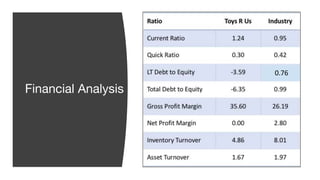
Financial Analysis
0.76
Analysis of the Effects of Laws,
Regulations, and Taxes
● Online Retailers “work to preserve their unfair
advantages and tilt the playing field ever
more in their favor.”
● Upon closure of all of its stores in June 2018,
many employees that were laid off did not
receive severance pay
○ “A class-action claim made to the court
in 2018…. had requested that severance
be treated on par with administrative
claims.”
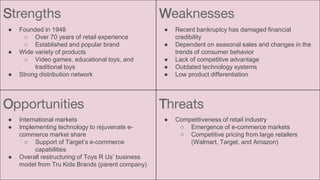
● Founded in 1948
○ Over 70 years of retail experience
○ Established and popular brand
● Wide variety of products
○ Video games, educational toys, and
traditional toys
● Strong distribution network
● International markets
● Implementing technology to rejuvenate e-
commerce market share
○ Support of Target’s e-commerce
capabilities
● Overall restructuring of Toys R Us’ business
model from Tru Kids Brands (parent company)
● Recent bankruptcy has damaged financial
credibility
● Dependent on seasonal sales and changes in the
trends of consumer behavior
● Lack of competitive advantage
● Outdated technology systems
● Low product differentiation
● Competitiveness of retail industry
○ Emergence of e-commerce markets
○ Competitive pricing from large retailers
(Walmart, Target, and Amazon)
Strengths Weaknesses
Opportunities Threats
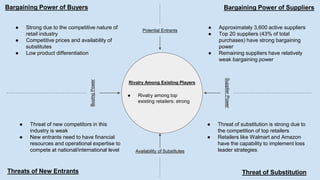
Rivalry Among Existing Players
Potential Entrants
Availability of Substitutes
BuyingPower
Bargaining Power of Buyers
Threat of SubstitutionThreats of New Entrants
● Strong due to the competitive nature of
retail industry
● Competitive prices and availability of
substitutes
● Low product differentiation
● Rivalry among top
existing retailers: strong
● Threat of new competitors in this
industry is weak
● New entrants need to have financial
resources and operational expertise to
compete at national/international level
● Approximately 3,600 active suppliers
● Top 20 suppliers (43% of total
purchases) have strong bargaining
power
● Remaining suppliers have relatively
weak bargaining power
● Threat of substitution is strong due to
the competition of top retailers
● Retailers like Walmart and Amazon
have the capability to implement loss
leader strategies
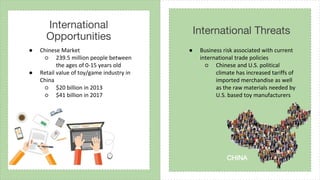
International Threats
International
Opportunities
● Chinese Market
○ 239.5 million people between
the ages of 0-15 years old
● Retail value of toy/game industry in
China
○ $20 billion in 2013
○ $41 billion in 2017
CHINA
● Business risk associated with current
international trade policies
○ Chinese and U.S. political
climate has increased tariffs of
imported merchandise as well
as the raw materials needed by
U.S. based toy manufacturers
PART II: PROPOSED STRATEGIC PLAN FOR TOYS R
US
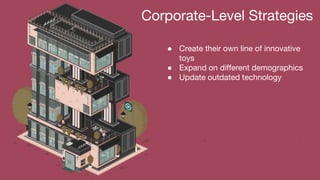
Corporate-Level Strategies
● Create their own line of innovative
toys
● Expand on different demographics
● Update outdated technology
Business-LevelStrategies ● Diversify line to include all types
of toys
○ Educational, video games,
electronics
● Update their technology
○ 60% off glitch
● Expand market reach to teens
because they are a prime target
○ Teens R Us
FUNCTIONAL STRATEGIES TO USE/CHANGE
● Marketing Strategies
● Product Line
● Gen Z / Millennials
○ 58% of MIllenials have played video games in the
past 30 days and ⅕ of them played for more than
20 hours a week
● Technology update
TOYS R US CURRENT FINANCIAL STANDING
Toys R Us recently returned with a new store
in Paramus, New Jersey
They have redesigned the experience and feel
of the store to create memorable experiences
for its customers.
“This store has about 1,500 items, but
through technology in the store, you can buy
over 15,000 items today” - Richard Barry,
President of TruKids
Toys R Us Current
Marketing Strategy
• 70 new stores in Asia, Europe, and
India
• Ensure focus on technology, in-
store experiences, and customer
service
• Target → boost e-commerce sales
• Outsource
The Future for Toys R Us
International Strategies
• Babies R Us in Japan
• Generation shift
• Baby advisors
• Expand 50 new stores in
China within three years
• Educational toys
The Future for Toys R Us Divisions/Departments
• Slim chance coming back into
industry
• Babies R Us may have a chance if
they can compete with Target,
Walmart, and Amazon’s prices
• Birth rates
• Kids R Us may have a chance if they
expand their product line
• Kidswear
• High competition
• Incorporating products into main
stores
CONCLUSION
● Demise of Toys R Us
○ Bankruptcy in 2017
● Resurgence of the company
○ New store experience
● Strategies for the future
○ Online market
○ Unique store experiences

Toys r us

  • 1.
    By: Casey Wu,Jeremy Vea, Mark Lemos, Steven Hong, and Elizabeth Leon
  • 2.
    Introduction • The companyeventually helped turn the $500 million dollar toy industry in 1950 into a $12 billion dollar industry by 1990, controlling 25% of the toy market. • It was the number one toy retailer in the world and was one of the top retailers in the world in 2017. “I decided that I would open a store in my father’s bicycle-repair shop. But instead of selling bikes, I would sell cribs, carriages, strollers, high chairs—everything for the baby. My instincts told me the timing was right” - Charles Lazarus
  • 3.
    Review and Analysisof the History ● 1948 the idea of Toys R Us came to life by C. Lazarus returning from WW2. “Everyone I talked to said that they were going home to get married and have children and live their american dream.” ● 1957 The First Toys R Us opened. ● Toys R Us was the first “Category Killer” in history ● Chapter 11 bankruptcy in September 2017 after years of slipping sales/debt that grew.
  • 4.
  • 5.
  • 6.
    Analysis of theEffects of Laws, Regulations, and Taxes ● Online Retailers “work to preserve their unfair advantages and tilt the playing field ever more in their favor.” ● Upon closure of all of its stores in June 2018, many employees that were laid off did not receive severance pay ○ “A class-action claim made to the court in 2018…. had requested that severance be treated on par with administrative claims.”
  • 7.
    ● Founded in1948 ○ Over 70 years of retail experience ○ Established and popular brand ● Wide variety of products ○ Video games, educational toys, and traditional toys ● Strong distribution network ● International markets ● Implementing technology to rejuvenate e- commerce market share ○ Support of Target’s e-commerce capabilities ● Overall restructuring of Toys R Us’ business model from Tru Kids Brands (parent company) ● Recent bankruptcy has damaged financial credibility ● Dependent on seasonal sales and changes in the trends of consumer behavior ● Lack of competitive advantage ● Outdated technology systems ● Low product differentiation ● Competitiveness of retail industry ○ Emergence of e-commerce markets ○ Competitive pricing from large retailers (Walmart, Target, and Amazon) Strengths Weaknesses Opportunities Threats
  • 8.
    Rivalry Among ExistingPlayers Potential Entrants Availability of Substitutes BuyingPower Bargaining Power of Buyers Threat of SubstitutionThreats of New Entrants ● Strong due to the competitive nature of retail industry ● Competitive prices and availability of substitutes ● Low product differentiation ● Rivalry among top existing retailers: strong ● Threat of new competitors in this industry is weak ● New entrants need to have financial resources and operational expertise to compete at national/international level ● Approximately 3,600 active suppliers ● Top 20 suppliers (43% of total purchases) have strong bargaining power ● Remaining suppliers have relatively weak bargaining power ● Threat of substitution is strong due to the competition of top retailers ● Retailers like Walmart and Amazon have the capability to implement loss leader strategies
  • 9.
    International Threats International Opportunities ● ChineseMarket ○ 239.5 million people between the ages of 0-15 years old ● Retail value of toy/game industry in China ○ $20 billion in 2013 ○ $41 billion in 2017 CHINA ● Business risk associated with current international trade policies ○ Chinese and U.S. political climate has increased tariffs of imported merchandise as well as the raw materials needed by U.S. based toy manufacturers
  • 10.
    PART II: PROPOSEDSTRATEGIC PLAN FOR TOYS R US
  • 11.
    Corporate-Level Strategies ● Createtheir own line of innovative toys ● Expand on different demographics ● Update outdated technology
  • 12.
    Business-LevelStrategies ● Diversifyline to include all types of toys ○ Educational, video games, electronics ● Update their technology ○ 60% off glitch ● Expand market reach to teens because they are a prime target ○ Teens R Us
  • 13.
    FUNCTIONAL STRATEGIES TOUSE/CHANGE ● Marketing Strategies ● Product Line ● Gen Z / Millennials ○ 58% of MIllenials have played video games in the past 30 days and ⅕ of them played for more than 20 hours a week ● Technology update
  • 14.
    TOYS R USCURRENT FINANCIAL STANDING Toys R Us recently returned with a new store in Paramus, New Jersey They have redesigned the experience and feel of the store to create memorable experiences for its customers. “This store has about 1,500 items, but through technology in the store, you can buy over 15,000 items today” - Richard Barry, President of TruKids
  • 15.
    Toys R UsCurrent Marketing Strategy • 70 new stores in Asia, Europe, and India • Ensure focus on technology, in- store experiences, and customer service • Target → boost e-commerce sales • Outsource
  • 16.
    The Future forToys R Us International Strategies • Babies R Us in Japan • Generation shift • Baby advisors • Expand 50 new stores in China within three years • Educational toys
  • 17.
    The Future forToys R Us Divisions/Departments • Slim chance coming back into industry • Babies R Us may have a chance if they can compete with Target, Walmart, and Amazon’s prices • Birth rates • Kids R Us may have a chance if they expand their product line • Kidswear • High competition • Incorporating products into main stores
  • 18.
    CONCLUSION ● Demise ofToys R Us ○ Bankruptcy in 2017 ● Resurgence of the company ○ New store experience ● Strategies for the future ○ Online market ○ Unique store experiences