



Private Sector Alliances
BE0964 Partnership & Collaborative Working
Introduction
•

Why Collaborate

•

A history of partnering

•

Key issues

•

Examples
Partnerships
A partnership is an arrangement in which parties
agree to cooperate to advance their mutual
interests

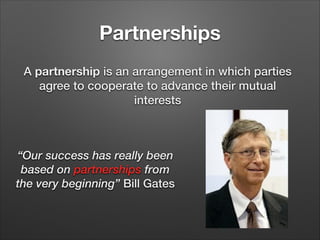
“Our success has really been
based on partnerships from
the very beginning” Bill Gates
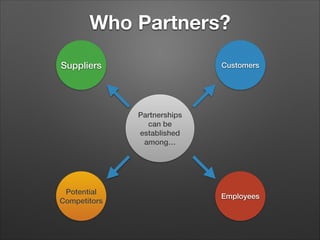
Who Partners?
Suppliers

Customers

Partnerships
can be
established
among…

Potential
Competitors

Employees
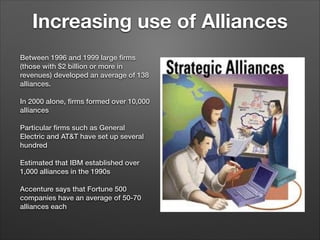
Increasing use of Alliances
Between 1996 and 1999 large firms
(those with $2 billion or more in
revenues) developed an average of 138
alliances.
In 2000 alone, firms formed over 10,000
alliances
Particular firms such as General
Electric and AT&T have set up several
hundred
Estimated that IBM established over
1,000 alliances in the 1990s
Accenture says that Fortune 500
companies have an average of 50-70
alliances each
Types of Partnerships

Linan Qiu (2011)

Collaboration

Strategic Partnership

Joint Venture
Strategic Alliance
Joint Ventures
•

!
•

!

Business agreement in which the parties
agree to develop, for a finite time, a new
entity and new assets by contributing
equity.
They exercise control over the enterprise
and share revenues, expenses and assets.

•

There are other types of companies such as
JV limited by guarantee, joint ventures
limited by guarantee with partners holding
shares.

•

The venture can be for one specific project only - when the JV is referred to more
correctly as a consortium (as the building of the Channel Tunnel) - or a continuing
business relationship.

•

The consortium JV is formed where one party seeks technological expertise or
technical service arrangements, franchise and brand use agreements,
management contracts, rental agreements, for one-time contracts. The JV is
dissolved when that goal is reached.
Joint Venture Examples
Strategic Alliances
•

A co-operative arrangement
between two or more companies in
which;

•

a common strategy is developed in
unison and a win-win attitude is
adopted by all parties;

•

the relationship is reciprocal, with
each partner prepared to share
specific strengths with the other,
thus lending power to the enterprise;

•

a pooling of resources, investment
and risks occurs for mutual gain.

•

falls short of forming a legal
partnership
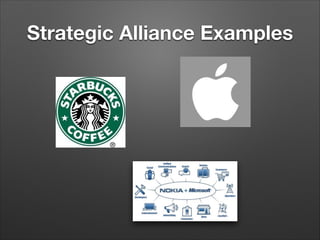
Strategic Alliance Examples
Main Differences
•

In a joint venture, the companies
start and invest in a new company
that's jointly owned by both of the
parent companies

!
•

•

A strategic alliance is a legal
agreement between two or more
companies to share access to their
technology, trademarks or other
assets
!
A strategic alliance does not create
a new company.
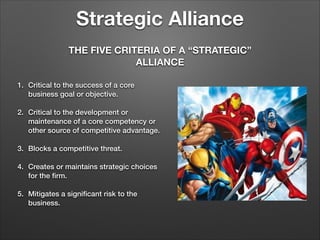
Strategic Alliance
THE FIVE CRITERIA OF A “STRATEGIC”
ALLIANCE
1. Critical to the success of a core
business goal or objective.

!
2. Critical to the development or
maintenance of a core competency or
other source of competitive advantage.

!
3. Blocks a competitive threat.

!
4. Creates or maintains strategic choices
for the firm.

!
5. Mitigates a significant risk to the
business.
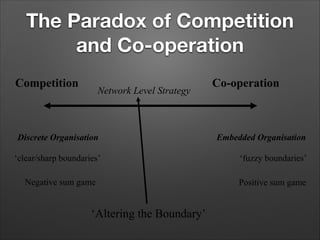
The Paradox of Competition
and Co-operation
Competition

Network Level Strategy

Co-operation

Discrete Organisation

Embedded Organisation

‘clear/sharp boundaries’

‘fuzzy boundaries’

Negative sum game

‘Altering the Boundary’

Positive sum game
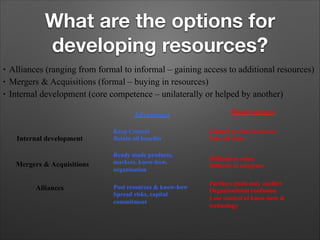
What are the options for
developing resources?
•
•
•

Alliances (ranging from formal to informal – gaining access to additional resources)
Mergers & Acquisitions (formal – buying in resources)
Internal development (core competence – unilaterally or helped by another)
Advantages

Internal development
Mergers & Acquisitions
Alliances

Disadvantages

Keep Control
Retain all benefits

Limited to own resources
Take all risks

Ready made products,
markets, know-how,
organisation

Difficult to value
Difficult to integrate

Pool resources & know-how
Spread risks, capital
commitment

Partners goals may conflict
Organisational confusion
Lose control of know-how &
technology
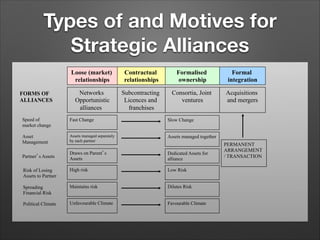
Types of and Motives for
Strategic Alliances
Loose (market)
relationships
FORMS OF
ALLIANCES

Contractual
relationships

Formalised
ownership

Formal
integration

Networks
Opportunistic
alliances

Subcontracting
Licences and
franchises

Consortia, Joint
ventures

Acquisitions
and mergers

Speed of
market change

Fast Change

Slow Change

Asset
Management

Assets managed separately
by each partner

Assets managed together

Partner s Assets

Draws on Parent s
Assets

Dedicated Assets for
alliance

Risk of Losing
Assets to Partner

High risk

Low Risk

Spreading
Financial Risk

Maintains risk

Dilutes Risk

Political Climate

Unfavourable Climate

Favourable Climate

PERMANENT
ARRANGEMENT
/ TRANSACTION
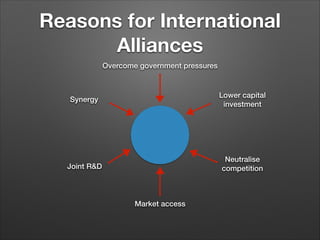
Reasons for International
Alliances
Overcome government pressures

Synergy

Lower capital
investment

Joint R&D

Neutralise
competition

Market access
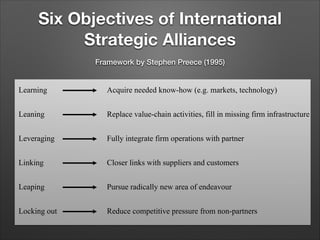
Six Objectives of International
Strategic Alliances
Framework by Stephen Preece (1995)

Learning

Acquire needed know-how (e.g. markets, technology)

Leaning

Replace value-chain activities, fill in missing firm infrastructure

Leveraging

Fully integrate firm operations with partner

Linking

Closer links with suppliers and customers

Leaping

Pursue radically new area of endeavour

Locking out

Reduce competitive pressure from non-partners
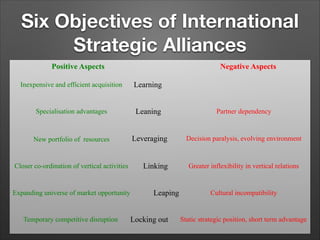
Six Objectives of International
Strategic Alliances
Positive Aspects

Negative Aspects

Inexpensive and efficient acquisition

Learning

Specialisation advantages

Leaning

Partner dependency

New portfolio of resources

Leveraging

Decision paralysis, evolving environment

Closer co-ordination of vertical activities

Expanding universe of market opportunity

Temporary competitive disruption

Linking
Leaping
Locking out

Greater inflexibility in vertical relations

Cultural incompatibility

Static strategic position, short term advantage
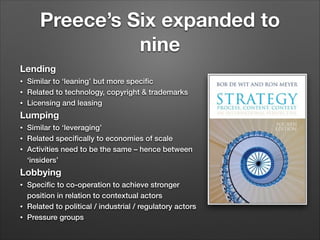
Preece’s Six expanded to
nine
Lending
•
•
•

Similar to ‘leaning’ but more specific
Related to technology, copyright & trademarks
Licensing and leasing

Lumping
•
•
•

Similar to ‘leveraging’
Related specifically to economies of scale
Activities need to be the same – hence between
‘insiders’

Lobbying
•

•
•

Specific to co-operation to achieve stronger
position in relation to contextual actors
Related to political / industrial / regulatory actors
Pressure groups
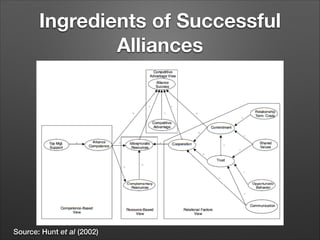
Ingredients of Successful
Alliances

Source: Hunt et al (2002)
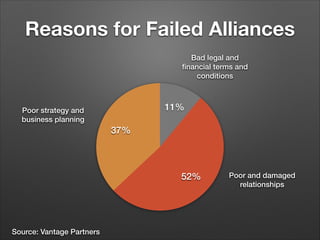
Reasons for Failed Alliances
Bad legal and
financial terms and
conditions

11%

Poor strategy and
business planning

37%

52%

Source: Vantage Partners

Poor and damaged
relationships
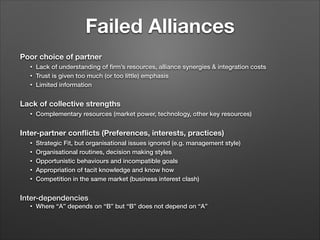
Failed Alliances
Poor choice of partner
•
•
•

Lack of understanding of firm’s resources, alliance synergies & integration costs
Trust is given too much (or too little) emphasis
Limited information

!
Lack of collective strengths
•

Complementary resources (market power, technology, other key resources)

!
Inter-partner conflicts (Preferences, interests, practices)
•
•
•
•
•

Strategic Fit, but organisational issues ignored (e.g. management style)
Organisational routines, decision making styles
Opportunistic behaviours and incompatible goals
Appropriation of tacit knowledge and know how
Competition in the same market (business interest clash)

!
Inter-dependencies
•

Where “A” depends on “B” but “B” does not depend on “A”
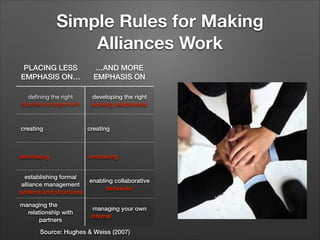
Simple Rules for Making
Alliances Work
PLACING LESS
EMPHASIS ON…

…AND MORE
EMPHASIS ON

defining the right
business arrangement

developing the right
working relationship

creating

creating

eliminating

embracing

establishing formal
alliance management
systems and structures

enabling collaborative
behaviour

managing the
relationship with
partners

managing your own
internal

Source: Hughes & Weiss (2007)
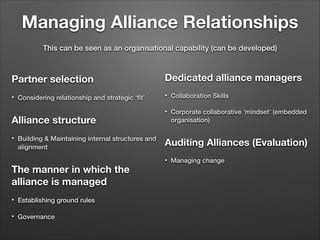
Managing Alliance Relationships
This can be seen as an organisational capability (can be developed)

Partner selection
•

Considering relationship and strategic ‘fit’

!

Alliance structure
•

Building & Maintaining internal structures and
alignment

!

Dedicated alliance managers
•

Collaboration Skills

•

Corporate collaborative ‘mindset’ (embedded
organisation)

!

Auditing Alliances (Evaluation)
•

The manner in which the
alliance is managed
•

Establishing ground rules

•

Governance

Managing change
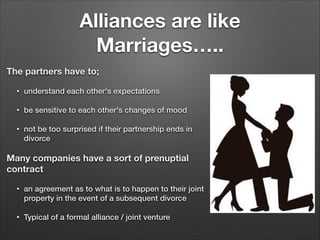
Alliances are like
Marriages…..
The partners have to;
•

understand each other's expectations

•

be sensitive to each other's changes of mood

•

not be too surprised if their partnership ends in
divorce

Many companies have a sort of prenuptial
contract
•

an agreement as to what is to happen to their joint
property in the event of a subsequent divorce

•

Typical of a formal alliance / joint venture
Further Reading
Explaining Alliance Success: Competences, Resources, Relational factors and Resource
Advantage Theory

!

Hunt, S. D., Lambe, C. J., & Wittmann, C. M. (2002). A theory and model of business alliance success. Journal of
Relationship Marketing, 1(1), 17-35.

!

Putting The S-Word Back In Alliances

!

Mitchell P. Koza and Arie Y. Lewin (Financial Times; Nov 1, 1999)

!

Trust And Control In Strategic Alliances

!

David Faulkner (Financial Times; Nov 29, 1999)

!

How To Make Strategic Alliances Work

!

Jeffrey H. Dyer, Prashant Kale and Harbir Singh (Mit Sloan Management Review Summer 2001)

!

Incorporating International Strategic Alliances into Overall Firm Strategy: A Typology of Six Managerial
Objectives

!

Stephen B Preece, (The International Executive; Vol 37 (3) 261-277 (May / June 1995))
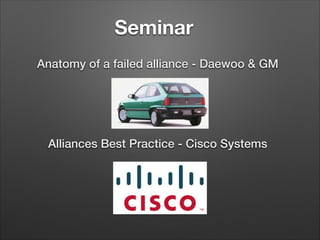
Seminar
Anatomy of a failed alliance - Daewoo & GM

Alliances Best Practice - Cisco Systems

Private Sector Alliances

  • 1.
    Private Sector Alliances BE0964Partnership & Collaborative Working
  • 2.
    Introduction • Why Collaborate • A historyof partnering • Key issues • Examples
  • 3.
    Partnerships A partnership isan arrangement in which parties agree to cooperate to advance their mutual interests “Our success has really been based on partnerships from the very beginning” Bill Gates
  • 4.
  • 5.
    Increasing use ofAlliances Between 1996 and 1999 large firms (those with $2 billion or more in revenues) developed an average of 138 alliances. In 2000 alone, firms formed over 10,000 alliances Particular firms such as General Electric and AT&T have set up several hundred Estimated that IBM established over 1,000 alliances in the 1990s Accenture says that Fortune 500 companies have an average of 50-70 alliances each
  • 6.
    Types of Partnerships LinanQiu (2011) Collaboration Strategic Partnership Joint Venture Strategic Alliance
  • 7.
    Joint Ventures • ! • ! Business agreementin which the parties agree to develop, for a finite time, a new entity and new assets by contributing equity. They exercise control over the enterprise and share revenues, expenses and assets. • There are other types of companies such as JV limited by guarantee, joint ventures limited by guarantee with partners holding shares. • The venture can be for one specific project only - when the JV is referred to more correctly as a consortium (as the building of the Channel Tunnel) - or a continuing business relationship. • The consortium JV is formed where one party seeks technological expertise or technical service arrangements, franchise and brand use agreements, management contracts, rental agreements, for one-time contracts. The JV is dissolved when that goal is reached.
  • 8.
  • 9.
    Strategic Alliances • A co-operativearrangement between two or more companies in which; • a common strategy is developed in unison and a win-win attitude is adopted by all parties; • the relationship is reciprocal, with each partner prepared to share specific strengths with the other, thus lending power to the enterprise; • a pooling of resources, investment and risks occurs for mutual gain. • falls short of forming a legal partnership
  • 10.
  • 11.
    Main Differences • In ajoint venture, the companies start and invest in a new company that's jointly owned by both of the parent companies ! • • A strategic alliance is a legal agreement between two or more companies to share access to their technology, trademarks or other assets ! A strategic alliance does not create a new company.
  • 12.
    Strategic Alliance THE FIVECRITERIA OF A “STRATEGIC” ALLIANCE 1. Critical to the success of a core business goal or objective. ! 2. Critical to the development or maintenance of a core competency or other source of competitive advantage. ! 3. Blocks a competitive threat. ! 4. Creates or maintains strategic choices for the firm. ! 5. Mitigates a significant risk to the business.
  • 13.
    The Paradox ofCompetition and Co-operation Competition Network Level Strategy Co-operation Discrete Organisation Embedded Organisation ‘clear/sharp boundaries’ ‘fuzzy boundaries’ Negative sum game ‘Altering the Boundary’ Positive sum game
  • 14.
    What are theoptions for developing resources? • • • Alliances (ranging from formal to informal – gaining access to additional resources) Mergers & Acquisitions (formal – buying in resources) Internal development (core competence – unilaterally or helped by another) Advantages Internal development Mergers & Acquisitions Alliances Disadvantages Keep Control Retain all benefits Limited to own resources Take all risks Ready made products, markets, know-how, organisation Difficult to value Difficult to integrate Pool resources & know-how Spread risks, capital commitment Partners goals may conflict Organisational confusion Lose control of know-how & technology
  • 15.
    Types of andMotives for Strategic Alliances Loose (market) relationships FORMS OF ALLIANCES Contractual relationships Formalised ownership Formal integration Networks Opportunistic alliances Subcontracting Licences and franchises Consortia, Joint ventures Acquisitions and mergers Speed of market change Fast Change Slow Change Asset Management Assets managed separately by each partner Assets managed together Partner s Assets Draws on Parent s Assets Dedicated Assets for alliance Risk of Losing Assets to Partner High risk Low Risk Spreading Financial Risk Maintains risk Dilutes Risk Political Climate Unfavourable Climate Favourable Climate PERMANENT ARRANGEMENT / TRANSACTION
  • 16.
    Reasons for International Alliances Overcomegovernment pressures Synergy Lower capital investment Joint R&D Neutralise competition Market access
  • 17.
    Six Objectives ofInternational Strategic Alliances Framework by Stephen Preece (1995) Learning Acquire needed know-how (e.g. markets, technology) Leaning Replace value-chain activities, fill in missing firm infrastructure Leveraging Fully integrate firm operations with partner Linking Closer links with suppliers and customers Leaping Pursue radically new area of endeavour Locking out Reduce competitive pressure from non-partners
  • 18.
    Six Objectives ofInternational Strategic Alliances Positive Aspects Negative Aspects Inexpensive and efficient acquisition Learning Specialisation advantages Leaning Partner dependency New portfolio of resources Leveraging Decision paralysis, evolving environment Closer co-ordination of vertical activities Expanding universe of market opportunity Temporary competitive disruption Linking Leaping Locking out Greater inflexibility in vertical relations Cultural incompatibility Static strategic position, short term advantage
  • 19.
    Preece’s Six expandedto nine Lending • • • Similar to ‘leaning’ but more specific Related to technology, copyright & trademarks Licensing and leasing Lumping • • • Similar to ‘leveraging’ Related specifically to economies of scale Activities need to be the same – hence between ‘insiders’ Lobbying • • • Specific to co-operation to achieve stronger position in relation to contextual actors Related to political / industrial / regulatory actors Pressure groups
  • 20.
  • 21.
    Reasons for FailedAlliances Bad legal and financial terms and conditions 11% Poor strategy and business planning 37% 52% Source: Vantage Partners Poor and damaged relationships
  • 22.
    Failed Alliances Poor choiceof partner • • • Lack of understanding of firm’s resources, alliance synergies & integration costs Trust is given too much (or too little) emphasis Limited information ! Lack of collective strengths • Complementary resources (market power, technology, other key resources) ! Inter-partner conflicts (Preferences, interests, practices) • • • • • Strategic Fit, but organisational issues ignored (e.g. management style) Organisational routines, decision making styles Opportunistic behaviours and incompatible goals Appropriation of tacit knowledge and know how Competition in the same market (business interest clash) ! Inter-dependencies • Where “A” depends on “B” but “B” does not depend on “A”
  • 23.
    Simple Rules forMaking Alliances Work PLACING LESS EMPHASIS ON… …AND MORE EMPHASIS ON defining the right business arrangement developing the right working relationship creating creating eliminating embracing establishing formal alliance management systems and structures enabling collaborative behaviour managing the relationship with partners managing your own internal Source: Hughes & Weiss (2007)
  • 24.
    Managing Alliance Relationships Thiscan be seen as an organisational capability (can be developed) Partner selection • Considering relationship and strategic ‘fit’ ! Alliance structure • Building & Maintaining internal structures and alignment ! Dedicated alliance managers • Collaboration Skills • Corporate collaborative ‘mindset’ (embedded organisation) ! Auditing Alliances (Evaluation) • The manner in which the alliance is managed • Establishing ground rules • Governance Managing change
  • 25.
    Alliances are like Marriages….. Thepartners have to; • understand each other's expectations • be sensitive to each other's changes of mood • not be too surprised if their partnership ends in divorce Many companies have a sort of prenuptial contract • an agreement as to what is to happen to their joint property in the event of a subsequent divorce • Typical of a formal alliance / joint venture
  • 26.
    Further Reading Explaining AllianceSuccess: Competences, Resources, Relational factors and Resource Advantage Theory ! Hunt, S. D., Lambe, C. J., & Wittmann, C. M. (2002). A theory and model of business alliance success. Journal of Relationship Marketing, 1(1), 17-35. ! Putting The S-Word Back In Alliances ! Mitchell P. Koza and Arie Y. Lewin (Financial Times; Nov 1, 1999) ! Trust And Control In Strategic Alliances ! David Faulkner (Financial Times; Nov 29, 1999) ! How To Make Strategic Alliances Work ! Jeffrey H. Dyer, Prashant Kale and Harbir Singh (Mit Sloan Management Review Summer 2001) ! Incorporating International Strategic Alliances into Overall Firm Strategy: A Typology of Six Managerial Objectives ! Stephen B Preece, (The International Executive; Vol 37 (3) 261-277 (May / June 1995))
  • 27.
    Seminar Anatomy of afailed alliance - Daewoo & GM Alliances Best Practice - Cisco Systems