1
   Role of IT has shifted beyond its traditional back office support
    model to provide an integral part of an organisational strategy.

   Organisations fail to realise the value of IT investments due to the
    lack of alignment between the business and IT strategies of an
    organisation.

   Strategic Alignment ensures that the operating elements of the
    company all work in harmony.

   Proper alignment will allow an organisation to use information
    technology efficiently to achieve its business objectives.


                                                                           2
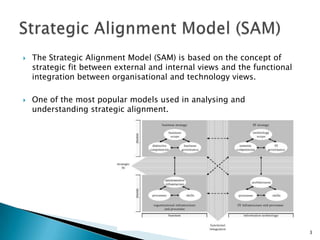
   The Strategic Alignment Model (SAM) is based on the concept of
    strategic fit between external and internal views and the functional
    integration between organisational and technology views.

   One of the most popular models used in analysing and
    understanding strategic alignment.


                                                                           3
   There are four domains involved in the strategic
    alignment model. There are two internal and two
    external domains.


   External: Business Strategy and IT Strategy


   Internal: Business Infrastructure and IT
    Infrastructure


                                                       4
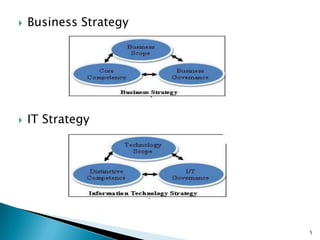
   Business Strategy


   IT Strategy


                        5
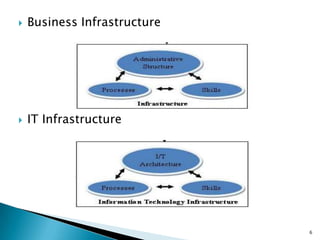
   Business Infrastructure


   IT Infrastructure


                              6
   These linkages are necessary because the all the quadrants
    and components have to work as a whole unit.


   Strategic fit refers to the use of strategy to determine the
    infrastructure of the business.


   Functional integration is most directly related to information
    technology and the alignment of the business.


                                                                     7
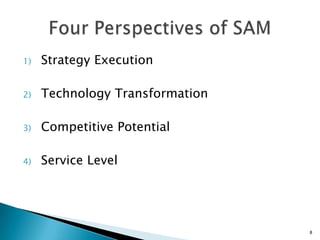
1)   Strategy Execution

2)   Technology Transformation

3)   Competitive Potential

4)   Service Level


                                 8
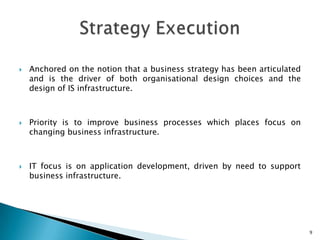
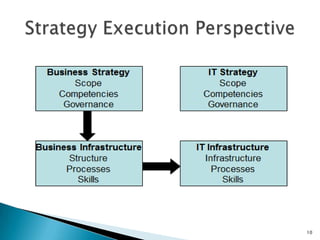
   Anchored on the notion that a business strategy has been articulated
    and is the driver of both organisational design choices and the
    design of IS infrastructure.


   Priority is to improve business processes which places focus on
    changing business infrastructure.


   IT focus is on application development, driven by need to support
    business infrastructure.


                                                                           9
10
   The Wolf Organisation is a traditional manufacturing company
    located in Pennsylvania.


   As competitors threatened, Wolf built an enterprise resource
    planning platform for growth, efficiency and productivity.


   In ten years, Wolf doubled revenues and positioned itself for
    expansion.


                                                                    11
   Business Strategy
   Dedicated to expanding their markets.

   Achieving Competitive Advantage.

   Providing exceptional customer service to their customers.


   Business Infrastructure
   Management team is an experienced group of professionals
    dedicated to building better business through service to company
    and community.

   Old billing system not meeting customer requirements or keeping up
    with competitors.

   To enable business improvement initiatives Wolf implemented SAP
    within the company.


                                                                         12
   IT Infrastructure

   Relies on technological innovation. It became one of the first midsize
    companies to partner with SAP.

   Recent implementation of SAP Biller Direct has helped to strengthen
    existing customer relationships and lay the groundwork for building
    new relationships in a tighter market.

   Listening to its customers, Wolf integrated Web-based billing,
    empowering customers who want a digital relationship and
    stimulating real-time collaboration.


                                                                             13
   Reduced customer and Wolf financial fees.

   Built entry barriers to competitors.

   Enhanced customer loyalty and collaboration.

   Alignment enabled better relationships with customers by meeting
    customer demand and improving billing detail.

   Improved communications with regional partners and employees.


                                                                       14
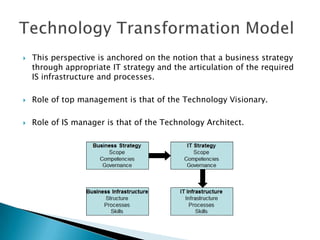
   This perspective is anchored on the notion that a business strategy
    through appropriate IT strategy and the articulation of the required
    IS infrastructure and processes.

   Role of top management is that of the Technology Visionary.

   Role of IS manager is that of the Technology Architect.
   Implement Chosen Business Strategy

   Identify the value of Information Technology.

   Identify the best possible IT competencies.

   identify the corresponding internal IS architecture.

   The technology transformation model is the ability to transform
    technology into business success.
   Business Strategy
     Deliver Creative Technology Solution
     Deliver Value
     Competitive Advantage


   IT Strategy
     Commitment to a Technology Alliance
     Expanding and Strengthening their Strategic Relationships
   IS Infastructure
     Samsung combined its hard disk drive operations into Seagate.

     A NAND flash memory supply agreement under which Samsung
      will provide Seagate with its market-leading semiconductor
      product.

     A disk supply agreement under which Seagate will supply disk
      drives to Samsung.
   Conclusions
     This Alignment enabled both Companies to better align their
      current and future product.

     Accelerate time-to-market for new products.

     Positioned the companies to better address rapidly evolving
      opportunities in the markets.

     This alignment significantly expanded Seagate’s customer access
      in China and Southeast Asia.
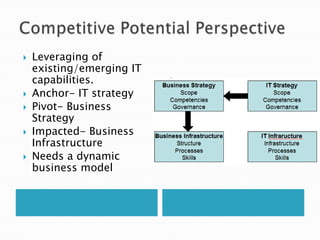
   Leveraging of
    existing/emerging IT
    capabilities.
   Anchor- IT strategy
   Pivot- Business
    Strategy
   Impacted- Business
    Infrastructure
   Needs a dynamic
    business model
   Flextronics produce components,
    circutboards based in Hollyhill, Cork.
   IT strategy initiative to improve data use.
   Business strategy- New Quality Management
    approach.
   Infrastructure? New flow of information,
    improved CRM
   More detailed overview of production.
   Employees: 38,100
   Revenue: US$15.3 billion
   Plants on 5 continents

   IT Driven- Opportunity to integrate software,
    improve quality management and quality
    management.
    Business Strategy change in expectation and
    standards.
   New performance measurement tools and
    share knowledge worldwide
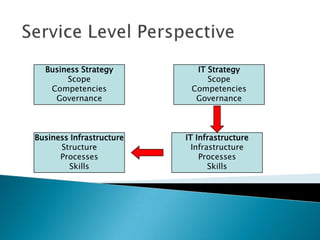
Business Strategy         IT Strategy
       Scope                   Scope
   Competencies            Competencies
    Governance              Governance


Business Infrastructure   IT Infrastructure
      Structure             Infrastructure
      Processes               Processes
        Skills                   Skills
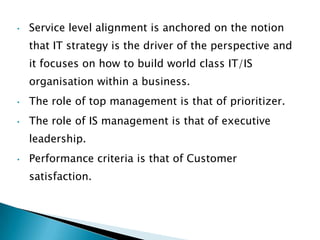
•   Service level alignment is anchored on the notion
    that IT strategy is the driver of the perspective and
    it focuses on how to build world class IT/IS
    organisation within a business.
•   The role of top management is that of prioritizer.
•   The role of IS management is that of executive
    leadership.
•   Performance criteria is that of Customer
    satisfaction.
   IT Strategy

    • Maintain business strategy of providing the best service for

      the lowest price

    • High levels of IT utilization.

    • High level of IT innovation.

    • Create customer loyalty through interactive customer

      technology and experience.
   IS Infrastructure.
    •   Customer ability to track package/product via GPS.
    •   Error handling programmes.
    •   High use of logistics benefiting business process and
        customer trust and satisfaction.
    •   Online return policy with customer, UPS and the vendor.
    •   Shipment updates via mobile apps.
    •   Reroute abilities through IT capabilities.
    •   Data delivery system of companies can be attached to the UPS
        server.
   Business Infrastructure
    • Enabling employees the skill set to operate all
        technology and new technology innovations.
    •   Integrating the advanced IT into the basic business
        process.
    • The provision of high levels of information to
        customers with the same low prices.
   Conclusion
    ◦ UPS is a world leader in the postal service business.
    ◦ It was the first postage service to provide the customer
     with the technology experience.
    ◦ UPS’s IS infrastructure has led them to gain competitive
     advantage over their rivals on the basis of the best
     service for the best value.
    ◦ UPS are very progressive expansion wise and our
     becoming leaders in the business in the European and
     Asian market.
 Example
        of how IT can bring
 harmony between strategies.

 Exploitation   through IT.

Strategic Alignment Model presentation

  • 1.
  • 2.
    Role of IT has shifted beyond its traditional back office support model to provide an integral part of an organisational strategy.  Organisations fail to realise the value of IT investments due to the lack of alignment between the business and IT strategies of an organisation.  Strategic Alignment ensures that the operating elements of the company all work in harmony.  Proper alignment will allow an organisation to use information technology efficiently to achieve its business objectives. 2
  • 3.
    The Strategic Alignment Model (SAM) is based on the concept of strategic fit between external and internal views and the functional integration between organisational and technology views.  One of the most popular models used in analysing and understanding strategic alignment. 3
  • 4.
    There are four domains involved in the strategic alignment model. There are two internal and two external domains.  External: Business Strategy and IT Strategy  Internal: Business Infrastructure and IT Infrastructure 4
  • 5.
    Business Strategy  IT Strategy 5
  • 6.
    Business Infrastructure  IT Infrastructure 6
  • 7.
    These linkages are necessary because the all the quadrants and components have to work as a whole unit.  Strategic fit refers to the use of strategy to determine the infrastructure of the business.  Functional integration is most directly related to information technology and the alignment of the business. 7
  • 8.
    1) Strategy Execution 2) Technology Transformation 3) Competitive Potential 4) Service Level 8
  • 9.
    Anchored on the notion that a business strategy has been articulated and is the driver of both organisational design choices and the design of IS infrastructure.  Priority is to improve business processes which places focus on changing business infrastructure.  IT focus is on application development, driven by need to support business infrastructure. 9
  • 10.
  • 11.
    The Wolf Organisation is a traditional manufacturing company located in Pennsylvania.  As competitors threatened, Wolf built an enterprise resource planning platform for growth, efficiency and productivity.  In ten years, Wolf doubled revenues and positioned itself for expansion. 11
  • 12.
    Business Strategy  Dedicated to expanding their markets.  Achieving Competitive Advantage.  Providing exceptional customer service to their customers.  Business Infrastructure  Management team is an experienced group of professionals dedicated to building better business through service to company and community.  Old billing system not meeting customer requirements or keeping up with competitors.  To enable business improvement initiatives Wolf implemented SAP within the company. 12
  • 13.
    IT Infrastructure  Relies on technological innovation. It became one of the first midsize companies to partner with SAP.  Recent implementation of SAP Biller Direct has helped to strengthen existing customer relationships and lay the groundwork for building new relationships in a tighter market.  Listening to its customers, Wolf integrated Web-based billing, empowering customers who want a digital relationship and stimulating real-time collaboration. 13
  • 14.
    Reduced customer and Wolf financial fees.  Built entry barriers to competitors.  Enhanced customer loyalty and collaboration.  Alignment enabled better relationships with customers by meeting customer demand and improving billing detail.  Improved communications with regional partners and employees. 14
  • 15.
    This perspective is anchored on the notion that a business strategy through appropriate IT strategy and the articulation of the required IS infrastructure and processes.  Role of top management is that of the Technology Visionary.  Role of IS manager is that of the Technology Architect.
  • 16.
    Implement Chosen Business Strategy  Identify the value of Information Technology.  Identify the best possible IT competencies.  identify the corresponding internal IS architecture.  The technology transformation model is the ability to transform technology into business success.
  • 18.
    Business Strategy  Deliver Creative Technology Solution  Deliver Value  Competitive Advantage  IT Strategy  Commitment to a Technology Alliance  Expanding and Strengthening their Strategic Relationships
  • 19.
    IS Infastructure  Samsung combined its hard disk drive operations into Seagate.  A NAND flash memory supply agreement under which Samsung will provide Seagate with its market-leading semiconductor product.  A disk supply agreement under which Seagate will supply disk drives to Samsung.
  • 20.
    Conclusions  This Alignment enabled both Companies to better align their current and future product.  Accelerate time-to-market for new products.  Positioned the companies to better address rapidly evolving opportunities in the markets.  This alignment significantly expanded Seagate’s customer access in China and Southeast Asia.
  • 21.
    Leveraging of existing/emerging IT capabilities.  Anchor- IT strategy  Pivot- Business Strategy  Impacted- Business Infrastructure  Needs a dynamic business model
  • 22.
    Flextronics produce components, circutboards based in Hollyhill, Cork.  IT strategy initiative to improve data use.  Business strategy- New Quality Management approach.  Infrastructure? New flow of information, improved CRM  More detailed overview of production.
  • 23.
    Employees: 38,100  Revenue: US$15.3 billion  Plants on 5 continents  IT Driven- Opportunity to integrate software, improve quality management and quality management.  Business Strategy change in expectation and standards.  New performance measurement tools and share knowledge worldwide
  • 24.
    Business Strategy IT Strategy Scope Scope Competencies Competencies Governance Governance Business Infrastructure IT Infrastructure Structure Infrastructure Processes Processes Skills Skills
  • 25.
    Service level alignment is anchored on the notion that IT strategy is the driver of the perspective and it focuses on how to build world class IT/IS organisation within a business. • The role of top management is that of prioritizer. • The role of IS management is that of executive leadership. • Performance criteria is that of Customer satisfaction.
  • 26.
    IT Strategy • Maintain business strategy of providing the best service for the lowest price • High levels of IT utilization. • High level of IT innovation. • Create customer loyalty through interactive customer technology and experience.
  • 27.
    IS Infrastructure. • Customer ability to track package/product via GPS. • Error handling programmes. • High use of logistics benefiting business process and customer trust and satisfaction. • Online return policy with customer, UPS and the vendor. • Shipment updates via mobile apps. • Reroute abilities through IT capabilities. • Data delivery system of companies can be attached to the UPS server.
  • 28.
    Business Infrastructure • Enabling employees the skill set to operate all technology and new technology innovations. • Integrating the advanced IT into the basic business process. • The provision of high levels of information to customers with the same low prices.
  • 29.
    Conclusion ◦ UPS is a world leader in the postal service business. ◦ It was the first postage service to provide the customer with the technology experience. ◦ UPS’s IS infrastructure has led them to gain competitive advantage over their rivals on the basis of the best service for the best value. ◦ UPS are very progressive expansion wise and our becoming leaders in the business in the European and Asian market.
  • 30.
     Example of how IT can bring harmony between strategies.  Exploitation through IT.