DEPARTMENT OF ORTHODONTICS AND DENTOFACIAL ORTHOPAEDICS.
SEMINAR PRESENTATION.
BAUSCHINGER EFFECT
Presented by: Guided by:
Dr. Deeksha Bhanotia Dr. Mridula Trehan.
M.D.S. First year. Professor & Head.
NIMS Dental College and Hospital. Department of Orthodontics
and Dentofacial Orthopaedics
1
Contents
1.Introduction.
2. General Physical Properties of Metals.
3. Bauschinger Effect.
4. Causes of the Bauschinger effect.
5. Main features of the Bauschinger effect.
6. Application Of Bauschinger Effect In Orthodontics.
7. Bauschinger Effect In Loop Design for space closure.
8. Effect of Loop Geometry on Horizontal Forces of
vertical Loops.
9. Direction of loading and its Effect on Elasticity of Wires.
10.Conclusion.
11.References.
2
Introduction:
The mechanical response of a metallic
material depends not only on its current stress state but
also on its deformation history. One of the most
important examples is the observation that after a metal
is deformed plastically in one direction, the yield stress in
the reverse direction is often lower. This anisotropic flow
behavior was first reported by Bauschinger and is
reported as Bauschinger effect. A good understanding of
Bauschinger effect may lead to more refined plasticity
theories and may ultimately result in materials with
superior mechanical behaviour.
3
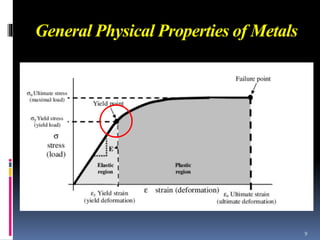
General Physical Properties of Metals:
Stress: Stress is the force per unit area acting on the
millions of atoms or molecules in a given plane of a
material.
Philips Science of Dental Material:Anusavice;73
4
General Physical Properties of Metals:
 Strain: Strain is the change in length per unit initial
length.
Philips Science of Dental Material:Anusavice;73 5
General Physical Properties of Metals:
Modulus of Elasticity: Relative stiffness of the material;
ratio of elastic stress to elastic strain.
Proportional Limit: Maximum stress at which stress is
proportional to strain and above which plastic
deformation occurs.
Philips Science of Dental Material:Anusavice;73
6
General Physical Properties of Metals:
Ductility: Ductility is the maximum plastic deformation a
material can withstand when it is stretched at room
temperature.
Malleability: The ability of the material to sustain
considerable permanent deformation without rupture
under compression , as in hammering or rolling into a
sheet, is termed as malleability.
Philips Science of Dental Material:Anusavice;73
7
General Physical Properties of Metals:
 Yield Strength: The stress at which a test specimen
exhibits a specific amount of plastic strain.
 Percent Elongation: Maximum amount of plastic
strain a tensile test specimen can sustain before it
fractures.
Philips Science of Dental Material:Anusavice;73
8
General Physical Properties of Metals
9
General Physical Properties of Metals
Work Hardening: Increase in strength and hardness and
corresponding decrease in ductility of a metal that is
caused by plastic deformation.
Hardness: Resistance of a material to plastic
deformation typically measured under an indentation
load.
Philips Science of Dental Material:Anusavice;73
10
General Physical Properties of Metals
Resilience: The relative amount of elastic energy per
unit volume released on unloading of a test specimen.
Also known as springiness of a material.
Toughness: Ability of a material to absorb elastic
energy and to deform plastically before fracturing .
Philips Science of Dental Material:Anusavice;73
11
General Physical Properties of Metals
Elastic Strain: Deformation that is recovered upon
removal of applied force of an externally applied
force or pressure.
Plastic Strain: Deformation that is not recoverable
when the externally applied force is removed.
Philips Science of Dental Material:Anusavice;73
12
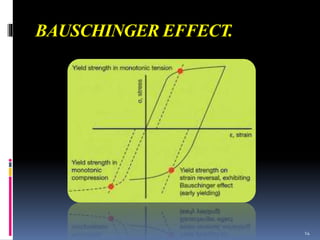
BAUSCHINGER EFFECT.
Given by German Engineer
Johann Bauschinger in 1886.
Bauschinger effect denotes the phenomenon when
the material is strained beyond its yield point in one
direction, and then strained in the reverse direction, its
yield strength in the reverse direction is reduced.
O.P.Kharbanda:Orthodontic Diagnosis And Management of Malocclusion and
Dentofacial Deformities;327 13
BAUSCHINGER EFFECT.
14
Causes of the Bauschinger effect.
Theories advanced to explain the Bauschinger
effect have been of two main types. The earlier theories
relied on internal stress effects and especially on
macroscopic residual stresses developed as a result of
inhomogeneous deformation of the grains of a
polycrystalline metal.
There are two principal Bauschinger effect theories:
1. Back stress theory
2. Orowan theory (1959)
BAUSCHINGER EFFECT IN Nb AND V MICROALLOYED LINE PIPE STEELS :Andrii
Gennadiovych Kostryzhev :School of Metallurgy and Materials College of Engineering and Physical
Sciences The University of Birmingham April 2009 ;35
15
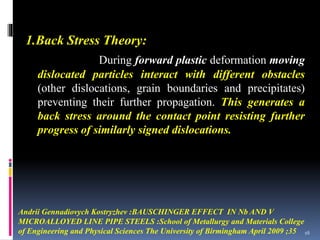
1.Back Stress Theory:
During forward plastic deformation moving
dislocated particles interact with different obstacles
(other dislocations, grain boundaries and precipitates)
preventing their further propagation. This generates a
back stress around the contact point resisting further
progress of similarly signed dislocations.
Andrii Gennadiovych Kostryzhev :BAUSCHINGER EFFECT IN Nb AND V
MICROALLOYED LINE PIPE STEELS :School of Metallurgy and Materials College
of Engineering and Physical Sciences The University of Birmingham April 2009 ;35 16
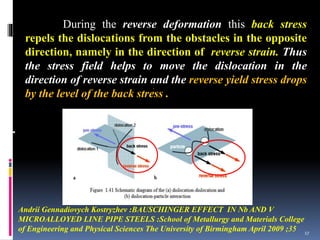
During the reverse deformation this back stress
repels the dislocations from the obstacles in the opposite
direction, namely in the direction of reverse strain. Thus
the stress field helps to move the dislocation in the
direction of reverse strain and the reverse yield stress drops
by the level of the back stress .
.
Andrii Gennadiovych Kostryzhev :BAUSCHINGER EFFECT IN Nb AND V
MICROALLOYED LINE PIPE STEELS :School of Metallurgy and Materials College
of Engineering and Physical Sciences The University of Birmingham April 2009 ;35 17
According to the back stress theory an increase in
dislocation density increases the number of density
dislocation interaction sites and consequently the level of
back stress. Thus the Bauschinger effect should be larger in
a material with a higher dislocation density.
18
Andrii Gennadiovych Kostryzhev :BAUSCHINGER EFFECT IN Nb AND V
MICROALLOYED LINE PIPE STEELS :School of Metallurgy and Materials College of
Engineering and Physical Sciences The University of Birmingham April 2009 ;35
Orowan idea, on the other hand, suggests that
anisotrophy (property of being directionally dependent)
in the resistance to dislocation motion is introduced by
prestraining, so that, after a certain amount of prestrain,
it is easier to move a dislocation in the opposite
direction.
These ideas were supported by the work of Heyn (1914),
Masing (1923, 1926)) Rahlfs and Masing (1950), Schmid
and Boas (1950), Smith and Wood (1944), Orowan
(1948)) and Thompson and Wadsworth (1958).
A. Abel & H. Muir (1972) The Bauschinger effect and discontinuous yielding,
Philosophical Magazine, 26:2, 489-504 19
Parameters Of The Bauschinger Effect.
A. Bauschinger stress Parameters:
It describes the relative decrease in the yield
stress from forward to reverse deformation.
B. Bauschinger Strain Parameters:
Bauschinger strain parameter describes the
amount of deformation in the reverse direction
needed to reach the pre-stressed level of stress.
Patel Chintankumar K, Anish H. Gandhi:Bauschinger Effect in spring Back Prediction
of High Strength Steel: A theoretical Approach:Volume 6 Issue IV, April 2018;689 20
C. Bauschinger Energy Parameter:
describes the amount of energy needed during
the reverse deformation to reach the prestress
level of stress.
Patel Chintankumar K, Anish H. Gandhi:Bauschinger Effect in spring Back Prediction
of High Strength Steel: A theoretical Approach:Volume 6 Issue IV, April 2018;689 21
22
With an increase in pre-strain the stress parameter βσ1
increases and the strain and energy parameters decrease
(Figure 1.42). This may be related to the total dislocation
density increase, leading to an increased yield lowering
effect, but mobile dislocation density decrease, leading to
a faster return of strength, with increase in pre-strain.
Andrii Gennadiovych Kostryzhev :BAUSCHINGER EFFECT IN Nb AND V
MICROALLOYED LINE PIPE STEELS :School of Metallurgy and Materials College of
Engineering and Physical Sciences The University of Birmingham April 2009 ;35
Application Of Bauschinger Effect In Orthodontics
 In Space Closure:
Space closure is one of the most challenging
processes in Orthodontics.
Tooth extraction, molar distalization, expansion
of dental arches, interproximal reduction, among other
things, have been part of the orthodontic armamentarium
to correct malocclusion and allow dental space gain with
which the orthodontist should deal.
Gerson Luiz Ulema Ribeiro, Helder B. Jacob:Understanding the basis of space closure in
Orthodontics for a more efficient orthodontic treatment;120
23
The ability to close spaces, especially those resulting
from tooth extraction, is an essential skill required
during orthodontic treatment.
Two basic biomechanical strategies can be used
to close spaces:
a. frictionless (closing loop mechanics)
b. frictional (sliding mechanics). .
Gerson Luiz Ulema Ribeiro, Helder B. Jacob:Understanding the basis of space closure in
Orthodontics for a more efficient orthodontic treatment;120
24
Bauschinger Effect In Loop Design for space closure
 The Bauschinger effect is normally associated with
conditions in which the strength of a metal decreases
when the direction of strain is changed.
 In other words, if we have two different T-loop
designs, when one closure loop is activated, if all
bends are bent in the same direction, it provides
more resistance to permanent deformation than if all
bends are bent in the opposite direction.
Gerson Luiz Ulema Ribeiro, Helder B. Jacob:Understanding the basis of space closure in
Orthodontics for a more efficient orthodontic treatment;120
25
26
a) Closing loop with bends in the winding-direction. This configuration
presents more resistance to permanent deformation during activation; than
Closing loop with bends in unwinding-direction.
Gerson Luiz Ulema Ribeiro, Helder B. Jacob:Understanding the basis of space
closure in Orthodontics for a more efficient orthodontic treatment;120
a b
Effect of Loop Geometry on Horizontal Forces
of Vertical Loops:
A. Plain vertical loop; B. Squash loop; C.Vertical Closed Loop; D.Vertical helical closed
loop ;E.Vertical Helical Open loop; F.Vertical Open Loop.
Hasan Salehi and Sepide Arab: Effect of Loop Geometry on Horizontal Forces of
Vertical Loops: A Finite Element Analysis:Iranian Journal of Orthodontics: December
30, 2015, ; e4988
27
A study done to know the benefits of applying loops in round stainless
steel wire and compare the horizontal forces of six different types of
commonly used vertical loops.
Effect of Loop Geometry on Horizontal Forces
of Vertical Loops:
 The results of the study revealed that in (0.1 mm, 0.4
mm, 0.8 mm and 1 mm) activations, vertical open
loop gave the highest amount of force (between 0.3 to
3 N).
 The second highest force was shown by the plain
vertical loop (between 0.29 to 2.95 N),
 followed by squash loop (between 0.27 to 2.77 N),
vertical helical open loop (between 0.19 to 1.99 N)
and closed vertical loop (0.12 to 1.24 N).
 Vertical helical closed loop had the lowest amount of
force in all activations
Hasan Salehi and Sepide Arab: Effect of Loop Geometry on Horizontal Forces of
Vertical Loops: A Finite Element Analysis:Iranian Journal of Orthodontics: December
30, 2015, ; e4988
28
Effect of Loop Geometry on Horizontal
Forces of Vertical Loops:
Hasan Salehi and Sepide Arab: Effect of Loop Geometry on Horizontal Forces of Vertical
Loops: A Finite Element Analysis:Iranian Journal of Orthodontics: December 30, 2015, ;
e4988 29
Effect of Loop Geometry on Horizontal
Forces of Vertical Loops:
The results of the present study, incorporation of a
single helix into a vertical loop reduced the horizontal force
down to two thirds in all activations.
Under equal circumstances, the loops which are
activated by closing rather than opening are more effective.
Furthermore, the Bauschinger effect points out that if
wires are activated in the direction identical to their original
bending direction, they will have higher maximal elastic load.
Hasan Salehi and Sepide Arab: Effect of Loop Geometry on Horizontal Forces of
Vertical Loops: A Finite Element Analysis:Iranian Journal of Orthodontics: December
30, 2015, ; e4988 30
Effect of Loop Geometry on Horizontal Forces of
Vertical Loops:
Addition of helices into the wire structure
in combination with designing the loop as it
activates by closing is capable of creating loops
which exert very light orthodontic force.
Hasan Salehi and Sepide Arab: Effect of Loop Geometry on Horizontal Forces of Vertical
Loops: A Finite Element Analysis:Iranian Journal of Orthodontics: December 30, 2015, ;
e4988 31
Direction of loading and its Effect on Elasticity of
Wires.
Not only the manner of loading important, but the
direction in which a member is loaded can influence the
elastic properties greatly.
If a straight wire piece is bent in the same direction as
had originally been done, the wire is more resistant to
permanent deformation than if an attempt had been made
to bend in opposite direction.
The wire is more resistant to permanent deformation
because a residual stress remains in the wire after the
placement of the first bend.
L.W.Graber,R.L.Vanarsdall,K.W.L.Vig,J.Huang:Orthodontic Current Principles and
Technique;176
32
Direction of loading and its Effect on Elasticity
of Wires.
A flexible member will not deform as easily if it is
activated in the same direction as the original bends were
made to form the configuration.
If a bend is made in an orthodontic appliance, the
maximal elastic load is not the same in all directions; it is
greatest in the direction identical to the original direction of
bending or twisting. This phenomenon responsible for this
difference is called as Bauschinger Effect.
L.W.Graber,R.L.Vanarsdall,K.W.L.Vig,J.Huang: Orthodontic Current Principles and
Technique;176
33
Direction of loading and its Effect on Elasticity of Wires.
Figure shows a vertical loop with a coil at the apex and a
number of turns in the coil under different directions of loading. Type of
loading in A tends to wind the coil, increasing the number of turns in the
helix and shortening the length. Type of loading in B tends to unwind the
helix reducing the number of coils and lengthening the spring. The
loading in A tends to activate the spring in the same direction as it
originally was wound and thus is the correct method of activation.
L.W.Graber,R.L.Vanarsdall,K.W.L.Vig,J.Huang:Orthodontic Current Principles and
Technique;176 34
Direction of loading and its Effect on Elasticity of
Wires.
The same principles can be applied to less complicated configurations,
such as a continous arch wire. The Orthodontist should be sure that the last bend
in an arch wire is made in the same direction as the bending produced during its
activation.
If a Reverse Curve of Spee is to be placed in an Arch Wire, the Curve
should be overbent and then partly removed ;only then will activation of the
arch wire occur in the same direction as the last bends.
L.W.Graber,R.L.Vanarsdall,K.W.L.Vig,J.Huang:Orthodontic Current Principles and
Technique;176 35
Conclusion
As a conclusion it may be said that the principal
cause of Bauchinger effect appears to be the creation of
mobile dislocations which exhibit directionality in their
resistance to further motions, acquired as a result of
prestrain. On this basis one would expect an increase in
the Bauschinger Effect as long as an increase in mobile
dislocation density is occurring. Beyond this strain the
total dislocation density increases further while the mobile
fraction decreases rapidly. It is suggested that the
Bauschinger effect has its maximum value at this
particular strain. Further straining shifts the deformation
more towards irreversible processes, decreasing the
potential for a Bauschinger Effect.
36
References:
1. Philips Science of Dental Material:Anusavice;73
2. O.P.Kharbanda:Orthodontic Diagnosis And Management of Malocclusion and
Dentofacial Deformities;327
3. BAUSCHINGER EFFECT IN Nb AND V MICROALLOYED LINE PIPE
STEELS :Andrii Gennadiovych Kostryzhev :School of Metallurgy and Materials
College of Engineering and Physical Sciences The University of Birmingham
April 2009 ;35
4. A. Abel & H. Muir (1972) The Bauschinger effect and discontinuous yielding,
Philosophical Magazine, 26:2, 489-504
5. Gerson Luiz Ulema Ribeiro, Helder B. Jacob:Understanding the basis of space
closure in Orthodontics for a more efficient orthodontic treatment;120
6. Hasan Salehi and Sepide Arab: Effect of Loop Geometry on Horizontal Forces of
Vertical Loops: A Finite Element Analysis:Iranian Journal of Orthodontics:
December 30, 2015, ; e4988
7.. L.W.Graber,R.L.Vanardall, K.W.L.Vig, J.Huang: Orthodontic Current Principles
and Technique;176
8. Patel Chintankumar K, Anish H. Gandhi:Bauschinger Effect in spring Back
Prediction of High Strength Steel: A theoretical Approach:Volume 6 Issue IV,
April 2018;689
37
38

Bauschinger Effect

  • 1.
    DEPARTMENT OF ORTHODONTICSAND DENTOFACIAL ORTHOPAEDICS. SEMINAR PRESENTATION. BAUSCHINGER EFFECT Presented by: Guided by: Dr. Deeksha Bhanotia Dr. Mridula Trehan. M.D.S. First year. Professor & Head. NIMS Dental College and Hospital. Department of Orthodontics and Dentofacial Orthopaedics 1
  • 2.
    Contents 1.Introduction. 2. General PhysicalProperties of Metals. 3. Bauschinger Effect. 4. Causes of the Bauschinger effect. 5. Main features of the Bauschinger effect. 6. Application Of Bauschinger Effect In Orthodontics. 7. Bauschinger Effect In Loop Design for space closure. 8. Effect of Loop Geometry on Horizontal Forces of vertical Loops. 9. Direction of loading and its Effect on Elasticity of Wires. 10.Conclusion. 11.References. 2
  • 3.
    Introduction: The mechanical responseof a metallic material depends not only on its current stress state but also on its deformation history. One of the most important examples is the observation that after a metal is deformed plastically in one direction, the yield stress in the reverse direction is often lower. This anisotropic flow behavior was first reported by Bauschinger and is reported as Bauschinger effect. A good understanding of Bauschinger effect may lead to more refined plasticity theories and may ultimately result in materials with superior mechanical behaviour. 3
  • 4.
    General Physical Propertiesof Metals: Stress: Stress is the force per unit area acting on the millions of atoms or molecules in a given plane of a material. Philips Science of Dental Material:Anusavice;73 4
  • 5.
    General Physical Propertiesof Metals:  Strain: Strain is the change in length per unit initial length. Philips Science of Dental Material:Anusavice;73 5
  • 6.
    General Physical Propertiesof Metals: Modulus of Elasticity: Relative stiffness of the material; ratio of elastic stress to elastic strain. Proportional Limit: Maximum stress at which stress is proportional to strain and above which plastic deformation occurs. Philips Science of Dental Material:Anusavice;73 6
  • 7.
    General Physical Propertiesof Metals: Ductility: Ductility is the maximum plastic deformation a material can withstand when it is stretched at room temperature. Malleability: The ability of the material to sustain considerable permanent deformation without rupture under compression , as in hammering or rolling into a sheet, is termed as malleability. Philips Science of Dental Material:Anusavice;73 7
  • 8.
    General Physical Propertiesof Metals:  Yield Strength: The stress at which a test specimen exhibits a specific amount of plastic strain.  Percent Elongation: Maximum amount of plastic strain a tensile test specimen can sustain before it fractures. Philips Science of Dental Material:Anusavice;73 8
  • 9.
  • 10.
    General Physical Propertiesof Metals Work Hardening: Increase in strength and hardness and corresponding decrease in ductility of a metal that is caused by plastic deformation. Hardness: Resistance of a material to plastic deformation typically measured under an indentation load. Philips Science of Dental Material:Anusavice;73 10
  • 11.
    General Physical Propertiesof Metals Resilience: The relative amount of elastic energy per unit volume released on unloading of a test specimen. Also known as springiness of a material. Toughness: Ability of a material to absorb elastic energy and to deform plastically before fracturing . Philips Science of Dental Material:Anusavice;73 11
  • 12.
    General Physical Propertiesof Metals Elastic Strain: Deformation that is recovered upon removal of applied force of an externally applied force or pressure. Plastic Strain: Deformation that is not recoverable when the externally applied force is removed. Philips Science of Dental Material:Anusavice;73 12
  • 13.
    BAUSCHINGER EFFECT. Given byGerman Engineer Johann Bauschinger in 1886. Bauschinger effect denotes the phenomenon when the material is strained beyond its yield point in one direction, and then strained in the reverse direction, its yield strength in the reverse direction is reduced. O.P.Kharbanda:Orthodontic Diagnosis And Management of Malocclusion and Dentofacial Deformities;327 13
  • 14.
  • 15.
    Causes of theBauschinger effect. Theories advanced to explain the Bauschinger effect have been of two main types. The earlier theories relied on internal stress effects and especially on macroscopic residual stresses developed as a result of inhomogeneous deformation of the grains of a polycrystalline metal. There are two principal Bauschinger effect theories: 1. Back stress theory 2. Orowan theory (1959) BAUSCHINGER EFFECT IN Nb AND V MICROALLOYED LINE PIPE STEELS :Andrii Gennadiovych Kostryzhev :School of Metallurgy and Materials College of Engineering and Physical Sciences The University of Birmingham April 2009 ;35 15
  • 16.
    1.Back Stress Theory: Duringforward plastic deformation moving dislocated particles interact with different obstacles (other dislocations, grain boundaries and precipitates) preventing their further propagation. This generates a back stress around the contact point resisting further progress of similarly signed dislocations. Andrii Gennadiovych Kostryzhev :BAUSCHINGER EFFECT IN Nb AND V MICROALLOYED LINE PIPE STEELS :School of Metallurgy and Materials College of Engineering and Physical Sciences The University of Birmingham April 2009 ;35 16
  • 17.
    During the reversedeformation this back stress repels the dislocations from the obstacles in the opposite direction, namely in the direction of reverse strain. Thus the stress field helps to move the dislocation in the direction of reverse strain and the reverse yield stress drops by the level of the back stress . . Andrii Gennadiovych Kostryzhev :BAUSCHINGER EFFECT IN Nb AND V MICROALLOYED LINE PIPE STEELS :School of Metallurgy and Materials College of Engineering and Physical Sciences The University of Birmingham April 2009 ;35 17
  • 18.
    According to theback stress theory an increase in dislocation density increases the number of density dislocation interaction sites and consequently the level of back stress. Thus the Bauschinger effect should be larger in a material with a higher dislocation density. 18 Andrii Gennadiovych Kostryzhev :BAUSCHINGER EFFECT IN Nb AND V MICROALLOYED LINE PIPE STEELS :School of Metallurgy and Materials College of Engineering and Physical Sciences The University of Birmingham April 2009 ;35
  • 19.
    Orowan idea, onthe other hand, suggests that anisotrophy (property of being directionally dependent) in the resistance to dislocation motion is introduced by prestraining, so that, after a certain amount of prestrain, it is easier to move a dislocation in the opposite direction. These ideas were supported by the work of Heyn (1914), Masing (1923, 1926)) Rahlfs and Masing (1950), Schmid and Boas (1950), Smith and Wood (1944), Orowan (1948)) and Thompson and Wadsworth (1958). A. Abel & H. Muir (1972) The Bauschinger effect and discontinuous yielding, Philosophical Magazine, 26:2, 489-504 19
  • 20.
    Parameters Of TheBauschinger Effect. A. Bauschinger stress Parameters: It describes the relative decrease in the yield stress from forward to reverse deformation. B. Bauschinger Strain Parameters: Bauschinger strain parameter describes the amount of deformation in the reverse direction needed to reach the pre-stressed level of stress. Patel Chintankumar K, Anish H. Gandhi:Bauschinger Effect in spring Back Prediction of High Strength Steel: A theoretical Approach:Volume 6 Issue IV, April 2018;689 20
  • 21.
    C. Bauschinger EnergyParameter: describes the amount of energy needed during the reverse deformation to reach the prestress level of stress. Patel Chintankumar K, Anish H. Gandhi:Bauschinger Effect in spring Back Prediction of High Strength Steel: A theoretical Approach:Volume 6 Issue IV, April 2018;689 21
  • 22.
    22 With an increasein pre-strain the stress parameter βσ1 increases and the strain and energy parameters decrease (Figure 1.42). This may be related to the total dislocation density increase, leading to an increased yield lowering effect, but mobile dislocation density decrease, leading to a faster return of strength, with increase in pre-strain. Andrii Gennadiovych Kostryzhev :BAUSCHINGER EFFECT IN Nb AND V MICROALLOYED LINE PIPE STEELS :School of Metallurgy and Materials College of Engineering and Physical Sciences The University of Birmingham April 2009 ;35
  • 23.
    Application Of BauschingerEffect In Orthodontics  In Space Closure: Space closure is one of the most challenging processes in Orthodontics. Tooth extraction, molar distalization, expansion of dental arches, interproximal reduction, among other things, have been part of the orthodontic armamentarium to correct malocclusion and allow dental space gain with which the orthodontist should deal. Gerson Luiz Ulema Ribeiro, Helder B. Jacob:Understanding the basis of space closure in Orthodontics for a more efficient orthodontic treatment;120 23
  • 24.
    The ability toclose spaces, especially those resulting from tooth extraction, is an essential skill required during orthodontic treatment. Two basic biomechanical strategies can be used to close spaces: a. frictionless (closing loop mechanics) b. frictional (sliding mechanics). . Gerson Luiz Ulema Ribeiro, Helder B. Jacob:Understanding the basis of space closure in Orthodontics for a more efficient orthodontic treatment;120 24
  • 25.
    Bauschinger Effect InLoop Design for space closure  The Bauschinger effect is normally associated with conditions in which the strength of a metal decreases when the direction of strain is changed.  In other words, if we have two different T-loop designs, when one closure loop is activated, if all bends are bent in the same direction, it provides more resistance to permanent deformation than if all bends are bent in the opposite direction. Gerson Luiz Ulema Ribeiro, Helder B. Jacob:Understanding the basis of space closure in Orthodontics for a more efficient orthodontic treatment;120 25
  • 26.
    26 a) Closing loopwith bends in the winding-direction. This configuration presents more resistance to permanent deformation during activation; than Closing loop with bends in unwinding-direction. Gerson Luiz Ulema Ribeiro, Helder B. Jacob:Understanding the basis of space closure in Orthodontics for a more efficient orthodontic treatment;120 a b
  • 27.
    Effect of LoopGeometry on Horizontal Forces of Vertical Loops: A. Plain vertical loop; B. Squash loop; C.Vertical Closed Loop; D.Vertical helical closed loop ;E.Vertical Helical Open loop; F.Vertical Open Loop. Hasan Salehi and Sepide Arab: Effect of Loop Geometry on Horizontal Forces of Vertical Loops: A Finite Element Analysis:Iranian Journal of Orthodontics: December 30, 2015, ; e4988 27 A study done to know the benefits of applying loops in round stainless steel wire and compare the horizontal forces of six different types of commonly used vertical loops.
  • 28.
    Effect of LoopGeometry on Horizontal Forces of Vertical Loops:  The results of the study revealed that in (0.1 mm, 0.4 mm, 0.8 mm and 1 mm) activations, vertical open loop gave the highest amount of force (between 0.3 to 3 N).  The second highest force was shown by the plain vertical loop (between 0.29 to 2.95 N),  followed by squash loop (between 0.27 to 2.77 N), vertical helical open loop (between 0.19 to 1.99 N) and closed vertical loop (0.12 to 1.24 N).  Vertical helical closed loop had the lowest amount of force in all activations Hasan Salehi and Sepide Arab: Effect of Loop Geometry on Horizontal Forces of Vertical Loops: A Finite Element Analysis:Iranian Journal of Orthodontics: December 30, 2015, ; e4988 28
  • 29.
    Effect of LoopGeometry on Horizontal Forces of Vertical Loops: Hasan Salehi and Sepide Arab: Effect of Loop Geometry on Horizontal Forces of Vertical Loops: A Finite Element Analysis:Iranian Journal of Orthodontics: December 30, 2015, ; e4988 29
  • 30.
    Effect of LoopGeometry on Horizontal Forces of Vertical Loops: The results of the present study, incorporation of a single helix into a vertical loop reduced the horizontal force down to two thirds in all activations. Under equal circumstances, the loops which are activated by closing rather than opening are more effective. Furthermore, the Bauschinger effect points out that if wires are activated in the direction identical to their original bending direction, they will have higher maximal elastic load. Hasan Salehi and Sepide Arab: Effect of Loop Geometry on Horizontal Forces of Vertical Loops: A Finite Element Analysis:Iranian Journal of Orthodontics: December 30, 2015, ; e4988 30
  • 31.
    Effect of LoopGeometry on Horizontal Forces of Vertical Loops: Addition of helices into the wire structure in combination with designing the loop as it activates by closing is capable of creating loops which exert very light orthodontic force. Hasan Salehi and Sepide Arab: Effect of Loop Geometry on Horizontal Forces of Vertical Loops: A Finite Element Analysis:Iranian Journal of Orthodontics: December 30, 2015, ; e4988 31
  • 32.
    Direction of loadingand its Effect on Elasticity of Wires. Not only the manner of loading important, but the direction in which a member is loaded can influence the elastic properties greatly. If a straight wire piece is bent in the same direction as had originally been done, the wire is more resistant to permanent deformation than if an attempt had been made to bend in opposite direction. The wire is more resistant to permanent deformation because a residual stress remains in the wire after the placement of the first bend. L.W.Graber,R.L.Vanarsdall,K.W.L.Vig,J.Huang:Orthodontic Current Principles and Technique;176 32
  • 33.
    Direction of loadingand its Effect on Elasticity of Wires. A flexible member will not deform as easily if it is activated in the same direction as the original bends were made to form the configuration. If a bend is made in an orthodontic appliance, the maximal elastic load is not the same in all directions; it is greatest in the direction identical to the original direction of bending or twisting. This phenomenon responsible for this difference is called as Bauschinger Effect. L.W.Graber,R.L.Vanarsdall,K.W.L.Vig,J.Huang: Orthodontic Current Principles and Technique;176 33
  • 34.
    Direction of loadingand its Effect on Elasticity of Wires. Figure shows a vertical loop with a coil at the apex and a number of turns in the coil under different directions of loading. Type of loading in A tends to wind the coil, increasing the number of turns in the helix and shortening the length. Type of loading in B tends to unwind the helix reducing the number of coils and lengthening the spring. The loading in A tends to activate the spring in the same direction as it originally was wound and thus is the correct method of activation. L.W.Graber,R.L.Vanarsdall,K.W.L.Vig,J.Huang:Orthodontic Current Principles and Technique;176 34
  • 35.
    Direction of loadingand its Effect on Elasticity of Wires. The same principles can be applied to less complicated configurations, such as a continous arch wire. The Orthodontist should be sure that the last bend in an arch wire is made in the same direction as the bending produced during its activation. If a Reverse Curve of Spee is to be placed in an Arch Wire, the Curve should be overbent and then partly removed ;only then will activation of the arch wire occur in the same direction as the last bends. L.W.Graber,R.L.Vanarsdall,K.W.L.Vig,J.Huang:Orthodontic Current Principles and Technique;176 35
  • 36.
    Conclusion As a conclusionit may be said that the principal cause of Bauchinger effect appears to be the creation of mobile dislocations which exhibit directionality in their resistance to further motions, acquired as a result of prestrain. On this basis one would expect an increase in the Bauschinger Effect as long as an increase in mobile dislocation density is occurring. Beyond this strain the total dislocation density increases further while the mobile fraction decreases rapidly. It is suggested that the Bauschinger effect has its maximum value at this particular strain. Further straining shifts the deformation more towards irreversible processes, decreasing the potential for a Bauschinger Effect. 36
  • 37.
    References: 1. Philips Scienceof Dental Material:Anusavice;73 2. O.P.Kharbanda:Orthodontic Diagnosis And Management of Malocclusion and Dentofacial Deformities;327 3. BAUSCHINGER EFFECT IN Nb AND V MICROALLOYED LINE PIPE STEELS :Andrii Gennadiovych Kostryzhev :School of Metallurgy and Materials College of Engineering and Physical Sciences The University of Birmingham April 2009 ;35 4. A. Abel & H. Muir (1972) The Bauschinger effect and discontinuous yielding, Philosophical Magazine, 26:2, 489-504 5. Gerson Luiz Ulema Ribeiro, Helder B. Jacob:Understanding the basis of space closure in Orthodontics for a more efficient orthodontic treatment;120 6. Hasan Salehi and Sepide Arab: Effect of Loop Geometry on Horizontal Forces of Vertical Loops: A Finite Element Analysis:Iranian Journal of Orthodontics: December 30, 2015, ; e4988 7.. L.W.Graber,R.L.Vanardall, K.W.L.Vig, J.Huang: Orthodontic Current Principles and Technique;176 8. Patel Chintankumar K, Anish H. Gandhi:Bauschinger Effect in spring Back Prediction of High Strength Steel: A theoretical Approach:Volume 6 Issue IV, April 2018;689 37
  • 38.