Narrative theories
   By Madeleine Stidder
Todorov’s Theory
Todorov proposed a basic structure for
 all narratives for all films and
 programmes. Todorov suggested that
 conventional narratives are
 structured in five stages:
   A state of calm at the start

   A disturbance of the calm by some action

   An acknowledgment that there has been a
    disturbance

   An attempt to repair the disturbance

   A return to a state of calm
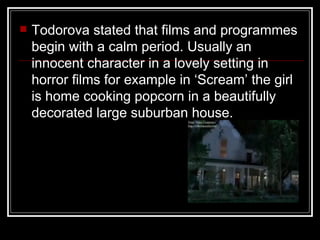
   Todorova stated that films and programmes
    begin with a calm period. Usually an
    innocent character in a lovely setting in
    horror films for example in ‘Scream’ the girl
    is home cooking popcorn in a beautifully
    decorated large suburban house.
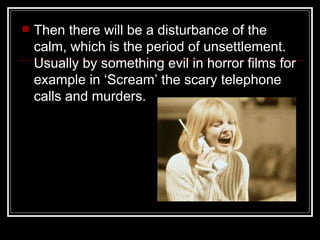
   Then there will be a disturbance of the
    calm, which is the period of unsettlement.
    Usually by something evil in horror films for
    example in ‘Scream’ the scary telephone
    calls and murders.
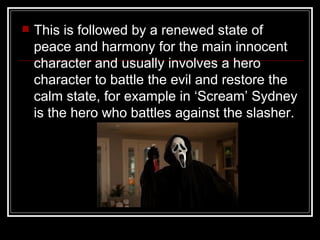
   This is followed by a renewed state of
    peace and harmony for the main innocent
    character and usually involves a hero
    character to battle the evil and restore the
    calm state, for example in ‘Scream’ Sydney
    is the hero who battles against the slasher.
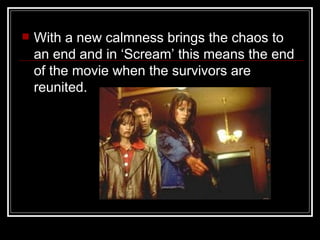
   With a new calmness brings the chaos to
    an end and in ‘Scream’ this means the end
    of the movie when the survivors are
    reunited.
This is the simplest form of narrative and
sometimes referred to as ‘Classic’ or
‘Hollywood’ narrative.

This type of narrative structure is very
familiar to everyone as this can be applied
to many mainstream film narratives in
particular in the horror genre.
Propp’s Theory
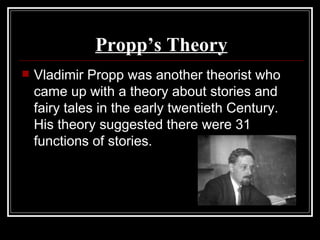
   Vladimir Propp was another theorist who
    came up with a theory about stories and
    fairy tales in the early twentieth Century.
    His theory suggested there were 31
    functions of stories.
Propp’s main functions
   ·    Characters,
   ·    Narrative function,
   ·    Complications,
   ·    Transference,
   ·    Struggle,
   ·    Return
   ·    Recognition.
   Propp thought all stories were either linear
    or non-linear stories. Linear is when the
    story is in order of beginning, middle and
    ending. The story is easy to follow in terms
    of sequence and not too demanding for the
    audience. Non- linear is when the story isn’t
    in order of beginning, middle and ending.
    The story may be harder to follow as it is
    not in sequence and make be more difficult
    for the audience .
   Here is how Propp’s theory can be applied to the film Shrek based
    on classic fairy tales.

Characters
 The hero who’s role is seeking something – Shrek seeks princess
 The villain who’s role is to opposes the hero- Dragon
 The dispatcher who’s role is to sends the hero on his way – The King
 The helper who’s role is to give support to the hero - donkey
 The princess who’s role is to the reward for the hero but also needs
  to be protected from the villain- Princess Fiona


The way the audience can identify the character type as it is easy to
  guess what they will do because each character will have a scope
  of the action. For example the hero will save the maiden, defeat the
  villain, marry the maiden.
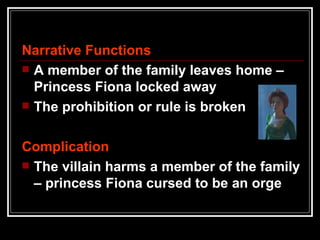
Narrative Functions
 A member of the family leaves home –
  Princess Fiona locked away
 The prohibition or rule is broken


Complication
 The villain harms a member of the family
  – princess Fiona cursed to be an orge
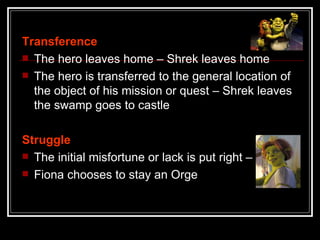
Transference
 The hero leaves home – Shrek leaves home
 The hero is transferred to the general location of
  the object of his mission or quest – Shrek leaves
  the swamp goes to castle

Struggle
 The initial misfortune or lack is put right –
 Fiona chooses to stay an Orge
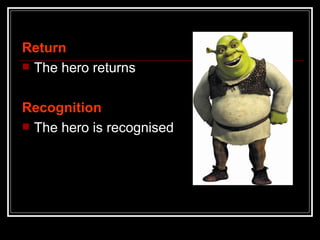
Return
 The hero returns


Recognition
 The hero is recognised

Narrative theories

  • 1.
    Narrative theories By Madeleine Stidder
  • 2.
    Todorov’s Theory Todorov proposeda basic structure for all narratives for all films and programmes. Todorov suggested that conventional narratives are structured in five stages:
  • 3.
    A state of calm at the start  A disturbance of the calm by some action  An acknowledgment that there has been a disturbance  An attempt to repair the disturbance  A return to a state of calm
  • 4.
    Todorova stated that films and programmes begin with a calm period. Usually an innocent character in a lovely setting in horror films for example in ‘Scream’ the girl is home cooking popcorn in a beautifully decorated large suburban house.
  • 5.
    Then there will be a disturbance of the calm, which is the period of unsettlement. Usually by something evil in horror films for example in ‘Scream’ the scary telephone calls and murders.
  • 6.
    This is followed by a renewed state of peace and harmony for the main innocent character and usually involves a hero character to battle the evil and restore the calm state, for example in ‘Scream’ Sydney is the hero who battles against the slasher.
  • 7.
    With a new calmness brings the chaos to an end and in ‘Scream’ this means the end of the movie when the survivors are reunited.
  • 8.
    This is thesimplest form of narrative and sometimes referred to as ‘Classic’ or ‘Hollywood’ narrative. This type of narrative structure is very familiar to everyone as this can be applied to many mainstream film narratives in particular in the horror genre.
  • 9.
    Propp’s Theory  Vladimir Propp was another theorist who came up with a theory about stories and fairy tales in the early twentieth Century. His theory suggested there were 31 functions of stories.
  • 10.
    Propp’s main functions  · Characters,  · Narrative function,  · Complications,  · Transference,  · Struggle,  · Return  · Recognition.
  • 11.
    Propp thought all stories were either linear or non-linear stories. Linear is when the story is in order of beginning, middle and ending. The story is easy to follow in terms of sequence and not too demanding for the audience. Non- linear is when the story isn’t in order of beginning, middle and ending. The story may be harder to follow as it is not in sequence and make be more difficult for the audience .
  • 12.
    Here is how Propp’s theory can be applied to the film Shrek based on classic fairy tales. Characters  The hero who’s role is seeking something – Shrek seeks princess  The villain who’s role is to opposes the hero- Dragon  The dispatcher who’s role is to sends the hero on his way – The King  The helper who’s role is to give support to the hero - donkey  The princess who’s role is to the reward for the hero but also needs to be protected from the villain- Princess Fiona The way the audience can identify the character type as it is easy to guess what they will do because each character will have a scope of the action. For example the hero will save the maiden, defeat the villain, marry the maiden.
  • 13.
    Narrative Functions  Amember of the family leaves home – Princess Fiona locked away  The prohibition or rule is broken Complication  The villain harms a member of the family – princess Fiona cursed to be an orge
  • 14.
    Transference  The heroleaves home – Shrek leaves home  The hero is transferred to the general location of the object of his mission or quest – Shrek leaves the swamp goes to castle Struggle  The initial misfortune or lack is put right –  Fiona chooses to stay an Orge
  • 15.
    Return  The heroreturns Recognition  The hero is recognised