AUDIENCE THEORY
Active Audience
• Engages with the text in some
way.
• Actively choose which text they
consume.
• Often converse about the text
they have seen or read.
• Actively use the text.
Blumler and Katz
• Blumler and Katz’s uses and gratification theory
suggests that media users play an active role in
choosing and using the media.
• Users take an active part in the communication process
and are goal oriented in their media use.
• The theorist say that a media user seeks out a media
source that best fulfils the needs of the user.
• Uses and gratifications assume that the user has
alternate choices to satisfy their need.
Uses and Gratifications theory.
An audiences needs:
• Informed and Educated
• Identify with characters
(people)
• Entertained
• Social Interaction
• Escape from daily lives
Audience Theory
Passive Audience
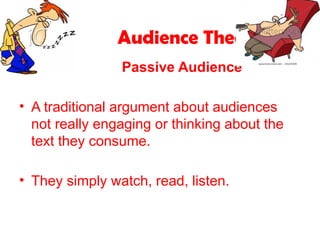
• A traditional argument about audiences
not really engaging or thinking about the
text they consume.
• They simply watch, read, listen.
Hypodermic Syringe Theory
The effects model of audience consumption.
• This effects model says that the media is like a syringe which
injects us with ideas and beliefs.
• This theory suggests that, as an audience, we are manipulated
by the creators of media texts, and that our behaviour and
thinking might be easily changed by media-makers. It assumes
that the audience are passive and soak in all they consume.
• It suggests that audiences passively receive the information
transmitted via a media text, without any attempt on their part to
process or challenge the data.
• E.g. Violence on screen influences behaviour.
7
NARRATIVE THEORY - Todorov
8
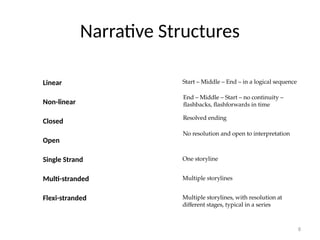
Narrative Structures
Linear
Non-linear
Closed
Open
Single Strand
Multi-stranded
Flexi-stranded
Start – Middle – End – in a logical sequence
End – Middle – Start – no continuity –
flashbacks, flashforwards in time
Resolved ending
No resolution and open to interpretation
One storyline
Multiple storylines
Multiple storylines, with resolution at
different stages, typical in a series
Todorov’s Narrative Stages
• Tzvetan Todorov developed a theory about narratives.
• He suggested for all the many many
narratives/stories that there are, they could all be
broken up into stages.
• Studied fairy tales, looking for a common structure
• Found that narratives are structured in the same way.
• There is a narrative formula.
• This is an important tool of analysis.
Todorov’s Narrative Stages
• He said that there are FIVE stages that
narrative could be broken into.
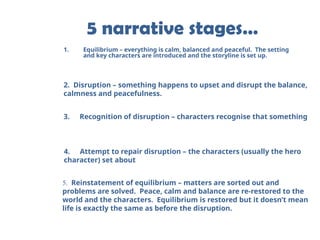
5 narrative stages…
1. Equilibrium – everything is calm, balanced and peaceful. The setting
and key characters are introduced and the storyline is set up.
2. Disruption – something happens to upset and disrupt the balance,
calmness and peacefulness.
3. Recognition of disruption – characters recognise that something
has happened to disrupt their world.
4. Attempt to repair disruption – the characters (usually the hero
character) set about trying to repair the disruption.
5. Reinstatement of equilibrium – matters are sorted out and
problems are solved. Peace, calm and balance are re-restored to the
world and the characters. Equilibrium is restored but it doesn’t mean
life is exactly the same as before the disruption.
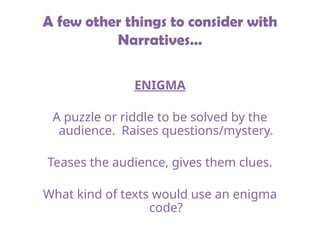
A few other things to consider with
Narratives…
ENIGMA
A puzzle or riddle to be solved by the
audience. Raises questions/mystery.
Teases the audience, gives them clues.
What kind of texts would use an enigma
code?
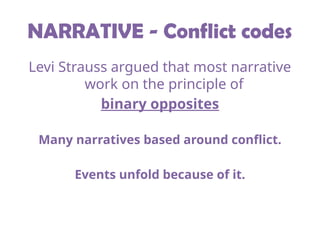
NARRATIVE - Conflict codes
Levi Strauss argued that most narrative
work on the principle of
binary opposites
Many narratives based around conflict.
Events unfold because of it.
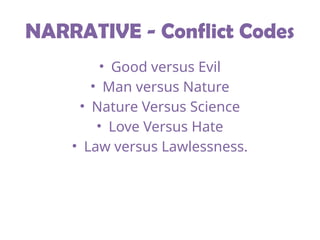
NARRATIVE - Conflict Codes
• Good versus Evil
• Man versus Nature
• Nature Versus Science
• Love Versus Hate
• Law versus Lawlessness.
Playing with Narrative
Flash Back
Section of film is referred back to
Flashforward
Section from the future shown before it would
normally happen
Playing with Narrative
Twist
Unpredictable or shocking ending
Parallel narratives
Lives of characters move alongside each
other without them meeting
17
Character theory - Propp
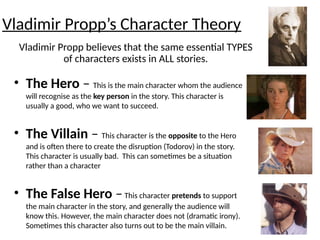
• The Hero – This is the main character whom the audience
will recognise as the key person in the story. This character is
usually a good, who we want to succeed.
• The Villain – This character is the opposite to the Hero
and is often there to create the disruption (Todorov) in the story.
This character is usually bad. This can sometimes be a situation
rather than a character
• The False Hero –This character pretends to support
the main character in the story, and generally the audience will
know this. However, the main character does not (dramatic irony).
Sometimes this character also turns out to be the main villain. 18
Vladimir Propp’s Character Theory
Vladimir Propp believes that the same essential TYPES
of characters exists in ALL stories.
• The Helper – The main character usually has a
companion who helps the main character, gives advice and
supports them throughout their journey.
• The Donor – This character is similar to the role of the
Helper. The character will give the main character something
which helps him repair (Todorov) the problem in the story.
• The Princess – This character can be the reward for the
Hero or the person whom the Hero and False Hero are in
competition for. Just as with The Villain, this could also be a
situation rather than an actual person.
• The Dispatcher – send the hero off
19
Vladimir Propp’s Character Theory

audience, narrative, character theories.pptx

  • 1.
  • 2.
    Active Audience • Engageswith the text in some way. • Actively choose which text they consume. • Often converse about the text they have seen or read. • Actively use the text.
  • 3.
    Blumler and Katz •Blumler and Katz’s uses and gratification theory suggests that media users play an active role in choosing and using the media. • Users take an active part in the communication process and are goal oriented in their media use. • The theorist say that a media user seeks out a media source that best fulfils the needs of the user. • Uses and gratifications assume that the user has alternate choices to satisfy their need.
  • 4.
    Uses and Gratificationstheory. An audiences needs: • Informed and Educated • Identify with characters (people) • Entertained • Social Interaction • Escape from daily lives
  • 5.
    Audience Theory Passive Audience •A traditional argument about audiences not really engaging or thinking about the text they consume. • They simply watch, read, listen.
  • 6.
    Hypodermic Syringe Theory Theeffects model of audience consumption. • This effects model says that the media is like a syringe which injects us with ideas and beliefs. • This theory suggests that, as an audience, we are manipulated by the creators of media texts, and that our behaviour and thinking might be easily changed by media-makers. It assumes that the audience are passive and soak in all they consume. • It suggests that audiences passively receive the information transmitted via a media text, without any attempt on their part to process or challenge the data. • E.g. Violence on screen influences behaviour.
  • 7.
  • 8.
    8 Narrative Structures Linear Non-linear Closed Open Single Strand Multi-stranded Flexi-stranded Start– Middle – End – in a logical sequence End – Middle – Start – no continuity – flashbacks, flashforwards in time Resolved ending No resolution and open to interpretation One storyline Multiple storylines Multiple storylines, with resolution at different stages, typical in a series
  • 9.
    Todorov’s Narrative Stages •Tzvetan Todorov developed a theory about narratives. • He suggested for all the many many narratives/stories that there are, they could all be broken up into stages. • Studied fairy tales, looking for a common structure • Found that narratives are structured in the same way. • There is a narrative formula. • This is an important tool of analysis.
  • 10.
    Todorov’s Narrative Stages •He said that there are FIVE stages that narrative could be broken into.
  • 11.
    5 narrative stages… 1.Equilibrium – everything is calm, balanced and peaceful. The setting and key characters are introduced and the storyline is set up. 2. Disruption – something happens to upset and disrupt the balance, calmness and peacefulness. 3. Recognition of disruption – characters recognise that something has happened to disrupt their world. 4. Attempt to repair disruption – the characters (usually the hero character) set about trying to repair the disruption. 5. Reinstatement of equilibrium – matters are sorted out and problems are solved. Peace, calm and balance are re-restored to the world and the characters. Equilibrium is restored but it doesn’t mean life is exactly the same as before the disruption.
  • 12.
    A few otherthings to consider with Narratives… ENIGMA A puzzle or riddle to be solved by the audience. Raises questions/mystery. Teases the audience, gives them clues. What kind of texts would use an enigma code?
  • 13.
    NARRATIVE - Conflictcodes Levi Strauss argued that most narrative work on the principle of binary opposites Many narratives based around conflict. Events unfold because of it.
  • 14.
    NARRATIVE - ConflictCodes • Good versus Evil • Man versus Nature • Nature Versus Science • Love Versus Hate • Law versus Lawlessness.
  • 15.
    Playing with Narrative FlashBack Section of film is referred back to Flashforward Section from the future shown before it would normally happen
  • 16.
    Playing with Narrative Twist Unpredictableor shocking ending Parallel narratives Lives of characters move alongside each other without them meeting
  • 17.
  • 18.
    • The Hero– This is the main character whom the audience will recognise as the key person in the story. This character is usually a good, who we want to succeed. • The Villain – This character is the opposite to the Hero and is often there to create the disruption (Todorov) in the story. This character is usually bad. This can sometimes be a situation rather than a character • The False Hero –This character pretends to support the main character in the story, and generally the audience will know this. However, the main character does not (dramatic irony). Sometimes this character also turns out to be the main villain. 18 Vladimir Propp’s Character Theory Vladimir Propp believes that the same essential TYPES of characters exists in ALL stories.
  • 19.
    • The Helper– The main character usually has a companion who helps the main character, gives advice and supports them throughout their journey. • The Donor – This character is similar to the role of the Helper. The character will give the main character something which helps him repair (Todorov) the problem in the story. • The Princess – This character can be the reward for the Hero or the person whom the Hero and False Hero are in competition for. Just as with The Villain, this could also be a situation rather than an actual person. • The Dispatcher – send the hero off 19 Vladimir Propp’s Character Theory