HOW TO IMPLEMENT
EFFECTIVE STORYBOARDING
Presented by Ashley Kayes, CP APMP
Senior Proposal Consultant, AOC Key Solutions, Inc.
AGENDA
• History of Storyboards
• WhyWe Storyboard
• Why Storyboarding is
Important
• Key Elements of Storyboarding
• Problems with Storyboarding
• Tips to Increase Storyboarding
Success
HISTORY OF STORYBOARDS
• Developed at Walt Disney Productions
during the early 1930s
• Originated as a graphic organizer of
pictures displayed in sequence
• Served to pre-visualize a motion
picture, animation, or interactive media
sequence
• Designed to visualize the storytelling,
focus the story and timing, and define
the technical parameters
WHY WE STORYBOARD
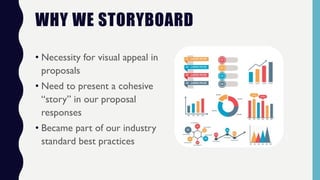
• Necessity for visual appeal in
proposals
• Need to present a cohesive
“story” in our proposal
responses
• Became part of our industry
standard best practices
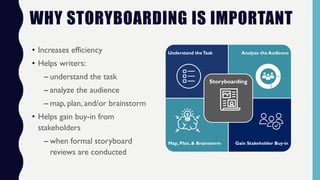
WHY STORYBOARDING IS IMPORTANT
• Increases efficiency
• Helps writers:
– understand the task
– analyze the audience
– map, plan, and/or brainstorm
• Helps gain buy-in from
stakeholders
– when formal storyboard
reviews are conducted
Understand theTask Analyze the Audience
Map, Plan, & Brainstorm Gain Stakeholder Buy-in
Storyboarding
WHEN SHOULD STORYBOARDING
OCCUR?
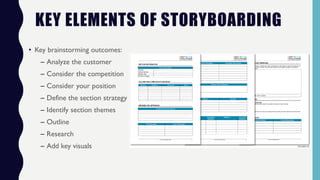
KEY ELEMENTS OF STORYBOARDING
• Key brainstorming outcomes:
– Analyze the customer
– Consider the competition
– Consider your position
– Define the section strategy
– Identify section themes
– Outline
– Research
– Add key visuals
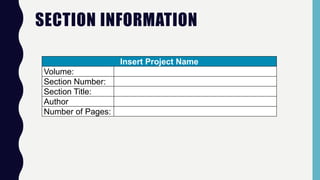
SECTION INFORMATION
Insert Project Name
Volume:
Section Number:
Section Title:
Author
Number of Pages:
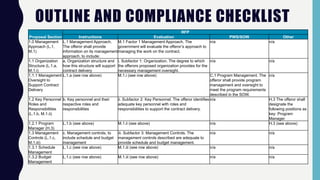
OUTLINE AND COMPLIANCE CHECKLIST
Proposal Section
RFP
Instructions Evaluation PWS/SOW Other
1.0 Management
Approach (L.1,
M.1)
L.1 Management Approach.
The offeror shall provide
information on its management
approach, to include:
M.1 Factor 1 Management Approach. The
government will evaluate the offeror’s approach to
managing the work on the contract.
n/a n/a
1.1 Organization
Structure (L.1.a,
M.1.i)
a. Organization structure and
how this structure will support
contract delivery
i. Subfactor 1: Organization. The degree to which
the offerors proposed organization provides for the
necessary management oversight.
n/a n/a
1.1.1 Management
Oversight to
Support Contract
Delivery
L.1.a (see row above) M.1.i (see row above) C.1 Program Management. The
offeror shall provide program
management and oversight to
meet the program requirements
described in the SOW.
n/a
1.2 Key Personnel
Roles and
Responsibilities
(L.1.b, M.1.ii)
b. Key personnel and their
respective roles and
responsibilities
ii. Subfactor 2: Key Personnel. The offeror identifies
adequate key personnel with roles and
responsibilities to support the contract delivery.
n/a H.3 The offeror shall
designate the
following positions as
key: Program
Manager
1.2.1 Program
Manager (H.3)
L.1.b (see above) M.1.ii (see above) n/a H.3 (see above)
1.3 Management
Controls (L.1.c,
M.1.iii)
c. Management controls, to
include schedule and budget
management
iii. Subfactor 3: Management Controls. The
management controls described are adequate to
provide schedule and budget management.
n/a n/a
1.3.1 Schedule
Management
L.1.c (see row above) M.1.iii (see row above) n/a n/a
1.3.2 Budget
Management
L.1.c (see row above) M.1.iii (see row above) n/a n/a
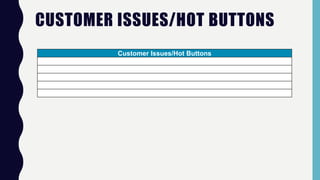
CUSTOMER ISSUES/HOT BUTTONS
Customer Issues/Hot Buttons
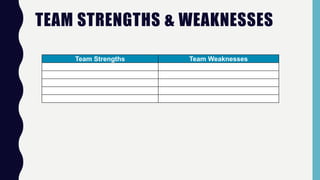
TEAM STRENGTHS & WEAKNESSES
Team Strengths Team Weaknesses
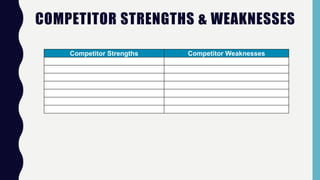
COMPETITOR STRENGTHS & WEAKNESSES
Competitor Strengths Competitor Weaknesses
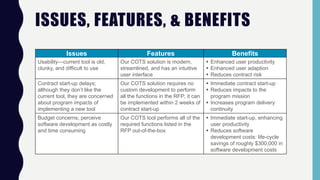
ISSUES, FEATURES, & BENEFITS
Issues Features Benefits
Usability—current tool is old,
clunky, and difficult to use
Our COTS solution is modern,
streamlined, and has an intuitive
user interface
 Enhanced user productivity
 Enhanced user adaption
 Reduces contract risk
Contract start-up delays;
although they don’t like the
current tool, they are concerned
about program impacts of
implementing a new tool
Our COTS solution requires no
custom development to perform
all the functions in the RFP; it can
be implemented within 2 weeks of
contract start-up
 Immediate contract start-up
 Reduces impacts to the
program mission
 Increases program delivery
continuity
Budget concerns; perceive
software development as costly
and time consuming
Our COTS tool performs all of the
required functions listed in the
RFP out-of-the-box
 Immediate start-up, enhancing
user productivity
 Reduces software
development costs: life-cycle
savings of roughly $300,000 in
software development costs
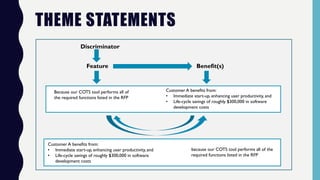
THEME STATEMENTS
Discriminator
Feature Benefit(s)
Because our COTS tool performs all of
the required functions listed in the RFP
Customer A benefits from:
• Immediate start-up, enhancing user productivity, and
• Life-cycle savings of roughly $300,000 in software
development costs
Customer A benefits from:
• Immediate start-up, enhancing user productivity, and
• Life-cycle savings of roughly $300,000 in software
development costs
because our COTS tool performs all of the
required functions listed in the RFP
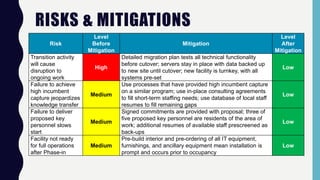
RISKS & MITIGATIONS
Risk
Level
Before
Mitigation
Mitigation
Level
After
Mitigation
Transition activity
will cause
disruption to
ongoing work
High
Detailed migration plan tests all technical functionality
before cutover; servers stay in place with data backed up
to new site until cutover; new facility is turnkey, with all
systems pre-set
Low
Failure to achieve
high incumbent
capture jeopardizes
knowledge transfer
Medium
Use processes that have provided high incumbent capture
on a similar program; use in-place consulting agreements
to fill short-term staffing needs; use database of local staff
resumes to fill remaining gaps
Low
Failure to deliver
proposed key
personnel slows
start
Medium
Signed commitments are provided with proposal; three of
five proposed key personnel are residents of the area of
work; additional resumes of available staff prescreened as
back-ups
Low
Facility not ready
for full operations
after Phase-in
Medium
Pre-build interior and pre-ordering of all IT equipment,
furnishings, and ancillary equipment mean installation is
prompt and occurs prior to occupancy
Low
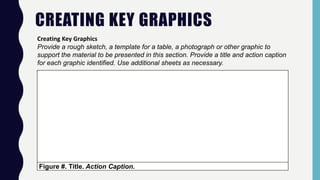
CREATING KEY GRAPHICS
Figure #. Title. Action Caption.
Creating Key Graphics
Provide a rough sketch, a template for a table, a photograph or other graphic to
support the material to be presented in this section. Provide a title and action caption
for each graphic identified. Use additional sheets as necessary.
CREATING KEY GRAPHICS
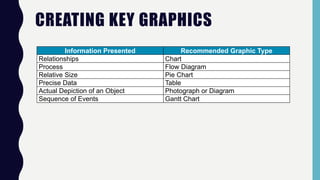
Information Presented Recommended Graphic Type
Relationships Chart
Process Flow Diagram
Relative Size Pie Chart
Precise Data Table
Actual Depiction of an Object Photograph or Diagram
Sequence of Events Gantt Chart
CREATING KEY GRAPHICS
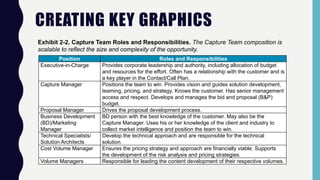
Position Roles and Responsibilities
Executive-in-Charge Provides corporate leadership and authority, including allocation of budget
and resources for the effort. Often has a relationship with the customer and is
a key player in the Contact/Call Plan.
Capture Manager Positions the team to win. Provides vision and guides solution development,
teaming, pricing, and strategy. Knows the customer. Has senior management
access and respect. Develops and manages the bid and proposal (B&P)
budget.
Proposal Manager Drives the proposal development process.
Business Development
(BD)/Marketing
Manager
BD person with the best knowledge of the customer. May also be the
Capture Manager. Uses his or her knowledge of the client and industry to
collect market intelligence and position the team to win.
Technical Specialists/
Solution Architects
Develop the technical approach and are responsible for the technical
solution.
Cost Volume Manager Ensures the pricing strategy and approach are financially viable. Supports
the development of the risk analysis and pricing strategies.
Volume Managers Responsible for leading the content development of their respective volumes.
Exhibit 2-2. Capture Team Roles and Responsibilities. The Capture Team composition is
scalable to reflect the size and complexity of the opportunity.
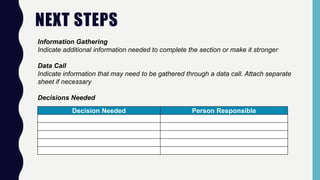
NEXT STEPS
Decision Needed Person Responsible
Information Gathering
Indicate additional information needed to complete the section or make it stronger
Data Call
Indicate information that may need to be gathered through a data call. Attach separate
sheet if necessary
Decisions Needed
PROBLEMS WITH STORYBOARDING
• Storyboarding is difficult to
implement
• When we do use storyboards,
they are often ineffective
– Content is often incomplete
– Content often doesn’t transfer
to the proposals
• This is likely because we are
approaching storyboarding in the
wrong way
PROBLEM #1: STORYBOARDING IN SILOS
• The real intent of storyboarding is to
foster collaborative thinking
• The process of visual thinking and
planning allows a group to:
– brainstorm together
– place ideas on storyboards
– arrange the storyboards on the wall
• When used correctly, storyboarding
fosters more ideas and generates
consensus inside the group
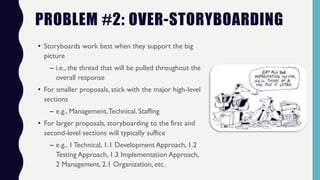
PROBLEM #2: OVER-STORYBOARDING
• Storyboards work best when they support the big
picture
– i.e., the thread that will be pulled throughout the
overall response
• For smaller proposals, stick with the major high-level
sections
– e.g., Management,Technical, Staffing
• For larger proposals, storyboarding to the first and
second-level sections will typically suffice
– e.g., 1 Technical, 1.1 Development Approach, 1.2
Testing Approach, 1.3 Implementation Approach,
2 Management, 2.1 Organization, etc.
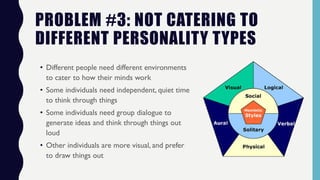
PROBLEM #3: NOT CATERING TO
DIFFERENT PERSONALITY TYPES
• Different people need different environments
to cater to how their minds work
• Some individuals need independent, quiet time
to think through things
• Some individuals need group dialogue to
generate ideas and think through things out
loud
• Other individuals are more visual, and prefer
to draw things out
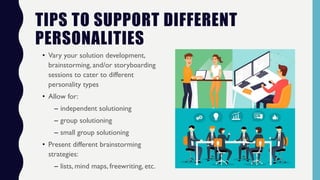
TIPS TO SUPPORT DIFFERENT
PERSONALITIES
• Vary your solution development,
brainstorming, and/or storyboarding
sessions to cater to different
personality types
• Allow for:
– independent solutioning
– group solutioning
– small group solutioning
• Present different brainstorming
strategies:
– lists, mind maps, freewriting, etc.
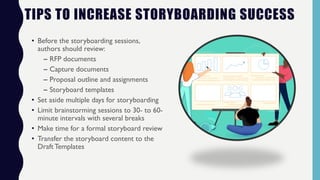
TIPS TO INCREASE STORYBOARDING SUCCESS
• Before the storyboarding sessions,
authors should review:
– RFP documents
– Capture documents
– Proposal outline and assignments
– Storyboard templates
• Set aside multiple days for storyboarding
• Limit brainstorming sessions to 30- to 60-
minute intervals with several breaks
• Make time for a formal storyboard review
• Transfer the storyboard content to the
Draft Templates
FINAL THOUGHTS
THANK YOU!
Ashley Kayes, CP APMP
Senior Proposal Consultant
AOC Key Solutions, Inc.
akayes@aockeysolutions.com
proposalreflections.com | aockeysolutions.com

Storyboarding 1

  • 1.
    HOW TO IMPLEMENT EFFECTIVESTORYBOARDING Presented by Ashley Kayes, CP APMP Senior Proposal Consultant, AOC Key Solutions, Inc.
  • 2.
    AGENDA • History ofStoryboards • WhyWe Storyboard • Why Storyboarding is Important • Key Elements of Storyboarding • Problems with Storyboarding • Tips to Increase Storyboarding Success
  • 3.
    HISTORY OF STORYBOARDS •Developed at Walt Disney Productions during the early 1930s • Originated as a graphic organizer of pictures displayed in sequence • Served to pre-visualize a motion picture, animation, or interactive media sequence • Designed to visualize the storytelling, focus the story and timing, and define the technical parameters
  • 4.
    WHY WE STORYBOARD •Necessity for visual appeal in proposals • Need to present a cohesive “story” in our proposal responses • Became part of our industry standard best practices
  • 5.
    WHY STORYBOARDING ISIMPORTANT • Increases efficiency • Helps writers: – understand the task – analyze the audience – map, plan, and/or brainstorm • Helps gain buy-in from stakeholders – when formal storyboard reviews are conducted Understand theTask Analyze the Audience Map, Plan, & Brainstorm Gain Stakeholder Buy-in Storyboarding
  • 6.
  • 7.
    KEY ELEMENTS OFSTORYBOARDING • Key brainstorming outcomes: – Analyze the customer – Consider the competition – Consider your position – Define the section strategy – Identify section themes – Outline – Research – Add key visuals
  • 8.
    SECTION INFORMATION Insert ProjectName Volume: Section Number: Section Title: Author Number of Pages:
  • 9.
    OUTLINE AND COMPLIANCECHECKLIST Proposal Section RFP Instructions Evaluation PWS/SOW Other 1.0 Management Approach (L.1, M.1) L.1 Management Approach. The offeror shall provide information on its management approach, to include: M.1 Factor 1 Management Approach. The government will evaluate the offeror’s approach to managing the work on the contract. n/a n/a 1.1 Organization Structure (L.1.a, M.1.i) a. Organization structure and how this structure will support contract delivery i. Subfactor 1: Organization. The degree to which the offerors proposed organization provides for the necessary management oversight. n/a n/a 1.1.1 Management Oversight to Support Contract Delivery L.1.a (see row above) M.1.i (see row above) C.1 Program Management. The offeror shall provide program management and oversight to meet the program requirements described in the SOW. n/a 1.2 Key Personnel Roles and Responsibilities (L.1.b, M.1.ii) b. Key personnel and their respective roles and responsibilities ii. Subfactor 2: Key Personnel. The offeror identifies adequate key personnel with roles and responsibilities to support the contract delivery. n/a H.3 The offeror shall designate the following positions as key: Program Manager 1.2.1 Program Manager (H.3) L.1.b (see above) M.1.ii (see above) n/a H.3 (see above) 1.3 Management Controls (L.1.c, M.1.iii) c. Management controls, to include schedule and budget management iii. Subfactor 3: Management Controls. The management controls described are adequate to provide schedule and budget management. n/a n/a 1.3.1 Schedule Management L.1.c (see row above) M.1.iii (see row above) n/a n/a 1.3.2 Budget Management L.1.c (see row above) M.1.iii (see row above) n/a n/a
  • 10.
  • 11.
    TEAM STRENGTHS &WEAKNESSES Team Strengths Team Weaknesses
  • 12.
    COMPETITOR STRENGTHS &WEAKNESSES Competitor Strengths Competitor Weaknesses
  • 13.
    ISSUES, FEATURES, &BENEFITS Issues Features Benefits Usability—current tool is old, clunky, and difficult to use Our COTS solution is modern, streamlined, and has an intuitive user interface  Enhanced user productivity  Enhanced user adaption  Reduces contract risk Contract start-up delays; although they don’t like the current tool, they are concerned about program impacts of implementing a new tool Our COTS solution requires no custom development to perform all the functions in the RFP; it can be implemented within 2 weeks of contract start-up  Immediate contract start-up  Reduces impacts to the program mission  Increases program delivery continuity Budget concerns; perceive software development as costly and time consuming Our COTS tool performs all of the required functions listed in the RFP out-of-the-box  Immediate start-up, enhancing user productivity  Reduces software development costs: life-cycle savings of roughly $300,000 in software development costs
  • 14.
    THEME STATEMENTS Discriminator Feature Benefit(s) Becauseour COTS tool performs all of the required functions listed in the RFP Customer A benefits from: • Immediate start-up, enhancing user productivity, and • Life-cycle savings of roughly $300,000 in software development costs Customer A benefits from: • Immediate start-up, enhancing user productivity, and • Life-cycle savings of roughly $300,000 in software development costs because our COTS tool performs all of the required functions listed in the RFP
  • 15.
    RISKS & MITIGATIONS Risk Level Before Mitigation Mitigation Level After Mitigation Transitionactivity will cause disruption to ongoing work High Detailed migration plan tests all technical functionality before cutover; servers stay in place with data backed up to new site until cutover; new facility is turnkey, with all systems pre-set Low Failure to achieve high incumbent capture jeopardizes knowledge transfer Medium Use processes that have provided high incumbent capture on a similar program; use in-place consulting agreements to fill short-term staffing needs; use database of local staff resumes to fill remaining gaps Low Failure to deliver proposed key personnel slows start Medium Signed commitments are provided with proposal; three of five proposed key personnel are residents of the area of work; additional resumes of available staff prescreened as back-ups Low Facility not ready for full operations after Phase-in Medium Pre-build interior and pre-ordering of all IT equipment, furnishings, and ancillary equipment mean installation is prompt and occurs prior to occupancy Low
  • 16.
    CREATING KEY GRAPHICS Figure#. Title. Action Caption. Creating Key Graphics Provide a rough sketch, a template for a table, a photograph or other graphic to support the material to be presented in this section. Provide a title and action caption for each graphic identified. Use additional sheets as necessary.
  • 17.
    CREATING KEY GRAPHICS InformationPresented Recommended Graphic Type Relationships Chart Process Flow Diagram Relative Size Pie Chart Precise Data Table Actual Depiction of an Object Photograph or Diagram Sequence of Events Gantt Chart
  • 18.
  • 19.
  • 20.
  • 21.
    CREATING KEY GRAPHICS PositionRoles and Responsibilities Executive-in-Charge Provides corporate leadership and authority, including allocation of budget and resources for the effort. Often has a relationship with the customer and is a key player in the Contact/Call Plan. Capture Manager Positions the team to win. Provides vision and guides solution development, teaming, pricing, and strategy. Knows the customer. Has senior management access and respect. Develops and manages the bid and proposal (B&P) budget. Proposal Manager Drives the proposal development process. Business Development (BD)/Marketing Manager BD person with the best knowledge of the customer. May also be the Capture Manager. Uses his or her knowledge of the client and industry to collect market intelligence and position the team to win. Technical Specialists/ Solution Architects Develop the technical approach and are responsible for the technical solution. Cost Volume Manager Ensures the pricing strategy and approach are financially viable. Supports the development of the risk analysis and pricing strategies. Volume Managers Responsible for leading the content development of their respective volumes. Exhibit 2-2. Capture Team Roles and Responsibilities. The Capture Team composition is scalable to reflect the size and complexity of the opportunity.
  • 22.
    NEXT STEPS Decision NeededPerson Responsible Information Gathering Indicate additional information needed to complete the section or make it stronger Data Call Indicate information that may need to be gathered through a data call. Attach separate sheet if necessary Decisions Needed
  • 23.
    PROBLEMS WITH STORYBOARDING •Storyboarding is difficult to implement • When we do use storyboards, they are often ineffective – Content is often incomplete – Content often doesn’t transfer to the proposals • This is likely because we are approaching storyboarding in the wrong way
  • 24.
    PROBLEM #1: STORYBOARDINGIN SILOS • The real intent of storyboarding is to foster collaborative thinking • The process of visual thinking and planning allows a group to: – brainstorm together – place ideas on storyboards – arrange the storyboards on the wall • When used correctly, storyboarding fosters more ideas and generates consensus inside the group
  • 25.
    PROBLEM #2: OVER-STORYBOARDING •Storyboards work best when they support the big picture – i.e., the thread that will be pulled throughout the overall response • For smaller proposals, stick with the major high-level sections – e.g., Management,Technical, Staffing • For larger proposals, storyboarding to the first and second-level sections will typically suffice – e.g., 1 Technical, 1.1 Development Approach, 1.2 Testing Approach, 1.3 Implementation Approach, 2 Management, 2.1 Organization, etc.
  • 26.
    PROBLEM #3: NOTCATERING TO DIFFERENT PERSONALITY TYPES • Different people need different environments to cater to how their minds work • Some individuals need independent, quiet time to think through things • Some individuals need group dialogue to generate ideas and think through things out loud • Other individuals are more visual, and prefer to draw things out
  • 27.
    TIPS TO SUPPORTDIFFERENT PERSONALITIES • Vary your solution development, brainstorming, and/or storyboarding sessions to cater to different personality types • Allow for: – independent solutioning – group solutioning – small group solutioning • Present different brainstorming strategies: – lists, mind maps, freewriting, etc.
  • 28.
    TIPS TO INCREASESTORYBOARDING SUCCESS • Before the storyboarding sessions, authors should review: – RFP documents – Capture documents – Proposal outline and assignments – Storyboard templates • Set aside multiple days for storyboarding • Limit brainstorming sessions to 30- to 60- minute intervals with several breaks • Make time for a formal storyboard review • Transfer the storyboard content to the Draft Templates
  • 29.
  • 30.
    THANK YOU! Ashley Kayes,CP APMP Senior Proposal Consultant AOC Key Solutions, Inc. akayes@aockeysolutions.com proposalreflections.com | aockeysolutions.com