Pricing and Estimating
Masterclass
Pricing Principles
 Pricing should be based on the value to the customer, not the cost to you
 Prices should be tangible, so your customers can see what they get for what they pay
 Prices should be comparable – on terms that you control
 IF you want to change your prices, you must reframe the service or product
 Price differentiation is the key enabler of profit
 Pricing communication shapes the client’s perception of value
 You must be prepared to lose some sales in order to increase profits
2
Famous Prices in History
3
Reading the customer’s mind
 Working of what customer wants is sometimes easier – Value Modelling
 Share to potential customers
 ONCE A PRICE PRECEDENT IS SET, IT IS HARD TO INCREASE
 Reframe your prices with promotions then raise
 Introduce new product variations
 Bundling
 Free offers
 Upselling
 Psychology of giving – emotional value
4
How many pricing models are there?
 Flat or Fixed product price
 Bespoke quotes for each customer
 Monthly memberships or subscriptions
 Percentage of value generated
 All inclusive pricing
 Cost plus % mark up
 Hourly rates
 Auctions
 Industry standard
 Annual contract
 Demand based (dynamic pricing
5
 Advanced commitment discounts
 Free to one group supported by other
(Advertising)
 Freemium
 Interest charges
 Penalty Fees
 Income based charges
 Marginal cost pricing
 Discounting for market share
 Decline price as adoption grows
 Random fluctuations in price
 Temporary promotions
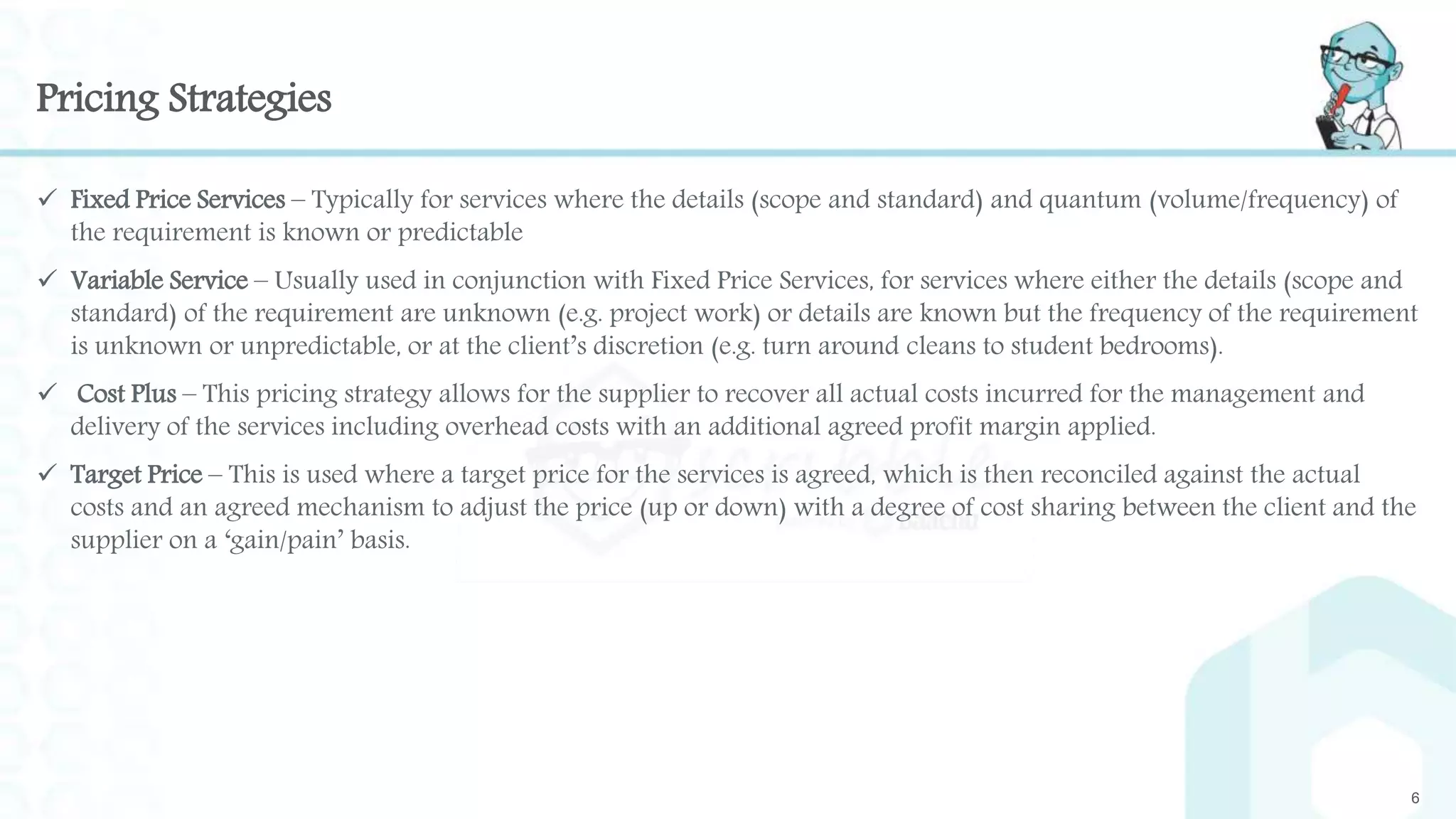
Pricing Strategies
 Fixed Price Services – Typically for services where the details (scope and standard) and quantum (volume/frequency) of
the requirement is known or predictable
 Variable Service – Usually used in conjunction with Fixed Price Services, for services where either the details (scope and
standard) of the requirement are unknown (e.g. project work) or details are known but the frequency of the requirement
is unknown or unpredictable, or at the client’s discretion (e.g. turn around cleans to student bedrooms).
 Cost Plus – This pricing strategy allows for the supplier to recover all actual costs incurred for the management and
delivery of the services including overhead costs with an additional agreed profit margin applied.
 Target Price – This is used where a target price for the services is agreed, which is then reconciled against the actual
costs and an agreed mechanism to adjust the price (up or down) with a degree of cost sharing between the client and the
supplier on a ‘gain/pain’ basis.
6
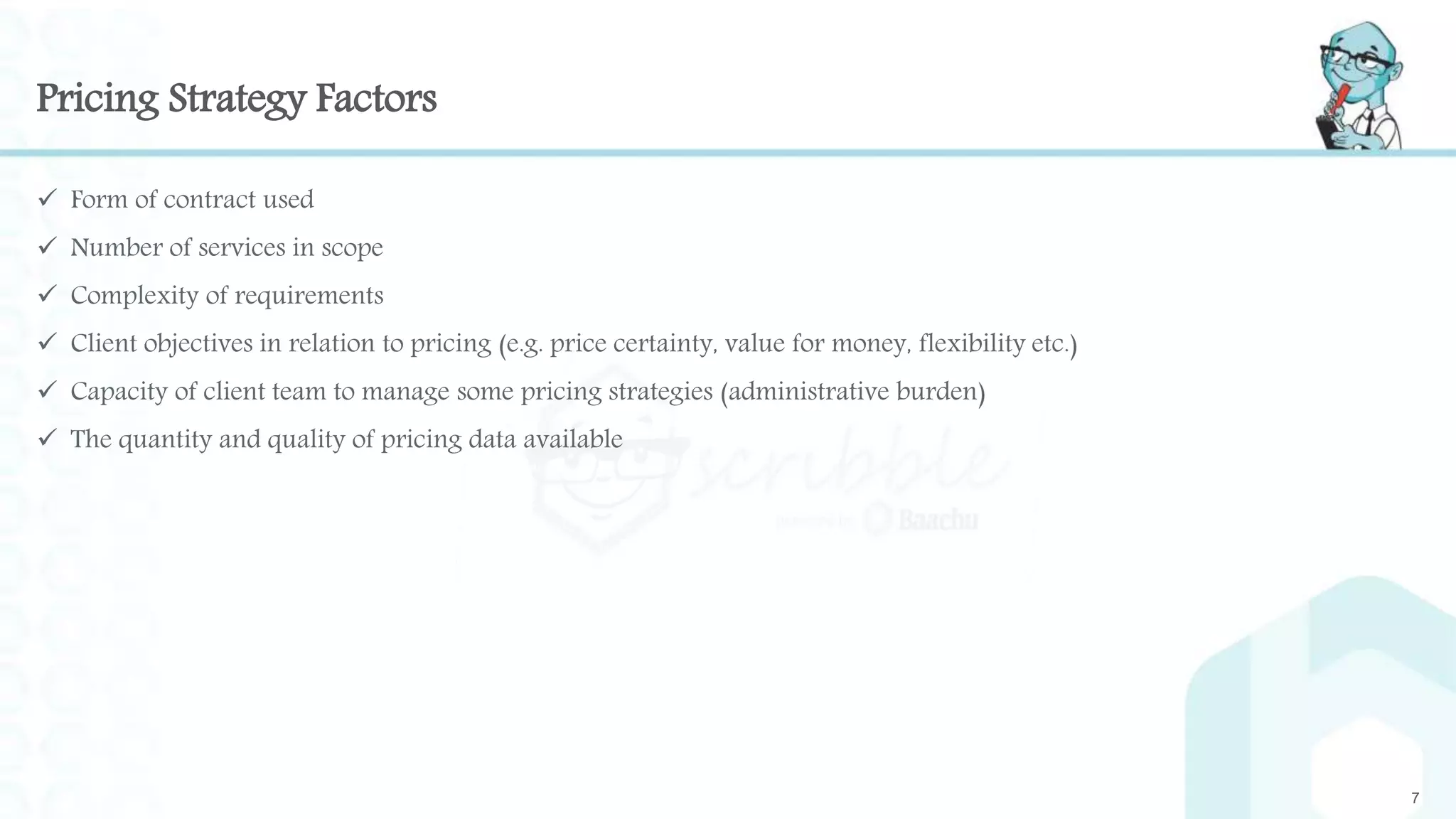
Pricing Strategy Factors
 Form of contract used
 Number of services in scope
 Complexity of requirements
 Client objectives in relation to pricing (e.g. price certainty, value for money, flexibility etc.)
 Capacity of client team to manage some pricing strategies (administrative burden)
 The quantity and quality of pricing data available
7
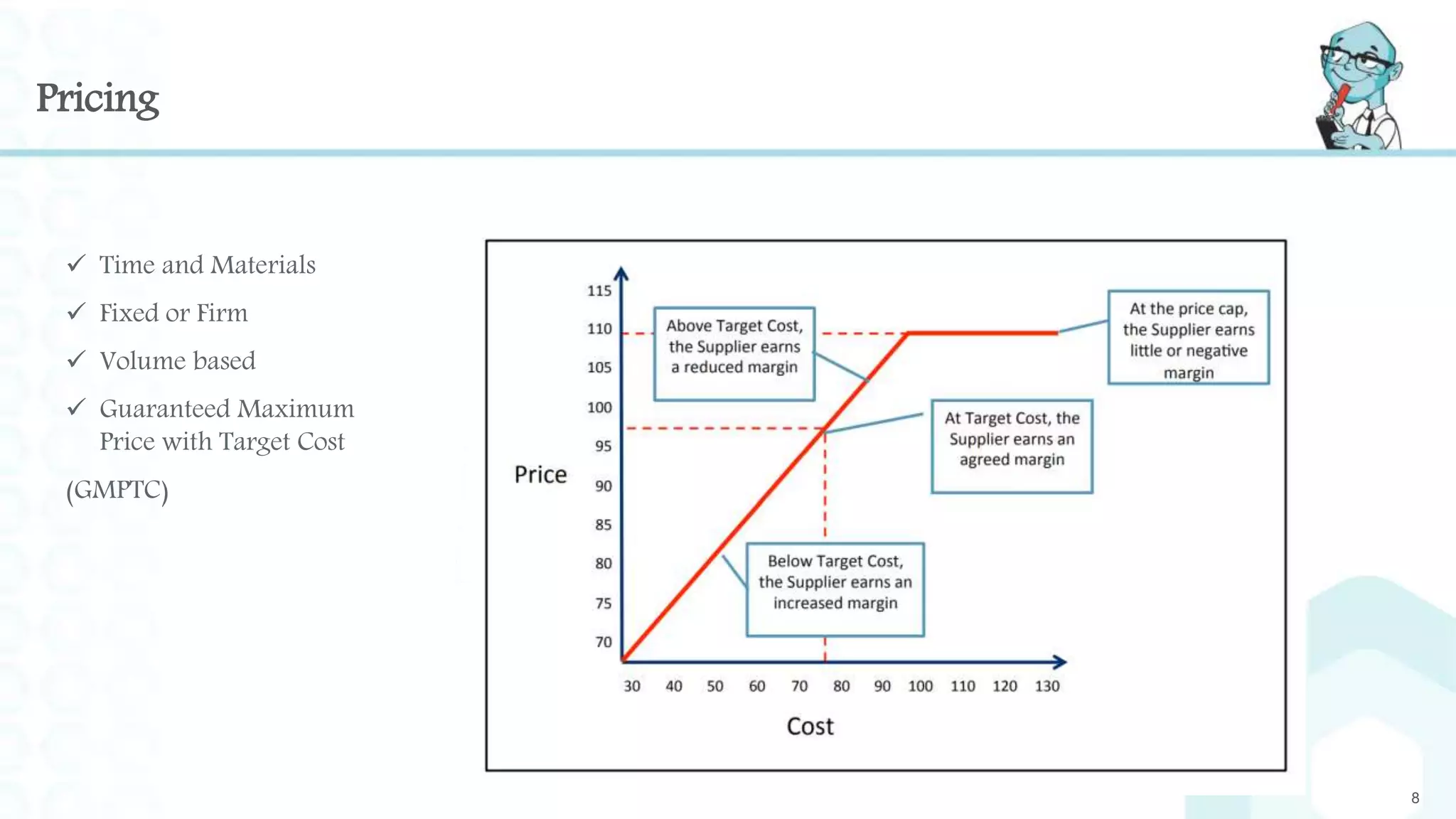
Pricing
8
 Time and Materials
 Fixed or Firm
 Volume based
 Guaranteed Maximum
Price with Target Cost
(GMPTC)
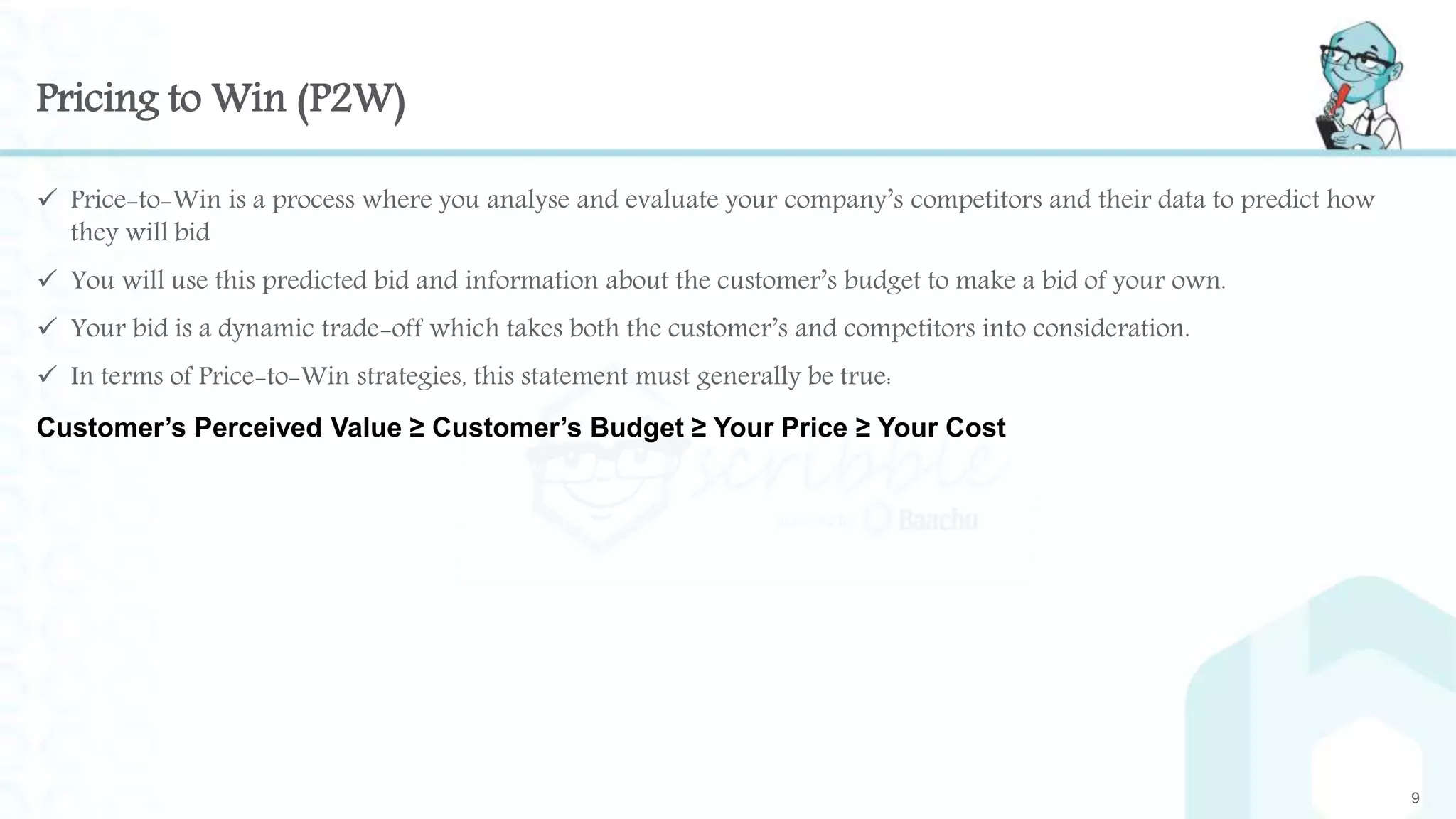
Pricing to Win (P2W)
 Price-to-Win is a process where you analyse and evaluate your company’s competitors and their data to predict how
they will bid
 You will use this predicted bid and information about the customer’s budget to make a bid of your own.
 Your bid is a dynamic trade-off which takes both the customer’s and competitors into consideration.
 In terms of Price-to-Win strategies, this statement must generally be true:
Customer’s Perceived Value ≥ Customer’s Budget ≥ Your Price ≥ Your Cost
9
Cost Model – Model Inputs
 MACRO ECONOMIC ASSUMPTIONS
 Inflation, Commodity Prices, Interest rates, Exchange rates, Economic Growth
 PROJECTS COSTS AND FUNDING
 Development Costs, Development Fees, Project Company Costs, Contract Price, Construction phase
insurance, Start up costs, Stock, Working Capital, Taxes, Financing Costs, Contingency
 OPERATIONAL REVENUES AND COSTS
 Operating revenues from sales of products, Cost of fuel or raw materials, Personnel, Office, Vehicle,
Insurance etc
 TAXATION AND ACCOUNTING
 Capitalisation, Amortisation and Depreciation of Project Costs
 Corporation Tax and VAT
 Investment and ROI calculations
10
Cost Model – Model Outputs
 CONSTRUCTION PHASE COSTS
 DRAWDOWN OF EQUITY/DEBT
 INTEREST CALCULATIONS
 OPERATING REVENUE AND COSTS
 TAX
 PROFIT AND LOSS ACCOUNT
 BALANCE SHEET
 CASH FLOW (SOURCE AND USE OF FUNDS)
 SUMMARY SHEET OF PROJECTS COSTS AND FUNDING
 CASHFLOW SUMMARY
 INVESTOR RETURNS
11
Project Risks
 Macro economic risks (financial risks) – external economic effects
 Commercial risks (project risks) – inherent to the project
 Political risks (country risks) – effects of government actions
12
Analysis of Commercial Risks
 Commercial viability
 Completion risks
 Environment risks
 Operating risks
 Revenue risks
 Input supply risks
 Force Majeure
 Contract mismatch
 Sponsor/Funding Support
13
 What the risk is?
 Whether it is covered in the project
contracts?
 What other mitigation there is for risks
not covered contractually (guarantees or
insurance)
 What impact the risk that then remains
would have on the project company
Risk evaluation and allocation
 Due Diligence
 Monte Carlo Simulations
Model Review – Example
14
 Cost book
 Cost assumptions
 Cost refresh
 Model build and expertise
 THERE IS NO RULE IN PRICING!
15
Copyright © 2020 by Baachu, Baskar Sundaram
All rights reserved. No part of this publication may be reproduced, distributed, or transmitted in any form or by any means, including photocopying, recording, or
other electronic or mechanical methods, without the prior written permission of the publisher, except in the case of certain other noncommercial uses permitted
by copyright law. For permission requests, write to the publisher, addressed “Attention: Legal,” at the address below.
Baachu
Sussex Innovation, No.1 Croydon, 12-16 Addiscombe Rd, Croydon CR0 0XT
www.baachuscribble.com
Disclaimer
While an effort is made to use the most accurate available information, Baachu does not guarantee that the information shared is always current. Baachu does
not warrant or make any representations as to the content, accuracy or completeness of the information, text, graphics, links and other items contained on its
printed material and web pages.

Pricing and-estimating-masterclass-

  • 1.
  • 2.
    Pricing Principles  Pricingshould be based on the value to the customer, not the cost to you  Prices should be tangible, so your customers can see what they get for what they pay  Prices should be comparable – on terms that you control  IF you want to change your prices, you must reframe the service or product  Price differentiation is the key enabler of profit  Pricing communication shapes the client’s perception of value  You must be prepared to lose some sales in order to increase profits 2
  • 3.
  • 4.
    Reading the customer’smind  Working of what customer wants is sometimes easier – Value Modelling  Share to potential customers  ONCE A PRICE PRECEDENT IS SET, IT IS HARD TO INCREASE  Reframe your prices with promotions then raise  Introduce new product variations  Bundling  Free offers  Upselling  Psychology of giving – emotional value 4
  • 5.
    How many pricingmodels are there?  Flat or Fixed product price  Bespoke quotes for each customer  Monthly memberships or subscriptions  Percentage of value generated  All inclusive pricing  Cost plus % mark up  Hourly rates  Auctions  Industry standard  Annual contract  Demand based (dynamic pricing 5  Advanced commitment discounts  Free to one group supported by other (Advertising)  Freemium  Interest charges  Penalty Fees  Income based charges  Marginal cost pricing  Discounting for market share  Decline price as adoption grows  Random fluctuations in price  Temporary promotions
  • 6.
    Pricing Strategies  FixedPrice Services – Typically for services where the details (scope and standard) and quantum (volume/frequency) of the requirement is known or predictable  Variable Service – Usually used in conjunction with Fixed Price Services, for services where either the details (scope and standard) of the requirement are unknown (e.g. project work) or details are known but the frequency of the requirement is unknown or unpredictable, or at the client’s discretion (e.g. turn around cleans to student bedrooms).  Cost Plus – This pricing strategy allows for the supplier to recover all actual costs incurred for the management and delivery of the services including overhead costs with an additional agreed profit margin applied.  Target Price – This is used where a target price for the services is agreed, which is then reconciled against the actual costs and an agreed mechanism to adjust the price (up or down) with a degree of cost sharing between the client and the supplier on a ‘gain/pain’ basis. 6
  • 7.
    Pricing Strategy Factors Form of contract used  Number of services in scope  Complexity of requirements  Client objectives in relation to pricing (e.g. price certainty, value for money, flexibility etc.)  Capacity of client team to manage some pricing strategies (administrative burden)  The quantity and quality of pricing data available 7
  • 8.
    Pricing 8  Time andMaterials  Fixed or Firm  Volume based  Guaranteed Maximum Price with Target Cost (GMPTC)
  • 9.
    Pricing to Win(P2W)  Price-to-Win is a process where you analyse and evaluate your company’s competitors and their data to predict how they will bid  You will use this predicted bid and information about the customer’s budget to make a bid of your own.  Your bid is a dynamic trade-off which takes both the customer’s and competitors into consideration.  In terms of Price-to-Win strategies, this statement must generally be true: Customer’s Perceived Value ≥ Customer’s Budget ≥ Your Price ≥ Your Cost 9
  • 10.
    Cost Model –Model Inputs  MACRO ECONOMIC ASSUMPTIONS  Inflation, Commodity Prices, Interest rates, Exchange rates, Economic Growth  PROJECTS COSTS AND FUNDING  Development Costs, Development Fees, Project Company Costs, Contract Price, Construction phase insurance, Start up costs, Stock, Working Capital, Taxes, Financing Costs, Contingency  OPERATIONAL REVENUES AND COSTS  Operating revenues from sales of products, Cost of fuel or raw materials, Personnel, Office, Vehicle, Insurance etc  TAXATION AND ACCOUNTING  Capitalisation, Amortisation and Depreciation of Project Costs  Corporation Tax and VAT  Investment and ROI calculations 10
  • 11.
    Cost Model –Model Outputs  CONSTRUCTION PHASE COSTS  DRAWDOWN OF EQUITY/DEBT  INTEREST CALCULATIONS  OPERATING REVENUE AND COSTS  TAX  PROFIT AND LOSS ACCOUNT  BALANCE SHEET  CASH FLOW (SOURCE AND USE OF FUNDS)  SUMMARY SHEET OF PROJECTS COSTS AND FUNDING  CASHFLOW SUMMARY  INVESTOR RETURNS 11
  • 12.
    Project Risks  Macroeconomic risks (financial risks) – external economic effects  Commercial risks (project risks) – inherent to the project  Political risks (country risks) – effects of government actions 12
  • 13.
    Analysis of CommercialRisks  Commercial viability  Completion risks  Environment risks  Operating risks  Revenue risks  Input supply risks  Force Majeure  Contract mismatch  Sponsor/Funding Support 13  What the risk is?  Whether it is covered in the project contracts?  What other mitigation there is for risks not covered contractually (guarantees or insurance)  What impact the risk that then remains would have on the project company Risk evaluation and allocation  Due Diligence  Monte Carlo Simulations
  • 14.
    Model Review –Example 14  Cost book  Cost assumptions  Cost refresh  Model build and expertise  THERE IS NO RULE IN PRICING!
  • 15.
    15 Copyright © 2020by Baachu, Baskar Sundaram All rights reserved. No part of this publication may be reproduced, distributed, or transmitted in any form or by any means, including photocopying, recording, or other electronic or mechanical methods, without the prior written permission of the publisher, except in the case of certain other noncommercial uses permitted by copyright law. For permission requests, write to the publisher, addressed “Attention: Legal,” at the address below. Baachu Sussex Innovation, No.1 Croydon, 12-16 Addiscombe Rd, Croydon CR0 0XT www.baachuscribble.com Disclaimer While an effort is made to use the most accurate available information, Baachu does not guarantee that the information shared is always current. Baachu does not warrant or make any representations as to the content, accuracy or completeness of the information, text, graphics, links and other items contained on its printed material and web pages.