Proposal Preparedness
Tan V. Wilson, PMP
President of Entellect, LLC
2
3
• Over 21 years of program management
experience and certified Project Management
Professional (PMP)
• Over 11 years of Federal contracting, project,
and proposal management experience with
both Civilian and Defense Agencies
• Shipley Trained Proposal Writer and Manager
• Notable Proposal Wins:
– INSCOM Global Intelligence Support Services
– NIH CIOSP3
– DHS EAGLE I
– SAMHSA Domains IV and V Contracts
– DIA SIS Contract
– HUD Big Buy Contract
Tan V. Wilson Background
Topics
• Business Development Lifecycle
• Before the Solicitation Release
• People, Processes, and Tools  Focus on the process
• Shipley Capture and Proposal Timeline
• Preparedness Challenges
• Get Organized
– Understand the Requirements
– Storyboard and Solution Approach
– Extract Information from SMEs
– Graphics
– Leverage Team Members
4
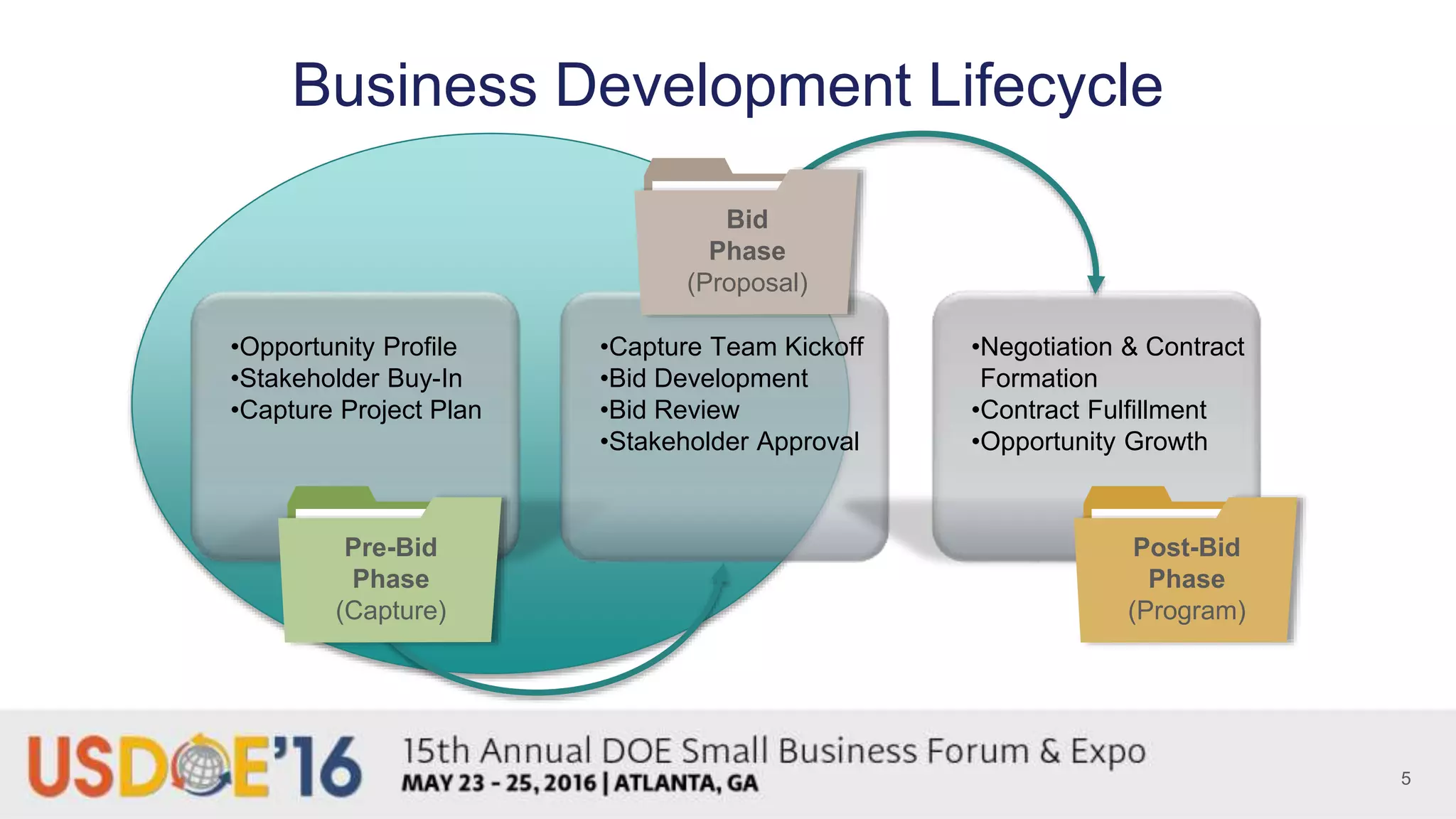
Business Development Lifecycle
5
•Opportunity Profile
•Stakeholder Buy-In
•Capture Project Plan
•Capture Team Kickoff
•Bid Development
•Bid Review
•Stakeholder Approval
•Negotiation & Contract
Formation
•Contract Fulfillment
•Opportunity Growth
Pre-Bid
Phase
(Capture)
Post-Bid
Phase
(Program)
Bid
Phase
(Proposal)
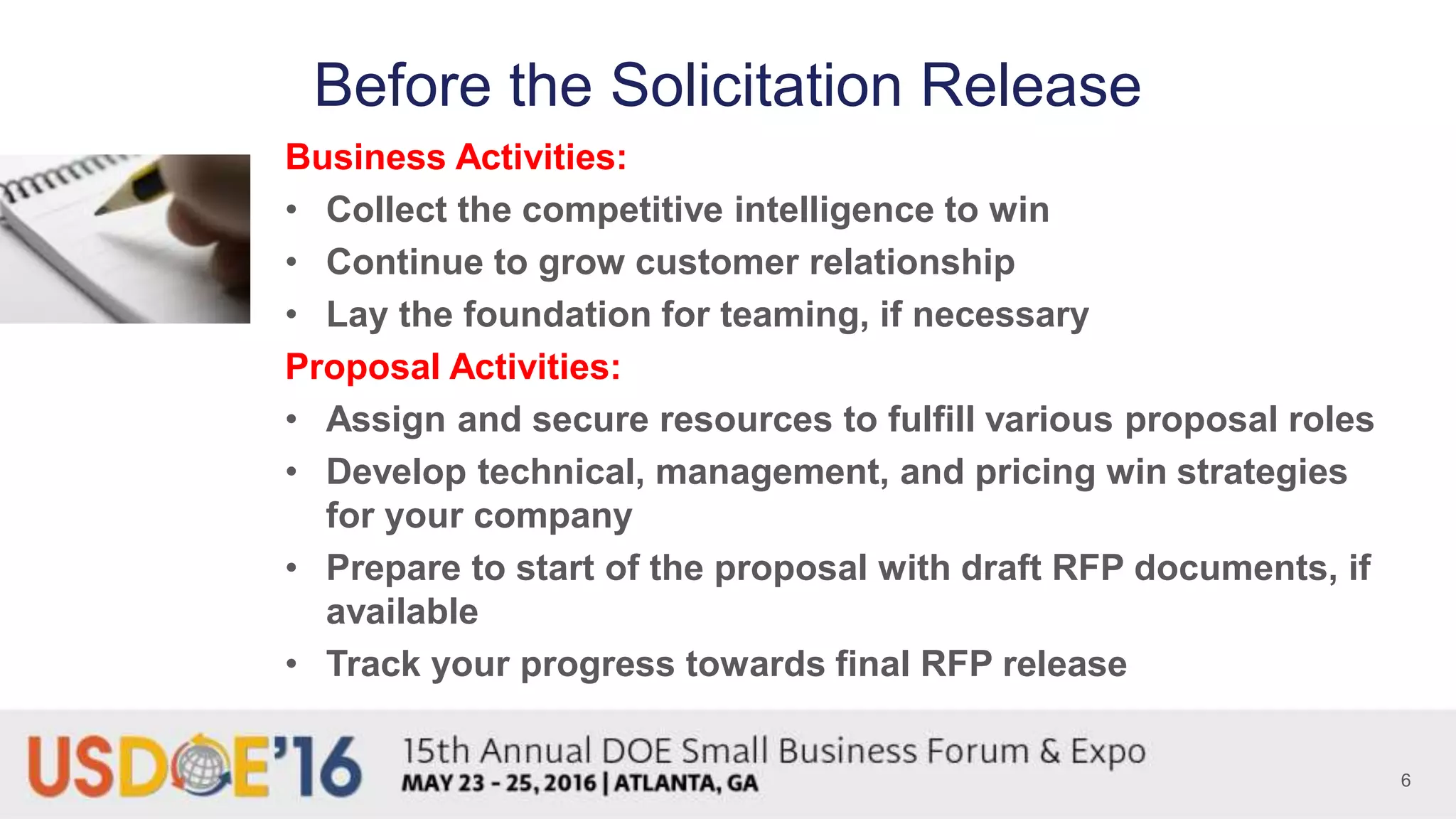
Before the Solicitation Release
Business Activities:
• Collect the competitive intelligence to win
• Continue to grow customer relationship
• Lay the foundation for teaming, if necessary
Proposal Activities:
• Assign and secure resources to fulfill various proposal roles
• Develop technical, management, and pricing win strategies
for your company
• Prepare to start of the proposal with draft RFP documents, if
available
• Track your progress towards final RFP release
6
7
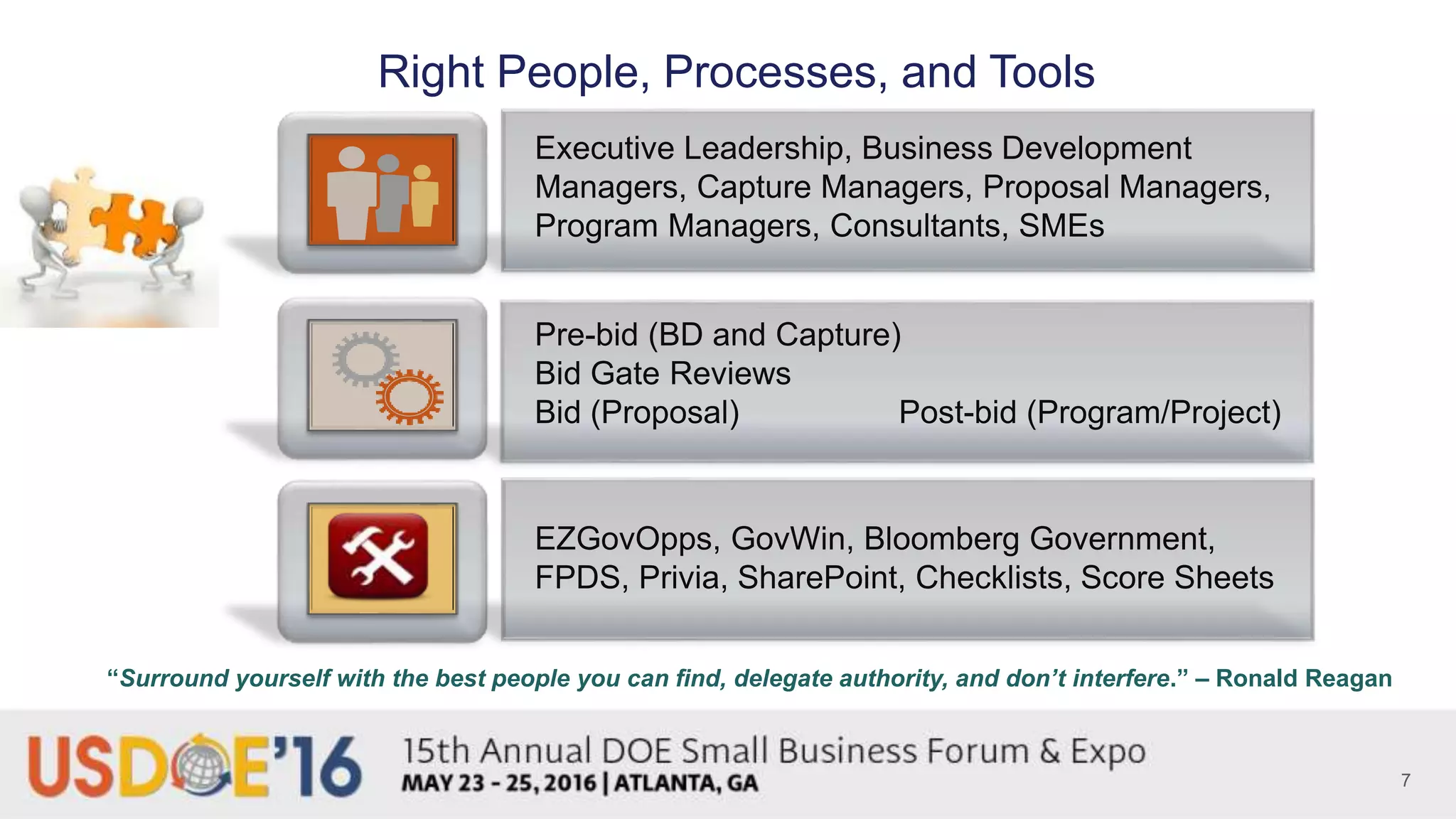
Right People, Processes, and Tools
“Surround yourself with the best people you can find, delegate authority, and don’t interfere.” – Ronald Reagan
Executive Leadership, Business Development
Managers, Capture Managers, Proposal Managers,
Program Managers, Consultants, SMEs
Pre-bid (BD and Capture)
Bid Gate Reviews
Bid (Proposal) Post-bid (Program/Project)
EZGovOpps, GovWin, Bloomberg Government,
FPDS, Privia, SharePoint, Checklists, Score Sheets
Right People
 Prior to the proposal, “train” the proposal team
 Clearly define roles and responsibilities of the proposal team
 Set expectations for each person’s support
 Communicate timelines and schedules often
 Make sure current and future work schedules allow for the
extra support required during a proposal response
 Determine any skills gaps and decide on strategic hires or
outsource the role to a consultant
 Secure the right Subject Matter Expert
and pricing expert
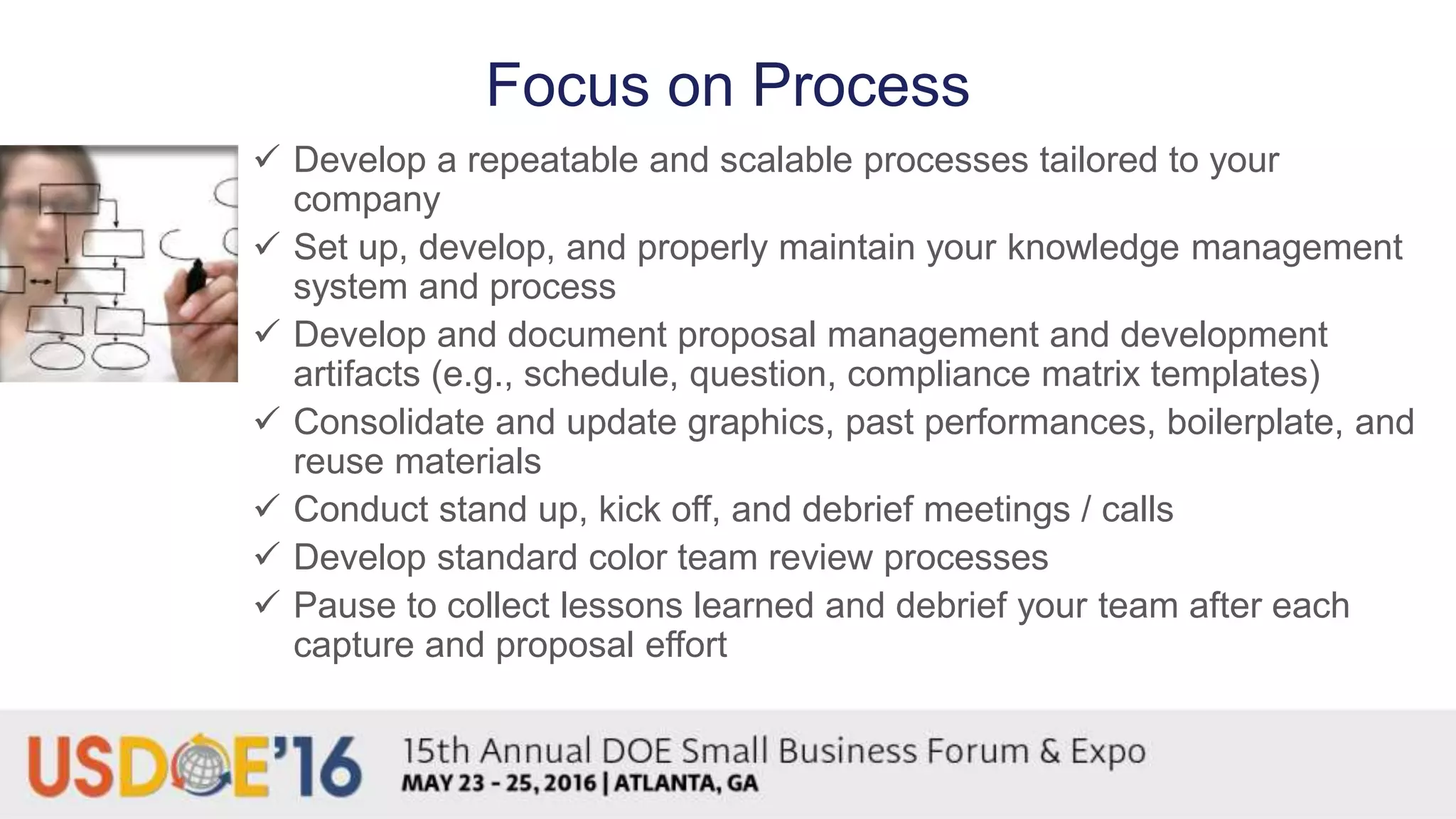
Focus on Process
 Develop a repeatable and scalable processes tailored to your
company
 Set up, develop, and properly maintain your knowledge management
system and process
 Develop and document proposal management and development
artifacts (e.g., schedule, question, compliance matrix templates)
 Consolidate and update graphics, past performances, boilerplate, and
reuse materials
 Conduct stand up, kick off, and debrief meetings / calls
 Develop standard color team review processes
 Pause to collect lessons learned and debrief your team after each
capture and proposal effort
Right Tool and Technology
 Use tools that complement your company culture and staff
needs
 Set up management/coordination tool similar to Privia,
Office 365, or SharePoint
• Design document folders and system to mimic and
facilitate a smooth workflow
• Select a tool that allows automatic version control
 For geographically dispersed team, set up a reliable and
inexpensive teleconferencing service (e.g.,
www.uberconference.com, www.join.me)
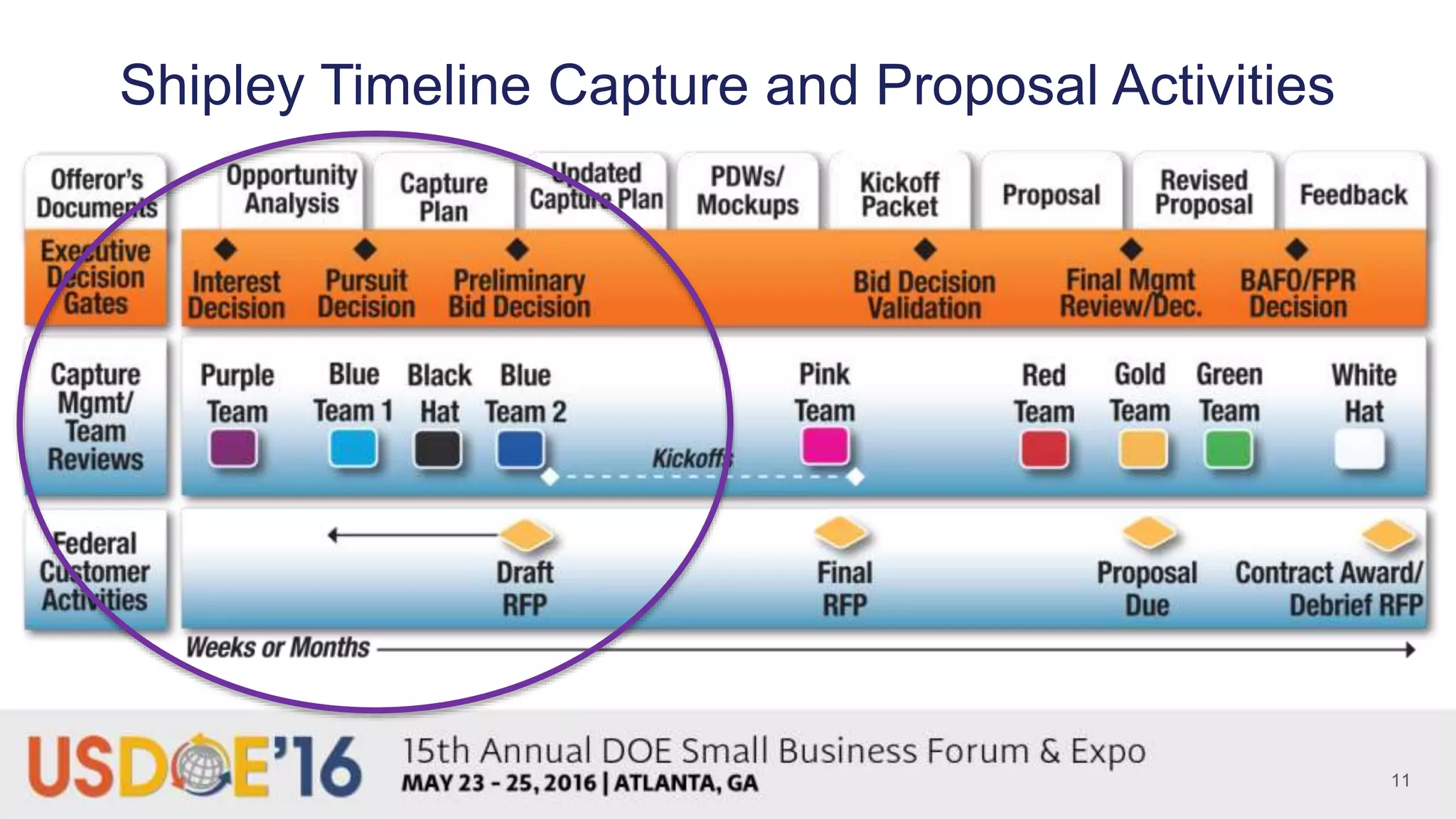
Shipley Timeline Capture and Proposal Activities
11
Proposal Preparedness Challenges
 Little or no understanding of the technical requirements
 Proposal are very labor intensive, expensive and tend to run over
budget
 Proposal teams start too late and are usually in reactive mode
 SOW/PWS is either incomplete or inconsistent with Sections L & M
 Technical SMEs, Program Managers, and other staff are currently
billable, over tasked, or don’t have proposal writing experience
 Proposal process is cumbersome and confusing
 Unclear Subcontractor experience, roles and responsibilities
12
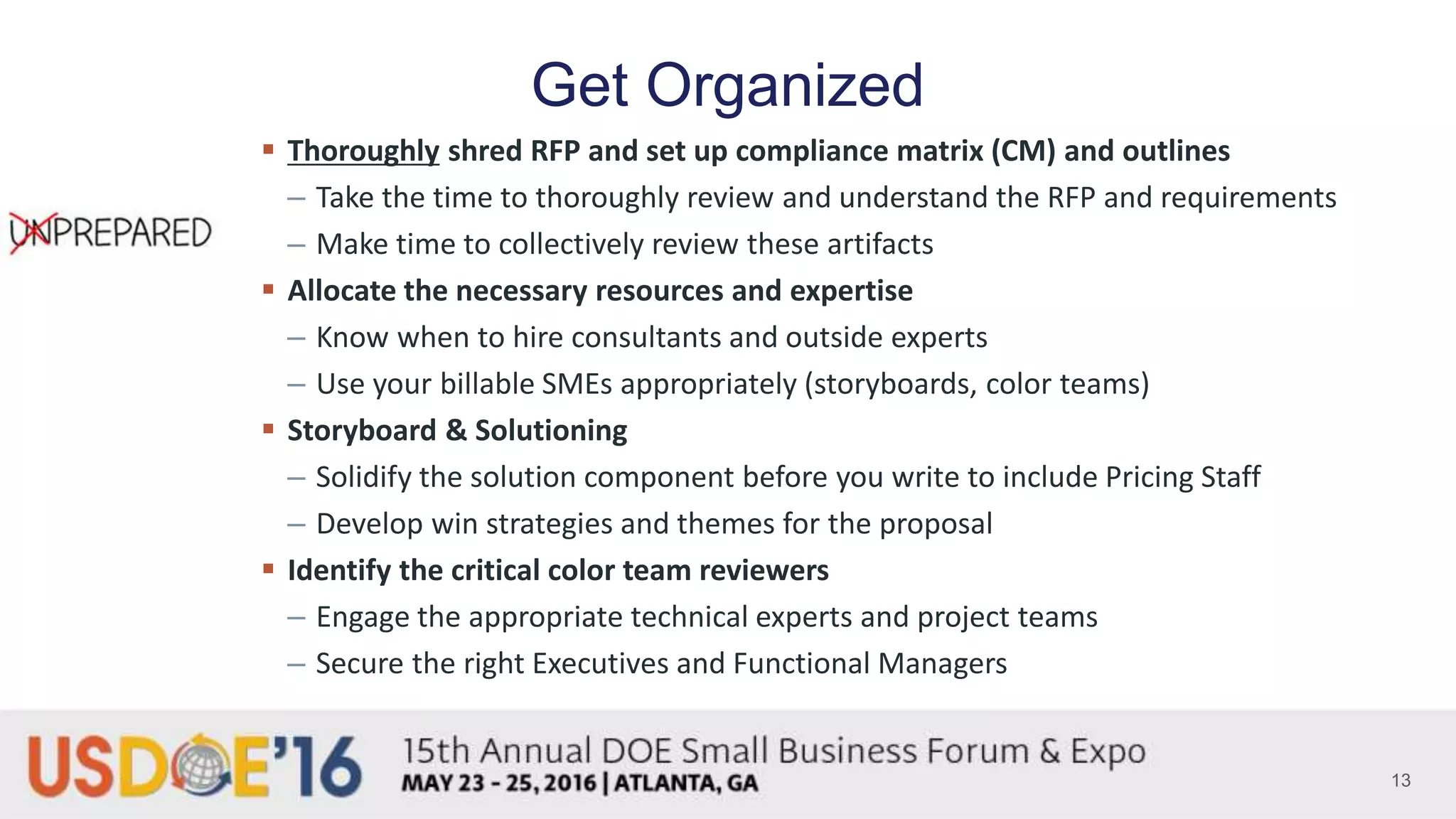
Get Organized
 Thoroughly shred RFP and set up compliance matrix (CM) and outlines
– Take the time to thoroughly review and understand the RFP and requirements
– Make time to collectively review these artifacts
 Allocate the necessary resources and expertise
– Know when to hire consultants and outside experts
– Use your billable SMEs appropriately (storyboards, color teams)
 Storyboard & Solutioning
– Solidify the solution component before you write to include Pricing Staff
– Develop win strategies and themes for the proposal
 Identify the critical color team reviewers
– Engage the appropriate technical experts and project teams
– Secure the right Executives and Functional Managers
13
Understand the Requirements
Demonstrate understanding of the customer, mission, and goals of
the contracts EARLY and OFTEN – the “so what factor”
Don’t parrot the RFP language – fine line between using key words
and parroting the customer
Use “anchor” graphic to show or communicate approach
–Should replace long and complicated narrative
–Show the interconnectedness of multiple tasks (“the big picture”)
Develop detail storyboards for each technical section to describe
specific steps, processes, procedures, tools, etc. to address RFP
requirements
14
15
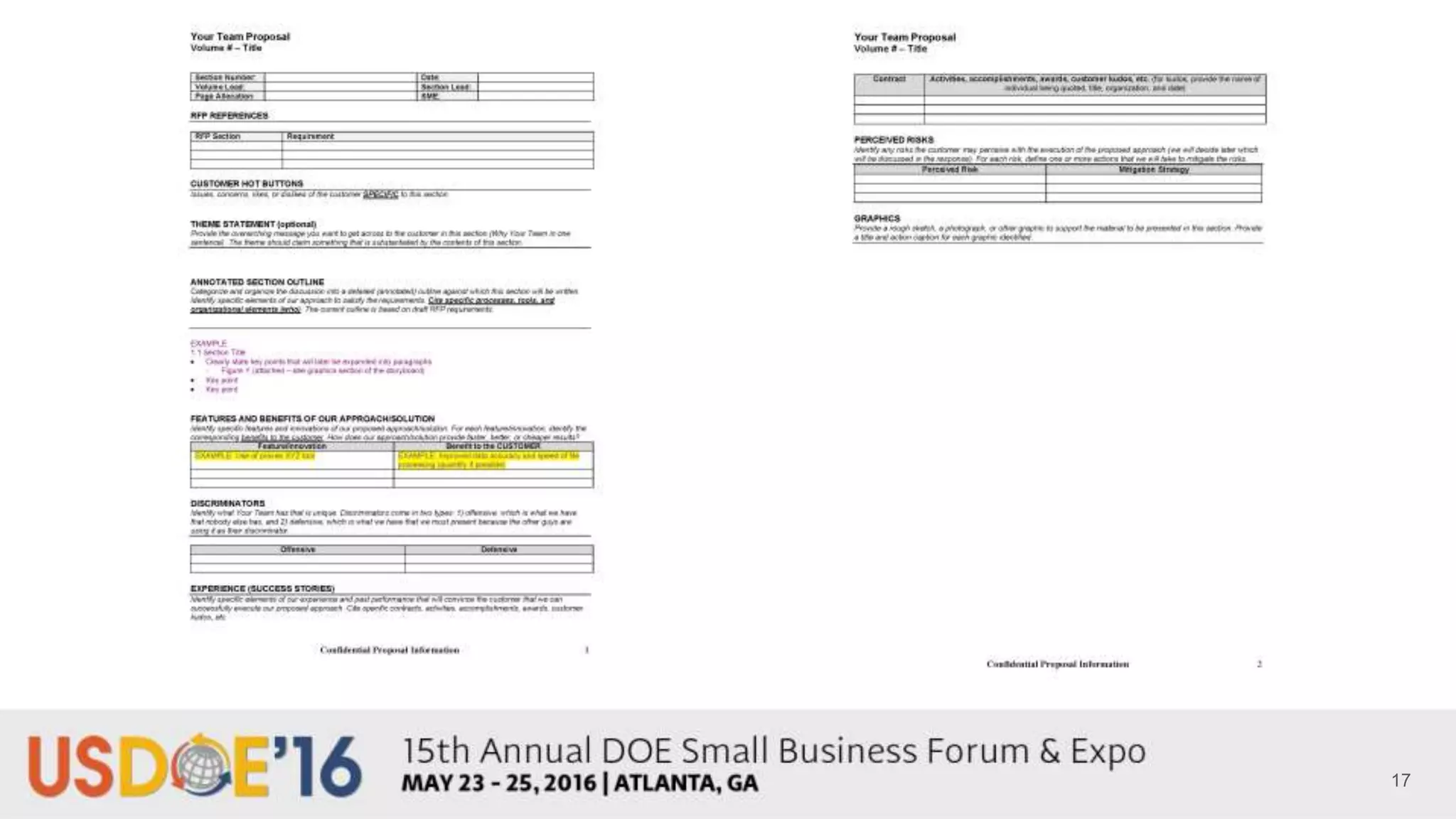
Elements of a Storyboard
Administrative: Volume, Section #, page allocations, Date, POC, and
SMEs
RFP References (C, L, M, CDRLs, etc.)
Theme Statement (overarching message, “Why Team ABC?”): should
claim something that is substantiated by the contents of this section
Customer Hot Buttons: Specific issues, concerns, likes, or dislikes of
the customer
Discriminators: two types
1) Offensive, which is what we have that nobody else has, and 2)
Defensive, which is what we have that we must present because the
other guys are using it as their discriminator.
16
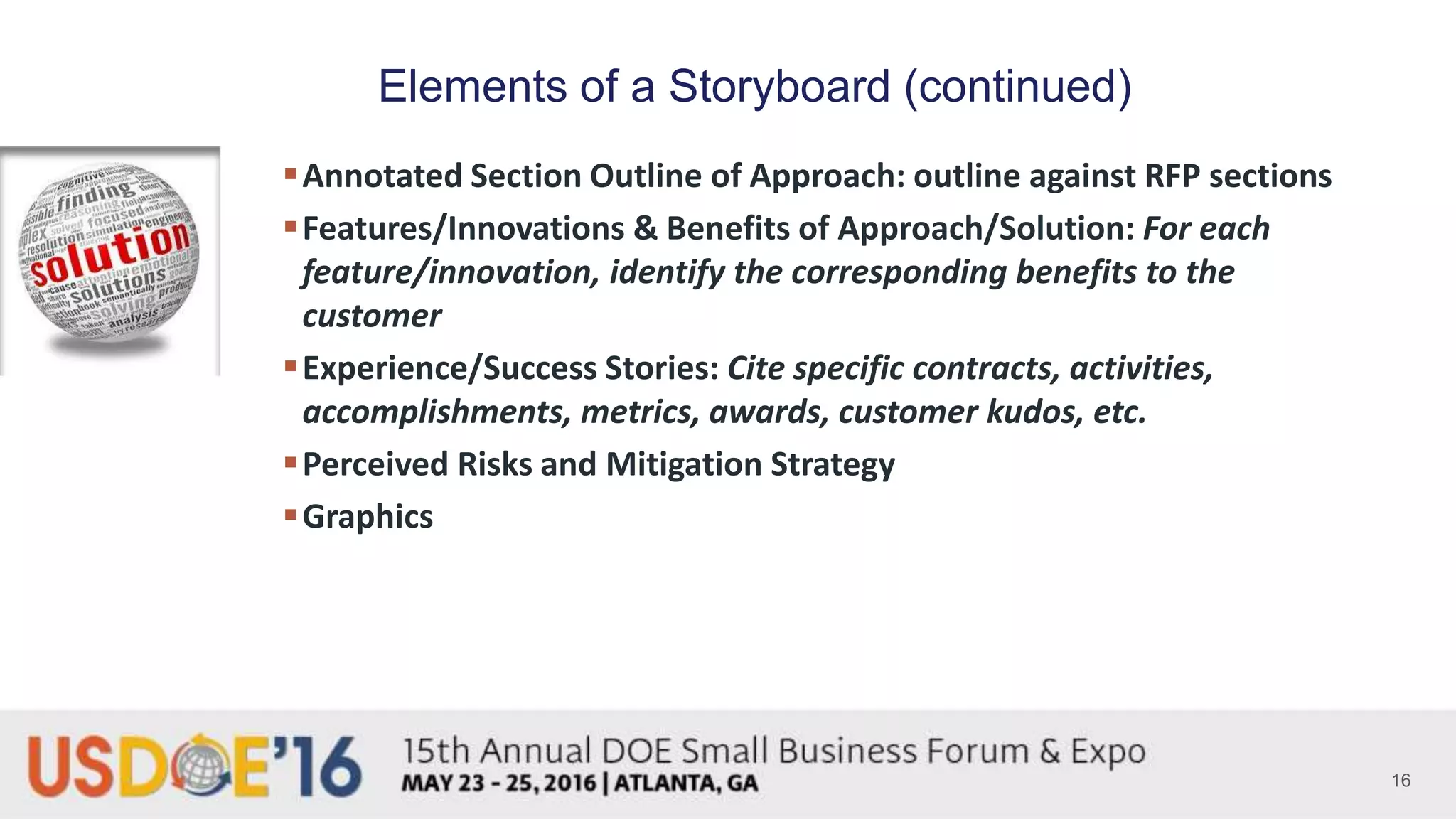
Elements of a Storyboard (continued)
Annotated Section Outline of Approach: outline against RFP sections
Features/Innovations & Benefits of Approach/Solution: For each
feature/innovation, identify the corresponding benefits to the
customer
Experience/Success Stories: Cite specific contracts, activities,
accomplishments, metrics, awards, customer kudos, etc.
Perceived Risks and Mitigation Strategy
Graphics
17
18
Extracting Technical Information and Approach from SMEs
 Do this via interview, group session, or data call questionnaire
 Describe the specific steps, processes, procedure, etc. to achieve requirements
– Steps, phases, inputs, and outputs
– Key performance indicators (KPI)
– Detail methodology, framework, etc.
– Deliverables, final product, etc.
 List any dependencies among the tasks
 Detail the schedule and key milestones
 Project Risks & Mitigation strategies with success examples
 Basis of Estimates (BOE) – resources to perform work
– Analyze the functional requirements against the solution set
– Discuss staffing level of effort based on the functional requirements
19
Graphics
Start each major section with a graphic
Call Out Box designs should pop off the page
Start early in the process and refine
Image should complement or replace narrative
Reuse graphics as a starting point to save time and resources IF
they support your approach and win-themes
Make graphics consistent (color scheme, font)
Use action captures to describe the benefit or feature of your
graphic
20
Leverage Team Member Skills and Resources
Have NDA and TAs in place before proposal writing occurs
Provide clear assignments and expectations – get buy in first
Establish incremental milestones and reviews
Leverage Teammate’s experiences and resources
–May have specific expertise or customer insight
–Help to minimize your B&P cost by using other outside
resources from the team
Key Takeaway
 Take the time to understand the client, requirements and your
approach
 Develop a repeatable and scalable processes tailored to your
company and opportunity size
 Develop and properly execute the right tools to develop your
technical solution
 Use graphics to enhance the visual appeal and effectiveness of
your proposal
 Pause to collect lessons learned and debrief your team after
each proposal effort
21
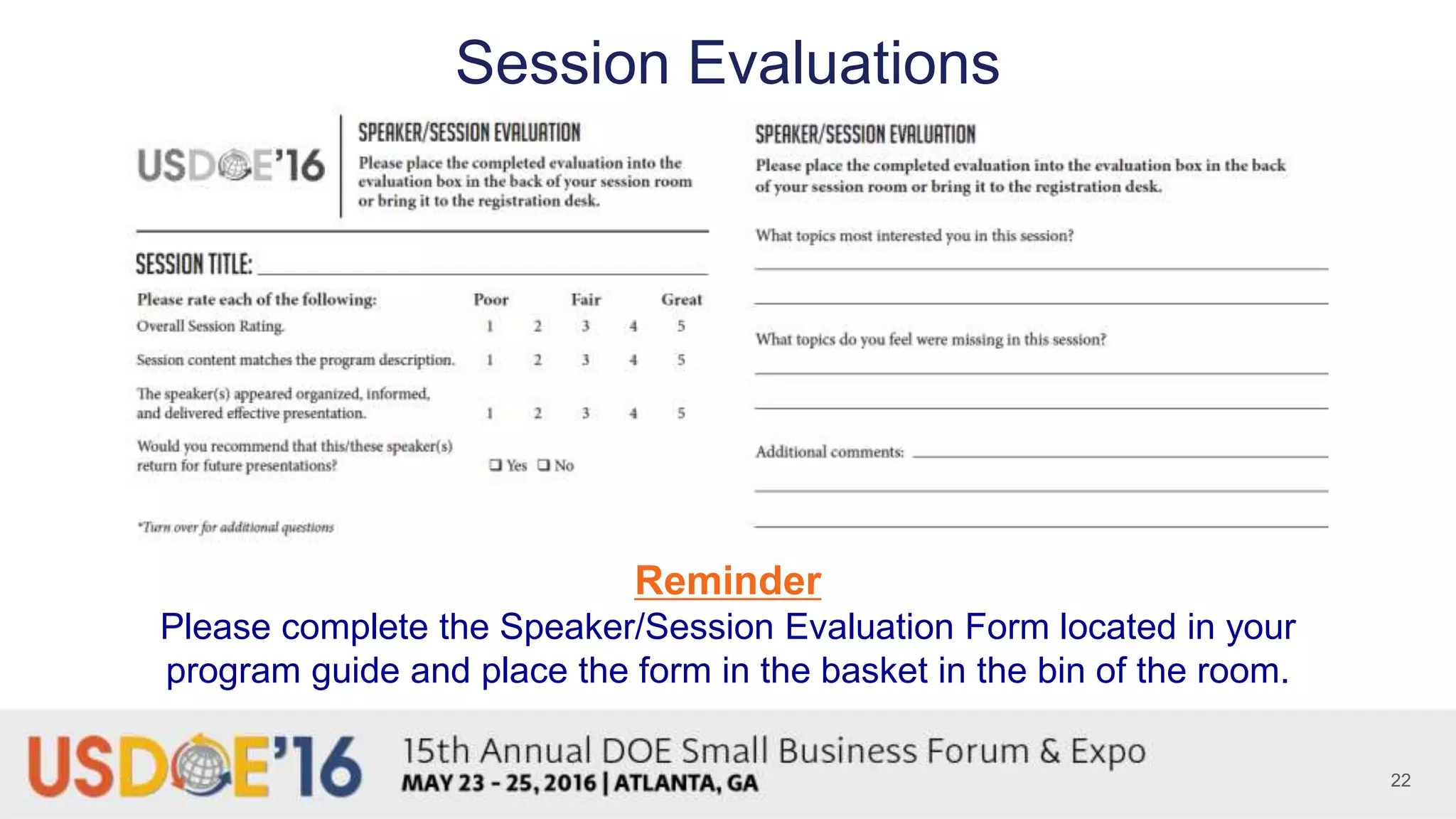
Session Evaluations
22
Reminder
Please complete the Speaker/Session Evaluation Form located in your
program guide and place the form in the basket in the bin of the room.
Questions?
Tan V. Wilson, PMP
President of Entellect, LLC
Phone: 703.489.1947
Email: tanwilson@entellectllc.com
Website: www.entellectllc.com
23

Proposal Preparedness

  • 2.
    Proposal Preparedness Tan V.Wilson, PMP President of Entellect, LLC 2
  • 3.
    3 • Over 21years of program management experience and certified Project Management Professional (PMP) • Over 11 years of Federal contracting, project, and proposal management experience with both Civilian and Defense Agencies • Shipley Trained Proposal Writer and Manager • Notable Proposal Wins: – INSCOM Global Intelligence Support Services – NIH CIOSP3 – DHS EAGLE I – SAMHSA Domains IV and V Contracts – DIA SIS Contract – HUD Big Buy Contract Tan V. Wilson Background
  • 4.
    Topics • Business DevelopmentLifecycle • Before the Solicitation Release • People, Processes, and Tools  Focus on the process • Shipley Capture and Proposal Timeline • Preparedness Challenges • Get Organized – Understand the Requirements – Storyboard and Solution Approach – Extract Information from SMEs – Graphics – Leverage Team Members 4
  • 5.
    Business Development Lifecycle 5 •OpportunityProfile •Stakeholder Buy-In •Capture Project Plan •Capture Team Kickoff •Bid Development •Bid Review •Stakeholder Approval •Negotiation & Contract Formation •Contract Fulfillment •Opportunity Growth Pre-Bid Phase (Capture) Post-Bid Phase (Program) Bid Phase (Proposal)
  • 6.
    Before the SolicitationRelease Business Activities: • Collect the competitive intelligence to win • Continue to grow customer relationship • Lay the foundation for teaming, if necessary Proposal Activities: • Assign and secure resources to fulfill various proposal roles • Develop technical, management, and pricing win strategies for your company • Prepare to start of the proposal with draft RFP documents, if available • Track your progress towards final RFP release 6
  • 7.
    7 Right People, Processes,and Tools “Surround yourself with the best people you can find, delegate authority, and don’t interfere.” – Ronald Reagan Executive Leadership, Business Development Managers, Capture Managers, Proposal Managers, Program Managers, Consultants, SMEs Pre-bid (BD and Capture) Bid Gate Reviews Bid (Proposal) Post-bid (Program/Project) EZGovOpps, GovWin, Bloomberg Government, FPDS, Privia, SharePoint, Checklists, Score Sheets
  • 8.
    Right People  Priorto the proposal, “train” the proposal team  Clearly define roles and responsibilities of the proposal team  Set expectations for each person’s support  Communicate timelines and schedules often  Make sure current and future work schedules allow for the extra support required during a proposal response  Determine any skills gaps and decide on strategic hires or outsource the role to a consultant  Secure the right Subject Matter Expert and pricing expert
  • 9.
    Focus on Process Develop a repeatable and scalable processes tailored to your company  Set up, develop, and properly maintain your knowledge management system and process  Develop and document proposal management and development artifacts (e.g., schedule, question, compliance matrix templates)  Consolidate and update graphics, past performances, boilerplate, and reuse materials  Conduct stand up, kick off, and debrief meetings / calls  Develop standard color team review processes  Pause to collect lessons learned and debrief your team after each capture and proposal effort
  • 10.
    Right Tool andTechnology  Use tools that complement your company culture and staff needs  Set up management/coordination tool similar to Privia, Office 365, or SharePoint • Design document folders and system to mimic and facilitate a smooth workflow • Select a tool that allows automatic version control  For geographically dispersed team, set up a reliable and inexpensive teleconferencing service (e.g., www.uberconference.com, www.join.me)
  • 11.
    Shipley Timeline Captureand Proposal Activities 11
  • 12.
    Proposal Preparedness Challenges Little or no understanding of the technical requirements  Proposal are very labor intensive, expensive and tend to run over budget  Proposal teams start too late and are usually in reactive mode  SOW/PWS is either incomplete or inconsistent with Sections L & M  Technical SMEs, Program Managers, and other staff are currently billable, over tasked, or don’t have proposal writing experience  Proposal process is cumbersome and confusing  Unclear Subcontractor experience, roles and responsibilities 12
  • 13.
    Get Organized  Thoroughlyshred RFP and set up compliance matrix (CM) and outlines – Take the time to thoroughly review and understand the RFP and requirements – Make time to collectively review these artifacts  Allocate the necessary resources and expertise – Know when to hire consultants and outside experts – Use your billable SMEs appropriately (storyboards, color teams)  Storyboard & Solutioning – Solidify the solution component before you write to include Pricing Staff – Develop win strategies and themes for the proposal  Identify the critical color team reviewers – Engage the appropriate technical experts and project teams – Secure the right Executives and Functional Managers 13
  • 14.
    Understand the Requirements Demonstrateunderstanding of the customer, mission, and goals of the contracts EARLY and OFTEN – the “so what factor” Don’t parrot the RFP language – fine line between using key words and parroting the customer Use “anchor” graphic to show or communicate approach –Should replace long and complicated narrative –Show the interconnectedness of multiple tasks (“the big picture”) Develop detail storyboards for each technical section to describe specific steps, processes, procedures, tools, etc. to address RFP requirements 14
  • 15.
    15 Elements of aStoryboard Administrative: Volume, Section #, page allocations, Date, POC, and SMEs RFP References (C, L, M, CDRLs, etc.) Theme Statement (overarching message, “Why Team ABC?”): should claim something that is substantiated by the contents of this section Customer Hot Buttons: Specific issues, concerns, likes, or dislikes of the customer Discriminators: two types 1) Offensive, which is what we have that nobody else has, and 2) Defensive, which is what we have that we must present because the other guys are using it as their discriminator.
  • 16.
    16 Elements of aStoryboard (continued) Annotated Section Outline of Approach: outline against RFP sections Features/Innovations & Benefits of Approach/Solution: For each feature/innovation, identify the corresponding benefits to the customer Experience/Success Stories: Cite specific contracts, activities, accomplishments, metrics, awards, customer kudos, etc. Perceived Risks and Mitigation Strategy Graphics
  • 17.
  • 18.
    18 Extracting Technical Informationand Approach from SMEs  Do this via interview, group session, or data call questionnaire  Describe the specific steps, processes, procedure, etc. to achieve requirements – Steps, phases, inputs, and outputs – Key performance indicators (KPI) – Detail methodology, framework, etc. – Deliverables, final product, etc.  List any dependencies among the tasks  Detail the schedule and key milestones  Project Risks & Mitigation strategies with success examples  Basis of Estimates (BOE) – resources to perform work – Analyze the functional requirements against the solution set – Discuss staffing level of effort based on the functional requirements
  • 19.
    19 Graphics Start each majorsection with a graphic Call Out Box designs should pop off the page Start early in the process and refine Image should complement or replace narrative Reuse graphics as a starting point to save time and resources IF they support your approach and win-themes Make graphics consistent (color scheme, font) Use action captures to describe the benefit or feature of your graphic
  • 20.
    20 Leverage Team MemberSkills and Resources Have NDA and TAs in place before proposal writing occurs Provide clear assignments and expectations – get buy in first Establish incremental milestones and reviews Leverage Teammate’s experiences and resources –May have specific expertise or customer insight –Help to minimize your B&P cost by using other outside resources from the team
  • 21.
    Key Takeaway  Takethe time to understand the client, requirements and your approach  Develop a repeatable and scalable processes tailored to your company and opportunity size  Develop and properly execute the right tools to develop your technical solution  Use graphics to enhance the visual appeal and effectiveness of your proposal  Pause to collect lessons learned and debrief your team after each proposal effort 21
  • 22.
    Session Evaluations 22 Reminder Please completethe Speaker/Session Evaluation Form located in your program guide and place the form in the basket in the bin of the room.
  • 23.
    Questions? Tan V. Wilson,PMP President of Entellect, LLC Phone: 703.489.1947 Email: tanwilson@entellectllc.com Website: www.entellectllc.com 23

Editor's Notes

  • #8 Prepare: Plan and schedule the review. (“Plan the work.”) Train the reviewers and the staff who will respond to their findings How to perform the review What to expect How to keep the process positive and constructive Perform: Execute the review as planned and scheduled. (“Work the plan.”) Project a positive tone YES: How we can improve our Pwin? NO: What is wrong with this document? Respond: Give a summary report of the review team’s findings. Perform detailed, one-on-one debriefs as needed. Determine whether or not each recommendation is valid. Document accept-or-reject decisions. Execute recommendations and verify their completion.