The way films tell stories
Key words to write down definitions of as we go:
Set Up, Catalyst, Central Question, Turning Point,
Climax, Resolution
Are all films the same?
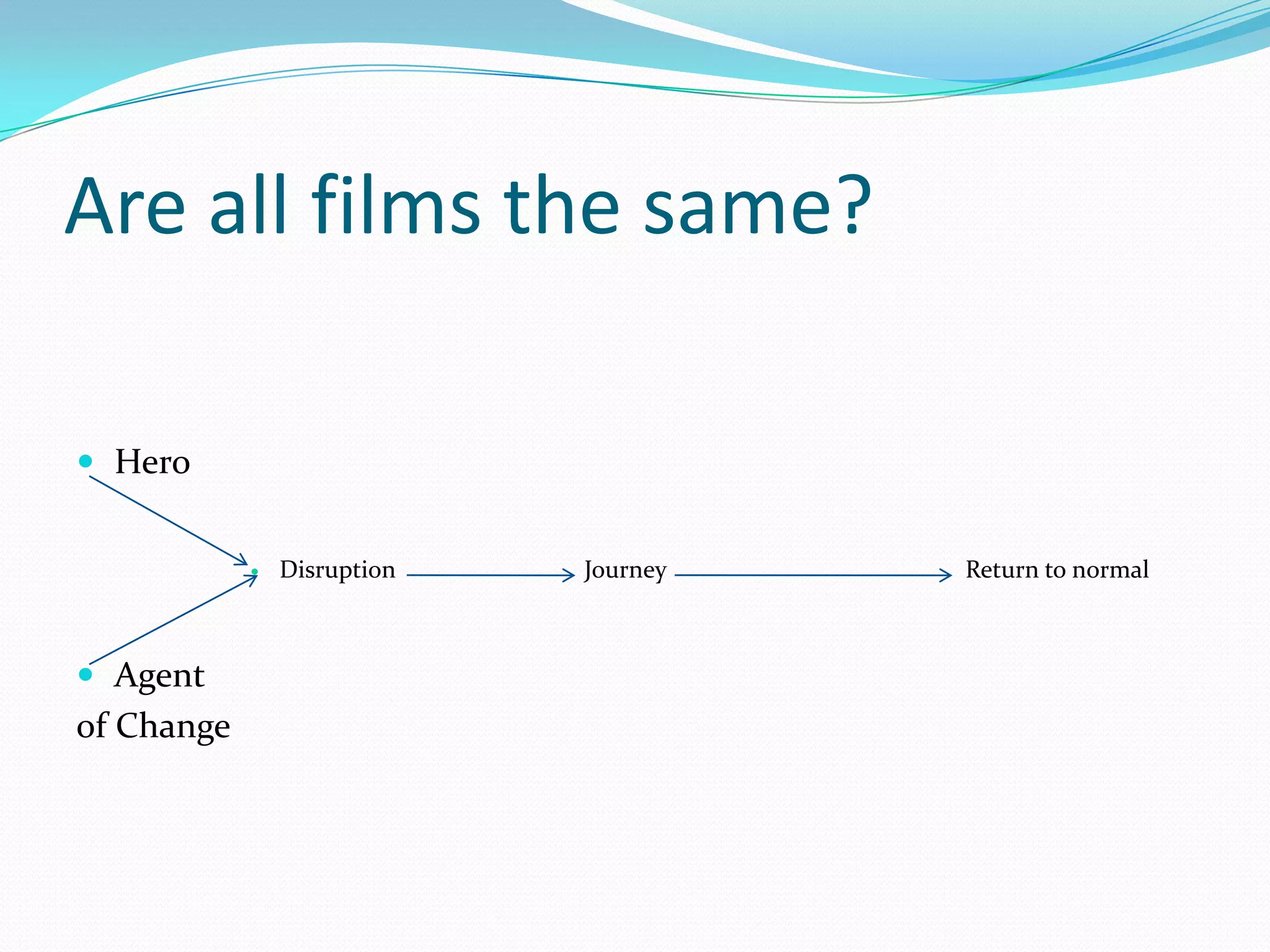
 Hero
 Disruption Journey Return to normal
 Agent
of Change
The Three Act Structure
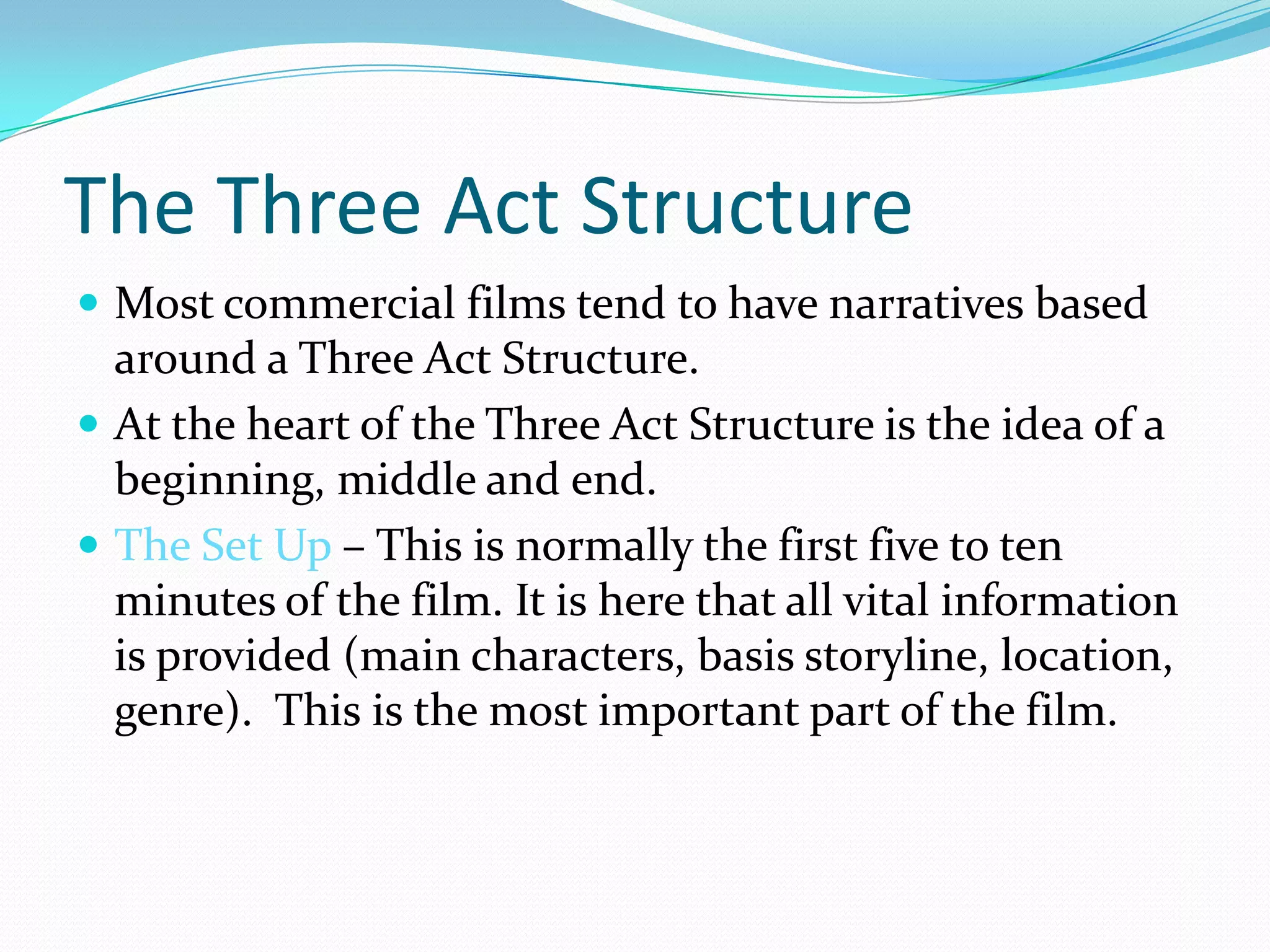
 Most commercial films tend to have narratives based
around a Three Act Structure.
 At the heart of the Three Act Structure is the idea of a
beginning, middle and end.
 The Set Up – This is normally the first five to ten
minutes of the film. It is here that all vital information
is provided (main characters, basis storyline, location,
genre). This is the most important part of the film.
During the Set Up
 Catalyst – During the set up a catalyst will be
introduced. The catalyst is what gets the story moving.
 Central Question – This is a problem, situation or
issue that needs to be resolved by the end of the film.
 These things are vital for the audience to learn early on
The Opening to The Ring
 Watch the opening carefully and make a list of all the
important things that we learn in the Set Up
 How are camera, editing, sound and mise en scene
used?
 Fill in the sheet provided in as much detail as possible.
After the Set Up
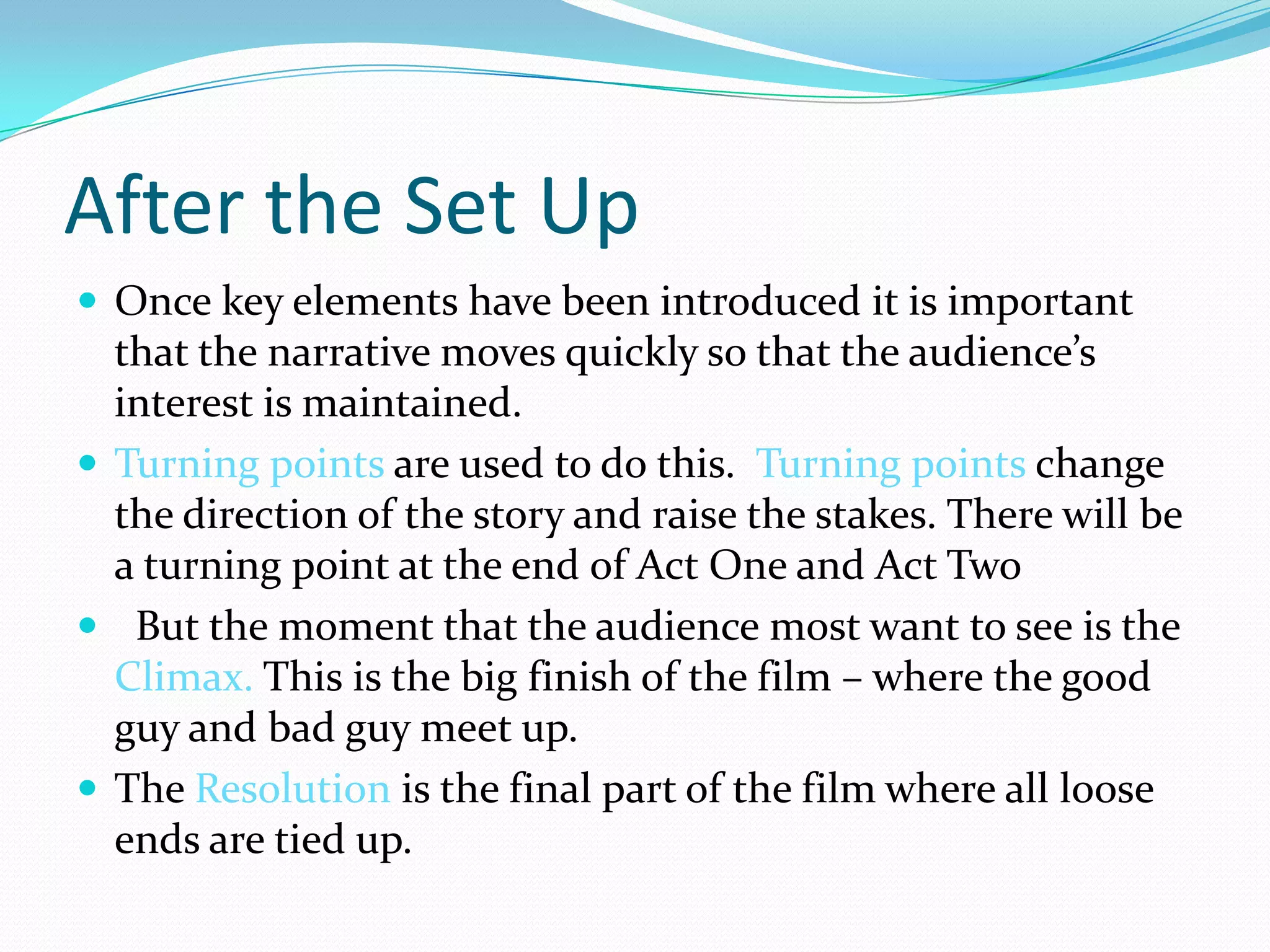
 Once key elements have been introduced it is important
that the narrative moves quickly so that the audience’s
interest is maintained.
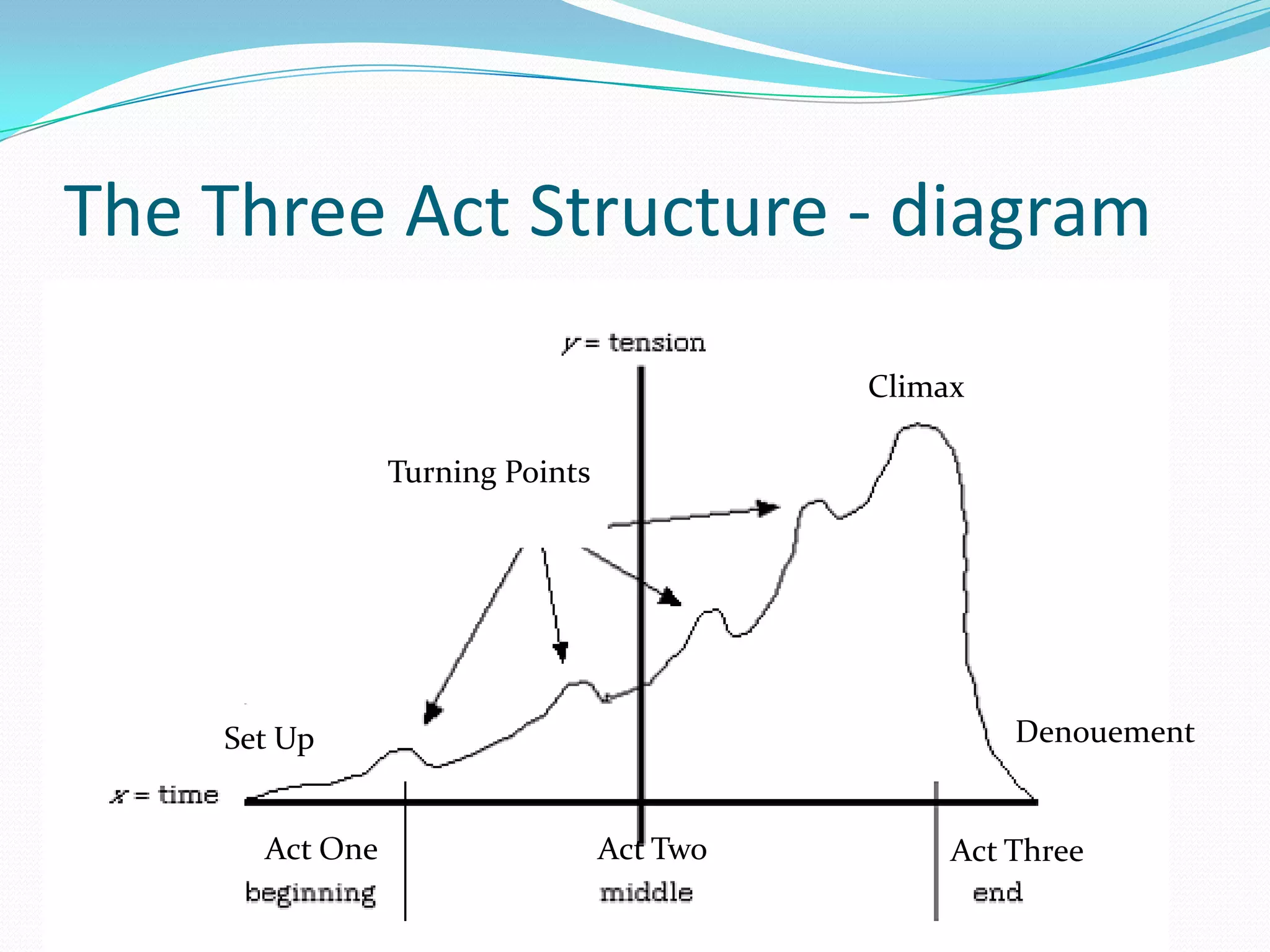
 Turning points are used to do this. Turning points change
the direction of the story and raise the stakes. There will be
a turning point at the end of Act One and Act Two
 But the moment that the audience most want to see is the
Climax. This is the big finish of the film – where the good
guy and bad guy meet up.
 The Resolution is the final part of the film where all loose
ends are tied up.
The Three Act Structure - diagram
Turning Points
ClimaxClimax
DenouementSet Up
Act One Act Two Act Three
What do these words mean?
Set Up, Catalyst, Central
Question, Turning Point,
Climax, Resolution
Activity
 A prop
 A character
 A location
 A line of dialogue
 Once you have your four elements you are start developing
ideas for possible horror films. Don’t forget to think about
the importance of the Set Up.
 As an individual you need to come up with three ideas.
Please fill in the sheet provided in as much detail as
possible. You will share ideas LATER. You will have 30mins
in class then you will complete this for HOMEWORK. Due
in for the next lesson
Research into Horrors
 Choose two of the following clips (that you have not
already focused on) and take notes on how they use
camera, editing, sound mise en scene and narrative.
 Darkness Falls
 Don’t be Afraid of the Dark
 Prom Night
 Scream 2
 The Amityville Horror
 Wrong Turn
 Saw
 The Ring (not opening)
 Silence of the Lambs
VOB files
need to be
opened
with VLC

Narrative structure in Film

  • 1.
    The way filmstell stories Key words to write down definitions of as we go: Set Up, Catalyst, Central Question, Turning Point, Climax, Resolution
  • 2.
    Are all filmsthe same?  Hero  Disruption Journey Return to normal  Agent of Change
  • 3.
    The Three ActStructure  Most commercial films tend to have narratives based around a Three Act Structure.  At the heart of the Three Act Structure is the idea of a beginning, middle and end.  The Set Up – This is normally the first five to ten minutes of the film. It is here that all vital information is provided (main characters, basis storyline, location, genre). This is the most important part of the film.
  • 4.
    During the SetUp  Catalyst – During the set up a catalyst will be introduced. The catalyst is what gets the story moving.  Central Question – This is a problem, situation or issue that needs to be resolved by the end of the film.  These things are vital for the audience to learn early on
  • 5.
    The Opening toThe Ring  Watch the opening carefully and make a list of all the important things that we learn in the Set Up  How are camera, editing, sound and mise en scene used?  Fill in the sheet provided in as much detail as possible.
  • 6.
    After the SetUp  Once key elements have been introduced it is important that the narrative moves quickly so that the audience’s interest is maintained.  Turning points are used to do this. Turning points change the direction of the story and raise the stakes. There will be a turning point at the end of Act One and Act Two  But the moment that the audience most want to see is the Climax. This is the big finish of the film – where the good guy and bad guy meet up.  The Resolution is the final part of the film where all loose ends are tied up.
  • 7.
    The Three ActStructure - diagram Turning Points ClimaxClimax DenouementSet Up Act One Act Two Act Three
  • 8.
    What do thesewords mean? Set Up, Catalyst, Central Question, Turning Point, Climax, Resolution
  • 9.
    Activity  A prop A character  A location  A line of dialogue  Once you have your four elements you are start developing ideas for possible horror films. Don’t forget to think about the importance of the Set Up.  As an individual you need to come up with three ideas. Please fill in the sheet provided in as much detail as possible. You will share ideas LATER. You will have 30mins in class then you will complete this for HOMEWORK. Due in for the next lesson
  • 10.
    Research into Horrors Choose two of the following clips (that you have not already focused on) and take notes on how they use camera, editing, sound mise en scene and narrative.  Darkness Falls  Don’t be Afraid of the Dark  Prom Night  Scream 2  The Amityville Horror  Wrong Turn  Saw  The Ring (not opening)  Silence of the Lambs VOB files need to be opened with VLC

Editor's Notes

  • #3 Give examples from film you knoweg LOTR, Titanic. Kids are to complete three examples of their own in books. Share
  • #4 What happens when you miss the first part? Has to catch your attention
  • #5 Event, action, piece of information, object.
  • #7 In horror film it could be key characters dying, a murder spree.....Double climaxOften this is not done in Horror films..... Why?
  • #10 Kids have to write down one example of a prop, character location dialogue on different bits of paper. Each group will get a selection of examples and will use these as stimulus Students may move to sit with people they want to work with. About five groups