Better Storage, Better Business
Presented by:
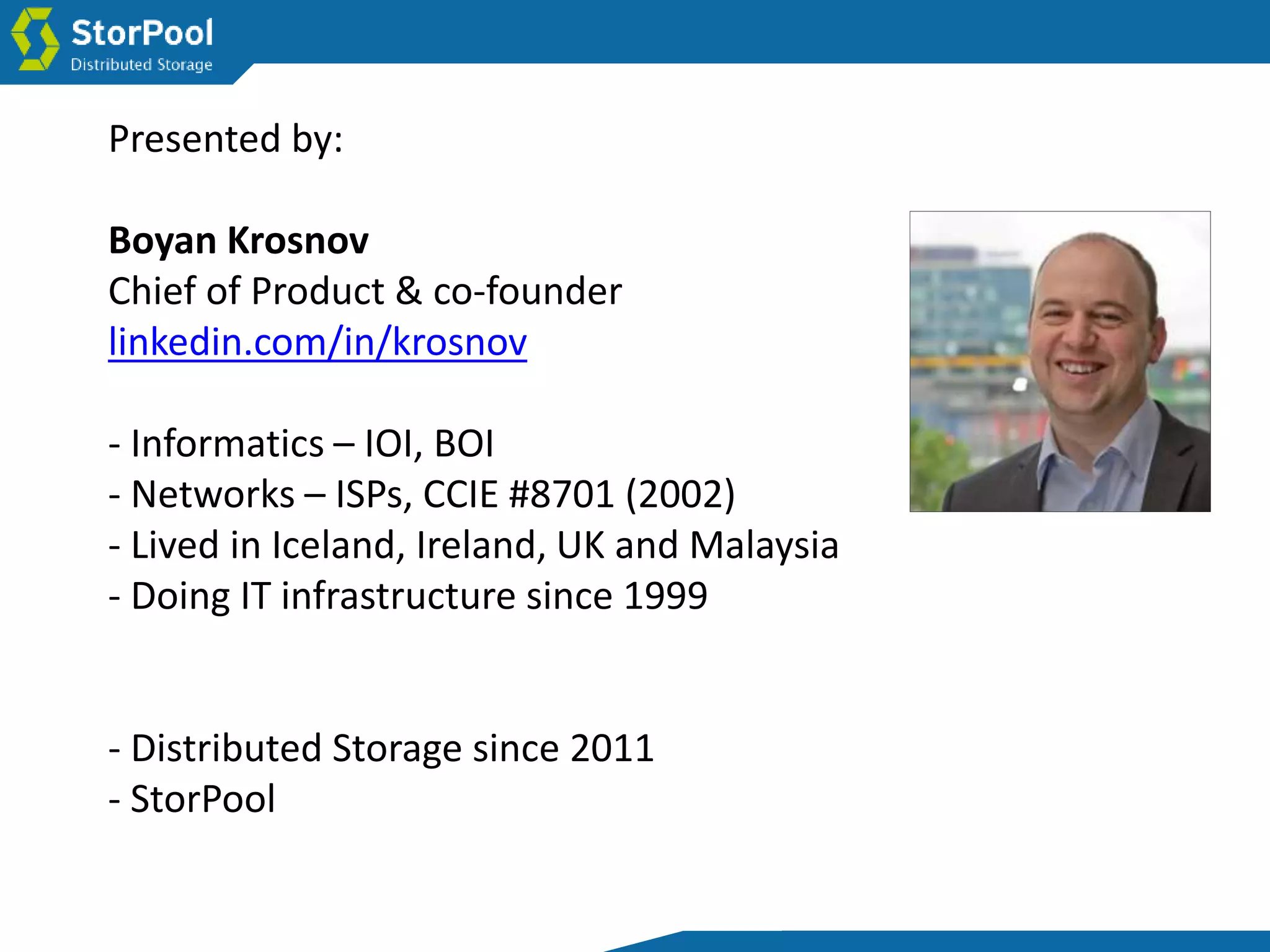
Boyan Krosnov
Chief of Product & co-founder
linkedin.com/in/krosnov
- Informatics – IOI, BOI
- Networks – ISPs, CCIE #8701 (2002)
- Lived in Iceland, Ireland, UK and Malaysia
- Doing IT infrastructure since 1999
- Distributed Storage since 2011
- StorPool
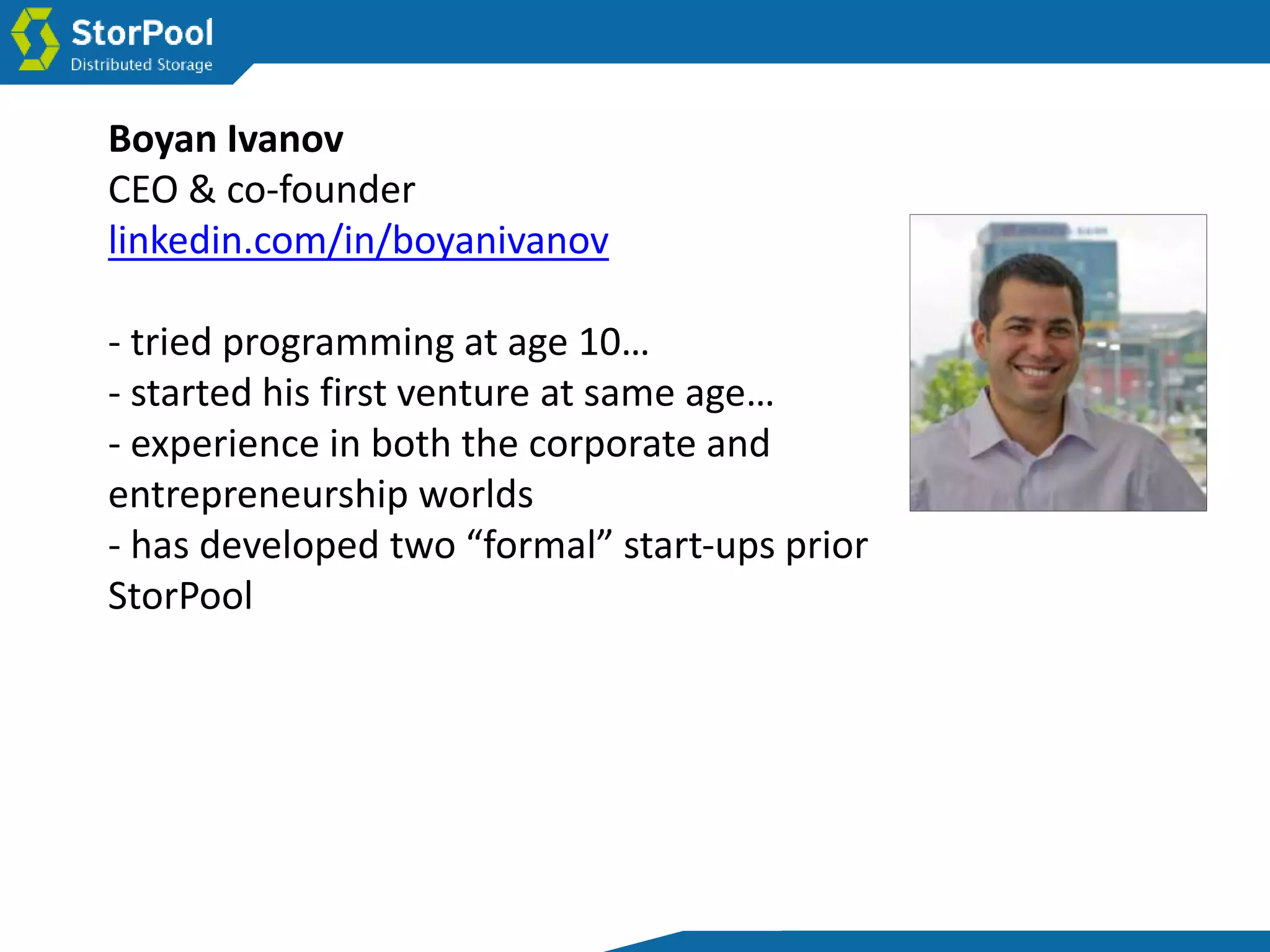
Boyan Ivanov
CEO & co-founder
linkedin.com/in/boyanivanov
- tried programming at age 10…
- started his first venture at same age…
- experience in both the corporate and
entrepreneurship worlds
- has developed two “formal” start-ups prior
StorPool
Agenda
1. The Storage Problem
2. Why is it so hard?
3. Today’s solutions
4. Tomorrow’s solution
5. StorPool Demo
6. Q & A
Defining the problem
• Primary block-layer storage is important
– Compute, Storage, Networking
• Storage is hard
– In networking – lose a packet – everything’s OK,
no need to panic
– In storage – lose the data – costly and slow
recovery from backup
– In compute – lose a CPU – just move the user to
another server
Defining the problem
• Storage is expensive
• Storage breaks badly and looses data
• Storage is slow
... Or, in reality, all of the above
Today’s storage solutions
• Local storage
– Workaround for problems with shared storage
solutions
– Performance good, but when you lose a node, you
lose the data
– Lack of key storage features – thin provisioning,
snapshots, etc.
– Not an ideal solution, some have learned to live
with it
Today’s storage solutions
• “Marketing-defined” storage solutions
– We call it “Software-defined”, because it’s hip.
– Would you like to buy our boxes?
– e.g. EMC, NetApp, HP, IBM
• Centralized storage solutions (both HW and SW)
– Many compute servers, one storage box
– Bottleneck, SPOF, inflexible, hard to scale
– e.g. SANs, ZFS, Nexenta
Today’s storage solutions
• Slow distributed storage solutions
– Distributed, scales, but inefficient
– Takes way too much CPU and RAM
– Does not deliver promised performance
– e.g. Ceph
So how do we make this better?
(And not just fix the problems. Really make it way better.)
We didn’t know it is impossible. So we just built it.
“ But, …. but this is impossible! ”
The CTO of a major infrastructure software vendor (to remain unnamed)
Storage system wishlist
• Horizontal scalability in performance and capacity
• Based on standard servers, drives and a standard network
• Online expansion, online changes, in-service upgrades
• Automatic self-healing
• Simple architecture:
• No dedicated metadata servers
• No active/passive pairs of servers
• No requirement for an additional layer of shared storage
• Ideally, just servers on a flat LAN
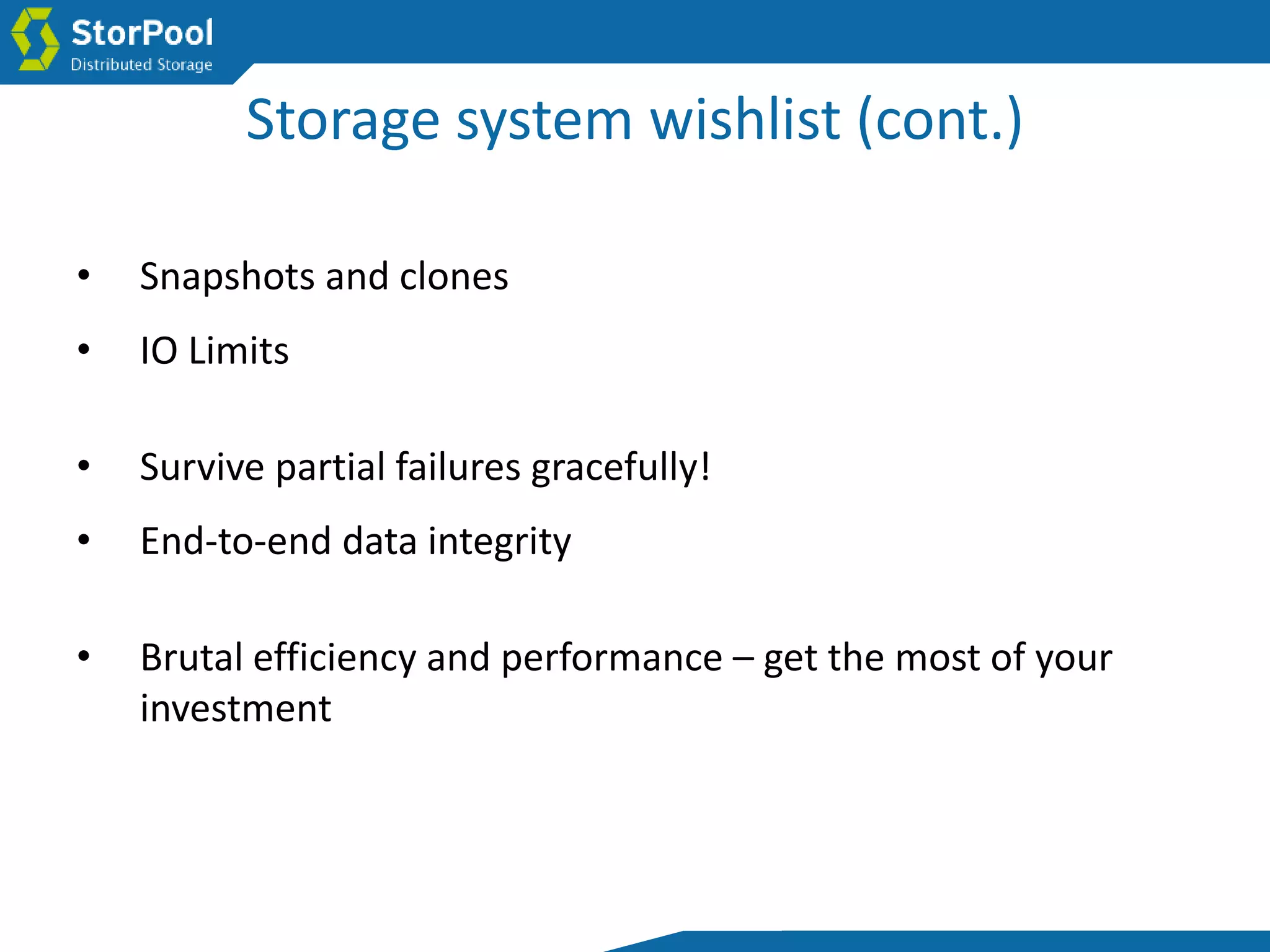
Storage system wishlist (cont.)
• Snapshots and clones
• IO Limits
• Survive partial failures gracefully!
• End-to-end data integrity
• Brutal efficiency and performance – get the most of your
investment
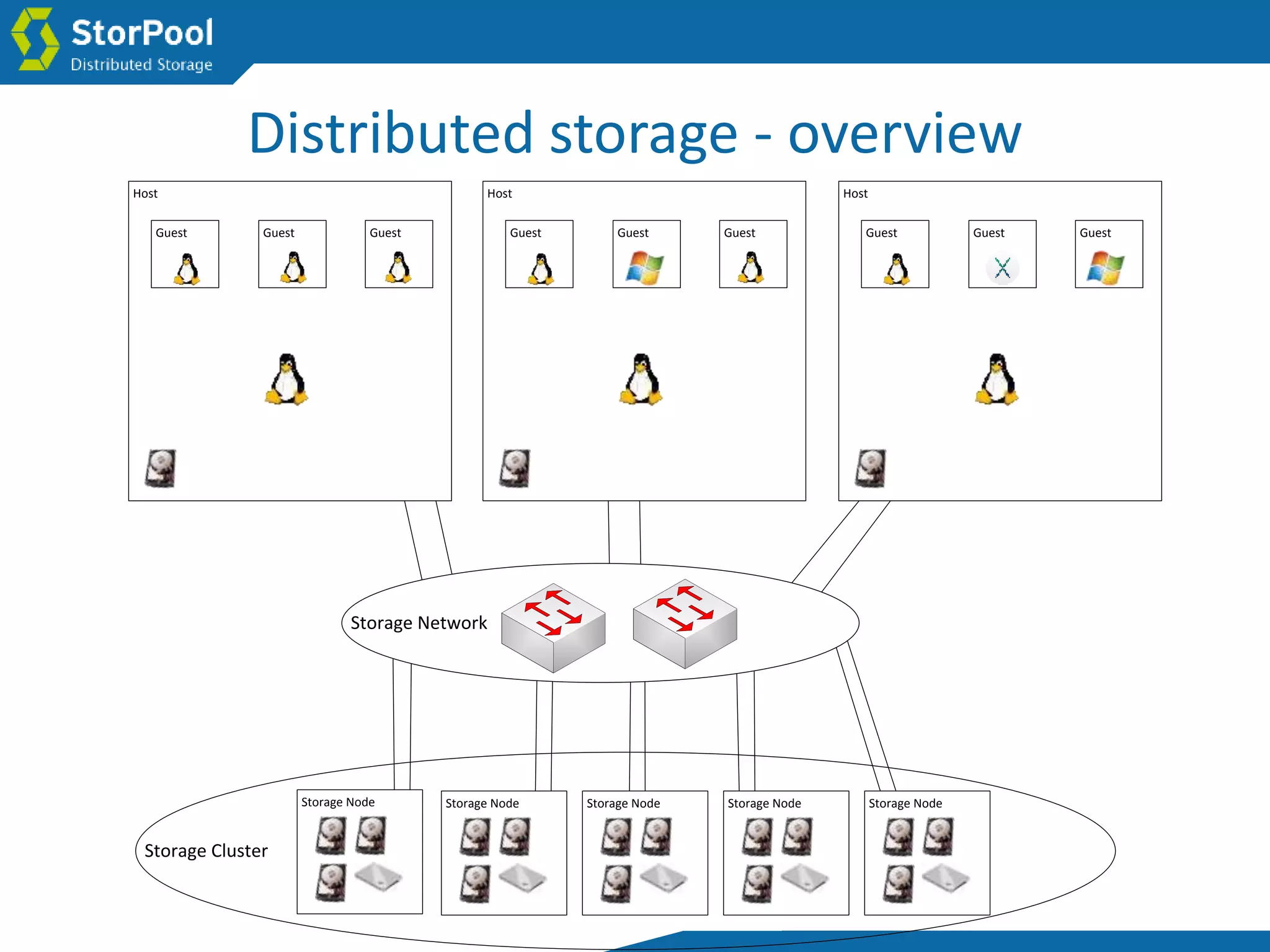
Storage Network
Host
Guest Guest Guest
Host
Guest Guest Guest
Host
Guest Guest Guest
Storage Node Storage Node Storage Node Storage Node Storage Node
Storage Cluster
Distributed storage - overview
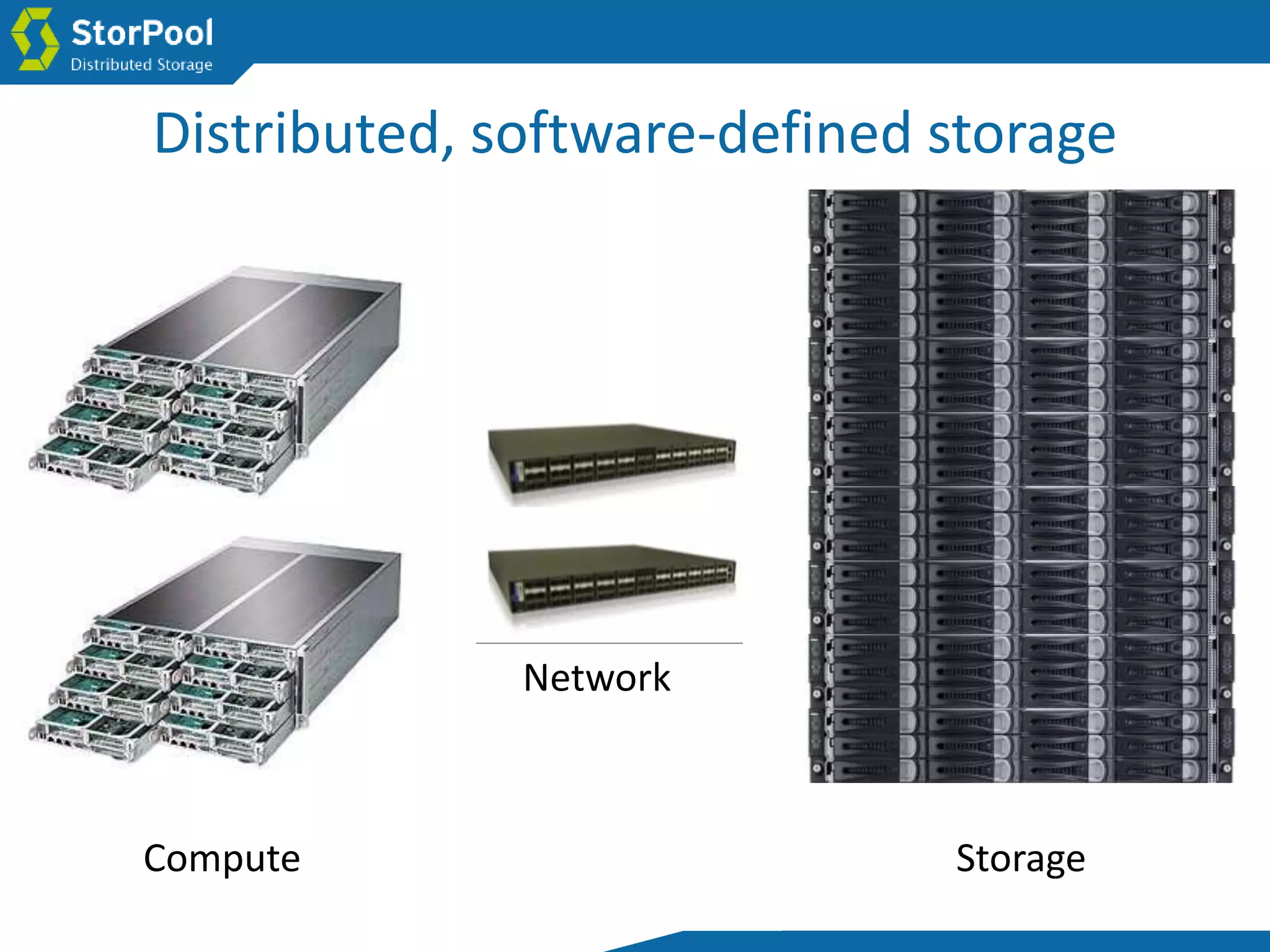
Compute Storage
Distributed, software-defined storage
Network
Storage
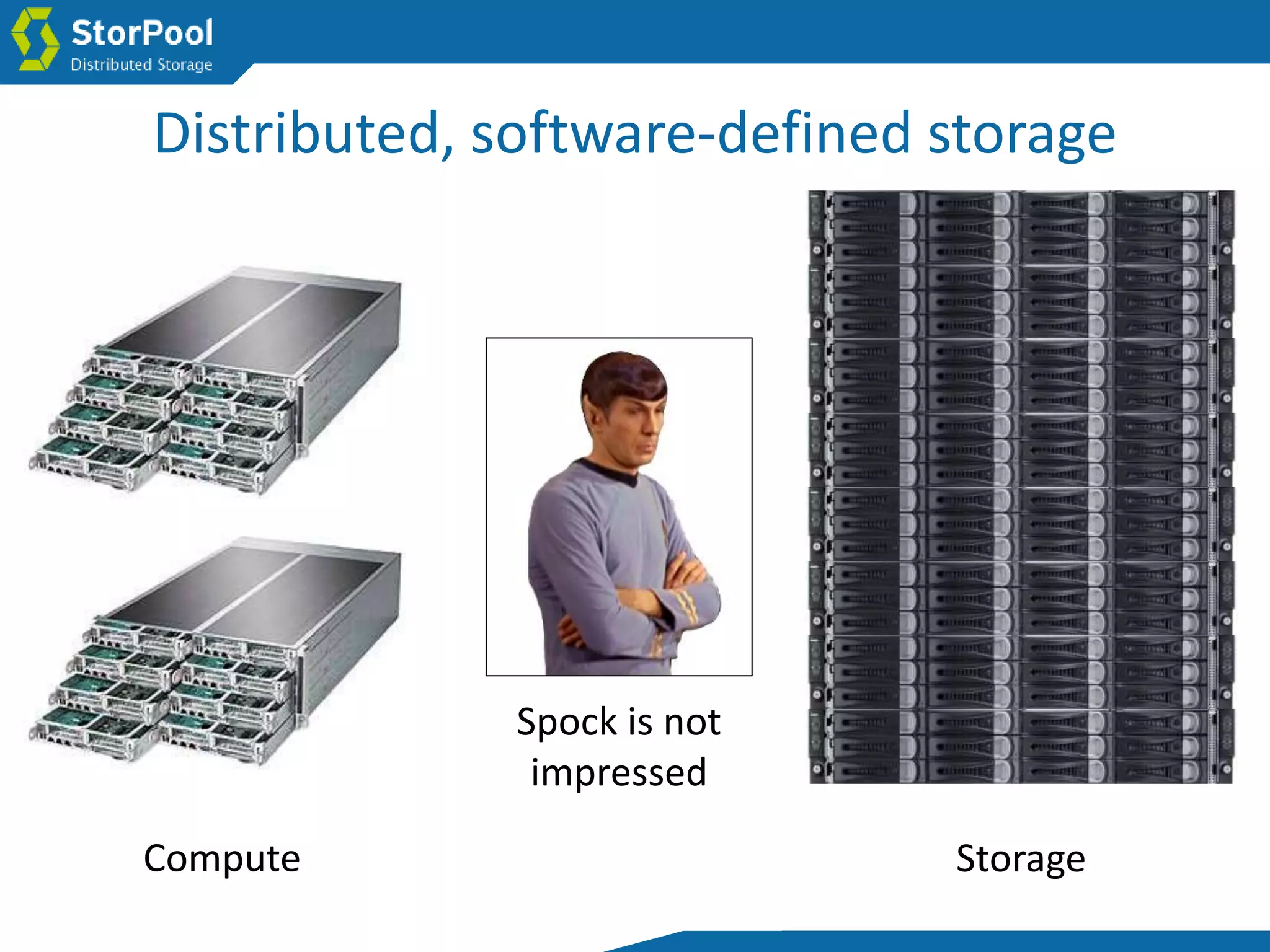
Spock is not
impressed
Compute
Distributed, software-defined storage
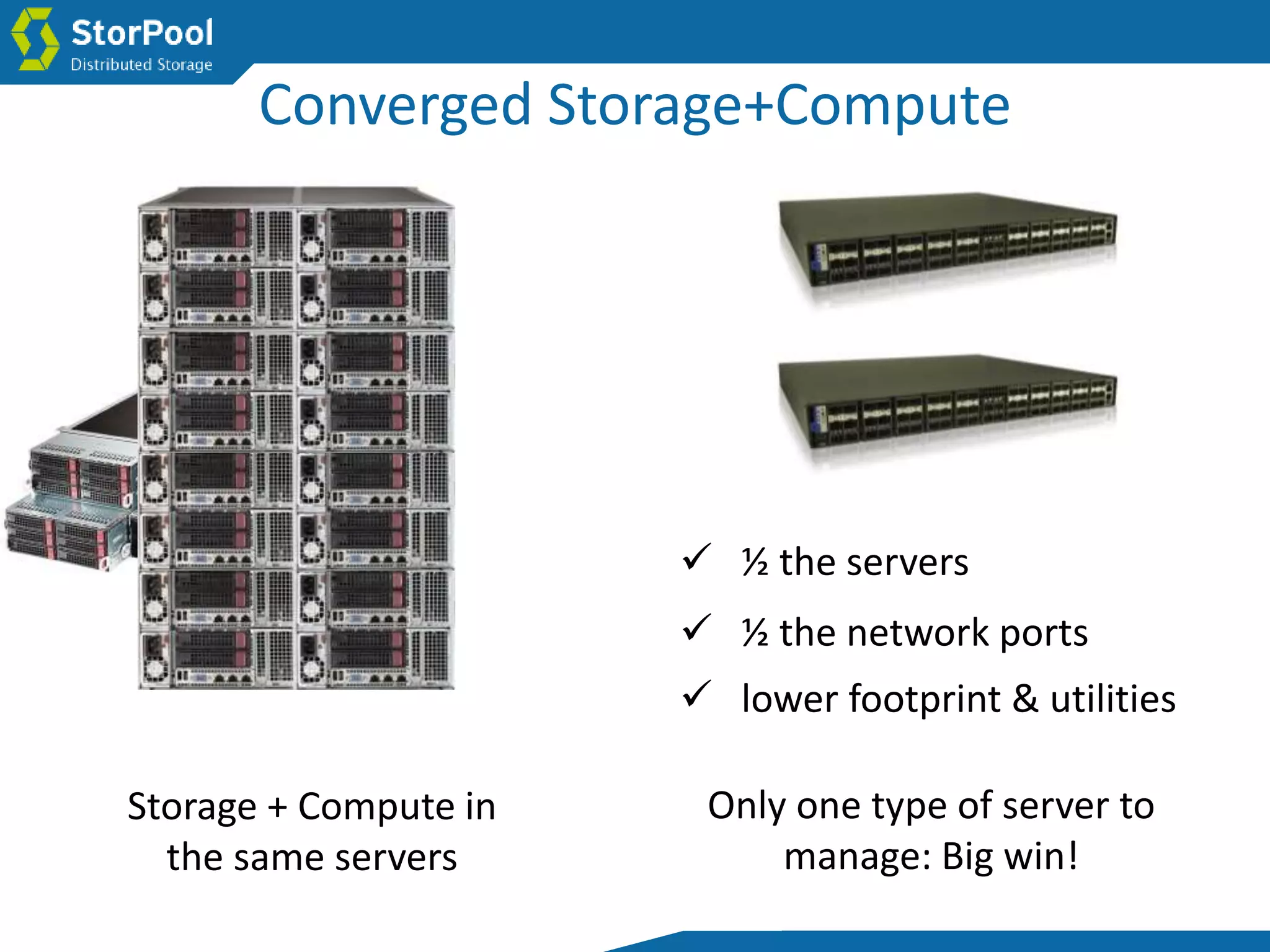
Storage + Compute in
the same servers
 ½ the servers
 ½ the network ports
 lower footprint & utilities
Only one type of server to
manage: Big win!
Converged Storage+Compute
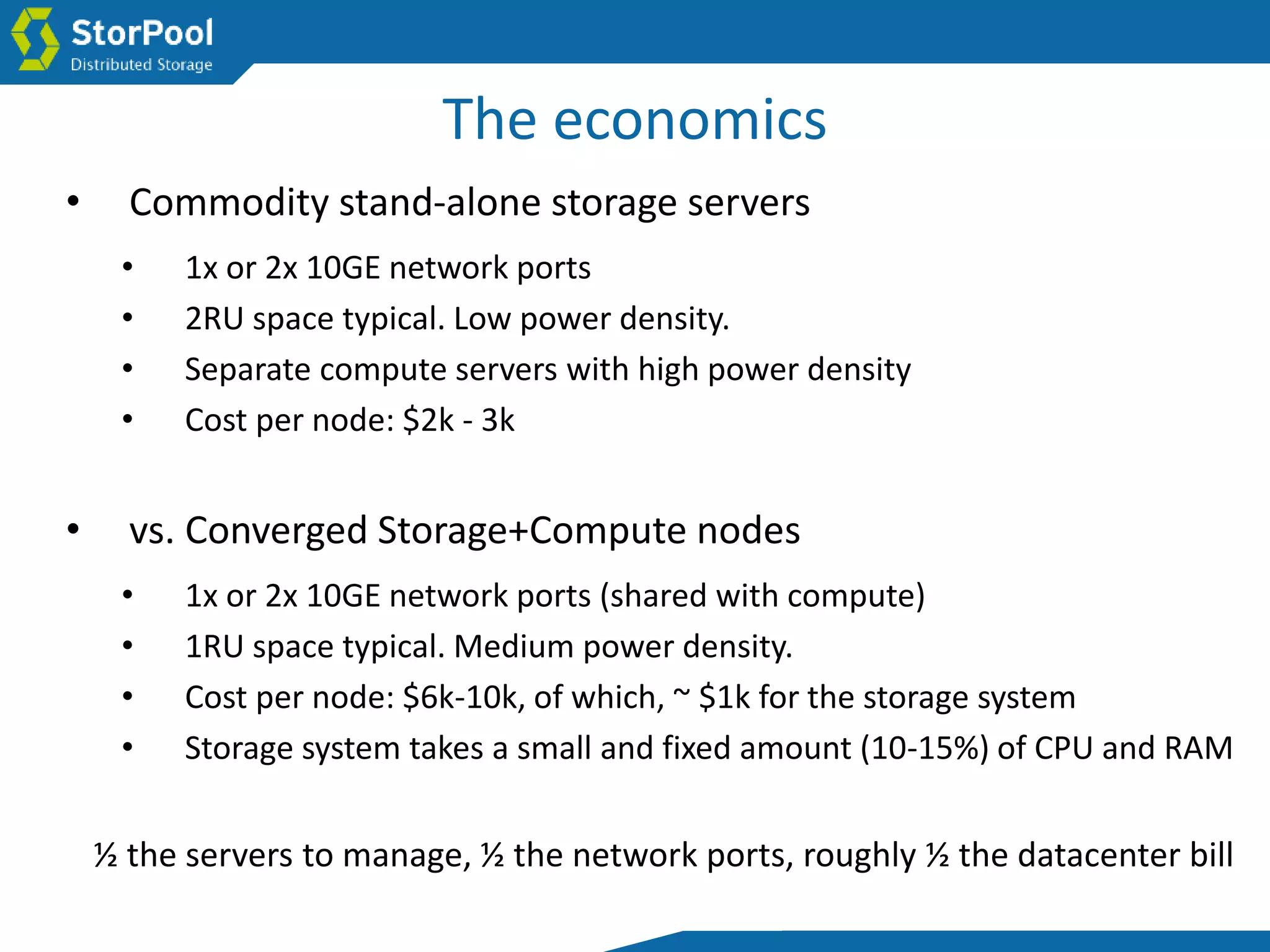
The economics
• vs. Converged Storage+Compute nodes
• 1x or 2x 10GE network ports (shared with compute)
• 1RU space typical. Medium power density.
• Cost per node: $6k-10k, of which, ~ $1k for the storage system
• Storage system takes a small and fixed amount (10-15%) of CPU and RAM
• Commodity stand-alone storage servers
• 1x or 2x 10GE network ports
• 2RU space typical. Low power density.
• Separate compute servers with high power density
• Cost per node: $2k - 3k
½ the servers to manage, ½ the network ports, roughly ½ the datacenter bill
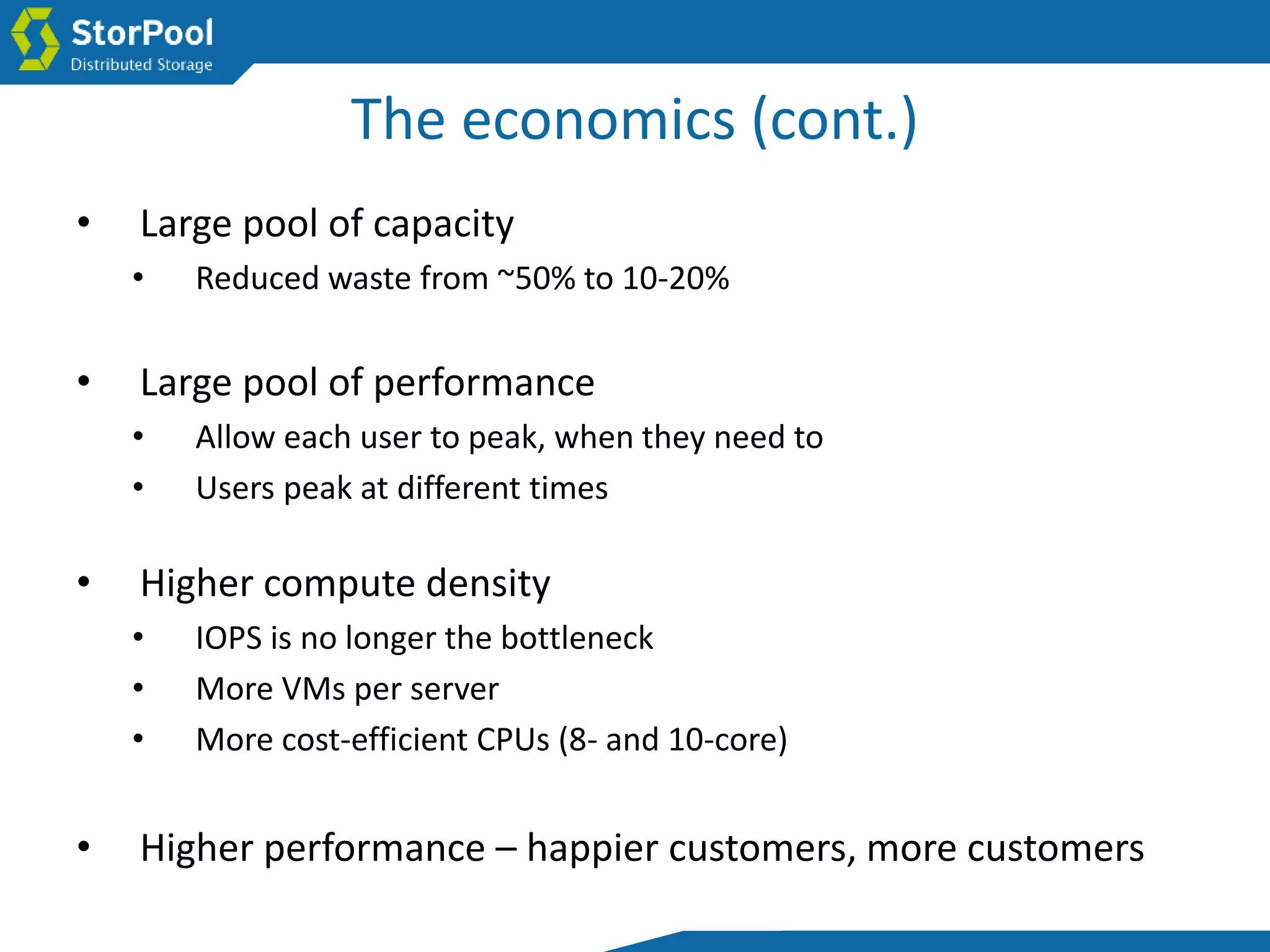
The economics (cont.)
• Large pool of capacity
• Reduced waste from ~50% to 10-20%
• Large pool of performance
• Allow each user to peak, when they need to
• Users peak at different times
• Higher compute density
• IOPS is no longer the bottleneck
• More VMs per server
• More cost-efficient CPUs (8- and 10-core)
• Higher performance – happier customers, more customers
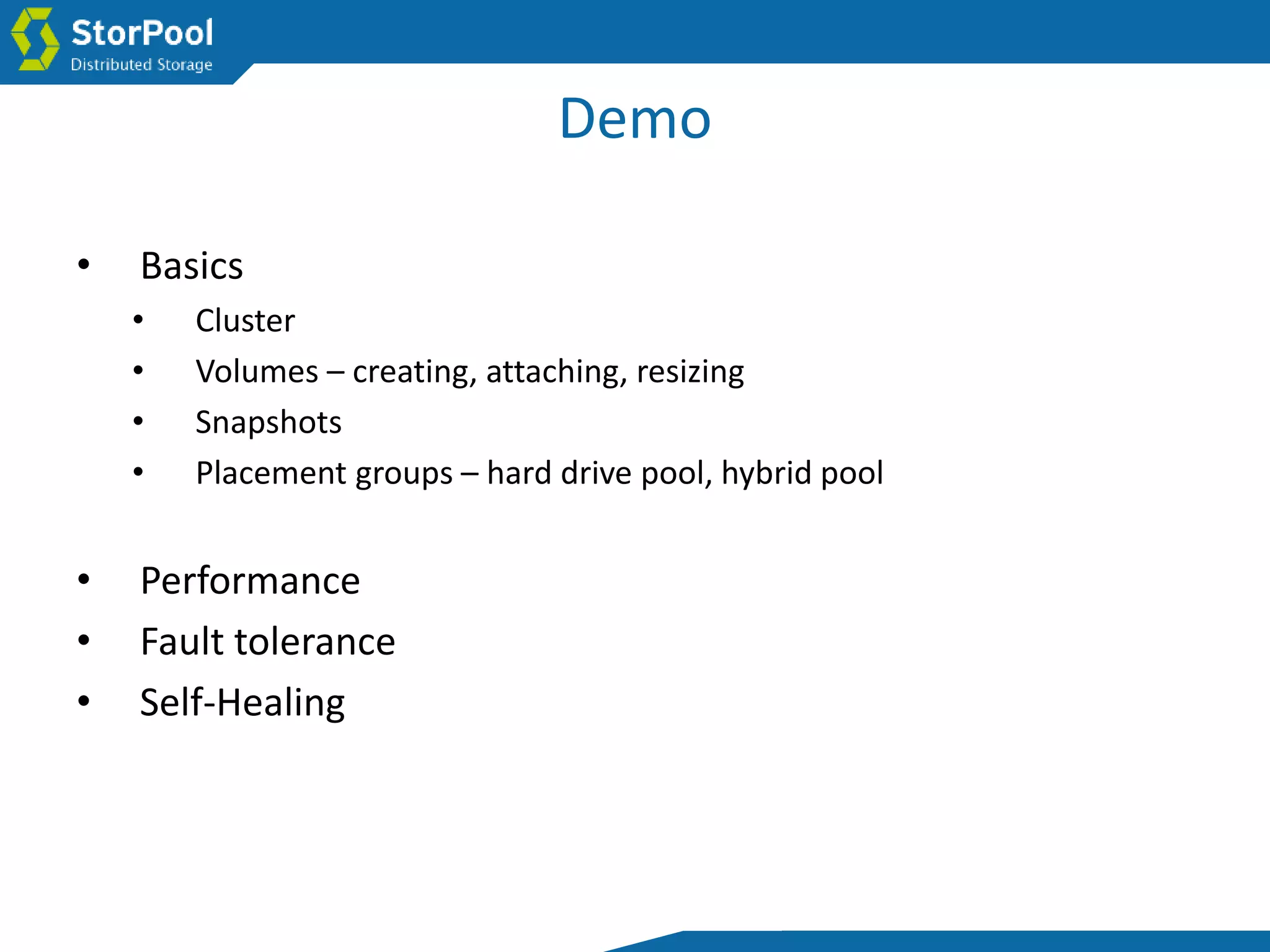
Demo
• Basics
• Cluster
• Volumes – creating, attaching, resizing
• Snapshots
• Placement groups – hard drive pool, hybrid pool
• Performance
• Fault tolerance
• Self-Healing
Thank you
+
Q&A
bk@storpool.com
@bkrosnov
bi@storpool.com
@bhivanov
info@storpool.com
@storpool

Webinar: StorPool and WHIR - better storage, better business

  • 1.
  • 2.
    Presented by: Boyan Krosnov Chiefof Product & co-founder linkedin.com/in/krosnov - Informatics – IOI, BOI - Networks – ISPs, CCIE #8701 (2002) - Lived in Iceland, Ireland, UK and Malaysia - Doing IT infrastructure since 1999 - Distributed Storage since 2011 - StorPool
  • 3.
    Boyan Ivanov CEO &co-founder linkedin.com/in/boyanivanov - tried programming at age 10… - started his first venture at same age… - experience in both the corporate and entrepreneurship worlds - has developed two “formal” start-ups prior StorPool
  • 4.
    Agenda 1. The StorageProblem 2. Why is it so hard? 3. Today’s solutions 4. Tomorrow’s solution 5. StorPool Demo 6. Q & A
  • 5.
    Defining the problem •Primary block-layer storage is important – Compute, Storage, Networking • Storage is hard – In networking – lose a packet – everything’s OK, no need to panic – In storage – lose the data – costly and slow recovery from backup – In compute – lose a CPU – just move the user to another server
  • 6.
    Defining the problem •Storage is expensive • Storage breaks badly and looses data • Storage is slow ... Or, in reality, all of the above
  • 7.
    Today’s storage solutions •Local storage – Workaround for problems with shared storage solutions – Performance good, but when you lose a node, you lose the data – Lack of key storage features – thin provisioning, snapshots, etc. – Not an ideal solution, some have learned to live with it
  • 8.
    Today’s storage solutions •“Marketing-defined” storage solutions – We call it “Software-defined”, because it’s hip. – Would you like to buy our boxes? – e.g. EMC, NetApp, HP, IBM • Centralized storage solutions (both HW and SW) – Many compute servers, one storage box – Bottleneck, SPOF, inflexible, hard to scale – e.g. SANs, ZFS, Nexenta
  • 9.
    Today’s storage solutions •Slow distributed storage solutions – Distributed, scales, but inefficient – Takes way too much CPU and RAM – Does not deliver promised performance – e.g. Ceph
  • 10.
    So how dowe make this better? (And not just fix the problems. Really make it way better.)
  • 11.
    We didn’t knowit is impossible. So we just built it. “ But, …. but this is impossible! ” The CTO of a major infrastructure software vendor (to remain unnamed)
  • 12.
    Storage system wishlist •Horizontal scalability in performance and capacity • Based on standard servers, drives and a standard network • Online expansion, online changes, in-service upgrades • Automatic self-healing • Simple architecture: • No dedicated metadata servers • No active/passive pairs of servers • No requirement for an additional layer of shared storage • Ideally, just servers on a flat LAN
  • 13.
    Storage system wishlist(cont.) • Snapshots and clones • IO Limits • Survive partial failures gracefully! • End-to-end data integrity • Brutal efficiency and performance – get the most of your investment
  • 14.
    Storage Network Host Guest GuestGuest Host Guest Guest Guest Host Guest Guest Guest Storage Node Storage Node Storage Node Storage Node Storage Node Storage Cluster Distributed storage - overview
  • 15.
  • 16.
  • 17.
    Storage + Computein the same servers  ½ the servers  ½ the network ports  lower footprint & utilities Only one type of server to manage: Big win! Converged Storage+Compute
  • 18.
    The economics • vs.Converged Storage+Compute nodes • 1x or 2x 10GE network ports (shared with compute) • 1RU space typical. Medium power density. • Cost per node: $6k-10k, of which, ~ $1k for the storage system • Storage system takes a small and fixed amount (10-15%) of CPU and RAM • Commodity stand-alone storage servers • 1x or 2x 10GE network ports • 2RU space typical. Low power density. • Separate compute servers with high power density • Cost per node: $2k - 3k ½ the servers to manage, ½ the network ports, roughly ½ the datacenter bill
  • 19.
    The economics (cont.) •Large pool of capacity • Reduced waste from ~50% to 10-20% • Large pool of performance • Allow each user to peak, when they need to • Users peak at different times • Higher compute density • IOPS is no longer the bottleneck • More VMs per server • More cost-efficient CPUs (8- and 10-core) • Higher performance – happier customers, more customers
  • 20.
    Demo • Basics • Cluster •Volumes – creating, attaching, resizing • Snapshots • Placement groups – hard drive pool, hybrid pool • Performance • Fault tolerance • Self-Healing
  • 21.

Editor's Notes

  • #2 Good afternoon,   My name is Boyan, I am co-founder and CEO at StorPool.   We have a storage technology that radically improves how data storage is done. It makes it several times more reliable, flexible and efficient.