
StarWind Virtual SAN
StarWind Virtual SAN is… 
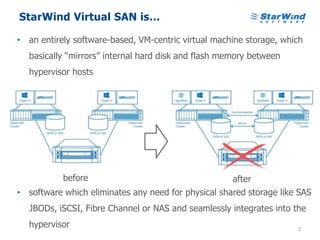
• an entirely software-based, VM-centric virtual machine storage, which 
basically “mirrors” internal hard disk and flash memory between 
hypervisor hosts 
• software which eliminates any need for physical shared storage like SAS 
JBODs, iSCSI, Fibre Channel or NAS and seamlessly integrates into the 
hypervisor 
2 
before after
Similar to VMware Virtual SAN but… 
• Has an absolutely minimalistic hardware footprint – needing only 
two physical hosts running VMware vSphere hypervisor and literally no 
other hardware (flash is optional) 
3 
• Flash-friendly – it uses Log-Structured File System (LSFS), in-line 
Deduplication and RAM-based L1 cache to help flash last longer 
eliminating small writes, reducing amount of written data and 
adsorbing writes in RAM
Similar to Microsoft Clustered Storage Spaces 
but… 
4 
• Has flexed-out hardware requirements starting with just two 
physical hosts running Hyper-V, no additional and external hardware is 
required: no SAS JBODs, SAS HBAs cabling, FC, iSCSI or SMB 3.0. 
Works not only with SAS but with SATA and PCIe flash memory. 
10/40/56 Gb Ethernet is used for connections, instead of 6/12 Gb SAS. 
• Adds In-line Deduplication and LSFS log structure targeting VDI 
and write intensive VMs and is Flash-friendly due to the amount of 
written data reduced in real time thus prolonging flash life
Similar to Microsoft Clustered Storage Spaces 
but… 
• Runs inside Hyper-V kernel and uses SMB 3.0 SOFS, iSCSI and Scale- 
5 
Out File Servers approaches to fit storage. 
It also uses RAM and PCIe based write back cache to adsorb 
writes and cache I/O.
Hyper-Converged 
6 
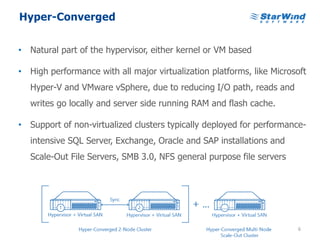
• Natural part of the hypervisor, either kernel or VM based 
• High performance with all major virtualization platforms, like Microsoft 
Hyper-V and VMware vSphere, due to reducing I/O path, reads and 
writes go locally and server side running RAM and flash cache. 
• Support of non-virtualized clusters typically deployed for performance-intensive 
SQL Server, Exchange, Oracle and SAP installations and 
Scale-Out File Servers, SMB 3.0, NFS general purpose file servers
Compute and Storage Separated 
7 
• Possibility to run on a dedicated set of servers creating separated 
storage pools, while for some installation a high LUN density is required. 
Implemented for total flexibility of different configurations to increase 
compute and storage layers performance with not only one means. 
• Uses industry standard uplink protocols SMB 3.0, NFS, iSCSI and 
hypervisor specific I/O acceleration technologies VAAI and ODX.
Scale-Up & Scale-Out 
8 
Flexible adoption of both Scale-Up and Scale-Out architectures 
• capacity is increased by throwing more spindles or flash modules 
into the existing storage cluster 
nodes, 
• storage and compute 
capacity is increased by adding 
additional nodes.
9 
• Fault Tolerance and High Availability 
Basically “mirroring” of the actual storage and caches between the hosts. 
Any number of replicas of a particular VM or LUN are kept alive and the 
cluster uses required number of active storage controllers. 
• VM-Centric Storage 
A combination of RAM and Flash as multi-layered cache is used to eliminate 
random reads, thus achieving major performance increase. Multiple smaller 
random writes are coalesced into a single sequential big I/O write. 
Implementation of Log-Structured File system (LSFS) allows to achieve up 
to 90% raw sequential write performance at the file system level.
10 
• Hardware Agnostic 
The utilization of inexpensive commodity hardware with the help of 
proprietary in-house developed software, general-purpose x64 servers, 
MLC flash, spinning disks and Ethernet, thus making a high-performance 
solution affordable. 
• Asynchronous replication 
An effective mechanism to ensure that mission-critical business data is 
replicated to a disaster recovery site. Replication is implemented to be 
asynchronous, background, deduplication and compression-aware as 
well as snapshot-based to reduce load on slow WAN connection.
11 
• Snapshots and Automated Storage Tiering 
Implementing of inter-node tiering technology to offload “cold” data 
from fast and expensive primary all-flash storage to slower but 
inexpensive secondary storage tier. 
• Deduplication and compression 
Utilization of VM and flash-friendly space reduction technologies such 
as in-line deduplication and compression, increasing usable capacity of 
all-flash configurations and also prolonging flash life-cycle.
301 Edgewater Place, 
Suite 100, 
Wakefield, MA 01880 
USA 
1-617-449-7717 Main 
1-617-507-5845 Fax 
www.starwindsoftware.com 
sales@starwindsoftware.com

StarWind Virtual SAN Overview

  • 1.
  • 2.
    StarWind Virtual SANis… • an entirely software-based, VM-centric virtual machine storage, which basically “mirrors” internal hard disk and flash memory between hypervisor hosts • software which eliminates any need for physical shared storage like SAS JBODs, iSCSI, Fibre Channel or NAS and seamlessly integrates into the hypervisor 2 before after
  • 3.
    Similar to VMwareVirtual SAN but… • Has an absolutely minimalistic hardware footprint – needing only two physical hosts running VMware vSphere hypervisor and literally no other hardware (flash is optional) 3 • Flash-friendly – it uses Log-Structured File System (LSFS), in-line Deduplication and RAM-based L1 cache to help flash last longer eliminating small writes, reducing amount of written data and adsorbing writes in RAM
  • 4.
    Similar to MicrosoftClustered Storage Spaces but… 4 • Has flexed-out hardware requirements starting with just two physical hosts running Hyper-V, no additional and external hardware is required: no SAS JBODs, SAS HBAs cabling, FC, iSCSI or SMB 3.0. Works not only with SAS but with SATA and PCIe flash memory. 10/40/56 Gb Ethernet is used for connections, instead of 6/12 Gb SAS. • Adds In-line Deduplication and LSFS log structure targeting VDI and write intensive VMs and is Flash-friendly due to the amount of written data reduced in real time thus prolonging flash life
  • 5.
    Similar to MicrosoftClustered Storage Spaces but… • Runs inside Hyper-V kernel and uses SMB 3.0 SOFS, iSCSI and Scale- 5 Out File Servers approaches to fit storage. It also uses RAM and PCIe based write back cache to adsorb writes and cache I/O.
  • 6.
    Hyper-Converged 6 •Natural part of the hypervisor, either kernel or VM based • High performance with all major virtualization platforms, like Microsoft Hyper-V and VMware vSphere, due to reducing I/O path, reads and writes go locally and server side running RAM and flash cache. • Support of non-virtualized clusters typically deployed for performance-intensive SQL Server, Exchange, Oracle and SAP installations and Scale-Out File Servers, SMB 3.0, NFS general purpose file servers
  • 7.
    Compute and StorageSeparated 7 • Possibility to run on a dedicated set of servers creating separated storage pools, while for some installation a high LUN density is required. Implemented for total flexibility of different configurations to increase compute and storage layers performance with not only one means. • Uses industry standard uplink protocols SMB 3.0, NFS, iSCSI and hypervisor specific I/O acceleration technologies VAAI and ODX.
  • 8.
    Scale-Up & Scale-Out 8 Flexible adoption of both Scale-Up and Scale-Out architectures • capacity is increased by throwing more spindles or flash modules into the existing storage cluster nodes, • storage and compute capacity is increased by adding additional nodes.
  • 9.
    9 • FaultTolerance and High Availability Basically “mirroring” of the actual storage and caches between the hosts. Any number of replicas of a particular VM or LUN are kept alive and the cluster uses required number of active storage controllers. • VM-Centric Storage A combination of RAM and Flash as multi-layered cache is used to eliminate random reads, thus achieving major performance increase. Multiple smaller random writes are coalesced into a single sequential big I/O write. Implementation of Log-Structured File system (LSFS) allows to achieve up to 90% raw sequential write performance at the file system level.
  • 10.
    10 • HardwareAgnostic The utilization of inexpensive commodity hardware with the help of proprietary in-house developed software, general-purpose x64 servers, MLC flash, spinning disks and Ethernet, thus making a high-performance solution affordable. • Asynchronous replication An effective mechanism to ensure that mission-critical business data is replicated to a disaster recovery site. Replication is implemented to be asynchronous, background, deduplication and compression-aware as well as snapshot-based to reduce load on slow WAN connection.
  • 11.
    11 • Snapshotsand Automated Storage Tiering Implementing of inter-node tiering technology to offload “cold” data from fast and expensive primary all-flash storage to slower but inexpensive secondary storage tier. • Deduplication and compression Utilization of VM and flash-friendly space reduction technologies such as in-line deduplication and compression, increasing usable capacity of all-flash configurations and also prolonging flash life-cycle.
  • 12.
    301 Edgewater Place, Suite 100, Wakefield, MA 01880 USA 1-617-449-7717 Main 1-617-507-5845 Fax www.starwindsoftware.com sales@starwindsoftware.com