©
Storage Expo Netherlands 2010
Jaarbeurs, Utrecht
How to Get More for Less
in Storage Procurement and Operation
Josh Krischer
©
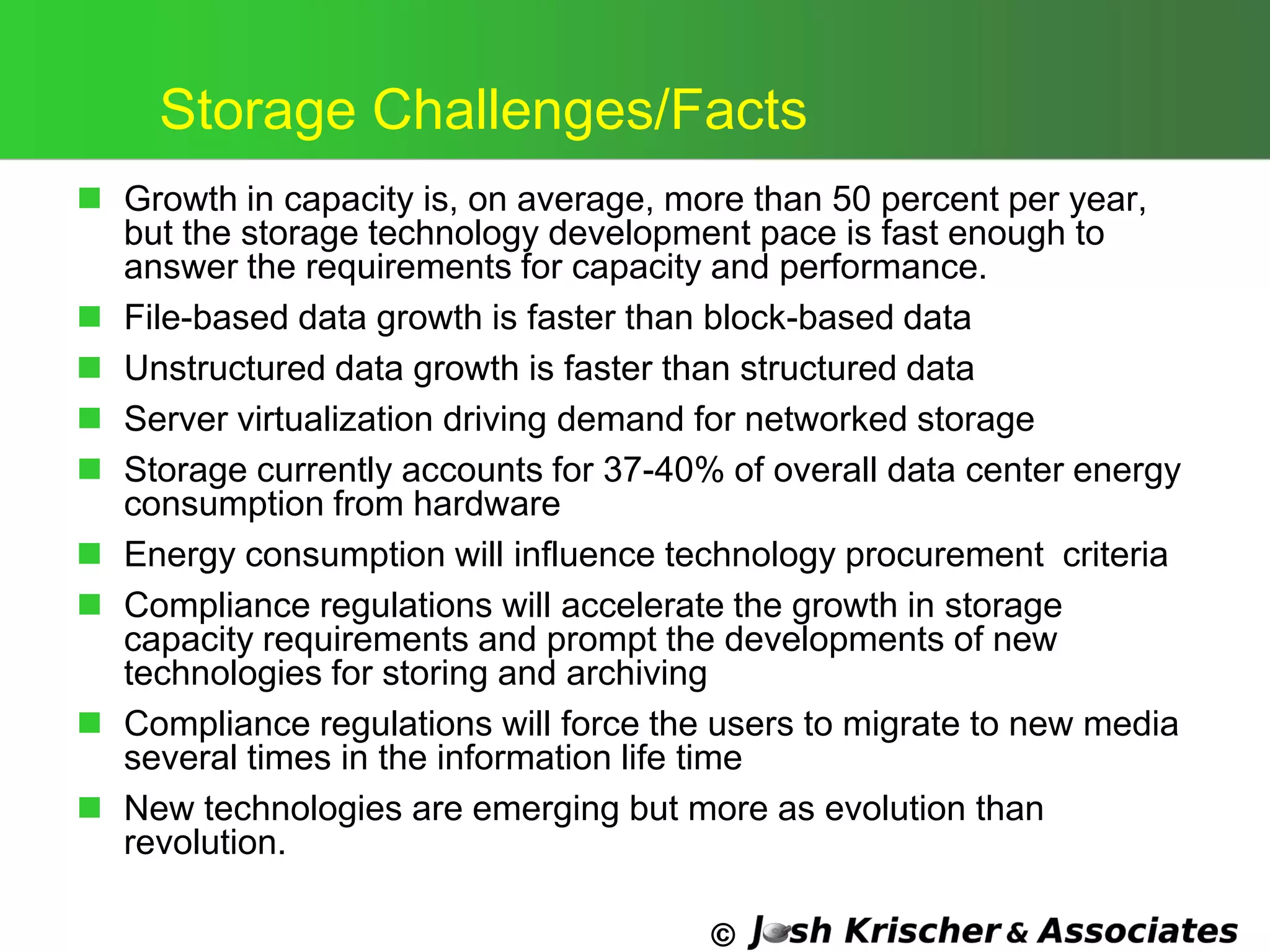
Storage Challenges/Facts
 Growth in capacity is, on average, more than 50 percent per year,
but the storage technology development pace is fast enough to
answer the requirements for capacity and performance.
 File-based data growth is faster than block-based data
 Unstructured data growth is faster than structured data
 Server virtualization driving demand for networked storage
 Storage currently accounts for 37-40% of overall data center energy
consumption from hardware
 Energy consumption will influence technology procurement criteria
 Compliance regulations will accelerate the growth in storage
capacity requirements and prompt the developments of new
technologies for storing and archiving
 Compliance regulations will force the users to migrate to new media
several times in the information life time
 New technologies are emerging but more as evolution than
revolution.
©
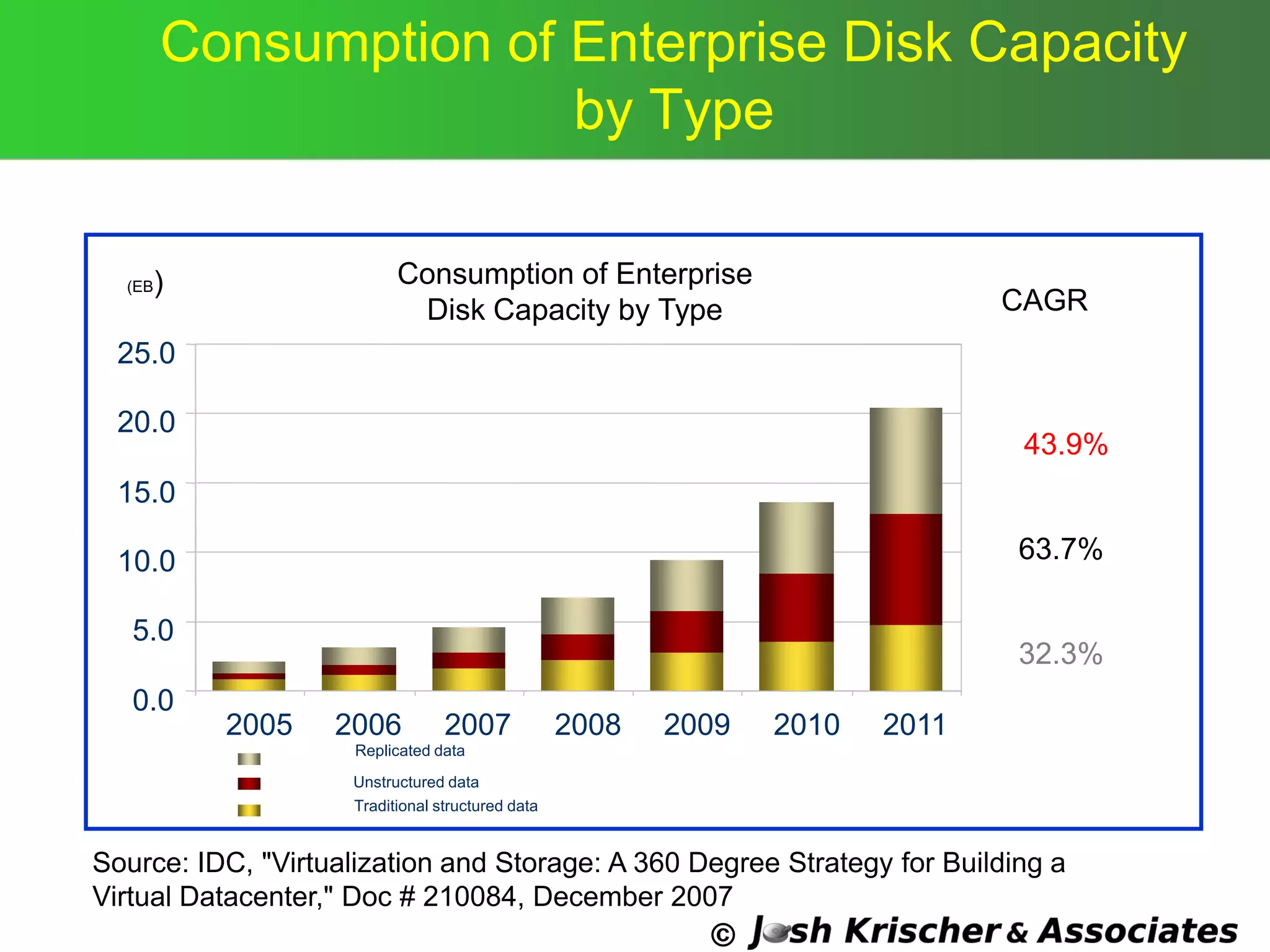
Consumption of Enterprise Disk Capacity
by Type
0.0
5.0
10.0
15.0
20.0
25.0
2005 2006 2007 2008 2009 2010 2011
Replicated data
Unstructured data
Traditional structured data
Consumption of Enterprise
Disk Capacity by Type CAGR
32.3%
63.7%
(EB)
43.9%
Source: IDC, "Virtualization and Storage: A 360 Degree Strategy for Building a
Virtual Datacenter," Doc # 210084, December 2007
©
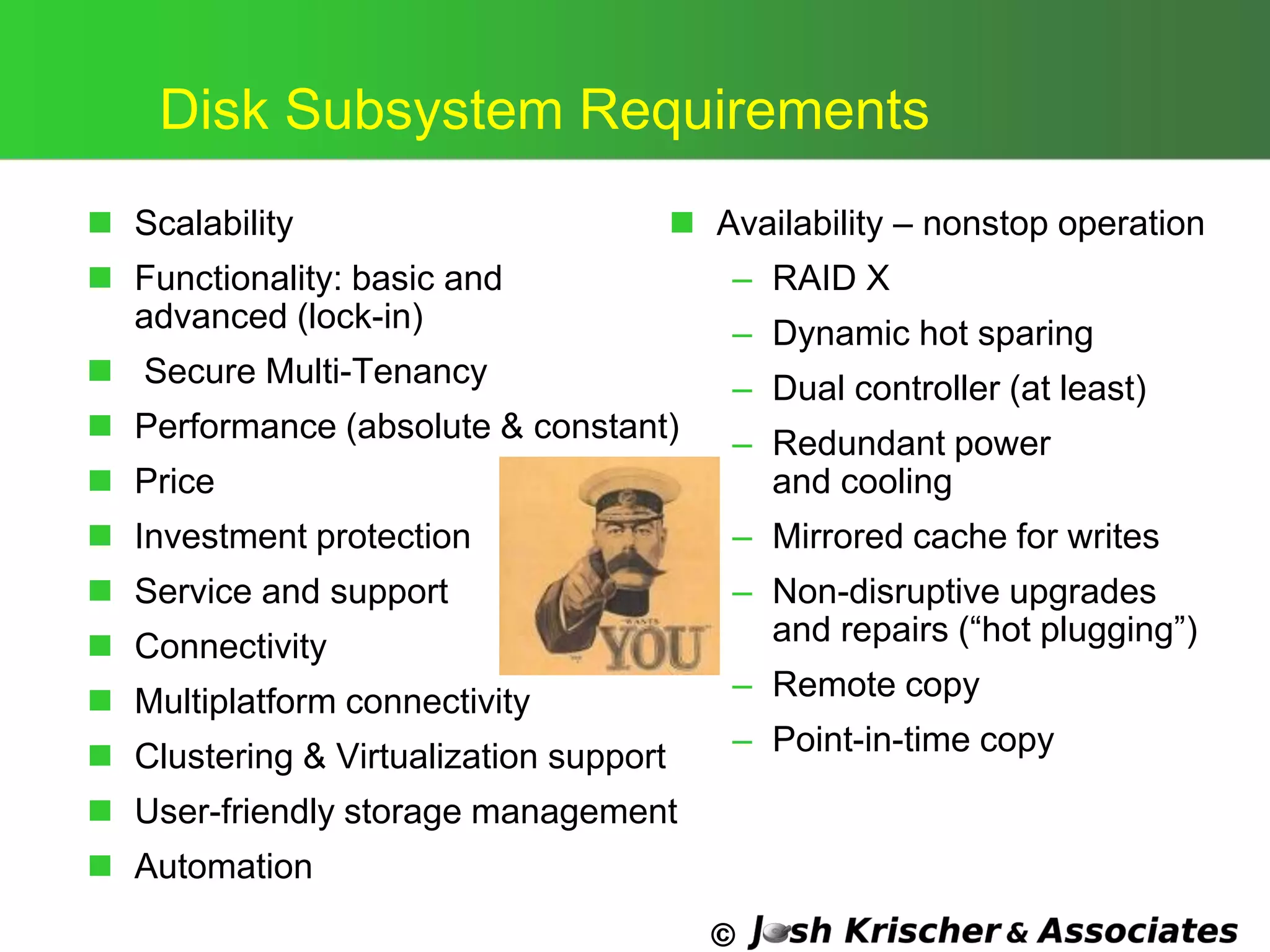
Disk Subsystem Requirements
 Scalability
 Functionality: basic and
advanced (lock-in)
 Secure Multi-Tenancy
 Performance (absolute & constant)
 Price
 Investment protection
 Service and support
 Connectivity
 Multiplatform connectivity
 Clustering & Virtualization support
 User-friendly storage management
 Automation
 Availability – nonstop operation
– RAID X
– Dynamic hot sparing
– Dual controller (at least)
– Redundant power
and cooling
– Mirrored cache for writes
– Non-disruptive upgrades
and repairs (―hot plugging‖)
– Remote copy
– Point-in-time copy
©
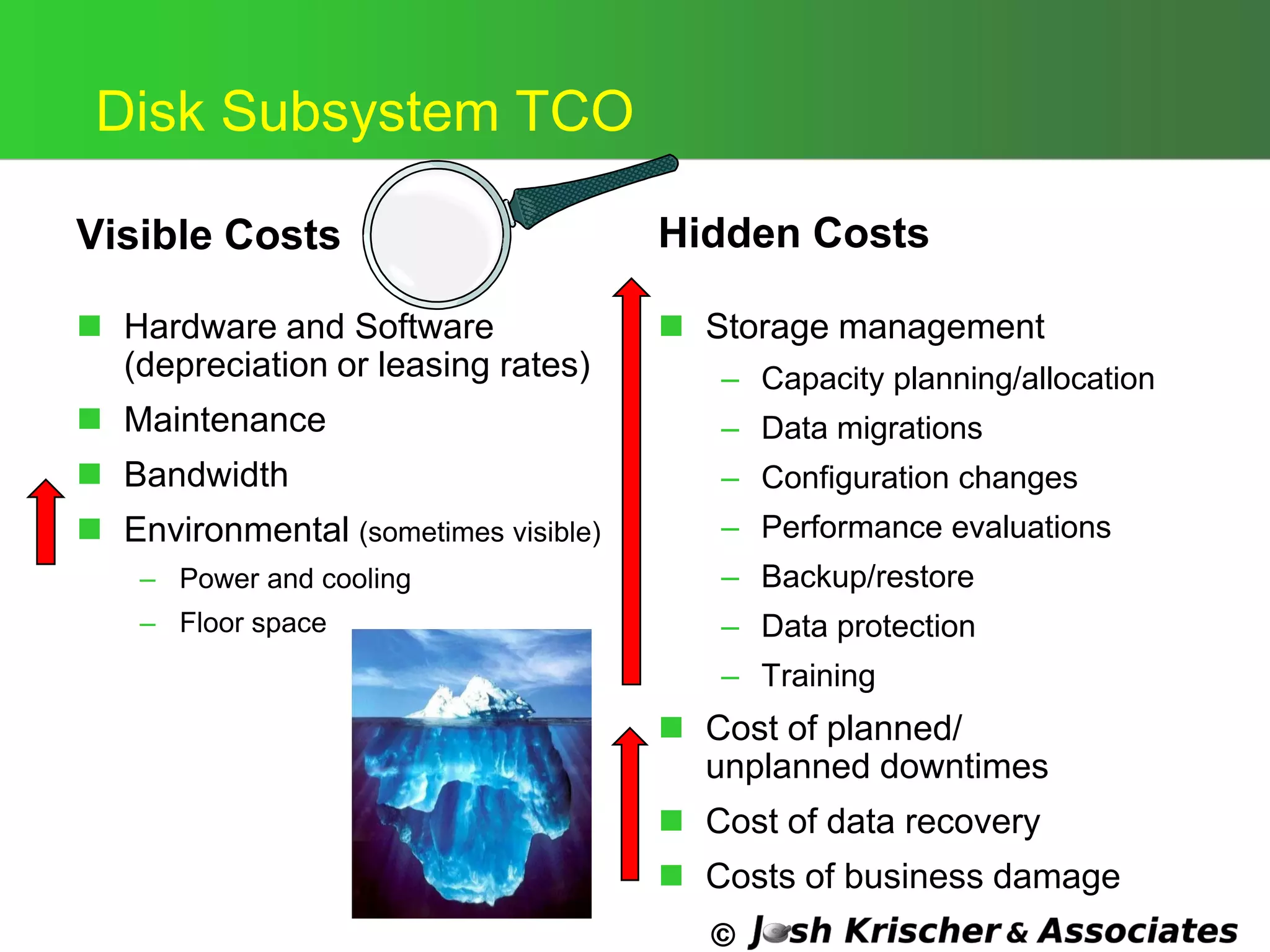
Disk Subsystem TCO
Visible Costs
 Hardware and Software
(depreciation or leasing rates)
 Maintenance
 Bandwidth
 Environmental (sometimes visible)
– Power and cooling
– Floor space
Hidden Costs
 Storage management
– Capacity planning/allocation
– Data migrations
– Configuration changes
– Performance evaluations
– Backup/restore
– Data protection
– Training
 Cost of planned/
unplanned downtimes
 Cost of data recovery
 Costs of business damage
©
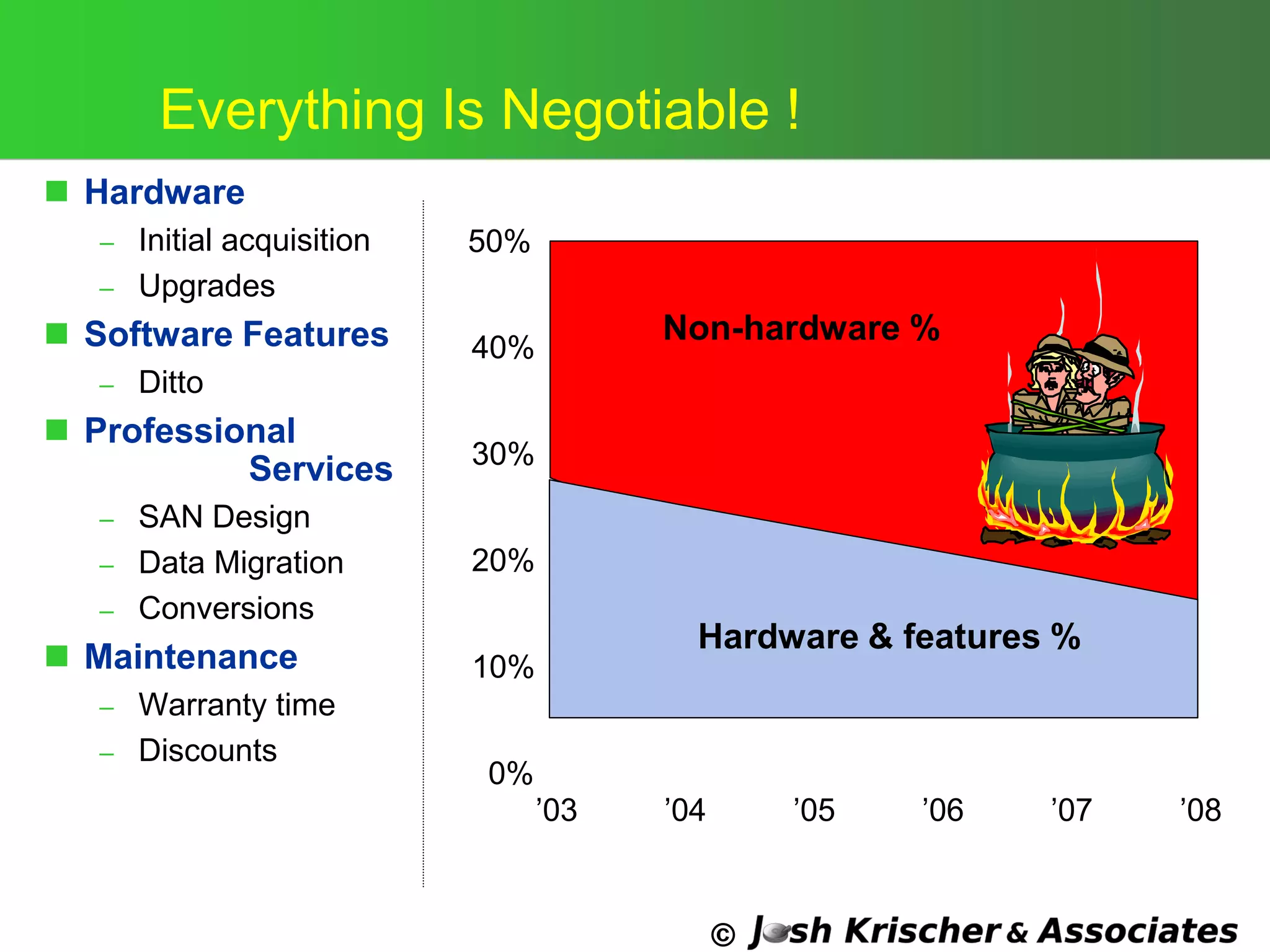
Hardware & features %
0%
10%
20%
30%
40%
50%
‘03 ‘04 ‘05 ‘06 ‘07 ‘08
Everything Is Negotiable !
 Hardware
– Initial acquisition
– Upgrades
 Software Features
– Ditto
 Professional
Services
– SAN Design
– Data Migration
– Conversions
 Maintenance
– Warranty time
– Discounts
Non-hardware %
©
How to Negotiate Contracts
 There are almost always negotiable!
 Avoid damage limitations ("Vendor's liability
for any loss, damage or expense of any kind,
resulting from the products or services,
negligence, or any other cause whatsoever,
regardless of the form of action, whether in
tort or in contract, shall be limited to the
selling price of the products or services.―)
 general rule is that a party can limit its liability
for ordinary negligence, but not gross
negligence.
 Don't walk into a deal thinking about how big
they are. They want your business or they
wouldn't be talking to you
Source: Mark Grossman, Attorney at Law
©
Disk Storage pricing facts
 In the years1999 -2006 disk prices declined at a
rate of 40-45 percent per annum, currently 30-35%
 Price reduction of 35% per annum means ca. 10%
per qtr.
 GB of upgrades should be cheaper in comparison
to the initial procurement
 Vendors will seldom agree to more than
30%/annum in future price projection
(-9%/qtr) usually 5% /qtr or 20% per annum
 Usually the price/TB ratio between the High-end
and midrange storage is 2:1
 Markets are competitive and cost-driven
 The maintenance costs (after the guarantee
period) prohibit long term amortization
©
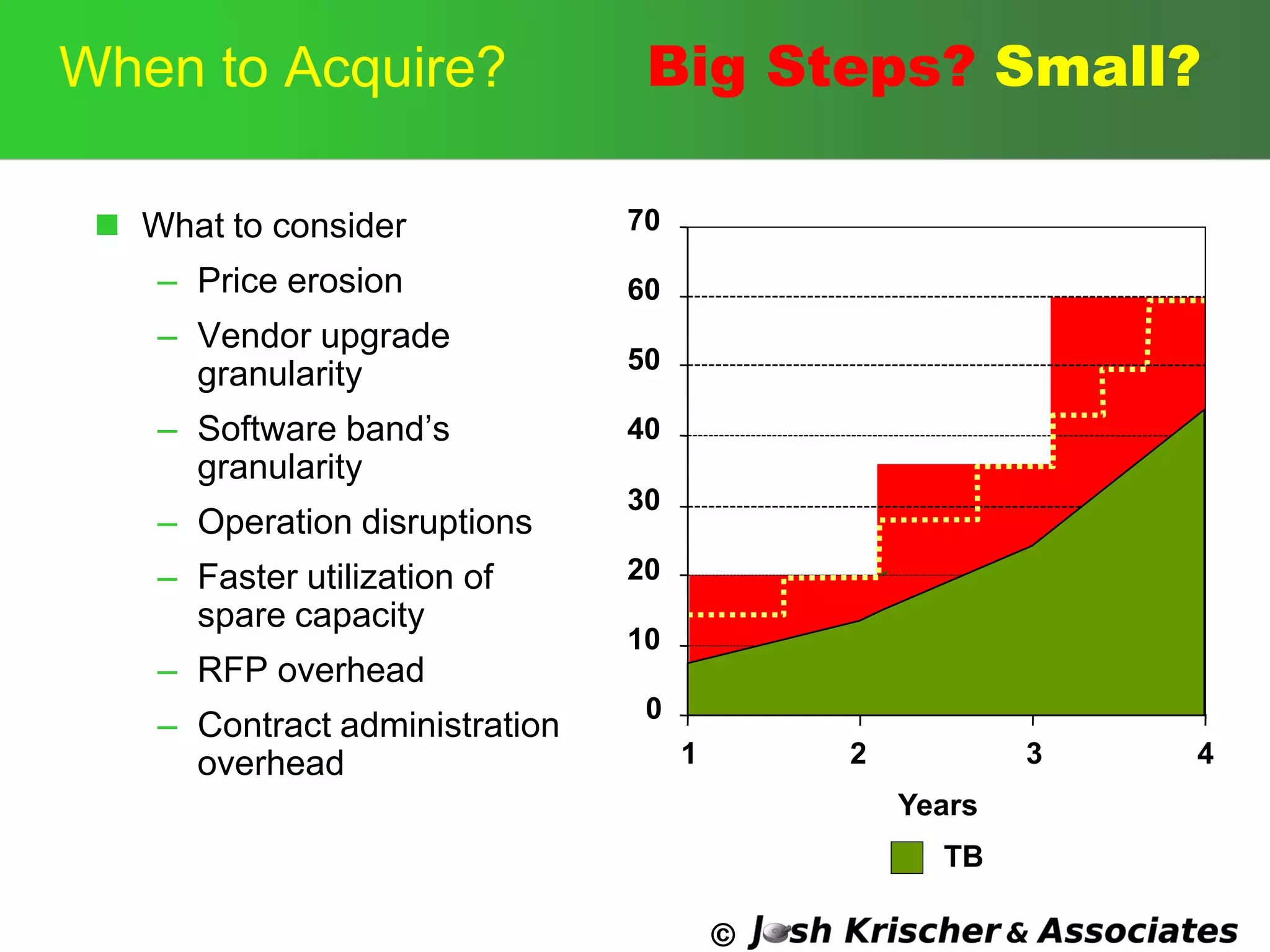
Big Steps?When to Acquire?
 What to consider
– Price erosion
– Vendor upgrade
granularity
– Software band‘s
granularity
– Operation disruptions
– Faster utilization of
spare capacity
– RFP overhead
– Contract administration
overhead
TB
1 2 3 4
0
10
20
30
40
50
60
70
Small?
Years
©
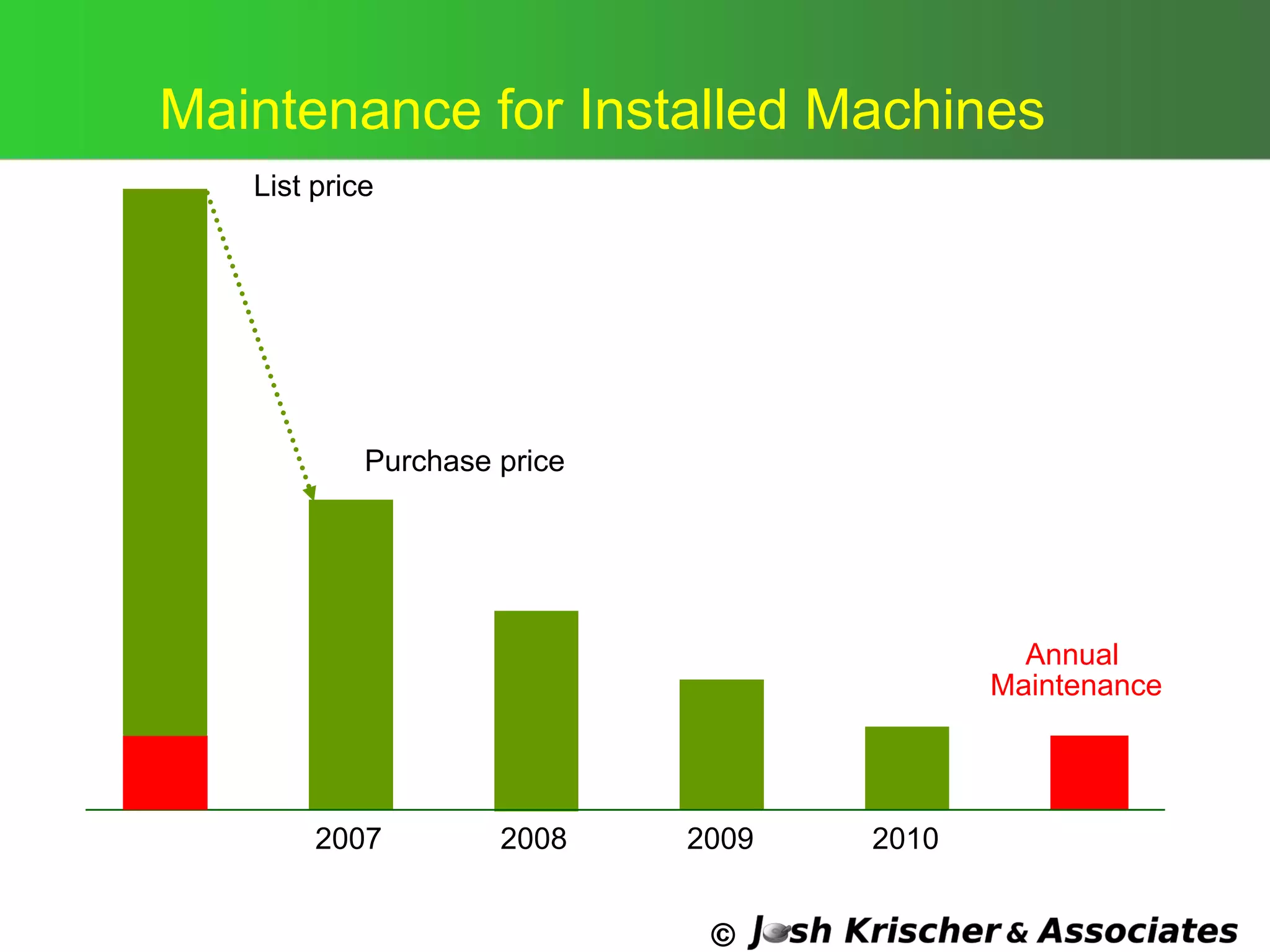
Maintenance for Installed Machines
Purchase price
2007 2008 2009 2010
Annual
Maintenance
List price
©
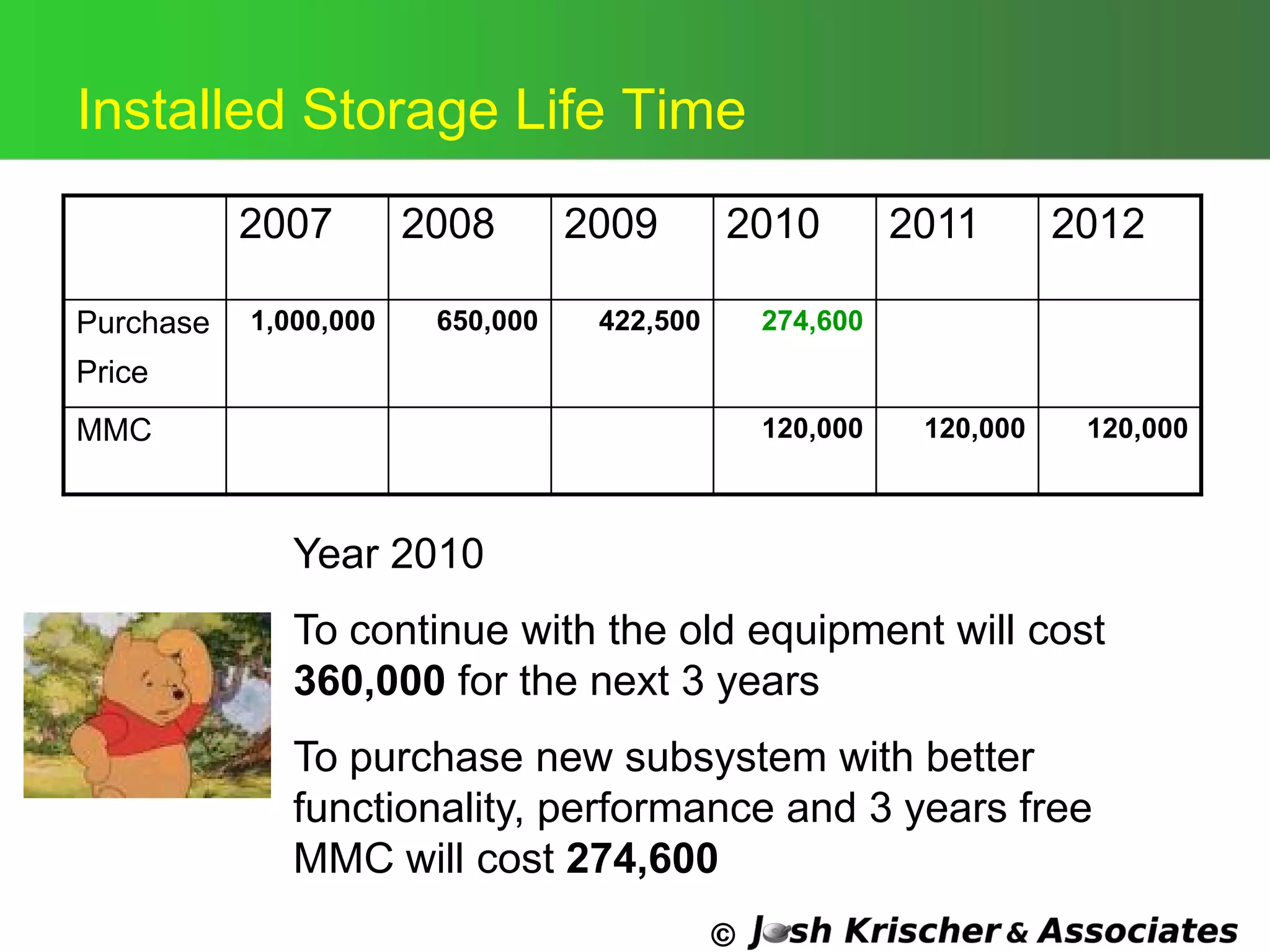
Installed Storage Life Time
2007 2008 2009 2010 2011 2012
Purchase
Price
1,000,000 650,000 422,500 274,600
MMC 120,000 120,000 120,000
Year 2010
To continue with the old equipment will cost
360,000 for the next 3 years
To purchase new subsystem with better
functionality, performance and 3 years free
MMC will cost 274,600
©
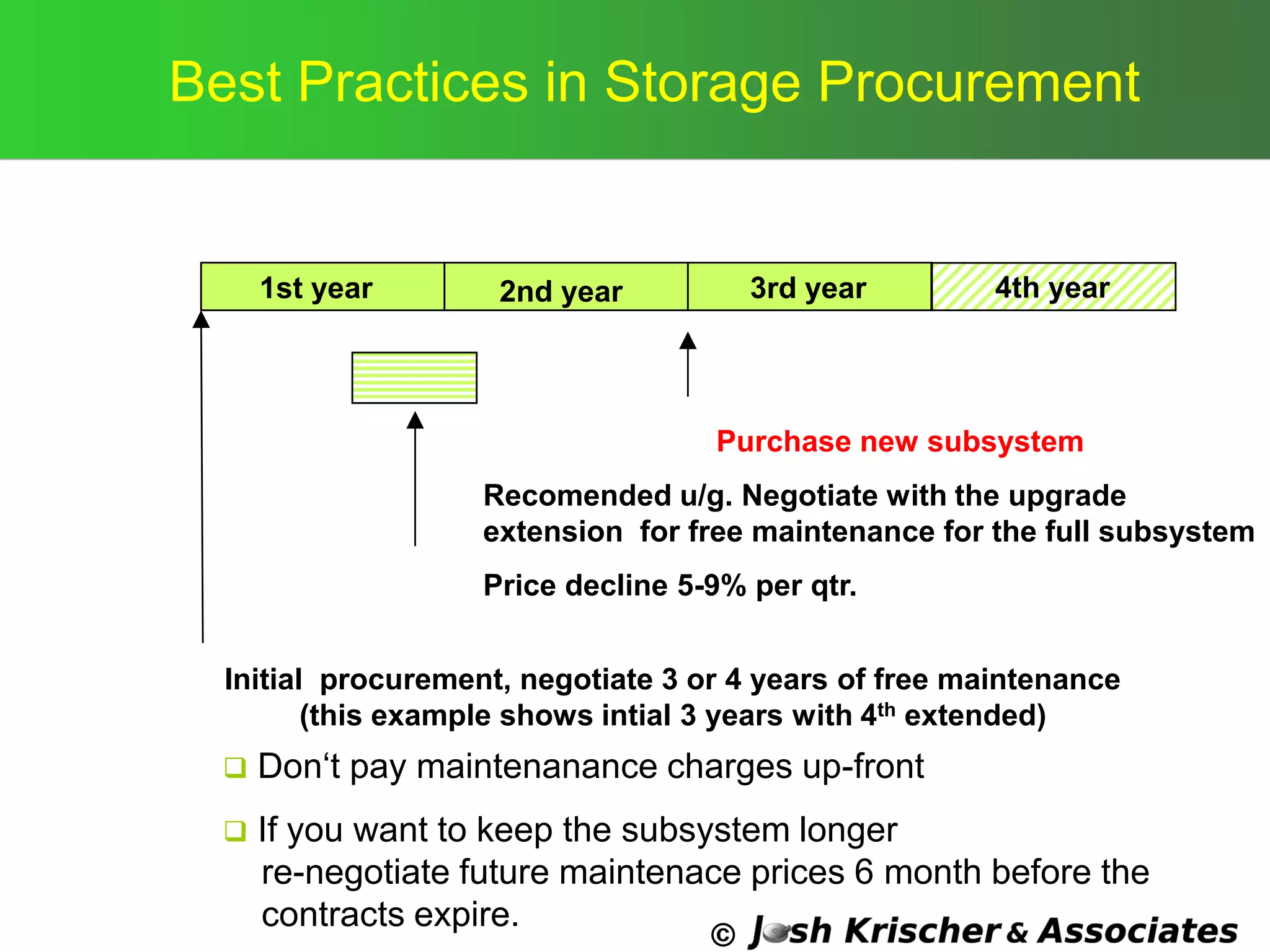
Best Practices in Storage Procurement
1st year 2nd year 3rd year 4th year
Initial procurement, negotiate 3 or 4 years of free maintenance
(this example shows intial 3 years with 4th extended)
Recomended u/g. Negotiate with the upgrade
extension for free maintenance for the full subsystem
Price decline 5-9% per qtr.
Purchase new subsystem
 Don‗t pay maintenanance charges up-front
 If you want to keep the subsystem longer
re-negotiate future maintenace prices 6 month before the
contracts expire.
©
Dual-Supplier policy ?
 Easier procurements, usually (vendor dependent) better
price
 Freedom of choice
 Only for large capacities
 More complicated storage management*
 More operator traning*
 More administration overhead (contracts, etc.)
 More complicated Disater Recovery*
* Can be reduced by using virtualization
©
How to Lower the Storage TCO and
help to save the Environment?
 Tiered storage, SSDs, ―Smart Data
Placement‖
 Storage consolidation within a tier
 De- duplication, compression
 Thin provisioning
 Alternative technologies (tapes, VTLs)
 Consolidation and Virtualization
 New HDDs (larger capacity, smaller
forms), SSD
 Power control for HDDs
 Storage resource management
(SRM) programs
$
€
$ $
$ $
€
$
Low hanging fruits
Data storage devices had the highest power consumption growth
rate (191%) and the highest overall power consumption!
©
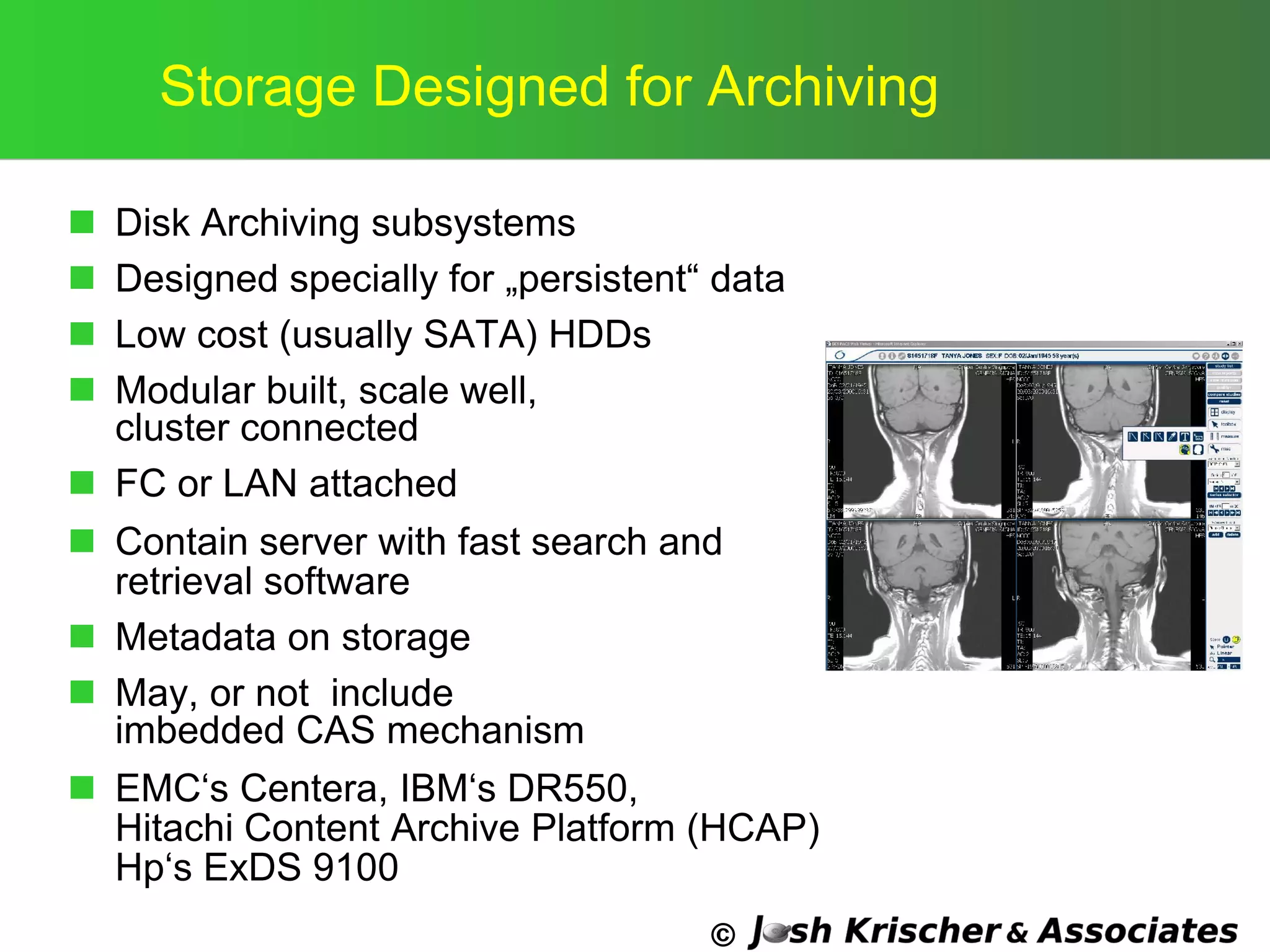
Storage Designed for Archiving
 Disk Archiving subsystems
 Designed specially for „persistent― data
 Low cost (usually SATA) HDDs
 Modular built, scale well,
cluster connected
 FC or LAN attached
 Contain server with fast search and
retrieval software
 Metadata on storage
 May, or not include
imbedded CAS mechanism
 EMC‗s Centera, IBM‗s DR550,
Hitachi Content Archive Platform (HCAP)
Hp‗s ExDS 9100
©
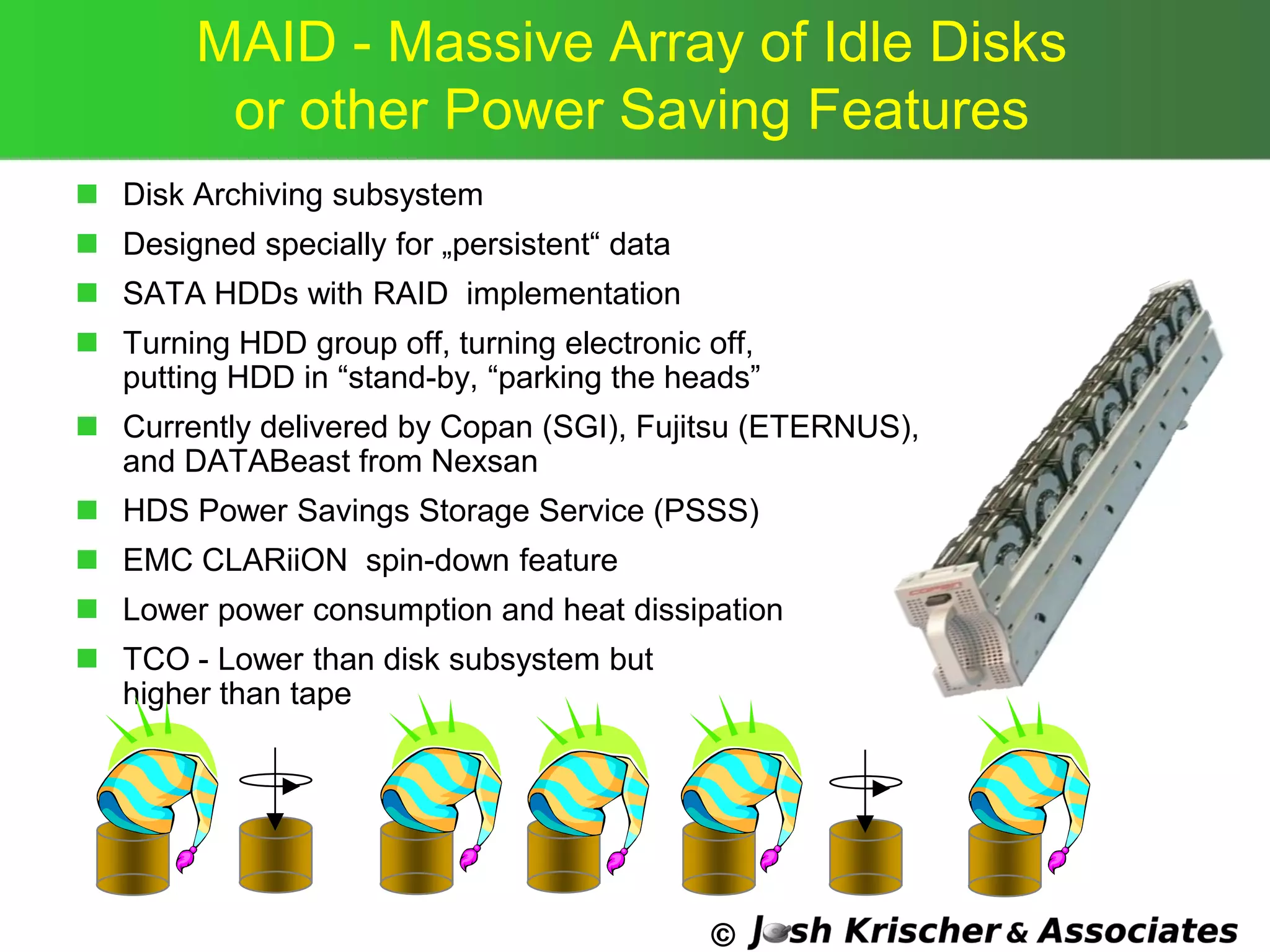
MAID - Massive Array of Idle Disks
or other Power Saving Features
 Disk Archiving subsystem
 Designed specially for „persistent― data
 SATA HDDs with RAID implementation
 Turning HDD group off, turning electronic off,
putting HDD in ―stand-by, ―parking the heads‖
 Currently delivered by Copan (SGI), Fujitsu (ETERNUS),
and DATABeast from Nexsan
 HDS Power Savings Storage Service (PSSS)
 EMC CLARiiON spin-down feature
 Lower power consumption and heat dissipation
 TCO - Lower than disk subsystem but
higher than tape
©
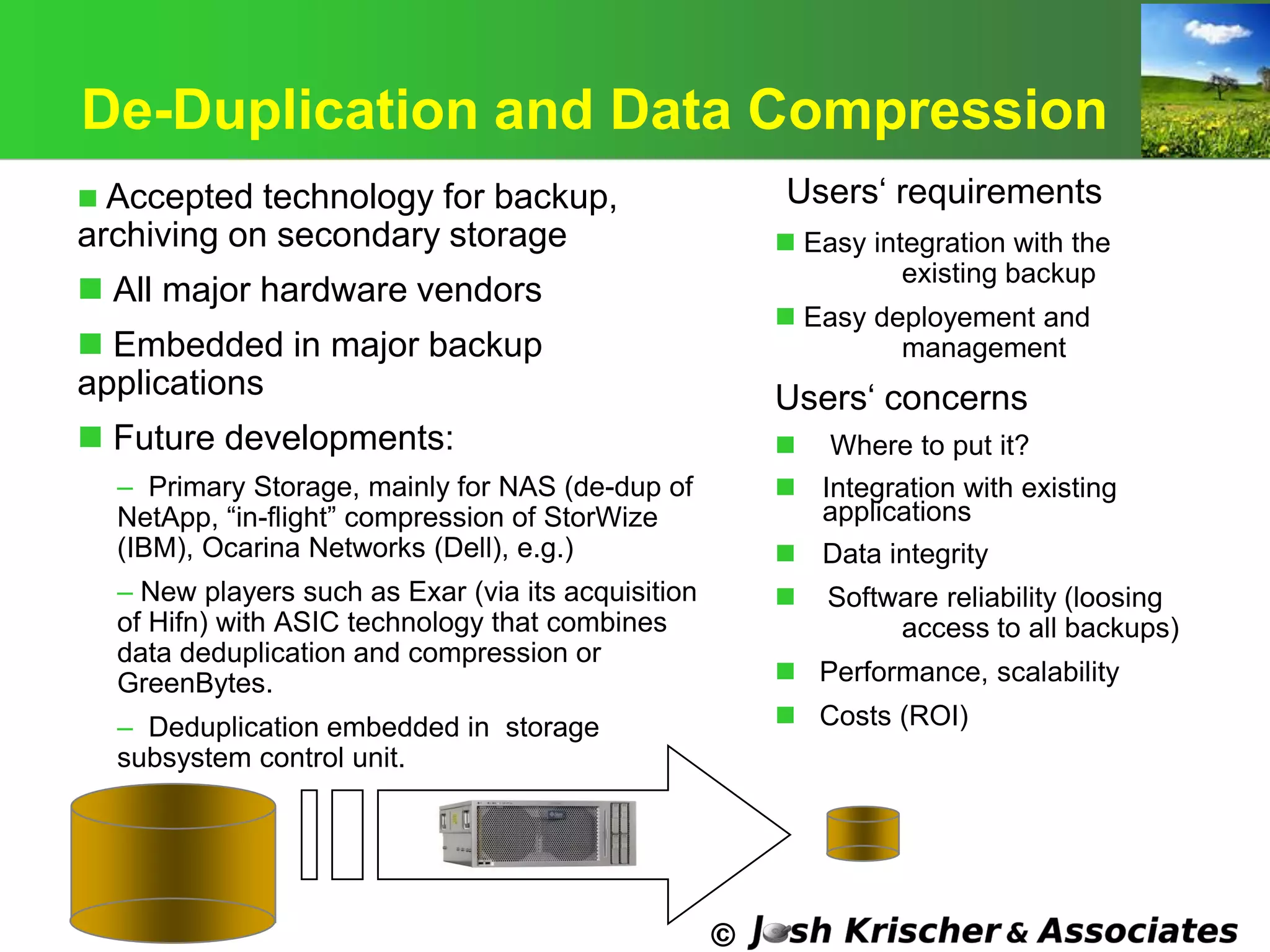
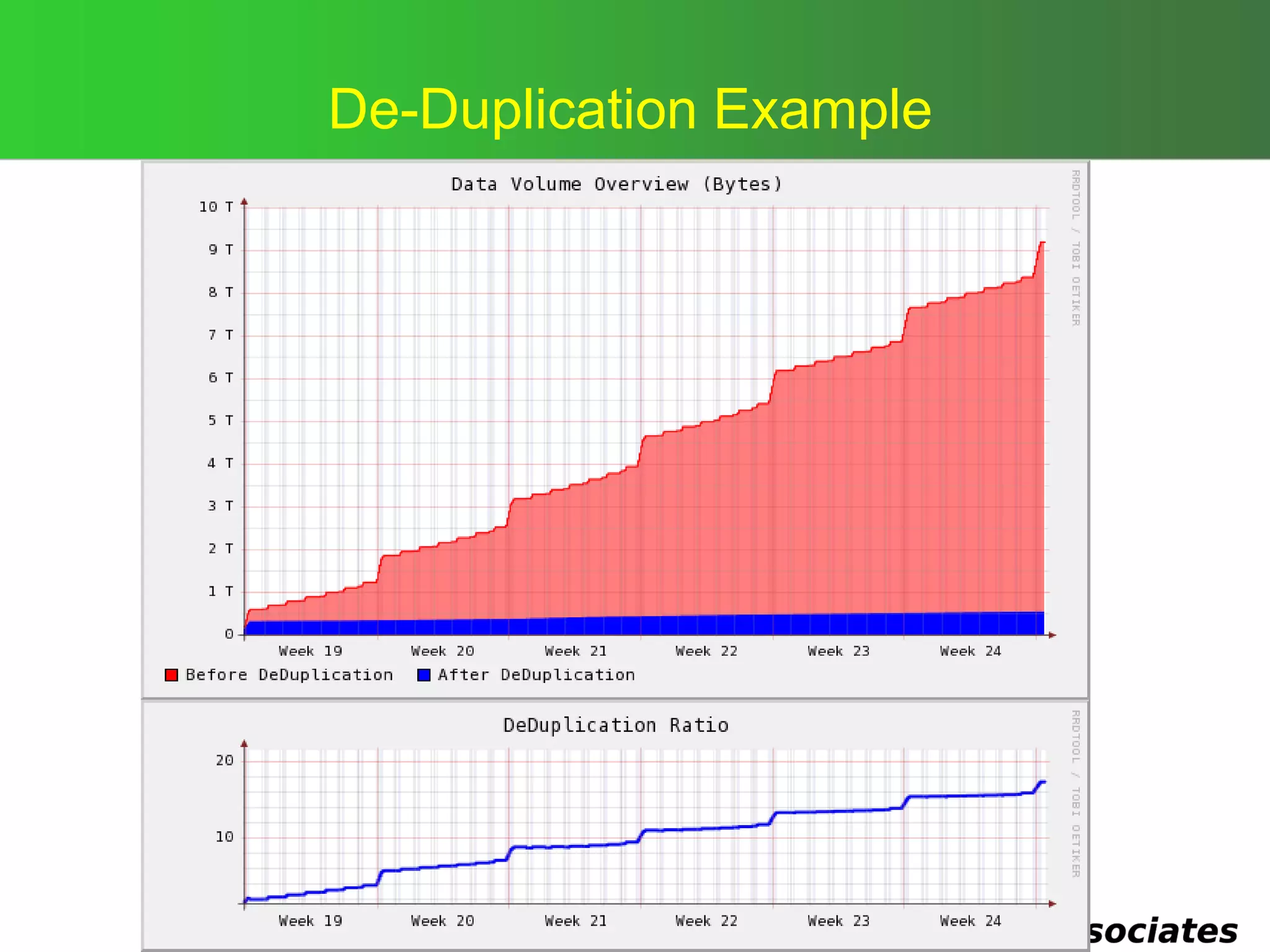
De-Duplication and Data Compression
 Accepted technology for backup,
archiving on secondary storage
 All major hardware vendors
 Embedded in major backup
applications
 Future developments:
– Primary Storage, mainly for NAS (de-dup of
NetApp, ―in-flight‖ compression of StorWize
(IBM), Ocarina Networks (Dell), e.g.)
– New players such as Exar (via its acquisition
of Hifn) with ASIC technology that combines
data deduplication and compression or
GreenBytes.
– Deduplication embedded in storage
subsystem control unit.
Users‗ requirements
 Easy integration with the
existing backup
 Easy deployement and
management
Users‗ concerns
 Where to put it?
 Integration with existing
applications
 Data integrity
 Software reliability (loosing
access to all backups)
 Performance, scalability
 Costs (ROI)
©
De-Duplication Example
©
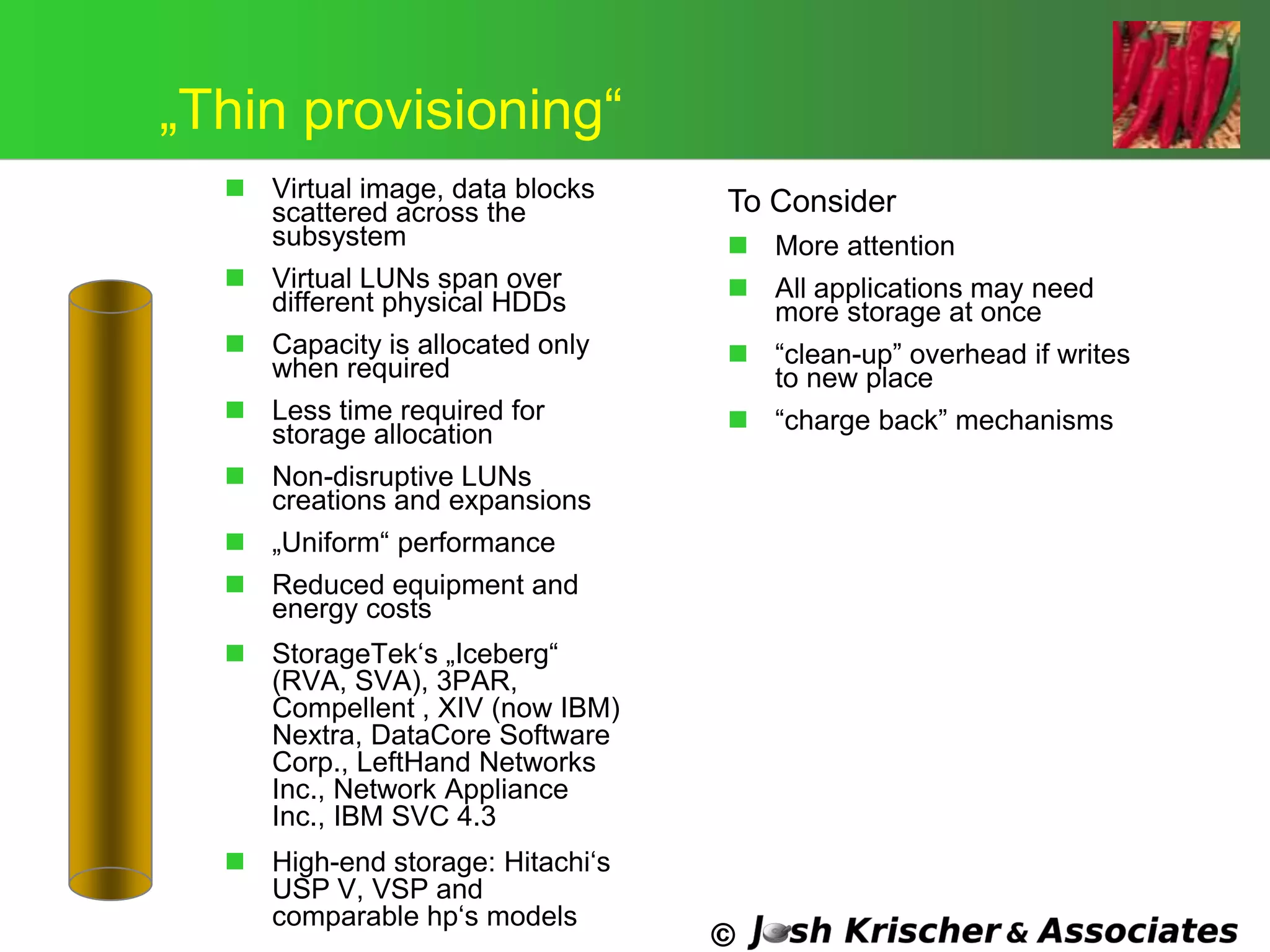
„Thin provisioning―
 Virtual image, data blocks
scattered across the
subsystem
 Virtual LUNs span over
different physical HDDs
 Capacity is allocated only
when required
 Less time required for
storage allocation
 Non-disruptive LUNs
creations and expansions
 „Uniform― performance
 Reduced equipment and
energy costs
 StorageTek‗s „Iceberg―
(RVA, SVA), 3PAR,
Compellent , XIV (now IBM)
Nextra, DataCore Software
Corp., LeftHand Networks
Inc., Network Appliance
Inc., IBM SVC 4.3
 High-end storage: Hitachi‗s
USP V, VSP and
comparable hp‗s models
To Consider
 More attention
 All applications may need
more storage at once
 ―clean-up‖ overhead if writes
to new place
 ―charge back‖ mechanisms
©
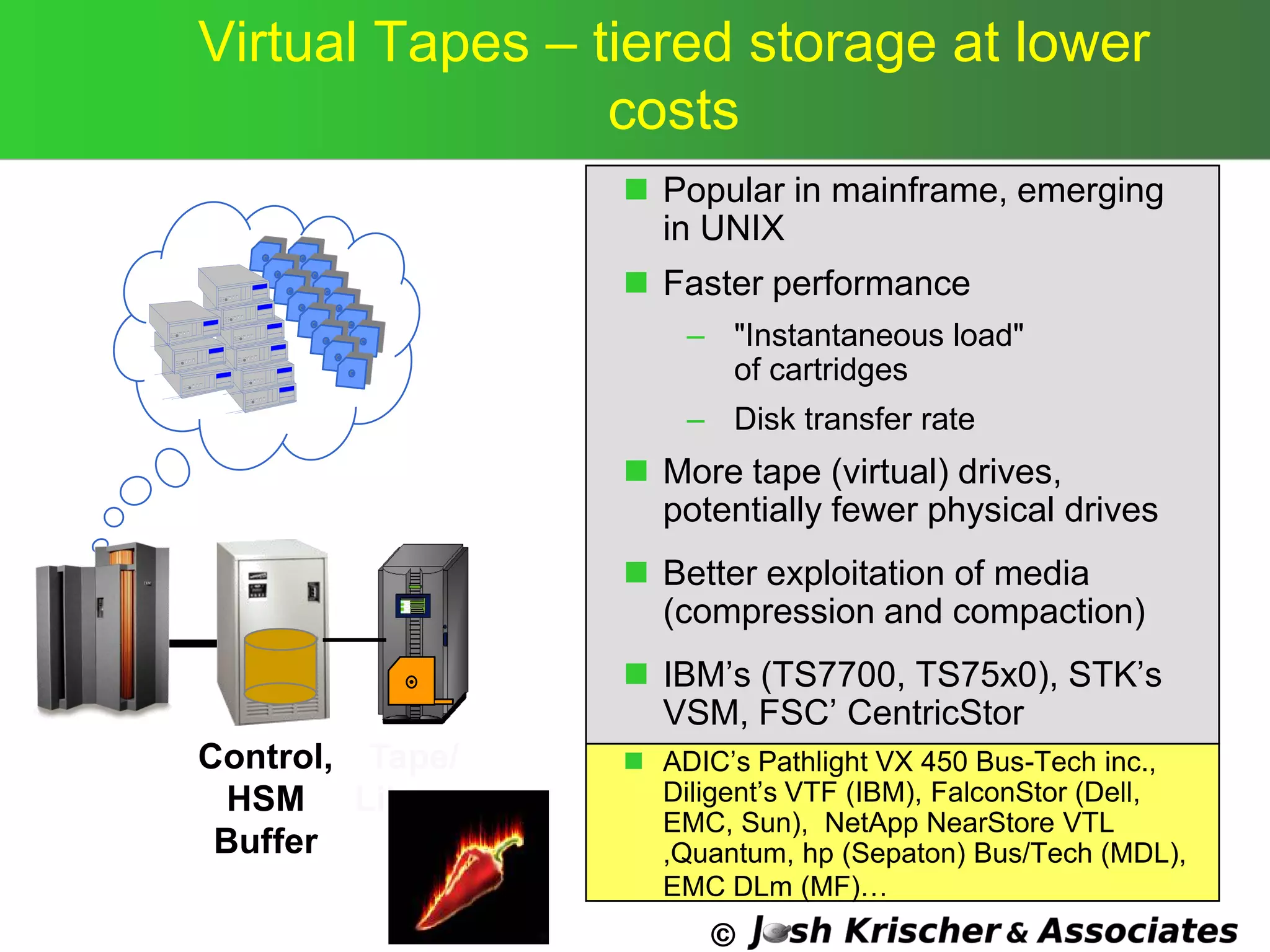
Virtual Tapes – tiered storage at lower
costs
Tape/
Library
Control,
HSM
Buffer
 Popular in mainframe, emerging
in UNIX
 Faster performance
– "Instantaneous load"
of cartridges
– Disk transfer rate
 More tape (virtual) drives,
potentially fewer physical drives
 Better exploitation of media
(compression and compaction)
 IBM‘s (TS7700, TS75x0), STK‘s
VSM, FSC‘ CentricStor
 ADIC‘s Pathlight VX 450 Bus-Tech inc.,
Diligent‘s VTF (IBM), FalconStor (Dell,
EMC, Sun), NetApp NearStore VTL
,Quantum, hp (Sepaton) Bus/Tech (MDL),
EMC DLm (MF)…
©
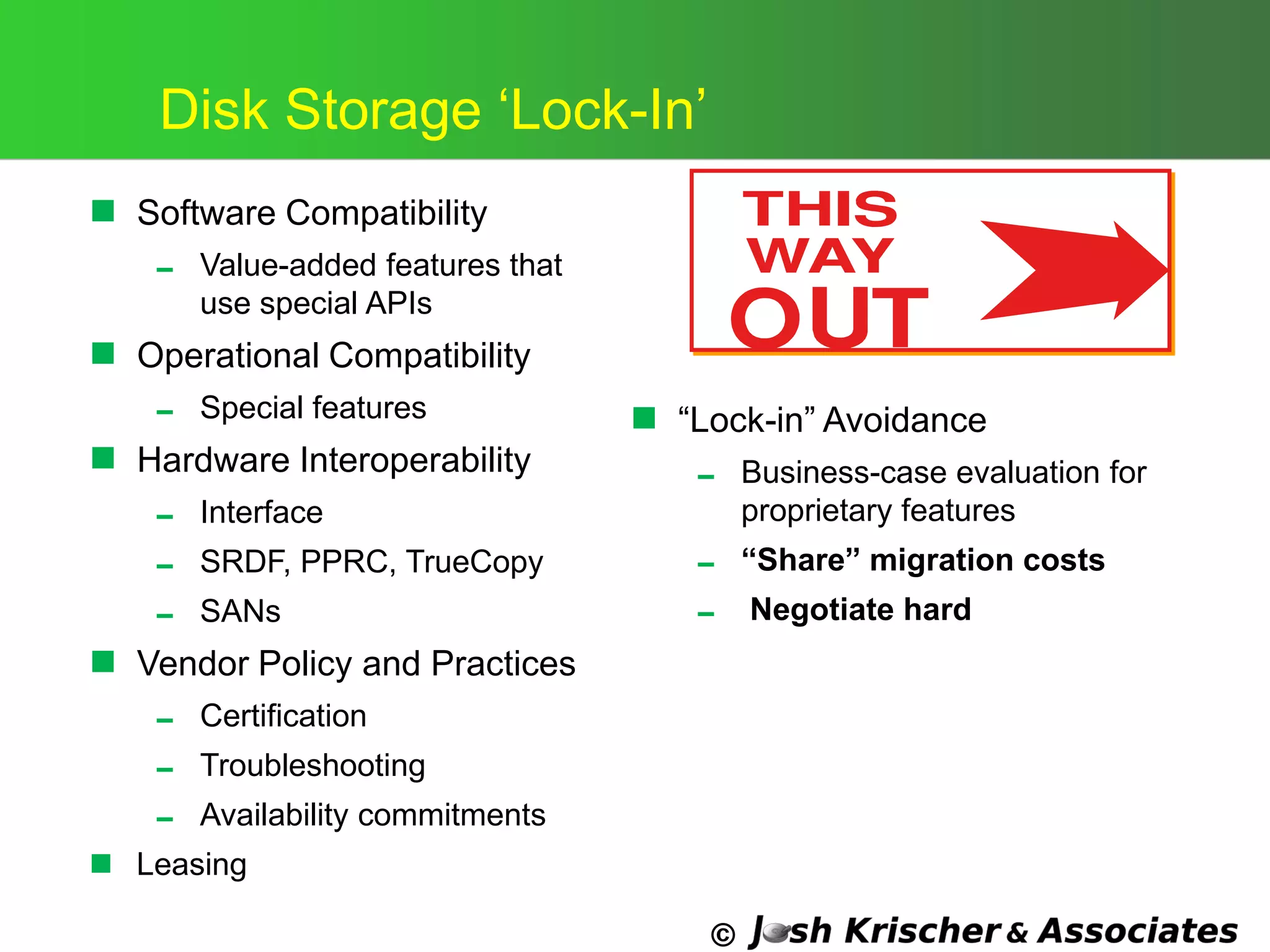
Disk Storage ‗Lock-In‘
 Software Compatibility
 Value-added features that
use special APIs
 Operational Compatibility
 Special features
 Hardware Interoperability
 Interface
 SRDF, PPRC, TrueCopy
 SANs
 Vendor Policy and Practices
 Certification
 Troubleshooting
 Availability commitments
 Leasing
 ―Lock-in‖ Avoidance
 Business-case evaluation for
proprietary features
 “Share” migration costs
 Negotiate hard
©
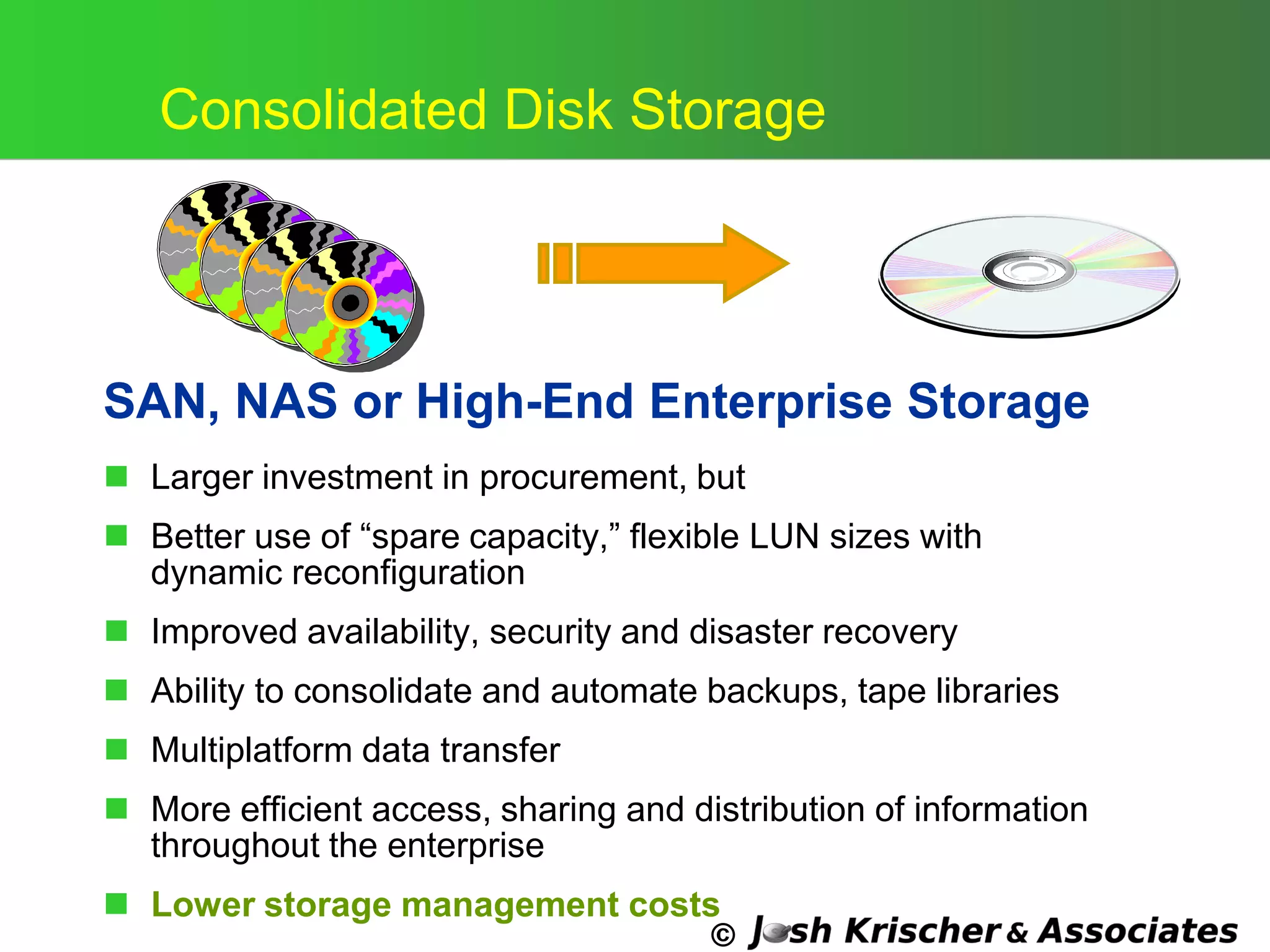
Consolidated Disk Storage
SAN, NAS or High-End Enterprise Storage
 Larger investment in procurement, but
 Better use of ―spare capacity,‖ flexible LUN sizes with
dynamic reconfiguration
 Improved availability, security and disaster recovery
 Ability to consolidate and automate backups, tape libraries
 Multiplatform data transfer
 More efficient access, sharing and distribution of information
throughout the enterprise
 Lower storage management costs
©
Disaster Recovery TCO (New Items)
 Disaster protection
– Additional capacity
– Additional channels, ports
– More-complex infrastructure
to manage
– Communications bandwidth
– Protocol converters
 Limited cost control
– Distance
– Multiplexers, DWDM (Dense
Wave Division Multiplexing)
– De-duplication, compression
©
Standard lease
 Subsystem storage costs are spread equally
over the lifecycle of the lease (flat rate).
 Match situation when storage requirements
are not growing or grows by new lease or
purchase of additional subsystems
 Check the ―residual value‖ – usually 0 after 3,
4 years
 Check the interest rate and compare it with
the financial market figures
 If the new lease is replacing an old one avoid
paying interest and maintenance charges
 Avoid upgrading or extending of the lease
©
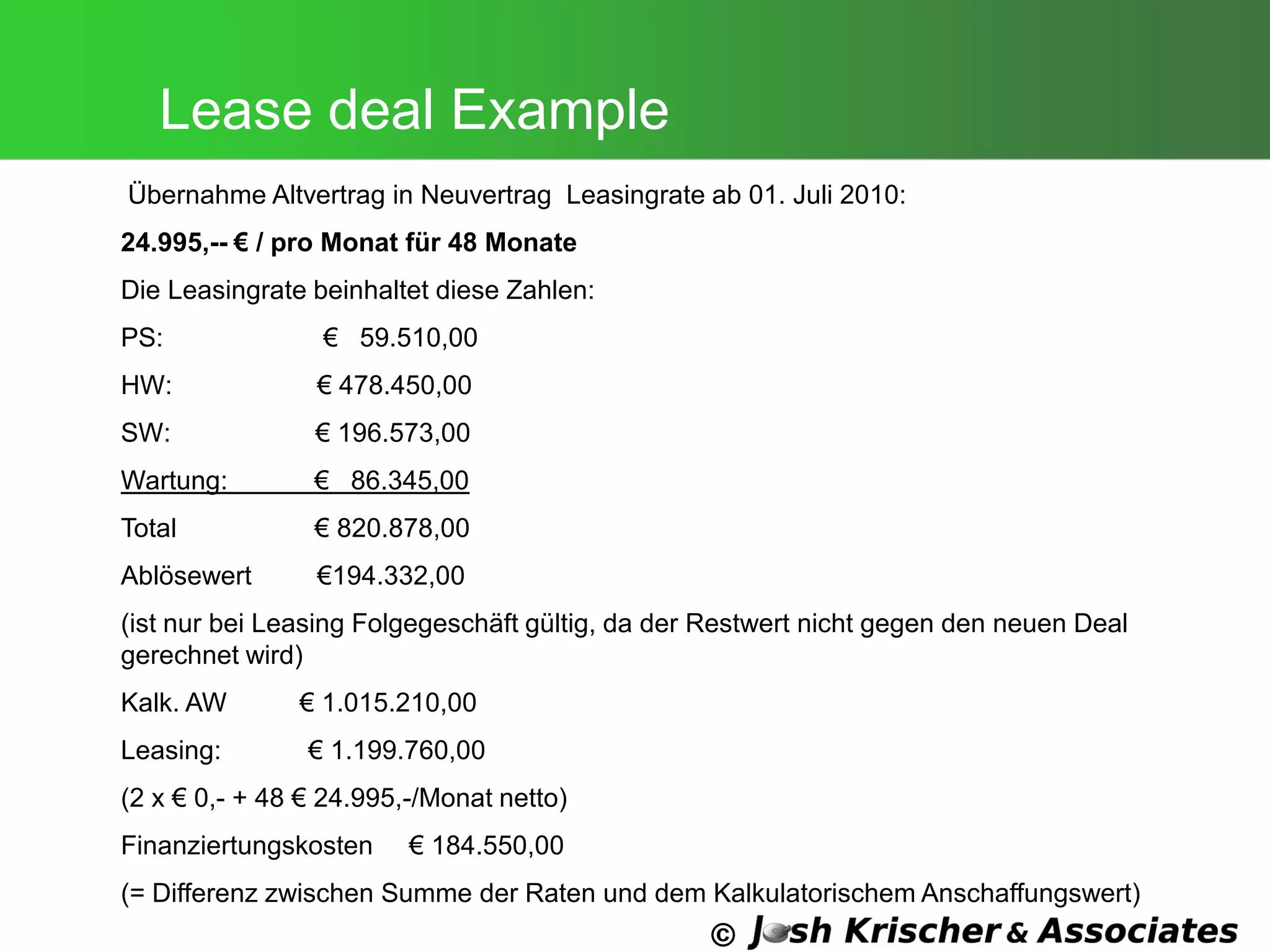
Lease deal Example
Übernahme Altvertrag in Neuvertrag Leasingrate ab 01. Juli 2010:
24.995,-- € / pro Monat für 48 Monate
Die Leasingrate beinhaltet diese Zahlen:
PS: € 59.510,00
HW: € 478.450,00
SW: € 196.573,00
Wartung: € 86.345,00
Total € 820.878,00
Ablösewert €194.332,00
(ist nur bei Leasing Folgegeschäft gültig, da der Restwert nicht gegen den neuen Deal
gerechnet wird)
Kalk. AW € 1.015.210,00
Leasing: € 1.199.760,00
(2 x € 0,- + 48 € 24.995,-/Monat netto)
Finanziertungskosten € 184.550,00
(= Differenz zwischen Summe der Raten und dem Kalkulatorischem Anschaffungswert)
©
New Financing Models (1st)
 Pay per forecast
– This model is designed for users with constant,
continuous and predictable growth rates.
– Instead of paying flat leasing rates up front, the monthly
lease payments are made according to the use forecast
©
New Financing Models (2nd)
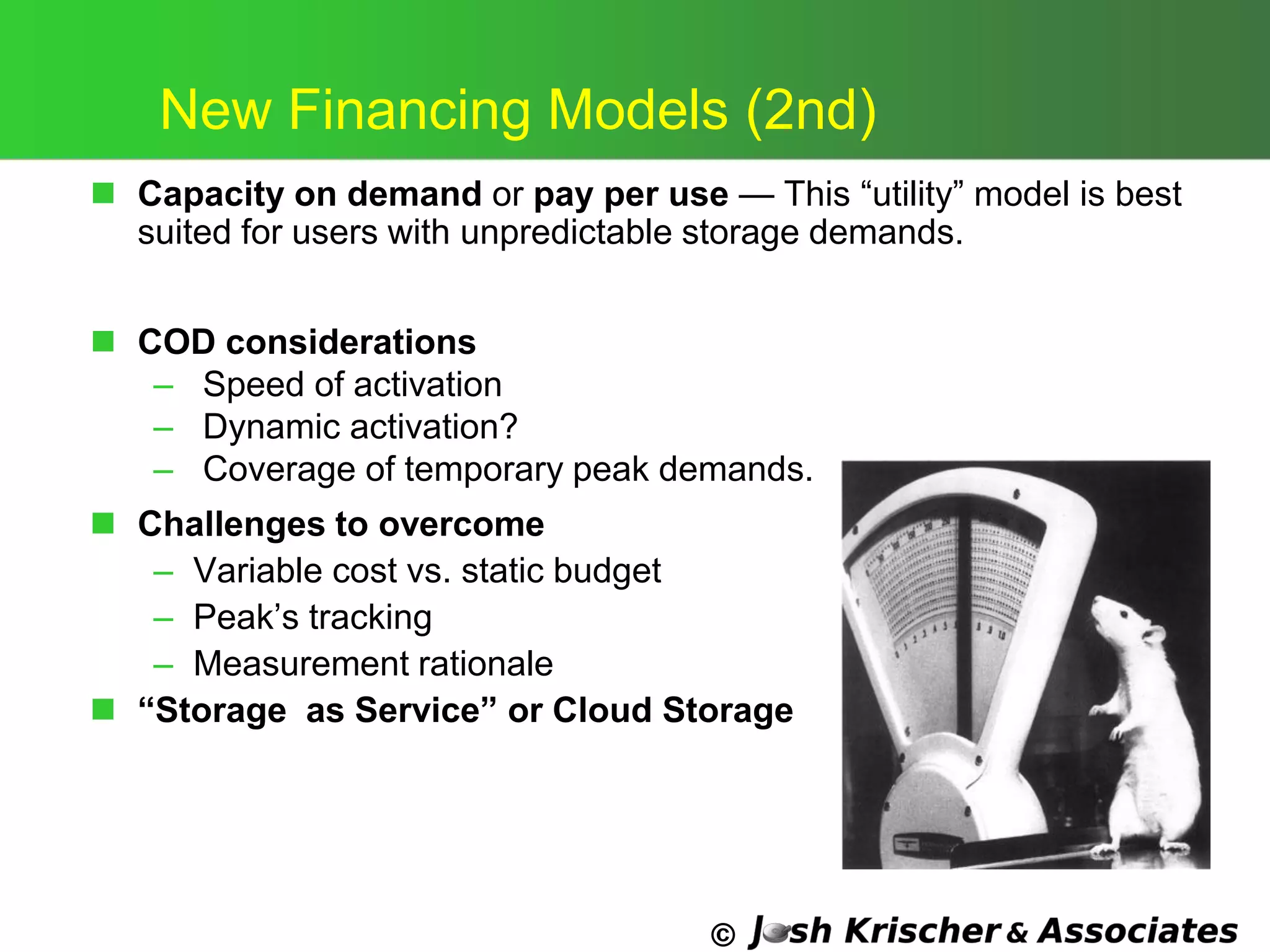
 Capacity on demand or pay per use — This ―utility‖ model is best
suited for users with unpredictable storage demands.
 COD considerations
– Speed of activation
– Dynamic activation?
– Coverage of temporary peak demands.
 Challenges to overcome
– Variable cost vs. static budget
– Peak‘s tracking
– Measurement rationale
 “Storage as Service” or Cloud Storage
©
―Cloud‖ Storage
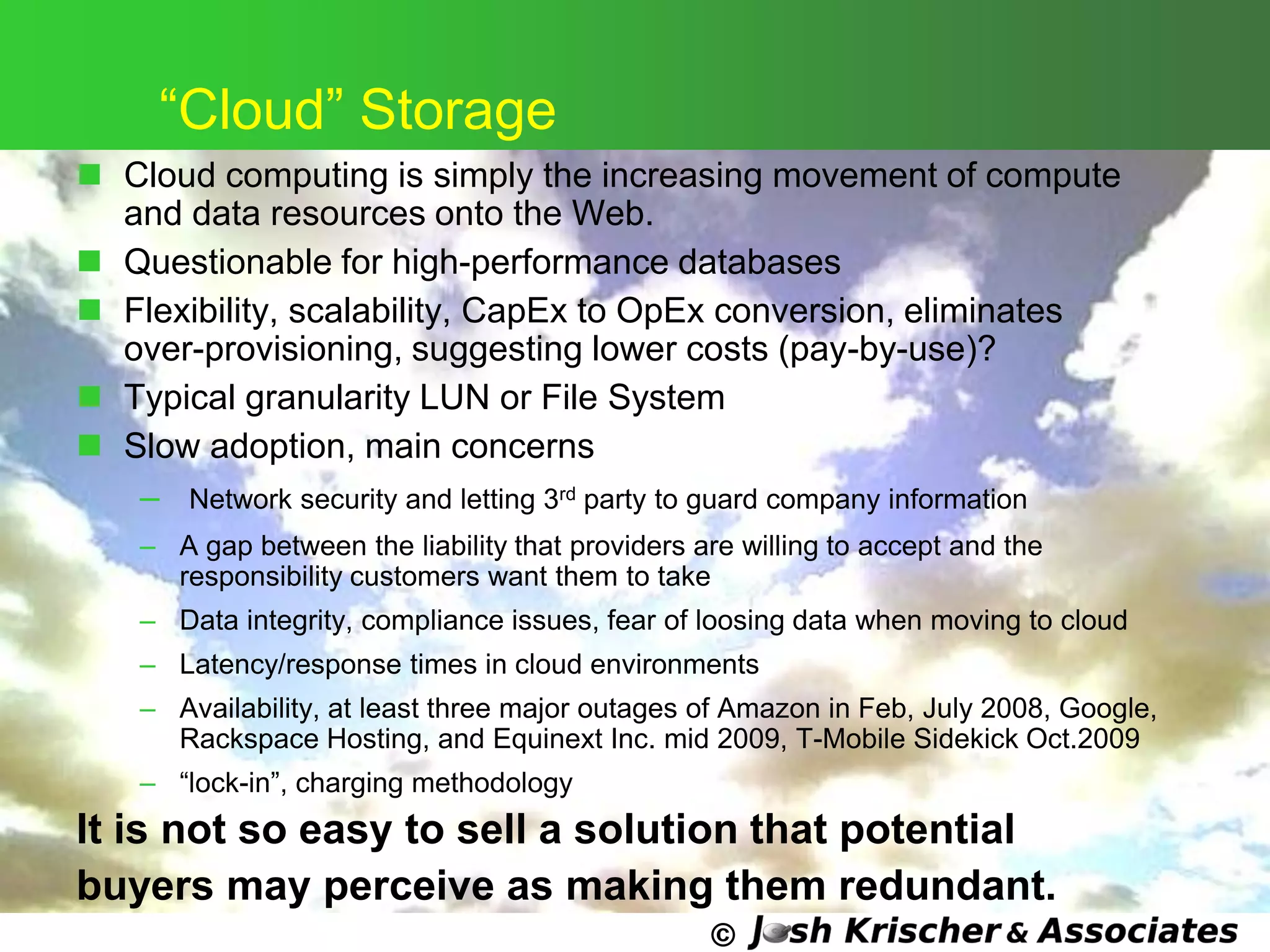
 Cloud computing is simply the increasing movement of compute
and data resources onto the Web.
 Questionable for high-performance databases
 Flexibility, scalability, CapEx to OpEx conversion, eliminates
over-provisioning, suggesting lower costs (pay-by-use)?
 Typical granularity LUN or File System
 Slow adoption, main concerns
– Network security and letting 3rd party to guard company information
– A gap between the liability that providers are willing to accept and the
responsibility customers want them to take
– Data integrity, compliance issues, fear of loosing data when moving to cloud
– Latency/response times in cloud environments
– Availability, at least three major outages of Amazon in Feb, July 2008, Google,
Rackspace Hosting, and Equinext Inc. mid 2009, T-Mobile Sidekick Oct.2009
– ―lock-in‖, charging methodology
It is not so easy to sell a solution that potential
buyers may perceive as making them redundant.
©
©
 Never purchase under time pressure
 Use a dual-supplier policy wherever feasible
 Don‘t allow a vendor to bypass the technical staff
 Align the booking time with the vendor‘s timings
 Don‘t show enthusiasm
 Obtain line-item pricing
 Lean toward purchase rather than standard lease
if upgrades or extension are planned
 Destroy the self-confidence of the
sales representative
Competition
The Fundamentals of Negotiating Mutually
Acceptable Deals
©
Tips for Better Storage Purchasing
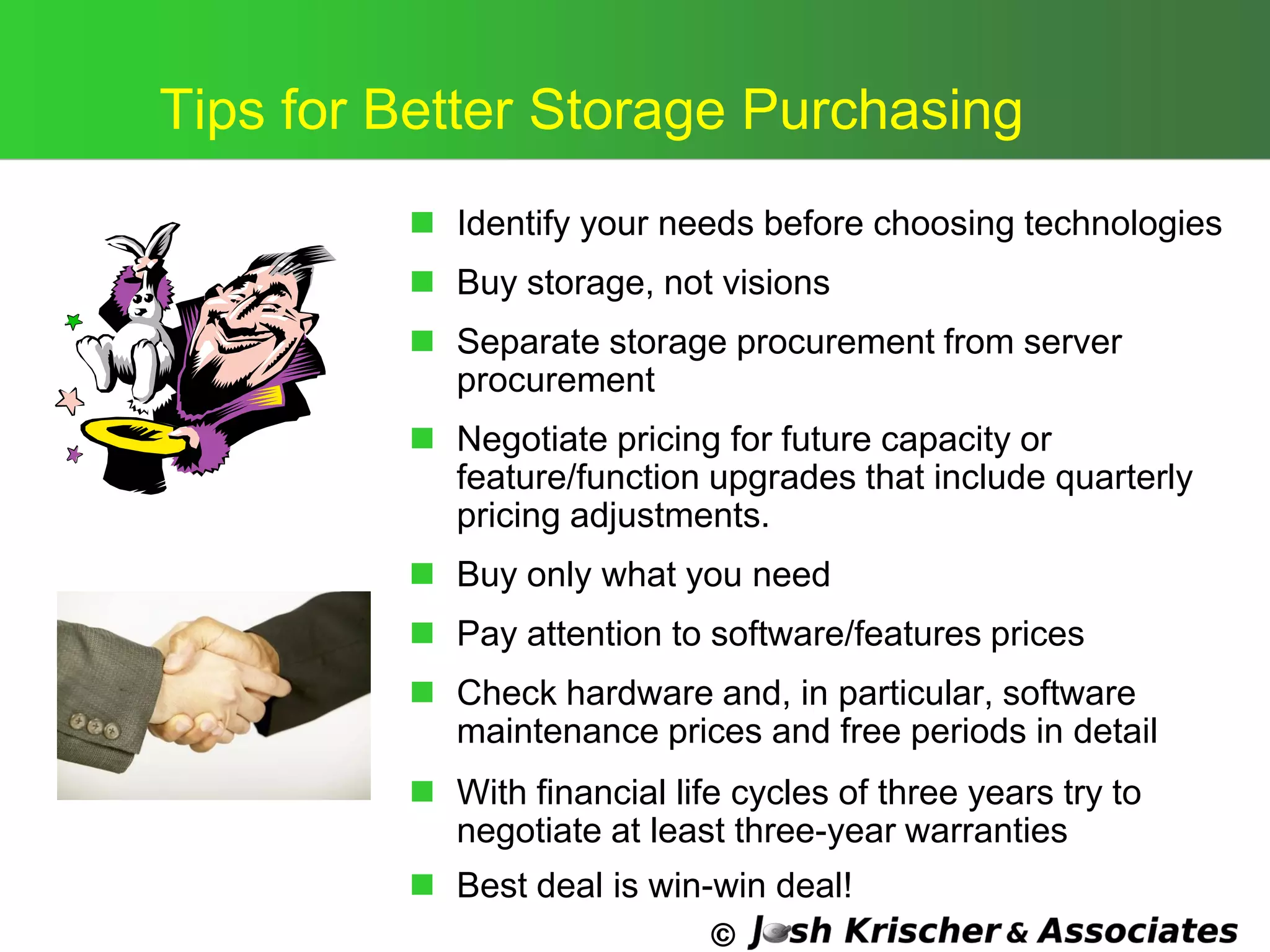
 Identify your needs before choosing technologies
 Buy storage, not visions
 Separate storage procurement from server
procurement
 Negotiate pricing for future capacity or
feature/function upgrades that include quarterly
pricing adjustments.
 Buy only what you need
 Pay attention to software/features prices
 Check hardware and, in particular, software
maintenance prices and free periods in detail
 With financial life cycles of three years try to
negotiate at least three-year warranties
 Best deal is win-win deal!
©
Recommendations
 Careful purchasing procedures will help enterprises
buy storage to keep pace with their growing need for
capacity.
 Consider emerged storage reduction techniques
 Pay attention to “software features”:
– Create “lock-in” situations
– Vendors shifting revenue and margins from
hardware to software
 Evaluate hardware and feature maintenance prices and
the free maintenance period
 Make decisions based on TCO calculations and SLAs.
 Skillfully use the fierce competition in the storage
market. There are enough viable vendors to provide
healthy competition, which results in better deals.
©
A selection of our coverage areas:
 Procurement & price evaluations
 Enterprise storage
 Mid-range storage
 Disaster recovery techniques
 Data center consolidation
 Data center design
 Mainframes
GmbH
josh@joshkrischer.com
Joshkrischer
Tel +49 6251 580626
Mobile + 49 172 6203272
Fax +49 6251 67952
http://www.joshkrischer.com

Josh Krischer - How to get more for less (4 november 2010 Storage Expo)

  • 1.
    © Storage Expo Netherlands2010 Jaarbeurs, Utrecht How to Get More for Less in Storage Procurement and Operation Josh Krischer
  • 2.
    © Storage Challenges/Facts  Growthin capacity is, on average, more than 50 percent per year, but the storage technology development pace is fast enough to answer the requirements for capacity and performance.  File-based data growth is faster than block-based data  Unstructured data growth is faster than structured data  Server virtualization driving demand for networked storage  Storage currently accounts for 37-40% of overall data center energy consumption from hardware  Energy consumption will influence technology procurement criteria  Compliance regulations will accelerate the growth in storage capacity requirements and prompt the developments of new technologies for storing and archiving  Compliance regulations will force the users to migrate to new media several times in the information life time  New technologies are emerging but more as evolution than revolution.
  • 3.
    © Consumption of EnterpriseDisk Capacity by Type 0.0 5.0 10.0 15.0 20.0 25.0 2005 2006 2007 2008 2009 2010 2011 Replicated data Unstructured data Traditional structured data Consumption of Enterprise Disk Capacity by Type CAGR 32.3% 63.7% (EB) 43.9% Source: IDC, "Virtualization and Storage: A 360 Degree Strategy for Building a Virtual Datacenter," Doc # 210084, December 2007
  • 4.
    © Disk Subsystem Requirements Scalability  Functionality: basic and advanced (lock-in)  Secure Multi-Tenancy  Performance (absolute & constant)  Price  Investment protection  Service and support  Connectivity  Multiplatform connectivity  Clustering & Virtualization support  User-friendly storage management  Automation  Availability – nonstop operation – RAID X – Dynamic hot sparing – Dual controller (at least) – Redundant power and cooling – Mirrored cache for writes – Non-disruptive upgrades and repairs (―hot plugging‖) – Remote copy – Point-in-time copy
  • 5.
    © Disk Subsystem TCO VisibleCosts  Hardware and Software (depreciation or leasing rates)  Maintenance  Bandwidth  Environmental (sometimes visible) – Power and cooling – Floor space Hidden Costs  Storage management – Capacity planning/allocation – Data migrations – Configuration changes – Performance evaluations – Backup/restore – Data protection – Training  Cost of planned/ unplanned downtimes  Cost of data recovery  Costs of business damage
  • 6.
    © Hardware & features% 0% 10% 20% 30% 40% 50% ‘03 ‘04 ‘05 ‘06 ‘07 ‘08 Everything Is Negotiable !  Hardware – Initial acquisition – Upgrades  Software Features – Ditto  Professional Services – SAN Design – Data Migration – Conversions  Maintenance – Warranty time – Discounts Non-hardware %
  • 7.
    © How to NegotiateContracts  There are almost always negotiable!  Avoid damage limitations ("Vendor's liability for any loss, damage or expense of any kind, resulting from the products or services, negligence, or any other cause whatsoever, regardless of the form of action, whether in tort or in contract, shall be limited to the selling price of the products or services.―)  general rule is that a party can limit its liability for ordinary negligence, but not gross negligence.  Don't walk into a deal thinking about how big they are. They want your business or they wouldn't be talking to you Source: Mark Grossman, Attorney at Law
  • 8.
    © Disk Storage pricingfacts  In the years1999 -2006 disk prices declined at a rate of 40-45 percent per annum, currently 30-35%  Price reduction of 35% per annum means ca. 10% per qtr.  GB of upgrades should be cheaper in comparison to the initial procurement  Vendors will seldom agree to more than 30%/annum in future price projection (-9%/qtr) usually 5% /qtr or 20% per annum  Usually the price/TB ratio between the High-end and midrange storage is 2:1  Markets are competitive and cost-driven  The maintenance costs (after the guarantee period) prohibit long term amortization
  • 9.
    © Big Steps?When toAcquire?  What to consider – Price erosion – Vendor upgrade granularity – Software band‘s granularity – Operation disruptions – Faster utilization of spare capacity – RFP overhead – Contract administration overhead TB 1 2 3 4 0 10 20 30 40 50 60 70 Small? Years
  • 10.
    © Maintenance for InstalledMachines Purchase price 2007 2008 2009 2010 Annual Maintenance List price
  • 11.
    © Installed Storage LifeTime 2007 2008 2009 2010 2011 2012 Purchase Price 1,000,000 650,000 422,500 274,600 MMC 120,000 120,000 120,000 Year 2010 To continue with the old equipment will cost 360,000 for the next 3 years To purchase new subsystem with better functionality, performance and 3 years free MMC will cost 274,600
  • 12.
    © Best Practices inStorage Procurement 1st year 2nd year 3rd year 4th year Initial procurement, negotiate 3 or 4 years of free maintenance (this example shows intial 3 years with 4th extended) Recomended u/g. Negotiate with the upgrade extension for free maintenance for the full subsystem Price decline 5-9% per qtr. Purchase new subsystem  Don‗t pay maintenanance charges up-front  If you want to keep the subsystem longer re-negotiate future maintenace prices 6 month before the contracts expire.
  • 13.
    © Dual-Supplier policy ? Easier procurements, usually (vendor dependent) better price  Freedom of choice  Only for large capacities  More complicated storage management*  More operator traning*  More administration overhead (contracts, etc.)  More complicated Disater Recovery* * Can be reduced by using virtualization
  • 14.
    © How to Lowerthe Storage TCO and help to save the Environment?  Tiered storage, SSDs, ―Smart Data Placement‖  Storage consolidation within a tier  De- duplication, compression  Thin provisioning  Alternative technologies (tapes, VTLs)  Consolidation and Virtualization  New HDDs (larger capacity, smaller forms), SSD  Power control for HDDs  Storage resource management (SRM) programs $ € $ $ $ $ € $ Low hanging fruits Data storage devices had the highest power consumption growth rate (191%) and the highest overall power consumption!
  • 15.
    © Storage Designed forArchiving  Disk Archiving subsystems  Designed specially for „persistent― data  Low cost (usually SATA) HDDs  Modular built, scale well, cluster connected  FC or LAN attached  Contain server with fast search and retrieval software  Metadata on storage  May, or not include imbedded CAS mechanism  EMC‗s Centera, IBM‗s DR550, Hitachi Content Archive Platform (HCAP) Hp‗s ExDS 9100
  • 16.
    © MAID - MassiveArray of Idle Disks or other Power Saving Features  Disk Archiving subsystem  Designed specially for „persistent― data  SATA HDDs with RAID implementation  Turning HDD group off, turning electronic off, putting HDD in ―stand-by, ―parking the heads‖  Currently delivered by Copan (SGI), Fujitsu (ETERNUS), and DATABeast from Nexsan  HDS Power Savings Storage Service (PSSS)  EMC CLARiiON spin-down feature  Lower power consumption and heat dissipation  TCO - Lower than disk subsystem but higher than tape
  • 17.
    © De-Duplication and DataCompression  Accepted technology for backup, archiving on secondary storage  All major hardware vendors  Embedded in major backup applications  Future developments: – Primary Storage, mainly for NAS (de-dup of NetApp, ―in-flight‖ compression of StorWize (IBM), Ocarina Networks (Dell), e.g.) – New players such as Exar (via its acquisition of Hifn) with ASIC technology that combines data deduplication and compression or GreenBytes. – Deduplication embedded in storage subsystem control unit. Users‗ requirements  Easy integration with the existing backup  Easy deployement and management Users‗ concerns  Where to put it?  Integration with existing applications  Data integrity  Software reliability (loosing access to all backups)  Performance, scalability  Costs (ROI)
  • 18.
  • 19.
    © „Thin provisioning―  Virtualimage, data blocks scattered across the subsystem  Virtual LUNs span over different physical HDDs  Capacity is allocated only when required  Less time required for storage allocation  Non-disruptive LUNs creations and expansions  „Uniform― performance  Reduced equipment and energy costs  StorageTek‗s „Iceberg― (RVA, SVA), 3PAR, Compellent , XIV (now IBM) Nextra, DataCore Software Corp., LeftHand Networks Inc., Network Appliance Inc., IBM SVC 4.3  High-end storage: Hitachi‗s USP V, VSP and comparable hp‗s models To Consider  More attention  All applications may need more storage at once  ―clean-up‖ overhead if writes to new place  ―charge back‖ mechanisms
  • 20.
    © Virtual Tapes –tiered storage at lower costs Tape/ Library Control, HSM Buffer  Popular in mainframe, emerging in UNIX  Faster performance – "Instantaneous load" of cartridges – Disk transfer rate  More tape (virtual) drives, potentially fewer physical drives  Better exploitation of media (compression and compaction)  IBM‘s (TS7700, TS75x0), STK‘s VSM, FSC‘ CentricStor  ADIC‘s Pathlight VX 450 Bus-Tech inc., Diligent‘s VTF (IBM), FalconStor (Dell, EMC, Sun), NetApp NearStore VTL ,Quantum, hp (Sepaton) Bus/Tech (MDL), EMC DLm (MF)…
  • 21.
    © Disk Storage ‗Lock-In‘ Software Compatibility  Value-added features that use special APIs  Operational Compatibility  Special features  Hardware Interoperability  Interface  SRDF, PPRC, TrueCopy  SANs  Vendor Policy and Practices  Certification  Troubleshooting  Availability commitments  Leasing  ―Lock-in‖ Avoidance  Business-case evaluation for proprietary features  “Share” migration costs  Negotiate hard
  • 22.
    © Consolidated Disk Storage SAN,NAS or High-End Enterprise Storage  Larger investment in procurement, but  Better use of ―spare capacity,‖ flexible LUN sizes with dynamic reconfiguration  Improved availability, security and disaster recovery  Ability to consolidate and automate backups, tape libraries  Multiplatform data transfer  More efficient access, sharing and distribution of information throughout the enterprise  Lower storage management costs
  • 23.
    © Disaster Recovery TCO(New Items)  Disaster protection – Additional capacity – Additional channels, ports – More-complex infrastructure to manage – Communications bandwidth – Protocol converters  Limited cost control – Distance – Multiplexers, DWDM (Dense Wave Division Multiplexing) – De-duplication, compression
  • 24.
    © Standard lease  Subsystemstorage costs are spread equally over the lifecycle of the lease (flat rate).  Match situation when storage requirements are not growing or grows by new lease or purchase of additional subsystems  Check the ―residual value‖ – usually 0 after 3, 4 years  Check the interest rate and compare it with the financial market figures  If the new lease is replacing an old one avoid paying interest and maintenance charges  Avoid upgrading or extending of the lease
  • 25.
    © Lease deal Example ÜbernahmeAltvertrag in Neuvertrag Leasingrate ab 01. Juli 2010: 24.995,-- € / pro Monat für 48 Monate Die Leasingrate beinhaltet diese Zahlen: PS: € 59.510,00 HW: € 478.450,00 SW: € 196.573,00 Wartung: € 86.345,00 Total € 820.878,00 Ablösewert €194.332,00 (ist nur bei Leasing Folgegeschäft gültig, da der Restwert nicht gegen den neuen Deal gerechnet wird) Kalk. AW € 1.015.210,00 Leasing: € 1.199.760,00 (2 x € 0,- + 48 € 24.995,-/Monat netto) Finanziertungskosten € 184.550,00 (= Differenz zwischen Summe der Raten und dem Kalkulatorischem Anschaffungswert)
  • 26.
    © New Financing Models(1st)  Pay per forecast – This model is designed for users with constant, continuous and predictable growth rates. – Instead of paying flat leasing rates up front, the monthly lease payments are made according to the use forecast
  • 27.
    © New Financing Models(2nd)  Capacity on demand or pay per use — This ―utility‖ model is best suited for users with unpredictable storage demands.  COD considerations – Speed of activation – Dynamic activation? – Coverage of temporary peak demands.  Challenges to overcome – Variable cost vs. static budget – Peak‘s tracking – Measurement rationale  “Storage as Service” or Cloud Storage
  • 28.
    © ―Cloud‖ Storage  Cloudcomputing is simply the increasing movement of compute and data resources onto the Web.  Questionable for high-performance databases  Flexibility, scalability, CapEx to OpEx conversion, eliminates over-provisioning, suggesting lower costs (pay-by-use)?  Typical granularity LUN or File System  Slow adoption, main concerns – Network security and letting 3rd party to guard company information – A gap between the liability that providers are willing to accept and the responsibility customers want them to take – Data integrity, compliance issues, fear of loosing data when moving to cloud – Latency/response times in cloud environments – Availability, at least three major outages of Amazon in Feb, July 2008, Google, Rackspace Hosting, and Equinext Inc. mid 2009, T-Mobile Sidekick Oct.2009 – ―lock-in‖, charging methodology It is not so easy to sell a solution that potential buyers may perceive as making them redundant.
  • 29.
  • 30.
    ©  Never purchaseunder time pressure  Use a dual-supplier policy wherever feasible  Don‘t allow a vendor to bypass the technical staff  Align the booking time with the vendor‘s timings  Don‘t show enthusiasm  Obtain line-item pricing  Lean toward purchase rather than standard lease if upgrades or extension are planned  Destroy the self-confidence of the sales representative Competition The Fundamentals of Negotiating Mutually Acceptable Deals
  • 31.
    © Tips for BetterStorage Purchasing  Identify your needs before choosing technologies  Buy storage, not visions  Separate storage procurement from server procurement  Negotiate pricing for future capacity or feature/function upgrades that include quarterly pricing adjustments.  Buy only what you need  Pay attention to software/features prices  Check hardware and, in particular, software maintenance prices and free periods in detail  With financial life cycles of three years try to negotiate at least three-year warranties  Best deal is win-win deal!
  • 32.
    © Recommendations  Careful purchasingprocedures will help enterprises buy storage to keep pace with their growing need for capacity.  Consider emerged storage reduction techniques  Pay attention to “software features”: – Create “lock-in” situations – Vendors shifting revenue and margins from hardware to software  Evaluate hardware and feature maintenance prices and the free maintenance period  Make decisions based on TCO calculations and SLAs.  Skillfully use the fierce competition in the storage market. There are enough viable vendors to provide healthy competition, which results in better deals.
  • 33.
    © A selection ofour coverage areas:  Procurement & price evaluations  Enterprise storage  Mid-range storage  Disaster recovery techniques  Data center consolidation  Data center design  Mainframes GmbH josh@joshkrischer.com Joshkrischer Tel +49 6251 580626 Mobile + 49 172 6203272 Fax +49 6251 67952 http://www.joshkrischer.com