Mrs. Gracy Dsouza, Assistant Professor
J. M. Patel College of Commerce

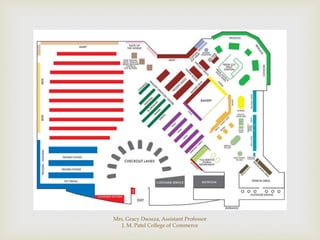
 The store layout is the arrangement of floor space to
promote the sale of fashion products.
 A retailer can be arranged as a series of
departments or groupings of merchandise.
Store Layout
Mrs. Gracy Dsouza, Assistant Professor
J. M. Patel College of Commerce

 To encourage customer exploration and help customers
move through the stores
Use a layout that facilitates a specific traffic
pattern
Provide interesting design elements
 Types of Store Layouts
Grid
Racetrack
Free Form
Spine
Store Layouts
Mrs. Gracy Dsouza, Assistant Professor
J. M. Patel College of Commerce

TYPES OF STORE
LAYOUT
Mrs. Gracy Dsouza, Assistant Professor
J. M. Patel College of Commerce

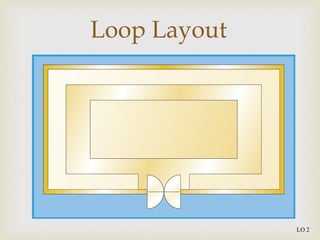
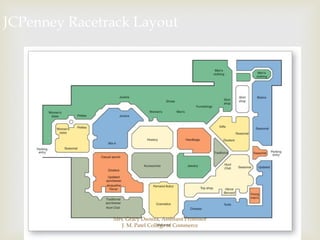
Provides a major customer aisle that begins at the entrance,
loops through the store, usually in the shape of a circle,
square, or rectangle, and then returns the customer to
the front of the store.
It is also referred to as a racetrack layout
1. Loop/Racetrack Layout
Mrs. Gracy Dsouza, Assistant Professor
J. M. Patel College of Commerce

 Loop with a major aisle that has access to departments
 Draws customers around the store
 Provide different viewing angles and encourage
exploration, impulse buying
 Used in department stores
Racetrack Layout (Loop)
Mrs. Gracy Dsouza, Assistant Professor
J. M. Patel College of Commerce
Loop Layout
LO 2

JCPenney Racetrack Layout
Mrs. Gracy Dsouza, Assistant Professor
J. M. Patel College of Commerce

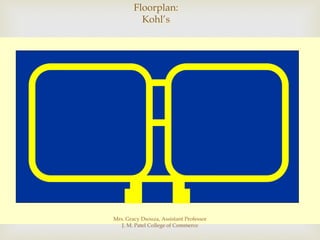
Floorplan:
Kohl’s
Mrs. Gracy Dsouza, Assistant Professor
J. M. Patel College of Commerce

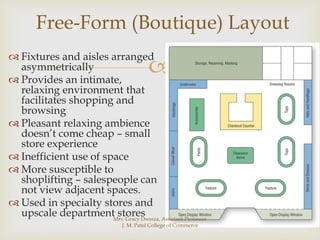
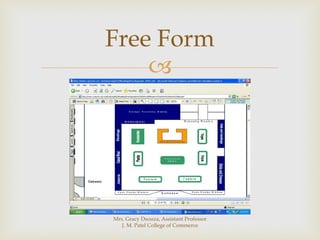
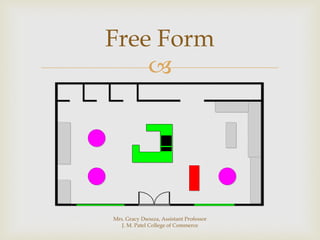
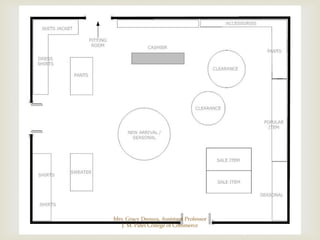
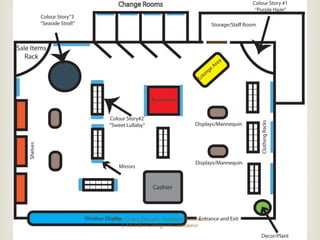
 Used primarily in specialty stores or within the boutiques
of larger stores that arranges fixtures and aisles in an
asymmetrical pattern.
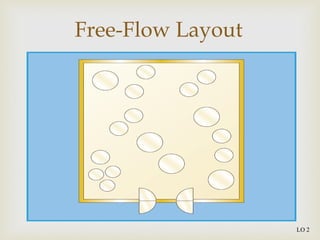
 A free flow layout allows merchandise to be placed in
groupings and patterns that allow customer traffic to flow
in an unstructured manner. It allows for maximum
product exposure and customer convenience. A free flow
layout encourages impulse buying and browsing.
 It is, however, a more costly layout to set up and is not as
efficient as the grid layout in utilizing space. Please note
that even though a free flow layout may appear on the
surface to be very random, it is in fact organized with
very specific logic and objectives
2. Free Form
Mrs. Gracy Dsouza, Assistant Professor
J. M. Patel College of Commerce
Free-Flow Layout
LO 2

 Fixtures and aisles arranged
asymmetrically
 Provides an intimate,
relaxing environment that
facilitates shopping and
browsing
 Pleasant relaxing ambience
doesn’t come cheap – small
store experience
 Inefficient use of space
 More susceptible to
shoplifting – salespeople can
not view adjacent spaces.
 Used in specialty stores and
upscale department stores
Free-Form (Boutique) Layout
Mrs. Gracy Dsouza, Assistant Professor
J. M. Patel College of Commerce

Free Form
Mrs. Gracy Dsouza, Assistant Professor
J. M. Patel College of Commerce

Free Form
Mrs. Gracy Dsouza, Assistant Professor
J. M. Patel College of Commerce

Mrs. Gracy Dsouza, Assistant Professor
J. M. Patel College of Commerce

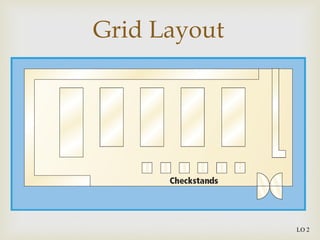
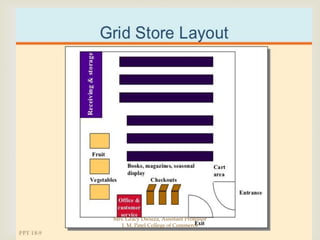
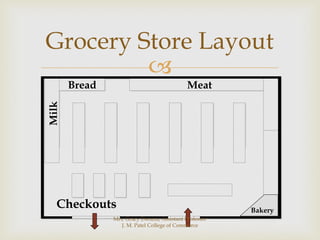
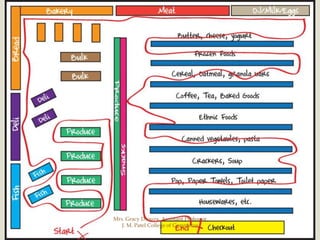
A store layout of fixtures and aisles in a
repetitive or rectangular pattern
Best illustrated by a variety store or the grocery
department in a typical supermarket.
Secondary aisles run at right angles to aisles,
and each aisle is usually of the same width for
its length.
3. Grid Layout
Mrs. Gracy Dsouza, Assistant Professor
J. M. Patel College of Commerce

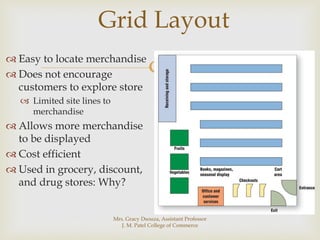
 Easy to locate merchandise
 Does not encourage
customers to explore store
 Limited site lines to
merchandise
 Allows more merchandise
to be displayed
 Cost efficient
 Used in grocery, discount,
and drug stores: Why?
Grid Layout
Mrs. Gracy Dsouza, Assistant Professor
J. M. Patel College of Commerce
Grid Layout
LO 2

Mrs. Gracy Dsouza, Assistant Professor
J. M. Patel College of Commerce

Grocery Store Layout
Checkouts
Meat
Bread
Milk
Bakery
Mrs. Gracy Dsouza, Assistant Professor
J. M. Patel College of Commerce

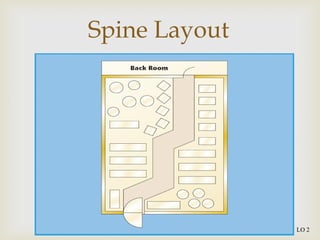
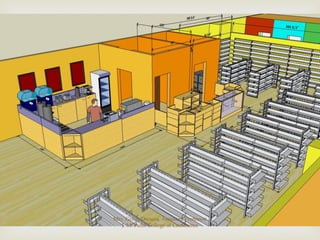
 It is a type of layout in which a single main walkway
runs from the front to the back of the store,
transporting customers in both the directions.
 It is convenient to medium sized speciality stores
with store area ranging from 2,000 to 10,000 sq. ft.
4. SPINE LAYOUT
Mrs. Gracy Dsouza, Assistant Professor
J. M. Patel College of Commerce
Spine Layout
LO 2

Mrs. Gracy Dsouza, Assistant Professor
J. M. Patel College of Commerce

Mrs. Gracy Dsouza, Assistant Professor
J. M. Patel College of Commerce

Mrs. Gracy Dsouza, Assistant Professor
J. M. Patel College of Commerce

Mrs. Gracy Dsouza, Assistant Professor
J. M. Patel College of Commerce
Store Planning
Free-flow
layout
Fixtures and merchandise are grouped into free-flowing
patterns on the sales floor.
Grid layout The counters and fixtures are placed in long rows or
‘‘runs,’’ usually at right angles, throughout the store.
Loop layout A major customer aisle begins at the entrance, loops
through the store—usually in the shape of a circle, square,
or rectangle—and then returns the customer to the front of
the store.
Spine layout A single main aisle runs from the front to the back of the
store, transporting customers in both directions, and
where on either side of this spine, merchandise
departments using either a free-flow or grid pattern
branch off toward the back side walls.
LO 2

store layout.pdf

  • 1.
    Mrs. Gracy Dsouza,Assistant Professor J. M. Patel College of Commerce
  • 2.
      The storelayout is the arrangement of floor space to promote the sale of fashion products.  A retailer can be arranged as a series of departments or groupings of merchandise. Store Layout Mrs. Gracy Dsouza, Assistant Professor J. M. Patel College of Commerce
  • 3.
      To encouragecustomer exploration and help customers move through the stores Use a layout that facilitates a specific traffic pattern Provide interesting design elements  Types of Store Layouts Grid Racetrack Free Form Spine Store Layouts Mrs. Gracy Dsouza, Assistant Professor J. M. Patel College of Commerce
  • 4.
     TYPES OF STORE LAYOUT Mrs.Gracy Dsouza, Assistant Professor J. M. Patel College of Commerce
  • 5.
     Provides a majorcustomer aisle that begins at the entrance, loops through the store, usually in the shape of a circle, square, or rectangle, and then returns the customer to the front of the store. It is also referred to as a racetrack layout 1. Loop/Racetrack Layout Mrs. Gracy Dsouza, Assistant Professor J. M. Patel College of Commerce
  • 6.
      Loop witha major aisle that has access to departments  Draws customers around the store  Provide different viewing angles and encourage exploration, impulse buying  Used in department stores Racetrack Layout (Loop) Mrs. Gracy Dsouza, Assistant Professor J. M. Patel College of Commerce
  • 7.
  • 8.
     JCPenney Racetrack Layout Mrs.Gracy Dsouza, Assistant Professor J. M. Patel College of Commerce
  • 9.
     Floorplan: Kohl’s Mrs. Gracy Dsouza,Assistant Professor J. M. Patel College of Commerce
  • 10.
      Used primarilyin specialty stores or within the boutiques of larger stores that arranges fixtures and aisles in an asymmetrical pattern.  A free flow layout allows merchandise to be placed in groupings and patterns that allow customer traffic to flow in an unstructured manner. It allows for maximum product exposure and customer convenience. A free flow layout encourages impulse buying and browsing.  It is, however, a more costly layout to set up and is not as efficient as the grid layout in utilizing space. Please note that even though a free flow layout may appear on the surface to be very random, it is in fact organized with very specific logic and objectives 2. Free Form Mrs. Gracy Dsouza, Assistant Professor J. M. Patel College of Commerce
  • 11.
  • 12.
      Fixtures andaisles arranged asymmetrically  Provides an intimate, relaxing environment that facilitates shopping and browsing  Pleasant relaxing ambience doesn’t come cheap – small store experience  Inefficient use of space  More susceptible to shoplifting – salespeople can not view adjacent spaces.  Used in specialty stores and upscale department stores Free-Form (Boutique) Layout Mrs. Gracy Dsouza, Assistant Professor J. M. Patel College of Commerce
  • 13.
     Free Form Mrs. GracyDsouza, Assistant Professor J. M. Patel College of Commerce
  • 14.
     Free Form Mrs. GracyDsouza, Assistant Professor J. M. Patel College of Commerce
  • 15.
     Mrs. Gracy Dsouza,Assistant Professor J. M. Patel College of Commerce
  • 16.
     A store layoutof fixtures and aisles in a repetitive or rectangular pattern Best illustrated by a variety store or the grocery department in a typical supermarket. Secondary aisles run at right angles to aisles, and each aisle is usually of the same width for its length. 3. Grid Layout Mrs. Gracy Dsouza, Assistant Professor J. M. Patel College of Commerce
  • 17.
      Easy tolocate merchandise  Does not encourage customers to explore store  Limited site lines to merchandise  Allows more merchandise to be displayed  Cost efficient  Used in grocery, discount, and drug stores: Why? Grid Layout Mrs. Gracy Dsouza, Assistant Professor J. M. Patel College of Commerce
  • 18.
  • 19.
     Mrs. Gracy Dsouza,Assistant Professor J. M. Patel College of Commerce
  • 20.
     Grocery Store Layout Checkouts Meat Bread Milk Bakery Mrs.Gracy Dsouza, Assistant Professor J. M. Patel College of Commerce
  • 21.
      It isa type of layout in which a single main walkway runs from the front to the back of the store, transporting customers in both the directions.  It is convenient to medium sized speciality stores with store area ranging from 2,000 to 10,000 sq. ft. 4. SPINE LAYOUT Mrs. Gracy Dsouza, Assistant Professor J. M. Patel College of Commerce
  • 22.
  • 23.
     Mrs. Gracy Dsouza,Assistant Professor J. M. Patel College of Commerce
  • 24.
     Mrs. Gracy Dsouza,Assistant Professor J. M. Patel College of Commerce
  • 25.
     Mrs. Gracy Dsouza,Assistant Professor J. M. Patel College of Commerce
  • 26.
     Mrs. Gracy Dsouza,Assistant Professor J. M. Patel College of Commerce
  • 27.
    Store Planning Free-flow layout Fixtures andmerchandise are grouped into free-flowing patterns on the sales floor. Grid layout The counters and fixtures are placed in long rows or ‘‘runs,’’ usually at right angles, throughout the store. Loop layout A major customer aisle begins at the entrance, loops through the store—usually in the shape of a circle, square, or rectangle—and then returns the customer to the front of the store. Spine layout A single main aisle runs from the front to the back of the store, transporting customers in both directions, and where on either side of this spine, merchandise departments using either a free-flow or grid pattern branch off toward the back side walls. LO 2