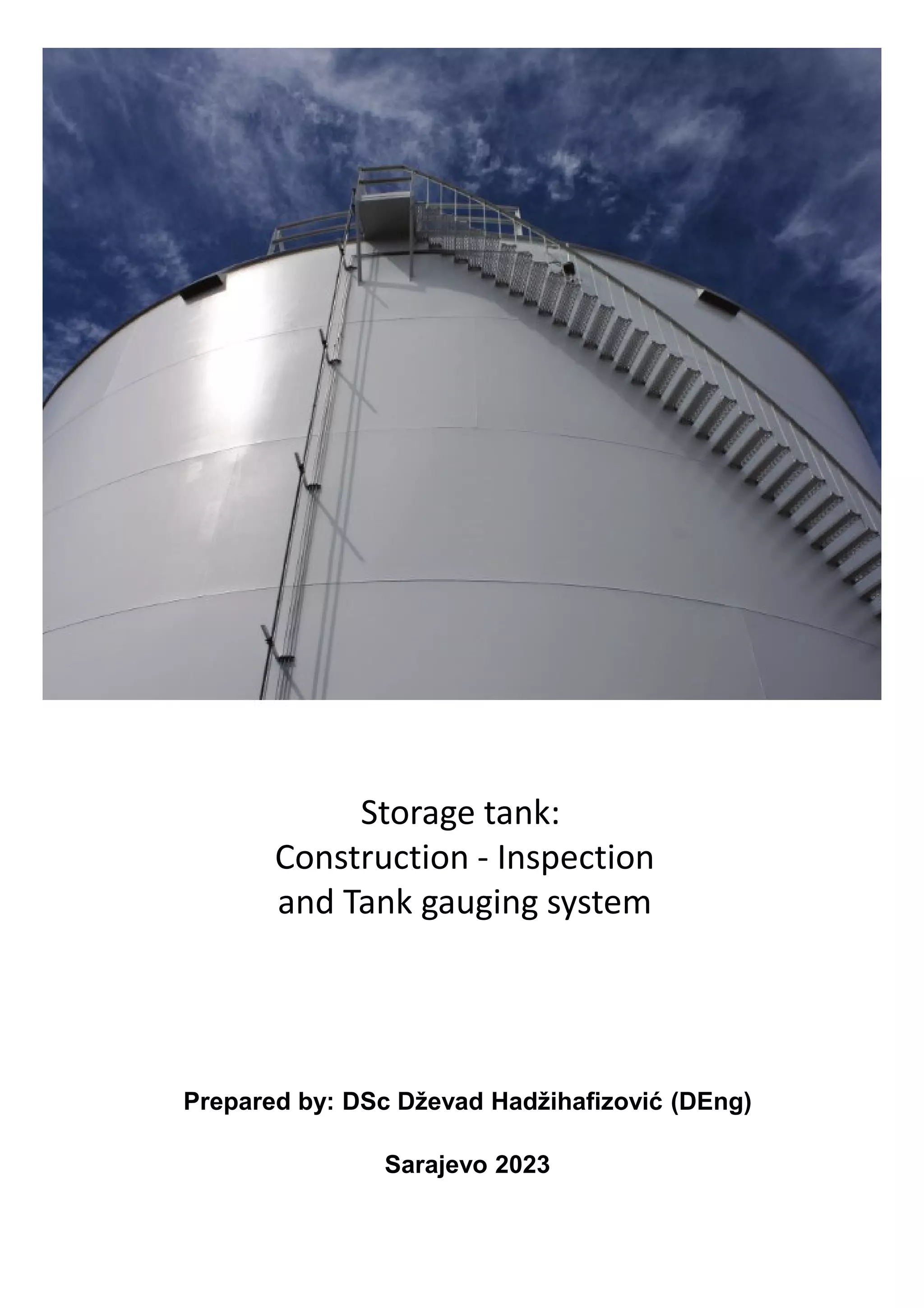
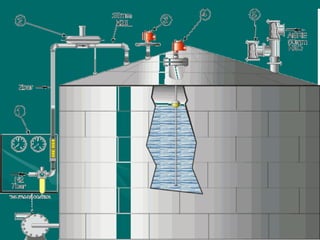
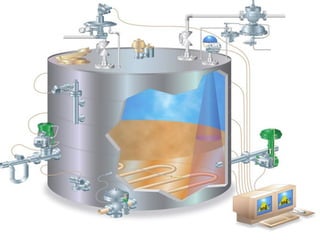
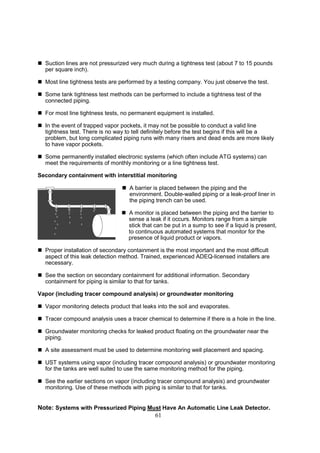
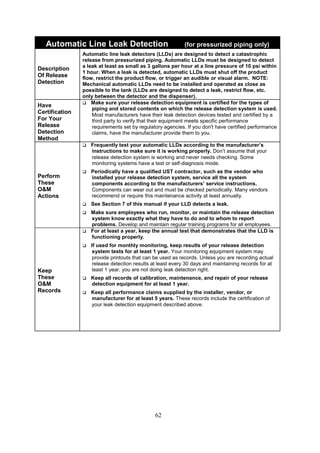
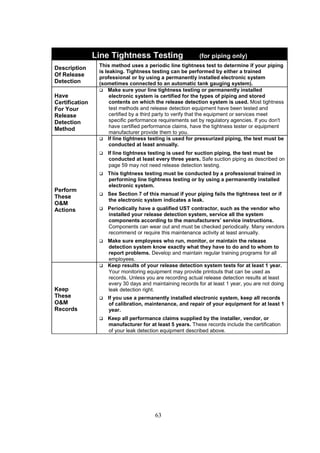
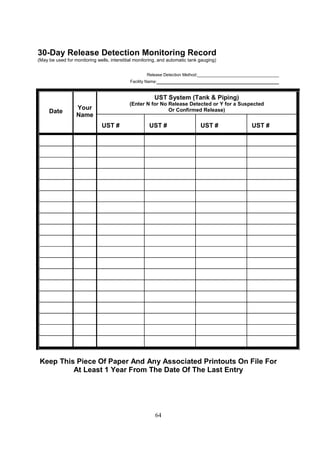
Storage tank:
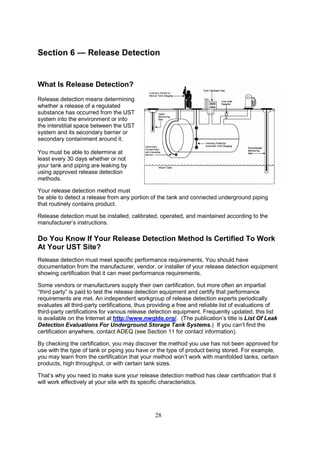
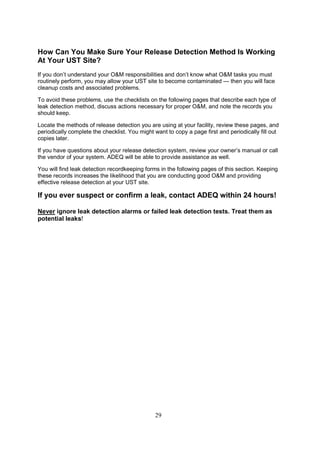
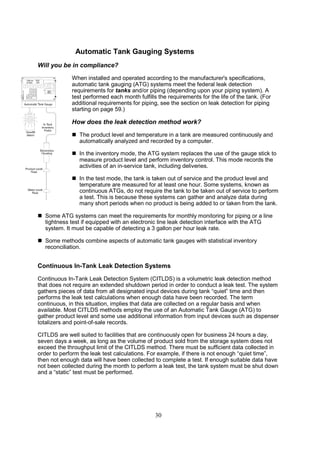
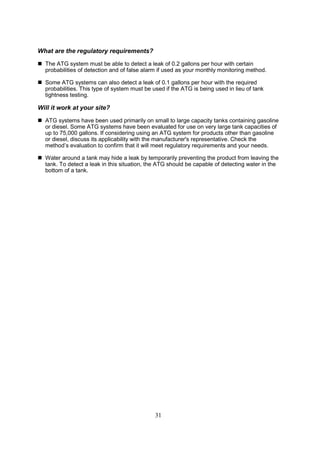
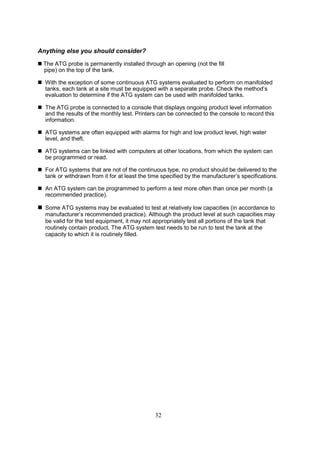
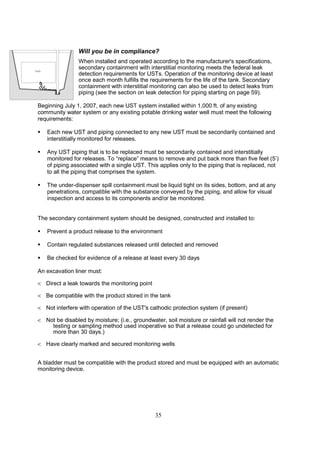
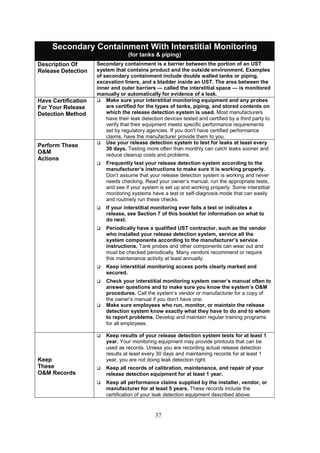
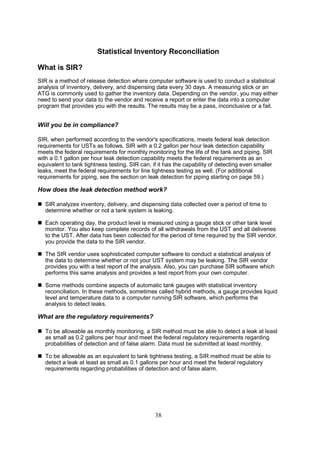
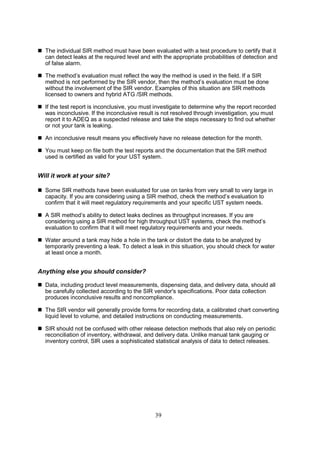
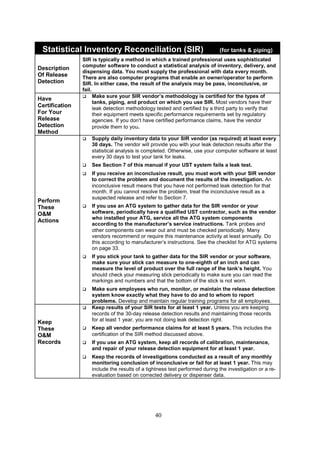
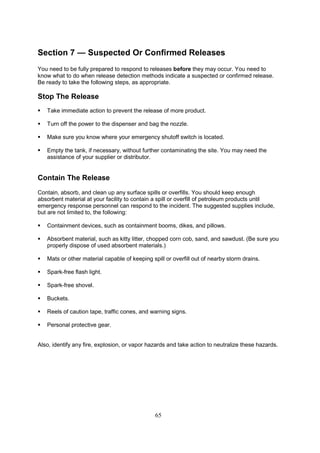
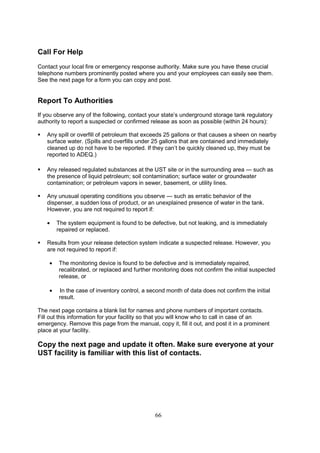
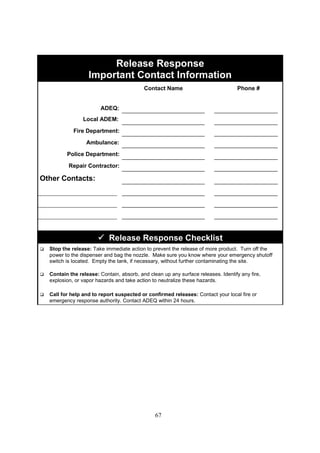
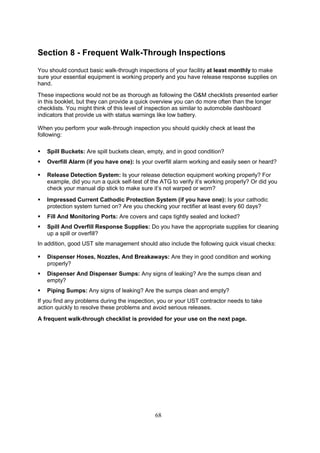
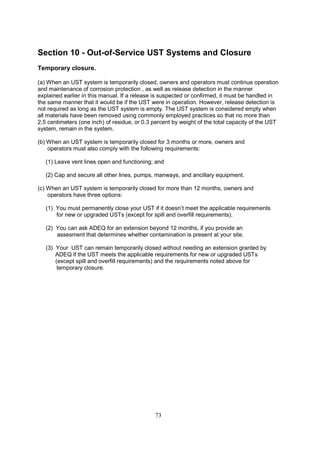
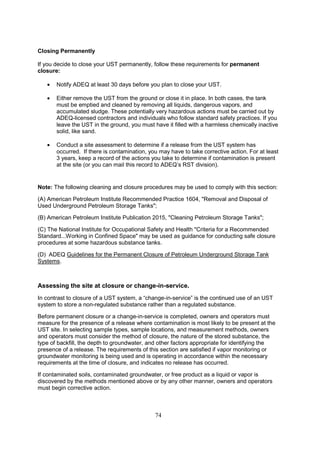
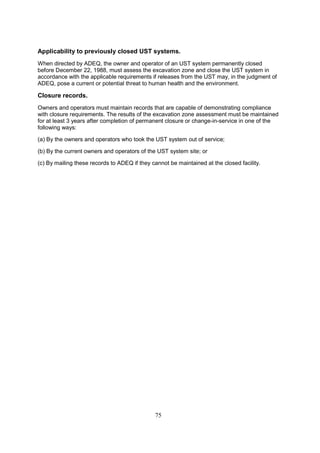
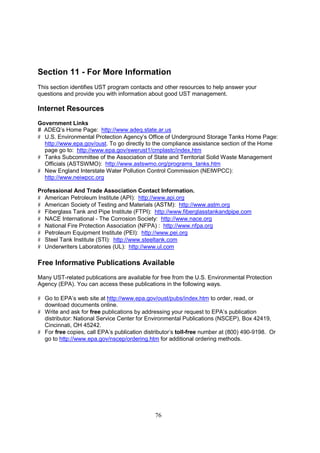
Construction - Inspection
and Tank gauging system
Prepared by: DSc Dževad Hadžihafizović (DEng)
Sarajevo 2023
PETROLEUM STORAGE TANKS
Basic Training
PETROLEUM STORAGE TANKS - Basic Training
What we'll be covering
> The design of the tank.
> Which tank , which product.
> The structure & assembly of the tank.
> Tank inspection
> Measurement
Goals for Today
> To identify tank type & tank equipments
> To know the limitation of tank
> Calculation of tank volume
> Safe tank operation
PETROLEUM STORAGE TANKS - Basic Training
Course Content
1. Background
2. Tank Design
- Types of vertical tanks
- Selection of vertical tanks
3. Tank Structure & Assembly of Tank
4. Tank Fittings
- Operational fitting
- Fittings common to all vertical tanks
- Additional fitting for floating roof tanks
- Special fittings and accessories for floating
5. Tank Inspection
6. Tank Farm Safety
…………………………………………………………………………………...
7. Measurement
8. Internal & external incident learning
9. Field trip
STORAGE TANKS- Basic Training
1.0 Background
Tanks have been around since the beginning of hydrocarbon
production. Tanks vary considerably, in the type and size based on
the type of products to be stored and the volume involved.
The failure of a tank can have several undesirable effects such as
endangering personnel, affecting the environment and interrupting
the Operator’s business.
Companies therefore, require a consistent approach for assessing tank
integrity and maintaining compliance with industry and regulatory
standards, (that is community requirements). Such an approach must;
• Ensure tanks are not leaking and will not leak before next inspection
• Reduce the potential for releases
• Maintain tanks in safe operating conditions, and
• Make repairs and determine when replacement is necessary.
PETROLEUM STORAGE TANKS Basic Training
TANK
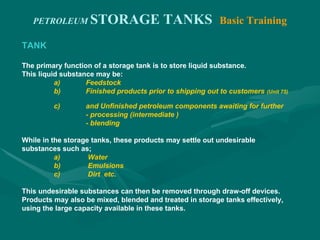
The primary function of a storage tank is to store liquid substance.
This liquid substance may be:
a) Feedstock
b) Finished products prior to shipping out to customers (Unit 75)
c) and Unfinished petroleum components awaiting for further
- processing (intermediate )
- blending
While in the storage tanks, these products may settle out undesirable
substances such as;
a) Water
b) Emulsions
c) Dirt etc.
This undesirable substances can then be removed through draw-off devices.
Products may also be mixed, blended and treated in storage tanks effectively,
using the large capacity available in these tanks.
TANK (cont)
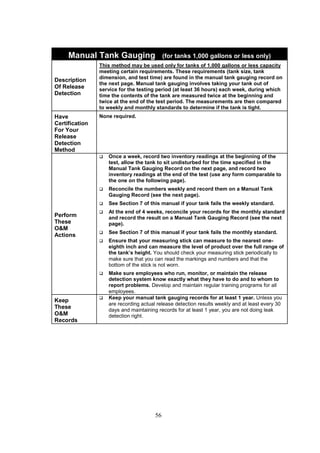
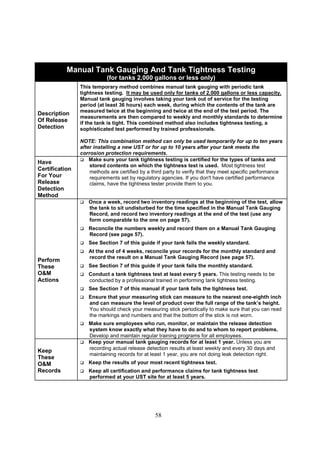
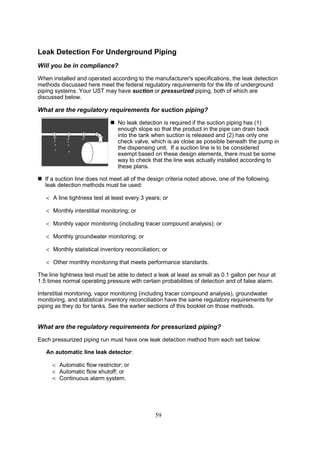
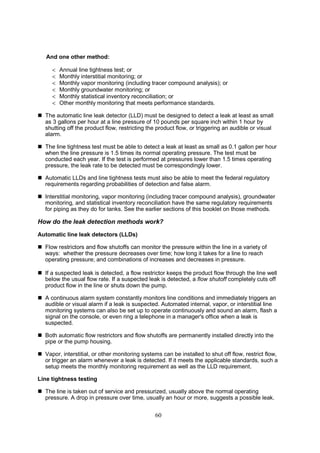
Broadly, the storage tanks can be divided into two basic types:
Atmospheric storage
Atmospheric storage is a term applied to tanks operating at or near atmospheric
pressure. This type of tank is used to hold liquid which will not vaporize at
ambient temperature. Tanks used in this category are primarily the open top,
fixed roof (cone & dome) and floating roof.
Pressurized storage
Pressurized storage applies to those vessels (mounded bullets) which are
designed to withstand pressure sufficient to keep the liquid stored, from
vaporizing. High vapor pressure hydrocarbons such as propane, butane,
iC5 are the types of products requiring pressurized storage vessels (Mounded
Bullets).
Note: STORAGE TANK TRAINING for MG 3 Operators, will basically focus
on aboveground vertical storage tanks of various types.
TANK
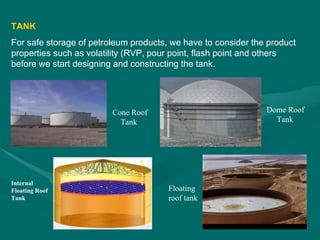
For safe storage of petroleum products, we have to consider the product
properties such as volatility (RVP, pour point, flash point and others
before we start designing and constructing the tank.
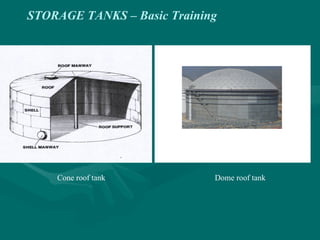
Floating
roof tank
Cone Roof
Tank
Dome Roof
Tank
Internal
Floating Roof
Tank
STORAGE TANKS – Basic Training
2.0 The design of the tank
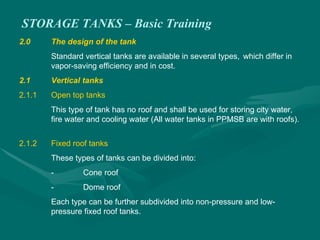
Standard vertical tanks are available in several types, which differ in
vapor-saving efficiency and in cost.
2.1 Vertical tanks
2.1.1 Open top tanks
This type of tank has no roof and shall be used for storing city water,
fire water and cooling water (All water tanks in PPMSB are with roofs).
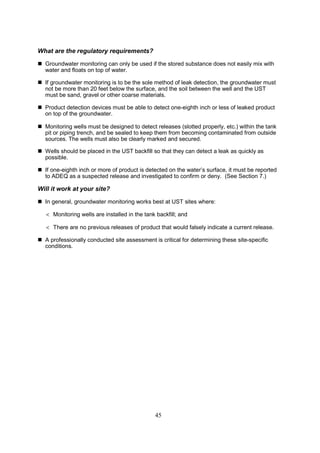
2.1.2 Fixed roof tanks
These types of tanks can be divided into:
- Cone roof
- Dome roof
Each type can be further subdivided into non-pressure and low-
pressure fixed roof tanks.
STORAGE TANKS – Basic Training
Cone roof tank Dome roof tank
STORAGE TANKS – Basic Training
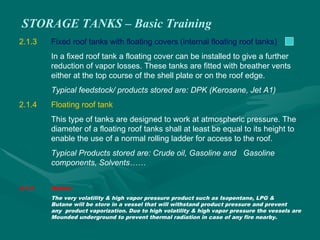
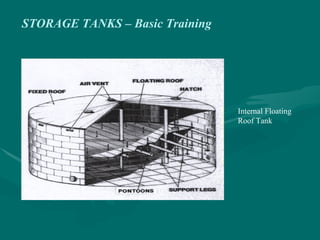
2.1.3 Fixed roof tanks with floating covers (internal floating roof tanks)
In a fixed roof tank a floating cover can be installed to give a further
reduction of vapor losses. These tanks are fitted with breather vents
either at the top course of the shell plate or on the roof edge.
Typical feedstock/ products stored are: DPK (Kerosene, Jet A1)
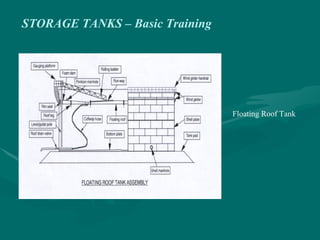
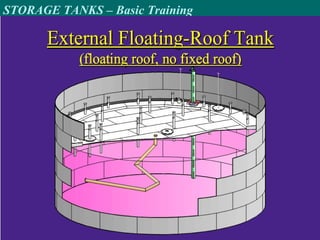
2.1.4 Floating roof tank
This type of tanks are designed to work at atmospheric pressure. The
diameter of a floating roof tanks shall at least be equal to its height to
enable the use of a normal rolling ladder for access to the roof.
Typical Products stored are: Crude oil, Gasoline and Gasoline
components, Solvents……
2.1.5 Bullets
The very volatility & high vapor pressure product such as Isopentane, LPG &
Butane will be store in a vessel that will withstand product pressure and prevent
any product vaporization. Due to high volatility & high vapor pressure the vessels are
Mounded underground to prevent thermal radiation in case of any fire nearby.
STORAGE TANKS – Basic Training
Internal Floating
Roof Tank
STORAGE TANKS – Basic Training
Floating Roof Tank
STORAGE TANKS – Basic Training
2.2 Selection of Vertical Tanks – which tank, which product
2.2.1 General
The types and ranges of tanks recommended for storage of
different classes of petroleum products.
2.3 Stability
For calculations of tank stability in strong winds, the
velocities given in the local regulations should be used; if no
local regulations exist, local experience should be considered.
Unstable tanks shall be provided with anchor bolts and
concrete foundation rings. Uplifting is caused by the internal vapor
pressure acting against the underside of the roof, in conjunction
with wind load. A stability calculation shall be made to determine
the number of anchor required.
STORAGE TANKS – Basic Training
2.3 Stability
For calculations of tank stability in strong winds the following
need to be done:
a) the velocities given in the local regulations should
be used;
b) if no local regulations exist, local experience should
be considered.
Unstable tanks shall be provided with anchor bolts and concrete
foundation rings. Uplifting is caused by the internal vapor pressure
acting against the underside of the roof, in conjunction with wind
load. A stability calculation shall be made to determine the number
of anchors required.
STORAGE TANKS – Basic Training
2.4 Tank Foundation
2.4.1 Checking of foundation
Surface, subsurface and climatic conditions vary from place to place,
so it is not practical to establish design data to cover all situations.
The allowable soil loading and exact type of subsurface construction
to be used must be decided for each individual case after careful
consideration.
Some of the many conditions that require special engineering
consideration are as follows:
> site on hillsides – undisturbed/ land filled
> sites at swampy or filled ground
> sites underlain by soils, such as organic clays that will settle over
long period and can cause lateral ground stability problem
> site adjacent to water courses or deep excavation
> site exposed to flood water
> site in regions of high seismicity
STORAGE TANKS – Basic Training
2.4 Tank Foundation
2.4.2 Typical Foundation Types
2.4.2.1 Earth foundation without a ringwall
When subsurface conditions shows adequate bearing capacity and
that settlements will be acceptable, satisfactory foundations may be
constructed from earth material.
Design for satisfactory long-term performance are:
> For small tanks, foundations can consist of compacted crushed
stone, screenings, fine gravel, clean sand, or similar material
placed directly on virgin soil.
STORAGE TANKS – Basic Training
2.4 Tank Foundation
2.4.2 Typical Foundation Types
2.4.2.2 Earth foundations with a concrete ringwall large tanks, with heavy or
tall shell and/or self-supported roofs impose a substantial load on the
foundation under the shell. When there is some doubt whether a
foundation will be able to carry the load directly, a concrete
ringwall foundation should be used.
Advantages of concrete ringwall are:
> It provides better distribution of the concentrated load of the shell
to produce a more uniform soil loading under the tank
> It provides a level, solid starting plane for concentration of the shell
> It is capable of preserving its contour during construction
> It retains the fill under the tank bottom and prevents loss of
material as a result of erosion
> It minimizes moisture under the tank
STORAGE TANKS – Basic Training
2.4 Tank Foundation
2.4.2 Typical Foundation Types
2.4.2.2 Earth foundations with a concrete ringwall
Other design requirements are:
> The ringwall shall not be less than 300 mm (12 in) thick
> Depth of ringwall depends on the local conditions
2.4.2.3 Earth foundations with a crushed stone and gravel ringwall
A crushed stone or gavel ringwall will provide adequate support for
high load imposed by the shell.
Advantages are:
> It provides better distribution of the concentrated load of the shell
to produce a more uniform soil loading under the tank
> It provides a means of leveling the tank grade, and it is capable
of preserving its contour during construction
> It retains the fill under the tank bottom and prevents loss of material
as a result of erosion
> it can more smoothly accommodate differential settlement
because of its flexibility
STORAGE TANKS – Basic Training
2.4 Tank Foundation
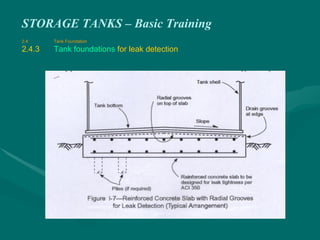
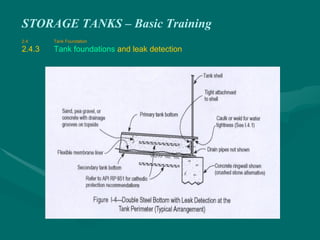
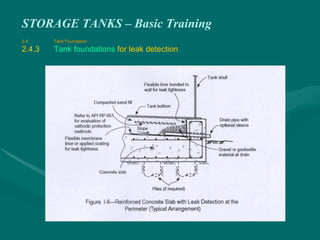
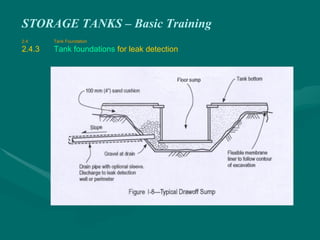
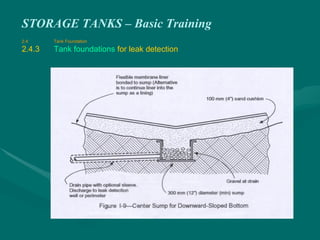
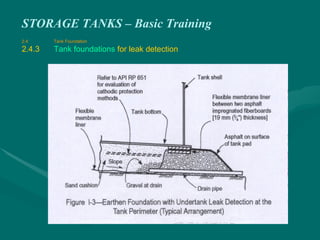
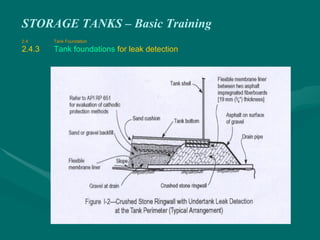
2.4.3 Tank foundations for leak detection
API supports a general position of installing a Release Prevention
barrier (RPB) under new tanks during initial construction. An RPB
includes steel bottoms, synthetic materials, clay liners, and all other
barriers or combination of barriers placed in the bottom of or
under an aboveground storage tank, which have the following functions:
> preventing the escape of contaminated material
and
> containing or channeling released material for leak
detection
STORAGE TANKS – Basic Training
2.4 Tank Foundation
2.4.3 Tank foundations for leak detection
STORAGE TANKS – Basic Training
2.4 Tank Foundation
2.4.3 Tank foundations and leak detection
STORAGE TANKS – Basic Training
2.4 Tank Foundation
2.4.3 Tank foundations for leak detection
STORAGE TANKS – Basic Training
2.4 Tank Foundation
2.4.3 Tank foundations for leak detection
STORAGE TANKS – Basic Training
2.4 Tank Foundation
2.4.3 Tank foundations for leak detection
STORAGE TANKS – Basic Training
2.4 Tank Foundation
2.4.3 Tank foundations for leak detection
STORAGE TANKS – Basic Training
2.4 Tank Foundation
2.4.3 Tank foundations for leak detection
STORAGE TANKS – Basic Training
3.0 Tank Structure
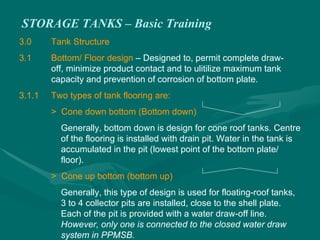
3.1 Bottom/ Floor design – Designed to, permit complete draw-
off, minimize product contact and to ulitilize maximum tank
capacity and prevention of corrosion of bottom plate.
3.1.1 Two types of tank flooring are:
> Cone down bottom (Bottom down)
Generally, bottom down is design for cone roof tanks. Centre
of the flooring is installed with drain pit. Water in the tank is
accumulated in the pit (lowest point of the bottom plate/
floor).
> Cone up bottom (bottom up)
Generally, this type of design is used for floating-roof tanks,
3 to 4 collector pits are installed, close to the shell plate.
Each of the pit is provided with a water draw-off line.
However, only one is connected to the closed water draw
system in PPMSB.
STORAGE TANKS – Basic Training
3.7 External Loading
3.7.1 Primary wind girders
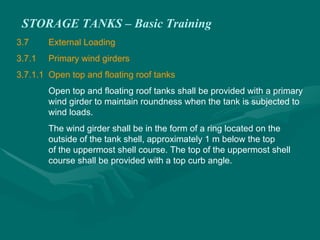
3.7.1.1 Open top and floating roof tanks
Open top and floating roof tanks shall be provided with a primary
wind girder to maintain roundness when the tank is subjected to
wind loads.
The wind girder shall be in the form of a ring located on the
outside of the tank shell, approximately 1 m below the top
of the uppermost shell course. The top of the uppermost shell
course shall be provided with a top curb angle.
STORAGE TANKS – Basic Training
3.7 External Loading
3.7.1 Primary wind girders
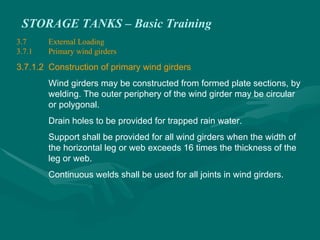
3.7.1.2 Construction of primary wind girders
Wind girders may be constructed from formed plate sections, by
welding. The outer periphery of the wind girder may be circular
or polygonal.
Drain holes to be provided for trapped rain water.
Support shall be provided for all wind girders when the width of
the horizontal leg or web exceeds 16 times the thickness of the
leg or web.
Continuous welds shall be used for all joints in wind girders.
STORAGE TANKS – Basic Training
3.7 External Loading
3.7.2 Secondary wind girders
3.7.2.1 General
Tank may require secondary rings to maintain roundness over
the full height of the tank shell under wind and/or vacuum
conditions (BS 2654).
3.7.2.2 Design of secondary wind girders
There are basically, additional stiffening rings. Continuous
welding (full penetration butt welds) shall be used for all
connections of the secondary wind girders.
STORAGE TANKS – Basic Training
3.7 External Loading
3.7.3 Isolated radial loads
Isolated radial loads (heavy platforms or elevated walkways)
shall be distributed along the shell by rolled structural section,
plate ribs or build-up members, preferably in a horizontal
position.
STORAGE TANKS – Basic Training
3.8 Shell openings
3.8.1 Reinforcement of shell openings
All openings larger than 80 mm in diameter shall be reinforce.
3.8.2 Pipe connections
Pipes connected to the nozzles of tanks shells designed in such
a way that no significant bending moments or loads act on the
nozzle. For bigger lines, use of bellows and balanced supports
should be considered.
3.8.3 Clean-out doors
If required for tanks made of carbon steel, clean out doors shall
be designed and fabricated. This is more for sludge removal and
to allow entry of a conveyor belt, if required.
STORAGE TANKS – Basic Training
3.9 Fixed roof design
3.9.1 Type of roof
As mentioned earlier: - Cone roof
- Dome roof
3.9.2 Design of supporting structure
A supported cone roof is roof formed to approximately the
surface of a right cone that is supported principally either by
rafters on girders and columns or by rafters on trusses with or
without column.
3.9.3 General
> Minimum thickness of roof plate – 5mm (3/16 in)
> Thicker roof plates may be required for self-supporting roofs.
> The roof thickness also determined by the type of product stored.
more corrosive product require thicker plate.
STORAGE TANKS – Basic Training
3.9 Fixed roof design
3.9.3 General (cont)
> roof plates of supported cone roofs shall not be attached to the
support members.
> Roof plate shall be attached to the top angle of the tank with a
continuous fillet weld on the top side only. The roof-to-shell joint may
be considered frangible and in the event of excessive internal
pressure may fail before failure occurs in the tank shell joints or the
shell-to-bottom joint.
3.10 Internal floating roof tank
An internal floating roof and its accessories shall be designed and
constructed to allow the roof to operate throughout its normal travel with
manual attention .
3.10.1 The IFR shall be designed and built to float and rest in a uniform
horizontal plane (no drainage slope required)
STORAGE TANKS – Basic Training
3.9 Fixed roof design
3.10 Internal floating roof tank
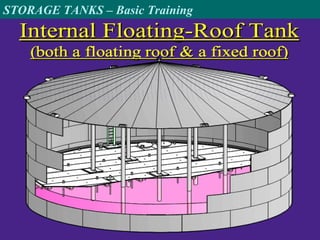
Internal Floating Roof (IFR)
An internal floating roof tank has both a permanent fixed roof and a floating desk inside. The term "deck" or "floating
roof" is used in reference to the structure floating on the liquid stored within the tank. The deck of an internal floating
roof tank rises and falls with the liquid level whilst in full contact on the underside thus achieving no vapor zone.
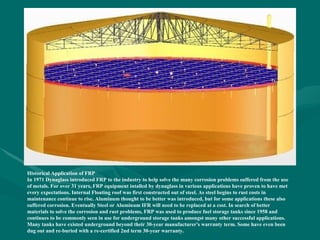
Historical Application of FRP
In 1971 Dynaglass introduced FRP to the industry to help solve the many corrosion problems suffered from the use
of metals. For over 31 years, FRP equipment intalled by dynaglass in various applications have proven to have met
every expectations. Internal Floating roof was first constructed out of steel. As steel begins to rust costs in
maintenance continue to rise. Aluminum thought to be better was introduced, but for some applications these also
suffered corrosion. Eventually Steel or Aluminum IFR will need to be replaced at a cost. In search of better
materials to solve the corrosion and rust problems, FRP was used to produce fuel storage tanks since 1958 and
continues to be commonly seen in use for underground storage tanks amongst many other successful applications.
Many tanks have existed underground beyond their 30-year manufacturer's warranty term. Some have even been
dug out and re-buried with a re-certified 2nd term 30-year warranty.
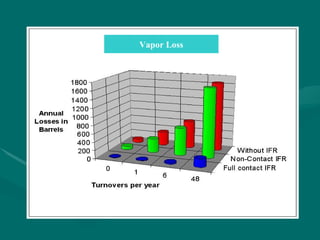
Vapor Loss
STORAGE TANKS – Basic Training
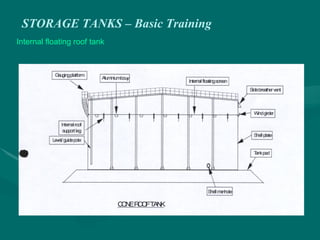
Internal floating roof tank
STORAGE TANKS – Basic Training
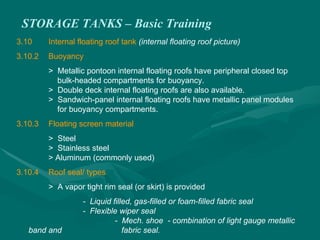
3.10 Internal floating roof tank (internal floating roof picture)
3.10.2 Buoyancy
> Metallic pontoon internal floating roofs have peripheral closed top
bulk-headed compartments for buoyancy.
> Double deck internal floating roofs are also available.
> Sandwich-panel internal floating roofs have metallic panel modules
for buoyancy compartments.
3.10.3 Floating screen material
> Steel
> Stainless steel
> Aluminum (commonly used)
3.10.4 Roof seal/ types
> A vapor tight rim seal (or skirt) is provided
- Liquid filled, gas-filled or foam-filled fabric seal
- Flexible wiper seal
- Mech. shoe - combination of light gauge metallic
band and fabric seal.
STORAGE TANKS – Basic Training
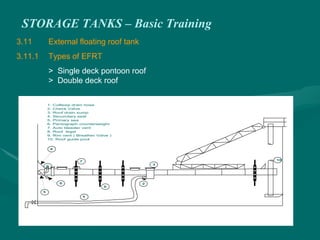
3.11 External floating roof tank
3.11.1 Types of EFRT
> Single deck pontoon roof
> Double deck roof
1
2
3
4
5
6
1
7
8
9
1. Coflexip drain hose
2. Check Valve
3. Roof drain sump
4. Secondary seal
5. Primary sea
6. Pantograph counterweight
7. Auto bleeder vent
8. Roof legsl
9. Rim vent ( Breather Valve )
10. Roof guide pool
10
STORAGE TANKS – Basic Training
3.11 External floating roof tank
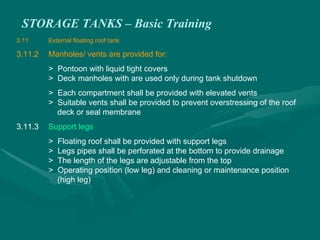
3.11.2 Manholes/ vents are provided for:
> Pontoon with liquid tight covers
> Deck manholes with are used only during tank shutdown
> Each compartment shall be provided with elevated vents
> Suitable vents shall be provided to prevent overstressing of the roof
deck or seal membrane
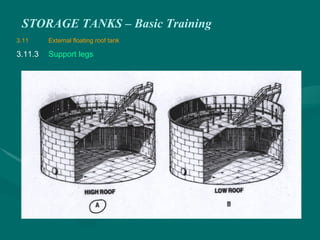
3.11.3 Support legs
> Floating roof shall be provided with support legs
> Legs pipes shall be perforated at the bottom to provide drainage
> The length of the legs are adjustable from the top
> Operating position (low leg) and cleaning or maintenance position
(high leg)
STORAGE TANKS – Basic Training
3.11 External floating roof tank
3.11.3 Support legs
STORAGE TANKS – Basic Training
3.11 External floating roof tank
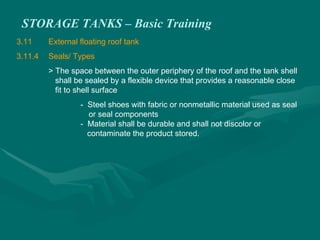
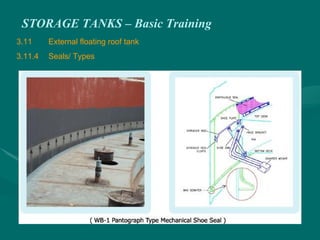
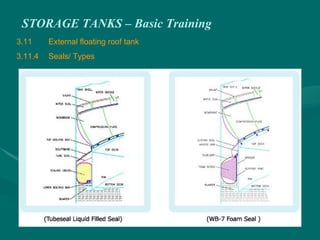
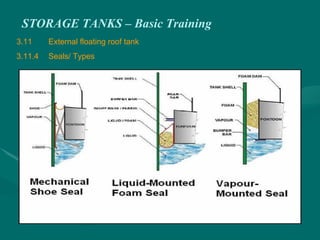
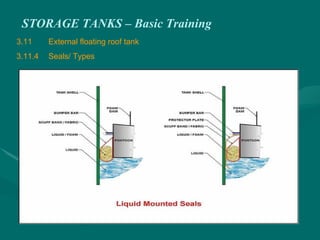
3.11.4 Seals/ Types
> The space between the outer periphery of the roof and the tank shell
shall be sealed by a flexible device that provides a reasonable close
fit to shell surface
- Steel shoes with fabric or nonmetallic material used as seal
or seal components
- Material shall be durable and shall not discolor or
contaminate the product stored.
STORAGE TANKS – Basic Training
3.11 External floating roof tank
3.11.4 Seals/ Types
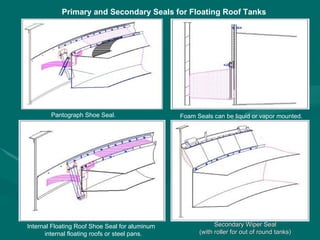
Pictures/ drawings of seals follows:
Primary and Secondary Seals for Floating Roof Tanks
Pantograph Shoe Seal. Foam Seals can be liquid or vapor mounted.
Internal Floating Roof Shoe Seal for aluminum
internal floating roofs or steel pans.
Secondary Wiper Seal
(with roller for out of round tanks)
STORAGE TANKS – Basic Training
3.11 External floating roof tank
3.11.4 Seals/ Types
STORAGE TANKS – Basic Training
3.11 External floating roof tank
3.11.4 Seals/ Types
STORAGE TANKS – Basic Training
3.11 External floating roof tank
3.11.4 Seals/ Types
STORAGE TANKS – Basic Training
3.11 External floating roof tank
3.11.4 Seals/ Types
STORAGE TANKS – Basic Training
3.11 External floating roof tank
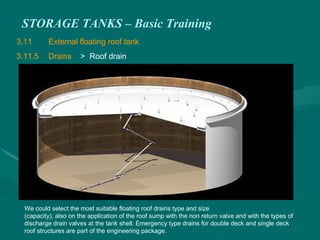
3.11.5 Drains > Roof drain
We could select the most suitable floating roof drains type and size
(capacity), also on the application of the roof sump with the non return valve and with the types of
discharge drain valves at the tank shell. Emergency type drains for double deck and single deck
roof structures are part of the engineering package.
STORAGE TANKS – Basic Training
3.11 External floating roof tank
3.11.6 Foam Dams
> Foam dams collect debris and therefore retain water causing
excessive corrosion of dam/ deck joint, roof annulars and seal
connections. The dam drain holes should always unplugged.`
STORAGE TANKS- Basic Training
4.0 Tank Fittings
4.1 Operational Fittings for vertical Tanks
Standard range of fittings and accessories
Tanks shall be provided with the standard range of fittings and
accessories. Optional fittings shall be supplied only when specified by
the owner.
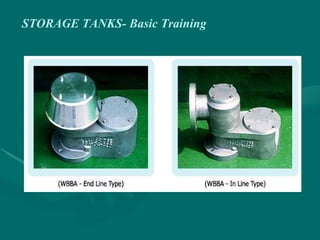
4.1.1 Breather valves (pic) and free vents
The number and sizes of breather valves and free vents required
should be specified separately due to large variations is
pumping rates, etc.
When deciding on the number of free vents required, their capacity
shall be taken into account.
Note: If the storage capacity of an existing tank is increased by
fitting additional courses of shell plates, the venting capacity
of the enlarged tank shall be checked, and increase if
necessary.
STORAGE TANKS- Basic Training
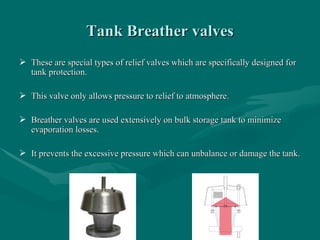
Tank Breather valves
 These are special types of relief valves which are specifically designed for
These are special types of relief valves which are specifically designed for
tank protection.
tank protection.
 This valve only allows pressure to relief to atmosphere.
This valve only allows pressure to relief to atmosphere.
 Breather valves are used extensively on bulk storage tank to minimize
Breather valves are used extensively on bulk storage tank to minimize
evaporation losses.
evaporation losses.
 It prevents the excessive pressure which can unbalance or damage the tank.
It prevents the excessive pressure which can unbalance or damage the tank.
STORAGE TANKS – Basic Training
4.1 Operational Fittings for vertical Tanks (cont)
4.1.3 Required venting capacity
The venting requirements shall include the following conditions:
• Inbreathing resulting from a maximum outflow from the tank
• Inbreathing resulting from contraction of vapors caused by a
maximum decrease in atmospheric temperature
• Outbreathing resulting from a maximum inflow of product into the
tank and maximum evaporation caused by such inflow
• Outbreathing resulting from expansion and evaporation due to a
maximum in atmospheric temperature (thermal breathing)
• Outbreathing resulting from the fire exposure
Note: Both cone and dome shaped fixed roof tanks shall be
designed to fail at the roof-to-shell connection when
subjected to an internal explosion or sudden increase in
pressure.
STORAGE TANKS – Basic Training
4.1 Operational Fittings for vertical Tanks (cont)
4.1.4 Thermal venting
Special attention is required to the influence of a sudden drop in
temperature (e.g. due to rainfall) on the venting requirements of
tanks containing warm product and for tanks in tropical areas.
A drop of 20 oC or more in 15 minutes may be experienced. Where
these conditions apply the venting shall be increased by at least 20%
of the thermal venting capacity requirements.
Tank N
Tank N2
2 blanketing/Inerting
blanketing/Inerting
• N2 Blanketing System is a insert gas control system to
N2 Blanketing System is a insert gas control system to
maintain the positive(+) interior pressure of vessel.
Objectives:
Objectives:
 It removes the explosive factor by controlling hazardous gas
It removes the explosive factor by controlling hazardous gas
such as oxygen from the vapor space of tank
 It prevents the damage of product by blocking the inflow of
It prevents the damage of product by blocking the inflow of
useless moisture and gas.
 It protects the tank from explosion by restricting spark.
It protects the tank from explosion by restricting spark.
STORAGE TANKS – Basic Training
4.2 Fittings Common to All Vertical Tanks
4.2.1 Stairways, handrails, etc.
Vertical tanks should be provided with spiral stairways. An
exception may be made for groups of tanks of less than 12.5 m
diameter sited close together and connected by walkways at roof level.
In such groups, two tanks at opposite ends of each group shall be
provided with stairways, so that each tank in that group will then have at
least two escape routes from the roof.
Handrails shall be provided at the edge of the roof for full
circumference of all fixed roof tanks and to the centre of the roof on all
tanks exceeding 12.5 m diameter. Handrails shall be provided on the
outside of all spiral stairways. For open top tanks, the inside of the
staircases shall also be provided with a handrail in the immediate vicinity
of the top landing.
Caution: Always have one hand free to hold the railing while
using the tank stairways.
STORAGE TANKS- Basic Training
4.2 Fittings Common to All Vertical Tanks
4.2.1 Stairways, handrails, etc. (cont)
Handrails shall be provided on both sides of all walkways
between tanks.
Note: The Owner shall specify on the requisition if it is required that
all stairways and walkways are to be provided with
galvanized, open grating (25 mm deep with main bearing
strips of 5 mm thickness).
Stairways shall be provided with the specified lighting facilities.
STORAGE TANKS – Basic Training
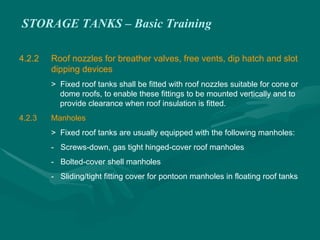
4.2.2 Roof nozzles for breather valves, free vents, dip hatch and slot
dipping devices
> Fixed roof tanks shall be fitted with roof nozzles suitable for cone or
dome roofs, to enable these fittings to be mounted vertically and to
provide clearance when roof insulation is fitted.
4.2.3 Manholes
> Fixed roof tanks are usually equipped with the following manholes:
- Screws-down, gas tight hinged-cover roof manholes
- Bolted-cover shell manholes
- Sliding/tight fitting cover for pontoon manholes in floating roof tanks
STORAGE TANKS – Basic Training
4.2 Fittings Common to All Vertical Tanks
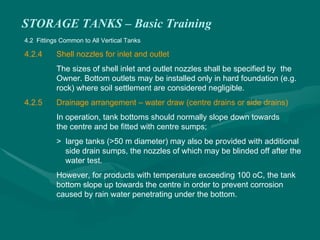
4.2.4 Shell nozzles for inlet and outlet
The sizes of shell inlet and outlet nozzles shall be specified by the
Owner. Bottom outlets may be installed only in hard foundation (e.g.
rock) where soil settlement are considered negligible.
4.2.5 Drainage arrangement – water draw (centre drains or side drains)
In operation, tank bottoms should normally slope down towards
the centre and be fitted with centre sumps;
> large tanks (>50 m diameter) may also be provided with additional
side drain sumps, the nozzles of which may be blinded off after the
water test.
However, for products with temperature exceeding 100 oC, the tank
bottom slope up towards the centre in order to prevent corrosion
caused by rain water penetrating under the bottom.
STORAGE TANKS - Basic Training
4.2 Fittings Common to All Vertical Tanks
4.2.6 Water spray system
If specified by the Owner, a water spray system shall be supplied.
4.2.7 Foam connection
If specified by the Owner, floating roof tanks shall be equipped with a
foam system.
Floating roof tanks shall be provided with a foam dam.
If specified by the Owner, fixed roof tanks shall be equipped with
a semi-fixed subsurface type or semi-fixed top pourer type foam
extinguishing system.
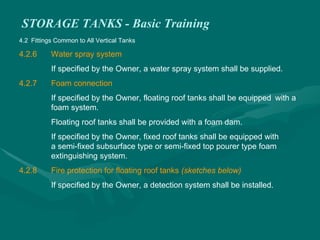
4.2.8 Fire protection for floating roof tanks (sketches below)
If specified by the Owner, a detection system shall be installed.
STORAGE TANKS – Basic Training
4.2. Fittings Common to All Vertical Tanks
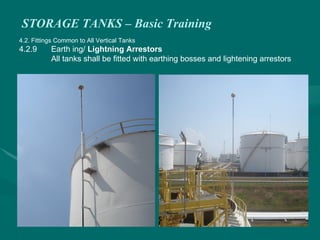
4.2.9 Earth ing/ Lightning Arrestors
All tanks shall be fitted with earthing bosses and lightening arrestors
STORAGE TANKS – Basic Training
4.2. Fittings Common to All Vertical Tanks
4.2.9 Earth ing/ Lightning Arrestors
All tanks shall be fitted with earthing bosses and lightening arrestors
4.2.10 Liquid level indicators
Liquid indicators or automatic liquid-level gauges shall be fitted to all
tanks.
The construction of the gauge poles depends on the operational
conditions and the required measurement accuracy of the level
gauges.
4.2.11 Dip plate or datum plate
A 6 mm thick dip plate shall be provided for welding to the tank bottom
or lowest shell course directly under the dip fittings (i.e. dip hatch,
slot dipping devices and combined vent and dip hatches).
STORAGE TANKS – Basic Training
4.3 Additional fittings for fixed roof tanks
4.3.3 Level alarms/ indication system
At least two independent level alarm systems shall be provided:
- Low, high and high/high level alarms (ATG)
- Independent high level alarm
The Hi/Hi level shall be set such that the maximum filling height is
limited to 200 mm below the top of the shell.
STORAGE TANKS – Basic Training
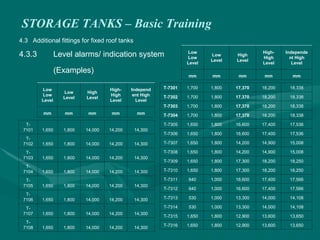
4.3 Additional fittings for fixed roof tanks
4.3.3 Level alarms/ indication system
(Examples)
T-
7101 1,650 1,800 14,000 14,200 14,300
T-
7102 1,650 1,800 14,000 14,200 14,300
T-
7103 1,650 1,800 14,000 14,200 14,300
T-
7104 1,650 1,800 14,000 14,200 14,300
T-
7105 1,650 1,800 14,000 14,200 14,300
T-
7106 1,650 1,800 14,000 14,200 14,300
T-
7107 1,650 1,800 14,000 14,200 14,300
T-
7108 1,650 1,800 14,000 14,200 14,300
Low
Low
Level
Low
Level
High
Level
High-
High
Level
Independ
ent High
Level
mm mm mm mm mm
T-7301 1,700 1,800 17,370 18,200 18,338
T-7302 1,700 1,800 17,370 18,200 18,338
T-7303 1,700 1,800 17,370 18,200 18,338
T-7304 1,700 1,800 17,370 18,200 18,338
T-7305 1,650 1,800 16,600 17,400 17,536
T-7306 1,650 1,800 16,600 17,400 17,536
T-7307 1,650 1,800 14,200 14,900 15,008
T-7308 1,650 1,800 14,200 14,900 15,008
T-7309 1,650 1,800 17,300 18,200 18,250
T-7310 1,650 1,800 17,300 18,200 18,250
T-7311 640 1,000 16,600 17,400 17,566
T-7312 640 1,000 16,600 17,400 17,566
T-7313 530 1,000 13,300 14,000 14,108
T-7314 530 1,000 13,300 14,000 14,108
T-7315 1,650 1,800 12,900 13,600 13,650
T-7316 1,650 1,800 12,900 13,600 13,650
Low
Low
Level
Low
Level
High
Level
High-
High
Level
Independe
nt High
Level
mm mm mm mm mm
STORAGE TANKS – Basic Training
4.3 Additional fittings for fixed roof tanks
4.3.4 Level alarms/ indication system (cont)
Tanks with an internal floating cover (IFC):
- The Hi/Hi level shall be set such that at least 200 mm clearance
remains between any moving part of the IFC and any obstruction
fixed to the shell, including the roof supporting structure.
- The low level alarm shall be set such that the IFC still remains
floating with its supports at least 100 mm above the tank bottom.
STORAGE TANKS – Basic Training
4.4 Additional fittings for fixed roof tanks
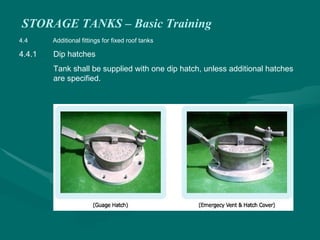
4.4.1 Dip hatches
Tank shall be supplied with one dip hatch, unless additional hatches
are specified.
STORAGE TANKS - Basic Training
4.4 Additional fittings for fixed roof tanks
4.4.3 Heating coils
If specified, heating coils shall be fitted to tanks when products are
required to be maintained at above-ambient temperatures to
facilitate pumping (e.g. on lubricating oil, bitumen and sulfur storage
tanks).
4.4.4 Suction heaters
If specified, suction heaters shall be provided for tanks fitted with
coils when additional localized heat is required at the outlet
connection. These heaters are usually of the nested tube type, and are
suitable for steam or heat transfer fluid systems.
4.4.5 Angle ring for tank roof insulation
When tank roofs are to be insulated an additional circumferential
angle ring and various small fittings shall be provided to retain the
insulation material, which is terminated below the top curb angle.
STORAGE TANKS _ Basic Training
4.4 Additional fittings for fixed roof tanks
4.2.6 Side-entry mixers
Side-entry mixers may be required to improve mixing of the product
or to reduce the formation of sludge. If side-entry mixers are to be
installed, the required shell connections shall be specified. Side-entry
mixers shall be placed on manholes-type shell nozzles to allow easy
removal for maintenance without entering the tank.
4.2.7 Sample connections and thermo-indicators
If specified, sample connections and thermo-indicators shall be
provided adjacent to the spiral stairway. Such connections shall be
flanged.
STORAGE TANKS – Basic Training
4.5 Special fittings and accessories for floating roof
4.5.1 Primary roof seals
The circumferential primary roof seal may comprise metallic shoes
having flexible seals with a weight or spring-operated pusher
mechanism, or be a compression plate type seal, or a fabric foam
filled seal.
- the lower part of the metallic shoe shall be submerged in the
product;
- compression plate types shall be provided with a continuous
weighted skirt which is partly submerged in the product.
- foam filled envelope seal shall be of the liquid mounted type.
Rim mounted secondary roof seals shall be used in all primary roof
seal systems. Both primary and secondary seals shall have a
minimum inward and outward flexibility of 125 mm.
STORAGE TANKS – Basic Training
4.5 Special fittings and accessories for floating roof
4.5.2 Fittings
All floating roof shall be equipped with a complete set of
accessories required for the proper functioning of the floating roof.
> Support legs
Adjustable supporting legs are provided on which the roof rests in
its lowest position during operation and in its highest position during
maintenance operations.
Pad plates shall be located on the bottom for each supporting leg.
STORAGE TANKS – Basic Training
4.5 Special fittings and accessories for floating roof
4.5.3 Fittings (cont)
> Roof drains
Floating roofs shall be fitted with roof drains. Roof drains could be
articulated pipe and coflexip hose. A check valve shall be
provided near the roof end of the articulated pipe or hose, to
prevent backflow of stored product onto the roof in case of leakage in the
pipe joints or hose/ hose fittings.
Depending on the size of the tank and amount of rainfall, two or
more roof drains should be installed.
STORAGE TANKS – Basic Training
4.5 Special fittings and accessories for floating roof
4.5.3 Fittings (cont)
> Access ladder to the roof
The access ladder to the roof shall be equipped with self-leveling stair
treads. The rails shall be placed at such a height above the centre
deck that rain water on the deck cannot affect movement of the
ladder. The ladder shall be provided with an anti-derailing device to
prevent uplift of the ladder during strong winds.
> Earthing
In addition to the earthing bosses on the tank shell, electrical earthing
facilities (spring stainless steel shunts) shall be fitted for the earthing
of the floating roof across the rim space at a maximum interval of 2.5
meter. Their sliding contact with the shell, shall be in the open air
above the secondary seal. An earthing cable be along the access
ladder to the roof.
STORAGE TANKS – Basic Training
4.5 Special fittings and accessories for floating roof
4.5.3 Fittings (cont)
> Automatic bleeder vents
Automatic bleeder vents shall be provided to vent the air from under
the floating roof when the tank is being filled initially. They shall also
open automatically just before the roof lands on its supports, thereby
preventing the development of a vacuum under the roof. The capacity
of the vents shall be based on the maximum pumping rates.
> Rim vents for metallic shoe type seals
Rim vent shall be provided to prevent any excess pressure in the
rim space, as this might press the shoe ring too tightly against the
tank shell. Settling shall be plus and minus 2.5 mbar.
STORAGE TANKS – Basic Training
4.5 Special fittings and accessories for floating roof
4.5.3 Fittings (cont)
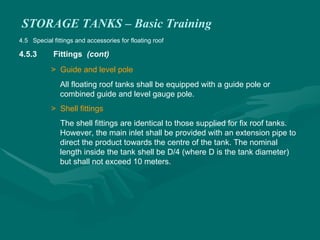
> Guide and level pole
All floating roof tanks shall be equipped with a guide pole or
combined guide and level gauge pole.
> Shell fittings
The shell fittings are identical to those supplied for fix roof tanks.
However, the main inlet shall be provided with an extension pipe to
direct the product towards the centre of the tank. The nominal
length inside the tank shell be D/4 (where D is the tank diameter)
but shall not exceed 10 meters.
STORAGE TANKS – Basic Training
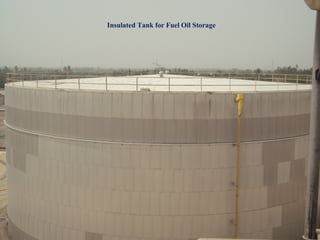
Insulated Tank for Fuel Oil Storage
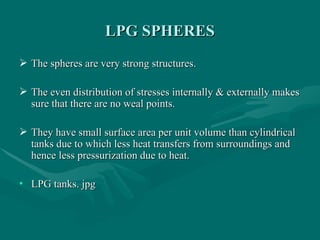
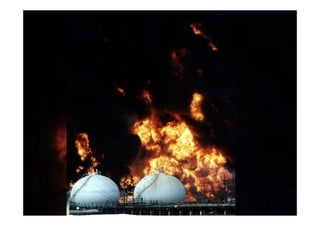
LPG SPHERES
LPG SPHERES
 The spheres are very strong structures.
The spheres are very strong structures.
 The even distribution of stresses internally & externally makes
The even distribution of stresses internally & externally makes
sure that there are no weal points.
 They have small surface area per unit volume than cylindrical
They have small surface area per unit volume than cylindrical
tanks due to which less heat transfers from surroundings and
hence less pressurization due to heat.
• LPG tanks. jpg
LPG tanks. jpg
STORAGE TANKS – Basic Training
Tank Dyke wall
This is a wall always built around bulk storage tanks for following purposes :
 To prevent spreading of oil if tank is leaked
To prevent Flood water to become close to tank which can destroy the tank
foundation
STORAGE TANKS – Basic Training
5.0 Tank Inspection
5.1 Inspection Frequencies
5.1.1 General
> It is important for the inspection of tank to be based upon a long
term program particularly where plant operator is dealing
with extensive tank farm installation involving numerous tanks in a
variety of service.
> If deferred for long then there is a risk of tank deteriorating and
developing defects which could lead to major leakage, fires and
pollution incidents.
> In-service inspection can give a good indication of integrity and
operability. However, there is no substitute in most operations for
out-of-service inspection.
STORAGE TANKS – Basic Training
5.0 Tank Inspection
5.1 Inspection Frequencies
5.1.2 External Inspection
> External inspection should take two forms.
Firstly, field operators should check for any abnormal situations
during the daily work or during scheduled checks
> Secondly a detailed on-stream inspection should be undertaken by
the inspection department
> It is important for inspectors to thoroughly evaluate the results of
on-stream inspections to revalidate the scope, extent and
frequency of such inspections and to further justify the interval of
thorough internal examination.
STORAGE TANKS – Basic Training
5.0 Tank Inspection
5.1 Inspection Frequencies
5.1.3 Internal Inspection
> The tables in the notes provides guidance on the frequency of out-
of-service interval inspections. The intervals are based on tanks
exhibiting no undue abnormalities or deterioration during
operations and on-stream inspections.
> External or internal corrosion, excessive foundation settlement etc.,
should be thoroughly investigated and the inspection interval
reduced accordingly.
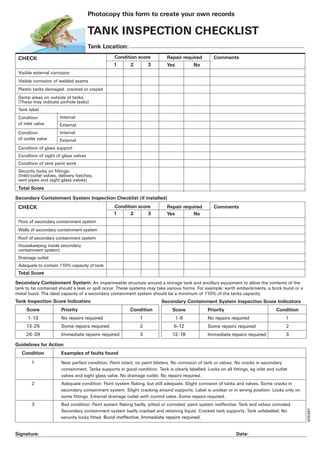
Refer to the notes provided on INSPECTION where Inspection
checklists are attached.
Tank Types
• Coned Roof
• Internal/Covered Floaters
• External/Open Top Floaters
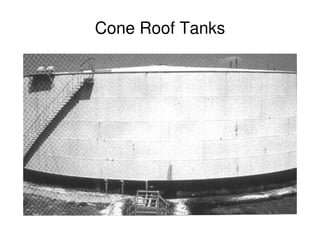
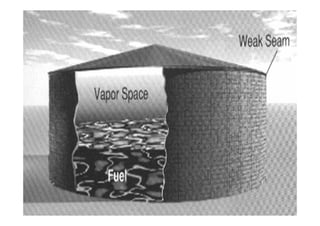
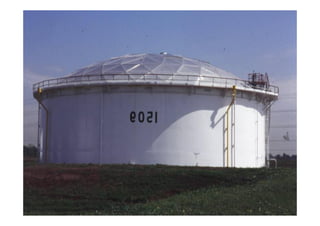
Cone Roof Tanks
Pressure Vacuum Vent
https://www.motherwelltankprotection.com/
Pressure/Vacuum Vent
Roof To Shell Seam
Weak Seam
Roof To Shell Seam
Incidents Involving Coned
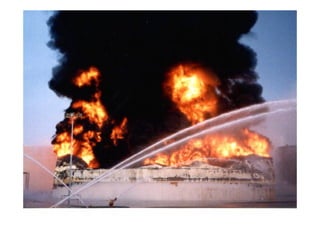
Roof Tanks
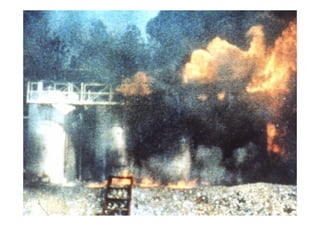
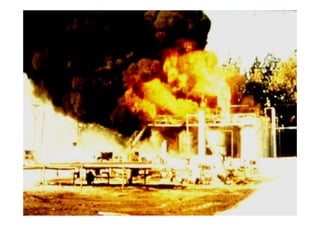
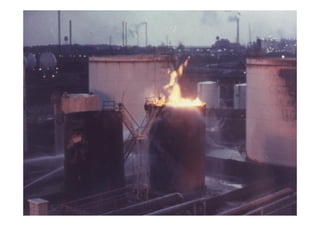
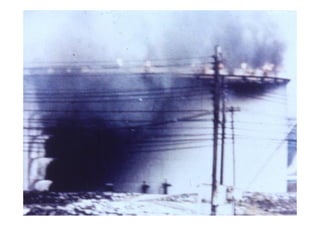
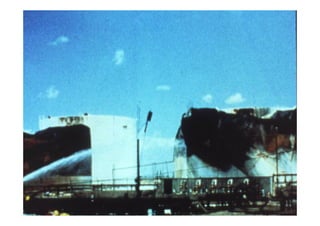
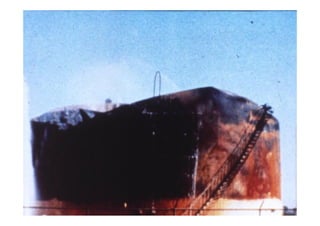
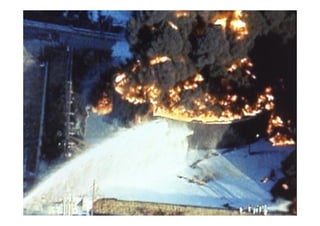
• Pressure/Vacuum vent fires
• Fish mouthed fires
• Full surface fires
• Manifold fires
• Dike fires
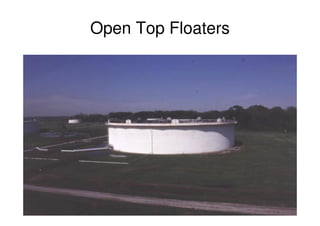
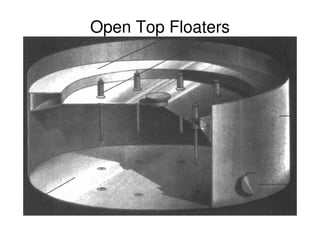
Open Top Floaters
Open Top Floaters
Open Top Floaters
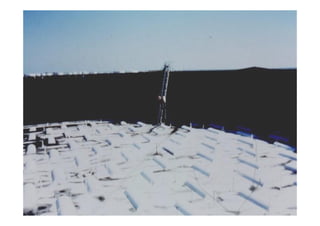
The floating roof eliminates the vapor space
above the liquid.
Open Top Floaters
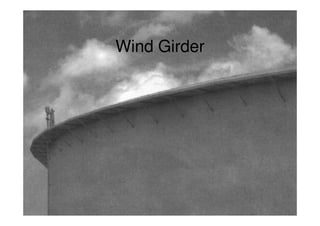
Open top, or external floaters, are designed
with a stiffening ring (commonly known as a
wind girder) to add support due to the
absence of a roof.
Wind Girder
Roof Seals
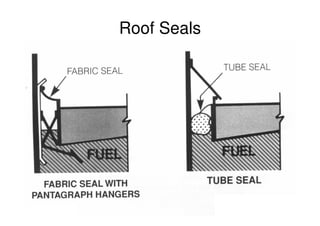
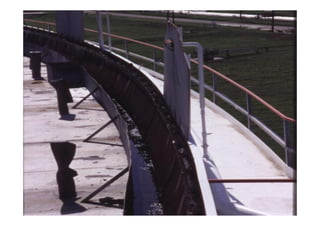
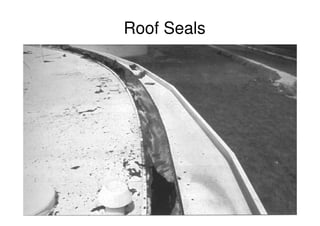
• Provide spacing to allow for the roof to
travel up and down on the product
without touching the tank wall.
• Provide a barrier between the fuel
surface and the atmosphere.
Roof Seals
Roof Seals
Incidents Involving Open Top
Floaters
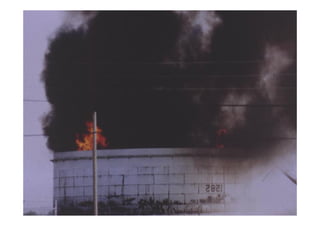
• Seal fires
• Full surface fires
• Dike fires
• Manifold fires
Internal Floating Roof Tanks
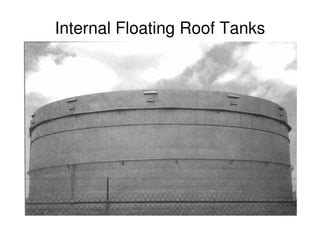
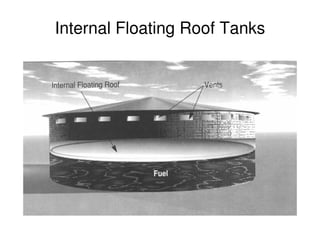
Same basic design as the open top floater but it
also utilizes a fixed roof.
Internal Floating Roof Tanks
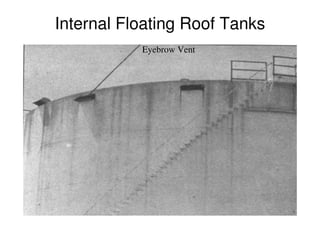
Internal floating roof tanks can be identified
and distinguished from the cone roof tank and
the open top floater by the characteristic
“eyebrow” vents at the top of the tank shell.
Internal Floating Roof Tanks
Eyebrow Vent
Incidents Involving Internal
Floaters
• Vent fires
• Fish mouthed fires
• Full surface fires
• Dike fires
• Manifold fires
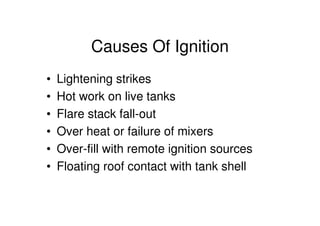
Causes Of Ignition
• Lightening strikes
• Hot work on live tanks
• Flare stack fall-out
• Over heat or failure of mixers
• Over-fill with remote ignition sources
• Floating roof contact with tank shell
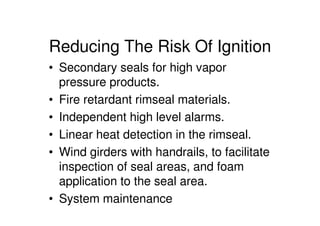
Reducing The Risk Of Ignition
• Secondary seals for high vapor
pressure products.
• Fire retardant rimseal materials.
• Independent high level alarms.
• Linear heat detection in the rimseal.
• Wind girders with handrails, to facilitate
inspection of seal areas, and foam
application to the seal area.
• System maintenance
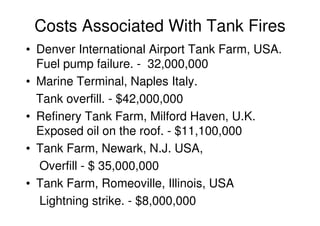
Costs Associated With Tank Fires
• Denver International Airport Tank Farm, USA.
Fuel pump failure. - 32,000,000
• Marine Terminal, Naples Italy.
Tank overfill. - $42,000,000
• Refinery Tank Farm, Milford Haven, U.K.
Exposed oil on the roof. - $11,100,000
• Tank Farm, Newark, N.J. USA,
Overfill - $ 35,000,000
• Tank Farm, Romeoville, Illinois, USA
Lightning strike. - $8,000,000
STORAGE WITH
ACCEPTABLE RISK
WWW.SGS.COM
YOUR COMPETENT BUSINESS PARTNER FOR INSPECTION,
VERIFICATION AND TESTING
Headquartered in Geneva, Switzerland,
the SGS Group is the global leader
and innovator in inspection, verification,
testing and certification services.
Founded in 1878, SGS is recognised
as the global benchmark in quality and
integrity.
Industrial Services as one of the largest
business lines within the SGS Group is
a global provider of technical inspection,
verification, testing and conformity
assessment services for all industrial
markets.
The core values of complete independence,
transparency and integrity guide us in our
mission to deliver first-class services on
a constant high quality level to customers
around the world.
Partnering with SGS guarantees access
to unparalleled know-how and facilities.
We eliminate uncertainty, enhance
mutual confidence, and offer you the
freedom to concentrate on the things
that really matter: the growth of your
core operations and the profitability of
your enterprise.
Storage of large quantities of hazardous substances entails risk for the population, the environment and the
surrounding area. Spills of hazardous substances into the soil can lead to expensive decontamination processes.
Leakage from storage tanks containing oil, gas or chemicals can be caused by the influence of weather on
the external surfaces, or material can be affected by internal temperature variations. These situations could lead
to a disaster. Periodic inspections, conducted in good time, can prevent such disasters from happening.
STORAGE TANK INSPECTION & AUDIT
In order to assure your Storage Tanks
compliance with Local Regulations as
well as with the relevant Standards and
Codes, SGS provides Technical Audits
according to EN 14015, API 650 or 653,
EEMUA 159 or Clients’ Specifications.
These Inspections include
• Tank foundation and settlements
evaluation
• Tank bottom evaluation
• Tank shell evaluation
• Tank roof evaluation
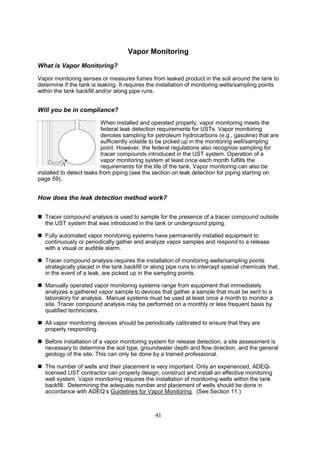
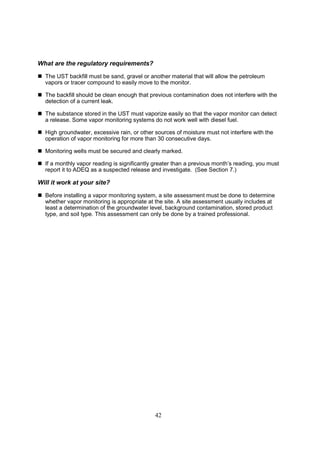
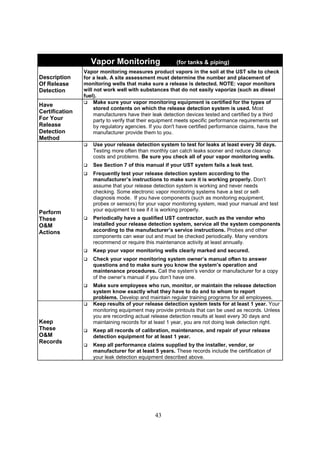
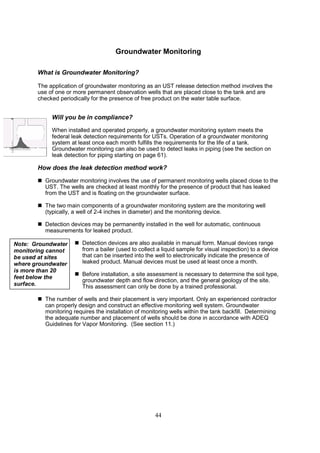
• Tank access evaluation
• Tank security instruments check
• Tank environmental study
• Survey of repairs
SGS has the experience, the
accreditations and the equipment to
carry out expert controls and
inspections for owners of storage
sites for hazardous substances and
installations in all industrial sectors.
With the competence of a Notified Body,
SGS performs independent assessment,
testing and verification for storage tanks.
Besides periodic visual inspections, SGS
is also a specialist in Non-Destructive
Testing (NDT). By offering a complete
range of Conventional NDT Techniques
and Special Examinations, SGS is in
the position to provide not just a list of
standard techniques but solutions using
a combination of multiple techniques.
Full Service
• Periodic visual external and internal
inspections
• Fugitive emission and leak detection
through infrared camera
• Mechanical integrity study
• NDT techniques
• Traditional NDT techniques
• Floorscan/Magnetic Flux Leakage
• Corrosion Mapping
• Tracing of system leaks and
determination of material strengths
• Hydrostatic pressure tests
• Ultrasonic density tests
• Determination of water and sludge
inside containers
• Determination of subsoil
corrosiveness
• Safety systems control
• External thickness measurements
and calculation reviews
• Adjustment and stamping of
identification plates
• Welding procedures and welding
qualifications for customary
international standards, including
ASME, ISO15614 and DIN EN 287
• Project Management and Supervision
of Construction
• Environmental impact studies and
risk analysis
SGS also monitors safety procedures
for cleaning or welding activities of
contractors during maintenance on-site.
This applies for facilities such as
• 
Underground and aboveground
flammable and hazardous product
storage sites
• Storage tanks for compressed or
liquefied gases
Standards and Codes
SGS inspects tanks for conformity with
all international construction codes and
standards, such as EN, API, BS, DIN,
ASME, AD Merkblätter, RTOD.
Recognition and accreditations
• Accreditation according to EN ISO/
IEC 17020 and 17025
• NDT operators certified according to
SNTC-1A and EN473 standards
• Recognised Third Party
NON-DESTRUCTIVE TESTING
The storage of dangerous goods in tanks
must be executed in a safe way. In order
to reduce the economical as well as the
environmental risks, a thorough
knowledge of the tank condition, and in
particular the tank bottom and shells, is
of outmost importance.
With the knowledge and inspection
experience of SGS, Non-Destructive
Testing (NDT) services provide your
installation with added quality, cost
reduction, business security and
improved safety, for both existing and
new installations. NDT gives a clear
insight into the risk of leakage or other
safety critical defects, which increases
the integrity and safety within the
installation, and hence avoids undue
operating expenses.
Non-Destructive Testing of storage tanks
includes several methods of examining
materials, components and connections
in order to identify and quantify material
defects and degradations.
Tank Bottom Inspection
For the inspection of tank bottoms, SGS
offers you a quick and above all reliable
inspection by combining two techniques:
Magnetic Flux Leakage (MFL) and
Ultrasonic Testing (UT). By using these
two techniques, corrosion is detected
effectively (MFL) and reliably quantified
(UT).
MFL is a detection technique, which
detects volumetrically changes. A strong
magnet induces a magnetic field in the
material. On a corrosion spot, a leakage
field will arise. The larger the corrosion
the larger the field will be.
After the fast MFL inspection is done,
the “suspicious” areas of the tank
bottom surface will be quantified by the
slow but more accurate UT.
Tank Shell Inspection
To assess the accurate wall thickness
of tank shells we use a rugged remote
access ultrasonic crawler. The equipment
is designed to allow cost effective
ultrasound thickness measurements on
above ground ferro-magnetic structures
without the need for costly scaffolding
or rope access.
The crawler system can be automatically
or manually operated and transverses
the tank shell either at equal distant
points or 100% around the tank
circumference.
The multi-axis robotic inspection arm is
capable of taking ultrasonic measurements
and transmitting the wall thickness and A
– and D-Scan inspection data in real time
to the operator’s remote panel. Different
colours will visualise degradation levels
and concentrations of corrosion during the
scan and later in the report.
Special Leak Testing
Leaks in installations or vessels can
cause environmental pollution and waste
of expensive fuel and energy. Therefore,
Leak Testing is performed to locate leaks
and measure the leakage of pressurised
(or decompressed) test products.
SGS performs the following Leak Test
methods
• Ammonia Leak Test
• Helium Leak Test
• Bubble Leak Test
• Pressure Change Measurement Test
TANK CALIBRATION
Reliable quantity measurement is
the critical basis of good contractual
relationships in worldwide trading of
chemicals, petroleum products and
liquefied gases.
This can only be assured by accurate
and regular calibration.
When you need to be sure of your tank
calibration results, SGS has the leading
solution. SGS innovative laser-calibration
measurement technology helps
companies to reduce time and costs of
tank management, as well as offering
precise storage tank calibration to
ISO7504.
Our motorised laser technology and
specialist software deliver results that
are accurate, fast and safe to cost-efficient
management for storage tanks, gas
vessels and stockpile measurements.
Not just volumes, but accurate roundness
surveys, tank tilt and settlement and
other construction measurements are
straightforward.
What is the precise capacity of your
tank? The difference can mean
thousands of dollars to your business.
SGS’ approach will replace the traditional
2-day turnaround with increased accuracy.
Features include
• Tank floor volume measurement
that can save 300% compared to
alternatives
• Automated measurement to
minimise human errors
• Faster results – just four hours
• Feduce down-time on your plant
operations
The combination of accurate, fast and
comprehensive calibration results helps
companies to drive cost-efficiencies.
Our calibration engineers use the
measurements to deliver comprehensive
results, so you can
• 	Gain a more accurate picture of the
current dimensions and state of your
bulk storage containers
• 	See a visual guide to the condition of
your plant using our 3D mapping of
the results
• Enable long-term management of
maintenance using trend analysis of
historical results
SGS offers you a full-service approach,
and provides regular measurement to
reduce the total plant cost of ownership,
and to
• 	Deliver volumes with calibrated and
measured confidence over time
• Calibrate to constantly be within
agreed limits
• Use our 3D modelling of tank floor
and shell to plan future floor levelling
and floating roofs installation
• Have 24/7 access to your data
When you use one of our highly trained
and professional calibration engineers,
you are tapping into the SGS global
network of the world‘s leading
inspection, verification, testing and
certification company. You will find our
calibration experts have the years of
experience needed to manage a wide
range of measurement situations.
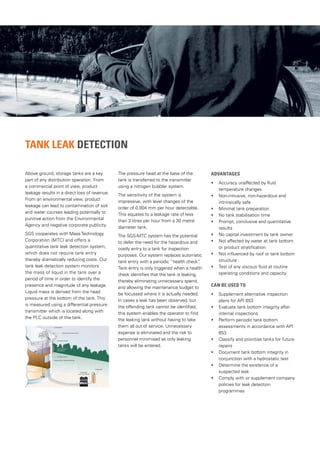
Tank Leak Detection
Above ground, storage tanks are a key
part of any distribution operation. From
a commercial point of view, product
leakage results in a direct loss of revenue.
From an environmental view, product
leakage can lead to contamination of soil
and water courses leading potentially to
punitive action from the Environmental
Agency and negative corporate publicity.
SGS cooperates with Mass Technology
Corporation (MTC) and offers a
quantitative tank leak detection system,
which does not require tank entry
thereby dramatically reducing costs. Our
tank leak detection system monitors
the mass of liquid in the tank over a
period of time in order to identify the
presence and magnitude of any leakage.
Liquid mass is derived from the head
pressure at the bottom of the tank. This
is measured using a differential pressure
transmitter which is located along with
the PLC outside of the tank.
The pressure head at the base of the
tank is transferred to the transmitter
using a nitrogen bubbler system.
The sensitivity of the system is
impressive, with level changes of the
order of 0.004 mm per hour detectable.
This equates to a leakage rate of less
than 3 litres per hour from a 30 metre
diameter tank.
The SGS-MTC system has the potential
to defer the need for the hazardous and
costly entry to a tank for inspection
purposes. Our system replaces automatic
tank entry with a periodic ”health check”
.
Tank entry is only triggered when a health
check identifies that the tank is leaking,
thereby eliminating unnecessary spend,
and allowing the maintenance budget to
be focussed where it is actually needed.
In cases a leak has been observed, but
the offending tank cannot be identified,
this system enables the operator to find
the leaking tank without having to take
them all out of service. Unnecessary
expense is eliminated and the risk to
personnel minimised as only leaking
tanks will be entered.
ADVANTAGES
• Accuracy unaffected by fluid
temperature changes
• Non-intrusive, non-hazardous and
intrinsically safe
• Minimal tank preparation
• No tank stabilisation time
• Prompt, conclusive and quantitative
results
• No capital investment by tank owner
• Not affected by water at tank bottom
or product stratification
• Not influenced by roof or tank bottom
structure
• Test of any viscous fluid at routine
operating conditions and capacity
CAN BE USED TO
• Supplement alternative inspection
plans for API 653
• Evaluate tank bottom integrity after
internal inspections
• Perform periodic tank bottom
assessments in accordance with API
653
• Classify and prioritise tanks for future
repairs
• Document tank bottom integrity in
conjunction with a hydrostatic test
• Determine the existence of a
suspected leak
• Comply with or supplement company
policies for leak detection
programmes
the art of tank gauging
For safety and precision
2
Preface
This document gives an introduction into modern tank gauging,
how and where it can be used.
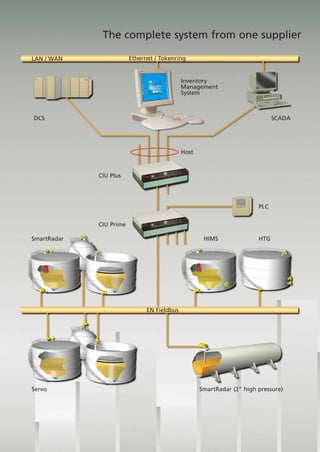
Accurate Servo- and Radar gauging, Hydrostatic Tank Gauging
(HTG) and the Hybrid Inventory Management System (HIMS),
combining the advantages of all systems, are described.
An uncertainty analysis of the tank inventory data is described
and the results are used for a concise comparison of tank
gauging systems. Uncertainties caused by the installation are
listed and clarified. Current technologies employed in tank
gauging, and future trends and possibilities of inventory
systems are presented.
Copyright by:
Enraf B.V.
Delftechpark 39, 2628 XJ Delft
P.O. Box 812, 2600 AV Delft
The Netherlands
Tel.: +31 (0)15 2701 100
Fax: +31 (0)15 2701 111
Email: info@enraf.nl
http://www.enraf.com
3
Contents
Preface . . . . . . . . . . . . . . . . . . . . . . . . . . . . . . . . . . . . . . . . . . 2
1 An introduction to Tank Gauging . . . . . . . . . . . . . . . 4
1.1 What is Tank Gauging? . . . . . . . . . . . . . . . . . . . . . . . . . . . . 4
1.2 Why Tank Gauging? . . . . . . . . . . . . . . . . . . . . . . . . . . . . . . . 4
1.2.1 Inventory control . . . . . . . . . . . . . . . . . . . . . . . . . . . . . . . . . . 4
1.2.2 Custody transfer . . . . . . . . . . . . . . . . . . . . . . . . . . . . . . . . . . 5
1.2.3 Oil Movement  operations . . . . . . . . . . . . . . . . . . . . . . . . 5
1.2.4 Leak detection  Reconciliation . . . . . . . . . . . . . . . . . . . . .6
2 Tank Gauging techniques . . . . . . . . . . . . . . . . . . . . . . . . 7
2.1 Manual gauging . . . . . . . . . . . . . . . . . . . . . . . . . . . . . . . . . . . 7
2.2 Float and tape gauges . . . . . . . . . . . . . . . . . . . . . . . . . . . . . 7
2.3 Servo gauges . . . . . . . . . . . . . . . . . . . . . . . . . . . . . . . . . . . . . 7
2.4 Radar gauges . . . . . . . . . . . . . . . . . . . . . . . . . . . . . . . . . . . . . 8
2.5 Hydrostatic Tank Gauging . . . . . . . . . . . . . . . . . . . . . . . . . . 9
2.6 Hybrid Inventory Measurement System . . . . . . . . . . . . 10
3 Quantity assessment in Tank Gauging . . . . . . . . . 12
3.1 Level based quantity assessment . . . . . . . . . . . . . . . . . . 12
3.2 Hydrostatic based quantity assessment . . . . . . . . . . . . 13
3.3 Hybrid based quantity assessment . . . . . . . . . . . . . . . . . 13
4 Uncertainties in Tank Gauging . . . . . . . . . . . . . . . . . 14
4.1 Sources of errors . . . . . . . . . . . . . . . . . . . . . . . . . . . . . . . . . 14
4.2 Overview of uncertainties . . . . . . . . . . . . . . . . . . . . . . . . . 15
5 Safety . . . . . . . . . . . . . . . . . . . . . . . . . . . . . . . . . . . . . . . . . . 16
5.1 Hazards of fire and explosions . . . . . . . . . . . . . . . . . . . . 16
5.2 Lightning and Tank Gauging . . . . . . . . . . . . . . . . . . . . . . 16
5.2.1 Suppression circuit . . . . . . . . . . . . . . . . . . . . . . . . . . . . . . . 16
5.2.2 Diversion circuit . . . . . . . . . . . . . . . . . . . . . . . . . . . . . . . . . . 17
5.2.3 Grounding and shielding . . . . . . . . . . . . . . . . . . . . . . . . . 17
5.2.4 Field experience . . . . . . . . . . . . . . . . . . . . . . . . . . . . . . . . . . 17
6 Developments in Tank Gauging Technology . . . 18
6.1 Servo gauges . . . . . . . . . . . . . . . . . . . . . . . . . . . . . . . . . . . . 18
6.2 Radar gauges . . . . . . . . . . . . . . . . . . . . . . . . . . . . . . . . . . . . 18
6.3 Temperature gauges . . . . . . . . . . . . . . . . . . . . . . . . . . . . . 19
6.4 Hydrostatic Tank Gauging . . . . . . . . . . . . . . . . . . . . . . . . 20
6.5 Hybrid Inventory Measurement System . . . . . . . . . . . . 20
6.6 Central Inventory Management System . . . . . . . . . . . . 20
6.7 Interfacing to Host systems . . . . . . . . . . . . . . . . . . . . . . . 21
7 Future trends in Tank Gauging Technology . . . . 22
8 Summary . . . . . . . . . . . . . . . . . . . . . . . . . . . . . . . . . . . . . . . 23
9 Literature . . . . . . . . . . . . . . . . . . . . . . . . . . . . . . . . . . . . . . . 23
The complete system from one supplier . . . . . . . . 24
4
1 An introduction to Tank Gauging
1.1 What is Tank Gauging?
Tank Gauging is the generic name for the static quantity
assessment of liquid products in bulk storage tanks.
Two methods are recognized:
• A volume based tank gauging system.
Quantity assessment based on level- and temperature
measurement.
• A mass based tank gauging system.
Quantity assessment based on hydrostatic pressure of the
liquid column measurement.
Whatever method is used, a high degree of reliability and
accuracy is of paramount importance when the data is used for
inventory control or custody transfer purposes.
Refineries, chemical plants, terminals and independent storage
companies make use of bulk storage tanks for storage of liquid
or liquefied products:
• Common bulk storage tanks are above ground vertical
cylindrical or spherical tanks.
• Vertical cylindrical tanks can be categorized as fixed roof
tanks, with either a cone- or dome roof construction, or
floating roof tanks.
• Underground storage facilities such as caverns are used in
areas where the soil structure permits.
Tank Gauging is essential to determine the inventory of liquid
bulk storage tanks
In order to reduce the vapor losses of fixed roof tanks they can
be fitted with internal floating roofs or screens.
Liquefied gasses are stored under pressure in spherical tanks,
cylindrical vessels or under refrigerated or cryogenic conditions
in specially designed, well insulated tanks.
Typical capacities of bulk storage tanks range from 1.000 m3
(6,300 bbl) to more than 120.000 m3 (755,000 bbl).
The value of the products stored in those tanks amounts to
many millions of dollars.
A level uncertainty of only 1 mm (0.04 inch) or 0.01 % in a
10 m (33 ft) tall, 50.000 m3 tank (315,000 bbl), equals 5 m3
(31 bbl). Hence, accuracy is a prime requisite for good inventory
management, however it is only one of the many aspects
involved in tank gauging. Reliability to prevent product spills
and safety of the environment and personnel are equally
important.
The following listings show a number of requirements for Tank
Gauging Systems.
1.2 Why Tank Gauging?
Tank Gauging is required for the assessment of tank contents,
tank inventory control and tank farm management.
System requirements depend on the type of installation and
operation.
The following types of operation, each having its own specific
requirements, can be categorized:
• Inventory control
• Custody transfer
• Oil movement  operations
• Leak control  reconciliation
1.2.1 Inventory control
Inventory control is one of the most important management
tools for any refinery, terminal or storage company.
Inventory represents a large amount of assets for each
company. Tank inventory control is either based on volume or
mass. However, neither volume nor mass is the sole solution for
accurate and complete inventory control. Products received,
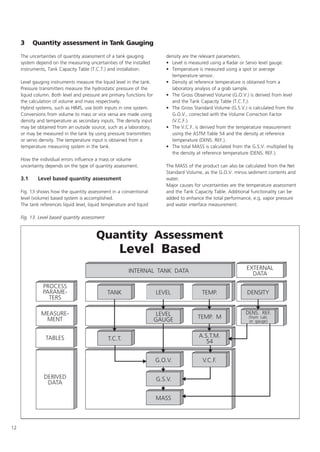
General requirements for a Tank Gauging System
• Safety
• Accuracy and repeatability
• Reliability and availability
• Compatibility with operations
• Stand alone capabilities
• Operator friendly
• Low maintenance
• Easy to expand
Additional requirements
• First order failure detection
• Accepted for custody transfer
• and legal purposes (duties, royalties)
• Compatible with standards (API, etc)
• Interface to Host computer
• Software support
• Upgradability
• Service  spares support
• Acceptable Price/Performance ratio
• Vendors quality assurance procedures (ISO 9000)
• Manuals  documentation
Fig. 1. Refineries make use of bulk storage tanks for which
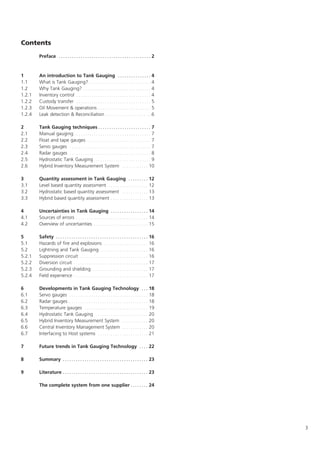
Tank Gauging is essential
5
internal product transfers and delivered products of refineries,
chemical plants and terminals are quite commonly measured in
often incompatible volumetric or mass based units.
Conversions from volume to mass and vice versa have to be
frequently made, so that all measuring parameters like product
level, water interface, density and temperature measurements
are equally important. The combination of volume and mass as
realized in hybrid systems provides the most attractive solution.
In-plant accuracy requirements for inventory control are often
non-critical. The measurement uncertainties do not result in
direct financial losses. Reliability and repeatability are much
more important. Independent storage companies and terminals
which strictly store and distribute products, owned by their
customers, cannot operate without an accurate inventory
control system. Such system should be very reliable, accurate
and provide all inventory data.
1.2.2 Custody transfer
Many installations use their tank gauging system for the
measurements of product transfers between ship and shore
and/or pipeline transmission systems.
A tank gauging system is a very cost effective and accurate
solution compared to flow metering systems, especially when
high flow rates are present and large quantities are transferred.
When flow measuring systems are used, however, the tank
gauging system offers a perfect verification tool.
Where custody transfer or assessment of taxes, duties or
royalties are involved, the gauging instruments and inventory
control system are required to be officially approved and
certified for this purpose.
In countries where such legal certification does not yet apply,
verification of the measurements is often carried out by
surveying companies. They generally use dip tapes, portable
thermometers and sampling cans to measure level, temperature
and density prior to, and after the product transfers.
This is labor intensive and requires considerable time.
Surveyors use the same procedures to calculate volumes or
mass as do modern tank gauging systems. Hence, the presence
of a reliable, certified accurate tank gauging system facilitates
their surveys and will reduce the turn around time.
Another advantage is, that in those cases where the quantity of
product transferred is determined on the basis of opening and
closing tank measurements, some systematic errors are
canceled out.
Hence, the uncertainty of such transfer measurements is better
than can be expected on the basis of uncertainties specified for
tank inventory.
1.2.3 Oil Movement  operations
Generally tank content measurements for day to day
operational use, for scheduling purposes and for blending
programs do not require the same accuracy as custody transfer
operations. However, measurement reliability and repeatability
are important. Reliable level alarms are also a must to operate
safely. A high degree of accuracy and reliability will allow
operations to safely use the maximum tank capacity.
Past experience indicates that a 5 % storage capacity gain can
be achieved.
Oil Movement and operations generally have very strict
equipment requirements. They specify compatibility with their
supervisory control and management systems. Operations will
use availability and easy maintenance as main criteria for
selection of equipment. 'Cost of ownership' calculations,
however, can provide excellent insights in the selection or
evaluation of alternative instrument and measurement
techniques. Still, the user of these type of calculations should
be careful to use only correct and valid arguments.
For example, including the price of a stilling well in a
comparative study for level gauges can be inappropriate if such
a well is already part of the tank construction.
Additionally, better performance, in terms of higher accuracy
and lower maintenance, needs to be valued.
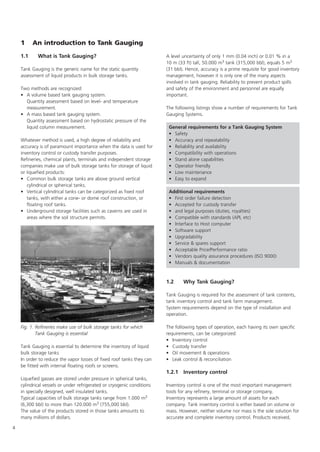
Fig. 2. Example of a central control room for a well-organized
survey of all parameters
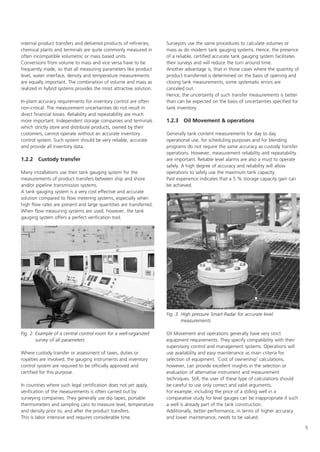
Fig. 3. High pressure Smart Radar for accurate level
measurements
6
For Oil Movement and operations, either mass or volume
measurement techniques can be used. Volume can be derived
from level only; mass can be measured directly by means of
pressure transmitters. Additional information can be obtained
by measuring vapor temperature and pressure.
Density measurement can also be added, with accuracy's from
0.5 % up to 0.1 %. Whichever technique is selected, it should
be compatible with the operations of all parties using the data
from the tank gauging system. As stated earlier, plant
management and control systems can facilitate Oil Movement
and operations. Maintaining data integrity from the field to the
receiving system is essential. A high degree of integration of the
transmission of field-instruments is a pre-requisite. However, as
long as a worldwide standard for digital communication is
missing, different protocols will be in use.
1.2.4 Leak detection  reconciliation
For many decades the oil industry has been concerned with the
financial consequences of oil losses. In recent years, there has
also been an increased awareness of the industry's
environmental impact. Pollution, caused both by liquid spills
and atmospheric emissions, is an area of increased concern,
and the industry has initiated programs to reduce the risks of
environmental damage. Maintaining an accurate leak detection
and reconciliation program is a necessity for any
environmentally conscious tank farm owner.
At the fourth OIL LOSS CONTROL Conference in 1991,
organized by the Institute of Petroleum in Great Britain, several
leading authorities presented papers on nearly every aspect of
loss control. Dr. E.R.Robinson, consultant to the IP Refining
LOSS Accountability Committee, showed with a survey of 11
major UK refineries that an 'average' refinery could have yearly
losses of 0.56 % of the total input quantity. An accurate,
reliable tank gauging system helps to quantify and identify the
source of these losses and offers the tools to prevent losses, or
at least reduce them.
Another paper presented by Dr. J. Miles (SGS Redwood Ltd.)
formulated an interesting approach to loss uncertainty
assessment. Stock is mainly determined on basis of tank
measurement, however, inputs and outputs can also be
assessed via flow, (either volume or mass) and weighing bridge.
Reconciliation of both measurements holds the key to reliable
inventory control and effective loss control. A Hybrid Inventory
Management System (HIMS), combines mass and volume based
inventory systems, improving the reliability and reducing
uncertainties of the overall balance.
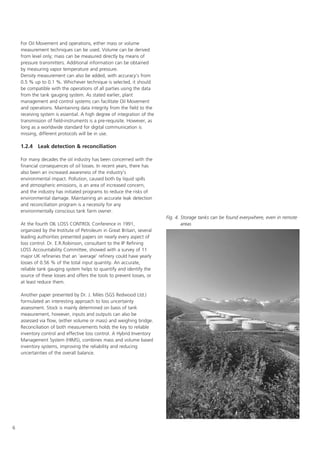
Fig. 4. Storage tanks can be found everywhere, even in remote
areas
7
2 Tank Gauging techniques
Tank gauging has a long history! Since each user and every
application has its own specific requirements, several
measurement techniques and solutions to gauge tank contents
are currently available.
2.1 Manual gauging
Tank gauging started with manual gauging, (Fig. 5) using a
graduated diptape or dipstick. This technique is still used
worldwide, and is today still the verification for gauge
performance calibration and verification.
The typical accuracy of a diptape used for custody transfer
measurements is often specified as ± (0.1 + 0.1 L) mm
[equal to ± (0.004 + 0.0012L') inch] for the initial calibration of
new dip tapes. In the metric formula L is the level in meters and
in the ft and inch formula L' is the level in ft. For tapes in use,
the recalibration accuracy applies. This accuracy is twice the
uncertainty of a new tape. But the tape uncertainty is not the
only cause of error. Accurate hand dipping is a difficult task,
particularly with high winds, cold weather, during night time or
when special protection equipment has to be used.
Additionally, a human error, of at least ± 2 mm (± 0.08 inch),
has to be added to the tape readings. API Standard 2545 is
dedicated completely to manual tank gauging.
Another disadvantage of manual tank gauging is that
employees are often not allowed to be on a tank because of
safety regulations, resulting in costly, long waiting times.
2.2 Float and tape gauges
The first float and tape gauges, also called Automatic Tank
Gauges, were introduced around 1930. These instruments use
a large, heavy float in order to obtain sufficient driving force.
Initially the float was connected via a cable to a balance weight
with a scale and pointer along the tank shell indicating the
level. Newer versions had the float connected, via a perforated
steel tape, to a constant torque spring motor.
The perforations drive a simple mechanical counter which acts
as local indicator. Typical accuracy of a mechanical gauge is in
the range of 10 mm (½ inch). Due to the mechanical friction in
pulleys, spring motor and indicator, the reliability is poor.
Remote indication is possible via an electronic transmitter
coupled to the indicator. However, this will not improve the
reliability or accuracy of the mechanical gauge.
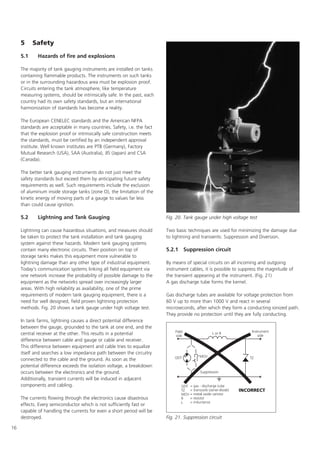
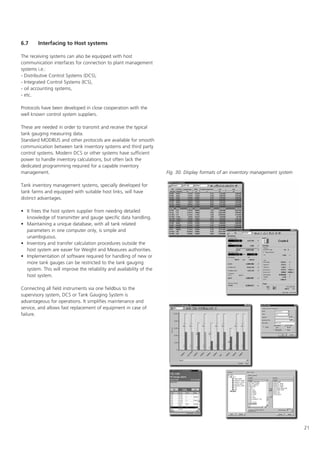
One of the major disadvantages with float driven instruments is
the continuous sudden movement due to the turbulence of the
liquid gauged. These movements, which can be rather violent,
cause a continuous acceleration and deceleration of the drive
mechanism, resulting in excessive wear and tear of the local
indicator, transmitter and other devices coupled to the gauge.
The reversing motions and accelerations cannot be followed by
the indicating system and transmitter. Often the gear mecha-
nism, driving the indicator and transmitter shaft, disengages,
resulting in erroneous readings and de-synchronization of the
transmitter. This leads to a considerable maintenance and lack
of measurement reliability. In light of the present worldwide
concern to prevent product spills, these gauges should no
longer be used. Because of their low price, however, a large
share of the world's tanks are still equipped with these
instruments.
2.3 Servo gauges
Servo tank gauges (Fig. 7) are a considerable improvement over
the float driven instruments. They were developed during the
1950s. In this gauge, the float is replaced by a small displacer,
suspended by a strong, flexible measuring wire. Instead of a
spring-motor, servo gauges use an electrical servo motor to
raise and lower the displacer. An ingenious weighing system
continuously measures the weight and buoyancy of the
Fig. 6. Float and tape
gauge
Fig. 5. Manual Gauging
8
displacer and controls the servo system. The motor also drives
the integral transmitter.
Mechanical friction in the servo system, transmitter, local
indicator and alarm switches has no effect on the sensitivity and
accuracy of the gauge. Also, turbulence has no direct effect.
An integrator in the serve control system eliminates the effects
of sudden product movements. The gauge not only produces
an average level measurement under turbulent conditions, but
it also eliminates unnecessary movements and reduces wear
and tear, greatly extending the operational life of the
instrument.
The original servo gauge does not look much like today's
modern version. The instruments have evolved into highly
reliable mature products, and are gradually replacing
mechanical float gauges, cutting down on maintenance and
improving on inventory results. Modern intelligent servo gauges
have very few moving parts, resulting in long term reliability
and accuracy. They also have a high degree of data processing
power. The instruments do not merely measure the liquid level
but are also capable measuring interface levels and product
density.
Accurate, programmable level alarms are standard. Accuracy's
of better than 1 mm (1/16 inch) over a 40 m (125 ft) range can
be attained. The exceptional accuracy and reliability has resulted
in the acceptance of the measurements and remote
transmission, by Weights  Measures and Customs  Excise
authorities in many countries.
2.4 Radar gauges
The use of radar to measure product levels in storage tanks is
one of the most recent techniques.
Radar level gauges were developed in the mid sixties for crude
carriers. The majority of these ships were equipped with
mechanical float driven gauges. The level gauges were only
used when the ship was ashore, loading or unloading. New
safety procedures for tank washing with closed tanks during
the return voyage, and the necessity to fill the empty tank
space with inert gas, made non-intrusive measurements
preferable. Accuracy was less important for the level
measurement of the cargo tanks, since custody transfer and
fiscal measurements used the certified level gauges or flow
meters of the shore installation.
Radar level gauges do not have moving parts and only an
antenna is required in the tank. This results in very low
maintenance cost. Although the investments costs are higher
when compared to float gauges, the cost of ownership will be
considerably lower.
The radar instruments use microwaves, generally in the 10 GHz
range, for the measurement of the liquid level. The distance the
signal has traveled is calculated from a comparison of
transmitted and reflected signals. With tank gauging, relatively
short distances have to be measured.
Electromagnetic waves travel with nearly the speed of light.
Because of the short distances ranging from some centimeters
(inches) to e.g. 20 m (66 ft) and the required resolution, a
measurement based on time is almost impossible. The solution
is to vary the frequency of the transmitted signal and measure
the frequency shift between transmitted and reflected signal.
The distance can be calculated from this frequency shift.
Fig. 8. Radar level gauge for free space measurement
Fig. 7. Servo gauge
9
Now radar level gauges are available for product storage tanks
found in refineries, terminals, chemical industries and
independent storage companies. The absence of moving parts,
their compact design and their non intrusive nature, result in
low maintenance costs and make them very attractive. In order
to achieve an accuracy ten times better than for use in marine
applications, specific antennas and full digital signal processing
have been applied. Older radar instruments were equipped with
large parabolic or long horn antennas, whereas the modern
radar level gauges use planar antenna techniques.
These antennas are compact and have a much better efficiency,
resulting in an excellent accuracy.
Several antenna types are available to suit virtually every tank
configuration:
• Free space propagation is the most common method and is
used if the gauge is installed on top of a fixed roof tank.
(Fig. 8)
• On floating roof tanks, the radar gauge can be installed on
the guide pole. A specific radar signal (circular mode signal)
is than guided via the inner shell of the guide pole or
support pipe. (Fig. 9)
• Sensing the roof can be done by using a roof reflector and a
radar level gauge with a free space antenna.
• Radar gauges can be also used on high pressure storage
vessels. An isolation valve can be installed between the
vessel and the instrument. Verification and calibration is
possible while the instrument remains in service.
Accurate measurement on products with very low vapor
pressures is possible with the latest radar gauging technique.
Your supplier will be able to inform you in detail on this
subject. Radar gauges are also a logical choice for tanks
containing highly viscous products, like blown asphalt's,
contaminating products and liquids that are very turbulent.
2.5 Hydrostatic Tank Gauging
Hydrostatic Tank Gauging (HTG) is one of the oldest techniques
to measure the tank contents. In the process industry, level
measurement using differential pressure transmitters is very
common. Normally this method uses analog pressure trans-
mitters, with a 1 % accuracy. However, so analog transmitters
are not suitable for this purpose, inventory measurement
requires a much better accuracy. Specially calibrated smart
digital pressure transmitters are now available to provide much
better accuracy.
The on-board microprocessor allows compensation for
temperature effects and systematic transmitter deviations.
HTG makes use of these accurate pressure transmitters for a
continuous mass measurement of the tank contents. (Fig. 10)
Various HTG configurations are available:
• A simple HTG system can be built with only a single
transmitter near the tank bottom (P1). The total mass can be
calculated by multiplying the measured pressure by the
equivalent area of the tank.
• By adding a second transmitter (P2) at a known distance
from P1, the observed density (DENS. OBS.) of the product
can be calculated from the pressure difference P1 - P2.
The level can be calculated from the density and the P1
pressure.
• A P3 or top transmitter can be added to eliminate the effect
of the vapor pressure on the P1 and P2 transmitters.
For pressurized tanks, HTG is less suitable. The large different
between the storage pressure and small hydrostatic pressure
variations (turn down ratio), causes inaccurate results.
Also the fitting of the transmitter nozzles on spheres is costly
and often unacceptable.
On atmospheric tanks, HTG systems offer a 0.5 % uncertainty
or better for the mass measurement.
The accuracy of the HTG level measurement, although sufficient
for the determination of the equivalent area, is 40 mm to
60 mm (1½ inch to 2 inch) and totally unacceptable for custody
Fig. 10. HTG system
Fig. 9. Radar level gauge for stilling well measurement
10
transfer or inventory assessment. Hence, many companies
require the addition of a dedicated level gauge. A drawback of
the HTG system is that its density measurement is only over a
limited range near the bottom of the tank. If the liquid level is
above the P2 transmitter, the calculated value is based on active
measurements. However, if the level is under P2 there is no
differential pressure measurement. This will be the case when
the level is only 1.5 m to 2.5 m (6 ft to 8 ft) above the tank
bottom. With many tanks, the density in the heel of the tank
will be different from the density at higher levels. This density
stratification has a devastating effect on the calculated values
for level and volume. Since the level measurement of a HTG
system is very inaccurate, it becomes worthless for any form of
overfill protection. Secondary high level alarms are essential.
2.6 Hybrid Inventory
Measurement System Hybrid Inventory Measurement System
(HIMS), combines the most modern level gauging techniques
with Hydrostatic Tank Gauging. (Fig. 11 and 12) It utilizes an
advanced Radar or Servo level gauge for accurate level
measurement, with a smart pressure transmitter (P1) and a
temperature measurement instrument. On non atmospheric
tanks, a second transmitter for the vapor pressure
compensation is required.
Fig. 11. HIMS systems with Radar or Servo level gauge
Fig. 12. Upper part of a HIMS installation
11
The level measurement is the basis for an accurate volume
inventory calculation. The pressure measurement, combined
with the level, provides a true average density measurement
over the entire product level height. This average density is used
for the mass assessment. The temperature is used to calculate
standard volumes and densities at reference temperatures.
Advanced servo gauges and radar gauges can be provided with
an interface board that communicates directly with the smart
pressure transmitter. The result is a unique Level Temperature
Pressure and very complete measurements providing level,
interface levels, product-water interface levels, average density,
average temperature, vapor temperature and alarms.
Existing installations with advanced Radar or Servo level gauges
can, in most cases, easily be extended to become a HIMS
system.
HIMS is often called 'The best of both worlds', providing the
best of level gauging combined with the best of hydrostatic
gauging.
Fig. 12a. The Servo Level Gauge as part of a HIMS installation
Fig. 12b. Example of a Temperature Measurment Instrument
(HIMS installation)
Fig. 12d. Example of a smart Pressure Transmitter on the side of
a tank (HIMS installation)
Fig. 12c. Smart Pressure Transmitter (HIMS installation)
12
The uncertainties of quantity assessment of a tank gauging
system depend on the measuring uncertainties of the installed
instruments, Tank Capacity Table (T.C.T.) and installation.
Level gauging instruments measure the liquid level in the tank.
Pressure transmitters measure the hydrostatic pressure of the
liquid column. Both level and pressure are primary functions for
the calculation of volume and mass respectively.
Hybrid systems, such as HIMS, use both inputs in one system.
Conversions from volume to mass or vice versa are made using
density and temperature as secondary inputs. The density input
may be obtained from an outside source, such as a laboratory,
or may be measured in the tank by using pressure transmitters
or servo density. The temperature input is obtained from a
temperature measuring system in the tank.
How the individual errors influence a mass or volume
uncertainty depends on the type of quantity assessment.
3.1 Level based quantity assessment
Fig. 13 shows how the quantity assessment in a conventional
level (volume) based system is accomplished.
The tank references liquid level, liquid temperature and liquid
density are the relevant parameters.
• Level is measured using a Radar or Servo level gauge.
• Temperature is measured using a spot or average
temperature sensor.
• Density at reference temperature is obtained from a
laboratory analysis of a grab sample.
• The Gross Observed Volume (G.O.V.) is derived from level
and the Tank Capacity Table (T.C.T.).
• The Gross Standard Volume (G.S.V.) is calculated from the
G.O.V., corrected with the Volume Correction Factor
(V.C.F.).
• The V.C.F. is derived from the temperature measurement
using the ASTM Table 54 and the density at reference
temperature (DENS. REF.).
• The total MASS is calculated from the G.S.V. multiplied by
the density at reference temperature (DENS. REF.).
The MASS of the product can also be calculated from the Net
Standard Volume, as the G.O.V. minus sediment contents and
water.
Major causes for uncertainties are the temperature assessment
and the Tank Capacity Table. Additional functionality can be
added to enhance the total performance, e.g. vapor pressure
and water interface measurement.
Fig. 13. Level based quantity assessment
3 Quantity assessment in Tank Gauging
13
3.2 Hydrostatic based quantity assessment
The quantity assessment of a HTG based system is shown in
Fig. 14. The tank references, hydrostatic liquid pressure, liquid
density and liquid temperature are the relevant parameters.
• Pressure M is measured via pressure transmitter P1.
• The observed Density (DENS. OBS.) is measured using
pressure transmitters P1 and P2.
• Temperature can be measured for G.S.V. calculations with a
temperature sensor.
• The MASS is directly calculated from the equivalent area and
the PI (PRESS. M) transmitter. The equivalent area is obtained
from the tank Capacity Table (T.C.T.).
• The G.O.V. is derived from MASS and the observed density.
• The observed density is derived from the differential pressure
measurement of P1 - P2 and the distance between both
transmitters. The V.C.F. is derived from the temperature
measurement using the ASTM Table 54 and the density at
reference temperature (DENS. REF.).
• The G.S.V. is calculated from the G.O.V., corrected with the
V.C.F.
• The V.C.F. is derived from the temperature measurement
using the ASTM Table 54 and the density at reference
temperature (DENS. REF.).
• The level is derived from the pressure (PRESS M) and density
(DENS. OBS.) measurement obtained from P1 and P2.
• The density at reference temperature (DENS. REF.) is derived
from the observed density (DENS. OBS.), however corrected
with the V.C.F.
Major uncertainties in an HTG system are caused by the T.C.T.,
the pressure transmitters and calculations using an incorrect
density value as a result of non-homogeneous products
Variations of the temperature do not influence the mass
accuracy. The temperature is required for the calculation of the
density under reference conditions and G.S.V.
3.3 Hybrid based quantity assessment
The quantity assessment of a HIMS based system is shown in
Fig. 15.
The hydrostatic liquid pressure, tank references, liquid level and
liquid temperature are the relevant parameters.
• The hydrostatic pressure is measured using pressure
transmitter P1.
• Level is measured by an advanced Radar or Servo level
gauge.
• Temperature is measured using a spot temperature sensor or
average temperature sensor.
The system is basically the same as the Level based system,
however, the density is derived from the hydrostatic pressure
(PRESS M) measured by P1 and the height of the liquid column
on P1.
• The G.O.V. is derived from level and the Tank Capacity Table
(T.C.T.).
• The G.S.V. is calculated from the G.O.V. and corrected with
the V.C.F.
• The MASS, however, is directly calculated from the G.O.V.
and DENS. OBS. from PRESS. M measured by P1.
• The DENS. REF. is calculated from DENS. OBS. corrected with
the V.C.F.
• The V.C.F. in this case is derived from the temperature
measurement using the ASTM Table 54 and the DENS. OBS.
HIMS provides, as an additional benefit, a highly accurate
continuous average density measurement.
The average observed density is determined over the entire level
height! This is a unique feature because all other systems
determine the density at one or more specific levels or over a
limited range of 2 m to 3 m (6.6 ft to 5 ft) only.
Fig. 14. HTG based quantity assessment Fig. 15. HIMS based quantity assessment
14
4 Uncertainties in Tank Gauging
In order to compare the different quantity assessment systems,
it is necessary to analyze all parameters affecting the final
uncertainty of each gauging system.
Instrument data sheets usually only state accuracy's under
reference conditions. Mass and volume accuracy's derived from
these data are often too optimistic. For correct interpretation of
data sheets and justification of the choice of instruments, errors
caused by the installation should also be taken into account.
This can be difficult. Even within international organizations
dealing with standardization, much time is spent to establish
the correct way to calculate or determine final uncertainties.
An uncertainty analysis for tank gauging was developed in
order to get a better understanding of the mechanisms and
parameters involved. On the basis of this analysis, a number of
graphs and data tables have been produced, illustrating the
uncertainties of the measurement systems dealt with in this
document. Analysis was done both for inventory and batch
transfers. All uncertainties are expressed as relative values, i.e.
as percentages of the inventory or the quantity transferred, as is
customary in loss control and custody transfer.
The comparison makes use of generic specifications of
uncertainties for tank gauging equipment, storage tanks and
installation. The data used are assumed to be manufacturer
independent.
4.1 Sources of errors
The overall uncertainty in the quantity assessment is the
combined result of all uncertainties of each single parameter in
the calculation. In order to obtain the optimal accuracy of a
specific gauge, careful installation is required. This applies to all
types of gauges. Fig. 16 shows the major sources of errors in
Tank gauging.
• Bulk storage tanks are not designed to serve as measuring
vessels. Their actual shape is influenced by many factors.
Computerized compensation for some of these effects is
possible, provided the effects are known and reproducible.
For the best accuracy obtainable with level measuring
devices, a stable gauging platform is a prerequisite. The use
of a support pipe is an available and known technique, and
is already present on many tanks, with and without floating
roofs. The presence of a such a pipe is an advantage that
makes the best accuracy possible when choosing instruments
in a revamp project.
For radar gauges, existing pipes can be used to provide
mechanical stability. Circular mode antennas are required
when installation on a pipe is foreseen. On high pressure
tanks, installation of an insert with reference pins is
recommended.
• Temperature is an often underestimated measuring
parameter. An accurate average temperature measurement
is essential to achieve accurate inventory calculations.
Spot measurements are not useful when the product
temperature is stratified.
• Equipment used in HTG systems are installed external to the
tank. With existing tanks hot tapping, an installation method
while the tank remains in service, may be the solution when
company regulations permit. This technique is fully
developed, but there are different opinions on the safety
aspects. The P1 transmitter must be installed as low as
possible, but above maximum water and sediment level.
It is important to realize that the product below the P1
nozzle is not actually measured. This restriction severely
limits the minimum quantity that can be measured for
custody and tax purposes.
A study performed by the Dutch Weight  Measures showed
that wind can cause errors as much as 0.2 % on a 10 m
(33 ft) high tank. On fixed roof tanks, compensation for this
error can be accomplished with an external connection
between P1 an P3. High nominal operation pressures
encountered in spheres and bullet type vessels, require
specially developed transmitters. The measurement of the
small signal superimposed on the high pressure reduces the
accuracy.
Level Gauging
Non stability of installation
Temperature Gauging
Temperature stratification
Hydrostatic Tank Gauging
Transmitter position
Wind
Pressurized applications
Fig. 16. Major sources of errors
15
4.2 Overview of uncertainties
Fig. 17 and 18 show respective overviews on uncertainties on
inventory and batch transfer for level based systems
(Servo / Radar), HIMS and HTG systems.
Note: For level based systems the density is obtained from the
laboratory analysis of a grab sample; the uncertainty is
assumed to be ± 0.1 %.
Fig. 17. Overview of inventory uncertainties
Fig. 18. Overview of batch transfer uncertainties
Fig. 19. A refinery
16
5 Safety
5.1 Hazards of fire and explosions
The majority of tank gauging instruments are installed on tanks
containing flammable products. The instruments on such tanks
or in the surrounding hazardous area must be explosion proof.
Circuits entering the tank atmosphere, like temperature
measuring systems, should be intrinsically safe. In the past, each
country had its own safety standards, but an international
harmonization of standards has become a reality.
The European CENELEC standards and the American NFPA
standards are acceptable in many countries. Safety, i.e. the fact
that the explosion proof or intrinsically safe construction meets
the standards, must be certified by an independent approval
institute. Well known institutes are PTB (Germany), Factory
Mutual Research (USA), SAA (Australia), JIS (Japan) and CSA
(Canada).
The better tank gauging instruments do not just meet the
safety standards but exceed them by anticipating future safety
requirements as well. Such requirements include the exclusion
of aluminum inside storage tanks (zone O), the limitation of the
kinetic energy of moving parts of a gauge to values far less
than could cause ignition.
5.2 Lightning and Tank Gauging
Lightning can cause hazardous situations, and measures should
be taken to protect the tank installation and tank gauging
system against these hazards. Modern tank gauging systems
contain many electronic circuits. Their position on top of
storage tanks makes this equipment more vulnerable to
lightning damage than any other type of industrial equipment.
Today's communication systems linking all field equipment via
one network increase the probability of possible damage to the
equipment as the networks spread over increasingly larger
areas. With high reliability as availability, one of the prime
requirements of modern tank gauging equipment, there is a
need for well designed, field proven lightning protection
methods. Fig. 20 shows a tank gauge under high voltage test.
In tank farms, lightning causes a direct potential difference
between the gauge, grounded to the tank at one end, and the
central receiver at the other. This results in a potential
difference between cable and gauge or cable and receiver.
This difference between equipment and cable tries to equalize
itself and searches a low impedance path between the circuitry
connected to the cable and the ground. As soon as the
potential difference exceeds the isolation voltage, a breakdown
occurs between the electronics and the ground.
Additionally, transient currents will be induced in adjacent
components and cabling.
The currents flowing through the electronics cause disastrous
effects. Every semiconductor which is not sufficiently fast or
capable of handling the currents for even a short period will be
destroyed.
Two basic techniques are used for minimizing the damage due
to lightning and transients: Suppression and Diversion.
5.2.1 Suppression circuit
By means of special circuits on all incoming and outgoing
instrument cables, it is possible to suppress the magnitude of
the transient appearing at the instrument. (Fig. 21)
A gas discharge tube forms the kernel.
Gas discharge tubes are available for voltage protection from
60 V up to more than 1000 V and react in several
microseconds, after which they form a conducting ionized path.
They provide no protection until they are fully conducting.
Fig. 20. Tank gauge under high voltage test
Fig. 21. Suppression circuit
17
A transzorb or varistor, in combination with a resistor and
preferably an inductor can be added to improve the protection.
These semiconductors react within a couple of nanoseconds
and limit the voltage. A major problem is that each time a
transient suppressor reacts, it degrades. Reliability is therefore
poor, rendering this type of device unsuitable for critical
applications like tank gauges.
5.2.2 Diversion circuit
Diversion (Fig. 22) is a much more reliable technique and better
suited for lightning protection of electronic tank gauging
instruments. Modern protection uses diversion combined with
screening and complete galvanic isolation. It is a technique in
which the high voltage spikes are diverted rather than
dissipated.
Specially developed isolation transformers are used for all inputs
and outputs. They have two separate internal ground shields
between primary and secondary windings and the transformer
core. External wiring is physically separated from internal wiring
and ground tracks are employed on all circuit boards to shield
electronics. Unfortunately this protection method is not suitable
with d.c. signals. In this case a conventional transient pro-
tection, enhanced with an additional galvanic isolation, is used.
5.2.3 Grounding and shielding
Proper grounding and shielding will also help protect
instruments and systems connected to field cabling against
damage by lightning. The possible discharge path over an
instrument flange (e.g. of a level gauge) and the corresponding
mounting flange should have a nearly zero resistance to
prevent built-up of potential differences.
A poor or disconnected ground connection may cause sparking
and ignite the surrounding product vapors.
5.2.4 Field experience
The diversion method described for internal lightning protection
has been in use for more than 15 years, with approximately
50.000 installed instruments. Almost 100 % of this equipment
is installed on top of bulk storage tanks, and interconnected via
wide area networking.
A large number of installations are situated in known lightning
prone areas. To date, only a few incidents in which lightning
may have played a decisive role have been experienced.
The amount of damage was always limited and could be
repaired locally at little expense. Before this protection method
was applied, more extensive lightning damage had been
experienced.
Fig. 22. Diversion circuit
Fig. 23. Typical bulk liquid storage tanks
18
6 Developments in Tank Gauging
Technology
6.1 Servo gauges
Modern servo gauges are already members of the sixth
generation. (Fig. 24) They use modern embedded micro-
controllers, minimizing the total amount of electronics.
Advanced software development tools and higher order
programming languages provide reliable operation.
Fuzzy control algorithms improve interaction of mechanics and
electronics, reducing the number of mechanical parts.
Current Advanced servo Tank Gauges (ATG) have less than
5 moving parts.
Main features
of an advanced technology servo gauge are:
• Low operating cost.
• Typical MTBF of more than 10 years.
• Low installation cost, especially when used to replace
existing servo gauges.
• A standard accuracy of 1 mm (0.04 inch).
• Software compensation for hydrostatic tank deformation,
making support pipes no longer a must for accurate
measurement.
• Full programmability for easy set-up and simple maintenance
without having to open the instrument.
• Compact and Lightweight construction requiring no hoisting
equipment.
• Possibilities for installation while the tank stays in full
operation.
• Continuous diagnostics to provide a maximum of reliability
and availability.
• Water-product interface measurement for time scheduled
water measurement.
• Spot- and average product density measurement.
• Interfacing to other smart transmitters, e.g. for product and
vapor temperature, and pressure via a digital protocol,
including average density support.
The strict German legislation currently accepts advanced servo
gauges as a single alarm for overfill protection!
6.2 Radar gauges
Radar gauges play an important role in tank gauging. (Fig. 25
and 26) Their non-intrusive solid state nature makes them very
attractive. The accuracy of the newest generation radar gauge
meets all requirements for custody transfer and legal inventory
measurements.
Reliability is high and maintenance will be further reduced.
The on-board intelligence allows for remote diagnosis of the
total instrument performance. The compact and lightweight
construction simplifies installation without the need for hoisting
equipment. installation is possible while the tank stays in full
operation. Current developments are aimed at more integrated
functions. Improved antenna designs, full digital signal
generation and processing offer better performance with less
interaction between tank and radar beam.
Fig. 24. Advanced Technology servo Gauge
Fig. 25. Radar level gauge with Planar antenna Technology
19
Main features
of the new generation Radar level gauge are:
• NO moving parts.
• Very low maintenance cost.
• Low operational cost.
• Non-intrusive instrument.
• Low installation cost.
• Typical MTBF of more than 60 years.
• Low cost of ownership.
• Modular design.
• A standard accuracy of 1 mm (0.04 inch).
• Software compensation for the hydrostatic tank
deformation, making support pipes no longer a must for
accurate measurement.
• Full programmability for easy set-up and verification facilities.
• The compact and lightweight construction eliminating the
need for hoisting equipment installation possibilities while
the tank stays in operation.
• Continuous diagnostics providing a maximum of reliability.
• Water-product interface measurement using digital
integrated probe.
• Density measurement via system integrated pressure
transmitter (HIMS).
• Interfacing to other transmitters, e.g. for product and vapor
temperature, and pressure via digital protocol.
6.3 Temperature gauging
Accurate temperature measurement is essential for level based
tank gauging systems.
Spot temperature elements are widely accepted for product
temperature assessment on tanks with homogenous products.
Installation is simple and the reliability is good. The graph of
Fig. 27 shows that spot measurements are unsuitable to
accurately measure the temperature of products which tend to
stratify. The effects of temperature stratification can be
neglected only for light products, mixed frequently.
In general, average temperature measuring elements are used
in case of temperature stratification.
The latest development is the Multi-Temperature Thermometer
(MTT) shown in Fig. 28 which utilizes 16 thermosensors evenly
distributed over the maximum possible liquid height.
A very accurate class A Pt100 element at the bottom is the
reference. Accuracy's of better than 0.05 °C (0.08 °F) are
possible. The elements can also be individually measured to
obtain temperature profiles and vapor temperatures.
MTT's are available with both nylon and stainless steel
protection tubes. It provides a rugged construction suitable for
the harsh environments of a bulk storage tank.
Fig. 26. Radar level gauge for high pressure applications
Fig. 27. Temperature stratification in a storage tank
Fig. 28. Average temperature an important parameter
Temperature probe
20
Another type of average temperature measuring element is the
Multi-Resistance Thermometer (MRT). Its operation is based on
a number of copper-wire temperature sensing elements of
different lengths. Average temperature measurement is
achieved by measuring the longest fully-immersed resistance
thermometer chosen by a solid state element selector. A draw-
back of MRT's is the delicate construction of the elements.
The very thin copper wire used makes the device susceptible for
damage, especially during transport and installation.
6.4 Hydrostatic Tank Gauging
Recent developments of smart transmitters opened a new era
for Hydrostatic Tank Gauging (HTG).
The development of smart pressure transmitters with
microcomputers made Hydrostatic Tank Gauging feasible.
Only a couple of years ago, high accuracy pressure transmitters
were still rare and quite expensive. Several manufacturers now
offer 0.02 % accuracy transmitters. Digital communication by
means of de facto standards as the HARTTM
-protocol, permits
simple interfacing to almost any transmitter. This wide choice
simplifies selection for specific applications, and allows the user
to choose his own preferred transmitter. The inherent
standardization for the end user reduces the cost of
maintenance.
6.5 Hybrid Inventory Measurement System
Hybrid Inventory Measurement Systems (HIMS) are also based
on the integration of smart pressure transmitters. Modern level
gauges, either servo or radar, provide the possibility for direct
interfacing to smart pressure transmitters. HIMS opens the ideal
route to total tank inventory systems, measuring all tank
parameters via one system.
6.6 Central Inventory management system
The interface to the operators and/or the supervisory control
and management system is the tank gauging inventory
management system. (Fig. 29) These high speed systems collect
the measurement data from all tank gauging instruments,
continuously check the status of alarms and functional
parameters and compute real time inventory data such as
volume and mass.
The hardware used is generally off-the-shelf personal or
industrial computers loaded with dedicated inventory
management software. It is this software, together with the
reliability and integrity of the field instrumentation that
determines the performance and accuracy of the inventory
management system. All field instruments, regardless of age or
type, should communicate via the same transmission bus.
Product volumes and mass should be calculated the same way
as do the owner appointed authorities and surveyors.
The system software should store the tank table parameters,
calculate observed and standard volumes, correct for free water
and, if applicable, correct for the floating roof immersion.
The Gross Standard Volume (GSV) calculations must be in
accordance with API, ASTM and ISO recommendations
implementing tables 6A, 6B, 6C, 53, 54A, 54B, 54C and 5.
The quality of the inventory management system can be
evidenced from the availability of Weights 81 Measures or
Customs  Excise approvals. Inventory management systems
can have their own display consoles or can make all data
available for a supervisory system.
Networked systems are available when required. Apart from a
large number of inventory management functions, the system
can also control inlet and outlet valves of the tanks, start and
stop pumps, display data from other transmitters, provide
shipping documents, provide trend curves, show bar graph
displays, perform sensitive leak detection, calculate flow rates,
control alarm annunciation relays, perform numerous diagnostic
tasks and much more. For examples of display formats of an
inventory management system see Fig. 30.
The operator friendliness of the system is of paramount
importance. The better and more advanced systems have a
context-sensitive help keys that make the proper help
instructions immediately available to the operator.
Fig. 29. Central inventory management system
21
6.7 Interfacing to Host systems
The receiving systems can also be equipped with host
communication interfaces for connection to plant management
systems i.e.:
- Distributive Control Systems (DCS),
- Integrated Control Systems (ICS),
- oil accounting systems,
- etc.
Protocols have been developed in close cooperation with the
well known control system suppliers.
These are needed in order to transmit and receive the typical
tank gauging measuring data.
Standard MODBUS and other protocols are available for smooth
communication between tank inventory systems and third party
control systems. Modern DCS or other systems have sufficient
power to handle inventory calculations, but often lack the
dedicated programming required for a capable inventory
management.
Tank inventory management systems, specially developed for
tank farms and equipped with suitable host links, will have
distinct advantages.
• It frees the host system supplier from needing detailed
knowledge of transmitter and gauge specific data handling.
• Maintaining a unique database, with all tank related
parameters in one computer only, is simple and
unambiguous.
• Inventory and transfer calculation procedures outside the
host system are easier for Weight and Measures authorities.
• Implementation of software required for handling of new or
more tank gauges can be restricted to the tank gauging
system. This will improve the reliability and availability of the
host system.
Connecting all field instruments via one fieldbus to the
supervisory system, DCS or Tank Gauging System is
advantageous for operations. It simplifies maintenance and
service, and allows fast replacement of equipment in case of
failure.
Fig. 30. Display formats of an inventory management system
22
7 Future trends in Tank Gauging
Technology
Combining static and dynamic measuring techniques provide a
possibility for continuously monitoring physical stock levels on a
real-time basis. By reconciling recorded changes in stock levels
against actually metered movements, the system can detect and
immediately identify any product losses.
Unexpected product movements can then be signaled to the
operator by an alarm.
Statistical analysis of static data from the tank gauging system
and dynamic data from flow meters could also be used to
improve the accuracy of the tank capacity table.
Cross correlation of gauges versus flow meters could further
reduce measurement uncertainties. With high accuracy tank
gauging instruments combined with powerful computing
platforms, automatic reconciliation becomes realistic.
Interfaces to multiple supplier systems, ranging from tank
gauging to loading and valve control systems, will be feasible
via internationally accepted communication standards.
Fig. 31. Pressurized gas storage facility
23
8 Summary
A wide range of different tank gauging instruments is available.
The employed techniques are more complementary than
competitive as each measuring principle has its own
advantages. Modern servo and radar gauges have improved
considerably. They hardly need any HTG is to be preferred if
mass is the desired measurement for inventory and custody
transfer.
The costs of any tank gauging system are mainly determined by
the cost of installation including field cabling. In upgrading
projects, costs depend very much on the possibility of
retrofitting existing facilities.
Because of worldwide commercial practice, volume
measurement will continue to play an important role.
maintenance and can provide trouble free operation if applied
correctly. The possibility of mixed installations with servo, radar,
HTG and HIMS provides optimal flexibility and utilizes the
capability of each gauging technique.
The combination of volume and mass offers great advantages.
A globally accepted measurement standard will probably not be
published for several years. Implementation of volume and mass
calculations outside the management information-, DCS- or
host systems remains preferable. Integrity requirements for
volume and mass calculations imposed by the Weight and
Measurement authorities are easier to fulfill externally and
justify the additional hardware.
Standard field busses may play a decisive role in the direct
interface between dedicated Tank Gauging Systems and other
systems. However, the quality of the measurements should
never be sacrificed for the sake of bus standardization.
9 Literature
• ISO 91.
• ISO/TC28/section 3.
Terms relating to the calculation of oil quantity.
• ASTM Tables 6, 53 and 54.
• API Manual of Petroleum Measurement Standards.
Annex to chapter 1, 'Vocabulary'.
• Enraf publication: Maintaining Safe Tank Storage with
Modern Automatic Tank Gauging Systems.
• Enraf publication: An analysis of uncertainties in Tank
Gauging Systems.
Fig. 32. A terminal
24
All products from one supplier
AlarmScout and WaterScout
Innovative devices to prevent overfill and spills.
AlarmScout detects liquids, slurries, foam as well as interfaces
(e.g. oil/water).
Also WaterScout can be applied for accurate water/product
interface level measurement.
Control Panel Indicator
This remote panel indicator can be used in a control room or
pumping facility. It displays liquid level and average liquid
temperature. Test and checking commands can easily be given
via dedicated soft keys on the front panel.
Portable Enraf Terminal
For safe and comfortable commissioning and instrument
configuration even in a hazardous area. This hand-held
instrument is provided with an easy to read LCD display and a
full ASCII membrane keyboard.
Field Display  Interface
A versatile, EEx approved solid-state field device for display of
tank gauging data at ground level, eliminating the need for
tank climbing. The FDI provides WM accepted tank inventory
information where needed.
Securiterre
This grounding device takes care of safe loading of flammable
products. It helps prevent an explosion due to ignition by
electrostatic electricity. Applications includes grounding of road
and rail tankers, airplanes, helicopters, barges, tankers, oil
drums, etc.
Average temperature gauging
For correct inventory calculations, accurate average liquid
temperature is a must. The Multiple Thermosensor
Thermometer (MTT) makes use of proven technology and offers
the highly efficient temperature parameter for total inventory
control.
Hydrostatic tank gauging systems
Unique is the Hybrid Inventory Management System (HIMS), a
combination of hydrostatic gauging and a level gauge. Average
density is continuously available.
A Hydrostatic Tank Gauging (HTG) system is the solution for
accurate mass measurement.
Communication Interface Unit, CIU Prime
This multi-functional unit is an interface between the field
instruments and the tank inventory management system.
The main task of the CIU Prime is scanning the tank gauges.
Information becomes available via CIU emulation or MODBUS
protocols.
Communication Interface Unit, CIU Plus
The CIU Plus processes data received from a CIU Prime.
This results in information including: volume, flow rate and
mass, using formulas according to international standards.
The information becomes available for higher level systems.
Entis Pro inventory management system
Enraf's CYBER approach to manage liquid inventory.
This flexible Windows-NT based system provides superb data for
effective tank farm management. With the latest technology,
Enraf has gained recognition from official measurement
authorities.
Servo tank gauge
This intelligent tank gauge is the fifth generation for liquid
storage applications. This instrument is able to detect level,
interface level as well as the density of the product. It received
certification from leading Weights  Measures authorities.
SmartRadar level gauge
A unique level gauge utilizing the newest technology is the
latest development in non-intrusive level measurement.
SmartRadar uses Planar Antenna Technology and Advanced
Digital Signal Processing to provide superior measuring results.
The complete system from one supplier
Ethernet / Tokenring
LAN / WAN
Inventory
Management
System
SCADA
DCS
Host
CIU Prime
CIU Plus
PLC
SmartRadar HIMS HTG
Servo SmartRadar (2” high pressure)
EN Fieldbus
Terminal Automation
Contrec
Tanksystem
Marine Systems
Fluid Technology
Information in this publication is subject to change without notice. ® Enraf is a registered trademark. © Enraf B.V. The Netherlands.
IN 4416.650 Rev. 6
Companies
The Netherlands: Enraf Terminal Automation
T +31 (0)15 2701 100, F +31 (0)15 270 1111
E info@enraf.nl, I www.enraf.com
Australia: Enraf Contrec Ltd.
T +61 3 9804 4200, F +61 3 9822 8329
E contrec@contrec.com.au, I www.enrafcontrec.com
Switzerland: Enraf Tanksystem SA
T +41 26 91 91 500, F +41 26 91 91 505
E info@tanksystem.com, I www.enraftanksystem.com
Branch Offices
Americas: Enraf Inc.
T +1 832 467 3422, F +1 832 467 3441
E sales@enrafinc.com
China: Enraf Pte. Ltd. (Shanghai Rep. Office)
T +86 21 50367000, F +86 21 50367111
E enraf@enraf.com.cn
France: ENRAF S.a.r.l. (Sevran)
T +33 (1) 49 36 20 80, F +33 (1) 43 85 26 48
E enraffrance@compuserve.com
France: ENRAF S.a.r.l. (Martigues)
T +33 (4) 42 07 07 69, F +33 (4) 42 81 41 81
E gillesbarreau@enraf.fr
Germany: Enraf GmbH
T +49 (0)212 58 750, F +49 (0)212 58 7549
E info@enraf.de
India: Enraf India Pvt. Ltd. (Mumbai)
T +91 22 285 23 990, F +91 22 285 22 264
E enraf@enraf.in
India: Enraf India Pvt. Ltd. (Chennai)
T +91 44 281 56 999, F +91 44 281 56 888
E enraf@enraf.in
Middle East: Enraf Middle East
T +973 17 456 187, F +973 17 456 133
E salesbahrain@enraf.nl
Russia: Enraf B.V. (Moscow Rep. Office)
T/F +7 (0)95 788 0713, T/F +7 (0)95 788 0691
E enrafrus@co.ru
Singapore: Enraf Pte. Ltd .
T +65 676 94 857, F +65 683 67 496
E enraf@enraf.com.sg
United Kingdom: Enraf Ltd.
T +44 (0)1329 825 823, F +44 (0)1329 825 824
E info@enraf.co.uk
Americas: Enraf Fluid Technology USA Inc.
T +1 770 475 1900 , F +91 44 281 56 888
E info@us.enraf.com, I www.enraffluidtechnology.com
United Kingdom: Enraf Fluid Technology Ltd.
T +44 (0)1329 825 823, F +44 (0)1329 825 824
E info@uk.enraf.com , I www.enraffluidtechnology.com
France: Enraf Marine Systems
T +33 (0)1 3920 3827, F +33 (0)1 3902 2561
E contact@enrafmarine.fr, I www.enrafmarine.com
ADEQ
Underground Storage Tank
Operator Training
Study Guide
Printed on Recycled Paper
Contents
Section 1 — The What, Why and Who of UST Operator Training .....5
Section 2 — How to Use This Study Guide ....................................... 8
Section 3 — Identifying The Equipment At Your UST Facility ........10
Section 4 — Spill And Overfill Protection .........................................13
Section 5 — Corrosion Protection .................................................... 23
Section 6 — Leak Detection Methods .............................................32
Section 7 — Suspected and confirmed Releases............................66
Section 8 — Frequent Walk-Through Inspections ..........................69
Section 9 — Financial Responsibility .............................................71
Section 10— Out-of-Service UST Systems and Closure .................74
Section 11— For More Information ...................................................76
1
Section 1 - The What, Why and Who of UST Operator Training
What is UST Operator Training?
Underground storage tank (UST) operator training is a program developed to ensure UST
operators have the basic knowledge necessary to properly operate and maintain UST systems
in Arkansas. The U.S. Environmental Protection Agency (EPA), in consultation with states, has
developed guidelines that specify training requirements for three classes of UST system
operators: Class A; Class B; and Class C. The general description for each class of operator is
as follows:
Class A Operator
Person having primary responsibility for on-site operation and maintenance of UST
system.
Class B Operator
Person having daily on-site responsibility for the operation and maintenance of UST
system.
Class C Operator
Daily, on-site employees having primary responsibility for addressing emergencies
presented by a spill or release from an UST system.
UST Operator Training is designed to ensure that UST operators operate their tank systems in a
manner that is compliant with state and federal requirements, and that will prevent product
releases that could endanger human health and/or the environment.
Why UST Operator Training?
 To Improve UST Compliance
 To Meet Requirements Set Forth by the Energy Policy Act of 2005 and by
Arkansas law and regulation
 To Reduce the Potential for Environmental Harm from UST Releases
Who Needs To Be Trained?
Each underground storage tank facility must have a Class A, Class B, and Class C operator
designated for that facility. Separate individuals may be designated for each class of operator,
or an individual may be designated to more than one of the operator classes. An individual who
is designated to more than one operator class must be trained in each operator class for which
he or she is designated. Class A or Class B operators will be responsible for making sure their
Class C operators are properly trained.
2
The major differences in class designations are outlined below.
Class A – The Class A operator has primary responsibility to operate and maintain the
underground storage tank (UST) system. Those responsibilities include managing resources
and personnel such as establishing work assignments to achieve and maintain compliance with
regulatory requirements. In general, the Class A focuses on the broader aspects of the statutory
and regulatory requirements and standards necessary to operate and maintain a UST system.
At a minimum, Class A operators must be ADEQ-certified in the following areas:
1. A general knowledge of applicable federal and state UST system requirements for
operation, maintenance, and recordkeeping including, but not limited to --
(a) Release prevention
(b) Release detection
(c) Emergency response
(d) Product compatibility
2. Financial responsibility requirements
3. Notification requirements
4. Release and suspected release reporting requirements
5. Temporary and permanent closure requirements
6. Operator training requirements
Class B – A Class B operator implements applicable UST regulatory requirements and
standards in the field. The Class B implements day-to-day aspects of operating, maintaining
and recordkeeping for USTs at one or more facilities.
At a minimum, a Class B operator must be ADEQ-certified in the following areas:
1. An in-depth knowledge of UST system requirements for day-to-day operation,
maintenance, and recordkeeping including, but not limited to --
(a) Release prevention
(b) Release detection
(c) Components of UST systems
(d) Materials of UST system components
(e) Emergency response
(f) Product compatibility
3
(g) Reporting requirements
(h) Class C operator training requirements
Class B operators will generally have a more in-depth understanding of operation and
maintenance aspects of the UST system in comparison to a Class A operator.
Class C – A Class C is an employee and is, generally, the first line of response to events
indicating emergency conditions. This individual is responsible for responding to alarms or
other indications of emergencies caused by spills or releases from UST systems. The Class C
operator notifies the Class B or A operator and appropriate emergency responders when
necessary.
A Class C operator typically:
 Controls or monitors the dispensing or sale of regulated substances, or
 Is responsible for initial response to alarms or releases
Class C operators, at a minimum, must be trained to:
 Take action in response to emergency situations posing an immediate danger to the
public or to the environment (e.g., spills or releases from a UST system)
 Take action in response to alarms caused by spills or releases from a UST system
4
Section 2- How To Use This Study Guide
Who Should Read This Study Guide?
This study guide is for persons seeking certification as an
Arkansas Class A or Class B operator of underground
storage tank (UST) systems.
As an operator of USTs, you are responsible for making
sure your tanks do not leak. In order to be a certified UST
operator, you must pass an exam given by ADEQ. This
study guide is provided to help you understand your
responsibilities as an operator and to help you prepare for
the Arkansas UST Operator exam.
What Can This Study Guide Help You Do?
 Identify and understand the operation and
maintenance (OM) procedures you need to follow
routinely to make sure your USTs don’t have
leaks that endanger human health, damage the
environment or result in costly cleanups.
 Maintain required records of your tank system’s OM.
 Correctly respond to and report releases or suspected releases, spills or other unusual
operating conditions associated with USTs.
What is an “UST”?
An UST is any tank, including the underground piping connected to it, with at least 10% of its
volume underground and which stores a regulated substance (petroleum or certain hazardous
chemicals.)
Some kinds of tanks that are not covered by federal and state UST regulations are:
 Farm and residential tanks of 1,100 gallons or less in size.
 Tanks storing heating oil used on the premises where stored.
 Septic tanks.
 USTs storing hazardous wastes.
 Any UST holding 110 gallons or less.
 Emergency spill or overfill tanks.
Key Terms Used In This Study
Guide
An UST is an underground
storage tank and underground
piping connected to the tank that
has at least 10 percent of its
combined volume underground.
The federal and state regulations
apply only to USTs storing
petroleum or certain hazardous
substances.
OM stands for operation and
maintenance procedures that
must be followed to keep USTs
from causing leaks and creating
costly cleanups.
5
Is Your UST A “New” Tank Or An “Existing” Tank?
UST systems installed after December 1988 are considered “new” tanks. As such, these
USTs have to meet all the federal standards for spill/overfill prevention, corrosion protection,
and release detection at the time of installation.
“Existing” UST systems are those installed before December 1988. These tank systems were
required to be upgraded with spill/overfill prevention and corrosion protection by the compliance
deadline of December 22, 1998, or be closed.
Your UST System Is New Or Upgraded — Is That Enough?
Being new or upgraded is not enough. New and upgraded USTs are a complex collection of
mechanical and electronic devices that can fail under certain conditions. These failures can be
prevented or quickly detected by following routine OM procedures. Having a new or upgraded
UST system is a good start, but the system must be properly operated and continuously
maintained to ensure that leaks are avoided or quickly detected.
What Should You Do With Each Section Of This Study Guide?
Read through each section carefully and
use the checklists to help you establish
clear OM procedures.
By identifying and understanding the OM
tasks you need to perform routinely, you
will ensure timely repair or replacement of
components when problems are identified.
Read through each section carefully and
use the checklists to help you establish
clear OM procedures.
How Can You Effectively Use
The Checklists Provided?
This guide includes several checklists.
You can easily copy any of the checklists
(as appropriate to your facility) from this manual, reproduce them, and fill them out to help
comply with various recordkeeping requirements.
You can also select the specific mix of checklists that matches your particular UST facility. Once
you have your select group of checklists together, make several copies that you can fill out
periodically over time.
In this way you can keep track of your OM activities and know that you’ve done what is
necessary to keep your UST site safe, clean, and in compliance, avoiding any threats to the
environment or nearby people as a result of costly and dangerous UST releases.
Use This Guide Often — Effective OM Requires Constant Vigilance.
6
Section 3 - Identifying The Equipment At Your UST Facility
Determine what UST equipment you have at your facility by completing the checklist below.
Note that each part of the checklist below refers you to the appropriate section of this guide for
relevant information. After you have identified your equipment, proceed to the following sections
to identify the OM actions necessary for your specific UST system.
General Facility Information (optional)
Facility Name
Facility ID #
Spill and Overfill Protection (See Section 4 for more information)
Check for each tank: Tank #1 Tank #2 Tank #3 Tank #4
Spill Catchment Basin/ Spill Bucket
Check at least one overfill device for each tank:
Automatic Shutoff Device
Overfill Alarm
Ball Float Valve
Corrosion Protection (See Section 5 for more information)
A. Corrosion Protection for Tanks
Check at least one for each tank: Tank #1 Tank #2 Tank #3 Tank #4
Coated and Cathodically Protected Steel
Noncorrodible Material (such as Fiberglass Reinforced Plastic)
Steel Jacketed or Clad with Noncorrodible Material
Cathodically Protected Noncoated Steel*
Internally Lined Tank*
Cathodically Protected Noncoated Steel and Internally Lined Tank*
Other Method Used to Achieve Corrosion Protection
(please specify):
* These options may be used only for tanks installed before December 22, 1988.
B. Corrosion Protection for Piping
Check at least one for each: Tank #1 Tank #2 Tank #3 Tank #4
Coated and Cathodically Protected Steel
Noncorrodible Material (such as Fiberglass Reinforced
Plastic or Flexible Plastic)
Cathodically Protected Noncoated Metal*
Other Method Used to Achieve Corrosion Protection
(please specify):
* This option may be used only for piping installed before December 22, 1988.
7
General Facility Information (optional)
Facility Name
Facility ID #
Release Detection (See Section 6 for information on release detection)
A. Release Detection for Tanks
Check at least one for each tank: Tank #1 Tank #2 Tank #3 Tank #4
Automatic Tank Gauging System
Interstitial Monitoring (with secondary containment)
Groundwater Monitoring
Vapor Monitoring
Inventory Control and Tank Tightness Testing (TTT)*
Manual Tank Gauging Only **
Manual Tank Gauging and Tank Tightness Testing (TTT)***
Other Release Detection Method, such as SIR
(please specify)
* Allowed only for 10 years after upgrading or installing tank with corrosion protection. TTT required every 5 years.
** Allowed only for tanks of 1,000 gallon capacity or less.
*** Allowed only for tanks of 2,000 gallon capacity or less and only for 10 years after upgrading or installing tank with corrosion
protection. TTT required every 5 years.
B. Release Detection for Pressurized Piping
Check at least one from A  B for each tank’s piping: Tank #1 Tank #2 Tank #3 Tank #4
Automatic Flow Restrictor
Automatic Shutoff Device
A
(Automatic
Line Leak
Detectors) Continuous Alarm
Annual Line Tightness Test
B
Monthly Monitoring*
* Monthly Monitoring for piping includes Interstitial Monitoring, Vapor Monitoring, Groundwater Monitoring, and other accepted
methods (such as SIR and Electronic Line Leak Detectors)
C. Release Detection for Suction Piping
Check at least one for each tank’s piping: Tank #1 Tank #2 Tank #3 Tank #4
Line Tightness Testing Every Three Years
Monthly Monitoring*
No Release Detection Required For Safe Suction **
* Monthly Monitoring for piping includes Interstitial Monitoring, Vapor Monitoring, Groundwater Monitoring, and SIR
** No release detection required only if it can be verified that you have a safe suction piping system with the following
characteristics:
1) Only one check valve per line located directly below the dispenser;
2) Piping sloping back to the tank; and
3) System must operate under atmospheric pressure.
8
Any Problems Filling Out These Checklists?
If you have trouble filling out the checklist above or any other checklist in this guide,
remember these sources of assistance you can contact:
 Your UST contractor, the vendor of your equipment, and the manufacturer of your
UST equipment should be ready to help you. Look through your records for contact
information. You may also want to use some of the industry contacts and other
contact information provided in Section 11.
 ADEQ’s Regulated Storage Tanks Division will be able to help you identify
equipment or sources of information about your UST equipment. You should make
yourself aware of all components of your UST system. State and Federal contact
information is available in Section 11.
9
Section 4 — Spill And Overfill Protection
The purpose of spill and overfill protection
equipment is to eliminate the potential for a
release during fuel deliveries. The equipment
must be in working order and used properly to
provide adequate protection from spills and
overfills.
Even the best spill and overfill protection
equipment can become faulty over time if not
properly operated and maintained.
Only one gallon of fuel leaking each week from a
poorly maintained spill bucket can result in up to
195 tons of contaminated soil in a year.
Improper maintenance of the spill bucket at the
UST site pictured below contributed to significant
contamination of soil and groundwater.
The following pages in this section focus on how you can routinely make sure your spill and
overfill equipment is operating effectively.
What's The Difference?
Spill Protection:
A spill bucket is installed at the fill
pipe to contain the drips and spills of
fuel that can occur when the delivery
hose is uncoupled from the fill pipe
after delivery.
Overfill Protection:
Equipment is installed on the UST
that is designed to stop product flow,
reduce product flow, or alert the
delivery person during delivery
before the tank becomes full and
begins releasing petroleum into the
environment.
10
What Are The Basics Of Spill Protection?
Your USTs must have catchment basins — also
called spill buckets — installed at the fill pipe to
contain spills that may occur as a result of fuel
deliveries.
 The spill bucket is designed to temporarily
contain product spills that might occur during fuel
delivery. To contain a spill, the spill bucket must
be liquid tight.
 The spill bucket is not designed to contain
fuel for long periods of time. After each
delivery, empty and dispose of contents properly.
 Spill buckets need to be large enough to contain
any fuel that may spill when the delivery hose is
uncoupled from the fill pipe. Spill buckets typically
range in size from 5 gallons to 25 gallons.
 If you use a checklist for correct filling practices
(see page 18), spills should be eliminated or
reduced to very small volumes that your spill
bucket can easily handle.
How Do You Maintain Your Spill Bucket?
The checklist below provides information on properly maintaining your spill bucket.


 Spill Bucket OM Checklist
 Keep your spill bucket empty of liquids.
Some spill buckets are equipped with a valve that allows you to drain accumulated fuel into your
UST. Others may be equipped with a manual pump so fuel can be put into your UST by pumping it
through the fill pipe. However, keep in mind that when you pump out or drain your spill bucket into
your UST, any water and debris may also enter the UST. If a basin is not equipped with drain
valve or pump, then any accumulated fuel or water must be removed manually and disposed of
properly.
 Periodically check your spill bucket to remove any debris.
Debris could include soil, stones, or trash.
 Periodically check to see if your spill bucket is still liquid tight.
Have a qualified UST contractor inspect your spill bucket for signs of wear, cracks, or holes.
Based on this inspection, the contractor may suggest a test to determine if the spill bucket is tight
or needs repair or replacement.
If your UST never receives
deliveries of more than 25 gallons at
a time, the UST does not need to
meet the spill protection
requirements. Many used oil tanks
fall into this category. Even though
these USTs are not required to have
spill protection, you should consider
using spill protection as part of good
UST system management.
Examples Of Spill Buckets
11
What Are The Basics Of Overfill Protection?
Your USTs must have overfill protection installed to
help prevent the overfilling of tanks.
Three types of overfill protection devices are
commonly used:
 Automatic shutoff devices
 Overfill alarms
 Ball float valves
Each of these forms of overfill protection is
discussed in detail on the following pages.
How Can You Help The Delivery Person Avoid Overfills?
To protect your business, you must make every effort to help the delivery person avoid
overfilling your UST.
Use A Checklist On Correct Filling Practices
If correct filling practices are used, you will not exceed the UST’s capacity — see page 18 for a
checklist on correct filling procedures. Overfills are caused when the delivery person makes a
mistake, such as ignoring an overfill alarm.
Use Signs, Alert Your Delivery Person
The delivery person should know what type of overfill device is present on each tank at your
facility and what action will occur if the overfill device is triggered — such as a visual and/or
audible alarm or that the product flow into the tank will stop or slow significantly.
Educate and alert your delivery person by placing a clear sign near your fill pipes, in
plain view of the delivery person. An example of such a sign follows on the next page.
If your UST never receives
deliveries of more than 25 gallons
at a time, the UST does not need
to meet the overfill protection
requirements. Many used oil tanks
fall into this category. Even though
these USTs are not required to
have overfill protection, you should
consider using overfill protection
as part of good UST system
management.
12
Make Sure You Order The Right Amount Of Product
Also, you need to make sure you’ve ordered the right amount of product for delivery.
Order only the quantity of fuel that will fit into 90% of the tank. For example, if you have a
10,000 gallon tank with 2,000 gallons already in the tank, you would order at the most a 7,000
gallon delivery (90% of 10,000 is 9,000 gallons; subtracting the 2,000 gallons already in the tank
leaves a maximum delivery of 7,000 gallons). Use the checklist formula on page 18. Do your
homework right and you reduce the chance of overfills.
Delivery Person ― Avoid Overfills
 An overfill alarm is used for overfill protection at this facility.
 Do not tamper with this alarm in any attempt to defeat its purpose.
 When the tank is 90% full, the overfill alarm whistles and a red light flashes.
 If you hear the alarm whistle or see the red light flashing,
Stop The Delivery Immediately!
13
What Should You Do
To Operate And Maintain Your
Automatic Shutoff Device?
The automatic shutoff device is a mechanical device installed in
line with the drop tube within the fill pipe riser. It slows down and
then stops the delivery when the product has reached a certain
level in the tank. It should be positioned so that the float arm is
not obstructed and can move through its full range of motion.
When installed and maintained properly, the shutoff valve will
shut off the flow of fuel to the UST at 95% of the tank’s capacity
or before the fittings at the top of the tank are exposed to fuel.


 Basic OM Checklist For Automatic Shutoff Devices
 A qualified UST contractor periodically checks to make sure that the automatic shutoff device is
functioning properly and that the device will shut off fuel flowing into the tank at 95% of the tank
capacity or before the fittings at the top of the tank are exposed to fuel:
• Make sure the float operates properly.
• Make sure there are no obstructions in the fill pipe that would keep the floating mechanism
from working.
 You have posted signs that the delivery person can easily see and that alert the delivery person
to the overfill warning devices and alarms in use at your facility.
You should not use an automatic shutoff
device for overfill protection if your UST
receives pressurized deliveries.
14
What Should You Do
To Operate And Maintain Your
Electronic Overfill Alarm?
This type of overfill device activates an audible and/or visual
warning to delivery personnel when the tank is either 90% full or is
within one minute of being overfilled. The alarm must be located
so it can be seen or heard (or both) from the UST delivery
location. Once the electronic overfill alarm sounds, the delivery
person has approximately one minute to stop the flow of fuel to the
tank.
Electronic overfill alarm devices have no mechanism to shut off or
restrict flow. Therefore, the fuel remaining in the delivery hose after
the delivery has been stopped will flow into the tank as long as the
tank is not yet full.


 Basic OM Checklist For Overfill Alarms
 A qualified UST contractor periodically checks your electronic overfill alarm to make sure that it is
functioning properly and that the alarm activates when the fuel reaches 90% of the tank capacity
or is within one minute of being overfilled:
• Ensure that the alarm can be heard and/or seen from where the tank is fueled.
• Make sure that the electronic device and probe are operating properly.
 You have posted signs that the delivery person can easily see and that alert the delivery person
to the overfill warning devices and alarms in use at your facility.
15
What Should You Do
To Operate And Maintain
Your Ball Float Valve?
The ball float valve — also called a float vent valve — is
installed at the vent pipe in the tank and restricts vapor flow
in an UST as the tank gets close to being full. The ball float
valve should be set at a depth which will restrict vapor flow
out of the vent line during delivery at 90% of the UST’s
capacity or 30 minutes prior to overfilling.
As the tank fills, the ball in the valve rises, restricting the
flow of vapors out of the UST during delivery. The flow rate
of the delivery will decrease noticeably and should alert the
delivery person to stop the delivery.
For ball float valves to work properly, the top of the tank must be airtight so that vapors cannot
escape from the tank. Everything from fittings to drain mechanisms on spill buckets must be
tight and be able to hold the pressure created when the ball float valve engages.
 A qualified UST contractor periodically checks to make sure that the ball float valve is functioning
properly and that it will restrict fuel flowing into the tank at 90% of the tank capacity or 30 minutes
prior to overfilling:
• Ensure that the air hole is not plugged.
• Make sure the ball cage is still intact.
• Ensure the ball still moves freely in the cage.
• Make sure the ball still seals tightly on the pipe.
 You have posted signs that the delivery person can easily see and that alert the delivery person to
the overfill warning devices and alarms in use at your facility.


 Basic OM Checklist For Ball Float Valves
You should not use a ball float valve for overfill protection
if any of the following apply:
 Your UST receives pressurized deliveries.
 Your UST system has suction piping.
 Your UST system has single point (coaxial) stage 1 vapor recovery.
16


 Spill And Overfill OM Checklist
Spill
Bucket
 Keep your spill bucket empty of liquids.
Some spill buckets are equipped with a drainage valve which allows you to drain
accumulated fuel into your UST. Others can be equipped with a manual pump so fuel can
be put into your UST by pumping it through the fill pipe. However, keep in mind that when
you pump out or drain your spill bucket into your UST, any water and debris may also enter
the UST. If a spill bucket is not equipped with a drain valve or pump, then any accumulated
fuel or water must be removed manually and disposed of properly.
 Periodically check your spill bucket to remove any debris.
Debris could include soil, stones, or trash.
 Periodically check to see if your spill bucket is still liquid tight.
Have a qualified UST contractor inspect your spill bucket for signs of wear, cracks, or holes.
Based on this inspection, the contractor may suggest a test to determine if the spill bucket is
tight or needs repair or replacement.
Automatic
Shutoff
Devices
 A qualified UST contractor periodically checks to make sure that the automatic shutoff
device is functioning properly and that the device will shut off fuel flowing into the tank at
95% of the tank capacity or before the fittings at the top of the tank are exposed to fuel:
• Make sure the float operates properly.
• Make sure that there are no obstructions in the fill pipe that would keep the floating
mechanism from working.
 You have posted signs that the delivery person can easily see and that alert the delivery
person to the overfill warning devices and alarms in use at your facility.
Overfill
Alarms
 A qualified UST contractor periodically checks your electronic overfill alarm to make sure
that it is functioning properly and that the alarm activates when the fuel reaches 90% of the
tank capacity or is within one minute of being overfilled:
• Ensure that the alarm can be heard and/or seen from where the tank is fueled.
• Make sure that the electronic device and probe are operating properly.
 You have posted signs that the delivery person can easily see and that alert the delivery
person to the overfill warning devices and alarms in use at your facility.
Ball
Float
Valves
 A qualified UST contractor periodically checks to make sure that the ball float valve is
functioning properly and that it will restrict fuel flowing into the tank at 90% of the tank
capacity or 30 minutes prior to overfilling:
• Ensure that the air hole is not plugged.
• Make sure the ball cage is still intact.
• Ensure the ball still moves freely in the cage.
• Make sure the ball still seals tightly on the pipe.
 You have posted signs that the delivery person can easily see and that alert the delivery
person to the overfill warning devices and alarms in use at your facility.
17
What Are Your Responsibilities For
Correct Filling Practices?
As an owner or operator you are responsible for ensuring that releases due to spilling or
overfilling do not occur during fuel delivery.
As part of this responsibility, you must:
 Ensure the amount of product to be delivered will fit into the available empty space in the
tank; and
 Ensure the transfer operation is monitored constantly to prevent overfilling and spilling.
One way help ensure the above requirements are met is to follow the checklist on the next
page. The checklist describes activities to perform before, during, and after a fuel delivery.
18


 Correct Filling Checklist
What To Do
Before Your
USTs Are
Filled
 Post clear signs that alert delivery persons to the overfill devices and alarms in use at your
facility.
 Make and record accurate readings for product and water in the tank before fuel delivery.
 Order only the quantity of fuel that will fit into 90% of the tank.
Remember, the formula for determining the maximum amount of gasoline
to order is:
(Tank capacity in gallons X 90% ) — Product currently in tank = Maximum
amount of fuel to order
Example: (10,000 gal X 0.9 ) — 2,000 gal = 7,000 gal maximum amount
to order
 Ensure fuel delivery personnel know the type of overfill device present at the tank and what
actions to perform if it activates. For example, use sample sign on page 12 of this section.
 Review and understand the spill response procedures.
 Verify that your spill bucket is empty, clean, and will contain spills.
What To Do
While
Your
USTs
Are Being
Filled
 Keep fill ports locked until the fuel delivery person requests access.
 Have an accurate tank capacity chart available for the fuel delivery person.
 The fuel delivery person makes all hook-ups. The person responsible for monitoring the
delivery should remain attentive and observe the entire fuel delivery, be prepared to stop the
flow of fuel from the truck to the UST at any time, and respond to any unusual condition,
leak, or spill which may occur during delivery.
 Have response supplies readily available for use in case a spill or overfill occurs (see
Section 7).
 Provide safety barriers around the fueling zone.
 Make sure there is adequate lighting around the fueling zone.
What To Do
After
Your USTs
Are Filled
 Following complete delivery, the fuel delivery person is responsible for disconnecting all
hook-ups.
 Return spill response kit and safety barriers to proper storage locations.
 Make and record accurate readings for product and water in the tank after fuel delivery.
 Verify the amount of fuel received.
 Make sure fill ports are properly secured.
 Ensure the spill bucket is free of product and clean up any small spills.
19
Section 5 — Corrosion Protection
Corrosion of metal is essentially the gradual process by which the metal tries to return to its
original state (ore). When unprotected steel USTs, piping or other subsurface metal
components are exposed to an electrolyte (usually moisture in the soil or backfill), the UST
system begins to corrode or give up pieces of itself as the existing electric current in the
surroundings passes through and exits the metal. As this happens, the hard metal begins to
turn into soft ore, holes form and leaks begin.
To prevent leaks, all parts of your UST system that
are underground and routinely contain product need
to be protected from corrosion. The UST system
includes the tank, piping, and ancillary equipment,
such as flexible connectors, fittings, and pumps.
One way to protect UST components from corrosion
is to make them with nonmetallic, noncorrodible
materials, such as USTs made of (or clad or
jacketed with) fiberglass reinforced plastic (FRP) or
other noncorrodible materials — as illustrated by the FRP tank above. Noncorrodible USTs
like these do not require OM for corrosion protection.
UST components made from metal, however, that routinely contain product and are in direct
contact with the ground need corrosion protection provided by cathodic protection or (in
some cases) lining the interior of the tank, as described below. These options require OM.
Note: Metal tanks or piping installed after December
22, 1988, must have a dielectric coating (a coating
that does not conduct electricity) in addition to the
cathodic protection described below.
Cathodic Protection Using Sacrificial
Anode Systems
Sacrificial anodes are buried and attached to UST
components for corrosion protection — as illustrated on
the right by an anode attached to a tank. Anodes are
pieces of metal that are more electrically active than steel, and thus they corrode faster than
the steel to which they are attached. Zinc and magnesium are two of the most commonly
used materials for sacrificial anodes.
Cathodic Protection Using Impressed Current
Systems
An impressed current system — as shown on the right —
uses a rectifier to provide direct current through anodes to
the tank or piping to achieve corrosion protection. The
steel is protected because the current going to the steel
overcomes the corrosion-causing current flowing away
from it. The cathodic protection rectifier must always
be on and operating to protect your UST system from
corrosion.
20
Corrosion Protection Using Internal Lining
Of The Tank
This corrosion protection upgrade option applied only to
“existing” tanks installed before December 22, 1988.
These older tanks could be internally lined by licensed
professionals to meet the corrosion protection upgrade
requirements and deadline of December 22, 1998.
Shown on the right is a professional following industry
codes to safely and effectively line a tank’s interior.
It may help you to see your corrosion protection options displayed in the following table.
Corrosion Protection Choices
Option Description
Noncorrodible Material The tank or piping is constructed of noncorrodible material.
Steel Tank Clad Or Jacketed
With A Noncorrodible
Material
Examples of cladding or jacket material include fiberglass and
urethane. Does not apply to piping.
Coated And Cathodically
Protected Steel Tanks Or
Piping
Steel tank and piping is well-coated with a dielectric material and
cathodically protected.
Cathodically Protected
Noncoated Steel Tanks Or
Piping
This option is only for steel tanks and piping installed before
December 22, 1988. Cathodic protection is usually provided by an
impressed current system.
Internal Lining Of Tanks This option is only for steel tanks installed before December 22,
1988. A lining is applied to the inside of the tank. Does not apply to
piping.
Combination Of Cathodically
Protected Steel And Internal
Lining Of Tanks
This option is only for steel tanks installed before December 22,
1988. Cathodic protection is usually provided by an impressed
current system. Does not apply to piping.
Other Methods Used To
Achieve Corrosion Protection
If you have tanks or piping that do not meet any of the descriptions
above, check with the Arkansas Department of Environmental
Quality to see if your UST system meets the requirements for
corrosion protection. You also will need to ask about the operation,
maintenance, and recordkeeping requirements applicable to this
type of UST system.
Note: In addition to tanks and piping, all other metal components in direct contact with the
ground that routinely hold product — such as flexible connectors, swing joints, fittings, and
pumps — must also be cathodically protected.
Use the OM checklist on the next page
Following the checklist, look for recordkeeping forms and discussions
of special corrosion protection situations.
21


 Basic OM Checklist For Corrosion Protection
Sacrificial
Anode
Cathodic
Protection
Systems
You need to have a periodic test conducted by a qualified corrosion tester to make
sure your cathodic protection system is adequately protecting your UST system.
This test needs to be conducted:
 Within 6 months of installation.
 At least every 3 years after the previous test.
 Within 6 months after any repairs to your UST system.
• Make sure the professional tester is qualified to perform the test and follows a
standard code of practice to determine that test criteria are adequate.
• If any test indicates your tanks are not adequately protected, you need to have
a corrosion expert examine and fix your system.
• Testing more frequently can catch problems before they become big problems.
 You need to keep the results of at least the last two tests on file. See page 23 for a
cathodic protection test record keeping form.
Impressed
Current
Cathodic
Protection
Systems
You need to have a periodic test conducted by a qualified corrosion tester to make
sure your cathodic protection system is adequately protecting your UST system.
This test needs to be conducted:
 Within 6 months of installation.
 At least every 3 years after the previous test.
 Within 6 months after any repairs to your UST system.
• Make sure the professional tester is qualified to perform the test and follows a
standard code of practice to determine that test criteria are adequate.
• If any test indicates your tanks are not adequately protected, you need to have a
corrosion expert examine and fix your system.
• Testing more frequently can catch problems before they become big problems.
 You need to keep the results of at least the last two tests on file. See page 23 for a
cathodic protection test record keeping form.
 You need to inspect your rectifier at least every 60 days to make sure that it is
operating within normal limits.
• This inspection involves reading and recording the voltage and amperage readouts
on the rectifier. You or your employees can perform this periodic inspection.
• Make sure your cathodic protection professional provides you with the rectifier’s
acceptable operating levels so you can compare the readings you take with an
acceptable operating level. If your readings are not within acceptable levels, you
must contact a cathodic protection professional to address the problem.
 You need to keep records of at least the last 3 rectifier readings. See page 25 for a
60-Day Inspection Results record keeping form.
 You should have a trained professional periodically service your impressed
current system.
 Never turn off your rectifier!
Internally
Lined
Tanks
 Within 10 years after lining and at least every 5 years thereafter, the lined tank must be
inspected by a trained professional and found to be structurally sound with the lining
still performing according to original design specifications. Make sure the professional
performing the inspection follows a standard code of practice.
 Keep records of the inspection (as specified in industry standards for lining
inspections).
23
Record For Periodic Testing Of Cathodic Protection Systems
(for use by a qualified cathodic protection tester)
Test Date:____/____/____ Facility Name/ID:_________________________
Note: Provide site sketch as directed on the back of this page.
Cathodic Protection (CP) Tester Information:
Name: ________________________________ Phone Number:______________________
Address: _____________________________________________________________________
Testing must be conducted by a qualified CP tester. Indicate your qualifications as a CP tester:
Identify which of the following testing situations applies:
 Test required within 6 months of installation of CP system (installation date was __/__/__)
 Test required at least every 3 years after installation test noted above
 Test required within 6 months of any repair activity – note repair activity and date below:
Indicate which industry standard you used to determine that the cathodic protection test criteria are
adequate: ___________________________________
Cathodic Protection Test Method Used (check one)
100 mV Cathodic Polarization Test
-850 mV Test (Circle 1 or 2 below)
1) Polarized Potential (instant off) 2) Potential with CP Applied, IR Drop Considered
Note: All readings taken must meet the -850 mV criteria to pass
Other Accepted Method (please describe):
Is the cathodic protection system working properly? Yes No
(circle one)
If answer is no, go to the directions at the bottom on the next page.
My signature below affirms that I have sufficient education and experience to be a cathodic protection
tester; I am competent to perform the tests indicated above; and that the results on this form are a
complete and truthful record of all testing at this location on the date shown.
CP Tester Signature: _______________________________ Date:_____________
Keep This Paper On File For At Least Six Years
24
Site Sketch: Provide a rough sketch of the tanks and piping, the location of each CP test,
and each voltage value obtained (use space below or attach separate drawing). Voltage
readings through concrete or asphalt do not provide accurate readings and are not
acceptable. Perform sufficient testing to evaluate the entire UST system.
If CP system fails test, you must have a corrosion expert fix the system.
If the answer was no, indicating that your CP system is not working, you must have a
corrosion expert investigate and fix the problem. A corrosion expert has additional
training, skills, and certification beyond the corrosion tester who filled out the bulk of this
form. A corrosion expert must be:
 Accredited/certified by NACE International (The Corrosion Society) as a corrosion
specialist or cathodic protection specialist, or
 Be a registered professional engineer with certification or licensing in corrosion
control.
As long as you have the UST, be sure you keep a record that clearly documents what the
corrosion expert did to fix your CP system.
Keep This Paper On File For At Least Six Years
25
60-Day Inspection Results For
Impressed Current Cathodic Protection Systems
Facility Name:_______________________________________________________________
Amp Range Recommended:____________________________________________________
Voltage Range Recommended:_________________________________________________
Date Your Name
Voltage
Reading
Amp
Reading
Is Your System Running
Properly? (Yes/No)
 If the rectifier voltage and/or amperage output(s) are outside the recommended
operating levels, contact a cathodic protection expert to address the problem.
 Never turn off your rectifier.
 Keep this record for at least 6 months after the date of the last reading.
26
Some Special Corrosion Protection Situations
What If You Have An STI-P3 Tank With A PP4 Test Station?
If you have a PP4 test station installed with an STI-P3 tank, you may perform the periodic
testing of your cathodic protection system by using the meter provided to you with the PP4
test station.
 Don’t forget to record the result of the reading and keep at least the last two results.
 If your test readings do not pass, you must take action to correct the problem. Call your
installer and ask that the corrosion expert who designed the system examine it and correct the
problem.
What If You Combine Internal Lining And Cathodic Protection?
If you chose the combination of internal lining and cathodic protection for meeting corrosion
protection requirements on your UST, you may not have to meet the periodic inspection
requirement for the lined tank. However, you must always meet the requirements for checking
and testing your cathodic protection system as described in the basic OM checklist for
corrosion protection on page 21. The 10-year and subsequent 5-year inspections of the lined
tank are not required if the integrity of the tank was ensured when cathodic protection was
added. You should be able to show an inspector documentation of the passed integrity
assessment.
Example 1:
If you have cathodic protection and internal lining applied to your tank at the same time,
periodic inspections of the lined tank are not required because an integrity assessment of the
tank is required prior to adding the cathodic protection and internal lining.
Example 2:
If you had cathodic protection added to a tank in 1997 that was internally lined in 1994 and the
contractor did not perform an integrity assessment of the tank at the time cathodic protection
was added (or you cannot show an inspector documentation of the passed integrity
assessment), then periodic inspections of the lined tank are required because you cannot
prove that the tank was structurally sound and free of corrosion holes when the cathodic
protection was added. The lined tank needs to be periodically inspected because the lining
may be the only barrier between your gasoline and the surrounding environment.
27
What If You Have A Double-Walled Steel UST With Interstitial Monitoring And Cathodic
Protection?
If you have a cathodically protected double-walled steel tank and you use interstitial monitoring
capable of detecting a breach in both the inner and outer wall or ingress of product and water
as your method of leak detection, then you should monitor your cathodic protection system
within six months of installation and following any activity that could affect the CP system.
If you are using impressed current cathodic protection, you still need to perform the 60-day
checks of your rectifier to make sure it is operating within normal limits.
 Testing the cathodic protection system frequently may help catch problems quicker.
 If your test readings do not pass, you must take action to correct the problem. Call your
installer and ask that the corrosion expert who designed the system examine it and correct the
problem.
 Don’t forget to keep at least the last two results of your cathodic protection testing.
Do All UST Sites Need Corrosion Protection?
A corrosion expert may be able to determine the soil at an UST site is not conducive to
corrosion and will not cause the tank or piping to have a release during its operating life. If so,
you must keep a record of that corrosion expert’s analysis for the life of the tank or piping to
demonstrate why your UST has no corrosion protection.
28
Section 6 — Release Detection
What Is Release Detection?
Release detection means determining
whether a release of a regulated
substance has occurred from the UST
system into the environment or into
the interstitial space between the UST
system and its secondary barrier or
secondary containment around it.
You must be able to determine at
least every 30 days whether or not
your tank and piping are leaking by
using approved release detection
methods.
Your release detection method must
be able to detect a release from any portion of the tank and connected underground piping
that routinely contains product.
Release detection must be installed, calibrated, operated, and maintained according to the
manufacturer’s instructions.
Do You Know If Your Release Detection Method Is Certified To Work
At Your UST Site?
Release detection must meet specific performance requirements. You should have
documentation from the manufacturer, vendor, or installer of your release detection equipment
showing certification that it can meet performance requirements.
Some vendors or manufacturers supply their own certification, but more often an impartial
“third party” is paid to test the release detection equipment and certify that performance
requirements are met. An independent workgroup of release detection experts periodically
evaluates all third-party certifications, thus providing a free and reliable list of evaluations of
third-party certifications for various release detection equipment. Frequently updated, this list
is available on the Internet at http://www.nwglde.org/. (The publication’s title is List Of Leak
Detection Evaluations For Underground Storage Tank Systems.) If you can’t find the
certification anywhere, contact ADEQ (see Section 11 for contact information).
By checking the certification, you may discover the method you use has not been approved for
use with the type of tank or piping you have or the type of product being stored. For example,
you may learn from the certification that your method won’t work with manifolded tanks, certain
products, high throughput, or with certain tank sizes.
That’s why you need to make sure your release detection method has clear certification that it
will work effectively at your site with its specific characteristics.
29
How Can You Make Sure Your Release Detection Method Is Working
At Your UST Site?
If you don’t understand your OM responsibilities and don’t know what OM tasks you must
routinely perform, you may allow your UST site to become contaminated — then you will face
cleanup costs and associated problems.
To avoid these problems, use the checklists on the following pages that describe each type of
leak detection method, discuss actions necessary for proper OM, and note the records you
should keep.
Locate the methods of release detection you are using at your facility, review these pages, and
periodically complete the checklist. You might want to copy a page first and periodically fill out
copies later.
If you have questions about your release detection system, review your owner’s manual or call
the vendor of your system. ADEQ will be able to provide assistance as well.
You will find leak detection recordkeeping forms in the following pages of this section. Keeping
these records increases the likelihood that you are conducting good OM and providing
effective release detection at your UST site.
If you ever suspect or confirm a leak, contact ADEQ within 24 hours!
Never ignore leak detection alarms or failed leak detection tests. Treat them as
potential leaks!
30
Automatic Tank Gauging Systems
Will you be in compliance?
When installed and operated according to the manufacturer's specifications,
automatic tank gauging (ATG) systems meet the federal leak detection
requirements for tanks and/or piping (depending upon your piping system). A
test performed each month fulfills the requirements for the life of the tank. (For
additional requirements for piping, see the section on leak detection for piping
starting on page 59.)
How does the leak detection method work?
 The product level and temperature in a tank are measured continuously and
automatically analyzed and recorded by a computer.
 In the inventory mode, the ATG system replaces the use of the gauge stick to
measure product level and perform inventory control. This mode records the
activities of an in-service tank, including deliveries.
 In the test mode, the tank is taken out of service and the product level and
temperature are measured for at least one hour. Some systems, known as
continuous ATGs, do not require the tank to be taken out of service to perform
a test. This is because these systems can gather and analyze data during
many short periods when no product is being added to or taken from the tank.
 Some ATG systems can meet the requirements for monthly monitoring for piping or a line
tightness test if equipped with an electronic line leak detection interface with the ATG
system. It must be capable of detecting a 3 gallon per hour leak rate.
 Some methods combine aspects of automatic tank gauges with statistical inventory
reconciliation.
Continuous In-Tank Leak Detection Systems
Continuous In-Tank Leak Detection System (CITLDS) is a volumetric leak detection method
that does not require an extended shutdown period in order to conduct a leak test. The system
gathers pieces of data from all designated input devices during tank “quiet” time and then
performs the leak test calculations when enough data have been recorded. The term
continuous, in this situation, implies that data are collected on a regular basis and when
available. Most CITLDS methods employ the use of an Automatic Tank Gauge (ATG) to
gather product level and some use additional information from input devices such as dispenser
totalizers and point-of-sale records.
CITLDS are well suited to facilities that are continuously open for business 24 hours a day,
seven days a week, as long as the volume of product sold from the storage system does not
exceed the throughput limit of the CITLDS method. There must be sufficient data collected in
order to perform the leak test calculations. For example, if there is not enough “quiet time”,
then not enough data will have been collected to complete a test. If enough suitable data have
not been collected during the month to perform a leak test, the tank system must be shut down
and a “static” test must be performed.
31
What are the regulatory requirements?
 The ATG system must be able to detect a leak of 0.2 gallons per hour with certain
probabilities of detection and of false alarm if used as your monthly monitoring method.
 Some ATG systems can also detect a leak of 0.1 gallons per hour with the required
probabilities. This type of system must be used if the ATG is being used in lieu of tank
tightness testing.
Will it work at your site?
 ATG systems have been used primarily on small to large capacity tanks containing gasoline
or diesel. Some ATG systems have been evaluated for use on very large tank capacities of
up to 75,000 gallons. If considering using an ATG system for products other than gasoline
or diesel, discuss its applicability with the manufacturer's representative. Check the
method’s evaluation to confirm that it will meet regulatory requirements and your needs.
 Water around a tank may hide a leak by temporarily preventing the product from leaving the
tank. To detect a leak in this situation, the ATG should be capable of detecting water in the
bottom of a tank.
32
Anything else you should consider?
 The ATG probe is permanently installed through an opening (not the fill
pipe) on the top of the tank.
 With the exception of some continuous ATG systems evaluated to perform on manifolded
tanks, each tank at a site must be equipped with a separate probe. Check the method’s
evaluation to determine if the ATG system can be used with manifolded tanks.
 The ATG probe is connected to a console that displays ongoing product level information
and the results of the monthly test. Printers can be connected to the console to record this
information.
 ATG systems are often equipped with alarms for high and low product level, high water
level, and theft.
 ATG systems can be linked with computers at other locations, from which the system can
be programmed or read.
 For ATG systems that are not of the continuous type, no product should be delivered to the
tank or withdrawn from it for at least the time specified by the manufacturer’s specifications.
 An ATG system can be programmed to perform a test more often than once per month (a
recommended practice).
 Some ATG systems may be evaluated to test at relatively low capacities (in accordance to
manufacturer’s recommended practice). Although the product level at such capacities may
be valid for the test equipment, it may not appropriately test all portions of the tank that
routinely contain product. The ATG system test needs to be run to test the tank at the
capacity to which it is routinely filled.
33
Automatic Tank Gauging (ATG) Systems (for tanks only)
Description
Of Release
Detection
An automatic tank gauging (ATG) system consists of a probe permanently
installed in a tank and wired to a monitor to provide information on product
level and temperature. ATG systems automatically calculate the changes in
product volume that can indicate a leaking tank.
Have
Certification
For Your
Release
Detection
Method
 Make sure your ATG system is certified for the types of tanks and stored
contents on which the ATG system is used. Most manufacturers have their
leak detection devices tested and certified by a third party to verify that their
equipment meets specific performance requirements set by regulatory agencies.
If you don't have certified performance claims, have the manufacturer provide
them to you.
Perform
These
OM
Actions
 Use your ATG system to test for leaks at least every 30 days. Most systems
are already programmed by the installer to run a leak test periodically. If your
system is not programmed to automatically conduct the leak test, refer to your
ATG system manual to identify which buttons to push to conduct the leak test.
Testing more often than monthly can catch leaks sooner and reduce cleanup
costs and problems.
 Make sure that the amount of product in your tank is sufficient to run the
ATG leak test. The tank must contain a minimum amount of product to perform
a valid leak detection test. One source for determining that minimum amount is
the certification for your leak detection equipment (as discussed above).
 Frequently test your ATG system according to the manufacturer’s
instructions to make sure it is working properly. Don’t assume that your
release detection system is working and never needs checking. Read your
owner’s manual, run the appropriate tests, and see if your ATG system is set up
and working properly. Most ATG systems have a test or self-diagnosis mode that
can easily and routinely run these checks.
 If your ATG ever fails a test or indicates a release, see Section 7 of this
booklet for information on what to do next.
 Periodically have a qualified UST contractor, such as the vendor who
installed your ATG, service all the ATG system components according to
the manufacturer’s service instructions. Tank probes and other components
can wear out and must be checked periodically. Many vendors recommend or
require this maintenance activity at least annually.
 Check your ATG system owner’s manual often to answer questions and to
make sure you know the ATG system’s operation and maintenance
procedures. Call the ATG manufacturer or vendor for a copy of the owner’s
manual if you don’t have one.
 Make sure employees who run, monitor, or maintain the release detection
system know exactly what they have to do and to whom to report
problems. Develop and maintain regular training programs for all employees.
Keep These
OM
Records
 Keep results of your ATG system tests for at least 1 year. Your monitoring
equipment may provide printouts that can be used as records. Unless you are
recording actual release detection results at least every 30 days and maintaining
records for at least 1 year, you are not doing leak detection right.
 Keep all records of calibration, maintenance, and repair of your release
detection equipment for at least 1 year.
 Keep all performance claims supplied by the installer, vendor, or
manufacturer for at least 5 years. These records include the certification of
your leak detection equipment described above.
34
Secondary Containment With Interstitial Monitoring
What is Secondary Containment with Interstitial Monitoring?
Secondary containment with interstitial monitoring as an UST release detection method for
regulated storage tanks/piping involves a barrier outside the primary tank/piping with a release
detection device between the inner and outer barriers. The space between the barriers is
called the interstitial space (or interstice).
How does the leak detection method work?
Secondary containment:
 Secondary containment provides a barrier between the tank/piping and the
environment. The barrier holds the release between the tank/piping and the barrier
so that the leak is detected. The barrier is shaped so that a release will be directed
towards the interstitial monitor.
 Barriers include:
 Double-walled or jacketed tanks, in which the outer wall partially or
completely surrounds the primary tank/piping
 Internally fitted liners (i.e., bladders)
 Leak-proof excavation liners that partially or completely surround the
tank/piping
 Clay and other earthen materials cannot be used as barriers.
Interstitial monitors
 Monitors are used to check the area between the tank/piping and the barrier for
releases and alert the operator if a release is suspected.
 Some monitors indicate the physical presence of the released product, either liquid or
gaseous. Other monitors check for a change in conditions that indicates a hole in the
tank or piping (such as a loss of vacuum or pressure) or a change in the level of
monitoring liquid (such as brine or glycol solution) between the walls of a double-
walled tank/piping.
 Monitors can be as simple as a dipstick used in the tank to measure at the lowest
point of the containment to see if liquid product has pooled there. Monitors can also
be sophisticated automated systems that continuously check for releases.
35
Will you be in compliance?
When installed and operated according to the manufacturer's specifications,
secondary containment with interstitial monitoring meets the federal leak
detection requirements for USTs. Operation of the monitoring device at least
once each month fulfills the requirements for the life of the tank. Secondary
containment with interstitial monitoring can also be used to detect leaks from
piping (see the section on leak detection for piping starting on page 59).
Beginning July 1, 2007, each new UST system installed within 1,000 ft. of any existing
community water system or any existing potable drinking water well must meet the following
requirements:
 Each new UST and piping connected to any new UST must be secondarily contained and
interstitially monitored for releases.
 Any UST piping that is to be replaced must be secondarily contained and interstitially
monitored for releases. To “replace” means to remove and put back more than five feet (5’)
of piping associated with a single UST. This applies only to the piping that is replaced, not
to all the piping that comprises the system.
 The under-dispenser spill containment must be liquid tight on its sides, bottom, and at any
penetrations, compatible with the substance conveyed by the piping, and allow for visual
inspection and access to its components and/or be monitored.
The secondary containment system should be designed, constructed and installed to:
 Prevent a product release to the environment
 Contain regulated substances released until detected and removed
 Be checked for evidence of a release at least every 30 days
An excavation liner must:
 Direct a leak towards the monitoring point
 Be compatible with the product stored in the tank
 Not interfere with operation of the UST's cathodic protection system (if present)
 Not be disabled by moisture; (i.e., groundwater, soil moisture or rainfall will not render the
testing or sampling method used inoperative so that a release could go undetected for
more than 30 days.)
 Have clearly marked and secured monitoring wells
A bladder must be compatible with the product stored and must be equipped with an automatic
monitoring device.
36
Will it work at your site?
 In areas with high groundwater or a lot of rainfall, it may be necessary to select a
secondary containment system that completely surrounds the tank to prevent
moisture from interfering with the monitor.
Anything else you should consider?
 This method works effectively only if the barrier and the interstitial monitor are installed
correctly. Therefore, trained and experienced installers are necessary.
 An ADEQ-licensed UST contractor must be used for any UST system work.
37
Secondary Containment With Interstitial Monitoring
(for tanks  piping)
Description Of
Release Detection
Secondary containment is a barrier between the portion of an UST
system that contains product and the outside environment. Examples
of secondary containment include double walled tanks or piping,
excavation liners, and a bladder inside an UST. The area between the
inner and outer barriers — called the interstitial space — is monitored
manually or automatically for evidence of a leak.
Have Certification
For Your Release
Detection Method
 Make sure your interstitial monitoring equipment and any probes
are certified for the types of tanks, piping, and stored contents on
which the release detection system is used. Most manufacturers
have their leak detection devices tested and certified by a third party to
verify that their equipment meets specific performance requirements
set by regulatory agencies. If you don't have certified performance
claims, have the manufacturer provide them to you.
Perform These
OM
Actions
 Use your release detection system to test for leaks at least every
30 days. Testing more often than monthly can catch leaks sooner and
reduce cleanup costs and problems.
 Frequently test your release detection system according to the
manufacturer’s instructions to make sure it is working properly.
Don’t assume that your release detection system is working and never
needs checking. Read your owner’s manual, run the appropriate tests,
and see if your system is set up and working properly. Some interstitial
monitoring systems have a test or self-diagnosis mode that can easily
and routinely run these checks.
 If your interstitial monitoring ever fails a test or indicates a
release, see Section 7 of this booklet for information on what to
do next.
 Periodically have a qualified UST contractor, such as the vendor
who installed your release detection system, service all the
system components according to the manufacturer’s service
instructions. Tank probes and other components can wear out and
must be checked periodically. Many vendors recommend or require
this maintenance activity at least annually.
 Keep interstitial monitoring access ports clearly marked and
secured.
 Check your interstitial monitoring system owner’s manual often to
answer questions and to make sure you know the system’s OM
procedures. Call the system’s vendor or manufacturer for a copy of
the owner’s manual if you don’t have one.
 Make sure employees who run, monitor, or maintain the release
detection system know exactly what they have to do and to whom
to report problems. Develop and maintain regular training programs
for all employees.
Keep
These
OM Records
 Keep results of your release detection system tests for at least 1
year. Your monitoring equipment may provide printouts that can be
used as records. Unless you are recording actual release detection
results at least every 30 days and maintaining records for at least 1
year, you are not doing leak detection right.
 Keep all records of calibration, maintenance, and repair of your
release detection equipment for at least 1 year.
 Keep all performance claims supplied by the installer, vendor, or
manufacturer for at least 5 years. These records include the
certification of your leak detection equipment described above.
38
Statistical Inventory Reconciliation
What is SIR?
SIR is a method of release detection where computer software is used to conduct a statistical
analysis of inventory, delivery, and dispensing data every 30 days. A measuring stick or an
ATG is commonly used to gather the inventory data. Depending on the vendor, you may either
need to send your data to the vendor and receive a report or enter the data into a computer
program that provides you with the results. The results may be a pass, inconclusive or a fail.
Will you be in compliance?
SIR, when performed according to the vendor's specifications, meets federal leak detection
requirements for USTs as follows. SIR with a 0.2 gallon per hour leak detection capability
meets the federal requirements for monthly monitoring for the life of the tank and piping. SIR
with a 0.1 gallon per hour leak detection capability meets the federal requirements as an
equivalent to tank tightness testing. SIR can, if it has the capability of detecting even smaller
leaks, meet the federal requirements for line tightness testing as well. (For additional
requirements for piping, see the section on leak detection for piping starting on page 59.)
How does the leak detection method work?
 SIR analyzes inventory, delivery, and dispensing data collected over a period of time to
determine whether or not a tank system is leaking.
 Each operating day, the product level is measured using a gauge stick or other tank level
monitor. You also keep complete records of all withdrawals from the UST and all deliveries
to the UST. After data has been collected for the period of time required by the SIR vendor,
you provide the data to the SIR vendor.
 The SIR vendor uses sophisticated computer software to conduct a statistical analysis of
the data to determine whether or not your UST system may be leaking. The SIR vendor
provides you with a test report of the analysis. Also, you can purchase SIR software which
performs this same analysis and provides a test report from your own computer.
 Some methods combine aspects of automatic tank gauges with statistical inventory
reconciliation. In these methods, sometimes called hybrid methods, a gauge provides liquid
level and temperature data to a computer running SIR software, which performs the
analysis to detect leaks.
What are the regulatory requirements?
 To be allowable as monthly monitoring, a SIR method must be able to detect a leak at least
as small as 0.2 gallons per hour and meet the federal regulatory requirements regarding
probabilities of detection and of false alarm. Data must be submitted at least monthly.
 To be allowable as an equivalent to tank tightness testing, a SIR method must be able to
detect a leak at least as small as 0.1 gallons per hour and meet the federal regulatory
requirements regarding probabilities of detection and of false alarm.
39
 The individual SIR method must have been evaluated with a test procedure to certify that it
can detect leaks at the required level and with the appropriate probabilities of detection and
of false alarm.
 The method’s evaluation must reflect the way the method is used in the field. If a SIR
method is not performed by the SIR vendor, then the method’s evaluation must be done
without the involvement of the SIR vendor. Examples of this situation are SIR methods
licensed to owners and hybrid ATG /SIR methods.
 If the test report is inconclusive, you must investigate to determine why the report recorded
was inconclusive. If the inconclusive result is not resolved through investigation, you must
report it to ADEQ as a suspected release and take the steps necessary to find out whether
or not your tank is leaking.
 An inconclusive result means you effectively have no release detection for the month.
 You must keep on file both the test reports and the documentation that the SIR method
used is certified as valid for your UST system.
Will it work at your site?
 Some SIR methods have been evaluated for use on tanks from very small to very large in
capacity. If you are considering using a SIR method, check the method’s evaluation to
confirm that it will meet regulatory requirements and your specific UST system needs.
 A SIR method’s ability to detect leaks declines as throughput increases. If you are
considering using a SIR method for high throughput UST systems, check the method’s
evaluation to confirm that it will meet regulatory requirements and your needs.
 Water around a tank may hide a hole in the tank or distort the data to be analyzed by
temporarily preventing a leak. To detect a leak in this situation, you should check for water
at least once a month.
Anything else you should consider?
 Data, including product level measurements, dispensing data, and delivery data, should all
be carefully collected according to the SIR vendor's specifications. Poor data collection
produces inconclusive results and noncompliance.
 The SIR vendor will generally provide forms for recording data, a calibrated chart converting
liquid level to volume, and detailed instructions on conducting measurements.
 SIR should not be confused with other release detection methods that also rely on periodic
reconciliation of inventory, withdrawal, and delivery data. Unlike manual tank gauging or
inventory control, SIR uses a sophisticated statistical analysis of data to detect releases.
40
Statistical Inventory Reconciliation (SIR) (for tanks  piping)
Description
Of Release
Detection
SIR is typically a method in which a trained professional uses sophisticated
computer software to conduct a statistical analysis of inventory, delivery, and
dispensing data. You must supply the professional with data every month.
There are also computer programs that enable an owner/operator to perform
SIR. In either case, the result of the analysis may be pass, inconclusive, or
fail.
Have
Certification
For Your
Release
Detection
Method
 Make sure your SIR vendor’s methodology is certified for the types of
tanks, piping, and product on which you use SIR. Most vendors have their
leak detection methodology tested and certified by a third party to verify that
their equipment meets specific performance requirements set by regulatory
agencies. If you don't have certified performance claims, have the vendor
provide them to you.
Perform
These
OM
Actions
 Supply daily inventory data to your SIR vendor (as required) at least every
30 days. The vendor will provide you with your leak detection results after the
statistical analysis is completed. Otherwise, use your computer software at least
every 30 days to test your tank for leaks.
 See Section 7 of this manual if your UST system fails a leak test.
 If you receive an inconclusive result, you must work with your SIR vendor
to correct the problem and document the results of the investigation. An
inconclusive result means that you have not performed leak detection for that
month. If you cannot resolve the problem, treat the inconclusive result as a
suspected release and refer to Section 7.
 If you use an ATG system to gather data for the SIR vendor or your
software, periodically have a qualified UST contractor, such as the vendor
who installed your ATG, service all the ATG system components
according to the manufacturer’s service instructions. Tank probes and
other components can wear out and must be checked periodically. Many
vendors recommend or require this maintenance activity at least annually. Do
this according to manufacturer’s instructions. See the checklist for ATG systems
on page 33.
 If you stick your tank to gather data for the SIR vendor or your software,
make sure your stick can measure to one-eighth of an inch and can
measure the level of product over the full range of the tank’s height. You
should check your measuring stick periodically to make sure you can read the
markings and numbers and that the bottom of the stick is not worn.
 Make sure employees who run, monitor, or maintain the release detection
system know exactly what they have to do and to whom to report
problems. Develop and maintain regular training programs for all employees.
Keep
These
OM
Records
 Keep results of your SIR tests for at least 1 year. Unless you are keeping
records of the 30-day release detection results and maintaining those records
for at least 1 year, you are not doing leak detection right.
 Keep all vendor performance claims for at least 5 years. This includes the
certification of the SIR method discussed above.
 If you use an ATG system, keep all records of calibration, maintenance,
and repair of your release detection equipment for at least 1 year.
 Keep the records of investigations conducted as a result of any monthly
monitoring conclusion of inconclusive or fail for at least 1 year. This may
include the results of a tightness test performed during the investigation or a re-
evaluation based on corrected delivery or dispenser data.
41
Vapor Monitoring
What is Vapor Monitoring?
Vapor monitoring senses or measures fumes from leaked product in the soil around the tank to
determine if the tank is leaking. It requires the installation of monitoring wells/sampling points
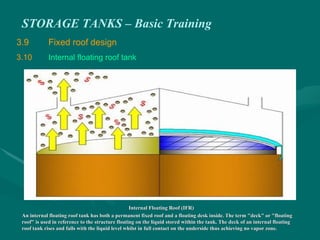
within the tank backfill and/or along pipe runs.
Will you be in compliance?
When installed and operated properly, vapor monitoring meets the
federal leak detection requirements for USTs. Vapor monitoring
denotes sampling for petroleum hydrocarbons (e.g., gasoline) that are
sufficiently volatile to be picked up in the monitoring well/sampling
point. However, the federal regulations also recognize sampling for
tracer compounds introduced in the UST system. Operation of a
vapor monitoring system at least once each month fulfills the
requirements for the life of the tank. Vapor monitoring can also be
installed to detect leaks from piping (see the section on leak detection for piping starting on
page 59).
How does the leak detection method work?
 Tracer compound analysis is used to sample for the presence of a tracer compound outside
the UST system that was introduced in the tank or underground piping.
 Fully automated vapor monitoring systems have permanently installed equipment to
continuously or periodically gather and analyze vapor samples and respond to a release
with a visual or audible alarm.
 Tracer compound analysis requires the installation of monitoring wells/sampling points
strategically placed in the tank backfill or along pipe runs to intercept special chemicals that,
in the event of a leak, are picked up in the sampling points.
 Manually operated vapor monitoring systems range from equipment that immediately
analyzes a gathered vapor sample to devices that gather a sample that must be sent to a
laboratory for analysis. Manual systems must be used at least once a month to monitor a
site. Tracer compound analysis may be performed on a monthly or less frequent basis by
qualified technicians.
 All vapor monitoring devices should be periodically calibrated to ensure that they are
properly responding.
 Before installation of a vapor monitoring system for release detection, a site assessment is
necessary to determine the soil type, groundwater depth and flow direction, and the general
geology of the site. This can only be done by a trained professional.
 The number of wells and their placement is very important. Only an experienced, ADEQ-
licensed UST contractor can properly design, construct and install an effective monitoring
well system. Vapor monitoring requires the installation of monitoring wells within the tank
backfill. Determining the adequate number and placement of wells should be done in
accordance with ADEQ’s Guidelines for Vapor Monitoring. (See Section 11.)
42
What are the regulatory requirements?
 The UST backfill must be sand, gravel or another material that will allow the petroleum
vapors or tracer compound to easily move to the monitor.
 The backfill should be clean enough that previous contamination does not interfere with the
detection of a current leak.
 The substance stored in the UST must vaporize easily so that the vapor monitor can detect
a release. Some vapor monitoring systems do not work well with diesel fuel.
 High groundwater, excessive rain, or other sources of moisture must not interfere with the
operation of vapor monitoring for more than 30 consecutive days.
 Monitoring wells must be secured and clearly marked.
 If a monthly vapor reading is significantly greater than a previous month’s reading, you must
report it to ADEQ as a suspected release and investigate. (See Section 7.)
Will it work at your site?
 Before installing a vapor monitoring system, a site assessment must be done to determine
whether vapor monitoring is appropriate at the site. A site assessment usually includes at
least a determination of the groundwater level, background contamination, stored product
type, and soil type. This assessment can only be done by a trained professional.
43
Vapor Monitoring (for tanks  piping)
Description
Of Release
Detection
Vapor monitoring measures product vapors in the soil at the UST site to check
for a leak. A site assessment must determine the number and placement of
monitoring wells that make sure a release is detected. NOTE: vapor monitors
will not work well with substances that do not easily vaporize (such as diesel
fuel).
Have
Certification
For Your
Release
Detection
Method
 Make sure your vapor monitoring equipment is certified for the types of
stored contents on which the release detection system is used. Most
manufacturers have their leak detection devices tested and certified by a third
party to verify that their equipment meets specific performance requirements set
by regulatory agencies. If you don't have certified performance claims, have the
manufacturer provide them to you.
Perform
These
OM
Actions
 Use your release detection system to test for leaks at least every 30 days.
Testing more often than monthly can catch leaks sooner and reduce cleanup
costs and problems. Be sure you check all of your vapor monitoring wells.
 See Section 7 of this manual if your UST system fails a leak test.
 Frequently test your release detection system according to the
manufacturer’s instructions to make sure it is working properly. Don’t
assume that your release detection system is working and never needs
checking. Some electronic vapor monitoring systems have a test or self-
diagnosis mode. If you have components (such as monitoring equipment,
probes or sensors) for your vapor monitoring system, read your manual and test
your equipment to see if it is working properly.
 Periodically have a qualified UST contractor, such as the vendor who
installed your release detection system, service all the system components
according to the manufacturer’s service instructions. Probes and other
components can wear out and must be checked periodically. Many vendors
recommend or require this maintenance activity at least annually.
 Keep your vapor monitoring wells clearly marked and secured.
 Check your vapor monitoring system owner’s manual often to answer
questions and to make sure you know the system’s operation and
maintenance procedures. Call the system’s vendor or manufacturer for a copy
of the owner’s manual if you don’t have one.
 Make sure employees who run, monitor, or maintain the release detection
system know exactly what they have to do and to whom to report
problems. Develop and maintain regular training programs for all employees.
Keep
These
OM
Records
 Keep results of your release detection system tests for at least 1 year. Your
monitoring equipment may provide printouts that can be used as records. Unless
you are recording actual release detection results at least every 30 days and
maintaining records for at least 1 year, you are not doing leak detection right.
 Keep all records of calibration, maintenance, and repair of your release
detection equipment for at least 1 year.
 Keep all performance claims supplied by the installer, vendor, or
manufacturer for at least 5 years. These records include the certification of
your leak detection equipment described above.
44
Groundwater Monitoring
What is Groundwater Monitoring?
The application of groundwater monitoring as an UST release detection method involves the
use of one or more permanent observation wells that are placed close to the tank and are
checked periodically for the presence of free product on the water table surface.
Will you be in compliance?
When installed and operated properly, a groundwater monitoring system meets the
federal leak detection requirements for USTs. Operation of a groundwater monitoring
system at least once each month fulfills the requirements for the life of a tank.
Groundwater monitoring can also be used to detect leaks in piping (see the section on
leak detection for piping starting on page 61).
How does the leak detection method work?
 Groundwater monitoring involves the use of permanent monitoring wells placed close to the
UST. The wells are checked at least monthly for the presence of product that has leaked
from the UST and is floating on the groundwater surface.
 The two main components of a groundwater monitoring system are the monitoring well
(typically, a well of 2-4 inches in diameter) and the monitoring device.
 Detection devices may be permanently installed in the well for automatic, continuous
measurements for leaked product.
 Detection devices are also available in manual form. Manual devices range
from a bailer (used to collect a liquid sample for visual inspection) to a device
that can be inserted into the well to electronically indicate the presence of
leaked product. Manual devices must be used at least once a month.
 Before installation, a site assessment is necessary to determine the soil type,
groundwater depth and flow direction, and the general geology of the site.
This assessment can only be done by a trained professional.
 The number of wells and their placement is very important. Only an experienced contractor
can properly design and construct an effective monitoring well system. Groundwater
monitoring requires the installation of monitoring wells within the tank backfill. Determining
the adequate number and placement of wells should be done in accordance with ADEQ
Guidelines for Vapor Monitoring. (See section 11.)
Note: Groundwater
monitoring cannot
be used at sites
where groundwater
is more than 20
feet below the
surface.
45
What are the regulatory requirements?
 Groundwater monitoring can only be used if the stored substance does not easily mix with
water and floats on top of water.
 If groundwater monitoring is to be the sole method of leak detection, the groundwater must
not be more than 20 feet below the surface, and the soil between the well and the UST
must be sand, gravel or other coarse materials.
 Product detection devices must be able to detect one-eighth inch or less of leaked product
on top of the groundwater.
 Monitoring wells must be designed to detect releases (slotted properly, etc.) within the tank
pit or piping trench, and be sealed to keep them from becoming contaminated from outside
sources. The wells must also be clearly marked and secured.
 Wells should be placed in the UST backfill so that they can detect a leak as quickly as
possible.
 If one-eighth inch or more of product is detected on the water’s surface, it must be reported
to ADEQ as a suspected release and investigated to confirm or deny. (See Section 7.)
Will it work at your site?
 In general, groundwater monitoring works best at UST sites where:
 Monitoring wells are installed in the tank backfill; and
 There are no previous releases of product that would falsely indicate a current release.
 A professionally conducted site assessment is critical for determining these site-specific
conditions.
46
Groundwater Monitoring (for tanks  piping)
Description
Of Release
Detection
Groundwater monitoring looks for the presence of liquid product floating on
the groundwater at the UST site. A site assessment must determine the
number and placement of monitoring wells that make sure a release is
detected. NOTE: this method cannot be used at sites where groundwater is
more than 20 feet below the surface.
Have
Certification
For Your
Release
Detection
Method
 Make sure any automated groundwater monitoring equipment is certified
for the types of stored contents on which the release detection system is
used. Most manufacturers have their leak detection devices tested and certified
by a third party to verify that their equipment meets specific performance
requirements set by regulatory agencies. If you don't have certified performance
claims, have the manufacturer provide them to you. (Manual devices such as
bailers are not generally certified.)
Perform
These
OM
Actions
 Use your release detection system to test for leaks at least every 30 days.
Testing more often than monthly can catch leaks sooner and reduce cleanup
costs and problems. Be sure you check all of your groundwater monitoring
wells.
 See Section 7 of this manual if your UST system fails a leak test.
 Frequently test your automated release detection system according to the
manufacturer’s instructions to make sure it is working properly. Don’t
assume that your release detection system is working and never needs
checking. Some electronic groundwater monitoring systems have a test or self-
diagnosis mode. If you have components (such as monitoring equipment,
probes or sensors) for your groundwater monitoring system, read your manual
and test your equipment to see if it is working properly. Manual devices should
be periodically checked to make sure they are working properly.
 Periodically have a qualified UST contractor, such as the vendor who
installed your release detection system, service all the system
components according to the manufacturer’s service instructions. Probes
and other components can wear out and must be checked periodically. Many
vendors recommend or require this maintenance activity at least annually.
 Keep your groundwater monitoring wells clearly marked and secured.
 Check your groundwater monitoring system owner’s manual often to
answer questions and to make sure you know the system’s operation and
maintenance procedures. Call the system’s vendor or manufacturer for a copy
of the owner’s manual if you don’t have one.
 Make sure employees who run, monitor, or maintain the release detection
system know exactly what they have to do and to whom to report
problems. Develop and maintain regular training programs for all employees.
Keep
These
OM
Records
 Keep results of your release detection system tests for at least 1 year.
Your monitoring equipment may provide printouts that can be used as records.
Unless you are recording actual release detection results at least every 30 days
and maintaining records for at least 1 year, you are not doing leak detection
right.
 Keep all records of calibration, maintenance, and repair of your release
detection equipment for at least 1 year.
 Keep all performance claims supplied by the installer, vendor, or
manufacturer for at least 5 years. These records include the certification of
your leak detection equipment described above.
47
Inventory Control and Tank Tightness Testing
What is Inventory Control and Tank Tightness Testing?
This method combines periodic tank tightness testing with monthly inventory control.
Inventory control involves taking measurements of tank contents and recording amount
pumped each operating day, as well as reconciling all this data at least once a month. This
combined method must also include tightness tests, which are sophisticated tests performed
by trained professionals. This combined method can be used only temporarily (usually for
10 years or less);
These two leak detection methods must be used together because neither method alone
meets the federal requirements for leak detection for tanks. Tightness testing is also an option
for underground piping, as described in the section on leak detection for piping starting on
page 59.
Because they must be used together, both tank tightness testing and inventory control are
discussed in this section.
Will you be in compliance?
When performed properly, periodic tank tightness testing combined with monthly inventory
control can temporarily meet the federal leak detection requirements for tanks (this method
does not detect piping leaks). See page 49 for time restrictions.
Tank Tightness Testing
How does the leak detection method work?
Tightness tests include a wide variety of methods. These methods can be divided into two
categories: volumetric and nonvolumetric. Tightness test methods are also referred to as
precision tank tests.
 Volumetric test methods generally involve measuring very precisely (in milliliters or
thousandths of an inch) the change in product level in a tank over time. Additional
characteristics of this category of tank tightness testing include:
 Changes in product temperature also must be measured very precisely (thousandths of
a degree) at the same time as level measurements, because temperature changes
cause volume changes that interfere with finding a leak.
 The product in the tank is required to be at a certain level before testing. This often
requires adding product from another tank on-site or purchasing additional product.
 A net decrease in product volume (subtracting out volume changes caused by
temperature) over the time of the test indicates a leak.
 A few of these methods measure properties of product that are independent of
temperature, such as mass and so do not need to measure product temperature.
 Nonvolumetric methods use acoustics or vacuum or pressure decay to determine the
presence of a hole in the tank.
 Various nonvolumetric methods are used to test either the wetted portion of the tank
(that part containing product) or the ullage (unfilled portion of the tank that does not
contain product) of the UST.
48
 Nonvolumetric testing involving acoustics interprets an ultrasonic signal.
 Tracer chemicals can also be circulated through the UST system and tested in
strategically placed sampling ports.
 Nonvolumetric testing involving acoustics interprets an ultrasonic signal.
 Tracer chemicals can also be circulated through the UST system and tested in
strategically placed sampling ports.
 For both volumetric and nonvolumetric (except tracer compounds) test methods, the
following generally apply:
 The testing equipment is temporarily installed in the tank, usually through the fill pipe.
 The tank must be taken out of service for the test.
 Some tightness test methods require all of the measurements and calculations be made
by hand by the tester. Other tightness test methods are highly automated. After the
tester sets up the equipment, a computer controls the measurements and analysis.
 Some automatic tank gauging systems are capable of meeting the regulatory requirements
for tank tightness testing and may be considered an equivalent method. Check with ADEQ.
What are the regulatory requirements?
 The tightness test method must be able to detect a leak at least as small as 0.1 gallon per
hour with certain probabilities of detection and of false alarm. To meet leak detection
requirements, tank tightness testing must be combined with either inventory control or
manual tank gauging.
 UST systems must have the combined method using tank tightness testing every 5 years
for no more than10 years following corrosion protection, spill, and overfill upgrade of tanks
(no later than December 1998) or installation of new tanks. For some USTs which had
corrosion protection before the entire UST system met upgrade standards, the combined
method using tank tightness testing every 5 years may be valid for less than 10 years.
 Ten years after upgrade or installation of a new UST system, you must have a monitoring
method that can be performed at least once per month.
49
Anything else you should consider?
 For most methods, the test is performed by a testing company. You just observe the test.
 Depending on the method, tank tightness testing can be used on tanks of varying capacity
containing gasoline and diesel. Many test methods have limitations on the capacity of the
tank or the amount of ullage (unwetted portion of the tank not filled with product) that should
not be exceeded. Methods that use tracer chemical analysis do not have limitations on tank
capacity. If you are considering using tightness testing for products other than gasoline or
diesel, discuss the method's applicability with the manufacturer's representative. Check the
method’s evaluation to confirm that it will meet regulatory requirements and your specific
UST system needs.
 Manifolded tanks generally should be disconnected and tested separately.
 Procedure and personnel, not equipment, are usually the most important factors in a
successful tightness test. Therefore, well-trained and experienced testers are very
important. Some states and local authorities have tester certification programs.
Time restrictions on the use of this combined method...
The combined method using tank tightness testing every 5 years is valid only
after the entire UST system has met spill, overfill, and corrosion protection
standards. Following entire UST system upgrade, this combined method may
be used for 10 years after the date the tank was installed or upgraded with
corrosion protection. Note that the end date is based on the compliance status
of the tank only, not the entire UST system. As a result, some USTs may not
be able to use this combined method for as long as 10 years. At the end of the
valid time period, you must use one of the monthly monitoring leak detection
choices described in this booklet.
Check with ADEQ for guidance.
The combined
method can be
used only
temporarily. Be
sure you know how
long you can use
the combined
method to meet
federal, state, or
local requirements.
50
Inventory Control And Tank Tightness Testing (for tanks only)
Description
Of Release
Detection
This temporary method combines monthly inventory control with periodic tank tightness
testing. Inventory control involves taking measurements of tank contents and recording
the amount of product pumped each operating day, measuring and recording tank
deliveries, and reconciling all this data at least once a month. This combined method also
includes tightness testing, a sophisticated test performed by trained professionals.
NOTE: This combination method can only be used temporarily for up to 10 years after
installing a new UST or for up to 10 years after your tank meets the corrosion protection
requirements.
Have
Certification
For Your
Release
Detection
Method
 Make sure your tank tightness testing method is certified for the types of tanks and
stored contents on which the tightness test is used. Most tightness test methods are
certified by a third party to verify that they meet specific performance requirements set by
regulatory agencies. If you don't have certified performance claims, have the tightness tester
provide them to you.
Perform
These
OM
Actions
 Take inventory readings and record the numbers at least each day that product is
added to or taken out of the tank. You may want to use the Daily Inventory Worksheet
provided for you on the next page.
 Reconcile the fuel deliveries with delivery receipts by taking inventory readings
before and after each delivery. Record these readings on a Daily Inventory Worksheet
(see next page).
 Reconcile all your data at least every 30 days. Use a Monthly Inventory Record (see
page 52 for an example).
 Have a tank tightness test conducted at least every 5 years. This testing needs to be
conducted by a professional trained in performing tank tightness testing and licensed
by ADEQ.
 See Section 7 of this manual if your tank fails a tightness test or if fails two
consecutive months of inventory control.
 Ensure that your measuring stick can measure to the nearest one-eighth inch and
can measure the level of product over the full range of the tank’s height. You should
check your measuring stick periodically to make sure that you can read the markings and
numbers and that the bottom of the stick is not worn.
 Ensure that your product dispenser is calibrated according to local standards or to
an accuracy of 6 cubic inches for every 5 gallons of product withdrawn.
 Measure the water in your tank to the nearest one-eighth inch at least once a month
and record the results on the reconciliation sheet. You can use a paste that changes
color when it comes into contact with water.
 Make sure employees who run, monitor, or maintain the release detection system
know exactly what they have to do and to whom to report problems. Develop and
maintain regular training programs for all employees.
Keep
These
OM
Records
 Keep results of your release detection system tests for at least 1 year. Your monitoring
equipment may provide printouts that can be used as records. Unless you are recording
actual release detection results at least every 30 days and maintaining records for at least 1
year, you are not doing leak detection right.
 Keep the results of your most recent tightness test.
 Keep all certification and performance claims for tank tightness test performed at
your UST site for at least 5 years.
51
Daily Inventory Worksheet
Facility Name: _________________________________________
Your Name: _________________________________________
Date: _________________________________________
Tank Identification
Type Of Fuel
Tank Size In Gallons
End Stick Inches
Amount Pumped
    
Totalizer Reading
Totalizer Reading
Totalizer Reading
Totalizer Reading
Totalizer Reading
Totalizer Reading
Totalizer Reading
Totalizer Reading
Today's Sum Of Totalizers
Previous Day's Sum Of
Totalizers
Amount Pumped Today
Delivery Record
    
Inches of Fuel Before Delivery
Gallons of Fuel Before
Delivery
(from tank chart)
Inches of Fuel After Delivery
Gallons of Fuel After Delivery
(from tank chart)
Gallons Delivered (Stick)
[Gallons After ! Gallons Before]
Gross Gallons Delivered
(Receipt)
52
Monthly Inventory Record
Month/Year :_______/______ Tank Identification  Type Of Fuel:____________________________
Facility Name:_________________________________________________
Date Of Water Check: ________ Level Of Water (Inches):______
Date
Start Stick
Inventory
(Gallons)
Gallons
Delivered
Gallons
Pumped
Book
Inventory
(Gallons)
End Stick Inventory
(Inches) (Gallons)
Daily Over (+) Or
Short (–)
[End – Book]
Initials
1 (+) (-) (=)
2 (+) (-) (=)
3 (+) (-) (=)
4 (+) (-) (=)
5 (+) (-) (=)
6 (+) (-) (=)
7 (+) (-) (=)
8 (+) (-) (=)
9 (+) (-) (=)
7 (+) (-) (=)
8 (+) (-) (=)
9 (+) (-) (=)
10 (+) (-) (=)
11 (+) (-) (=)
12 (+) (-) (=)
13 (+) (-) (=)
14 (+) (-) (=)
15 (+) (-) (=)
16 (+) (-) (=)
17 (+) (-) (=)
18 (+) (-) (=)
19 (+) (-) (=)
20 (+) (-) (=)
21 (+) (-) (=)
22 (+) (-) (=)
23 (+) (-) (=)
24 (+) (-) (=)
25 (+) (-) (=)
26 (+) (-) (=)
27 (+) (-) (=)
28 (+) (-) (=)
29 (+) (-) (=)
30 (+) (-) (=)
31 (+) (-) (=)
Total Gallons Pumped  Total Gallons Over Or Short 
Leak Check: Compare these numbers
Drop the last two digits
from the Total Gallons
Pumped number and enter here: _____________ + 130 = ____________ gallons
Is the total gallons over or short larger than leak check result? Yes No (circle one)
If your answer is “Yes” for 2 months in a row, notify the regulatory agency as soon as possible. (Keep this
piece of paper on file for at least 1 year)
53
Manual Tank Gauging
What is Manual Tank Gauging
Manual tank gauging can be used only for tanks 2,000 gallons or less
capacity. Tanks 1,000 gallons or less can use this method alone. Tanks
from 1,001-2,000 gallons can temporarily use manual tank gauging only
when it is combined with tank tightness testing. Manual tank gauging cannot
be used on tanks over 2,000 gallons.
Will you be in compliance?
When performed according to recommended practices, manual tank gauging meets the
federal leak detection requirements for USTs with a capacity of 1,000 gallons or less for the
life of the tank. Manual tank gauging detects leaks only from tanks (this method does not
detect piping leaks). For requirements for piping, see the section on leak detection for piping
starting on page 59.
How does the leak detection method work?
EPA has a booklet, Manual Tank Gauging, that fully explains how to do manual tank gauging
correctly. The booklet also contains standard recordkeeping forms. You can order this free
booklet by calling EPA's publication distributor at (800) 490-9198 or downloading it from the
EPA Web site at www.epa.gov/oust.
 Four measurements of the tank's contents must be taken weekly, two at
the beginning and two at the end of at least a 36-hour period during
which nothing is added to or removed from the tank. See the table on the
next page.
 The average of the two consecutive ending measurements are subtracted
from the average of the two beginning measurements to indicate the change
in product volume.
 Every week, the calculated change in tank volume is compared to the
standards shown in the table on the next page. If the calculated change
exceeds the weekly standard, the UST may be leaking. Also, monthly
averages of the four weekly test results must be compared to the monthly
standard in the same way. See the table on the next page.
What are the regulatory requirements?
 Liquid level measurements must be taken with a gauge stick that is marked to measure the
liquid to the nearest one-eighth of an inch.
 Manual tank gauging may be used as the sole method of leak detection for tanks with a
capacity of 1,000 gallons or less for the life of the tank. Tanks between 551 and 1,000
gallons have testing standards based on their diameter or their additional use of tightness
testing (see table). These tanks may temporarily use a combination of manual tank gauging
and periodic tank tightness. (See next bullet on following page.)
54
Table of Test Standards for Manual Tank Gauging
Tank Size Minimum
Duration Of
Test
Weekly Standard
(1 test)
Monthly
Standard
(4-test average)
up to 550 gallons 36 hours 10 gallons 5 gallons
551-1,000 gallons (when
tank diameter is 64)
44 hours 9 gallons 4 gallons
551-1,000 gallons (when
tank diameter is 48)
58 hours 12 gallons 6 gallons
551-1,000 gallons
(also requires periodic
tank tightness testing)
36 hours 13 gallons 7 gallons
1,001-2,000 gallons (also
requires periodic tank
tightness testing)
36 hours 26 gallons 13 gallons
 For tanks with a capacity of 1,001-2,000 gallons, manual tank gauging must be combined
with periodic tightness testing. This combined method will meet the federal requirements
only temporarily. See page 49 for an explanation of time restrictions that also applies to
the combination of manual tank gauging and tank tightness testing. You must eventually
have another monitoring method that can be performed at least once a month.
 Tanks greater than 2,000 gallons in capacity may not use this method of leak detection to
meet these regulatory requirements.
Common Equipment used in Manual Tank Gauging
Gauge Stick or Other Gauges
The gauge stick used to measure the depth of liquid in an underground tank must be
marked or notched to the1/8th
inch, starting with zero at the bottom end. Check your stick to
be sure the end has not been worn or cut off and that the stick is not warped. The stick
should be made of non-sparking material, such as wood, and varnished to minimize the
creeping of fuel above the actual fuel level in the tank. Instead of using a gauge stick, you
may use a mechanical or electronic tank level monitor. Whatever measuring device you
use must be capable of measuring the level of product over the full range of the tank's
height to the nearest 1/8 inch.
Forms
A sample “MANUAL TANK GAUGING RECORD” form has been provided for you in this
manual on page 57. (Make copies as needed,)
55
Tank Chart
A tank chart is a table that converts the number of inches of liquid in the tank into the
number of gallons. You need a tank chart that exactly matches your storage tank (tank
manufacturers usually provide charts for their tanks). If you have more than one tank, you
will need a chart for each tank unless the tanks are identical. The tank chart must show
conversion to gallons for each 1/8th
inch stick reading. If your tank chart does not convert
each 1/8th inch reading into gallons, contact the tank manufacturer, or, if you have a steel
tank, the Steel Tank Institute (see Section 11) to get an appropriate chart.
You always need to convert inches into gallons in order to fill out the form correctly
and to do the necessary math. To convert inches into gallons, find your stick's reading to
the nearest 1/8th
inch on the tank chart, then simply read across to the gallons column to
find the number of gallons.
Anything else you should consider?
 You can perform manual tank gauging yourself. Correct gauging, recording, and math are
the most important factors for successful tank gauging. The accuracy of tank gauging can
be greatly increased by spreading product-finding paste on the gauge stick before taking
measurements.
56
Manual Tank Gauging (for tanks 1,000 gallons or less only)
Description
Of Release
Detection
This method may be used only for tanks of 1,000 gallons or less capacity
meeting certain requirements. These requirements (tank size, tank
dimension, and test time) are found in the manual tank gauging record on
the next page. Manual tank gauging involves taking your tank out of
service for the testing period (at least 36 hours) each week, during which
time the contents of the tank are measured twice at the beginning and
twice at the end of the test period. The measurements are then compared
to weekly and monthly standards to determine if the tank is tight.
Have
Certification
For Your
Release
Detection
Method
None required.
Perform
These
OM
Actions
 Once a week, record two inventory readings at the beginning of the
test, allow the tank to sit undisturbed for the time specified in the
Manual Tank Gauging Record on the next page, and record two
inventory readings at the end of the test (use any form comparable to
the one on the following page).
 Reconcile the numbers weekly and record them on a Manual Tank
Gauging Record (see the next page).
 See Section 7 of this manual if your tank fails the weekly standard.
 At the end of 4 weeks, reconcile your records for the monthly standard
and record the result on a Manual Tank Gauging Record (see the next
page).
 See Section 7 of this manual if your tank fails the monthly standard.
 Ensure that your measuring stick can measure to the nearest one-
eighth inch and can measure the level of product over the full range of
the tank’s height. You should check your measuring stick periodically to
make sure that you can read the markings and numbers and that the
bottom of the stick is not worn.
 Make sure employees who run, monitor, or maintain the release
detection system know exactly what they have to do and to whom to
report problems. Develop and maintain regular training programs for all
employees.
Keep
These
OM
Records
 Keep your manual tank gauging records for at least 1 year. Unless you
are recording actual release detection results weekly and at least every 30
days and maintaining records for at least 1 year, you are not doing leak
detection right.
57
Compare your weekly readings and the
monthly average of the 4
weekly readings with the standards
shown in the table on the left.
If the calculated change exceeds the
weekly standard, the UST may
be leaking. Also, the monthly average
of the 4 weekly test results
must be compared to the monthly
standard in the same way.
If either the weekly or the monthly
standards have been exceeded, the
UST may be leaking. Call ADEQ within 24 to report the suspected release
and get further instructions.
Start Test
(month,
day, and
time)
First
Initial
Stick
Reading
Second
Initial
Stick
Reading
Average
Initial
Reading
Initial
Gallons
(convert
inches
to
gallons)
[a]
End Test
(month,
day, and
time)
First
End
Stick
Reading
Second
End
Stick
Reading
Average
End
Reading
End
Gallons
(convert
inches
to
gallons)
[b]
Change
in Tank
Volume
In
Gallons
+ or (-)
[a-b]
Tank
Passes
Test
(circleYes
or No)
Date:
Time:
AM/PM
Date:
Time:
AM/PM
Y N
Date:
Time:
AM/PM
Date:
Time:
AM/PM
Y N
Date:
Time:
AM/PM
Date:
Time:
AM/PM
Y N
Date:
Time:
AM/PM
Date:
Time:
AM/PM
Y N
To see how close you are to the
monthly
Standard, divide the sum of the
4 weekly
Readings by 4 and enter the
results here 
Y N
Keep This Piece Of Paper On File For At Least 1 Year
Tank Size
Minimum
Duration
of Test
Weekly
Standard
(1 test)
Monthly
Standard
(4 test average)
Up to 550 gallons
551-1,000 gallons
(when tank diameter is 64”)
551-1,000 gallons
(when tank is 48”)
551-1,000 gallons (also requires
periodic tank tightness testing)
1,001- 2,000 gallons (also requires
periodic tank tightness testing)
Manual Tank Gauging Record
Circle your tank size, test duration, and weekly/monthly standards in the window below
58
Manual Tank Gauging And Tank Tightness Testing
(for tanks 2,000 gallons or less only)
Description
Of Release
Detection
This temporary method combines manual tank gauging with periodic tank
tightness testing. It may be used only for tanks of 2,000 gallons or less capacity.
Manual tank gauging involves taking your tank out of service for the testing
period (at least 36 hours) each week, during which the contents of the tank are
measured twice at the beginning and twice at the end of the test period. The
measurements are then compared to weekly and monthly standards to determine
if the tank is tight. This combined method also includes tightness testing, a
sophisticated test performed by trained professionals.
NOTE: This combination method can only be used temporarily for up to ten years
after installing a new UST or for up to 10 years after your tank meets the
corrosion protection requirements.
Have
Certification
For Your
Release
Detection
Method
 Make sure your tank tightness testing is certified for the types of tanks and
stored contents on which the tightness test is used. Most tightness test
methods are certified by a third party to verify that they meet specific performance
requirements set by regulatory agencies. If you don't have certified performance
claims, have the tightness tester provide them to you.
Perform
These
OM
Actions
 Once a week, record two inventory readings at the beginning of the test, allow
the tank to sit undisturbed for the time specified in the Manual Tank Gauging
Record, and record two inventory readings at the end of the test (use any
form comparable to the one on page 57).
 Reconcile the numbers weekly and record them on a Manual Tank Gauging
Record (see page 57).
 See Section 7 of this guide if your tank fails the weekly standard.
 At the end of 4 weeks, reconcile your records for the monthly standard and
record the result on a Manual Tank Gauging Record (see page 57).
 See Section 7 of this guide if your tank fails the monthly standard.
 Conduct a tank tightness test at least every 5 years. This testing needs to be
conducted by a professional trained in performing tank tightness testing.
 See Section 7 of this manual if your tank fails the tightness test.
 Ensure that your measuring stick can measure to the nearest one-eighth inch
and can measure the level of product over the full range of the tank’s height.
You should check your measuring stick periodically to make sure that you can read
the markings and numbers and that the bottom of the stick is not worn.
 Make sure employees who run, monitor, or maintain the release detection
system know exactly what they have to do and to whom to report problems.
Develop and maintain regular training programs for all employees.
Keep
These
OM
Records
 Keep your manual tank gauging records for at least 1 year. Unless you are
recording actual release detection results at least weekly and every 30 days and
maintaining records for at least 1 year, you are not doing leak detection right.
 Keep the results of your most recent tightness test.
 Keep all certification and performance claims for tank tightness test
performed at your UST site for at least 5 years.
59
Leak Detection For Underground Piping
Will you be in compliance?
When installed and operated according to the manufacturer's specifications, the leak detection
methods discussed here meet the federal regulatory requirements for the life of underground
piping systems. Your UST may have suction or pressurized piping, both of which are
discussed below.
What are the regulatory requirements for suction piping?
 No leak detection is required if the suction piping has (1)
enough slope so that the product in the pipe can drain back
into the tank when suction is released and (2) has only one
check valve, which is as close as possible beneath the pump in
the dispensing unit. If a suction line is to be considered
exempt based on these design elements, there must be some
way to check that the line was actually installed according to
these plans.
 If a suction line does not meet all of the design criteria noted above, one of the following
leak detection methods must be used:
 A line tightness test at least every 3 years; or
 Monthly interstitial monitoring; or
 Monthly vapor monitoring (including tracer compound analysis); or
 Monthly groundwater monitoring; or
 Monthly statistical inventory reconciliation; or
 Other monthly monitoring that meets performance standards.
The line tightness test must be able to detect a leak at least as small as 0.1 gallon per hour at
1.5 times normal operating pressure with certain probabilities of detection and of false alarm.
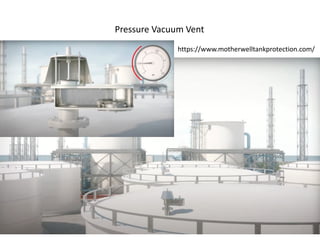
Interstitial monitoring, vapor monitoring (including tracer compound analysis), groundwater
monitoring, and statistical inventory reconciliation have the same regulatory requirements for
piping as they do for tanks. See the earlier sections of this booklet on those methods.
What are the regulatory requirements for pressurized piping?
Each pressurized piping run must have one leak detection method from each set below:
An automatic line leak detector:
 Automatic flow restrictor; or
 Automatic flow shutoff; or
 Continuous alarm system.
60
And one other method:
 Annual line tightness test; or
 Monthly interstitial monitoring; or
 Monthly vapor monitoring (including tracer compound analysis); or
 Monthly groundwater monitoring; or
 Monthly statistical inventory reconciliation; or
 Other monthly monitoring that meets performance standards.
 The automatic line leak detector (LLD) must be designed to detect a leak at least as small
as 3 gallons per hour at a line pressure of 10 pounds per square inch within 1 hour by
shutting off the product flow, restricting the product flow, or triggering an audible or visual
alarm.
 The line tightness test must be able to detect a leak at least as small as 0.1 gallon per hour
when the line pressure is 1.5 times its normal operating pressure. The test must be
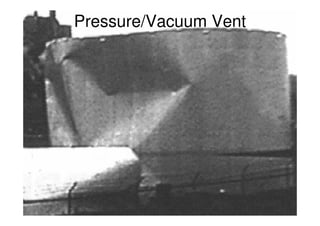
conducted each year. If the test is performed at pressures lower than 1.5 times operating
pressure, the leak rate to be detected must be correspondingly lower.
 Automatic LLDs and line tightness tests must also be able to meet the federal regulatory
requirements regarding probabilities of detection and false alarm.
 Interstitial monitoring, vapor monitoring (including tracer compound analysis), groundwater
monitoring, and statistical inventory reconciliation have the same regulatory requirements
for piping as they do for tanks. See the earlier sections of this booklet on those methods.
How do the leak detection methods work?
Automatic line leak detectors (LLDs)
 Flow restrictors and flow shutoffs can monitor the pressure within the line in a variety of
ways: whether the pressure decreases over time; how long it takes for a line to reach
operating pressure; and combinations of increases and decreases in pressure.
 If a suspected leak is detected, a flow restrictor keeps the product flow through the line well
below the usual flow rate. If a suspected leak is detected, a flow shutoff completely cuts off
product flow in the line or shuts down the pump.
 A continuous alarm system constantly monitors line conditions and immediately triggers an
audible or visual alarm if a leak is suspected. Automated internal, vapor, or interstitial line
monitoring systems can also be set up to operate continuously and sound an alarm, flash a
signal on the console, or even ring a telephone in a manager's office when a leak is
suspected.
 Both automatic flow restrictors and flow shutoffs are permanently installed directly into the
pipe or the pump housing.
 Vapor, interstitial, or other monitoring systems can be installed to shut off flow, restrict flow,
or trigger an alarm whenever a leak is detected. If it meets the applicable standards, such a
setup meets the monthly monitoring requirement as well as the LLD requirement.
Line tightness testing
 The line is taken out of service and pressurized, usually above the normal operating
pressure. A drop in pressure over time, usually an hour or more, suggests a possible leak.
61
 Suction lines are not pressurized very much during a tightness test (about 7 to 15 pounds
per square inch).
 Most line tightness tests are performed by a testing company. You just observe the test.
 Some tank tightness test methods can be performed to include a tightness test of the
connected piping.
 For most line tightness tests, no permanent equipment is installed.
 In the event of trapped vapor pockets, it may not be possible to conduct a valid line
tightness test. There is no way to tell definitely before the test begins if this will be a
problem, but long complicated piping runs with many risers and dead ends are more likely
to have vapor pockets.
 Some permanently installed electronic systems (which often include ATG systems) can
meet the requirements of monthly monitoring or a line tightness test.
Secondary containment with interstitial monitoring
 A barrier is placed between the piping and the
environment. Double-walled piping or a leak-proof liner in
the piping trench can be used.
 A monitor is placed between the piping and the barrier to
sense a leak if it occurs. Monitors range from a simple
stick that can be put in a sump to see if a liquid is present,
to continuous automated systems that monitor for the
presence of liquid product or vapors.
 Proper installation of secondary containment is the most important and the most difficult
aspect of this leak detection method. Trained, experienced ADEQ-licensed installers are
necessary.
 See the section on secondary containment for additional information. Secondary
containment for piping is similar to that for tanks.
Vapor (including tracer compound analysis) or groundwater monitoring
 Vapor monitoring detects product that leaks into the soil and evaporates.
 Tracer compound analysis uses a tracer chemical to determine if there is a hole in the line.
 Groundwater monitoring checks for leaked product floating on the groundwater near the
piping.
 A site assessment must be used to determine monitoring well placement and spacing.
 UST systems using vapor (including tracer compound analysis) or groundwater monitoring
for the tanks are well suited to use the same monitoring method for the piping.
 See the earlier sections on vapor (including tracer compound analysis) and groundwater
monitoring. Use of these methods with piping is similar to that for tanks.
Note: Systems with Pressurized Piping Must Have An Automatic Line Leak Detector.
62
Automatic Line Leak Detection (for pressurized piping only)
Description
Of Release
Detection
Automatic line leak detectors (LLDs) are designed to detect a catastrophic
release from pressurized piping. Automatic LLDs must be designed to detect
a leak at least as small as 3 gallons per hour at a line pressure of 10 psi within
1 hour. When a leak is detected, automatic LLDs must shut off the product
flow, restrict the product flow, or trigger an audible or visual alarm. NOTE:
Mechanical automatic LLDs need to be installed and operated as close as
possible to the tank (LLDs are designed to detect a leak, restrict flow, etc.
only between the detector and the dispenser).
Have
Certification
For Your
Release
Detection
Method
 Make sure your release detection equipment is certified for the types of
piping and stored contents on which the release detection system is used.
Most manufacturers have their leak detection devices tested and certified by a
third party to verify that their equipment meets specific performance
requirements set by regulatory agencies. If you don't have certified performance
claims, have the manufacturer provide them to you.
Perform
These
OM
Actions
 Frequently test your automatic LLDs according to the manufacturer’s
instructions to make sure it is working properly. Don’t assume that your
release detection system is working and never needs checking. Some
monitoring systems have a test or self-diagnosis mode.
 Periodically have a qualified UST contractor, such as the vendor who
installed your release detection system, service all the system
components according to the manufacturers’ service instructions.
Components can wear out and must be checked periodically. Many vendors
recommend or require this maintenance activity at least annually.
 See Section 7 of this manual if your LLD detects a leak.
 Make sure employees who run, monitor, or maintain the release detection
system know exactly what they have to do and to whom to report
problems. Develop and maintain regular training programs for all employees.
Keep
These
OM
Records
 For at least a year, keep the annual test that demonstrates that the LLD is
functioning properly.
 If used for monthly monitoring, keep results of your release detection
system tests for at least 1 year. Your monitoring equipment system may
provide printouts that can be used as records. Unless you are recording actual
release detection results at least every 30 days and maintaining records for at
least 1 year, you are not doing leak detection right.
 Keep all records of calibration, maintenance, and repair of your release
detection equipment for at least 1 year.
 Keep all performance claims supplied by the installer, vendor, or
manufacturer for at least 5 years. These records include the certification of
your leak detection equipment described above.
63
Line Tightness Testing (for piping only)
Description
Of Release
Detection
This method uses a periodic line tightness test to determine if your piping
is leaking. Tightness testing can be performed by either a trained
professional or by using a permanently installed electronic system
(sometimes connected to an automatic tank gauging system).
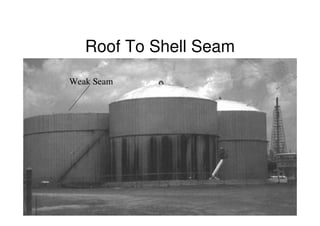
Have
Certification
For Your
Release
Detection
Method
 Make sure your line tightness testing or permanently installed
electronic system is certified for the types of piping and stored
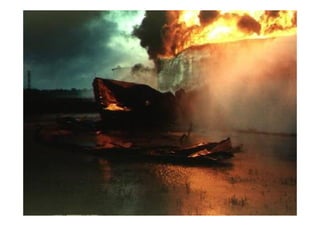
contents on which the release detection system is used. Most tightness
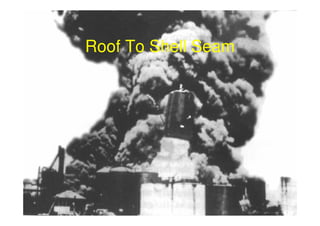
test methods and release detection equipment have been tested and
certified by a third party to verify that the equipment or services meet
specific performance requirements set by regulatory agencies. If you don't
have certified performance claims, have the tightness tester or equipment
manufacturer provide them to you.
Perform
These
OM
Actions
 If line tightness testing is used for pressurized piping, the test must be
conducted at least annually.
 If line tightness testing is used for suction piping, the test must be
conducted at least every three years. Safe suction piping as described on
page 59 may not need release detection testing.
 This tightness testing must be conducted by a professional trained in
performing line tightness testing or by using a permanently installed
electronic system.
 See Section 7 of this manual if your piping fails the tightness test or if
the electronic system indicates a leak.
 Periodically have a qualified UST contractor, such as the vendor who
installed your release detection system, service all the system
components according to the manufacturers’ service instructions.
Components can wear out and must be checked periodically. Many vendors
recommend or require this maintenance activity at least annually.
 Make sure employees who run, monitor, or maintain the release
detection system know exactly what they have to do and to whom to
report problems. Develop and maintain regular training programs for all
employees.
Keep
These
OM
Records
 Keep results of your release detection system tests for at least 1 year.
Your monitoring equipment may provide printouts that can be used as
records. Unless you are recording actual release detection results at least
every 30 days and maintaining records for at least 1 year, you are not doing
leak detection right.
 If you use a permanently installed electronic system, keep all records
of calibration, maintenance, and repair of your equipment for at least 1
year.
 Keep all performance claims supplied by the installer, vendor, or
manufacturer for at least 5 years. These records include the certification
of your leak detection equipment described above.
64
30-Day Release Detection Monitoring Record
(May be used for monitoring wells, interstitial monitoring, and automatic tank gauging)

Release Detection Method:___________________________________
Facility Name:___________________________________
UST System (Tank  Piping)
(Enter N for No Release Detected or Y for a Suspected
Or Confirmed Release)
Date
Your
Name
UST # UST # UST # UST #
Keep This Piece Of Paper And Any Associated Printouts On File For
At Least 1 Year From The Date Of The Last Entry
65
Section 7 — Suspected Or Confirmed Releases
You need to be fully prepared to respond to releases before they may occur. You need to
know what to do when release detection methods indicate a suspected or confirmed release.
Be ready to take the following steps, as appropriate.
Stop The Release
 Take immediate action to prevent the release of more product.
 Turn off the power to the dispenser and bag the nozzle.
 Make sure you know where your emergency shutoff switch is located.
 Empty the tank, if necessary, without further contaminating the site. You may need the
assistance of your supplier or distributor.
Contain The Release
Contain, absorb, and clean up any surface spills or overfills. You should keep enough
absorbent material at your facility to contain a spill or overfill of petroleum products until
emergency response personnel can respond to the incident. The suggested supplies include,
but are not limited to, the following:
 Containment devices, such as containment booms, dikes, and pillows.
 Absorbent material, such as kitty litter, chopped corn cob, sand, and sawdust. (Be sure you
properly dispose of used absorbent materials.)
 Mats or other material capable of keeping spill or overfill out of nearby storm drains.
 Spark-free flash light.
 Spark-free shovel.
 Buckets.
 Reels of caution tape, traffic cones, and warning signs.
 Personal protective gear.
Also, identify any fire, explosion, or vapor hazards and take action to neutralize these hazards.
66
Call For Help
Contact your local fire or emergency response authority. Make sure you have these crucial
telephone numbers prominently posted where you and your employees can easily see them.
See the next page for a form you can copy and post.
Report To Authorities
If you observe any of the following, contact your state’s underground storage tank regulatory
authority to report a suspected or confirmed release as soon as possible (within 24 hours):
 Any spill or overfill of petroleum that exceeds 25 gallons or that causes a sheen on nearby
surface water. (Spills and overfills under 25 gallons that are contained and immediately
cleaned up do not have to be reported. If they can’t be quickly cleaned up, they must be
reported to ADEQ.)
 Any released regulated substances at the UST site or in the surrounding area — such as
the presence of liquid petroleum; soil contamination; surface water or groundwater
contamination; or petroleum vapors in sewer, basement, or utility lines.
 Any unusual operating conditions you observe — such as erratic behavior of the
dispenser, a sudden loss of product, or an unexplained presence of water in the tank.
However, you are not required to report if:
• The system equipment is found to be defective, but not leaking, and is immediately
repaired or replaced.
 Results from your release detection system indicate a suspected release. However, you
are not required to report if:
• The monitoring device is found to be defective and is immediately repaired,
recalibrated, or replaced and further monitoring does not confirm the initial suspected
release, or
• In the case of inventory control, a second month of data does not confirm the initial
result.
The next page contains a blank list for names and phone numbers of important contacts.
Fill out this information for your facility so that you will know who to call in case of an
emergency. Remove this page from the manual, copy it, fill it out, and post it in a prominent
place at your facility.
Copy the next page and update it often. Make sure everyone at your
UST facility is familiar with this list of contacts.
67
Release Response
Important Contact Information
Contact Name Phone #
ADEQ:
Local ADEM:
Fire Department:
Ambulance:
Police Department:
Repair Contractor:
Other Contacts:


 Release Response Checklist
 Stop the release: Take immediate action to prevent the release of more product. Turn off the
power to the dispenser and bag the nozzle. Make sure you know where your emergency shutoff
switch is located. Empty the tank, if necessary, without further contaminating the site.
 Contain the release: Contain, absorb, and clean up any surface releases. Identify any fire,
explosion, or vapor hazards and take action to neutralize these hazards.
 Call for help and to report suspected or confirmed releases: Contact your local fire or
emergency response authority. Contact ADEQ within 24 hours.
68
Section 8 - Frequent Walk-Through Inspections
You should conduct basic walk-through inspections of your facility at least monthly to make
sure your essential equipment is working properly and you have release response supplies on
hand.
These inspections would not be as thorough as following the OM checklists presented earlier
in this booklet, but they can provide a quick overview you can do more often than the longer
checklists. You might think of this level of inspection as similar to automobile dashboard
indicators that provide us with status warnings like low battery.
When you perform your walk-through inspection you should quickly check at least the
following:
 Spill Buckets: Are spill buckets clean, empty, and in good condition?
 Overfill Alarm (if you have one): Is your overfill alarm working and easily seen or heard?
 Release Detection System: Is your release detection equipment working properly? For
example, did you run a quick self-test of the ATG to verify it’s working properly? Or did you
check your manual dip stick to make sure it’s not warped or worn?
 Impressed Current Cathodic Protection System (if you have one): Is your cathodic
protection system turned on? Are you checking your rectifier at least every 60 days?
 Fill And Monitoring Ports: Are covers and caps tightly sealed and locked?
 Spill And Overfill Response Supplies: Do you have the appropriate supplies for cleaning
up a spill or overfill?
In addition, good UST site management should also include the following quick visual checks:
 Dispenser Hoses, Nozzles, And Breakaways: Are they in good condition and working
properly?
 Dispenser And Dispenser Sumps: Any signs of leaking? Are the sumps clean and
empty?
 Piping Sumps: Any signs of leaking? Are the sumps clean and empty?
If you find any problems during the inspection, you or your UST contractor needs to take
action quickly to resolve these problems and avoid serious releases.
A frequent walk-through checklist is provided for your use on the next page.
69


 Frequent Walk-Through Inspection Checklist
Date Of Inspection
Release Detection System: Inspect for
proper operation.
Spill Buckets: Ensure spill buckets are clean
and empty.
Overfill Alarm: Inspect for proper operation.
Can a delivery person hear or see the alarm
when it alarms?
Impressed Current System: Inspect for
proper operation.
Fill And Monitoring Ports: Inspect all
fill/monitoring ports and other access points to
make sure that the covers and caps are tightly
sealed and locked.
Spill And Overfill Response Supplies:
Inventory and inspect the emergency spill
response supplies. If the supplies are low,
restock the supplies. Inspect supplies for
deterioration and improper functioning.
Dispenser Hoses, Nozzles, And
Breakaways: Inspect for loose fittings,
deterioration, obvious signs of leakage, and
improper functioning.
Dispenser And Dispenser Sumps: Open
each dispenser and inspect all visible piping,
fittings, and couplings for any signs of leakage.
If any water or product is present, remove it
and dispose of it properly. Remove any debris
from the sump.
Piping Sumps: Inspect all visible piping,
fittings, and couplings for any signs of leakage.
If any water or product is present, remove it
and dispose of it properly. Remove any debris
from the sump.
Your initials in each box below the date of the inspection indicate the device/system was inspected
and OK on that date.
70
Section 9 - Financial Responsibility
Financial Responsibility
State and federal regulations require that owners of regulated storage tanks maintain financial
responsibility for their tanks. This ensures that an owner is able to pay for the cleanup of
damage caused to the environment and third-party claims that may result from a leaking UST
system. The amount of coverage required varies by the type of tank owner or operator and
the number of tanks owned or operated.
There are two general types of coverage required: per occurrence and annual aggregate.
• Per occurrence means the amount of money that must be available to pay the
costs for each occurrence of a leaking UST. The amount of per occurrence
coverage required depends on the type of facility and, in some cases, on the
amount of throughput at the facility.
• Annual aggregate means the total amount of FR available to cover all
obligations that might occur in one year. The amount of annual aggregate
coverage required depends on the number of tanks that are owned or operated.
The amount of coverage required is provided in the table below.
Required Coverage Of Financial Responsibility
Group Of UST Owners And
Operators
Per Occurrence
Amount
Aggregate
Amount
Group 1: Petroleum producers,
refiners, or marketers
$1 million
Group 2: Non-marketers (Non-
marketing facilities do not sell or
transfer petroleum to the public or
any other facility that would sell the
petroleum. Additionally, non-
marketing facilities do not produce or
refine petroleum. An example of a
non-marketer is a bus terminal.)
$500,000
(if throughput is 10,000
gallons monthly or less)
or
$1 million
(if throughput is more
than 10,000 gallons
monthly)
$1 million
(for 100 or fewer
tanks)
or
$ 2 million
(for more than 100
tanks)
Tank owners can use one or more of several mechanisms available to meet financial
responsibility (FR) obligations:
• Financial Test Of Self-Insurance - A firm with a tangible net worth of at least $10 million
may demonstrate FR by passing one of the two financial tests listed in the federal
regulations.
• Corporate Guarantee - You may secure a corporate guarantee from another eligible firm.
The provider of the guarantee has to pass one of the financial tests listed in the federal
regulations.
• Insurance Coverage - You may buy insurance from an insurer or a risk retention group.
71
• Surety Bond - You may obtain a surety bond, which is a guarantee by a surety company
that it will satisfy FR obligations if the person who obtained the surety bond does not.
• Letter Of Credit - You may obtain a letter of credit, which obligates the issuer to provide
funding for corrective action and third-party compensation.
• Trust Fund - You may set up a fully-funded trust fund administered by a third party to pay
for corrective action costs and third-party claims.
• State Financial Assurance Funds - You may be covered by a state fund that provides all
or a portion of FR to the degree it pays for cleanup and third-party compensation costs.
You may use one or a combination of the mechanisms listed above to meet your FR
obligations. Combinations may be used to cover:
• Different sets of tanks - For example, tanks in one state may be covered by a state fund,
while tanks in another state may be covered by insurance.
• Different scopes of coverage - For example, an owner may use a state fund to cover
corrective action obligations and a letter of credit to cover third-party liability obligations.
• Different dollar amounts of coverage - For example, an owner may have a letter of
credit for the first $7,500 (the deductible amount) of coverage and state fund coverage for
the rest.
One FR mechanism owners in the State of Arkansas have available is the Arkansas
Petroleum Storage Tank Trust Fund. Although the state trust fund is not insurance, it may
be used to meet part of the tank owner’s financial responsibility obligation. Like insurance,
there is a “deductible” amount or a non-reimbursable amount which the tank owner must pay
before he/she can receive any trust fund reimbursement. Eligibility for the state trust fund is
not automatic or a guaranteed entitlement once a tank is registered and fees paid.
Participation in the fund is voluntary, and owners must meet certain eligibility requirements at
the time of discovery of the occurrence.
State Trust Fund Requirements
In order to obtain reimbursement from the state trust fund for the costs of investigation and
corrective action resulting from the accidental release of petroleum from a regulated storage
tank, an owner must be compliant with the following criteria at the time of discovery of the
release:
• Tanks must be registered with ADEQ
• Tank fees must be paid as required by ADEQ
• Financial responsibility for the deductible amount of $7,500 must be maintained
• Release must be reported to ADEQ in a timely manner (within 24 hours of discovery)
• Cooperate fully with ADEQ in corrective action to address the release.
The owner must expend $7,500 in reasonable, allowable and necessary corrective action
costs for the occurrence before any reimbursement may be made from the state trust fund.
72
State Trust Fund Coverage Limits
For eligible owners of petroleum storage tank systems, the trust fund will
reimburse:
• Up to $1.5 million per occurrence for corrective action costs
• Up to $1 million for third-party damages.
FR for Local Governments
If you are a local government, there are four additional methods that you can use to comply
with the FR requirements:
• Bond Rating Test - A local government may demonstrate (or guarantee) FR by passing a
bond rating test.
• Financial Test - A local government may demonstrate (or guarantee) FR by passing a
financial test.
• Guarantee - A local government may obtain a guarantee from another local government or
the state.
• Dedicated Fund - A local government may demonstrate (or guarantee) FR by establishing
a fund.
73
Section 10 - Out-of-Service UST Systems and Closure
Temporary closure.
(a) When an UST system is temporarily closed, owners and operators must continue operation
and maintenance of corrosion protection , as well as release detection in the manner
explained earlier in this manual. If a release is suspected or confirmed, it must be handled in
the same manner that it would be if the UST were in operation. However, release detection is
not required as long as the UST system is empty. The UST system is considered empty when
all materials have been removed using commonly employed practices so that no more than
2.5 centimeters (one inch) of residue, or 0.3 percent by weight of the total capacity of the UST
system, remain in the system.
(b) When an UST system is temporarily closed for 3 months or more, owners and
operators must also comply with the following requirements:
(1) Leave vent lines open and functioning; and
(2) Cap and secure all other lines, pumps, manways, and ancillary equipment.
(c) When an UST system is temporarily closed for more than 12 months, owners and
operators have three options:
(1) You must permanently close your UST if it doesn’t meet the applicable requirements
for new or upgraded USTs (except for spill and overfill requirements).
(2) You can ask ADEQ for an extension beyond 12 months, if you provide an
assesment that determines whether contamination is present at your site.
(3) Your UST can remain temporarily closed without needing an extension granted by
ADEQ if the UST meets the applicable requirements for new or upgraded USTs
(except spill and overfill requirements) and the requirements noted above for
temporary closure.
74
Closing Permanently
If you decide to close your UST permanently, follow these requirements for permanent
closure:
• Notify ADEQ at least 30 days before you plan to close your UST.
• Either remove the UST from the ground or close it in place. In both cases, the tank
must be emptied and cleaned by removing all liquids, dangerous vapors, and
accumulated sludge. These potentially very hazardous actions must be carried out by
ADEQ-licensed contractors and individuals who follow standard safety practices. If you
leave the UST in the ground, you must have it filled with a harmless chemically inactive
solid, like sand.
• Conduct a site assessment to determine if a release from the UST system has
occurred. If there is contamination, you may have to take corrective action. For at least
3 years, keep a record of the actions you take to determine if contamination is present
at the site (or you can mail this record to ADEQ’s RST division).
Note: The following cleaning and closure procedures may be used to comply with this section:
(A) American Petroleum Institute Recommended Practice 1604, Removal and Disposal of
Used Underground Petroleum Storage Tanks;
(B) American Petroleum Institute Publication 2015, Cleaning Petroleum Storage Tanks;
(C) The National Institute for Occupational Safety and Health Criteria for a Recommended
Standard...Working in Confined Space may be used as guidance for conducting safe closure
procedures at some hazardous substance tanks.
(D) ADEQ Guidelines for the Permanent Closure of Petroleum Underground Storage Tank
Systems.
Assessing the site at closure or change-in-service.
In contrast to closure of a UST system, a “change-in-service” is the continued use of an UST
system to store a non-regulated substance rather than a regulated substance.
Before permanent closure or a change-in-service is completed, owners and operators must
measure for the presence of a release where contamination is most likely to be present at the
UST site. In selecting sample types, sample locations, and measurement methods, owners
and operators must consider the method of closure, the nature of the stored substance, the
type of backfill, the depth to groundwater, and other factors appropriate for identifying the
presence of a release. The requirements of this section are satisfied if vapor monitoring or
groundwater monitoring is being used and is operating in accordance within the necessary
requirements at the time of closure, and indicates no release has occurred.
If contaminated soils, contaminated groundwater, or free product as a liquid or vapor is
discovered by the methods mentioned above or by any other manner, owners and operators
must begin corrective action.
75
Applicability to previously closed UST systems.
When directed by ADEQ, the owner and operator of an UST system permanently closed
before December 22, 1988, must assess the excavation zone and close the UST system in
accordance with the applicable requirements if releases from the UST may, in the judgment of
ADEQ, pose a current or potential threat to human health and the environment.
Closure records.
Owners and operators must maintain records that are capable of demonstrating compliance
with closure requirements. The results of the excavation zone assessment must be maintained
for at least 3 years after completion of permanent closure or change-in-service in one of the
following ways:
(a) By the owners and operators who took the UST system out of service;
(b) By the current owners and operators of the UST system site; or
(c) By mailing these records to ADEQ if they cannot be maintained at the closed facility.
76
Section 11 - For More Information
This section identifies UST program contacts and other resources to help answer your
questions and provide you with information about good UST management.
Internet Resources
Government Links
# ADEQ’s Home Page: http://www.adeq.state.ar.us
# U.S. Environmental Protection Agency’s Office of Underground Storage Tanks Home Page:
http://www.epa.gov/oust. To go directly to the compliance assistance section of the Home
page go to: http://www.epa.gov/swerust1/cmplastc/index.htm
# Tanks Subcommittee of the Association of State and Territorial Solid Waste Management
Officials (ASTSWMO): http://www.astswmo.org/programs_tanks.htm
# New England Interstate Water Pollution Control Commission (NEIWPCC):
http://www.neiwpcc.org
Professional And Trade Association Contact Information.
# American Petroleum Institute (API): http://www.api.org
# American Society of Testing and Materials (ASTM): http://www.astm.org
# Fiberglass Tank and Pipe Institute (FTPI): http://www.fiberglasstankandpipe.com
# NACE International - The Corrosion Society: http://www.nace.org
# National Fire Protection Association (NFPA) : http://www.nfpa.org
# Petroleum Equipment Institute (PEI): http://www.pei.org
# Steel Tank Institute (STI): http://www.steeltank.com
# Underwriters Laboratories (UL): http://www.ul.com
Free Informative Publications Available
Many UST-related publications are available for free from the U.S. Environmental Protection
Agency (EPA). You can access these publications in the following ways.
# Go to EPA’s web site at http://www.epa.gov/oust/pubs/index.htm to order, read, or
download documents online.
# Write and ask for free publications by addressing your request to EPA’s publication
distributor: National Service Center for Environmental Publications (NSCEP), Box 42419,
Cincinnati, OH 45242.
# For free copies, call EPA’s publication distributor’s toll-free number at (800) 490-9198. Or
go to http://www.epa.gov/nscep/ordering.htm for additional ordering methods.
Always ready for your next challenge
ROSEMOUNT TANK GAUGING SYSTEM
Get precise net volume calculations and comply with the
latest overfill standards now and in the future. With
Emerson’s R­
osemount Tank Gauging System you are
always ready to handle the ever-increasing demands on
efficiency, safety and accuracy.
2
+
+ Secure efficient operations
+
+ Raise the level of safety
+
+ Ensure precise measurement
Take control of your tank farm
Rosemount Tank Gauging System lets you stay on top of tank farm management.
+
+ Control your inventory—know the exact amount of products in the tanks.
Inventory control is a crucial management tool, involving large assets
+
+ Measure precise batches and custody transfers between ship and shore
as well as for pipeline transmission systems
+
+ Perform oil movement and operations functions. Use it for everyday
operations, scheduling purposes and blending programs
+
+ Keep accurate track of leaks and prevent overfills to reduce environmental
impact and the financial consequences of oil losses
WHAT IF YOU COULD MEET EVERY
CHALLENGE TODAY AND TOMORROW?
FUTURE-PROOF
+
3
As our terminal is located in the New York
metropolitan area, the Rosemount Tank
Gauging System’s reliability and overfill
prevention capability are fundamental.
Craig Royston, General Manager, New York Terminals
”
”
Go wireless
There are many situations when wireless is the logical choice.
+
+ Connect with tanks that are divided by water, roads or other obstacles
+
+ Avoid excavation work—reduce risk and shorten installation time
+
+ Create a redundant communication path quickly and easily—
add a wireless network to your existing wired installation
Improve safety
With no moving parts and non-contact measurement, radar technology
is fundamentally reliable.
+
+ Benefit from unique 2-in-1 solution for safety upgrades of existing tanks with
a minimum of modification
+
+ Get API 2350 and IEC 61511 compliant solutions for automatic and manual
overfill prevention systems
+
+ Make remote proof-testing without affecting the process
Boost efficiency
Rosemount Tank Gauging System helps you increase plant performance
and reduce downtime.
+
+ Get reliable and accurate tank information in real time
+
+ Handle more tanks—and fill them higher
+
+ Install new devices and replace existing equipment easily
Increase accuracy
For decades, Rosemount radar level gauges have been the obvious
choice when precision is critical.
+
+ Measure levels with an instrument accuracy of ±0.5 mm (0.02 in.)
+
+ Calculate precise net volumes by combining level and average
temperature measurement
+
+ Use with all tank storage applications—from operational control only
to custody transfer performance with full inventory management
5900S 2-in-1
with Array Antenna
2240S with
765 sensor
3051S
2230 2410
644
2410
THUM
5900S for LPG
Connect new equipment to your tank farm easily as
Emerson’s Rosemount Tank Gauging System is open and
scalable. You are always ready to expand your plant and
replace damaged or outdated technology—with rugged
and reliable equipment designed for all climates.
WHATEVER YOUR NEXT STEP, YOU’LL BE READY
4
+
+ Maintain high plant efficiency
+
+ Comply with new regulations
+
+ Protect the value of your assets
System overview
Rosemount Tank Gauging System covers all your needs—from precise bulk
liquid measurement to secure transmission and presentation of data.
SYSTEM
INFO
+
5
It is like walking around in the tank
farm but you’re standing in your office.
All measurement points are centralized.
Curt Åkesson, Instrument Engineer, St1
”
”
Migrate legacy systems seamlessly
Replace outdated level gauges with high-performing
gauges from Rosemount thanks to advanced emulation
technology.
Stay in charge of operations
Control your plant with TankMaster—get real-time
gross and net volume calculations based on API and
ISO standards as well as alarm, inventory and custody
transfer functions. The user-friendly interface increases
productivity and ease of plant management.
Simplify tank farm automation
Use wireless communication to automate your bulk liquid
tank content measuring. The solution is based on IEC 62591
(WirelessHART®
).
Combine devices freely
Our Tankbus uses the open communication standard
Foundation™
fieldbus, allowing you to connect the
gauging units you need on the tank. The Tankbus is
two-wired, self-configuring and intrinsically safe allowing
cabling without conduits. Communication from
the Tank Hub to the control room can be made
via our Modbus based fieldbus, other major
fieldbus standards or Emerson Smart Wireless
transmission. Measure density and mass
Create a hybrid inventory measurement system by
connecting a pressure transmitter for real-time density
and mass calculations in addition to net volume. Get all
tank parameters from one system and reduce the need
for manual sampling.
2460
5900S Radar Level Gauges
(2-in-1 optional)
Still-pipe Array Horn LPG/LNG
Parabolic
2240S Multi-input
Temperature Transmitter
2100 Series
Liquid Level Switch
5400 Radar Level
Transmitter
5300 Guided
Wave Radar
Transmitter
2410 Tank Hub
775 Smart
Wireless
THUM™
Adapter
644 with Point
Temperature
475 Field
Communicator
3051S Pressure
Transmitter
765 Multiple Spot
Temperature and Free
Water Level Sensor
2230 Graphical
Field Display
565/566 Multiple
Spot Temperature
Sensor
Get more precise tank gauging with Emerson’s Rosemount
Tank G­auging System and benefit from better tank utilization,
less inventory uncertainty and more accurate billing. No
moving parts make the radar level gauges reliable, virtually
maintenance-free and long lasting. The money you invest in
the system is soon paid back and turned into years of profits.
WHEN EVERY DROP COUNTS, YOU CAN COUNT
ON RADAR TECHNOLOGY
6
+
+ Improve net volume calculations
+
+ Enhance inventory volume control
+
+ Use for all tank storage applications
Strengthen accuracy with radar level gauges
Choose non-contacting gauges with instrument level measurement accuracy
of ±0.5 mm (0.02 in.) and get precise data for custody transfer, inventory
management and loss control. Combine with precise multiple spot
temperature for exact net volume calculations.
Rosemount 5900S
Rosemount 5900C Unfold and inspect
Both 5900S and 5900C are available
in an openable version enabling
sampling and verification hand dips.
Rosemount Tank Gauging System is accuracy certified for custody
transfer by the International Organization of Legal Metrology (OIML)
and many n­ational institutes such as CMI, GOST, LNE, NMi and PTB.
±3.0 mm (0.12 in.)
±0.5 mm (0.02 in.)
SMART
DESIGN
+
7
Products are excellent and the technical
support capability is great.
Haydar Cömert, Terminal Manager, Akim Tek
”
”
+
+ Pressurized or cryogenic
liquefied gas
+
+ Strong echo even under surface
boiling conditions
+
+ Measurement verification with
closed tank via reference device
LPG/LNG antenna
+
+ New or existing still-pipes
+
+ Crude oil tanks with
floating roofs
+
+ Gasoline tanks with/without
inner floating roof
Still-pipe array antenna
+
+ Best choice in tanks without
still-pipe
+
+ Demanding environments
with sticky or condensing
liquids
Parabolic antenna
Get stable temperature measurement
Use the ultra-stable 2240S t­emperature transmitter with temperature
conversion a­
ccuracy of ±0.05°C (±0.09 °F). Connect up to 16 three- or f­our-
wire temperature elements and add an integrated free water level sensor.
For highest precision net volume measurement, use Emerson’s calibrated
four-wire multiple spot sensors.
Use 5900S with still-pipe array antenna and benefit from Low Loss Mode
technology transmitting radar waves in the pipe center. This e­
liminates
signal and accuracy degradation due to rust and product d­
eposits inside
the pipe.
Measure accurately in old still-pipes
Install Rosemount radar level gauges with parabolic antennas and get
r­
eliable measurements in bitumen tanks—one of the toughest level
a­
pplications in the oil industry. The antenna in the picture has been e­
xposed
to blown bitumen for several months, heated to over 220°C (430°F).
Solve contamination challenges
+
+ For use in smaller nozzles
without pipes
+
+ From 4-in. to 8-in.
Horn/Cone antenna
Meet the demands for increased safety from lawmakers,
corporate management and members of the community.
The features and flexibility of Rosemount Tank Gauging
System allow you to fulfill existing and future requirements.
TAKING SAFETY TO A HIGHER LEVEL
8
+
+ Ensure continuous overfill
surveillance
+
+ Protect plant assets and
human lives
+
+ Reduce the risk of
environmental pollution
5900S (2-in-1)
+
+ Two radar gauges in one housing for seamless
safety upgrade
+
+ Independent level and overfill measurements
+
+ Certified IEC 61508 SIL 2 or SIL 3 capable
5900S + 5900S
+
+ Dual radar gauges for level and overfill measurements
+
+ Each device is IEC 61508 certified SIL 2 capable
+
+ Single device type minimizes need for training and
spare parts
+
Achieve SIL 2 or SIL 3 overfill safety
Use a 5900S radar level gauge (available with 2-in-1 functionality) for overfill and dry-run prevention
and combine with other radar devices, switches and tank hubs. Perform remote proof-testing in just
a few minutes without affecting tank operations.
+
5900S + 2100 Series
+
+ Radar level gauge and point level switch
+
+ The traditional solution for overfill prevention
+
+ Up to SIL 2 in non-redundant configurations
5900S + 5400/5300
+
+
+ Radar level gauge combined with radar level
transmitter to reduce cost
+
+ Independent level measurement and
continuous high-level alarm
+
+ Up to SIL 2 in non-redundant configurations
SAFETY
FIRST
+
9
Safety is a must. That is why we spend money
on state-of-the-art tank gauging.
Íbrahim Ünlü, Terminal Manager, Altintel
”
”
Stay safe and sleep well
Use two separate radar level gauges to compare
the results and immediately spot if one gauge is not
working. Add on a temperature-compensated leak
alarm for early detection of small and gradual spills,
which may occur due to corrosion. Download our
comprehensive guide about overfill prevention at
www.api-2350.com.
Create automated overfill prevention
Simplify installation on still-pipes
Connect your Rosemount radar tank gauges to
emergency shutdown devices and logic s­
olvers
—get a powerful overfill prevention s­
olution in
line with standards such as API 2350.
Floating roof and LPG tanks often have only one
suitable still-pipe for installation. Reduce
installation costs with the 2-in-1 5900S gauge
and get dual redundant level measurement and
an overfill alarm with one tank opening.
Rosemount
5900S Radar
Level Gauge
2240S Multi-Spot
Temperature
Rosemount
5900S Radar
Level Gauge
2230 Graphical
Field Display
THUM
2410
Tank Hub
2460 System
Hub
TankMaster
Inventory Software
Delta V
SIS
Automatic Tank Gauging (ATG)
Automatic Overfill Prevention System (AOPS)
Connection
to TankMaster
(optional)
Includes Visual  Audible Level Alert High
and Level Alarm High-High (optional)
Output to
SIS Valve and
Actuator
Independent
Alarm Panel
2410
Tank Hub
Smart Wireless
Gateway
Temperature
TReference
Free Water
Volume
Level Tank Capacity
Table
Total Observed
Volume
Gross Observed
Volume
Volume Correction
Factor, VCF
Gross Standard
Volume
Volume
Net Standard
Volume
Sediment 
Water
INCREASE YOUR POWER IN
TANK INVENTORY MANAGEMENT
Get a critical real-time overview of the Rosemount gauging system
tank data, inventory and custody transfer, configuration, service
and setup with TankMaster software (based on Windows). Access
information anywhere, anytime through the easy-to-use interface.
+
+ Share data with users on
all levels
+
+ Make better and more
timely decisions
+
+ Improve inventory
management accuracy
Operate tanks with full overview
+
+ See customized views with graphic plant layout
+
+ Handle alarms via screen, e-mail or text message
+
+ Use powerful batch handling to control transferred volumes
+
+ Record and trace operations with audit logs and reporting
Calculate inventory and custody transfer
Base all net volume calculations on major industry standards such as API and ISO.
Rest assured that metrological data stay confidential.
Average
Temperature
10
SOFTWARE
+
To save time, we sometimes load seven
tanks on a ship at the same time.
TankMaster gives us uninterrupted on-line
level data—necessary to do things right.
Nor Bin Taib, General Manager,
Port Klang Terminal
”
”
Integrate with legacy host systems, DCS and enterprise systems
+
+ Get OPC server with browser for easy interface
+
+ Enable SCADA/DCS communication via Modbus and OPC
+
+ Use TankMaster network with redundant server and client PCs
+
+ Integrate with legacy tank gauging systems by taking in and displaying data from other vendors’ gauges
Get overview from anywhere
+
+ See tank content on-line wherever you
are via the Internet
+
+ Improve services by letting customers
access real-time inventory information
TankMaster distributes essential inventory tank gauging data
Foundation™
Fieldbus Tankbus Tank Data, Level, Temperature, Pressure, Volume etc
TankMaster
Server Modbus
Modbus
Modbus
TankMaster Net
SCADA
TankMaster Client,
Engineering
TankMaster Client,
Management
TankMaster Client,
Operation
www
DCS
or
PLC
Ethernet
(OPC
Client)
11
UPGRADE YOUR TANK GAUGING EASILY
Go for measurement solutions that allow you to easily replace
current devices with new ones and transmit information
securely without installing field wiring.
+
+ Reduce installation costs
and disturbances
+
+ Improve technical level
step by step
+
+ Increase efficiency without
heavy investments
Automate your tank farm
Maximize safety and operational performance while minimizing installation costs.
Go for a Smart Wireless tank gauging solution designed for your bulk liquid storage plant.
+
+ Eliminate the need for long distance field wiring
+
+ Reduce installation costs by up to 70 percent
+
+ Get tank data from tanks previously out of reach
3051S Wireless
Pressure Transmitter
2160 Wireless
Switch
Smart Wireless
THUM Adapter
2240S Temperature and
Free Water Level Transmitter
2460 System Hub
LAN
Wired
System
Smart
Wireless
Gateway
TankMaster Inventory
Management Software
565/566 Multiple Spot Temperature
Sensor or 765 Multiple Spot Temperature
and Free Water Level Sensor
5900S Radar
Level Gauge
Host/DCS
2410 Tank Hub
12
I believe in wireless transmission, and the
technology has been proven in our most
strategic measurement system.
Cristiano Cicardi, Instrument and
Maintenance Coordinator, IPLOM
”
”
+
Move forward with gauge emulation
Add Rosemount tank gauging devices to your existing system by emulating the previous
vendor’s field bus communication. Replace your tank management software with Rosemount
TankMaster for seamless and trouble-free communication with all installed devices.
+
+ Avoid rewiring or trenching
—upgrade bit by bit
+
+ Improve precision and efficiency
with modern devices
+
+ Lower the risk of interruptions
and disturbances
Reduce wiring costs on tanks
Use our two-wired bus-powered Tankbus, based on
self-configuring Foundation™
Fieldbus, for smooth and
easy start-up. No expensive cable conduits are required
as the tank units are intrinsically safe. Daisy-chain
configuration reduces the need for junction boxes.
Communicate with the control room via our Modbus
based fieldbus, other major fieldbus standards or
Emerson Smart Wireless transmission. All gauges,
except for pressurized tanks, can be installed without
taking the tank out of service.
EASY
TO
INSTALL
TankMaster 2460 System Hub
Temperature
 Water
Level
Temperature
 Water
Level Level
Level
P2
P2
Tankbus
Field
Display
Tank Hub
Field
Display
P1
P1
Field Bus
Power
Field Bus
Power
Previous
System
Rosemount
Tank Gauging
System
13
COUNT ON THE BEST IN BUSINESS
14
The pioneer in radar-based tank gauging
We introduced the world’s
first tank gauging system …
.
.
.
f
o
r
m
a
r
i
n
e
t
a
n
k
e
r
s
…
f
o
r
o
n
-
s
h
o
r
e
t
a
n
k
s
w
i
t
h
c
u
s
t
o
d
y
t
r
a
n
s
f
e
r
a
c
c
u
r
a
c
y
…
w
i
t
h
2
-
i
n
-
1
a
n
d
3
-
i
n
-
1
f
u
n
c
t
i
o
n
a
l
i
t
y
…
w
i
t
h
2
-
i
n
-
1
a
n
d
S
I
L
3
s
a
f
e
t
y
Put your trust in the inventor of radar tank gauging who installed
the first radar level gauge in 1975 and today delivers more tank
gauging systems worldwide than anyone else. Talk to our people
in technical and sales support and get access to knowledge from
highly trained service engineers in more than 80 countries.
+
+ Use products and people from
the world market leader
+
+ Benefit from decades of
e­
xperience in radar tank gauging
+
+ Secure availability to high-quality
service and support
Works everywhere
UseRosemountTankGaugingSystemfromEmersonforallkindsoftanks:pressurized
and n­
on-pressurized, with fixed or floating roofs, with or without still-pipes.
The picture shows jet fuel storage at Los Angeles International Airport (LAX) using a
Rosemount 5900S radar level gauge with an 8 inch still-pipe. Examples of applications:
+
+ Refineries
+
+ Tank terminals
+
+ Fuel depots
+
+ LNG plants
+
+ LPG plats
+
+ Distillers
+
+ Chemical storage
…
w
i
t
h
a
u
t
o
m
a
t
e
d
c
a
l
i
b
r
a
t
i
o
n
o
f
f
o
u
r
-
w
i
r
e
t
e
m
p
e
r
a
t
u
r
e
s
e
n
s
o
r
s
…
w
i
t
h
w
i
r
e
l
e
s
s
c
o
m
m
u
n
i
c
a
t
i
o
n
s
…
w
i
t
h
e
m
u
l
a
t
i
o
n
f
u
n
c
t
i
o
n
a
l
i
t
y
1975 1984 2000 2002 2009 2010 2014
WELL-PROVEN
15
+
Since oil movement is the core business of our
company, we want the most reliable and safe
system for just-in-time delivery to refineries.
Technical Assets Manager,
Oil Distribution Terminal
”
”
Learn more
Get in touch with your
local sales representative
if you have any questions
or want to book a meeting.
Visit rosemount.com/contacts
for contact details.
00803-0100-5100,
Rev
BB,
November
2015
Emerson Process Management supports customers with innovative technologies
and expertise to address your toughest challenges. Rosemount measurement
instrumentation and the many other Emerson brands represent the many ways
we’re helping you do more and get more from your process.
Consider it Solved.
For more information about Rosemount Tank Gauging System,
visit Rosemount.com/TankGauging
Emerson Process Management
Rosemount Tank Gauging
Box 150
SE-435 23 Mölnlycke
SWEDEN
Tel: +46 31 337 00 00
E-mail: sales.rtg@emerson.com
Emerson Process Management
Rosemount Tank Gauging North America Inc
6005 Rogerdale Road
Mail Stop NC 136
Houston, TX 77072, USA
Primary Phone: +1 281 988 4000
Secondary Phone: +1 800 722 2865
E-mail: sales.rtg.hou@emerson.com
Emerson Process Management
Rosemount Tank Gauging Middle East  Africa
P. O Box 20048
Manama
Bahrain
Tel: +973 1722 6610
Fax: +973 1722 7771
E-mail: rtgmea.sales@emerson.com
©TheEmersonlogoisatrademarkand
servicemarkofEmersonElectricCo.
RosemountandtheRosemountlogotype
areregisteredtrademarksofRosemountInc.
All other marks are property of their
respective owners. © 2015 Rosemount
Tank Radar AB. All rights reserved.
Emerson Process Management
Asia Pacific Pte Ltd
1 Pandan Crescent
Singapore 128461
Tel: +65 6777 8211
Fax: +65 6777 0947
E-mail:Specialist-OneLevel.RMT-AP@Emerson.com
Emerson Process Management
Latin America
1300 Concord Terrace, Suite 400
Sunrise, FL 33323, USA
Tel: +1 954 846 5030
E-mail: RFQ.RMD-RCC@EmersonProcess.com
Prepared By :
Date : 17-Aug-11
REV : A
Tank No. : T-30A1
Legend : I = Inspection by visual, II = Inspection by Surveillance, III = Inspection by Measurement, IV = Inspection by Testing, P = Prepare, R = Review Record, A = Approve Record, W = Witness, ( ) = Spot, [ ] = Random, H = Hold Point
ITP APPLICABLE ITP SAMPLE SIZE / RECORD REMARKS
NO. CODE/STANDARD METHOD FREQUENCY 3rd
-Party FORM No.
Shop Fabrication
1.0 Material -DEP 34.51.01.31-GEN. To be accomplished
-EN 14015 : 2004 on each surveillance
-EN 10029 : 1991
1.1 Incoming Inspection - Check purchase requisition Visual 100% of incoming goods I, II [ I ] - Mill Cert. of visit for which the
(a) Material Spec. and Grade against D/O and order spec. (below 5 pcs per one item) Materials activity is applicable
(b) Yield and Tensile Strength - Compliance with the Code
(c) Chemical Composition requirement.
(d) Plate Size  Physical Condition - Thk.tolerance Vernier Caliper 6 points of each steel plate I, III ( R ) - QA-F06B
specified thk., PO / code or UTM Gauge
- No flattening, thining, flaw, and Visual Throughout fabrication
injurious defects on the surfaces
and cut edges.
1.2 Identification and Traceability - Check plate ID such as heat no., -Para 15.4 EN 14015:2004 Visual All pressure retaining parts P R - QA-T-33
plate no., and thickness against
Mill Certificate.
1.3 Storage and Handling : - Timber piece req'd, never direct -Para 15.3 EN 14015:2004 Visual Throughout fabrication II R - None
(a) Materials on ground and proper handle to
avoid mechanical damage.
(b) Welding Consumables - Shall be kept in a clean/dry area TREL-11402-WP-005
 proper handle to avoid physical II [ II ] -
damage and contamination.
2.0 WPS / PQR / WQT Certs -ENTS-QWI-09 Visual All applicable welding
process(es)
IV, P R, A - QA-W-00,
-ASME SECTION IX TOP approved NDE companies IV, P R A QA-W-02
3.0 Pre-fabrication -DEP 34.51.01.31-GEN
-DEP 64.51.01.31-GEN.
3.1 Dimensional Inspection : - Dimension shall be within the -EN 14015 : 2004 Measuring Tape Full inspection I, II, III, [W] - QA-T-01, QA-T-02,
Shell, Roof, Bottom , Annular Bottom, following tolerance:- IV, P QA-T-03
Roof Annular, Reinforcing Plate, etc. - Max.allow. tolerance for difference -Para 15.5 EN 14015 : 2004 QA-T-20
in diagonal of shell plate : 3 mm.
(a) Layout, Marking and Cutting - Tolerance within ± 2 mm. in length.
-Para 15.5 EN 14015 :
2004 Template,
(b) Edge Preparation -Tolerance within ± 2 mm. in width.
-Para 15.5 EN 14015 :
2004 Measuring Tape
(c) Curvature and Surface - O.D., width  length tolerance for QA-T-05
reinforcing plate : ± 3 mm.
- Tolerance within ± 2.5º in single bevel. Weld Gauge
- Plate thickness up to 12.5 mm.Max.16mm
differences between design and the as built
profile
-Table 25 EN 14015 : 2004 Sweep Board 1
m long
-Final thickness of the plate shall not be less
than 95% of the plate thickness
-Para 15.7 EN 14015:2004
Compliance with para.5 of project spec. No.
DEP 34.51.01.31 GEN. and  EN 14015
Compliance with project spec. No.
DEP 34.51.01.31 GEN.
INSPECTION AND TEST ITEMS
-Para 6.1.8 EN 14015 :
2004  Table 1 EN 10029
: 1991
-Para 7.4e(3) TREL-
11402-MP-001
Before and after removal from
manufacturer's package
QUALITY CONTROL PLAN
INSPECTION AND TEST PLAN FOR STORAGE TANK
As per TREL-
11402-WP-005
Date
(ALUMINUM DOME ROOF / INTERNAL FLOATING COVER (FULL FACE CONTACT))
ITP METHOD / BY
Compliance with ENTS-QWI-09(Issue no.04)
and Sex.IX of the ASME Code and PO/ Spec.
requirments
Signature
ACCEPTANCE CRITERIA
Page 1 of 6
Prepared By :
Date : 17-Aug-11
REV : A
Tank No. : T-30A1
Legend : I = Inspection by visual, II = Inspection by Surveillance, III = Inspection by Measurement, IV = Inspection by Testing, P = Prepare, R = Review Record, A = Approve Record, W = Witness, ( ) = Spot, [ ] = Random, H = Hold Point
ITP APPLICABLE ITP SAMPLE SIZE / RECORD REMARKS
NO. CODE/STANDARD METHOD FREQUENCY 3rd
-Party FORM No.
INSPECTION AND TEST ITEMS
QUALITY CONTROL PLAN
INSPECTION AND TEST PLAN FOR STORAGE TANK
Date
(ALUMINUM DOME ROOF / INTERNAL FLOATING COVER (FULL FACE CONTACT))
ITP METHOD / BY
Signature
ACCEPTANCE CRITERIA
3.2 Marking Inspection - As per AFC. drawing and EN 14015 : 2004 I, II [ I ] -
(a) Third Point Punch Marking (a) Shall be punched on the inside top Visual Shell plates section P R - QA-T-33
edge in every 1/3 plate length.
(b) Pre-fabricated Material (b) Markings, such as number of tank, Visual All primary components
Identification (piece mark) course, piece, heat, and thickness.
(c ) Low stress die-stamping min.radius of
0.25mm. ,not suitable for plates less than
6mm.thick
3.3 Manhole  Nozzle pre-assembly - Manhole tolerance: ID.min.600mm. Square, After welding III, P [ III ], R - QA-T-04
with Flange  Cover - ±3 mm for O.D. of flange and neck. Measuring Tape
- +3 mm / -0 mm for flange Thk.
- ±1º for inclination of flg. face to neck.
Nozzle tolerance :
- ±0.5º for inclination of flg. face to neck.
3.4 Other Components(Internal pipe w/c supp't,
sump, vortex breaker, spiral stair-way, roof
handrail, roof walkway,roof way, water spray
system, topangle,
- As per AFC drawing and EN 14015 : 2004 Square, Weld
Gauge,
Measuring Tape
Full inspection I, II, III, IV, P (W), R - QA-G-01,QA-S-01
earth piece, cable conduit,support, settling
level mark, gussets,name plate bracket,
anchor chair,jacking up bracket, riser
pipe,internals and other structural etc.
3.5 Heating coils-Shop welding if any - Dimension check  Tolerance as per drawings - EN14015 : 2004 Measuring Tape Full Inspection I, III, P [ W ]
- Visual  100% RT Per approved drawing Visual Full Inspection R R
4.0 Shop Post Weld Heat Treatment (PWHT) - Para 18.10 EN 14015 : 2004
Visual I, II, III, I, W, R - PWHT Chart
(Shell with nozzles, t ≥ 25 MM or D  300 MM) a) No. of thermocouple  location Thermocouple Min. TC of 3 pcs
b) Temperature / recorder Heating Max. 120 oC /hr /
Cooling  Max. 140 oC/hr
c) Holding time Min. 60 mins
d) Calibration / certification Certificates
5.0 Shop Examination of Welds - As per AFC. drawing and EN 14015 : 2004
-Para 19.11 EN 14015 :
2004
-
(b) PT or MT
- Shall accordance with Table 29, EN14015 :
2004
-Para 19.6, 19.7 EN
14015 : 2004
MT/PT methods IV, P (W), R, A - PT or MT report
- Temporary  Permanent attachment - Accordance with Table 32-Imperfection
acceptance criteria
6.0 Painting Inspection (External)
( Under Bottom, shell, roof and structure steel)
(a) Surface Preparation - As per para. 3 of project spec. no. -DEP 30.48.00.31-GEN. Visual Full inspection of blasted I, III, P [W] - QA-F-11B Painting report shall be
DEP 30.48.00.31-GEN.  TOSS-48-001 -TOSS-48-001 Profile Gauge area attached surveillance
(b) Primer Coat DFT Gauge reports from representative
paint manufacturer
-Para 7.4e(3) TREL-
11402-MP-001
(a) Visual Inspection of Weldment, final
visual, dimension checks.
-Para 15.4  15.11 EN
14015 : 2004
- As per appendix 1  2 of project spec. no.
DEP 30.48.00.31-GEN. and TOSS-48-001
QA-T-04,QA-T-10
I, III, P
- Accordance with Table 32-Imperfection
acceptance criteria
100% of welds
Visual
10 points of the plate surface
and spot for other tank
components.
100% for steel yield strength
≥355N/mm2
(W)
Page 2 of 6
Prepared By :
Date : 17-Aug-11
REV : A
Tank No. : T-30A1
Legend : I = Inspection by visual, II = Inspection by Surveillance, III = Inspection by Measurement, IV = Inspection by Testing, P = Prepare, R = Review Record, A = Approve Record, W = Witness, ( ) = Spot, [ ] = Random, H = Hold Point
ITP APPLICABLE ITP SAMPLE SIZE / RECORD REMARKS
NO. CODE/STANDARD METHOD FREQUENCY 3rd
-Party FORM No.
INSPECTION AND TEST ITEMS
QUALITY CONTROL PLAN
INSPECTION AND TEST PLAN FOR STORAGE TANK
Date
(ALUMINUM DOME ROOF / INTERNAL FLOATING COVER (FULL FACE CONTACT))
ITP METHOD / BY
Signature
ACCEPTANCE CRITERIA
7.0 Field Site Erection - As per AFC. drawing and project spec. no.
(Handover from Civils Contractor to Tank Contractor.) DEP 64.51.01.31-GEN. EN 14015 : 2004
7.1 Foundation Survey ( field ) I, W, A W I, P QA-T-30
(a) Concrete - Elevation differences of foundation shall not
exceed ±3 mm. In 3 m. From the main level and shall
not Exceed. ± 3 mm. Between any two point around the
periphery
- Note 5 Tank foundation
Detail Drawing D-300-
1315-12X Rev.0
Level Transit Any two point between around
the periphery
 D  Diameter
(b) Surface
(c) Underside of Shell Plate Around the circumference.
7.2 Diamensional check of CS tank ( field ) - As per AFC. drawing and project spec. no.
a Fit - Up of Tank Floor DEP 64.51.01.31-GEN. and DEP 34.51.01.31-GEN.
-DEP 34.51.01.31-GEN.
( Prior To Welding ) -DEP 64.51.01.31-GEN.
( a ) Roundness of annular plate - 50 ≤ 100 from rim annular plate to Outsied of shell
-Figure 3d EN 14015 : 2004 Visual  Measurement minimum 8 point III, P W - QA-T-06
( b ) Overlap of Plates DEP 34.51.01.31-GEN. and AFC. Drawing. Visual Each Overlap plate I, P A - QA-T-10
- Overlap of bottom plate - Minimum 5 time of bottom thickness
- Para 8.4.1/Figuer 3c EN
14015 : 2004
- Minimum 300mm. With 3 plate lap ot other 3
plate lap
- Para 16.6 EN 14015
:103:1032004
- Overlap of sketch plate to annular plate - Minimum 65 mm Visual Each Overlap plate I, P A - QA-T-10
b 1 st Shell Course to bottom plate Joint
( a ) Roundness lowest shell course - ±0.1% of radius -Table 24 EN 14015 : 2004 Measurement
minimum 8 point
Insied radius mesuasured
holizontally at a height 200 mm.
above the bottom of the shell
III, P W, A - QA-T-08
( b ) Level before welding - not exceed 25% of Tank diameter Max.100 mm.- Para 16.6 EN 14015 : 2004
Level Transit Measurement minimum 8 point III, P W, A - QA-T-32
( c ) Fit up - 3mm.Maximum gap -Para 16.7.1 EN 14015 : 2004
Taper bore gap Bottom course to annular plate I, III, [ W ] - QA-T-10
with Annular plate - Minimum width 600 mm. -Para 4.1.2 DEP
34.51.01.31-Gen
measuring tape Any point mesured from inside
of the tank to Scetch plate
Vertical joint with annular joint - Minimum 10 time of lowest shell course - Para 8.3.4 EN 14015:2004measuring tape Any Vertical joint weld of shell
to Annular joint
( d ) After Welding - Accordance Imperfaction acceptance - Table 32 EN 14015 : 2004 Visual Both side I, P [ W ] - QA-T-10
7.3 Shell course ( Fit up and visual )
a) Shell Fit-Up Inspection By Vertical - 18% for ≤ 8mm.thk and 1.5mm for more than
8mm to 15mm.of shell plate
- Table 26 EN 14015 : 2004 Visual Any vertical joint I, P [ W ], R - QA-T-10
- min.distance vertical joint in adjacent(Thk.
above 5mm.)
- Para 5.3 DEP
34.51.01.31-Gen
b) Shell Fit-Up Inspection By horizontal - not exceed 20% of thk. Of upper plate max.3mm.
- Para 16.7.4.2 EN 14015
: 2004 Visual Any shell course I, P [ W ], R - QA-T-10
7.4 Plumb Check ( Shell Verticality ) - Not exceed 1/200 of tank height, or 50mm. Plumb Block @ 45o
intervals starting at 0o
II, P W - QA-T-09
Measuring Tape for each shell course.
 Try Square
- Para 16.7.3 EN 14015 :
2004
- Para 4.1.2 DEP
34.51.01.31-Gen
Plumbness Inspection
TREL QC to Check all
and Client to Witness
only the first  Final Shell
course after Welding.
- Top of Foundation shall be level within ±3
mm. within any 10000mm. Arc, and ±6mm.
Around the entire periphery
Page 3 of 6
Prepared By :
Date : 17-Aug-11
REV : A
Tank No. : T-30A1
Legend : I = Inspection by visual, II = Inspection by Surveillance, III = Inspection by Measurement, IV = Inspection by Testing, P = Prepare, R = Review Record, A = Approve Record, W = Witness, ( ) = Spot, [ ] = Random, H = Hold Point
ITP APPLICABLE ITP SAMPLE SIZE / RECORD REMARKS
NO. CODE/STANDARD METHOD FREQUENCY 3rd
-Party FORM No.
INSPECTION AND TEST ITEMS
QUALITY CONTROL PLAN
INSPECTION AND TEST PLAN FOR STORAGE TANK
Date
(ALUMINUM DOME ROOF / INTERNAL FLOATING COVER (FULL FACE CONTACT))
ITP METHOD / BY
Signature
ACCEPTANCE CRITERIA
7.5 Peaking and Banding Horizontal  3 points across the III, H - QA-T-07
(Local Departure of Shell due to welding) - Maximun 10 mm. for plate thk. Up to 12.5 mm.
- Table 27 EN 14015 :
2004 vertical sweep vertical and P
( a ) Peaking @ Vertical weld joint Boards 1 m. horizontal side of
( b ) Banding @ Horizontal weld joint long. the plate joint
8.0 Tank Appurtanances ( field )
8.1 Orientation Mark Check for - As per approved construction drawings -DEP 64.51.01.31-GEN. Visual All III, W, R - QA-T-12
Manholes / Nozzles - EN 14015 : 2004 Inspection P
8.2 Trial Fit - Up Inspection of (a) ± 5mm projection from outside -TREL-11402-QP-003 Measuring Tape All III, (W), R -
Manholes / Nozzles of tankshell to extreme face of flange  Try Square P
QA-T-11
(c) ± 3mm plumbness
9.0 Stairway, landing platforms, ladders - As per approved construction drawings Visual, All I, III, P (W), R - QA-G-01
and handrails - Vertical attachment welds shall not be located
within 150 mm. of any main vertical seam and
horizontal attachment welds shall not be made
on top of any main horizontal seam
- Para 13.5.2 EN
14015:2004
measuring tape
- Temporary attachment the requirement same
as permanent attachment
- Para 13.16 EN 14015:2004
- Tack weld shall be cleaned to remove all rust and paint
10.0 Field Examination of Welds - As per AFC. drawing and EN 14015 : 2004
(a) Visual Inspection of Weldment, final - Accordance Table 32-Imperfection acceptance criteria
-Para 19.11 EN 14015 :
2004
Visual weldment I ,P [ W ] - QA-T-10
- Corner fillet welded , shell to bottom annular
plate
- min. 2 layers, throat thk.shell be equal 0.7
time of annular thickness
-Para 4.2, 4.3 DEP
34.51.01.31-Gen
measuring tape Both side
- Bottom fillet welded - Minimum throat thk. Of each fillet shall be
equal to thk. Of plate , need not exceed 9.5 mm.
- Para 8.4.5 EN 14015 :
2004 weldment
-Shell butt weld - Surface of adjoining plate to a height of not
more than 1.5 mm.
- Para 5.1 DEP
64.51.01.31-Gen.
weldment
- Roof to shell - seal weld 3mm for OD.12.5m. less / 5mm.
For over 12.5m.OD of tank
- Para 5.4.1 / 6.1.3.4 DEP
34.51.01.31-Gen
Roof plate shall not be attached
to the roof-supporting structure.
They shall be continuously fillet-
welded to top curb angle
- Roof plate - Continuously fillet welded on the outside with
a minimum lap of 25mm.
- Para 10.3.5 EN 14015 :
2004
Roof plate lap joint
11.0 Vacuum Box Test ( after welding )
( a ) Annular Plate Weldments - Table 29 EN 14015 : 2004 Visual All weldments IV, H, A - QA-T-14
( b ) Bottom Plate Weldments - Para 19.5 EN 14015 : 2004
Inspection with test overlapped P
( c ) Roof Plate Weldments
12.0 Dry penetrant Test
( a ) Bottom plate - Table 29 EN 14015 : 2004 Visual  100% Fillet weld lap plate IV, [ W ], A - PT Report
( b ) Nozzle to shell , Nozzle to reinforcing plate - Para 19.6 EN 14015 : 2004
PT test 100% Welded ment P
( c ) Nozzle to roof fillet weld - Substitute to Soab bubble test - Para 19.8 EN 14015 : 2004
Soapy water 100% Welded ment IV, H , A - QA-T-18 Cover when Pneumatic Roof
( d ) Temporary bracket / Permanent bracket and pad plate
( e ) Stiffening rings (Wind girders)
- Accordance with table 32- Imperfection
acceptance criteria
100% for steel yield strength
≥355N/mm2
(b) ± 6 mm for nozzles, ± 13 mm for Manholes
centreline Elevation or radial location
- No leak indication with minimun pressure of -
30 kPa gauge and soapy water
Page 4 of 6
Prepared By :
Date : 17-Aug-11
REV : A
Tank No. : T-30A1
Legend : I = Inspection by visual, II = Inspection by Surveillance, III = Inspection by Measurement, IV = Inspection by Testing, P = Prepare, R = Review Record, A = Approve Record, W = Witness, ( ) = Spot, [ ] = Random, H = Hold Point
ITP APPLICABLE ITP SAMPLE SIZE / RECORD REMARKS
NO. CODE/STANDARD METHOD FREQUENCY 3rd
-Party FORM No.
INSPECTION AND TEST ITEMS
QUALITY CONTROL PLAN
INSPECTION AND TEST PLAN FOR STORAGE TANK
Date
(ALUMINUM DOME ROOF / INTERNAL FLOATING COVER (FULL FACE CONTACT))
ITP METHOD / BY
Signature
ACCEPTANCE CRITERIA
13.0 Magnetic Particle Examination
( a ) Bottom plates, Bottom annular plate - Table 29 EN 14015 : 2004 MT Yoke If vacuum box test impractical IV, [ W ], A -
( b ) Bottom to shell fillet weld - Para 19.7 EN 14015 : 2004 100% On both side P
( c ) Roof , Roof to shell - Substitute to Vacuum test or soap test 100% Butt weld , fillet weld
( d ) Nozzle to shell , Nozzle to reinforcing plate - Substitute to Dry penetrant 100% weldment
( e ) Temporary bracket / Permanent bracket and pad plate
- Substitute to Dry penetrant
( f ) Stiffening rings (Wind girders) - Substitute to Dry penetrant
14.0 Soap bubble examination
( a ) Reinforcing plate to shell
- No leaks at pressure 30 kPa gauge, holding
time not less than 30 seconds - Table 29 EN 14015 : 2004 Soapy water 100% weldment IV, P [ W ], A - QA-T-15
15.0 Radiography examination - Accordance with table 32- Imperfection acceptance criteria
( a ) Vertical weld in the first shell course
- Addition there shell be at least one
examination - Table 30 EN 14015 : 2004 Visual  5% of total length of 1st course R R, A IV,P RT Film  Report Film length 400mm.
( b ) Vertical weld in the remaining shell course
1. For each welding process on first
vert.Horiz. - Para 19.10 EN 14015 : 2004
Radio-graphy 1% of total remaining course
( c ) T-joint 2.For each welder or welding operator ( Gamma Ray ) 25% of total T-joint
( d ) Horizontal seam 3. Vertical lowest course change from manual to automatic 1% of total horizontal length
( e ) Additional if imperfections are found - If one of these add. Film is reject, Total Exam.
Of the Day's product by welder / machine
- Para 19.4.5 EN 14015 : 2004 Each side of the original area
( f ) Heating internal Pipe, if any - table 32- Imperfection acceptance criteria - Para 19.9 EN 14015 : 2004 100% Butt Welded
16.0 Final Inspection prior to hydrostatic test
(a) All attachment shell ,bottom internal  External
- Punch A shall be cleared - Para 19.13 EN 14015 : 2004
Visual All welding has been completed I, P H -
(b) Peripheral level check - Empty checked and record - Para 19.13.5.1 EN 14015 Level Transit D≤ 10m on 4 mark, 10m.on 8 mark IV,P H - QA-T-30
(c ) Bottom surface level survey - Record contour of the bottom tank - Para 19.13.5.2 EN 14015 Level Transit D≤ 10m.on 3 radii, D10m.on 6 radii IV,P [ W ] - QA-T-35
17.0 Examination during Hydrostatic Test - As per AFC. Drawing QA-T-00
(a) Peripheral level check - After holding time - Para 19.13.5.1 EN 14015 Level Transit Settlement mark per AFC. drawing IV,P H - QA-T-30
(b) Filling rate - Water filling Stage 1 ot 4 checked and record - Table 1 DEP 64.51.01.31-Gen Monitoring stage 1 to 4 I, P (W) - QA-T-25
(c) Shell joint / Corner shell to bottom - No laek , should a leak be discovered - Para 19.13.6 EN 14015 Visual lowered to app.300 mm.repair point I [ W ] - QA-G-01
18.0 Hydro-Pneumatic Test
( a ) Roof , Roof to shell - Para 19.8 EN 14015 : 2004
Visual IV, H , A - QA-T-18
( b ) Roof nozzles / manholes P
19.0 After Hydrostatic Test
(a) All accessories internal  External - Punch B shall be cleared - Para 19.15 EN 14015 : 2004
Visual
All accessories has been re-
state I, P W - QA-T-00
(b) Peripheral level check - Empty checked and record after drainage - Para 19.14 EN 14015 Level Transit Settlement mark per AFC. drawing IV,P H - QA-T-30
(c ) Bottom surface level survey - to ensure bottom is in contact with foundation
profile./ measured values shall be verified
against.
- Para 19.13.5.2 EN 14015 Level Transit After tested, 25 cm of water
shoule be left inside
I ,P [ W ] - QA-T-35
20.0 Heating internal pipe if any
(a) Butt weld - TREL-11402-QP-003 Visual All weldment IV, P H - QA-G-01
21.0 Painting Inspection - TOSS-48-001
(a) Surface Preparation - As per para. 3 of project spec. no. -DEP 30.48.00.31-GEN Profile Gauge Full inspection of blasted Painting report shall be
DEP 30.48.00.31-GEN.  TOSS-48-001 Visual area attached surveillance
(b) Primer Coat reports from representative
(c) Intermediate coats DFT Gauge I, III, P [W] - QA-F-11B paint manufacturer
(d) Top coats
QA-T-00
10 points of the plate surface
and spot for other tank
components.
- As per appendix 1  2 of project spec. no.
DEP 30.48.00.31-GEN. and TOSS-48-001
- Accordance with table 32- Imperfection
acceptance criteria
Apply soapy water during the
pneumatic pressure test of the
roof
MT Report
T-Joint position with in
50% vertical and 50%
horizontal
- No leak on Pressure test of 1.5 time of design
pressure
- No leak under pressure 1.1 time of design
pressure greater than 10mbar gauge
100% for steel yield strength
≥355N/mm
2
Page 5 of 6
Prepared By :
Date : 17-Aug-11
REV : A
Tank No. : T-30A1
Legend : I = Inspection by visual, II = Inspection by Surveillance, III = Inspection by Measurement, IV = Inspection by Testing, P = Prepare, R = Review Record, A = Approve Record, W = Witness, ( ) = Spot, [ ] = Random, H = Hold Point
ITP APPLICABLE ITP SAMPLE SIZE / RECORD REMARKS
NO. CODE/STANDARD METHOD FREQUENCY 3rd
-Party FORM No.
INSPECTION AND TEST ITEMS
QUALITY CONTROL PLAN
INSPECTION AND TEST PLAN FOR STORAGE TANK
Date
(ALUMINUM DOME ROOF / INTERNAL FLOATING COVER (FULL FACE CONTACT))
ITP METHOD / BY
Signature
ACCEPTANCE CRITERIA
22.0 Final Inspection Prior to Box-up - Perform visual inspection for tank - TOSS-48-001 Visual Full I H -
completed installation without damaged -DEP 30.48.00.31-GEN Inspection P
painting and cleanliness per -DEP 64.51.01.31-GEN. QA-T-00
project requirements -DEN 34.51.01.31-GEN.
- EN 14015 : 2004
23.0 Review of MDR - Completeness -Verify compliance with Review Full P / H, A -
dossier requirements. R
Punch list closer
Page 6 of 6
Photocopy this form to create your own records
TANK INSPECTION CHECKLIST
Tank Location:
CHECK
Floor of secondary containment system
Walls of secondary containment system
Roof of secondary containment system
Housekeeping inside secondary
containment system)
Drainage outlet
Adequate to contain 110% capacity of tank
Total Score
Condition score
1 2 3
Repair required
Yes No
Comments
Secondary Containment System: An impermeable structure around a storage tank and ancillary equipment to allow the contents of the
tank to be contained should a leak or spill occur. These systems may take various forms. For example: earth embankments, a brick bund or a
metal bund. The ideal capacity of a secondary containment system should be a minimum of 110% of the tanks capacity.
Score Priority Condition
1-13 No repairs required 1
13-26 Some repairs required 2
26-39 Immediate repairs required 3
Score Priority Condition
1-6 No repairs required 1
6-12 Some repairs required 2
12-18 Immediate repairs required 3
Tank Inspection Score Indicators Secondary Containment System Inspection Score Indicators
Condition Examples of faults found
1 Near perfect condition: Paint intact, no paint blisters. No corrosion of tank or valves. No cracks in secondary
containment. Tanks supports in good condition. Tank is clearly labelled. Locks on all fittings, eg inlet and outlet
valves and sight glass valve. No drainage outlet. No repairs required.
2 Adequate condition: Paint system flaking, but still adequate. Slight corrosion of tanks and valves. Some cracks in
secondary containment system. Slight cracking around supports. Label is unclear or in wrong position. Locks only on
some fittings. External drainage outlet with control valve. Some repairs required.
3 Bad condition: Paint system flaking badly, pitted or corroded; paint system ineffective. Tank and valves corroded.
Secondary containment system badly cracked and retaining liquid. Cracked tank supports. Tank unlabelled. No
security locks fitted. Bund ineffective. Immediate repairs required.
Guidelines for Action
Signature: Date:
Secondary Containment System Inspection Checklist (if installed)
CHECK
Visible external corrosion
Visible corrosion of welded seams
Plastic tanks damaged. cracked or crazed
Damp areas on outside of tanks
(These may indicate pinhole leaks)
Tank label
Internal
External
Internal
External
Condition of glass support
Condition of sight of glass valves
Condition of tank paint work
Security locks on fittings:
(Inlet/outlet valves, delivery hatches,
vent pipes and sight glass valves)
Total Score
Condition score
1 2 3
Repair required
Yes No
Comments
Condition
of inlet valve
Condition
of outlet valve
406387

Storage Tank.pdf

  • 1.
    Storage tank: Construction -Inspection and Tank gauging system Prepared by: DSc Dževad Hadžihafizović (DEng) Sarajevo 2023
  • 2.
  • 3.
    PETROLEUM STORAGE TANKS- Basic Training What we'll be covering > The design of the tank. > Which tank , which product. > The structure & assembly of the tank. > Tank inspection > Measurement Goals for Today > To identify tank type & tank equipments > To know the limitation of tank > Calculation of tank volume > Safe tank operation
  • 4.
    PETROLEUM STORAGE TANKS- Basic Training Course Content 1. Background 2. Tank Design - Types of vertical tanks - Selection of vertical tanks 3. Tank Structure & Assembly of Tank 4. Tank Fittings - Operational fitting - Fittings common to all vertical tanks - Additional fitting for floating roof tanks - Special fittings and accessories for floating 5. Tank Inspection 6. Tank Farm Safety …………………………………………………………………………………... 7. Measurement 8. Internal & external incident learning 9. Field trip
  • 5.
    STORAGE TANKS- BasicTraining 1.0 Background Tanks have been around since the beginning of hydrocarbon production. Tanks vary considerably, in the type and size based on the type of products to be stored and the volume involved. The failure of a tank can have several undesirable effects such as endangering personnel, affecting the environment and interrupting the Operator’s business. Companies therefore, require a consistent approach for assessing tank integrity and maintaining compliance with industry and regulatory standards, (that is community requirements). Such an approach must; • Ensure tanks are not leaking and will not leak before next inspection • Reduce the potential for releases • Maintain tanks in safe operating conditions, and • Make repairs and determine when replacement is necessary.
  • 6.
    PETROLEUM STORAGE TANKSBasic Training TANK The primary function of a storage tank is to store liquid substance. This liquid substance may be: a) Feedstock b) Finished products prior to shipping out to customers (Unit 75) c) and Unfinished petroleum components awaiting for further - processing (intermediate ) - blending While in the storage tanks, these products may settle out undesirable substances such as; a) Water b) Emulsions c) Dirt etc. This undesirable substances can then be removed through draw-off devices. Products may also be mixed, blended and treated in storage tanks effectively, using the large capacity available in these tanks.
  • 7.
    TANK (cont) Broadly, thestorage tanks can be divided into two basic types: Atmospheric storage Atmospheric storage is a term applied to tanks operating at or near atmospheric pressure. This type of tank is used to hold liquid which will not vaporize at ambient temperature. Tanks used in this category are primarily the open top, fixed roof (cone & dome) and floating roof. Pressurized storage Pressurized storage applies to those vessels (mounded bullets) which are designed to withstand pressure sufficient to keep the liquid stored, from vaporizing. High vapor pressure hydrocarbons such as propane, butane, iC5 are the types of products requiring pressurized storage vessels (Mounded Bullets). Note: STORAGE TANK TRAINING for MG 3 Operators, will basically focus on aboveground vertical storage tanks of various types.
  • 8.
    TANK For safe storageof petroleum products, we have to consider the product properties such as volatility (RVP, pour point, flash point and others before we start designing and constructing the tank. Floating roof tank Cone Roof Tank Dome Roof Tank Internal Floating Roof Tank
  • 9.
    STORAGE TANKS –Basic Training 2.0 The design of the tank Standard vertical tanks are available in several types, which differ in vapor-saving efficiency and in cost. 2.1 Vertical tanks 2.1.1 Open top tanks This type of tank has no roof and shall be used for storing city water, fire water and cooling water (All water tanks in PPMSB are with roofs). 2.1.2 Fixed roof tanks These types of tanks can be divided into: - Cone roof - Dome roof Each type can be further subdivided into non-pressure and low- pressure fixed roof tanks.
  • 10.
    STORAGE TANKS –Basic Training Cone roof tank Dome roof tank
  • 11.
    STORAGE TANKS –Basic Training 2.1.3 Fixed roof tanks with floating covers (internal floating roof tanks) In a fixed roof tank a floating cover can be installed to give a further reduction of vapor losses. These tanks are fitted with breather vents either at the top course of the shell plate or on the roof edge. Typical feedstock/ products stored are: DPK (Kerosene, Jet A1) 2.1.4 Floating roof tank This type of tanks are designed to work at atmospheric pressure. The diameter of a floating roof tanks shall at least be equal to its height to enable the use of a normal rolling ladder for access to the roof. Typical Products stored are: Crude oil, Gasoline and Gasoline components, Solvents…… 2.1.5 Bullets The very volatility & high vapor pressure product such as Isopentane, LPG & Butane will be store in a vessel that will withstand product pressure and prevent any product vaporization. Due to high volatility & high vapor pressure the vessels are Mounded underground to prevent thermal radiation in case of any fire nearby.
  • 12.
    STORAGE TANKS –Basic Training Internal Floating Roof Tank
  • 13.
    STORAGE TANKS –Basic Training
  • 14.
    STORAGE TANKS –Basic Training Floating Roof Tank
  • 15.
    STORAGE TANKS –Basic Training
  • 16.
    STORAGE TANKS –Basic Training 2.2 Selection of Vertical Tanks – which tank, which product 2.2.1 General The types and ranges of tanks recommended for storage of different classes of petroleum products. 2.3 Stability For calculations of tank stability in strong winds, the velocities given in the local regulations should be used; if no local regulations exist, local experience should be considered. Unstable tanks shall be provided with anchor bolts and concrete foundation rings. Uplifting is caused by the internal vapor pressure acting against the underside of the roof, in conjunction with wind load. A stability calculation shall be made to determine the number of anchor required.
  • 17.
    STORAGE TANKS –Basic Training 2.3 Stability For calculations of tank stability in strong winds the following need to be done: a) the velocities given in the local regulations should be used; b) if no local regulations exist, local experience should be considered. Unstable tanks shall be provided with anchor bolts and concrete foundation rings. Uplifting is caused by the internal vapor pressure acting against the underside of the roof, in conjunction with wind load. A stability calculation shall be made to determine the number of anchors required.
  • 18.
    STORAGE TANKS –Basic Training 2.4 Tank Foundation 2.4.1 Checking of foundation Surface, subsurface and climatic conditions vary from place to place, so it is not practical to establish design data to cover all situations. The allowable soil loading and exact type of subsurface construction to be used must be decided for each individual case after careful consideration. Some of the many conditions that require special engineering consideration are as follows: > site on hillsides – undisturbed/ land filled > sites at swampy or filled ground > sites underlain by soils, such as organic clays that will settle over long period and can cause lateral ground stability problem > site adjacent to water courses or deep excavation > site exposed to flood water > site in regions of high seismicity
  • 19.
    STORAGE TANKS –Basic Training 2.4 Tank Foundation 2.4.2 Typical Foundation Types 2.4.2.1 Earth foundation without a ringwall When subsurface conditions shows adequate bearing capacity and that settlements will be acceptable, satisfactory foundations may be constructed from earth material. Design for satisfactory long-term performance are: > For small tanks, foundations can consist of compacted crushed stone, screenings, fine gravel, clean sand, or similar material placed directly on virgin soil.
  • 20.
    STORAGE TANKS –Basic Training 2.4 Tank Foundation 2.4.2 Typical Foundation Types 2.4.2.2 Earth foundations with a concrete ringwall large tanks, with heavy or tall shell and/or self-supported roofs impose a substantial load on the foundation under the shell. When there is some doubt whether a foundation will be able to carry the load directly, a concrete ringwall foundation should be used. Advantages of concrete ringwall are: > It provides better distribution of the concentrated load of the shell to produce a more uniform soil loading under the tank > It provides a level, solid starting plane for concentration of the shell > It is capable of preserving its contour during construction > It retains the fill under the tank bottom and prevents loss of material as a result of erosion > It minimizes moisture under the tank
  • 21.
    STORAGE TANKS –Basic Training 2.4 Tank Foundation 2.4.2 Typical Foundation Types 2.4.2.2 Earth foundations with a concrete ringwall Other design requirements are: > The ringwall shall not be less than 300 mm (12 in) thick > Depth of ringwall depends on the local conditions 2.4.2.3 Earth foundations with a crushed stone and gravel ringwall A crushed stone or gavel ringwall will provide adequate support for high load imposed by the shell. Advantages are: > It provides better distribution of the concentrated load of the shell to produce a more uniform soil loading under the tank > It provides a means of leveling the tank grade, and it is capable of preserving its contour during construction > It retains the fill under the tank bottom and prevents loss of material as a result of erosion > it can more smoothly accommodate differential settlement because of its flexibility
  • 22.
    STORAGE TANKS –Basic Training 2.4 Tank Foundation 2.4.3 Tank foundations for leak detection API supports a general position of installing a Release Prevention barrier (RPB) under new tanks during initial construction. An RPB includes steel bottoms, synthetic materials, clay liners, and all other barriers or combination of barriers placed in the bottom of or under an aboveground storage tank, which have the following functions: > preventing the escape of contaminated material and > containing or channeling released material for leak detection
  • 23.
    STORAGE TANKS –Basic Training 2.4 Tank Foundation 2.4.3 Tank foundations for leak detection
  • 24.
    STORAGE TANKS –Basic Training 2.4 Tank Foundation 2.4.3 Tank foundations and leak detection
  • 25.
    STORAGE TANKS –Basic Training 2.4 Tank Foundation 2.4.3 Tank foundations for leak detection
  • 26.
    STORAGE TANKS –Basic Training 2.4 Tank Foundation 2.4.3 Tank foundations for leak detection
  • 27.
    STORAGE TANKS –Basic Training 2.4 Tank Foundation 2.4.3 Tank foundations for leak detection
  • 28.
    STORAGE TANKS –Basic Training 2.4 Tank Foundation 2.4.3 Tank foundations for leak detection
  • 29.
    STORAGE TANKS –Basic Training 2.4 Tank Foundation 2.4.3 Tank foundations for leak detection
  • 30.
    STORAGE TANKS –Basic Training 3.0 Tank Structure 3.1 Bottom/ Floor design – Designed to, permit complete draw- off, minimize product contact and to ulitilize maximum tank capacity and prevention of corrosion of bottom plate. 3.1.1 Two types of tank flooring are: > Cone down bottom (Bottom down) Generally, bottom down is design for cone roof tanks. Centre of the flooring is installed with drain pit. Water in the tank is accumulated in the pit (lowest point of the bottom plate/ floor). > Cone up bottom (bottom up) Generally, this type of design is used for floating-roof tanks, 3 to 4 collector pits are installed, close to the shell plate. Each of the pit is provided with a water draw-off line. However, only one is connected to the closed water draw system in PPMSB.
  • 31.
    STORAGE TANKS –Basic Training 3.7 External Loading 3.7.1 Primary wind girders 3.7.1.1 Open top and floating roof tanks Open top and floating roof tanks shall be provided with a primary wind girder to maintain roundness when the tank is subjected to wind loads. The wind girder shall be in the form of a ring located on the outside of the tank shell, approximately 1 m below the top of the uppermost shell course. The top of the uppermost shell course shall be provided with a top curb angle.
  • 32.
    STORAGE TANKS –Basic Training 3.7 External Loading 3.7.1 Primary wind girders 3.7.1.2 Construction of primary wind girders Wind girders may be constructed from formed plate sections, by welding. The outer periphery of the wind girder may be circular or polygonal. Drain holes to be provided for trapped rain water. Support shall be provided for all wind girders when the width of the horizontal leg or web exceeds 16 times the thickness of the leg or web. Continuous welds shall be used for all joints in wind girders.
  • 33.
    STORAGE TANKS –Basic Training 3.7 External Loading 3.7.2 Secondary wind girders 3.7.2.1 General Tank may require secondary rings to maintain roundness over the full height of the tank shell under wind and/or vacuum conditions (BS 2654). 3.7.2.2 Design of secondary wind girders There are basically, additional stiffening rings. Continuous welding (full penetration butt welds) shall be used for all connections of the secondary wind girders.
  • 34.
    STORAGE TANKS –Basic Training 3.7 External Loading 3.7.3 Isolated radial loads Isolated radial loads (heavy platforms or elevated walkways) shall be distributed along the shell by rolled structural section, plate ribs or build-up members, preferably in a horizontal position.
  • 35.
    STORAGE TANKS –Basic Training 3.8 Shell openings 3.8.1 Reinforcement of shell openings All openings larger than 80 mm in diameter shall be reinforce. 3.8.2 Pipe connections Pipes connected to the nozzles of tanks shells designed in such a way that no significant bending moments or loads act on the nozzle. For bigger lines, use of bellows and balanced supports should be considered. 3.8.3 Clean-out doors If required for tanks made of carbon steel, clean out doors shall be designed and fabricated. This is more for sludge removal and to allow entry of a conveyor belt, if required.
  • 36.
    STORAGE TANKS –Basic Training 3.9 Fixed roof design 3.9.1 Type of roof As mentioned earlier: - Cone roof - Dome roof 3.9.2 Design of supporting structure A supported cone roof is roof formed to approximately the surface of a right cone that is supported principally either by rafters on girders and columns or by rafters on trusses with or without column. 3.9.3 General > Minimum thickness of roof plate – 5mm (3/16 in) > Thicker roof plates may be required for self-supporting roofs. > The roof thickness also determined by the type of product stored. more corrosive product require thicker plate.
  • 37.
    STORAGE TANKS –Basic Training 3.9 Fixed roof design 3.9.3 General (cont) > roof plates of supported cone roofs shall not be attached to the support members. > Roof plate shall be attached to the top angle of the tank with a continuous fillet weld on the top side only. The roof-to-shell joint may be considered frangible and in the event of excessive internal pressure may fail before failure occurs in the tank shell joints or the shell-to-bottom joint. 3.10 Internal floating roof tank An internal floating roof and its accessories shall be designed and constructed to allow the roof to operate throughout its normal travel with manual attention . 3.10.1 The IFR shall be designed and built to float and rest in a uniform horizontal plane (no drainage slope required)
  • 38.
    STORAGE TANKS –Basic Training 3.9 Fixed roof design 3.10 Internal floating roof tank Internal Floating Roof (IFR) Internal Floating Roof (IFR) An internal floating roof tank has both a permanent fixed roof and a floating desk inside. The term "deck" or "floating An internal floating roof tank has both a permanent fixed roof and a floating desk inside. The term "deck" or "floating roof" is used in reference to the structure floating on the liquid stored within the tank. The deck of an internal floating roof" is used in reference to the structure floating on the liquid stored within the tank. The deck of an internal floating roof tank rises and falls with the liquid level whilst in full contact on the underside thus achieving no vapor zone. roof tank rises and falls with the liquid level whilst in full contact on the underside thus achieving no vapor zone.
  • 39.
    Historical Application ofFRP In 1971 Dynaglass introduced FRP to the industry to help solve the many corrosion problems suffered from the use of metals. For over 31 years, FRP equipment intalled by dynaglass in various applications have proven to have met every expectations. Internal Floating roof was first constructed out of steel. As steel begins to rust costs in maintenance continue to rise. Aluminum thought to be better was introduced, but for some applications these also suffered corrosion. Eventually Steel or Aluminum IFR will need to be replaced at a cost. In search of better materials to solve the corrosion and rust problems, FRP was used to produce fuel storage tanks since 1958 and continues to be commonly seen in use for underground storage tanks amongst many other successful applications. Many tanks have existed underground beyond their 30-year manufacturer's warranty term. Some have even been dug out and re-buried with a re-certified 2nd term 30-year warranty.
  • 40.
  • 41.
    STORAGE TANKS –Basic Training Internal floating roof tank
  • 42.
    STORAGE TANKS –Basic Training 3.10 Internal floating roof tank (internal floating roof picture) 3.10.2 Buoyancy > Metallic pontoon internal floating roofs have peripheral closed top bulk-headed compartments for buoyancy. > Double deck internal floating roofs are also available. > Sandwich-panel internal floating roofs have metallic panel modules for buoyancy compartments. 3.10.3 Floating screen material > Steel > Stainless steel > Aluminum (commonly used) 3.10.4 Roof seal/ types > A vapor tight rim seal (or skirt) is provided - Liquid filled, gas-filled or foam-filled fabric seal - Flexible wiper seal - Mech. shoe - combination of light gauge metallic band and fabric seal.
  • 43.
    STORAGE TANKS –Basic Training 3.11 External floating roof tank 3.11.1 Types of EFRT > Single deck pontoon roof > Double deck roof 1 2 3 4 5 6 1 7 8 9 1. Coflexip drain hose 2. Check Valve 3. Roof drain sump 4. Secondary seal 5. Primary sea 6. Pantograph counterweight 7. Auto bleeder vent 8. Roof legsl 9. Rim vent ( Breather Valve ) 10. Roof guide pool 10
  • 44.
    STORAGE TANKS –Basic Training 3.11 External floating roof tank 3.11.2 Manholes/ vents are provided for: > Pontoon with liquid tight covers > Deck manholes with are used only during tank shutdown > Each compartment shall be provided with elevated vents > Suitable vents shall be provided to prevent overstressing of the roof deck or seal membrane 3.11.3 Support legs > Floating roof shall be provided with support legs > Legs pipes shall be perforated at the bottom to provide drainage > The length of the legs are adjustable from the top > Operating position (low leg) and cleaning or maintenance position (high leg)
  • 45.
    STORAGE TANKS –Basic Training 3.11 External floating roof tank 3.11.3 Support legs
  • 46.
    STORAGE TANKS –Basic Training 3.11 External floating roof tank 3.11.4 Seals/ Types > The space between the outer periphery of the roof and the tank shell shall be sealed by a flexible device that provides a reasonable close fit to shell surface - Steel shoes with fabric or nonmetallic material used as seal or seal components - Material shall be durable and shall not discolor or contaminate the product stored.
  • 47.
    STORAGE TANKS –Basic Training 3.11 External floating roof tank 3.11.4 Seals/ Types Pictures/ drawings of seals follows:
  • 48.
    Primary and SecondarySeals for Floating Roof Tanks Pantograph Shoe Seal. Foam Seals can be liquid or vapor mounted. Internal Floating Roof Shoe Seal for aluminum internal floating roofs or steel pans. Secondary Wiper Seal Secondary Wiper Seal (with roller for out of round tanks) (with roller for out of round tanks)
  • 49.
    STORAGE TANKS –Basic Training 3.11 External floating roof tank 3.11.4 Seals/ Types
  • 50.
    STORAGE TANKS –Basic Training 3.11 External floating roof tank 3.11.4 Seals/ Types
  • 51.
    STORAGE TANKS –Basic Training 3.11 External floating roof tank 3.11.4 Seals/ Types
  • 52.
    STORAGE TANKS –Basic Training 3.11 External floating roof tank 3.11.4 Seals/ Types
  • 53.
    STORAGE TANKS –Basic Training 3.11 External floating roof tank 3.11.5 Drains > Roof drain We could select the most suitable floating roof drains type and size (capacity), also on the application of the roof sump with the non return valve and with the types of discharge drain valves at the tank shell. Emergency type drains for double deck and single deck roof structures are part of the engineering package.
  • 54.
    STORAGE TANKS –Basic Training 3.11 External floating roof tank 3.11.6 Foam Dams > Foam dams collect debris and therefore retain water causing excessive corrosion of dam/ deck joint, roof annulars and seal connections. The dam drain holes should always unplugged.`
  • 55.
    STORAGE TANKS- BasicTraining 4.0 Tank Fittings 4.1 Operational Fittings for vertical Tanks Standard range of fittings and accessories Tanks shall be provided with the standard range of fittings and accessories. Optional fittings shall be supplied only when specified by the owner. 4.1.1 Breather valves (pic) and free vents The number and sizes of breather valves and free vents required should be specified separately due to large variations is pumping rates, etc. When deciding on the number of free vents required, their capacity shall be taken into account. Note: If the storage capacity of an existing tank is increased by fitting additional courses of shell plates, the venting capacity of the enlarged tank shall be checked, and increase if necessary.
  • 56.
  • 57.
    Tank Breather valves TankBreather valves  These are special types of relief valves which are specifically designed for These are special types of relief valves which are specifically designed for tank protection. tank protection.  This valve only allows pressure to relief to atmosphere. This valve only allows pressure to relief to atmosphere.  Breather valves are used extensively on bulk storage tank to minimize Breather valves are used extensively on bulk storage tank to minimize evaporation losses. evaporation losses.  It prevents the excessive pressure which can unbalance or damage the tank. It prevents the excessive pressure which can unbalance or damage the tank.
  • 58.
    STORAGE TANKS –Basic Training 4.1 Operational Fittings for vertical Tanks (cont) 4.1.3 Required venting capacity The venting requirements shall include the following conditions: • Inbreathing resulting from a maximum outflow from the tank • Inbreathing resulting from contraction of vapors caused by a maximum decrease in atmospheric temperature • Outbreathing resulting from a maximum inflow of product into the tank and maximum evaporation caused by such inflow • Outbreathing resulting from expansion and evaporation due to a maximum in atmospheric temperature (thermal breathing) • Outbreathing resulting from the fire exposure Note: Both cone and dome shaped fixed roof tanks shall be designed to fail at the roof-to-shell connection when subjected to an internal explosion or sudden increase in pressure.
  • 59.
    STORAGE TANKS –Basic Training 4.1 Operational Fittings for vertical Tanks (cont) 4.1.4 Thermal venting Special attention is required to the influence of a sudden drop in temperature (e.g. due to rainfall) on the venting requirements of tanks containing warm product and for tanks in tropical areas. A drop of 20 oC or more in 15 minutes may be experienced. Where these conditions apply the venting shall be increased by at least 20% of the thermal venting capacity requirements.
  • 60.
    Tank N Tank N2 2blanketing/Inerting blanketing/Inerting • N2 Blanketing System is a insert gas control system to N2 Blanketing System is a insert gas control system to maintain the positive(+) interior pressure of vessel. maintain the positive(+) interior pressure of vessel. Objectives: Objectives:  It removes the explosive factor by controlling hazardous gas It removes the explosive factor by controlling hazardous gas such as oxygen from the vapor space of tank such as oxygen from the vapor space of tank  It prevents the damage of product by blocking the inflow of It prevents the damage of product by blocking the inflow of useless moisture and gas. useless moisture and gas.  It protects the tank from explosion by restricting spark. It protects the tank from explosion by restricting spark.
  • 63.
    STORAGE TANKS –Basic Training 4.2 Fittings Common to All Vertical Tanks 4.2.1 Stairways, handrails, etc. Vertical tanks should be provided with spiral stairways. An exception may be made for groups of tanks of less than 12.5 m diameter sited close together and connected by walkways at roof level. In such groups, two tanks at opposite ends of each group shall be provided with stairways, so that each tank in that group will then have at least two escape routes from the roof. Handrails shall be provided at the edge of the roof for full circumference of all fixed roof tanks and to the centre of the roof on all tanks exceeding 12.5 m diameter. Handrails shall be provided on the outside of all spiral stairways. For open top tanks, the inside of the staircases shall also be provided with a handrail in the immediate vicinity of the top landing. Caution: Always have one hand free to hold the railing while using the tank stairways.
  • 64.
    STORAGE TANKS- BasicTraining 4.2 Fittings Common to All Vertical Tanks 4.2.1 Stairways, handrails, etc. (cont) Handrails shall be provided on both sides of all walkways between tanks. Note: The Owner shall specify on the requisition if it is required that all stairways and walkways are to be provided with galvanized, open grating (25 mm deep with main bearing strips of 5 mm thickness). Stairways shall be provided with the specified lighting facilities.
  • 65.
    STORAGE TANKS –Basic Training 4.2.2 Roof nozzles for breather valves, free vents, dip hatch and slot dipping devices > Fixed roof tanks shall be fitted with roof nozzles suitable for cone or dome roofs, to enable these fittings to be mounted vertically and to provide clearance when roof insulation is fitted. 4.2.3 Manholes > Fixed roof tanks are usually equipped with the following manholes: - Screws-down, gas tight hinged-cover roof manholes - Bolted-cover shell manholes - Sliding/tight fitting cover for pontoon manholes in floating roof tanks
  • 66.
    STORAGE TANKS –Basic Training 4.2 Fittings Common to All Vertical Tanks 4.2.4 Shell nozzles for inlet and outlet The sizes of shell inlet and outlet nozzles shall be specified by the Owner. Bottom outlets may be installed only in hard foundation (e.g. rock) where soil settlement are considered negligible. 4.2.5 Drainage arrangement – water draw (centre drains or side drains) In operation, tank bottoms should normally slope down towards the centre and be fitted with centre sumps; > large tanks (>50 m diameter) may also be provided with additional side drain sumps, the nozzles of which may be blinded off after the water test. However, for products with temperature exceeding 100 oC, the tank bottom slope up towards the centre in order to prevent corrosion caused by rain water penetrating under the bottom.
  • 67.
    STORAGE TANKS -Basic Training 4.2 Fittings Common to All Vertical Tanks 4.2.6 Water spray system If specified by the Owner, a water spray system shall be supplied. 4.2.7 Foam connection If specified by the Owner, floating roof tanks shall be equipped with a foam system. Floating roof tanks shall be provided with a foam dam. If specified by the Owner, fixed roof tanks shall be equipped with a semi-fixed subsurface type or semi-fixed top pourer type foam extinguishing system. 4.2.8 Fire protection for floating roof tanks (sketches below) If specified by the Owner, a detection system shall be installed.
  • 68.
    STORAGE TANKS –Basic Training 4.2. Fittings Common to All Vertical Tanks 4.2.9 Earth ing/ Lightning Arrestors All tanks shall be fitted with earthing bosses and lightening arrestors
  • 69.
    STORAGE TANKS –Basic Training 4.2. Fittings Common to All Vertical Tanks 4.2.9 Earth ing/ Lightning Arrestors All tanks shall be fitted with earthing bosses and lightening arrestors 4.2.10 Liquid level indicators Liquid indicators or automatic liquid-level gauges shall be fitted to all tanks. The construction of the gauge poles depends on the operational conditions and the required measurement accuracy of the level gauges. 4.2.11 Dip plate or datum plate A 6 mm thick dip plate shall be provided for welding to the tank bottom or lowest shell course directly under the dip fittings (i.e. dip hatch, slot dipping devices and combined vent and dip hatches).
  • 70.
    STORAGE TANKS –Basic Training 4.3 Additional fittings for fixed roof tanks 4.3.3 Level alarms/ indication system At least two independent level alarm systems shall be provided: - Low, high and high/high level alarms (ATG) - Independent high level alarm The Hi/Hi level shall be set such that the maximum filling height is limited to 200 mm below the top of the shell.
  • 71.
    STORAGE TANKS –Basic Training 4.3 Additional fittings for fixed roof tanks 4.3.3 Level alarms/ indication system (Examples) T- 7101 1,650 1,800 14,000 14,200 14,300 T- 7102 1,650 1,800 14,000 14,200 14,300 T- 7103 1,650 1,800 14,000 14,200 14,300 T- 7104 1,650 1,800 14,000 14,200 14,300 T- 7105 1,650 1,800 14,000 14,200 14,300 T- 7106 1,650 1,800 14,000 14,200 14,300 T- 7107 1,650 1,800 14,000 14,200 14,300 T- 7108 1,650 1,800 14,000 14,200 14,300 Low Low Level Low Level High Level High- High Level Independ ent High Level mm mm mm mm mm T-7301 1,700 1,800 17,370 18,200 18,338 T-7302 1,700 1,800 17,370 18,200 18,338 T-7303 1,700 1,800 17,370 18,200 18,338 T-7304 1,700 1,800 17,370 18,200 18,338 T-7305 1,650 1,800 16,600 17,400 17,536 T-7306 1,650 1,800 16,600 17,400 17,536 T-7307 1,650 1,800 14,200 14,900 15,008 T-7308 1,650 1,800 14,200 14,900 15,008 T-7309 1,650 1,800 17,300 18,200 18,250 T-7310 1,650 1,800 17,300 18,200 18,250 T-7311 640 1,000 16,600 17,400 17,566 T-7312 640 1,000 16,600 17,400 17,566 T-7313 530 1,000 13,300 14,000 14,108 T-7314 530 1,000 13,300 14,000 14,108 T-7315 1,650 1,800 12,900 13,600 13,650 T-7316 1,650 1,800 12,900 13,600 13,650 Low Low Level Low Level High Level High- High Level Independe nt High Level mm mm mm mm mm
  • 72.
    STORAGE TANKS –Basic Training 4.3 Additional fittings for fixed roof tanks 4.3.4 Level alarms/ indication system (cont) Tanks with an internal floating cover (IFC): - The Hi/Hi level shall be set such that at least 200 mm clearance remains between any moving part of the IFC and any obstruction fixed to the shell, including the roof supporting structure. - The low level alarm shall be set such that the IFC still remains floating with its supports at least 100 mm above the tank bottom.
  • 73.
    STORAGE TANKS –Basic Training 4.4 Additional fittings for fixed roof tanks 4.4.1 Dip hatches Tank shall be supplied with one dip hatch, unless additional hatches are specified.
  • 74.
    STORAGE TANKS -Basic Training 4.4 Additional fittings for fixed roof tanks 4.4.3 Heating coils If specified, heating coils shall be fitted to tanks when products are required to be maintained at above-ambient temperatures to facilitate pumping (e.g. on lubricating oil, bitumen and sulfur storage tanks). 4.4.4 Suction heaters If specified, suction heaters shall be provided for tanks fitted with coils when additional localized heat is required at the outlet connection. These heaters are usually of the nested tube type, and are suitable for steam or heat transfer fluid systems. 4.4.5 Angle ring for tank roof insulation When tank roofs are to be insulated an additional circumferential angle ring and various small fittings shall be provided to retain the insulation material, which is terminated below the top curb angle.
  • 75.
    STORAGE TANKS _Basic Training 4.4 Additional fittings for fixed roof tanks 4.2.6 Side-entry mixers Side-entry mixers may be required to improve mixing of the product or to reduce the formation of sludge. If side-entry mixers are to be installed, the required shell connections shall be specified. Side-entry mixers shall be placed on manholes-type shell nozzles to allow easy removal for maintenance without entering the tank. 4.2.7 Sample connections and thermo-indicators If specified, sample connections and thermo-indicators shall be provided adjacent to the spiral stairway. Such connections shall be flanged.
  • 76.
    STORAGE TANKS –Basic Training 4.5 Special fittings and accessories for floating roof 4.5.1 Primary roof seals The circumferential primary roof seal may comprise metallic shoes having flexible seals with a weight or spring-operated pusher mechanism, or be a compression plate type seal, or a fabric foam filled seal. - the lower part of the metallic shoe shall be submerged in the product; - compression plate types shall be provided with a continuous weighted skirt which is partly submerged in the product. - foam filled envelope seal shall be of the liquid mounted type. Rim mounted secondary roof seals shall be used in all primary roof seal systems. Both primary and secondary seals shall have a minimum inward and outward flexibility of 125 mm.
  • 77.
    STORAGE TANKS –Basic Training 4.5 Special fittings and accessories for floating roof 4.5.2 Fittings All floating roof shall be equipped with a complete set of accessories required for the proper functioning of the floating roof. > Support legs Adjustable supporting legs are provided on which the roof rests in its lowest position during operation and in its highest position during maintenance operations. Pad plates shall be located on the bottom for each supporting leg.
  • 78.
    STORAGE TANKS –Basic Training 4.5 Special fittings and accessories for floating roof 4.5.3 Fittings (cont) > Roof drains Floating roofs shall be fitted with roof drains. Roof drains could be articulated pipe and coflexip hose. A check valve shall be provided near the roof end of the articulated pipe or hose, to prevent backflow of stored product onto the roof in case of leakage in the pipe joints or hose/ hose fittings. Depending on the size of the tank and amount of rainfall, two or more roof drains should be installed.
  • 79.
    STORAGE TANKS –Basic Training 4.5 Special fittings and accessories for floating roof 4.5.3 Fittings (cont) > Access ladder to the roof The access ladder to the roof shall be equipped with self-leveling stair treads. The rails shall be placed at such a height above the centre deck that rain water on the deck cannot affect movement of the ladder. The ladder shall be provided with an anti-derailing device to prevent uplift of the ladder during strong winds. > Earthing In addition to the earthing bosses on the tank shell, electrical earthing facilities (spring stainless steel shunts) shall be fitted for the earthing of the floating roof across the rim space at a maximum interval of 2.5 meter. Their sliding contact with the shell, shall be in the open air above the secondary seal. An earthing cable be along the access ladder to the roof.
  • 80.
    STORAGE TANKS –Basic Training 4.5 Special fittings and accessories for floating roof 4.5.3 Fittings (cont) > Automatic bleeder vents Automatic bleeder vents shall be provided to vent the air from under the floating roof when the tank is being filled initially. They shall also open automatically just before the roof lands on its supports, thereby preventing the development of a vacuum under the roof. The capacity of the vents shall be based on the maximum pumping rates. > Rim vents for metallic shoe type seals Rim vent shall be provided to prevent any excess pressure in the rim space, as this might press the shoe ring too tightly against the tank shell. Settling shall be plus and minus 2.5 mbar.
  • 81.
    STORAGE TANKS –Basic Training 4.5 Special fittings and accessories for floating roof 4.5.3 Fittings (cont) > Guide and level pole All floating roof tanks shall be equipped with a guide pole or combined guide and level gauge pole. > Shell fittings The shell fittings are identical to those supplied for fix roof tanks. However, the main inlet shall be provided with an extension pipe to direct the product towards the centre of the tank. The nominal length inside the tank shell be D/4 (where D is the tank diameter) but shall not exceed 10 meters.
  • 82.
    STORAGE TANKS –Basic Training Insulated Tank for Fuel Oil Storage
  • 83.
    LPG SPHERES LPG SPHERES The spheres are very strong structures. The spheres are very strong structures.  The even distribution of stresses internally & externally makes The even distribution of stresses internally & externally makes sure that there are no weal points. sure that there are no weal points.  They have small surface area per unit volume than cylindrical They have small surface area per unit volume than cylindrical tanks due to which less heat transfers from surroundings and tanks due to which less heat transfers from surroundings and hence less pressurization due to heat. hence less pressurization due to heat. • LPG tanks. jpg LPG tanks. jpg
  • 84.
    STORAGE TANKS –Basic Training Tank Dyke wall This is a wall always built around bulk storage tanks for following purposes :  To prevent spreading of oil if tank is leaked To prevent Flood water to become close to tank which can destroy the tank foundation
  • 85.
    STORAGE TANKS –Basic Training 5.0 Tank Inspection 5.1 Inspection Frequencies 5.1.1 General > It is important for the inspection of tank to be based upon a long term program particularly where plant operator is dealing with extensive tank farm installation involving numerous tanks in a variety of service. > If deferred for long then there is a risk of tank deteriorating and developing defects which could lead to major leakage, fires and pollution incidents. > In-service inspection can give a good indication of integrity and operability. However, there is no substitute in most operations for out-of-service inspection.
  • 86.
    STORAGE TANKS –Basic Training 5.0 Tank Inspection 5.1 Inspection Frequencies 5.1.2 External Inspection > External inspection should take two forms. Firstly, field operators should check for any abnormal situations during the daily work or during scheduled checks > Secondly a detailed on-stream inspection should be undertaken by the inspection department > It is important for inspectors to thoroughly evaluate the results of on-stream inspections to revalidate the scope, extent and frequency of such inspections and to further justify the interval of thorough internal examination.
  • 87.
    STORAGE TANKS –Basic Training 5.0 Tank Inspection 5.1 Inspection Frequencies 5.1.3 Internal Inspection > The tables in the notes provides guidance on the frequency of out- of-service interval inspections. The intervals are based on tanks exhibiting no undue abnormalities or deterioration during operations and on-stream inspections. > External or internal corrosion, excessive foundation settlement etc., should be thoroughly investigated and the inspection interval reduced accordingly. Refer to the notes provided on INSPECTION where Inspection checklists are attached.
  • 88.
    Tank Types • ConedRoof • Internal/Covered Floaters • External/Open Top Floaters
  • 89.
  • 93.
  • 94.
  • 96.
    Roof To ShellSeam Weak Seam
  • 98.
  • 99.
    Incidents Involving Coned RoofTanks • Pressure/Vacuum vent fires • Fish mouthed fires • Full surface fires • Manifold fires • Dike fires
  • 100.
  • 102.
  • 103.
    Open Top Floaters Thefloating roof eliminates the vapor space above the liquid.
  • 106.
    Open Top Floaters Opentop, or external floaters, are designed with a stiffening ring (commonly known as a wind girder) to add support due to the absence of a roof.
  • 107.
  • 108.
    Roof Seals • Providespacing to allow for the roof to travel up and down on the product without touching the tank wall. • Provide a barrier between the fuel surface and the atmosphere.
  • 109.
  • 111.
  • 113.
    Incidents Involving OpenTop Floaters • Seal fires • Full surface fires • Dike fires • Manifold fires
  • 114.
    Internal Floating RoofTanks Same basic design as the open top floater but it also utilizes a fixed roof.
  • 115.
  • 116.
  • 117.
    Internal Floating RoofTanks Internal floating roof tanks can be identified and distinguished from the cone roof tank and the open top floater by the characteristic “eyebrow” vents at the top of the tank shell.
  • 118.
    Internal Floating RoofTanks Eyebrow Vent
  • 119.
    Incidents Involving Internal Floaters •Vent fires • Fish mouthed fires • Full surface fires • Dike fires • Manifold fires
  • 120.
    Causes Of Ignition •Lightening strikes • Hot work on live tanks • Flare stack fall-out • Over heat or failure of mixers • Over-fill with remote ignition sources • Floating roof contact with tank shell
  • 121.
    Reducing The RiskOf Ignition • Secondary seals for high vapor pressure products. • Fire retardant rimseal materials. • Independent high level alarms. • Linear heat detection in the rimseal. • Wind girders with handrails, to facilitate inspection of seal areas, and foam application to the seal area. • System maintenance
  • 122.
    Costs Associated WithTank Fires • Denver International Airport Tank Farm, USA. Fuel pump failure. - 32,000,000 • Marine Terminal, Naples Italy. Tank overfill. - $42,000,000 • Refinery Tank Farm, Milford Haven, U.K. Exposed oil on the roof. - $11,100,000 • Tank Farm, Newark, N.J. USA, Overfill - $ 35,000,000 • Tank Farm, Romeoville, Illinois, USA Lightning strike. - $8,000,000
  • 137.
  • 138.
    YOUR COMPETENT BUSINESSPARTNER FOR INSPECTION, VERIFICATION AND TESTING Headquartered in Geneva, Switzerland, the SGS Group is the global leader and innovator in inspection, verification, testing and certification services. Founded in 1878, SGS is recognised as the global benchmark in quality and integrity. Industrial Services as one of the largest business lines within the SGS Group is a global provider of technical inspection, verification, testing and conformity assessment services for all industrial markets. The core values of complete independence, transparency and integrity guide us in our mission to deliver first-class services on a constant high quality level to customers around the world. Partnering with SGS guarantees access to unparalleled know-how and facilities. We eliminate uncertainty, enhance mutual confidence, and offer you the freedom to concentrate on the things that really matter: the growth of your core operations and the profitability of your enterprise. Storage of large quantities of hazardous substances entails risk for the population, the environment and the surrounding area. Spills of hazardous substances into the soil can lead to expensive decontamination processes. Leakage from storage tanks containing oil, gas or chemicals can be caused by the influence of weather on the external surfaces, or material can be affected by internal temperature variations. These situations could lead to a disaster. Periodic inspections, conducted in good time, can prevent such disasters from happening.
  • 139.
    STORAGE TANK INSPECTION& AUDIT In order to assure your Storage Tanks compliance with Local Regulations as well as with the relevant Standards and Codes, SGS provides Technical Audits according to EN 14015, API 650 or 653, EEMUA 159 or Clients’ Specifications. These Inspections include • Tank foundation and settlements evaluation • Tank bottom evaluation • Tank shell evaluation • Tank roof evaluation • Tank access evaluation • Tank security instruments check • Tank environmental study • Survey of repairs SGS has the experience, the accreditations and the equipment to carry out expert controls and inspections for owners of storage sites for hazardous substances and installations in all industrial sectors. With the competence of a Notified Body, SGS performs independent assessment, testing and verification for storage tanks. Besides periodic visual inspections, SGS is also a specialist in Non-Destructive Testing (NDT). By offering a complete range of Conventional NDT Techniques and Special Examinations, SGS is in the position to provide not just a list of standard techniques but solutions using a combination of multiple techniques. Full Service • Periodic visual external and internal inspections • Fugitive emission and leak detection through infrared camera • Mechanical integrity study • NDT techniques • Traditional NDT techniques • Floorscan/Magnetic Flux Leakage • Corrosion Mapping • Tracing of system leaks and determination of material strengths • Hydrostatic pressure tests • Ultrasonic density tests • Determination of water and sludge inside containers • Determination of subsoil corrosiveness • Safety systems control • External thickness measurements and calculation reviews • Adjustment and stamping of identification plates • Welding procedures and welding qualifications for customary international standards, including ASME, ISO15614 and DIN EN 287 • Project Management and Supervision of Construction • Environmental impact studies and risk analysis SGS also monitors safety procedures for cleaning or welding activities of contractors during maintenance on-site. This applies for facilities such as • Underground and aboveground flammable and hazardous product storage sites • Storage tanks for compressed or liquefied gases Standards and Codes SGS inspects tanks for conformity with all international construction codes and standards, such as EN, API, BS, DIN, ASME, AD Merkblätter, RTOD. Recognition and accreditations • Accreditation according to EN ISO/ IEC 17020 and 17025 • NDT operators certified according to SNTC-1A and EN473 standards • Recognised Third Party
  • 140.
    NON-DESTRUCTIVE TESTING The storageof dangerous goods in tanks must be executed in a safe way. In order to reduce the economical as well as the environmental risks, a thorough knowledge of the tank condition, and in particular the tank bottom and shells, is of outmost importance. With the knowledge and inspection experience of SGS, Non-Destructive Testing (NDT) services provide your installation with added quality, cost reduction, business security and improved safety, for both existing and new installations. NDT gives a clear insight into the risk of leakage or other safety critical defects, which increases the integrity and safety within the installation, and hence avoids undue operating expenses. Non-Destructive Testing of storage tanks includes several methods of examining materials, components and connections in order to identify and quantify material defects and degradations. Tank Bottom Inspection For the inspection of tank bottoms, SGS offers you a quick and above all reliable inspection by combining two techniques: Magnetic Flux Leakage (MFL) and Ultrasonic Testing (UT). By using these two techniques, corrosion is detected effectively (MFL) and reliably quantified (UT). MFL is a detection technique, which detects volumetrically changes. A strong magnet induces a magnetic field in the material. On a corrosion spot, a leakage field will arise. The larger the corrosion the larger the field will be. After the fast MFL inspection is done, the “suspicious” areas of the tank bottom surface will be quantified by the slow but more accurate UT. Tank Shell Inspection To assess the accurate wall thickness of tank shells we use a rugged remote access ultrasonic crawler. The equipment is designed to allow cost effective ultrasound thickness measurements on above ground ferro-magnetic structures without the need for costly scaffolding or rope access. The crawler system can be automatically or manually operated and transverses the tank shell either at equal distant points or 100% around the tank circumference. The multi-axis robotic inspection arm is capable of taking ultrasonic measurements and transmitting the wall thickness and A – and D-Scan inspection data in real time to the operator’s remote panel. Different colours will visualise degradation levels and concentrations of corrosion during the scan and later in the report. Special Leak Testing Leaks in installations or vessels can cause environmental pollution and waste of expensive fuel and energy. Therefore, Leak Testing is performed to locate leaks and measure the leakage of pressurised (or decompressed) test products. SGS performs the following Leak Test methods • Ammonia Leak Test • Helium Leak Test • Bubble Leak Test • Pressure Change Measurement Test
  • 141.
    TANK CALIBRATION Reliable quantitymeasurement is the critical basis of good contractual relationships in worldwide trading of chemicals, petroleum products and liquefied gases. This can only be assured by accurate and regular calibration. When you need to be sure of your tank calibration results, SGS has the leading solution. SGS innovative laser-calibration measurement technology helps companies to reduce time and costs of tank management, as well as offering precise storage tank calibration to ISO7504. Our motorised laser technology and specialist software deliver results that are accurate, fast and safe to cost-efficient management for storage tanks, gas vessels and stockpile measurements. Not just volumes, but accurate roundness surveys, tank tilt and settlement and other construction measurements are straightforward. What is the precise capacity of your tank? The difference can mean thousands of dollars to your business. SGS’ approach will replace the traditional 2-day turnaround with increased accuracy. Features include • Tank floor volume measurement that can save 300% compared to alternatives • Automated measurement to minimise human errors • Faster results – just four hours • Feduce down-time on your plant operations The combination of accurate, fast and comprehensive calibration results helps companies to drive cost-efficiencies. Our calibration engineers use the measurements to deliver comprehensive results, so you can • Gain a more accurate picture of the current dimensions and state of your bulk storage containers • See a visual guide to the condition of your plant using our 3D mapping of the results • Enable long-term management of maintenance using trend analysis of historical results SGS offers you a full-service approach, and provides regular measurement to reduce the total plant cost of ownership, and to • Deliver volumes with calibrated and measured confidence over time • Calibrate to constantly be within agreed limits • Use our 3D modelling of tank floor and shell to plan future floor levelling and floating roofs installation • Have 24/7 access to your data When you use one of our highly trained and professional calibration engineers, you are tapping into the SGS global network of the world‘s leading inspection, verification, testing and certification company. You will find our calibration experts have the years of experience needed to manage a wide range of measurement situations.
  • 142.
    Tank Leak Detection Aboveground, storage tanks are a key part of any distribution operation. From a commercial point of view, product leakage results in a direct loss of revenue. From an environmental view, product leakage can lead to contamination of soil and water courses leading potentially to punitive action from the Environmental Agency and negative corporate publicity. SGS cooperates with Mass Technology Corporation (MTC) and offers a quantitative tank leak detection system, which does not require tank entry thereby dramatically reducing costs. Our tank leak detection system monitors the mass of liquid in the tank over a period of time in order to identify the presence and magnitude of any leakage. Liquid mass is derived from the head pressure at the bottom of the tank. This is measured using a differential pressure transmitter which is located along with the PLC outside of the tank. The pressure head at the base of the tank is transferred to the transmitter using a nitrogen bubbler system. The sensitivity of the system is impressive, with level changes of the order of 0.004 mm per hour detectable. This equates to a leakage rate of less than 3 litres per hour from a 30 metre diameter tank. The SGS-MTC system has the potential to defer the need for the hazardous and costly entry to a tank for inspection purposes. Our system replaces automatic tank entry with a periodic ”health check” . Tank entry is only triggered when a health check identifies that the tank is leaking, thereby eliminating unnecessary spend, and allowing the maintenance budget to be focussed where it is actually needed. In cases a leak has been observed, but the offending tank cannot be identified, this system enables the operator to find the leaking tank without having to take them all out of service. Unnecessary expense is eliminated and the risk to personnel minimised as only leaking tanks will be entered. ADVANTAGES • Accuracy unaffected by fluid temperature changes • Non-intrusive, non-hazardous and intrinsically safe • Minimal tank preparation • No tank stabilisation time • Prompt, conclusive and quantitative results • No capital investment by tank owner • Not affected by water at tank bottom or product stratification • Not influenced by roof or tank bottom structure • Test of any viscous fluid at routine operating conditions and capacity CAN BE USED TO • Supplement alternative inspection plans for API 653 • Evaluate tank bottom integrity after internal inspections • Perform periodic tank bottom assessments in accordance with API 653 • Classify and prioritise tanks for future repairs • Document tank bottom integrity in conjunction with a hydrostatic test • Determine the existence of a suspected leak • Comply with or supplement company policies for leak detection programmes
  • 143.
    the art oftank gauging For safety and precision
  • 144.
    2 Preface This document givesan introduction into modern tank gauging, how and where it can be used. Accurate Servo- and Radar gauging, Hydrostatic Tank Gauging (HTG) and the Hybrid Inventory Management System (HIMS), combining the advantages of all systems, are described. An uncertainty analysis of the tank inventory data is described and the results are used for a concise comparison of tank gauging systems. Uncertainties caused by the installation are listed and clarified. Current technologies employed in tank gauging, and future trends and possibilities of inventory systems are presented. Copyright by: Enraf B.V. Delftechpark 39, 2628 XJ Delft P.O. Box 812, 2600 AV Delft The Netherlands Tel.: +31 (0)15 2701 100 Fax: +31 (0)15 2701 111 Email: info@enraf.nl http://www.enraf.com
  • 145.
    3 Contents Preface . .. . . . . . . . . . . . . . . . . . . . . . . . . . . . . . . . . . . . . . . . 2 1 An introduction to Tank Gauging . . . . . . . . . . . . . . . 4 1.1 What is Tank Gauging? . . . . . . . . . . . . . . . . . . . . . . . . . . . . 4 1.2 Why Tank Gauging? . . . . . . . . . . . . . . . . . . . . . . . . . . . . . . . 4 1.2.1 Inventory control . . . . . . . . . . . . . . . . . . . . . . . . . . . . . . . . . . 4 1.2.2 Custody transfer . . . . . . . . . . . . . . . . . . . . . . . . . . . . . . . . . . 5 1.2.3 Oil Movement operations . . . . . . . . . . . . . . . . . . . . . . . . 5 1.2.4 Leak detection Reconciliation . . . . . . . . . . . . . . . . . . . . .6 2 Tank Gauging techniques . . . . . . . . . . . . . . . . . . . . . . . . 7 2.1 Manual gauging . . . . . . . . . . . . . . . . . . . . . . . . . . . . . . . . . . . 7 2.2 Float and tape gauges . . . . . . . . . . . . . . . . . . . . . . . . . . . . . 7 2.3 Servo gauges . . . . . . . . . . . . . . . . . . . . . . . . . . . . . . . . . . . . . 7 2.4 Radar gauges . . . . . . . . . . . . . . . . . . . . . . . . . . . . . . . . . . . . . 8 2.5 Hydrostatic Tank Gauging . . . . . . . . . . . . . . . . . . . . . . . . . . 9 2.6 Hybrid Inventory Measurement System . . . . . . . . . . . . 10 3 Quantity assessment in Tank Gauging . . . . . . . . . 12 3.1 Level based quantity assessment . . . . . . . . . . . . . . . . . . 12 3.2 Hydrostatic based quantity assessment . . . . . . . . . . . . 13 3.3 Hybrid based quantity assessment . . . . . . . . . . . . . . . . . 13 4 Uncertainties in Tank Gauging . . . . . . . . . . . . . . . . . 14 4.1 Sources of errors . . . . . . . . . . . . . . . . . . . . . . . . . . . . . . . . . 14 4.2 Overview of uncertainties . . . . . . . . . . . . . . . . . . . . . . . . . 15 5 Safety . . . . . . . . . . . . . . . . . . . . . . . . . . . . . . . . . . . . . . . . . . 16 5.1 Hazards of fire and explosions . . . . . . . . . . . . . . . . . . . . 16 5.2 Lightning and Tank Gauging . . . . . . . . . . . . . . . . . . . . . . 16 5.2.1 Suppression circuit . . . . . . . . . . . . . . . . . . . . . . . . . . . . . . . 16 5.2.2 Diversion circuit . . . . . . . . . . . . . . . . . . . . . . . . . . . . . . . . . . 17 5.2.3 Grounding and shielding . . . . . . . . . . . . . . . . . . . . . . . . . 17 5.2.4 Field experience . . . . . . . . . . . . . . . . . . . . . . . . . . . . . . . . . . 17 6 Developments in Tank Gauging Technology . . . 18 6.1 Servo gauges . . . . . . . . . . . . . . . . . . . . . . . . . . . . . . . . . . . . 18 6.2 Radar gauges . . . . . . . . . . . . . . . . . . . . . . . . . . . . . . . . . . . . 18 6.3 Temperature gauges . . . . . . . . . . . . . . . . . . . . . . . . . . . . . 19 6.4 Hydrostatic Tank Gauging . . . . . . . . . . . . . . . . . . . . . . . . 20 6.5 Hybrid Inventory Measurement System . . . . . . . . . . . . 20 6.6 Central Inventory Management System . . . . . . . . . . . . 20 6.7 Interfacing to Host systems . . . . . . . . . . . . . . . . . . . . . . . 21 7 Future trends in Tank Gauging Technology . . . . 22 8 Summary . . . . . . . . . . . . . . . . . . . . . . . . . . . . . . . . . . . . . . . 23 9 Literature . . . . . . . . . . . . . . . . . . . . . . . . . . . . . . . . . . . . . . . 23 The complete system from one supplier . . . . . . . . 24
  • 146.
    4 1 An introductionto Tank Gauging 1.1 What is Tank Gauging? Tank Gauging is the generic name for the static quantity assessment of liquid products in bulk storage tanks. Two methods are recognized: • A volume based tank gauging system. Quantity assessment based on level- and temperature measurement. • A mass based tank gauging system. Quantity assessment based on hydrostatic pressure of the liquid column measurement. Whatever method is used, a high degree of reliability and accuracy is of paramount importance when the data is used for inventory control or custody transfer purposes. Refineries, chemical plants, terminals and independent storage companies make use of bulk storage tanks for storage of liquid or liquefied products: • Common bulk storage tanks are above ground vertical cylindrical or spherical tanks. • Vertical cylindrical tanks can be categorized as fixed roof tanks, with either a cone- or dome roof construction, or floating roof tanks. • Underground storage facilities such as caverns are used in areas where the soil structure permits. Tank Gauging is essential to determine the inventory of liquid bulk storage tanks In order to reduce the vapor losses of fixed roof tanks they can be fitted with internal floating roofs or screens. Liquefied gasses are stored under pressure in spherical tanks, cylindrical vessels or under refrigerated or cryogenic conditions in specially designed, well insulated tanks. Typical capacities of bulk storage tanks range from 1.000 m3 (6,300 bbl) to more than 120.000 m3 (755,000 bbl). The value of the products stored in those tanks amounts to many millions of dollars. A level uncertainty of only 1 mm (0.04 inch) or 0.01 % in a 10 m (33 ft) tall, 50.000 m3 tank (315,000 bbl), equals 5 m3 (31 bbl). Hence, accuracy is a prime requisite for good inventory management, however it is only one of the many aspects involved in tank gauging. Reliability to prevent product spills and safety of the environment and personnel are equally important. The following listings show a number of requirements for Tank Gauging Systems. 1.2 Why Tank Gauging? Tank Gauging is required for the assessment of tank contents, tank inventory control and tank farm management. System requirements depend on the type of installation and operation. The following types of operation, each having its own specific requirements, can be categorized: • Inventory control • Custody transfer • Oil movement operations • Leak control reconciliation 1.2.1 Inventory control Inventory control is one of the most important management tools for any refinery, terminal or storage company. Inventory represents a large amount of assets for each company. Tank inventory control is either based on volume or mass. However, neither volume nor mass is the sole solution for accurate and complete inventory control. Products received, General requirements for a Tank Gauging System • Safety • Accuracy and repeatability • Reliability and availability • Compatibility with operations • Stand alone capabilities • Operator friendly • Low maintenance • Easy to expand Additional requirements • First order failure detection • Accepted for custody transfer • and legal purposes (duties, royalties) • Compatible with standards (API, etc) • Interface to Host computer • Software support • Upgradability • Service spares support • Acceptable Price/Performance ratio • Vendors quality assurance procedures (ISO 9000) • Manuals documentation Fig. 1. Refineries make use of bulk storage tanks for which Tank Gauging is essential
  • 147.
    5 internal product transfersand delivered products of refineries, chemical plants and terminals are quite commonly measured in often incompatible volumetric or mass based units. Conversions from volume to mass and vice versa have to be frequently made, so that all measuring parameters like product level, water interface, density and temperature measurements are equally important. The combination of volume and mass as realized in hybrid systems provides the most attractive solution. In-plant accuracy requirements for inventory control are often non-critical. The measurement uncertainties do not result in direct financial losses. Reliability and repeatability are much more important. Independent storage companies and terminals which strictly store and distribute products, owned by their customers, cannot operate without an accurate inventory control system. Such system should be very reliable, accurate and provide all inventory data. 1.2.2 Custody transfer Many installations use their tank gauging system for the measurements of product transfers between ship and shore and/or pipeline transmission systems. A tank gauging system is a very cost effective and accurate solution compared to flow metering systems, especially when high flow rates are present and large quantities are transferred. When flow measuring systems are used, however, the tank gauging system offers a perfect verification tool. Where custody transfer or assessment of taxes, duties or royalties are involved, the gauging instruments and inventory control system are required to be officially approved and certified for this purpose. In countries where such legal certification does not yet apply, verification of the measurements is often carried out by surveying companies. They generally use dip tapes, portable thermometers and sampling cans to measure level, temperature and density prior to, and after the product transfers. This is labor intensive and requires considerable time. Surveyors use the same procedures to calculate volumes or mass as do modern tank gauging systems. Hence, the presence of a reliable, certified accurate tank gauging system facilitates their surveys and will reduce the turn around time. Another advantage is, that in those cases where the quantity of product transferred is determined on the basis of opening and closing tank measurements, some systematic errors are canceled out. Hence, the uncertainty of such transfer measurements is better than can be expected on the basis of uncertainties specified for tank inventory. 1.2.3 Oil Movement operations Generally tank content measurements for day to day operational use, for scheduling purposes and for blending programs do not require the same accuracy as custody transfer operations. However, measurement reliability and repeatability are important. Reliable level alarms are also a must to operate safely. A high degree of accuracy and reliability will allow operations to safely use the maximum tank capacity. Past experience indicates that a 5 % storage capacity gain can be achieved. Oil Movement and operations generally have very strict equipment requirements. They specify compatibility with their supervisory control and management systems. Operations will use availability and easy maintenance as main criteria for selection of equipment. 'Cost of ownership' calculations, however, can provide excellent insights in the selection or evaluation of alternative instrument and measurement techniques. Still, the user of these type of calculations should be careful to use only correct and valid arguments. For example, including the price of a stilling well in a comparative study for level gauges can be inappropriate if such a well is already part of the tank construction. Additionally, better performance, in terms of higher accuracy and lower maintenance, needs to be valued. Fig. 2. Example of a central control room for a well-organized survey of all parameters Fig. 3. High pressure Smart Radar for accurate level measurements
  • 148.
    6 For Oil Movementand operations, either mass or volume measurement techniques can be used. Volume can be derived from level only; mass can be measured directly by means of pressure transmitters. Additional information can be obtained by measuring vapor temperature and pressure. Density measurement can also be added, with accuracy's from 0.5 % up to 0.1 %. Whichever technique is selected, it should be compatible with the operations of all parties using the data from the tank gauging system. As stated earlier, plant management and control systems can facilitate Oil Movement and operations. Maintaining data integrity from the field to the receiving system is essential. A high degree of integration of the transmission of field-instruments is a pre-requisite. However, as long as a worldwide standard for digital communication is missing, different protocols will be in use. 1.2.4 Leak detection reconciliation For many decades the oil industry has been concerned with the financial consequences of oil losses. In recent years, there has also been an increased awareness of the industry's environmental impact. Pollution, caused both by liquid spills and atmospheric emissions, is an area of increased concern, and the industry has initiated programs to reduce the risks of environmental damage. Maintaining an accurate leak detection and reconciliation program is a necessity for any environmentally conscious tank farm owner. At the fourth OIL LOSS CONTROL Conference in 1991, organized by the Institute of Petroleum in Great Britain, several leading authorities presented papers on nearly every aspect of loss control. Dr. E.R.Robinson, consultant to the IP Refining LOSS Accountability Committee, showed with a survey of 11 major UK refineries that an 'average' refinery could have yearly losses of 0.56 % of the total input quantity. An accurate, reliable tank gauging system helps to quantify and identify the source of these losses and offers the tools to prevent losses, or at least reduce them. Another paper presented by Dr. J. Miles (SGS Redwood Ltd.) formulated an interesting approach to loss uncertainty assessment. Stock is mainly determined on basis of tank measurement, however, inputs and outputs can also be assessed via flow, (either volume or mass) and weighing bridge. Reconciliation of both measurements holds the key to reliable inventory control and effective loss control. A Hybrid Inventory Management System (HIMS), combines mass and volume based inventory systems, improving the reliability and reducing uncertainties of the overall balance. Fig. 4. Storage tanks can be found everywhere, even in remote areas
  • 149.
    7 2 Tank Gaugingtechniques Tank gauging has a long history! Since each user and every application has its own specific requirements, several measurement techniques and solutions to gauge tank contents are currently available. 2.1 Manual gauging Tank gauging started with manual gauging, (Fig. 5) using a graduated diptape or dipstick. This technique is still used worldwide, and is today still the verification for gauge performance calibration and verification. The typical accuracy of a diptape used for custody transfer measurements is often specified as ± (0.1 + 0.1 L) mm [equal to ± (0.004 + 0.0012L') inch] for the initial calibration of new dip tapes. In the metric formula L is the level in meters and in the ft and inch formula L' is the level in ft. For tapes in use, the recalibration accuracy applies. This accuracy is twice the uncertainty of a new tape. But the tape uncertainty is not the only cause of error. Accurate hand dipping is a difficult task, particularly with high winds, cold weather, during night time or when special protection equipment has to be used. Additionally, a human error, of at least ± 2 mm (± 0.08 inch), has to be added to the tape readings. API Standard 2545 is dedicated completely to manual tank gauging. Another disadvantage of manual tank gauging is that employees are often not allowed to be on a tank because of safety regulations, resulting in costly, long waiting times. 2.2 Float and tape gauges The first float and tape gauges, also called Automatic Tank Gauges, were introduced around 1930. These instruments use a large, heavy float in order to obtain sufficient driving force. Initially the float was connected via a cable to a balance weight with a scale and pointer along the tank shell indicating the level. Newer versions had the float connected, via a perforated steel tape, to a constant torque spring motor. The perforations drive a simple mechanical counter which acts as local indicator. Typical accuracy of a mechanical gauge is in the range of 10 mm (½ inch). Due to the mechanical friction in pulleys, spring motor and indicator, the reliability is poor. Remote indication is possible via an electronic transmitter coupled to the indicator. However, this will not improve the reliability or accuracy of the mechanical gauge. One of the major disadvantages with float driven instruments is the continuous sudden movement due to the turbulence of the liquid gauged. These movements, which can be rather violent, cause a continuous acceleration and deceleration of the drive mechanism, resulting in excessive wear and tear of the local indicator, transmitter and other devices coupled to the gauge. The reversing motions and accelerations cannot be followed by the indicating system and transmitter. Often the gear mecha- nism, driving the indicator and transmitter shaft, disengages, resulting in erroneous readings and de-synchronization of the transmitter. This leads to a considerable maintenance and lack of measurement reliability. In light of the present worldwide concern to prevent product spills, these gauges should no longer be used. Because of their low price, however, a large share of the world's tanks are still equipped with these instruments. 2.3 Servo gauges Servo tank gauges (Fig. 7) are a considerable improvement over the float driven instruments. They were developed during the 1950s. In this gauge, the float is replaced by a small displacer, suspended by a strong, flexible measuring wire. Instead of a spring-motor, servo gauges use an electrical servo motor to raise and lower the displacer. An ingenious weighing system continuously measures the weight and buoyancy of the Fig. 6. Float and tape gauge Fig. 5. Manual Gauging
  • 150.
    8 displacer and controlsthe servo system. The motor also drives the integral transmitter. Mechanical friction in the servo system, transmitter, local indicator and alarm switches has no effect on the sensitivity and accuracy of the gauge. Also, turbulence has no direct effect. An integrator in the serve control system eliminates the effects of sudden product movements. The gauge not only produces an average level measurement under turbulent conditions, but it also eliminates unnecessary movements and reduces wear and tear, greatly extending the operational life of the instrument. The original servo gauge does not look much like today's modern version. The instruments have evolved into highly reliable mature products, and are gradually replacing mechanical float gauges, cutting down on maintenance and improving on inventory results. Modern intelligent servo gauges have very few moving parts, resulting in long term reliability and accuracy. They also have a high degree of data processing power. The instruments do not merely measure the liquid level but are also capable measuring interface levels and product density. Accurate, programmable level alarms are standard. Accuracy's of better than 1 mm (1/16 inch) over a 40 m (125 ft) range can be attained. The exceptional accuracy and reliability has resulted in the acceptance of the measurements and remote transmission, by Weights Measures and Customs Excise authorities in many countries. 2.4 Radar gauges The use of radar to measure product levels in storage tanks is one of the most recent techniques. Radar level gauges were developed in the mid sixties for crude carriers. The majority of these ships were equipped with mechanical float driven gauges. The level gauges were only used when the ship was ashore, loading or unloading. New safety procedures for tank washing with closed tanks during the return voyage, and the necessity to fill the empty tank space with inert gas, made non-intrusive measurements preferable. Accuracy was less important for the level measurement of the cargo tanks, since custody transfer and fiscal measurements used the certified level gauges or flow meters of the shore installation. Radar level gauges do not have moving parts and only an antenna is required in the tank. This results in very low maintenance cost. Although the investments costs are higher when compared to float gauges, the cost of ownership will be considerably lower. The radar instruments use microwaves, generally in the 10 GHz range, for the measurement of the liquid level. The distance the signal has traveled is calculated from a comparison of transmitted and reflected signals. With tank gauging, relatively short distances have to be measured. Electromagnetic waves travel with nearly the speed of light. Because of the short distances ranging from some centimeters (inches) to e.g. 20 m (66 ft) and the required resolution, a measurement based on time is almost impossible. The solution is to vary the frequency of the transmitted signal and measure the frequency shift between transmitted and reflected signal. The distance can be calculated from this frequency shift. Fig. 8. Radar level gauge for free space measurement Fig. 7. Servo gauge
  • 151.
    9 Now radar levelgauges are available for product storage tanks found in refineries, terminals, chemical industries and independent storage companies. The absence of moving parts, their compact design and their non intrusive nature, result in low maintenance costs and make them very attractive. In order to achieve an accuracy ten times better than for use in marine applications, specific antennas and full digital signal processing have been applied. Older radar instruments were equipped with large parabolic or long horn antennas, whereas the modern radar level gauges use planar antenna techniques. These antennas are compact and have a much better efficiency, resulting in an excellent accuracy. Several antenna types are available to suit virtually every tank configuration: • Free space propagation is the most common method and is used if the gauge is installed on top of a fixed roof tank. (Fig. 8) • On floating roof tanks, the radar gauge can be installed on the guide pole. A specific radar signal (circular mode signal) is than guided via the inner shell of the guide pole or support pipe. (Fig. 9) • Sensing the roof can be done by using a roof reflector and a radar level gauge with a free space antenna. • Radar gauges can be also used on high pressure storage vessels. An isolation valve can be installed between the vessel and the instrument. Verification and calibration is possible while the instrument remains in service. Accurate measurement on products with very low vapor pressures is possible with the latest radar gauging technique. Your supplier will be able to inform you in detail on this subject. Radar gauges are also a logical choice for tanks containing highly viscous products, like blown asphalt's, contaminating products and liquids that are very turbulent. 2.5 Hydrostatic Tank Gauging Hydrostatic Tank Gauging (HTG) is one of the oldest techniques to measure the tank contents. In the process industry, level measurement using differential pressure transmitters is very common. Normally this method uses analog pressure trans- mitters, with a 1 % accuracy. However, so analog transmitters are not suitable for this purpose, inventory measurement requires a much better accuracy. Specially calibrated smart digital pressure transmitters are now available to provide much better accuracy. The on-board microprocessor allows compensation for temperature effects and systematic transmitter deviations. HTG makes use of these accurate pressure transmitters for a continuous mass measurement of the tank contents. (Fig. 10) Various HTG configurations are available: • A simple HTG system can be built with only a single transmitter near the tank bottom (P1). The total mass can be calculated by multiplying the measured pressure by the equivalent area of the tank. • By adding a second transmitter (P2) at a known distance from P1, the observed density (DENS. OBS.) of the product can be calculated from the pressure difference P1 - P2. The level can be calculated from the density and the P1 pressure. • A P3 or top transmitter can be added to eliminate the effect of the vapor pressure on the P1 and P2 transmitters. For pressurized tanks, HTG is less suitable. The large different between the storage pressure and small hydrostatic pressure variations (turn down ratio), causes inaccurate results. Also the fitting of the transmitter nozzles on spheres is costly and often unacceptable. On atmospheric tanks, HTG systems offer a 0.5 % uncertainty or better for the mass measurement. The accuracy of the HTG level measurement, although sufficient for the determination of the equivalent area, is 40 mm to 60 mm (1½ inch to 2 inch) and totally unacceptable for custody Fig. 10. HTG system Fig. 9. Radar level gauge for stilling well measurement
  • 152.
    10 transfer or inventoryassessment. Hence, many companies require the addition of a dedicated level gauge. A drawback of the HTG system is that its density measurement is only over a limited range near the bottom of the tank. If the liquid level is above the P2 transmitter, the calculated value is based on active measurements. However, if the level is under P2 there is no differential pressure measurement. This will be the case when the level is only 1.5 m to 2.5 m (6 ft to 8 ft) above the tank bottom. With many tanks, the density in the heel of the tank will be different from the density at higher levels. This density stratification has a devastating effect on the calculated values for level and volume. Since the level measurement of a HTG system is very inaccurate, it becomes worthless for any form of overfill protection. Secondary high level alarms are essential. 2.6 Hybrid Inventory Measurement System Hybrid Inventory Measurement System (HIMS), combines the most modern level gauging techniques with Hydrostatic Tank Gauging. (Fig. 11 and 12) It utilizes an advanced Radar or Servo level gauge for accurate level measurement, with a smart pressure transmitter (P1) and a temperature measurement instrument. On non atmospheric tanks, a second transmitter for the vapor pressure compensation is required. Fig. 11. HIMS systems with Radar or Servo level gauge Fig. 12. Upper part of a HIMS installation
  • 153.
    11 The level measurementis the basis for an accurate volume inventory calculation. The pressure measurement, combined with the level, provides a true average density measurement over the entire product level height. This average density is used for the mass assessment. The temperature is used to calculate standard volumes and densities at reference temperatures. Advanced servo gauges and radar gauges can be provided with an interface board that communicates directly with the smart pressure transmitter. The result is a unique Level Temperature Pressure and very complete measurements providing level, interface levels, product-water interface levels, average density, average temperature, vapor temperature and alarms. Existing installations with advanced Radar or Servo level gauges can, in most cases, easily be extended to become a HIMS system. HIMS is often called 'The best of both worlds', providing the best of level gauging combined with the best of hydrostatic gauging. Fig. 12a. The Servo Level Gauge as part of a HIMS installation Fig. 12b. Example of a Temperature Measurment Instrument (HIMS installation) Fig. 12d. Example of a smart Pressure Transmitter on the side of a tank (HIMS installation) Fig. 12c. Smart Pressure Transmitter (HIMS installation)
  • 154.
    12 The uncertainties ofquantity assessment of a tank gauging system depend on the measuring uncertainties of the installed instruments, Tank Capacity Table (T.C.T.) and installation. Level gauging instruments measure the liquid level in the tank. Pressure transmitters measure the hydrostatic pressure of the liquid column. Both level and pressure are primary functions for the calculation of volume and mass respectively. Hybrid systems, such as HIMS, use both inputs in one system. Conversions from volume to mass or vice versa are made using density and temperature as secondary inputs. The density input may be obtained from an outside source, such as a laboratory, or may be measured in the tank by using pressure transmitters or servo density. The temperature input is obtained from a temperature measuring system in the tank. How the individual errors influence a mass or volume uncertainty depends on the type of quantity assessment. 3.1 Level based quantity assessment Fig. 13 shows how the quantity assessment in a conventional level (volume) based system is accomplished. The tank references liquid level, liquid temperature and liquid density are the relevant parameters. • Level is measured using a Radar or Servo level gauge. • Temperature is measured using a spot or average temperature sensor. • Density at reference temperature is obtained from a laboratory analysis of a grab sample. • The Gross Observed Volume (G.O.V.) is derived from level and the Tank Capacity Table (T.C.T.). • The Gross Standard Volume (G.S.V.) is calculated from the G.O.V., corrected with the Volume Correction Factor (V.C.F.). • The V.C.F. is derived from the temperature measurement using the ASTM Table 54 and the density at reference temperature (DENS. REF.). • The total MASS is calculated from the G.S.V. multiplied by the density at reference temperature (DENS. REF.). The MASS of the product can also be calculated from the Net Standard Volume, as the G.O.V. minus sediment contents and water. Major causes for uncertainties are the temperature assessment and the Tank Capacity Table. Additional functionality can be added to enhance the total performance, e.g. vapor pressure and water interface measurement. Fig. 13. Level based quantity assessment 3 Quantity assessment in Tank Gauging
  • 155.
    13 3.2 Hydrostatic basedquantity assessment The quantity assessment of a HTG based system is shown in Fig. 14. The tank references, hydrostatic liquid pressure, liquid density and liquid temperature are the relevant parameters. • Pressure M is measured via pressure transmitter P1. • The observed Density (DENS. OBS.) is measured using pressure transmitters P1 and P2. • Temperature can be measured for G.S.V. calculations with a temperature sensor. • The MASS is directly calculated from the equivalent area and the PI (PRESS. M) transmitter. The equivalent area is obtained from the tank Capacity Table (T.C.T.). • The G.O.V. is derived from MASS and the observed density. • The observed density is derived from the differential pressure measurement of P1 - P2 and the distance between both transmitters. The V.C.F. is derived from the temperature measurement using the ASTM Table 54 and the density at reference temperature (DENS. REF.). • The G.S.V. is calculated from the G.O.V., corrected with the V.C.F. • The V.C.F. is derived from the temperature measurement using the ASTM Table 54 and the density at reference temperature (DENS. REF.). • The level is derived from the pressure (PRESS M) and density (DENS. OBS.) measurement obtained from P1 and P2. • The density at reference temperature (DENS. REF.) is derived from the observed density (DENS. OBS.), however corrected with the V.C.F. Major uncertainties in an HTG system are caused by the T.C.T., the pressure transmitters and calculations using an incorrect density value as a result of non-homogeneous products Variations of the temperature do not influence the mass accuracy. The temperature is required for the calculation of the density under reference conditions and G.S.V. 3.3 Hybrid based quantity assessment The quantity assessment of a HIMS based system is shown in Fig. 15. The hydrostatic liquid pressure, tank references, liquid level and liquid temperature are the relevant parameters. • The hydrostatic pressure is measured using pressure transmitter P1. • Level is measured by an advanced Radar or Servo level gauge. • Temperature is measured using a spot temperature sensor or average temperature sensor. The system is basically the same as the Level based system, however, the density is derived from the hydrostatic pressure (PRESS M) measured by P1 and the height of the liquid column on P1. • The G.O.V. is derived from level and the Tank Capacity Table (T.C.T.). • The G.S.V. is calculated from the G.O.V. and corrected with the V.C.F. • The MASS, however, is directly calculated from the G.O.V. and DENS. OBS. from PRESS. M measured by P1. • The DENS. REF. is calculated from DENS. OBS. corrected with the V.C.F. • The V.C.F. in this case is derived from the temperature measurement using the ASTM Table 54 and the DENS. OBS. HIMS provides, as an additional benefit, a highly accurate continuous average density measurement. The average observed density is determined over the entire level height! This is a unique feature because all other systems determine the density at one or more specific levels or over a limited range of 2 m to 3 m (6.6 ft to 5 ft) only. Fig. 14. HTG based quantity assessment Fig. 15. HIMS based quantity assessment
  • 156.
    14 4 Uncertainties inTank Gauging In order to compare the different quantity assessment systems, it is necessary to analyze all parameters affecting the final uncertainty of each gauging system. Instrument data sheets usually only state accuracy's under reference conditions. Mass and volume accuracy's derived from these data are often too optimistic. For correct interpretation of data sheets and justification of the choice of instruments, errors caused by the installation should also be taken into account. This can be difficult. Even within international organizations dealing with standardization, much time is spent to establish the correct way to calculate or determine final uncertainties. An uncertainty analysis for tank gauging was developed in order to get a better understanding of the mechanisms and parameters involved. On the basis of this analysis, a number of graphs and data tables have been produced, illustrating the uncertainties of the measurement systems dealt with in this document. Analysis was done both for inventory and batch transfers. All uncertainties are expressed as relative values, i.e. as percentages of the inventory or the quantity transferred, as is customary in loss control and custody transfer. The comparison makes use of generic specifications of uncertainties for tank gauging equipment, storage tanks and installation. The data used are assumed to be manufacturer independent. 4.1 Sources of errors The overall uncertainty in the quantity assessment is the combined result of all uncertainties of each single parameter in the calculation. In order to obtain the optimal accuracy of a specific gauge, careful installation is required. This applies to all types of gauges. Fig. 16 shows the major sources of errors in Tank gauging. • Bulk storage tanks are not designed to serve as measuring vessels. Their actual shape is influenced by many factors. Computerized compensation for some of these effects is possible, provided the effects are known and reproducible. For the best accuracy obtainable with level measuring devices, a stable gauging platform is a prerequisite. The use of a support pipe is an available and known technique, and is already present on many tanks, with and without floating roofs. The presence of a such a pipe is an advantage that makes the best accuracy possible when choosing instruments in a revamp project. For radar gauges, existing pipes can be used to provide mechanical stability. Circular mode antennas are required when installation on a pipe is foreseen. On high pressure tanks, installation of an insert with reference pins is recommended. • Temperature is an often underestimated measuring parameter. An accurate average temperature measurement is essential to achieve accurate inventory calculations. Spot measurements are not useful when the product temperature is stratified. • Equipment used in HTG systems are installed external to the tank. With existing tanks hot tapping, an installation method while the tank remains in service, may be the solution when company regulations permit. This technique is fully developed, but there are different opinions on the safety aspects. The P1 transmitter must be installed as low as possible, but above maximum water and sediment level. It is important to realize that the product below the P1 nozzle is not actually measured. This restriction severely limits the minimum quantity that can be measured for custody and tax purposes. A study performed by the Dutch Weight Measures showed that wind can cause errors as much as 0.2 % on a 10 m (33 ft) high tank. On fixed roof tanks, compensation for this error can be accomplished with an external connection between P1 an P3. High nominal operation pressures encountered in spheres and bullet type vessels, require specially developed transmitters. The measurement of the small signal superimposed on the high pressure reduces the accuracy. Level Gauging Non stability of installation Temperature Gauging Temperature stratification Hydrostatic Tank Gauging Transmitter position Wind Pressurized applications Fig. 16. Major sources of errors
  • 157.
    15 4.2 Overview ofuncertainties Fig. 17 and 18 show respective overviews on uncertainties on inventory and batch transfer for level based systems (Servo / Radar), HIMS and HTG systems. Note: For level based systems the density is obtained from the laboratory analysis of a grab sample; the uncertainty is assumed to be ± 0.1 %. Fig. 17. Overview of inventory uncertainties Fig. 18. Overview of batch transfer uncertainties Fig. 19. A refinery
  • 158.
    16 5 Safety 5.1 Hazardsof fire and explosions The majority of tank gauging instruments are installed on tanks containing flammable products. The instruments on such tanks or in the surrounding hazardous area must be explosion proof. Circuits entering the tank atmosphere, like temperature measuring systems, should be intrinsically safe. In the past, each country had its own safety standards, but an international harmonization of standards has become a reality. The European CENELEC standards and the American NFPA standards are acceptable in many countries. Safety, i.e. the fact that the explosion proof or intrinsically safe construction meets the standards, must be certified by an independent approval institute. Well known institutes are PTB (Germany), Factory Mutual Research (USA), SAA (Australia), JIS (Japan) and CSA (Canada). The better tank gauging instruments do not just meet the safety standards but exceed them by anticipating future safety requirements as well. Such requirements include the exclusion of aluminum inside storage tanks (zone O), the limitation of the kinetic energy of moving parts of a gauge to values far less than could cause ignition. 5.2 Lightning and Tank Gauging Lightning can cause hazardous situations, and measures should be taken to protect the tank installation and tank gauging system against these hazards. Modern tank gauging systems contain many electronic circuits. Their position on top of storage tanks makes this equipment more vulnerable to lightning damage than any other type of industrial equipment. Today's communication systems linking all field equipment via one network increase the probability of possible damage to the equipment as the networks spread over increasingly larger areas. With high reliability as availability, one of the prime requirements of modern tank gauging equipment, there is a need for well designed, field proven lightning protection methods. Fig. 20 shows a tank gauge under high voltage test. In tank farms, lightning causes a direct potential difference between the gauge, grounded to the tank at one end, and the central receiver at the other. This results in a potential difference between cable and gauge or cable and receiver. This difference between equipment and cable tries to equalize itself and searches a low impedance path between the circuitry connected to the cable and the ground. As soon as the potential difference exceeds the isolation voltage, a breakdown occurs between the electronics and the ground. Additionally, transient currents will be induced in adjacent components and cabling. The currents flowing through the electronics cause disastrous effects. Every semiconductor which is not sufficiently fast or capable of handling the currents for even a short period will be destroyed. Two basic techniques are used for minimizing the damage due to lightning and transients: Suppression and Diversion. 5.2.1 Suppression circuit By means of special circuits on all incoming and outgoing instrument cables, it is possible to suppress the magnitude of the transient appearing at the instrument. (Fig. 21) A gas discharge tube forms the kernel. Gas discharge tubes are available for voltage protection from 60 V up to more than 1000 V and react in several microseconds, after which they form a conducting ionized path. They provide no protection until they are fully conducting. Fig. 20. Tank gauge under high voltage test Fig. 21. Suppression circuit
  • 159.
    17 A transzorb orvaristor, in combination with a resistor and preferably an inductor can be added to improve the protection. These semiconductors react within a couple of nanoseconds and limit the voltage. A major problem is that each time a transient suppressor reacts, it degrades. Reliability is therefore poor, rendering this type of device unsuitable for critical applications like tank gauges. 5.2.2 Diversion circuit Diversion (Fig. 22) is a much more reliable technique and better suited for lightning protection of electronic tank gauging instruments. Modern protection uses diversion combined with screening and complete galvanic isolation. It is a technique in which the high voltage spikes are diverted rather than dissipated. Specially developed isolation transformers are used for all inputs and outputs. They have two separate internal ground shields between primary and secondary windings and the transformer core. External wiring is physically separated from internal wiring and ground tracks are employed on all circuit boards to shield electronics. Unfortunately this protection method is not suitable with d.c. signals. In this case a conventional transient pro- tection, enhanced with an additional galvanic isolation, is used. 5.2.3 Grounding and shielding Proper grounding and shielding will also help protect instruments and systems connected to field cabling against damage by lightning. The possible discharge path over an instrument flange (e.g. of a level gauge) and the corresponding mounting flange should have a nearly zero resistance to prevent built-up of potential differences. A poor or disconnected ground connection may cause sparking and ignite the surrounding product vapors. 5.2.4 Field experience The diversion method described for internal lightning protection has been in use for more than 15 years, with approximately 50.000 installed instruments. Almost 100 % of this equipment is installed on top of bulk storage tanks, and interconnected via wide area networking. A large number of installations are situated in known lightning prone areas. To date, only a few incidents in which lightning may have played a decisive role have been experienced. The amount of damage was always limited and could be repaired locally at little expense. Before this protection method was applied, more extensive lightning damage had been experienced. Fig. 22. Diversion circuit Fig. 23. Typical bulk liquid storage tanks
  • 160.
    18 6 Developments inTank Gauging Technology 6.1 Servo gauges Modern servo gauges are already members of the sixth generation. (Fig. 24) They use modern embedded micro- controllers, minimizing the total amount of electronics. Advanced software development tools and higher order programming languages provide reliable operation. Fuzzy control algorithms improve interaction of mechanics and electronics, reducing the number of mechanical parts. Current Advanced servo Tank Gauges (ATG) have less than 5 moving parts. Main features of an advanced technology servo gauge are: • Low operating cost. • Typical MTBF of more than 10 years. • Low installation cost, especially when used to replace existing servo gauges. • A standard accuracy of 1 mm (0.04 inch). • Software compensation for hydrostatic tank deformation, making support pipes no longer a must for accurate measurement. • Full programmability for easy set-up and simple maintenance without having to open the instrument. • Compact and Lightweight construction requiring no hoisting equipment. • Possibilities for installation while the tank stays in full operation. • Continuous diagnostics to provide a maximum of reliability and availability. • Water-product interface measurement for time scheduled water measurement. • Spot- and average product density measurement. • Interfacing to other smart transmitters, e.g. for product and vapor temperature, and pressure via a digital protocol, including average density support. The strict German legislation currently accepts advanced servo gauges as a single alarm for overfill protection! 6.2 Radar gauges Radar gauges play an important role in tank gauging. (Fig. 25 and 26) Their non-intrusive solid state nature makes them very attractive. The accuracy of the newest generation radar gauge meets all requirements for custody transfer and legal inventory measurements. Reliability is high and maintenance will be further reduced. The on-board intelligence allows for remote diagnosis of the total instrument performance. The compact and lightweight construction simplifies installation without the need for hoisting equipment. installation is possible while the tank stays in full operation. Current developments are aimed at more integrated functions. Improved antenna designs, full digital signal generation and processing offer better performance with less interaction between tank and radar beam. Fig. 24. Advanced Technology servo Gauge Fig. 25. Radar level gauge with Planar antenna Technology
  • 161.
    19 Main features of thenew generation Radar level gauge are: • NO moving parts. • Very low maintenance cost. • Low operational cost. • Non-intrusive instrument. • Low installation cost. • Typical MTBF of more than 60 years. • Low cost of ownership. • Modular design. • A standard accuracy of 1 mm (0.04 inch). • Software compensation for the hydrostatic tank deformation, making support pipes no longer a must for accurate measurement. • Full programmability for easy set-up and verification facilities. • The compact and lightweight construction eliminating the need for hoisting equipment installation possibilities while the tank stays in operation. • Continuous diagnostics providing a maximum of reliability. • Water-product interface measurement using digital integrated probe. • Density measurement via system integrated pressure transmitter (HIMS). • Interfacing to other transmitters, e.g. for product and vapor temperature, and pressure via digital protocol. 6.3 Temperature gauging Accurate temperature measurement is essential for level based tank gauging systems. Spot temperature elements are widely accepted for product temperature assessment on tanks with homogenous products. Installation is simple and the reliability is good. The graph of Fig. 27 shows that spot measurements are unsuitable to accurately measure the temperature of products which tend to stratify. The effects of temperature stratification can be neglected only for light products, mixed frequently. In general, average temperature measuring elements are used in case of temperature stratification. The latest development is the Multi-Temperature Thermometer (MTT) shown in Fig. 28 which utilizes 16 thermosensors evenly distributed over the maximum possible liquid height. A very accurate class A Pt100 element at the bottom is the reference. Accuracy's of better than 0.05 °C (0.08 °F) are possible. The elements can also be individually measured to obtain temperature profiles and vapor temperatures. MTT's are available with both nylon and stainless steel protection tubes. It provides a rugged construction suitable for the harsh environments of a bulk storage tank. Fig. 26. Radar level gauge for high pressure applications Fig. 27. Temperature stratification in a storage tank Fig. 28. Average temperature an important parameter Temperature probe
  • 162.
    20 Another type ofaverage temperature measuring element is the Multi-Resistance Thermometer (MRT). Its operation is based on a number of copper-wire temperature sensing elements of different lengths. Average temperature measurement is achieved by measuring the longest fully-immersed resistance thermometer chosen by a solid state element selector. A draw- back of MRT's is the delicate construction of the elements. The very thin copper wire used makes the device susceptible for damage, especially during transport and installation. 6.4 Hydrostatic Tank Gauging Recent developments of smart transmitters opened a new era for Hydrostatic Tank Gauging (HTG). The development of smart pressure transmitters with microcomputers made Hydrostatic Tank Gauging feasible. Only a couple of years ago, high accuracy pressure transmitters were still rare and quite expensive. Several manufacturers now offer 0.02 % accuracy transmitters. Digital communication by means of de facto standards as the HARTTM -protocol, permits simple interfacing to almost any transmitter. This wide choice simplifies selection for specific applications, and allows the user to choose his own preferred transmitter. The inherent standardization for the end user reduces the cost of maintenance. 6.5 Hybrid Inventory Measurement System Hybrid Inventory Measurement Systems (HIMS) are also based on the integration of smart pressure transmitters. Modern level gauges, either servo or radar, provide the possibility for direct interfacing to smart pressure transmitters. HIMS opens the ideal route to total tank inventory systems, measuring all tank parameters via one system. 6.6 Central Inventory management system The interface to the operators and/or the supervisory control and management system is the tank gauging inventory management system. (Fig. 29) These high speed systems collect the measurement data from all tank gauging instruments, continuously check the status of alarms and functional parameters and compute real time inventory data such as volume and mass. The hardware used is generally off-the-shelf personal or industrial computers loaded with dedicated inventory management software. It is this software, together with the reliability and integrity of the field instrumentation that determines the performance and accuracy of the inventory management system. All field instruments, regardless of age or type, should communicate via the same transmission bus. Product volumes and mass should be calculated the same way as do the owner appointed authorities and surveyors. The system software should store the tank table parameters, calculate observed and standard volumes, correct for free water and, if applicable, correct for the floating roof immersion. The Gross Standard Volume (GSV) calculations must be in accordance with API, ASTM and ISO recommendations implementing tables 6A, 6B, 6C, 53, 54A, 54B, 54C and 5. The quality of the inventory management system can be evidenced from the availability of Weights 81 Measures or Customs Excise approvals. Inventory management systems can have their own display consoles or can make all data available for a supervisory system. Networked systems are available when required. Apart from a large number of inventory management functions, the system can also control inlet and outlet valves of the tanks, start and stop pumps, display data from other transmitters, provide shipping documents, provide trend curves, show bar graph displays, perform sensitive leak detection, calculate flow rates, control alarm annunciation relays, perform numerous diagnostic tasks and much more. For examples of display formats of an inventory management system see Fig. 30. The operator friendliness of the system is of paramount importance. The better and more advanced systems have a context-sensitive help keys that make the proper help instructions immediately available to the operator. Fig. 29. Central inventory management system
  • 163.
    21 6.7 Interfacing toHost systems The receiving systems can also be equipped with host communication interfaces for connection to plant management systems i.e.: - Distributive Control Systems (DCS), - Integrated Control Systems (ICS), - oil accounting systems, - etc. Protocols have been developed in close cooperation with the well known control system suppliers. These are needed in order to transmit and receive the typical tank gauging measuring data. Standard MODBUS and other protocols are available for smooth communication between tank inventory systems and third party control systems. Modern DCS or other systems have sufficient power to handle inventory calculations, but often lack the dedicated programming required for a capable inventory management. Tank inventory management systems, specially developed for tank farms and equipped with suitable host links, will have distinct advantages. • It frees the host system supplier from needing detailed knowledge of transmitter and gauge specific data handling. • Maintaining a unique database, with all tank related parameters in one computer only, is simple and unambiguous. • Inventory and transfer calculation procedures outside the host system are easier for Weight and Measures authorities. • Implementation of software required for handling of new or more tank gauges can be restricted to the tank gauging system. This will improve the reliability and availability of the host system. Connecting all field instruments via one fieldbus to the supervisory system, DCS or Tank Gauging System is advantageous for operations. It simplifies maintenance and service, and allows fast replacement of equipment in case of failure. Fig. 30. Display formats of an inventory management system
  • 164.
    22 7 Future trendsin Tank Gauging Technology Combining static and dynamic measuring techniques provide a possibility for continuously monitoring physical stock levels on a real-time basis. By reconciling recorded changes in stock levels against actually metered movements, the system can detect and immediately identify any product losses. Unexpected product movements can then be signaled to the operator by an alarm. Statistical analysis of static data from the tank gauging system and dynamic data from flow meters could also be used to improve the accuracy of the tank capacity table. Cross correlation of gauges versus flow meters could further reduce measurement uncertainties. With high accuracy tank gauging instruments combined with powerful computing platforms, automatic reconciliation becomes realistic. Interfaces to multiple supplier systems, ranging from tank gauging to loading and valve control systems, will be feasible via internationally accepted communication standards. Fig. 31. Pressurized gas storage facility
  • 165.
    23 8 Summary A widerange of different tank gauging instruments is available. The employed techniques are more complementary than competitive as each measuring principle has its own advantages. Modern servo and radar gauges have improved considerably. They hardly need any HTG is to be preferred if mass is the desired measurement for inventory and custody transfer. The costs of any tank gauging system are mainly determined by the cost of installation including field cabling. In upgrading projects, costs depend very much on the possibility of retrofitting existing facilities. Because of worldwide commercial practice, volume measurement will continue to play an important role. maintenance and can provide trouble free operation if applied correctly. The possibility of mixed installations with servo, radar, HTG and HIMS provides optimal flexibility and utilizes the capability of each gauging technique. The combination of volume and mass offers great advantages. A globally accepted measurement standard will probably not be published for several years. Implementation of volume and mass calculations outside the management information-, DCS- or host systems remains preferable. Integrity requirements for volume and mass calculations imposed by the Weight and Measurement authorities are easier to fulfill externally and justify the additional hardware. Standard field busses may play a decisive role in the direct interface between dedicated Tank Gauging Systems and other systems. However, the quality of the measurements should never be sacrificed for the sake of bus standardization. 9 Literature • ISO 91. • ISO/TC28/section 3. Terms relating to the calculation of oil quantity. • ASTM Tables 6, 53 and 54. • API Manual of Petroleum Measurement Standards. Annex to chapter 1, 'Vocabulary'. • Enraf publication: Maintaining Safe Tank Storage with Modern Automatic Tank Gauging Systems. • Enraf publication: An analysis of uncertainties in Tank Gauging Systems. Fig. 32. A terminal
  • 166.
    24 All products fromone supplier AlarmScout and WaterScout Innovative devices to prevent overfill and spills. AlarmScout detects liquids, slurries, foam as well as interfaces (e.g. oil/water). Also WaterScout can be applied for accurate water/product interface level measurement. Control Panel Indicator This remote panel indicator can be used in a control room or pumping facility. It displays liquid level and average liquid temperature. Test and checking commands can easily be given via dedicated soft keys on the front panel. Portable Enraf Terminal For safe and comfortable commissioning and instrument configuration even in a hazardous area. This hand-held instrument is provided with an easy to read LCD display and a full ASCII membrane keyboard. Field Display Interface A versatile, EEx approved solid-state field device for display of tank gauging data at ground level, eliminating the need for tank climbing. The FDI provides WM accepted tank inventory information where needed. Securiterre This grounding device takes care of safe loading of flammable products. It helps prevent an explosion due to ignition by electrostatic electricity. Applications includes grounding of road and rail tankers, airplanes, helicopters, barges, tankers, oil drums, etc. Average temperature gauging For correct inventory calculations, accurate average liquid temperature is a must. The Multiple Thermosensor Thermometer (MTT) makes use of proven technology and offers the highly efficient temperature parameter for total inventory control. Hydrostatic tank gauging systems Unique is the Hybrid Inventory Management System (HIMS), a combination of hydrostatic gauging and a level gauge. Average density is continuously available. A Hydrostatic Tank Gauging (HTG) system is the solution for accurate mass measurement. Communication Interface Unit, CIU Prime This multi-functional unit is an interface between the field instruments and the tank inventory management system. The main task of the CIU Prime is scanning the tank gauges. Information becomes available via CIU emulation or MODBUS protocols. Communication Interface Unit, CIU Plus The CIU Plus processes data received from a CIU Prime. This results in information including: volume, flow rate and mass, using formulas according to international standards. The information becomes available for higher level systems. Entis Pro inventory management system Enraf's CYBER approach to manage liquid inventory. This flexible Windows-NT based system provides superb data for effective tank farm management. With the latest technology, Enraf has gained recognition from official measurement authorities. Servo tank gauge This intelligent tank gauge is the fifth generation for liquid storage applications. This instrument is able to detect level, interface level as well as the density of the product. It received certification from leading Weights Measures authorities. SmartRadar level gauge A unique level gauge utilizing the newest technology is the latest development in non-intrusive level measurement. SmartRadar uses Planar Antenna Technology and Advanced Digital Signal Processing to provide superior measuring results.
  • 167.
    The complete systemfrom one supplier Ethernet / Tokenring LAN / WAN Inventory Management System SCADA DCS Host CIU Prime CIU Plus PLC SmartRadar HIMS HTG Servo SmartRadar (2” high pressure) EN Fieldbus
  • 168.
    Terminal Automation Contrec Tanksystem Marine Systems FluidTechnology Information in this publication is subject to change without notice. ® Enraf is a registered trademark. © Enraf B.V. The Netherlands. IN 4416.650 Rev. 6 Companies The Netherlands: Enraf Terminal Automation T +31 (0)15 2701 100, F +31 (0)15 270 1111 E info@enraf.nl, I www.enraf.com Australia: Enraf Contrec Ltd. T +61 3 9804 4200, F +61 3 9822 8329 E contrec@contrec.com.au, I www.enrafcontrec.com Switzerland: Enraf Tanksystem SA T +41 26 91 91 500, F +41 26 91 91 505 E info@tanksystem.com, I www.enraftanksystem.com Branch Offices Americas: Enraf Inc. T +1 832 467 3422, F +1 832 467 3441 E sales@enrafinc.com China: Enraf Pte. Ltd. (Shanghai Rep. Office) T +86 21 50367000, F +86 21 50367111 E enraf@enraf.com.cn France: ENRAF S.a.r.l. (Sevran) T +33 (1) 49 36 20 80, F +33 (1) 43 85 26 48 E enraffrance@compuserve.com France: ENRAF S.a.r.l. (Martigues) T +33 (4) 42 07 07 69, F +33 (4) 42 81 41 81 E gillesbarreau@enraf.fr Germany: Enraf GmbH T +49 (0)212 58 750, F +49 (0)212 58 7549 E info@enraf.de India: Enraf India Pvt. Ltd. (Mumbai) T +91 22 285 23 990, F +91 22 285 22 264 E enraf@enraf.in India: Enraf India Pvt. Ltd. (Chennai) T +91 44 281 56 999, F +91 44 281 56 888 E enraf@enraf.in Middle East: Enraf Middle East T +973 17 456 187, F +973 17 456 133 E salesbahrain@enraf.nl Russia: Enraf B.V. (Moscow Rep. Office) T/F +7 (0)95 788 0713, T/F +7 (0)95 788 0691 E enrafrus@co.ru Singapore: Enraf Pte. Ltd . T +65 676 94 857, F +65 683 67 496 E enraf@enraf.com.sg United Kingdom: Enraf Ltd. T +44 (0)1329 825 823, F +44 (0)1329 825 824 E info@enraf.co.uk Americas: Enraf Fluid Technology USA Inc. T +1 770 475 1900 , F +91 44 281 56 888 E info@us.enraf.com, I www.enraffluidtechnology.com United Kingdom: Enraf Fluid Technology Ltd. T +44 (0)1329 825 823, F +44 (0)1329 825 824 E info@uk.enraf.com , I www.enraffluidtechnology.com France: Enraf Marine Systems T +33 (0)1 3920 3827, F +33 (0)1 3902 2561 E contact@enrafmarine.fr, I www.enrafmarine.com
  • 169.
    ADEQ Underground Storage Tank OperatorTraining Study Guide Printed on Recycled Paper
  • 170.
    Contents Section 1 —The What, Why and Who of UST Operator Training .....5 Section 2 — How to Use This Study Guide ....................................... 8 Section 3 — Identifying The Equipment At Your UST Facility ........10 Section 4 — Spill And Overfill Protection .........................................13 Section 5 — Corrosion Protection .................................................... 23 Section 6 — Leak Detection Methods .............................................32 Section 7 — Suspected and confirmed Releases............................66 Section 8 — Frequent Walk-Through Inspections ..........................69 Section 9 — Financial Responsibility .............................................71 Section 10— Out-of-Service UST Systems and Closure .................74 Section 11— For More Information ...................................................76
  • 171.
    1 Section 1 -The What, Why and Who of UST Operator Training What is UST Operator Training? Underground storage tank (UST) operator training is a program developed to ensure UST operators have the basic knowledge necessary to properly operate and maintain UST systems in Arkansas. The U.S. Environmental Protection Agency (EPA), in consultation with states, has developed guidelines that specify training requirements for three classes of UST system operators: Class A; Class B; and Class C. The general description for each class of operator is as follows: Class A Operator Person having primary responsibility for on-site operation and maintenance of UST system. Class B Operator Person having daily on-site responsibility for the operation and maintenance of UST system. Class C Operator Daily, on-site employees having primary responsibility for addressing emergencies presented by a spill or release from an UST system. UST Operator Training is designed to ensure that UST operators operate their tank systems in a manner that is compliant with state and federal requirements, and that will prevent product releases that could endanger human health and/or the environment. Why UST Operator Training? To Improve UST Compliance To Meet Requirements Set Forth by the Energy Policy Act of 2005 and by Arkansas law and regulation To Reduce the Potential for Environmental Harm from UST Releases Who Needs To Be Trained? Each underground storage tank facility must have a Class A, Class B, and Class C operator designated for that facility. Separate individuals may be designated for each class of operator, or an individual may be designated to more than one of the operator classes. An individual who is designated to more than one operator class must be trained in each operator class for which he or she is designated. Class A or Class B operators will be responsible for making sure their Class C operators are properly trained.
  • 172.
    2 The major differencesin class designations are outlined below. Class A – The Class A operator has primary responsibility to operate and maintain the underground storage tank (UST) system. Those responsibilities include managing resources and personnel such as establishing work assignments to achieve and maintain compliance with regulatory requirements. In general, the Class A focuses on the broader aspects of the statutory and regulatory requirements and standards necessary to operate and maintain a UST system. At a minimum, Class A operators must be ADEQ-certified in the following areas: 1. A general knowledge of applicable federal and state UST system requirements for operation, maintenance, and recordkeeping including, but not limited to -- (a) Release prevention (b) Release detection (c) Emergency response (d) Product compatibility 2. Financial responsibility requirements 3. Notification requirements 4. Release and suspected release reporting requirements 5. Temporary and permanent closure requirements 6. Operator training requirements Class B – A Class B operator implements applicable UST regulatory requirements and standards in the field. The Class B implements day-to-day aspects of operating, maintaining and recordkeeping for USTs at one or more facilities. At a minimum, a Class B operator must be ADEQ-certified in the following areas: 1. An in-depth knowledge of UST system requirements for day-to-day operation, maintenance, and recordkeeping including, but not limited to -- (a) Release prevention (b) Release detection (c) Components of UST systems (d) Materials of UST system components (e) Emergency response (f) Product compatibility
  • 173.
    3 (g) Reporting requirements (h)Class C operator training requirements Class B operators will generally have a more in-depth understanding of operation and maintenance aspects of the UST system in comparison to a Class A operator. Class C – A Class C is an employee and is, generally, the first line of response to events indicating emergency conditions. This individual is responsible for responding to alarms or other indications of emergencies caused by spills or releases from UST systems. The Class C operator notifies the Class B or A operator and appropriate emergency responders when necessary. A Class C operator typically: Controls or monitors the dispensing or sale of regulated substances, or Is responsible for initial response to alarms or releases Class C operators, at a minimum, must be trained to: Take action in response to emergency situations posing an immediate danger to the public or to the environment (e.g., spills or releases from a UST system) Take action in response to alarms caused by spills or releases from a UST system
  • 174.
    4 Section 2- HowTo Use This Study Guide Who Should Read This Study Guide? This study guide is for persons seeking certification as an Arkansas Class A or Class B operator of underground storage tank (UST) systems. As an operator of USTs, you are responsible for making sure your tanks do not leak. In order to be a certified UST operator, you must pass an exam given by ADEQ. This study guide is provided to help you understand your responsibilities as an operator and to help you prepare for the Arkansas UST Operator exam. What Can This Study Guide Help You Do? Identify and understand the operation and maintenance (OM) procedures you need to follow routinely to make sure your USTs don’t have leaks that endanger human health, damage the environment or result in costly cleanups. Maintain required records of your tank system’s OM. Correctly respond to and report releases or suspected releases, spills or other unusual operating conditions associated with USTs. What is an “UST”? An UST is any tank, including the underground piping connected to it, with at least 10% of its volume underground and which stores a regulated substance (petroleum or certain hazardous chemicals.) Some kinds of tanks that are not covered by federal and state UST regulations are: Farm and residential tanks of 1,100 gallons or less in size. Tanks storing heating oil used on the premises where stored. Septic tanks. USTs storing hazardous wastes. Any UST holding 110 gallons or less. Emergency spill or overfill tanks. Key Terms Used In This Study Guide An UST is an underground storage tank and underground piping connected to the tank that has at least 10 percent of its combined volume underground. The federal and state regulations apply only to USTs storing petroleum or certain hazardous substances. OM stands for operation and maintenance procedures that must be followed to keep USTs from causing leaks and creating costly cleanups.
  • 175.
    5 Is Your USTA “New” Tank Or An “Existing” Tank? UST systems installed after December 1988 are considered “new” tanks. As such, these USTs have to meet all the federal standards for spill/overfill prevention, corrosion protection, and release detection at the time of installation. “Existing” UST systems are those installed before December 1988. These tank systems were required to be upgraded with spill/overfill prevention and corrosion protection by the compliance deadline of December 22, 1998, or be closed. Your UST System Is New Or Upgraded — Is That Enough? Being new or upgraded is not enough. New and upgraded USTs are a complex collection of mechanical and electronic devices that can fail under certain conditions. These failures can be prevented or quickly detected by following routine OM procedures. Having a new or upgraded UST system is a good start, but the system must be properly operated and continuously maintained to ensure that leaks are avoided or quickly detected. What Should You Do With Each Section Of This Study Guide? Read through each section carefully and use the checklists to help you establish clear OM procedures. By identifying and understanding the OM tasks you need to perform routinely, you will ensure timely repair or replacement of components when problems are identified. Read through each section carefully and use the checklists to help you establish clear OM procedures. How Can You Effectively Use The Checklists Provided? This guide includes several checklists. You can easily copy any of the checklists (as appropriate to your facility) from this manual, reproduce them, and fill them out to help comply with various recordkeeping requirements. You can also select the specific mix of checklists that matches your particular UST facility. Once you have your select group of checklists together, make several copies that you can fill out periodically over time. In this way you can keep track of your OM activities and know that you’ve done what is necessary to keep your UST site safe, clean, and in compliance, avoiding any threats to the environment or nearby people as a result of costly and dangerous UST releases. Use This Guide Often — Effective OM Requires Constant Vigilance.
  • 176.
    6 Section 3 -Identifying The Equipment At Your UST Facility Determine what UST equipment you have at your facility by completing the checklist below. Note that each part of the checklist below refers you to the appropriate section of this guide for relevant information. After you have identified your equipment, proceed to the following sections to identify the OM actions necessary for your specific UST system. General Facility Information (optional) Facility Name Facility ID # Spill and Overfill Protection (See Section 4 for more information) Check for each tank: Tank #1 Tank #2 Tank #3 Tank #4 Spill Catchment Basin/ Spill Bucket Check at least one overfill device for each tank: Automatic Shutoff Device Overfill Alarm Ball Float Valve Corrosion Protection (See Section 5 for more information) A. Corrosion Protection for Tanks Check at least one for each tank: Tank #1 Tank #2 Tank #3 Tank #4 Coated and Cathodically Protected Steel Noncorrodible Material (such as Fiberglass Reinforced Plastic) Steel Jacketed or Clad with Noncorrodible Material Cathodically Protected Noncoated Steel* Internally Lined Tank* Cathodically Protected Noncoated Steel and Internally Lined Tank* Other Method Used to Achieve Corrosion Protection (please specify): * These options may be used only for tanks installed before December 22, 1988. B. Corrosion Protection for Piping Check at least one for each: Tank #1 Tank #2 Tank #3 Tank #4 Coated and Cathodically Protected Steel Noncorrodible Material (such as Fiberglass Reinforced Plastic or Flexible Plastic) Cathodically Protected Noncoated Metal* Other Method Used to Achieve Corrosion Protection (please specify): * This option may be used only for piping installed before December 22, 1988.
  • 177.
    7 General Facility Information(optional) Facility Name Facility ID # Release Detection (See Section 6 for information on release detection) A. Release Detection for Tanks Check at least one for each tank: Tank #1 Tank #2 Tank #3 Tank #4 Automatic Tank Gauging System Interstitial Monitoring (with secondary containment) Groundwater Monitoring Vapor Monitoring Inventory Control and Tank Tightness Testing (TTT)* Manual Tank Gauging Only ** Manual Tank Gauging and Tank Tightness Testing (TTT)*** Other Release Detection Method, such as SIR (please specify) * Allowed only for 10 years after upgrading or installing tank with corrosion protection. TTT required every 5 years. ** Allowed only for tanks of 1,000 gallon capacity or less. *** Allowed only for tanks of 2,000 gallon capacity or less and only for 10 years after upgrading or installing tank with corrosion protection. TTT required every 5 years. B. Release Detection for Pressurized Piping Check at least one from A B for each tank’s piping: Tank #1 Tank #2 Tank #3 Tank #4 Automatic Flow Restrictor Automatic Shutoff Device A (Automatic Line Leak Detectors) Continuous Alarm Annual Line Tightness Test B Monthly Monitoring* * Monthly Monitoring for piping includes Interstitial Monitoring, Vapor Monitoring, Groundwater Monitoring, and other accepted methods (such as SIR and Electronic Line Leak Detectors) C. Release Detection for Suction Piping Check at least one for each tank’s piping: Tank #1 Tank #2 Tank #3 Tank #4 Line Tightness Testing Every Three Years Monthly Monitoring* No Release Detection Required For Safe Suction ** * Monthly Monitoring for piping includes Interstitial Monitoring, Vapor Monitoring, Groundwater Monitoring, and SIR ** No release detection required only if it can be verified that you have a safe suction piping system with the following characteristics: 1) Only one check valve per line located directly below the dispenser; 2) Piping sloping back to the tank; and 3) System must operate under atmospheric pressure.
  • 178.
    8 Any Problems FillingOut These Checklists? If you have trouble filling out the checklist above or any other checklist in this guide, remember these sources of assistance you can contact: Your UST contractor, the vendor of your equipment, and the manufacturer of your UST equipment should be ready to help you. Look through your records for contact information. You may also want to use some of the industry contacts and other contact information provided in Section 11. ADEQ’s Regulated Storage Tanks Division will be able to help you identify equipment or sources of information about your UST equipment. You should make yourself aware of all components of your UST system. State and Federal contact information is available in Section 11.
  • 179.
    9 Section 4 —Spill And Overfill Protection The purpose of spill and overfill protection equipment is to eliminate the potential for a release during fuel deliveries. The equipment must be in working order and used properly to provide adequate protection from spills and overfills. Even the best spill and overfill protection equipment can become faulty over time if not properly operated and maintained. Only one gallon of fuel leaking each week from a poorly maintained spill bucket can result in up to 195 tons of contaminated soil in a year. Improper maintenance of the spill bucket at the UST site pictured below contributed to significant contamination of soil and groundwater. The following pages in this section focus on how you can routinely make sure your spill and overfill equipment is operating effectively. What's The Difference? Spill Protection: A spill bucket is installed at the fill pipe to contain the drips and spills of fuel that can occur when the delivery hose is uncoupled from the fill pipe after delivery. Overfill Protection: Equipment is installed on the UST that is designed to stop product flow, reduce product flow, or alert the delivery person during delivery before the tank becomes full and begins releasing petroleum into the environment.
  • 180.
    10 What Are TheBasics Of Spill Protection? Your USTs must have catchment basins — also called spill buckets — installed at the fill pipe to contain spills that may occur as a result of fuel deliveries. The spill bucket is designed to temporarily contain product spills that might occur during fuel delivery. To contain a spill, the spill bucket must be liquid tight. The spill bucket is not designed to contain fuel for long periods of time. After each delivery, empty and dispose of contents properly. Spill buckets need to be large enough to contain any fuel that may spill when the delivery hose is uncoupled from the fill pipe. Spill buckets typically range in size from 5 gallons to 25 gallons. If you use a checklist for correct filling practices (see page 18), spills should be eliminated or reduced to very small volumes that your spill bucket can easily handle. How Do You Maintain Your Spill Bucket? The checklist below provides information on properly maintaining your spill bucket. Spill Bucket OM Checklist Keep your spill bucket empty of liquids. Some spill buckets are equipped with a valve that allows you to drain accumulated fuel into your UST. Others may be equipped with a manual pump so fuel can be put into your UST by pumping it through the fill pipe. However, keep in mind that when you pump out or drain your spill bucket into your UST, any water and debris may also enter the UST. If a basin is not equipped with drain valve or pump, then any accumulated fuel or water must be removed manually and disposed of properly. Periodically check your spill bucket to remove any debris. Debris could include soil, stones, or trash. Periodically check to see if your spill bucket is still liquid tight. Have a qualified UST contractor inspect your spill bucket for signs of wear, cracks, or holes. Based on this inspection, the contractor may suggest a test to determine if the spill bucket is tight or needs repair or replacement. If your UST never receives deliveries of more than 25 gallons at a time, the UST does not need to meet the spill protection requirements. Many used oil tanks fall into this category. Even though these USTs are not required to have spill protection, you should consider using spill protection as part of good UST system management. Examples Of Spill Buckets
  • 181.
    11 What Are TheBasics Of Overfill Protection? Your USTs must have overfill protection installed to help prevent the overfilling of tanks. Three types of overfill protection devices are commonly used: Automatic shutoff devices Overfill alarms Ball float valves Each of these forms of overfill protection is discussed in detail on the following pages. How Can You Help The Delivery Person Avoid Overfills? To protect your business, you must make every effort to help the delivery person avoid overfilling your UST. Use A Checklist On Correct Filling Practices If correct filling practices are used, you will not exceed the UST’s capacity — see page 18 for a checklist on correct filling procedures. Overfills are caused when the delivery person makes a mistake, such as ignoring an overfill alarm. Use Signs, Alert Your Delivery Person The delivery person should know what type of overfill device is present on each tank at your facility and what action will occur if the overfill device is triggered — such as a visual and/or audible alarm or that the product flow into the tank will stop or slow significantly. Educate and alert your delivery person by placing a clear sign near your fill pipes, in plain view of the delivery person. An example of such a sign follows on the next page. If your UST never receives deliveries of more than 25 gallons at a time, the UST does not need to meet the overfill protection requirements. Many used oil tanks fall into this category. Even though these USTs are not required to have overfill protection, you should consider using overfill protection as part of good UST system management.
  • 182.
    12 Make Sure YouOrder The Right Amount Of Product Also, you need to make sure you’ve ordered the right amount of product for delivery. Order only the quantity of fuel that will fit into 90% of the tank. For example, if you have a 10,000 gallon tank with 2,000 gallons already in the tank, you would order at the most a 7,000 gallon delivery (90% of 10,000 is 9,000 gallons; subtracting the 2,000 gallons already in the tank leaves a maximum delivery of 7,000 gallons). Use the checklist formula on page 18. Do your homework right and you reduce the chance of overfills. Delivery Person ― Avoid Overfills An overfill alarm is used for overfill protection at this facility. Do not tamper with this alarm in any attempt to defeat its purpose. When the tank is 90% full, the overfill alarm whistles and a red light flashes. If you hear the alarm whistle or see the red light flashing, Stop The Delivery Immediately!
  • 183.
    13 What Should YouDo To Operate And Maintain Your Automatic Shutoff Device? The automatic shutoff device is a mechanical device installed in line with the drop tube within the fill pipe riser. It slows down and then stops the delivery when the product has reached a certain level in the tank. It should be positioned so that the float arm is not obstructed and can move through its full range of motion. When installed and maintained properly, the shutoff valve will shut off the flow of fuel to the UST at 95% of the tank’s capacity or before the fittings at the top of the tank are exposed to fuel. Basic OM Checklist For Automatic Shutoff Devices A qualified UST contractor periodically checks to make sure that the automatic shutoff device is functioning properly and that the device will shut off fuel flowing into the tank at 95% of the tank capacity or before the fittings at the top of the tank are exposed to fuel: • Make sure the float operates properly. • Make sure there are no obstructions in the fill pipe that would keep the floating mechanism from working. You have posted signs that the delivery person can easily see and that alert the delivery person to the overfill warning devices and alarms in use at your facility. You should not use an automatic shutoff device for overfill protection if your UST receives pressurized deliveries.
  • 184.
    14 What Should YouDo To Operate And Maintain Your Electronic Overfill Alarm? This type of overfill device activates an audible and/or visual warning to delivery personnel when the tank is either 90% full or is within one minute of being overfilled. The alarm must be located so it can be seen or heard (or both) from the UST delivery location. Once the electronic overfill alarm sounds, the delivery person has approximately one minute to stop the flow of fuel to the tank. Electronic overfill alarm devices have no mechanism to shut off or restrict flow. Therefore, the fuel remaining in the delivery hose after the delivery has been stopped will flow into the tank as long as the tank is not yet full. Basic OM Checklist For Overfill Alarms A qualified UST contractor periodically checks your electronic overfill alarm to make sure that it is functioning properly and that the alarm activates when the fuel reaches 90% of the tank capacity or is within one minute of being overfilled: • Ensure that the alarm can be heard and/or seen from where the tank is fueled. • Make sure that the electronic device and probe are operating properly. You have posted signs that the delivery person can easily see and that alert the delivery person to the overfill warning devices and alarms in use at your facility.
  • 185.
    15 What Should YouDo To Operate And Maintain Your Ball Float Valve? The ball float valve — also called a float vent valve — is installed at the vent pipe in the tank and restricts vapor flow in an UST as the tank gets close to being full. The ball float valve should be set at a depth which will restrict vapor flow out of the vent line during delivery at 90% of the UST’s capacity or 30 minutes prior to overfilling. As the tank fills, the ball in the valve rises, restricting the flow of vapors out of the UST during delivery. The flow rate of the delivery will decrease noticeably and should alert the delivery person to stop the delivery. For ball float valves to work properly, the top of the tank must be airtight so that vapors cannot escape from the tank. Everything from fittings to drain mechanisms on spill buckets must be tight and be able to hold the pressure created when the ball float valve engages. A qualified UST contractor periodically checks to make sure that the ball float valve is functioning properly and that it will restrict fuel flowing into the tank at 90% of the tank capacity or 30 minutes prior to overfilling: • Ensure that the air hole is not plugged. • Make sure the ball cage is still intact. • Ensure the ball still moves freely in the cage. • Make sure the ball still seals tightly on the pipe. You have posted signs that the delivery person can easily see and that alert the delivery person to the overfill warning devices and alarms in use at your facility. Basic OM Checklist For Ball Float Valves You should not use a ball float valve for overfill protection if any of the following apply: Your UST receives pressurized deliveries. Your UST system has suction piping. Your UST system has single point (coaxial) stage 1 vapor recovery.
  • 186.
    16 Spill AndOverfill OM Checklist Spill Bucket Keep your spill bucket empty of liquids. Some spill buckets are equipped with a drainage valve which allows you to drain accumulated fuel into your UST. Others can be equipped with a manual pump so fuel can be put into your UST by pumping it through the fill pipe. However, keep in mind that when you pump out or drain your spill bucket into your UST, any water and debris may also enter the UST. If a spill bucket is not equipped with a drain valve or pump, then any accumulated fuel or water must be removed manually and disposed of properly. Periodically check your spill bucket to remove any debris. Debris could include soil, stones, or trash. Periodically check to see if your spill bucket is still liquid tight. Have a qualified UST contractor inspect your spill bucket for signs of wear, cracks, or holes. Based on this inspection, the contractor may suggest a test to determine if the spill bucket is tight or needs repair or replacement. Automatic Shutoff Devices A qualified UST contractor periodically checks to make sure that the automatic shutoff device is functioning properly and that the device will shut off fuel flowing into the tank at 95% of the tank capacity or before the fittings at the top of the tank are exposed to fuel: • Make sure the float operates properly. • Make sure that there are no obstructions in the fill pipe that would keep the floating mechanism from working. You have posted signs that the delivery person can easily see and that alert the delivery person to the overfill warning devices and alarms in use at your facility. Overfill Alarms A qualified UST contractor periodically checks your electronic overfill alarm to make sure that it is functioning properly and that the alarm activates when the fuel reaches 90% of the tank capacity or is within one minute of being overfilled: • Ensure that the alarm can be heard and/or seen from where the tank is fueled. • Make sure that the electronic device and probe are operating properly. You have posted signs that the delivery person can easily see and that alert the delivery person to the overfill warning devices and alarms in use at your facility. Ball Float Valves A qualified UST contractor periodically checks to make sure that the ball float valve is functioning properly and that it will restrict fuel flowing into the tank at 90% of the tank capacity or 30 minutes prior to overfilling: • Ensure that the air hole is not plugged. • Make sure the ball cage is still intact. • Ensure the ball still moves freely in the cage. • Make sure the ball still seals tightly on the pipe. You have posted signs that the delivery person can easily see and that alert the delivery person to the overfill warning devices and alarms in use at your facility.
  • 187.
    17 What Are YourResponsibilities For Correct Filling Practices? As an owner or operator you are responsible for ensuring that releases due to spilling or overfilling do not occur during fuel delivery. As part of this responsibility, you must: Ensure the amount of product to be delivered will fit into the available empty space in the tank; and Ensure the transfer operation is monitored constantly to prevent overfilling and spilling. One way help ensure the above requirements are met is to follow the checklist on the next page. The checklist describes activities to perform before, during, and after a fuel delivery.
  • 188.
    18 Correct FillingChecklist What To Do Before Your USTs Are Filled Post clear signs that alert delivery persons to the overfill devices and alarms in use at your facility. Make and record accurate readings for product and water in the tank before fuel delivery. Order only the quantity of fuel that will fit into 90% of the tank. Remember, the formula for determining the maximum amount of gasoline to order is: (Tank capacity in gallons X 90% ) — Product currently in tank = Maximum amount of fuel to order Example: (10,000 gal X 0.9 ) — 2,000 gal = 7,000 gal maximum amount to order Ensure fuel delivery personnel know the type of overfill device present at the tank and what actions to perform if it activates. For example, use sample sign on page 12 of this section. Review and understand the spill response procedures. Verify that your spill bucket is empty, clean, and will contain spills. What To Do While Your USTs Are Being Filled Keep fill ports locked until the fuel delivery person requests access. Have an accurate tank capacity chart available for the fuel delivery person. The fuel delivery person makes all hook-ups. The person responsible for monitoring the delivery should remain attentive and observe the entire fuel delivery, be prepared to stop the flow of fuel from the truck to the UST at any time, and respond to any unusual condition, leak, or spill which may occur during delivery. Have response supplies readily available for use in case a spill or overfill occurs (see Section 7). Provide safety barriers around the fueling zone. Make sure there is adequate lighting around the fueling zone. What To Do After Your USTs Are Filled Following complete delivery, the fuel delivery person is responsible for disconnecting all hook-ups. Return spill response kit and safety barriers to proper storage locations. Make and record accurate readings for product and water in the tank after fuel delivery. Verify the amount of fuel received. Make sure fill ports are properly secured. Ensure the spill bucket is free of product and clean up any small spills.
  • 189.
    19 Section 5 —Corrosion Protection Corrosion of metal is essentially the gradual process by which the metal tries to return to its original state (ore). When unprotected steel USTs, piping or other subsurface metal components are exposed to an electrolyte (usually moisture in the soil or backfill), the UST system begins to corrode or give up pieces of itself as the existing electric current in the surroundings passes through and exits the metal. As this happens, the hard metal begins to turn into soft ore, holes form and leaks begin. To prevent leaks, all parts of your UST system that are underground and routinely contain product need to be protected from corrosion. The UST system includes the tank, piping, and ancillary equipment, such as flexible connectors, fittings, and pumps. One way to protect UST components from corrosion is to make them with nonmetallic, noncorrodible materials, such as USTs made of (or clad or jacketed with) fiberglass reinforced plastic (FRP) or other noncorrodible materials — as illustrated by the FRP tank above. Noncorrodible USTs like these do not require OM for corrosion protection. UST components made from metal, however, that routinely contain product and are in direct contact with the ground need corrosion protection provided by cathodic protection or (in some cases) lining the interior of the tank, as described below. These options require OM. Note: Metal tanks or piping installed after December 22, 1988, must have a dielectric coating (a coating that does not conduct electricity) in addition to the cathodic protection described below. Cathodic Protection Using Sacrificial Anode Systems Sacrificial anodes are buried and attached to UST components for corrosion protection — as illustrated on the right by an anode attached to a tank. Anodes are pieces of metal that are more electrically active than steel, and thus they corrode faster than the steel to which they are attached. Zinc and magnesium are two of the most commonly used materials for sacrificial anodes. Cathodic Protection Using Impressed Current Systems An impressed current system — as shown on the right — uses a rectifier to provide direct current through anodes to the tank or piping to achieve corrosion protection. The steel is protected because the current going to the steel overcomes the corrosion-causing current flowing away from it. The cathodic protection rectifier must always be on and operating to protect your UST system from corrosion.
  • 190.
    20 Corrosion Protection UsingInternal Lining Of The Tank This corrosion protection upgrade option applied only to “existing” tanks installed before December 22, 1988. These older tanks could be internally lined by licensed professionals to meet the corrosion protection upgrade requirements and deadline of December 22, 1998. Shown on the right is a professional following industry codes to safely and effectively line a tank’s interior. It may help you to see your corrosion protection options displayed in the following table. Corrosion Protection Choices Option Description Noncorrodible Material The tank or piping is constructed of noncorrodible material. Steel Tank Clad Or Jacketed With A Noncorrodible Material Examples of cladding or jacket material include fiberglass and urethane. Does not apply to piping. Coated And Cathodically Protected Steel Tanks Or Piping Steel tank and piping is well-coated with a dielectric material and cathodically protected. Cathodically Protected Noncoated Steel Tanks Or Piping This option is only for steel tanks and piping installed before December 22, 1988. Cathodic protection is usually provided by an impressed current system. Internal Lining Of Tanks This option is only for steel tanks installed before December 22, 1988. A lining is applied to the inside of the tank. Does not apply to piping. Combination Of Cathodically Protected Steel And Internal Lining Of Tanks This option is only for steel tanks installed before December 22, 1988. Cathodic protection is usually provided by an impressed current system. Does not apply to piping. Other Methods Used To Achieve Corrosion Protection If you have tanks or piping that do not meet any of the descriptions above, check with the Arkansas Department of Environmental Quality to see if your UST system meets the requirements for corrosion protection. You also will need to ask about the operation, maintenance, and recordkeeping requirements applicable to this type of UST system. Note: In addition to tanks and piping, all other metal components in direct contact with the ground that routinely hold product — such as flexible connectors, swing joints, fittings, and pumps — must also be cathodically protected. Use the OM checklist on the next page Following the checklist, look for recordkeeping forms and discussions of special corrosion protection situations.
  • 191.
    21 Basic OMChecklist For Corrosion Protection Sacrificial Anode Cathodic Protection Systems You need to have a periodic test conducted by a qualified corrosion tester to make sure your cathodic protection system is adequately protecting your UST system. This test needs to be conducted: Within 6 months of installation. At least every 3 years after the previous test. Within 6 months after any repairs to your UST system. • Make sure the professional tester is qualified to perform the test and follows a standard code of practice to determine that test criteria are adequate. • If any test indicates your tanks are not adequately protected, you need to have a corrosion expert examine and fix your system. • Testing more frequently can catch problems before they become big problems. You need to keep the results of at least the last two tests on file. See page 23 for a cathodic protection test record keeping form. Impressed Current Cathodic Protection Systems You need to have a periodic test conducted by a qualified corrosion tester to make sure your cathodic protection system is adequately protecting your UST system. This test needs to be conducted: Within 6 months of installation. At least every 3 years after the previous test. Within 6 months after any repairs to your UST system. • Make sure the professional tester is qualified to perform the test and follows a standard code of practice to determine that test criteria are adequate. • If any test indicates your tanks are not adequately protected, you need to have a corrosion expert examine and fix your system. • Testing more frequently can catch problems before they become big problems. You need to keep the results of at least the last two tests on file. See page 23 for a cathodic protection test record keeping form. You need to inspect your rectifier at least every 60 days to make sure that it is operating within normal limits. • This inspection involves reading and recording the voltage and amperage readouts on the rectifier. You or your employees can perform this periodic inspection. • Make sure your cathodic protection professional provides you with the rectifier’s acceptable operating levels so you can compare the readings you take with an acceptable operating level. If your readings are not within acceptable levels, you must contact a cathodic protection professional to address the problem. You need to keep records of at least the last 3 rectifier readings. See page 25 for a 60-Day Inspection Results record keeping form. You should have a trained professional periodically service your impressed current system. Never turn off your rectifier! Internally Lined Tanks Within 10 years after lining and at least every 5 years thereafter, the lined tank must be inspected by a trained professional and found to be structurally sound with the lining still performing according to original design specifications. Make sure the professional performing the inspection follows a standard code of practice. Keep records of the inspection (as specified in industry standards for lining inspections).
  • 192.
    23 Record For PeriodicTesting Of Cathodic Protection Systems (for use by a qualified cathodic protection tester) Test Date:____/____/____ Facility Name/ID:_________________________ Note: Provide site sketch as directed on the back of this page. Cathodic Protection (CP) Tester Information: Name: ________________________________ Phone Number:______________________ Address: _____________________________________________________________________ Testing must be conducted by a qualified CP tester. Indicate your qualifications as a CP tester: Identify which of the following testing situations applies: Test required within 6 months of installation of CP system (installation date was __/__/__) Test required at least every 3 years after installation test noted above Test required within 6 months of any repair activity – note repair activity and date below: Indicate which industry standard you used to determine that the cathodic protection test criteria are adequate: ___________________________________ Cathodic Protection Test Method Used (check one) 100 mV Cathodic Polarization Test -850 mV Test (Circle 1 or 2 below) 1) Polarized Potential (instant off) 2) Potential with CP Applied, IR Drop Considered Note: All readings taken must meet the -850 mV criteria to pass Other Accepted Method (please describe): Is the cathodic protection system working properly? Yes No (circle one) If answer is no, go to the directions at the bottom on the next page. My signature below affirms that I have sufficient education and experience to be a cathodic protection tester; I am competent to perform the tests indicated above; and that the results on this form are a complete and truthful record of all testing at this location on the date shown. CP Tester Signature: _______________________________ Date:_____________ Keep This Paper On File For At Least Six Years
  • 193.
    24 Site Sketch: Providea rough sketch of the tanks and piping, the location of each CP test, and each voltage value obtained (use space below or attach separate drawing). Voltage readings through concrete or asphalt do not provide accurate readings and are not acceptable. Perform sufficient testing to evaluate the entire UST system. If CP system fails test, you must have a corrosion expert fix the system. If the answer was no, indicating that your CP system is not working, you must have a corrosion expert investigate and fix the problem. A corrosion expert has additional training, skills, and certification beyond the corrosion tester who filled out the bulk of this form. A corrosion expert must be: Accredited/certified by NACE International (The Corrosion Society) as a corrosion specialist or cathodic protection specialist, or Be a registered professional engineer with certification or licensing in corrosion control. As long as you have the UST, be sure you keep a record that clearly documents what the corrosion expert did to fix your CP system. Keep This Paper On File For At Least Six Years
  • 194.
    25 60-Day Inspection ResultsFor Impressed Current Cathodic Protection Systems Facility Name:_______________________________________________________________ Amp Range Recommended:____________________________________________________ Voltage Range Recommended:_________________________________________________ Date Your Name Voltage Reading Amp Reading Is Your System Running Properly? (Yes/No) If the rectifier voltage and/or amperage output(s) are outside the recommended operating levels, contact a cathodic protection expert to address the problem. Never turn off your rectifier. Keep this record for at least 6 months after the date of the last reading.
  • 195.
    26 Some Special CorrosionProtection Situations What If You Have An STI-P3 Tank With A PP4 Test Station? If you have a PP4 test station installed with an STI-P3 tank, you may perform the periodic testing of your cathodic protection system by using the meter provided to you with the PP4 test station. Don’t forget to record the result of the reading and keep at least the last two results. If your test readings do not pass, you must take action to correct the problem. Call your installer and ask that the corrosion expert who designed the system examine it and correct the problem. What If You Combine Internal Lining And Cathodic Protection? If you chose the combination of internal lining and cathodic protection for meeting corrosion protection requirements on your UST, you may not have to meet the periodic inspection requirement for the lined tank. However, you must always meet the requirements for checking and testing your cathodic protection system as described in the basic OM checklist for corrosion protection on page 21. The 10-year and subsequent 5-year inspections of the lined tank are not required if the integrity of the tank was ensured when cathodic protection was added. You should be able to show an inspector documentation of the passed integrity assessment. Example 1: If you have cathodic protection and internal lining applied to your tank at the same time, periodic inspections of the lined tank are not required because an integrity assessment of the tank is required prior to adding the cathodic protection and internal lining. Example 2: If you had cathodic protection added to a tank in 1997 that was internally lined in 1994 and the contractor did not perform an integrity assessment of the tank at the time cathodic protection was added (or you cannot show an inspector documentation of the passed integrity assessment), then periodic inspections of the lined tank are required because you cannot prove that the tank was structurally sound and free of corrosion holes when the cathodic protection was added. The lined tank needs to be periodically inspected because the lining may be the only barrier between your gasoline and the surrounding environment.
  • 196.
    27 What If YouHave A Double-Walled Steel UST With Interstitial Monitoring And Cathodic Protection? If you have a cathodically protected double-walled steel tank and you use interstitial monitoring capable of detecting a breach in both the inner and outer wall or ingress of product and water as your method of leak detection, then you should monitor your cathodic protection system within six months of installation and following any activity that could affect the CP system. If you are using impressed current cathodic protection, you still need to perform the 60-day checks of your rectifier to make sure it is operating within normal limits. Testing the cathodic protection system frequently may help catch problems quicker. If your test readings do not pass, you must take action to correct the problem. Call your installer and ask that the corrosion expert who designed the system examine it and correct the problem. Don’t forget to keep at least the last two results of your cathodic protection testing. Do All UST Sites Need Corrosion Protection? A corrosion expert may be able to determine the soil at an UST site is not conducive to corrosion and will not cause the tank or piping to have a release during its operating life. If so, you must keep a record of that corrosion expert’s analysis for the life of the tank or piping to demonstrate why your UST has no corrosion protection.
  • 197.
    28 Section 6 —Release Detection What Is Release Detection? Release detection means determining whether a release of a regulated substance has occurred from the UST system into the environment or into the interstitial space between the UST system and its secondary barrier or secondary containment around it. You must be able to determine at least every 30 days whether or not your tank and piping are leaking by using approved release detection methods. Your release detection method must be able to detect a release from any portion of the tank and connected underground piping that routinely contains product. Release detection must be installed, calibrated, operated, and maintained according to the manufacturer’s instructions. Do You Know If Your Release Detection Method Is Certified To Work At Your UST Site? Release detection must meet specific performance requirements. You should have documentation from the manufacturer, vendor, or installer of your release detection equipment showing certification that it can meet performance requirements. Some vendors or manufacturers supply their own certification, but more often an impartial “third party” is paid to test the release detection equipment and certify that performance requirements are met. An independent workgroup of release detection experts periodically evaluates all third-party certifications, thus providing a free and reliable list of evaluations of third-party certifications for various release detection equipment. Frequently updated, this list is available on the Internet at http://www.nwglde.org/. (The publication’s title is List Of Leak Detection Evaluations For Underground Storage Tank Systems.) If you can’t find the certification anywhere, contact ADEQ (see Section 11 for contact information). By checking the certification, you may discover the method you use has not been approved for use with the type of tank or piping you have or the type of product being stored. For example, you may learn from the certification that your method won’t work with manifolded tanks, certain products, high throughput, or with certain tank sizes. That’s why you need to make sure your release detection method has clear certification that it will work effectively at your site with its specific characteristics.
  • 198.
    29 How Can YouMake Sure Your Release Detection Method Is Working At Your UST Site? If you don’t understand your OM responsibilities and don’t know what OM tasks you must routinely perform, you may allow your UST site to become contaminated — then you will face cleanup costs and associated problems. To avoid these problems, use the checklists on the following pages that describe each type of leak detection method, discuss actions necessary for proper OM, and note the records you should keep. Locate the methods of release detection you are using at your facility, review these pages, and periodically complete the checklist. You might want to copy a page first and periodically fill out copies later. If you have questions about your release detection system, review your owner’s manual or call the vendor of your system. ADEQ will be able to provide assistance as well. You will find leak detection recordkeeping forms in the following pages of this section. Keeping these records increases the likelihood that you are conducting good OM and providing effective release detection at your UST site. If you ever suspect or confirm a leak, contact ADEQ within 24 hours! Never ignore leak detection alarms or failed leak detection tests. Treat them as potential leaks!
  • 199.
    30 Automatic Tank GaugingSystems Will you be in compliance? When installed and operated according to the manufacturer's specifications, automatic tank gauging (ATG) systems meet the federal leak detection requirements for tanks and/or piping (depending upon your piping system). A test performed each month fulfills the requirements for the life of the tank. (For additional requirements for piping, see the section on leak detection for piping starting on page 59.) How does the leak detection method work? The product level and temperature in a tank are measured continuously and automatically analyzed and recorded by a computer. In the inventory mode, the ATG system replaces the use of the gauge stick to measure product level and perform inventory control. This mode records the activities of an in-service tank, including deliveries. In the test mode, the tank is taken out of service and the product level and temperature are measured for at least one hour. Some systems, known as continuous ATGs, do not require the tank to be taken out of service to perform a test. This is because these systems can gather and analyze data during many short periods when no product is being added to or taken from the tank. Some ATG systems can meet the requirements for monthly monitoring for piping or a line tightness test if equipped with an electronic line leak detection interface with the ATG system. It must be capable of detecting a 3 gallon per hour leak rate. Some methods combine aspects of automatic tank gauges with statistical inventory reconciliation. Continuous In-Tank Leak Detection Systems Continuous In-Tank Leak Detection System (CITLDS) is a volumetric leak detection method that does not require an extended shutdown period in order to conduct a leak test. The system gathers pieces of data from all designated input devices during tank “quiet” time and then performs the leak test calculations when enough data have been recorded. The term continuous, in this situation, implies that data are collected on a regular basis and when available. Most CITLDS methods employ the use of an Automatic Tank Gauge (ATG) to gather product level and some use additional information from input devices such as dispenser totalizers and point-of-sale records. CITLDS are well suited to facilities that are continuously open for business 24 hours a day, seven days a week, as long as the volume of product sold from the storage system does not exceed the throughput limit of the CITLDS method. There must be sufficient data collected in order to perform the leak test calculations. For example, if there is not enough “quiet time”, then not enough data will have been collected to complete a test. If enough suitable data have not been collected during the month to perform a leak test, the tank system must be shut down and a “static” test must be performed.
  • 200.
    31 What are theregulatory requirements? The ATG system must be able to detect a leak of 0.2 gallons per hour with certain probabilities of detection and of false alarm if used as your monthly monitoring method. Some ATG systems can also detect a leak of 0.1 gallons per hour with the required probabilities. This type of system must be used if the ATG is being used in lieu of tank tightness testing. Will it work at your site? ATG systems have been used primarily on small to large capacity tanks containing gasoline or diesel. Some ATG systems have been evaluated for use on very large tank capacities of up to 75,000 gallons. If considering using an ATG system for products other than gasoline or diesel, discuss its applicability with the manufacturer's representative. Check the method’s evaluation to confirm that it will meet regulatory requirements and your needs. Water around a tank may hide a leak by temporarily preventing the product from leaving the tank. To detect a leak in this situation, the ATG should be capable of detecting water in the bottom of a tank.
  • 201.
    32 Anything else youshould consider? The ATG probe is permanently installed through an opening (not the fill pipe) on the top of the tank. With the exception of some continuous ATG systems evaluated to perform on manifolded tanks, each tank at a site must be equipped with a separate probe. Check the method’s evaluation to determine if the ATG system can be used with manifolded tanks. The ATG probe is connected to a console that displays ongoing product level information and the results of the monthly test. Printers can be connected to the console to record this information. ATG systems are often equipped with alarms for high and low product level, high water level, and theft. ATG systems can be linked with computers at other locations, from which the system can be programmed or read. For ATG systems that are not of the continuous type, no product should be delivered to the tank or withdrawn from it for at least the time specified by the manufacturer’s specifications. An ATG system can be programmed to perform a test more often than once per month (a recommended practice). Some ATG systems may be evaluated to test at relatively low capacities (in accordance to manufacturer’s recommended practice). Although the product level at such capacities may be valid for the test equipment, it may not appropriately test all portions of the tank that routinely contain product. The ATG system test needs to be run to test the tank at the capacity to which it is routinely filled.
  • 202.
    33 Automatic Tank Gauging(ATG) Systems (for tanks only) Description Of Release Detection An automatic tank gauging (ATG) system consists of a probe permanently installed in a tank and wired to a monitor to provide information on product level and temperature. ATG systems automatically calculate the changes in product volume that can indicate a leaking tank. Have Certification For Your Release Detection Method Make sure your ATG system is certified for the types of tanks and stored contents on which the ATG system is used. Most manufacturers have their leak detection devices tested and certified by a third party to verify that their equipment meets specific performance requirements set by regulatory agencies. If you don't have certified performance claims, have the manufacturer provide them to you. Perform These OM Actions Use your ATG system to test for leaks at least every 30 days. Most systems are already programmed by the installer to run a leak test periodically. If your system is not programmed to automatically conduct the leak test, refer to your ATG system manual to identify which buttons to push to conduct the leak test. Testing more often than monthly can catch leaks sooner and reduce cleanup costs and problems. Make sure that the amount of product in your tank is sufficient to run the ATG leak test. The tank must contain a minimum amount of product to perform a valid leak detection test. One source for determining that minimum amount is the certification for your leak detection equipment (as discussed above). Frequently test your ATG system according to the manufacturer’s instructions to make sure it is working properly. Don’t assume that your release detection system is working and never needs checking. Read your owner’s manual, run the appropriate tests, and see if your ATG system is set up and working properly. Most ATG systems have a test or self-diagnosis mode that can easily and routinely run these checks. If your ATG ever fails a test or indicates a release, see Section 7 of this booklet for information on what to do next. Periodically have a qualified UST contractor, such as the vendor who installed your ATG, service all the ATG system components according to the manufacturer’s service instructions. Tank probes and other components can wear out and must be checked periodically. Many vendors recommend or require this maintenance activity at least annually. Check your ATG system owner’s manual often to answer questions and to make sure you know the ATG system’s operation and maintenance procedures. Call the ATG manufacturer or vendor for a copy of the owner’s manual if you don’t have one. Make sure employees who run, monitor, or maintain the release detection system know exactly what they have to do and to whom to report problems. Develop and maintain regular training programs for all employees. Keep These OM Records Keep results of your ATG system tests for at least 1 year. Your monitoring equipment may provide printouts that can be used as records. Unless you are recording actual release detection results at least every 30 days and maintaining records for at least 1 year, you are not doing leak detection right. Keep all records of calibration, maintenance, and repair of your release detection equipment for at least 1 year. Keep all performance claims supplied by the installer, vendor, or manufacturer for at least 5 years. These records include the certification of your leak detection equipment described above.
  • 203.
    34 Secondary Containment WithInterstitial Monitoring What is Secondary Containment with Interstitial Monitoring? Secondary containment with interstitial monitoring as an UST release detection method for regulated storage tanks/piping involves a barrier outside the primary tank/piping with a release detection device between the inner and outer barriers. The space between the barriers is called the interstitial space (or interstice). How does the leak detection method work? Secondary containment: Secondary containment provides a barrier between the tank/piping and the environment. The barrier holds the release between the tank/piping and the barrier so that the leak is detected. The barrier is shaped so that a release will be directed towards the interstitial monitor. Barriers include: Double-walled or jacketed tanks, in which the outer wall partially or completely surrounds the primary tank/piping Internally fitted liners (i.e., bladders) Leak-proof excavation liners that partially or completely surround the tank/piping Clay and other earthen materials cannot be used as barriers. Interstitial monitors Monitors are used to check the area between the tank/piping and the barrier for releases and alert the operator if a release is suspected. Some monitors indicate the physical presence of the released product, either liquid or gaseous. Other monitors check for a change in conditions that indicates a hole in the tank or piping (such as a loss of vacuum or pressure) or a change in the level of monitoring liquid (such as brine or glycol solution) between the walls of a double- walled tank/piping. Monitors can be as simple as a dipstick used in the tank to measure at the lowest point of the containment to see if liquid product has pooled there. Monitors can also be sophisticated automated systems that continuously check for releases.
  • 204.
    35 Will you bein compliance? When installed and operated according to the manufacturer's specifications, secondary containment with interstitial monitoring meets the federal leak detection requirements for USTs. Operation of the monitoring device at least once each month fulfills the requirements for the life of the tank. Secondary containment with interstitial monitoring can also be used to detect leaks from piping (see the section on leak detection for piping starting on page 59). Beginning July 1, 2007, each new UST system installed within 1,000 ft. of any existing community water system or any existing potable drinking water well must meet the following requirements: Each new UST and piping connected to any new UST must be secondarily contained and interstitially monitored for releases. Any UST piping that is to be replaced must be secondarily contained and interstitially monitored for releases. To “replace” means to remove and put back more than five feet (5’) of piping associated with a single UST. This applies only to the piping that is replaced, not to all the piping that comprises the system. The under-dispenser spill containment must be liquid tight on its sides, bottom, and at any penetrations, compatible with the substance conveyed by the piping, and allow for visual inspection and access to its components and/or be monitored. The secondary containment system should be designed, constructed and installed to: Prevent a product release to the environment Contain regulated substances released until detected and removed Be checked for evidence of a release at least every 30 days An excavation liner must: Direct a leak towards the monitoring point Be compatible with the product stored in the tank Not interfere with operation of the UST's cathodic protection system (if present) Not be disabled by moisture; (i.e., groundwater, soil moisture or rainfall will not render the testing or sampling method used inoperative so that a release could go undetected for more than 30 days.) Have clearly marked and secured monitoring wells A bladder must be compatible with the product stored and must be equipped with an automatic monitoring device.
  • 205.
    36 Will it workat your site? In areas with high groundwater or a lot of rainfall, it may be necessary to select a secondary containment system that completely surrounds the tank to prevent moisture from interfering with the monitor. Anything else you should consider? This method works effectively only if the barrier and the interstitial monitor are installed correctly. Therefore, trained and experienced installers are necessary. An ADEQ-licensed UST contractor must be used for any UST system work.
  • 206.
    37 Secondary Containment WithInterstitial Monitoring (for tanks piping) Description Of Release Detection Secondary containment is a barrier between the portion of an UST system that contains product and the outside environment. Examples of secondary containment include double walled tanks or piping, excavation liners, and a bladder inside an UST. The area between the inner and outer barriers — called the interstitial space — is monitored manually or automatically for evidence of a leak. Have Certification For Your Release Detection Method Make sure your interstitial monitoring equipment and any probes are certified for the types of tanks, piping, and stored contents on which the release detection system is used. Most manufacturers have their leak detection devices tested and certified by a third party to verify that their equipment meets specific performance requirements set by regulatory agencies. If you don't have certified performance claims, have the manufacturer provide them to you. Perform These OM Actions Use your release detection system to test for leaks at least every 30 days. Testing more often than monthly can catch leaks sooner and reduce cleanup costs and problems. Frequently test your release detection system according to the manufacturer’s instructions to make sure it is working properly. Don’t assume that your release detection system is working and never needs checking. Read your owner’s manual, run the appropriate tests, and see if your system is set up and working properly. Some interstitial monitoring systems have a test or self-diagnosis mode that can easily and routinely run these checks. If your interstitial monitoring ever fails a test or indicates a release, see Section 7 of this booklet for information on what to do next. Periodically have a qualified UST contractor, such as the vendor who installed your release detection system, service all the system components according to the manufacturer’s service instructions. Tank probes and other components can wear out and must be checked periodically. Many vendors recommend or require this maintenance activity at least annually. Keep interstitial monitoring access ports clearly marked and secured. Check your interstitial monitoring system owner’s manual often to answer questions and to make sure you know the system’s OM procedures. Call the system’s vendor or manufacturer for a copy of the owner’s manual if you don’t have one. Make sure employees who run, monitor, or maintain the release detection system know exactly what they have to do and to whom to report problems. Develop and maintain regular training programs for all employees. Keep These OM Records Keep results of your release detection system tests for at least 1 year. Your monitoring equipment may provide printouts that can be used as records. Unless you are recording actual release detection results at least every 30 days and maintaining records for at least 1 year, you are not doing leak detection right. Keep all records of calibration, maintenance, and repair of your release detection equipment for at least 1 year. Keep all performance claims supplied by the installer, vendor, or manufacturer for at least 5 years. These records include the certification of your leak detection equipment described above.
  • 207.
    38 Statistical Inventory Reconciliation Whatis SIR? SIR is a method of release detection where computer software is used to conduct a statistical analysis of inventory, delivery, and dispensing data every 30 days. A measuring stick or an ATG is commonly used to gather the inventory data. Depending on the vendor, you may either need to send your data to the vendor and receive a report or enter the data into a computer program that provides you with the results. The results may be a pass, inconclusive or a fail. Will you be in compliance? SIR, when performed according to the vendor's specifications, meets federal leak detection requirements for USTs as follows. SIR with a 0.2 gallon per hour leak detection capability meets the federal requirements for monthly monitoring for the life of the tank and piping. SIR with a 0.1 gallon per hour leak detection capability meets the federal requirements as an equivalent to tank tightness testing. SIR can, if it has the capability of detecting even smaller leaks, meet the federal requirements for line tightness testing as well. (For additional requirements for piping, see the section on leak detection for piping starting on page 59.) How does the leak detection method work? SIR analyzes inventory, delivery, and dispensing data collected over a period of time to determine whether or not a tank system is leaking. Each operating day, the product level is measured using a gauge stick or other tank level monitor. You also keep complete records of all withdrawals from the UST and all deliveries to the UST. After data has been collected for the period of time required by the SIR vendor, you provide the data to the SIR vendor. The SIR vendor uses sophisticated computer software to conduct a statistical analysis of the data to determine whether or not your UST system may be leaking. The SIR vendor provides you with a test report of the analysis. Also, you can purchase SIR software which performs this same analysis and provides a test report from your own computer. Some methods combine aspects of automatic tank gauges with statistical inventory reconciliation. In these methods, sometimes called hybrid methods, a gauge provides liquid level and temperature data to a computer running SIR software, which performs the analysis to detect leaks. What are the regulatory requirements? To be allowable as monthly monitoring, a SIR method must be able to detect a leak at least as small as 0.2 gallons per hour and meet the federal regulatory requirements regarding probabilities of detection and of false alarm. Data must be submitted at least monthly. To be allowable as an equivalent to tank tightness testing, a SIR method must be able to detect a leak at least as small as 0.1 gallons per hour and meet the federal regulatory requirements regarding probabilities of detection and of false alarm.
  • 208.
    39 The individualSIR method must have been evaluated with a test procedure to certify that it can detect leaks at the required level and with the appropriate probabilities of detection and of false alarm. The method’s evaluation must reflect the way the method is used in the field. If a SIR method is not performed by the SIR vendor, then the method’s evaluation must be done without the involvement of the SIR vendor. Examples of this situation are SIR methods licensed to owners and hybrid ATG /SIR methods. If the test report is inconclusive, you must investigate to determine why the report recorded was inconclusive. If the inconclusive result is not resolved through investigation, you must report it to ADEQ as a suspected release and take the steps necessary to find out whether or not your tank is leaking. An inconclusive result means you effectively have no release detection for the month. You must keep on file both the test reports and the documentation that the SIR method used is certified as valid for your UST system. Will it work at your site? Some SIR methods have been evaluated for use on tanks from very small to very large in capacity. If you are considering using a SIR method, check the method’s evaluation to confirm that it will meet regulatory requirements and your specific UST system needs. A SIR method’s ability to detect leaks declines as throughput increases. If you are considering using a SIR method for high throughput UST systems, check the method’s evaluation to confirm that it will meet regulatory requirements and your needs. Water around a tank may hide a hole in the tank or distort the data to be analyzed by temporarily preventing a leak. To detect a leak in this situation, you should check for water at least once a month. Anything else you should consider? Data, including product level measurements, dispensing data, and delivery data, should all be carefully collected according to the SIR vendor's specifications. Poor data collection produces inconclusive results and noncompliance. The SIR vendor will generally provide forms for recording data, a calibrated chart converting liquid level to volume, and detailed instructions on conducting measurements. SIR should not be confused with other release detection methods that also rely on periodic reconciliation of inventory, withdrawal, and delivery data. Unlike manual tank gauging or inventory control, SIR uses a sophisticated statistical analysis of data to detect releases.
  • 209.
    40 Statistical Inventory Reconciliation(SIR) (for tanks piping) Description Of Release Detection SIR is typically a method in which a trained professional uses sophisticated computer software to conduct a statistical analysis of inventory, delivery, and dispensing data. You must supply the professional with data every month. There are also computer programs that enable an owner/operator to perform SIR. In either case, the result of the analysis may be pass, inconclusive, or fail. Have Certification For Your Release Detection Method Make sure your SIR vendor’s methodology is certified for the types of tanks, piping, and product on which you use SIR. Most vendors have their leak detection methodology tested and certified by a third party to verify that their equipment meets specific performance requirements set by regulatory agencies. If you don't have certified performance claims, have the vendor provide them to you. Perform These OM Actions Supply daily inventory data to your SIR vendor (as required) at least every 30 days. The vendor will provide you with your leak detection results after the statistical analysis is completed. Otherwise, use your computer software at least every 30 days to test your tank for leaks. See Section 7 of this manual if your UST system fails a leak test. If you receive an inconclusive result, you must work with your SIR vendor to correct the problem and document the results of the investigation. An inconclusive result means that you have not performed leak detection for that month. If you cannot resolve the problem, treat the inconclusive result as a suspected release and refer to Section 7. If you use an ATG system to gather data for the SIR vendor or your software, periodically have a qualified UST contractor, such as the vendor who installed your ATG, service all the ATG system components according to the manufacturer’s service instructions. Tank probes and other components can wear out and must be checked periodically. Many vendors recommend or require this maintenance activity at least annually. Do this according to manufacturer’s instructions. See the checklist for ATG systems on page 33. If you stick your tank to gather data for the SIR vendor or your software, make sure your stick can measure to one-eighth of an inch and can measure the level of product over the full range of the tank’s height. You should check your measuring stick periodically to make sure you can read the markings and numbers and that the bottom of the stick is not worn. Make sure employees who run, monitor, or maintain the release detection system know exactly what they have to do and to whom to report problems. Develop and maintain regular training programs for all employees. Keep These OM Records Keep results of your SIR tests for at least 1 year. Unless you are keeping records of the 30-day release detection results and maintaining those records for at least 1 year, you are not doing leak detection right. Keep all vendor performance claims for at least 5 years. This includes the certification of the SIR method discussed above. If you use an ATG system, keep all records of calibration, maintenance, and repair of your release detection equipment for at least 1 year. Keep the records of investigations conducted as a result of any monthly monitoring conclusion of inconclusive or fail for at least 1 year. This may include the results of a tightness test performed during the investigation or a re- evaluation based on corrected delivery or dispenser data.
  • 210.
    41 Vapor Monitoring What isVapor Monitoring? Vapor monitoring senses or measures fumes from leaked product in the soil around the tank to determine if the tank is leaking. It requires the installation of monitoring wells/sampling points within the tank backfill and/or along pipe runs. Will you be in compliance? When installed and operated properly, vapor monitoring meets the federal leak detection requirements for USTs. Vapor monitoring denotes sampling for petroleum hydrocarbons (e.g., gasoline) that are sufficiently volatile to be picked up in the monitoring well/sampling point. However, the federal regulations also recognize sampling for tracer compounds introduced in the UST system. Operation of a vapor monitoring system at least once each month fulfills the requirements for the life of the tank. Vapor monitoring can also be installed to detect leaks from piping (see the section on leak detection for piping starting on page 59). How does the leak detection method work? Tracer compound analysis is used to sample for the presence of a tracer compound outside the UST system that was introduced in the tank or underground piping. Fully automated vapor monitoring systems have permanently installed equipment to continuously or periodically gather and analyze vapor samples and respond to a release with a visual or audible alarm. Tracer compound analysis requires the installation of monitoring wells/sampling points strategically placed in the tank backfill or along pipe runs to intercept special chemicals that, in the event of a leak, are picked up in the sampling points. Manually operated vapor monitoring systems range from equipment that immediately analyzes a gathered vapor sample to devices that gather a sample that must be sent to a laboratory for analysis. Manual systems must be used at least once a month to monitor a site. Tracer compound analysis may be performed on a monthly or less frequent basis by qualified technicians. All vapor monitoring devices should be periodically calibrated to ensure that they are properly responding. Before installation of a vapor monitoring system for release detection, a site assessment is necessary to determine the soil type, groundwater depth and flow direction, and the general geology of the site. This can only be done by a trained professional. The number of wells and their placement is very important. Only an experienced, ADEQ- licensed UST contractor can properly design, construct and install an effective monitoring well system. Vapor monitoring requires the installation of monitoring wells within the tank backfill. Determining the adequate number and placement of wells should be done in accordance with ADEQ’s Guidelines for Vapor Monitoring. (See Section 11.)
  • 211.
    42 What are theregulatory requirements? The UST backfill must be sand, gravel or another material that will allow the petroleum vapors or tracer compound to easily move to the monitor. The backfill should be clean enough that previous contamination does not interfere with the detection of a current leak. The substance stored in the UST must vaporize easily so that the vapor monitor can detect a release. Some vapor monitoring systems do not work well with diesel fuel. High groundwater, excessive rain, or other sources of moisture must not interfere with the operation of vapor monitoring for more than 30 consecutive days. Monitoring wells must be secured and clearly marked. If a monthly vapor reading is significantly greater than a previous month’s reading, you must report it to ADEQ as a suspected release and investigate. (See Section 7.) Will it work at your site? Before installing a vapor monitoring system, a site assessment must be done to determine whether vapor monitoring is appropriate at the site. A site assessment usually includes at least a determination of the groundwater level, background contamination, stored product type, and soil type. This assessment can only be done by a trained professional.
  • 212.
    43 Vapor Monitoring (fortanks piping) Description Of Release Detection Vapor monitoring measures product vapors in the soil at the UST site to check for a leak. A site assessment must determine the number and placement of monitoring wells that make sure a release is detected. NOTE: vapor monitors will not work well with substances that do not easily vaporize (such as diesel fuel). Have Certification For Your Release Detection Method Make sure your vapor monitoring equipment is certified for the types of stored contents on which the release detection system is used. Most manufacturers have their leak detection devices tested and certified by a third party to verify that their equipment meets specific performance requirements set by regulatory agencies. If you don't have certified performance claims, have the manufacturer provide them to you. Perform These OM Actions Use your release detection system to test for leaks at least every 30 days. Testing more often than monthly can catch leaks sooner and reduce cleanup costs and problems. Be sure you check all of your vapor monitoring wells. See Section 7 of this manual if your UST system fails a leak test. Frequently test your release detection system according to the manufacturer’s instructions to make sure it is working properly. Don’t assume that your release detection system is working and never needs checking. Some electronic vapor monitoring systems have a test or self- diagnosis mode. If you have components (such as monitoring equipment, probes or sensors) for your vapor monitoring system, read your manual and test your equipment to see if it is working properly. Periodically have a qualified UST contractor, such as the vendor who installed your release detection system, service all the system components according to the manufacturer’s service instructions. Probes and other components can wear out and must be checked periodically. Many vendors recommend or require this maintenance activity at least annually. Keep your vapor monitoring wells clearly marked and secured. Check your vapor monitoring system owner’s manual often to answer questions and to make sure you know the system’s operation and maintenance procedures. Call the system’s vendor or manufacturer for a copy of the owner’s manual if you don’t have one. Make sure employees who run, monitor, or maintain the release detection system know exactly what they have to do and to whom to report problems. Develop and maintain regular training programs for all employees. Keep These OM Records Keep results of your release detection system tests for at least 1 year. Your monitoring equipment may provide printouts that can be used as records. Unless you are recording actual release detection results at least every 30 days and maintaining records for at least 1 year, you are not doing leak detection right. Keep all records of calibration, maintenance, and repair of your release detection equipment for at least 1 year. Keep all performance claims supplied by the installer, vendor, or manufacturer for at least 5 years. These records include the certification of your leak detection equipment described above.
  • 213.
    44 Groundwater Monitoring What isGroundwater Monitoring? The application of groundwater monitoring as an UST release detection method involves the use of one or more permanent observation wells that are placed close to the tank and are checked periodically for the presence of free product on the water table surface. Will you be in compliance? When installed and operated properly, a groundwater monitoring system meets the federal leak detection requirements for USTs. Operation of a groundwater monitoring system at least once each month fulfills the requirements for the life of a tank. Groundwater monitoring can also be used to detect leaks in piping (see the section on leak detection for piping starting on page 61). How does the leak detection method work? Groundwater monitoring involves the use of permanent monitoring wells placed close to the UST. The wells are checked at least monthly for the presence of product that has leaked from the UST and is floating on the groundwater surface. The two main components of a groundwater monitoring system are the monitoring well (typically, a well of 2-4 inches in diameter) and the monitoring device. Detection devices may be permanently installed in the well for automatic, continuous measurements for leaked product. Detection devices are also available in manual form. Manual devices range from a bailer (used to collect a liquid sample for visual inspection) to a device that can be inserted into the well to electronically indicate the presence of leaked product. Manual devices must be used at least once a month. Before installation, a site assessment is necessary to determine the soil type, groundwater depth and flow direction, and the general geology of the site. This assessment can only be done by a trained professional. The number of wells and their placement is very important. Only an experienced contractor can properly design and construct an effective monitoring well system. Groundwater monitoring requires the installation of monitoring wells within the tank backfill. Determining the adequate number and placement of wells should be done in accordance with ADEQ Guidelines for Vapor Monitoring. (See section 11.) Note: Groundwater monitoring cannot be used at sites where groundwater is more than 20 feet below the surface.
  • 214.
    45 What are theregulatory requirements? Groundwater monitoring can only be used if the stored substance does not easily mix with water and floats on top of water. If groundwater monitoring is to be the sole method of leak detection, the groundwater must not be more than 20 feet below the surface, and the soil between the well and the UST must be sand, gravel or other coarse materials. Product detection devices must be able to detect one-eighth inch or less of leaked product on top of the groundwater. Monitoring wells must be designed to detect releases (slotted properly, etc.) within the tank pit or piping trench, and be sealed to keep them from becoming contaminated from outside sources. The wells must also be clearly marked and secured. Wells should be placed in the UST backfill so that they can detect a leak as quickly as possible. If one-eighth inch or more of product is detected on the water’s surface, it must be reported to ADEQ as a suspected release and investigated to confirm or deny. (See Section 7.) Will it work at your site? In general, groundwater monitoring works best at UST sites where: Monitoring wells are installed in the tank backfill; and There are no previous releases of product that would falsely indicate a current release. A professionally conducted site assessment is critical for determining these site-specific conditions.
  • 215.
    46 Groundwater Monitoring (fortanks piping) Description Of Release Detection Groundwater monitoring looks for the presence of liquid product floating on the groundwater at the UST site. A site assessment must determine the number and placement of monitoring wells that make sure a release is detected. NOTE: this method cannot be used at sites where groundwater is more than 20 feet below the surface. Have Certification For Your Release Detection Method Make sure any automated groundwater monitoring equipment is certified for the types of stored contents on which the release detection system is used. Most manufacturers have their leak detection devices tested and certified by a third party to verify that their equipment meets specific performance requirements set by regulatory agencies. If you don't have certified performance claims, have the manufacturer provide them to you. (Manual devices such as bailers are not generally certified.) Perform These OM Actions Use your release detection system to test for leaks at least every 30 days. Testing more often than monthly can catch leaks sooner and reduce cleanup costs and problems. Be sure you check all of your groundwater monitoring wells. See Section 7 of this manual if your UST system fails a leak test. Frequently test your automated release detection system according to the manufacturer’s instructions to make sure it is working properly. Don’t assume that your release detection system is working and never needs checking. Some electronic groundwater monitoring systems have a test or self- diagnosis mode. If you have components (such as monitoring equipment, probes or sensors) for your groundwater monitoring system, read your manual and test your equipment to see if it is working properly. Manual devices should be periodically checked to make sure they are working properly. Periodically have a qualified UST contractor, such as the vendor who installed your release detection system, service all the system components according to the manufacturer’s service instructions. Probes and other components can wear out and must be checked periodically. Many vendors recommend or require this maintenance activity at least annually. Keep your groundwater monitoring wells clearly marked and secured. Check your groundwater monitoring system owner’s manual often to answer questions and to make sure you know the system’s operation and maintenance procedures. Call the system’s vendor or manufacturer for a copy of the owner’s manual if you don’t have one. Make sure employees who run, monitor, or maintain the release detection system know exactly what they have to do and to whom to report problems. Develop and maintain regular training programs for all employees. Keep These OM Records Keep results of your release detection system tests for at least 1 year. Your monitoring equipment may provide printouts that can be used as records. Unless you are recording actual release detection results at least every 30 days and maintaining records for at least 1 year, you are not doing leak detection right. Keep all records of calibration, maintenance, and repair of your release detection equipment for at least 1 year. Keep all performance claims supplied by the installer, vendor, or manufacturer for at least 5 years. These records include the certification of your leak detection equipment described above.
  • 216.
    47 Inventory Control andTank Tightness Testing What is Inventory Control and Tank Tightness Testing? This method combines periodic tank tightness testing with monthly inventory control. Inventory control involves taking measurements of tank contents and recording amount pumped each operating day, as well as reconciling all this data at least once a month. This combined method must also include tightness tests, which are sophisticated tests performed by trained professionals. This combined method can be used only temporarily (usually for 10 years or less); These two leak detection methods must be used together because neither method alone meets the federal requirements for leak detection for tanks. Tightness testing is also an option for underground piping, as described in the section on leak detection for piping starting on page 59. Because they must be used together, both tank tightness testing and inventory control are discussed in this section. Will you be in compliance? When performed properly, periodic tank tightness testing combined with monthly inventory control can temporarily meet the federal leak detection requirements for tanks (this method does not detect piping leaks). See page 49 for time restrictions. Tank Tightness Testing How does the leak detection method work? Tightness tests include a wide variety of methods. These methods can be divided into two categories: volumetric and nonvolumetric. Tightness test methods are also referred to as precision tank tests. Volumetric test methods generally involve measuring very precisely (in milliliters or thousandths of an inch) the change in product level in a tank over time. Additional characteristics of this category of tank tightness testing include: Changes in product temperature also must be measured very precisely (thousandths of a degree) at the same time as level measurements, because temperature changes cause volume changes that interfere with finding a leak. The product in the tank is required to be at a certain level before testing. This often requires adding product from another tank on-site or purchasing additional product. A net decrease in product volume (subtracting out volume changes caused by temperature) over the time of the test indicates a leak. A few of these methods measure properties of product that are independent of temperature, such as mass and so do not need to measure product temperature. Nonvolumetric methods use acoustics or vacuum or pressure decay to determine the presence of a hole in the tank. Various nonvolumetric methods are used to test either the wetted portion of the tank (that part containing product) or the ullage (unfilled portion of the tank that does not contain product) of the UST.
  • 217.
    48 Nonvolumetric testinginvolving acoustics interprets an ultrasonic signal. Tracer chemicals can also be circulated through the UST system and tested in strategically placed sampling ports. Nonvolumetric testing involving acoustics interprets an ultrasonic signal. Tracer chemicals can also be circulated through the UST system and tested in strategically placed sampling ports. For both volumetric and nonvolumetric (except tracer compounds) test methods, the following generally apply: The testing equipment is temporarily installed in the tank, usually through the fill pipe. The tank must be taken out of service for the test. Some tightness test methods require all of the measurements and calculations be made by hand by the tester. Other tightness test methods are highly automated. After the tester sets up the equipment, a computer controls the measurements and analysis. Some automatic tank gauging systems are capable of meeting the regulatory requirements for tank tightness testing and may be considered an equivalent method. Check with ADEQ. What are the regulatory requirements? The tightness test method must be able to detect a leak at least as small as 0.1 gallon per hour with certain probabilities of detection and of false alarm. To meet leak detection requirements, tank tightness testing must be combined with either inventory control or manual tank gauging. UST systems must have the combined method using tank tightness testing every 5 years for no more than10 years following corrosion protection, spill, and overfill upgrade of tanks (no later than December 1998) or installation of new tanks. For some USTs which had corrosion protection before the entire UST system met upgrade standards, the combined method using tank tightness testing every 5 years may be valid for less than 10 years. Ten years after upgrade or installation of a new UST system, you must have a monitoring method that can be performed at least once per month.
  • 218.
    49 Anything else youshould consider? For most methods, the test is performed by a testing company. You just observe the test. Depending on the method, tank tightness testing can be used on tanks of varying capacity containing gasoline and diesel. Many test methods have limitations on the capacity of the tank or the amount of ullage (unwetted portion of the tank not filled with product) that should not be exceeded. Methods that use tracer chemical analysis do not have limitations on tank capacity. If you are considering using tightness testing for products other than gasoline or diesel, discuss the method's applicability with the manufacturer's representative. Check the method’s evaluation to confirm that it will meet regulatory requirements and your specific UST system needs. Manifolded tanks generally should be disconnected and tested separately. Procedure and personnel, not equipment, are usually the most important factors in a successful tightness test. Therefore, well-trained and experienced testers are very important. Some states and local authorities have tester certification programs. Time restrictions on the use of this combined method... The combined method using tank tightness testing every 5 years is valid only after the entire UST system has met spill, overfill, and corrosion protection standards. Following entire UST system upgrade, this combined method may be used for 10 years after the date the tank was installed or upgraded with corrosion protection. Note that the end date is based on the compliance status of the tank only, not the entire UST system. As a result, some USTs may not be able to use this combined method for as long as 10 years. At the end of the valid time period, you must use one of the monthly monitoring leak detection choices described in this booklet. Check with ADEQ for guidance. The combined method can be used only temporarily. Be sure you know how long you can use the combined method to meet federal, state, or local requirements.
  • 219.
    50 Inventory Control AndTank Tightness Testing (for tanks only) Description Of Release Detection This temporary method combines monthly inventory control with periodic tank tightness testing. Inventory control involves taking measurements of tank contents and recording the amount of product pumped each operating day, measuring and recording tank deliveries, and reconciling all this data at least once a month. This combined method also includes tightness testing, a sophisticated test performed by trained professionals. NOTE: This combination method can only be used temporarily for up to 10 years after installing a new UST or for up to 10 years after your tank meets the corrosion protection requirements. Have Certification For Your Release Detection Method Make sure your tank tightness testing method is certified for the types of tanks and stored contents on which the tightness test is used. Most tightness test methods are certified by a third party to verify that they meet specific performance requirements set by regulatory agencies. If you don't have certified performance claims, have the tightness tester provide them to you. Perform These OM Actions Take inventory readings and record the numbers at least each day that product is added to or taken out of the tank. You may want to use the Daily Inventory Worksheet provided for you on the next page. Reconcile the fuel deliveries with delivery receipts by taking inventory readings before and after each delivery. Record these readings on a Daily Inventory Worksheet (see next page). Reconcile all your data at least every 30 days. Use a Monthly Inventory Record (see page 52 for an example). Have a tank tightness test conducted at least every 5 years. This testing needs to be conducted by a professional trained in performing tank tightness testing and licensed by ADEQ. See Section 7 of this manual if your tank fails a tightness test or if fails two consecutive months of inventory control. Ensure that your measuring stick can measure to the nearest one-eighth inch and can measure the level of product over the full range of the tank’s height. You should check your measuring stick periodically to make sure that you can read the markings and numbers and that the bottom of the stick is not worn. Ensure that your product dispenser is calibrated according to local standards or to an accuracy of 6 cubic inches for every 5 gallons of product withdrawn. Measure the water in your tank to the nearest one-eighth inch at least once a month and record the results on the reconciliation sheet. You can use a paste that changes color when it comes into contact with water. Make sure employees who run, monitor, or maintain the release detection system know exactly what they have to do and to whom to report problems. Develop and maintain regular training programs for all employees. Keep These OM Records Keep results of your release detection system tests for at least 1 year. Your monitoring equipment may provide printouts that can be used as records. Unless you are recording actual release detection results at least every 30 days and maintaining records for at least 1 year, you are not doing leak detection right. Keep the results of your most recent tightness test. Keep all certification and performance claims for tank tightness test performed at your UST site for at least 5 years.
  • 220.
    51 Daily Inventory Worksheet FacilityName: _________________________________________ Your Name: _________________________________________ Date: _________________________________________ Tank Identification Type Of Fuel Tank Size In Gallons End Stick Inches Amount Pumped Totalizer Reading Totalizer Reading Totalizer Reading Totalizer Reading Totalizer Reading Totalizer Reading Totalizer Reading Totalizer Reading Today's Sum Of Totalizers Previous Day's Sum Of Totalizers Amount Pumped Today Delivery Record Inches of Fuel Before Delivery Gallons of Fuel Before Delivery (from tank chart) Inches of Fuel After Delivery Gallons of Fuel After Delivery (from tank chart) Gallons Delivered (Stick) [Gallons After ! Gallons Before] Gross Gallons Delivered (Receipt)
  • 221.
    52 Monthly Inventory Record Month/Year:_______/______ Tank Identification Type Of Fuel:____________________________ Facility Name:_________________________________________________ Date Of Water Check: ________ Level Of Water (Inches):______ Date Start Stick Inventory (Gallons) Gallons Delivered Gallons Pumped Book Inventory (Gallons) End Stick Inventory (Inches) (Gallons) Daily Over (+) Or Short (–) [End – Book] Initials 1 (+) (-) (=) 2 (+) (-) (=) 3 (+) (-) (=) 4 (+) (-) (=) 5 (+) (-) (=) 6 (+) (-) (=) 7 (+) (-) (=) 8 (+) (-) (=) 9 (+) (-) (=) 7 (+) (-) (=) 8 (+) (-) (=) 9 (+) (-) (=) 10 (+) (-) (=) 11 (+) (-) (=) 12 (+) (-) (=) 13 (+) (-) (=) 14 (+) (-) (=) 15 (+) (-) (=) 16 (+) (-) (=) 17 (+) (-) (=) 18 (+) (-) (=) 19 (+) (-) (=) 20 (+) (-) (=) 21 (+) (-) (=) 22 (+) (-) (=) 23 (+) (-) (=) 24 (+) (-) (=) 25 (+) (-) (=) 26 (+) (-) (=) 27 (+) (-) (=) 28 (+) (-) (=) 29 (+) (-) (=) 30 (+) (-) (=) 31 (+) (-) (=) Total Gallons Pumped Total Gallons Over Or Short Leak Check: Compare these numbers Drop the last two digits from the Total Gallons Pumped number and enter here: _____________ + 130 = ____________ gallons Is the total gallons over or short larger than leak check result? Yes No (circle one) If your answer is “Yes” for 2 months in a row, notify the regulatory agency as soon as possible. (Keep this piece of paper on file for at least 1 year)
  • 222.
    53 Manual Tank Gauging Whatis Manual Tank Gauging Manual tank gauging can be used only for tanks 2,000 gallons or less capacity. Tanks 1,000 gallons or less can use this method alone. Tanks from 1,001-2,000 gallons can temporarily use manual tank gauging only when it is combined with tank tightness testing. Manual tank gauging cannot be used on tanks over 2,000 gallons. Will you be in compliance? When performed according to recommended practices, manual tank gauging meets the federal leak detection requirements for USTs with a capacity of 1,000 gallons or less for the life of the tank. Manual tank gauging detects leaks only from tanks (this method does not detect piping leaks). For requirements for piping, see the section on leak detection for piping starting on page 59. How does the leak detection method work? EPA has a booklet, Manual Tank Gauging, that fully explains how to do manual tank gauging correctly. The booklet also contains standard recordkeeping forms. You can order this free booklet by calling EPA's publication distributor at (800) 490-9198 or downloading it from the EPA Web site at www.epa.gov/oust. Four measurements of the tank's contents must be taken weekly, two at the beginning and two at the end of at least a 36-hour period during which nothing is added to or removed from the tank. See the table on the next page. The average of the two consecutive ending measurements are subtracted from the average of the two beginning measurements to indicate the change in product volume. Every week, the calculated change in tank volume is compared to the standards shown in the table on the next page. If the calculated change exceeds the weekly standard, the UST may be leaking. Also, monthly averages of the four weekly test results must be compared to the monthly standard in the same way. See the table on the next page. What are the regulatory requirements? Liquid level measurements must be taken with a gauge stick that is marked to measure the liquid to the nearest one-eighth of an inch. Manual tank gauging may be used as the sole method of leak detection for tanks with a capacity of 1,000 gallons or less for the life of the tank. Tanks between 551 and 1,000 gallons have testing standards based on their diameter or their additional use of tightness testing (see table). These tanks may temporarily use a combination of manual tank gauging and periodic tank tightness. (See next bullet on following page.)
  • 223.
    54 Table of TestStandards for Manual Tank Gauging Tank Size Minimum Duration Of Test Weekly Standard (1 test) Monthly Standard (4-test average) up to 550 gallons 36 hours 10 gallons 5 gallons 551-1,000 gallons (when tank diameter is 64) 44 hours 9 gallons 4 gallons 551-1,000 gallons (when tank diameter is 48) 58 hours 12 gallons 6 gallons 551-1,000 gallons (also requires periodic tank tightness testing) 36 hours 13 gallons 7 gallons 1,001-2,000 gallons (also requires periodic tank tightness testing) 36 hours 26 gallons 13 gallons For tanks with a capacity of 1,001-2,000 gallons, manual tank gauging must be combined with periodic tightness testing. This combined method will meet the federal requirements only temporarily. See page 49 for an explanation of time restrictions that also applies to the combination of manual tank gauging and tank tightness testing. You must eventually have another monitoring method that can be performed at least once a month. Tanks greater than 2,000 gallons in capacity may not use this method of leak detection to meet these regulatory requirements. Common Equipment used in Manual Tank Gauging Gauge Stick or Other Gauges The gauge stick used to measure the depth of liquid in an underground tank must be marked or notched to the1/8th inch, starting with zero at the bottom end. Check your stick to be sure the end has not been worn or cut off and that the stick is not warped. The stick should be made of non-sparking material, such as wood, and varnished to minimize the creeping of fuel above the actual fuel level in the tank. Instead of using a gauge stick, you may use a mechanical or electronic tank level monitor. Whatever measuring device you use must be capable of measuring the level of product over the full range of the tank's height to the nearest 1/8 inch. Forms A sample “MANUAL TANK GAUGING RECORD” form has been provided for you in this manual on page 57. (Make copies as needed,)
  • 224.
    55 Tank Chart A tankchart is a table that converts the number of inches of liquid in the tank into the number of gallons. You need a tank chart that exactly matches your storage tank (tank manufacturers usually provide charts for their tanks). If you have more than one tank, you will need a chart for each tank unless the tanks are identical. The tank chart must show conversion to gallons for each 1/8th inch stick reading. If your tank chart does not convert each 1/8th inch reading into gallons, contact the tank manufacturer, or, if you have a steel tank, the Steel Tank Institute (see Section 11) to get an appropriate chart. You always need to convert inches into gallons in order to fill out the form correctly and to do the necessary math. To convert inches into gallons, find your stick's reading to the nearest 1/8th inch on the tank chart, then simply read across to the gallons column to find the number of gallons. Anything else you should consider? You can perform manual tank gauging yourself. Correct gauging, recording, and math are the most important factors for successful tank gauging. The accuracy of tank gauging can be greatly increased by spreading product-finding paste on the gauge stick before taking measurements.
  • 225.
    56 Manual Tank Gauging(for tanks 1,000 gallons or less only) Description Of Release Detection This method may be used only for tanks of 1,000 gallons or less capacity meeting certain requirements. These requirements (tank size, tank dimension, and test time) are found in the manual tank gauging record on the next page. Manual tank gauging involves taking your tank out of service for the testing period (at least 36 hours) each week, during which time the contents of the tank are measured twice at the beginning and twice at the end of the test period. The measurements are then compared to weekly and monthly standards to determine if the tank is tight. Have Certification For Your Release Detection Method None required. Perform These OM Actions Once a week, record two inventory readings at the beginning of the test, allow the tank to sit undisturbed for the time specified in the Manual Tank Gauging Record on the next page, and record two inventory readings at the end of the test (use any form comparable to the one on the following page). Reconcile the numbers weekly and record them on a Manual Tank Gauging Record (see the next page). See Section 7 of this manual if your tank fails the weekly standard. At the end of 4 weeks, reconcile your records for the monthly standard and record the result on a Manual Tank Gauging Record (see the next page). See Section 7 of this manual if your tank fails the monthly standard. Ensure that your measuring stick can measure to the nearest one- eighth inch and can measure the level of product over the full range of the tank’s height. You should check your measuring stick periodically to make sure that you can read the markings and numbers and that the bottom of the stick is not worn. Make sure employees who run, monitor, or maintain the release detection system know exactly what they have to do and to whom to report problems. Develop and maintain regular training programs for all employees. Keep These OM Records Keep your manual tank gauging records for at least 1 year. Unless you are recording actual release detection results weekly and at least every 30 days and maintaining records for at least 1 year, you are not doing leak detection right.
  • 226.
    57 Compare your weeklyreadings and the monthly average of the 4 weekly readings with the standards shown in the table on the left. If the calculated change exceeds the weekly standard, the UST may be leaking. Also, the monthly average of the 4 weekly test results must be compared to the monthly standard in the same way. If either the weekly or the monthly standards have been exceeded, the UST may be leaking. Call ADEQ within 24 to report the suspected release and get further instructions. Start Test (month, day, and time) First Initial Stick Reading Second Initial Stick Reading Average Initial Reading Initial Gallons (convert inches to gallons) [a] End Test (month, day, and time) First End Stick Reading Second End Stick Reading Average End Reading End Gallons (convert inches to gallons) [b] Change in Tank Volume In Gallons + or (-) [a-b] Tank Passes Test (circleYes or No) Date: Time: AM/PM Date: Time: AM/PM Y N Date: Time: AM/PM Date: Time: AM/PM Y N Date: Time: AM/PM Date: Time: AM/PM Y N Date: Time: AM/PM Date: Time: AM/PM Y N To see how close you are to the monthly Standard, divide the sum of the 4 weekly Readings by 4 and enter the results here Y N Keep This Piece Of Paper On File For At Least 1 Year Tank Size Minimum Duration of Test Weekly Standard (1 test) Monthly Standard (4 test average) Up to 550 gallons 551-1,000 gallons (when tank diameter is 64”) 551-1,000 gallons (when tank is 48”) 551-1,000 gallons (also requires periodic tank tightness testing) 1,001- 2,000 gallons (also requires periodic tank tightness testing) Manual Tank Gauging Record Circle your tank size, test duration, and weekly/monthly standards in the window below
  • 227.
    58 Manual Tank GaugingAnd Tank Tightness Testing (for tanks 2,000 gallons or less only) Description Of Release Detection This temporary method combines manual tank gauging with periodic tank tightness testing. It may be used only for tanks of 2,000 gallons or less capacity. Manual tank gauging involves taking your tank out of service for the testing period (at least 36 hours) each week, during which the contents of the tank are measured twice at the beginning and twice at the end of the test period. The measurements are then compared to weekly and monthly standards to determine if the tank is tight. This combined method also includes tightness testing, a sophisticated test performed by trained professionals. NOTE: This combination method can only be used temporarily for up to ten years after installing a new UST or for up to 10 years after your tank meets the corrosion protection requirements. Have Certification For Your Release Detection Method Make sure your tank tightness testing is certified for the types of tanks and stored contents on which the tightness test is used. Most tightness test methods are certified by a third party to verify that they meet specific performance requirements set by regulatory agencies. If you don't have certified performance claims, have the tightness tester provide them to you. Perform These OM Actions Once a week, record two inventory readings at the beginning of the test, allow the tank to sit undisturbed for the time specified in the Manual Tank Gauging Record, and record two inventory readings at the end of the test (use any form comparable to the one on page 57). Reconcile the numbers weekly and record them on a Manual Tank Gauging Record (see page 57). See Section 7 of this guide if your tank fails the weekly standard. At the end of 4 weeks, reconcile your records for the monthly standard and record the result on a Manual Tank Gauging Record (see page 57). See Section 7 of this guide if your tank fails the monthly standard. Conduct a tank tightness test at least every 5 years. This testing needs to be conducted by a professional trained in performing tank tightness testing. See Section 7 of this manual if your tank fails the tightness test. Ensure that your measuring stick can measure to the nearest one-eighth inch and can measure the level of product over the full range of the tank’s height. You should check your measuring stick periodically to make sure that you can read the markings and numbers and that the bottom of the stick is not worn. Make sure employees who run, monitor, or maintain the release detection system know exactly what they have to do and to whom to report problems. Develop and maintain regular training programs for all employees. Keep These OM Records Keep your manual tank gauging records for at least 1 year. Unless you are recording actual release detection results at least weekly and every 30 days and maintaining records for at least 1 year, you are not doing leak detection right. Keep the results of your most recent tightness test. Keep all certification and performance claims for tank tightness test performed at your UST site for at least 5 years.
  • 228.
    59 Leak Detection ForUnderground Piping Will you be in compliance? When installed and operated according to the manufacturer's specifications, the leak detection methods discussed here meet the federal regulatory requirements for the life of underground piping systems. Your UST may have suction or pressurized piping, both of which are discussed below. What are the regulatory requirements for suction piping? No leak detection is required if the suction piping has (1) enough slope so that the product in the pipe can drain back into the tank when suction is released and (2) has only one check valve, which is as close as possible beneath the pump in the dispensing unit. If a suction line is to be considered exempt based on these design elements, there must be some way to check that the line was actually installed according to these plans. If a suction line does not meet all of the design criteria noted above, one of the following leak detection methods must be used: A line tightness test at least every 3 years; or Monthly interstitial monitoring; or Monthly vapor monitoring (including tracer compound analysis); or Monthly groundwater monitoring; or Monthly statistical inventory reconciliation; or Other monthly monitoring that meets performance standards. The line tightness test must be able to detect a leak at least as small as 0.1 gallon per hour at 1.5 times normal operating pressure with certain probabilities of detection and of false alarm. Interstitial monitoring, vapor monitoring (including tracer compound analysis), groundwater monitoring, and statistical inventory reconciliation have the same regulatory requirements for piping as they do for tanks. See the earlier sections of this booklet on those methods. What are the regulatory requirements for pressurized piping? Each pressurized piping run must have one leak detection method from each set below: An automatic line leak detector: Automatic flow restrictor; or Automatic flow shutoff; or Continuous alarm system.
  • 229.
    60 And one othermethod: Annual line tightness test; or Monthly interstitial monitoring; or Monthly vapor monitoring (including tracer compound analysis); or Monthly groundwater monitoring; or Monthly statistical inventory reconciliation; or Other monthly monitoring that meets performance standards. The automatic line leak detector (LLD) must be designed to detect a leak at least as small as 3 gallons per hour at a line pressure of 10 pounds per square inch within 1 hour by shutting off the product flow, restricting the product flow, or triggering an audible or visual alarm. The line tightness test must be able to detect a leak at least as small as 0.1 gallon per hour when the line pressure is 1.5 times its normal operating pressure. The test must be conducted each year. If the test is performed at pressures lower than 1.5 times operating pressure, the leak rate to be detected must be correspondingly lower. Automatic LLDs and line tightness tests must also be able to meet the federal regulatory requirements regarding probabilities of detection and false alarm. Interstitial monitoring, vapor monitoring (including tracer compound analysis), groundwater monitoring, and statistical inventory reconciliation have the same regulatory requirements for piping as they do for tanks. See the earlier sections of this booklet on those methods. How do the leak detection methods work? Automatic line leak detectors (LLDs) Flow restrictors and flow shutoffs can monitor the pressure within the line in a variety of ways: whether the pressure decreases over time; how long it takes for a line to reach operating pressure; and combinations of increases and decreases in pressure. If a suspected leak is detected, a flow restrictor keeps the product flow through the line well below the usual flow rate. If a suspected leak is detected, a flow shutoff completely cuts off product flow in the line or shuts down the pump. A continuous alarm system constantly monitors line conditions and immediately triggers an audible or visual alarm if a leak is suspected. Automated internal, vapor, or interstitial line monitoring systems can also be set up to operate continuously and sound an alarm, flash a signal on the console, or even ring a telephone in a manager's office when a leak is suspected. Both automatic flow restrictors and flow shutoffs are permanently installed directly into the pipe or the pump housing. Vapor, interstitial, or other monitoring systems can be installed to shut off flow, restrict flow, or trigger an alarm whenever a leak is detected. If it meets the applicable standards, such a setup meets the monthly monitoring requirement as well as the LLD requirement. Line tightness testing The line is taken out of service and pressurized, usually above the normal operating pressure. A drop in pressure over time, usually an hour or more, suggests a possible leak.
  • 230.
    61 Suction linesare not pressurized very much during a tightness test (about 7 to 15 pounds per square inch). Most line tightness tests are performed by a testing company. You just observe the test. Some tank tightness test methods can be performed to include a tightness test of the connected piping. For most line tightness tests, no permanent equipment is installed. In the event of trapped vapor pockets, it may not be possible to conduct a valid line tightness test. There is no way to tell definitely before the test begins if this will be a problem, but long complicated piping runs with many risers and dead ends are more likely to have vapor pockets. Some permanently installed electronic systems (which often include ATG systems) can meet the requirements of monthly monitoring or a line tightness test. Secondary containment with interstitial monitoring A barrier is placed between the piping and the environment. Double-walled piping or a leak-proof liner in the piping trench can be used. A monitor is placed between the piping and the barrier to sense a leak if it occurs. Monitors range from a simple stick that can be put in a sump to see if a liquid is present, to continuous automated systems that monitor for the presence of liquid product or vapors. Proper installation of secondary containment is the most important and the most difficult aspect of this leak detection method. Trained, experienced ADEQ-licensed installers are necessary. See the section on secondary containment for additional information. Secondary containment for piping is similar to that for tanks. Vapor (including tracer compound analysis) or groundwater monitoring Vapor monitoring detects product that leaks into the soil and evaporates. Tracer compound analysis uses a tracer chemical to determine if there is a hole in the line. Groundwater monitoring checks for leaked product floating on the groundwater near the piping. A site assessment must be used to determine monitoring well placement and spacing. UST systems using vapor (including tracer compound analysis) or groundwater monitoring for the tanks are well suited to use the same monitoring method for the piping. See the earlier sections on vapor (including tracer compound analysis) and groundwater monitoring. Use of these methods with piping is similar to that for tanks. Note: Systems with Pressurized Piping Must Have An Automatic Line Leak Detector.
  • 231.
    62 Automatic Line LeakDetection (for pressurized piping only) Description Of Release Detection Automatic line leak detectors (LLDs) are designed to detect a catastrophic release from pressurized piping. Automatic LLDs must be designed to detect a leak at least as small as 3 gallons per hour at a line pressure of 10 psi within 1 hour. When a leak is detected, automatic LLDs must shut off the product flow, restrict the product flow, or trigger an audible or visual alarm. NOTE: Mechanical automatic LLDs need to be installed and operated as close as possible to the tank (LLDs are designed to detect a leak, restrict flow, etc. only between the detector and the dispenser). Have Certification For Your Release Detection Method Make sure your release detection equipment is certified for the types of piping and stored contents on which the release detection system is used. Most manufacturers have their leak detection devices tested and certified by a third party to verify that their equipment meets specific performance requirements set by regulatory agencies. If you don't have certified performance claims, have the manufacturer provide them to you. Perform These OM Actions Frequently test your automatic LLDs according to the manufacturer’s instructions to make sure it is working properly. Don’t assume that your release detection system is working and never needs checking. Some monitoring systems have a test or self-diagnosis mode. Periodically have a qualified UST contractor, such as the vendor who installed your release detection system, service all the system components according to the manufacturers’ service instructions. Components can wear out and must be checked periodically. Many vendors recommend or require this maintenance activity at least annually. See Section 7 of this manual if your LLD detects a leak. Make sure employees who run, monitor, or maintain the release detection system know exactly what they have to do and to whom to report problems. Develop and maintain regular training programs for all employees. Keep These OM Records For at least a year, keep the annual test that demonstrates that the LLD is functioning properly. If used for monthly monitoring, keep results of your release detection system tests for at least 1 year. Your monitoring equipment system may provide printouts that can be used as records. Unless you are recording actual release detection results at least every 30 days and maintaining records for at least 1 year, you are not doing leak detection right. Keep all records of calibration, maintenance, and repair of your release detection equipment for at least 1 year. Keep all performance claims supplied by the installer, vendor, or manufacturer for at least 5 years. These records include the certification of your leak detection equipment described above.
  • 232.
    63 Line Tightness Testing(for piping only) Description Of Release Detection This method uses a periodic line tightness test to determine if your piping is leaking. Tightness testing can be performed by either a trained professional or by using a permanently installed electronic system (sometimes connected to an automatic tank gauging system). Have Certification For Your Release Detection Method Make sure your line tightness testing or permanently installed electronic system is certified for the types of piping and stored contents on which the release detection system is used. Most tightness test methods and release detection equipment have been tested and certified by a third party to verify that the equipment or services meet specific performance requirements set by regulatory agencies. If you don't have certified performance claims, have the tightness tester or equipment manufacturer provide them to you. Perform These OM Actions If line tightness testing is used for pressurized piping, the test must be conducted at least annually. If line tightness testing is used for suction piping, the test must be conducted at least every three years. Safe suction piping as described on page 59 may not need release detection testing. This tightness testing must be conducted by a professional trained in performing line tightness testing or by using a permanently installed electronic system. See Section 7 of this manual if your piping fails the tightness test or if the electronic system indicates a leak. Periodically have a qualified UST contractor, such as the vendor who installed your release detection system, service all the system components according to the manufacturers’ service instructions. Components can wear out and must be checked periodically. Many vendors recommend or require this maintenance activity at least annually. Make sure employees who run, monitor, or maintain the release detection system know exactly what they have to do and to whom to report problems. Develop and maintain regular training programs for all employees. Keep These OM Records Keep results of your release detection system tests for at least 1 year. Your monitoring equipment may provide printouts that can be used as records. Unless you are recording actual release detection results at least every 30 days and maintaining records for at least 1 year, you are not doing leak detection right. If you use a permanently installed electronic system, keep all records of calibration, maintenance, and repair of your equipment for at least 1 year. Keep all performance claims supplied by the installer, vendor, or manufacturer for at least 5 years. These records include the certification of your leak detection equipment described above.
  • 233.
    64 30-Day Release DetectionMonitoring Record (May be used for monitoring wells, interstitial monitoring, and automatic tank gauging) Release Detection Method:___________________________________ Facility Name:___________________________________ UST System (Tank Piping) (Enter N for No Release Detected or Y for a Suspected Or Confirmed Release) Date Your Name UST # UST # UST # UST # Keep This Piece Of Paper And Any Associated Printouts On File For At Least 1 Year From The Date Of The Last Entry
  • 234.
    65 Section 7 —Suspected Or Confirmed Releases You need to be fully prepared to respond to releases before they may occur. You need to know what to do when release detection methods indicate a suspected or confirmed release. Be ready to take the following steps, as appropriate. Stop The Release Take immediate action to prevent the release of more product. Turn off the power to the dispenser and bag the nozzle. Make sure you know where your emergency shutoff switch is located. Empty the tank, if necessary, without further contaminating the site. You may need the assistance of your supplier or distributor. Contain The Release Contain, absorb, and clean up any surface spills or overfills. You should keep enough absorbent material at your facility to contain a spill or overfill of petroleum products until emergency response personnel can respond to the incident. The suggested supplies include, but are not limited to, the following: Containment devices, such as containment booms, dikes, and pillows. Absorbent material, such as kitty litter, chopped corn cob, sand, and sawdust. (Be sure you properly dispose of used absorbent materials.) Mats or other material capable of keeping spill or overfill out of nearby storm drains. Spark-free flash light. Spark-free shovel. Buckets. Reels of caution tape, traffic cones, and warning signs. Personal protective gear. Also, identify any fire, explosion, or vapor hazards and take action to neutralize these hazards.
  • 235.
    66 Call For Help Contactyour local fire or emergency response authority. Make sure you have these crucial telephone numbers prominently posted where you and your employees can easily see them. See the next page for a form you can copy and post. Report To Authorities If you observe any of the following, contact your state’s underground storage tank regulatory authority to report a suspected or confirmed release as soon as possible (within 24 hours): Any spill or overfill of petroleum that exceeds 25 gallons or that causes a sheen on nearby surface water. (Spills and overfills under 25 gallons that are contained and immediately cleaned up do not have to be reported. If they can’t be quickly cleaned up, they must be reported to ADEQ.) Any released regulated substances at the UST site or in the surrounding area — such as the presence of liquid petroleum; soil contamination; surface water or groundwater contamination; or petroleum vapors in sewer, basement, or utility lines. Any unusual operating conditions you observe — such as erratic behavior of the dispenser, a sudden loss of product, or an unexplained presence of water in the tank. However, you are not required to report if: • The system equipment is found to be defective, but not leaking, and is immediately repaired or replaced. Results from your release detection system indicate a suspected release. However, you are not required to report if: • The monitoring device is found to be defective and is immediately repaired, recalibrated, or replaced and further monitoring does not confirm the initial suspected release, or • In the case of inventory control, a second month of data does not confirm the initial result. The next page contains a blank list for names and phone numbers of important contacts. Fill out this information for your facility so that you will know who to call in case of an emergency. Remove this page from the manual, copy it, fill it out, and post it in a prominent place at your facility. Copy the next page and update it often. Make sure everyone at your UST facility is familiar with this list of contacts.
  • 236.
    67 Release Response Important ContactInformation Contact Name Phone # ADEQ: Local ADEM: Fire Department: Ambulance: Police Department: Repair Contractor: Other Contacts: Release Response Checklist Stop the release: Take immediate action to prevent the release of more product. Turn off the power to the dispenser and bag the nozzle. Make sure you know where your emergency shutoff switch is located. Empty the tank, if necessary, without further contaminating the site. Contain the release: Contain, absorb, and clean up any surface releases. Identify any fire, explosion, or vapor hazards and take action to neutralize these hazards. Call for help and to report suspected or confirmed releases: Contact your local fire or emergency response authority. Contact ADEQ within 24 hours.
  • 237.
    68 Section 8 -Frequent Walk-Through Inspections You should conduct basic walk-through inspections of your facility at least monthly to make sure your essential equipment is working properly and you have release response supplies on hand. These inspections would not be as thorough as following the OM checklists presented earlier in this booklet, but they can provide a quick overview you can do more often than the longer checklists. You might think of this level of inspection as similar to automobile dashboard indicators that provide us with status warnings like low battery. When you perform your walk-through inspection you should quickly check at least the following: Spill Buckets: Are spill buckets clean, empty, and in good condition? Overfill Alarm (if you have one): Is your overfill alarm working and easily seen or heard? Release Detection System: Is your release detection equipment working properly? For example, did you run a quick self-test of the ATG to verify it’s working properly? Or did you check your manual dip stick to make sure it’s not warped or worn? Impressed Current Cathodic Protection System (if you have one): Is your cathodic protection system turned on? Are you checking your rectifier at least every 60 days? Fill And Monitoring Ports: Are covers and caps tightly sealed and locked? Spill And Overfill Response Supplies: Do you have the appropriate supplies for cleaning up a spill or overfill? In addition, good UST site management should also include the following quick visual checks: Dispenser Hoses, Nozzles, And Breakaways: Are they in good condition and working properly? Dispenser And Dispenser Sumps: Any signs of leaking? Are the sumps clean and empty? Piping Sumps: Any signs of leaking? Are the sumps clean and empty? If you find any problems during the inspection, you or your UST contractor needs to take action quickly to resolve these problems and avoid serious releases. A frequent walk-through checklist is provided for your use on the next page.
  • 238.
    69 Frequent Walk-ThroughInspection Checklist Date Of Inspection Release Detection System: Inspect for proper operation. Spill Buckets: Ensure spill buckets are clean and empty. Overfill Alarm: Inspect for proper operation. Can a delivery person hear or see the alarm when it alarms? Impressed Current System: Inspect for proper operation. Fill And Monitoring Ports: Inspect all fill/monitoring ports and other access points to make sure that the covers and caps are tightly sealed and locked. Spill And Overfill Response Supplies: Inventory and inspect the emergency spill response supplies. If the supplies are low, restock the supplies. Inspect supplies for deterioration and improper functioning. Dispenser Hoses, Nozzles, And Breakaways: Inspect for loose fittings, deterioration, obvious signs of leakage, and improper functioning. Dispenser And Dispenser Sumps: Open each dispenser and inspect all visible piping, fittings, and couplings for any signs of leakage. If any water or product is present, remove it and dispose of it properly. Remove any debris from the sump. Piping Sumps: Inspect all visible piping, fittings, and couplings for any signs of leakage. If any water or product is present, remove it and dispose of it properly. Remove any debris from the sump. Your initials in each box below the date of the inspection indicate the device/system was inspected and OK on that date.
  • 239.
    70 Section 9 -Financial Responsibility Financial Responsibility State and federal regulations require that owners of regulated storage tanks maintain financial responsibility for their tanks. This ensures that an owner is able to pay for the cleanup of damage caused to the environment and third-party claims that may result from a leaking UST system. The amount of coverage required varies by the type of tank owner or operator and the number of tanks owned or operated. There are two general types of coverage required: per occurrence and annual aggregate. • Per occurrence means the amount of money that must be available to pay the costs for each occurrence of a leaking UST. The amount of per occurrence coverage required depends on the type of facility and, in some cases, on the amount of throughput at the facility. • Annual aggregate means the total amount of FR available to cover all obligations that might occur in one year. The amount of annual aggregate coverage required depends on the number of tanks that are owned or operated. The amount of coverage required is provided in the table below. Required Coverage Of Financial Responsibility Group Of UST Owners And Operators Per Occurrence Amount Aggregate Amount Group 1: Petroleum producers, refiners, or marketers $1 million Group 2: Non-marketers (Non- marketing facilities do not sell or transfer petroleum to the public or any other facility that would sell the petroleum. Additionally, non- marketing facilities do not produce or refine petroleum. An example of a non-marketer is a bus terminal.) $500,000 (if throughput is 10,000 gallons monthly or less) or $1 million (if throughput is more than 10,000 gallons monthly) $1 million (for 100 or fewer tanks) or $ 2 million (for more than 100 tanks) Tank owners can use one or more of several mechanisms available to meet financial responsibility (FR) obligations: • Financial Test Of Self-Insurance - A firm with a tangible net worth of at least $10 million may demonstrate FR by passing one of the two financial tests listed in the federal regulations. • Corporate Guarantee - You may secure a corporate guarantee from another eligible firm. The provider of the guarantee has to pass one of the financial tests listed in the federal regulations. • Insurance Coverage - You may buy insurance from an insurer or a risk retention group.
  • 240.
    71 • Surety Bond- You may obtain a surety bond, which is a guarantee by a surety company that it will satisfy FR obligations if the person who obtained the surety bond does not. • Letter Of Credit - You may obtain a letter of credit, which obligates the issuer to provide funding for corrective action and third-party compensation. • Trust Fund - You may set up a fully-funded trust fund administered by a third party to pay for corrective action costs and third-party claims. • State Financial Assurance Funds - You may be covered by a state fund that provides all or a portion of FR to the degree it pays for cleanup and third-party compensation costs. You may use one or a combination of the mechanisms listed above to meet your FR obligations. Combinations may be used to cover: • Different sets of tanks - For example, tanks in one state may be covered by a state fund, while tanks in another state may be covered by insurance. • Different scopes of coverage - For example, an owner may use a state fund to cover corrective action obligations and a letter of credit to cover third-party liability obligations. • Different dollar amounts of coverage - For example, an owner may have a letter of credit for the first $7,500 (the deductible amount) of coverage and state fund coverage for the rest. One FR mechanism owners in the State of Arkansas have available is the Arkansas Petroleum Storage Tank Trust Fund. Although the state trust fund is not insurance, it may be used to meet part of the tank owner’s financial responsibility obligation. Like insurance, there is a “deductible” amount or a non-reimbursable amount which the tank owner must pay before he/she can receive any trust fund reimbursement. Eligibility for the state trust fund is not automatic or a guaranteed entitlement once a tank is registered and fees paid. Participation in the fund is voluntary, and owners must meet certain eligibility requirements at the time of discovery of the occurrence. State Trust Fund Requirements In order to obtain reimbursement from the state trust fund for the costs of investigation and corrective action resulting from the accidental release of petroleum from a regulated storage tank, an owner must be compliant with the following criteria at the time of discovery of the release: • Tanks must be registered with ADEQ • Tank fees must be paid as required by ADEQ • Financial responsibility for the deductible amount of $7,500 must be maintained • Release must be reported to ADEQ in a timely manner (within 24 hours of discovery) • Cooperate fully with ADEQ in corrective action to address the release. The owner must expend $7,500 in reasonable, allowable and necessary corrective action costs for the occurrence before any reimbursement may be made from the state trust fund.
  • 241.
    72 State Trust FundCoverage Limits For eligible owners of petroleum storage tank systems, the trust fund will reimburse: • Up to $1.5 million per occurrence for corrective action costs • Up to $1 million for third-party damages. FR for Local Governments If you are a local government, there are four additional methods that you can use to comply with the FR requirements: • Bond Rating Test - A local government may demonstrate (or guarantee) FR by passing a bond rating test. • Financial Test - A local government may demonstrate (or guarantee) FR by passing a financial test. • Guarantee - A local government may obtain a guarantee from another local government or the state. • Dedicated Fund - A local government may demonstrate (or guarantee) FR by establishing a fund.
  • 242.
    73 Section 10 -Out-of-Service UST Systems and Closure Temporary closure. (a) When an UST system is temporarily closed, owners and operators must continue operation and maintenance of corrosion protection , as well as release detection in the manner explained earlier in this manual. If a release is suspected or confirmed, it must be handled in the same manner that it would be if the UST were in operation. However, release detection is not required as long as the UST system is empty. The UST system is considered empty when all materials have been removed using commonly employed practices so that no more than 2.5 centimeters (one inch) of residue, or 0.3 percent by weight of the total capacity of the UST system, remain in the system. (b) When an UST system is temporarily closed for 3 months or more, owners and operators must also comply with the following requirements: (1) Leave vent lines open and functioning; and (2) Cap and secure all other lines, pumps, manways, and ancillary equipment. (c) When an UST system is temporarily closed for more than 12 months, owners and operators have three options: (1) You must permanently close your UST if it doesn’t meet the applicable requirements for new or upgraded USTs (except for spill and overfill requirements). (2) You can ask ADEQ for an extension beyond 12 months, if you provide an assesment that determines whether contamination is present at your site. (3) Your UST can remain temporarily closed without needing an extension granted by ADEQ if the UST meets the applicable requirements for new or upgraded USTs (except spill and overfill requirements) and the requirements noted above for temporary closure.
  • 243.
    74 Closing Permanently If youdecide to close your UST permanently, follow these requirements for permanent closure: • Notify ADEQ at least 30 days before you plan to close your UST. • Either remove the UST from the ground or close it in place. In both cases, the tank must be emptied and cleaned by removing all liquids, dangerous vapors, and accumulated sludge. These potentially very hazardous actions must be carried out by ADEQ-licensed contractors and individuals who follow standard safety practices. If you leave the UST in the ground, you must have it filled with a harmless chemically inactive solid, like sand. • Conduct a site assessment to determine if a release from the UST system has occurred. If there is contamination, you may have to take corrective action. For at least 3 years, keep a record of the actions you take to determine if contamination is present at the site (or you can mail this record to ADEQ’s RST division). Note: The following cleaning and closure procedures may be used to comply with this section: (A) American Petroleum Institute Recommended Practice 1604, Removal and Disposal of Used Underground Petroleum Storage Tanks; (B) American Petroleum Institute Publication 2015, Cleaning Petroleum Storage Tanks; (C) The National Institute for Occupational Safety and Health Criteria for a Recommended Standard...Working in Confined Space may be used as guidance for conducting safe closure procedures at some hazardous substance tanks. (D) ADEQ Guidelines for the Permanent Closure of Petroleum Underground Storage Tank Systems. Assessing the site at closure or change-in-service. In contrast to closure of a UST system, a “change-in-service” is the continued use of an UST system to store a non-regulated substance rather than a regulated substance. Before permanent closure or a change-in-service is completed, owners and operators must measure for the presence of a release where contamination is most likely to be present at the UST site. In selecting sample types, sample locations, and measurement methods, owners and operators must consider the method of closure, the nature of the stored substance, the type of backfill, the depth to groundwater, and other factors appropriate for identifying the presence of a release. The requirements of this section are satisfied if vapor monitoring or groundwater monitoring is being used and is operating in accordance within the necessary requirements at the time of closure, and indicates no release has occurred. If contaminated soils, contaminated groundwater, or free product as a liquid or vapor is discovered by the methods mentioned above or by any other manner, owners and operators must begin corrective action.
  • 244.
    75 Applicability to previouslyclosed UST systems. When directed by ADEQ, the owner and operator of an UST system permanently closed before December 22, 1988, must assess the excavation zone and close the UST system in accordance with the applicable requirements if releases from the UST may, in the judgment of ADEQ, pose a current or potential threat to human health and the environment. Closure records. Owners and operators must maintain records that are capable of demonstrating compliance with closure requirements. The results of the excavation zone assessment must be maintained for at least 3 years after completion of permanent closure or change-in-service in one of the following ways: (a) By the owners and operators who took the UST system out of service; (b) By the current owners and operators of the UST system site; or (c) By mailing these records to ADEQ if they cannot be maintained at the closed facility.
  • 245.
    76 Section 11 -For More Information This section identifies UST program contacts and other resources to help answer your questions and provide you with information about good UST management. Internet Resources Government Links # ADEQ’s Home Page: http://www.adeq.state.ar.us # U.S. Environmental Protection Agency’s Office of Underground Storage Tanks Home Page: http://www.epa.gov/oust. To go directly to the compliance assistance section of the Home page go to: http://www.epa.gov/swerust1/cmplastc/index.htm # Tanks Subcommittee of the Association of State and Territorial Solid Waste Management Officials (ASTSWMO): http://www.astswmo.org/programs_tanks.htm # New England Interstate Water Pollution Control Commission (NEIWPCC): http://www.neiwpcc.org Professional And Trade Association Contact Information. # American Petroleum Institute (API): http://www.api.org # American Society of Testing and Materials (ASTM): http://www.astm.org # Fiberglass Tank and Pipe Institute (FTPI): http://www.fiberglasstankandpipe.com # NACE International - The Corrosion Society: http://www.nace.org # National Fire Protection Association (NFPA) : http://www.nfpa.org # Petroleum Equipment Institute (PEI): http://www.pei.org # Steel Tank Institute (STI): http://www.steeltank.com # Underwriters Laboratories (UL): http://www.ul.com Free Informative Publications Available Many UST-related publications are available for free from the U.S. Environmental Protection Agency (EPA). You can access these publications in the following ways. # Go to EPA’s web site at http://www.epa.gov/oust/pubs/index.htm to order, read, or download documents online. # Write and ask for free publications by addressing your request to EPA’s publication distributor: National Service Center for Environmental Publications (NSCEP), Box 42419, Cincinnati, OH 45242. # For free copies, call EPA’s publication distributor’s toll-free number at (800) 490-9198. Or go to http://www.epa.gov/nscep/ordering.htm for additional ordering methods.
  • 246.
    Always ready foryour next challenge ROSEMOUNT TANK GAUGING SYSTEM
  • 247.
    Get precise netvolume calculations and comply with the latest overfill standards now and in the future. With Emerson’s R­ osemount Tank Gauging System you are always ready to handle the ever-increasing demands on efficiency, safety and accuracy. 2 + + Secure efficient operations + + Raise the level of safety + + Ensure precise measurement Take control of your tank farm Rosemount Tank Gauging System lets you stay on top of tank farm management. + + Control your inventory—know the exact amount of products in the tanks. Inventory control is a crucial management tool, involving large assets + + Measure precise batches and custody transfers between ship and shore as well as for pipeline transmission systems + + Perform oil movement and operations functions. Use it for everyday operations, scheduling purposes and blending programs + + Keep accurate track of leaks and prevent overfills to reduce environmental impact and the financial consequences of oil losses WHAT IF YOU COULD MEET EVERY CHALLENGE TODAY AND TOMORROW?
  • 248.
    FUTURE-PROOF + 3 As our terminalis located in the New York metropolitan area, the Rosemount Tank Gauging System’s reliability and overfill prevention capability are fundamental. Craig Royston, General Manager, New York Terminals ” ” Go wireless There are many situations when wireless is the logical choice. + + Connect with tanks that are divided by water, roads or other obstacles + + Avoid excavation work—reduce risk and shorten installation time + + Create a redundant communication path quickly and easily— add a wireless network to your existing wired installation Improve safety With no moving parts and non-contact measurement, radar technology is fundamentally reliable. + + Benefit from unique 2-in-1 solution for safety upgrades of existing tanks with a minimum of modification + + Get API 2350 and IEC 61511 compliant solutions for automatic and manual overfill prevention systems + + Make remote proof-testing without affecting the process Boost efficiency Rosemount Tank Gauging System helps you increase plant performance and reduce downtime. + + Get reliable and accurate tank information in real time + + Handle more tanks—and fill them higher + + Install new devices and replace existing equipment easily Increase accuracy For decades, Rosemount radar level gauges have been the obvious choice when precision is critical. + + Measure levels with an instrument accuracy of ±0.5 mm (0.02 in.) + + Calculate precise net volumes by combining level and average temperature measurement + + Use with all tank storage applications—from operational control only to custody transfer performance with full inventory management
  • 249.
    5900S 2-in-1 with ArrayAntenna 2240S with 765 sensor 3051S 2230 2410 644 2410 THUM 5900S for LPG Connect new equipment to your tank farm easily as Emerson’s Rosemount Tank Gauging System is open and scalable. You are always ready to expand your plant and replace damaged or outdated technology—with rugged and reliable equipment designed for all climates. WHATEVER YOUR NEXT STEP, YOU’LL BE READY 4 + + Maintain high plant efficiency + + Comply with new regulations + + Protect the value of your assets System overview Rosemount Tank Gauging System covers all your needs—from precise bulk liquid measurement to secure transmission and presentation of data.
  • 250.
    SYSTEM INFO + 5 It is likewalking around in the tank farm but you’re standing in your office. All measurement points are centralized. Curt Åkesson, Instrument Engineer, St1 ” ” Migrate legacy systems seamlessly Replace outdated level gauges with high-performing gauges from Rosemount thanks to advanced emulation technology. Stay in charge of operations Control your plant with TankMaster—get real-time gross and net volume calculations based on API and ISO standards as well as alarm, inventory and custody transfer functions. The user-friendly interface increases productivity and ease of plant management. Simplify tank farm automation Use wireless communication to automate your bulk liquid tank content measuring. The solution is based on IEC 62591 (WirelessHART® ). Combine devices freely Our Tankbus uses the open communication standard Foundation™ fieldbus, allowing you to connect the gauging units you need on the tank. The Tankbus is two-wired, self-configuring and intrinsically safe allowing cabling without conduits. Communication from the Tank Hub to the control room can be made via our Modbus based fieldbus, other major fieldbus standards or Emerson Smart Wireless transmission. Measure density and mass Create a hybrid inventory measurement system by connecting a pressure transmitter for real-time density and mass calculations in addition to net volume. Get all tank parameters from one system and reduce the need for manual sampling. 2460 5900S Radar Level Gauges (2-in-1 optional) Still-pipe Array Horn LPG/LNG Parabolic 2240S Multi-input Temperature Transmitter 2100 Series Liquid Level Switch 5400 Radar Level Transmitter 5300 Guided Wave Radar Transmitter 2410 Tank Hub 775 Smart Wireless THUM™ Adapter 644 with Point Temperature 475 Field Communicator 3051S Pressure Transmitter 765 Multiple Spot Temperature and Free Water Level Sensor 2230 Graphical Field Display 565/566 Multiple Spot Temperature Sensor
  • 251.
    Get more precisetank gauging with Emerson’s Rosemount Tank G­auging System and benefit from better tank utilization, less inventory uncertainty and more accurate billing. No moving parts make the radar level gauges reliable, virtually maintenance-free and long lasting. The money you invest in the system is soon paid back and turned into years of profits. WHEN EVERY DROP COUNTS, YOU CAN COUNT ON RADAR TECHNOLOGY 6 + + Improve net volume calculations + + Enhance inventory volume control + + Use for all tank storage applications Strengthen accuracy with radar level gauges Choose non-contacting gauges with instrument level measurement accuracy of ±0.5 mm (0.02 in.) and get precise data for custody transfer, inventory management and loss control. Combine with precise multiple spot temperature for exact net volume calculations. Rosemount 5900S Rosemount 5900C Unfold and inspect Both 5900S and 5900C are available in an openable version enabling sampling and verification hand dips. Rosemount Tank Gauging System is accuracy certified for custody transfer by the International Organization of Legal Metrology (OIML) and many n­ational institutes such as CMI, GOST, LNE, NMi and PTB. ±3.0 mm (0.12 in.) ±0.5 mm (0.02 in.)
  • 252.
    SMART DESIGN + 7 Products are excellentand the technical support capability is great. Haydar Cömert, Terminal Manager, Akim Tek ” ” + + Pressurized or cryogenic liquefied gas + + Strong echo even under surface boiling conditions + + Measurement verification with closed tank via reference device LPG/LNG antenna + + New or existing still-pipes + + Crude oil tanks with floating roofs + + Gasoline tanks with/without inner floating roof Still-pipe array antenna + + Best choice in tanks without still-pipe + + Demanding environments with sticky or condensing liquids Parabolic antenna Get stable temperature measurement Use the ultra-stable 2240S t­emperature transmitter with temperature conversion a­ ccuracy of ±0.05°C (±0.09 °F). Connect up to 16 three- or f­our- wire temperature elements and add an integrated free water level sensor. For highest precision net volume measurement, use Emerson’s calibrated four-wire multiple spot sensors. Use 5900S with still-pipe array antenna and benefit from Low Loss Mode technology transmitting radar waves in the pipe center. This e­ liminates signal and accuracy degradation due to rust and product d­ eposits inside the pipe. Measure accurately in old still-pipes Install Rosemount radar level gauges with parabolic antennas and get r­ eliable measurements in bitumen tanks—one of the toughest level a­ pplications in the oil industry. The antenna in the picture has been e­ xposed to blown bitumen for several months, heated to over 220°C (430°F). Solve contamination challenges + + For use in smaller nozzles without pipes + + From 4-in. to 8-in. Horn/Cone antenna
  • 253.
    Meet the demandsfor increased safety from lawmakers, corporate management and members of the community. The features and flexibility of Rosemount Tank Gauging System allow you to fulfill existing and future requirements. TAKING SAFETY TO A HIGHER LEVEL 8 + + Ensure continuous overfill surveillance + + Protect plant assets and human lives + + Reduce the risk of environmental pollution 5900S (2-in-1) + + Two radar gauges in one housing for seamless safety upgrade + + Independent level and overfill measurements + + Certified IEC 61508 SIL 2 or SIL 3 capable 5900S + 5900S + + Dual radar gauges for level and overfill measurements + + Each device is IEC 61508 certified SIL 2 capable + + Single device type minimizes need for training and spare parts + Achieve SIL 2 or SIL 3 overfill safety Use a 5900S radar level gauge (available with 2-in-1 functionality) for overfill and dry-run prevention and combine with other radar devices, switches and tank hubs. Perform remote proof-testing in just a few minutes without affecting tank operations. + 5900S + 2100 Series + + Radar level gauge and point level switch + + The traditional solution for overfill prevention + + Up to SIL 2 in non-redundant configurations 5900S + 5400/5300 + + + Radar level gauge combined with radar level transmitter to reduce cost + + Independent level measurement and continuous high-level alarm + + Up to SIL 2 in non-redundant configurations
  • 254.
    SAFETY FIRST + 9 Safety is amust. That is why we spend money on state-of-the-art tank gauging. Íbrahim Ünlü, Terminal Manager, Altintel ” ” Stay safe and sleep well Use two separate radar level gauges to compare the results and immediately spot if one gauge is not working. Add on a temperature-compensated leak alarm for early detection of small and gradual spills, which may occur due to corrosion. Download our comprehensive guide about overfill prevention at www.api-2350.com. Create automated overfill prevention Simplify installation on still-pipes Connect your Rosemount radar tank gauges to emergency shutdown devices and logic s­ olvers —get a powerful overfill prevention s­ olution in line with standards such as API 2350. Floating roof and LPG tanks often have only one suitable still-pipe for installation. Reduce installation costs with the 2-in-1 5900S gauge and get dual redundant level measurement and an overfill alarm with one tank opening. Rosemount 5900S Radar Level Gauge 2240S Multi-Spot Temperature Rosemount 5900S Radar Level Gauge 2230 Graphical Field Display THUM 2410 Tank Hub 2460 System Hub TankMaster Inventory Software Delta V SIS Automatic Tank Gauging (ATG) Automatic Overfill Prevention System (AOPS) Connection to TankMaster (optional) Includes Visual Audible Level Alert High and Level Alarm High-High (optional) Output to SIS Valve and Actuator Independent Alarm Panel 2410 Tank Hub Smart Wireless Gateway
  • 255.
    Temperature TReference Free Water Volume Level TankCapacity Table Total Observed Volume Gross Observed Volume Volume Correction Factor, VCF Gross Standard Volume Volume Net Standard Volume Sediment Water INCREASE YOUR POWER IN TANK INVENTORY MANAGEMENT Get a critical real-time overview of the Rosemount gauging system tank data, inventory and custody transfer, configuration, service and setup with TankMaster software (based on Windows). Access information anywhere, anytime through the easy-to-use interface. + + Share data with users on all levels + + Make better and more timely decisions + + Improve inventory management accuracy Operate tanks with full overview + + See customized views with graphic plant layout + + Handle alarms via screen, e-mail or text message + + Use powerful batch handling to control transferred volumes + + Record and trace operations with audit logs and reporting Calculate inventory and custody transfer Base all net volume calculations on major industry standards such as API and ISO. Rest assured that metrological data stay confidential. Average Temperature 10
  • 256.
    SOFTWARE + To save time,we sometimes load seven tanks on a ship at the same time. TankMaster gives us uninterrupted on-line level data—necessary to do things right. Nor Bin Taib, General Manager, Port Klang Terminal ” ” Integrate with legacy host systems, DCS and enterprise systems + + Get OPC server with browser for easy interface + + Enable SCADA/DCS communication via Modbus and OPC + + Use TankMaster network with redundant server and client PCs + + Integrate with legacy tank gauging systems by taking in and displaying data from other vendors’ gauges Get overview from anywhere + + See tank content on-line wherever you are via the Internet + + Improve services by letting customers access real-time inventory information TankMaster distributes essential inventory tank gauging data Foundation™ Fieldbus Tankbus Tank Data, Level, Temperature, Pressure, Volume etc TankMaster Server Modbus Modbus Modbus TankMaster Net SCADA TankMaster Client, Engineering TankMaster Client, Management TankMaster Client, Operation www DCS or PLC Ethernet (OPC Client) 11
  • 257.
    UPGRADE YOUR TANKGAUGING EASILY Go for measurement solutions that allow you to easily replace current devices with new ones and transmit information securely without installing field wiring. + + Reduce installation costs and disturbances + + Improve technical level step by step + + Increase efficiency without heavy investments Automate your tank farm Maximize safety and operational performance while minimizing installation costs. Go for a Smart Wireless tank gauging solution designed for your bulk liquid storage plant. + + Eliminate the need for long distance field wiring + + Reduce installation costs by up to 70 percent + + Get tank data from tanks previously out of reach 3051S Wireless Pressure Transmitter 2160 Wireless Switch Smart Wireless THUM Adapter 2240S Temperature and Free Water Level Transmitter 2460 System Hub LAN Wired System Smart Wireless Gateway TankMaster Inventory Management Software 565/566 Multiple Spot Temperature Sensor or 765 Multiple Spot Temperature and Free Water Level Sensor 5900S Radar Level Gauge Host/DCS 2410 Tank Hub 12
  • 258.
    I believe inwireless transmission, and the technology has been proven in our most strategic measurement system. Cristiano Cicardi, Instrument and Maintenance Coordinator, IPLOM ” ” + Move forward with gauge emulation Add Rosemount tank gauging devices to your existing system by emulating the previous vendor’s field bus communication. Replace your tank management software with Rosemount TankMaster for seamless and trouble-free communication with all installed devices. + + Avoid rewiring or trenching —upgrade bit by bit + + Improve precision and efficiency with modern devices + + Lower the risk of interruptions and disturbances Reduce wiring costs on tanks Use our two-wired bus-powered Tankbus, based on self-configuring Foundation™ Fieldbus, for smooth and easy start-up. No expensive cable conduits are required as the tank units are intrinsically safe. Daisy-chain configuration reduces the need for junction boxes. Communicate with the control room via our Modbus based fieldbus, other major fieldbus standards or Emerson Smart Wireless transmission. All gauges, except for pressurized tanks, can be installed without taking the tank out of service. EASY TO INSTALL TankMaster 2460 System Hub Temperature Water Level Temperature Water Level Level Level P2 P2 Tankbus Field Display Tank Hub Field Display P1 P1 Field Bus Power Field Bus Power Previous System Rosemount Tank Gauging System 13
  • 259.
    COUNT ON THEBEST IN BUSINESS 14 The pioneer in radar-based tank gauging We introduced the world’s first tank gauging system … . . . f o r m a r i n e t a n k e r s … f o r o n - s h o r e t a n k s w i t h c u s t o d y t r a n s f e r a c c u r a c y … w i t h 2 - i n - 1 a n d 3 - i n - 1 f u n c t i o n a l i t y … w i t h 2 - i n - 1 a n d S I L 3 s a f e t y Put your trust in the inventor of radar tank gauging who installed the first radar level gauge in 1975 and today delivers more tank gauging systems worldwide than anyone else. Talk to our people in technical and sales support and get access to knowledge from highly trained service engineers in more than 80 countries. + + Use products and people from the world market leader + + Benefit from decades of e­ xperience in radar tank gauging + + Secure availability to high-quality service and support Works everywhere UseRosemountTankGaugingSystemfromEmersonforallkindsoftanks:pressurized and n­ on-pressurized, with fixed or floating roofs, with or without still-pipes. The picture shows jet fuel storage at Los Angeles International Airport (LAX) using a Rosemount 5900S radar level gauge with an 8 inch still-pipe. Examples of applications: + + Refineries + + Tank terminals + + Fuel depots + + LNG plants + + LPG plats + + Distillers + + Chemical storage … w i t h a u t o m a t e d c a l i b r a t i o n o f f o u r - w i r e t e m p e r a t u r e s e n s o r s … w i t h w i r e l e s s c o m m u n i c a t i o n s … w i t h e m u l a t i o n f u n c t i o n a l i t y 1975 1984 2000 2002 2009 2010 2014
  • 260.
    WELL-PROVEN 15 + Since oil movementis the core business of our company, we want the most reliable and safe system for just-in-time delivery to refineries. Technical Assets Manager, Oil Distribution Terminal ” ” Learn more Get in touch with your local sales representative if you have any questions or want to book a meeting. Visit rosemount.com/contacts for contact details.
  • 261.
    00803-0100-5100, Rev BB, November 2015 Emerson Process Managementsupports customers with innovative technologies and expertise to address your toughest challenges. Rosemount measurement instrumentation and the many other Emerson brands represent the many ways we’re helping you do more and get more from your process. Consider it Solved. For more information about Rosemount Tank Gauging System, visit Rosemount.com/TankGauging Emerson Process Management Rosemount Tank Gauging Box 150 SE-435 23 Mölnlycke SWEDEN Tel: +46 31 337 00 00 E-mail: sales.rtg@emerson.com Emerson Process Management Rosemount Tank Gauging North America Inc 6005 Rogerdale Road Mail Stop NC 136 Houston, TX 77072, USA Primary Phone: +1 281 988 4000 Secondary Phone: +1 800 722 2865 E-mail: sales.rtg.hou@emerson.com Emerson Process Management Rosemount Tank Gauging Middle East Africa P. O Box 20048 Manama Bahrain Tel: +973 1722 6610 Fax: +973 1722 7771 E-mail: rtgmea.sales@emerson.com ©TheEmersonlogoisatrademarkand servicemarkofEmersonElectricCo. RosemountandtheRosemountlogotype areregisteredtrademarksofRosemountInc. All other marks are property of their respective owners. © 2015 Rosemount Tank Radar AB. All rights reserved. Emerson Process Management Asia Pacific Pte Ltd 1 Pandan Crescent Singapore 128461 Tel: +65 6777 8211 Fax: +65 6777 0947 E-mail:Specialist-OneLevel.RMT-AP@Emerson.com Emerson Process Management Latin America 1300 Concord Terrace, Suite 400 Sunrise, FL 33323, USA Tel: +1 954 846 5030 E-mail: RFQ.RMD-RCC@EmersonProcess.com
  • 262.
    Prepared By : Date: 17-Aug-11 REV : A Tank No. : T-30A1 Legend : I = Inspection by visual, II = Inspection by Surveillance, III = Inspection by Measurement, IV = Inspection by Testing, P = Prepare, R = Review Record, A = Approve Record, W = Witness, ( ) = Spot, [ ] = Random, H = Hold Point ITP APPLICABLE ITP SAMPLE SIZE / RECORD REMARKS NO. CODE/STANDARD METHOD FREQUENCY 3rd -Party FORM No. Shop Fabrication 1.0 Material -DEP 34.51.01.31-GEN. To be accomplished -EN 14015 : 2004 on each surveillance -EN 10029 : 1991 1.1 Incoming Inspection - Check purchase requisition Visual 100% of incoming goods I, II [ I ] - Mill Cert. of visit for which the (a) Material Spec. and Grade against D/O and order spec. (below 5 pcs per one item) Materials activity is applicable (b) Yield and Tensile Strength - Compliance with the Code (c) Chemical Composition requirement. (d) Plate Size Physical Condition - Thk.tolerance Vernier Caliper 6 points of each steel plate I, III ( R ) - QA-F06B specified thk., PO / code or UTM Gauge - No flattening, thining, flaw, and Visual Throughout fabrication injurious defects on the surfaces and cut edges. 1.2 Identification and Traceability - Check plate ID such as heat no., -Para 15.4 EN 14015:2004 Visual All pressure retaining parts P R - QA-T-33 plate no., and thickness against Mill Certificate. 1.3 Storage and Handling : - Timber piece req'd, never direct -Para 15.3 EN 14015:2004 Visual Throughout fabrication II R - None (a) Materials on ground and proper handle to avoid mechanical damage. (b) Welding Consumables - Shall be kept in a clean/dry area TREL-11402-WP-005 proper handle to avoid physical II [ II ] - damage and contamination. 2.0 WPS / PQR / WQT Certs -ENTS-QWI-09 Visual All applicable welding process(es) IV, P R, A - QA-W-00, -ASME SECTION IX TOP approved NDE companies IV, P R A QA-W-02 3.0 Pre-fabrication -DEP 34.51.01.31-GEN -DEP 64.51.01.31-GEN. 3.1 Dimensional Inspection : - Dimension shall be within the -EN 14015 : 2004 Measuring Tape Full inspection I, II, III, [W] - QA-T-01, QA-T-02, Shell, Roof, Bottom , Annular Bottom, following tolerance:- IV, P QA-T-03 Roof Annular, Reinforcing Plate, etc. - Max.allow. tolerance for difference -Para 15.5 EN 14015 : 2004 QA-T-20 in diagonal of shell plate : 3 mm. (a) Layout, Marking and Cutting - Tolerance within ± 2 mm. in length. -Para 15.5 EN 14015 : 2004 Template, (b) Edge Preparation -Tolerance within ± 2 mm. in width. -Para 15.5 EN 14015 : 2004 Measuring Tape (c) Curvature and Surface - O.D., width length tolerance for QA-T-05 reinforcing plate : ± 3 mm. - Tolerance within ± 2.5º in single bevel. Weld Gauge - Plate thickness up to 12.5 mm.Max.16mm differences between design and the as built profile -Table 25 EN 14015 : 2004 Sweep Board 1 m long -Final thickness of the plate shall not be less than 95% of the plate thickness -Para 15.7 EN 14015:2004 Compliance with para.5 of project spec. No. DEP 34.51.01.31 GEN. and EN 14015 Compliance with project spec. No. DEP 34.51.01.31 GEN. INSPECTION AND TEST ITEMS -Para 6.1.8 EN 14015 : 2004 Table 1 EN 10029 : 1991 -Para 7.4e(3) TREL- 11402-MP-001 Before and after removal from manufacturer's package QUALITY CONTROL PLAN QUALITY CONTROL PLAN INSPECTION AND TEST PLAN FOR STORAGE TANK As per TREL- 11402-WP-005 Date (ALUMINUM DOME ROOF / INTERNAL FLOATING COVER (FULL FACE CONTACT)) ITP METHOD / BY Compliance with ENTS-QWI-09(Issue no.04) and Sex.IX of the ASME Code and PO/ Spec. requirments Signature ACCEPTANCE CRITERIA Page 1 of 6
  • 263.
    Prepared By : Date: 17-Aug-11 REV : A Tank No. : T-30A1 Legend : I = Inspection by visual, II = Inspection by Surveillance, III = Inspection by Measurement, IV = Inspection by Testing, P = Prepare, R = Review Record, A = Approve Record, W = Witness, ( ) = Spot, [ ] = Random, H = Hold Point ITP APPLICABLE ITP SAMPLE SIZE / RECORD REMARKS NO. CODE/STANDARD METHOD FREQUENCY 3rd -Party FORM No. INSPECTION AND TEST ITEMS QUALITY CONTROL PLAN QUALITY CONTROL PLAN INSPECTION AND TEST PLAN FOR STORAGE TANK Date (ALUMINUM DOME ROOF / INTERNAL FLOATING COVER (FULL FACE CONTACT)) ITP METHOD / BY Signature ACCEPTANCE CRITERIA 3.2 Marking Inspection - As per AFC. drawing and EN 14015 : 2004 I, II [ I ] - (a) Third Point Punch Marking (a) Shall be punched on the inside top Visual Shell plates section P R - QA-T-33 edge in every 1/3 plate length. (b) Pre-fabricated Material (b) Markings, such as number of tank, Visual All primary components Identification (piece mark) course, piece, heat, and thickness. (c ) Low stress die-stamping min.radius of 0.25mm. ,not suitable for plates less than 6mm.thick 3.3 Manhole Nozzle pre-assembly - Manhole tolerance: ID.min.600mm. Square, After welding III, P [ III ], R - QA-T-04 with Flange Cover - ±3 mm for O.D. of flange and neck. Measuring Tape - +3 mm / -0 mm for flange Thk. - ±1º for inclination of flg. face to neck. Nozzle tolerance : - ±0.5º for inclination of flg. face to neck. 3.4 Other Components(Internal pipe w/c supp't, sump, vortex breaker, spiral stair-way, roof handrail, roof walkway,roof way, water spray system, topangle, - As per AFC drawing and EN 14015 : 2004 Square, Weld Gauge, Measuring Tape Full inspection I, II, III, IV, P (W), R - QA-G-01,QA-S-01 earth piece, cable conduit,support, settling level mark, gussets,name plate bracket, anchor chair,jacking up bracket, riser pipe,internals and other structural etc. 3.5 Heating coils-Shop welding if any - Dimension check Tolerance as per drawings - EN14015 : 2004 Measuring Tape Full Inspection I, III, P [ W ] - Visual 100% RT Per approved drawing Visual Full Inspection R R 4.0 Shop Post Weld Heat Treatment (PWHT) - Para 18.10 EN 14015 : 2004 Visual I, II, III, I, W, R - PWHT Chart (Shell with nozzles, t ≥ 25 MM or D 300 MM) a) No. of thermocouple location Thermocouple Min. TC of 3 pcs b) Temperature / recorder Heating Max. 120 oC /hr / Cooling Max. 140 oC/hr c) Holding time Min. 60 mins d) Calibration / certification Certificates 5.0 Shop Examination of Welds - As per AFC. drawing and EN 14015 : 2004 -Para 19.11 EN 14015 : 2004 - (b) PT or MT - Shall accordance with Table 29, EN14015 : 2004 -Para 19.6, 19.7 EN 14015 : 2004 MT/PT methods IV, P (W), R, A - PT or MT report - Temporary Permanent attachment - Accordance with Table 32-Imperfection acceptance criteria 6.0 Painting Inspection (External) ( Under Bottom, shell, roof and structure steel) (a) Surface Preparation - As per para. 3 of project spec. no. -DEP 30.48.00.31-GEN. Visual Full inspection of blasted I, III, P [W] - QA-F-11B Painting report shall be DEP 30.48.00.31-GEN. TOSS-48-001 -TOSS-48-001 Profile Gauge area attached surveillance (b) Primer Coat DFT Gauge reports from representative paint manufacturer -Para 7.4e(3) TREL- 11402-MP-001 (a) Visual Inspection of Weldment, final visual, dimension checks. -Para 15.4 15.11 EN 14015 : 2004 - As per appendix 1 2 of project spec. no. DEP 30.48.00.31-GEN. and TOSS-48-001 QA-T-04,QA-T-10 I, III, P - Accordance with Table 32-Imperfection acceptance criteria 100% of welds Visual 10 points of the plate surface and spot for other tank components. 100% for steel yield strength ≥355N/mm2 (W) Page 2 of 6
  • 264.
    Prepared By : Date: 17-Aug-11 REV : A Tank No. : T-30A1 Legend : I = Inspection by visual, II = Inspection by Surveillance, III = Inspection by Measurement, IV = Inspection by Testing, P = Prepare, R = Review Record, A = Approve Record, W = Witness, ( ) = Spot, [ ] = Random, H = Hold Point ITP APPLICABLE ITP SAMPLE SIZE / RECORD REMARKS NO. CODE/STANDARD METHOD FREQUENCY 3rd -Party FORM No. INSPECTION AND TEST ITEMS QUALITY CONTROL PLAN QUALITY CONTROL PLAN INSPECTION AND TEST PLAN FOR STORAGE TANK Date (ALUMINUM DOME ROOF / INTERNAL FLOATING COVER (FULL FACE CONTACT)) ITP METHOD / BY Signature ACCEPTANCE CRITERIA 7.0 Field Site Erection - As per AFC. drawing and project spec. no. (Handover from Civils Contractor to Tank Contractor.) DEP 64.51.01.31-GEN. EN 14015 : 2004 7.1 Foundation Survey ( field ) I, W, A W I, P QA-T-30 (a) Concrete - Elevation differences of foundation shall not exceed ±3 mm. In 3 m. From the main level and shall not Exceed. ± 3 mm. Between any two point around the periphery - Note 5 Tank foundation Detail Drawing D-300- 1315-12X Rev.0 Level Transit Any two point between around the periphery D Diameter (b) Surface (c) Underside of Shell Plate Around the circumference. 7.2 Diamensional check of CS tank ( field ) - As per AFC. drawing and project spec. no. a Fit - Up of Tank Floor DEP 64.51.01.31-GEN. and DEP 34.51.01.31-GEN. -DEP 34.51.01.31-GEN. ( Prior To Welding ) -DEP 64.51.01.31-GEN. ( a ) Roundness of annular plate - 50 ≤ 100 from rim annular plate to Outsied of shell -Figure 3d EN 14015 : 2004 Visual Measurement minimum 8 point III, P W - QA-T-06 ( b ) Overlap of Plates DEP 34.51.01.31-GEN. and AFC. Drawing. Visual Each Overlap plate I, P A - QA-T-10 - Overlap of bottom plate - Minimum 5 time of bottom thickness - Para 8.4.1/Figuer 3c EN 14015 : 2004 - Minimum 300mm. With 3 plate lap ot other 3 plate lap - Para 16.6 EN 14015 :103:1032004 - Overlap of sketch plate to annular plate - Minimum 65 mm Visual Each Overlap plate I, P A - QA-T-10 b 1 st Shell Course to bottom plate Joint ( a ) Roundness lowest shell course - ±0.1% of radius -Table 24 EN 14015 : 2004 Measurement minimum 8 point Insied radius mesuasured holizontally at a height 200 mm. above the bottom of the shell III, P W, A - QA-T-08 ( b ) Level before welding - not exceed 25% of Tank diameter Max.100 mm.- Para 16.6 EN 14015 : 2004 Level Transit Measurement minimum 8 point III, P W, A - QA-T-32 ( c ) Fit up - 3mm.Maximum gap -Para 16.7.1 EN 14015 : 2004 Taper bore gap Bottom course to annular plate I, III, [ W ] - QA-T-10 with Annular plate - Minimum width 600 mm. -Para 4.1.2 DEP 34.51.01.31-Gen measuring tape Any point mesured from inside of the tank to Scetch plate Vertical joint with annular joint - Minimum 10 time of lowest shell course - Para 8.3.4 EN 14015:2004measuring tape Any Vertical joint weld of shell to Annular joint ( d ) After Welding - Accordance Imperfaction acceptance - Table 32 EN 14015 : 2004 Visual Both side I, P [ W ] - QA-T-10 7.3 Shell course ( Fit up and visual ) a) Shell Fit-Up Inspection By Vertical - 18% for ≤ 8mm.thk and 1.5mm for more than 8mm to 15mm.of shell plate - Table 26 EN 14015 : 2004 Visual Any vertical joint I, P [ W ], R - QA-T-10 - min.distance vertical joint in adjacent(Thk. above 5mm.) - Para 5.3 DEP 34.51.01.31-Gen b) Shell Fit-Up Inspection By horizontal - not exceed 20% of thk. Of upper plate max.3mm. - Para 16.7.4.2 EN 14015 : 2004 Visual Any shell course I, P [ W ], R - QA-T-10 7.4 Plumb Check ( Shell Verticality ) - Not exceed 1/200 of tank height, or 50mm. Plumb Block @ 45o intervals starting at 0o II, P W - QA-T-09 Measuring Tape for each shell course. Try Square - Para 16.7.3 EN 14015 : 2004 - Para 4.1.2 DEP 34.51.01.31-Gen Plumbness Inspection TREL QC to Check all and Client to Witness only the first Final Shell course after Welding. - Top of Foundation shall be level within ±3 mm. within any 10000mm. Arc, and ±6mm. Around the entire periphery Page 3 of 6
  • 265.
    Prepared By : Date: 17-Aug-11 REV : A Tank No. : T-30A1 Legend : I = Inspection by visual, II = Inspection by Surveillance, III = Inspection by Measurement, IV = Inspection by Testing, P = Prepare, R = Review Record, A = Approve Record, W = Witness, ( ) = Spot, [ ] = Random, H = Hold Point ITP APPLICABLE ITP SAMPLE SIZE / RECORD REMARKS NO. CODE/STANDARD METHOD FREQUENCY 3rd -Party FORM No. INSPECTION AND TEST ITEMS QUALITY CONTROL PLAN QUALITY CONTROL PLAN INSPECTION AND TEST PLAN FOR STORAGE TANK Date (ALUMINUM DOME ROOF / INTERNAL FLOATING COVER (FULL FACE CONTACT)) ITP METHOD / BY Signature ACCEPTANCE CRITERIA 7.5 Peaking and Banding Horizontal 3 points across the III, H - QA-T-07 (Local Departure of Shell due to welding) - Maximun 10 mm. for plate thk. Up to 12.5 mm. - Table 27 EN 14015 : 2004 vertical sweep vertical and P ( a ) Peaking @ Vertical weld joint Boards 1 m. horizontal side of ( b ) Banding @ Horizontal weld joint long. the plate joint 8.0 Tank Appurtanances ( field ) 8.1 Orientation Mark Check for - As per approved construction drawings -DEP 64.51.01.31-GEN. Visual All III, W, R - QA-T-12 Manholes / Nozzles - EN 14015 : 2004 Inspection P 8.2 Trial Fit - Up Inspection of (a) ± 5mm projection from outside -TREL-11402-QP-003 Measuring Tape All III, (W), R - Manholes / Nozzles of tankshell to extreme face of flange Try Square P QA-T-11 (c) ± 3mm plumbness 9.0 Stairway, landing platforms, ladders - As per approved construction drawings Visual, All I, III, P (W), R - QA-G-01 and handrails - Vertical attachment welds shall not be located within 150 mm. of any main vertical seam and horizontal attachment welds shall not be made on top of any main horizontal seam - Para 13.5.2 EN 14015:2004 measuring tape - Temporary attachment the requirement same as permanent attachment - Para 13.16 EN 14015:2004 - Tack weld shall be cleaned to remove all rust and paint 10.0 Field Examination of Welds - As per AFC. drawing and EN 14015 : 2004 (a) Visual Inspection of Weldment, final - Accordance Table 32-Imperfection acceptance criteria -Para 19.11 EN 14015 : 2004 Visual weldment I ,P [ W ] - QA-T-10 - Corner fillet welded , shell to bottom annular plate - min. 2 layers, throat thk.shell be equal 0.7 time of annular thickness -Para 4.2, 4.3 DEP 34.51.01.31-Gen measuring tape Both side - Bottom fillet welded - Minimum throat thk. Of each fillet shall be equal to thk. Of plate , need not exceed 9.5 mm. - Para 8.4.5 EN 14015 : 2004 weldment -Shell butt weld - Surface of adjoining plate to a height of not more than 1.5 mm. - Para 5.1 DEP 64.51.01.31-Gen. weldment - Roof to shell - seal weld 3mm for OD.12.5m. less / 5mm. For over 12.5m.OD of tank - Para 5.4.1 / 6.1.3.4 DEP 34.51.01.31-Gen Roof plate shall not be attached to the roof-supporting structure. They shall be continuously fillet- welded to top curb angle - Roof plate - Continuously fillet welded on the outside with a minimum lap of 25mm. - Para 10.3.5 EN 14015 : 2004 Roof plate lap joint 11.0 Vacuum Box Test ( after welding ) ( a ) Annular Plate Weldments - Table 29 EN 14015 : 2004 Visual All weldments IV, H, A - QA-T-14 ( b ) Bottom Plate Weldments - Para 19.5 EN 14015 : 2004 Inspection with test overlapped P ( c ) Roof Plate Weldments 12.0 Dry penetrant Test ( a ) Bottom plate - Table 29 EN 14015 : 2004 Visual 100% Fillet weld lap plate IV, [ W ], A - PT Report ( b ) Nozzle to shell , Nozzle to reinforcing plate - Para 19.6 EN 14015 : 2004 PT test 100% Welded ment P ( c ) Nozzle to roof fillet weld - Substitute to Soab bubble test - Para 19.8 EN 14015 : 2004 Soapy water 100% Welded ment IV, H , A - QA-T-18 Cover when Pneumatic Roof ( d ) Temporary bracket / Permanent bracket and pad plate ( e ) Stiffening rings (Wind girders) - Accordance with table 32- Imperfection acceptance criteria 100% for steel yield strength ≥355N/mm2 (b) ± 6 mm for nozzles, ± 13 mm for Manholes centreline Elevation or radial location - No leak indication with minimun pressure of - 30 kPa gauge and soapy water Page 4 of 6
  • 266.
    Prepared By : Date: 17-Aug-11 REV : A Tank No. : T-30A1 Legend : I = Inspection by visual, II = Inspection by Surveillance, III = Inspection by Measurement, IV = Inspection by Testing, P = Prepare, R = Review Record, A = Approve Record, W = Witness, ( ) = Spot, [ ] = Random, H = Hold Point ITP APPLICABLE ITP SAMPLE SIZE / RECORD REMARKS NO. CODE/STANDARD METHOD FREQUENCY 3rd -Party FORM No. INSPECTION AND TEST ITEMS QUALITY CONTROL PLAN QUALITY CONTROL PLAN INSPECTION AND TEST PLAN FOR STORAGE TANK Date (ALUMINUM DOME ROOF / INTERNAL FLOATING COVER (FULL FACE CONTACT)) ITP METHOD / BY Signature ACCEPTANCE CRITERIA 13.0 Magnetic Particle Examination ( a ) Bottom plates, Bottom annular plate - Table 29 EN 14015 : 2004 MT Yoke If vacuum box test impractical IV, [ W ], A - ( b ) Bottom to shell fillet weld - Para 19.7 EN 14015 : 2004 100% On both side P ( c ) Roof , Roof to shell - Substitute to Vacuum test or soap test 100% Butt weld , fillet weld ( d ) Nozzle to shell , Nozzle to reinforcing plate - Substitute to Dry penetrant 100% weldment ( e ) Temporary bracket / Permanent bracket and pad plate - Substitute to Dry penetrant ( f ) Stiffening rings (Wind girders) - Substitute to Dry penetrant 14.0 Soap bubble examination ( a ) Reinforcing plate to shell - No leaks at pressure 30 kPa gauge, holding time not less than 30 seconds - Table 29 EN 14015 : 2004 Soapy water 100% weldment IV, P [ W ], A - QA-T-15 15.0 Radiography examination - Accordance with table 32- Imperfection acceptance criteria ( a ) Vertical weld in the first shell course - Addition there shell be at least one examination - Table 30 EN 14015 : 2004 Visual 5% of total length of 1st course R R, A IV,P RT Film Report Film length 400mm. ( b ) Vertical weld in the remaining shell course 1. For each welding process on first vert.Horiz. - Para 19.10 EN 14015 : 2004 Radio-graphy 1% of total remaining course ( c ) T-joint 2.For each welder or welding operator ( Gamma Ray ) 25% of total T-joint ( d ) Horizontal seam 3. Vertical lowest course change from manual to automatic 1% of total horizontal length ( e ) Additional if imperfections are found - If one of these add. Film is reject, Total Exam. Of the Day's product by welder / machine - Para 19.4.5 EN 14015 : 2004 Each side of the original area ( f ) Heating internal Pipe, if any - table 32- Imperfection acceptance criteria - Para 19.9 EN 14015 : 2004 100% Butt Welded 16.0 Final Inspection prior to hydrostatic test (a) All attachment shell ,bottom internal External - Punch A shall be cleared - Para 19.13 EN 14015 : 2004 Visual All welding has been completed I, P H - (b) Peripheral level check - Empty checked and record - Para 19.13.5.1 EN 14015 Level Transit D≤ 10m on 4 mark, 10m.on 8 mark IV,P H - QA-T-30 (c ) Bottom surface level survey - Record contour of the bottom tank - Para 19.13.5.2 EN 14015 Level Transit D≤ 10m.on 3 radii, D10m.on 6 radii IV,P [ W ] - QA-T-35 17.0 Examination during Hydrostatic Test - As per AFC. Drawing QA-T-00 (a) Peripheral level check - After holding time - Para 19.13.5.1 EN 14015 Level Transit Settlement mark per AFC. drawing IV,P H - QA-T-30 (b) Filling rate - Water filling Stage 1 ot 4 checked and record - Table 1 DEP 64.51.01.31-Gen Monitoring stage 1 to 4 I, P (W) - QA-T-25 (c) Shell joint / Corner shell to bottom - No laek , should a leak be discovered - Para 19.13.6 EN 14015 Visual lowered to app.300 mm.repair point I [ W ] - QA-G-01 18.0 Hydro-Pneumatic Test ( a ) Roof , Roof to shell - Para 19.8 EN 14015 : 2004 Visual IV, H , A - QA-T-18 ( b ) Roof nozzles / manholes P 19.0 After Hydrostatic Test (a) All accessories internal External - Punch B shall be cleared - Para 19.15 EN 14015 : 2004 Visual All accessories has been re- state I, P W - QA-T-00 (b) Peripheral level check - Empty checked and record after drainage - Para 19.14 EN 14015 Level Transit Settlement mark per AFC. drawing IV,P H - QA-T-30 (c ) Bottom surface level survey - to ensure bottom is in contact with foundation profile./ measured values shall be verified against. - Para 19.13.5.2 EN 14015 Level Transit After tested, 25 cm of water shoule be left inside I ,P [ W ] - QA-T-35 20.0 Heating internal pipe if any (a) Butt weld - TREL-11402-QP-003 Visual All weldment IV, P H - QA-G-01 21.0 Painting Inspection - TOSS-48-001 (a) Surface Preparation - As per para. 3 of project spec. no. -DEP 30.48.00.31-GEN Profile Gauge Full inspection of blasted Painting report shall be DEP 30.48.00.31-GEN. TOSS-48-001 Visual area attached surveillance (b) Primer Coat reports from representative (c) Intermediate coats DFT Gauge I, III, P [W] - QA-F-11B paint manufacturer (d) Top coats QA-T-00 10 points of the plate surface and spot for other tank components. - As per appendix 1 2 of project spec. no. DEP 30.48.00.31-GEN. and TOSS-48-001 - Accordance with table 32- Imperfection acceptance criteria Apply soapy water during the pneumatic pressure test of the roof MT Report T-Joint position with in 50% vertical and 50% horizontal - No leak on Pressure test of 1.5 time of design pressure - No leak under pressure 1.1 time of design pressure greater than 10mbar gauge 100% for steel yield strength ≥355N/mm 2 Page 5 of 6
  • 267.
    Prepared By : Date: 17-Aug-11 REV : A Tank No. : T-30A1 Legend : I = Inspection by visual, II = Inspection by Surveillance, III = Inspection by Measurement, IV = Inspection by Testing, P = Prepare, R = Review Record, A = Approve Record, W = Witness, ( ) = Spot, [ ] = Random, H = Hold Point ITP APPLICABLE ITP SAMPLE SIZE / RECORD REMARKS NO. CODE/STANDARD METHOD FREQUENCY 3rd -Party FORM No. INSPECTION AND TEST ITEMS QUALITY CONTROL PLAN QUALITY CONTROL PLAN INSPECTION AND TEST PLAN FOR STORAGE TANK Date (ALUMINUM DOME ROOF / INTERNAL FLOATING COVER (FULL FACE CONTACT)) ITP METHOD / BY Signature ACCEPTANCE CRITERIA 22.0 Final Inspection Prior to Box-up - Perform visual inspection for tank - TOSS-48-001 Visual Full I H - completed installation without damaged -DEP 30.48.00.31-GEN Inspection P painting and cleanliness per -DEP 64.51.01.31-GEN. QA-T-00 project requirements -DEN 34.51.01.31-GEN. - EN 14015 : 2004 23.0 Review of MDR - Completeness -Verify compliance with Review Full P / H, A - dossier requirements. R Punch list closer Page 6 of 6
  • 268.
    Photocopy this formto create your own records TANK INSPECTION CHECKLIST Tank Location: CHECK Floor of secondary containment system Walls of secondary containment system Roof of secondary containment system Housekeeping inside secondary containment system) Drainage outlet Adequate to contain 110% capacity of tank Total Score Condition score 1 2 3 Repair required Yes No Comments Secondary Containment System: An impermeable structure around a storage tank and ancillary equipment to allow the contents of the tank to be contained should a leak or spill occur. These systems may take various forms. For example: earth embankments, a brick bund or a metal bund. The ideal capacity of a secondary containment system should be a minimum of 110% of the tanks capacity. Score Priority Condition 1-13 No repairs required 1 13-26 Some repairs required 2 26-39 Immediate repairs required 3 Score Priority Condition 1-6 No repairs required 1 6-12 Some repairs required 2 12-18 Immediate repairs required 3 Tank Inspection Score Indicators Secondary Containment System Inspection Score Indicators Condition Examples of faults found 1 Near perfect condition: Paint intact, no paint blisters. No corrosion of tank or valves. No cracks in secondary containment. Tanks supports in good condition. Tank is clearly labelled. Locks on all fittings, eg inlet and outlet valves and sight glass valve. No drainage outlet. No repairs required. 2 Adequate condition: Paint system flaking, but still adequate. Slight corrosion of tanks and valves. Some cracks in secondary containment system. Slight cracking around supports. Label is unclear or in wrong position. Locks only on some fittings. External drainage outlet with control valve. Some repairs required. 3 Bad condition: Paint system flaking badly, pitted or corroded; paint system ineffective. Tank and valves corroded. Secondary containment system badly cracked and retaining liquid. Cracked tank supports. Tank unlabelled. No security locks fitted. Bund ineffective. Immediate repairs required. Guidelines for Action Signature: Date: Secondary Containment System Inspection Checklist (if installed) CHECK Visible external corrosion Visible corrosion of welded seams Plastic tanks damaged. cracked or crazed Damp areas on outside of tanks (These may indicate pinhole leaks) Tank label Internal External Internal External Condition of glass support Condition of sight of glass valves Condition of tank paint work Security locks on fittings: (Inlet/outlet valves, delivery hatches, vent pipes and sight glass valves) Total Score Condition score 1 2 3 Repair required Yes No Comments Condition of inlet valve Condition of outlet valve 406387