STORAGE TANK DESIGN
based on API 650 Ed. 12 Add. 3
By :
Izzatul F
TANK INTRODUCTION
STORAGE TANK
1
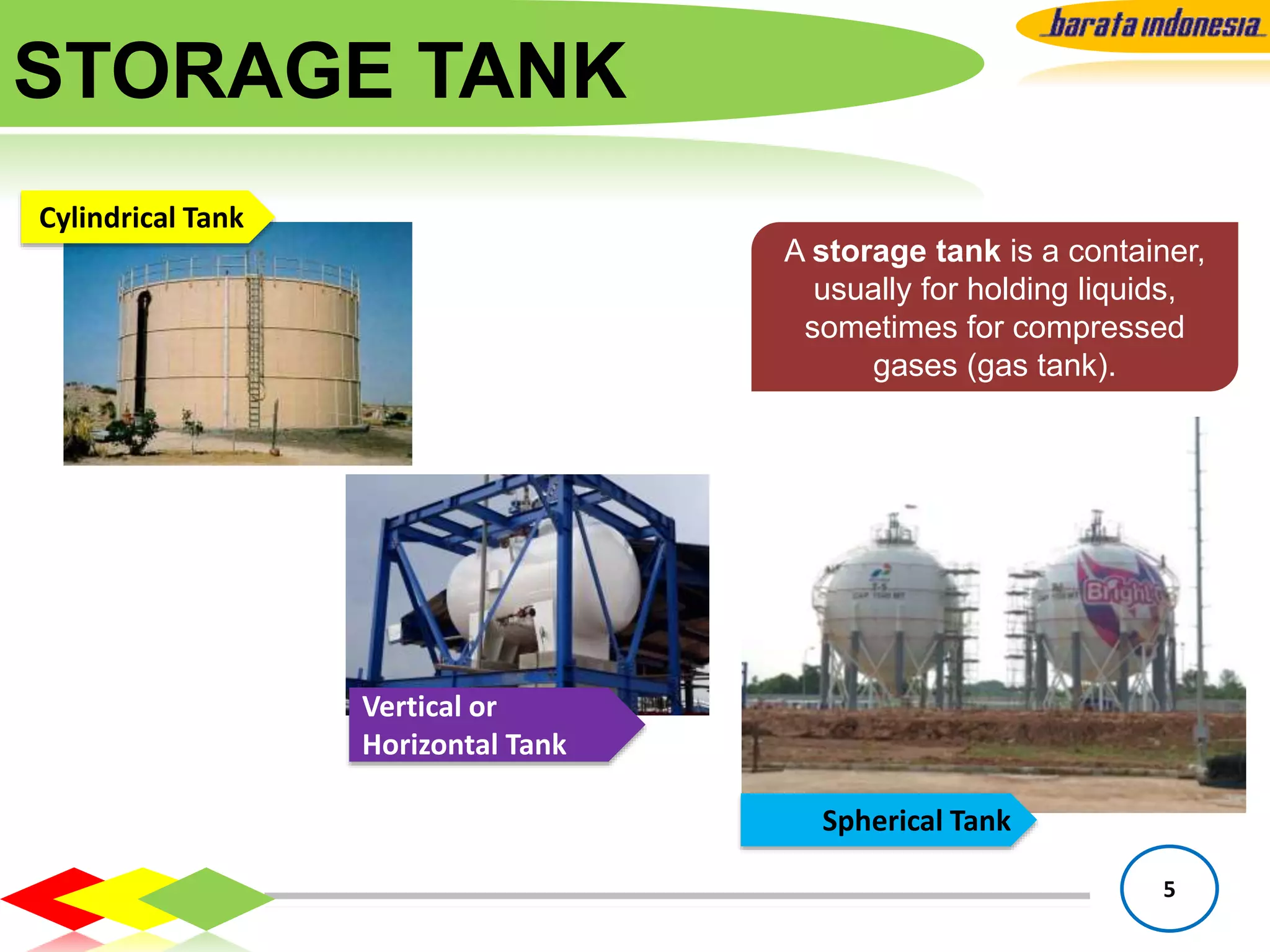
Storage tanks are available in many shapes: vertical and horizontal cylindrical;
open top and closed top; flat bottom, cone bottom.
Large tanks tend to be vertical cylindrical, or to have rounded corners to easier
withstand hydraulic hydrostatically induced pressure of contained liquid
Raw Materials Intermediate products Final products
Recycle materials Off-grade materials Fuels
Storage Facility are
required for:
STORAGE TANK
2
The storage tanks can be divided into two basic types:
Atmospheric storage
Atmospheric storage is a term applied to tanks operating at or near atmospheric
pressure. This type of tank is used to hold liquid which will not vaporize at
ambient temperature. Tanks used in this category are primarily the open top,
fixed roof (cone & dome) and floating roof.
Pressurized storage
Pressurized storage applies to those vessels (mounded bullets) which are
designed to withstand pressure sufficient to keep the liquid stored, from
vaporizing. High vapor pressure hydrocarbons such as propane and butane are
the types of products requiring pressurized storage vessels (Mounded Bullets)
API 650 TANK STANDARD
3
Content
Section 1 - Scope
Section 2 - Normative Reference
Section 3 - Terms and Definition
Section 4 - Materials
Section 5 - Design
Section 6 - Fabrication
Section 7 - Erection
Section 8 - Method of Examining Joints
Section 9 - Welding Procedure & Welder Qualification
Section 10 - Marking
Annex A - Y
API 650 TANK STANDARD
4
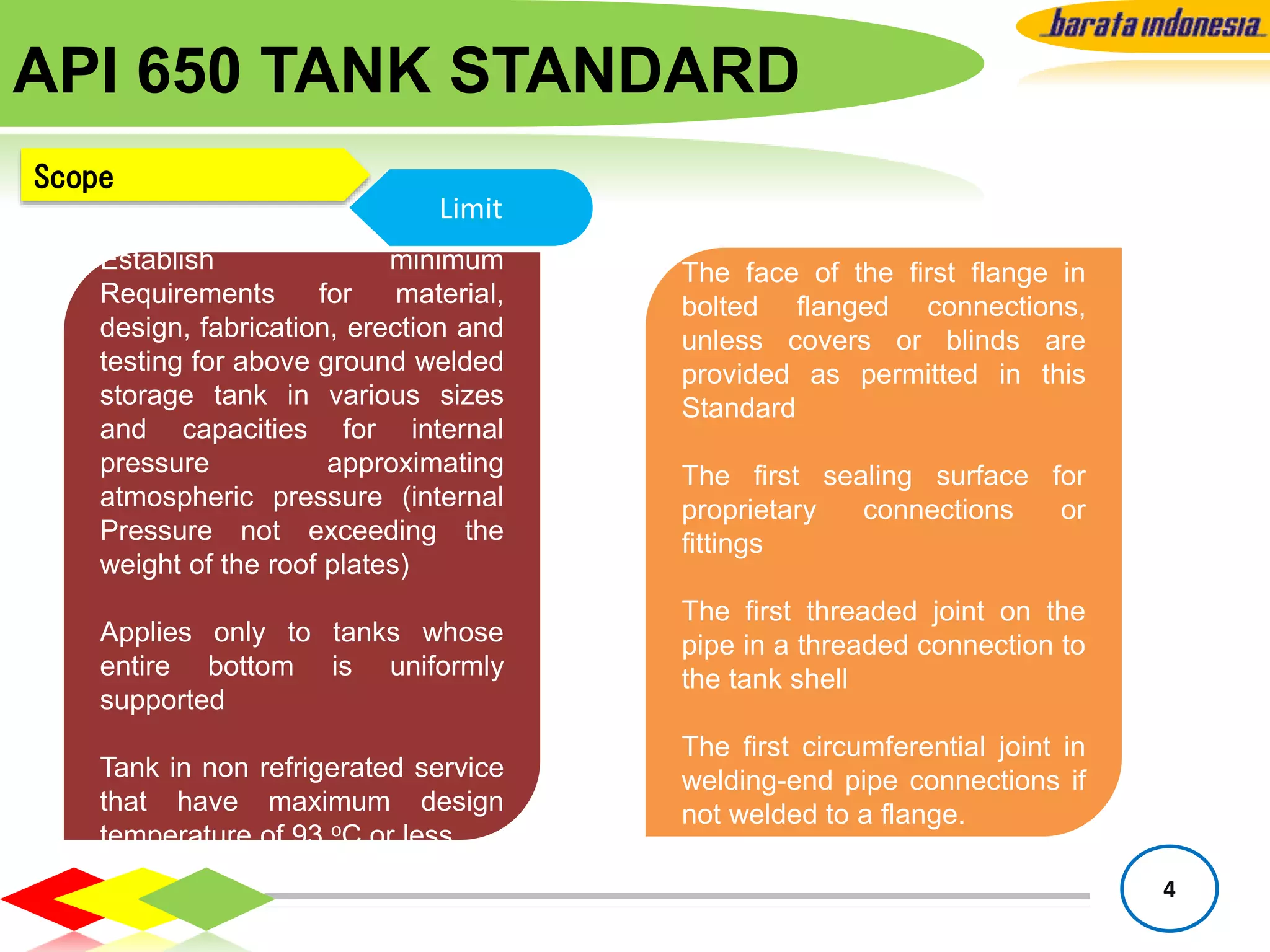
Scope
Establish minimum
Requirements for material,
design, fabrication, erection and
testing for above ground welded
storage tank in various sizes
and capacities for internal
pressure approximating
atmospheric pressure (internal
Pressure not exceeding the
weight of the roof plates)
Applies only to tanks whose
entire bottom is uniformly
supported
Tank in non refrigerated service
that have maximum design
temperature of 93 oC or less.
Limit
The face of the first flange in
bolted flanged connections,
unless covers or blinds are
provided as permitted in this
Standard
The first sealing surface for
proprietary connections or
fittings
The first threaded joint on the
pipe in a threaded connection to
the tank shell
The first circumferential joint in
welding-end pipe connections if
not welded to a flange.
STORAGE TANK
5
Cylindrical Tank
A storage tank is a container,
usually for holding liquids,
sometimes for compressed
gases (gas tank).
Spherical Tank
Vertical or
Horizontal Tank
CYLINDRICAL TANK TYPE
6
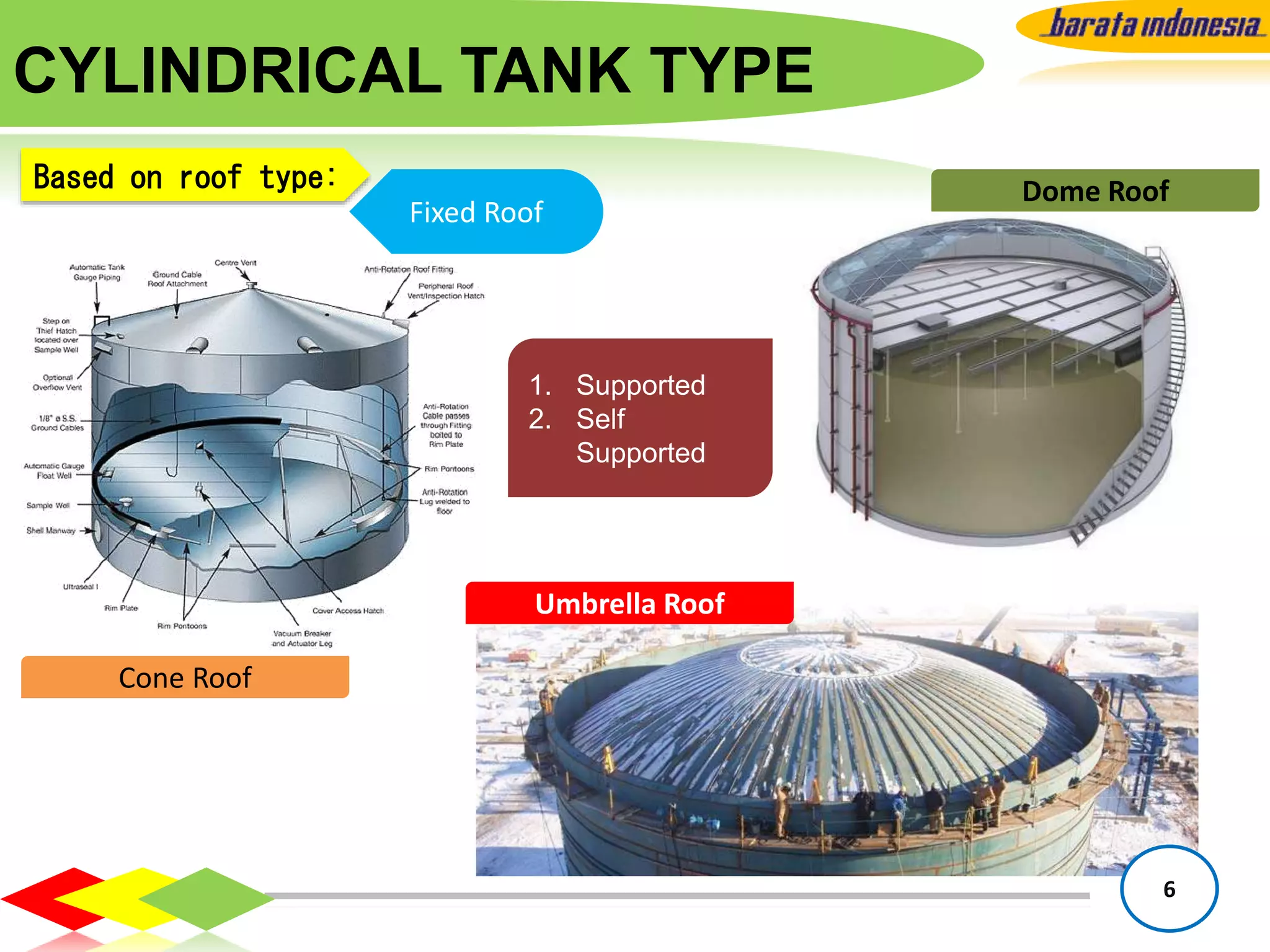
Based on roof type:
Cone Roof
Dome Roof
Fixed Roof
Umbrella Roof
1. Supported
2. Self
Supported
CYLINDRICAL TANK TYPE
7
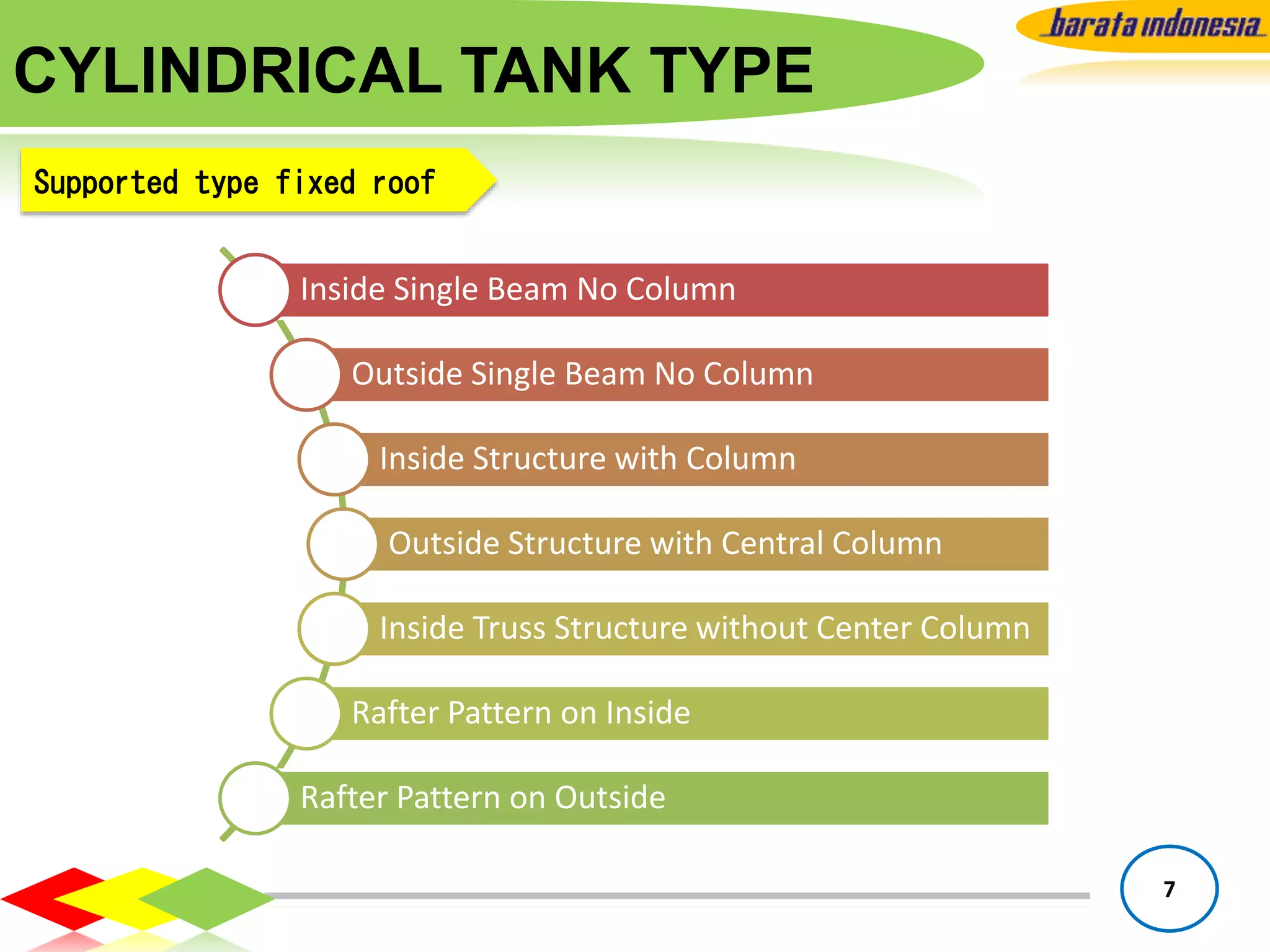
Supported type fixed roof
Inside Single Beam No Column
Outside Single Beam No Column
Inside Structure with Column
Outside Structure with Central Column
Inside Truss Structure without Center Column
Rafter Pattern on Inside
Rafter Pattern on Outside
CYLINDRICAL TANK TYPE
8
Based on roof type:
Internal Floating Roof
Floating Roof
External Floating Roof
CYLINDRICAL TANK TYPE
9
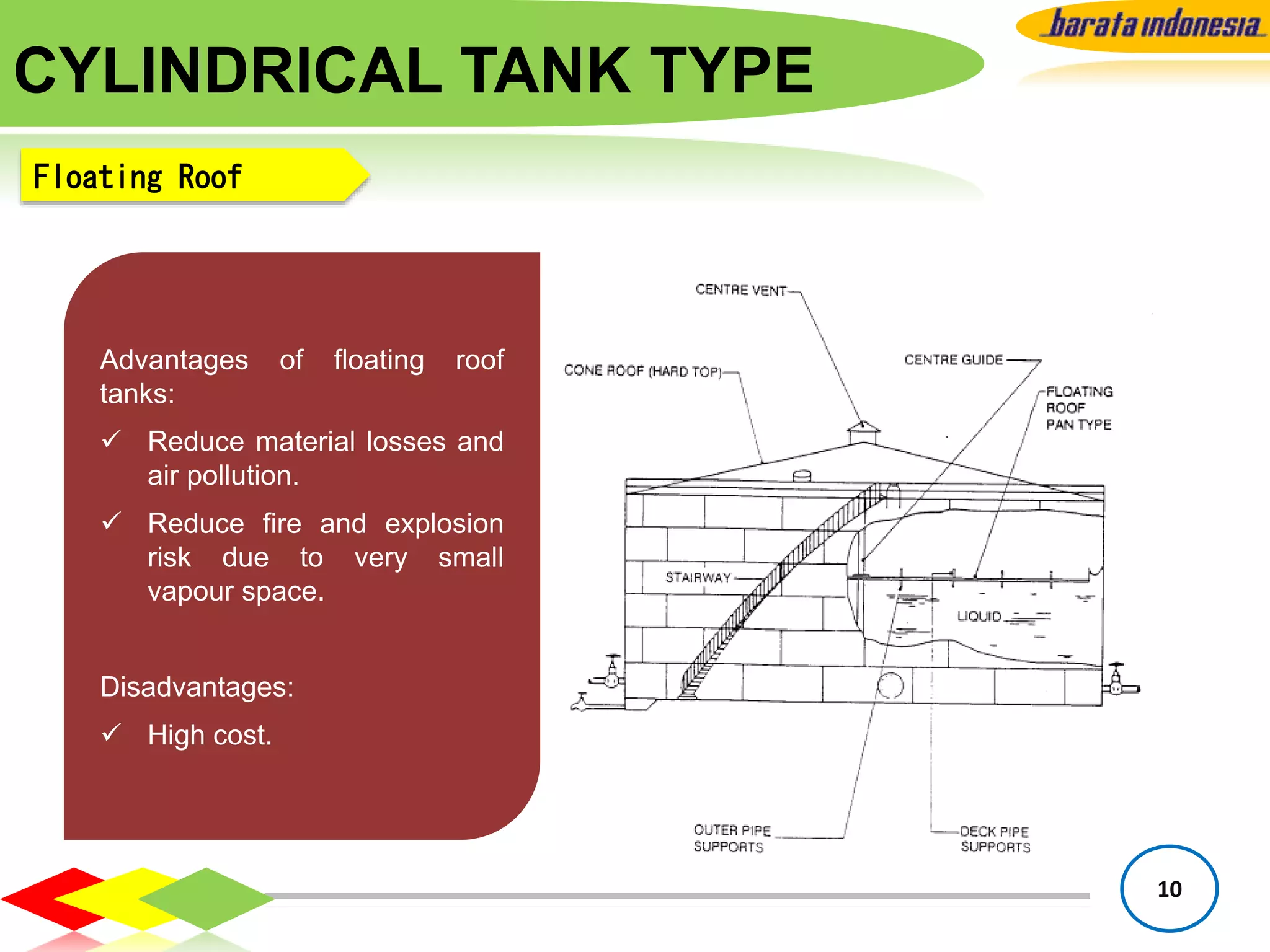
Floating Roof
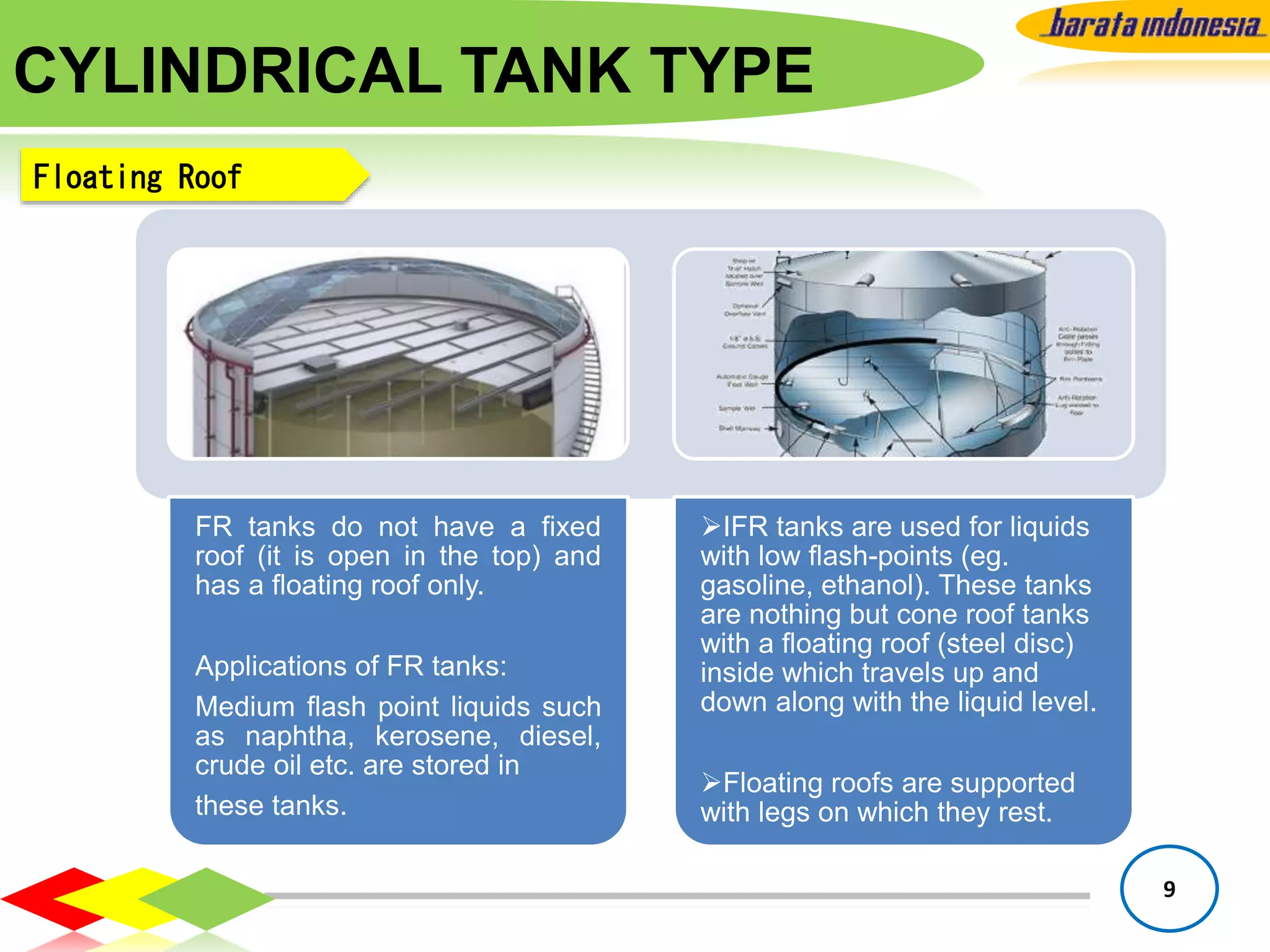
FR tanks do not have a fixed
roof (it is open in the top) and
has a floating roof only.
Applications of FR tanks:
Medium flash point liquids such
as naphtha, kerosene, diesel,
crude oil etc. are stored in
these tanks.
IFR tanks are used for liquids
with low flash-points (eg.
gasoline, ethanol). These tanks
are nothing but cone roof tanks
with a floating roof (steel disc)
inside which travels up and
down along with the liquid level.
Floating roofs are supported
with legs on which they rest.
CYLINDRICAL TANK TYPE
10
Floating Roof
Advantages of floating roof
tanks:
 Reduce material losses and
air pollution.
 Reduce fire and explosion
risk due to very small
vapour space.
Disadvantages:
 High cost.
CYLINDRICAL TANK
11
Roof Type Decision
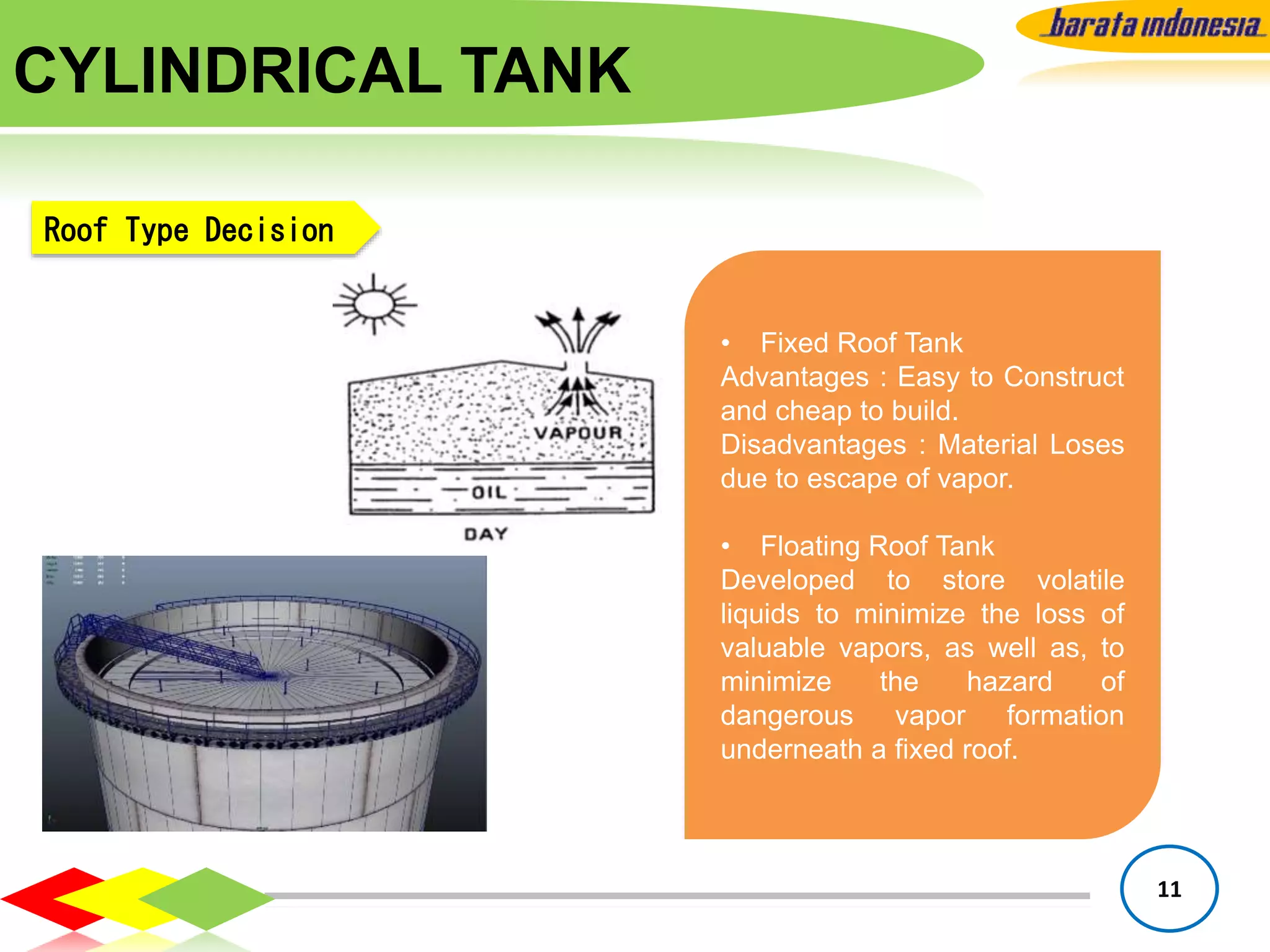
• Fixed Roof Tank
Advantages : Easy to Construct
and cheap to build.
Disadvantages : Material Loses
due to escape of vapor.
• Floating Roof Tank
Developed to store volatile
liquids to minimize the loss of
valuable vapors, as well as, to
minimize the hazard of
dangerous vapor formation
underneath a fixed roof.
CYLINDRICAL TANK
12
Roof Type Decision
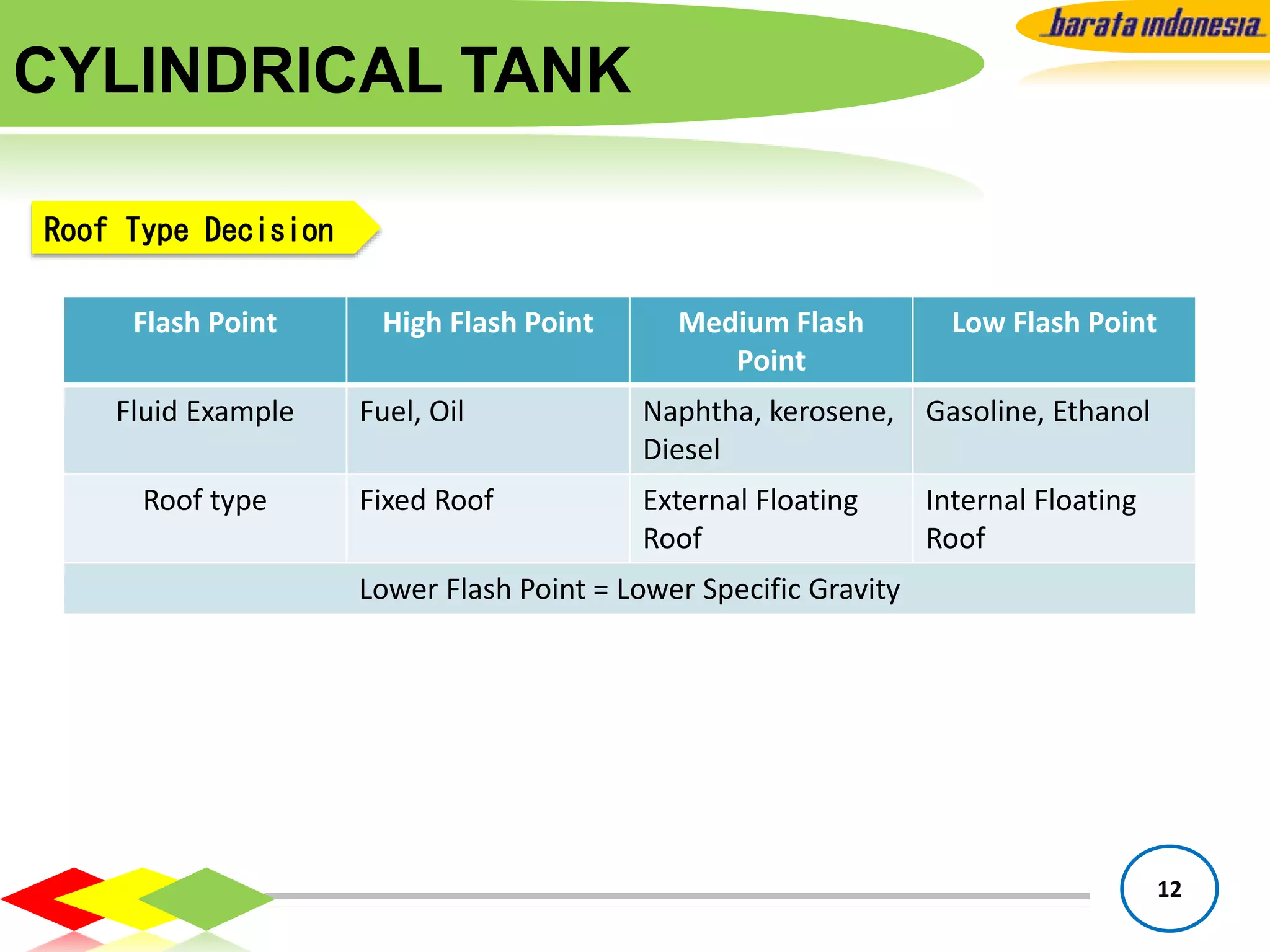
Flash Point High Flash Point Medium Flash
Point
Low Flash Point
Fluid Example Fuel, Oil Naphtha, kerosene,
Diesel
Gasoline, Ethanol
Roof type Fixed Roof External Floating
Roof
Internal Floating
Roof
Lower Flash Point = Lower Specific Gravity
CYLINDRICAL TANK MATL
14
Main Material
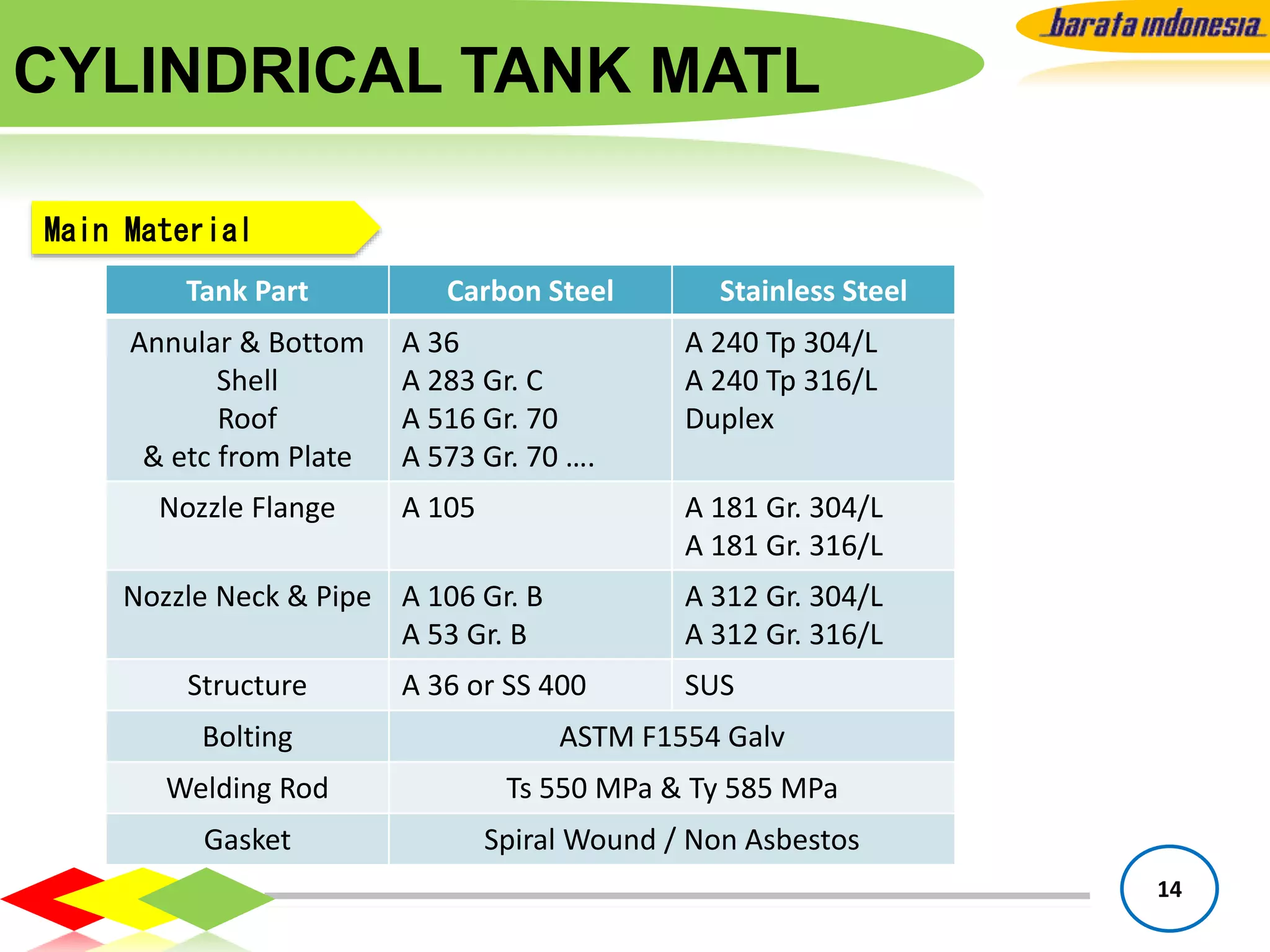
Tank Part Carbon Steel Stainless Steel
Annular & Bottom
Shell
Roof
& etc from Plate
A 36
A 283 Gr. C
A 516 Gr. 70
A 573 Gr. 70 ….
A 240 Tp 304/L
A 240 Tp 316/L
Duplex
Nozzle Flange A 105 A 181 Gr. 304/L
A 181 Gr. 316/L
Nozzle Neck & Pipe A 106 Gr. B
A 53 Gr. B
A 312 Gr. 304/L
A 312 Gr. 316/L
Structure A 36 or SS 400 SUS
Bolting ASTM F1554 Galv
Welding Rod Ts 550 MPa & Ty 585 MPa
Gasket Spiral Wound / Non Asbestos
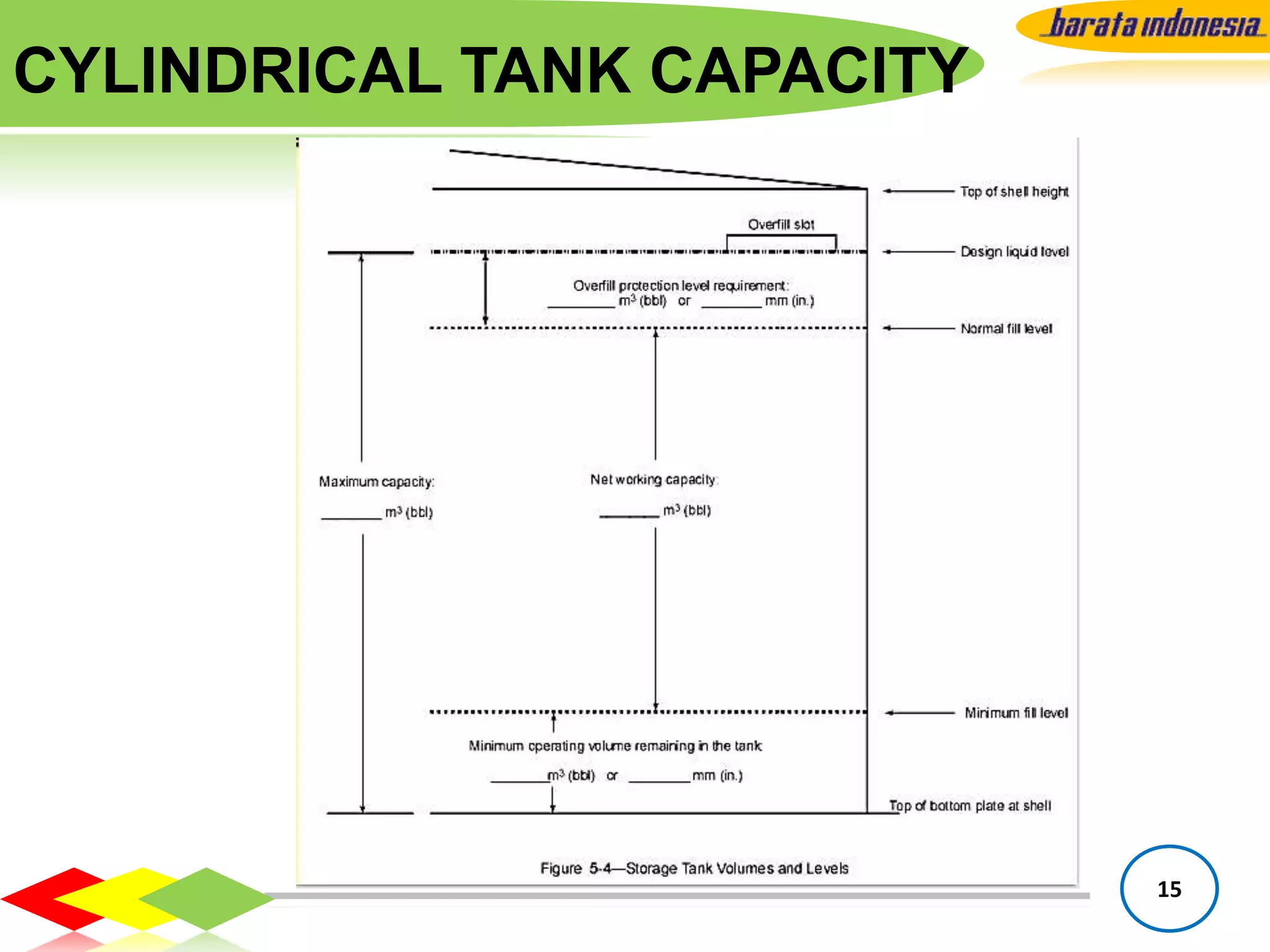
CYLINDRICAL TANK CAPACITY
15
TANK ACCESSORIES
16
Main Part
Floating Roof accessories
Roof Support
Opening & Venting
Tank Support
Access tank
Top Angle & stiffener
Drain & Overflow
Other accessories
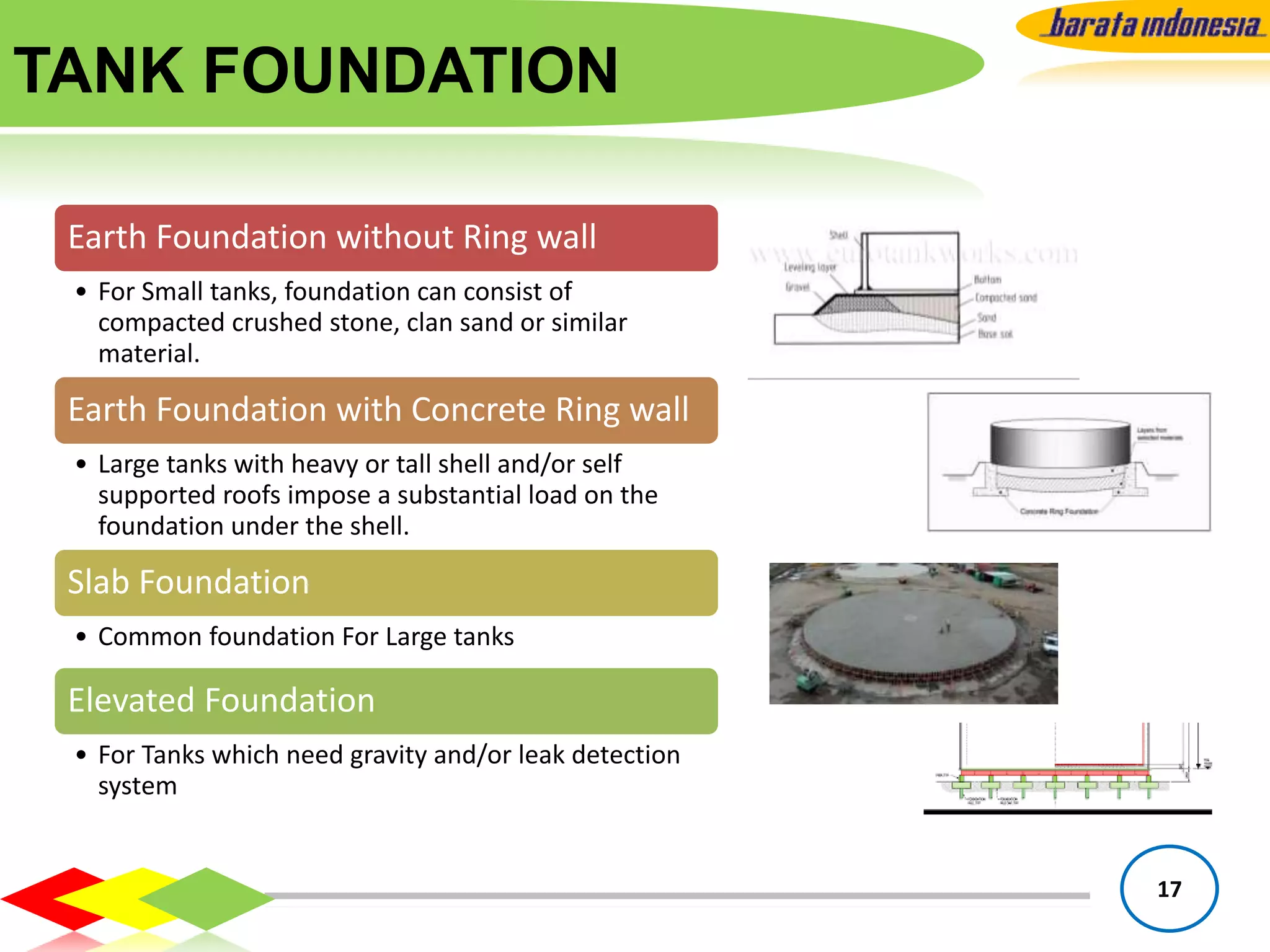
TANK FOUNDATION
17
Earth Foundation without Ring wall
• For Small tanks, foundation can consist of
compacted crushed stone, clan sand or similar
material.
Earth Foundation with Concrete Ring wall
• Large tanks with heavy or tall shell and/or self
supported roofs impose a substantial load on the
foundation under the shell.
Slab Foundation
• Common foundation For Large tanks
Elevated Foundation
• For Tanks which need gravity and/or leak detection
system
TANK FOUNDATION
18
• Checking Foundation
Surface, subsurface and climatic conditions vary from place to place, so it is not practical to
establish design data to cover all situations. The allowable soil loading and exact type of
subsurface construction to be used must be decided for each individual case after careful
consideration.
Foundation Elevation
Foundation Size & Roundness
Foundation Slope
Anchor Position (if any)
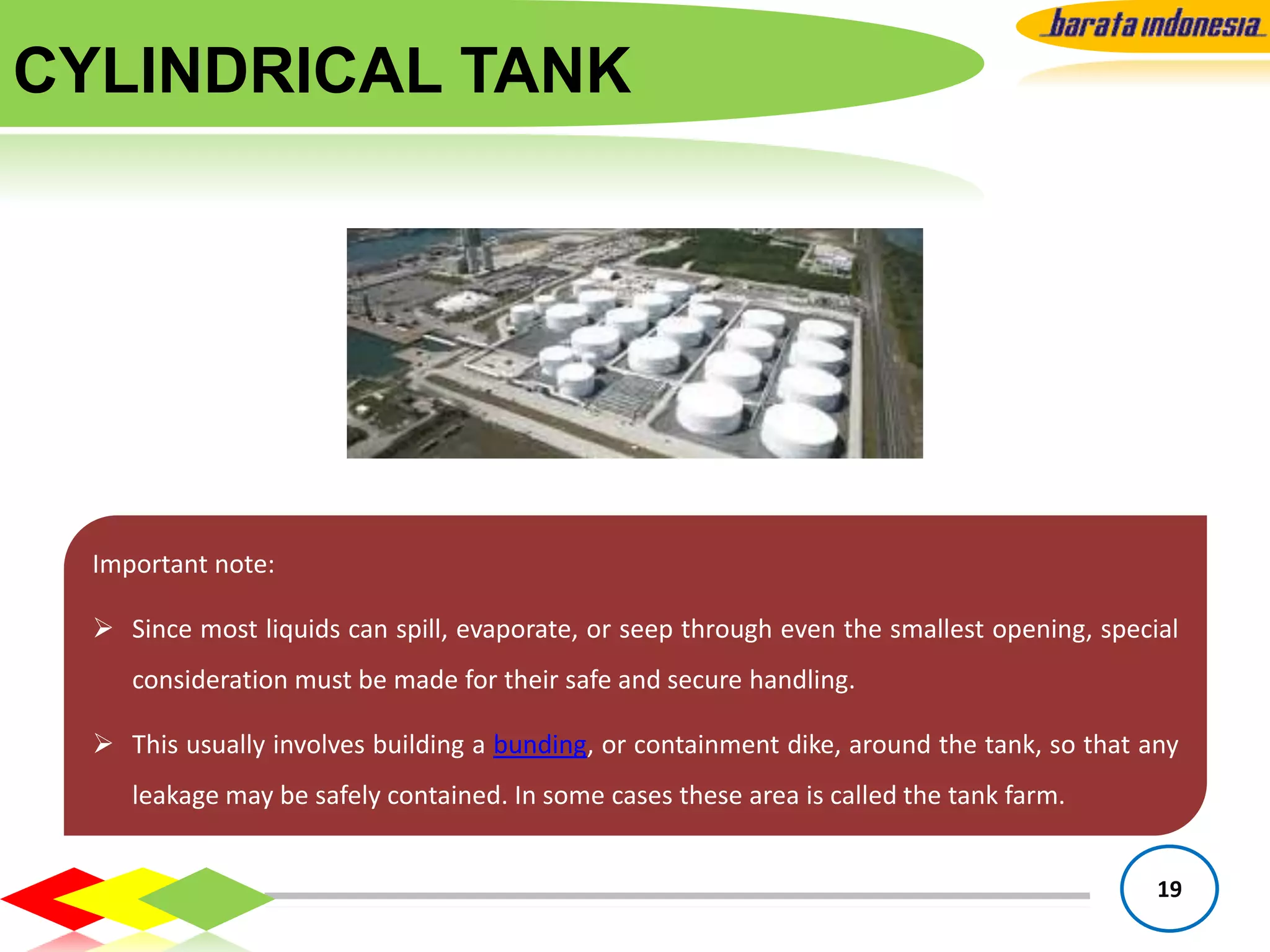
CYLINDRICAL TANK
19
Important note:
 Since most liquids can spill, evaporate, or seep through even the smallest opening, special
consideration must be made for their safe and secure handling.
 This usually involves building a bunding, or containment dike, around the tank, so that any
leakage may be safely contained. In some cases these area is called the tank farm.
21
22

Tank Introduction.pptx

  • 1.
    STORAGE TANK DESIGN basedon API 650 Ed. 12 Add. 3 By : Izzatul F TANK INTRODUCTION
  • 2.
    STORAGE TANK 1 Storage tanksare available in many shapes: vertical and horizontal cylindrical; open top and closed top; flat bottom, cone bottom. Large tanks tend to be vertical cylindrical, or to have rounded corners to easier withstand hydraulic hydrostatically induced pressure of contained liquid Raw Materials Intermediate products Final products Recycle materials Off-grade materials Fuels Storage Facility are required for:
  • 3.
    STORAGE TANK 2 The storagetanks can be divided into two basic types: Atmospheric storage Atmospheric storage is a term applied to tanks operating at or near atmospheric pressure. This type of tank is used to hold liquid which will not vaporize at ambient temperature. Tanks used in this category are primarily the open top, fixed roof (cone & dome) and floating roof. Pressurized storage Pressurized storage applies to those vessels (mounded bullets) which are designed to withstand pressure sufficient to keep the liquid stored, from vaporizing. High vapor pressure hydrocarbons such as propane and butane are the types of products requiring pressurized storage vessels (Mounded Bullets)
  • 4.
    API 650 TANKSTANDARD 3 Content Section 1 - Scope Section 2 - Normative Reference Section 3 - Terms and Definition Section 4 - Materials Section 5 - Design Section 6 - Fabrication Section 7 - Erection Section 8 - Method of Examining Joints Section 9 - Welding Procedure & Welder Qualification Section 10 - Marking Annex A - Y
  • 5.
    API 650 TANKSTANDARD 4 Scope Establish minimum Requirements for material, design, fabrication, erection and testing for above ground welded storage tank in various sizes and capacities for internal pressure approximating atmospheric pressure (internal Pressure not exceeding the weight of the roof plates) Applies only to tanks whose entire bottom is uniformly supported Tank in non refrigerated service that have maximum design temperature of 93 oC or less. Limit The face of the first flange in bolted flanged connections, unless covers or blinds are provided as permitted in this Standard The first sealing surface for proprietary connections or fittings The first threaded joint on the pipe in a threaded connection to the tank shell The first circumferential joint in welding-end pipe connections if not welded to a flange.
  • 6.
    STORAGE TANK 5 Cylindrical Tank Astorage tank is a container, usually for holding liquids, sometimes for compressed gases (gas tank). Spherical Tank Vertical or Horizontal Tank
  • 7.
    CYLINDRICAL TANK TYPE 6 Basedon roof type: Cone Roof Dome Roof Fixed Roof Umbrella Roof 1. Supported 2. Self Supported
  • 8.
    CYLINDRICAL TANK TYPE 7 Supportedtype fixed roof Inside Single Beam No Column Outside Single Beam No Column Inside Structure with Column Outside Structure with Central Column Inside Truss Structure without Center Column Rafter Pattern on Inside Rafter Pattern on Outside
  • 9.
    CYLINDRICAL TANK TYPE 8 Basedon roof type: Internal Floating Roof Floating Roof External Floating Roof
  • 10.
    CYLINDRICAL TANK TYPE 9 FloatingRoof FR tanks do not have a fixed roof (it is open in the top) and has a floating roof only. Applications of FR tanks: Medium flash point liquids such as naphtha, kerosene, diesel, crude oil etc. are stored in these tanks. IFR tanks are used for liquids with low flash-points (eg. gasoline, ethanol). These tanks are nothing but cone roof tanks with a floating roof (steel disc) inside which travels up and down along with the liquid level. Floating roofs are supported with legs on which they rest.
  • 11.
    CYLINDRICAL TANK TYPE 10 FloatingRoof Advantages of floating roof tanks:  Reduce material losses and air pollution.  Reduce fire and explosion risk due to very small vapour space. Disadvantages:  High cost.
  • 12.
    CYLINDRICAL TANK 11 Roof TypeDecision • Fixed Roof Tank Advantages : Easy to Construct and cheap to build. Disadvantages : Material Loses due to escape of vapor. • Floating Roof Tank Developed to store volatile liquids to minimize the loss of valuable vapors, as well as, to minimize the hazard of dangerous vapor formation underneath a fixed roof.
  • 13.
    CYLINDRICAL TANK 12 Roof TypeDecision Flash Point High Flash Point Medium Flash Point Low Flash Point Fluid Example Fuel, Oil Naphtha, kerosene, Diesel Gasoline, Ethanol Roof type Fixed Roof External Floating Roof Internal Floating Roof Lower Flash Point = Lower Specific Gravity
  • 14.
    CYLINDRICAL TANK MATL 14 MainMaterial Tank Part Carbon Steel Stainless Steel Annular & Bottom Shell Roof & etc from Plate A 36 A 283 Gr. C A 516 Gr. 70 A 573 Gr. 70 …. A 240 Tp 304/L A 240 Tp 316/L Duplex Nozzle Flange A 105 A 181 Gr. 304/L A 181 Gr. 316/L Nozzle Neck & Pipe A 106 Gr. B A 53 Gr. B A 312 Gr. 304/L A 312 Gr. 316/L Structure A 36 or SS 400 SUS Bolting ASTM F1554 Galv Welding Rod Ts 550 MPa & Ty 585 MPa Gasket Spiral Wound / Non Asbestos
  • 15.
  • 16.
    TANK ACCESSORIES 16 Main Part FloatingRoof accessories Roof Support Opening & Venting Tank Support Access tank Top Angle & stiffener Drain & Overflow Other accessories
  • 17.
    TANK FOUNDATION 17 Earth Foundationwithout Ring wall • For Small tanks, foundation can consist of compacted crushed stone, clan sand or similar material. Earth Foundation with Concrete Ring wall • Large tanks with heavy or tall shell and/or self supported roofs impose a substantial load on the foundation under the shell. Slab Foundation • Common foundation For Large tanks Elevated Foundation • For Tanks which need gravity and/or leak detection system
  • 18.
    TANK FOUNDATION 18 • CheckingFoundation Surface, subsurface and climatic conditions vary from place to place, so it is not practical to establish design data to cover all situations. The allowable soil loading and exact type of subsurface construction to be used must be decided for each individual case after careful consideration. Foundation Elevation Foundation Size & Roundness Foundation Slope Anchor Position (if any)
  • 19.
    CYLINDRICAL TANK 19 Important note: Since most liquids can spill, evaporate, or seep through even the smallest opening, special consideration must be made for their safe and secure handling.  This usually involves building a bunding, or containment dike, around the tank, so that any leakage may be safely contained. In some cases these area is called the tank farm.
  • 20.
  • 21.