STORAGE TANKS Part 1
Basic Training
PETROLEUM STORAGE TANKS - Basic Training
What we'll be covering
> The design of the tank.
> Which tank , which product.
> The structure & assembly of the tank.
> Tank inspection
> Measurement
Goals for Today & Tomorrow
> To identify tank type & tank equipments
> To know the limitation of tank
> Calculation of tank volume
> Safe tank operation
PETROLEUM STORAGE TANKS - Basic Training
Course Content
1. Background
2. Tank Design
Day One - Types of vertical tanks
- Selection of vertical tanks
3. Tank Structure & Assembly of Tank
4. Tank Fittings
- Operational fitting
- Fittings common to all vertical tanks
- Additional fitting for floating roof tanks
- Special fittings and accessories for floating
5. Tank Inspection
6. Tank Farm Safety
…………………………………………………………………………………...
7. Measurement
Day Two 8. Internal & external incident learning
9. Field trip
STORAGE TANKS
STORAGE TANKS
STORAGE TANKS
STORAGE TANKS-
-
-
- Basic Training
Basic Training
Basic Training
Basic Training
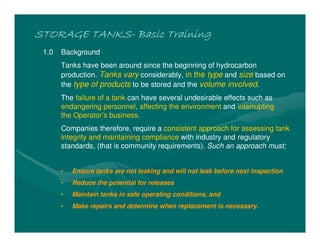
1.0 Background
Tanks have been around since the beginning of hydrocarbon
production. Tanks vary considerably, in the type and size based on
the type of products to be stored and the volume involved.
The failure of a tank can have several undesirable effects such as
endangering personnel, affecting the environment and interrupting
the Operator’s business.
Companies therefore, require a consistent approach for assessing tank
integrity and maintaining compliance with industry and regulatory
standards, (that is community requirements). Such an approach must;
• Ensure tanks are not leaking and will not leak before next inspection
• Reduce the potential for releases
• Maintain tanks in safe operating conditions, and
• Make repairs and determine when replacement is necessary.
PETROLEUM STORAGE TANKS Basic Training
TANK
The primary function of a storage tank is to store liquid substance.
This liquid substance may be:
a) Feedstock (Unit 71)
b) Finished products prior to shipping out to customers (Unit 75)
c) and Unfinished petroleum components awaiting for further
- processing (intermediate – Unit 72)
- blending (Unit 73)
While in the storage tanks, these products may settle out undesirable
substances such as;
a) Water
b) Emulsions
c) Dirt etc.
This undesirable substances can then be removed through draw-off devices.
Products may also be mixed, blended and treated in storage tanks effectively,
using the large capacity available in these tanks.
TANK (cont)
Broadly, the storage tanks can be divided into two basic types:
Atmospheric storage
Atmospheric storage is a term applied to tanks operating at or near atmospheric
pressure. This type of tank is used to hold liquid which will not vaporize at
ambient temperature. Tanks used in this category are primarily the open top,
fixed roof (cone & dome) and floating roof.
Pressurized storage
Pressurized storage applies to those vessels (mounded bullets) which are
designed to withstand pressure sufficient to keep the liquid stored, from
vaporizing. High vapor pressure hydrocarbons such as propane, butane,
iC5 are the types of products requiring pressurized storage vessels (Mounded
Bullets).
Note: STORAGE TANK TRAINING for MG 3 Operators, will basically focus
on aboveground vertical storage tanks of various types.
TANK
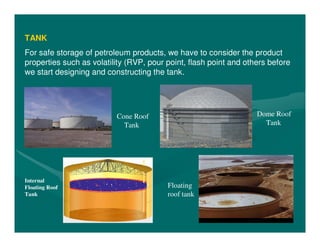
For safe storage of petroleum products, we have to consider the product
properties such as volatility (RVP, pour point, flash point and others before
we start designing and constructing the tank.
Floating
roof tank
Cone Roof
Tank
Dome Roof
Tank
Internal
Floating Roof
Tank
STORAGE TANKS
STORAGE TANKS
STORAGE TANKS
STORAGE TANKS –
–
–
– Basic Training
Basic Training
Basic Training
Basic Training
2.0 The design of the tank
Standard vertical tanks are available in several types, which differ in
vapor-saving efficiency and in cost.
2.1 Vertical tanks
2.1.1 Open top tanks
This type of tank has no roof and shall be used for storing city water,
fire water and cooling water (All water tanks in PPMSB are with roofs).
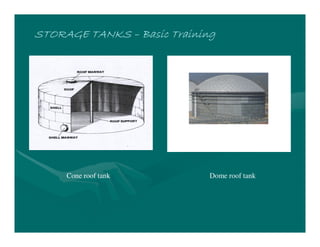
2.1.2 Fixed roof tanks
These types of tanks can be divided into:
- Cone roof
- Dome roof
Each type can be further subdivided into non-pressure and low-
pressure fixed roof tanks.
STORAGE TANKS
STORAGE TANKS
STORAGE TANKS
STORAGE TANKS –
–
–
– Basic Training
Basic Training
Basic Training
Basic Training
Cone roof tank Dome roof tank
o
o
f
f
s
s
u
u
m
m
p
p
w
w
i
i
t
t
h
h
t
t
h
h
e
e
n
n
o
o
n
n
r
r
e
e
t
t
u
u
r
r
n
n
v
v
a
a
l
l
v
v
e
e
a
a
n
n
d
d
w
w
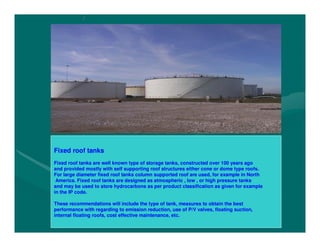
Fixed roof tanks
Fixed roof tanks are well known type of storage tanks, constructed over 100 years ago and
provided mostly with self supporting roof structures either cone or dome type roofs. For
large diameter fixed roof tanks column supported roof are used, for example in North
America. Fixed roof tanks are designed as atmospheric , low , or high pressure tanks and
may be used to store hydrocarbons as per product classification as given for example in
the IP code.
These recommendations will include the type of tank, measures to obtain the best
performance with regarding to emission reduction, use of P/V valves, floating suction,
internal floating roofs, cost effective maintenance, etc.
Fixed roof tanks
Fixed roof tanks are well known type of storage tanks, constructed over 100 years ago
and provided mostly with self supporting roof structures either cone or dome type roofs.
For large diameter fixed roof tanks column supported roof are used, for example in North
America. Fixed roof tanks are designed as atmospheric , low , or high pressure tanks
and may be used to store hydrocarbons as per product classification as given for example
in the IP code.
These recommendations will include the type of tank, measures to obtain the best
performance with regarding to emission reduction, use of P/V valves, floating suction,
internal floating roofs, cost effective maintenance, etc.
STORAGE TANKS
STORAGE TANKS
STORAGE TANKS
STORAGE TANKS –
–
–
– Basic Training
Basic Training
Basic Training
Basic Training
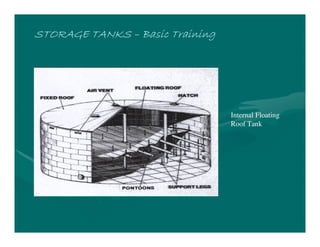
2.1.3 Fixed roof tanks with floating covers (internal floating roof tanks)
In a fixed roof tank a floating cover can be installed to give a further
reduction of vapor losses. These tanks are fitted with breather vents
either at the top course of the shell plate or on the roof edge.
Typical feedstock/ products stored are: DPK (Kerosene, Jet A1)
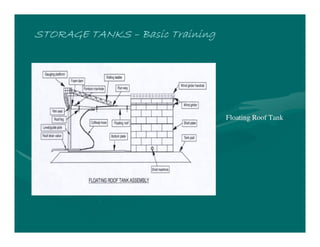
2.1.4 Floating roof tank
This type of tanks are designed to work at atmospheric pressure. The
diameter of a floating roof tanks shall at least be equal to its height to
enable the use of a normal rolling ladder for access to the roof.
Typical Products stored are: Crude oil, Gasoline and Gasoline
components, Solvents……
2.1.5 Bullets
The very volatility & high vapor pressure product such as Isopentane, LPG &
Butane will be store in a vessel that will withstand product pressure and prevent
any product vaporization. Due to high volatility & high vapor pressure the vessels are
Mounded underground to prevent thermal radiation in case of any fire nearby.
STORAGE TANKS
STORAGE TANKS
STORAGE TANKS
STORAGE TANKS –
–
–
– Basic Training
Basic Training
Basic Training
Basic Training
Internal Floating
Roof Tank
STORAGE TANKS
STORAGE TANKS
STORAGE TANKS
STORAGE TANKS –
–
–
– Basic Training
Basic Training
Basic Training
Basic Training
Floating Roof Tank
STORAGE TANKS
STORAGE TANKS
STORAGE TANKS
STORAGE TANKS –
–
–
– Basic Training
Basic Training
Basic Training
Basic Training
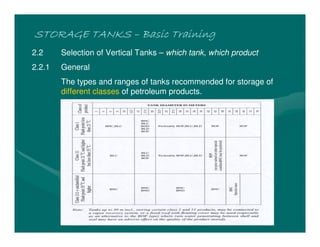
2.2 Selection of Vertical Tanks – which tank, which product
2.2.1 General
The types and ranges of tanks recommended for storage of
different classes of petroleum products.
STORAGE TANKS
STORAGE TANKS
STORAGE TANKS
STORAGE TANKS –
–
–
– Basic Training
Basic Training
Basic Training
Basic Training
2.2 Selection of Vertical Tanks – which tank, which product
2.2.1 General
The types and ranges of tanks recommended for storage of
different classes of petroleum products.
2.3 Stability
For calculations of tank stability in strong winds, the
velocities given in the local regulations should be used; if
no local regulations exist, local experience should be
considered.
Unstable tanks shall be provided with anchor bolts and
concrete foundation rings. Uplifting is caused by the
internal vapor pressure acting against the underside of the
roof, in conjunction with wind load. A stability calculation shall
be made to determine the number of anchor required.
STORAGE TANKS
STORAGE TANKS
STORAGE TANKS
STORAGE TANKS –
–
–
– Basic Training
Basic Training
Basic Training
Basic Training
2.3 Stability
For calculations of tank stability in strong winds the following
need to be done:
a) the velocities given in the local regulations should be
used;
b) if no local regulations exist, local experience should
be considered.
Unstable tanks shall be provided with anchor bolts and concrete
foundation rings. Uplifting is caused by the internal vapor pressure
acting against the underside of the roof, in conjunction with wind
load. A stability calculation shall be made to determine the number
of anchors required.
STORAGE TANKS
STORAGE TANKS
STORAGE TANKS
STORAGE TANKS –
–
–
– Basic Training
Basic Training
Basic Training
Basic Training
2.4 Tank Foundation
2.4.1 Checking of foundation
Surface, subsurface and climatic conditions vary from place to place,
so it is not practical to establish design data to cover all situations.
The allowable soil loading and exact type of subsurface construction
to be used must be decided for each individual case after careful
consideration.
Some of the many conditions that require special engineering
consideration are as follows:
> site on hillsides – undisturbed/ land filled
> sites at swampy or filled ground
> sites underlain by soils, such as organic clays that will settle over
long period and can cause lateral ground stability problem
> site adjacent to water courses or deep excavation
> site exposed to flood water
> site in regions of high seismicity
STORAGE TANKS
STORAGE TANKS
STORAGE TANKS
STORAGE TANKS –
–
–
– Basic Training
Basic Training
Basic Training
Basic Training
2.4 Tank Foundation
2.4.2 Typical Foundation Types
2.4.2.1 Earth foundation without a ringwall
When subsurface conditions shows adequate bearing capacity and
that settlements will be acceptable, satisfactory foundations may be
constructed from earth material.
Design for satisfactory long-term performance are:
> For small tanks, foundations can consist of compacted crushed
stone, screenings, fine gravel, clean sand, or similar material
placed directly on virgin soil.
STORAGE TANKS
STORAGE TANKS
STORAGE TANKS
STORAGE TANKS –
–
–
– Basic Training
Basic Training
Basic Training
Basic Training
2.4 Tank Foundation
2.4.2 Typical Foundation Types
2.4.2.2 Earth foundations with a concrete ringwall large tanks, with heavy or
tall shell and/or self-supported roofs impose a substantial load on the
foundation under the shell. When there is some doubt whether a
foundation will be able to carry the load directly, a concrete
ringwall foundation should be used.
Advantages of concrete ringwall are:
> It provides better distribution of the concentrated load of the shell
to produce a more uniform soil loading under the tank
> It provides a level, solid starting plane for concentration of the shell
> It is capable of preserving its contour during construction
> It retains the fill under the tank bottom and prevents loss of
material as a result of erosion
> It minimizes moisture under the tank
STORAGE TANKS
STORAGE TANKS
STORAGE TANKS
STORAGE TANKS –
–
–
– Basic Training
Basic Training
Basic Training
Basic Training
2.4 Tank Foundation
2.4.2 Typical Foundation Types
2.4.2.2 Earth foundations with a concrete ringwall
Other design requirements are:
> The ringwall shall not be less than 300 mm (12 in) thick
> Depth of ringwall depends on the local conditions
2.4.2.3 Earth foundations with a crushed stone and gravel ringwall
A crushed stone or gavel ringwall will provide adequate support for
high load imposed by the shell.
Advantages are:
> It provides better distribution of the concentrated load of the shell
to produce a more uniform soil loading under the tank
> It provides a means of leveling the tank grade, and it is capable
of preserving its contour during construction
> It retains the fill under the tank bottom and prevents loss of material
as a result of erosion
> it can more smoothly accommodate differential settlement
because of its flexibility
STORAGE TANKS
STORAGE TANKS
STORAGE TANKS
STORAGE TANKS –
–
–
– Basic Training
Basic Training
Basic Training
Basic Training
2.4 Tank Foundation
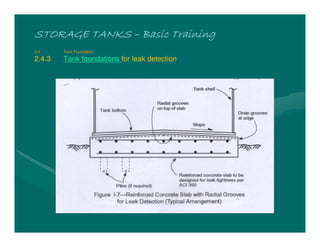
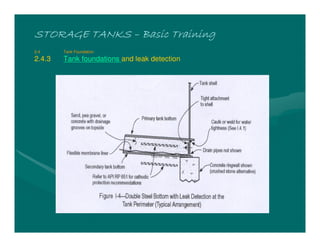
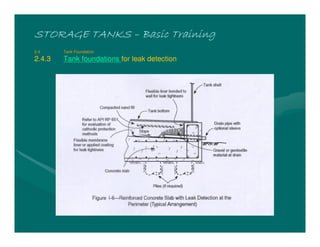
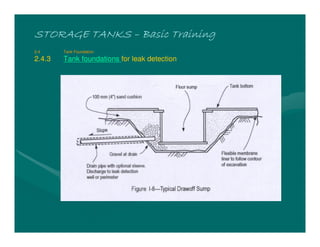
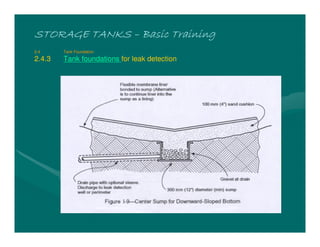
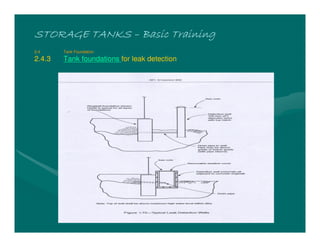
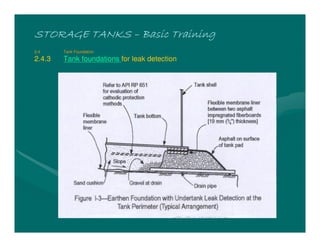
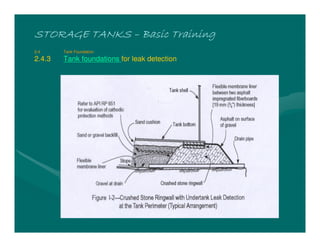
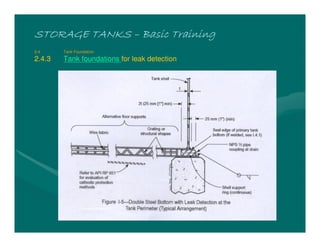
2.4.3 Tank foundations for leak detection
API supports a general position of installing a Release Prevention
barrier (RPB) under new tanks during initial construction. An RPB
includes steel bottoms, synthetic materials, clay liners, and all other
barriers or combination of barriers placed in the bottom of or
under an aboveground storage tank, which have the following
functions:
> preventing the escape of contaminated material
and
> containing or channeling released material for leak
detection
STORAGE TANKS
STORAGE TANKS
STORAGE TANKS
STORAGE TANKS –
–
–
– Basic Training
Basic Training
Basic Training
Basic Training
2.4 Tank Foundation
2.4.3 Tank foundations for leak detection
STORAGE TANKS
STORAGE TANKS
STORAGE TANKS
STORAGE TANKS –
–
–
– Basic Training
Basic Training
Basic Training
Basic Training
2.4 Tank Foundation
2.4.3 Tank foundations and leak detection
STORAGE TANKS
STORAGE TANKS
STORAGE TANKS
STORAGE TANKS –
–
–
– Basic Training
Basic Training
Basic Training
Basic Training
2.4 Tank Foundation
2.4.3 Tank foundations for leak detection
STORAGE TANKS
STORAGE TANKS
STORAGE TANKS
STORAGE TANKS –
–
–
– Basic Training
Basic Training
Basic Training
Basic Training
2.4 Tank Foundation
2.4.3 Tank foundations for leak detection
STORAGE TANKS
STORAGE TANKS
STORAGE TANKS
STORAGE TANKS –
–
–
– Basic Training
Basic Training
Basic Training
Basic Training
2.4 Tank Foundation
2.4.3 Tank foundations for leak detection
STORAGE TANKS
STORAGE TANKS
STORAGE TANKS
STORAGE TANKS –
–
–
– Basic Training
Basic Training
Basic Training
Basic Training
2.4 Tank Foundation
2.4.3 Tank foundations for leak detection
STORAGE TANKS
STORAGE TANKS
STORAGE TANKS
STORAGE TANKS –
–
–
– Basic Training
Basic Training
Basic Training
Basic Training
2.4 Tank Foundation
2.4.3 Tank foundations for leak detection
STORAGE TANKS
STORAGE TANKS
STORAGE TANKS
STORAGE TANKS –
–
–
– Basic Training
Basic Training
Basic Training
Basic Training
2.4 Tank Foundation
2.4.3 Tank foundations for leak detection
STORAGE TANKS
STORAGE TANKS
STORAGE TANKS
STORAGE TANKS –
–
–
– Basic Training
Basic Training
Basic Training
Basic Training
2.4 Tank Foundation
2.4.3 Tank foundations for leak detection
STORAGE TANKS
STORAGE TANKS
STORAGE TANKS
STORAGE TANKS –
–
–
– Basic Training
Basic Training
Basic Training
Basic Training
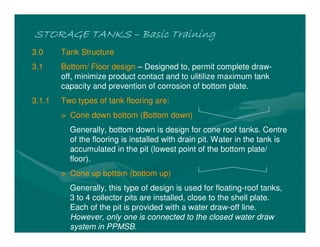
3.0 Tank Structure
3.1 Bottom/ Floor design – Designed to, permit complete draw-
off, minimize product contact and to ulitilize maximum tank
capacity and prevention of corrosion of bottom plate.
3.1.1 Two types of tank flooring are:
> Cone down bottom (Bottom down)
Generally, bottom down is design for cone roof tanks. Centre
of the flooring is installed with drain pit. Water in the tank is
accumulated in the pit (lowest point of the bottom plate/
floor).
> Cone up bottom (bottom up)
Generally, this type of design is used for floating-roof tanks,
3 to 4 collector pits are installed, close to the shell plate.
Each of the pit is provided with a water draw-off line.
However, only one is connected to the closed water draw
system in PPMSB.
STORAGE TANKS
STORAGE TANKS
STORAGE TANKS
STORAGE TANKS –
–
–
– Basic Training
Basic Training
Basic Training
Basic Training
3.0 Tank Structure
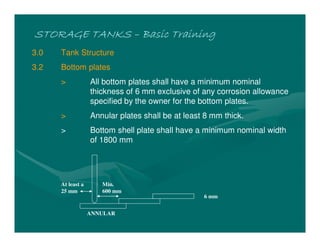
3.2 Bottom plates
> All bottom plates shall have a minimum nominal
thickness of 6 mm exclusive of any corrosion allowance
specified by the owner for the bottom plates.
> Annular plates shall be at least 8 mm thick.
> Bottom shell plate shall have a minimum nominal width
of 1800 mm
ANNULAR
Min.
600 mm
6 mm
At least a
25 mm
STORAGE TANKS
STORAGE TANKS
STORAGE TANKS
STORAGE TANKS –
–
–
– Basic Training
Basic Training
Basic Training
Basic Training
3.0 Tank Structure
3.3 Attachment to shell
The connection between the bottom edge of the lowest course
of the shell plates and the bottom annular plates shall be
continuous fillet weld on both side of the shell plates.
3.4 Joints in tank bottom plates
All joint in bottom plates shall be lapped. The minimum lap shall
be five times the thickness of the plate.
There shall be a minimum lap of 65 mm between the bottom
plates and the bottom annular plates.
STORAGE TANKS
STORAGE TANKS
STORAGE TANKS
STORAGE TANKS –
–
–
– Basic Training
Basic Training
Basic Training
Basic Training
3.0 Tank Structure
3.5 Pad Plates
Pad plates fixed to the tank bottom shall be used at all supports.
Pad plates should be of circular shape; if square or rectangular
plates are used, they shall have their corners rounded (radius at
least 5 times the plate thickness) and continuously welded.
3.6 Shell Design
The bottom course shall have a minimum height of 1800 mm
and a minimum thickness of 8 mm.
The nominal thickness of the shell plates shall not exceed 40
mm. The minimum shell thickness shall be:
> 6 mm for tanks of less than 33 m in diameter
> 8 mm for tanks of 33 m up to and including 60 m in diameter,
> 10 mm for tanks over 60 m in diameter.
STORAGE TANKS
STORAGE TANKS
STORAGE TANKS
STORAGE TANKS –
–
–
– Basic Training
Basic Training
Basic Training
Basic Training
3.6 Internal Loading
No course shall have a thickness less than that of the course
above, regardless of the material of construction.
The shell plates for which a minimum thickness has been
calculated and ordered shall not under run (furnished by mill) the
computed thickness by more than 0.25 mm at any place.
Calculated/ Ordered
plate thickness
Delivered plate
thickness
Delta thickness must not
be more than 0.25 mm
STORAGE TANKS
STORAGE TANKS
STORAGE TANKS
STORAGE TANKS –
–
–
– Basic Training
Basic Training
Basic Training
Basic Training
3.7 External Loading
3.7.1 Primary wind girders
3.7.1.1 Open top and floating roof tanks
Open top and floating roof tanks shall be provided with a primary
wind girder to maintain roundness when the tank is subjected to
wind loads.
The wind girder shall be in the form of a ring located on the
outside of the tank shell, approximately 1 m below the top
of the uppermost shell course. The top of the uppermost shell
course shall be provided with a top curb angle.
STORAGE TANKS
STORAGE TANKS
STORAGE TANKS
STORAGE TANKS –
–
–
– Basic Training
Basic Training
Basic Training
Basic Training
3.7 External Loading
3.7.1 Primary wind girders
3.7.1.2 Construction of primary wind girders
Wind girders may be constructed from formed plate sections, by
welding. The outer periphery of the wind girder may be circular
or polygonal.
Drain holes to be provided for trapped rain water.
Support shall be provided for all wind girders when the width of
the horizontal leg or web exceeds 16 times the thickness of the
leg or web.
Continuous welds shall be used for all joints in wind girders.
STORAGE TANKS
STORAGE TANKS
STORAGE TANKS
STORAGE TANKS –
–
–
– Basic Training
Basic Training
Basic Training
Basic Training
3.7 External Loading
3.7.2 Secondary wind girders
3.7.2.1 General
Tank may require secondary rings to maintain roundness over
the full height of the tank shell under wind and/or vacuum
conditions (BS 2654).
3.7.2.2 Design of secondary wind girders
There are basically, additional stiffening rings. Continuous
welding (full penetration butt welds) shall be used for all
connections of the secondary wind girders.
STORAGE TANKS
STORAGE TANKS
STORAGE TANKS
STORAGE TANKS –
–
–
– Basic Training
Basic Training
Basic Training
Basic Training
3.7 External Loading
3.7.3 Isolated radial loads
Isolated radial loads (heavy platforms or elevated walkways)
shall be distributed along the shell by rolled structural section,
plate ribs or build-up members, preferably in a horizontal
position.
STORAGE TANKS
STORAGE TANKS
STORAGE TANKS
STORAGE TANKS –
–
–
– Basic Training
Basic Training
Basic Training
Basic Training
3.8 Shell openings
3.8.1 Reinforcement of shell openings
All openings larger than 80 mm in diameter shall be reinforce.
3.8.2 Pipe connections
Pipes connected to the nozzles of tanks shells designed in such
a way that no significant bending moments or loads act on the
nozzle. For bigger lines, use of bellows and balanced supports
should be considered.
3.8.3 Clean-out doors
If required for tanks made of carbon steel, clean out doors shall
be designed and fabricated. This is more for sludge removal and
to allow entry of a conveyor belt, if required.
STORAGE TANKS
STORAGE TANKS
STORAGE TANKS
STORAGE TANKS –
–
–
– Basic Training
Basic Training
Basic Training
Basic Training
3.9 Fixed roof design
3.9.1 Type of roof
As mentioned earlier: - Cone roof
- Dome roof
3.9.2 Design of supporting structure
A supported cone roof is roof formed to approximately the
surface of a right cone that is supported principally either by
rafters on girders and columns or by rafters on trusses with or
without column.
3.9.3 General
> Minimum thickness of roof plate – 5mm (3/16 in)
> Thicker roof plates may be required for self-supporting roofs.
> The roof thickness also determined by the type of product stored.
more corrosive product require thicker plate.
STORAGE TANKS
STORAGE TANKS
STORAGE TANKS
STORAGE TANKS –
–
–
– Basic Training
Basic Training
Basic Training
Basic Training
3.9 Fixed roof design
3.9.3 General (cont)
> roof plates of supported cone roofs shall not be attached to the
support members.
> Roof plate shall be attached to the top angle of the tank with a
continuous fillet weld on the top side only. The roof-to-shell joint may
be considered frangible and in the event of excessive internal
pressure may fail before failure occurs in the tank shell joints or the
shell-to-bottom joint.
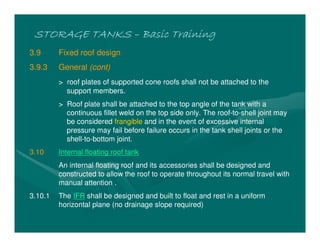
3.10 Internal floating roof tank
An internal floating roof and its accessories shall be designed and
constructed to allow the roof to operate throughout its normal travel with
manual attention .
3.10.1 The IFR shall be designed and built to float and rest in a uniform
horizontal plane (no drainage slope required)
STORAGE TANKS
STORAGE TANKS
STORAGE TANKS
STORAGE TANKS –
–
–
– Basic Training
Basic Training
Basic Training
Basic Training
3.9 Fixed roof design
3.10 Internal floating roof tank
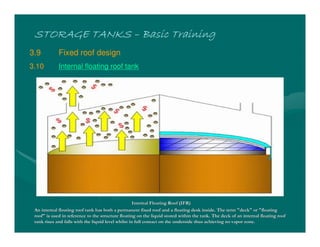
Internal Floating Roof (IFR)
An internal floating roof tank has both a permanent fixed roof a
An internal floating roof tank has both a permanent fixed roof and a floating desk inside. The term "deck" or "floating
nd a floating desk inside. The term "deck" or "floating
roof" is used in reference to the structure floating on the liqu
roof" is used in reference to the structure floating on the liquid stored within the tank. The deck of an internal floating roof
id stored within the tank. The deck of an internal floating roof
tank rises and falls with the liquid level whilst in full contac
tank rises and falls with the liquid level whilst in full contact on the underside thus achieving no vapor zone.
t on the underside thus achieving no vapor zone.
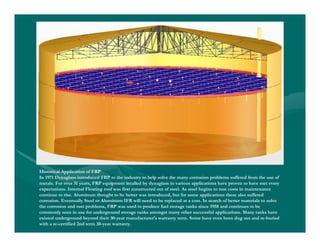
Historical Application of FRP
In 1971 Dynaglass introduced FRP to the industry to help solve the many corrosion problems suffered from the use of
metals. For over 31 years, FRP equipment intalled by dynaglass in various applications have proven to have met every
expectations. Internal Floating roof was first constructed out of steel. As steel begins to rust costs in maintenance
continue to rise. Aluminum thought to be better was introduced, but for some applications these also suffered
corrosion. Eventually Steel or Aluminum IFR will need to be replaced at a cost. In search of better materials to solve
the corrosion and rust problems, FRP was used to produce fuel storage tanks since 1958 and continues to be
commonly seen in use for underground storage tanks amongst many other successful applications. Many tanks have
existed underground beyond their 30-year manufacturer's warranty term. Some have even been dug out and re-buried
with a re-certified 2nd term 30-year warranty.
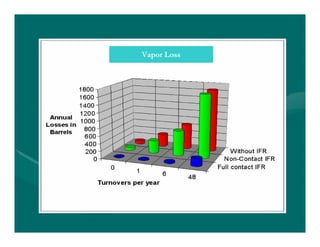
Vapor Loss
STORAGE TANKS
STORAGE TANKS
STORAGE TANKS
STORAGE TANKS –
–
–
– Basic Training
Basic Training
Basic Training
Basic Training
3.9 Fixed roof design
3.9.3 General (cont)
> roof plates of supported cone roofs shall not be attached to the
support members.
> Roof plate shall be attached to the top angle of the tank with a
continuous fillet weld on the top side only. The roof-to-shell joint may
be considered frangible and in the event of excessive internal
pressure may fail before failure occurs in the tank shell joints or the
shell-to-bottom joint.
3.10 Internal floating roof tank
An internal floating roof and its accessories shall be designed and
constructed to allow the roof to operate throughout its normal travel with
manual attention .
3.10.1 The IFR shall be designed and built to float and rest in a uniform
horizontal plane (no drainage slope required)
STORAGE TANKS
STORAGE TANKS
STORAGE TANKS
STORAGE TANKS –
–
–
– Basic Training
Basic Training
Basic Training
Basic Training
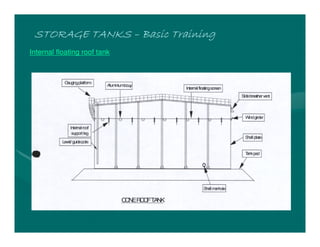
Internal floating roof tank
STORAGE TANKS
STORAGE TANKS
STORAGE TANKS
STORAGE TANKS –
–
–
– Basic Training
Basic Training
Basic Training
Basic Training
3.10 Internal floating roof tank (internal floating roof picture)
3.10.2 Buoyancy
> Metallic pontoon internal floating roofs have peripheral closed top
bulk-headed compartments for buoyancy.
> Double deck internal floating roofs are also available.
> Sandwich-panel internal floating roofs have metallic panel modules
for buoyancy compartments.
3.10.3 Floating screen material
> Steel
> Stainless steel
> Aluminum (commonly used)
3.10.4 Roof seal/ types
> A vapor tight rim seal (or skirt) is provided
- Liquid filled, gas-filled or foam-filled fabric seal
- Flexible wiper seal
- Mech. shoe - combination of light gauge metallic band and
fabric seal.
STORAGE TANKS
STORAGE TANKS
STORAGE TANKS
STORAGE TANKS –
–
–
– Basic Training
Basic Training
Basic Training
Basic Training
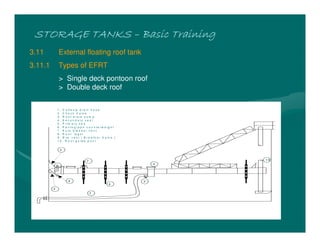
3.11 External floating roof tank
3.11.1 Types of EFRT
> Single deck pontoon roof
> Double deck roof
1
2
3
4
5
6
1
7
8
9
1 . C o f le x ip d r a in h o s e
2 . C h e c k V a lv e
3 . R o o f d r a in s u m p
4 . S e c o n d a r y s e a l
5 . P r i m a r y s e a
6 . P a n t o g r a p h c o u n t e r w e ig h t
7 . A u t o b le e d e r v e n t
8 . R o o f le g s l
9 . R im v e n t ( B r e a t h e r V a lv e )
1 0 . R o o f g u id e p o o l
1 0
STORAGE TANKS
STORAGE TANKS
STORAGE TANKS
STORAGE TANKS –
–
–
– Basic Training
Basic Training
Basic Training
Basic Training
3.11 External floating roof tank
3.11.2 Manholes/ vents are provided for:
> Pontoon with liquid tight covers
> Deck manholes with are used only during tank shutdown
> Each compartment shall be provided with elevated vents
> Suitable vents shall be provided to prevent overstressing of the roof
deck or seal membrane
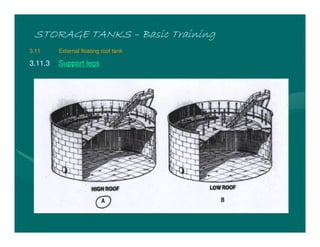
3.11.3 Support legs
> Floating roof shall be provided with support legs
> Legs pipes shall be perforated at the bottom to provide drainage
> The length of the legs are adjustable from the top
> Operating position (low leg) and cleaning or maintenance position
(high leg)
STORAGE TANKS
STORAGE TANKS
STORAGE TANKS
STORAGE TANKS –
–
–
– Basic Training
Basic Training
Basic Training
Basic Training
3.11 External floating roof tank
3.11.3 Support legs
STORAGE TANKS
STORAGE TANKS
STORAGE TANKS
STORAGE TANKS –
–
–
– Basic Training
Basic Training
Basic Training
Basic Training
3.11 External floating roof tank
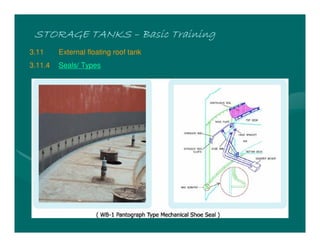
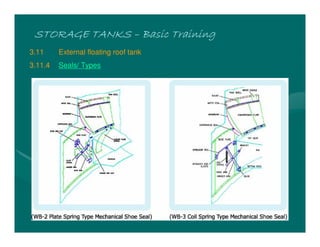
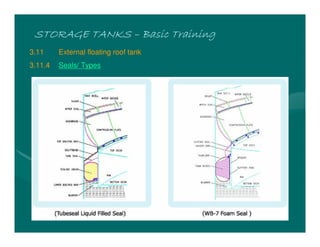
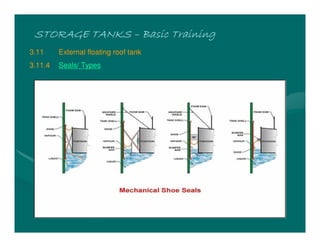
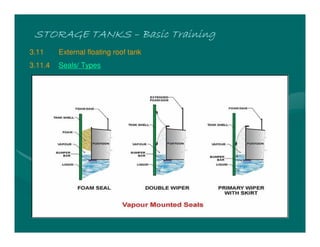
3.11.4 Seals/ Types
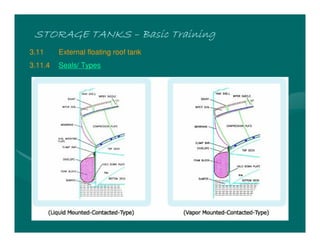
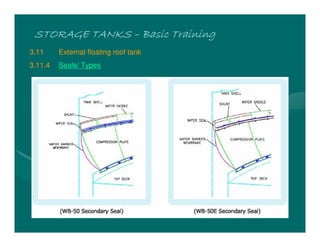
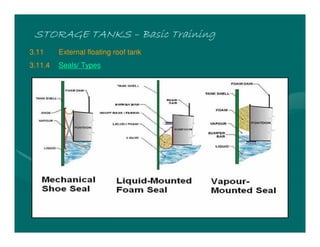
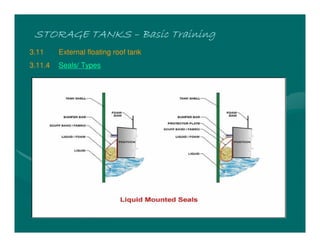
> The space between the outer periphery of the roof and the tank shell
shall be sealed by a flexible device that provides a reasonable close
fit to shell surface
- Steel shoes with fabric or nonmetallic material used as seal
or seal components
- Material shall be durable and shall not discolor or
contaminate the product stored.
STORAGE TANKS
STORAGE TANKS
STORAGE TANKS
STORAGE TANKS –
–
–
– Basic Training
Basic Training
Basic Training
Basic Training
3.11 External floating roof tank
3.11.4 Seals/ Types
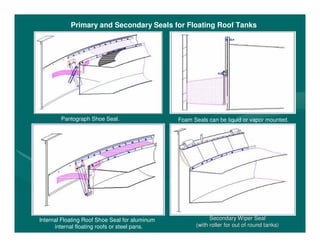
Pictures/ drawings of seals follows:
Primary and Secondary Seals for Floating Roof Tanks
Pantograph Shoe Seal. Foam Seals can be liquid or vapor mounted.
Internal Floating Roof Shoe Seal for aluminum
internal floating roofs or steel pans.
Secondary Wiper Seal
(with roller for out of round tanks)
STORAGE TANKS
STORAGE TANKS
STORAGE TANKS
STORAGE TANKS –
–
–
– Basic Training
Basic Training
Basic Training
Basic Training
3.11 External floating roof tank
3.11.4 Seals/ Types
STORAGE TANKS
STORAGE TANKS
STORAGE TANKS
STORAGE TANKS –
–
–
– Basic Training
Basic Training
Basic Training
Basic Training
3.11 External floating roof tank
3.11.4 Seals/ Types
STORAGE TANKS
STORAGE TANKS
STORAGE TANKS
STORAGE TANKS –
–
–
– Basic Training
Basic Training
Basic Training
Basic Training
3.11 External floating roof tank
3.11.4 Seals/ Types
STORAGE TANKS
STORAGE TANKS
STORAGE TANKS
STORAGE TANKS –
–
–
– Basic Training
Basic Training
Basic Training
Basic Training
3.11 External floating roof tank
3.11.4 Seals/ Types
STORAGE TANKS
STORAGE TANKS
STORAGE TANKS
STORAGE TANKS –
–
–
– Basic Training
Basic Training
Basic Training
Basic Training
3.11 External floating roof tank
3.11.4 Seals/ Types
STORAGE TANKS
STORAGE TANKS
STORAGE TANKS
STORAGE TANKS –
–
–
– Basic Training
Basic Training
Basic Training
Basic Training
3.11 External floating roof tank
3.11.4 Seals/ Types
STORAGE TANKS
STORAGE TANKS
STORAGE TANKS
STORAGE TANKS –
–
–
– Basic Training
Basic Training
Basic Training
Basic Training
3.11 External floating roof tank
3.11.4 Seals/ Types
STORAGE TANKS
STORAGE TANKS
STORAGE TANKS
STORAGE TANKS –
–
–
– Basic Training
Basic Training
Basic Training
Basic Training
3.11 External floating roof tank
3.11.4 Seals/ Types
STORAGE TANKS
STORAGE TANKS
STORAGE TANKS
STORAGE TANKS –
–
–
– Basic Training
Basic Training
Basic Training
Basic Training
3.11 External floating roof tank
3.11.4 Seals/ Types
STORAGE TANKS
STORAGE TANKS
STORAGE TANKS
STORAGE TANKS –
–
–
– Basic Training
Basic Training
Basic Training
Basic Training
3.11 External floating roof tank
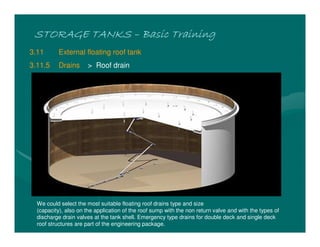
3.11.5 Drains > Roof drain
We could select the most suitable floating roof drains type and size
(capacity), also on the application of the roof sump with the non return valve and with the types of
discharge drain valves at the tank shell. Emergency type drains for double deck and single deck
roof structures are part of the engineering package.
STORAGE TANKS
STORAGE TANKS
STORAGE TANKS
STORAGE TANKS –
–
–
– Basic Training
Basic Training
Basic Training
Basic Training
3.11 External floating roof tank
3.11.6 Foam Dams
> Foam dams collect debris and therefore retain water causing
excessive corrosion of dam/ deck joint, roof annulars and seal
connections. The dam drain holes should always unplugged.`
STORAGE TANKS
STORAGE TANKS
STORAGE TANKS
STORAGE TANKS-
-
-
- Basic Training
Basic Training
Basic Training
Basic Training
4.0 Tank Fittings
4.1 Operational Fittings for vertical Tanks
Standard range of fittings and accessories
Tanks shall be provided with the standard range of fittings and
accessories. Optional fittings shall be supplied only when specified by
the owner.
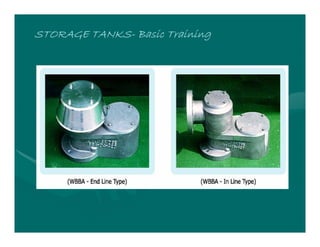
4.1.1 Breather valves (pic) and free vents
The number and sizes of breather valves and free vents required
should be specified separately due to large variations is
pumping rates, etc.
When deciding on the number of free vents required, their capacity
shall be taken into account.
Note: If the storage capacity of an existing tank is increased by
fitting additional courses of shell plates, the venting capacity
of the enlarged tank shall be checked, and increase if
necessary.
STORAGE TANKS
STORAGE TANKS
STORAGE TANKS
STORAGE TANKS-
-
-
- Basic Training
Basic Training
Basic Training
Basic Training
Flame Arrestor
Flame Arrestor
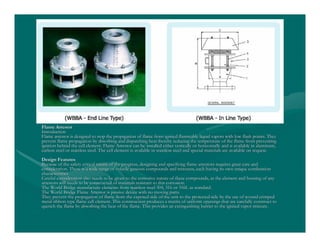
Introduction
Introduction
Flame arrestor is designed to stop the propagation of flame from
Flame arrestor is designed to stop the propagation of flame from ignited flammable liquid vapors with low flash points. They
ignited flammable liquid vapors with low flash points. They
prevent flame propagation by absorbing and dispatching heat ther
prevent flame propagation by absorbing and dispatching heat thereby reducing the temperature of the flame front preventing
eby reducing the temperature of the flame front preventing
ignition behind the cell element. Flame Arrestor can be installe
ignition behind the cell element. Flame Arrestor can be installed either vertically or horizontally and is available in aluminum
d either vertically or horizontally and is available in aluminum,
,
carbon steel or stainless steel. The cell element is available i
carbon steel or stainless steel. The cell element is available in stainless steel and special materials are available on request
n stainless steel and special materials are available on request.
.
Design Features
Design Features
Because of the safety critical nature of the progress, designing
Because of the safety critical nature of the progress, designing and specifying flame arrestors requires great care and
and specifying flame arrestors requires great care and
consideration. There is a wide range of volatile gaseous compoun
consideration. There is a wide range of volatile gaseous compounds and mixtures, each having its own unique combustion
ds and mixtures, each having its own unique combustion
characteristics.
characteristics.
Careful consideration also needs to be given to the corrosive na
Careful consideration also needs to be given to the corrosive nature of these compounds, as the element and housing of any
ture of these compounds, as the element and housing of any
arrestors will needs to be constructed of materials resistant to
arrestors will needs to be constructed of materials resistant to this corrosion.
this corrosion.
The World Bridge manufacture elements from stainless steel 304,
The World Bridge manufacture elements from stainless steel 304, 316 or 316L as standard.
316 or 316L as standard.
The World Bridge Flame Arrestor is passive device with no moving
The World Bridge Flame Arrestor is passive device with no moving parts.
parts.
They prevent the propagation of flame from the exposed side of t
They prevent the propagation of flame from the exposed side of the unit to the protected side by the use of wound crimped
he unit to the protected side by the use of wound crimped
metal ribbon type flame cell element. This construction produces
metal ribbon type flame cell element. This construction produces a matrix of uniform openings that are carefully construct to
a matrix of uniform openings that are carefully construct to
quench the flame by absorbing the heat of the flame. This provid
quench the flame by absorbing the heat of the flame. This provides an extinguishing barrier to the ignited vapor mixture.
es an extinguishing barrier to the ignited vapor mixture.
STORAGE TANKS
STORAGE TANKS
STORAGE TANKS
STORAGE TANKS –
–
–
– Basic Training
Basic Training
Basic Training
Basic Training
4.1 Operational Fittings for vertical Tanks (cont)
4.1.2 Roof nozzles
The flow characteristics of breather valves and free vents are
influenced by the profile and length of the roof nozzle.
Wire netting in the opening of free vents and breather valves (e.g. as
used to prevent nesting of birds) shall have openings of at least 6
mm square.
STORAGE TANKS
STORAGE TANKS
STORAGE TANKS
STORAGE TANKS –
–
–
– Basic Training
Basic Training
Basic Training
Basic Training
4.1 Operational Fittings for vertical Tanks (cont)
4.1.3 Required venting capacity
The venting requirements shall include the following conditions:
• Inbreathing resulting from a maximum outflow from the tank
• Inbreathing resulting from contraction of vapors caused by a
maximum decrease in atmospheric temperature
• Outbreathing resulting from a maximum inflow of product into the
tank and maximum evaporation caused by such inflow
• Outbreathing resulting from expansion and evaporation due to a
maximum in atmospheric temperature (thermal breathing)
• Outbreathing resulting from the fire exposure
Note: Both cone and dome shaped fixed roof tanks shall be
designed to fail at the roof-to-shell connection when
subjected to an internal explosion or sudden increase in
pressure.
STORAGE TANKS
STORAGE TANKS
STORAGE TANKS
STORAGE TANKS –
–
–
– Basic Training
Basic Training
Basic Training
Basic Training
4.1 Operational Fittings for vertical Tanks (cont)
4.1.4 Thermal venting
Special attention is required to the influence of a sudden drop in
temperature (e.g. due to rainfall) on the venting requirements of
tanks containing warm product and for tanks in tropical areas.
A drop of 20 oC or more in 15 minutes may be experienced. Where
these conditions apply the venting shall be increased by at least 20%
of the thermal venting capacity requirements.
STORAGE TANKS
STORAGE TANKS
STORAGE TANKS
STORAGE TANKS –
–
–
– Basic Training
Basic Training
Basic Training
Basic Training
4.2 Fittings Common to All Vertical Tanks
4.2.1 Stairways, handrails, etc.
Vertical tanks should be provided with spiral stairways. An
exception may be made for groups of tanks of less than 12.5 m
diameter sited close together and connected by walkways at roof
level. In such groups, two tanks at opposite ends of each group
shall be provided with stairways, so that each tank in that group
will then have at least two escape routes from the roof.
Handrails shall be provided at the edge of the roof for full
circumference of all fixed roof tanks and to the centre of the roof on
all tanks exceeding 12.5 m diameter. Handrails shall be provided on
the outside of all spiral stairways. For open top tanks, the inside of the
staircases shall also be provided with a handrail in the immediate
vicinity of the top landing.
Caution: Always have one hand free to hold the railing while
using the tank stairways.
STORAGE TANKS
STORAGE TANKS
STORAGE TANKS
STORAGE TANKS-
-
-
- Basic Training
Basic Training
Basic Training
Basic Training
4.2 Fittings Common to All Vertical Tanks
4.2.1 Stairways, handrails, etc. (cont)
Handrails shall be provided on both sides of all walkways
between tanks.
Note: The Owner shall specify on the requisition if it is required that
all stairways and walkways are to be provided with
galvanized, open grating (25 mm deep with main bearing
strips of 5 mm thickness).
Stairways shall be provided with the specified lighting facilities.
STORAGE TANKS
STORAGE TANKS
STORAGE TANKS
STORAGE TANKS –
–
–
– Basic Training
Basic Training
Basic Training
Basic Training
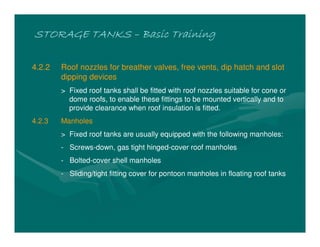
4.2.2 Roof nozzles for breather valves, free vents, dip hatch and slot
dipping devices
> Fixed roof tanks shall be fitted with roof nozzles suitable for cone or
dome roofs, to enable these fittings to be mounted vertically and to
provide clearance when roof insulation is fitted.
4.2.3 Manholes
> Fixed roof tanks are usually equipped with the following manholes:
- Screws-down, gas tight hinged-cover roof manholes
- Bolted-cover shell manholes
- Sliding/tight fitting cover for pontoon manholes in floating roof tanks
STORAGE TANKS
STORAGE TANKS
STORAGE TANKS
STORAGE TANKS –
–
–
– Basic Training
Basic Training
Basic Training
Basic Training
4.2 Fittings Common to All Vertical Tanks
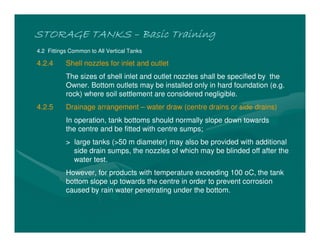
4.2.4 Shell nozzles for inlet and outlet
The sizes of shell inlet and outlet nozzles shall be specified by the
Owner. Bottom outlets may be installed only in hard foundation (e.g.
rock) where soil settlement are considered negligible.
4.2.5 Drainage arrangement – water draw (centre drains or side drains)
In operation, tank bottoms should normally slope down towards
the centre and be fitted with centre sumps;
> large tanks (>50 m diameter) may also be provided with additional
side drain sumps, the nozzles of which may be blinded off after the
water test.
However, for products with temperature exceeding 100 oC, the tank
bottom slope up towards the centre in order to prevent corrosion
caused by rain water penetrating under the bottom.
STORAGE TANKS
STORAGE TANKS
STORAGE TANKS
STORAGE TANKS -
-
-
- Basic Training
Basic Training
Basic Training
Basic Training
4.2 Fittings Common to All Vertical Tanks
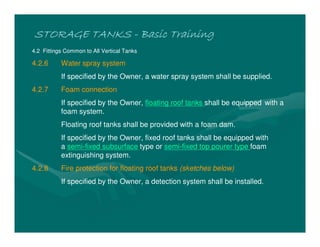
4.2.6 Water spray system
If specified by the Owner, a water spray system shall be supplied.
4.2.7 Foam connection
If specified by the Owner, floating roof tanks shall be equipped with a
foam system.
Floating roof tanks shall be provided with a foam dam.
If specified by the Owner, fixed roof tanks shall be equipped with
a semi-fixed subsurface type or semi-fixed top pourer type foam
extinguishing system.
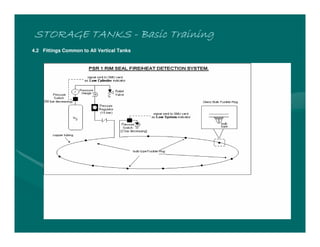
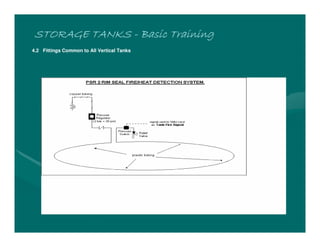
4.2.8 Fire protection for floating roof tanks (sketches below)
If specified by the Owner, a detection system shall be installed.
STORAGE TANKS
STORAGE TANKS
STORAGE TANKS
STORAGE TANKS -
-
-
- Basic Training
Basic Training
Basic Training
Basic Training
4.2 Fittings Common to All Vertical Tanks
STORAGE TANKS
STORAGE TANKS
STORAGE TANKS
STORAGE TANKS -
-
-
- Basic Training
Basic Training
Basic Training
Basic Training
4.2 Fittings Common to All Vertical Tanks
STORAGE TANKS
STORAGE TANKS
STORAGE TANKS
STORAGE TANKS –
–
–
– Basic Training
Basic Training
Basic Training
Basic Training
4.2. Fittings Common to All Vertical Tanks
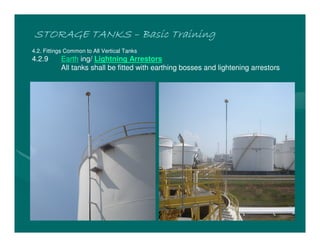
4.2.9 Earth ing/ Lightning Arrestors
All tanks shall be fitted with earthing bosses and lightening arrestors
STORAGE TANKS
STORAGE TANKS
STORAGE TANKS
STORAGE TANKS –
–
–
– Basic Training
Basic Training
Basic Training
Basic Training
4.2. Fittings Common to All Vertical Tanks
4.2.9 Earth ing/ Lightning Arrestors
All tanks shall be fitted with earthing bosses and lightening arrestors
STORAGE TANKS
STORAGE TANKS
STORAGE TANKS
STORAGE TANKS –
–
–
– Basic Training
Basic Training
Basic Training
Basic Training
4.2. Fittings Common to All Vertical Tanks
4.2.9 Earth ing/ Lightning Arrestors
All tanks shall be fitted with earthing bosses and lightening arrestors
4.2.10 Liquid level indicators
Liquid indicators or automatic liquid-level gauges shall be fitted to all
tanks.
The construction of the gauge poles depends on the operational
conditions and the required measurement accuracy of the level
gauges.
4.2.11 Dip plate or datum plate
A 6 mm thick dip plate shall be provided for welding to the tank
bottom or lowest shell course directly under the dip fittings (i.e. dip
hatch, slot dipping devices and combined vent and dip
hatches).
STORAGE TANKS
STORAGE TANKS
STORAGE TANKS
STORAGE TANKS –
–
–
– Basic Training
Basic Training
Basic Training
Basic Training
4.3 Additional fittings for fixed roof tanks
4.3.1 Slot dipping devices
Slot dipping devices are required for all tanks operating under
pressure, so that dips and samples may be taken without excessive
pressure loss.
4.3.2 Manometer or pressure/ vacuum gauges
If specified, manometers shall be supplied for pressurized tanks in
order that the working of the breather valves may be checked. The
manometers are normally mounted at ground level for easy reading.
STORAGE TANKS
STORAGE TANKS
STORAGE TANKS
STORAGE TANKS –
–
–
– Basic Training
Basic Training
Basic Training
Basic Training
4.3 Additional fittings for fixed roof tanks
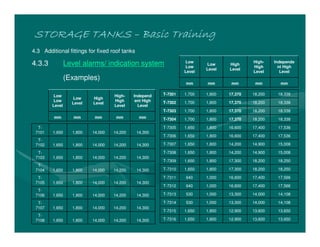
4.3.3 Level alarms/ indication system
At least two independent level alarm systems shall be provided:
- Low, high and high/high level alarms (ATG)
- Independent high level alarm
The Hi/Hi level shall be set such that the maximum filling height is
limited to 200 mm below the top of the shell.
STORAGE TANKS
STORAGE TANKS
STORAGE TANKS
STORAGE TANKS –
–
–
– Basic Training
Basic Training
Basic Training
Basic Training
4.3 Additional fittings for fixed roof tanks
4.3.3 Level alarms/ indication system
(Examples)
14,300
14,200
14,000
1,800
1,650
T-
7108
14,300
14,200
14,000
1,800
1,650
T-
7107
14,300
14,200
14,000
1,800
1,650
T-
7106
14,300
14,200
14,000
1,800
1,650
T-
7105
14,300
14,200
14,000
1,800
1,650
T-
7104
14,300
14,200
14,000
1,800
1,650
T-
7103
14,300
14,200
14,000
1,800
1,650
T-
7102
14,300
14,200
14,000
1,800
1,650
T-
7101
mm
mm
mm
mm
mm
Independ
ent High
Level
High-
High
Level
High
Level
Low
Level
Low
Low
Level
13,650
13,600
12,900
1,800
1,650
T-7316
13,650
13,600
12,900
1,800
1,650
T-7315
14,108
14,000
13,300
1,000
530
T-7314
14,108
14,000
13,300
1,000
530
T-7313
17,566
17,400
16,600
1,000
640
T-7312
17,566
17,400
16,600
1,000
640
T-7311
18,250
18,200
17,300
1,800
1,650
T-7310
18,250
18,200
17,300
1,800
1,650
T-7309
15,008
14,900
14,200
1,800
1,650
T-7308
15,008
14,900
14,200
1,800
1,650
T-7307
17,536
17,400
16,600
1,800
1,650
T-7306
17,536
17,400
16,600
1,800
1,650
T-7305
18,338
18,200
17,370
1,800
1,700
T-7304
18,338
18,200
17,370
1,800
1,700
T-7303
18,338
18,200
17,370
1,800
1,700
T-7302
18,338
18,200
17,370
1,800
1,700
T-7301
mm
mm
mm
mm
mm
Independe
nt High
Level
High-
High
Level
High
Level
Low
Level
Low
Low
Level
STORAGE TANKS
STORAGE TANKS
STORAGE TANKS
STORAGE TANKS –
–
–
– Basic Training
Basic Training
Basic Training
Basic Training
4.3 Additional fittings for fixed roof tanks
4.3.4 Level alarms/ indication system (cont)
Tanks with an internal floating cover (IFC):
- The Hi/Hi level shall be set such that at least 200 mm clearance
remains between any moving part of the IFC and any obstruction
fixed to the shell, including the roof supporting structure.
- The low level alarm shall be set such that the IFC still remains
floating with its supports at least 100 mm above the tank bottom.
STORAGE TANKS
STORAGE TANKS
STORAGE TANKS
STORAGE TANKS –
–
–
– Basic Training
Basic Training
Basic Training
Basic Training
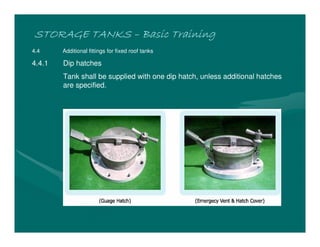
4.4 Additional fittings for fixed roof tanks
4.4.1 Dip hatches
Tank shall be supplied with one dip hatch, unless additional hatches
are specified.
STORAGE TANKS
STORAGE TANKS
STORAGE TANKS
STORAGE TANKS -
-
-
- Basic Training
Basic Training
Basic Training
Basic Training
4.4 Additional fittings for fixed roof tanks
4.4.3 Heating coils
If specified, heating coils shall be fitted to tanks when products are
required to be maintained at above-ambient temperatures to
facilitate pumping (e.g. on lubricating oil, bitumen and sulfur storage
tanks).
4.4.4 Suction heaters
If specified, suction heaters shall be provided for tanks fitted with
coils when additional localized heat is required at the outlet
connection. These heaters are usually of the nested tube type, and
are suitable for steam or heat transfer fluid systems.
4.4.5 Angle ring for tank roof insulation
When tank roofs are to be insulated an additional circumferential
angle ring and various small fittings shall be provided to retain the
insulation material, which is terminated below the top curb angle.
STORAGE TANKS _ Basic Training
4.4 Additional fittings for fixed roof tanks
4.2.6 Side-entry mixers
Side-entry mixers may be required to improve mixing of the product
or to reduce the formation of sludge. If side-entry mixers are to be
installed, the required shell connections shall be specified. Side-entry
mixers shall be placed on manholes-type shell nozzles to allow easy
removal for maintenance without entering the tank.
4.2.7 Sample connections and thermo-indicators
If specified, sample connections and thermo-indicators shall be
provided adjacent to the spiral stairway. Such connections shall be
flanged.
STORAGE TANKS
STORAGE TANKS
STORAGE TANKS
STORAGE TANKS –
–
–
– Basic Training
Basic Training
Basic Training
Basic Training
4.5 Special fittings and accessories for floating roof
4.5.1 Primary roof seals
The circumferential primary roof seal may comprise metallic shoes
having flexible seals with a weight or spring-operated pusher
mechanism, or be a compression plate type seal, or a fabric foam
filled seal.
- the lower part of the metallic shoe shall be submerged in the
product;
- compression plate types shall be provided with a continuous
weighted skirt which is partly submerged in the product.
- foam filled envelope seal shall be of the liquid mounted type.
Rim mounted secondary roof seals shall be used in all primary roof
seal systems. Both primary and secondary seals shall have a
minimum inward and outward flexibility of 125 mm.
STORAGE TANKS
STORAGE TANKS
STORAGE TANKS
STORAGE TANKS –
–
–
– Basic Training
Basic Training
Basic Training
Basic Training
4.5 Special fittings and accessories for floating roof
4.5.2 Fittings
All floating roof shall be equipped with a complete set of
accessories required for the proper functioning of the floating roof.
> Support legs
Adjustable supporting legs are provided on which the roof rests in
its lowest position during operation and in its highest position during
maintenance operations.
Pad plates shall be located on the bottom for each supporting leg.
STORAGE TANKS
STORAGE TANKS
STORAGE TANKS
STORAGE TANKS –
–
–
– Basic Training
Basic Training
Basic Training
Basic Training
4.5 Special fittings and accessories for floating roof
4.5.3 Fittings (cont)
> Roof drains
Floating roofs shall be fitted with roof drains. Roof drains could be
articulated pipe and coflexip hose. A check valve shall be
provided near the roof end of the articulated pipe or hose, to
prevent backflow of stored product onto the roof in case of leakage
in the pipe joints or hose/ hose fittings.
Depending on the size of the tank and amount of rainfall, two or
more roof drains should be installed.
STORAGE TANKS
STORAGE TANKS
STORAGE TANKS
STORAGE TANKS –
–
–
– Basic Training
Basic Training
Basic Training
Basic Training
4.5 Special fittings and accessories for floating roof
4.5.3 Fittings (cont)
> Access ladder to the roof
The access ladder to the roof shall be equipped with self-leveling stair
treads. The rails shall be placed at such a height above the centre
deck that rain water on the deck cannot affect movement of the
ladder. The ladder shall be provided with an anti-derailing device to
prevent uplift of the ladder during strong winds.
> Earthing
In addition to the earthing bosses on the tank shell, electrical earthing
facilities (spring stainless steel shunts) shall be fitted for the earthing
of the floating roof across the rim space at a maximum interval of 2.5
meter. Their sliding contact with the shell, shall be in the open air
above the secondary seal. An earthing cable be along the access
ladder to the roof.
STORAGE TANKS
STORAGE TANKS
STORAGE TANKS
STORAGE TANKS –
–
–
– Basic Training
Basic Training
Basic Training
Basic Training
4.5 Special fittings and accessories for floating roof
4.5.3 Fittings (cont)
> Automatic bleeder vents
Automatic bleeder vents shall be provided to vent the air from under
the floating roof when the tank is being filled initially. They shall also
open automatically just before the roof lands on its supports, thereby
preventing the development of a vacuum under the roof. The capacity
of the vents shall be based on the maximum pumping rates.
> Rim vents for metallic shoe type seals
Rim vent shall be provided to prevent any excess pressure in the
rim space, as this might press the shoe ring too tightly against the
tank shell. Settling shall be plus and minus 2.5 mbar.
STORAGE TANKS
STORAGE TANKS
STORAGE TANKS
STORAGE TANKS –
–
–
– Basic Training
Basic Training
Basic Training
Basic Training
4.5 Special fittings and accessories for floating roof
4.5.3 Fittings (cont)
> Guide and level pole
All floating roof tanks shall be equipped with a guide pole or
combined guide and level gauge pole.
> Shell fittings
The shell fittings are identical to those supplied for fix roof tanks.
However, the main inlet shall be provided with an extension pipe to
direct the product towards the centre of the tank. The nominal
length inside the tank shell be D/4 (where D is the tank diameter)
but shall not exceed 10 meters.
STORAGE TANKS
STORAGE TANKS
STORAGE TANKS
STORAGE TANKS –
–
–
– Basic Training
Basic Training
Basic Training
Basic Training
5.0 Tank Inspection
5.1 Inspection Frequencies
5.1.1 General
> It is important for the inspection of tank to be based upon a long
term program particularly where plant operator is dealing with
extensive tank farm installation involving numerous tanks in a
variety of service.
> If deferred for long then there is a risk of tank deteriorating and
developing defects which could lead to major leakage, fires and
pollution incidents.
> In-service inspection can give a good indication of integrity and
operability. However, there is no substitute in most operations for
out-of-service inspection.
STORAGE TANKS
STORAGE TANKS
STORAGE TANKS
STORAGE TANKS –
–
–
– Basic Training
Basic Training
Basic Training
Basic Training
5.0 Tank Inspection
5.1 Inspection Frequencies
5.1.2 External Inspection
> External inspection should take two forms.
Firstly, field operators should check for any abnormal situations
during the daily work or during scheduled checks
> Secondly a detailed on-stream inspection should be undertaken by
the inspection department
> It is important for inspectors to thoroughly evaluate the results of
on-stream inspections to revalidate the scope, extent and
frequency of such inspections and to further justify the interval of
thorough internal examination.
STORAGE TANKS
STORAGE TANKS
STORAGE TANKS
STORAGE TANKS –
–
–
– Basic Training
Basic Training
Basic Training
Basic Training
5.0 Tank Inspection
5.1 Inspection Frequencies
5.1.3 Internal Inspection
> The tables in the notes provides guidance on the frequency of out-
of-service interval inspections. The intervals are based on tanks
exhibiting no undue abnormalities or deterioration during
operations and on-stream inspections.
> External or internal corrosion, excessive foundation settlement etc.,
should be thoroughly investigated and the inspection interval
reduced accordingly.
Refer to the notes provided on INSPECTION where Inspection
checklists are attached.

Storage-Tanks-Basic-Training and understanding.pdf

  • 1.
    STORAGE TANKS Part1 Basic Training
  • 2.
    PETROLEUM STORAGE TANKS- Basic Training What we'll be covering > The design of the tank. > Which tank , which product. > The structure & assembly of the tank. > Tank inspection > Measurement Goals for Today & Tomorrow > To identify tank type & tank equipments > To know the limitation of tank > Calculation of tank volume > Safe tank operation
  • 3.
    PETROLEUM STORAGE TANKS- Basic Training Course Content 1. Background 2. Tank Design Day One - Types of vertical tanks - Selection of vertical tanks 3. Tank Structure & Assembly of Tank 4. Tank Fittings - Operational fitting - Fittings common to all vertical tanks - Additional fitting for floating roof tanks - Special fittings and accessories for floating 5. Tank Inspection 6. Tank Farm Safety …………………………………………………………………………………... 7. Measurement Day Two 8. Internal & external incident learning 9. Field trip
  • 4.
    STORAGE TANKS STORAGE TANKS STORAGETANKS STORAGE TANKS- - - - Basic Training Basic Training Basic Training Basic Training 1.0 Background Tanks have been around since the beginning of hydrocarbon production. Tanks vary considerably, in the type and size based on the type of products to be stored and the volume involved. The failure of a tank can have several undesirable effects such as endangering personnel, affecting the environment and interrupting the Operator’s business. Companies therefore, require a consistent approach for assessing tank integrity and maintaining compliance with industry and regulatory standards, (that is community requirements). Such an approach must; • Ensure tanks are not leaking and will not leak before next inspection • Reduce the potential for releases • Maintain tanks in safe operating conditions, and • Make repairs and determine when replacement is necessary.
  • 5.
    PETROLEUM STORAGE TANKSBasic Training TANK The primary function of a storage tank is to store liquid substance. This liquid substance may be: a) Feedstock (Unit 71) b) Finished products prior to shipping out to customers (Unit 75) c) and Unfinished petroleum components awaiting for further - processing (intermediate – Unit 72) - blending (Unit 73) While in the storage tanks, these products may settle out undesirable substances such as; a) Water b) Emulsions c) Dirt etc. This undesirable substances can then be removed through draw-off devices. Products may also be mixed, blended and treated in storage tanks effectively, using the large capacity available in these tanks.
  • 6.
    TANK (cont) Broadly, thestorage tanks can be divided into two basic types: Atmospheric storage Atmospheric storage is a term applied to tanks operating at or near atmospheric pressure. This type of tank is used to hold liquid which will not vaporize at ambient temperature. Tanks used in this category are primarily the open top, fixed roof (cone & dome) and floating roof. Pressurized storage Pressurized storage applies to those vessels (mounded bullets) which are designed to withstand pressure sufficient to keep the liquid stored, from vaporizing. High vapor pressure hydrocarbons such as propane, butane, iC5 are the types of products requiring pressurized storage vessels (Mounded Bullets). Note: STORAGE TANK TRAINING for MG 3 Operators, will basically focus on aboveground vertical storage tanks of various types.
  • 7.
    TANK For safe storageof petroleum products, we have to consider the product properties such as volatility (RVP, pour point, flash point and others before we start designing and constructing the tank. Floating roof tank Cone Roof Tank Dome Roof Tank Internal Floating Roof Tank
  • 8.
    STORAGE TANKS STORAGE TANKS STORAGETANKS STORAGE TANKS – – – – Basic Training Basic Training Basic Training Basic Training 2.0 The design of the tank Standard vertical tanks are available in several types, which differ in vapor-saving efficiency and in cost. 2.1 Vertical tanks 2.1.1 Open top tanks This type of tank has no roof and shall be used for storing city water, fire water and cooling water (All water tanks in PPMSB are with roofs). 2.1.2 Fixed roof tanks These types of tanks can be divided into: - Cone roof - Dome roof Each type can be further subdivided into non-pressure and low- pressure fixed roof tanks.
  • 9.
    STORAGE TANKS STORAGE TANKS STORAGETANKS STORAGE TANKS – – – – Basic Training Basic Training Basic Training Basic Training Cone roof tank Dome roof tank
  • 10.
    o o f f s s u u m m p p w w i i t t h h t t h h e e n n o o n n r r e e t t u u r r n n v v a a l l v v e e a a n n d d w w Fixed roof tanks Fixedroof tanks are well known type of storage tanks, constructed over 100 years ago and provided mostly with self supporting roof structures either cone or dome type roofs. For large diameter fixed roof tanks column supported roof are used, for example in North America. Fixed roof tanks are designed as atmospheric , low , or high pressure tanks and may be used to store hydrocarbons as per product classification as given for example in the IP code. These recommendations will include the type of tank, measures to obtain the best performance with regarding to emission reduction, use of P/V valves, floating suction, internal floating roofs, cost effective maintenance, etc. Fixed roof tanks Fixed roof tanks are well known type of storage tanks, constructed over 100 years ago and provided mostly with self supporting roof structures either cone or dome type roofs. For large diameter fixed roof tanks column supported roof are used, for example in North America. Fixed roof tanks are designed as atmospheric , low , or high pressure tanks and may be used to store hydrocarbons as per product classification as given for example in the IP code. These recommendations will include the type of tank, measures to obtain the best performance with regarding to emission reduction, use of P/V valves, floating suction, internal floating roofs, cost effective maintenance, etc.
  • 11.
    STORAGE TANKS STORAGE TANKS STORAGETANKS STORAGE TANKS – – – – Basic Training Basic Training Basic Training Basic Training 2.1.3 Fixed roof tanks with floating covers (internal floating roof tanks) In a fixed roof tank a floating cover can be installed to give a further reduction of vapor losses. These tanks are fitted with breather vents either at the top course of the shell plate or on the roof edge. Typical feedstock/ products stored are: DPK (Kerosene, Jet A1) 2.1.4 Floating roof tank This type of tanks are designed to work at atmospheric pressure. The diameter of a floating roof tanks shall at least be equal to its height to enable the use of a normal rolling ladder for access to the roof. Typical Products stored are: Crude oil, Gasoline and Gasoline components, Solvents…… 2.1.5 Bullets The very volatility & high vapor pressure product such as Isopentane, LPG & Butane will be store in a vessel that will withstand product pressure and prevent any product vaporization. Due to high volatility & high vapor pressure the vessels are Mounded underground to prevent thermal radiation in case of any fire nearby.
  • 12.
    STORAGE TANKS STORAGE TANKS STORAGETANKS STORAGE TANKS – – – – Basic Training Basic Training Basic Training Basic Training Internal Floating Roof Tank
  • 13.
    STORAGE TANKS STORAGE TANKS STORAGETANKS STORAGE TANKS – – – – Basic Training Basic Training Basic Training Basic Training Floating Roof Tank
  • 14.
    STORAGE TANKS STORAGE TANKS STORAGETANKS STORAGE TANKS – – – – Basic Training Basic Training Basic Training Basic Training 2.2 Selection of Vertical Tanks – which tank, which product 2.2.1 General The types and ranges of tanks recommended for storage of different classes of petroleum products.
  • 15.
    STORAGE TANKS STORAGE TANKS STORAGETANKS STORAGE TANKS – – – – Basic Training Basic Training Basic Training Basic Training 2.2 Selection of Vertical Tanks – which tank, which product 2.2.1 General The types and ranges of tanks recommended for storage of different classes of petroleum products. 2.3 Stability For calculations of tank stability in strong winds, the velocities given in the local regulations should be used; if no local regulations exist, local experience should be considered. Unstable tanks shall be provided with anchor bolts and concrete foundation rings. Uplifting is caused by the internal vapor pressure acting against the underside of the roof, in conjunction with wind load. A stability calculation shall be made to determine the number of anchor required.
  • 16.
    STORAGE TANKS STORAGE TANKS STORAGETANKS STORAGE TANKS – – – – Basic Training Basic Training Basic Training Basic Training 2.3 Stability For calculations of tank stability in strong winds the following need to be done: a) the velocities given in the local regulations should be used; b) if no local regulations exist, local experience should be considered. Unstable tanks shall be provided with anchor bolts and concrete foundation rings. Uplifting is caused by the internal vapor pressure acting against the underside of the roof, in conjunction with wind load. A stability calculation shall be made to determine the number of anchors required.
  • 17.
    STORAGE TANKS STORAGE TANKS STORAGETANKS STORAGE TANKS – – – – Basic Training Basic Training Basic Training Basic Training 2.4 Tank Foundation 2.4.1 Checking of foundation Surface, subsurface and climatic conditions vary from place to place, so it is not practical to establish design data to cover all situations. The allowable soil loading and exact type of subsurface construction to be used must be decided for each individual case after careful consideration. Some of the many conditions that require special engineering consideration are as follows: > site on hillsides – undisturbed/ land filled > sites at swampy or filled ground > sites underlain by soils, such as organic clays that will settle over long period and can cause lateral ground stability problem > site adjacent to water courses or deep excavation > site exposed to flood water > site in regions of high seismicity
  • 18.
    STORAGE TANKS STORAGE TANKS STORAGETANKS STORAGE TANKS – – – – Basic Training Basic Training Basic Training Basic Training 2.4 Tank Foundation 2.4.2 Typical Foundation Types 2.4.2.1 Earth foundation without a ringwall When subsurface conditions shows adequate bearing capacity and that settlements will be acceptable, satisfactory foundations may be constructed from earth material. Design for satisfactory long-term performance are: > For small tanks, foundations can consist of compacted crushed stone, screenings, fine gravel, clean sand, or similar material placed directly on virgin soil.
  • 19.
    STORAGE TANKS STORAGE TANKS STORAGETANKS STORAGE TANKS – – – – Basic Training Basic Training Basic Training Basic Training 2.4 Tank Foundation 2.4.2 Typical Foundation Types 2.4.2.2 Earth foundations with a concrete ringwall large tanks, with heavy or tall shell and/or self-supported roofs impose a substantial load on the foundation under the shell. When there is some doubt whether a foundation will be able to carry the load directly, a concrete ringwall foundation should be used. Advantages of concrete ringwall are: > It provides better distribution of the concentrated load of the shell to produce a more uniform soil loading under the tank > It provides a level, solid starting plane for concentration of the shell > It is capable of preserving its contour during construction > It retains the fill under the tank bottom and prevents loss of material as a result of erosion > It minimizes moisture under the tank
  • 20.
    STORAGE TANKS STORAGE TANKS STORAGETANKS STORAGE TANKS – – – – Basic Training Basic Training Basic Training Basic Training 2.4 Tank Foundation 2.4.2 Typical Foundation Types 2.4.2.2 Earth foundations with a concrete ringwall Other design requirements are: > The ringwall shall not be less than 300 mm (12 in) thick > Depth of ringwall depends on the local conditions 2.4.2.3 Earth foundations with a crushed stone and gravel ringwall A crushed stone or gavel ringwall will provide adequate support for high load imposed by the shell. Advantages are: > It provides better distribution of the concentrated load of the shell to produce a more uniform soil loading under the tank > It provides a means of leveling the tank grade, and it is capable of preserving its contour during construction > It retains the fill under the tank bottom and prevents loss of material as a result of erosion > it can more smoothly accommodate differential settlement because of its flexibility
  • 21.
    STORAGE TANKS STORAGE TANKS STORAGETANKS STORAGE TANKS – – – – Basic Training Basic Training Basic Training Basic Training 2.4 Tank Foundation 2.4.3 Tank foundations for leak detection API supports a general position of installing a Release Prevention barrier (RPB) under new tanks during initial construction. An RPB includes steel bottoms, synthetic materials, clay liners, and all other barriers or combination of barriers placed in the bottom of or under an aboveground storage tank, which have the following functions: > preventing the escape of contaminated material and > containing or channeling released material for leak detection
  • 22.
    STORAGE TANKS STORAGE TANKS STORAGETANKS STORAGE TANKS – – – – Basic Training Basic Training Basic Training Basic Training 2.4 Tank Foundation 2.4.3 Tank foundations for leak detection
  • 23.
    STORAGE TANKS STORAGE TANKS STORAGETANKS STORAGE TANKS – – – – Basic Training Basic Training Basic Training Basic Training 2.4 Tank Foundation 2.4.3 Tank foundations and leak detection
  • 24.
    STORAGE TANKS STORAGE TANKS STORAGETANKS STORAGE TANKS – – – – Basic Training Basic Training Basic Training Basic Training 2.4 Tank Foundation 2.4.3 Tank foundations for leak detection
  • 25.
    STORAGE TANKS STORAGE TANKS STORAGETANKS STORAGE TANKS – – – – Basic Training Basic Training Basic Training Basic Training 2.4 Tank Foundation 2.4.3 Tank foundations for leak detection
  • 26.
    STORAGE TANKS STORAGE TANKS STORAGETANKS STORAGE TANKS – – – – Basic Training Basic Training Basic Training Basic Training 2.4 Tank Foundation 2.4.3 Tank foundations for leak detection
  • 27.
    STORAGE TANKS STORAGE TANKS STORAGETANKS STORAGE TANKS – – – – Basic Training Basic Training Basic Training Basic Training 2.4 Tank Foundation 2.4.3 Tank foundations for leak detection
  • 28.
    STORAGE TANKS STORAGE TANKS STORAGETANKS STORAGE TANKS – – – – Basic Training Basic Training Basic Training Basic Training 2.4 Tank Foundation 2.4.3 Tank foundations for leak detection
  • 29.
    STORAGE TANKS STORAGE TANKS STORAGETANKS STORAGE TANKS – – – – Basic Training Basic Training Basic Training Basic Training 2.4 Tank Foundation 2.4.3 Tank foundations for leak detection
  • 30.
    STORAGE TANKS STORAGE TANKS STORAGETANKS STORAGE TANKS – – – – Basic Training Basic Training Basic Training Basic Training 2.4 Tank Foundation 2.4.3 Tank foundations for leak detection
  • 31.
    STORAGE TANKS STORAGE TANKS STORAGETANKS STORAGE TANKS – – – – Basic Training Basic Training Basic Training Basic Training 3.0 Tank Structure 3.1 Bottom/ Floor design – Designed to, permit complete draw- off, minimize product contact and to ulitilize maximum tank capacity and prevention of corrosion of bottom plate. 3.1.1 Two types of tank flooring are: > Cone down bottom (Bottom down) Generally, bottom down is design for cone roof tanks. Centre of the flooring is installed with drain pit. Water in the tank is accumulated in the pit (lowest point of the bottom plate/ floor). > Cone up bottom (bottom up) Generally, this type of design is used for floating-roof tanks, 3 to 4 collector pits are installed, close to the shell plate. Each of the pit is provided with a water draw-off line. However, only one is connected to the closed water draw system in PPMSB.
  • 32.
    STORAGE TANKS STORAGE TANKS STORAGETANKS STORAGE TANKS – – – – Basic Training Basic Training Basic Training Basic Training 3.0 Tank Structure 3.2 Bottom plates > All bottom plates shall have a minimum nominal thickness of 6 mm exclusive of any corrosion allowance specified by the owner for the bottom plates. > Annular plates shall be at least 8 mm thick. > Bottom shell plate shall have a minimum nominal width of 1800 mm ANNULAR Min. 600 mm 6 mm At least a 25 mm
  • 33.
    STORAGE TANKS STORAGE TANKS STORAGETANKS STORAGE TANKS – – – – Basic Training Basic Training Basic Training Basic Training 3.0 Tank Structure 3.3 Attachment to shell The connection between the bottom edge of the lowest course of the shell plates and the bottom annular plates shall be continuous fillet weld on both side of the shell plates. 3.4 Joints in tank bottom plates All joint in bottom plates shall be lapped. The minimum lap shall be five times the thickness of the plate. There shall be a minimum lap of 65 mm between the bottom plates and the bottom annular plates.
  • 34.
    STORAGE TANKS STORAGE TANKS STORAGETANKS STORAGE TANKS – – – – Basic Training Basic Training Basic Training Basic Training 3.0 Tank Structure 3.5 Pad Plates Pad plates fixed to the tank bottom shall be used at all supports. Pad plates should be of circular shape; if square or rectangular plates are used, they shall have their corners rounded (radius at least 5 times the plate thickness) and continuously welded. 3.6 Shell Design The bottom course shall have a minimum height of 1800 mm and a minimum thickness of 8 mm. The nominal thickness of the shell plates shall not exceed 40 mm. The minimum shell thickness shall be: > 6 mm for tanks of less than 33 m in diameter > 8 mm for tanks of 33 m up to and including 60 m in diameter, > 10 mm for tanks over 60 m in diameter.
  • 35.
    STORAGE TANKS STORAGE TANKS STORAGETANKS STORAGE TANKS – – – – Basic Training Basic Training Basic Training Basic Training 3.6 Internal Loading No course shall have a thickness less than that of the course above, regardless of the material of construction. The shell plates for which a minimum thickness has been calculated and ordered shall not under run (furnished by mill) the computed thickness by more than 0.25 mm at any place. Calculated/ Ordered plate thickness Delivered plate thickness Delta thickness must not be more than 0.25 mm
  • 36.
    STORAGE TANKS STORAGE TANKS STORAGETANKS STORAGE TANKS – – – – Basic Training Basic Training Basic Training Basic Training 3.7 External Loading 3.7.1 Primary wind girders 3.7.1.1 Open top and floating roof tanks Open top and floating roof tanks shall be provided with a primary wind girder to maintain roundness when the tank is subjected to wind loads. The wind girder shall be in the form of a ring located on the outside of the tank shell, approximately 1 m below the top of the uppermost shell course. The top of the uppermost shell course shall be provided with a top curb angle.
  • 37.
    STORAGE TANKS STORAGE TANKS STORAGETANKS STORAGE TANKS – – – – Basic Training Basic Training Basic Training Basic Training 3.7 External Loading 3.7.1 Primary wind girders 3.7.1.2 Construction of primary wind girders Wind girders may be constructed from formed plate sections, by welding. The outer periphery of the wind girder may be circular or polygonal. Drain holes to be provided for trapped rain water. Support shall be provided for all wind girders when the width of the horizontal leg or web exceeds 16 times the thickness of the leg or web. Continuous welds shall be used for all joints in wind girders.
  • 38.
    STORAGE TANKS STORAGE TANKS STORAGETANKS STORAGE TANKS – – – – Basic Training Basic Training Basic Training Basic Training 3.7 External Loading 3.7.2 Secondary wind girders 3.7.2.1 General Tank may require secondary rings to maintain roundness over the full height of the tank shell under wind and/or vacuum conditions (BS 2654). 3.7.2.2 Design of secondary wind girders There are basically, additional stiffening rings. Continuous welding (full penetration butt welds) shall be used for all connections of the secondary wind girders.
  • 39.
    STORAGE TANKS STORAGE TANKS STORAGETANKS STORAGE TANKS – – – – Basic Training Basic Training Basic Training Basic Training 3.7 External Loading 3.7.3 Isolated radial loads Isolated radial loads (heavy platforms or elevated walkways) shall be distributed along the shell by rolled structural section, plate ribs or build-up members, preferably in a horizontal position.
  • 40.
    STORAGE TANKS STORAGE TANKS STORAGETANKS STORAGE TANKS – – – – Basic Training Basic Training Basic Training Basic Training 3.8 Shell openings 3.8.1 Reinforcement of shell openings All openings larger than 80 mm in diameter shall be reinforce. 3.8.2 Pipe connections Pipes connected to the nozzles of tanks shells designed in such a way that no significant bending moments or loads act on the nozzle. For bigger lines, use of bellows and balanced supports should be considered. 3.8.3 Clean-out doors If required for tanks made of carbon steel, clean out doors shall be designed and fabricated. This is more for sludge removal and to allow entry of a conveyor belt, if required.
  • 41.
    STORAGE TANKS STORAGE TANKS STORAGETANKS STORAGE TANKS – – – – Basic Training Basic Training Basic Training Basic Training 3.9 Fixed roof design 3.9.1 Type of roof As mentioned earlier: - Cone roof - Dome roof 3.9.2 Design of supporting structure A supported cone roof is roof formed to approximately the surface of a right cone that is supported principally either by rafters on girders and columns or by rafters on trusses with or without column. 3.9.3 General > Minimum thickness of roof plate – 5mm (3/16 in) > Thicker roof plates may be required for self-supporting roofs. > The roof thickness also determined by the type of product stored. more corrosive product require thicker plate.
  • 42.
    STORAGE TANKS STORAGE TANKS STORAGETANKS STORAGE TANKS – – – – Basic Training Basic Training Basic Training Basic Training 3.9 Fixed roof design 3.9.3 General (cont) > roof plates of supported cone roofs shall not be attached to the support members. > Roof plate shall be attached to the top angle of the tank with a continuous fillet weld on the top side only. The roof-to-shell joint may be considered frangible and in the event of excessive internal pressure may fail before failure occurs in the tank shell joints or the shell-to-bottom joint. 3.10 Internal floating roof tank An internal floating roof and its accessories shall be designed and constructed to allow the roof to operate throughout its normal travel with manual attention . 3.10.1 The IFR shall be designed and built to float and rest in a uniform horizontal plane (no drainage slope required)
  • 43.
    STORAGE TANKS STORAGE TANKS STORAGETANKS STORAGE TANKS – – – – Basic Training Basic Training Basic Training Basic Training 3.9 Fixed roof design 3.10 Internal floating roof tank Internal Floating Roof (IFR) Internal Floating Roof (IFR) An internal floating roof tank has both a permanent fixed roof a An internal floating roof tank has both a permanent fixed roof and a floating desk inside. The term "deck" or "floating nd a floating desk inside. The term "deck" or "floating roof" is used in reference to the structure floating on the liqu roof" is used in reference to the structure floating on the liquid stored within the tank. The deck of an internal floating roof id stored within the tank. The deck of an internal floating roof tank rises and falls with the liquid level whilst in full contac tank rises and falls with the liquid level whilst in full contact on the underside thus achieving no vapor zone. t on the underside thus achieving no vapor zone.
  • 44.
    Historical Application ofFRP In 1971 Dynaglass introduced FRP to the industry to help solve the many corrosion problems suffered from the use of metals. For over 31 years, FRP equipment intalled by dynaglass in various applications have proven to have met every expectations. Internal Floating roof was first constructed out of steel. As steel begins to rust costs in maintenance continue to rise. Aluminum thought to be better was introduced, but for some applications these also suffered corrosion. Eventually Steel or Aluminum IFR will need to be replaced at a cost. In search of better materials to solve the corrosion and rust problems, FRP was used to produce fuel storage tanks since 1958 and continues to be commonly seen in use for underground storage tanks amongst many other successful applications. Many tanks have existed underground beyond their 30-year manufacturer's warranty term. Some have even been dug out and re-buried with a re-certified 2nd term 30-year warranty.
  • 45.
  • 46.
    STORAGE TANKS STORAGE TANKS STORAGETANKS STORAGE TANKS – – – – Basic Training Basic Training Basic Training Basic Training 3.9 Fixed roof design 3.9.3 General (cont) > roof plates of supported cone roofs shall not be attached to the support members. > Roof plate shall be attached to the top angle of the tank with a continuous fillet weld on the top side only. The roof-to-shell joint may be considered frangible and in the event of excessive internal pressure may fail before failure occurs in the tank shell joints or the shell-to-bottom joint. 3.10 Internal floating roof tank An internal floating roof and its accessories shall be designed and constructed to allow the roof to operate throughout its normal travel with manual attention . 3.10.1 The IFR shall be designed and built to float and rest in a uniform horizontal plane (no drainage slope required)
  • 47.
    STORAGE TANKS STORAGE TANKS STORAGETANKS STORAGE TANKS – – – – Basic Training Basic Training Basic Training Basic Training Internal floating roof tank
  • 48.
    STORAGE TANKS STORAGE TANKS STORAGETANKS STORAGE TANKS – – – – Basic Training Basic Training Basic Training Basic Training 3.10 Internal floating roof tank (internal floating roof picture) 3.10.2 Buoyancy > Metallic pontoon internal floating roofs have peripheral closed top bulk-headed compartments for buoyancy. > Double deck internal floating roofs are also available. > Sandwich-panel internal floating roofs have metallic panel modules for buoyancy compartments. 3.10.3 Floating screen material > Steel > Stainless steel > Aluminum (commonly used) 3.10.4 Roof seal/ types > A vapor tight rim seal (or skirt) is provided - Liquid filled, gas-filled or foam-filled fabric seal - Flexible wiper seal - Mech. shoe - combination of light gauge metallic band and fabric seal.
  • 49.
    STORAGE TANKS STORAGE TANKS STORAGETANKS STORAGE TANKS – – – – Basic Training Basic Training Basic Training Basic Training 3.11 External floating roof tank 3.11.1 Types of EFRT > Single deck pontoon roof > Double deck roof 1 2 3 4 5 6 1 7 8 9 1 . C o f le x ip d r a in h o s e 2 . C h e c k V a lv e 3 . R o o f d r a in s u m p 4 . S e c o n d a r y s e a l 5 . P r i m a r y s e a 6 . P a n t o g r a p h c o u n t e r w e ig h t 7 . A u t o b le e d e r v e n t 8 . R o o f le g s l 9 . R im v e n t ( B r e a t h e r V a lv e ) 1 0 . R o o f g u id e p o o l 1 0
  • 50.
    STORAGE TANKS STORAGE TANKS STORAGETANKS STORAGE TANKS – – – – Basic Training Basic Training Basic Training Basic Training 3.11 External floating roof tank 3.11.2 Manholes/ vents are provided for: > Pontoon with liquid tight covers > Deck manholes with are used only during tank shutdown > Each compartment shall be provided with elevated vents > Suitable vents shall be provided to prevent overstressing of the roof deck or seal membrane 3.11.3 Support legs > Floating roof shall be provided with support legs > Legs pipes shall be perforated at the bottom to provide drainage > The length of the legs are adjustable from the top > Operating position (low leg) and cleaning or maintenance position (high leg)
  • 51.
    STORAGE TANKS STORAGE TANKS STORAGETANKS STORAGE TANKS – – – – Basic Training Basic Training Basic Training Basic Training 3.11 External floating roof tank 3.11.3 Support legs
  • 52.
    STORAGE TANKS STORAGE TANKS STORAGETANKS STORAGE TANKS – – – – Basic Training Basic Training Basic Training Basic Training 3.11 External floating roof tank 3.11.4 Seals/ Types > The space between the outer periphery of the roof and the tank shell shall be sealed by a flexible device that provides a reasonable close fit to shell surface - Steel shoes with fabric or nonmetallic material used as seal or seal components - Material shall be durable and shall not discolor or contaminate the product stored.
  • 53.
    STORAGE TANKS STORAGE TANKS STORAGETANKS STORAGE TANKS – – – – Basic Training Basic Training Basic Training Basic Training 3.11 External floating roof tank 3.11.4 Seals/ Types Pictures/ drawings of seals follows:
  • 54.
    Primary and SecondarySeals for Floating Roof Tanks Pantograph Shoe Seal. Foam Seals can be liquid or vapor mounted. Internal Floating Roof Shoe Seal for aluminum internal floating roofs or steel pans. Secondary Wiper Seal Secondary Wiper Seal (with roller for out of round tanks) (with roller for out of round tanks)
  • 55.
    STORAGE TANKS STORAGE TANKS STORAGETANKS STORAGE TANKS – – – – Basic Training Basic Training Basic Training Basic Training 3.11 External floating roof tank 3.11.4 Seals/ Types
  • 56.
    STORAGE TANKS STORAGE TANKS STORAGETANKS STORAGE TANKS – – – – Basic Training Basic Training Basic Training Basic Training 3.11 External floating roof tank 3.11.4 Seals/ Types
  • 57.
    STORAGE TANKS STORAGE TANKS STORAGETANKS STORAGE TANKS – – – – Basic Training Basic Training Basic Training Basic Training 3.11 External floating roof tank 3.11.4 Seals/ Types
  • 58.
    STORAGE TANKS STORAGE TANKS STORAGETANKS STORAGE TANKS – – – – Basic Training Basic Training Basic Training Basic Training 3.11 External floating roof tank 3.11.4 Seals/ Types
  • 59.
    STORAGE TANKS STORAGE TANKS STORAGETANKS STORAGE TANKS – – – – Basic Training Basic Training Basic Training Basic Training 3.11 External floating roof tank 3.11.4 Seals/ Types
  • 60.
    STORAGE TANKS STORAGE TANKS STORAGETANKS STORAGE TANKS – – – – Basic Training Basic Training Basic Training Basic Training 3.11 External floating roof tank 3.11.4 Seals/ Types
  • 61.
    STORAGE TANKS STORAGE TANKS STORAGETANKS STORAGE TANKS – – – – Basic Training Basic Training Basic Training Basic Training 3.11 External floating roof tank 3.11.4 Seals/ Types
  • 62.
    STORAGE TANKS STORAGE TANKS STORAGETANKS STORAGE TANKS – – – – Basic Training Basic Training Basic Training Basic Training 3.11 External floating roof tank 3.11.4 Seals/ Types
  • 63.
    STORAGE TANKS STORAGE TANKS STORAGETANKS STORAGE TANKS – – – – Basic Training Basic Training Basic Training Basic Training 3.11 External floating roof tank 3.11.4 Seals/ Types
  • 64.
    STORAGE TANKS STORAGE TANKS STORAGETANKS STORAGE TANKS – – – – Basic Training Basic Training Basic Training Basic Training 3.11 External floating roof tank 3.11.5 Drains > Roof drain We could select the most suitable floating roof drains type and size (capacity), also on the application of the roof sump with the non return valve and with the types of discharge drain valves at the tank shell. Emergency type drains for double deck and single deck roof structures are part of the engineering package.
  • 65.
    STORAGE TANKS STORAGE TANKS STORAGETANKS STORAGE TANKS – – – – Basic Training Basic Training Basic Training Basic Training 3.11 External floating roof tank 3.11.6 Foam Dams > Foam dams collect debris and therefore retain water causing excessive corrosion of dam/ deck joint, roof annulars and seal connections. The dam drain holes should always unplugged.`
  • 66.
    STORAGE TANKS STORAGE TANKS STORAGETANKS STORAGE TANKS- - - - Basic Training Basic Training Basic Training Basic Training 4.0 Tank Fittings 4.1 Operational Fittings for vertical Tanks Standard range of fittings and accessories Tanks shall be provided with the standard range of fittings and accessories. Optional fittings shall be supplied only when specified by the owner. 4.1.1 Breather valves (pic) and free vents The number and sizes of breather valves and free vents required should be specified separately due to large variations is pumping rates, etc. When deciding on the number of free vents required, their capacity shall be taken into account. Note: If the storage capacity of an existing tank is increased by fitting additional courses of shell plates, the venting capacity of the enlarged tank shall be checked, and increase if necessary.
  • 67.
    STORAGE TANKS STORAGE TANKS STORAGETANKS STORAGE TANKS- - - - Basic Training Basic Training Basic Training Basic Training
  • 68.
    Flame Arrestor Flame Arrestor Introduction Introduction Flamearrestor is designed to stop the propagation of flame from Flame arrestor is designed to stop the propagation of flame from ignited flammable liquid vapors with low flash points. They ignited flammable liquid vapors with low flash points. They prevent flame propagation by absorbing and dispatching heat ther prevent flame propagation by absorbing and dispatching heat thereby reducing the temperature of the flame front preventing eby reducing the temperature of the flame front preventing ignition behind the cell element. Flame Arrestor can be installe ignition behind the cell element. Flame Arrestor can be installed either vertically or horizontally and is available in aluminum d either vertically or horizontally and is available in aluminum, , carbon steel or stainless steel. The cell element is available i carbon steel or stainless steel. The cell element is available in stainless steel and special materials are available on request n stainless steel and special materials are available on request. . Design Features Design Features Because of the safety critical nature of the progress, designing Because of the safety critical nature of the progress, designing and specifying flame arrestors requires great care and and specifying flame arrestors requires great care and consideration. There is a wide range of volatile gaseous compoun consideration. There is a wide range of volatile gaseous compounds and mixtures, each having its own unique combustion ds and mixtures, each having its own unique combustion characteristics. characteristics. Careful consideration also needs to be given to the corrosive na Careful consideration also needs to be given to the corrosive nature of these compounds, as the element and housing of any ture of these compounds, as the element and housing of any arrestors will needs to be constructed of materials resistant to arrestors will needs to be constructed of materials resistant to this corrosion. this corrosion. The World Bridge manufacture elements from stainless steel 304, The World Bridge manufacture elements from stainless steel 304, 316 or 316L as standard. 316 or 316L as standard. The World Bridge Flame Arrestor is passive device with no moving The World Bridge Flame Arrestor is passive device with no moving parts. parts. They prevent the propagation of flame from the exposed side of t They prevent the propagation of flame from the exposed side of the unit to the protected side by the use of wound crimped he unit to the protected side by the use of wound crimped metal ribbon type flame cell element. This construction produces metal ribbon type flame cell element. This construction produces a matrix of uniform openings that are carefully construct to a matrix of uniform openings that are carefully construct to quench the flame by absorbing the heat of the flame. This provid quench the flame by absorbing the heat of the flame. This provides an extinguishing barrier to the ignited vapor mixture. es an extinguishing barrier to the ignited vapor mixture.
  • 69.
    STORAGE TANKS STORAGE TANKS STORAGETANKS STORAGE TANKS – – – – Basic Training Basic Training Basic Training Basic Training 4.1 Operational Fittings for vertical Tanks (cont) 4.1.2 Roof nozzles The flow characteristics of breather valves and free vents are influenced by the profile and length of the roof nozzle. Wire netting in the opening of free vents and breather valves (e.g. as used to prevent nesting of birds) shall have openings of at least 6 mm square.
  • 70.
    STORAGE TANKS STORAGE TANKS STORAGETANKS STORAGE TANKS – – – – Basic Training Basic Training Basic Training Basic Training 4.1 Operational Fittings for vertical Tanks (cont) 4.1.3 Required venting capacity The venting requirements shall include the following conditions: • Inbreathing resulting from a maximum outflow from the tank • Inbreathing resulting from contraction of vapors caused by a maximum decrease in atmospheric temperature • Outbreathing resulting from a maximum inflow of product into the tank and maximum evaporation caused by such inflow • Outbreathing resulting from expansion and evaporation due to a maximum in atmospheric temperature (thermal breathing) • Outbreathing resulting from the fire exposure Note: Both cone and dome shaped fixed roof tanks shall be designed to fail at the roof-to-shell connection when subjected to an internal explosion or sudden increase in pressure.
  • 71.
    STORAGE TANKS STORAGE TANKS STORAGETANKS STORAGE TANKS – – – – Basic Training Basic Training Basic Training Basic Training 4.1 Operational Fittings for vertical Tanks (cont) 4.1.4 Thermal venting Special attention is required to the influence of a sudden drop in temperature (e.g. due to rainfall) on the venting requirements of tanks containing warm product and for tanks in tropical areas. A drop of 20 oC or more in 15 minutes may be experienced. Where these conditions apply the venting shall be increased by at least 20% of the thermal venting capacity requirements.
  • 72.
    STORAGE TANKS STORAGE TANKS STORAGETANKS STORAGE TANKS – – – – Basic Training Basic Training Basic Training Basic Training 4.2 Fittings Common to All Vertical Tanks 4.2.1 Stairways, handrails, etc. Vertical tanks should be provided with spiral stairways. An exception may be made for groups of tanks of less than 12.5 m diameter sited close together and connected by walkways at roof level. In such groups, two tanks at opposite ends of each group shall be provided with stairways, so that each tank in that group will then have at least two escape routes from the roof. Handrails shall be provided at the edge of the roof for full circumference of all fixed roof tanks and to the centre of the roof on all tanks exceeding 12.5 m diameter. Handrails shall be provided on the outside of all spiral stairways. For open top tanks, the inside of the staircases shall also be provided with a handrail in the immediate vicinity of the top landing. Caution: Always have one hand free to hold the railing while using the tank stairways.
  • 73.
    STORAGE TANKS STORAGE TANKS STORAGETANKS STORAGE TANKS- - - - Basic Training Basic Training Basic Training Basic Training 4.2 Fittings Common to All Vertical Tanks 4.2.1 Stairways, handrails, etc. (cont) Handrails shall be provided on both sides of all walkways between tanks. Note: The Owner shall specify on the requisition if it is required that all stairways and walkways are to be provided with galvanized, open grating (25 mm deep with main bearing strips of 5 mm thickness). Stairways shall be provided with the specified lighting facilities.
  • 74.
    STORAGE TANKS STORAGE TANKS STORAGETANKS STORAGE TANKS – – – – Basic Training Basic Training Basic Training Basic Training 4.2.2 Roof nozzles for breather valves, free vents, dip hatch and slot dipping devices > Fixed roof tanks shall be fitted with roof nozzles suitable for cone or dome roofs, to enable these fittings to be mounted vertically and to provide clearance when roof insulation is fitted. 4.2.3 Manholes > Fixed roof tanks are usually equipped with the following manholes: - Screws-down, gas tight hinged-cover roof manholes - Bolted-cover shell manholes - Sliding/tight fitting cover for pontoon manholes in floating roof tanks
  • 75.
    STORAGE TANKS STORAGE TANKS STORAGETANKS STORAGE TANKS – – – – Basic Training Basic Training Basic Training Basic Training 4.2 Fittings Common to All Vertical Tanks 4.2.4 Shell nozzles for inlet and outlet The sizes of shell inlet and outlet nozzles shall be specified by the Owner. Bottom outlets may be installed only in hard foundation (e.g. rock) where soil settlement are considered negligible. 4.2.5 Drainage arrangement – water draw (centre drains or side drains) In operation, tank bottoms should normally slope down towards the centre and be fitted with centre sumps; > large tanks (>50 m diameter) may also be provided with additional side drain sumps, the nozzles of which may be blinded off after the water test. However, for products with temperature exceeding 100 oC, the tank bottom slope up towards the centre in order to prevent corrosion caused by rain water penetrating under the bottom.
  • 76.
    STORAGE TANKS STORAGE TANKS STORAGETANKS STORAGE TANKS - - - - Basic Training Basic Training Basic Training Basic Training 4.2 Fittings Common to All Vertical Tanks 4.2.6 Water spray system If specified by the Owner, a water spray system shall be supplied. 4.2.7 Foam connection If specified by the Owner, floating roof tanks shall be equipped with a foam system. Floating roof tanks shall be provided with a foam dam. If specified by the Owner, fixed roof tanks shall be equipped with a semi-fixed subsurface type or semi-fixed top pourer type foam extinguishing system. 4.2.8 Fire protection for floating roof tanks (sketches below) If specified by the Owner, a detection system shall be installed.
  • 77.
    STORAGE TANKS STORAGE TANKS STORAGETANKS STORAGE TANKS - - - - Basic Training Basic Training Basic Training Basic Training 4.2 Fittings Common to All Vertical Tanks
  • 78.
    STORAGE TANKS STORAGE TANKS STORAGETANKS STORAGE TANKS - - - - Basic Training Basic Training Basic Training Basic Training 4.2 Fittings Common to All Vertical Tanks
  • 79.
    STORAGE TANKS STORAGE TANKS STORAGETANKS STORAGE TANKS – – – – Basic Training Basic Training Basic Training Basic Training 4.2. Fittings Common to All Vertical Tanks 4.2.9 Earth ing/ Lightning Arrestors All tanks shall be fitted with earthing bosses and lightening arrestors
  • 80.
    STORAGE TANKS STORAGE TANKS STORAGETANKS STORAGE TANKS – – – – Basic Training Basic Training Basic Training Basic Training 4.2. Fittings Common to All Vertical Tanks 4.2.9 Earth ing/ Lightning Arrestors All tanks shall be fitted with earthing bosses and lightening arrestors
  • 81.
    STORAGE TANKS STORAGE TANKS STORAGETANKS STORAGE TANKS – – – – Basic Training Basic Training Basic Training Basic Training 4.2. Fittings Common to All Vertical Tanks 4.2.9 Earth ing/ Lightning Arrestors All tanks shall be fitted with earthing bosses and lightening arrestors 4.2.10 Liquid level indicators Liquid indicators or automatic liquid-level gauges shall be fitted to all tanks. The construction of the gauge poles depends on the operational conditions and the required measurement accuracy of the level gauges. 4.2.11 Dip plate or datum plate A 6 mm thick dip plate shall be provided for welding to the tank bottom or lowest shell course directly under the dip fittings (i.e. dip hatch, slot dipping devices and combined vent and dip hatches).
  • 82.
    STORAGE TANKS STORAGE TANKS STORAGETANKS STORAGE TANKS – – – – Basic Training Basic Training Basic Training Basic Training 4.3 Additional fittings for fixed roof tanks 4.3.1 Slot dipping devices Slot dipping devices are required for all tanks operating under pressure, so that dips and samples may be taken without excessive pressure loss. 4.3.2 Manometer or pressure/ vacuum gauges If specified, manometers shall be supplied for pressurized tanks in order that the working of the breather valves may be checked. The manometers are normally mounted at ground level for easy reading.
  • 83.
    STORAGE TANKS STORAGE TANKS STORAGETANKS STORAGE TANKS – – – – Basic Training Basic Training Basic Training Basic Training 4.3 Additional fittings for fixed roof tanks 4.3.3 Level alarms/ indication system At least two independent level alarm systems shall be provided: - Low, high and high/high level alarms (ATG) - Independent high level alarm The Hi/Hi level shall be set such that the maximum filling height is limited to 200 mm below the top of the shell.
  • 84.
    STORAGE TANKS STORAGE TANKS STORAGETANKS STORAGE TANKS – – – – Basic Training Basic Training Basic Training Basic Training 4.3 Additional fittings for fixed roof tanks 4.3.3 Level alarms/ indication system (Examples) 14,300 14,200 14,000 1,800 1,650 T- 7108 14,300 14,200 14,000 1,800 1,650 T- 7107 14,300 14,200 14,000 1,800 1,650 T- 7106 14,300 14,200 14,000 1,800 1,650 T- 7105 14,300 14,200 14,000 1,800 1,650 T- 7104 14,300 14,200 14,000 1,800 1,650 T- 7103 14,300 14,200 14,000 1,800 1,650 T- 7102 14,300 14,200 14,000 1,800 1,650 T- 7101 mm mm mm mm mm Independ ent High Level High- High Level High Level Low Level Low Low Level 13,650 13,600 12,900 1,800 1,650 T-7316 13,650 13,600 12,900 1,800 1,650 T-7315 14,108 14,000 13,300 1,000 530 T-7314 14,108 14,000 13,300 1,000 530 T-7313 17,566 17,400 16,600 1,000 640 T-7312 17,566 17,400 16,600 1,000 640 T-7311 18,250 18,200 17,300 1,800 1,650 T-7310 18,250 18,200 17,300 1,800 1,650 T-7309 15,008 14,900 14,200 1,800 1,650 T-7308 15,008 14,900 14,200 1,800 1,650 T-7307 17,536 17,400 16,600 1,800 1,650 T-7306 17,536 17,400 16,600 1,800 1,650 T-7305 18,338 18,200 17,370 1,800 1,700 T-7304 18,338 18,200 17,370 1,800 1,700 T-7303 18,338 18,200 17,370 1,800 1,700 T-7302 18,338 18,200 17,370 1,800 1,700 T-7301 mm mm mm mm mm Independe nt High Level High- High Level High Level Low Level Low Low Level
  • 85.
    STORAGE TANKS STORAGE TANKS STORAGETANKS STORAGE TANKS – – – – Basic Training Basic Training Basic Training Basic Training 4.3 Additional fittings for fixed roof tanks 4.3.4 Level alarms/ indication system (cont) Tanks with an internal floating cover (IFC): - The Hi/Hi level shall be set such that at least 200 mm clearance remains between any moving part of the IFC and any obstruction fixed to the shell, including the roof supporting structure. - The low level alarm shall be set such that the IFC still remains floating with its supports at least 100 mm above the tank bottom.
  • 86.
    STORAGE TANKS STORAGE TANKS STORAGETANKS STORAGE TANKS – – – – Basic Training Basic Training Basic Training Basic Training 4.4 Additional fittings for fixed roof tanks 4.4.1 Dip hatches Tank shall be supplied with one dip hatch, unless additional hatches are specified.
  • 87.
    STORAGE TANKS STORAGE TANKS STORAGETANKS STORAGE TANKS - - - - Basic Training Basic Training Basic Training Basic Training 4.4 Additional fittings for fixed roof tanks 4.4.3 Heating coils If specified, heating coils shall be fitted to tanks when products are required to be maintained at above-ambient temperatures to facilitate pumping (e.g. on lubricating oil, bitumen and sulfur storage tanks). 4.4.4 Suction heaters If specified, suction heaters shall be provided for tanks fitted with coils when additional localized heat is required at the outlet connection. These heaters are usually of the nested tube type, and are suitable for steam or heat transfer fluid systems. 4.4.5 Angle ring for tank roof insulation When tank roofs are to be insulated an additional circumferential angle ring and various small fittings shall be provided to retain the insulation material, which is terminated below the top curb angle.
  • 88.
    STORAGE TANKS _Basic Training STORAGE TANKS _ Basic Training STORAGE TANKS _ Basic Training STORAGE TANKS _ Basic Training 4.4 Additional fittings for fixed roof tanks 4.2.6 Side-entry mixers Side-entry mixers may be required to improve mixing of the product or to reduce the formation of sludge. If side-entry mixers are to be installed, the required shell connections shall be specified. Side-entry mixers shall be placed on manholes-type shell nozzles to allow easy removal for maintenance without entering the tank. 4.2.7 Sample connections and thermo-indicators If specified, sample connections and thermo-indicators shall be provided adjacent to the spiral stairway. Such connections shall be flanged.
  • 89.
    STORAGE TANKS STORAGE TANKS STORAGETANKS STORAGE TANKS – – – – Basic Training Basic Training Basic Training Basic Training 4.5 Special fittings and accessories for floating roof 4.5.1 Primary roof seals The circumferential primary roof seal may comprise metallic shoes having flexible seals with a weight or spring-operated pusher mechanism, or be a compression plate type seal, or a fabric foam filled seal. - the lower part of the metallic shoe shall be submerged in the product; - compression plate types shall be provided with a continuous weighted skirt which is partly submerged in the product. - foam filled envelope seal shall be of the liquid mounted type. Rim mounted secondary roof seals shall be used in all primary roof seal systems. Both primary and secondary seals shall have a minimum inward and outward flexibility of 125 mm.
  • 90.
    STORAGE TANKS STORAGE TANKS STORAGETANKS STORAGE TANKS – – – – Basic Training Basic Training Basic Training Basic Training 4.5 Special fittings and accessories for floating roof 4.5.2 Fittings All floating roof shall be equipped with a complete set of accessories required for the proper functioning of the floating roof. > Support legs Adjustable supporting legs are provided on which the roof rests in its lowest position during operation and in its highest position during maintenance operations. Pad plates shall be located on the bottom for each supporting leg.
  • 91.
    STORAGE TANKS STORAGE TANKS STORAGETANKS STORAGE TANKS – – – – Basic Training Basic Training Basic Training Basic Training 4.5 Special fittings and accessories for floating roof 4.5.3 Fittings (cont) > Roof drains Floating roofs shall be fitted with roof drains. Roof drains could be articulated pipe and coflexip hose. A check valve shall be provided near the roof end of the articulated pipe or hose, to prevent backflow of stored product onto the roof in case of leakage in the pipe joints or hose/ hose fittings. Depending on the size of the tank and amount of rainfall, two or more roof drains should be installed.
  • 92.
    STORAGE TANKS STORAGE TANKS STORAGETANKS STORAGE TANKS – – – – Basic Training Basic Training Basic Training Basic Training 4.5 Special fittings and accessories for floating roof 4.5.3 Fittings (cont) > Access ladder to the roof The access ladder to the roof shall be equipped with self-leveling stair treads. The rails shall be placed at such a height above the centre deck that rain water on the deck cannot affect movement of the ladder. The ladder shall be provided with an anti-derailing device to prevent uplift of the ladder during strong winds. > Earthing In addition to the earthing bosses on the tank shell, electrical earthing facilities (spring stainless steel shunts) shall be fitted for the earthing of the floating roof across the rim space at a maximum interval of 2.5 meter. Their sliding contact with the shell, shall be in the open air above the secondary seal. An earthing cable be along the access ladder to the roof.
  • 93.
    STORAGE TANKS STORAGE TANKS STORAGETANKS STORAGE TANKS – – – – Basic Training Basic Training Basic Training Basic Training 4.5 Special fittings and accessories for floating roof 4.5.3 Fittings (cont) > Automatic bleeder vents Automatic bleeder vents shall be provided to vent the air from under the floating roof when the tank is being filled initially. They shall also open automatically just before the roof lands on its supports, thereby preventing the development of a vacuum under the roof. The capacity of the vents shall be based on the maximum pumping rates. > Rim vents for metallic shoe type seals Rim vent shall be provided to prevent any excess pressure in the rim space, as this might press the shoe ring too tightly against the tank shell. Settling shall be plus and minus 2.5 mbar.
  • 94.
    STORAGE TANKS STORAGE TANKS STORAGETANKS STORAGE TANKS – – – – Basic Training Basic Training Basic Training Basic Training 4.5 Special fittings and accessories for floating roof 4.5.3 Fittings (cont) > Guide and level pole All floating roof tanks shall be equipped with a guide pole or combined guide and level gauge pole. > Shell fittings The shell fittings are identical to those supplied for fix roof tanks. However, the main inlet shall be provided with an extension pipe to direct the product towards the centre of the tank. The nominal length inside the tank shell be D/4 (where D is the tank diameter) but shall not exceed 10 meters.
  • 95.
    STORAGE TANKS STORAGE TANKS STORAGETANKS STORAGE TANKS – – – – Basic Training Basic Training Basic Training Basic Training 5.0 Tank Inspection 5.1 Inspection Frequencies 5.1.1 General > It is important for the inspection of tank to be based upon a long term program particularly where plant operator is dealing with extensive tank farm installation involving numerous tanks in a variety of service. > If deferred for long then there is a risk of tank deteriorating and developing defects which could lead to major leakage, fires and pollution incidents. > In-service inspection can give a good indication of integrity and operability. However, there is no substitute in most operations for out-of-service inspection.
  • 96.
    STORAGE TANKS STORAGE TANKS STORAGETANKS STORAGE TANKS – – – – Basic Training Basic Training Basic Training Basic Training 5.0 Tank Inspection 5.1 Inspection Frequencies 5.1.2 External Inspection > External inspection should take two forms. Firstly, field operators should check for any abnormal situations during the daily work or during scheduled checks > Secondly a detailed on-stream inspection should be undertaken by the inspection department > It is important for inspectors to thoroughly evaluate the results of on-stream inspections to revalidate the scope, extent and frequency of such inspections and to further justify the interval of thorough internal examination.
  • 97.
    STORAGE TANKS STORAGE TANKS STORAGETANKS STORAGE TANKS – – – – Basic Training Basic Training Basic Training Basic Training 5.0 Tank Inspection 5.1 Inspection Frequencies 5.1.3 Internal Inspection > The tables in the notes provides guidance on the frequency of out- of-service interval inspections. The intervals are based on tanks exhibiting no undue abnormalities or deterioration during operations and on-stream inspections. > External or internal corrosion, excessive foundation settlement etc., should be thoroughly investigated and the inspection interval reduced accordingly. Refer to the notes provided on INSPECTION where Inspection checklists are attached.