STORAGE TANKS
( API 650 / 620 )
Presented by : Danilo Casacop
Static & Tank Inspector
CP1 & CP2
Storage tanks can be divided into two basic
types:
API 650 Tanks
Covers minimum requirements for material,
design, fabrication, erection, and testing for
vertical, cylindrical, aboveground, closed and
open-top, welded carbon or stainless steel
storage tanks in various sizes and capacities for
internal pressures approximating atmospheric
pressure (internal pressures not exceeding the
weight of the roof plates)
API 620 Tanks
Covers the design and construction of large,
welded, low-pressure carbon steel above ground
storage tanks with pressures in their gas or
vapor spaces not more than 15 psi.
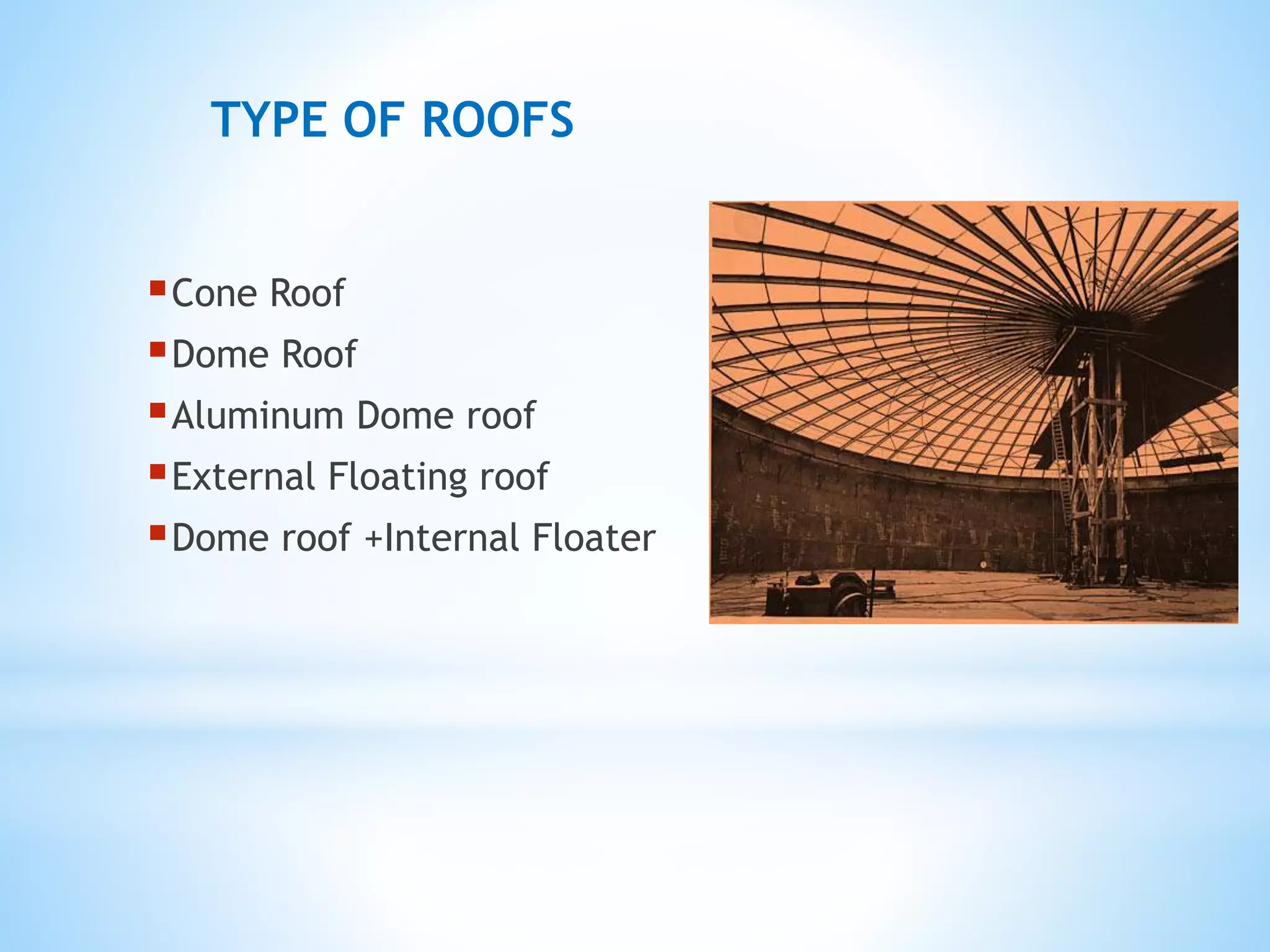
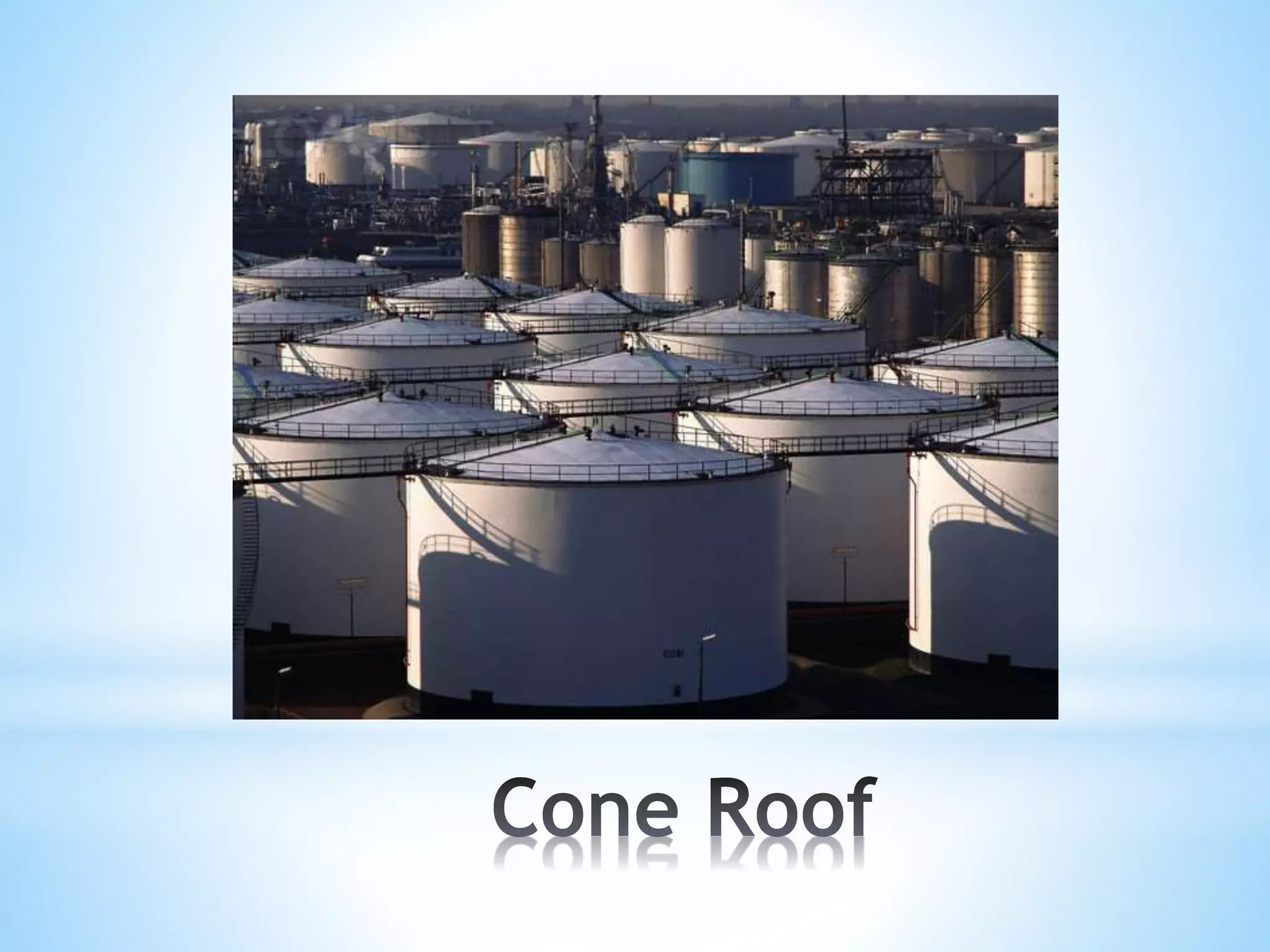
Cone Roof
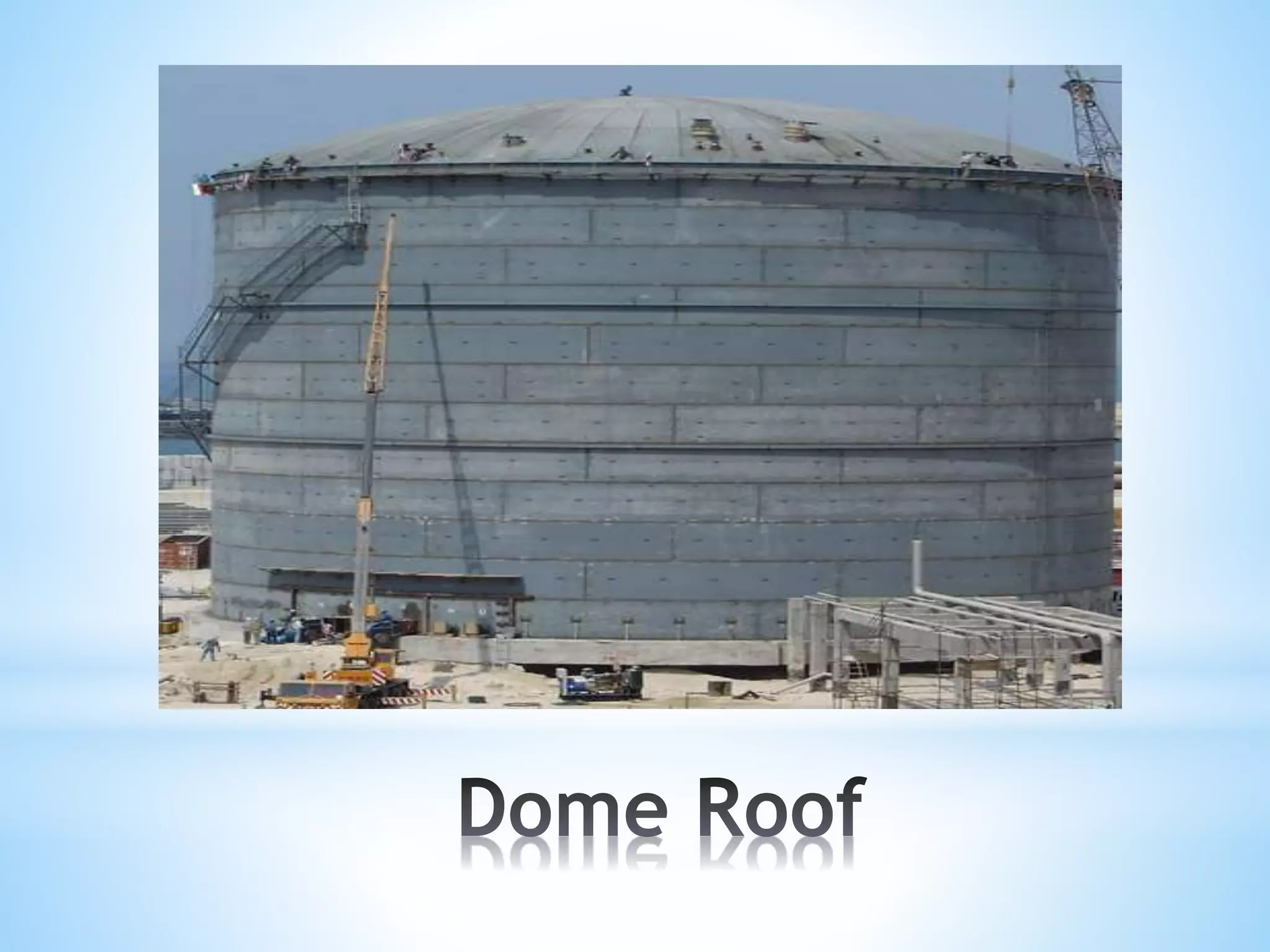
Dome Roof
Aluminum Dome roof
External Floating roof
Dome roof +Internal Floater
TYPE OF ROOFS
IMPORTANT PARAMETERS TO BE CHECKED DURING
CONSTRUCTION :
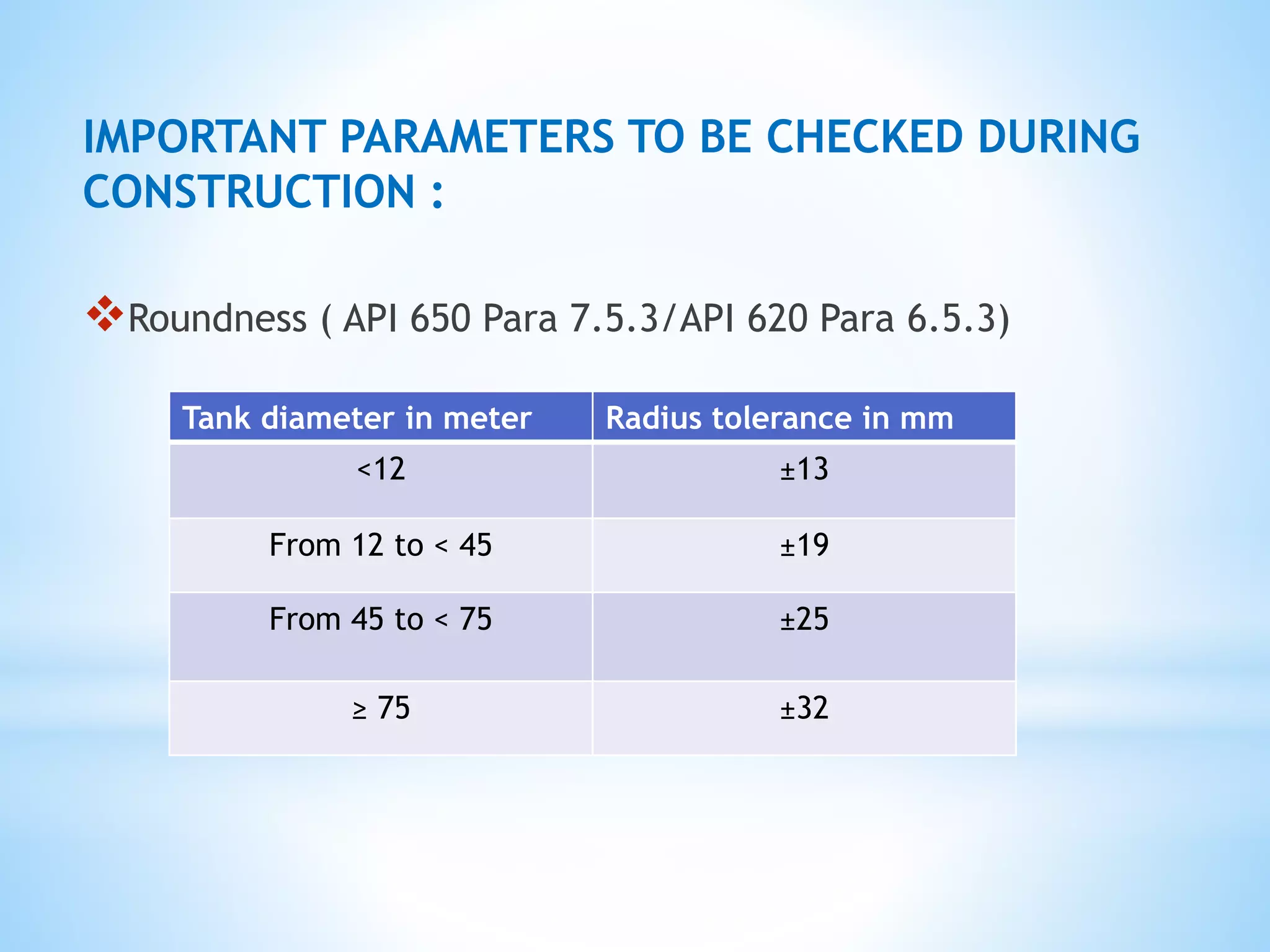
Roundness ( API 650 Para 7.5.3/API 620 Para 6.5.3)
Tank diameter in meter Radius tolerance in mm
<12 ±13
From 12 to < 45 ±19
From 45 to < 75 ±25
≥ 75 ±32
IMPORTANT PARAMETERS TO BE CHECKED DURING
CONSTRUCTION :
Plumbness ( API 650 Para 7.5.2/API 620 Para
6.5.2)
The maximum out-of-Plumbness of the top of the
shell relative to the bottom of the shell shall not
exceed 1/200 of the total tank height.
IMPORTANT PARAMETERS TO BE CHECKED DURING
CONSTRUCTION :
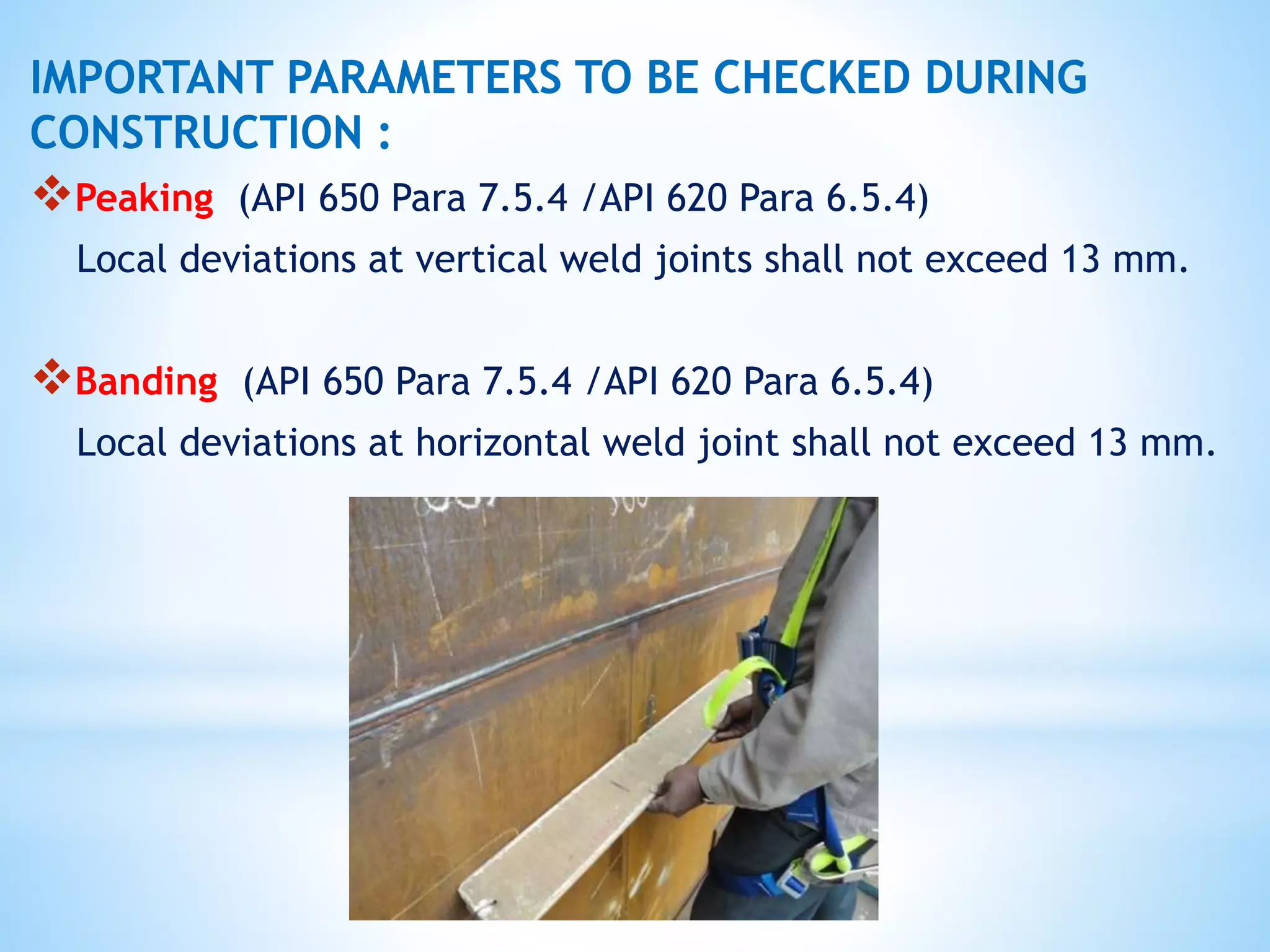
Peaking (API 650 Para 7.5.4 /API 620 Para 6.5.4)
Local deviations at vertical weld joints shall not exceed 13 mm.
Banding (API 650 Para 7.5.4 /API 620 Para 6.5.4)
Local deviations at horizontal weld joint shall not exceed 13 mm.
IMPORTANT PARAMETERS TO BE CHECKED DURING
CONSTRUCTION :
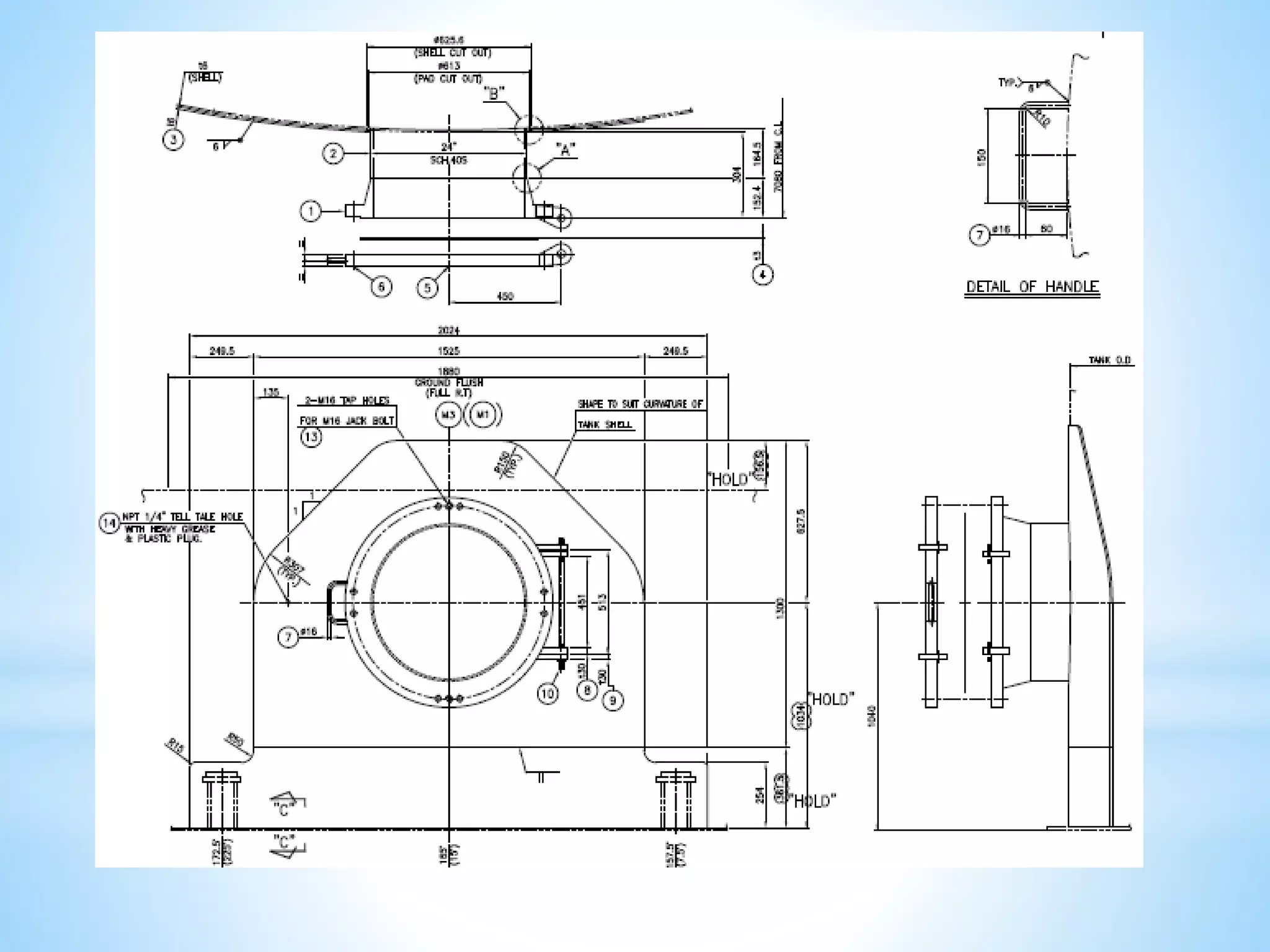
Nozzles & Manhole ( API 650 Para 7.5.6 & 7.5.7)
a. Projection
b. Orientation
c. Elevation
d. Flange tilt
e. Flange bolt hole orientation
RADIOGRAPHIC REQUIRMENTS ( API 650 Sec 8)
RT is required for All shell butt-welds and annular plate
butt-welds
Number and location of radiograph is depends on the plate
thickness.
Radiographic inspection is not required for roof-plate welds,
bottom-plate welds, welds joining the top angle to either
the roof or shell, welds joining the shell plate to the bottom
plate, welds in nozzle and man way necks made from plate
and other external attachments.
OTHER INSPECTION ACTIVITIES :
Weld visual for all welds
Vacuum box test for bottom plate weld
joints
Oil penetrant test for shell to annular
plate joints.
Pneumatic test for all R/F pad
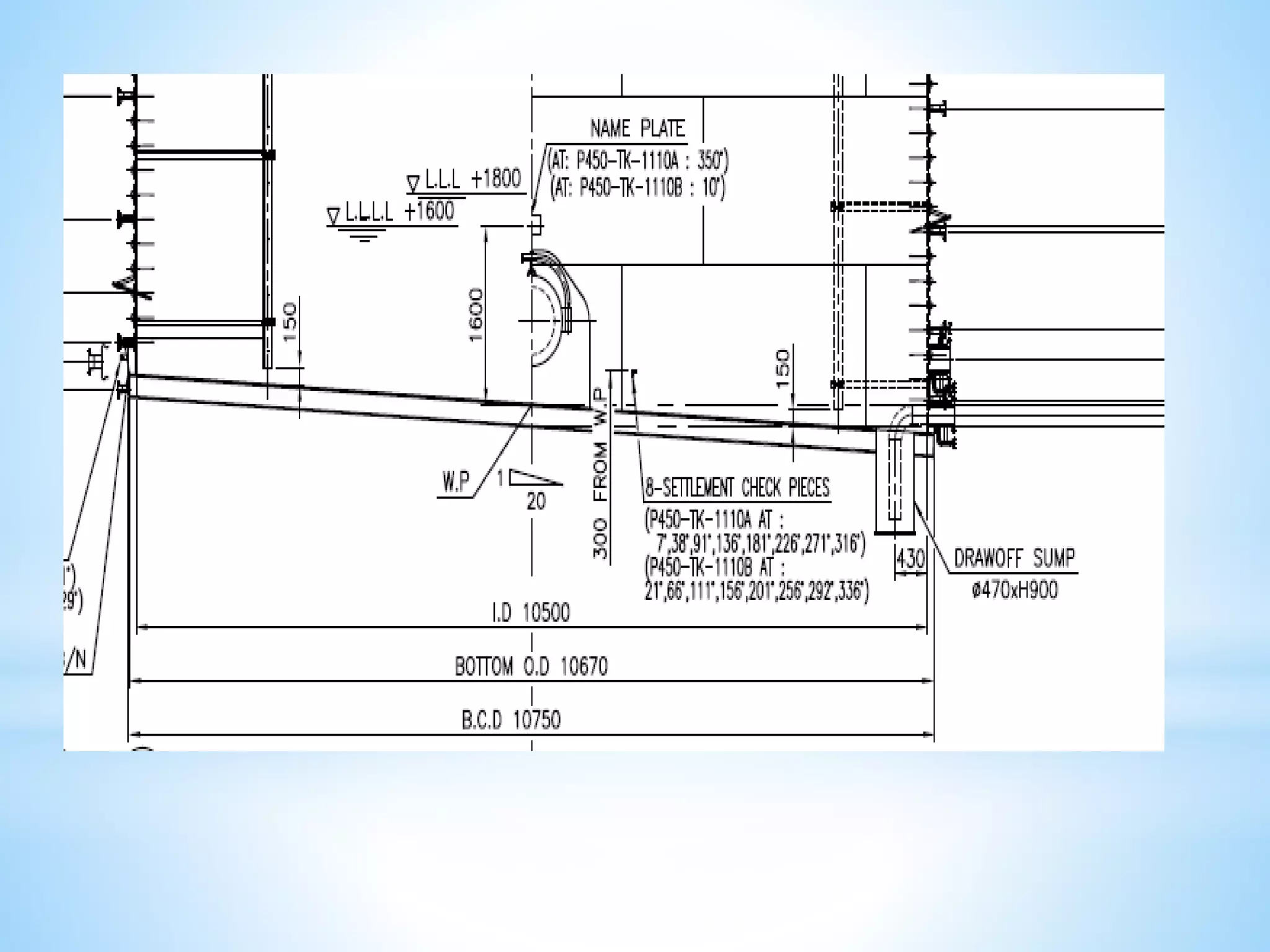
Tank Hydro test ( API 650 Para 7.3.6)
Testing of the Roof
Tank Hydro test :
1. Preparing the tank for testing
2. Filling the water
3. Taking settlement measurements
 Before start of hydrostatic test
 With tank filled to ¼ test height
 With tank filled to ½ test height
 With tank filled to ¾ test height
 At least 24 hours after the tank has been filled to test height.
 After tank has been emptied of test water.
Test Water Quality:
•Potable water is preferred for hydro testing
•Purchaser shall consider the issues acidity, general
corrosion, pitting, low temperature brittle fracture, disposal
and the residual left in the tank after emptying.
•If the purchaser supplied test water causes corrosion, the
purchaser is responsible for the required repairs.
•For carbon steel tank where water contact exceeds 14 days
consider adding an oxygen scavenger and a biocide and raise
the pH by the addition of caustic.
•For stainless steel tanks the chlorine content of the water
shall be below 50 ppm.
Testing of the Roof:
Upon completion the roof of a tank shall be tested by one
of the following method.
•Pneumatic test by applying internal air pressure
not exceeding the weight of the roof plates.
•Vacuum testing the weld joints to detect any
leaks.
*TANK INSTALLATION
PROCEDURE
TANK presentation-2.pptx

TANK presentation-2.pptx

  • 2.
    STORAGE TANKS ( API650 / 620 ) Presented by : Danilo Casacop Static & Tank Inspector CP1 & CP2
  • 3.
    Storage tanks canbe divided into two basic types: API 650 Tanks Covers minimum requirements for material, design, fabrication, erection, and testing for vertical, cylindrical, aboveground, closed and open-top, welded carbon or stainless steel storage tanks in various sizes and capacities for internal pressures approximating atmospheric pressure (internal pressures not exceeding the weight of the roof plates) API 620 Tanks Covers the design and construction of large, welded, low-pressure carbon steel above ground storage tanks with pressures in their gas or vapor spaces not more than 15 psi.
  • 4.
    Cone Roof Dome Roof AluminumDome roof External Floating roof Dome roof +Internal Floater TYPE OF ROOFS
  • 13.
    IMPORTANT PARAMETERS TOBE CHECKED DURING CONSTRUCTION : Roundness ( API 650 Para 7.5.3/API 620 Para 6.5.3) Tank diameter in meter Radius tolerance in mm <12 ±13 From 12 to < 45 ±19 From 45 to < 75 ±25 ≥ 75 ±32
  • 18.
    IMPORTANT PARAMETERS TOBE CHECKED DURING CONSTRUCTION : Plumbness ( API 650 Para 7.5.2/API 620 Para 6.5.2) The maximum out-of-Plumbness of the top of the shell relative to the bottom of the shell shall not exceed 1/200 of the total tank height.
  • 22.
    IMPORTANT PARAMETERS TOBE CHECKED DURING CONSTRUCTION : Peaking (API 650 Para 7.5.4 /API 620 Para 6.5.4) Local deviations at vertical weld joints shall not exceed 13 mm. Banding (API 650 Para 7.5.4 /API 620 Para 6.5.4) Local deviations at horizontal weld joint shall not exceed 13 mm.
  • 24.
    IMPORTANT PARAMETERS TOBE CHECKED DURING CONSTRUCTION : Nozzles & Manhole ( API 650 Para 7.5.6 & 7.5.7) a. Projection b. Orientation c. Elevation d. Flange tilt e. Flange bolt hole orientation
  • 26.
    RADIOGRAPHIC REQUIRMENTS (API 650 Sec 8) RT is required for All shell butt-welds and annular plate butt-welds Number and location of radiograph is depends on the plate thickness. Radiographic inspection is not required for roof-plate welds, bottom-plate welds, welds joining the top angle to either the roof or shell, welds joining the shell plate to the bottom plate, welds in nozzle and man way necks made from plate and other external attachments.
  • 27.
    OTHER INSPECTION ACTIVITIES: Weld visual for all welds Vacuum box test for bottom plate weld joints Oil penetrant test for shell to annular plate joints. Pneumatic test for all R/F pad Tank Hydro test ( API 650 Para 7.3.6) Testing of the Roof
  • 28.
    Tank Hydro test: 1. Preparing the tank for testing 2. Filling the water 3. Taking settlement measurements  Before start of hydrostatic test  With tank filled to ¼ test height  With tank filled to ½ test height  With tank filled to ¾ test height  At least 24 hours after the tank has been filled to test height.  After tank has been emptied of test water.
  • 30.
    Test Water Quality: •Potablewater is preferred for hydro testing •Purchaser shall consider the issues acidity, general corrosion, pitting, low temperature brittle fracture, disposal and the residual left in the tank after emptying. •If the purchaser supplied test water causes corrosion, the purchaser is responsible for the required repairs. •For carbon steel tank where water contact exceeds 14 days consider adding an oxygen scavenger and a biocide and raise the pH by the addition of caustic. •For stainless steel tanks the chlorine content of the water shall be below 50 ppm.
  • 31.
    Testing of theRoof: Upon completion the roof of a tank shall be tested by one of the following method. •Pneumatic test by applying internal air pressure not exceeding the weight of the roof plates. •Vacuum testing the weld joints to detect any leaks.
  • 33.