MECHANICAL DESIGN REQUIREMENTS
Prepared by :
Ayman Ahmed widaa
Feb 2017
1
MECHANICAL DESIGN :
 Mechanical design parameters
 Shell thickness determination
 Wind girder requirements
 Other
2
MECHANICAL DESIGN FACTORS IN STORAGE
TANK:
 Metal temperature
 Pressure
 Specific gravity of the stored liquid
 Corrosion allowance
3
MECHANICAL DESIGN FACTORS IN STORAGE
TANK:
 Metal temperature :
The metal temperature of storage tank
components is determined by the operating
requirements of stored liquid and by the
ambient temperature of the tank location.
4
MECHANICAL DESIGN FACTORS IN STORAGE
TANK:
 Metal temperature :
The mechanical design of storage tank
component must consider both highest and
lowest temperature .
5
MECHANICAL DESIGN FACTORS IN STORAGE
TANK:
 Metal temperature :
Maximum operating temperature is the highest
design metal temperature is the lowest .
( API 650 Appendix L)
6
MECHANICAL DESIGN FACTORS IN STORAGE
TANK:
 Pressure :
 The internal pressure are consider in tank
design codes
 API 650 are used for tank that operate at
internal pressure up to 17 kPa
 The internal pressure are determined by
process engineer .
7
MECHANICAL DESIGN FACTORS IN STORAGE
TANK:
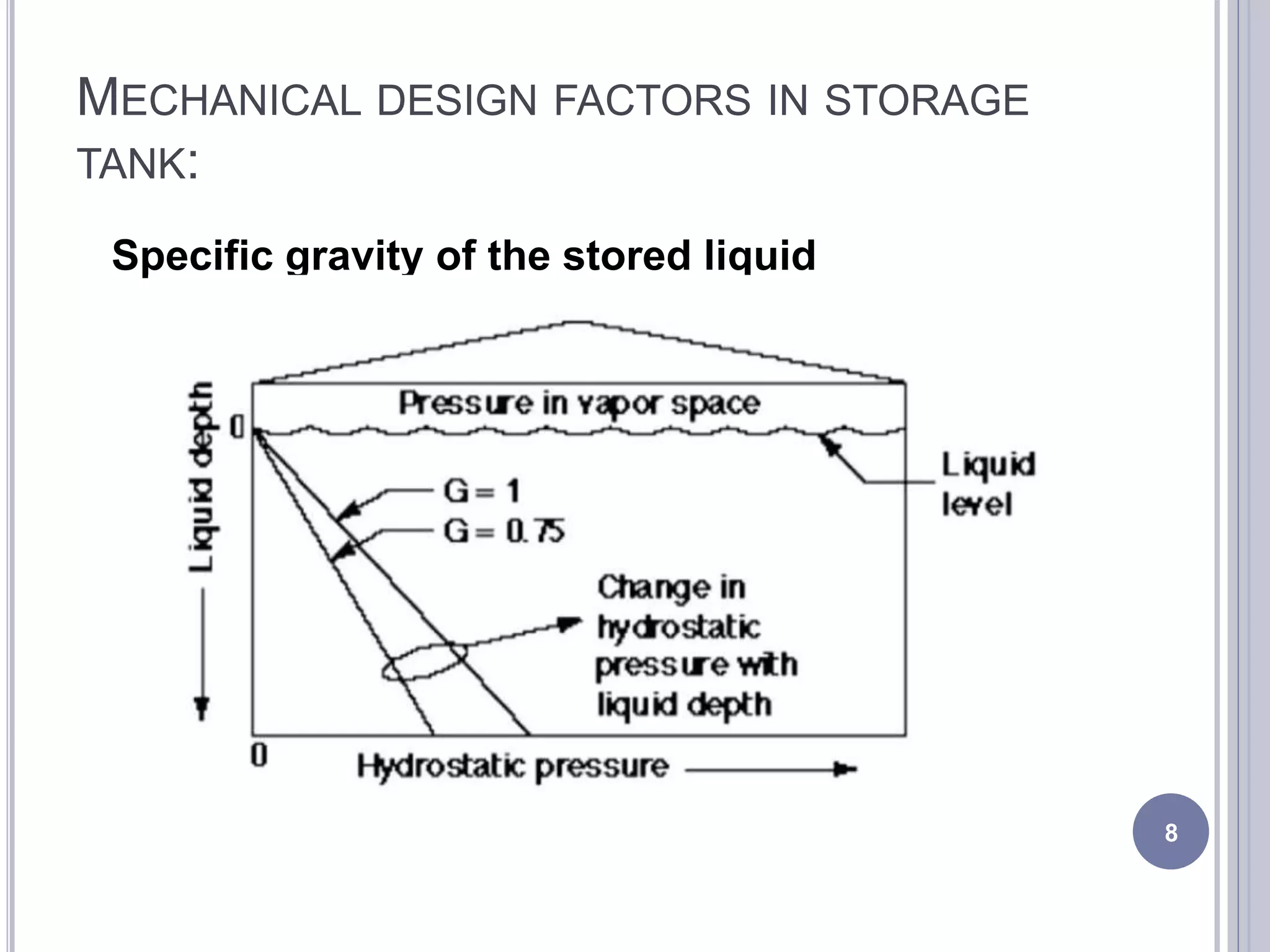
Specific gravity of the stored liquid
8
MECHANICAL DESIGN FACTORS IN STORAGE
TANK:
 Corrosion
allowance
9
MECHANICAL DESIGN
 Stress design and analysis of the storage tank
is the greatest concern to engineer as it
provides the basic for the tank stability and integrity.
10
MECHANICAL DESIGN
The basic stress analyses to be taken care in tank
design are as follow:
 Tank shell wall due to internal and external loading
 Bottom plate/ Tank flooring
 Tank roof – In this case, floating roof
11
12
DESIGN CODES AND STANDARDS
 The design and construction of the storage tanks
are bounded and regulated by various
 codes and standards. List a few here, they are:
 • American Standards API 650 (Welded Steel Tanks
for Oil Storage)
 • British Standards BS 2654 (Manufacture of
Vertical Storage Tanks with Buttwelded
 Shells for the Petroleum Industry
13
DESIGN CODES AND STANDARDS
 • The European Standards
 - German Code Din 4119 – Part 1 and 2 (Above
Ground Cylindrical Flat
 Bottomed Storage Tanks of Metallic Materials)
 - The French Code, Codres – (Code Francais de
construction des reservoirs
 cylindriques verticauz en acier U.C.S.I.P. et
S.N.C.T.)
 • The EEMUA Standards (The Engineering
Equipments and Materials Users
 Association) 14
TANK SHELL DESIGN METHOD AS PER API
650
 Calculation of thickness by 1-Foot Method
 Calculation of thickness by Variable-Design-Point
Method
 Calculation of thickness by Elastic Analysis
15
1-FOOT METHOD
 The 1-foot method calculates the thickness
required at design points 0.3 m (1 ft) above the
bottom of each shell course
 This method is shall not be used for tanks larger
than 60 m in diameter
16
1-FOOT METHOD
 The formula for the minimum required thickness is as
followed:
 For design shell thickness,
17
1-FOOT METHOD
 The formula for the minimum required thickness is as
followed:
 For hydrostatic test shell thickness
18
19
VARIABLE-DESIGN-POINT METHOD
 Design using variable-design-point method gives shell
thickness at design points that in the calculated
stressed being relatively closed to the actual
circumferential shell stress.
20
VARIABLE-DESIGN-POINT METHOD
 This method normally provides a reduction in shell-
course thickness and total material
weight, but more important is its potential to permit
construction of large diameter tanks
within the maximum plate thickness limitation
21
VARIABLE-DESIGN-POINT METHOD
 This method may only be used when 1-foot
method is not specified and when the
 following is true:
22
ELASTIC ANALYSIS
 For tanks where L / H is greater than 1000/6, the
selection of shell thickness shall be based on an
elastic analysis that shows the calculated
circumferential shell stress to be below the allowable
stress.
23
FLOATING ROOF TANKS
 The floating roof is a circular steel structure
provided with a built-in buoyancy which
 allowing it to sit/ float on top of the liquid product in
a close or open top tank.
24
FLOATING ROOF TANKS
 The overall diameter of the roof is normally 400 mm
smaller than the inside diameter of
the tank, which has about 200 mm gap on each side
between the roof and the inside tank
 wall. This is due to the limitation on the accuracy of
dimension during construction for
 the large diameter tank. The gaps allow the floating
roof to rise and fall without binding
 on the tank wall.
25
FLOATING ROOF TANKS
 To protect the product inside the tank from
evaporation to the atmosphere and
 contamination from the rain water through the gaps
between the outer rim of the floating
 roof and the tank wall, the gaps will be closed or
sealed up by mean of flexible sealing
 system.
26
ADVANTAGES OF THE FLOATING ROOF
STORAGE TANK
 As the roof floats directly on the product, there is no
vapour space and thus eliminating
 any possibility of flammable atmosphere. It reduces
evaporation losses and hence
 reduction in air pollution. Vapour emission is only
possible from the rim seal area and
 this would mainly depend on the type of seal
selected and used
27
ADVANTAGES OF THE FLOATING ROOF
STORAGE TANK
 Despite of the advantages of the floating roof, to
design and construct a floating roof tank
 will be much more complicated and costly than the
fixed ones. In term of tank stability
 and design integrity, floating roof tank is never
better than the fixed roof tank as there are
 still many unknown parameters and factors in
designing the floating roof.
28
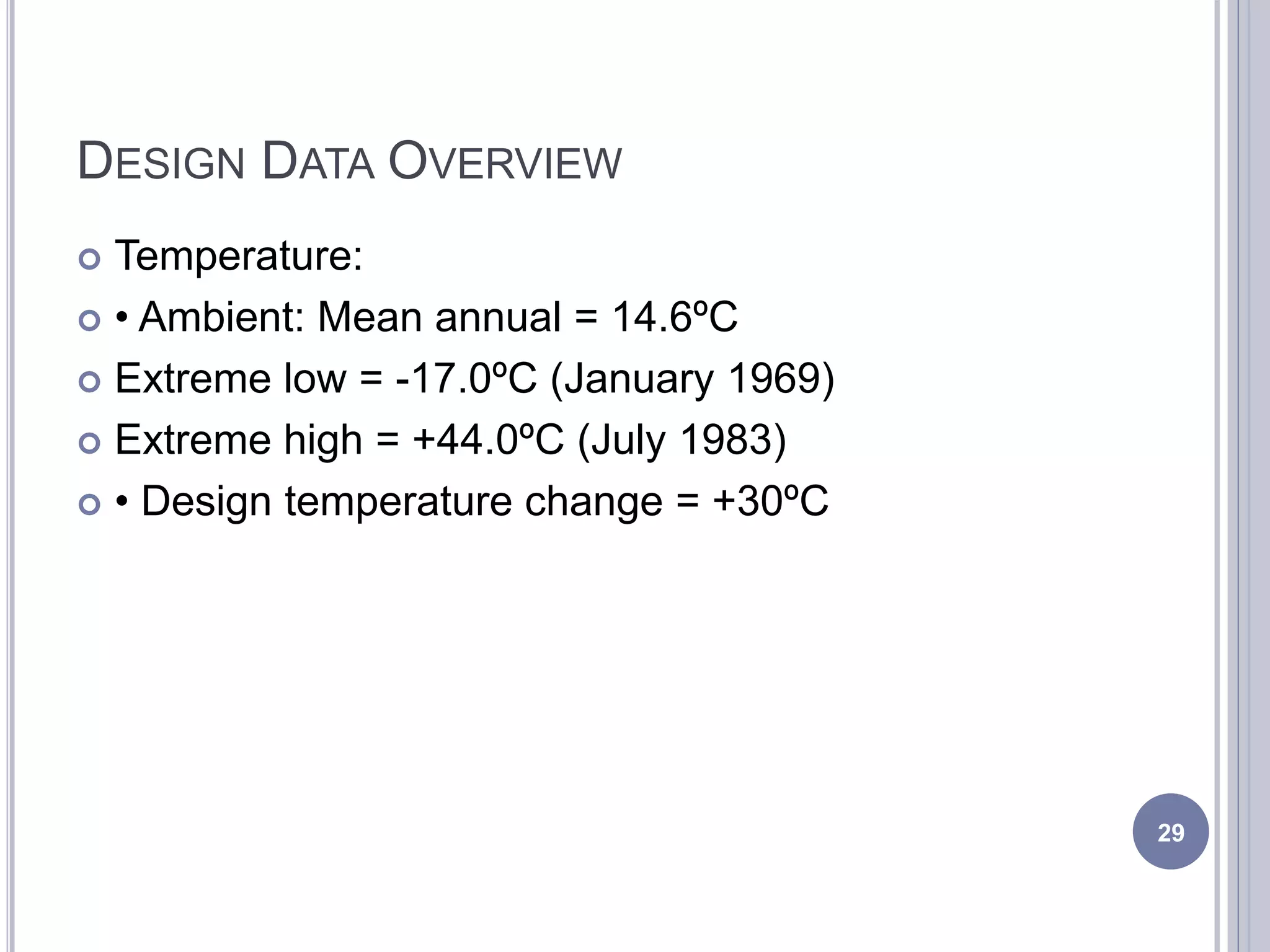
DESIGN DATA OVERVIEW
 Temperature:
 • Ambient: Mean annual = 14.6ºC
 Extreme low = -17.0ºC (January 1969)
 Extreme high = +44.0ºC (July 1983)
 • Design temperature change = +30ºC
29
DESIGN DATA OVERVIEW
 b. Rainfall Intensity:
 Maximum daily rainfall (4th May 1972) : 68 mm
 Maximum rain density once in 100 years : 0.69
mm/min
 Maximum rain density once in 50 years : 0.59
mm/min
 Maximum rain density once in 2 years : 0.3 mm/min
30
DESIGN DATA OVERVIEW
 c. Humidity:
 Summer : 50% at 34ºC
 Winter : 74% at 7ºC
31
DESIGN DATA OVERVIEW
 d. Wind Speed at 10 m above Ground level:
32
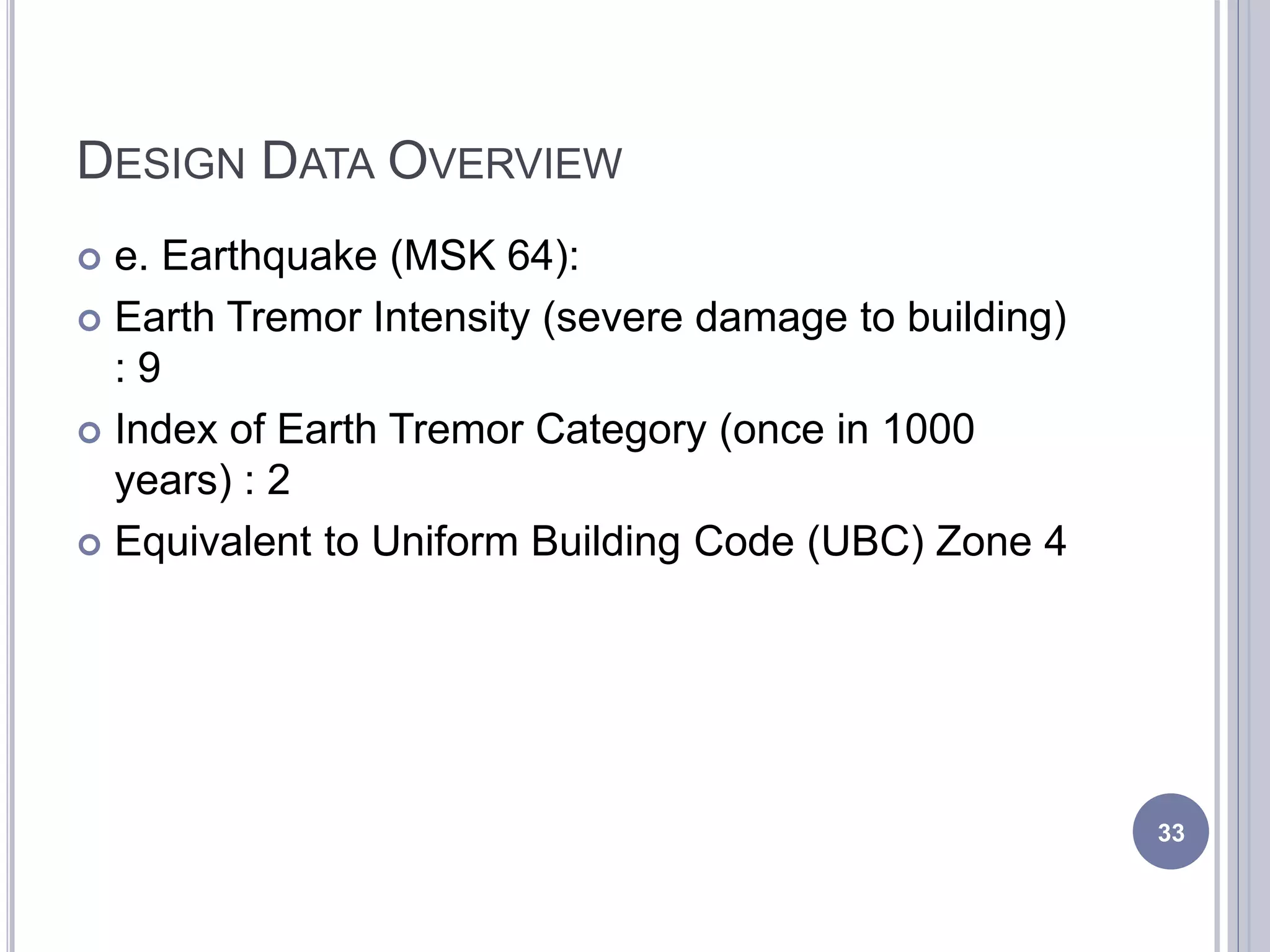
DESIGN DATA OVERVIEW
 e. Earthquake (MSK 64):
 Earth Tremor Intensity (severe damage to building)
: 9
 Index of Earth Tremor Category (once in 1000
years) : 2
 Equivalent to Uniform Building Code (UBC) Zone 4
33
34
35
36

floating tank design

  • 1.
    MECHANICAL DESIGN REQUIREMENTS Preparedby : Ayman Ahmed widaa Feb 2017 1
  • 2.
    MECHANICAL DESIGN : Mechanical design parameters  Shell thickness determination  Wind girder requirements  Other 2
  • 3.
    MECHANICAL DESIGN FACTORSIN STORAGE TANK:  Metal temperature  Pressure  Specific gravity of the stored liquid  Corrosion allowance 3
  • 4.
    MECHANICAL DESIGN FACTORSIN STORAGE TANK:  Metal temperature : The metal temperature of storage tank components is determined by the operating requirements of stored liquid and by the ambient temperature of the tank location. 4
  • 5.
    MECHANICAL DESIGN FACTORSIN STORAGE TANK:  Metal temperature : The mechanical design of storage tank component must consider both highest and lowest temperature . 5
  • 6.
    MECHANICAL DESIGN FACTORSIN STORAGE TANK:  Metal temperature : Maximum operating temperature is the highest design metal temperature is the lowest . ( API 650 Appendix L) 6
  • 7.
    MECHANICAL DESIGN FACTORSIN STORAGE TANK:  Pressure :  The internal pressure are consider in tank design codes  API 650 are used for tank that operate at internal pressure up to 17 kPa  The internal pressure are determined by process engineer . 7
  • 8.
    MECHANICAL DESIGN FACTORSIN STORAGE TANK: Specific gravity of the stored liquid 8
  • 9.
    MECHANICAL DESIGN FACTORSIN STORAGE TANK:  Corrosion allowance 9
  • 10.
    MECHANICAL DESIGN  Stressdesign and analysis of the storage tank is the greatest concern to engineer as it provides the basic for the tank stability and integrity. 10
  • 11.
    MECHANICAL DESIGN The basicstress analyses to be taken care in tank design are as follow:  Tank shell wall due to internal and external loading  Bottom plate/ Tank flooring  Tank roof – In this case, floating roof 11
  • 12.
  • 13.
    DESIGN CODES ANDSTANDARDS  The design and construction of the storage tanks are bounded and regulated by various  codes and standards. List a few here, they are:  • American Standards API 650 (Welded Steel Tanks for Oil Storage)  • British Standards BS 2654 (Manufacture of Vertical Storage Tanks with Buttwelded  Shells for the Petroleum Industry 13
  • 14.
    DESIGN CODES ANDSTANDARDS  • The European Standards  - German Code Din 4119 – Part 1 and 2 (Above Ground Cylindrical Flat  Bottomed Storage Tanks of Metallic Materials)  - The French Code, Codres – (Code Francais de construction des reservoirs  cylindriques verticauz en acier U.C.S.I.P. et S.N.C.T.)  • The EEMUA Standards (The Engineering Equipments and Materials Users  Association) 14
  • 15.
    TANK SHELL DESIGNMETHOD AS PER API 650  Calculation of thickness by 1-Foot Method  Calculation of thickness by Variable-Design-Point Method  Calculation of thickness by Elastic Analysis 15
  • 16.
    1-FOOT METHOD  The1-foot method calculates the thickness required at design points 0.3 m (1 ft) above the bottom of each shell course  This method is shall not be used for tanks larger than 60 m in diameter 16
  • 17.
    1-FOOT METHOD  Theformula for the minimum required thickness is as followed:  For design shell thickness, 17
  • 18.
    1-FOOT METHOD  Theformula for the minimum required thickness is as followed:  For hydrostatic test shell thickness 18
  • 19.
  • 20.
    VARIABLE-DESIGN-POINT METHOD  Designusing variable-design-point method gives shell thickness at design points that in the calculated stressed being relatively closed to the actual circumferential shell stress. 20
  • 21.
    VARIABLE-DESIGN-POINT METHOD  Thismethod normally provides a reduction in shell- course thickness and total material weight, but more important is its potential to permit construction of large diameter tanks within the maximum plate thickness limitation 21
  • 22.
    VARIABLE-DESIGN-POINT METHOD  Thismethod may only be used when 1-foot method is not specified and when the  following is true: 22
  • 23.
    ELASTIC ANALYSIS  Fortanks where L / H is greater than 1000/6, the selection of shell thickness shall be based on an elastic analysis that shows the calculated circumferential shell stress to be below the allowable stress. 23
  • 24.
    FLOATING ROOF TANKS The floating roof is a circular steel structure provided with a built-in buoyancy which  allowing it to sit/ float on top of the liquid product in a close or open top tank. 24
  • 25.
    FLOATING ROOF TANKS The overall diameter of the roof is normally 400 mm smaller than the inside diameter of the tank, which has about 200 mm gap on each side between the roof and the inside tank  wall. This is due to the limitation on the accuracy of dimension during construction for  the large diameter tank. The gaps allow the floating roof to rise and fall without binding  on the tank wall. 25
  • 26.
    FLOATING ROOF TANKS To protect the product inside the tank from evaporation to the atmosphere and  contamination from the rain water through the gaps between the outer rim of the floating  roof and the tank wall, the gaps will be closed or sealed up by mean of flexible sealing  system. 26
  • 27.
    ADVANTAGES OF THEFLOATING ROOF STORAGE TANK  As the roof floats directly on the product, there is no vapour space and thus eliminating  any possibility of flammable atmosphere. It reduces evaporation losses and hence  reduction in air pollution. Vapour emission is only possible from the rim seal area and  this would mainly depend on the type of seal selected and used 27
  • 28.
    ADVANTAGES OF THEFLOATING ROOF STORAGE TANK  Despite of the advantages of the floating roof, to design and construct a floating roof tank  will be much more complicated and costly than the fixed ones. In term of tank stability  and design integrity, floating roof tank is never better than the fixed roof tank as there are  still many unknown parameters and factors in designing the floating roof. 28
  • 29.
    DESIGN DATA OVERVIEW Temperature:  • Ambient: Mean annual = 14.6ºC  Extreme low = -17.0ºC (January 1969)  Extreme high = +44.0ºC (July 1983)  • Design temperature change = +30ºC 29
  • 30.
    DESIGN DATA OVERVIEW b. Rainfall Intensity:  Maximum daily rainfall (4th May 1972) : 68 mm  Maximum rain density once in 100 years : 0.69 mm/min  Maximum rain density once in 50 years : 0.59 mm/min  Maximum rain density once in 2 years : 0.3 mm/min 30
  • 31.
    DESIGN DATA OVERVIEW c. Humidity:  Summer : 50% at 34ºC  Winter : 74% at 7ºC 31
  • 32.
    DESIGN DATA OVERVIEW d. Wind Speed at 10 m above Ground level: 32
  • 33.
    DESIGN DATA OVERVIEW e. Earthquake (MSK 64):  Earth Tremor Intensity (severe damage to building) : 9  Index of Earth Tremor Category (once in 1000 years) : 2  Equivalent to Uniform Building Code (UBC) Zone 4 33
  • 34.
  • 35.
  • 36.

Editor's Notes

  • #13 shows an example of tank exploding due to vacuum loading