Typha for biorefinery
                                                             Yakindra Prasad Timilsena
                          Food Research Officer, Department of Food Technology and Quality Control, Kathmandu
                                                       Email: yakendra.timilsena@gmail.com

                                Abstract                                                                          Objective
    Typha grass is an invasive and obnoxious wetland herbaceous plant with        The overall objective is to explore the potentiality of
    the annual productivity of more than 50 ton dry matter per hectare. It        Typha capensis as feedstock for biorefinery. Specifically-
    has been used in the treatment of various diseases since ancient times.
    Compositional analysis demonstrated approximately 80% sugars and              • To determine the EOL yield and Klason lignin content of
    very low lignin content (<20%) in dry biomass basis underpinning its
                                                                                    the pulp after two step pretreatment
    potential use as food and for conversion processes. It has also been
    marked for its good anti microbial properties. Strong capacity of typha       • To compare the enzymatic hydrolysis yield of sugars
    for removing contaminants such as heavy metals and inorganic nutrients        • To characterize typha lignin
    from waste waters established it as a promising aquatic macrophyte for
    phytoremediation. 13C NMR analysis of typha lignin revealed significantly
    higher S/G ratio (55:15) suggesting its easier delignification and better
                                                                                                       Results and discussion
    pulp yield during pretreatment process. Enzymatic hydrolysis, in
    addition, demonstrated efficient cellulose to glucose conversion
    alleviating downstream processing to food, chemical or fuel. In addition
    to its plenteous availability, high biomass productivity, easier
    delignification and enzymatic hydrolysability Typha deserves a promising
    biomass feedstock for tropical food, environment, medicine or
    biorefining sector.

                            Methodology
    Layout of 2-step pretreatment and enzymatic hydrolysis


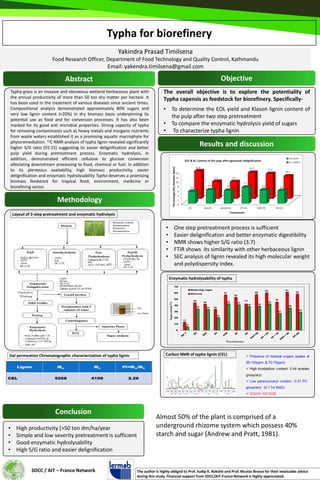
                                                                                   •     One step pretreatment process is sufficient
                                                                                   •     Easier delignification and better enzymatic digestibility
                                                                                   •     NMR shows higher S/G ratio (3.7)
                                                                                   •     FTIR shows its similarity with other herbaceous lignin
                                                                                   •     SEC analysis of lignin revealed its high molecular weight
                                                                                         and polydispersity index.

                                                                                       Enzymatic hydrolysability of typha


Gel permeation Chromatographic characterization of typha lignin                    Carbon NMR of typha lignin (CEL)


                           Conclusion
                                                                                Almost 50% of the plant is comprised of a
•      High productivity (>50 ton dm/ha/year                                    underground rhizome system which possess 40%
•      Simple and low severity pretreatment is sufficient                       starch and sugar (Andrew and Pratt, 1981).
•      Good enzymatic hydrolysability
•      High S/G ratio and easier delignification

Typha capensis

  • 1.
    Typha for biorefinery Yakindra Prasad Timilsena Food Research Officer, Department of Food Technology and Quality Control, Kathmandu Email: yakendra.timilsena@gmail.com Abstract Objective Typha grass is an invasive and obnoxious wetland herbaceous plant with The overall objective is to explore the potentiality of the annual productivity of more than 50 ton dry matter per hectare. It Typha capensis as feedstock for biorefinery. Specifically- has been used in the treatment of various diseases since ancient times. Compositional analysis demonstrated approximately 80% sugars and • To determine the EOL yield and Klason lignin content of very low lignin content (<20%) in dry biomass basis underpinning its the pulp after two step pretreatment potential use as food and for conversion processes. It has also been marked for its good anti microbial properties. Strong capacity of typha • To compare the enzymatic hydrolysis yield of sugars for removing contaminants such as heavy metals and inorganic nutrients • To characterize typha lignin from waste waters established it as a promising aquatic macrophyte for phytoremediation. 13C NMR analysis of typha lignin revealed significantly higher S/G ratio (55:15) suggesting its easier delignification and better Results and discussion pulp yield during pretreatment process. Enzymatic hydrolysis, in addition, demonstrated efficient cellulose to glucose conversion alleviating downstream processing to food, chemical or fuel. In addition to its plenteous availability, high biomass productivity, easier delignification and enzymatic hydrolysability Typha deserves a promising biomass feedstock for tropical food, environment, medicine or biorefining sector. Methodology Layout of 2-step pretreatment and enzymatic hydrolysis • One step pretreatment process is sufficient • Easier delignification and better enzymatic digestibility • NMR shows higher S/G ratio (3.7) • FTIR shows its similarity with other herbaceous lignin • SEC analysis of lignin revealed its high molecular weight and polydispersity index. Enzymatic hydrolysability of typha Gel permeation Chromatographic characterization of typha lignin Carbon NMR of typha lignin (CEL) Conclusion Almost 50% of the plant is comprised of a • High productivity (>50 ton dm/ha/year underground rhizome system which possess 40% • Simple and low severity pretreatment is sufficient starch and sugar (Andrew and Pratt, 1981). • Good enzymatic hydrolysability • High S/G ratio and easier delignification