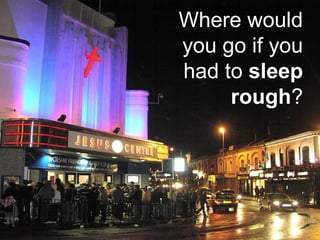
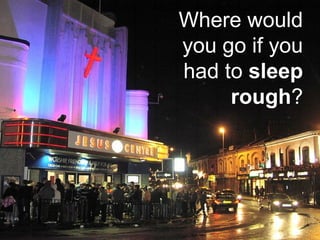
Where would
you go if you
had to sleep
rough?
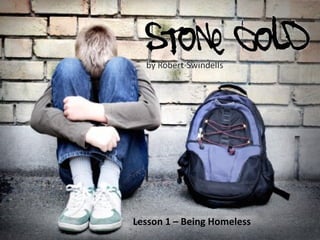
Lesson 1 – Being Homeless
What do you know
about homeless
people?
By the end of the lesson...
ALL of you will be able to understand of the
difference between fact and opinion.
MOST of you will be able to predict and
speculate ideas from the front cover and the
blurb. RAF 1
SOME of you will be able to use appropriate
vocabulary and layout when creating a charity
leaflet. WAF 7
What is the difference between
fact and opinion?
What is a fact?
A fact is something that can be verified and backed up with
evidence, e.g. In 2005, Brazil and FC Barcelona star Ronaldinho
was named FIFA World Footballer of The Year. We can verify
these details by looking at FIFA records.
What is an opinion?
An opinion is based on a belief or view. It is not based on
evidence that can be verified, e.g. Wayne Rooney is the best
football player in the English Premier League. Are there players
in the English Premier League who are better than Wayne
Rooney?
Read the following
statements. If you think the
statement is a fact, you
need to stand up. If you
think the words on the screen
are an opinion, you need
to sit down.
West Ham United are the
greatest British football
team ever.
opinion
Mr Sedani thinks West
Ham United are the
greatest British football
team ever.
fact
Thomas Becket Catholic
School is in Northampton.
fact
Thomas Becket Catholic
School has over a
thousand students.
fact
All homeless people
are old.
opinion
Over 1 million people in
the UK live in slum-like
conditions.
fact
According to government
statistics, rough sleepers
are 4 times more likely to
be murdered than the
general public.
fact
25% of homeless people
have served in the armed
forces.
fact
fact
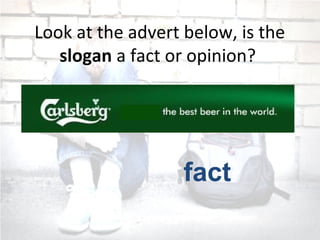
Look at the advert below, is the
slogan a fact or opinion?
opinion
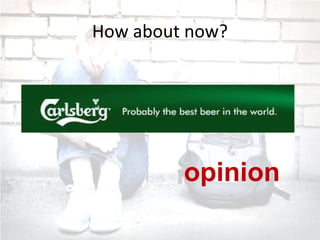
How about now?
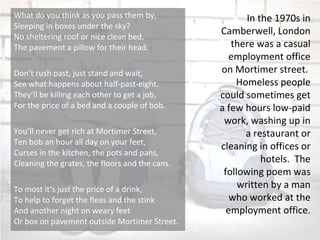
What do you think as you pass them by,
Sleeping in boxes under the sky?
No sheltering roof or nice clean bed,
The pavement a pillow for their head.
Don’t rush past, just stand and wait,
See what happens about half-past-eight.
They’ll be killing each other to get a job,
For the price of a bed and a couple of bob.
You’ll never get rich at Mortimer Street,
Ten bob an hour all day on your feet,
Curses in the kitchen, the pots and pans,
Cleaning the grates, the floors and the cans.
To most it’s just the price of a drink,
To help to forget the fleas and the stink
And another night on weary feet
Or box on pavement outside Mortimer Street.
In the 1970s in
Camberwell, London
there was a casual
employment office
on Mortimer street.
Homeless people
could sometimes get
a few hours low-paid
work, washing up in
a restaurant or
cleaning in offices or
hotels. The
following poem was
written by a man
who worked at the
employment office.
Why do people become homeless?
In pairs, discuss your ideas and create a small
brainstorm of several ideas.
Why do people
become homeless?
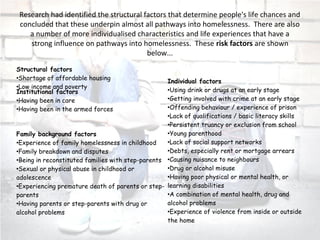
Research had identified the structural factors that determine people's life chances and
concluded that these underpin almost all pathways into homelessness. There are also
a number of more individualised characteristics and life experiences that have a
strong influence on pathways into homelessness. These risk factors are shown
below...
Structural factors
•Shortage of affordable housing
•Low income and poverty
Individual factors
•Using drink or drugs at an early stage
•Getting involved with crime at an early stage
•Offending behaviour / experience of prison
•Lack of qualifications / basic literacy skills
•Persistent truancy or exclusion from school
•Young parenthood
•Lack of social support networks
•Debts, especially rent or mortgage arrears
•Causing nuisance to neighbours
•Drug or alcohol misuse
•Having poor physical or mental health, or
learning disabilities
•A combination of mental health, drug and
alcohol problems
•Experience of violence from inside or outside
the home
Institutional factors
•Having been in care
•Having been in the armed forces
Family background factors
•Experience of family homelessness in childhood
•Family breakdown and disputes
•Being in reconstituted families with step-parents
•Sexual or physical abuse in childhood or
adolescence
•Experiencing premature death of parents or step-
parents
•Having parents or step-parents with drug or
alcohol problems
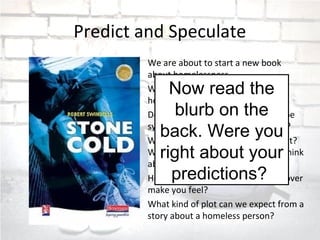
Predict and Speculate
We are about to start a new book
about homelessness.
What are your views about the
homeless?
Do you think the writer is going to be
sympathetic towards the homeless?
What do you think the story is about?
What does ‘Stone Cold’ make you think
about?
How does the image on the front cover
make you feel?
What kind of plot can we expect from a
story about a homeless person?
Now read the
blurb on the
back. Were you
right about your
predictions?
What’s in a name?
• Jonathan Strange
• Professor Snape
• Sauron
• Eeyore
• Mercutio
• Miss Trunchbull
• Lady Dedlock
• Do the names
give you any clue
about what the
character might
be like? How?
Give it a try
In pairs, choose ‘suitable’ names that reflect
each of these characters:
 A ‘mad’ scientist
 A young girl who lives in a ruined castle
 A boy detective
 A school-girl genius
 A young and glamorous male vampire
 An old woman who uses a variety of
disguises to pretend to be someone else
What about these names?
LINK
SHELTER
What do you think they might be like?
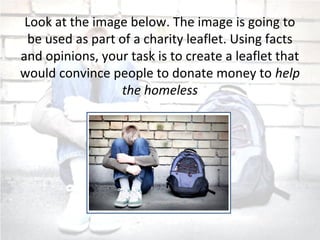
Look at the image below. The image is going to
be used as part of a charity leaflet. Using facts
and opinions, your task is to create a leaflet that
would convince people to donate money to help
the homeless
Now swap books...
Read another students work and identify two
sentences that are facts and two others that
are opinions. Write them down in your book.
For example
‘One in four people who served in the army
end up homeless at some point’ – FACT
‘We must help these people today’ - OPINION
What have you learned?
Are you able to understand of the difference
between fact and opinion?
Are you able to predict and speculate ideas
from the front cover and the blurb? RAF 1
Are you able to use appropriate vocabulary
and layout when creating a charity leaflet?
WAF 7
Where would
you go if you
had to sleep
rough?

Stone Cold Lesson 1 - Being Homeless

  • 1.
    Where would you goif you had to sleep rough?
  • 2.
    Lesson 1 –Being Homeless
  • 3.
    What do youknow about homeless people?
  • 4.
    By the endof the lesson... ALL of you will be able to understand of the difference between fact and opinion. MOST of you will be able to predict and speculate ideas from the front cover and the blurb. RAF 1 SOME of you will be able to use appropriate vocabulary and layout when creating a charity leaflet. WAF 7
  • 5.
    What is thedifference between fact and opinion? What is a fact? A fact is something that can be verified and backed up with evidence, e.g. In 2005, Brazil and FC Barcelona star Ronaldinho was named FIFA World Footballer of The Year. We can verify these details by looking at FIFA records. What is an opinion? An opinion is based on a belief or view. It is not based on evidence that can be verified, e.g. Wayne Rooney is the best football player in the English Premier League. Are there players in the English Premier League who are better than Wayne Rooney?
  • 6.
    Read the following statements.If you think the statement is a fact, you need to stand up. If you think the words on the screen are an opinion, you need to sit down.
  • 7.
    West Ham Unitedare the greatest British football team ever. opinion
  • 8.
    Mr Sedani thinksWest Ham United are the greatest British football team ever. fact
  • 9.
    Thomas Becket Catholic Schoolis in Northampton. fact
  • 10.
    Thomas Becket Catholic Schoolhas over a thousand students. fact
  • 11.
  • 12.
    Over 1 millionpeople in the UK live in slum-like conditions. fact
  • 13.
    According to government statistics,rough sleepers are 4 times more likely to be murdered than the general public. fact
  • 14.
    25% of homelesspeople have served in the armed forces. fact
  • 15.
    fact Look at theadvert below, is the slogan a fact or opinion?
  • 16.
  • 17.
    What do youthink as you pass them by, Sleeping in boxes under the sky? No sheltering roof or nice clean bed, The pavement a pillow for their head. Don’t rush past, just stand and wait, See what happens about half-past-eight. They’ll be killing each other to get a job, For the price of a bed and a couple of bob. You’ll never get rich at Mortimer Street, Ten bob an hour all day on your feet, Curses in the kitchen, the pots and pans, Cleaning the grates, the floors and the cans. To most it’s just the price of a drink, To help to forget the fleas and the stink And another night on weary feet Or box on pavement outside Mortimer Street. In the 1970s in Camberwell, London there was a casual employment office on Mortimer street. Homeless people could sometimes get a few hours low-paid work, washing up in a restaurant or cleaning in offices or hotels. The following poem was written by a man who worked at the employment office.
  • 18.
    Why do peoplebecome homeless? In pairs, discuss your ideas and create a small brainstorm of several ideas. Why do people become homeless?
  • 19.
    Research had identifiedthe structural factors that determine people's life chances and concluded that these underpin almost all pathways into homelessness. There are also a number of more individualised characteristics and life experiences that have a strong influence on pathways into homelessness. These risk factors are shown below... Structural factors •Shortage of affordable housing •Low income and poverty Individual factors •Using drink or drugs at an early stage •Getting involved with crime at an early stage •Offending behaviour / experience of prison •Lack of qualifications / basic literacy skills •Persistent truancy or exclusion from school •Young parenthood •Lack of social support networks •Debts, especially rent or mortgage arrears •Causing nuisance to neighbours •Drug or alcohol misuse •Having poor physical or mental health, or learning disabilities •A combination of mental health, drug and alcohol problems •Experience of violence from inside or outside the home Institutional factors •Having been in care •Having been in the armed forces Family background factors •Experience of family homelessness in childhood •Family breakdown and disputes •Being in reconstituted families with step-parents •Sexual or physical abuse in childhood or adolescence •Experiencing premature death of parents or step- parents •Having parents or step-parents with drug or alcohol problems
  • 20.
    Predict and Speculate Weare about to start a new book about homelessness. What are your views about the homeless? Do you think the writer is going to be sympathetic towards the homeless? What do you think the story is about? What does ‘Stone Cold’ make you think about? How does the image on the front cover make you feel? What kind of plot can we expect from a story about a homeless person? Now read the blurb on the back. Were you right about your predictions?
  • 21.
    What’s in aname? • Jonathan Strange • Professor Snape • Sauron • Eeyore • Mercutio • Miss Trunchbull • Lady Dedlock • Do the names give you any clue about what the character might be like? How?
  • 22.
    Give it atry In pairs, choose ‘suitable’ names that reflect each of these characters:  A ‘mad’ scientist  A young girl who lives in a ruined castle  A boy detective  A school-girl genius  A young and glamorous male vampire  An old woman who uses a variety of disguises to pretend to be someone else
  • 23.
    What about thesenames? LINK SHELTER What do you think they might be like?
  • 24.
    Look at theimage below. The image is going to be used as part of a charity leaflet. Using facts and opinions, your task is to create a leaflet that would convince people to donate money to help the homeless
  • 25.
    Now swap books... Readanother students work and identify two sentences that are facts and two others that are opinions. Write them down in your book. For example ‘One in four people who served in the army end up homeless at some point’ – FACT ‘We must help these people today’ - OPINION
  • 26.
    What have youlearned? Are you able to understand of the difference between fact and opinion? Are you able to predict and speculate ideas from the front cover and the blurb? RAF 1 Are you able to use appropriate vocabulary and layout when creating a charity leaflet? WAF 7
  • 27.
    Where would you goif you had to sleep rough?